
eorge William Horner (1849-1930) is a bright light in the field of Coptic textual criticism. His two most notable contributions are:
- The Coptic version of the New Testament in the northern dialect, otherwise called Memphitic and Bohairic (apparently published by Horner from 1898-1905); and
- The Coptic version of the New Testament in the Southern dialect : otherwise called Sahidic and Thebaic ; with critical apparatus, literal English translation, register of fragments and estimate of the version (apparently published by Horner from 1911-24)
The Coptic translations have the benefit of being presumed to have been made directly from the Greek (and at a very early century), often including what appear (to me) to be Greek loan words and using an alphabet derived from the Greek alphabet.
Unfortunately for us, there are always limitations in the use of translations. Even if we literally back-translate using formal equivalency principles, we are not guaranteed that the original translator was using those same principles.
Bohairic
The Bohairic version is in the "northern" dialect of what is today Egypt, and is associated with the area near Memphis (Egypt, not Tennessee) (I sometimes see "Bohairic" spelled as "Boharic," but it seems that former is the correct spelling).- (Volume 1: Matthew and Mark)
- (Volume 2: Luke and John)(lower quality version)
- (Volume 3: Paul's Epistles)(possible second link)
- (Volume 4: Catholic Epistles, Acts of the Apostles, and Apocalypse - lower quality)
- (Someone combined vols. 1-4 here)
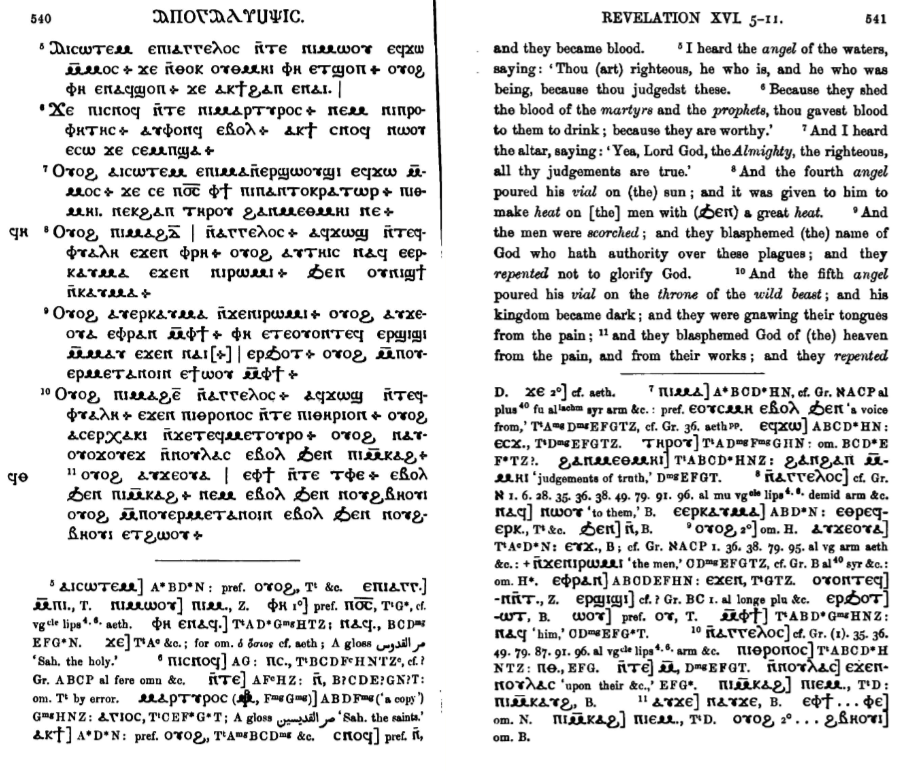


The Arabic gloss "مر القدوس" (mar al-Quddūs) apparently means "Sahidic, The Holy One". The Arabic word (based on machines) seems to mean "passed," but I understand that weakness of computer-based translation.
It is difficult to know whether the Coptic Boharic should be viewed as a witness to a Vorlage that lacked hosios, or whether the translator combined "righteous and holy" to just "righteous" in his translation. Even assuming that it suggests an original without hosios, it does not suggest the substitution proposed by Beza, as there is no "shall being one" in the Coptic.
Sahidic
The Sahidic version is in the "southern" dialect of what is today Egypt, and is associated with the area near Thebes (Egypt).(Volume 5: Paul's Epistles Continued)
(Volume 6: Acts of the Apostles)
(Volume 7: Catholic Epistles and Apocalypse)
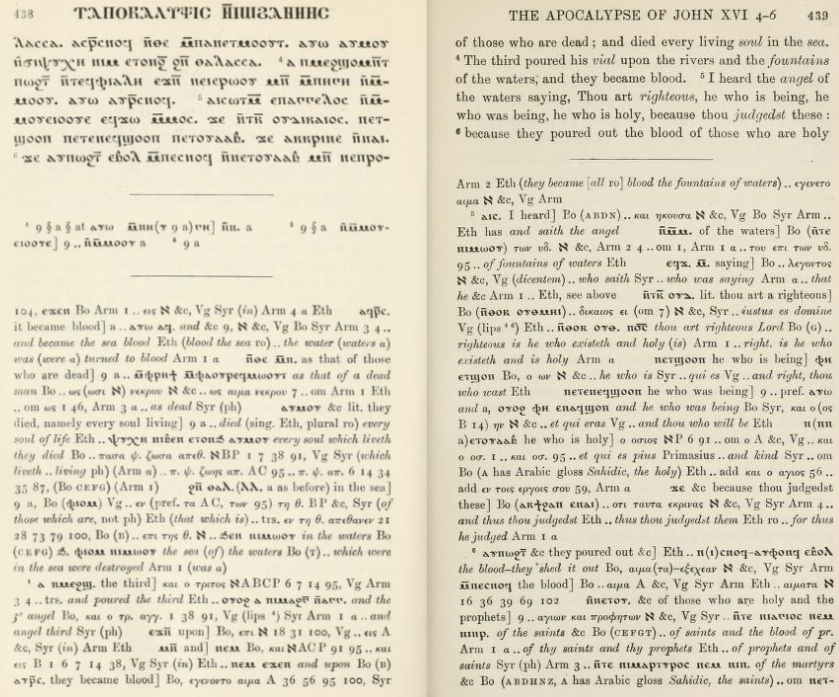



It is difficult to know whether the Coptic Sahidic should be viewed as a witness to a Vorlage that lacked dikaios, or whether the translator combined "righteous and holy" to just "holy" in his translation. I should point out that it is interesting that one of the two Coptic branches seem to have dropped one word as redundant, and the other dropped the other word as redundant.
For our purposes, this version seems to favor the majority Greek reading here, and utterly fails to support Beza's substitution.


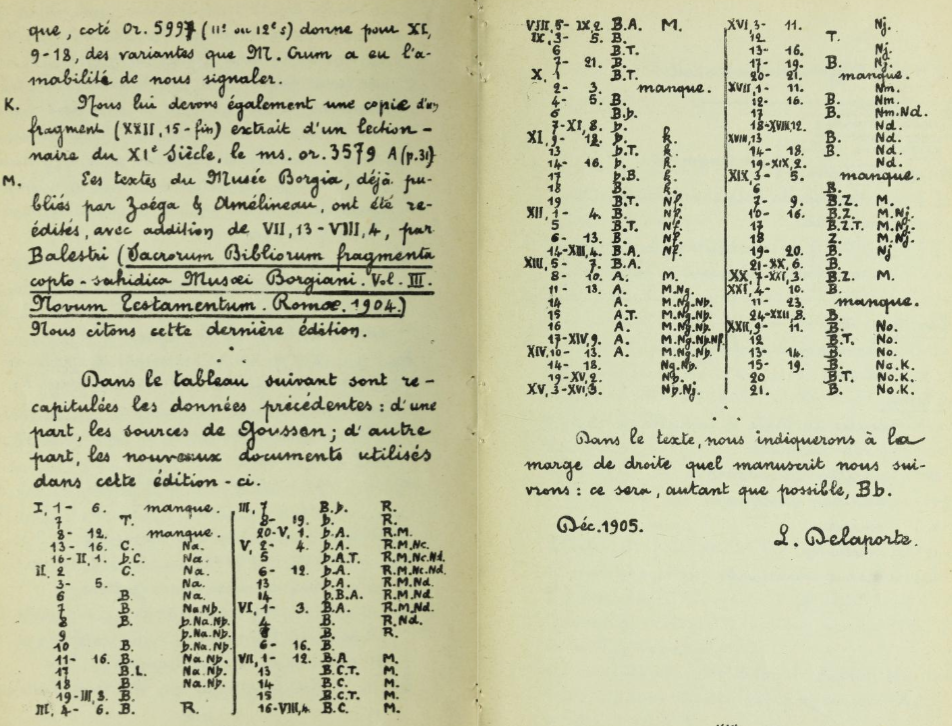

This version seems to have an identical text of Revelation 16:5 to Horner's, except that "akrine" in Delaporte's version is "akkrine" in Horner's version.
Both versions seem to have ⲟⲩⲇⲓⲕⲁⲓⲟⲥ, which (on its face) appears to be a cognate word for the Greek word δίκαιος (dikaios), "righteous."
Middle Egyptian & Nubian
There are also "Middle Egypt" Biblical manuscripts, but very few, and only of Matthew, Acts, and John.
Likewise, there are Paleo-Nubian manuscripts, even some including parts of Revelation, but none of Revelation 16:5 (at least according to this work).
Crum


You will notice the overlap at 157a for both words:

Azevedo
Joaquim Azevedo's "A Simplified Coptic Dictionary (Sahidic dialect)" has an entry with what appears to be a Coptic cognate of hosios:
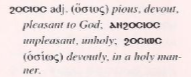
As well as a Coptic cognate of dikaios:

Conclusion
The Coptic broadly supports the majority Greek text and is inconsistent with Beza's emendation of the text. However, the Coptic falls short of specifically and strongly demonstrating precisely the text of Revelation 16:5 as it is found in the Greek manuscripts. So, for example, none of the Coptic evidence could be used to settle the variant readings found in the Greek manuscripts.
No comments:
Post a Comment
Comment Guidelines:
1. Thanks for posting a comment. Without you, this blog would not be interactive.
2. Please be polite. That doesn't mean you have to use kid gloves, but please try not to flame others, even if they are heretics, infidels, or worse.
3. If you insult me, I'm more likely to delete your comment than if you butter me up. After all, I'm human. I prefer praise to insults. If you prefer insults, there's something wrong with you.
4. Please be concise. The comment box is not your blog. Your blog is your blog. If you have a really long comment, post it on your blog and post a short summary of it here.
5. Please don't just spam. It's one thing to be concise, it's another thing to simply use the comment box to advertise.
6. Please note, by commenting here, you are relinquishing your (C) in your comments to me.
7. Remember that you will give an account on judgment day for your words, including those typed in comment boxes. Try to write so you will not be ashamed if it is read back before the entire world.
8. Stay on topic. If your comment has nothing to do with the post, email it to me (my email can be obtained through my blogger profile), or simply don't post it.
9. Don't post as "Anonymous." If you are going to post anonymously, at least use some kind of recognizable "handle," so we can tell you apart from all the other anonymous folks. (This is moot at the moment, since recent abuse has forced me to turn off "anonymous" commenting.)
10. Do unto others as you would have them do unto you; and abstain from doing to others what you would not wish upon yourself.