Monday, February 17, 2025

Reading of Revelation 16:5 in Dutch Bibles

From what I can see, it seems that the Dutch Bible developed along a branched path (I'm focusing here on the printed editions - there does not seem to have been any complete Dutch Bible before the printing press - nor even a single standard Dutch language.).  From 1526-46 were the "twenty glorious years" of Dutch Bible production.  Jacob van Liesvelt and Willem Vorsterman competed with one another in the Bible market (there is a fascinating article with more detail here).

Vorstermanbijbel (1528/1531) (link to page)

Apparently, the text of the Vorstermanbijbel may have been based on the Complutensian Polyglot, according to the article linked above. The same article notes that there were some changes in the various Vorsterman Bible editions (including differences between 1528 and 1531 - I have not verified whether the image above is from the former or latter date).  However, the intent of the publisher seems to have been to align with the Vulgate, which may explain the more Latin-sounding reading of Revelation 16:5 with "was holy."

Liesveltbijbel (1542)(link to page)

You may notice that the Liesvelt Bible has "and holy," more closely matching the Greek.  However, this more close match is not necessarily a result of translating directly from the Greek, but rather from Luther's German Bible, which was from the Greek.

Leuvense bijbel (1548)(link to page)

The Leuven Bible, translated by Nicolaas van Winghe, became the standard Catholic Bible for the Netherlands for centuries.  This Bible (like Vorsterman's) provides a "were holy" reading, to align with Vulgate text.  There were ultimately (apparaently) fifty editions of the Leuven Bible from 1548 to 1846 (this was also known as the Moerentorf  Bible, because of the 1599 revision by Jan Moretus).  The replacement Roman Catholic version, the Professorenbijbel, was published between 1894-1911, but only included the Old Testament.  The Petrus Canisius translation of 1948 then provided a complete and more literal version.

Biestkensbijbel (1560)(link to page)


Nicolaes Biestkens aimed to provide a Bible for Mennonites, though Lutherans also used this Bible.  For Mennonites, this Bible was the most widely read until the eighteenth century, despite inroads made by the Statenvertaling.  It was the first Dutch Bible with numbered verses.

Deux-Aesbijbel (1562)(link to page)


Until the Statenvertaling, the Deux-Aesbijbel was the standard Bible for Dutch-speaking Reformed churches.  The nickname for this Bible comes from a marginal note on Nehemiah 3:5 that includes a saying by Martin Luther that utilized the numbers of a die (for what appears to me to be a pun - see here). 

Statenvertaling (1637)(link to page)


The "States Bible" aimed to provide a direct translation from the Greek (in the New Testament, and similarly from the original languages of the Old) rather than a translation from Latin or German.  

The annotations contained in the Statenvertaling were voluminous.  The English were interested in the wisdom of their Dutch brethren, and so commissioned an English translation of the Statenvertaling annotations, which annotations were published in 1657 (link).

At Revelation 1:4, the annotations read:

(image 942/966)
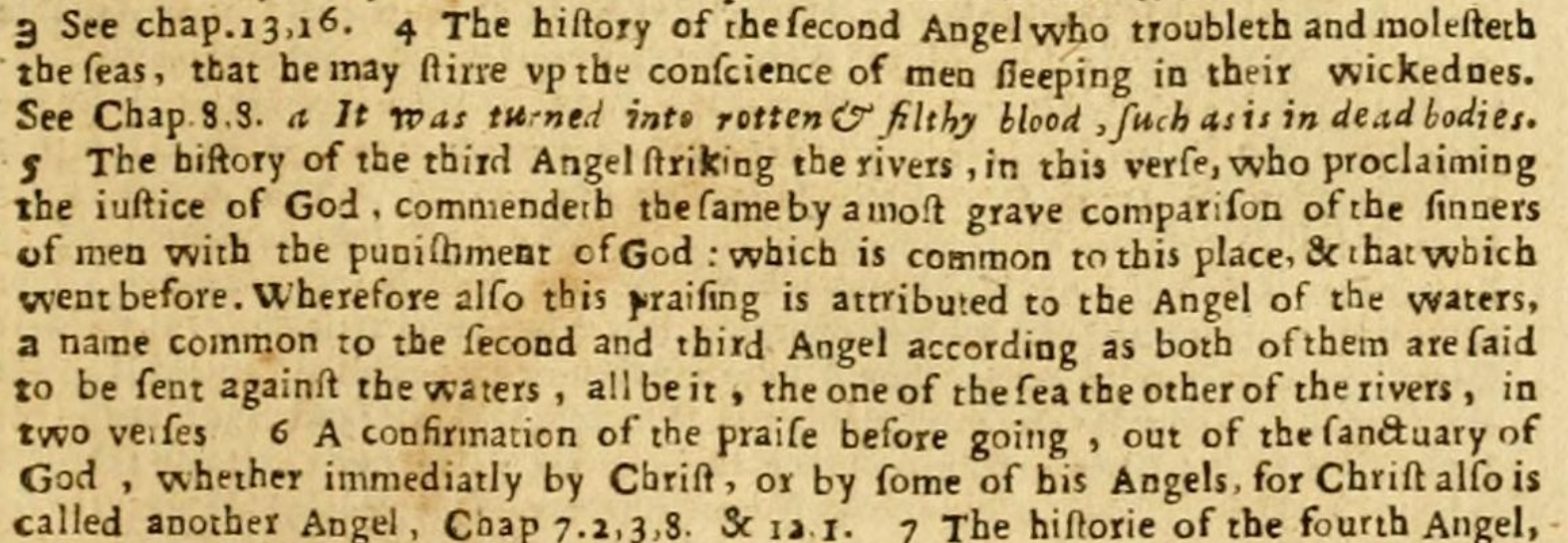
At Revelation 16:5, the annotations read:

(image 958/966)

Meanwhile, back in Holland, Adolph Visscher (1605-1652) led a committee that produced the Lutherse Vertaling (1648), which came to be known in Holland as the Visscher Bible ("Visscherbijbel")

The Visscher Bible replaced the Biestkensbijbel (1560), not by retranslating from the original languages (as with the Statenvertaling) but by correcting the Biestkensbijbel on the basis of the High German Luther Bible.  This became the standard Bible for the Lutherans in the Netherlands.

The Visscher Bible went under revisions in 1702, 1734, 1748, 1780, 1823 (apparently this was a significant revision), 1852, 1873, 1906, 1911, and 1939.  The revisions apparently were based on original languages, developments of the Dutch language, and attempts to harmonize toward the Statenvertaling.  In 1951, the Visscher Bible was replaced by a new translation, the NBG-vertaling 1951.

*** Appendix

1702


1734 (also includes an impressive Psalter!)


1748


1780 (Old Testament and Apocrypha, New Testament and Psalter)

1823 (Old Testament, Apocrypha, [could not locate New Testament]) 

[Perhaps to be completed at a later date.]

1852

1873

1906

1911

1939.

Dionysius bar Ṣalibi - Commentary on Revelation

Luke J. Stevens translated Commentary on the Apocalypse, of Dionysius bar Ṣalibi (d. 1171), from the Latin translation published in Corpus Scriptorum Christianorum Orientaliumm 53 (1909).  Stevens' translation was in 2020, with an update in 2021, and is available online (link).  Unfortunately for me, The commentary does not address several passages of textual interest to me. Moreover, as is the case with an "translation of a translation," be careful about relying too heavily on the exact wording of the English.
There are many verses that have no commentary.  I have marked a few such omissions that might otherwise be of interest to me.  I cannot tell whether the issues is that the manuscript preserving this work was incomplete, or whether the bishop didn't write any commentary on the particular place in question.

Thanks very much to Luke Stevens for this translation.  The work itself has the dubious distinction of being the "second oldest" Syriac commentary on Revelation.

At Revelation 1:4, DbA writes: "From him who is and who was—This indicates that (the book) is John the Apostle’s; for thus he writes in the Gospel: In the beginning was the Word, etc. By the words who is, he indicates God."

At Revelation 1:8, DbA writes: "I am the Aleph and the Taw—the beginning and the end. Who is and who was and who is to come—He expounds three times. He is God today and yesterday and forever, according to the word of the apostle. Is signifies present time, and was, past time, and is to come, future time, as God is above times and spaces and moments."

The translator has provided the italics distinction shown above, as though "the beginning and the end" is an explanation of the preceding phrase.  Interestingly enough, there is a textual variant issue on this point and the KJV goes with the longer reading.  

At Revelation 1:10, "I was in the Spirit, on the day of the Lord—He calls the first day of the week the Lord’s, because on that day our Lord rose from the tomb, and on that day the Spirit descended upon the apostles, and on that day creation was created, and on that day our Lord arose."

[There is no commentary on Revelation 4:8-11]

At Revelation 12:1-2: "A woman clothed with the sun, and the moon under her feet, and upon her head a crown of twelve stars. And when she was pregnant, she shouted and in labor was struggling to give birth—That here indicates the persecutions and vexations that the church must suffer by the Antichrist. For he calls the church the woman; clothed with the sun, because she is clothed with the paternal word that shines more than the sun. And the moon under her feet—adorned with heavenly beauty like the moon. And upon her head a crown of twelve stars—the twelve apostles, whose is the Church’s firmness. And she shouted and was struggling to give birth— because continually and incessantly she gives birth from her heart to the Word, and indeed in the world she suffers persecution by the unbelieving."

[There is no commentary from Revelation 11:9-19]

At Revelation 12:5 "And she gave birth to a male child, who is to shepherd all the nations—He called Christ male, who is God and himself man, whom the Church procures immediately and teaches to all the nations. And her son was carried off to God and to his throne—because he is the heavenly king and the Son of the Father, as David says: The Lord said to my Lord, sit at my right hand."

At Revelation 12:6-7: "And that woman fled into the desert, where a place was prepared for her by God; she there finished a thousand two hundred sixty days. And battle was waged in heaven—The woman is the church who suffers persecution by the Antichrist. And the faithful who call upon the Church in the presence of the pseudo-Christ will flee or scatter: and they will depart into places that now lack religion, that their gospel may be announced in the whole earth."

At Revelation 13:18: "And his number is: six hundred sixty-six—it is not permitted to be equally definite about his name: for we see that many names arrive at this reckoning, for example Titin or Auntos, and others such. This computation occurs in the alphabet of the Greeks, and not in the alphabet of the Syrians. Taw in the Greek language is three hundred, and in ours teth is nine. But because, as we said before: The beast’s wound was healed, and he made the image speak—that he be strengthened, the manifestation is of those who now dominate, i.e., of the Romans. The Romans, before they had this name, were called Latins, and one of them is called a Latin. However, from this name the number of one man is collected. Latin is the name ΛΕΑΤΙΝΟΣ (Leatinos). According to the numeration of the Greeks, those signs are applied: as we said, taw is three hundred among the Greeks, seventy […] such is the name of the beast and the number of his name."

[There is no commentary from Revelation 15:1-5]

[There is no commentary from Revelation 15:8-16:15]

Monday, February 10, 2025

Revelation 16:5 in Tomson's New Testament of 1576

In 1576, Laurence Tomson (1539-1608) published a New Testament based on Beza's then-current annotations (as well as other materials).  

His Revelation 16:5 is as follows:

(p. 118, image 234/268)

5 And I heard the Angel of the waters say, Lord, Thou art just, which art, and Which was: and Holy, because thou hast judged these things.

The punctuation itself tells us how "Holy" is understood grammatically.  Tomson's commentary does not directly address the grammatical challenges of the text:

(p. 118, image 234/268)

At Revelation 1:4, Tomson provides the typical connection between the verse and the name, Jehovah.  Tomson follows Beza's capitalization and glosses "and which is to come" in his commentary.  Specifically, he writes: "By these three times, Is, Was and shall be, is signified this word Jehovah, which is the proper name of God. ∵ Exod. 3. 14." 

(p. 111, 220/268)

This view erroneously overlooks the fact that the title, "The Coming One," is about the coming of God not about God being one who will exist at some future time.

H.T. to Irena Backus who points out this translation and its relationship to Beza in "The Reformed Roots of the English New Testament: the Influence of Theodore Beza on the English New Testament."

Saturday, February 08, 2025

Coptic Versions (Southern/Sahadic and Northern/Boharic)

eorge William Horner (1849-1930) is a bright light in the field of Coptic textual criticism.  His two most notable contributions are: 

  1. The Coptic version of the New Testament in the northern dialect, otherwise called Memphitic and Bohairic (apparently published by Horner from 1898-1905); and
  2. The Coptic version of the New Testament in the Southern dialect : otherwise called Sahidic and Thebaic ; with critical apparatus, literal English translation, register of fragments and estimate of the version (apparently published by Horner from 1911-24)

The Coptic translations have the benefit of being presumed to have been made directly from the Greek (and at a very early century), often including what appear (to me) to be Greek loan words and using an alphabet derived from the Greek alphabet. 

Unfortunately for us, there are always limitations in the use of translations.  Even if we literally back-translate using formal equivalency principles, we are not guaranteed that the original translator was using those same principles. 

Bohairic 

The Bohairic version is in the "northern" dialect of what is today Egypt, and is associated with the area near Memphis (Egypt, not Tennessee) (I sometimes see "Bohairic" spelled as "Boharic," but it seems that former is the correct spelling).  

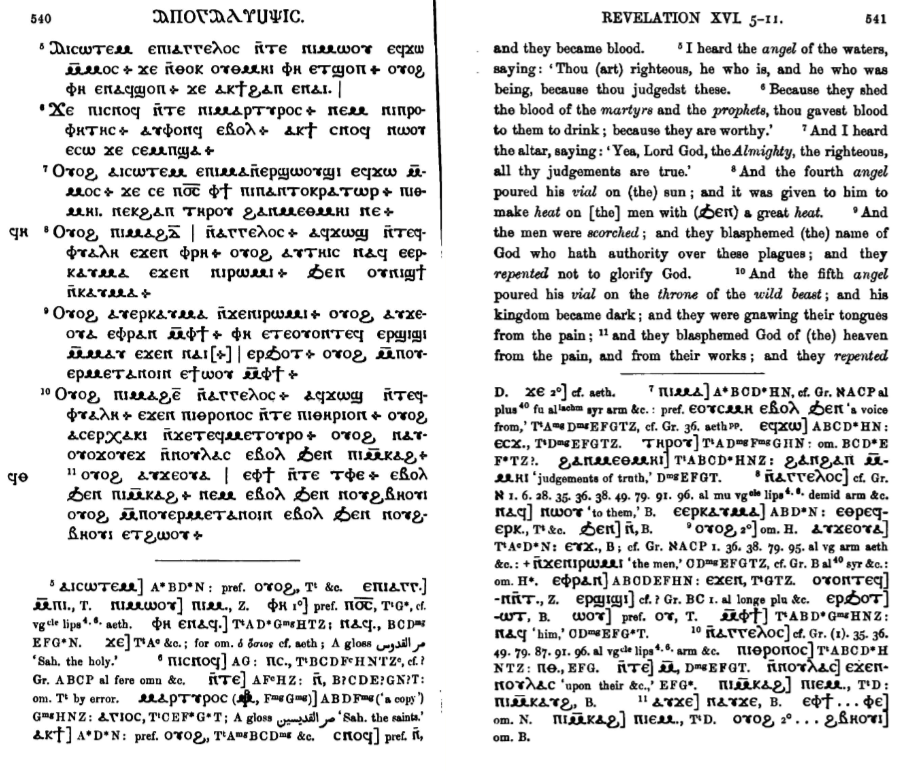
(pp. 540-41, image 553/612)
(p. 540, image 553/612)
(p. 541, image 553/612)

The Arabic gloss "مر القدوس" (mar al-Quddūs) apparently means "Sahidic, The Holy One".  The Arabic word (based on machines) seems to mean "passed," but I understand that weakness of computer-based translation.

It is difficult to know whether the Coptic Boharic should be viewed as a witness to a Vorlage that lacked hosios, or whether the translator combined "righteous and holy" to just "righteous" in his translation.  Even assuming that it suggests an original without hosios, it does not suggest the substitution proposed by Beza, as there is no "shall being one" in the Coptic.

Sahidic

The Sahidic version is in the "southern" dialect of what is today Egypt, and is associated with the area near Thebes (Egypt).  

    (Volume 1: Matthew and Mark)

    (Volume 2: Luke)

    (Volume 3: John)

    (Volume 4: Paul's Epistles)

    (Volume 5: Paul's Epistles Continued)

    (Volume 6: Acts of the Apostles)

    (Volume 7: Catholic Epistles and Apocalypse)

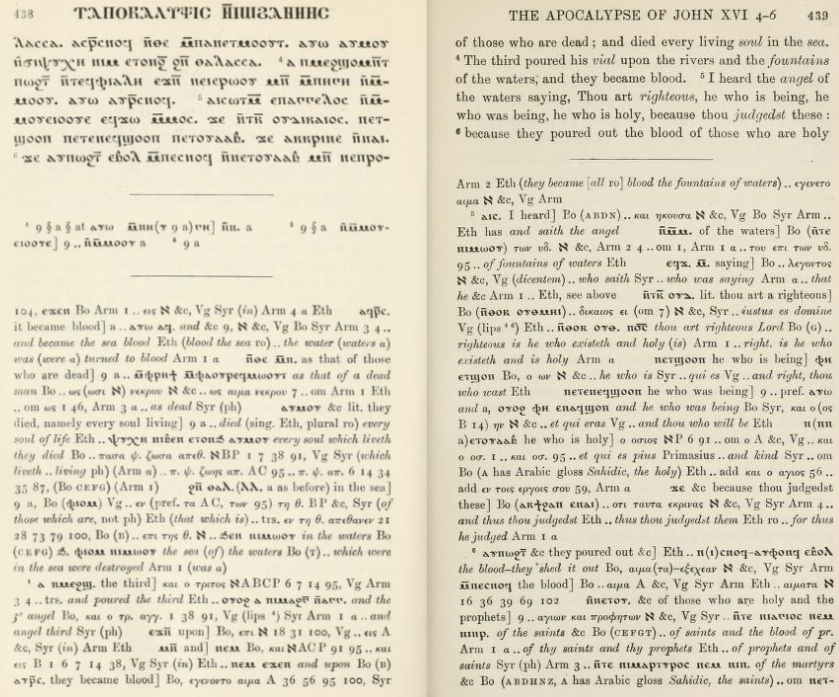
    (pp. 438-39, image 446/578)
    (p. 438, image 446/578)
    (p. 438, image 446/578)
    (p. 439, image 446/578)
    (p. 439, image 446/578)

    It is difficult to know whether the Coptic Sahidic should be viewed as a witness to a Vorlage that lacked dikaios, or whether the translator combined "righteous and holy" to just "holy" in his translation. I should point out that it is interesting that one of the two Coptic branches seem to have dropped one word as redundant, and the other dropped the other word as redundant.

    For our purposes, this version seems to favor the majority Greek reading here, and utterly fails to support Beza's substitution.

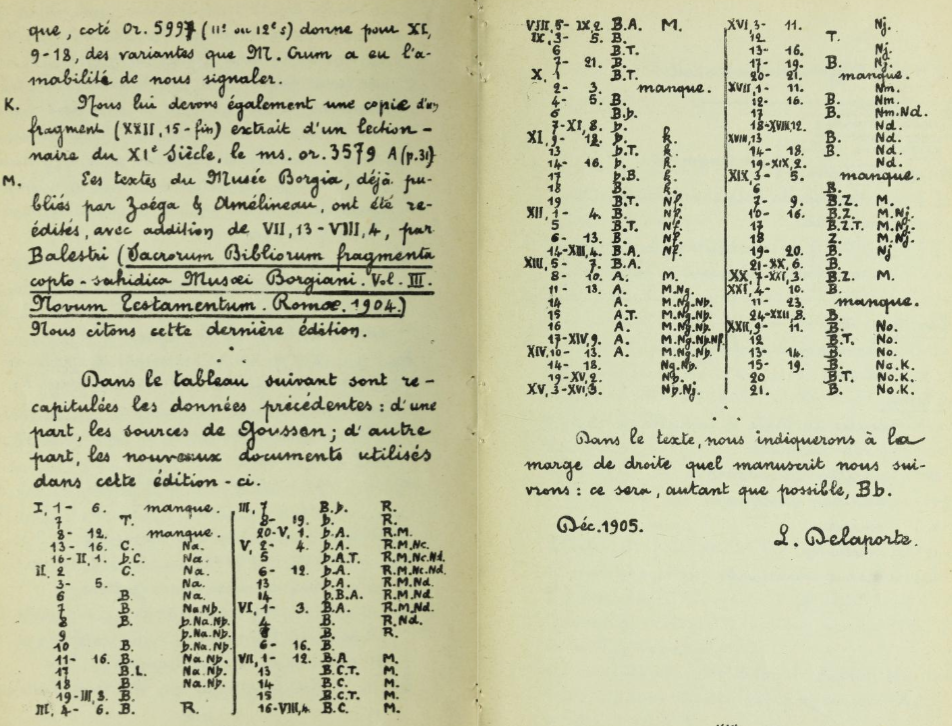
    I also located a separate work on Sahidic Apocalypse from 1906 by Louis Delaporte (1874-1944)  I have not checked whether (as I would hope is the case) Horner incorporated the work of Delaporte.


    This version seems to have an identical text of Revelation 16:5 to Horner's, except that "akrine" in Delaporte's version is "akkrine" in Horner's version.

    Both versions seem to have  ⲟⲩⲇⲓⲕⲁⲓⲟⲥ, which (on its face) appears to be a cognate word for the Greek word δίκαιος (dikaios), "righteous."

    Middle Egyptian & Nubian

    There are also "Middle Egypt" Biblical manuscripts, but very few, and only of Matthew, Acts, and John.

    Likewise, there are Paleo-Nubian manuscripts, even some including parts of Revelation, but none of Revelation 16:5 (at least according to this work).

    Crum

    W. E. Crum's "A Coptic Dictionary" is regarded as the standard.  I think there have been updates since 1939, but I resorted to that edition for convenience.  The Greek word index highlights the places where Coptic words are mapped to Greek words.  As we are interested hosios and dikaios, I have focused on those two words. 

    (p. 919, 950/992)
    (p. 893, 924/992)

    You will notice the overlap at 157a for both words:

    (p. 157, col. a, 188/992)

    Azevedo

    Joaquim Azevedo's "A Simplified Coptic Dictionary (Sahidic dialect)" has an entry with what appears to be a Coptic cognate of hosios:

    (p. 159, left col., 206/236)

    As well as a Coptic cognate of dikaios:

    (p. 16, right col., 62/236)


    Conclusion

    The Coptic broadly supports the majority Greek text and is inconsistent with Beza's emendation of the text.  However, the Coptic falls short of specifically and strongly demonstrating precisely the text of Revelation 16:5 as it is found in the Greek manuscripts.  So, for example, none of the Coptic evidence could be used to settle the variant readings found in the Greek manuscripts.


    Old Church Slavonic - Revelation 16:5

    The OCS Apocalypse apparently goes back to Methodius' translation in 885 (link to source), however the oldest manuscripts may only be from the 14th century (link to source).

    I was able to find a printed OCS text beautifully typeset, which had the following text:

    (p. 2683/2696)

    My own translation is this:

    And I heard the angel of the waters say: righteous you are, O Lord, [the] being [one] and which was, and holy, because thus judged you:

    (both instances of "you" are singular) 

    A corresponding transliteration of the OCS to modern Russian (Cyrillic) letters is this:
      
    И слышах Ангела воднаго глаголюща: праведен еси, Господи, сый и Иже бе, и преподобн, яко сия судил еси: (source)(Step Bible offers here as the 1757 Church Slavonic Elizabeth Bible)

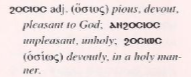
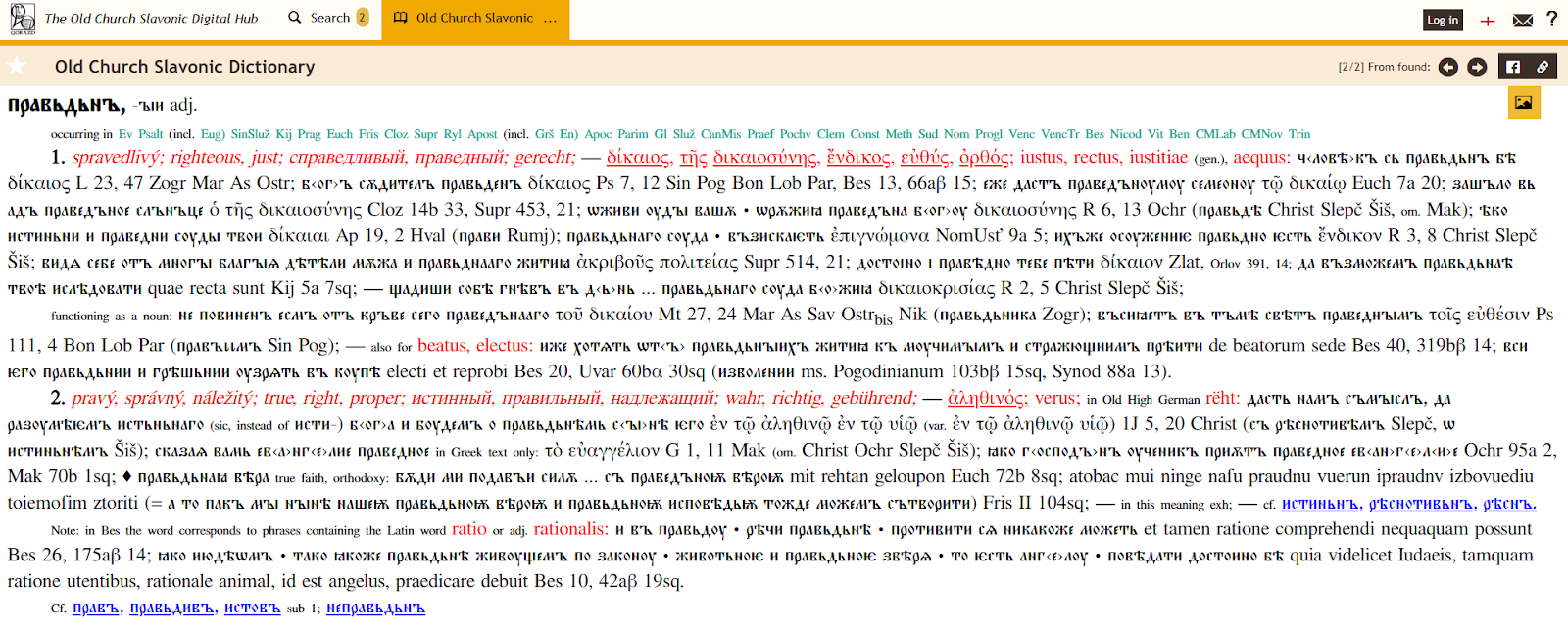
    The word "преподобн" is an OCS word used to translate hosios. So, in terms of being an additional confirmation of the pre-Bezean form of the text, the OCS seems to be fairly mainstream.  Unfortunately, however, I do not know how critical this printed text is, and whether, as Metzger (p. 430) suggests, it was influenced by Latin at an early (9th or 10th century) stage.  It is even possible that the printed OCS text I located was amended to align with an early printed Greek text.      

    H.T. "Base form dictionary"

    H.T. Slavonic Titlo

    H.T. Slavonic conjugation of "to be"

    H.T. Dictionary of the Oldest Old Church Slavonic Manuscripts:


    Wednesday, February 05, 2025

    Armenian version at Revelation 16:5

    The Armenian alphabet was apparently invented in AD 405 by Mesrop Mashtots and Isaac of Armenia for the purpose of having a written language into which to translate Scripture.  The translation was apparently initially made from Syriac and then subsequently retranslated Greek. (The Heritage of Armenian Literature) (further thoughts on the Armenian version here)  

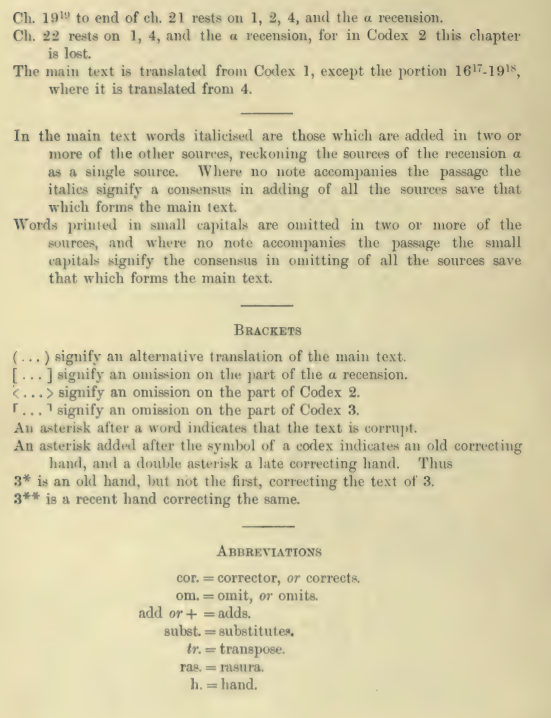
    In 1907, the Text and Translation Society published Frederick Cornwallis Conybeare's critical edition of the Armenian translated into English. Below, I've transcribed the text he offers (as well as his marginal readings), followed by images of the transcribed text and images of the explanation of the apparatus.

    For us, Conybeare's work is useful, even despite  

    5    And I heard from the angel of the waters that he said, Righteous is he which exists and holy. For thus he hath judged. 

    5    of the waters] 2 4——that he] who a——Righteous art thou, the existent, thy existent, thou holy, for this hast thou judged 4——exists and which is, holy 2: exists and is and holy 3 (holy over a rasura of alone): exists and is and holy in his works a

    5    Եւ լուայ ի հրեշտակէն զի ասէր, արդար է որ էնն և սբ. զի այն. պէս դատեցաւ։ 

    Proposed 

    • Եւ (yev) – "And"
    • լուայ (luay) – "I heard"
    • ի հրեշտակէն (i hreshdaken) – "from the angel"
    • զի (zi) – "that" (introducing indirect speech)
    • ասէր (aser) – "he said" (imperfect)
    • արդար է (ardar e) – "righteous is"
    • որ (vor) – "who"
    • էնն (enn) – "is" (a form of "to be")
    • և (yev) – "and"
    • սբ. (sb.) – "holy" (abbreviation for "սուրբ")
    • զի (zi) – "because"
    • այն. (ayn.) – "thus" (possibly an abbreviation for "այնպէս")
    • պէս դատեցաւ (pes datets’av) – "thus was judged" (passive form of "judge")
    My main conclusions from this are as follows. The Armenian is opposed to Beza's emendation of the text.  Additionally, it seems that the Armenian translators struggled in how to accurately capture the meaning of "the being one and the has been." As an interesting point, the text (at least as presented by Conybeare) seems to employ an abbreviation of the word for holy.  This is only interesting by way of coincidence in view of the 21st century theory that "holy" may itself have been intended as an abbreviation for something else.   


    Monday, February 03, 2025

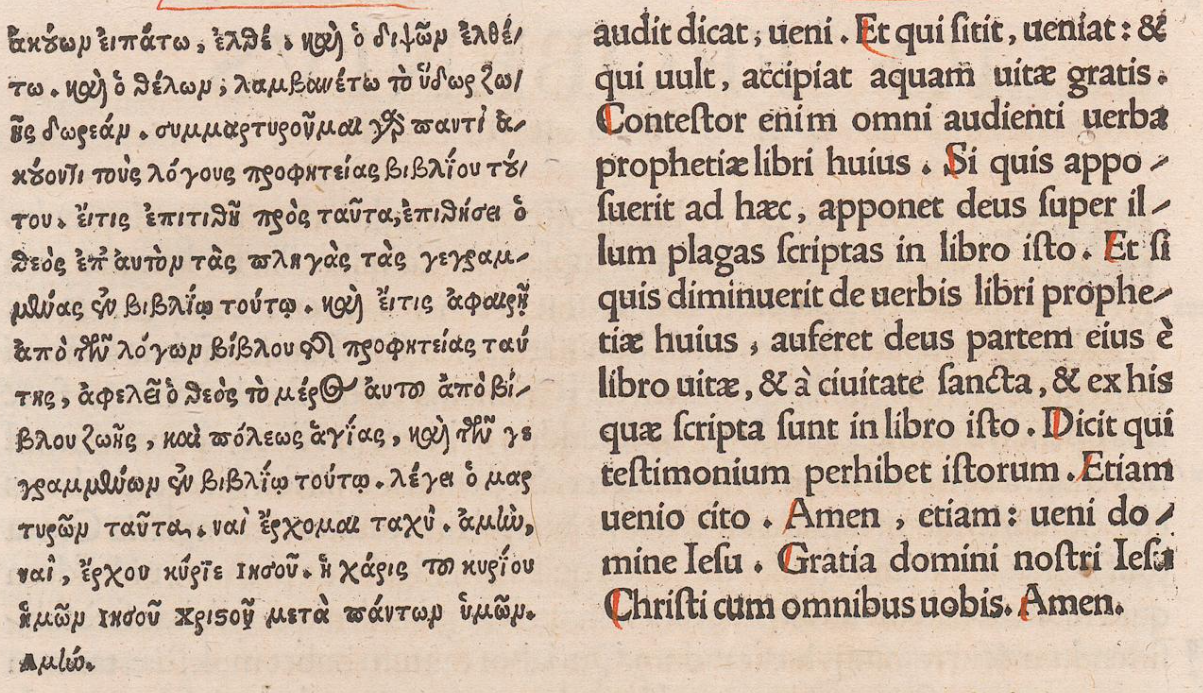
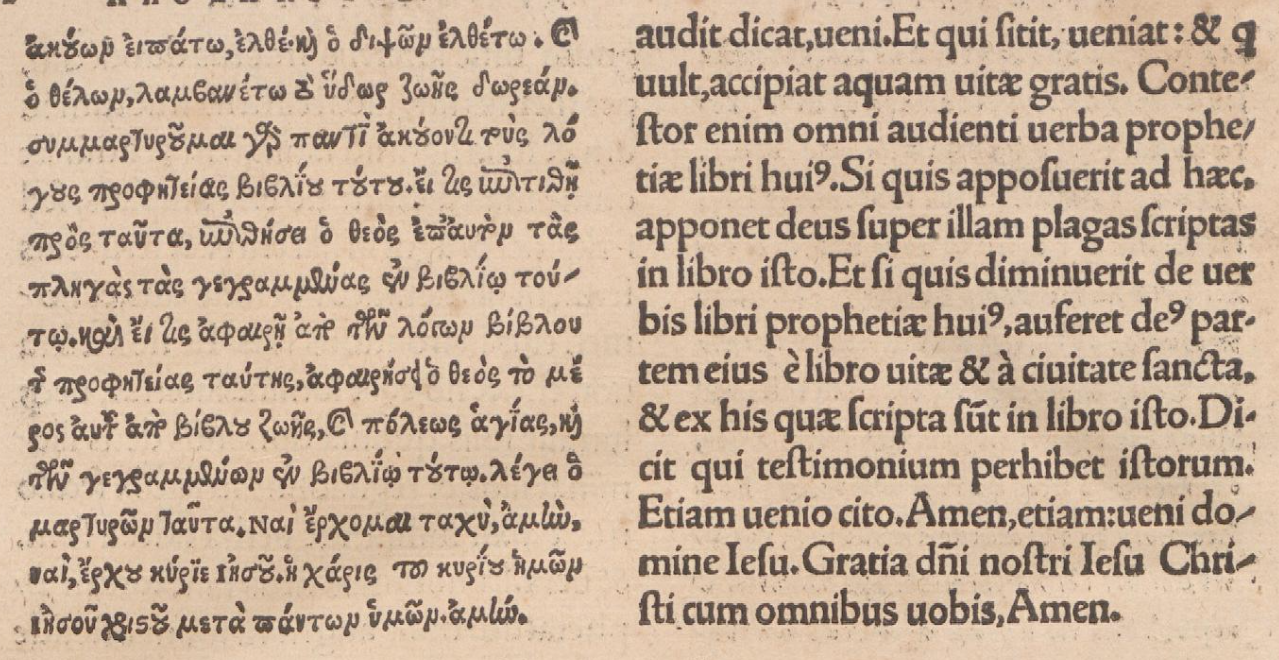
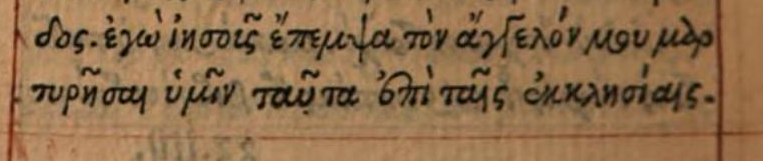
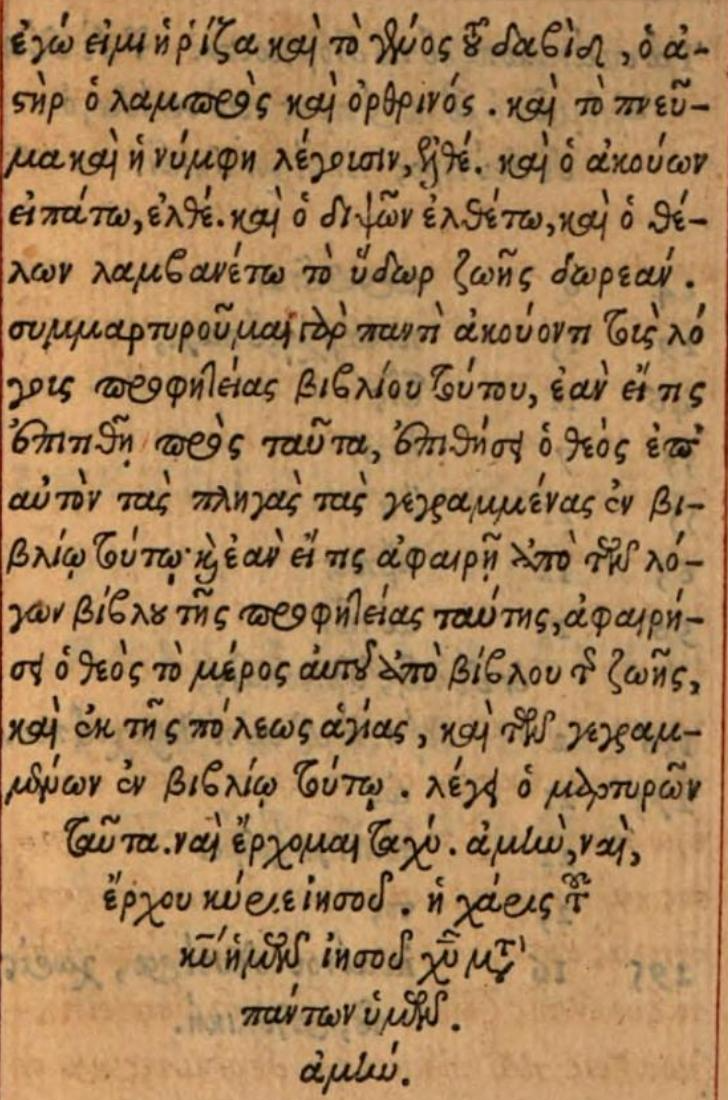
    Revelation 22:16-22 in the various editions of Erasmus

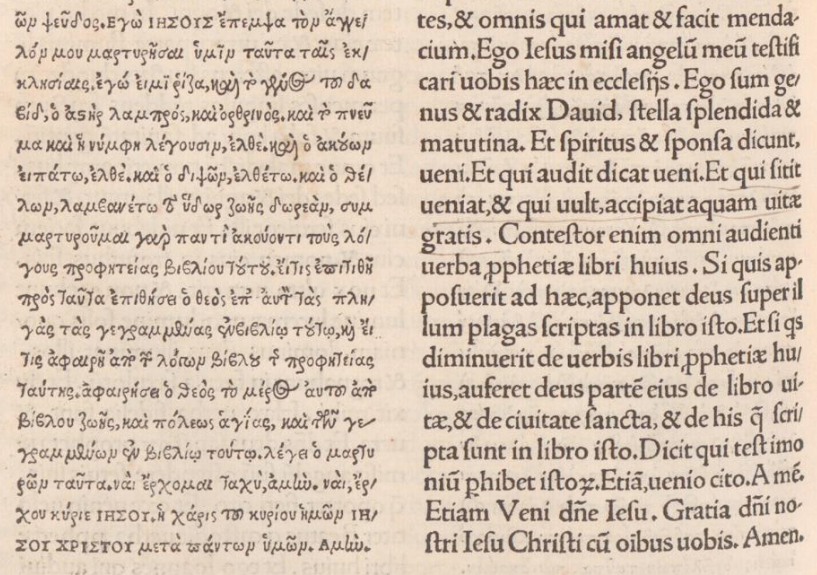
    The last six verses of Revelation 22 have been the topic of criticism (or praise) of Erasmus' work because apparently Erasmus' only manuscript of Revelation (GA 2814) was missing the last six verses (see the discussion from Pastor Jeffrey Stivason, here). 

    The usual explanation is that Erasmus, being knowledgeable in Greek, back translated the final six verse of Revelation 22 from the Vulgate Latin.

    I plan to update this page as time permits.  However, for now I want to provide the five editions of Erasmus (including Greek and Latin) for the passage in question, as well as the four editions of Stephanus (only one of which includes Latin).

    (1516, image 584)
    (1519, image 690)
    (1519, p. 565, image 691)
    (1522, p. 561, image 633)
    (1522, p. 562, image 634)
    (1527, p. 545, image 597)
    (1535, p. 429, image 477)
    H.T. to Jan Krans for this helpful list of online editions of Erasmus (link).


    (1546, p. 360)
    (1546, p. 361)
    (1549, p. 360)
    (1549, p. 361)
    (1550, p. 202)
    (1551, p. 312r)
    (1551, p. 312v)

    H.T. also to Jan Krans for this helpful list of online editions of Stephanus (link).