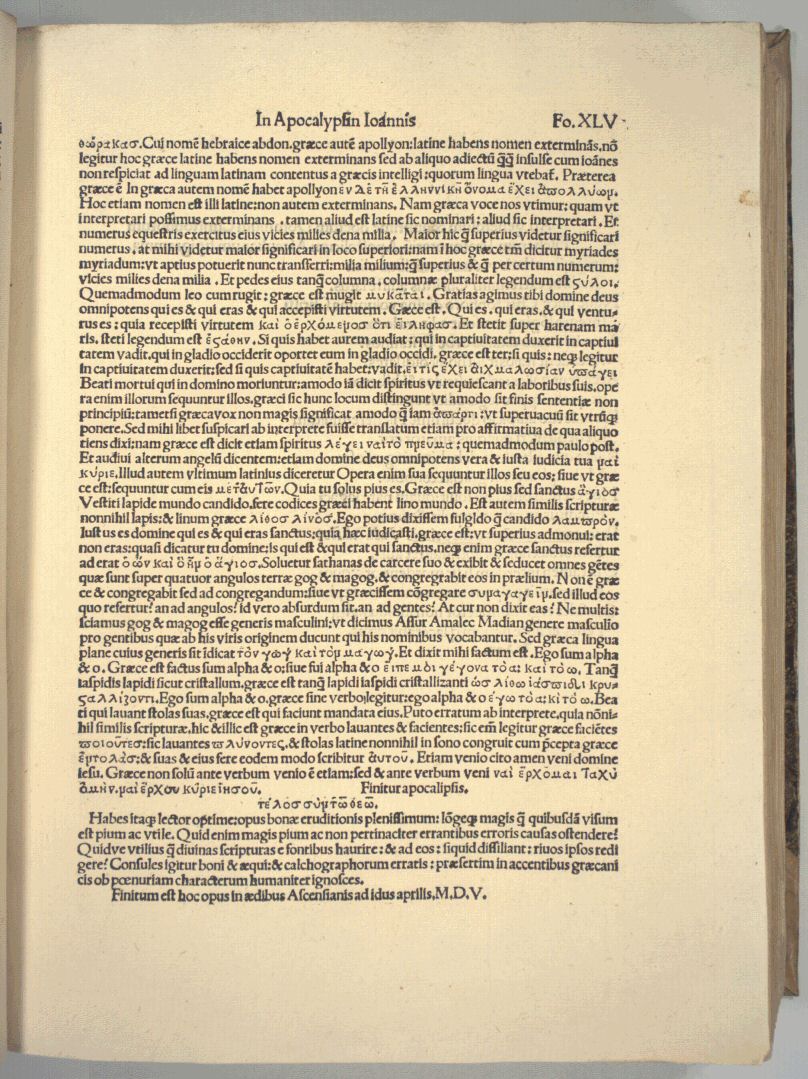
The Trinitarian Bible Society's Quarterly Record, Issue No. 636 (July to September 2021) contained the following announcement:
Preparation for an important article on the textual question of Revelation 16.5 has been underway for some time now. The Received Text at Revelation 16.5 contains the triadic declaration ‘which art, and wast, and shalt be’, whereas the Critical Text substitutes the last member of that expression with ‘O Holy One’, thus setting the verse at odds with other parallel declarations found in the Book of Revelation (1.4, 1.8, 4.8, and 11.17).
Likewise, in an interview apparently conducted August 29, 2020, Mr. Larry Brigden, a "Senior Editorial Consultant of the Trinitarian Bible Society," mentioned that he had been asked to write such an article.
To my knowledge, no such article has yet emerged. Nevertheless, we have Mr. Larry Brigden's comments, from around the 24 minute mark to the 38 minute mark of the above-linked interview. The un-interrupted version of the transcript is provided in Appendix I, below, for context. Otherwise, I'm aiming to provide Brigden's comments (indented) and my responses.
I've been involved in writing an article on Revelation 16 verse 5. The society has asked me to write this article because often people who are opponents of the received text position pick this particular verse. They pick it because they think the authorised version is weak at this point.
Not just weak, the KJV is wrong on this point, because it is following Beza and departing from all the Greek manuscripts, as well as departing from the witness to the Greek provided by the ancient versions.
And the verse, I'll just read it in the authorised version is, and I heard the angel of the waters say, thou art righteous, O Lord, which art and wast and shalt be, because thou hast judged us. The authorised version has which art and wast and shalt be. But the modern versions, following the critical text, leave off that last part, and shalt be.
None of the Greek manuscripts have "shalt be." Moreover, nearly all the Greek manuscripts have "hosios" (usually translated as "holy" or "O Holy One"). Beza removed "hosios" and replaced it with "esomenos" ("shall being"), and the KJV editors followed his lead and altered the English Bible to reflect Beza's change to the text.
From Tyndale through the Bishops' Bible, including the Geneva Bible, the English Bible had "holy" (reflecting the Greek manuscripts) not "shalt be" (reflecting zero Greek manuscripts). This substitution was first made by Beza. None of the versions prior to Beza have this substitution, not even in versions that somehow omit the word "holy." (see the update at the end of this post for more discussion on this issue) In short, this was a novel substitution.
And so, as I say, the critics of the authorised version often point to that verse and say, Aha! This is a weak point in the translation because we don't have Greek manuscripts that have that last part there in the verse, and shall be. And they also say or allege that Beza, well I should say when I said that Greek manuscripts don't contain it, Beza's 1589 Greek text does contain it. And the authorized version is mostly reliant upon that text, and that's why the authorised version contains it.
Beza first introduced the change in his 1582 edition (see this page). The KJV translators were probably working from Beza's 1598 edition (which continued to reflect the change made in the 1582 edition). Beza's printed editions are, of course, not Greek manuscripts.
But as I say, the critics of the authorised version often point to the text and say, but at that verse, none of the other Greek editions or manuscripts contain those words. And Beza only inserted those words if they read his note and the note's written in Latin, and they say, well, Beza's only inserted those words as a conjecture. So he didn't have any Greek manuscript evidence on which to print those words in his text.
Yes, none of the previous printed Greek editions (before 1582) had ever included Beza's substitution. Yes, the best explanation for Beza's substitution is that it was a conjecture, notwithstanding his notes.
So since this is often a point at which those who oppose the authorised version and received text seek to undermine the position of the society, the society has asked me to write something on this question. And it is very interesting because it does involve a good deal of research.
It boggles the mind that the "position of the society" is that Beza's 1598 Greek text (or the 1589 or the 1582) ought to be the standard against the weight of all the Greek manuscripts and versions and against the weight of the internal evidence. The real reason seems to be that for "the society" the standard is actually the KJV, not the Greek. After all, Beza's substitution is only found in a minority of the printed editions of the "textus receptus" family of printed editions.
And the first point that I would make about it, contrary to those that oppose the verse, how it's translated in the authorised version, is that where they say that this is merely a conjecture is not correct. It's not true. And yet that story that it's a conjecture has been widely taken up by a lot of people, even by conservative writers, such as Edward Hills, in his book, The King James Version Defended, he seems to have accepted that it's actually a conjecture. And of course, James White makes a lot of that in his attacks on the authorized version.
Mr. Brigden is wrong. It is true that this was a conjecture Beza.
The curious thing is that Beza's note in his Greek text where he explains why he has "and shalt be" in verse five there, does not at all say that he's making a conjecture. He says he's relying upon an ancient and a very reliable manuscript. So first of all, the point is that where it has been represented by many people as being a conjecture, it's not a conjecture. Beza himself says that he had a very reliable and a very ancient manuscript as the basis for that reading.
Mr. Brigden is right that Beza does not explicitly acknowledge this to be a conjecture. He seems to assert that the substitution is being made based on an old, reliable manuscript. Beza's claim, however, is (a) vague, as he fails to identify the manuscript or the wording of the verse in that manuscript, (b) unsupported by his own notes on the text, which have in God's providence been preserved, and (c) unbelievable in view of his limited access to manuscripts.
As to (a), Beza does not provide any manuscript identifier at all and does not say how the manuscript was a witness to his substitution. If we were to accept the idea that Beza was basing his emendation on a manuscript, did the manuscript include both "esomenos" and "hosios" - did it include a series of blurred letters that more closely resembled "esemenos" to Beza's eye - did it lack the word altogether, but the gap somehow implied a longer word than "hosios"? Beza does not say. The reason, of course, is that Beza never saw any such manuscript.
As to (b), Beza's own notes written in his printed 1565 edition simply propose the change, without referencing any manuscript or providing any other explanation. Given that there were numerous markups to the text of the New Testament, and given that Beza was doing many things other than editing the New Testament between 1565 and 1582, it is quite reasonable to suppose that Beza (or own of Beza's assistants in the editing process) assumed that he had made the suggested change based on an old, reliable manuscript, rather than based on his own intuition.
As to (c), Beza is known to have had only two manuscripts of the New Testament, neither of which included Revelation. Prior to 1582, Beza also had access to a collation of manuscripts made by Henri Stephanus, apparently in manuscript form. Beza does not seem to have still had that collation in 1582. So, again, it would be reasonable for Beza (or his editorial assistant) to mistakenly believe that his note was based on Henri Stephanus' collation document, rather than being based on Beza's own intuition.
Beza's mistaken assumption would be further bolstered by the fact that Beza's general policy was never to make changes to the text based solely on conjecture. So, Beza is unlikely to have thought that this note was a reference to his own conjecture.
So it's obvious when I first started to look into the question that the whole matter has been misunderstood for quite some time. And how it's been represented is not the way it actually is. It raises a lot of interesting questions because here Beza is saying, I have a manuscript for it. It's a very good one and it's a very reliable one. But our opponents in the critical text camp, of course, would say, and have said, Beza just wasn't remembering very well. He actually made a conjecture. Sometimes they actually do try and stick to that story. But that's simply incredible. Do you imagine that a man like Beza could forget that he'd made a conjecture when he quite explicitly says that he had a good manuscript for it? I think that's incredible. You have to disbelieve the man's own words. Do you have any reason for disbelieving his words? No, not particularly. Just an animosity to the authorised version, apparently.
Of course, as Brigden already acknowledged, the fact that this was a conjecture was rightly admitted by a great defender of the KJV, Edward Hills. Surely his motive was not "just an animosity" to the KJV. Moreover, the leading scholar on Beza's conjectural emendations (Jan Krans) has likewise concluded that this was a conjectural emendation, even though this required him to acknowledge that his doctoral thesis erroneously omitted this example.
Moreover, it is not "simply incredible" that Beza made a conjecture and did not correctly remember it. We have his extremely sparse note on this verse. There is absolutely not explanation provided here, and it is not as though this verse occupied the center stage of Beza's revisions to the New Testament. Here is his note:
Do we have reasons to disbelieve his word? Absolutely. We have abundant reason to disbelieve the idea that Beza made this substitution on the basis of an old, reliable manuscript. The biggest reason is that no old, reliable manuscript reads that way, Stephanus' collation notes as published in the 1550 Stephanus contain no such annotation, and no other human being who has collated manuscripts has every before or after Beza recorded Beza's substitution reading.

But the other interesting question is, is doing a fair bit of research on more recently is, if Beza had that manuscript, where is it today? Yes, that's a very interesting question.
Possibly, it is this research that led to the wise choice not to publish the commissioned article. There is a related question, however: if there was one manuscript like that, why do all the other manuscripts and versions differ from it? That question has no good answer.
And the other interesting thing I should say is, when the authorized version translators came to this verse, they make no comment on it. There's no marginal note. And sometimes, you know, the authorized version does use marginal notes where there's an uncertainty on the Greek manuscript or the Hebrew manuscript evidence. Not very often, but sometimes they do. They give an alternate reading. They give no alternate reading in this case. So what it would appear to me is that, of course, it's always possible that the manuscripts that Beza consulted are no longer in existence today. I think some people might think that.
People may think that Beza had a manuscript and it is now lost, but both of the manuscripts that Beza personally owned are still in existence today. There is not a good reason for speculating a third, otherwise unknown, manuscript that is now lost.
The great Reformed scholar and Bible translator, Diodati, rejected Beza's conjecture when making his translations. On the other hand, the 1588 (French) Geneva Bible, edited by Beza himself, has a marginal note on this point (see this previous post).
But I would incline to think it's always possible that they are in existence today but have never been located or collated. A lot of people don't understand that. The manuscripts that we have are not stored in one particular place. They're scattered. And the all the manuscripts for the New Testament have not been collated to this day. So that means that it's quite possible that what Beza saw is around somewhere, but simply has not been collated. That means collected and registered. That's not impossible. That is possible.
Unfortunately for this theory, Hoskier collated nearly all the manuscripts of Revelation and did not find any with this reading. This is not like the case of the gospels, where a nearly complete collation remains elusive.
As I say, if you understand that we live in dark times, as I was saying, that times of reviving are always associated with times of the recovery of God's word. And if we live in dark times, that means that the word of God will be partly hidden from us in such times. The fact is, of course, is most of these manuscripts are not in the hands of people who necessarily have the convictions that we would have. So we are somewhat subject to them. And that's something else people don't understand.
Very few of the manuscripts of Revelation are inaccessible today.
I remember some people, I do get asked the question about the majority text sometimes. I don't know if people are aware of that, but that's another another camp apart from the received text, you get the critical text and the majority text. And I don't know that people are fully aware that majority text is a bit of a misnomer because it was supposed to be a collation of the majority of the Greek New Testament manuscripts, but physically not possible, although they only collated about 10% of the manuscripts. So 90% of it remained uncollated. So how is it truly a majority text? But that's another story, but it just gives you an indication of the fact that not all the manuscripts have been collated.
This is not an accurate depiction of the collation efforts that have been made on the book of Revelation. There are extremely few Greek Revelation manuscripts that were not collated by Hoskier.
So the evidence for Revelation 16.5, just because we're not aware of it, doesn't mean it's not actually available somewhere. It's simply through lack of industry or lack of motivation to actually seek it out. But the fact that Beza gives undeniable historical testimony to the existence of such a reading indicates that he saw it and he was convinced that it was correct. I think that element of the question is not raised by many people. And as I say, the whole issue is misconstrued and misrepresented by critical text people.
Presumably "the society" is motivated to find this evidence, were it to exist. Five years have passed in the meantime since this interview. As mentioned above, presumably it is the absence of any support for Beza's conjecture that has prevented the publication of such an article.
So it's a topic that I'll have to investigate further. Because what I'm really trying to do is trying to work out, well, what was the state of the texts back there at that time, at the time of the Reformation? And that's not an easy thing to work out. There's a lot of historical research needed for that.
We certainly welcome additional historical reseach.
But I should mention, too, that the real reason for believing that this part of the text should be there is the where it says, which art and was and shall be, there's obviously an assertion of God's being in the past, being present and being in the future. And that triadic declaration occurs in numerous other times in the book of Revelation. It's not really easily conceivable that it should have been slipped out in Revelation 16:5. That would go against the principle of the analogy of scripture. Some people have tried to offer a reason why it could have been missing in that part, but I don't think any of those reasons are credible.
There are several issues here.
First, in the "Authorized Version" (i.e., the King James Version) the other places to which Brigden alludes have the following readings:
- Revelation 1:4 John to the seven churches which are in Asia: Grace be unto you, and peace, from him which is, and which was, and which is to come; and from the seven Spirits which are before his throne;
- Revelation 1:8 I am Alpha and Omega, the beginning and the ending, saith the Lord, which is, and which was, and which is to come, the Almighty.
- Revelation 4:8 And the four beasts had each of them six wings about him; and they were full of eyes within: and they rest not day and night, saying, Holy, holy, holy, Lord God Almighty, which was, and is, and is to come.
- Revelation 11:17 Saying, We give thee thanks, O Lord God Almighty, which art, and wast, and art to come; because thou hast taken to thee thy great power, and hast reigned.
Thus, if this argument from the analogy of Scripture is to carry weight, then the reading at Revelation 16:5 should be "art to come" or "is to come" not "shalt be."
Second, the King James Version here is not the most literal rendering of the text. The Greek is more literally, "the Being" and "the Having Been" and "the Coming," or "the Being One," "the Having Been One" and "the Coming One." Switching to the indicative and conjugating to the third person or second person according to the grammar of the sentence is at cross-purposes to John's own Greek.
Third, "the Coming" or "the Coming One" is not equivalent to "the Shall Being" or "the Shall Being One." There is a Greek verb for that, and John does not use. Instead, the reference is to the coming of God in judgment on the Earth.
Fourth, King James is in error at Revelation 11:17 including the "art to come," which is not in the majority of manuscripts. The reason for the majority reading is that, as noted in the third point, the "Coming One" refers to God coming in judgment, which God has already done by Revelation 11:17 and also by Revelation 16. That's the reason that "the Coming One" is no longer used in those places.
Fifth, it's not only numerous commentators who comment on this reason for the absence of "the Coming One" here, but even Beza himself acknowledges the same thing. Beza claims that the reason it should not be "erchemonos" (the coming one) is that Jesus already sits in judgment (see his relevant annotations here).
But the handling of scripture and the questions associated with it is not divorced from theology. And scriptures are given to the church. They're not given to the world. And therefore, and they're not properly, worldly men cannot properly handle the scriptures, nor make sense of them, because the carnal mind is enmity with God. And it will never properly be able to decide questions, textual questions.
These questions, sometimes people think these questions are simply scientifically decided. No, they're not. Well, in a sense, I suppose they are, but they have to be decided, first of all, in a theological context. If you handle the word of God, you have to know what it is you're handling. You're handling something that is inspired and preserved by God. Therefore, come not to it with a carnal mind. Therefore, you must have a regenerate man who has been given a heart of flesh and the heart of stone taken out. His enmity toward God is removed. You cannot possibly make proper decisions, textual decisions, if you do not, if you have a carnal mind, it's impossible. You will not see the things that are before your eyes.
On the other hand, it is a dangerous place to sit in judgment that those who disagree with you on textual questions have a carnal mind, if you are doing so simply on the basis that you and they disagree. There are plenty of regenerate folks who have come to similar conclusions in rejecting Beza's emendation of the text.
Mr. Mark Mullins (whom TBS lists as a "Coordinator" for its Greater London Auxiliary) graciously credits Mr. Brigden as providing assistance in the "paper" (Mr. Mullins was contacted in an effort to obtain a copy of the "paper," if such a document exists, but no such paper was forthcoming as of the publication of this paper) that Mr. Mullins presented at the Reformation Bible Society's 2025 meeting (apparently on August 2, 2025).
In the following transcription (for which I had some machine assistance), I've tried to smooth out verbal start/stop issues (and asides for help with words, etc.) without changing the meaning. The link above provides the complete interview without any such smoothing on my part.
After a brief introduction, Mullins jumped in:
The Revelation 16.5 controversy. Well let's get straight to the heart of it. Revelation chapter 16 verse 5 says in our King James Bibles, or our Authorized Version Bibles, "And I heard the angel of the waters say, thou art righteous, O Lord, which art, and wast, and shalt be, because thou hast judged thus." However, modern translations contain a different reading, as seen in the New American Standard Bible "And I heard the angel of the waters saying, righteous are you who are and who were, O Holy One, because you judged these things." The ESV translates it slightly differently and changes the order of the Greek. "And I heard the angel in charge of the waters say, just are you, O Holy One, who is and who was, for you brought these judgments."
Mullins is correct that the NASB is closer to the word order of the Greek than the ESV is, on this particular verse. I would assume Mullins knows well that the ESV does not (and indeed cannot) "change[] the order of the Greek," since the ESV is an English text. On the other hand, Mullins does not seem to note that the ESV follows the lack of person change in the Greek (i.e., "is" and "was" instead of "are" and "were"), whereas the NASB follows the KJV in changing to second person. Mullins also does not seem to note the additional difference of the KJV's insertion of "O Lord" into the text.
James White, who has specialized in criticizing those who promote the King James Version and the Received Text, or Textus Receptus, wrote a book in 1994, which he updated in 2009 called The King James Only Controversy: Can You Trust the Modern Translations?
Two objections:
First, James White did indeed write the book mentioned, but James White has not "specialized" in opposition to the King James Only movement. Unless one is to count "Debating the Text of the Word of God" (2017), which Dr. White published with and against Doug Wilson's position, I believe one would be hard pressed to argue that Dr. White had written more than one book against the King James Only positions. On the other hand, Dr. White has multiple books against Roman Catholicism, Islam, and Mormonism, and even more promoting Calvinism. For example, some of his other books include "The Roman Catholic Controversy" (1996), "The Same Sex Controversy" (2002), "Letters to a Mormon Elder" (1990), "Is the Mormon My Brother?" (2008), "The Potter's Freedom" (2000), "The God Who Justifies" (2001), "Scripture Alone" (2004), "Grieving" (1997), and "Dangerous Airwaves" (2007). To suggest that "King James Only" is his singular focus is simply a mischaracterization.
Second, James White primarily criticizes the arguments and positions of those who say that the King James Version is without error. He may also criticize the people, from time to time, but his primary emphasis is, and always has been, the arguments and positions, rather than the people.
On page 237, he claimed to have found an irrefutable example of error in the King James Version. He contended that the rendition of Revelation 16 verse 5 was correct in the NASB, but wrong in the King James Version. And he's used some pretty strong language to make his case. He goes on confidently to assert at page 237: "Every Greek text, not just Alexandrian texts, but all Greek texts, majority texts, the Byzantine text, every manuscript, the entire manuscript tradition, reads, 'O Holy One,' containing the Greek phrase ho hosios. So why does the King James Version read 'and shalt be,' which in Greek is kai ho esomenos? Because John Calvin's successor at Geneva, Theodore Beza, conjectured that the original read differently. To use his words, they all wrote in Latin in those days, ex vetusta bonae fidei manuscripto codici restituti. Beza believed there was sufficient similarity between the Greek terms hosios and esomenos, that's the future form "shall be," to allow him to make the change to harmonize the text with other such language in Revelation. But he had no manuscript evidence in support of his conjecture. For the King James Version-only advocate, there is simply no way out of this problem. Those who appeal to the Byzantine text are refuted, for it reads ho hosios. Those who appeal to the majority text found they're on the same reality. How about Erasmus? Here is the third edition from 1522." He then shows some pictures, forgive me, I haven't reproduced them here, in his book of Erasmus's edition. "Coverdale and Geneva, which do not have the King James Version reading, "shall be" but say 'and holy'." He then concludes, "As one can see, the King James Version reading at Revelation 16, verse five, arose from Theodore Beza's conjectural emendation and was unknown to history before prior to that time."
I believe this accurately reproduces Dr. White's argument. I would say that there are some minor flaws in Dr. White's work -- points that a person could criticize -- but the substance of his point is correct: this was a conjectural emendation by Beza and was not then (and is not now) supported by any Greek manuscripts from before the age of printing.
Well, more recently, on the 4th of January 2019, James White gave a lecture at Covenant Baptist Seminary on textual criticism and the TR, where he repeated these claims. So, is James White correct? Is there no manuscript evidence for the KJV rendition of the disputed phrase? And does it matter?
To answer his questions:
- In substance, James White is correct.
- There is no manuscript evidence that supports the KJV wording.
- It matters at least this much: there is still room to improve the KJV.
Mullins continued:
Firstly, let us consider whether it matters, because that will inform the interest we take in this particular controversy. Those of us who contend for the received text believe that God has providentially preserved His Word down the century within the Church of Jesus Christ, just as the Old Testament manuscripts were preserved within the Temple up until the destruction of the Second Temple in A.D. 70. The reasoning for this is simple. The New Testament Temple consists of God's people. 1 Peter 2, verse 5. Ye also, as lively stones, are built up a spiritual house and holy priesthood to offer up spiritual sacrifices acceptable to God by Jesus Christ, and it is therefore among his people that we would expect to find his word preserved.
It's nice to see this acknowledgment of the Biblical doctrine of the preservation of Scriptures.
"The doctrine of providential preservation is a vital doctrine for believers," as John Owen wrote in his Of the Integrity and Purity of the Hebrew and Greek Text of the Scripture. He goes on to say, "But what, I pray, will it advantage us that God did so once deliver His Word, if we are not assured also that that Word so delivered hath been, by His special care and providence, preserved entire and uncorrupt unto us, or that it doth not evidence and manifest itself to be His Word being so preserved? Far be it from the thoughts of any good man, that God whose covenant with his church is that his Word and Spirit shall never depart from it." And then he quotes Isaiah 49:21, Matthew 5:18, I Peter 1:25, 1 Corinthians 11.23, Matthew 28.20-- "have left it in uncertainties about the things that are the foundation of all that faith and obedience which He requires at our hands."
Again, it's nice to see this acknowledged. This is, of course, not only Owen's view, but the view of folks like myself, or Dr. James White.
We believe that the received text consists of God's preserved Word in its entirety. Although we can see that in some verses, such as Revelation 16, verse 5, there are variations in the Greek manuscripts, but it is contended that the received text has consolidated the word that has been preserved through the ages within the Church, and that it cannot be added to or subtracted from. Where manuscripts have gone missing but were present when the received text was being assembled, we believe that God preserved his word in the received text. So we would not necessarily expect manuscripts themselves to be preserved until today, once those texts have been incorporated into the received text.
This is a new doctrine that was not taught by John Owen, the historic Francis Turretin, or the like. The idea that all of the correct readings are found in the main text of a single printed edition is a novel idea, at least for Protestants. That's particularly true if the "received text" in question is a printed edition that didn't exist until the late 1800s, when Scrivener prepared it.
There is a lovely picture of God's providential preservation, supplied by Adoniram Judson. He was a missionary to Burma in the 19th century, and spent many years translating the Bible into the Burmese language. When he was imprisoned, he placed his manuscript inside a pillow, but one day the prison guards confiscated his pillow. After he was transferred to another prison, the prison guards tossed his pillow into the yard. It is said that the soldiers walked over it and kicked it, and the pigs pushed it around, but God watched over it. In the yard one day, a Burmese Christian was feeling sad that his great friend, Adoniram Judson, had been taken away, and he thought that he would never see him again. Then he spotted the pillow and recognized that it belonged to Mr. Judson. So he carefully picked it up and gave it to Mrs. Johnson and so the word of God was preserved for the Burmese people. If God could watch over Mr. Johnson's translation of the Bible into Burmese, which could, after all, be repeated, how much more was he able to watch over the original Greek and Hebrew manuscripts in fulfillment of his promise in Psalm 12, verses six and seven? "The words of the Lord are pure words, as silver tried in a furnace of earth, purified seven times. Thou shalt keep them, O Lord. Thou shalt preserve them from this generation forever."
The story is a lovely account. However, the connection to Psalm 12:6-7 is misplaced. The text of that Psalm, in the KJV, is this (emphasis added):
Psalm 12:1-8 [[To the chief Musician upon Sheminith, A Psalm of David.]] Help, LORD; for the godly man ceaseth; for the faithful fail from among the children of men. They speak vanity every one with his neighbour: [with] flattering lips [and] with a double heart do they speak. The LORD shall cut off all flattering lips, [and] the tongue that speaketh proud things: Who have said, With our tongue will we prevail; our lips [are] our own: who [is] lord over us? For the oppression of the poor, for the sighing of the needy, now will I arise, saith the LORD; I will set [him] in safety [from him that] puffeth at him. The words of the LORD [are] pure words: [as] silver tried in a furnace of earth, purified seven times. Thou shalt keep them, O LORD, thou shalt preserve them from this generation for ever. The wicked walk on every side, when the vilest men are exalted.
As you can see, even without trying to improve the translation, the theme of the Psalm is God's preservation of his people, the godly and faithful who are poor and needy. In contrast to the vain words of the persecutors, God's words are like silver, and his promise is to preserve his people. God will keep his promise (keep his word), but this text seems to be stretched in favor of a correct doctrine. We would do better not to argue for good doctrine from the wrong verses.
In order to undermine the claim that the Word of God has been preserved in the received text, James White focuses on this verse in Revelation to claim that God could not have preserved His Word in the King James Version because Revelation 16 verse 5 has been wrongly translated. Mr. White's main point is that there is no Greek manuscript support for Revelation chapter 16 verse 5. And he has a point, as we've already seen.
First, this characterization of Dr. White's motive is a bit odd. Dr. White is arguing that the Word of God has been preserved in the manuscripts. That's the same position that Owen had, for whatever that's worth.
Second, unless one is limiting themselves (as apparently the TBS does) to Scrivener's Textus Receptus, the family of Textus Receptus texts is broader than a single printed text. The family, including Erasmus' and Stephanus' editions, does indeed include the word hosios rather than Beza's conjecture. Thus, one could conceivably hold to the TR family of printed editions as preserving the text, and still recognize the KJV's error on this particular point.
Third, although I do think that the King James Version's translation itself could be improved here, this is not a question of translation, but a question of the underlying Greek text. I assume that this may just have been a mis-speak, as Mullins goes on to focus on the Greek.
Today there are about 200 Greek manuscripts in existence, but it has to be conceded that esomenos is not present in any of them. There are only four Greek manuscripts containing Revelation chapter 16 verse 5 from before the 10th century. Of those, the three earliest witnesses do not agree. They read as follows. Ho on kai hen kai hosios. Papyrus, 47, and that's from the third century. And then Sinaiticus. ho on kai ho hen ho hosios. And that's Sinaiticus from the fourth century. And then finally, we have Codex Alexandrinus from the fifth century, which reads ho on kai ho hen hosios.
The oldest Greek manuscript, Greek text of Revelation, is P, that's Papyrus, 47, which is from the third century, and contains this passage. But it is different to the other two, as you can see. It contains the kai, that is, "and," meaning "and," in Bezos' phrase, kai o esomenos. Modern textual scholars had rejected the kai of other manuscripts so prevalent in English Bibles of the Reformation, such as the Geneva Bible with and holy. However, P47 was discovered in the 1930s. If modern textual critics followed the oldest manuscript, then they would have a reading like this.
"Righteous art thou, the being one, and the one who was, and the holy one."
I suppose what Mullins means is that only about 200 to 250 Greek manuscripts include Revelation 16:5, and that only a small number of those 200-250 are from the 800s or earlier (I've dealt with a similar argument by the author of KJV Today, here). However, the later manuscripts did not just alight, like manna from heaven, in the churches and monasteries in where they have been found. So, the emphasis on the oldest manuscripts is fascinating, but not necessary.
The presence or absence of the kai is an interesting textual variant. The reading would probably be, in that case: "Thou art righteous (O, Being One and Having-Been One) and holy ..." or to follow the KJV's way of rendering of the name : "Thou art righteous (who is/art and who was/wast) and holy ...." This was Beza's point when he said that the kai is necessary to join hosios and dikaios. This reading is the "e" reading in the ECM.
However, of course, this interesting (and even delightful) study of the article (ho) and particle (kai) differences amongst the manuscripts overlooks the agreement of the manuscripts that hosios is present rather than esomenos.
Likewise, for what it's worth, these oldest four manuscripts (like the overwhelming majority of Greek manuscripts) are united in lacking the KJV's insertion of "O Lord" into the text.
As we've seen in his book, James White maintains that every Greek text, sorry, Every Greek text, not just Alexandrian texts, but all Greek texts, majority texts, the Byzantine texts, every manuscript, the entire manuscript traditions, reads "O Holy One," containing the Greek phrase ὁ όσιος.
However, as we have shown, this is misleading, because there is no such consensus when P47 adds "and," or "kai," to its reading of the verse. The significance of the and should not be underestimated, because it renders the verse nonsensical, suggesting that P47 is a copy of a corrupted manuscript, or indeed has been corrupted itself. You will note how the ESV attempted to cure this by changing the word order and leaving out kai.
We have to acknowledge that Dr. White may have very slightly overstated the point, since there are a number of textual variants. However, Dr. White's main point -- that there is no Greek manuscript that substitutes esomenos for hosios-- remains untouched.
Moreover, the kai does not render the verse nonsensical: it indicates that the words "righteous" and "holy" are to be understood as linked: "You are righteous and holy," with "who is/art and was/wast" being a parenthetical.
Thus, likewise, there is no need to suppose that P47 was "a copy of a corrupted manuscript," though in the very broad sense that P47 includes errors that might also have been in its exemplar, of course (as with almost all manuscripts).
The critical text rejects P47's kai as well as other errors in P47. Without the kai and with the article, ho, the meaning is "O Holy One" rather than "and holy". That's why the ESV and NASB both render it "O Holy One" and both do not provide a translation corresponding to kai. The word order in the ESV is (one presumes) about it feeling more natural in English to have vocatives earlier in the sentence; in other words, it seems to be a word ordering for English readability (though admittedly, I have not asked the ESV translators to weigh in on this point, and I would certainly welcome their insights).
The Vulgate is the Latin translation of the Bible, translated by Jerome, or mostly by Jerome, between 382 and 405. Revelation chapter 16, verse 5 reads, et audivi angelum aquarum dissentum, justus es domine, qui es et qui eras sanctus, qui haec judicasti. been translated, "and I heard the angel of the waters saying, you are a righteous Lord who is, and who was, the Holy One, because you have judged these things."
Now I think the translation that I have must be slightly different to Theodore Beza's, because he said, this led Theodore Beza, who we'll come on to shortly, to comment in respect of the Vulgate, which also contains kai in this place, the reading of and holy, meant that there was a division between the words and it made the reading foolish, distorting what it put forth in scripture.
I suspect that what's happening here is that Mullins is dependent, directly or indirectly, on the mistranslation of Beza's annotations by the author of KJV Today, which uses the expression "foolish, distorting what is put forth in scripture."
It's unclear what Mullins means by "the translation ... must be slightly different to Theodore Beza's." Beza's Vulgate was the right column of the text in this edition:
Beza read Latin and didn't provide any English translation (it would have been odd for him to have done so, as he was French, not English, and living in Switzerland).
Unfortunately, it seems Mullins has not correctly understood Beza's comments. Beza's annotations (available in translation here) are saying that it is not grammatically correct for hosios (an adjective) to have an article. The Vulgate, of course, does not have articles, because Latin does not have articles. Beza thought that "hosios" (Latin: sanctus; English: holy) should be coordinate with dikaios (Latin: justus; English: righteous). The Vulgate does not "et sanctus" (and holy) but just "sanctus" (holy). Beza thinks that must be incorrect. This appears to be because Beza has not considered that the Greek may be using the vocative here. The Vulgate has the nominative, not the vocative (which would be sancte), and presumably connects "holy" with what follows, rather than what came before, as a kind of appositive to justus (righteous). There is a reasonable argument to be made that one of the Old Latin translations, which offers pius, is better than the Vulgate rendering here. In any event, the linked page with a better translation of Beza's annotations should help to clarify what Beza meant in context.
It seems that James White was in good company, believing that Theodore Beza made the change based on a conjecture rather than on solid evidence, as we can see. In an edition of the King James Version with commentary as edited by F.C. Cook and printed in 1881, William Lee, in his introduction to the Book of Revelation, referred to the conjectural reading of Beza's last three editions at Revelation 16, verse 5. That's in the volume four, page 463. Even Edward Hills seemed to agree. He wrote, "like Calvin, Beza introduced a few conjectural emendations into his New Testament text. In the providence of God, however, only two of these were perpetuated in the King James Version, namely Romans 7, verse 6, 'that being dead wherein,' instead of 'being dead to that wherein,' and Revelation 16, verse 5, 'shall be' instead of 'holy.' In the development of the textus receptus, the influence of the common faith kept conjectural emendation down to a minimum."
Yes, that's not even the best company. The leading expert in history on Theodore Beza's conjectural emendations has acknowledged that this was a conjectural emendation (see the discussion here). For a blog post on who first noticed that this was a conjecture, going back to the 1700s, see the linked discussion (link).
J. I. Mombert listed Revelation 16 verse 5 as one of the places where he asserted that the reading of the A.V. is supported by no known Greek manuscript, whatever, but rests on an error of Erasmus or Beza. Page 389 of his handbook. In 1844, Samuel Tregelles maintained that the reading adopted by Beza of Revelation 16 verse 5 is not found in any known MS or manuscript. It's in his book of Revelation, page 35. Jonathan E. Stonis asserted that Theodore Beza modified the traditional text against manuscript evidence by dropping the words "holy one" and replacing them with "to be." And that's A Juror's Verdict, page 60. I'm grateful to Jeff for those examples.
There are also additional examples available at the previously linked article, and also on the NT conjectures page, which is linked there as well.
I should add that I do appreciate what I perceive to be Mr. Mullins' effort to be fair here. Mr. Mullins does not accept that this was a conjectural emendation, but he is at least acknowledging that this is not Dr. White's unique view.
So, did Mr. Beza, Theodore Beza, make this change based on a conjecture or emendation? In order to decide, we need to look at what he actually wrote. As I've said, in those days, scholarly articles were written in Latin, as that was the language of academia, just as French is the language of diplomacy.
Theodore Beza lived between the 24th of June, 1519, and the 13th of October, 1605. He was French and a disciple of John Calvin, living most of his life in Geneva. Beza succeeded Calvin as the spiritual leader of the Republic of Geneva, and I've taken this from Wikipedia. In 1565, Beza published an edition of the Greek New Testament accompanied in parallel columns by the text of the Vulgate and a translation of his own.
The earliest edition dates back to 1556, although the earliest manuscript in existence is dated 1559. It is believed to have been an edition published as early as 1556. Importantly, annotations were added, also previously published, but now he greatly enriched and enlarged them. We know that he had access to two manuscripts, being Codex Cantabrigiensis, which he later presented to Cambridge University, and Codex Claromontanus, which he'd found in Clermont, and which is now in the Bibliothèque Nationale de France in Paris. In creating his Greek New Testament, he was standing on the shoulders of giants, using Robert Estienne's Greek edition, published in 1550, which itself was largely based on Erasmus' latest edition. Beza's annotation for Revelation 16, verse 5, in his 1598 edition, reads as follows. I'm not sure that you'll be helped if I do read it all out, so I think I'll let you see it on a screen. And you'll see in bold here is the key sentence. Itaque ambigere non possum quin germana sit scriptura quam ex vetusto bonae fidei manuscripto codice restitui nempe Ό ἐσόμενος. Does anyone read Latin? Well, I'm in good company.
The Latin is the same as shown in my previously linked post (available with translation here).
I should also point out that I've provided an audio version of a biography of Beza (available here). Suffice to say that the work of Bible reconstruction was not the primary task of Beza's career, even though his work in that area has had some of the largest impact from his body of work.
Codex Cantabrigiensis is more usually referred to as Codex Bezae. It's worth noting that neither Codex Bezae nor Codex Claramontanus includes the book of Revelation.
The English translation, according to Larry Brigden, who is the Greek expert for the Trinitarian Bible Society, he translated it as follows:
"Commonly kai o hosios is read, but the article is against all usage of speech and shows that the reading is corrupt. And the Vulgate, whether it reads the article or not, translates not more correctly sanctus, holy, hosios, wrongly omitting the particle kai, which is outright necessary in order to connect dikaios and hosios. But as we've seen above at Revelation 1.4, at all the other places where he stems the name of Jehovah, John used to add a third element, namely kai o erchomenos. Why then would he have left it out here? Therefore, I cannot doubt that the original reading is the one I restored from an old and reliable manuscript, namely o esomenos. The reason is here that o erchomenos is written as in four places above, Revelation 1.4, 1.8, 4.8, and 11.17, is that those places concern Christ as the coming judge, whereas in this vision he is presented as already sitting on the tribunal and delivering judicial decisions."
This is quite similar to the translation I offered and I don't have any objections to it at this time.
It's quite clear from the annotation that Beza was first pointing to the translation of Revelation 16.5 using hosios as simply not fitting in with the sense of the verse. In four other places in the Revelation, the expression "is and was" is followed by "and is to come." So let me just show you that.
The problem, of course, is that Beza is wrong about the internal evidence for several reasons. Some of those are laid out in the opening argument of my debate with Nick Sayers (link to text of opening argument as planned).
The most obvious error here is the idea that "is to come" is in all four of the other places. It is not original to Revelation 11:17. Moreover, the reason it is not in Revelation 11:17 is the same as the reason it is not in Revelation 16:5 -- a point that Beza recognizes: God has come in judgment.
Another mistake is that the order is different in Revelation 4:8, the Greek being translated as "was" is first there, followed by "is" and then the "the coming one."
That's where those are the four other places where esomenos is used and where you can see that the use of hosios doesn't fit in. It's known as the triadic formulation or declaration, expressing the eternal nature of the Godhead. Consider Paul's declaration of the deity of Christ in Hebrews 13, verse 8. Jesus Christ, the same yesterday, today, and forever.
I listened a few times to check, but it seems my transcription is correct, that he is claiming that esomenos is used in those four places, when it isn't. In fact, the New Testament never uses esomenos anywhere. Three of those places use erchomenos and the KJV follows Beza's text, which also includes erchomenos at Revelation 11:17, although the majority of Greek texts do not support its inclusion.
It seems to me strange that Beza's Latin should have been mistranslated. And so, not being a classic scholar myself, as you would already have gathered, I checked with a friend of mine, Duncan Boyd, who's a council member of the Cross and Truth Society, and who read classics at Christchurch, Oxford. He wrote to me, "Here is my literal translation of Beza's Latin: 'Therefore, I cannot doubt that the scripture is genuine, which I restored to the codex,' that's book or text, 'from an old manuscript of good faith,' i.e. reliable, 'namely o esomenos'," and said, "I don't have a Greek script."
Well, just to be absolutely sure, I decided to ask Dr. Eric Dugdale, who was formerly professor of classics at Gustavus Adolphus College. He translated the phrase in bold as, "therefore, I don't doubt the authenticity of the reading that I have restored from an old and reliable manuscript." He then gave a literal word-for-word translation as follows, "therefore I am not able to doubt that the reading is genuine that I have restored from an old manuscript of good reliability."
The meaning of Beza's sentence seems reasonably clear, but I suppose it is good that Mullins verified that translation several ways.
It seems to me that it is clear beyond argument that Theodore Beza was saying that he was in possession of an old and reliable manuscript that is no longer in existence in order to make the change that he did to his Greek translation of the New Testament.
Here we must respectfully disagree. Saying that he made the change on the basis of an old and reliable manuscript is not the same as saying that he has that manuscript in his possession. As Mullins has already acknowledged above, we have no good reason to suppose that Beza was in possession of any other manuscripts than the two mentioned above, neither of which includes Revelation.
How could he have based his emendation on a manuscript, if it was not in his possession? The answer is that in most cases Beza relied on a collation of manuscripts by Henri Stephanus. This collation seems to have been no longer in Beza's possession when he published the 1582 revision that first included this change, but it had been in his possession some years prior.
Jan Krans, in Beyond What is Written, p. 212, explains (link to page):
In the 1556 preface, Beza himself actually states that he used Stephanus' collations directly, that is, the information on which Stephanus drew for his critical apparatus. In a 1565 addition to the preface, Beza informs us that the collations were actually Henri Stephanus',[fn6] who was probably asked to do them by his father.[fn7] Some readings mentioned by Beza in the same way as the others are not found in Stephanus' editions; they are probably derived from the collations.[fn8]
In other words, even though it might be a natural assumption for Mullins to think that Beza had some manuscript in his possession, the better explanation is that Beza did not have such a manuscript in his possession. Instead, Beza (mistakenly) believed his notes were based on one of the manuscripts from the Stephanus' collation of manuscripts.
Mullins continued:
There are also three contemporary writers who confirm that Theodore Beza made the change from o hosios to ho esomenos, "o holy one" to "who is to come," as a result of having in his possession an old and reliable manuscript. David Pareus was a German Reformed Protestant theologian, 1548 to 1622, and I'm indebted to Mr. Brigden for these examples. In his commentary on the Book of Revelation, he confirmed that Beza had restored ho esomanos from an ancient manuscript. Second, Erasmus Schmidius, who lived from 1570 to 1637, a German philologist and mathematician at the University of Wittenberg, confirmed that in his Versio novi testamenti nova, ad graecum veritatem emendata, this is what he'd written. Sorry, I think I'll go through the whole of that description. Anyway, he wrote, Verba haec kai ho esemonos hisce signis inclusa () non legunta in omnibus codecibus restituta autem sunt a Beza ex vetusto bonae fidei manuscripto. That they were restored by Beza from an ancient manuscript of good faithfulness. So that's two. Then finally, Isaac Newton, who will be familiar to some of us, living from 1642 to 1727, also remarks that the source of the reading, o esomenos, is Bezae Codex Antiquus, an ancient manuscript of Beza. Thus, Isaac Newton also correctly understood Beza's note on Revelation 16.5, that he'd obtained the reading of esomenos from an ancient manuscript and therefore that it was not a conjecture of his.
What Mullins calls "confirmation" here is simply a confirmation of the translation/meaning of Beza's words. This is certainly valuable if someone thinks that Beza's words mean something else. However, what it does not do is "confirm" that the change was "a result of having in his possession an old and reliable manuscript." None of these sources indicate that the respective author had any independent information, so as to serve as a confirmation. This is the equivalent of finding three sources that say, "Beza said that."
Additionally, "non legunta in omnibus codecibus" means "not read in all codices." In other words, although E. Schmidius acknowledges Beza's claim, he appears to be saying that the word esomenos is not present in any of the known codices (aside from Beza's printed edition, obviously). So far from being a confirmation, this sets the stage for later authors to conclude the Beza was mistaken in his claim.
At this point, there was an interruption in Mullins' presentation, from an audience member whose voice is unfamiliar to me. I'm identifying their lines as "Aud." as distinct from "Mullins."
Aud: I'm so sorry to interrupt. Can you please repeat the name of that manuscript? The first one for that, Isaac Newton?
Mulline: Newton? Yes, let me see.
Aud: Yeah, the one that Beza had in his possession. That's super important.
Mullins: Hang on. I did want that, did I? I'm so sorry. Yeah, sorry. He had Bezae Codex Antiquus.
Aud: Bezae Antiquus. Thank you so much.
I'm grateful to the audience member for asking this question. The correct answer to the question is that the codex is not named. The phrase "Bezae codex antiquus" means "Beza's old codex." It is not the name of a codex. There is a Codex Bezae Cantabrigensis (as noted above), but this is not that codex. It's truly remarkable that if Mullins understood what Newton was saying (and he provided a quotation in his speech, so one presumes he must), that he did not realize that this is not a name of the codex. Perhaps he simply was flustered by public speaking, or something. It's hard to explain this odd error.
Mullins continued:
Interestingly, the Institute of New Testament Textual Research at the University of Munster, although correctly translating Beza's annotation, suggested that Beza must have forgotten that he did not in fact have a manuscript, and therefore must have conjectured it. Well, if you can't accept history, I suppose you then have to change it.
This kind of snark ought to be below any serious student of the topic. It shows that Mullins is aware of the answer to his argument (at least in some broad strokes), but that he has not been bothered to actually address the argument. The argument is laid out in the Jan Krans post that I linked above (and I believe there may also be an English translation of the same note on the INTF website).
The idea that Jan Krans, the leading expert on Beza's many conjectures, just "can't accept history" has to go down as one of the most absurd claims offered by Mullins in this presentation. It would actually be more convenient for Krans to accept Beza at his word, since Krans had initially not included this conjecture in his work, due to Beza's statement. Instead, the overwhelming evidence that Beza was mistaken is what compelled Krans' result (evidence that Mullins cannot be bothered to address).
Next. The Statenvertaling, which is on the screen, was published in 1637. It is the Dutch translation from Elsevier's Greek text of 1633. That edition contains kai o esomenos ("and shalt be") in Revelation 16, verse 5. However, the 1624 edition contains kai o hosios, despite it being published 26 years after Beza's 1598 edition. That suggests that the Elzevir brothers had independently of Beza come to the conclusion that kai o esomenos was the correct reading, because obviously for both of their versions, 1624 and 1633, they would have had access to Beza's translation. In their first edition, they rejected it, but in the second edition, they accepted it.
It's hard to tell what exactly is on the screen. The Statenvertaling, or State Version, did adopt Beza's conjecture as the main text. However, it provided an annotation "other read, and the holy one" (as shown in my post on Dutch Reformation Bibles).
There's no reason at all to suppose that the Elzevirs (often mistakenly referred to as brothers - even by critical text advocates - though they were not) had come to their conclusion "independently" of Beza. Their changes to the text after 1611, however, is a useful reminder that they did not view the printed text of Beza's 1598 as being unchangeably settled. I'm told that the Elzevirs have editions from 1624, 1633, 1641, and 1679, but admittedly, tracking these down has not been a top priority, as they could not serve as the basis for Beza's conjecture.
It would certainly be interesting to explore the differences and to discovery any documentation for the reasons for those differences, if any exists. That said, absent some evidence, I'm reluctant to view the Elzevirs as representing anything independent of what came before them on this point. Moreover, when we look at the Elzevirs' editions, we see that it is only the second edition (1633) that adopts Beza's conjecture, before the text returns to hosios in the final five editions.
Elzevirs' Editions
1624 1st Edition (per this source, they based their text on Beza's 1565 with some readings from Beza's 1580)
1633 2nd Edition (
per this source, the source of the familiar phrase "Textus Receptus")
1641 3rd Edition (
vol. 1)(
vol. 2), mostly (
but per this source, not completely) follows the first Elzevir edition.
1656 4th Edition (per this source, only two known differences from the 1641 edition)
1662 5th Edition (
per this source, a "close reprint" of the 1656 edition) I have not located this one online yet.
1670 6th Edition (per this source, a reprint of the 1656 edition)
1678 7th Edition (
per this source, the final Elzevir edition and almost a reprint of the 1656 edition, except for correcting one typographic error at Revelation 3:12)
Other editions (this section perhaps to be updated at a later date):
1657 (The London Polyglot - uses the Stephanus 1550 text in the NT)
1658 Curcellaeus First Edition for the Elzevirs (per this source, follows the 1633 edition except that the Johannine Comma is bracketed)
1675 Fell's Edition (link)
Mullins continued:
Well, what about Erasmus? In his 1516 edition of the New Testament, he chose kai o hosios, "and the Holy One" in the Greek text, yet in his annotations on the text, he wrote as if the reading was o esomenos in the Greek and venturus est in the Latin. In other words, there was a contradiction between what he chose and his explanation.
It's wrong to say that Erasmus "chose" that reading. As far as we know, Erasmus was working from a single Greek copy (one of the Andreas Commentary family of manuscripts) and further had the Latin. He did not have the luxury of choosing between readings. In addition, based on only the evidence we have, there was not (as to this point) any alternative reading to be chosen from.
The relevant portion of these annotations states:
Qui es, & qui eras.) Quanquam interpres mutavit personam, tamen totidem syllabis dictum est, quibus superius qui est, qui erat qui venturus est, ὁ ὢν, ὁ ἦν, ὁ ἐρχόμενος.
"Who art, and who wast." Although the translator changed the person, nevertheless it was said with just as many syllables as above: who is, who was, who is to come — ὁ ὢν, ὁ ἦν, ὁ ἐρχόμενος.
The annotations refer to erchomenos (i.e., venturus est - "is to come") as being what is found superius ("above"), not what is found here. So, no, there is no contradiction. Erasmus' point is that although the Latin translation switches to the second person, the underlying Greek verb form does not change. He's not saying that the word erchomenos is found here.
And, of course, one assumes that Mullins probably correctly had erchomenos on the screen and just misread it as esomenos. If, however, he thinks Erasmus proposed esomenos, then we can add that to the list of errors in this presentation.
Interestingly, in 2016, Nick Sayers discovered that the 1549 Ethiopic version has the same "shalt be" reading in Revelation 16 verse 5 as Beza's Textus Receptus, even though this preceded Beza's earliest published Greek New Testament. The earliest Ethiopic translation is said to date back to the 4th century and was made from Greek manuscripts. So that is another pointer to the correctness of the reading.
The Ethiopic, or Ge'ez as it's sometimes called, supports the majority and critical text reading (I've explained in great detail here). The reason for Mr. Sayers' unfortunately mis-reliance on the Ge'ez is that the Ge'ez translates "ὁ ὢν, ὁ ἦν" with a present tense verb and a future tense verb. However, the Ge'ez reflects a Greek exemplar that has hosios (either directly or indirectly through an intermediate translation), as has been demonstrated. So, the Ge'ez does not reflect Beza's conjectural substitution.
Not that it particularly matters, but there is plenty of reason to doubt that the Ge'ez translation of the Apocalypse is 4th century, though - of course - that would be helpful to my position. If Mullins can establish that it was based directly on one or more Greek manuscript (as opposed to an Arabic or Coptic manuscript), I would love to see that demonstration. I suspect that this is just speculation.
Spanish theologian Beatus of Liebana (730 to 800) wrote a commentary on the book of Revelation called Commentaria in Apocalypsin. Nick Sayers suggests that the date of Beza's readings may go as far back as 360 AD, as he relied on Tychonius' commentary on Revelation. Thirty-one manuscripts have apparently survived. He incorporated both readings in his rendition of Revelation 16, verse 5, so the English translates as, "Just are you which has been and will be the Holy One."
There are apparently over 40 manuscripts of this commentary (link to source). It is also usually agreed that Beatus' commentary uses an Old Latin translation that goes back to the time of Tychonius or even earlier.
The Tychonius Old Latin (TOL) text does not "incorporate both readings." As read by Mullins, the TOL translates "ὁ ὢν, ὁ ἦν" by the Latin equivalent of "which has been and will be". It does not substitute anything for hosios but, as read by Mullins, says the Latin equivalent of "Holy."
James White has boldly claimed that Theodore Beza had no manuscript evidence for his reading of Revelation 16 verse 5. My reply is to borrow a well-known Latin expression used in legal circles, res ipsa loquitur, the thing speaks for itself.
Mullins confidence in things speaking for themselves is misplaced.
I'm indebted to all those who've helped me, including Larry Brigden, Jeff Riddle, Nick Sayers and where I've quoted from them verbatim and not specifically said so I'm grateful and I apologize for not having done so and also for the two gentlemen who helped me that's Duncan Boyd and Eric Dugdale for confirming the translation of Beza's Latin emendation. So I'm grateful to you also for coming and listening to this interesting subject.
This acknowledgment serves, as far as I'm concerned, to further justify grouping my responses to both Mullins and Brigden in a single blog post response. I should note that Sermon Audio provides a 2011 recording from the Trinitarian Bible Society, which credits a "Duncan Boyd" (link), though presumably there are many folks with that name.
*** Update May 12, 2026
One kind reader asked what versions omit "holy," as my original comment above does not spell this out.
The most interesting versions that omit "holy" are Coptic versions (though not all of them). The problem with this evidence is that it's not perfectly clear whether the omission was because they were working from a Greek original without the word or because it would be (or sound) redundant in Coptic to translate both "righteous" and "holy". My discussion and analysis can be found here: link to Coptic discussion.
I'm not sure I ever made a blog post from it, but I recall discussing something related to this in my video: "The English Apocalypse: a Fourteenth Century Translation of the Book of Revelation." That's an English version that's translated from a French version, which is translated from a Latin version, but the English version (if I'm remembering correctly) omits "holy".
There are not a lot of such versions, and the omission (by itself) has very little value for textual criticism. It's fair to say that the textual critical value of the 14th century English version is basically of zero value on this particular matter, as there is no good reason to think it traces back to a Greek exemplar that lacked hosios.
With the Coptic versions, the omission is a weak testimony to there potentially being an early variant reading without hosios. However, there is another obvious explanation, namely that the Coptic translator was not offering a word-for-word translation of the text. The support for this explanation is the presence of the other Coptic version that has the word equivalent to hosios but lacks the word equivalent to dikaios.