
For reasons that probably don't need to spelled out, the Arabic Bible has had a complex transmission history. Pre-Islamic Arabic translations do not seem to exist. Islamic era Arabic translations are seemingly from multiple different translations, and those translations may be from the Greek or - more likely - from a Coptic translation of the Greek. Existing manuscripts of Arabic Revelation do not seem to be well studied -- at least I could not find a definitive critical edition of Arabic Revelation. I anticipate that this may change in the future, as there is continuing scholarly interest in the Arabic Bible, and scholarly attention should eventually arrive on Revelation.
Accordingly, we are left with a survey of notable printed Arabic texts, which begin in the 17th century (though presumably based on manuscripts before that time). Metzger, The Early Versions of the New Testament, states: "The variety of Arabic versions of the New Testament is almost bewildering." (p. 260) And again, he writes: "It should also be mentioned that all of the four Arabic versions of the Book of Revelation, which was not regarded as canonical in the East, are of Coptic origin."(p. 265)
Erpenius (1616):
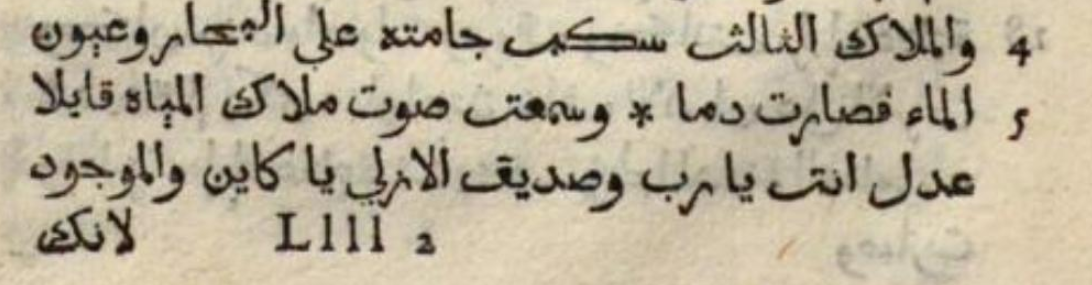
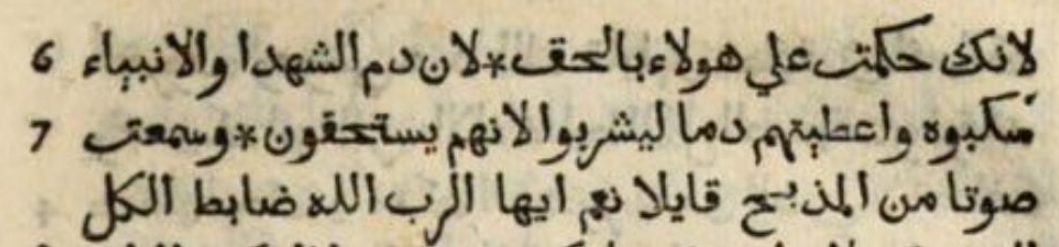
And the third angel poured his bowl solidly upon the rivers and springs of water, so they became blood. And I heard the voice of the angel of the waters saying: "You are just, O Lord, and righteous in judgments, for you were and are. Because you have judged these ones, for the blood of the martyrs and prophets they poured out, and you have given them blood to drink because they are worthy." And I heard an altar speaking loudly, saying: "Yes, O Lord God, Almighty of all."
My suspicion is that this may be a fresh Arabic translation from the Latin Vulgate. Others have suggested that the Vorlage was a Coptic edition. In any event, the "righteous in your judgments" points us back to an ultimate Greek exemplar with the word hosios.
Paris Polyglot (1630/1633, not sure which date is accurate here)


It is difficult to translate Arabic (particularly if one doesn't speak Arabic). The Latin translation provided reads: And I heard the angel of the waters saying: "Just you are O Eternal One, Oh Chosen One, because thus you have judged in these." However, I think that the "Oh Chosen One" is a mistranslation for "O Pure One," representing a Coptic Vorlage with a Coptic intended equivalent of hosios.
Walton's Polyglot (1657)
Walton's Polyglot has essentially the same Arabic and Latin as the Paris Polyglot (per Metzger: "The Arabic version of the Paris Polyglot was reprinted, with minor alterations in text and Latin translation, in Walton’s London Polyglot (1657). In the work on the Arabic text the editor was assisted by Edward Pococke, who also revised the Latin translation of the Arabic." The Early Versions of the New Testament, p. 266):


Biblia Arabica of 1671


A 1703 edition apparently provided a slightly different recension of that Erpenius (the text can apparently be found here). This one also had Roman Catholic involvement (read control), however.

