Saturday, August 16, 2025

Analyzing SoCal Preston's Rebuttal Material from his Previous Canon Debate

David "SoCal" Preston's Rebuttal arguments (in a debate with Steve Christie) were as follows:

1. "There is no such thing as an official King James Bible website."

Cambridge, which claims to have the official rights to the King James version, does have a website (for example, here). There are, however, lots of other websites out there promoting the King James version.  Ultimately, this point of Preston's rebuttal seemed to be a throw-away point.  The website mentioned by Preston's debate opponent does exist and does say what his opponent said.  I suppose ultimately Preston's point ought to be about the authority of the website, which is more of a "KJV fan" site, than being the official Cambridge University page.  The specific cited page can be found here: (link).

2. The Reformers "talked out of both sides of their mouth, there is definitely contradictions in what they say" 

Preston does not elaborate on this.  Preston's theory about the Reformers' words is one theory: a theory that the scholars he mentions were inconsistent.  Another theory is that Preston himself is confused.  I'm sure Preston does not love this alternative theory, but I think it's correct. 

3. It is "very un-scholarly" and "dishonest" to only define "Apocrypha" as "Spurious"

The Oxford English Dictionary (1913 ed.) defines Apocrypha this way:


As can be seen from this definition, the idea of "hidden" is etymologically related to the word, but the meaning of the word "Apocrypha" in English has a more specific meaning, with "Hidden" being a "rare" use of the word, not the use in connection with Scripture.

On the other hand, the meaning "without authority" is attested by Coverdale (in his translation of Erasmus' Paraphrase, in the introduction to Jude).  There are also multiple citations of examples for the usual meaning of "books ... having no well-grounded claim to inspired authorship", including examples from Golding and Hooker from the late 1500s, with the negative "lack of authority" connotation, not vague hiddenness.

The Oxford English Dictionary is certainly fallible and able to be corrected, but it is not even a little "un-scholarly" and its citation of Coverdale checks out, so it is not "dishonest," either.  Ultimately, it seems that Preston is the one who has not done his homework.

Preston offers the straw man that his opponents position is that labeling the books Apocrypha means saying that the books are "filled with lies and heresies."  But, of course, that's not what his opponent said.  Assuming that this was not deliberate on Preston's part, it seems to suggest some difficulty in understanding the difference between the books being non-inspired and the books being utterly worthless.

In his second rebuttal, Preston seemed to retreat a bit from his first rebuttal position and argued instead that "Apocrypha" can mean other things besides spurious and that the corresponding Greek word is translated by "hidden" in the New Testament (a point that seems utterly irrelevant).

Preston, however, re-emphasized the straw man "filled with lies" and suggested that the translators of the KJV spent seven years of their life translating these books, which does not seem to have been the case at all.  

4. The Hagiographa / Apocrypha / Ketuvim Connection

Preston tries to make a connection between the term, "Ketuvim," and the term "Hagiographa" and between the term, "Apocrypha," and the term, "Hagiographa."  

Preston tries to argue that the Great Bible used the term "hagiographa" instead of the word "Apocrypha."  He then said that the term "Hagiographa" refers to the "third section of the Hebrew Scriptures."  It should be noted, though, that Great Bible lists the "hagiographa" (as it calls them) as separate from what it identifies as the third section, and not as a "fourth section."   


As bad as this may seem, it gets worse for Preston.  The introduction to the "Hagiographa" section of the 1540 Great Bible says this:


According to this introduction, the reason for calling these books "hagiographa" is "because they were wont to be read, not openly and in common, but as it were in secret and apart" (spelling modernized).  This portion, Preston seizes upon to associate the Hagiographa with the "hidden" sense of Apocrypha.  However, the text continues: "And that also they are not received nor taken as legitimate and lawful, as well of the Hebrews as of the whole Church, as St. Jerome sheweth: we have separated them, and set them aside, that they may the better be known: to the intent that men may know of which books witness ought to be received, and of which not." (spelling modernized)

The association he is making is not altogether warrantless.  After all, this appears to be a minor revision of the same introduction from another Bible, with the word "Apocrphya" replaced by the word "Hagiographa".  Specifically, the so-called Matthews Bible, published by John Rogers in 1537 under the pseudonym, Thomas Matthew, had essentially the same introduction, but with the word "Apocrypha" rather than "Hagiographa."  


The International Journal of the Apocrypha explains the source of this introduction, and offers a patrial transcription with modern characters:

Behind the second title page in this Bible we have a new apologia for the separation of the Apocrypha from the other books of the Bible. This was literally translated from the French Bible of Olivetan published in 1535. It is in these terms: 

To the Reader 

In consyderacyon that the bokes before are founde in the Hebrue tongue receaved of all men and that the other fol owing which are called Apocripha because they were wont to be reade not openly and in comen but as it were in secret and aparte are neither founde in the Hebrew nor in the Chalde in which tonges they have not of longe bene written in lesse then it were happily the boke of Sapience whereupon it were now very harde to repaye and amende them And that also they are not receaved nor taken as legyttymate and leafull as well of the Hebrues as of the whole Churche as S Hierome sheweth we have separat them and sett them asyde that they may the better be knowen to thintent that men maye knowe of which bokes witnes ought to be receaved and of which not For the sayde S Hierome speakynge of the boke of Judith which is Apocriphe sayth that the autorytye thereof is not esteamed worthy and suffycyent to confyrme and stablysh the thynges that lyght in dysputacyon And generally of all the bokes called Apocripha he sayth that men maye reade them to the edyfyinge of the people but not to confyrme and strengthen the doctryne of the Churche I leave oute here the lawe as they call it of Canon c Sancta Romana xv distinct which sayth that men reade them but not in generall as though he shulde saye that generally and throuly they are not alowed And not without a cause For that they have been corrupted and falsyfyed in many places it appeareth sufficiently by Eusebius in his boke callud Historia Ecclesiastica Which thinge is easye to be knowen even now adayes in certen poyntes namely in the bokes of the Machabees whose second boke S Hiero confesseth that he founde not in the Hebrue by the meanes whereof it is become unto us the more suspect and the less receaved In lyke maner is it of the thyrde and fourthe boke of Esdras which S Hierome protesteth that he wolde not have translated esteamyng them for dreames whereas Josephus yet in his boke of his Antiquities declareth ye summe of the matter after the maner of a storye as well of the boke of Machabees as of the iii of Esdras althouh he esteame the bokes compyled from the raygne of King Artaxerses unto hys tyme to be Apocripha .....

(International Journal of Apocrypha, No. 33 (Series IX), April. 1913, p. 39)

On the other hand, the 1535 Coverdale Bible warned the reader thus:


In short, although there is an odd editorial choice to replace the word "Apocrypha" with the word "Hagiographa" in 1540, the warning about the books is still present.  My best bet is that the choice to substitute the word was political, coming from Thomas Cromwell, who was ultimately executed in 1540 or Thomas Cranmer, who apparently was involved in writing prefatory material for the version. (if Bryan Ross happens to read this, I suspect that the background regarding the multiple editions in 1540 may help reassure him of the accuracy of one of his sources)
(this colored title page to a 1539 printing shows Henry VIII flanked by Cranmer and Cromwell)

In his second rebuttal, Preston seems to emphasize that Jerome says that the Jews referred to the Apocrypha as Hagiographa.  He then says that this just means that the Jews considered these books to be part of the third section of the Scriptures.  He even says that "you can't debate" that Jews viewed the  Ketuvim ('Writings', which are eleven books by their counting) as having lower authority than the Torah (the five Books of Moses) and the Nevi'im (the Books of the Prophets).  First, we definitely can debate that assertion, if the claim is that Jesus viewed the Ketuvim as having lower authority.  Second, as a group, the Apocrypha were not part of the Ketuvim.  Whether Jerome uses the term "Hagiographa" for them or not, and whether or not Cranmer and/or Cromwell preferred the term "Hagiographa" for them or not, they are not properly categorized that way.

The Jewish Encyclopedia has its own interesting take (link to article):

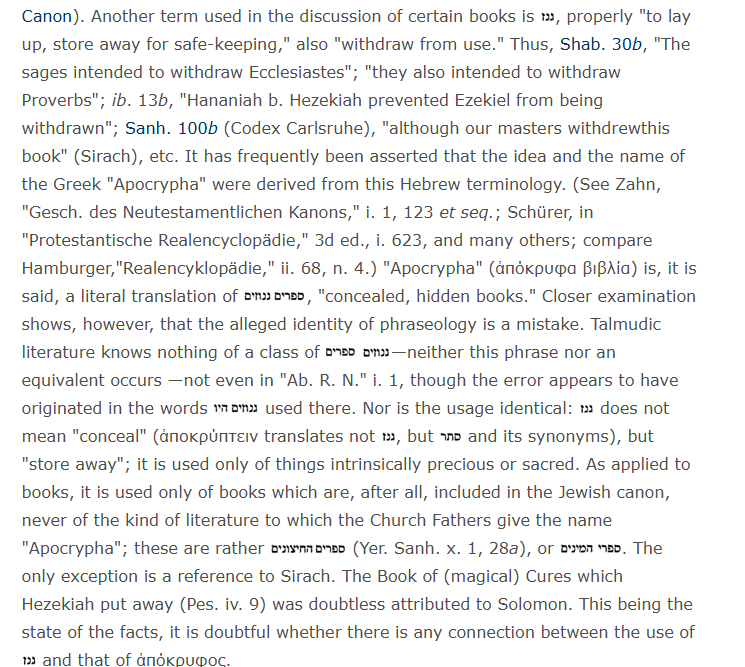
Another term used in the discussion of certain books is , properly "to lay up, store away for safe-keeping," also "withdraw from use." Thus, Shab. 30b, "The sages intended to withdraw Ecclesiastes"; "they also intended to withdraw Proverbs"; ib. 13b, "Hananiah b. Hezekiah prevented Ezekiel from being withdrawn"; Sanh. 100b (Codex Carlsruhe), "although our masters withdrewthis book" (Sirach), etc. 

The article goes on to deny that the term "Apocrypha" derives from Jewish usage. The article explains (link to article):

Nor is the usage identical:  does not mean "conceal" (ἀποκρύπτειν translates not , but  and its synonyms), but "store away"; it is used only of things intrinsically precious or sacred. As applied to books, it is used only of books which are, after all, included in the Jewish canon, never of the kind of literature to which the Church Fathers give the name "Apocrypha"; these are rather  (Yer. Sanh. x. 1, 28a), or . The only exception is a reference to Sirach. The Book of (magical) Cures which Hezekiah put away (Pes. iv. 9) was doubtless attributed to Solomon. 

As mentioned in the IJA (cited above), the prologue for the Coverdale Bible came from the French language Olivetan Bible of 1535.  Here is the cover page:
(531/877)
(532/877)
It's worth noting that the prologue in the Olivetan uses the French equivalents of Apocrypha (Apocryphe, Apocryphes), not the French equivalent of Hagiographa. 

5. "We don't know specifically what books [King James] thought were Apocrypha"

One of King James' most famous literary outputs was his, ""Basilikon dōron. Or His Majesties instructions to his dearest sonne, Henry the prince." Book 1 is "OF A KINGS CHRISTIAN DVETIE TO WARDS GOD." At pp. 9-10, he writes: "And as to the Apocriphe bookes, I omitte them, because I am no Papist, as I saide before, & indeed some of them are no wayes like the dytement of the Spirite of God." (source)

Preston behaves as though he is unfamiliar with associating books like Sirach with the Old Testament, while simultaneously considering them Apocrypha (example of this practice from 1604).  So, when Preston reads James summarizing a group of Cardinal Bellarmine's citations as being from "the Old Testament," Preston takes that as suggesting that James thinks that the cited material is inspired Scripture:

The Cardinall, in his booke of Controuersies bringeth sowerplaces of Scripture for probation of this idle dreame: two in the Olde Testament, Malachie and Ecclesiasticus, and two in the New, CHRIST in Matthew (hee might haue added Marke too) and Iohn in the xi. of the Apocalyps. (p. 63)

Now for that place of Ecclesiasticus; as the sonne of Syrach onely borroweth it from Ma∣lachie (as appeareth by these wordes of his, of conuerting the sonnes hearts to their Fa∣thers, which are Malachies owne words) so doth CHRISTS Comentary serue as well to interprete the one as the other: it being no shame for that mortall Iesus to bee commented and interpreted by the immortall and true IE∣SVS, though to the shame and confusion of the Iesuits heresies herein. But Enoch must bee ioyned to Elias in this errand, onely to beare vp the couples, as I thinke. For no place of Scripture speaketh of his returning againe, only it is said in Ecclesia∣sticus the xliiij, that Enoch pleased GOD, and was translated to Paradise, vt daret Gen∣tibus sapientiam, or poenitentiam; since they will haue it so.(pp. 66-67)

(source)

6. Preston says, of himself, that it "blows my mind" that King James would appeal to the fathers to reject the Apocrypha

The problem with Preston's thinking, of course, is that the study of the fathers is the same problem as the study of King James himself, but magnified in several ways, most especially that there are more authors to study and not all have explicit comments on the subject, like James did.  

Preston even half-acknowledges this, saying that the same kind of "contradiction" that he perceives in King James is found in the Reformers and early church writers.

7. The "Used to Build Doctrine" Argument

Preston thinks that the Apocrypha are "used to build doctrine," and consequently must be Scripture.  This is the fallacy of affirming the consequent.  

8. The King James lists the Apocrypha for Liturgical Readings

Preston puts stock in the fact that there were Church of England public readings of the Apocrypha amongst the liturgical reading of Scripture. 

9. Miles Coverdale claimed that Judith is Holy Scripture 

Preston says that this is in the same book that his opponent cited.

First, here's the material quoted, with the word "Judith" highlighted.

Here is a transcription from the version printed above:

Sidrach, Misach, and Abenago preserved he from the flaming furnace of burning fire; and Daniel he delivered from the devouring mouths of the hungry lions. Moyses, among the reeds and flags hid and hanged by the water-side in a basket, was restored again to his natural mother to be nursed of her. Paul was let down in a basket, and so escaped the hands of his persecutors. Susannah was preserved and defended pure and undefiled from [four words omitted] the false priests and judges. Judith, with much joy and victory, was delivered from the fiery violence and mighty power of all the enemies of God. These and many more godly ensamples be left in the holy scriptures, to the great comfort and consolation of them that suffer persecution for Christ's sake, according to the saying of Christ himself: "Blessed are all they which suffer persecution for righteousness' sake ; for theirs is the kingdom of heaven." Again, "as many as will live godly in Christ Jesus must suffer persecution."

One can easily see how that may sound as though the author is endorsing Judith and Susannah as being from the inspired and canonical Scriptures.  He does not say that they are, but since that's what we would mean when we say "holy scriptures," it's quite natural for us to assume that the author would have meant the same thing.  That said, however, it is important to note that the author in this case is a Dutch noble, and Miles Coverdale is the translator.

By contrast, in a work by Coverdale himself in the same volume, we find this:

It is a token, that your doctrine hath but a weak foundation, when ye go about to prove it by a dream, yea, and that out of such a book, as serveth not for the confirmation of the doctrine of Christ's church : for though it be read among the stories of other books, yet did not the church receive it among the canonical scriptures in St Hierome's time.[fn1: Sicut ergo Judith, et Tobise, et Machabseorum libros legit qmdem ecclesia, sed eos inter canonicas scripturas non recipit ; sic et hoc, &c. — Hieron. in Prov. Eccles. et Cant. Cantic. Praefat. Tom. in. p. 346. Antverp. 1579.]

I don't think the footnote is Coverdale's, though it does seem to accurately capture the sentiment of Jerome's to which Coverdale was referring.

In another place, we find Coverdale making the "canonical" qualification regarding Scripture:

Now as concerning the third, that is, praying for the dead and sacrificing for them, as in the other we confess, teach, and believe according to God's word, so do we in this; namely, that in holy scripture, throughout the canonical books of the old and new Testament, we find neither precept nor ensample of praying for any, when they be departed this life ; but as men die, so shall they arise : if in faith in the Lord towards the south, then need they no prayers ; then are they presently happy, and shall arise in glory : if in unbelief without the Lord towards the north, then are they past all help, in the damned state presently, and shall rise to eternal shame

("An Exhortation to the Carrying of Christ's Cross," p. 258)

The "canonical" qualification is necessary, because we do see an example of praying for the dead in 2 Maccabees.

Thursday, August 14, 2025

The Apocrypha and the 1611 King James - a Series by Bryan Ross

In preparation for an upcoming debate on several books in the King James Version's "Apocrypha" section, I came across a very interesting series of five videos by Bryan Ross (link to playlist).  I felt like there is very little I could criticize about this series, and what little criticism I could offer would be things as trivial as what I believe to be "speak-os" by Ross or in one place where I think he conflated "wont" (the somewhat archaic English word) with "want" due to the quality of the scanned document he was reading from.    

Ross offers a brief gospel presentation at the end of each video, but I don't know anything (either good or bad) about Ross' theology more generally. I definitely found his research regarding the word "Easter" to be very helpful in advancing the issue of the KJV's usage of that term in one place in the New Testament (it certainly was helpful in persuading me to revise my own position).  I must acknowledge that I did not attempt to fact-check things like his presentation of data on how many editions of the KJV include the apocrypha.   I did not see any videos replying his series, if they exist.

His series refers to an article of his, which I think he either did or was planning to minorly revise.  A version of this article was criticized by SoCal Preston in a video, which prompted Ross's response.  I believe the article (in some form) can be found at the following link (link).

The general takeaway from the series (and the article itself) is that the inclusion of the Apocrypha in the 1611 KJV should not be taken as suggesting that King James himself, nor the translators individually or collectively, in any way considered the Apocrypha to be Scripture, in the sense of being inspired, canonical writings.  One minor caveat I would offer is that in the 1500s and 1600s, some authors still used the word "Scripture" or even "Old Testament" to describe non-canonical and uninspired books in a way that we would not today.  There is a lot more that could be said on this point.


Postscript/Update:

Bryan Ross's playlist stands in stark contrast to a video called, "The Apocrypha Apostasy," which - while it raises a few points of interest, I cannot recommend.  The biggest point of interest was that the TAA video, toward the end, names two other gentlemen (not Mr. Preston) who are also trying to advocate for the Apocrypha while still apparently remaining some kind of Non-Roman Catholic.  

Friday, July 04, 2025

Gregory of Nazianzen and the Grammar of the Johannine Comma

Gregory Nazianzen (aka Gregory of Nazianzus) (329-390), in his Fifth Theological Oration (Oration 31), section XIX, is sometimes quoted in the battle over the Johannine Comma, because he provides one of the more notable citations of 1 John 5:7-8.  As Gregory was a Greek speaker, one presumes he did not have access to the Latin interpolation, known as the Johannine Comma, but only to the original Greek of the epistle.

Recently, certain folks have tried to argue that there is some kind of glaring grammatical error in the text of 1 John, one that would be obvious to any Greek speaker, and consequently one that would call out for correction.  The Latin interpolation is then brought forward as the possible correction to this supposed error in God's Word.

Gregory provides useful insight as someone who was fluent in Greek and who was specifically interested in Greek grammatical rules.  It is worthwhile, therefore, to consider his comments: not as being an infallible interpreter, but rather as being someone who commented on the grammatical issue before the grammar of the text was ever used to try to justify the Latin interpolation of the three heavenly witnesses. 

First, a word about the translation.  I found this interesting observation from Stephen Reynolds, who provided his own translation (link).  Reynolds writes:

The standard English translation of Gregory’s Five Theological Orations has been the one produced by Charles Gordon Browne and James Edward Swallow for the Library of Nicene and Post-Nicene Fathers, volume 7 (1893). I have used this translation in the past, but with mounting misgivings. So, for this course, I went back to the Greek text and began to revise Browne and Swallow’s version. It turned out to be a major undertaking. Browne and Swallow produced a truly awful translation – it is so literal as to be incomprehensible as English, and at many others points it is not only inaccurate but downright wrong. In my revision, I have used The Five Theological Orations of Gregory of Nazianzus, ed. Arthur James Mason (Cambridge: Cambridge University Press, 1899); and besides the Greek text there established, it will be clear that I have been heavily indebted to Mason’s notes on the text.

For those who would like to check the Greek, Mason's Greek is this (link):

I am not here to focus on the claims of Reynolds, as such, but rather to highlight the value of updating translations of works that were previously translated in the Schaff series (Nicene and Post-Nicene Fathers).

First, the Browne and Swallow translation (from the CCEL):

XIX. But to my mind, he says, those things are said to be connumerated and of the same essence of which the names also correspond, as Three Men, or Three gods, but not Three this and that. What does this concession amount to? It is suitable to one laying down the law as to names, not to one who is asserting the truth. For I also will assert that Peter and James and John are not three or consubstantial, so long as I cannot say Three Peters, or Three Jameses, or Three Johns; for what you have reserved for common names we demand also for proper names, in accordance with your arrangement; or else you will be unfair in not conceding to others what you assume for yourself. What about John then, when in his Catholic Epistle he says that there are Three that bear witness, the Spirit and the Water and the Blood? Do you think he is talking nonsense? First, because he has ventured to reckon under one numeral things which are not consubstantial, though you say this ought to be done only in the case of things which are consubstantial. For who would assert that these are consubstantial? Secondly, because he has not been consistent in the way he has happened upon his terms; for after using Three in the masculine gender he adds three words which are neuter, contrary to the definitions and laws which you and your grammarians have laid down. For what is the difference between putting a masculine Three first, and then adding One and One and One in the neuter, or after a masculine One and One and One to use the Three not in the masculine but in the neuter, which you yourself disclaim in the case of Deity? What have you to say about the Crab, which may mean either an animal, or an instrument, or a constellation? And what about the Dog, now terrestrial, now aquatic, now celestial? Do you not see that three crabs or dogs are spoken of? Why of course it is so. Well then, are they therefore of one substance? None but a fool would say that. So you see how completely your argument from connumeration has broken down, and is refuted by all these instances. For if things that are of one substance are not always counted under one numeral, and things not of one substance are thus counted, and the pronunciation of the name once for all is used in both cases, what advantage do you gain towards your doctrine?

Stephen Reynolds' translation:

§ 19. “But to my mind,” our opponent says, “those things are said to be numbered together and of the same essence when they are reciprocally designated by the same name – for example, ‘three humans’ or ‘three gods’. But this does not apply to a group of three composed of different things.” What does this retort amount to? It befits someone laying down the law as to names, not to one who is asserting the truth. I also will concede that Peter, Paul, and John are not three and are not “of the same being [homoousioi],” insofar as I cannot say “three Peters,” or “three Pauls,” or “three Johns”. counting them under one designation [i.e. “master”] despite the vast difference between them, I should probably be even more ridiculous in your eyes for my method of numbering things together.

What does John say? In his Catholic Epistles he says: There are three that bear witness: the Spirit and the water and the blood. For what you have reserved for names which are common to a general class of things, we claim – in conformity with your analytical figment – for proper names as well; otherwise, you will be unfair in not conceding to others what you arrogate for yourself.  Do you think he is talking nonsense? – Talking nonsense, first, because he has been so bold as to assign a single numeral to things which are not “of the same being [homoousia],” though you say this ought to be done only in the case of things which are “of the same being”. For who would assert that these three “witnesses” have the same essence? Talking nonsense, secondly, because he has not been consistent in the way he happened upon his terms. For after using three in the masculine gender [τρεις – treis], he adds three words which are neuter [τα τρια – ta tria], contrary to the rules and regulations which you and your grammarians have laid down. For what is the difference between putting a masculine-gender three first, and then adding one and one and one in the neuter gender, or after a masculine-gender one and one and one to use the three not in the masculine but in the neuter gender? Is this not what you yourself reject in the case of the divinity?

What have you to say about the word καρκινος [karkinos], which can mean an animal, an instrument, and a constellation? And what about the word “dog”? – now something which runs on the ground, now something which swims in the sea, now something which sits in the heavens? Do you not see that three crabs or three dogs are being spoken of? – “Why, certainly.” – Well then, are they therefore of the same essence [homoousia]? – “Only a fool would say that.” – So you see how completely your argument – that only things of the same essence [homoousia] can be counted together – has broken down, and is refuted by all these instances. For if things of same essence are not always designated by the same numeral, and things not of the same essence can be designated by the same numeral, and if the nouns in both cases are stated with the numerals – what remains of your teachings?

There is also a Williams & Wickham translation:

But, someone may say, what I am talking about is things of the same substance being counted together that have nouns, which are mentioned as well, to match them. For example: Three men, three gods—not three odds and ends.

What answer are we to make? This is the behavior of a man who lays down the law for words, not one who uses them to speak the truth. What I am talking about is Peter, Paul, and John’s not being three or consubstantial, so long as three Pauls, three Peters, and as many Johns cannot be spoken of. We shall demand that you apply to more specific nouns the new-fangled rule you have kept to in the case of the more generic ones. Or will you break the rule by not conceding whatever rights you have assumed? Why does John in the Catholic Epistles say that there are “three who bear witness, the Spirit, the water, and the blood?” Is he not talking nonsense in your opinion? First, because he has been rash enough to count together things that are not consubstantial—and that right you only allow to things that are consubstantial. Who could call these “of one substance”? Secondly, because he happens to have got his grammar wrong. He puts the Greek word for “three” in the masculine and then tacks on three words in the neuter, in defiance of your definitive rules of grammar. Yet what is the difference between putting “three” in the masculine and tacking on single things in the neuter, and using “one” thrice in the masculine without calling them “three” in the masculine but instead “three” in the neuter? This is the very proposition you reject in the case of the Godhead!

What do we make of the fact that the same Greek word can mean the animal a crab, a pair of tongs, or the sign of the zodiac, Cancer? What about the word that can denote a dog, a dog-fish, or the dog-star in the sky? Do you not agree that people talk about “three crabs” or “three dogs”? Of course you do. Does that mean that they are of the same substance? What man in his senses would assert that? You see how your argument about counting things together has collapsed under the weight of so many proofs to the contrary. If consubstantial things are not always counted together and nonconsubstantial things are counted together, and if in both cases nouns are used along with the numerals, what is left of your doctrinaire pronouncement?

Gregory's explanation is significant in three respects.

First, Gregory is not aware of any interpretation of "Spirit, water, and blood" as being Father (who is spirit), Spirit (who hovered over the water), and Son (who shed his blood on the cross).  If He did hold to such an interpretation, he would certainly not deny that Spirit, water, and blood are consubstantial.  In context, Gregory is arguing that the Father, Son, and Holy Spirit are consubstantial, but his opponent is arguing that they are not.

Second, Gregory is aware of the difference in gender between "three" and the nouns that follow, and of the fact that this violates the gender agreement rule, but he does not think this means that the text needs to be corrected.  

Third, Gregory discards the supposed "consubstantiality rule" as a being a legitimate grammatical rule.  This is, of course, less relevant to the argument of the advocates of the Latin interpolation. 

I suppose we could add that if Gregory were aware of the so-called TR reading of 1 John 5:7-8, it would be so helpful to his argument on this point, that it seems impossible that he would not cite it.  It would satisfy his objector's so-called rule, and it would support his view that the Holy Spirit is consubstantial with the Father and the Son.

So, Gregory's citation is a powerful testimony that the Greek of 1 John 5:7-8 as it is found in the Greek manuscripts today was also the Greek of 1 John 5:7-8 in the 4th century.  This conclusion is further supported by the fourth century manuscripts of 1 John that we have. 

Tuesday, July 01, 2025

Assyrian Church of the East and the Canon

In 2006 (apparently), "The Rev’d C H Klutz, B.A., B.Th., M.Th." and "The Rev’d George Toma, B.A., M.A., D.Min," released a "Catechism," which their forward describes in these words: "We had laid before us a work which would involve many long hours and serious thought. It is the teaching (dogma) embraced within The Holy Apostolic Catholic Assyrian Church of the East. These are the Orthodox, Sacred Traditions and teachings."

The catechism offers the following definition of "Holy Scriptures":

4) What is that which you call “Holy Scriptures”?

The Holy Scriptures is a collection of books written under the inspiration of the Spirit of God, through men who were sanctified by God, these men are known as Prophets and Apostles. These books of Sacred Scriptures are collected, canonized, and are entitled “The Holy Bible.” It is written: “. . . all Scripture is given by inspiration of God, and is profitable for doctrine, for reproof, for correction, for instruction in righteousness.”(II Timothy 3:16)

I bring this up in case someone might question what canon they have in mind, such as suggesting that they are merely reproducing a Jewish canon.

When it comes to discussing the Old Testament, they write:

7) We number how many books for the Old Testament?

According to the earliest records of The Church, we have a system of numbering which may confuse the faithful; however let us state that there are a total of 46 books of the Old Testament. The early Church Fathers number a total of 22 Old Testament books, having arrived at that particular, number agreeing with the Jerusalem Jewish community, who had so reckoned them with the ancient original “Hebrew” tongue.

8) Why do we need to assent to the Jewish Jerusalem reckoning of these books?

We refer you to the writings of St Paul the Treasurer of the Church, where he states in the Epistle to the Roman Church, “. . . much every way: chiefly, because that, unto them was committed the oracles of God.” (3:2), which is by interpretation, meaning simply, that The Holy Writings of the Old Testament had been received from the Hebrew Church (in Jerusalem) by the Christian Church of the New Testament of Jerusalem.

Notice that this reasoning is similar to our view.  The church is not authorized to add to the Old Testament: we just receive what was handed down.  They then go on to provide the 

9) How do the Church Fathers of the early Church enumerate The Books of the Old Testament?

 1. The Book of Genesis;

 2. The Book of Exodus;

3. The Book of Leviticus;

4. The Book of Numbers;

5. The Book of Deuteronomy;

6. The Book of Joshua, son of Nun;

7. The Book of Judges, and with it as an appendix

 The Book of Ruth;

8. The I & II Books of Kings, as two parts of one

9. The III and IV Books of Kings;

10. The I and II Paralipomenon (I & II Chronicles);

11. The I Book of Esdras, and the II or, as it is

 Named in Nehemiah;

12. The Book of Esther;

13. The Book of Job;

14. The Psalms;

15. The Proverbs of Solomon;

16. The Ecclesiastes, also by Solomon;

17, The Song of Songs, also by Solomon;

18. The Book of the Prophet Isaiah;

19. The Book of Jeremiah;

20. The Book of the Prophet Ezekiel;

21. The Book of the Prophet Daniel;

22. The Book of the Twelve Prophets.

Notice that this is is simply the same canon as the Protestant Old Testament canon.  However, for the ACE folks, this raises a natural next question:

10) We have other Old Testament Books, but they are not noted here, such as The Wisdom of the son of Sirach, and of others, why?

These books do not exist in the Hebrew language, but they are in the Greek texts.

11) How does the Church of the East regard these other books which are not included in the original Hebrew?

St Athanasis, as a Church Father, had declared that these books were included in the reading requirements of the proselytes who are preparing for admission into the Holy Church through Holy Baptism.

Now, unfortunately for them, they go on also to have twenty-two book New Testament canon, by excluding II Peter, II John, III John, Jude, and Revelation.  They also make other errors, such as affirming the perpetual virginity of Mary and insisting on including an Icon of Christ as one part of the liturgical environment of the "Holy Qurbana" ("Holy Offering").

My reason for citing this catechism is, of course, not for endorsement of that catechism. Instead, I point it out as being of interest to folks who try to suggest that there is something "Protestant" about the 22 book Old Testament canon.  For those have the same question as I do, as to why "Lamentations" is not separately listed from Jeremiah, I have no good answer - perhaps it is just a typographic error in the Catechism.

The "46" number seems to be the 39 of the protocanon plus the seven deuterocanonical books, although they do not enumerate the deuterocanonical books.  Moreover, when discussing prayers for the dead, they write:

18) Can we substantiate through the Sacred Writing that the prayer intentions offered in behalf of the righteous deceased will benefit the soul departed?

Consider the book of Maccabees (II Maccabees 12:43) at the time of Judah who had sent to Jerusalem an offering to be presented for forgiveness at the Temple for one who had died. ...

They do go on to use actual Scripture, and it seems clear that they do not accept the Western invention of Purgatory.  To wit:

9) Where or in what state are the souls of the deceased kept until the Day of the General Resurrection?

They are kept in a place called Sheol or Abraham’s Bosom. This place is also called Paradise, the Land of the Light or the land of The Rest. Those righteous souls are kept in that land of Perpetual Light or in the Presence of Jesus our Lord; it is only a foretaste of the glorious promises of our Lord and God. Whereas the wicked and ungodly will be kept in the lower regions of Sheol which is the region of darkness and torments, and is only a foretaste of eternal damnation. The Church Fathers have written for us: “. . . as to the wicked, they shall remain upon the earth in darkness, in which none can walk, and shall be consumed with the flames of remorse; for those which denied Him, their sinfulness betrayed everlasting bliss for the temporal and deceptive enjoyments and a real possession for the dung of the Earth. This is the true Hell,’ whose fire will not quench and the worm will not die’... ” (Matthew 25:30-41, see also, Luke 16:19-26)

So, they are not Roman Catholics (even though they make some errors in common with Roman Catholics), and they are not Protestants (even though they agree with us on a number of important issues). 


Thursday, June 19, 2025

Did Augustine Change his Mind on the Canon?

In his Revisions (aka Retractiones), Augustine offers a number of corrections to his previous work.  He is the only author that comes to mind as having engaged in such systematic self-criticism.  The recent translation of his works "The Works of Saint Augustine: A Translation for the 21st Century," uses the title "Revisions," while some others have used "Retractions."  Retractions is a more natural cognate, but Revisions is probably more accurate as an overall description of his work.

One of the revisions he proposes relates to his Two Books on Genesis Against the Manichaeans.  The citation is Revisions, First Book, 10 (9), section 3, he writes (p. ):

Again, I do not seem to have been correct in referring to what is written, Why are earth and ashes proud? (Sir 10:9), as prophetic words, because they are not read in the book of someone who we are certain ought to be called a prophet.

The reference is to what Augustine said in On Genesis: A Refutation of the Manichees, Book II, 5 (6) (trans. from the WSAT21 series, vol. I/13, p. 74):

When the soul was being watered by such a spring as that, it had not yet "cast out its innards" through pride. The beginning, you see, of man's pride is to apostatize from God (Sir 10:12); and since his swelling out through pride to exterior things has put a stop to his being watered from that interior spring, he is very properly jeered at by these words of the prophet, and told: What has earth and ashes to be proud of, since in its lifetime it has cast out its innards? (Sir 10:9).

Later on, in Revisions, Second Book, 4 (31), section 2, he writes (p. 113):

In the second book, concerning the author of the book that many call the Wisdom of Solomon, namely, that Jesus Sirach wrote it just as he did Ecclesiasticus, I afterwards learned that this was not as agreed upon as it was said to be by me, and in all probability the book's author is not discoverable.

When I said, "The authority of the Old Testament is confined within these forty-four books," I referred to the Old Testament according to the Church's customary way of speaking. The Apostle, however, seems to refer only to what was given on Mount Sinai as the Old Testament.

Finally, in Revisions, Second Book, 20 (47), he writes (p. 128):

In the first [book], then, it did not occur to me that what I said about the manna--that it tasted in each person's mouth as he himself wished it to-- could not be demonstrated by any text apart from the Book of Wisdom, which the Jews do not accept as having canonical authorship. 

The "first [book]" in question is found in Augustine's works as Letter 54, and the specific citation is Letter 54,3,4. (trans. from the WSAT21 series, Letter 54, p. 212)

It also serves as a comparison in that in the earlier people the manna tasted in the mouth of each one as the individual wanted, just as that sacrament by which the world is conquered has a different taste in the heart of each Christian.

What's particularly interesting here is that Augustine's original argument does not hinge on Jewish acceptance of his argument.  He's writing to Januaris and the section is dealing with the sacrament of the Lord's Supper. Why is Jewish acceptance relevant? The only answer staring us in the face is a tacit acknowledgment that Jerome is right about the canon.  Maybe the churches read and use Sirach and Wisdom, but they do not have full canonical status to establish doctrine.  Likewise, Wisdom is neither a book by Solomon (as originally thought by the North African councils) nor even a book by Jesus Ben Sira (as had been speculated).  Instead, it's a book of uncertain authorship, despite its obvious claims to be by Solomon.

Wednesday, June 18, 2025

Abbot Pirminius: a Witness Against Purgatory

Abbot Pirminius, also known as Saint Pirmin, (c. 670 to 753)  is attributed with a fascinating treatise that has attached to it the title, "Scarapsus de singulis libris canonicis."  The title of the book itself is what initially caught my eye, since to first glance it would seem to imply something like "Extracts from each of the canonical books."  Naturally, therefore, I was rather disappointed to discover that the contents were not some kind of canonically ordered set of quotations from Scripture. As noted in my initial sentence, the authorship of the work is not something that is well-established. 

Indeed, I'm not sure that the title fits the book.  The book is more of a set of canons for behavior derived from the Bible (some more explicitly than others: many are direct quotations with citation). Now, certainly there are errors in Abbot Pirminius' hamartiology: he is not representative of later Protestant orthodoxy.  In particular, Pirminius has adopted the idea (drawn presumably from Tobit) that doing alms can purge one's personal sins. Nevertheless, it is fascinating to note the absence of Purgatory in his discussion of sin.  

The final substantive paragraph of the work is this exhortation to right living:

Let no one deceive himself, brothers, because every man who, after baptism, commits mortal crimes— such as murder, adultery, fornication, theft, false testimony, perjury, drunkenness, or any similar mortal crimes—if he has not done penance, has not given just alms, and has not persevered in good works, he will never enter the kingdom of God nor possess eternal glory; rather, he will descend with the devil into hell, because the Apostle says: “Those who do such things will not inherit the kingdom of God.” 

Therefore, it is written: “By no means does God spare the sinner,” for He either strikes the sinner with temporal scourging to purify him, or leaves him to be punished by eternal judgment, or the man himself, by punishing himself, purges what he has done wrong. So then it is justly said that God does not spare the one who sins. 

And elsewhere it is written: “God leaves no sin unpunished”—that is, without vengeance— because surely either we ourselves punish our sins here by penance, or God punishes them with the severity of judgment.

And believe with certainty this: that every man, however much a sinner, however much a criminal he may have been, no matter how great the evils he has committed—if he has done true penance, has given just alms, and death finds him in good devotion with righteous deeds, he will never go to hell, but will be lifted up by the angels into heaven, and will possess eternal glory.

Wherefore the Lord said: “He will not be judged twice for the same thing.” And the Apostle says: “If we judged ourselves, we would not be judged by the Lord” — that is, he who in this present life judges himself by penance will not be judged again, if he finishes his life in this present world in such a state. Hence it is written: “If we do perfect penance, not only does God forgive our faults, but after our faults, He promises rewards.”

Nemo se circumveniat, fratres, quia omnis homo qui post baptismum mortalia crimina committit, homicidium et adulterium, fornicationem, furtum, falsum testimonium, perjurium, ebrietatem, vel his similia mortalia crimina perpetratus fuerit, si poenitentiam non egerit, et eleemosynas justas non fecerit, et in bonis operibus non perseveraverit, nunquam intrabit in regno Dei, nec possidebit gloriam aeternam; cum diabolo descendet in inferna, quia Apostolus dicit: Qui talia agunt, regnum Dei non possidebunt. Proinde scriptum est: Nequaquam Deus delinquentibus parcit, quoniam peccatorem aut flagello temporale ad purgationem ferit, aut aeterno judicio puniendum relinquit, aut ipse in se homo quod male commisit, puniendo purgat. Ita proinde est quod Deus delinquenti non parcit. Et alibi scriptum est: Nulla peccata inulta dimittit Deus, hoc est, sine vindicta, quia certe aut nos hic vindicabimus peccata nostra per poenitentiam, aut vindicat illa Deus per severitatem judicii. Et illud certissime credite, quod omnis homo, quamvis peccator, quamvis criminosus fuisset, quanta mala perpetrasset, si veram poenitentiam egerit, eleemosynas justas fecerit, et in bona devotione cum operibus justis mors illum invenerit, nunquam infernum, sed ab angelis elevatur in coelum, et gloriam possidebit aeternam. Unde Dominus dixit: Non judicabitur bis in idipsum. Et Apostolus dicit: Si nos judicaremus, utique a Domino non dijudicaremur, hoc est, ut ille qui hic in praesentem vitam seipsum per poenitentiam judicat ad judicium, iterum non dijudicabitur, qui hic in praesente vita terminabit. Unde scriptum est: Quod si nos perfecte poenitentiam agimus, non solum nostras culpas Deus dimittit; sed post culpas praemia promittit.

Notice that Pirminius offers only two options: (1) "he will descend with the devil into hell" (cum diabolo descendet in inferna) or (2) "he will never go to hell, but will be lifted up by the angels into heaven, and will possess eternal glory" (nunquam infernum, sed ab angelis elevatur in coelum, et gloriam possidebit aeternam).  There is no third way, where the person goes to hell for a bit to be purged, before going to heaven, nor any third place, such as Purgatory.

There is one place where Pirminius offers three options: "Therefore, it is written: “By no means does God spare the sinner,” for He either strikes the sinner with temporal scourging to purify him, or leaves him to be punished by eternal judgment, or the man himself, by punishing himself, purges what he has done wrong" (Nequaquam Deus delinquentibus parcit, quoniam peccatorem aut flagello temporale ad purgationem ferit, aut aeterno judicio puniendum relinquit, aut ipse in se homo quod male commisit, puniendo purgat).  In short the three options are (1) God punishes in this life, (2) God punishes us with eternal judgment, or (3) we punish ourselves.  There is no option "God punishes us in the afterlife with something less than eternal judgment."

While this is not Purgatory, it is still both hamartiologically and soteriologically flawed, and in a serious way.  God punished Christ for our sins. That is the way by which God leaves no sin unpunished. We may be chastised or disciplined in this life because of our sins, but the punishment of the sins is borne by our Savior.  Moreover, the guilt of sin is too great for us to somehow expiate it through self-inflicted punishments in this life.  So, Pirminius has simultaneously underestimated the severity of sin and the role of Christ in taking our sin debt on Himself.

So, I do not post this extract of the Extract by way of approval, except inasmuch as it avoids adopting the fiction of Purgatory.

Tuesday, June 17, 2025

Lamy on the Complutensian Polyglot and the Rhodian Codex

The American Ecclesiastical Review, Vol. XVII (Vol. VII of new series) (1897) included an article, "The Decision of the Holy Office on the Comma Joanneum," by "The Right Rev." Thomas Jos. Lamy, D.D., University of Louvain, Belgium, which runs for over 30 pages starting from p. 449.  

The subject of the Complutensian and its alleged sources comes up a few times:

"Within a few years, the Polyglotta Complutensis, the publication of which had been retarded a long time, finally appeared. It contained a Greek text of the New Testament printed before that followed by Erasmus, and there was the celebrated verse.¹

FN1 Most likely after the Codex Rhodiensis of which Stunica speaks."  (p. 452)

"And previous to that, Lopez Stunica had called Erasmus' attention to the Codex Rhodiensis, which likewise had the verse." (p. 477)

"But two other codices are cited for it : the Codex Rhodiensis of Stunica, and the Codex Britannicus of Erasmus, which by some is held to be the Codex Monfortianus of Dublin." (p. 480)

As we have seen, however, Stunica does not say that the Rhodian codex has the reading of the CP, but instead says that the Greek is corrupt (which is not how he describes the Greek when citing the Rhodian codex). Of course, Lamy himself could not tell anyone where the Rhodian codex was, much less could he produce any collation of its various readings.

To try to buttress the Complutensian text, he states:

The Codex Ravianus which is in the Library of Berlin, has the verse in the same terms as the Editio Complutensis. Tischendorf claims that it belongs to the seventeenth century and Martin declares it to be only a copy of the Editio Complutensis; but the matter remains doubtful despite the assertions of Wetstein, of Griesbach, of Tapelbaum and of Martin." (p. 476)

The Codex Ravianus has indeed been demonstrated to be a copy of the Complutensian Polyglot (see the discussion of manuscript 110 here, for example).  It is not included in the GA list of NT manuscripts for that reason.

As for the Rhodian Codex, its identity remains a mystery, despite the efforts of some great scholars to track it down (see the discussion in Bentley, J. H. (1980). NEW LIGHT ON THE EDITING OF THE COMPLUTENSIAN NEW TESTAMENT. Bibliothèque d’Humanisme et Renaissance, 42(1), 145–156.)

Of particular interest to my ongoing discussion with some pro-CJ folks, Bentley's article notes that the then-recently analyzed annotations did not cover 1 John 5:7-8, alone among the four major notes in the Complutensian Polyglot.  

Monday, June 16, 2025

Stunica's Annotations on 1 John

In a previous post, I focused on the secondary (with a nod to the tertiary) literature on the relationship of Stunica's alleged testimony to the Johannine Comma. However, upon reading his annotations (which can be found here), it seems that Stunica agrees that the Complutensian Polyglot reading was not following a Greek codex, but was correcting the Greek based on the Latin, as my first post in this series had already suggested.  Stunica argues, "in this place the Greek codices are most clearly corrupted," but argues for the originality of a longer reading from a ps-Jerome prologue to the Catholic epistles.  The Rhodian Codex (Codex Rhodiensis).

Interestingly enough, I find myself in the company of Isaac Newton, who wrote (Two Notable Corruptions ...):

A third reason why I conceive the Complutensian Greek to have been in this place a translation from the Latin is because Stunica, who, as I told you, was one of the Divines employed by the Cardinal in this Edition & at that very time wrote against Erasmus, when in his Objections he comes to this text of the testimony of the three in heaven, he cites not one Greek Manuscript for it against Erasmus, but argues wholly from the authority of the Latin. On the contrary he sets down by way of concession, the common reading of the Greek Manuscripts (his own & others,) in these words Ὅτι τρεις ἐισιν ὁι μαρτυρουντες τὸ πνευμα καὶ τὸ ὑδωρ καὶ τὸ ἁιμα καὶ ὁι τρεις ἐις τὸ ἕν ἐισι, & then he condemns them all together without exception & justifies the Latin against them by the [] authority of Jerome. Be it known, saith he, that in this place the Greek Manuscripts are most evidently corrupted, but ours (that is the Latin ones) contain the truth itself as they are translated from the first original. Which is manifest by the Prologue of S. Jerome upon the Epistles, &c And this Prologue ... is all he urges in favor of the testimony of the three in heaven. In other places of scripture where he had Greek Manuscripts on his side, he produces them readily. ... After this manner does Stunica produce the manuscripts used in the Complutensian edition when they make for him & here he produces them too but 'tis for Erasmus against himself. Know, saith he, that in this place the Greek manuscripts are most evidently corrupted. In other places if he hath but one manuscrip {sic} on his side, he produces it magnificently enough, as the Codex Rhodiensis in his discourse upon 2 Cor. 2.3 James 1.22. 2 Pet. 2.2. & other texts: here he produces all the Manuscripts against himself without excepting so much as one. 

For those interested, the following are all the annotations of Stunica on 1 John (first my halting translation and then the Latin).

*** 

FROM THE FIRST EPISTLE OF JOHN, CHAPTER I

Old translation. What has been (fuit) from the beginning.

John. ὃ ἦν ἀπ’ ἀρχῆς.

Erasmus. What was (erat) from the beginning.

And in the annotations. What has been (fuit) ὃ ἦν, that is, what was (erat).

Stunica. It must be known that the word ἦν among the Greeks signifies both has been (fuit) and was (erat). For in the conjugation of the substantive verb, the παρατατικὸς and παρακειμένος, that is, the imperfect past and the perfect, are placed together, such that a single word—namely ἦν—serves for both: for there are not, as in Latin, distinct words for these tenses in the verb εἰμί, that is, I am. For which reason, this passage may be rendered in either way—namely, what has been (fuit) from the beginning or what was (erat) from the beginning.

[TF note: it's actually also similarly challenging to express "past imperfect" of "to be" in English in contrast to the perfect of "to be".  The main nuance of meaning is that "fuit" implies completion, whereas "erat" does not necessarily imply completion. Normally, we would just translate either Latin word as "was", but the different translation above is to try to bring out Stunica's point.]

FROM CHAPTER III

Old translation. In this we have known the love of God.

Erasmus in the annotations. Of God is superfluous according to the Greek codex.

Stunica. In the Rhodian Greek codex of the apostolic epistles, which we have often cited, of God was read in this place: for it has ἐν τούτω ἐγνώκαμεν τὴν ἀγάπην τοῦ θεοῦ, and it is necessary that of God be added, because it follows: because he laid down his life for us.

FROM CHAPTER V

Old translation. For there are three who bear witness in heaven: the Father, the Word, and the Holy Spirit, and these three are one. And there are three who bear witness on earth: the Spirit, the water, and the blood, and these three are one.

John. Ὅτι τρεῖς εἰσιν οἱ μαρτυροῦντες, τὸ πνεῦμα καὶ τὸ ὕδωρ καὶ τὸ αἷμα καὶ οἱ τρεῖς εἰς τὸ ἕν εἰσιν.

Erasmus. For there are three who bear witness: the Spirit, and the water, and the blood, and these three are one.

And in the annotations. In the Greek codex I find only this concerning the threefold witness, etc.

Stunica. It must be known that in this place the Greek codices are most clearly corrupted, but our Latin ones [TF note: literally the Latin word here is "our" in a plural form; the implication is that while the codices of the Greeks - in the Greek language - are corrupted, the codices of the Latins - in the Latin language - are not; see, for confirmation, Sir Isaac Newton's translation, above] contain the very truth as it was delivered from the beginning. This clearly appears from the prologue of blessed Jerome on the canonical epistles. For he says: If those things which were arranged by them had likewise been faithfully translated by the interpreters into Latin expression, they would cause no ambiguity for readers; nor would the variety of expressions contradict each other—especially in that place where, in the First Epistle of John, the unity of the Trinity is set forth. In which also we have found that the unbelieving translators erred much from the truth of the faith, since they placed in their edition only three words—namely, water, blood, and spirit—and omitted the testimony of the Father, the Word, and the Spirit, in which the Catholic faith is most strongly confirmed, and the one substance of divinity of the Father and the Son and the Holy Spirit is established.

Old translation. That we may know the true God.

Erasmus in the annotations. God is not in the Greek, but τὸν ἀληθινόν, that is, him who is true.

Stunica. God is in the Greek. For indeed in the Rhodian codex, of which we spoke above, it is read in this place: ίνα γινώσκωμεν τὸν ἀληθινόν θεόν, that is, that we may know the true God. And thus also Ambrose reads it in the first book On the Call of All Nations, chapter 6 [TF note: although often associated with Ambrose, Prosper of Aquitaine is the correct author, not Ambrose.  The citation in the ACW series would be St. Prosper of Aquitaine, The Call of All Nations, Book I, Chapter 20, p. 67].

*** 

EX EPISTOLA IOANNIS PRIMA. CAP. I.

Vetus translatio. Quod fuit ab initio. 

Ioannes. ὃ ἦν ἀπ’ ἀρχῆς. 

Erasmus, Quod erat ab initio. 

Et in annotationibus. Quod fuit ὃ ἐν, id est, quod erat.

Stunica. Sciendum est dictionem ἦν apud Graecos ἦν et fuit et erat significare. Siquidem in declinatione verbi substantivi παρατατικὸς καὶ παρακειμένος, imperfectum praeteritum et perfectum simul ponuntur, quod unica vox, id est,  ἦν utrisque deserviat: necque enim distinctas in verbo εἰμί, id est sum quantum ad haec tempora ut Latini habent voces idest fuit et erat. Qua ex re utroque modo hic locus transferri potest, id est, quod fuit ab initio aut quod erat ab initio.

EX CAP. III.

Vetus translatio. In hoc cognovimus caritatem dei. 

Erasmus in annotationibus. Dei redundat iuxta graecum codicem.

Stunica. In graeco codice Rhodiensi epistolarum apostolicarum quem saepe citavimus dei hoc loco legebatur: sic enim habet ἐν τούτω ἐγνώκαμεν τὴν ἀγάπην τοῦ θεοῦ et necesse est ut dei addatur quia sequitur quoniam ille animam suam pro nobis posuit.


EX CAP. V.

Vetus translatio. Quoniam tres sunt qui testimonium dant in caelo pater verbum et spiritus sanctus et hi tres unum sunt. Et tres sunt qui testimonium dant in terra spiritus aqua et sanguis et hi tres unum sunt.

Ioannes. Ὅτι τρεῖς εἰσιν οἱ μαρτυροῦντες, τὸ πνεῦμα καὶ τὸ ὕδωρ καὶ τὸ αἷμα καὶ οἱ τρεῖς εἰς τὸ ἕν εἰσιν.

Erasmus. Quoniam tres sunt qui testimonium dant spiritus et aqua et sanguis et hi tres unum sunt.

Et in annotationibus. In graeco codice tantum hoc reperio de testimonium triplici etc.

Stunica. Sciendum est hoc loco graecorum codices apertissime esse corruptos: nostros vero veritatem ipsam vt a prima origine traducti sunt continere. Quod ex prologo beati Hieronymi super epistolas canonicas manifeste apparet. Ait enim: Quae si sic vt ab eis digestae sunt ita quoque ab interpretibus fideliter in Latinum verterentur eloquium: nec ambiguitatem legentibus facerent: nec sermonum sese varietas impugnaret illo praecipue loco ubi de unitate trinitatis in prima Ioannis epistola positum legimus. In qua etiam ab infidelibus translatoribus multum erratum esse a fidei veritate comperimus trium tantummodo vocabula hoc est aquae sanguinis et spiritus in ipsa sua editione ponentibus et patris verbiquum ac spiritus testimonio ommittentibus in quo maxime et fides catholica roboratur et patris et filii et spiritus sancti una divinitatis substantia comprobatur.

Vetus translatio. Ut cognoscamus deum verum.

Erasmus in annotationibus. Deum apud Graecos non est sed τὃν ἀληθινόν idest eum qui verus est.

Stunica. Deum apud Graecos esse. Siquidem in codice Rhodiensi de quo supra diximus sic hoc loco legitur: ίνα γινώσκωμεν τὸν ἀληθινόν θεόν idest ut cognoscamus verum deum. Atquum ita etiam legit Ambrosius libro primo de vocatione omnium gentium cap. 6.

Second Death in Jewish Targums (aka Targumim) and Philo

Harry Sysling in Tehiyyat Ha-metim : The Resurrection of the Dead in the Palestinian Targums of the Pentateuch and Parallel Traditions in Classical Rabbinic Literature, has the most comprehensive treatment on the second death in the Targumim -- at least the most comprehensive that I was able to find.

He analyzes:

  • Targum Onqelos of Deut 33:6 (p. 211)
  • The Palestinian Targumim of Deut 33:6 (p. 214)
  • The second death in the Targum of the Prophets (tgYon) (p. 219)
  • The second death in the Targum of the Psalms (p. 221)
He also considers Greek sources including the Apocalypse of John (as well as other rabbinical tradition). 

Sysling's summary offers at least the following various usage of "the second death":
  • as the death by which the wicked die;
  • the retribution in Gehinnom "which burns all day long";
  • as exclusion from life in the world to come (and from the resurrection?);
  • as identical with the punishment in Gehinnom; and
  • as exclusion from the resurrection.
Sysling's comments seem essentially consistent with those of the great Calvinistic Baptist author, John Gill.  John Gill, commenting on Revelation 2:11, states:

shall not be hurt of the second death; by which is meant eternal death, in distinction from a corporeal and temporal one; and lies in a destruction of both body and soul in hell, and in an everlasting separation from God, and a continual sense of divine wrath; but of this the saints shall never be hurt, they are ordained to eternal life; this is secured for them in Christ, and he has it in his hands for them, and will give it to them. The phrase is Jewish, and is opposed to the first death, or the death of the body; which is the effect of sin, and is appointed of God, and which the people of God die as well as others; but the second death is peculiar to wicked men. So the Jerusalem Targum on Deuteronomy 33:6; paraphrases those words, "let Reuben live, and not die," thus; "let Reuben live in this world, and not die anyynt atwmb, "by the second death," with which the wicked die in the world to come." Of which sense of the text and phrase Epiphanius makes mention {q}. See the same phrase in the Targum of Jonathan ben Uzziel, in Isaiah 22:14; and in Jeremiah 51:39; and in Philo the Jew {r}.

{q} Contr. Haeres. Haeres. 9. 
{r} De Praemiis & Poenis, p. 921.

Baker's Evangelical Dictionary of Biblical Theology, includes, within its entry for "Second Death" the following:

This phrase is found only in Revelation 2:11,20:6,20:14 , and 21:8. The Targums use it (Deuteronomy 33:6; Psalm 49:11 ). Philo uses the term to refer to all miseries arising from sin causing physical death followed by hopelessness in the afterlife (Rewards and Punishments 2.419). Revelation 2:10-11 contrasts it with the life given to the faithful. Death is the loss of the only kind of life worthy of the name.

Section XII of Philo's "Rewards and Punishments" has the following account:

XII. (67) Therefore those rewards which were thus long since assigned to the good, both publicly and privately, have now been described though somewhat in outline, but sufficiently to enable anyone to comprehend with tolerable ease what has been omitted. We must now proceed in regular order to consider in turn the punishments appointed for the wicked, speaking of them in a somewhat general way since the time does not allow of my enumerating all the particular instances. (68) Now there was at the very beginning of the world when the race of men had not as yet multiplied, a fratricide: this is the first man who ever was under a curse; the first man who imprinted on the pure earth the unprecedented pollution of human blood; the first man who checked the fertility of the earth which was previously blooming, and producing all kinds of animals, and plants, and flourishing with every kind of productiveness; the first man who introduced destruction as a rival against creation, death against life, sorrow against joy, and evil against good. (69) What then could possibly have been inflicted upon him, which would have been an adequate punishment for him, who thus in one single action left no description of violence and impiety unperformed? Perhaps some one will say he should have been put to death at once; this is a human mode of reasoning, fit for one who does not consider the great tribunal of all for men look upon death as the extreme limit of all punishments, but in the view of the divine tribunal it is scarcely the beginning of them. (70) Since then the action of this man was a novel one, it was necessary that a novel punishment should be devised for him; and what was it? That he should live continually dying, and that he should in a manner endure an undying and never ending death; for there are two kinds of death; the one that of being dead, which is either good or else a matter of indifference; the other that of dying, which is in every respect an evil; and the more protracted the dying the more intolerable the evil. (71) Consider now then how it is that death can be said to be never ending in this man's case; since there are four different affections to which the soul is liable, two of them being conversant with good either present or future, namely, pleasure and desire; and two with evil either present or expected, namely, sorrow and fear; it cuts up the pair of those which are conversant with good by the roots, in order that the man may never receive pleasure from any accident of fortune, nor ever feel a desire even for anything pleasant; and it leaves him only those affections conversant about evil, sorrow without any mixture of cheerfulness, and unmingled fear, (72) for the scripture Says{2}{#ge 4:14.} that God laid a curse upon the fratricide, so that he should be continually groaning and trembling. Moreover he put a mark upon him, that he might never be pitied by any one, so that he might not die once, but might, as I have said before, pass all his time in dying, amid griefs, and pains, and incessant calamities; and what is most grievous of all, might have a feeling of his own miseries, and be afflicted both with the evils which were before him, and also from a foresight of the number of misfortunes which were constantly impending over him, which nevertheless he was unable to guard against, since hope was wholly taken from him, which God has implanted in the race of mankind, in order that thus, having an innate comfort in themselves, they might feel their sorrows relieved, provided they had not committed any inexpiable crimes. (73) Therefore, as a man who is being carried away by a torrent shudders at the nearest waves by which he is being hurried away, and still more at those coming upon him from above, since the one is continually and incessantly propelling him forward with violence, but the other being raised above him threatens to overwhelm him utterly, so in the same manner those evils which are present are grievous, but those which proceed from fear of the future are more grievous still; for fear continually supplies sorrowful feelings as from an everlasting spring.

I would love to agree that Philo "uses the term" or "the same phrase" but I do not see it. That said, he does seem to discuss two senses of "death," one of which fits quite well with Johannine theology. 


The Second Death in (pre-Christian) Greek Literature

The Thesaurus Linguae Graecae does not provide any examples of pre-incarnation Greek writers who use the phrase "the second death."  The only non-Christian Greek author using the phrase that I could find prior to Origen is Plutarch (c. AD 40 - 120).  His "On the Face which appears on the Orb of the Moon" is the one work that I found with the phrase.  I offer the following translation by Arthur Octavius Prickard (1843-1939)(pp. 44-45):

XXVII. When I marvelled at this, and asked for clearer statements, he went on : — " Many tales, Sylla, are told among the Greeks about the gods, but not all are well told. For instance, about Demeter and Cora, they are right in their names, but wrong in supposing that they both belong to the same region ; for the latter is on earth, and has power over earthly things, the former is in the moon and is concerned with things of the moon. The moon has been called both Cora and Persephone, Persephone because she gives light, Cora because we also use the same Greek word for the pupil of the eye, in which the image of the beholder flashes back, as the sunbeam is seen in the moon. In the stories told about their wanderings and the search there is an element of truth. They yearn for one another when parted, and often embrace in shadow. And what is told of Cora, that she is sometimes in heaven and in light, and again in night and darkness, is no untruth, only time has brought error into the numbers ; for it is not during six months, but at intervals of six months, that we see her received by the earth, as by a mother, in the shadow, and more rarely at intervals of five months ; for to leave Hades is impossible to her, who is herself a ' bound of Hades,' as Homer well hints in the words, (Od., ix, 563.) 'Now to Elysian plains, earth's utmost bound.' For where the shadow of the earth rests in its passage, there Homer placed the limit and boundary of earth. To that limit comes no man that is bad or impure, but the good after death are conveyed thither, and pass a most easy life, not, however, one blessed or divine until the second death."

Based on where this quotation ends, at the end of section XXVII, one might think that the idea of "the second death" was one that was well-established in Greek mythology/religion already. The way that Plutarch continues, however, suggests otherwise:

 XXVIII. "But what is that, Sylla?" "Ask me not of these things, for I am going to tell you fully myself. The common view that man is a composite creature is correct, but it is not correct that he is composed of two parts only. For they suppose that mind is in some sense a part of soul, which is as great a mistake as to think that soul is a part of body; mind is as much better a thing and more divine than soul, as soul is than body. Now the union of soul with body makes up the emotional part, the further union with mind produces reason, the former the origin of pleasure and pain, the latter of virtue and vice. When these three principles have been compacted, the earth contributes body to the birth of man, the moon soul, the sun reason, just as he contributes light to the moon. The death which we die is of two kinds; the one makes man two out of three, the other makes him one out of two ; the one takes place in the earth which is the realm of Demeter, and is initiation unto her, so that the Athenians used in ancient times to call the dead 'Demetrians,' the other is in the moon and is of Persephone; Hermes of the lower earth is the associate of the one, the heavenly Hermes of the other. Demeter parts soul from body quickly and with force; Persephone parts mind from soul gently and very slowly, and therefore has been called ' Of the Birth to Unity,' for the best part of man is left in oneness, when separated by her. Each process happens according to nature, as thus (Plato, Timaeus, end.): — It is appointed that every soul, irrational or rational, when it has quitted the body, should wander in the region between earth and moon, but not all for an equal time; unjust and unchaste souls pay penalties for their wrong doings; but the good must for a certain appointed time, sufficient to purge away and blow to the winds, as noxious exhalations, the defilements which come from the body, their vicious cause, be in that mildest part of the air which they call 'The Meadows of Hades'; then they return as from long and distant exile back to their country, they taste such joy as men feel here who are initiated, joy mingled with much amazement and trouble, yet also with a hope which is each man's own. For many who are already grasping at the moon she pushes off and washes away, and some even of those souls which are already there and are turning round to look below are seen to be plunged again into the abyss. But those which have passed above, and have found firm footing, first go round like victors wreathed with crowns of feathers called 'crowns of constancy,' because they kept the irrational part of the soul obedient to the curb of reason, and well ordered in life. Then with countenance like a sunbeam, and soul borne lightly upwards, as here by fire, in the air about the moon, they receive tone and force from it, as iron takes an edge in its bath ; for that which is still volatile and diffuse is strengthened and becomes firm and transparent, so that they are nourished by such vapor as meets them, and well did Heraclitus say that 'Souls feed on smell in Hades.'

It is interesting to see a purgatorial concept in Plutarch (the final highlighted portion above).  However, the main point is to note that the "second death" in Plutarch is a second separation.  Not this time between corporeal and incorporeal, but between two incorporeal aspects of man: mind and soul.

Second Death in John's Writings

The phrase "second death" appears in four verses in Revelation:

Revelation 2:11 [KJV] He that hath an ear, let him hear what the Spirit saith unto the churches; He that overcometh shall not be hurt of the second death.

NA28 Ὁ ἔχων οὖς ἀκουσάτω τί τὸ πνεῦμα λέγει ταῖς ἐκκλησίαις. Ὁ νικῶν οὐ μὴ ἀδικηθῇ ἐκ τοῦ θανάτου τοῦ δευτέρου.

There does not seem to be any significant textual difference between the so-called Textus Receptus and the NA28 at Revelation 2:11.

To be hurt or injured (ἀδικηθῇ) by the second death is already some hint at what the second death constitutes.  However, it is necessarily a bit vague.  In the New Testament, it is not used of annihilation or even conventional death.  It often refers to receiving an injustice, though in this case it seems to relate more to physical harm as in Revelation 9:10 with the scorpions.

Thus, the second death is portrayed has having the ability to injure people (though not those who overcome).

Revelation 20:6 [KJV] Blessed and holy [is] he that hath part in the first resurrection: on such the second death hath no power, but they shall be priests of God and of Christ, and shall reign with him a thousand years.

NA28 μακάριος καὶ ἅγιος ὁ ἔχων μέρος ἐν τῇ ἀναστάσει τῇ πρώτῃ· ἐπὶ τούτων ὁ δεύτερος θάνατος οὐκ ἔχει ἐξουσίαν, ἀλλ’ ἔσονται ἱερεῖς τοῦ θεοῦ καὶ τοῦ Χριστοῦ καὶ βασιλεύσουσιν μετ’ αὐτοῦ [τὰ] χίλια ἔτη.

The TR has "ὁ θάνατος ὁ δεύτερος" instead of "ὁ δεύτερος θάνατος" and does not include the bracketed [τὰ].  The meaning seems to be the same. 

The word "power" here is part of the coordinated words ἐξουσίαν and ἐπὶ, which together refer to having "power over" something, effectively a question of authority or jurisdiction.  The angel that had "power over" fire is mentioned in Revelation 14:18 and God is said to have "power over" the plagues in Revelation 16:9, for example. 

Thus, the second death is portrayed has having effectively a jurisdiction, or authority, though not over those who are part of the first resurrection.

Revelation 20:14 [KJV] And death and hell were cast into the lake of fire. This is the second death.

NA28 καὶ ὁ θάνατος καὶ ὁ ᾅδης ἐβλήθησαν εἰς τὴν λίμνην τοῦ πυρός. οὗτος ὁ θάνατος ὁ δεύτερός ἐστιν, ἡ λίμνη τοῦ πυρός. 

The TR (of the KJV) has "οὗτος ἐστιν ὁ δεύτερός θάνατος" (this is the second death) rather than "this second death is the lake of fire" (my translation of the NA28).  I have not carefully studied the textual evidence for the difference between the readings.

Under either reading, the sentence serves to explain what the "second death" is with reference to the lake of fire, as opposed to the opposite.

Revelation 21:8 [KJV] But the fearful, and unbelieving, and the abominable, and murderers, and whoremongers, and sorcerers, and idolaters, and all liars, shall have their part in the lake which burneth with fire and brimstone: which is the second death.

NA28 τοῖς δὲ δειλοῖς καὶ ἀπίστοις καὶ ἐβδελυγμένοις καὶ φονεῦσιν καὶ πόρνοις καὶ φαρμάκοις καὶ εἰδωλολάτραις καὶ πᾶσιν τοῖς ψευδέσιν τὸ μέρος αὐτῶν ἐν τῇ λίμνῃ τῇ καιομένῃ πυρὶ καὶ θείῳ, ὅ ἐστιν ὁ θάνατος ὁ δεύτερος.

TR δειλοῖς δὲ καὶ ἀπίστοις καὶ ἐβδελυγμένοις καὶ φονεῦσιν καὶ πόρνοις καὶ φαρμακεῦσιν καὶ εἰδωλολάτραις καὶ πᾶσιν τοῖς ψευδέσιν τὸ μέρος αὐτῶν ἐν τῇ λίμνῃ τῇ καιομένῃ πυρὶ καὶ θείῳ ὅ ἐστιν δεύτερος θάνατος

While there are some minor differences between the NA28 and TR text, it seems that the relevant phrase, "ὅ ἐστιν ὁ θάνατος ὁ δεύτερος," is essentially the same between them (regardless of whether the articles should be present or not, a question I have not yet carefully examined).

In Revelation:

  • John uses "ὅ ἐστιν" in Revelation 2:7 to introduce an explanation of the location of the tree of life;
  • John uses "ὅ ἐστιν" in Revelation 20:12 to explain which book was opened; and
  • John uses "ὅ ἐστιν" in Revelation 21:17 to associate the 144 cubit measurement "of a man" is "of an angel."

Based on such usage, the most we can say is that like TR Revelation 20:14, the point seems to be link the "lake of fire" and the "second death."