
Vetus Latina at 1 John 5:7-8 is very messy.
Friday, June 13, 2025



Codex Perpinianensis on Revelation 16:5
Codex Perpinianensis is dated to the second half of the 12th century and referred to as "VL 54 (p)." It is available from the French library (link).

The Latin text is:
et audiui angelum aquarium dicente Iustus es qui est et qui eras sanctus. qui hec uiudicasta
Codex Gigas at Revelation 16:5
Codex Gigas is considered an "Old Latin" edition. It contains the following reading for Revelation 16:5:

Et audim angelum quarum dicente Justus es qui es et qui eras et sanctus. quia hec iudiasti
After reading this, I realized how it was that Manetti's Latin has "fourth" instead of "of the water" and that is because of an "a" dropping off in the Latin. Of course "fourth" and "of the water" are not at all visually similar in Greek.
Death of Antiochus IV according to the books of the Maccabees
2 Maccabees 9 describes Antiochus:
2 Maccabees 9:1-6
About that time Antiochus retreated in disgrace from the region of Persia. He had entered the city called Persepolis and attempted to rob the temples and gain control of the city. Thereupon the people had swift recourse to arms, and Antiochus’ forces were routed, so that in the end Antiochus was put to flight by the people of that region and forced to beat a shameful retreat. On his arrival in Ecbatana, he learned what had happened to Nicanor and to Timothy’s forces. Overcome with anger, he planned to make the Jews suffer for the injury done by those who had put him to flight. Therefore he ordered his charioteer to drive without stopping until he finished the journey. Yet the condemnation of Heaven rode with him, because he said in his arrogance, “I will make Jerusalem the common graveyard of Jews as soon as I arrive there.” So the all-seeing Lord, the God of Israel, struck him down with an incurable and invisible blow; for scarcely had he uttered those words when he was seized with excruciating pains in his bowels and sharp internal torment, a fit punishment for him who had tortured the bowels of others with many barbarous torments.
He initially became even more enraged, but then his flesh started rotting off and:
2 Maccabees 9:12 When he could no longer bear his own stench, he said, “It is right to be subject to God, and not to think one’s mortal self equal to God.”
Then he promised to free Jerusalem and treat the Jews like the Athenians (i.e. with great respect), and even become a Jew himself. But his sufferings did not decrease, so he wrote a letter of supplication to the Jews while at the same time naming his son (also named Antiochus) to be his successor.
After the conclusion of the letter, the epitomizer opines:
2 Maccabees 9:28-29
So this murderer and blasphemer, after extreme sufferings, such as he had inflicted on others, died a miserable death in the mountains of a foreign land. His foster brother Philip brought the body home; but fearing Antiochus’ son, he later withdrew into Egypt, to Ptolemy Philometor.
2 Maccabees 10 then turns to the purification of the temple, and in case you think it's just an unrelated topic, 2 Maccabees 10:9 says "Such was the end of Antiochus surnamed Epiphanes."
This is somewhat different from the account of the death of Antiochus offered in the letter to Aristobulus, contained in the first chapter of 2 Maccabees.
2 Maccabees 1:11-17
Since we have been saved by God from grave dangers, we give him great thanks as befits those who fought against the king; for it was God who drove out those who fought against the holy city. When their leader arrived in Persia with his seemingly irresistible army, they were cut to pieces in the temple of the goddess Nanea through a deceitful stratagem employed by Nanea’s priests. On the pretext of marrying the goddess, Antiochus with his Friends had come to the place to get its great treasures as a dowry. When the priests of Nanea’s temple had displayed the treasures and Antiochus with a few attendants had come inside the wall of the temple precincts, the priests locked the temple as soon as he entered. Then they opened a hidden trapdoor in the ceiling, and hurling stones at the leader and his companions, struck them down. They dismembered the bodies, cut off their heads and tossed them to the people outside. Forever blessed be our God, who has thus punished the impious!
As different as these accounts are, they are also different from the account of the death of Antiochus in 1 Maccabees. In 1 Maccabees, the death of Antiochus is recounted in 1 Maccabees 6, prior to the defeat of Nicanor in 1 Maccabees 7, but after the defeat of Timothy in 1 Maccabees 5.
The story has some similarities to the story from 2 Maccabees 9. The text says:
1 Maccabees 6:1-8
As King Antiochus passed through the eastern provinces, he heard that in Persia there was a city, Elam, famous for its wealth in silver and gold, and that its temple was very rich, containing gold helmets, breastplates, and weapons left there by the first king of the Greeks, Alexander, son of Philip, king of Macedon. He went therefore and tried to capture and loot the city. But he could not do so, because his plan became known to the people of the city who rose up in battle against him. So he fled and in great dismay withdrew from there to return to Babylon. While he was in Persia, a messenger brought him news that the armies that had gone into the land of Judah had been routed; that Lysias had gone at first with a strong army and been driven back; that the people of Judah had grown strong by reason of the arms, wealth, and abundant spoils taken from the armies they had cut down; that they had pulled down the abomination which he had built upon the altar in Jerusalem; and that they had surrounded with high walls both the sanctuary, as it had been before, and his city of Beth-zur. When the king heard this news, he was astonished and very much shaken. Sick with grief because his designs had failed, he took to his bed.
You should notice some similarities to the previous stories. There is reference to a failed temple robbery, although it is in Persepolis in 2 Maccabees and Elam in 1 Maccabees. He does not live and die by his wits as in the Letter to Aristobulus, but instead attempts to use force. News that his forces have been routed reaches him.
The differences, however, are also noticeable. The news he gets includes news that they have purged the temple and rebuilt the temple walls. He is not rotting away in stench but instead is dying from grief and anxiety.
The purification and rededication of the temple is in 1 Maccabees 4 and thus not only before the death of Antiochus, but also before the defeat of Timothy.
In short, remarkably, we have three different accounts of the death of Antiochus in two books (partly because 2 Maccabees is a combination of two introductory letters and an epitome of a history by Jason of Cyrene).
Thursday, June 12, 2025
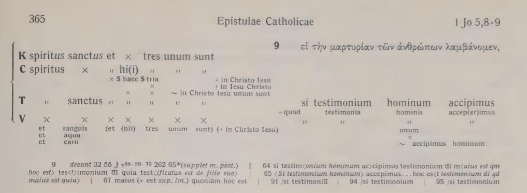
Codex Gigas at 1 John 5:7-8 (And Codex Sangermanensis primus and Codex Colbertinus and Codex Perpinianensis and Book of Armagh
I thought I would check the Vetus Latina manuscripts (a helpful list can be found here) to see what they actually say it when it comes to the Johannine Comma. I should point out that while these manuscripts have been characterized by someone as Old Latin manuscripts and given a "VL" designation, all of these manuscripts are later than Jerome's translation. I am not sure whether anyone has checked/verified whether the text is in fact Vetus Latina, either in general or specifically for the text of 1 John. It is always possible that these manuscripts have been characterized based on having at least one section that is VL, or that they have been mischaracterized. As this is a research-intensive post, it is quite possible that it will be updated from time to time, possibly without formally identifying each update. The initial version of the article covered: VL 6, 7, 51, 54, and 61, of which VL 7, 51, and 61 are witnesses against the JC.
One of the largest and most expensive Bibles ever produced is Codex Gigans, a 13th century manuscript produced in area that is now part of the Czech Republic. It is part of the "Vetus Latina" family and is referred to by the manuscript designation, "VL 51 (gig)." It does not only include Biblical texts but also Isidore of Seville's Etymologies, among other things.
At 1 John 5:7-8, the manuscript has this:

The text reads:
qui tres sunt qui testumonium dant spiritus et aqua et sanguis et tres unum sunt.
Codex Sangermanensis primus is dated to around 810. It is referrred to as "VL 7 (g1)." It is available from the Paris library (link).

(source)
The Latin text is:
qui tres sunt qui testumonium dant spiritus, aqua, et sanguis et tres unum sunt.
Codex Colbertinus is dated to the 12th century and referred to as "VL 6 (c)." It is available from the Paris library (link).

(source)
The Latin text is:
qui tres sunt qui testumonium dant spiritus et aqua et sanguis et tres unum sunt. Et tres sunt qui testimonium dicunt in celo pater, verbum, et spiritus sanctus. Et hi tres unum sunt.
Codex Perpinianensis is dated to the second half of the 12th century and referred to as "VL 54 (p)." It is available from the French library (link).

The Latin text is:
qui tres sunt qui testumonium dant in terra spiritus aqua et sanguis et tres unum sunt. Et [some damage/erasure change here] tres sunt qui testimonium dicunt in celo pater, verbum, spiritus sanctus. Et hii tres unum sunt.
The Liber Ardmachanus or Book of Armagh is dated to 807/08 and is referred to as "VL 61 (ar, D)."
Book of Armaugh is available in a full scan from the Trinity College, Dublin.

A sort of facsimile via Archive.org provides the following "transcription":
quia -iii- sunt qu'i' testimonium dant spiritus eiaqua c/sanguis et •iii' unum Sunt
I would suggest instead:
quia III sunt qui testimonium dant spiritus et aqua et sanguis et III unum sunt
I may expand this post in the future, as noted at the beginning of the post.
Frisingensia Fragmenta (aka Freising Fragments) include a few folios dated to first half of the 7th century and containing (in fragmentary form) 1 John 5:7-8. The designation for this is "VL 64":

(scan 53)
The text of 1 John 5:7-8 is mostly lost, but one can see the "in terra" and "in caelo," which suggests that *some form* of the JC was present.For future study:
VL 62
VL 65 (Z)
...
Tuesday, June 10, 2025
Lorenzo Valla and the Johannine Comma
Lorenzo Valla's annotations on the New Testament, as published by Erasmus, included only about one third of one page on 1 John:
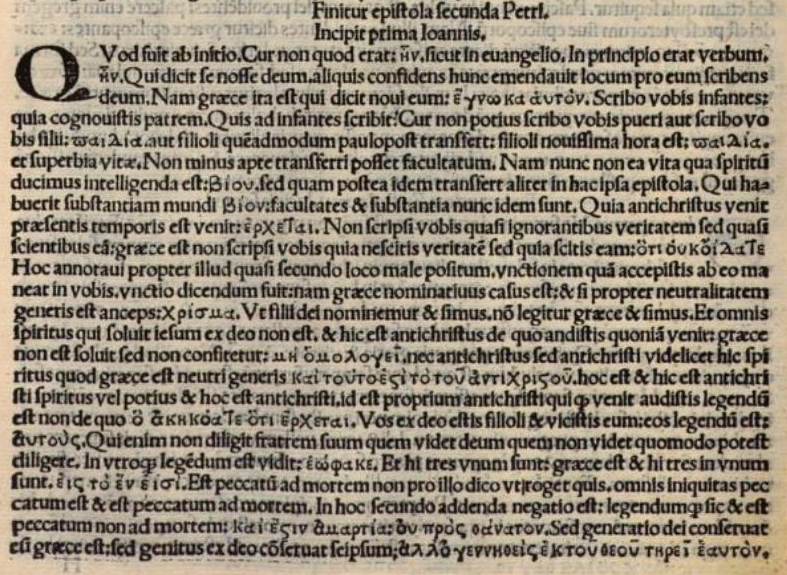

Translation: And these three are one: Greek is And these three are in one. εἰς τὸ ἕν εἰσι (eis to en eisi)
It is interesting that Valla notes the difference between "are one" and "are in one" but does not address the elephant in the room, namely the non-inclusion of "Father, Word, and Holy Spirit." We could speculate about why he does not mention it, but suffice to say that he does not discuss it.
Giannozzo Manetti and the Johannine Comma
Giannozzo Manetti (1396-1459) was arguably the leading expert on translation from Greek to Latin in the 15th century. His translation of the New Testament remains (as far as I can tell) unpublished. However, (as I've previously discussed here) his manuscripts are available to view online.
Manetti's New Testament at 1 John 5:7-8 has the following:


quia tres sunt qui in caelo testificantur, Pater, Verbum, et Spiritus Sanctus. Et hi tres unum sunt. Et tres sunt qui in terra testificantur: Spiritus, aqua et sanguis
Manetti's Greek source is available. Here is his Greek text:

ὅτι τρεῖς εἰσιν οἱ μαρτυροῦντες, τὸ πνεῦμα καὶ τὸ ὕδωρ καὶ τὸ αἷμα, καὶ οἱ τρεῖς εἰς τὸ ἕν εἰσιν.
Why, then, does his Latin not agree with the Greek? The short answer is that he was influenced by the Latin text he was aiming to improve.
Here is the Vulgate Latin text from which he was working:

quia tres sunt qui testimonium dant in caelo, Pater, Verbum, et Spiritus Sanctus. Et hi tres unum sunt. Et tres sunt qui testimonium dant in terra: Spiritus, aqua et sanguis
You may note the change that Manetti offers to the Vulgate text: a change from "[they] give testimony" to "[they] testify." It seems to be a more word-for-word translation. However, Manetti skates right past the absence of the JC in the Greek text.
You will note that contrary to the Clementine Vulgate and the KJV, the Latin text agrees with Alcuin's Vulgate (discussed here) against the Clementine Vulgate and KJV/DRB (link) in that it does not include a second instance of "these three are one" after the three earthly witnesses. Again, he has to somewhat ignore his Greek text to do this.
In the previous post, we discussed issues related to Revelation 16:5, where "fourth angel" and "Lord" were included in Manetti's translation on the basis of the Latin, not the Greek (link). So, it should not be very surprising that his Latin "translation" is more of a moderate improvement to an existing Latin text, rather than a fresh translation from Greek to Latin of his actual Greek text.
Monday, June 09, 2025
Alcuin of York and the Johannine Comma
As I was looking for something else, I happened across an image containing the end of 1 John and the beginning of 2 John in a copy of Alcuin's Vulgate Bible. Codex Vallicellianus is apparently representative of a Bible text overseen by Alcuin of York (740-804), at the dawn of the middle ages. The page providing this information must be taken with at least a grain of salt, however, given that the caption of the page image says that one should hover to enlarge the "papyrus" text. It is, of course, not papyrus.
It is quite old, however, and apparently a copy of a recension of the text by one of the leading scholars of Western Christianity at the time. Most interesting to me, it follows the Greek rather than the interpolation found in the King James Version at 1 John 5:7-8.

(source)
Isidore on Hebrew as the Original Language
Isidore of Seville (560-636) is one of the most influential western theologians of the late patristic period. He was a noted linguist, but his views do lean toward the idea that Hebrew was the language spoken in the garden of Eden by Adam and Eve, and that all the language confusion at Babylon was various departures from Hebrew. Here are some examples of his statements on this point:
Etymologies, Book IX, number 1:
Language diversity began after the flood, during the construction of the tower. The arrogance of that tower divided human society: different words had the same meaning. Earlier, all nations used one language: Hebrew. The patriarchs and prophets used it for speech, as well as for their holy writings. ...
Etymologies, Book X, number 191:
Nugas is a Hebrew word. It is set out in the books of the Prophets, where Zephaniah (3.18) says, Nugas, qui a lege recesserunt (the sorrowful, who have withdrawn from the law), enabling us to know that the mother of all languages is Hebrew.
(I should note that the parenthetical is from the translator.)
Etymologies, Book XII, number 2:
The pagans gave names to each animal, in their own languages. Adam assigned names using neither Latin, Greek, or the barborous tongues of the pagans, but Hebrew, the universal language before the flood.
I have recently heard folks begin to discuss this view with the label "Edenics." Having only found that term in Wikipedia dictionaries, I'm a little reluctant to endorse it as having an established meaning, but - at any rate - this view by Isidore seems to fit the description of that label.
It's interesting to note that Isidore also makes an argument for the use of multiple versions (in multiple languages) based on the potential obscurity of the Scriptural language.
Etymologies, Book IX, number 3:
The sacred languages are pre-eminent throughout the world: Hebrew, Greek, and Latin. These three languages were used by Pilate to write the charge <"King of the Jews"> against the Lord at the top of the cross. The obscurity of the Holy Scriptures, makes knowledge of these languages necessary. When the wording of one language creates doubt about a word or meaning, there is recourse to another.
The above translations come from Priscilla Throop's translation (2005 for books I-X and 2006 for books XI to XX).
Sunday, June 08, 2025
Isidore of Seville on Dragons
Isidore of Seville (560-636) is one of the most influential western theologians of the late patristic period. One of his major scholarly focuses was the meaning of Latin words. So, I was fascinated by his discussion of the Latin word for Dragon, Draco. What I find particularly interesting is that none (or at least very few) of the late medieval characteristics of dragons are reflected in Isidore's description. Instead, his description just seems to be of a gigantic snake, like an anaconda, particularly one that is religiously venerated.
Book of Differences, I, 48 (p. 97)
The difference between words for snake (anguis, serpens, and draco) is that angues are in the sea, serpentes are on land, and dracones are in a shrine. As Virgil says (Aeneid 2.203-204) "Angues through the peaceful depths"; and a little further on (2.214) "Each serpens embraced"; and (2.225) "Dracones to the lofty shrines".
Etymologies, VIII, Topic 11, 55
The say Apollo is also called Pythius, from Python, the serpent of immense size, whose poison was as terrifying as his size. Piercing him with arrows, Apollo felled him, and carried back the spoils, including the use of his name, so he is called Pythius. He also instituted the celebration of the Pythian rites, to honor the victory.
Etymologies, XII, Topic 4, 4
The dragon or python, draco, is larger than all serpents, as well as all animals on earth. The Greeks call it δράκων, whence it becomes draco in Latin. It is said to be often drawn from its den into the air, which is stirred up because of him. He is crested, with a small face, and narrow tubes through which he draws his breath and moves his tongue. His power is not in his teeth, but in his tail, and he kills with a lash, rather than with his gaping jaws.
Etymologies, XII, Topic 6, 42
The sea dragon, draco marinus, has stingers on its arms, facing its tail. When they strike, poison pours into whatever is hit.
Etymologies, XVIII, Topic 3, section 3
Standards of snakes, dracones, were started by Apollo, with the death of the serpent Python. From that time, they began to be carried in war by Greeks and Romans.
Thursday, June 05, 2025
The Johannine Comma in the Complutensian Polyglot
There are extremely few marginal notes regarding the reading of the text in the Complutensian Polyglot. One of those very few notes is found at 1 John 5:7, as shown in the following screenshot:


(source)
The note reads:Sanctus thomas in expositione secunde decretalis de suma trinitate et fide catholica tractans istum passum contra Abbatem Joachim ut tres sunt qui testimonium dant in celo. pater: verbum: et spiritus sanctus: dicit ad litteram verba sequentia. Et ad insinuandam unitatem trium personarum subditur et hii tres unum sunt. Quodquidem dicitur propter essentie unitatem. Sed hoc Joachim perverse trahere volens ad unitatem charitatis et consensus inducebat consequeintem auctoritatem. Nam subditur ibidem: et tres sunt qui testimonium dant in terra. s. spiritus: aqua: et sanguis. Et in quibusdam libris additur: et hii tres unum sunt. Sed hoc in veris exemplaribus non habetur: sed dicitur esse appositum ab hereticis arrianis ad pervertendum intellectum sanum auctoritatis premisse de unitate essentie trium personaruim. Hec beatus Thomas ubi supra.
My translation:
Saint Thomas, in the exposition of the second decretal On the Most High Trinity and the Catholic Faith, treating that passage against Abbot Joachim, “For there are three who give testimony in heaven: the Father, the Word, and the Holy Spirit”, says the following words literally:
“And to indicate the unity of the three persons it is added: ‘And these three are one.’ This indeed is said because of the unity of essence.”
But Joachim, wishing perversely to twist this to the unity of charity and agreement, brought in the following authority:
“For it is added in the same place: ‘And there are three who give testimony on earth: the Spirit, the water, and the blood.’ And in certain books it is added: ‘And these three are one.’”
But this is not found in the true copies, but is said to have been inserted by Arian heretics to corrupt the sound understanding of the preceding authority concerning the unity of essence of the three persons.
These things are from blessed Thomas, as cited above.
Please note that the text of 1 John 5:7-8 in "the TR" is this:
ὅτι τρεῖς εἰσιν οἱ μαρτυροῦντες ἐν τῷ οὐρανῷ ὁ πατὴρ ὁ λόγος, καὶ τὸ ἅγιον πνεῦμα καὶ οὗτοι οἱ τρεῖς ἕν εἰσιν καὶ τρεῖς εἰσιν οἱ μαρτυροῦντες ἐν τῇ γῇ τὸ πνεῦμα καὶ τὸ ὕδωρ, καὶ τὸ αἷμα καὶ οἱ τρεῖς εἰς τὸ ἕν εἰσιν
By contrast, the text of 1 John 5:7-8 in the Complutensian Polyglot is this:
ὅτι τρεῖς εἰσιν οἱ μαρτυροῦντες ἐν τῷ οὐρανῷ ὁ πατὴρ καὶ ὁ λόγος, καὶ τὸ ἅγιον πνεῦμα καὶ οἱ τρεῖς εἰς τὸ ἕν εἰσι καὶ τρεῖς εἰσιν οἱ μαρτυροῦντες ἐπὶ τῆς γης τὸ πνεῦμα καὶ τὸ ὕδωρ, καὶ τὸ αἷμα
Notice the differences:
- The "TR" inserts οὗτοι (these)
- The "TR" adds a movable nu to the end of εἰσι ("there are"); no apparent difference in meaning.
- The "TR" omits the καὶ (and) between Father and Word.
- The "TR" omits the εἰς τὸ ("to the") in the first statement of unity.
- The "TR" includes the phrase "καὶ οἱ τρεῖς εἰς τὸ ἕν εἰσιν" after the three earthly witnesses, whereas the CP marginal note refers to this phrase as an Arian insertion, citing Thomas Aquinas.
- The "TR" substitutes "ἐν τῇ γῇ" (in the earth) in place of "ἐπὶ τῆς γης" (on the earth).
The reason for treating the CP as the primary text, and the "TR" as a departure from it, is that the reading in the CP was printed first.
Appendix:
Here's a translation apparently by Ezra Abbot (in 1872) in a memoir by by Rev. William Orme (1787-1830)(pp. 80-81):
"Saint Thomas, in his exposition of the second Decretal concerning the Most High Trinity and the Catholic faith, treating of this passage, 'There are three that bear witness in heaven, the Father, the Word, and the Holy Spirit,' in opposition to the Abbot Joachim, uses precisely the following language: —' And to teach the unity of the three persons it is subjoined, And these three are one; which is said on account of their unity of essence. But Joachim, wishing perversely to refer this to a unity of affection and agreement, alleged the text that follows it. For it is immediately subjoined, And there are three that bear witness on earth, namely, the Spirit, the water, and the blood. And in some books it is added, And these three are one. But this is not contained in the true copies, but is said to have been added by the Arian heretics to prevent the text that precedes from being correctly understood as relating to the unity of essence of the three persons.'- Thus the blessed Thomas, as above referred to."
Postscript:
For the record, I am not posting the Complutensian's note because of any agreement with it, but instead because (1) sometimes it is claimed that although Erasmus did not have a manuscript with Johannine Comma, the Complutensian editors must have had one, and (2) it seems impossible (or at least highly unlikely) that the Complutensian editors had a Greek text that includes the Johannine Comma. They seem to have created it to match the Latin and in the process moved the genuine phrase "καὶ οἱ τρεῖς εἰς τὸ ἕν εἰσιν" from its proper place after the Spirit, Water, and Blood to before those three witnesses are mentioned. In short, like the other Greek testimonies to the Comma, the Complutensian is a testimony to reverse engineering from the Latin.
Wednesday, June 04, 2025
The 19th Century Shift in Views Regarding the Johannine Comma
The following endorsement of John Candlish (1806-1873) is attributed to Charles Spurgeon: "A man hardly needs anything beyond Candlish. He is devout, candid, prudent and forcible." Candlish's massive two-volume commentary on 1 John is one of the go-to commentaries on the book. In lecture XXXVIII, "The Three Witnesses and their Agreement," Candlish quotes 1 John v. 6 and 8 with the following footnote:
I acquiesce of course in the rejection of the 7th verse, and of the words "in earth" in the 8th verse, as not in the original. I need not argue the point, for it is now all but universally admitted by intelligent critics.
The text of his commentary (including this footnote) can be found online (link to vol. 2, p. 200)
Meanwhile, his contemporary, James Morgan (1799-1873), has the following comment in his own lectures (which came after Candlish's):
Doubts have long been entertained respecting the authenticity of this verse. It is wanting in many of the early Greek manuscripts of the New Testament. And we must wait for farther light, before we rest in its inspiration.
(link to Lecture XLIII, p. 426)
Writing shortly after Morgan and Candlish, J.J. Lias, The First Epistle of St. John with Exposition and Homiletical Treatment (1887):
The spuriousness of ver. 7 is a fact which, in the present stage of textual criticism, can hardly be said to admit of dispute. A brief summary of the evidence is all that need be offered here. For a fuller statement the reader is referred to those works on New Testament criticism designed for the use of scholars. Especially will the latest view of the critical evidence be found in Professor Westcott's Commentary.
(p. 379, with extended arguments for and against following)
W. Graham, The Spirit of Love, or a Practical & Exegetical Commentary on 1 John (1857) argues as follows:
4thly. The three Witnesses are mentioned, in the seventh and eighth verses, thus, " For there are three that bear record (in heaven, the Father, the Word, and the Holy Ghost, and these three are one ; and there are three that bear witness in earth, εν τῷ οὐρανῷ, ὁ Πατήρ, ὁ Λόγος, καὶ τὸ Ἅγιον Πνεῦμα· καὶ οὗτοι οἱ τρεῖς ἕν εἰσι. Καὶ τρεῖς εἰσιν οἱ μαρτυροῦντες ἕν τῇ γῇ) "the Spirit, and the water, and the blood ; and these three agree in one." The words included in the parenthesis form the celebrated text of the heavenly witnesses which has been the subject of such fierce and bitter discussion. 1 do not intend to give a statement of the argument on either side, but having read all I could get at on the subject, both in English and German, I may be permitted to state simply my convictions. (1) Nothing can be proved out of the internal evidence either for or against its genuineness. The passage seems to be full and perfect without these words, and yet, when inserted, the meaning is scriptural and apostolical. The apostle might have written them, for they contain nothing which cannot be proved from other passages of sacred Scripture, and therefore I altogether disagree with the dogmatism and presumption of Lücke, who says, " Either these words are spurious, and the rest of the epistle a genuine production of John, or they are genuine, and the epistle belongs to a much later period." (2) There is not sufficient ground for retaining these words in the sacred text. The evidence, so far as it is known or examined, is entirely against their genuineness, and therefore our jealous veneration for the word of God should make us reject them, at least until new confirmatory evidence be produced.
(pp. 323-4)
John Stock (apparently died prior to 1865) wrote an exposition on 1 John (apparently from 1861-64). When he came to 1 John 7-8, he states: "It is admitted, as to a portion of the verses before us, that many manuscripts have it not; yet others have; and most learned divines have affirmed that the argument was in favour of the version we have in our testaments." (link to p. 421) He builds up to this admission with two paragraphs about how confident he is (and his readers should be) in the quality of the English text. And after his admission, he says that whether the verse is "rejected, or retained" it "does not in the least degree affect the blessed doctrine of the Trinity in Unity...."
Samuel Pierce (1746-1829) provided a two volume commentary set of sermons on 1 John. His Sermon LXXIX and LXXX discuss the text of 1 John 5:7, while his Sermon LXXX discusses the text of 1 John 5:8 including the "in earth" phrase. Unlike Morgan and Candlish in the next generation, Pierce seems convinced of the authenticity of the verse, despite his awareness of challenges to it. His arguments, however, do not reflect much understanding of the issues. For example, he argues:
And the series of the context and scope of the place do necessarily require this verse. For the words of the following verse, And there are three in earth, cannot have a right construction, but upon supposition that there are Three also that bear record in heaven, with which these three in earth are connected by the conjunctive particle and.
However, of course, the words "and there are three in earth" are also part of the interpolation.
My overall point is this. At the start of the 19th century, there was a sincere belief that textual criticism vindicated the Johannine Comma. However, by the end of the 19th century, it was clear that textual criticism had conclusively demonstrated that the Johannine Comma is an interpolation.
Monday, June 02, 2025
Pope Leo X's Approval of the Complutensian Polyglot
Pope Leo X, writing on March 22, 1520, approved of the publication of the Complutensian Polyglot. One of the issues faced by the Complutensian project was that Cardinal Francisco Ximénez de Cisneros (1436 to 1517) died in 1517, after 15 years of work and an enormous outlay of money. Although the project was essentially completed four months before his death, the actual publication of the work was not made during his life, and the result was that there had not been any papal approval of the work prior to his demise. Pope Leo X, soon to become famous to history for his condemnation of Martin Luther in Exsurge Domine (June 15, 1520), officially approved the Complutensian Polyglot in the letter that was included as front matter to volume 1 of the CP.
One point to highlight from this document is that it approves the Complutensian Polyglot, which includes prefaces that adopt Jerome's view of the lack of full canonicity of the Deuterocanonical books.
Finally, it's worth noting (as Dr. Ed Gallagher does here) that this is not an issue that is limited to the prologues reproduced from Jerome and others (I think that some are Isidore's, or at least influenced by Isidore, but I have not checked to be sure). The bigger issue is the portion of the book that, above all other portions, Leo X is most likely to have read. That portion has two parts, (1) the dedicatory prologue written in 1517 (a full translation can be found here); and (2) .
The dedicatory prologue includes this:
There are many reasons, Holy Father, that impel us to print the languages of the original text of Holy Scripture ... Since, however, the most learned translator can present only a part of this, the full Scripture in translation inevitably remains up to the present time laden with a variety of sublime truths which cannot be understood from any source other than the original language. Moreover, wherever a diversity in the Latin manuscripts or the suspicion of a corrupted reading (we know how frequently this occurs because of the ignorance and negligence of copyists), it is necessary to go back to the original source of Scripture, as St. Jerome and St. Augustine and other ecclesiastical writers advise us to do, to examine the authenticity of the books of the Old Testament in light of the correctness of the Hebrew text and of the New Testament in the light of the Greek copies. And so that every student of Holy Scripture might have at hand the original texts themselves and be able to quench his thirst at the very fountainhead of the water that flows unto life everlasting and not have to content himself with rivulets alone, we ordered the original languages of Holy Scripture with their translations adjoined to be printed and dedicated to your Holiness.
Translation is from Catholic Reform: From Cardinal Ximenes to the Council of Trent, 1495-1563 : an Essay with Illustrative Documents and a Brief Study of St. Ignatius Loyola, by John C. Olin (Fordham University Press, 1990).
The next is the Prologue to the Reader (begins on the back side of the dedicatory prologue).
I have provided an image of the first page of the prologue with a relevant portion highlighted, below. However, the relevant Latin text is this (as helpfully and correctly transcribed by Dr. Gallagher):
At vero libri extra canonem: quos Ecclesia potius ad aedificationem populi quam ad autoritatem ecclesiasticorum dogmatum confirmandam recipit. Graecam tamen habent scripturam: sed cum duplici latina interpretatione: altera beati Hieronymi: altera interlineari de verbo ad verbum: eo modo quo in caeteris.
My translation:
But truly [there are] books outside the canon, which the Church receives rather for the edification of the people than for the establishing of ecclesiastical doctrines: they have Greek writing, but with a double Latin translation; one by the blessed Jerome, the other interlinear: word for word, in the same manner as the others.
Gallagher's translation:
But there are books outside the canon which the Church has received more for the edification of the people than for the authoritative confirmation of ecclesiastical dogmas. But they have Greek writing, but with a double Latin translation, one of blessed Jerome, the other a word-for-word interlinear, just as in the others.
Gallagher notes that the first sentence, "But ... dogmas," is "a quotation from Jerome's Preface to the Books of Solomon, discussed here, p. 102." There are plenty of additional jewels to be found in Gallagher's post.
I should add here that we have additional evidence of Leo X's tacit approval of the distinction between "Sacred Scripture" (generally) and "Sacred Scripture that is in the canon." The evidence comes from his condemnation of Martin Luther in Exsurge Domine, in which he condemns as number thirty-seven of the errors of Martin Luther: "37. Purgatory cannot be proved from Sacred Scripture which is in the canon."
The following is an (unprofessional) English translation of his letter, followed by an image of the letter and an approximate transcription of the same. I've also included an image of (perhaps) the most significant of the prologues included. Note well, however, that there are other prologues that (taken alone) might seem to reflect a more favorable attitude toward the deuterocanonical books. Below that are images of additional material referenced above.
***
TO THE VENERABLE BROTHER FRANCISCO, BISHOP OF ÁVILA, AND TO THE BELOVED SON FRANCISCO DE MENDOZA, ARCHDEACON OF PEDROCHE IN THE CHURCH OF CÓRDOBA, OR TO EITHER OF THEM.
POPE LEO X
To the venerable brother and beloved son, greetings and apostolic blessing.
Some time ago, through the report of our venerable brother Bernardino, Bishop of Sabina, and our beloved son Giles, priest and Cardinal (titular of St. Matthew), we understood that among other things which the late Francis, priest and Cardinal (titular of St. Balbina), completed with the highest praise before he departed from human affairs, there exists a work of the New and Old Testaments—namely, the New [Testament] in Greek and Latin, and the Old [Testament] in Greek and Latin as well as in Hebrew and Chaldean languages—compiled by the same Cardinal Francis with much diligence and the agreement of learned men, and printed at the expense of the same Cardinal Francis in up to six hundred volumes or more.
But since, after such printing, the said Cardinal Francis was suddenly taken by death, and our approval for the publication of the said work had not been requested, the work itself has not until now been able to reach the hands of scholars and the public good, for whom it will be fruitful. Moreover, the will of the said Cardinal Francis, recorded in his testament, remains partly unexecuted. And this is to be fulfilled from the price for which the said volumes will be sold.
Wherefore, we deem it unworthy that a work of such usefulness for the public should be hidden any longer, and that the pious will of so worthy a man should be frustrated by a delayed execution. And desiring to support both with the help of our provision:
Of our own accord, and with certain knowledge, approving the aforesaid work, and granting that it may henceforth freely come to light through the hands of scholars and others, we command your discretion—who, as we have heard, are among the executors of the said testament—by these letters, that you should diligently see to it that the aforesaid volumes be sold for the best price that can be obtained, even without the other executors of the said testament, if any there be, and that from this price you should cause the said will to be fulfilled according to the means of the said price.
And lest any of the said volumes remain unsold, we forbid all and each person, both ecclesiastical and secular, of whatever dignity, state, rank, order, and condition they may be, under penalty of latae sententiae excommunication (from which no one may be absolved except by us or by our special mandate, except when in the moment of death), and also under the penalty of one thousand gold ducats to be paid by each transgressor to the court—and which are to be assigned, in equal parts, to the building of the basilica of Saint Peter in the city and to our treasury for the time being, for up to seven years from the day the sale begins—that they presume to print the same [work] in any way.
But if, rashly (which may it not be), they do not fear to violate this prohibition, we grant to you, or to either of you, the power and faculty by the tenor of these presents to denounce such transgressors as excommunicated and to command that they be avoided as such, as well as to fine each individually with the penalty of five hundred ducats, and to do whatever else may be necessary or appropriate in this matter.
Notwithstanding apostolic constitutions and ordinances and all other things whatsoever to the contrary.
Given at Rome, at Saint Peter’s, under the Fisherman’s Ring, on the 22nd day of March, 1520, in the eighth year of our pontificate.

VENERABILI FRATRI FRANCISCO EPISCOPO ABULEN. ET DILECTO FILIO FRANCISCO DE MENDOZA, ARCHIDIACONO DE PEDROCHE IN ECCLESIA CORDUBENSI VEL EORUM ALTERI.
LEO PAPA X.
Venerabilis frater et dilecte fili salutem et apostolicam benedictionem.
Dudum relatione venerabilis fratris Bernardini, Episcopi Sabinensis, et dilecti filii nostrorum Egidii.tt.sancti Mathei, presbyteri Cardinalis, nobis facta intelleximus, quod inter alia quae bonae memoriae Franciscus.tt.sanctae Balbinae presbyter Cardinalis, ante que ab humanis excederet summa cum laude absolvit: extat opus novi et veteris testamenti, novi videlicet in greco et latino, et veteris in greco et latino predictis, necnon hebraeo et caldeo sermonibus ab eodem Francisco Cardinale multa cum vigilia et doctorum consensu compositum, et usque ad sexcenta volumina vel amplius impensa eiusdem Francisci Cardinalis impressa.
Sed cum post impressionem huiusmodi subito dictus Franciscus Cardinalis morte esset ablatus et noster ad publicationem dicti operis consensus petitius non esset; nequevit hactenus opus ipsum ad doctorum manus et publicam utilitatem cui erit fructuosum advenire. Manet insuper voluntas dicti Francisci Cardinalis in illius testamento notata pro parte inexequuta. Et est ex precio pro quo dicta volumina vendentur explenda. Unde nos indignum existimantes, quod huiusmodi diopus amplius cum publicae utilitatis factura lateat, et pia tam imitabilis viri voluntas diutius debita exequutione frustretur. Et utriquae damno nostrae provisionis opesubvenire volentes.
Motu proprio et ex certa scientia nostra opus praefatum comprobantes. Et ut tale in lucem per doctorum et aliorum manus libere de caetero venire possit concedentes, discretioni vestrae, qui sicut accepimus ex exequutoribus dicti testamenti estis, per haec scripta mandamus, quatenus volumina praedicta pro precio de quo melius agi poterit etiam sine aliis dicti testamenti exequutoribus, si qui sint, diligenter vendi procuretis, et faciatis ex ipso precio dictam voluntatem iuxta vires eiusdem precii adimpleri.
Et ne aliquod dictorum voluminum non venditum maneat, inhibemus universis et singulis tam ecclesiasticis quam secularibus personis cuiuscumque dignitatis, status, gradus, ordinis et conditionis sint, sub excommunicationis latae sententiae a qua nisi a nobis impis vel de nostro speciali mandato, praeterquam in mortis articulo constituti, absolvi possint, necnon mille ducatorum auri de camera per quemlibet transgressorum solvendorum, et quos fabricae basilicae sancti Petri de urbe et nostrae camerae paribus portionibus ad id deputatis pro tempore usquae ad septennium a die inchoatae venditionis himmoi imprimere quoquomodo presmant.
Si vero temerarie inhibitionem huiusmodi quod absit praeterire non expaverint. Vobis et vestrum cui quae transgressores praedictros excommunicatos denunciandi et eos ut tales evitari mandandi necnon poena quingentorum ducatorum hmmoi singulariter mulctari et quaevis alia desuper necessaria seu oportuna faciendi licentiam et facultatem tenore praesentium elargimur.
Non obstan. constitutionibus et ordinationibus apostolicis caeterisqae quibuscunque.
Datum Romae apud sanctum Petrum sub annulo Piscatoris. die xxii Martii, MDXX. Pontificatus nostri anno octavo. Evangelista.
***
Finally, here is the famous prologue that was included, which identifies the deuterocanonical books as apocrypha. It's not the only prologue material provided, and there is some tension between the various prologues provided, but it is indeed here (at p. 358/1042 of this scan):


Tuesday, May 20, 2025
Lord's Prayer in a Papyrus (Probable Amulet)
Brent Nongbri in “The Lord’s Prayer and XMΓ: Two Christian Papyrus Amulets,” The Harvard Theological Review, vol. 104, no. 1, 2011, pp. 59–68 (JSTOR), presented a papyrus tentatively dated to the 6th or 7th century. The papyrus is thought to have been an amulet papyrus, something folded up and worn on the body of the person who owned it. The text of the Lord's Prayer on the papyrus ends (as in other early witnesses) without the doxology familiar to KJV readers. This is the opposite of what one's expectation would be if (1) this was intended as being worn for the purpose of having some kind of special power and (2) if the person who made it thought that the prayer included the doxology. The best explanation seems to be that this early witnesses (identified as P.CtTBR inv. 4600 in the article) was created by someone who did not think that the doxology was a part of the Lord's Prayer. Of course, it is not certain that this was an amulet (only "probably an amulet" according to the article). The papyrus itself is not the best possible witness to the text of the Lord's Prayer for lots of reasons (there is some wear and tear, and poor spelling). Nevertheless, if one holds that the doxology was originally part of the Lord's Prayer, this kind of document seems hard to explain.
Monday, May 19, 2025
Josephus' Canon - A Brief Response to Gary Michuta
In a recent livestream ("Josephus Does Not Give a Canon"), Gary Michuta argued that a famous quotation from Against Apion, usually cited in discussions of Josephus' canon, is misleading because it is based on an interpolated Greek text (via Eusebius) and because it includes a further unjustified gloss provided by the most popular translator of Josephus. Even assuming Michuta is right about the Greek text of Josephus' work and the gloss by an 18th century translator, Josephus still is referring to a closed canon of Scripture, and the citation stands.
Michuta even goes so far as to claim (source), "If you're a defender of the faith, guys, this is a silver bullet for you. You can refute probably 99% of non-Catholic apologists who are appealing to Josephus, just by this one move I'm going to show you."
It's certainly possible that many non-Roman-Catholic apologists will not be ready for Michuta's argument. In that very limited way, it could prevail. Likewise, it's certainly possible that if someone has not read anything except the two or three lines mentioned in the video, they might think that the citation has been "debunked" or the like. However, once we dig in, we see that the silver bullet ricochets harmlessly off the truth.
And it is the truth that is most important. Michuta has identified some potential problems. We should not ignore them, but instead we should address them head on.
The allegedly misleading translation, based on the allegedly interpolated Greek text, is as follows (source) Against Apion, Book I, sections 6-8 (Michuta gives credit to William Whiston for this translation and to Siwart Haverkamp for the Greek):
6. As to the care of writing down the records from the earliest antiquity among the Egyptians, and Babylonians; that the priests were entrusted therewith, and employed a philosophical concern about it; that they were the Chaldean priests that did so among the Babylonians; and that the Phoenicians, who were mingled among the Greeks, did especially make use of their letters, both for the common affairs of life, and for the delivering down the history of common transactions; I think I may omit any proof: because all men allow it so to be. But now as to our forefathers, that they took no less care about writing such records: (for I will not say they took greater care than the others I spoke of:) and that they committed that matter to their High-priests, and to their Prophets; and that these records have been written all along down to our own times, with the utmost accuracy; nay if it be not too bold for me to say it, our history will be so written hereafter; I shall endeavor briefly to inform you.
7. For our forefathers did not only appoint the best of these priests, and those that attended upon the divine worship, for that design, from the beginning; but made provision that the stock of the priests should continue unmixed, and pure. For he who is partaker of the priesthood, must propagate of a wife of the same nation; without having any regard to money, or any other dignities: but he is to make a scrutiny, and take his wife’s genealogy from the ancient tables; and procure many witnesses to it. And this is our practice, not only in Judea; but wheresoever any body of men of our nation do live: and even there an exact catalogue of our priests marriages is kept: I mean at Egypt and at Babylon; or in any other place of the rest of the habitable earth, whithersoever our priests are scattered. For they send to Jerusalem the ancient names of their parents in writing, as well as those of their remoter ancestors: and signify who are the witnesses also. But if any war falls out, such as have fallen out a great many of them already, when Antiochus Epiphanes made an invasion upon our country: as also when Pompey the great, and Quintilius Varus did so also: and principally in the wars that have happened in our own times: those priests that survive them compose new tables of genealogy, out of the old records, and examine the circumstances of the women that remain. For still they do not admit of those that have been captives; as suspecting that they have had conversation with some foreigners. But what is the strongest argument of our exact management in this matter is what I am now going to say; that we have the names of our High priests from father to son set down in our records, for the interval of two thousand years. And if any of these have been transgressors of these rules, they are prohibited to present themselves at the altar, or to be partakers of any other of our purifications. And this is justly, or rather necessarily done: because every one is not permitted of his own accord to be a writer; nor is there any disagreement in what is written. They being only prophets that have written the original and eldest accounts of things, as they learned them of God himself, by inspiration: and others have written what hath happened in their own times, and that in a very distinct manner also.
8. For we have not an innumerable multitude of books among us, disagreeing from, and contradicting one another: [as the Greeks have:] but only twenty two books: which contain the records of all the past times: which are justly believed to be divine. And of them five belong to Moses: which contain his laws, and the traditions of the origin of mankind, till his death. This interval of time was little short of three thousand years. But as to the time from the death of Moses, till the reign of Artaxerxes, King of Persia, who reigned after Xerxes, the Prophets, who were after Moses, wrote down what was done in their times, in thirteen books. The remaining four books contain hymns to God; and precepts for the conduct of human life. ’Tis true, our history hath been written since Artaxerxes very particularly; but hath not been esteemed of the like authority with the former by our forefathers; because there hath not been an exact succession of Prophets since that time. And how firmly we have given credit to these books of our own nation, is evident by what we do. For during so many ages as have already passed, no one has been so bold, as either to add any thing to them; to take any thing from them; or to make any change in them. But it is become natural to all Jews, immediately, and from their very birth, to esteem these books to contain divine doctrines; and to persist in them: and, if occasion be, willingly to die for them. For ’tis no new thing for our captives, many of them in number, and frequently in time, to be seen to endure wracks, and deaths of all kinds, upon the theatres; that they may not be obliged to say one word against our laws, and the records that contain them. Whereas there are none at all among the Greeks who would undergo the least harm on that account: no nor in case all the writings that are among them were to be destroyed. For they take them to be such discourses as are framed agreeably to the inclinations of those that write them. And they have justly the same opinion of the elder writers: since they see some of the present generation bold enough to write about such affairs, wherein they were not present; nor had concern enough to inform themselves about them from those that knew them. Examples of which may be had in this late war of ours: where some persons have written histories, and published them, without having been in the places concerned; or having been near them when the actions were done: but these men put a few things together, by hearsay; and insolently abuse the world; and call these writings by the name of Histories.
I have provided the full section with surrounding context, rather than the shorter portion Michuta offered in his video, for a couple of reasons. Most obviously, you (dear Reader) and I don't have the same time constraints in a blog post that Michuta has in a video. Also, in this case, the context matters. The portion that Michuta initially quoted was just this: "For we have not an innumerable multitude of books among us, disagreeing from, and contradicting one another: [as the Greeks have:] but only twenty two books: which contain the records of all the past times: which are justly believed to be divine."
According to Michuta, "which are just believed to be divine," is a valid translation of a Greek text but that the Greek text itself is not supported by any of the manuscripts of Josephus' Against Apion, but only by the quotation found in Eusebius. Michuta believes that either Eusebius, or someone who was copying Eusebius' manuscript, must have inserted the Greek word Theon. Michuta argues that although the most popular translation of the text has "divine" here, it is not original to Josephus.
Likewise, according to Michuta, the second highlighted portion, which says "by our forefathers" has inserted the reference to the forefathers without any corresponding Greek text, as a gloss on the sense of the text, but not actually something found in Josephus' Greek.
Admittedly, I am not addressing Michuta's textual critical claims about Josephus, because I don't think it's necessary to do so. Henry St. John Thackeray (1869–1930) provided an updated translation of Josephus in the early 1900s.
Thackery's translation (available here) of the section in question is this:
(6) Of the care bestowed by the Egyptians and Babylonians on their chronicles from the remotest ages, and how the charge and exposition of these was entrusted, in the former country to the priests, in the latter to the Chaldaeans ; and how, among the nations in touch with the Greeks, it was the Phoenicians who made the largest use of writing, both for the ordinary affairs of life and for the commemoration of public events ; of all this I think I need say nothing, as the facts are universally admitted. But that our forefathers took no less, not to say even greater, care than the nations I have mentioned in the keeping of their records—a task which they assigned to their chief priests and prophets—and that down to our own times these records have been, and if I may venture to say so, will continue to be, preserved with scrupulous accuracy, I will now endeavour briefly to demonstrate.
(7) Not only did our ancestors in the first instance set over this business men of the highest character, devoted to the service of God, but they took precautions to ensure that the priests' lineage should be kept unadulterated and pure. A member of the priestly order must, to beget a family, marry a woman of his own race, without regard to her wealth or other distinctions ; but he must investigate her pedigree, obtaining the genealogy from the archives and producing a number of witnesses. And this practice of ours is not confined to the home country of Judaea, but wherever there is a Jewish colony, there too a strict account is kept by the priests of their marriages ; I allude to the Jews in Egypt and Babylon and other parts of the world in which any of the priestly order are living in dispersion. A statement is drawn up by them and sent to Jerusalem, showing the names of the bride and her father and more remote ancestors, together with the names of the witnesses. In the not infrequent event of war, for instance when our country was invaded by Antiochus Epiphanes, by Pompey the Great, by Quintilius Varus, and above all in our own times, the surviving priests compile fresh records from the archives ; they also pass scrutiny upon the remaining women, and disallow marriage with any who have been taken captive, suspecting them of having had frequent intercourse with foreigners. But the most convincing proof of our accuracy in this matter is that our records contain the names of our high priests, with the succession from father to son for the last two thousand years. And whoever violates any of the above rules is forbidden to minister at the altars or to take any other part in divine worship.
It therefore naturally, or rather necessarily, follows (seeing that with us it is not open to everybody to write the records, and that there is no discrepancy in what is written ; seeing that, on the contrary, the prophets alone had this privilege, obtaining their knowledge of the most remote and ancient history through the inspiration which they owed to God, and committing to writing a clear account of the events of their own time just as they occurred)—it follows, I say, that (8) we do not possess myriads of inconsistent books, conflicting with each other. Our books, those which are justly accredited, are but two and twenty, and contain the record of all time.
Of these, five are the books of Moses, comprising the laws and the traditional history from the birth of man down to the death of the lawgiver. This period falls only a little short of three thousand years. From the death of Moses until Artaxerxes, who succeeded Xerxes as king of Persia, the prophets subsequent to Moses wrote the history of the events of their own times in thirteen books. The remaining four books contain hymns to God and precepts for the conduct of human life.
From Artaxerxes to our own time the complete history has been written, but has not been deemed worthy of equal credit with the earlier records, because of the failure of the exact succession of the prophets.We have given practical proof of our reverence for our own Scriptures. For, although such long ages have now passed, no one has ventured either to add, or to remove, or to alter a syllable ; and it is an instinct with every Jew, from the day of his birth, to regard them as the decrees of God, to abide by them, and, if need be, cheerfully to die for them. Time and again ere now the sight has been witnessed of prisoners enduring tortures and death in every form in the theatres, rather than utter a single word against the laws and the allied documents.What Greek would endure as much for the same cause ? Even to save the entire collection of his nation's writings from destruction he would not face the smallest personal injury. For to the Greeks they are mere stories improvised according to the fancy of their authors ; and in this estimate even of the older historians they are quite justified, when they see some of their own contemporaries venturing to describe events in which they bore no part, without taking the trouble to seek information from those who know the facts. We have actually had so-called histories even of our recent war published by persons who never visited the sites nor were anywhere near the actions described, but, having put together a few hearsay reports, have, with the gross impudence of drunken revellers, miscalled their productions by the name of history.
The relevant portion, you can see, does not include the word "divine" nor "forefathers": "Our books, those which are justly accredited, are but two and twenty, and contain the record of all time." ... "with the earlier records."
Michuta suggests that we should look at the work of the very recent Brill series (Michuta oddly refers to the editor, Steve Mason, rather than to the translator, John M.G. Barclay, although his slide is correct - perhaps Michuta was a just a bit tired when presenting, he mentioned it was around 3 or 4 am for him). John M.G. Barclay has provided what is asserted by Brill to be "a fresh English translation ... based on new textual research conducted by the Münster Josephus project." (source) Published in 2006, it benefits from an additional century of scholarship compared to Thackery. Barclay's translation offers this (pp. 28-30):
Naturally, then, or rather necessarily-- seeing that it is not open to anyone to write of their own accord, nor is there any disagreement present in what is written, but the prophets alone learned, by inspiration from God, what had happened in the distant and most ancient past and recorded plainly events in their own time just as they occurred--(1.8) among us there are not thousands of books in disagreement and conflict with each other, but only twenty-two books, containing the record of all time, which are rightly trusted. Five of these are the books of Moses, which contain both the laws and the tradition from the birth of humanity up to his death; this is a period of a little less than 3,000 years. From the death of Moses until Artaxerxes, king of the Persians after Xerxes, the prophets after Moses wrote the history of what took place in their own times in thirteen books; the remaining four books contain hymns to God and instructions for people on life. From Artaxerxes up to our own time every event has been recorded, but this is not judged worthy of the same trust, since exact line of succession of the prophets did not continue.
If you're wondering how such few lines could occupy three pages of the book, it's because about 80% of each page is commentary, with only about 6 lines of text per page.
Coming back to Michuta's claims, you will notice that both Thackery and Barclay omit "divine" and "forefathers." On the other hand, while Michuta claims that those words are responsible for misleading people into thinking this is a canon list, Barclay demonstrates otherwise.
Michuta says (source): "My assertion is, Josephus doesn't give a canon. In fact, I believe his twenty-two books that he gives in his work, Against Apion, actually isn't a canon at all. It is just a list of histories that are the most credible."
What Michuta overlooks, however, are several contextual clues. First, these are books with respect to which the Jews are not willing to add, remove, or change even a syllable. Second, there are "only" twenty-two books. Third, these are books written by prophets and maintained by prophets and priests. Fourth, these are books that Jews regard as "the decrees of God" and for which they are willing to die.
Picking Barclay's translation (for example), notice that the reason Josephus provides for the distinction between the twenty-two books (going from Creation to Artexerxes) and the remaining books is the absence of succession of prophets. Notice as well that Josephus includes four books of "hymns to God and instructions for people on life," which are not presented as being "historical" books.
Michuta argues that a canon list should identify the contents of the canon. Josephus does so in two ways: (1) by a general outline of the nature of the books; and (2) by a concluding date to the books. With respect to the first five, he also gives a specific author.
We don't need to latch on to the words "divine" and "fore-fathers" to conclude as we do.
Michuta should know this. After all, he not only screenshot Barclay's translation, but also footnote 158, which mentions that the word "divine" may be a Christian modification. Even if he had read only that footnote, he should have seen what it said, considering that he even highlighted it in his slide, namely: "anticipating the claim made in 1.42." This refers to the claim by Josephus that these books are regarded as "decrees of God."
Footnote 156, on the same page as footnote 158, has the following to say:

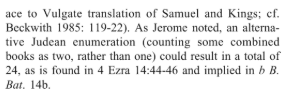
Notice that Barclay explains: "They are not characterized here as "sacred" (cf. 1.1, 54, 127), but they are clearly distinguished from other and subsequent literature (1.41), and to this extent Josephus' canon is clearly "closed" (even if the contents of these books and their textual form may have been subject to dispute); so rightly Beckwith 1985: 78-80; Mason 2002:110-27."
From my point of view, Michuta's characterization of the issue is misleading at best. While it is certainly possible that Eusebius' Greek and Whiston's English gloss may not be a woodenly literal representation of Josephus' original, even without those influences, it should be readily important that Josephus is referring to the canonical Scriptures.
Footnotes 166-67 on the next page, further underscore my point that Barclay himself sees the same thing in Josephus:


Note that Barclay is right to emphasize the fact that Josephus' motivation is to provide a low number of books. If he just meant to point to the reliable Old Testament histories, why bring in the number twenty-two in the first place? Particularly, why bring in that number when it includes the Psalms and Proverbs? The intuitively correct answer is that Josephus is appealing to an existing canon that is extrinsic to himself. This is not a list he just made up. The same explains why Josephus does not feel the need to provide the name for each book: just as people of his day knew what the names of the five books of Moses were, so also they knew which constituted the twenty-two books.
Ultimately, I fear that Michuta's video is likely to be misleading to Roman Catholic apologists who will boldly claim that Josephus didn't provide a canon or that such a view is based on a mistranslation of a faulty text. While such misleading claims may benefit my side in the sense that they can be debunked and we can demonstrate the veracity of our claims and the weakness of theirs, ultimately I think it is better for folks like Michuta to be more circumspect in their claims and analysis, to avoid misleading the next generation of apologists.
A brief postlude. There still remains the enigmatic question of which books Josephus did intend to be included in the twenty-two. Barclay provides his thoughts in footnote 165:

Subscribe to:
Posts (Atom)

