I had noted in a comment box (appended to this post) that it would take a real imbecile to think that Dura Europos was typical of the early church.
But many folks who bow down to paintings and statues don't sweat that history stuff, and consequently end up appealing to a most unique place like Dura Europa where (evidently) even the Jewish synagogue was highly decorated (although in a style borrowed from the Roman pagans). Of course, some of the same people will try to claim that Dura Europos represented a typical Jewish synagogue of the time as well.
But we may leave such issues momentarily aside. One such person (Mr. Bellisario) has tried to counter (between two insults) with the following: "How many other examples do we have of early house churches?"
Such a comment misses the issues in a spectacularly simplistic way. The issue is not how many examples we have of early house churches, but why anyone would think this "example" is a typical example.
For example, we know almost nothing about the "Christians" that lived at Dura Europos at the time. For example, we don't know whether they were heretics or orthodox, whether they were strict or syncretic in their views. We don't have any particularly good reason to think that they were orthodox Christians.
We have apparently found some Aramaic texts at the location that appear to be Eucharistic prayers similar to those in the Didache, and (at another location in the garrison town) a tiny fragment of a Greek harmony of the gospels (though not Diatessaron of Tatian). In other words, we have no strong reason for linking this building to any particular branch of "Christianity."
But, of course, to answer Bellisario's simplistic question, how on earth would anyone hope to recognize an early house church that wasn't decorated? If it were not for the murals, we wouldn't be inclined to call the building they found at Dura Europos a church. We have no way of knowing how many of the myriad undecorated houses we've uncovered were house-churches. So, of course, it is a silly question.
But what about the decorations at this building in Dura Europos? They were not icons, they were not statues, they were "murals," rough sketches marked on the wall. From the images I've seen of them, we have to speculate as to how they are intended to relate to the Bible, but there are three main murals, and a couple more that are shown in a fourth image.
1. "Good Shepherd" - The mural shows a shepherd carrying a sheep. Such a depiction is somewhat similar to a "Christ the Good Shepherd" icon but in other ways is more similar to this earlier depiction of a shepherd (link) alleged to be from about the same time period - 3rd century - from Roman catacombs.
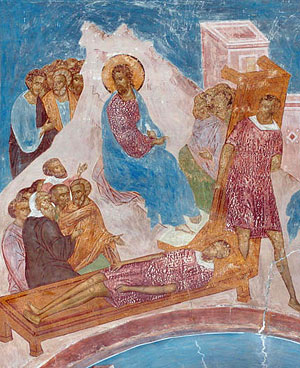
2. "Healing of the Paralytic" - The mural shows a man taking his bed on his back, apparently after being cured, which is reminiscent of the healing recorded in John 5. Such a depiction is somewhat similar to a rather modern-looking icon I found (link) but more similar to a fresco/icon from the Dionisian Frescos (1502).
3. "Peter and Jesus Walking on Water - The title is self-explanatory. The closest icon I could find was this one (link).
4. A couple others involving women (link)
As you can see, while there is some resemblance between the icons and the murals, it's not a real close match. Basically, if you let them be considered matches, then you are basically calling any drawing an icon.
Of course, there were items more like icons at Dura Europos (link), but keep in mind that these are from the local temple of Mithras.
There are plenty of other good reasons (such as the Council of Elvira - about 60 years after the date of the building at Dura Europos, and the writings of Epiphanius of Salamis and Eusebius of Caesarea - leading to sharper battles in the 8th-9th centuries) to think that paintings were starting to enter into Christian churches, but were meeting resistance. As well, as I've previously mentioned, much of the writings opposed to novel introduction of icons into worship was destroyed (and/or disparaged) by the icondules.
-TurretinFan
Saturday, May 23, 2009

Friday, May 22, 2009
Epistemology - Some More Thoughts
1. Certainty about information being true is properly justified according to the source of that information.
2. God is the ultimate and only infallible source of information.
3. Therefore, certainty in the strictest sense is only possible via revelation from God.
4. Perspicuity is important to certainty.
5. Scripture is the highest form of revelation, because it is the most perspicuous.
6. Scripture is not God's only revelation to men, for Scripture itself testifies clearly to general revelation.
7. General revelation may not teach much clearly, but it does clearly teach the existence of God, time, space, general morality, and logic (inter alia).
8. General revelation is manifest in one way by the imprint on the human heart of the knowledge of the existence of God, [one's own existence - the existence of other minds], time, space, general morality, and logic (inter alia).
8. If Scripture teaches a proposition, that proposition is necessarily true.
9. No other teacher besides Scripture (at the present time) both provides propositions and shares this quality of infallibity.
10. Therefore, nothing can be known with absolute certainty aside from what is taught in Scripture [or General Revelation] or what is properly deduced from Scripture [and/or General Revelation].
11. Men, however, are capable of using imperfect knowledge.
12. Some knowledge is more imperfect than other knowledge.
***
Hopefully this list of 12 items spells out a framework of epistemology that is understandable, even if not everyone agrees.
-TurretinFan
2. God is the ultimate and only infallible source of information.
3. Therefore, certainty in the strictest sense is only possible via revelation from God.
4. Perspicuity is important to certainty.
5. Scripture is the highest form of revelation, because it is the most perspicuous.
6. Scripture is not God's only revelation to men, for Scripture itself testifies clearly to general revelation.
7. General revelation may not teach much clearly, but it does clearly teach the existence of God, time, space, general morality, and logic (inter alia).
8. General revelation is manifest in one way by the imprint on the human heart of the knowledge of the existence of God, [one's own existence - the existence of other minds], time, space, general morality, and logic (inter alia).
8. If Scripture teaches a proposition, that proposition is necessarily true.
9. No other teacher besides Scripture (at the present time) both provides propositions and shares this quality of infallibity.
10. Therefore, nothing can be known with absolute certainty aside from what is taught in Scripture [or General Revelation] or what is properly deduced from Scripture [and/or General Revelation].
11. Men, however, are capable of using imperfect knowledge.
12. Some knowledge is more imperfect than other knowledge.
***
Hopefully this list of 12 items spells out a framework of epistemology that is understandable, even if not everyone agrees.
-TurretinFan
Cajetan and the Canon
Response to Mr. William Albrecht regarding Cajetan and the Canon. Cajetan was a Roman Catholic cardinal who opposed Luther as an official representative of Rome, but who also held to the same canon as "Protestants" do today. This clip discusses that issue as well as a few related issues.
-TurretinFan
-TurretinFan
The real Turretin on: the Spirit's Relation to Revelation
Viva Verbum has an interesting quotation from the real Francis Turretin, which explains the Spirit's relation to revelation in the life of the believer: the Spirit does not give us additional personal revelation but opens our eyes to the truth of Scripture. (link)
-TurretinFan
-TurretinFan
Thursday, May 21, 2009
What does Simon mean? and did "Peter" replace "Simon"?
I recently heard a terrible argument arguing that Simon means "grain of sand" and that when Jesus changed Simon's name to Peter, he was changing this grain of sand into a Rock. Obviously, as you might guess, this argument came from someone who thinks that Peter was the first pope.
There are two significant problems with this argument.
First, "Peter" didn't replace "Simon" it became a sort of surname, essentially replacing "Barjonna" although he continued to be called "Barjonna" even after being called "Peter." We can see this from the following:
Mark 3:16 And Simon he surnamed Peter;
John 1:42 And he brought him to Jesus. And when Jesus beheld him, he said, Thou art Simon the son of Jona: thou shalt be called Cephas, which is by interpretation, A stone.
Matthew 4:18 And Jesus, walking by the sea of Galilee, saw two brethren, Simon called Peter, and Andrew his brother, casting a net into the sea: for they were fishers.
John 1:40 One of the two which heard John speak, and followed him, was Andrew, Simon Peter's brother.
Luke 5:8 When Simon Peter saw it, he fell down at Jesus' knees, saying, Depart from me; for I am a sinful man, O Lord.
John 6:8 One of his disciples, Andrew, Simon Peter's brother, saith unto him,
Matthew 10:2 Now the names of the twelve apostles are these; The first, Simon, who is called Peter, and Andrew his brother; James the son of Zebedee, and John his brother;
Luke 6:14 Simon, (whom he also named Peter,) and Andrew his brother, James and John, Philip and Bartholomew,
John 6:68 Then Simon Peter answered him, Lord, to whom shall we go? thou hast the words of eternal life.
Matthew 16:16 And Simon Peter answered and said, Thou art the Christ, the Son of the living God.
John 13:6 Then cometh he to Simon Peter: and Peter saith unto him, Lord, dost thou wash my feet?
John 13:9 Simon Peter saith unto him, Lord, not my feet only, but also my hands and my head.
John 13:24 Simon Peter therefore beckoned to him, that he should ask who it should be of whom he spake.
John 13:36 Simon Peter said unto him, Lord, whither goest thou? Jesus answered him, Whither I go, thou canst not follow me now; but thou shalt follow me afterwards.
Mark 14:37 And he cometh, and findeth them sleeping, and saith unto Peter, Simon, sleepest thou? couldest not thou watch one hour?
John 18:10 Then Simon Peter having a sword drew it, and smote the high priest's servant, and cut off his right ear. The servant's name was Malchus.
John 18:15 And Simon Peter followed Jesus, and so did another disciple: that disciple was known unto the high priest, and went in with Jesus into the palace of the high priest.
John 18:25 And Simon Peter stood and warmed himself. They said therefore unto him, Art not thou also one of his disciples? He denied it, and said, I am not.
John 20:2 Then she runneth, and cometh to Simon Peter, and to the other disciple, whom Jesus loved, and saith unto them, They have taken away the Lord out of the sepulchre, and we know not where they have laid him.
In these verses we see that Simon is referred to frequently as "Simon Peter" or by similar labels, such as "Simon, whom he also named Peter" (where "also" implies that this was an additional name) and "Simon he surnamed Peter" (where "surnamed" implies that an additional name was imposed upon Simon). Finally, while we see a large number of verses (not reproduced above) where Simon is simply referred to as "Peter," we never see Simon referred to as "Peter bar-Jona" or "Peter the son of Jona" or the like. Thus, Simon's name wasn't changed: he was given an additional name that essentially took the place of his natural name.
A second significant problem is that "Simon" doesn't mean "grain of sand" - it means "heard." The Greek word that we translate "Simon" is Σίμωνα (Simona). This Greek word is a borrow word from Hebrew. The Hebrew word to which it (as well as the alternative Grecianized form Συμεὼν (Simeon)) corresponds is שׁמעון (Shimon) which is etymologically derived from the word שׁמע (Shama) which is the root word for "to hear." With some words, the etymology is a bit speculative, but not with this one:
Genesis 29:33 And she conceived again, and bare a son; and said, Because the LORD hath heard that I was hated, he hath therefore given me this son also: and she called his name Simeon.
-TurretinFan
There are two significant problems with this argument.
First, "Peter" didn't replace "Simon" it became a sort of surname, essentially replacing "Barjonna" although he continued to be called "Barjonna" even after being called "Peter." We can see this from the following:
Mark 3:16 And Simon he surnamed Peter;
John 1:42 And he brought him to Jesus. And when Jesus beheld him, he said, Thou art Simon the son of Jona: thou shalt be called Cephas, which is by interpretation, A stone.
Matthew 4:18 And Jesus, walking by the sea of Galilee, saw two brethren, Simon called Peter, and Andrew his brother, casting a net into the sea: for they were fishers.
John 1:40 One of the two which heard John speak, and followed him, was Andrew, Simon Peter's brother.
Luke 5:8 When Simon Peter saw it, he fell down at Jesus' knees, saying, Depart from me; for I am a sinful man, O Lord.
John 6:8 One of his disciples, Andrew, Simon Peter's brother, saith unto him,
Matthew 10:2 Now the names of the twelve apostles are these; The first, Simon, who is called Peter, and Andrew his brother; James the son of Zebedee, and John his brother;
Luke 6:14 Simon, (whom he also named Peter,) and Andrew his brother, James and John, Philip and Bartholomew,
John 6:68 Then Simon Peter answered him, Lord, to whom shall we go? thou hast the words of eternal life.
Matthew 16:16 And Simon Peter answered and said, Thou art the Christ, the Son of the living God.
John 13:6 Then cometh he to Simon Peter: and Peter saith unto him, Lord, dost thou wash my feet?
John 13:9 Simon Peter saith unto him, Lord, not my feet only, but also my hands and my head.
John 13:24 Simon Peter therefore beckoned to him, that he should ask who it should be of whom he spake.
John 13:36 Simon Peter said unto him, Lord, whither goest thou? Jesus answered him, Whither I go, thou canst not follow me now; but thou shalt follow me afterwards.
Mark 14:37 And he cometh, and findeth them sleeping, and saith unto Peter, Simon, sleepest thou? couldest not thou watch one hour?
John 18:10 Then Simon Peter having a sword drew it, and smote the high priest's servant, and cut off his right ear. The servant's name was Malchus.
John 18:15 And Simon Peter followed Jesus, and so did another disciple: that disciple was known unto the high priest, and went in with Jesus into the palace of the high priest.
John 18:25 And Simon Peter stood and warmed himself. They said therefore unto him, Art not thou also one of his disciples? He denied it, and said, I am not.
John 20:2 Then she runneth, and cometh to Simon Peter, and to the other disciple, whom Jesus loved, and saith unto them, They have taken away the Lord out of the sepulchre, and we know not where they have laid him.
In these verses we see that Simon is referred to frequently as "Simon Peter" or by similar labels, such as "Simon, whom he also named Peter" (where "also" implies that this was an additional name) and "Simon he surnamed Peter" (where "surnamed" implies that an additional name was imposed upon Simon). Finally, while we see a large number of verses (not reproduced above) where Simon is simply referred to as "Peter," we never see Simon referred to as "Peter bar-Jona" or "Peter the son of Jona" or the like. Thus, Simon's name wasn't changed: he was given an additional name that essentially took the place of his natural name.
A second significant problem is that "Simon" doesn't mean "grain of sand" - it means "heard." The Greek word that we translate "Simon" is Σίμωνα (Simona). This Greek word is a borrow word from Hebrew. The Hebrew word to which it (as well as the alternative Grecianized form Συμεὼν (Simeon)) corresponds is שׁמעון (Shimon) which is etymologically derived from the word שׁמע (Shama) which is the root word for "to hear." With some words, the etymology is a bit speculative, but not with this one:
Genesis 29:33 And she conceived again, and bare a son; and said, Because the LORD hath heard that I was hated, he hath therefore given me this son also: and she called his name Simeon.
-TurretinFan
A Quick Comment on the Van Til / Gordon Clark Debate
There is an odd artifact I've noticed in discussions between followers of Van Til and those of Clark. For some reason, those in the camp of Van Til take great delight in pointing out that Clark used the term "know" to refer to what we would call "know with absolute certainty." As such, Clark did not "know" that the woman with whom he was living was his wife. Endless merriment such comments make, particularly when the quotation marks around "know" are removed!
But why? Is it just to goad on the followers of Clark? Is it simply for the pleasure of hearing the sound of "you don't know that I am even real" or is there a deeper reason?
Surely the reason cannot be that the followers of Van Til think that Clark was wrong, and that Clark could know with absolute certainty that the woman he was living with was his wife. After all, it's imaginable that his parents-in-law had identical twins, one of whom was given up at birth. By chance, this twin sister discovered her long separated twin, murdered her in a jealous rage, and took her place. We could think of even more implausible options, but this relatively simple account provides one way that a person might be mistaken about such an important issue. Is it probable? No, it's not (though, of course, Clark was justifiably uncomfortable with such a concept), but the issue is certainty, not probability.
In the end, Clark is right in saying that the only things we can know with absolute certainty are those things that are revealed to us by God (whether through general or through special revelation). The only way to be absolutely sure about something is to obtain that knowledge from an absolutely reliable source.
-TurretinFan
But why? Is it just to goad on the followers of Clark? Is it simply for the pleasure of hearing the sound of "you don't know that I am even real" or is there a deeper reason?
Surely the reason cannot be that the followers of Van Til think that Clark was wrong, and that Clark could know with absolute certainty that the woman he was living with was his wife. After all, it's imaginable that his parents-in-law had identical twins, one of whom was given up at birth. By chance, this twin sister discovered her long separated twin, murdered her in a jealous rage, and took her place. We could think of even more implausible options, but this relatively simple account provides one way that a person might be mistaken about such an important issue. Is it probable? No, it's not (though, of course, Clark was justifiably uncomfortable with such a concept), but the issue is certainty, not probability.
In the end, Clark is right in saying that the only things we can know with absolute certainty are those things that are revealed to us by God (whether through general or through special revelation). The only way to be absolutely sure about something is to obtain that knowledge from an absolutely reliable source.
-TurretinFan
The Editor-in-chief of the Vatican newspaper, L’Osservatore Romano said it, so it must be true
The Editor-in-chief of the Vatican newspaper, L’Osservatore Romano has claimed that President Barack Husein Obama "is not a pro-abortion president." (link) If this is where Benedict XVI is getting his information about the American president (and I'm sure folks will assure me that the pope has other sources than the Vatican newspaper), then it would explain why he did nothing as a nominally Roman Catholic school called "Notre Dame" honored the most pro-abortion president that America has ever had. One really has to read the entire article for oneself (and, as one of my pseudonymous readers likes to point out, just because it is in a news article doesn't mean its true). The article is from the "Catholic News Agency."
-TurretinFan
-TurretinFan
Wednesday, May 20, 2009
Clarification on the Madrid Issue
A few of the folks who read my blog have taken umbrage with my recent comments (link) regarding Patrick Madrid's apologetics forum, ironically titled "Speak Your Mind." Two of those I've already addressed in part in a previous post (link) and another has posted comments on his own blog as well (a post creatively titled "Ummm - What?").
The gist of one of the recurrent complaints seems to be that my comment about Madrid turtling is unjustified, because even if he has hidden his apologetic forum from the public eye he still has:
1) Previous debates
2) Published books
3) Live TV/Radio Appearances
4) A Blog
I certainly agree that Mr. Madrid's turtling is not complete. He has not withdrawn himself wholly from the apologetics ring yet, he's just cut off a significant aspect of what used to be his apologetics sphere.
A second complaint is that there is no way to know Madrid's heart, and consequently we cannot infer any intent to conceal his website even from the fact that he has now concealed his formerly public website. As far as I'm concerned such a complaint is frivolous. We reasonably infer that people intend to do what they do.
Perhaps someone will further complain that the issue is not over whether Mr. Madrid intended to hide his candle under a bushel basket in this instance, but over why. In other words, was it to hide from criticism or not? I acknowledge that this inference is not as clear as the first inference. However, considering that his lock-down of public access to his website follows hard on the heels of his complaints that comments from the website were being posted elsewhere, it is a reasonable inference.
A third complaint is that since Madrid has debated Michael Horton and Robert Godfrey (apparently referring to a single debate entitled: "What Divides Us?" in which Madrid, Sungenis, and Marshner took the Romanist side and Horton, Godfrey, and Rosenbladt took the Reformation side), it is unreasonable to suppose that Madrid would be loathe to interact with my friend who uses the nick "Algo" and his critiques. Presumably, the hidden premise is that because my friend Algo isn't (as far as the complainers know) a Westminster Seminary professor, his critiques will necessarily be easier to defeat than those of said professors. Therefore, our critics seem to suppose that it is unreasonable to think that Madrid has significant limited access to limit criticism.
I understand the basic intuition of this objection, and to a small extent I can agree: if Madrid is brave enough to handle Godfrey he should be brave enough to handle my friend Algo. The primary way that Algo relates to our discussion is that he was about the only (if not the only) Reformed voice that had not already been kicked off by the moderators of the site - and he was kicked off when two Reformed blogs posted discussion of his interactions there. In other words, he was essentially given the boot for leaking information.
In any event, I hope the above has helped to clarify matters. If someone has inaccurately inferred from my previous post that I think (or that I want you to think) that Mr. Madrid has entirely withdrawn from apologetics, this post should disabuse them of that erroneous inference.
-TurretinFan
The gist of one of the recurrent complaints seems to be that my comment about Madrid turtling is unjustified, because even if he has hidden his apologetic forum from the public eye he still has:
1) Previous debates
2) Published books
3) Live TV/Radio Appearances
4) A Blog
I certainly agree that Mr. Madrid's turtling is not complete. He has not withdrawn himself wholly from the apologetics ring yet, he's just cut off a significant aspect of what used to be his apologetics sphere.
A second complaint is that there is no way to know Madrid's heart, and consequently we cannot infer any intent to conceal his website even from the fact that he has now concealed his formerly public website. As far as I'm concerned such a complaint is frivolous. We reasonably infer that people intend to do what they do.
Perhaps someone will further complain that the issue is not over whether Mr. Madrid intended to hide his candle under a bushel basket in this instance, but over why. In other words, was it to hide from criticism or not? I acknowledge that this inference is not as clear as the first inference. However, considering that his lock-down of public access to his website follows hard on the heels of his complaints that comments from the website were being posted elsewhere, it is a reasonable inference.
A third complaint is that since Madrid has debated Michael Horton and Robert Godfrey (apparently referring to a single debate entitled: "What Divides Us?" in which Madrid, Sungenis, and Marshner took the Romanist side and Horton, Godfrey, and Rosenbladt took the Reformation side), it is unreasonable to suppose that Madrid would be loathe to interact with my friend who uses the nick "Algo" and his critiques. Presumably, the hidden premise is that because my friend Algo isn't (as far as the complainers know) a Westminster Seminary professor, his critiques will necessarily be easier to defeat than those of said professors. Therefore, our critics seem to suppose that it is unreasonable to think that Madrid has significant limited access to limit criticism.
I understand the basic intuition of this objection, and to a small extent I can agree: if Madrid is brave enough to handle Godfrey he should be brave enough to handle my friend Algo. The primary way that Algo relates to our discussion is that he was about the only (if not the only) Reformed voice that had not already been kicked off by the moderators of the site - and he was kicked off when two Reformed blogs posted discussion of his interactions there. In other words, he was essentially given the boot for leaking information.
In any event, I hope the above has helped to clarify matters. If someone has inaccurately inferred from my previous post that I think (or that I want you to think) that Mr. Madrid has entirely withdrawn from apologetics, this post should disabuse them of that erroneous inference.
-TurretinFan
Augustine - Metaphor - Bodily Presence
In this clip, we respond to Mr. William Albrecht's continued (but unsupported) insistence that apparently terms like "the bread becomes the body of Christ" or "the bread is the body of Christ" must be understood neither literally (as actual flesh with skin, veins, DNA, etc.) nor analogically but transubstantially. We note that Mr. Albrecht doesn't like the comparison between Latin and modern English, and so we provide commentary from Augustine himself on the use of metaphor in Scripture.
-TurretinFan
-TurretinFan
Another Broken Link in the Darwinian Chain
There has been much hubub about a supposed missing link that has been allegedly located in the form of what appears simply to be a lemur monkey skeleton. Less attention has been given to a serious problem for evolutionists: a newly discovered species of mega-shrew (link).
Why is this mega-shrew a problem? It has a characteristic found in snakes, but not in any allegedly common ancestors of both shrews and snakes: teeth capable of injecting venom.
What is so significant about that? It requires that naturalists hypothesize parallel evolution: two species coming to be by chance to have similar features through the process of random mutation and natural selection.
The chances of both a shrew and a snake developing a similar beneficial mutation by chance is extremely small. Although this cannot definitively disprove naturalism (nothing can - naturalism is by definition unfalsifiable), it does require a still higher degree of "faith" (if you will) by the proponents of naturalism.
This is, of course, not the first such instance. One of the most notorious examples is the eye of the squid as compared to the eyes of men. Again, no alleged common ancestor can be found to provide appropriate nesting for this common feature and consequently the hypothesis of parallel evolution must be invoked.
And that is the basic flow chart for neo-Darwinian naturalism:
1. Hypothesize that everything is the result of natural selection and random (sometimes beneficial) mutations.
2. Attempt to arrange species data using nesting to meet hypothesis.
3. If nesting cannot fit all the species data, allege parallel evolution of species.
4. Claim victory despite the vast statistical improbability of beneficial mutations happening in different species in parallel.
5. If necessary, sprinkle in the pixie dust of vast periods of time to explain away the inconceivably unlikely event you are alleging occurred.
6. Insist that any explanation that invokes the supernatural is just filling gaps, superstitious, or religion interfering with science.
How sad.
-TurretinFan
Why is this mega-shrew a problem? It has a characteristic found in snakes, but not in any allegedly common ancestors of both shrews and snakes: teeth capable of injecting venom.
What is so significant about that? It requires that naturalists hypothesize parallel evolution: two species coming to be by chance to have similar features through the process of random mutation and natural selection.
The chances of both a shrew and a snake developing a similar beneficial mutation by chance is extremely small. Although this cannot definitively disprove naturalism (nothing can - naturalism is by definition unfalsifiable), it does require a still higher degree of "faith" (if you will) by the proponents of naturalism.
This is, of course, not the first such instance. One of the most notorious examples is the eye of the squid as compared to the eyes of men. Again, no alleged common ancestor can be found to provide appropriate nesting for this common feature and consequently the hypothesis of parallel evolution must be invoked.
And that is the basic flow chart for neo-Darwinian naturalism:
1. Hypothesize that everything is the result of natural selection and random (sometimes beneficial) mutations.
2. Attempt to arrange species data using nesting to meet hypothesis.
3. If nesting cannot fit all the species data, allege parallel evolution of species.
4. Claim victory despite the vast statistical improbability of beneficial mutations happening in different species in parallel.
5. If necessary, sprinkle in the pixie dust of vast periods of time to explain away the inconceivably unlikely event you are alleging occurred.
6. Insist that any explanation that invokes the supernatural is just filling gaps, superstitious, or religion interfering with science.
How sad.
-TurretinFan
Tuesday, May 19, 2009
"We Have Apostolic Tradition"- The Unofficial Catholic Apologist Commentary #10
To a certain extent I'm treading on Mr. James Swan's toes in posting this episode to the "We Have Apostolic Tradition" series. Mr. Swan had noticed that Roman Catholic apologists often let us know how crucial it is to have an infallible magisterium and church Tradition in order to interpret the Bible correctly. With so many Roman Catholic apologists now commenting on sacred scripture, Mr. Swan thought it would be interesting to provide their commentary on the Bible. Let's see how they've been able to rightly divide the word of truth.
One issue that comes up again and again is the issue of justification by faith alone. As most people know, this was an issue of great importance to Luther and is viewed as one of the dividing lines of the Reformation. Accordingly, many Roman Catholics have been quick to accuse Luther of adding the word "alone" to his translation of Romans.
Jodocus Adolph Birkhaeuser writes:
But today, although we have seen that some Roman Catholic apologists like Mr. Martignoni are making similar claims (link), we also see a new trend that recognizes that this older view was wrong. Anthony N. S. Lane writes: "Ever since Luther inserted the word 'alone' into his translation of Romans 3:28 this [sola fide] has been a major point of controversy." Mr. Lane also provides a footnote, but it is somewhat different from Mr. Birkhaeuser's. Mr. Lane notes: "Though Hans Küng points out that some pre-Reformation translations of Galatians 2:16 contained the formula "faith alone". (citation omitted)
Mr. Swan has already pointed out (at the link above) that Joseph Fitzmyer has confirmed that Luther's translation here was not a radical departure or unwarranted insertion. Indeed, as Mr. Swan pointed out, Fitzmeyer references the fact that Bellarmine had identified at least eight men who had translated Romans 3:28 to include the word "alone" ranging from Origen to Thomas Aquinas.
But, of course, Fitzmeyer has been tagged as a "liberal" within Catholicism, and consequently he sometimes gets dismissed as not being sufficiently scholarly or not being truly unbiased. However, it should be noted that Fitzmeyer is not all on his own here.
A certain man of German extraction, presently living in Italy wrote: "And he adds "we hold that a man is justified by faith apart from works of the law" (ibid., v. 28). At this point Luther translated: "justified by faith alone". I shall return to this point at the end of the Catechesis. ... [at the end of the Catechesis] For this reason Luther's phrase: "faith alone" is true, if it is not opposed to faith in charity, in love." (General Audience, 19 November 2008)
By now you have perhaps guessed who this man is: he is Joseph Ratzinger who goes by the title Pope Benedict XVI and is recognized as the earthly head of the Roman Catholic church. This sounds somewhat different from what we recall of Leo X's words against Luther and of Trent's condemnation of justification by faith alone. These times are different, though. Today we find statements put forth from the Vatican, such as the following: "Justification takes place "by grace alone" (JD 15 and 16), by faith alone, the person is justified "apart from works" (Rom 3:28, cf. JD 25)." (source)
You'd almost think that the Vatican has conceded that Luther was not just right about his translation, but that he was right about his doctrine. That thought would be wrong. Through careful sophistry the Vatican today has done what the Vatican in Luther's day was unable to do: they have found a way to affirm Luther's words while meaning precisely the opposite thing.
"Grace Alone" is not, in the Vatican's new double-speak, inconsistent with human cooperation. "Faith Alone" is not, in the Vatican's new double-speak, inconsistent with justification by human cooperation (recall Trent: "CANON IX.-If any one saith, that by faith alone the impious is justified; in such wise as to mean, that nothing else is required to co-operate in order to the obtaining the grace of Justification, and that it is not in any way necessary, that he be prepared and disposed by the movement of his own will; let him be anathema." and "CANON XIV.-If any one saith, that man is truly absolved from his sins and justified, because that he assuredly believed himself absolved and justified; or, that no one is truly justified but he who believes himself justified; and that, by this faith alone, absolution and justification are effected; let him be anathema." and "CANON XXVII.-If any one saith, that there is no mortal sin but that of infidelity [unbelief]; or, that grace once received is not lost by any other sin, however grievous and enormous, save by that of infidelity [unbelief]; let him be anathema." and again "CANON XI.-If any one saith, that men are justified, either by the sole imputation of the justice of Christ, or by the sole remission of sins, to the exclusion of the grace and the charity which is poured forth in their hearts by the Holy Ghost, and is inherent in them; or even that the grace, whereby we are justified, is only the favour of God; let him be anathema.") To which we might add many more such quotations.
What is the bottom line? Rome has been forced to acknowledge that Luther's translation was correct. Instead of going after the translation itself, there has been attempt to redefine the phrases "sola fide" (faith alone) and "sola gratia" (grace alone) to include a concept that can be adopted by those who believe that they contribute something of their own to their justification by co-operation.
Who has apostolic tradition? The answer, as always, is whoever sides with Scripture.
-TurretinFan
One issue that comes up again and again is the issue of justification by faith alone. As most people know, this was an issue of great importance to Luther and is viewed as one of the dividing lines of the Reformation. Accordingly, many Roman Catholics have been quick to accuse Luther of adding the word "alone" to his translation of Romans.
Jodocus Adolph Birkhaeuser writes:
In Rom. iii. 20, and Rom. v. 15, Luther inserted the word "only", and in Rom. iii. 28, after the words "we account a man to be justified by faith," he added the word alone, "by faith alone."(History of the church, from its first establishment to our own times, 1898) Mr. Birkhaeuser provides a footnote to this claim. The footnote states:
When charged with having falsified verse Rom. iii. 28, by adding the word "alone," he replied, "Should your Pope give himself any useless annoyance about the word sola (alone), you may promptly reply: 'It is the will of Dr Martin Luther that it should be so.'"
But today, although we have seen that some Roman Catholic apologists like Mr. Martignoni are making similar claims (link), we also see a new trend that recognizes that this older view was wrong. Anthony N. S. Lane writes: "Ever since Luther inserted the word 'alone' into his translation of Romans 3:28 this [sola fide] has been a major point of controversy." Mr. Lane also provides a footnote, but it is somewhat different from Mr. Birkhaeuser's. Mr. Lane notes: "Though Hans Küng points out that some pre-Reformation translations of Galatians 2:16 contained the formula "faith alone". (citation omitted)
Mr. Swan has already pointed out (at the link above) that Joseph Fitzmyer has confirmed that Luther's translation here was not a radical departure or unwarranted insertion. Indeed, as Mr. Swan pointed out, Fitzmeyer references the fact that Bellarmine had identified at least eight men who had translated Romans 3:28 to include the word "alone" ranging from Origen to Thomas Aquinas.
But, of course, Fitzmeyer has been tagged as a "liberal" within Catholicism, and consequently he sometimes gets dismissed as not being sufficiently scholarly or not being truly unbiased. However, it should be noted that Fitzmeyer is not all on his own here.
A certain man of German extraction, presently living in Italy wrote: "And he adds "we hold that a man is justified by faith apart from works of the law" (ibid., v. 28). At this point Luther translated: "justified by faith alone". I shall return to this point at the end of the Catechesis. ... [at the end of the Catechesis] For this reason Luther's phrase: "faith alone" is true, if it is not opposed to faith in charity, in love." (General Audience, 19 November 2008)
By now you have perhaps guessed who this man is: he is Joseph Ratzinger who goes by the title Pope Benedict XVI and is recognized as the earthly head of the Roman Catholic church. This sounds somewhat different from what we recall of Leo X's words against Luther and of Trent's condemnation of justification by faith alone. These times are different, though. Today we find statements put forth from the Vatican, such as the following: "Justification takes place "by grace alone" (JD 15 and 16), by faith alone, the person is justified "apart from works" (Rom 3:28, cf. JD 25)." (source)
You'd almost think that the Vatican has conceded that Luther was not just right about his translation, but that he was right about his doctrine. That thought would be wrong. Through careful sophistry the Vatican today has done what the Vatican in Luther's day was unable to do: they have found a way to affirm Luther's words while meaning precisely the opposite thing.
"Grace Alone" is not, in the Vatican's new double-speak, inconsistent with human cooperation. "Faith Alone" is not, in the Vatican's new double-speak, inconsistent with justification by human cooperation (recall Trent: "CANON IX.-If any one saith, that by faith alone the impious is justified; in such wise as to mean, that nothing else is required to co-operate in order to the obtaining the grace of Justification, and that it is not in any way necessary, that he be prepared and disposed by the movement of his own will; let him be anathema." and "CANON XIV.-If any one saith, that man is truly absolved from his sins and justified, because that he assuredly believed himself absolved and justified; or, that no one is truly justified but he who believes himself justified; and that, by this faith alone, absolution and justification are effected; let him be anathema." and "CANON XXVII.-If any one saith, that there is no mortal sin but that of infidelity [unbelief]; or, that grace once received is not lost by any other sin, however grievous and enormous, save by that of infidelity [unbelief]; let him be anathema." and again "CANON XI.-If any one saith, that men are justified, either by the sole imputation of the justice of Christ, or by the sole remission of sins, to the exclusion of the grace and the charity which is poured forth in their hearts by the Holy Ghost, and is inherent in them; or even that the grace, whereby we are justified, is only the favour of God; let him be anathema.") To which we might add many more such quotations.
What is the bottom line? Rome has been forced to acknowledge that Luther's translation was correct. Instead of going after the translation itself, there has been attempt to redefine the phrases "sola fide" (faith alone) and "sola gratia" (grace alone) to include a concept that can be adopted by those who believe that they contribute something of their own to their justification by co-operation.
Who has apostolic tradition? The answer, as always, is whoever sides with Scripture.
-TurretinFan
Response to Nick on "Censorship" vs. Publicity
Responding to my recent post on Patrick Madrid's turtling of his apologetics forum (head and legs well in shell), one Roman Catholic seems to have missed the point.
Nick writes: "I agree with you, if censorship (via difficult registration) is what is going on, then that's wrong and Catholics should not be engaging in that."
No, that's not what I said. There were (presumably still are) censorship issues at that forum. For example, people were not permitted to link to Dr. White or my blogs, and the administrators routinely edited folks' posts (on both sides of the Tiber). That's not the issue. The issue is that Patrick Madrid is trying to hide his apologetics (at that forum) from the public eye: put his flickering candle under a bushel basket, as it were.
Nick continued: "That said, I don't like such censorship on any apologetics blogs, and only after grave violations should someone be banned."
I don't think I'll ever "get" why folks think that other people's blogs are supposed to be a "free speech zone" for them. While I do permit most folks and most comments here, there's no particular reason I need to permit any comments at all. It's my blog. If you want to respond and you want your comments to be seen by all (as opposed to just being seen by the person whose blog it is), get your own blog - they're free and easy to set up. I'll even help you set yours up, if you cannot figure out how to do it.
Nick continued: "I think that to be fair with your critique and not be searching for someone with a speck in their eye, you should not moderate comments on your own blog. I've spent time and energy writing responses to some of your posts, only to find they never see daylight. That's unfair to me and I believe goes directly against the spirit of apologetics."
If you read the link that I've directed all commenters to on the comment submission page, you would be well aware that your comments may end up in a black hole for a variety of reasons. Other times, comments are simply sitting in moderation awaiting my finding time to respond to them. In early January, there were about 150 such comments - and that number has slightly climbed through the first half of the year, even while many comments have been approved and responded to.
There is a mechanism that permits you to comment on the blog post without my getting involved in moderation. That is by commenting on your own blog and providing a link. The blogging software should (and normally does) automatically create a link that directs the readers to your "comments elsewhere" at the appropriate section.
Believe me, I can appreciate that Patrick Madrid does not want to let people speak their mind on his forum - although one might find the name "Speak Your Mind" as the forum title a bit duplicitous. But, of course, aside from the irony of the name of his forum, I wasn't criticizing him for censoring other people, but for hiding his apologetics.
Besides that, of course, I do host a blog specifically for providing a forum for opposing viewpoints to interact with me (link to debate blog). It's unnecessary for me to do so, but it does prevent folks from suggesting that I'm trying to hide my positions from criticism.
Nick continued: "To me, censorship on blogs or forums (and I know of a few Reformed apologetics forms who restrict membership) is a bad sign as far as openness to opposing views go."
Plenty of fora restrict membership. That's quite understandable. Surely no one expects that my local parish of Roman Catholicism will permit me to get up and share my views after the priest gives his homily. I don't have the least problem with blogs (and other sites) that don't advertise themselves as being a free speech forum. What I do find silly is apologetics that tries to hide itself from its critics.
What we do (in Reformed apologetics) is open for the world to see. We don't try to hide our arguments from the outside world. We're not afraid of seeing our arguments addressed in the popular media of the opposing side.
Again, don't get me wrong. There are fora that can and should be private. I'm not expecting that the next college of cardinals that elects Benedict XVI's successor needs to let me in to review its on-going discussions, nor that Internet fora cannot be entirely private or contain private sections. Not at all. I'm simply suggesting that secret apologetics (i.e. trying to keep the arguments secret) suggests weakness of argument and an attempt to hide from criticism.
-TurretinFan
Update: Nick's not alone in confusing the issue. A guy who uses the nick Syzygus makes similar comments on his own blog (link). Interestingly, while Syzygus mistakenly claims I require folks to register to post comments (I do not, though perhaps I should), he also (more accurately) complains that I am pseudonymous and do not post my credentials, while he himself doesn't post his name or his credentials in any particularly visible place on his blog (perhaps one could find them if one dug more deeply there). What Mr. Burgess misses is that I don't hide the arguments I use. They are out there in the open for all to see.
Nick writes: "I agree with you, if censorship (via difficult registration) is what is going on, then that's wrong and Catholics should not be engaging in that."
No, that's not what I said. There were (presumably still are) censorship issues at that forum. For example, people were not permitted to link to Dr. White or my blogs, and the administrators routinely edited folks' posts (on both sides of the Tiber). That's not the issue. The issue is that Patrick Madrid is trying to hide his apologetics (at that forum) from the public eye: put his flickering candle under a bushel basket, as it were.
Nick continued: "That said, I don't like such censorship on any apologetics blogs, and only after grave violations should someone be banned."
I don't think I'll ever "get" why folks think that other people's blogs are supposed to be a "free speech zone" for them. While I do permit most folks and most comments here, there's no particular reason I need to permit any comments at all. It's my blog. If you want to respond and you want your comments to be seen by all (as opposed to just being seen by the person whose blog it is), get your own blog - they're free and easy to set up. I'll even help you set yours up, if you cannot figure out how to do it.
Nick continued: "I think that to be fair with your critique and not be searching for someone with a speck in their eye, you should not moderate comments on your own blog. I've spent time and energy writing responses to some of your posts, only to find they never see daylight. That's unfair to me and I believe goes directly against the spirit of apologetics."
If you read the link that I've directed all commenters to on the comment submission page, you would be well aware that your comments may end up in a black hole for a variety of reasons. Other times, comments are simply sitting in moderation awaiting my finding time to respond to them. In early January, there were about 150 such comments - and that number has slightly climbed through the first half of the year, even while many comments have been approved and responded to.
There is a mechanism that permits you to comment on the blog post without my getting involved in moderation. That is by commenting on your own blog and providing a link. The blogging software should (and normally does) automatically create a link that directs the readers to your "comments elsewhere" at the appropriate section.
Believe me, I can appreciate that Patrick Madrid does not want to let people speak their mind on his forum - although one might find the name "Speak Your Mind" as the forum title a bit duplicitous. But, of course, aside from the irony of the name of his forum, I wasn't criticizing him for censoring other people, but for hiding his apologetics.
Besides that, of course, I do host a blog specifically for providing a forum for opposing viewpoints to interact with me (link to debate blog). It's unnecessary for me to do so, but it does prevent folks from suggesting that I'm trying to hide my positions from criticism.
Nick continued: "To me, censorship on blogs or forums (and I know of a few Reformed apologetics forms who restrict membership) is a bad sign as far as openness to opposing views go."
Plenty of fora restrict membership. That's quite understandable. Surely no one expects that my local parish of Roman Catholicism will permit me to get up and share my views after the priest gives his homily. I don't have the least problem with blogs (and other sites) that don't advertise themselves as being a free speech forum. What I do find silly is apologetics that tries to hide itself from its critics.
What we do (in Reformed apologetics) is open for the world to see. We don't try to hide our arguments from the outside world. We're not afraid of seeing our arguments addressed in the popular media of the opposing side.
Again, don't get me wrong. There are fora that can and should be private. I'm not expecting that the next college of cardinals that elects Benedict XVI's successor needs to let me in to review its on-going discussions, nor that Internet fora cannot be entirely private or contain private sections. Not at all. I'm simply suggesting that secret apologetics (i.e. trying to keep the arguments secret) suggests weakness of argument and an attempt to hide from criticism.
-TurretinFan
Update: Nick's not alone in confusing the issue. A guy who uses the nick Syzygus makes similar comments on his own blog (link). Interestingly, while Syzygus mistakenly claims I require folks to register to post comments (I do not, though perhaps I should), he also (more accurately) complains that I am pseudonymous and do not post my credentials, while he himself doesn't post his name or his credentials in any particularly visible place on his blog (perhaps one could find them if one dug more deeply there). What Mr. Burgess misses is that I don't hide the arguments I use. They are out there in the open for all to see.
Sunday, May 17, 2009
Veneration of Mary Debate - Thoughts on Reflection - Part 8
In this eighth section of my reflections on my recent debate with Mr. William Albrecht on the veneration of Mary, I respond to a video that Mr. Albrecht put out (link to Albrecht's video). Since he put out a video, I've also provided this response in video form.
Mr. Albrecht's video, after an introduction section, plunges into a few areas that Mr. Albrecht felt he couldn't cover during the debate:
1) "Turretinfan's LACK of Preparedness When it Came to Luke 1:28" (all-caps to show spoken emphasis)
Mr. Albrecht's support for this contention was that I allegedly simply don't realize that the word κεχαριτωμένη (kecharitomeneh) is used as a title for Mary. He supports his position that this is a title by saying that this isn't him reading into the text, this is just a basic fact that "anyone familiar with even the basic level of New Testament Greek - Biblical Greek - would know this fact." He continued: "In fact, I don't know a single Protestant that would deny this."
I have to chuckle a bit. Ironically, before seeing this video, I had already gone on in a previous post into much greater detail about what the best possible arguments are for the word being a title, and disposed of them (link to previous post). Mr. Albrecht offers us absolutely nothing except his own assertion as a basis for accepting his position. If it were such a "basic fact" as he claims, you'd think that he'd be able to find at least one person who agreed with him, but instead he resorts to a negative assertion: he claims he doesn't know of any Protestant who would deny this. The next step, no doubt, is for him to ask me to find some scholar who rejects his unusual view - rather than him having to prove his own point. Is this really the best that he can do even without the pressures of the debate? Amazing.
2) "He's [TurretinFan is] also Confused about Ephesians 1:6"
Mr. Albrecht's support for his contention that I am confused is that Ephesians 1:6 doesn't use the same exact word.
Again, this was rather amusing. It is the exact same verb, just a different conjugations of the verb in each case. Mr. Albrecht reads off the two different conjugations, seemingly intending to give the listener the impression that these are two different Greek words, rather than two different conjugations of the same Greek word. What's even more amusing is that, during the debate, Mr. Albrecht had acknowledged that it is the same word in Ephesians 1:6.
There is an important difference between the two conjugations as it pertains to the word being used as a title, as I have already explained in my previous post. Unfortunately, if you watch the video, you'll see that Mr. Albrecht gives you no argument in this regard, just assertions. In fact, he puts it well when he says "The fact - not even an argument - is that kecharitomeneh is used as a name for Mary. And that's not even an argument, that's just something he was confused about." Well, yes, Mr. Albrecht tries very hard to present it as though it were a fact, Mr. Albrecht does try to persuade people that I was confused, and Mr. Albrecht does so without making an actual argument, just a string of assertions.
-TurretinFan
Mr. Albrecht's video, after an introduction section, plunges into a few areas that Mr. Albrecht felt he couldn't cover during the debate:
1) "Turretinfan's LACK of Preparedness When it Came to Luke 1:28" (all-caps to show spoken emphasis)
Mr. Albrecht's support for this contention was that I allegedly simply don't realize that the word κεχαριτωμένη (kecharitomeneh) is used as a title for Mary. He supports his position that this is a title by saying that this isn't him reading into the text, this is just a basic fact that "anyone familiar with even the basic level of New Testament Greek - Biblical Greek - would know this fact." He continued: "In fact, I don't know a single Protestant that would deny this."
I have to chuckle a bit. Ironically, before seeing this video, I had already gone on in a previous post into much greater detail about what the best possible arguments are for the word being a title, and disposed of them (link to previous post). Mr. Albrecht offers us absolutely nothing except his own assertion as a basis for accepting his position. If it were such a "basic fact" as he claims, you'd think that he'd be able to find at least one person who agreed with him, but instead he resorts to a negative assertion: he claims he doesn't know of any Protestant who would deny this. The next step, no doubt, is for him to ask me to find some scholar who rejects his unusual view - rather than him having to prove his own point. Is this really the best that he can do even without the pressures of the debate? Amazing.
2) "He's [TurretinFan is] also Confused about Ephesians 1:6"
Mr. Albrecht's support for his contention that I am confused is that Ephesians 1:6 doesn't use the same exact word.
Again, this was rather amusing. It is the exact same verb, just a different conjugations of the verb in each case. Mr. Albrecht reads off the two different conjugations, seemingly intending to give the listener the impression that these are two different Greek words, rather than two different conjugations of the same Greek word. What's even more amusing is that, during the debate, Mr. Albrecht had acknowledged that it is the same word in Ephesians 1:6.
There is an important difference between the two conjugations as it pertains to the word being used as a title, as I have already explained in my previous post. Unfortunately, if you watch the video, you'll see that Mr. Albrecht gives you no argument in this regard, just assertions. In fact, he puts it well when he says "The fact - not even an argument - is that kecharitomeneh is used as a name for Mary. And that's not even an argument, that's just something he was confused about." Well, yes, Mr. Albrecht tries very hard to present it as though it were a fact, Mr. Albrecht does try to persuade people that I was confused, and Mr. Albrecht does so without making an actual argument, just a string of assertions.
-TurretinFan
Saturday, May 16, 2009
Veneration of Mary Debate - Thoughts on Reflection - Part 7
This is the seventh section of my reflections on my recent debate on the veneration of Mary with Mr. William Albrecht. This one may discuss a few different miscellaneous points as I try to round up the last of my thoughts on the debate itself.
I. No Logical Link Between Mary's Being Blessed and Mary's Being Venerated
About 4 minutes into the debate, Mr. Albrecht makes the claim that Mary is called blessed in a different degree. Mr. Albrecht refers to the beatitudes where the followers of Jesus are called blessed. Then, Mr. Albrecht says: "But there is a great variance in degree when we compare those in the beatitudes and Mary." He doesn't really go on to support this, except to note that great things were done for Mary, and (according to Albrecht) because of these great things people are supposed to honor and venerate Mary.
First, there's no real logical connection between this being a matter of degree as opposed to simply a different kind of blessing. Second, there is no real reason to go from someone simply recognizing that God has blessed Mary to a person honoring or venerating Mary.
I didn't really go after this in the debate and perhaps I ought to have spent a few seconds explaining the fact that there is no comparison of degrees and no logical link between someone being blessed by God and someone deserving (or mandating) honor and veneration of men.
II. No Logical Link Between Loving the Brethren and Venerating Mary
Another odd argument that Mr. Albrecht used was one that basically said, that because Paul tells us to serve one another in love in the Epistle to the Galatians, that consequently we should venerate Mary. There's really no logical link there. The way in which we serve one another in love is not by engaging in any sort of religious veneration, such as offering up prayer or lighting candles and incense, but by meeting their needs. But Mary has passed into glory. She no longer has needs - or at least she certainly has no needs that we on Earth can meet. I mentioned this briefly in the debate, but perhaps I should have insisted that Mr. Albrecht justify himself more fully in this regard.
III. "Continue to be Graced"
There was an odd line that Mr. Albrecht took during his cross-examination questions, in which he asked about Mary continuing to be "graced." Mary was given a great honor, namely to be the mother of the Lord. But this was not like wearing a coat made from a shiny material called "grace" or something like that. The verb employed (as we have already discussed) relates to a past event that had (at the time the statement was being made) continuing effects. The past event was the dispensation of an enormous favor to Mary, namely the conception of our Lord in her womb. That had a continuing effect at the time the angel announced her pregnancy, namely that Jesus was in her womb. Mr. Albrecht appeared to be trying to suggest that the action of receiving favor from God was a continuing action, which it is not.
Well - that's about all for miscellaneous thoughts. Next up, I'm going to review what Mr. Albrecht has to say about the debate, as he's posted a video regarding the debate.
-TurretinFan
I. No Logical Link Between Mary's Being Blessed and Mary's Being Venerated
About 4 minutes into the debate, Mr. Albrecht makes the claim that Mary is called blessed in a different degree. Mr. Albrecht refers to the beatitudes where the followers of Jesus are called blessed. Then, Mr. Albrecht says: "But there is a great variance in degree when we compare those in the beatitudes and Mary." He doesn't really go on to support this, except to note that great things were done for Mary, and (according to Albrecht) because of these great things people are supposed to honor and venerate Mary.
First, there's no real logical connection between this being a matter of degree as opposed to simply a different kind of blessing. Second, there is no real reason to go from someone simply recognizing that God has blessed Mary to a person honoring or venerating Mary.
I didn't really go after this in the debate and perhaps I ought to have spent a few seconds explaining the fact that there is no comparison of degrees and no logical link between someone being blessed by God and someone deserving (or mandating) honor and veneration of men.
II. No Logical Link Between Loving the Brethren and Venerating Mary
Another odd argument that Mr. Albrecht used was one that basically said, that because Paul tells us to serve one another in love in the Epistle to the Galatians, that consequently we should venerate Mary. There's really no logical link there. The way in which we serve one another in love is not by engaging in any sort of religious veneration, such as offering up prayer or lighting candles and incense, but by meeting their needs. But Mary has passed into glory. She no longer has needs - or at least she certainly has no needs that we on Earth can meet. I mentioned this briefly in the debate, but perhaps I should have insisted that Mr. Albrecht justify himself more fully in this regard.
III. "Continue to be Graced"
There was an odd line that Mr. Albrecht took during his cross-examination questions, in which he asked about Mary continuing to be "graced." Mary was given a great honor, namely to be the mother of the Lord. But this was not like wearing a coat made from a shiny material called "grace" or something like that. The verb employed (as we have already discussed) relates to a past event that had (at the time the statement was being made) continuing effects. The past event was the dispensation of an enormous favor to Mary, namely the conception of our Lord in her womb. That had a continuing effect at the time the angel announced her pregnancy, namely that Jesus was in her womb. Mr. Albrecht appeared to be trying to suggest that the action of receiving favor from God was a continuing action, which it is not.
Well - that's about all for miscellaneous thoughts. Next up, I'm going to review what Mr. Albrecht has to say about the debate, as he's posted a video regarding the debate.
-TurretinFan
Friday, May 15, 2009
Veneration of Mary Debate - Thoughts on Reflection 5a
One Eastern Orthodox reader (he calls himself "orthodox" - we'll just call him "O") has provided five points against part 5 of my thoughts on reflection. He may be the only one to think this way, but just in case it may be edifying to others, here are some brief responses to his points:
orthodox has left a new comment on your post "Veneration of Mary Debate - Thoughts on Reflection...":
1) O's First Point: "Lack of an imperative only helps you if you want to argue that Mary is bemoaning the fact she will be called blessed instead of rejoicing in it."
My response:
a) O seems to have forgotten that the Romanist in this debate argued the verse as an imperative, suggesting that it is a command to call Mary "blessed" - or something to that effect. That's far from the meaning of the verse as has already been demonstrated.
b) Mary is clearly happy. Why on earth O thinks that anyone would need to think otherwise is totally obscure.
c) Mary's happiness is expressed, in part, by her comment about all generations considering her happy. It's not the other way around: she's not happy because other people will consider her to be happy. What an absurd concept that would be! Yet it is, apparently, the position that O wants to take, as though Mary were not rejoicing in Christ but in other people considering Mary happy.
2) O's second point: "How can a single word μακαριοῦσιν be an idiom? Idioms are characterised by a set of words."
I answer:
Idioms don't have to be more than one word. There are lots of counter-examples. One example in English is the use of "heart" for the seat of emotions. Another, and a more germane, example of a single-word idiom is the potential one previously discussed in Luke 1:28. One idiomatic usage of χαῖρε (Chaire) is as a greeting. As previously noted, it can convey either a literal sense of "Rejoice" or it can serve in an idiomatic capacity as a greeting.
3) O's third point: "You say "Solomon's being considered blessed "by all nations" was primarily fulfilled by the respect he received from nations".... Errr, isn't respect and veneration synonyms? Isn't that the exact point?"
I answer:
What an amusing attempt to equivocate. If saying, "Wow, that king is really lucky to be so wise and rich" is veneration then I guess everybody who says "Wow, Mary was really lucky to have borne Jesus in her womb" is also venerating Mary, and we all venerate the winners of Lottery Jackpots when we call them happy too. What silliness!
While there certainly may be some semantic hopscotch that can be played among the words, people recognizing the wisdom and riches of Solomon is not religious veneration of Solomon.
4) O's fourth point: "The Magnificat is not inspired?! Wow, are we grasping at straws today. How do you know if any of Luke is inspired for that matter? So Mary botched up this one, eh?"
I answer:
a) Luke's inspiration is beyond question.
b) Not ever conversation and speech recorded in the inspired Scriptures is itself inspired. To take an obvious example, the inspired book of Job relates Satan's words to God. Nevertheless, no one in their right minds would think that Satan was inspired.
c) Why should it be shocking that Mary's monologue of happiness be uninspired? When Luke wants to tell us that Elizabeth was inspired, he does so. With Mary he makes no similar claim. And Elizabeth isn't a one-off instance for Luke: he also tells us the same thing about John the Baptist (Luke 1:15); Zacharias (Luke 1:67); the disciples at Pentecost (Acts 2:4); Peter (Luke 4:8); the disciples after Peter and John opposed the elders of Israel (Acts 4:31); Paul (Acts 9:17); and again Paul (Acts 13:9).
d) The term "botched" is so pejorative. Just because someone is not inspired and expresses their joy in hyperbolic language, we wouldn't normally say that they "botched" anything.
5) O's fifth point: "The rest of the article is straw man, since the debate was not about whether Mary is "shining little beams of blessing", but whether scripture teaches veneration of Mary. And your statement about Psalm 72:17 indicates that you just conceded this debate."
I answer:
If all that were involved in the Romanist veneration of Mary were recognizing (as Reformed believers do) that she was greatly blessed by God, then we wouldn't be having the debate in the first place. But the meaning of words is important, despite attempts by certain folks to equivocate their way to victory.
And that's also true of the term "blessed." It is important to distinguish between a view of Mary as "blessed" in the sense of irradiating a sort of spiritual energy, and Mary as "blessed" in the sense of happy, fortunate, or the like. The latter sense is Biblical, the former sense is a common (but unbiblical) superstition.
-TurretinFan
UPDATE: Mr. Burgess has chimed in with similar comments. He stated:
"Who inspired Mary to say what she did?"
People speak without inspiration all the time. See the discussion above.
"Who inspired Luke to write it?"
The Holy Spirit.
"Why do you deny that the statement is an imperative command from God given the (known) answers to the above questions?"
The statement is plainly not an imperative command to anyone who can parse the Greek word used. It is a simple indicative statement declaring what will happen (perhaps, as already discussed, merely by way of hyperbole) not what should, ought, or must happen.
"Why bifurcate?"
To bifurcate is to split into two. In context, it's a little unclear what Mr. Burgess is trying to suggest. If he is noting that I have distinguished between Luke being inspired to write Scripture and the people he records not being inspired themselves, it's actually an important distinction. Otherwise, you end up with absurdities like Satan being inspired, simply because his words are recorded in Scripture.
"It's pedantically disingenuous of you."
To be pedantic is to focus on trivial details and to be disingenuous is not to be open and frank. I guess Mr. Burgess' clumsily worded criticism is intended to suggest that whether or not Mary was inspired or the word is actually imperative is simply a trifling detail, and that by focusing on trifling details I'm somehow masking my real position. Well, despite Mr. Burgess' thoughts, it's neither a trifling detail (for the reasons already explained above) nor is it an attempt to hide my position (I've been candid about the position I advocate throughout this discussion). And, of course, if Mr. Burgess himself were sincerely interested in understanding what the text of Scripture said, he would not be inclined to characterize issues of inspiration and grammar as trifling details.
-TurretinFan
orthodox has left a new comment on your post "Veneration of Mary Debate - Thoughts on Reflection...":
1) O's First Point: "Lack of an imperative only helps you if you want to argue that Mary is bemoaning the fact she will be called blessed instead of rejoicing in it."
My response:
a) O seems to have forgotten that the Romanist in this debate argued the verse as an imperative, suggesting that it is a command to call Mary "blessed" - or something to that effect. That's far from the meaning of the verse as has already been demonstrated.
b) Mary is clearly happy. Why on earth O thinks that anyone would need to think otherwise is totally obscure.
c) Mary's happiness is expressed, in part, by her comment about all generations considering her happy. It's not the other way around: she's not happy because other people will consider her to be happy. What an absurd concept that would be! Yet it is, apparently, the position that O wants to take, as though Mary were not rejoicing in Christ but in other people considering Mary happy.
2) O's second point: "How can a single word μακαριοῦσιν be an idiom? Idioms are characterised by a set of words."
I answer:
Idioms don't have to be more than one word. There are lots of counter-examples. One example in English is the use of "heart" for the seat of emotions. Another, and a more germane, example of a single-word idiom is the potential one previously discussed in Luke 1:28. One idiomatic usage of χαῖρε (Chaire) is as a greeting. As previously noted, it can convey either a literal sense of "Rejoice" or it can serve in an idiomatic capacity as a greeting.
3) O's third point: "You say "Solomon's being considered blessed "by all nations" was primarily fulfilled by the respect he received from nations".... Errr, isn't respect and veneration synonyms? Isn't that the exact point?"
I answer:
What an amusing attempt to equivocate. If saying, "Wow, that king is really lucky to be so wise and rich" is veneration then I guess everybody who says "Wow, Mary was really lucky to have borne Jesus in her womb" is also venerating Mary, and we all venerate the winners of Lottery Jackpots when we call them happy too. What silliness!
While there certainly may be some semantic hopscotch that can be played among the words, people recognizing the wisdom and riches of Solomon is not religious veneration of Solomon.
4) O's fourth point: "The Magnificat is not inspired?! Wow, are we grasping at straws today. How do you know if any of Luke is inspired for that matter? So Mary botched up this one, eh?"
I answer:
a) Luke's inspiration is beyond question.
b) Not ever conversation and speech recorded in the inspired Scriptures is itself inspired. To take an obvious example, the inspired book of Job relates Satan's words to God. Nevertheless, no one in their right minds would think that Satan was inspired.
c) Why should it be shocking that Mary's monologue of happiness be uninspired? When Luke wants to tell us that Elizabeth was inspired, he does so. With Mary he makes no similar claim. And Elizabeth isn't a one-off instance for Luke: he also tells us the same thing about John the Baptist (Luke 1:15); Zacharias (Luke 1:67); the disciples at Pentecost (Acts 2:4); Peter (Luke 4:8); the disciples after Peter and John opposed the elders of Israel (Acts 4:31); Paul (Acts 9:17); and again Paul (Acts 13:9).
d) The term "botched" is so pejorative. Just because someone is not inspired and expresses their joy in hyperbolic language, we wouldn't normally say that they "botched" anything.
5) O's fifth point: "The rest of the article is straw man, since the debate was not about whether Mary is "shining little beams of blessing", but whether scripture teaches veneration of Mary. And your statement about Psalm 72:17 indicates that you just conceded this debate."
I answer:
If all that were involved in the Romanist veneration of Mary were recognizing (as Reformed believers do) that she was greatly blessed by God, then we wouldn't be having the debate in the first place. But the meaning of words is important, despite attempts by certain folks to equivocate their way to victory.
And that's also true of the term "blessed." It is important to distinguish between a view of Mary as "blessed" in the sense of irradiating a sort of spiritual energy, and Mary as "blessed" in the sense of happy, fortunate, or the like. The latter sense is Biblical, the former sense is a common (but unbiblical) superstition.
-TurretinFan
UPDATE: Mr. Burgess has chimed in with similar comments. He stated:
Who inspired Mary to say what she did? Who inspired Luke to write it? Why do you deny that the statement is an imperative command from God given the (known) answers to the above questions? Why bifurcate? It's pedantically disingenuous of you.I respond line by line:
"Who inspired Mary to say what she did?"
People speak without inspiration all the time. See the discussion above.
"Who inspired Luke to write it?"
The Holy Spirit.
"Why do you deny that the statement is an imperative command from God given the (known) answers to the above questions?"
The statement is plainly not an imperative command to anyone who can parse the Greek word used. It is a simple indicative statement declaring what will happen (perhaps, as already discussed, merely by way of hyperbole) not what should, ought, or must happen.
"Why bifurcate?"
To bifurcate is to split into two. In context, it's a little unclear what Mr. Burgess is trying to suggest. If he is noting that I have distinguished between Luke being inspired to write Scripture and the people he records not being inspired themselves, it's actually an important distinction. Otherwise, you end up with absurdities like Satan being inspired, simply because his words are recorded in Scripture.
"It's pedantically disingenuous of you."
To be pedantic is to focus on trivial details and to be disingenuous is not to be open and frank. I guess Mr. Burgess' clumsily worded criticism is intended to suggest that whether or not Mary was inspired or the word is actually imperative is simply a trifling detail, and that by focusing on trifling details I'm somehow masking my real position. Well, despite Mr. Burgess' thoughts, it's neither a trifling detail (for the reasons already explained above) nor is it an attempt to hide my position (I've been candid about the position I advocate throughout this discussion). And, of course, if Mr. Burgess himself were sincerely interested in understanding what the text of Scripture said, he would not be inclined to characterize issues of inspiration and grammar as trifling details.
-TurretinFan
Veneration of Mary Debate - Thoughts on Reflection - Part 6
This is the sixth part of some reflections on the recent debate conducted with Mr. Albrecht on the subject of the veneration of Mary. One of the topics that came up briefly in the debate was the subject of calling Mary, the mother of Jesus, "Mother of God." As I noted, such a title is not Biblical and is actually somewhat against the Biblical description of Jesus as being motherless with respect to his divinity. Connected with this, someone has recently asked me directly two questions, which help to explore this issue a bit more.
Someone asked: "Do you believe that Mary was the MOTHER OF GOD?"
I believe that Mary is the mother of Jesus, who is both God and Man, in two distinct natures and one person. Mary thus had, in her womb, the God-man and she is properly called Theotokos (the God-bearer). Mary, however, was only mother to Jesus' humanity, since only his humanity was derived from her. Thus, Mary was not the mother of the divinity of Christ, and consequently although the phrase "Mother of God" could be interpreted in an orthodox way, it is misleading title that requires clarification.
I think Theodoret put it well in his letter to Ireneaus (Letter 16 - obviously, this is not to the famous Irenaeus, but to another bishop of the same name), when he wrote:
It is not a Biblical term and it is not a term favored by many of the fathers before the 5th century. Thus, for example, I cannot find any place in Augustine's genuine works where the term is used, nor likewise among Origen's authentic works. It is not a term used (to my knowledge) by any of the fathers of the first three centuries, including the Apostolic fathers.
Although I have noted above that I could not find the term in any of Augustine's genuine works, I did find a single usage of it among a work of Pseudo-Augustine, De Assumptione Beatae Mariae Virginis (probably 9th century) (Augustinini ... Opera Omnia, Volume 6, 1147). It also used in other ancient forgeries, including the Apocalypse of the Virgin, the Protoevangelium of James, the Revelation of Paul, the Gospel of Nicodemus, and Pseudo-Peter-of-Alexandria.
The same person also asked: "Also, do you believe this title is appropriate to be used towards Mary?"
Hopefully the discussion above has largely answered this question. As a description of the fact that Mary bore Jesus and Jesus is divine, it is descriptive. However, it has a tendency to be understood in a very exalted way, a way designed to treat Mary as particularly special or important. It leads toward the worship of Mary, which is one reason it is inadvisable. Another reason it is inadvisable is that it suggests that Mary is the mother of the Godhead (and of both the human and divine natures of Jesus' person), and not simply of Jesus and particularly his human nature.
It is important to remember what Theodoret wisely noted, namely that with respect to Jesus' humanity, Mary was His mother, but with respect to Jesus' divinity, Mary was His handmaid by her own confession. Is the title potentially ok? I think Turretin put it well when he said:
-TurretinFan
Someone asked: "Do you believe that Mary was the MOTHER OF GOD?"
I believe that Mary is the mother of Jesus, who is both God and Man, in two distinct natures and one person. Mary thus had, in her womb, the God-man and she is properly called Theotokos (the God-bearer). Mary, however, was only mother to Jesus' humanity, since only his humanity was derived from her. Thus, Mary was not the mother of the divinity of Christ, and consequently although the phrase "Mother of God" could be interpreted in an orthodox way, it is misleading title that requires clarification.
I think Theodoret put it well in his letter to Ireneaus (Letter 16 - obviously, this is not to the famous Irenaeus, but to another bishop of the same name), when he wrote:
What does it matter whether we style the holy Virgin at the same time mother of Man and mother of God, or call her mother and servant of her offspring, with the addition that she is mother of our Lord Jesus Christ as man, but His servant as God, and so at once avoid the term which is the pretext of calumny, and express the same opinion by another phrase?
It is not a Biblical term and it is not a term favored by many of the fathers before the 5th century. Thus, for example, I cannot find any place in Augustine's genuine works where the term is used, nor likewise among Origen's authentic works. It is not a term used (to my knowledge) by any of the fathers of the first three centuries, including the Apostolic fathers.
Although I have noted above that I could not find the term in any of Augustine's genuine works, I did find a single usage of it among a work of Pseudo-Augustine, De Assumptione Beatae Mariae Virginis (probably 9th century) (Augustinini ... Opera Omnia, Volume 6, 1147). It also used in other ancient forgeries, including the Apocalypse of the Virgin, the Protoevangelium of James, the Revelation of Paul, the Gospel of Nicodemus, and Pseudo-Peter-of-Alexandria.
The same person also asked: "Also, do you believe this title is appropriate to be used towards Mary?"
Hopefully the discussion above has largely answered this question. As a description of the fact that Mary bore Jesus and Jesus is divine, it is descriptive. However, it has a tendency to be understood in a very exalted way, a way designed to treat Mary as particularly special or important. It leads toward the worship of Mary, which is one reason it is inadvisable. Another reason it is inadvisable is that it suggests that Mary is the mother of the Godhead (and of both the human and divine natures of Jesus' person), and not simply of Jesus and particularly his human nature.
It is important to remember what Theodoret wisely noted, namely that with respect to Jesus' humanity, Mary was His mother, but with respect to Jesus' divinity, Mary was His handmaid by her own confession. Is the title potentially ok? I think Turretin put it well when he said:
The "Son of the living God" cannot be called the son of Mary according to that in which he is the Son of God. But because he assumed the human nature from her into unity of person, he is rightly and truly called also the son of Mary in this respect. Thus Mary can truly be called theotokos or "mother of God," if the word "God" is taken concretely for the total personality of Christ consisting of the person of the Logos (Logou) and the human nature (in which sense she is called "the mother of the Lord," Lk. 1:43), but not precisely and abstractly in respect of the deity. Thus she is called the mother of God specificatively (i.e., of him who is God), but not reduplicatively (as he is God).Turretin, Institutes of Elenctic Theology, 13:5:18 (p. 310 in the Dennison edition).
-TurretinFan
Thursday, May 14, 2009
Veneration of Mary Debate - Thoughts on Reflection - Part 5
This is the fifth segment of my thoughts about the recent debate I had with Mr. William Albrecht on the subject of the veneration of Mary. In this section, I'll be discussing the issue of "all generations shall call me blessed" (Luke 1:48), which came up during the debate.
One reason that this came up was because Mr. Albrecht seemed to suggest, well, to state, that the comment about all generations calling Mary blessed was actually a command to all generations to call Mary blessed. As I brought up in the debate, it is not a command.
The wording of the KJV is a little bit ambiguous: in English "shall" can be an imperative verb or it can simply be a future indicative. However, in Greek there is no ambiguity: μακαριοῦσίν (makariousin) is a future active indicative (i.e. it describes, it does not command) verb. It means to "consider blessed" or "count as fortunate."
This, of course, leads to the second part of this post. As with the "highly favored" issue I dealt with in the previous part, there seemed to be a view either that the verb means "shall call [me] 'blessed'" as though "blessed" were a nickname, or that the verb conveys a sense that people will somehow bless Mary. Neither of these two views is right.
In fact, both miss the point of Mary's comment entirely. Mary is excited and happy. She is speaking exuberantly. There is no particular reason to read Mary's comment literally rather than hyperbolically. After all, this is a reported statement of Mary's: not commentary by the inspired author.
Furthermore, we have other similar statements in Scripture, which suggest that this Greek word is essentially conveying a Hebrew idiom:
Psalm 72:17 His name shall endure for ever: his name shall be continued as long as the sun: and men shall be blessed in him: all nations shall call him blessed.
Malachi 3:12 And all nations shall call you blessed: for ye shall be a delightsome land, saith the LORD of hosts.
And sure enough, the Greek word in the LXX translation of these verses is "μακαριοῦσιν." Psalm 72 is a Psalm for Solomon (title), it is the last of David's psalms (last verse), and it is a Messianic Psalm like so many others. The preliminary fulfillment of the Psalm was David's son, Solomon (and he was greatly blessed by God). The major fulfillment was in the Messiah, David's son, Jesus - who was also greatly blessed by God.
Solomon's being considered blessed "by all nations" was primarily fulfilled by the respect he received from nations as far away as Ethiopia. It's not really that literally every nation considered Solomon blessed, but that he was considered blessed far and wide.
But whether Mary's statement should be taken literally or not, it's worth noting that Mary's statement of praise (sometimes taken to be a song) is reported to us, but is not identified as being inspired. Elizabeth's statement is described as inspired, but not Mary's.
Nevertheless, even if we assumed that Mary was also inspired, and even assumed that she should be taken literally, the statement is simply declaring that all generations will count or consider Mary as a person who has received something good from God. She received an enormous blessing. This is certainly true.
For some reason, though, people seem to take this as though the blessing were radiation and Mary were sort of glowing with blessing, shining little beams of blessing in every direction. Nothing of the sort is suggested from the word employed. It just means something great happened to her. We consider her a happy person. That's the approximate sense conveyed.
None of that would, could, or should lead one toward a veneration of Mary, the mother and handmaiden of the Lord.
-TurretinFan
One reason that this came up was because Mr. Albrecht seemed to suggest, well, to state, that the comment about all generations calling Mary blessed was actually a command to all generations to call Mary blessed. As I brought up in the debate, it is not a command.
The wording of the KJV is a little bit ambiguous: in English "shall" can be an imperative verb or it can simply be a future indicative. However, in Greek there is no ambiguity: μακαριοῦσίν (makariousin) is a future active indicative (i.e. it describes, it does not command) verb. It means to "consider blessed" or "count as fortunate."
This, of course, leads to the second part of this post. As with the "highly favored" issue I dealt with in the previous part, there seemed to be a view either that the verb means "shall call [me] 'blessed'" as though "blessed" were a nickname, or that the verb conveys a sense that people will somehow bless Mary. Neither of these two views is right.
In fact, both miss the point of Mary's comment entirely. Mary is excited and happy. She is speaking exuberantly. There is no particular reason to read Mary's comment literally rather than hyperbolically. After all, this is a reported statement of Mary's: not commentary by the inspired author.
Furthermore, we have other similar statements in Scripture, which suggest that this Greek word is essentially conveying a Hebrew idiom:
Psalm 72:17 His name shall endure for ever: his name shall be continued as long as the sun: and men shall be blessed in him: all nations shall call him blessed.
Malachi 3:12 And all nations shall call you blessed: for ye shall be a delightsome land, saith the LORD of hosts.
And sure enough, the Greek word in the LXX translation of these verses is "μακαριοῦσιν." Psalm 72 is a Psalm for Solomon (title), it is the last of David's psalms (last verse), and it is a Messianic Psalm like so many others. The preliminary fulfillment of the Psalm was David's son, Solomon (and he was greatly blessed by God). The major fulfillment was in the Messiah, David's son, Jesus - who was also greatly blessed by God.
Solomon's being considered blessed "by all nations" was primarily fulfilled by the respect he received from nations as far away as Ethiopia. It's not really that literally every nation considered Solomon blessed, but that he was considered blessed far and wide.
But whether Mary's statement should be taken literally or not, it's worth noting that Mary's statement of praise (sometimes taken to be a song) is reported to us, but is not identified as being inspired. Elizabeth's statement is described as inspired, but not Mary's.
Nevertheless, even if we assumed that Mary was also inspired, and even assumed that she should be taken literally, the statement is simply declaring that all generations will count or consider Mary as a person who has received something good from God. She received an enormous blessing. This is certainly true.
For some reason, though, people seem to take this as though the blessing were radiation and Mary were sort of glowing with blessing, shining little beams of blessing in every direction. Nothing of the sort is suggested from the word employed. It just means something great happened to her. We consider her a happy person. That's the approximate sense conveyed.
None of that would, could, or should lead one toward a veneration of Mary, the mother and handmaiden of the Lord.
-TurretinFan
Wednesday, May 13, 2009
Limited Atonement - Response to OneTrueChurch
In the following video, I respond to a video from “OneTrueChurch” on the topic of Calvinism and Limited Atonement (link). OneTrueChurch calls (in the title of his video) Calvinism a “Heresy” although he does not explain why he thinks that, and picks on Limited Atonement as key to the whole issue of Calvinism (much to the chagrin of my Amyraldian listeners and readers, no doubt).
Jerome (347-420) on Matthew 20:28: He does not say that he gave his life for all, but for many, that is, for all those who would believe.
(Psuedo-?)Hilary of Arles (401-449) commenting on 1 John 2:2: When John says that Christ died for the sins of the “whole world,” what he means is that he died for the whole church.
(N.B. A friend has brought to my attention that although this text is found in the PL Supp., CCSL 108B and Clavis designate this work as spurius. I haven't had time to research the question more fully myself, but wanted to highlight this in case anyone is using these quotations.)
Augustine (354-430): Hence things that are lawful are not all good, but everything unlawful is not good. Just as everyone redeemed by Christ's blood is a human being, but human beings are not all redeemed by Christ's blood, so too everything that is unlawful is not good, but things that are not good are not all unlawful. As we learn from the testimony of the apostle, there are some things that are lawful but are not good.
Chrysostom (349-407) on Hebrews 9:28. “So Christ was once offered.”: By whom offered? evidently by Himself. Here he says that He is not Priest only, but Victim also, and what is sacrificed. On this account are [the words] “was offered.” “Was once offered” (he says) “to bear the sins of many.” Why “of many,” and not “of all”? Because not all believed, For He died indeed for all, that is His part: for that death was a counterbalance against the destruction of all men. But He did not bear the sins of all men, because they were not willing.
Theodoret of Cyrrhus (393-466) commenting on Hebrews 9:27-28: As it is appointed for each human being to die once, and the one who accepts death’s decree no longer sins but awaits the examination of what was done in life, so Christ the Lord, after being offered once for us and taking up our sins, will come to us again, with sin no longer in force, that is, with sin no longer occupying a place as far as human beings are concerned. He said himself, remember, when he still had a mortal body, “He committed no sin, nor was guile found in his mouth.” It should be noted, of course, that he bore the sins of many, not of all: not all came to faith, so he removed the sins of the believers only.
Bede (672/673-735) commenting on 1 John 2:1: The Lord intercedes for us not by words but by his dying compassion, because he took upon himself the sins which he was unwilling to condemn his elect for.
Bede (672/673-735) commenting on 1 John 2:2: In his humanity Christ pleads for our sins before the Father, but in his divinity he has propitiated them for us with the Father. Furthermore, he has not done this only for those who were alive at the time of his death, but also for the whole church which is scattered over the full compass of the world, and it will be valid for everyone, from the very first among the elect until the last one who will be born at the end of time. This verse is therefore a rebuke to the Donatists, who thought that the true church was to be found only in Africa. The Lord pleads for the sins of the whole world, because the church which he has bought with his blood exists in every corner of the globe.
After dealing with the patristic evidence, I dealt with a logical critique of some of the objections to limited atonement. One of the objections is that Limited Atonement means that there is no chance for some people to be saved. I noted, however, that if we believe that God knows the future, he already knows who will be saved and who won’t be saved. Even if this is just simple prediction (it is not, of course, but even if it were) then it would be the case that it would be an infallible prediction. There is no chance that if God has foreseen you will be saved that something else will happen and likewise if God has foreseen that you will be lost.
Likewise, if God is said to “want to save everyone” then the question is, why doesn’t he? Cannot God save whom he wants to save by his grace?
We noticed that the only way out of these logical critiques is to blaspheme either the omniscience of God (by suggesting that God doesn’t know the future) or the omnipotence of God (by suggesting that God cannot get what he wants).
We concluded, therefore, that not only is the Calvinistic doctrine of Limited Atonement an historical doctrine of Christianity and the Biblical truth, it is an inescapable matter of logic reasoning from the nature of God himself.
-TurretinFan
Jerome (347-420) on Matthew 20:28: He does not say that he gave his life for all, but for many, that is, for all those who would believe.
(Psuedo-?)Hilary of Arles (401-449) commenting on 1 John 2:2: When John says that Christ died for the sins of the “whole world,” what he means is that he died for the whole church.
(N.B. A friend has brought to my attention that although this text is found in the PL Supp., CCSL 108B and Clavis designate this work as spurius. I haven't had time to research the question more fully myself, but wanted to highlight this in case anyone is using these quotations.)
Augustine (354-430): Hence things that are lawful are not all good, but everything unlawful is not good. Just as everyone redeemed by Christ's blood is a human being, but human beings are not all redeemed by Christ's blood, so too everything that is unlawful is not good, but things that are not good are not all unlawful. As we learn from the testimony of the apostle, there are some things that are lawful but are not good.
Chrysostom (349-407) on Hebrews 9:28. “So Christ was once offered.”: By whom offered? evidently by Himself. Here he says that He is not Priest only, but Victim also, and what is sacrificed. On this account are [the words] “was offered.” “Was once offered” (he says) “to bear the sins of many.” Why “of many,” and not “of all”? Because not all believed, For He died indeed for all, that is His part: for that death was a counterbalance against the destruction of all men. But He did not bear the sins of all men, because they were not willing.
Theodoret of Cyrrhus (393-466) commenting on Hebrews 9:27-28: As it is appointed for each human being to die once, and the one who accepts death’s decree no longer sins but awaits the examination of what was done in life, so Christ the Lord, after being offered once for us and taking up our sins, will come to us again, with sin no longer in force, that is, with sin no longer occupying a place as far as human beings are concerned. He said himself, remember, when he still had a mortal body, “He committed no sin, nor was guile found in his mouth.” It should be noted, of course, that he bore the sins of many, not of all: not all came to faith, so he removed the sins of the believers only.
Bede (672/673-735) commenting on 1 John 2:1: The Lord intercedes for us not by words but by his dying compassion, because he took upon himself the sins which he was unwilling to condemn his elect for.
Bede (672/673-735) commenting on 1 John 2:2: In his humanity Christ pleads for our sins before the Father, but in his divinity he has propitiated them for us with the Father. Furthermore, he has not done this only for those who were alive at the time of his death, but also for the whole church which is scattered over the full compass of the world, and it will be valid for everyone, from the very first among the elect until the last one who will be born at the end of time. This verse is therefore a rebuke to the Donatists, who thought that the true church was to be found only in Africa. The Lord pleads for the sins of the whole world, because the church which he has bought with his blood exists in every corner of the globe.
After dealing with the patristic evidence, I dealt with a logical critique of some of the objections to limited atonement. One of the objections is that Limited Atonement means that there is no chance for some people to be saved. I noted, however, that if we believe that God knows the future, he already knows who will be saved and who won’t be saved. Even if this is just simple prediction (it is not, of course, but even if it were) then it would be the case that it would be an infallible prediction. There is no chance that if God has foreseen you will be saved that something else will happen and likewise if God has foreseen that you will be lost.
Likewise, if God is said to “want to save everyone” then the question is, why doesn’t he? Cannot God save whom he wants to save by his grace?
We noticed that the only way out of these logical critiques is to blaspheme either the omniscience of God (by suggesting that God doesn’t know the future) or the omnipotence of God (by suggesting that God cannot get what he wants).
We concluded, therefore, that not only is the Calvinistic doctrine of Limited Atonement an historical doctrine of Christianity and the Biblical truth, it is an inescapable matter of logic reasoning from the nature of God himself.
-TurretinFan
Monday, May 11, 2009
Veneration of Mary Debate - Thoughts on Reflection - Part 4
This is the fourth part of a series of some reflections of mine on a recent debate with Mr. William Albrecht on the veneration of Mary. The issue I'd like to deal with in this post is the issue of Mary's being highly favored. This is an issue I would have liked to have addressed more fully during the debate.
There was some back-and-forth on the issue of the properly translation of the term κεχαριτωμένη (kecharitomeneh). Mr. Albrecht himself gave several renderings of it in his opening statement, I went with the KJV's rendering of it in my opening statement and criticized the Vulgate's mistranslation of the term. Then, later in the debate, Mr. Albrecht argued that the Vulgate's mistranslation is actually acceptable.
Here are some (But certainly not all) translations that are out there (words have been adjusted to their American spellings):
"highly favored" - American Standard Version, King James Version, Revised Version, Webster's Bible, International Standard Version, New International Version, 21st Century King James Version, Today's New International Version, World English Bible, Third Millenium Bible,
"favored one" - English Majority Text Version, English Standard Version, John Nelson Darby Bible, New Testament in Modern Speech, Young's Literal Translation, New American Standard Bible, Amplified Bible (primary reading), Rotherham, New English Translation, Revised Standard Version, New Revised Standard Version,
"highly favored one" - New King James Version
"favored by the Lord" - God's Word to the Nations Bible
"favored woman" - New Living Translation, Holman Christian Standard Bible
"who enjoy God's favour" - Jerusalem Bible
"freely beloved" - Bishops' Bible, Geneva Bible
"truly blessed" - Contemporary English Version
"full of grace" - Douay-Rheims Bible, Murdock's Translation of the Peshitta, Younan's Translation of the Peshitta
"[one] having been bestowed grace [or, shown kindness]!" - Analytical-Literal Translation
"to whom special grace has been given" - Bible in Basic English
"one having received grace!" - Literal Translation of the Holy Bible
"one receiving grace" - Modern King James Version
"The Lord ... has greatly blessed you" - Good News Bible
"The Lord has given you special favor" - New International Reader's Version
"You're beautiful with God's beauty, Beautiful inside and out!" - The Message
"The Lord has blessed you" (or possibly omitted) - New Century Version
(apparently omitted) - Worldwide English (New Testament)
What should be taken away from all of this? The only versions that translate the word as "full of grace" are those that are based on the Vulgate, either directly or by way of the Peshitta. None of the English translations that are based on the Greek come close to "full of grace" because that's simply not what is being conveyed by the participle.
Instead, the sense of the participle is that some special favor or blessing has been shown to Mary. In this case, the special favor or blessing is that Jesus is in her womb. Furthermore, this is not a favor that is deserved, it is a gracious favor. It is not as though Mary somehow was more holy than other women, and consequently obtained this blessing by merit, but instead it was according to the grace of God.
The mistranslation "full of grace" as well as several confused comments by Mr. Albrecht during the debate treat Mary as though she were an urn into which some stuff called "grace" had been poured. That's not what the text is conveying at all. Instead, it is simply indicating that something wonderful had happened to Mary, a great blessing had been given to her by God.
This is reflected in virtually all of the major English translations, as I've outlined above. Furthermore, as was mentioned during the debate, the verb is a perfect passive participle. That means that the participle is conveying information about a past act (in this case the conception of Jesus in Mary's womb) with continuing effects (her pregnancy).
Of course, after nine months, Jesus emerged from Mary's womb. At that point, the act of bearing Jesus in her womb was over. Mary continued to have an important role in Jesus' upbringing (breast-feeding and so forth), but eventually even that ceased as Jesus was weaned and grew from being a boy to a man.
So, as an historical matter, it will always be the case that Mary was the Theotokos - the God-bearer - the one who had in her womb the second person of the Trinity. It was truly an amazing and unforgettable experience.
But it is not as though grace was a powder that was sprinkled on Mary or that grace was in an IV drip that was given to Mary. It wasn't a golden dress she wore. Such an idea of κεχαριτωμένη (kecharitomeneh) misses the point.
Mary was highly favored. Mary was given an enormous privilege. Mary was given a tremendous blessing, she got to be the womb from which our Savior sprung. Children are always a gift from God, but this child was a more wonderful gift than any other woman has ever received from God.
Thus we should understand κεχαριτωμένη (kecharitomeneh) - not as suggesting that Mary was an urn full of grace, or a vending machine loaded up with grace, but as a woman who was given an amazing gift from God.
-TurretinFan
There was some back-and-forth on the issue of the properly translation of the term κεχαριτωμένη (kecharitomeneh). Mr. Albrecht himself gave several renderings of it in his opening statement, I went with the KJV's rendering of it in my opening statement and criticized the Vulgate's mistranslation of the term. Then, later in the debate, Mr. Albrecht argued that the Vulgate's mistranslation is actually acceptable.
Here are some (But certainly not all) translations that are out there (words have been adjusted to their American spellings):
"highly favored" - American Standard Version, King James Version, Revised Version, Webster's Bible, International Standard Version, New International Version, 21st Century King James Version, Today's New International Version, World English Bible, Third Millenium Bible,
"favored one" - English Majority Text Version, English Standard Version, John Nelson Darby Bible, New Testament in Modern Speech, Young's Literal Translation, New American Standard Bible, Amplified Bible (primary reading), Rotherham, New English Translation, Revised Standard Version, New Revised Standard Version,
"highly favored one" - New King James Version
"favored by the Lord" - God's Word to the Nations Bible
"favored woman" - New Living Translation, Holman Christian Standard Bible
"who enjoy God's favour" - Jerusalem Bible
"freely beloved" - Bishops' Bible, Geneva Bible
"truly blessed" - Contemporary English Version
"full of grace" - Douay-Rheims Bible, Murdock's Translation of the Peshitta, Younan's Translation of the Peshitta
"[one] having been bestowed grace [or, shown kindness]!" - Analytical-Literal Translation
"to whom special grace has been given" - Bible in Basic English
"one having received grace!" - Literal Translation of the Holy Bible
"one receiving grace" - Modern King James Version
"The Lord ... has greatly blessed you" - Good News Bible
"The Lord has given you special favor" - New International Reader's Version
"You're beautiful with God's beauty, Beautiful inside and out!" - The Message
"The Lord has blessed you" (or possibly omitted) - New Century Version
(apparently omitted) - Worldwide English (New Testament)
What should be taken away from all of this? The only versions that translate the word as "full of grace" are those that are based on the Vulgate, either directly or by way of the Peshitta. None of the English translations that are based on the Greek come close to "full of grace" because that's simply not what is being conveyed by the participle.
Instead, the sense of the participle is that some special favor or blessing has been shown to Mary. In this case, the special favor or blessing is that Jesus is in her womb. Furthermore, this is not a favor that is deserved, it is a gracious favor. It is not as though Mary somehow was more holy than other women, and consequently obtained this blessing by merit, but instead it was according to the grace of God.
The mistranslation "full of grace" as well as several confused comments by Mr. Albrecht during the debate treat Mary as though she were an urn into which some stuff called "grace" had been poured. That's not what the text is conveying at all. Instead, it is simply indicating that something wonderful had happened to Mary, a great blessing had been given to her by God.
This is reflected in virtually all of the major English translations, as I've outlined above. Furthermore, as was mentioned during the debate, the verb is a perfect passive participle. That means that the participle is conveying information about a past act (in this case the conception of Jesus in Mary's womb) with continuing effects (her pregnancy).
Of course, after nine months, Jesus emerged from Mary's womb. At that point, the act of bearing Jesus in her womb was over. Mary continued to have an important role in Jesus' upbringing (breast-feeding and so forth), but eventually even that ceased as Jesus was weaned and grew from being a boy to a man.
So, as an historical matter, it will always be the case that Mary was the Theotokos - the God-bearer - the one who had in her womb the second person of the Trinity. It was truly an amazing and unforgettable experience.
But it is not as though grace was a powder that was sprinkled on Mary or that grace was in an IV drip that was given to Mary. It wasn't a golden dress she wore. Such an idea of κεχαριτωμένη (kecharitomeneh) misses the point.
Mary was highly favored. Mary was given an enormous privilege. Mary was given a tremendous blessing, she got to be the womb from which our Savior sprung. Children are always a gift from God, but this child was a more wonderful gift than any other woman has ever received from God.
Thus we should understand κεχαριτωμένη (kecharitomeneh) - not as suggesting that Mary was an urn full of grace, or a vending machine loaded up with grace, but as a woman who was given an amazing gift from God.
-TurretinFan
Sunday, May 10, 2009
Veneration of Mary Debate - Thoughts on Reflection - Part 3
This is the third part of a series of some reflections of mine on a recent debate with Mr. William Albrecht on the veneration of Mary (Part 1)(Part 2). Those posts dealt with whether "having been highly favored" is a title and whether the concept of veneration of Mary can be justified based on her being Jesus' mother. In this post I'll deal with an interesting theme I only brushed on briefly during the debate.
Early in the debate, Mr. Albrecht argues for the perspicuity of Scripture on this topic. He states: "Today I will make an attempt to come to the Scriptures as one who merely picks up the Bible and reads it and attempts to understand its plain meaning. ... We will see that no matter what denomination you come from you can see the plain truth of Mary in Scripture."
I was instantly reminded of what a Reformed apologist wrote hundreds of years ago in relation to those papists with whom he was dealing in the 16th century.
William Whitaker (1547-1595):
As I pointed out in the debate, it is interesting how - when they are not dealing with the topic of Sola Scriptura, even those who deny Sola Scriptura recognize that it is perspicuous on many subjects. But it also important to recognize that just because Scripture is clear doesn't mean that there will never be any disagreements about what it says. As the same apologist pointed out:
However, as expected, Mr. Albrecht opened his closing argument, "I think that anyone who comes to the Scriptures without any preconceived notions or biases will find that ..." suggesting again that the Scriptures can clearly provide teaching on the subject.
It is a strange approach to the issue, and I think I adequately demonstrated that one cannot get veneration of Mary from the Scripture. In fact, to the contrary, Jesus disclaimed any special place of honor for Mary, making her and his brethren of only equal importance to all believers.
-TurretinFan
Early in the debate, Mr. Albrecht argues for the perspicuity of Scripture on this topic. He states: "Today I will make an attempt to come to the Scriptures as one who merely picks up the Bible and reads it and attempts to understand its plain meaning. ... We will see that no matter what denomination you come from you can see the plain truth of Mary in Scripture."
I was instantly reminded of what a Reformed apologist wrote hundreds of years ago in relation to those papists with whom he was dealing in the 16th century.
William Whitaker (1547-1595):
Indeed all the papists in their books, when they seek to prove any thing, boast everywhere that they can bring arguments against us from the most luminous, plain, clear and manifest testimonies of Scripture . . . For in every dispute their common phrases are,"”This is clear,"”This is plain,"”This is manifest in the scriptures, and such like. Surely when they speak thus, they ignorantly and unawares confess the perspicuity of the scriptures even in the greatest questions and controversies.(A Disputation on Holy Scripture Against the Papists, Especially Bellarmine and Stapleton, trans. and ed. William Fitzgerald (Cambridge: The University Press, reprinted 1849), p. 401.)
As I pointed out in the debate, it is interesting how - when they are not dealing with the topic of Sola Scriptura, even those who deny Sola Scriptura recognize that it is perspicuous on many subjects. But it also important to recognize that just because Scripture is clear doesn't mean that there will never be any disagreements about what it says. As the same apologist pointed out:
For there is nothing in Scripture so plain that some men have not doubted it; as, that God is Almighty, that he created heaven and earth, that Christ was born of the Virgin Mary, conceived of the Holy Ghost, and so forth: these are indeed plainly and openly set down in Scripture, and yet there are controversies about them. Things therefore are not presently obscure, concerning which there are many controversies; because these so manifold disputes arise rather from the perversity and curiosity of the human mind, than from any real obscurity. The apostle says that the minds of infidels are blinded by the devil, lest they should see that brilliant light and acquiesce in it: which is most true of our adversaries.Id. at pp. 388-389.
However, as expected, Mr. Albrecht opened his closing argument, "I think that anyone who comes to the Scriptures without any preconceived notions or biases will find that ..." suggesting again that the Scriptures can clearly provide teaching on the subject.
It is a strange approach to the issue, and I think I adequately demonstrated that one cannot get veneration of Mary from the Scripture. In fact, to the contrary, Jesus disclaimed any special place of honor for Mary, making her and his brethren of only equal importance to all believers.
-TurretinFan
Subscribe to:
Posts (Atom)