Showing posts with label Manichean. Show all posts

Friday, August 12, 2022

Irenaeus and the Manichaeans?

Dr. Kenneth Wilson is a contributor to the critique of Calvinism that I'm currently reviewing.  I'm not up to Wilson's chapter yet in my review, but Thuyen Tran called my attention to a rather glaring error in his chapter/article of the book, and an indication that this was not the first time this error had been seen from Wilson.  The error identified was related to a claim by Wilson regarding Irenaeus and the Manichaeans.

In an interview video that Dr. Leighton Flowers posted on February 26, 2019 (link to a few seconds before relevant point of video), Wilson made an interesting claim:

LF: Now did you, in your preparations, did you read through many of these other early church fathers as well?

KW: I did.  I have many chapters in my dissertation discussing their views, all talking about original sin, about freedom of will, and the earliest Christians - those guys you just mentioned - Irenaeus, Tertullian and Clement - they're all arguing against Stoics, and against Manichaeans and Gnostics. 

Manichaeans were followers of Mani, a 3rd century Persian, who was born around 216 and died around 276.  Tertullian died around 220.  Irenaeus died around 202. Clement of Rome is believed to have died around 100, while Clement of Alexandria died around 215.  None of them had any interaction with Mani or Mani's followers or Manichaeism.

By itself, this off-hand response during a video interview is not particularly troubling.  People make slips of the tongue all the time, and while the listed early Christians didn't interact with Mani, they did interact with other heretical, quasi-Christian, and non-Christian groups.

More troubling, though, was the following assertion Wilson makes in the critique to Calvinism edited by Allen and Lemke, and published by B&H academic:

For example, Irenaeus (ca. AD 180) had argued that the Manichaean god was puny because he could only achieve his goals by micromanaging all events and persons. In contrast, the Christian God allowed humanity freedom, yet was so powerful he could still accomplish his plans.  It requires a more omnipotent and sovereign God to allow human freedom. "The essential principle in the concept of freedom appears first in Christ's status as the sovereign Lord, because for Irenaeus man's freedom is, strangely enough, a direct expression of God's omnipotence, so direct in fact, that a diminution of man's freedom automatically involves a corresponding diminution of God's omnipotence." (FN17 Gustaf Wingren ... Man and the Incarnation ... pp. 36-37)

One reason this is troubling because obviously Irenaeus was not responding to Mani or the Manichaean god.  He correctly notes the approximate date of Irenaeus's Against Heresies.  On the other hand, he did not seem to recognize that this was almost a century before the rise of Mani's religion.

Another reason this is troubling is that it is not a correct analysis of Irenaeus.  Obviously, interpretations of Irenaeus differ, but even Wilson's source, Wingren, acknowledges that the position that Irenaeus was responding to was not one of divine micromanagement, but exactly the opposite.

Wingren states, in the sentence immediately following that quoted by Wilson: 

This fundamental emphasis in Irenaeus's doctrine of freedom is bound up with his attack on the Gnostic classification of men, according to which the "pneumatics" are saved, while the "hylics" are destroyed, on the basis of their respective substances--God is powerless before this predestination from below, and can only watch passively while man's substance divides itself according to his own inherent quality into wordly and unworldly, spirit and matter. 

Thus, Irenaeus was not opposing an Augustinian or Calvinistic conception of God's providence, but a position in which God is unable to control.  Here's a copy of the relevant pages:
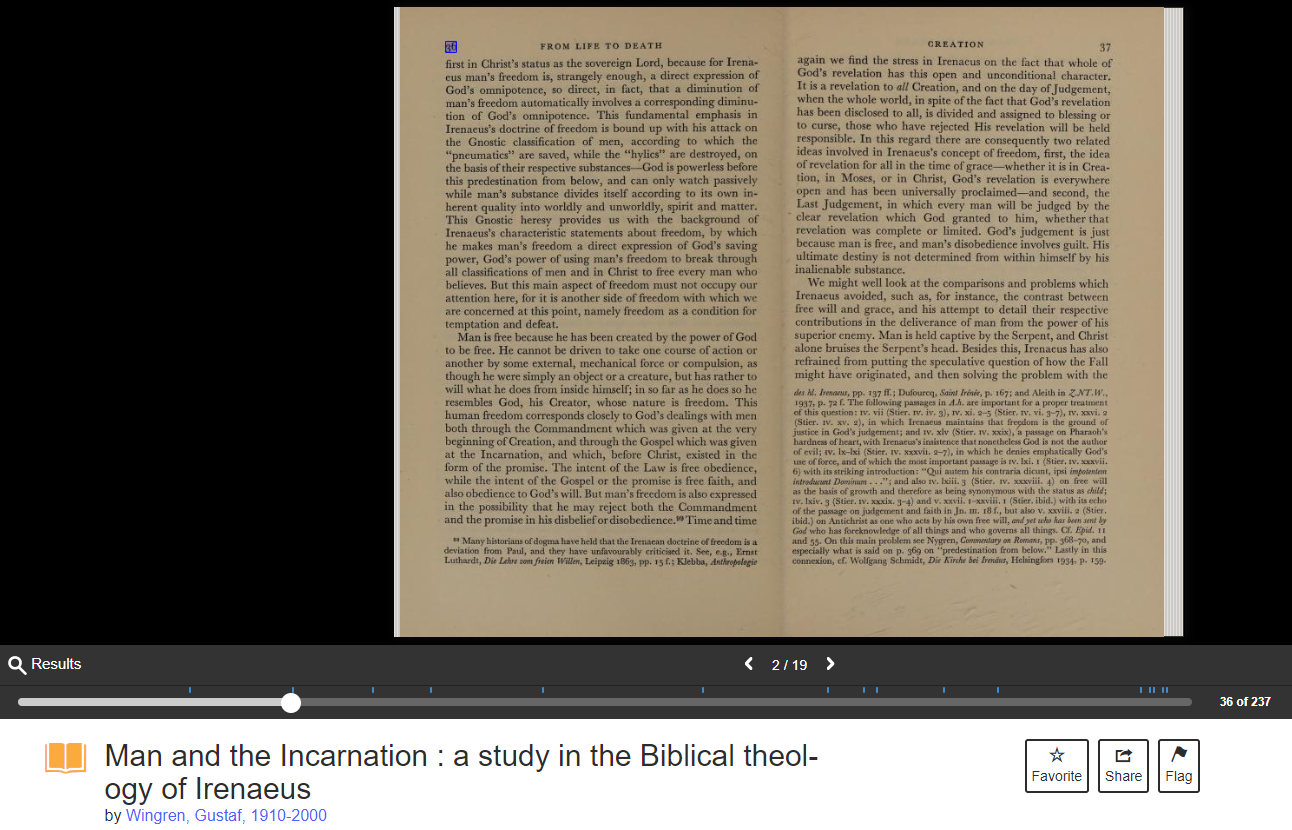
Finally, this is troubling because it appears to be the result of simply recycling source material.  This same quotation from Wingren is found in Wilson's book, which itself is apparently essentially his dissertation:
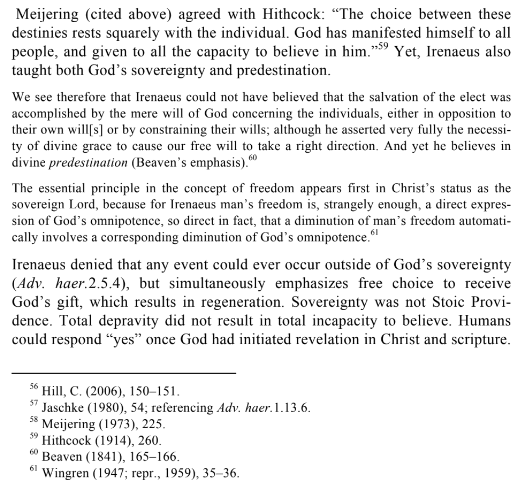
 

K. Wilson, Augustine's Conversion from Traditional Free Choice to "non-free Free Will" A Comprehensive Methodology, p. 54 (2018).

While I appreciate Wilson's attempt to contribute to patristic scholarship, I would encourage him not only to correct this error in any subsequent edition of "Calvinism: a Biblical and Theological Critique," but also to correct his underlying error of thought regarding the relationship of Irenaeus to Augustinian thought.

Wednesday, April 14, 2010

Brief Responses to Jay Dyer

Jay Dyer has resurrected a few old jibes at his blog in two posts (first)(second).

In the first article he resurrects the assertion (which I already debunked) that Calvinists are Nestorians or "proto-Nestorians":
Here, St. Athanasius rebukes the Proto-Nestorians and by extension, their modern day re-incarnation, the Calvinists. So, we now officially have five well-known Calvinists who have made pro-Nestorian statements: A.A. Hodge, R.J. Rushdoony, Eric Svendson, Turretinfan and John W. Robbins co-author, Sean Gerety.
Mr. Dyer is being a little misleading in presenting things this way. Speaking only for myself and A.A. Hodge, our comments were that Nestorius was false accused of holding Nestorianism. Jay's comment suggests something else to the reader.

What about the substance of what Athanasius wrote? Is it opposed to Reformed theology? On the contrary, Athanasius properly distinguishes between the human and divine natures, even while affirming the unity of the person: "But the Word Himself offered His own Body on our behalf that our faith and hope might not be in man, but that we might have our faith in God the Word Himself." And again: "For humanly He enquires where Lazarus is laid, but raises him up divinely."

Athanasius even mentions the issue of the substitutionary atonement: "And it has been made plain to all that not for His own sake but for ours He underwent all things, that we by His sufferings might put on freedom from suffering and incorruption [1 Corinthians 15:53], and abide unto life eternal." And again: "But in the same body in which He was when he washed their feet, He also carried up our sins to the Tree [1 Peter 2:24]."

The second article resurrects the assertion that Calvinists are Manicheans (which I already debunked). The second article primarily relies on Gregory of Nyssa. The bigger part of my response will have to wait for another time, where I will argue that although Gregory of Nyssa does not make reference to "original sin" as such (that term is one that has historically been more popular in the West, especially following Augustine), Gregory inconsistently affirms various of the aspects of it, namely those aspects that are the most clear from Scripture. The lesser part of the response (and an adequate response to the quotation provided from Gregory) is that like Gregory of Nyssa we oppose dualism of the kind that posits two distinct first causes: one good and one evil. Thus, we avoid the charge of Manicheanism or even any reasonable accusation of tendency thereto.

-TurretinFan

Tuesday, January 27, 2009

Response to Jay Dyer on Calvinism (Part 3 of 13)

This is part 3 of the thirteen part series in response to Jay Dyer. The previous part may be found here (link).

Jay Dyer says:
2) "[A consistent Calvinist must be] Manichaean, in that nature is inherently evil."

(Note, "Manichaean" and "Manichean" are both widely used spellings for this position.)

I answer:

a) The Calvinist Position (whether right doctrine or error let Scripture decide)

Men are, by nature, children of wrath (Ephesians 2:3). Nevertheless, God originally created man good (Genesis 1:26-31) although fallible (Genesis 2:16-17). By Adam's fall, he and all those whom he represented died and came under bondage to sin (Romans 5:12). In regeneration, the old becomes new (Colosians 3:10 and Ephesians 4:24) as a result of the work of Christ (Ephesians 2:15). Thus, Christ is called the new Adam (1 Corinthians 15:45). God has foreordained all things that come to pass (Acts 17:26), and has a purpose even in the evil acts of men (e.g. Genesis 50:20). Thus, as Proverbs 16:4 states, "The LORD hath made all things for himself: yea, even the wicked for the day of evil," and as it is written in the Epistle to the Romans, "Therefore hath he mercy on whom he will have mercy, and whom he will he hardeneth." (Romans 9:18)

b) The Accusation Disputed

The error of the Manicheans may be succinctly described as asserting that the physical world is intrinsicly evil, having been created by an evil opposite of God. Thus, the Manicheans deny that evil has a purpose in God's plan, view the body as contemptible, and deny God's omnipotence. Calvinism, however, teaches that God has a purpose even in the evil that happens, that the bodies of believers will be redeemed, and that God is omnipotent, even to the point of affirming that nothing can happen apart from the permission of God. Thus, no consistent Calvinist could be a Manichean.

c) The Accusation Redirected

On the other hand, Manichean errors - particularly the dualism of viewing the body as intrinsically evil - have had a perceptible impact on the theology of Roman Catholicism. Thus, for example, we seen in modern Roman Catholicism things like a view that abstinence from sexual relations is more holy than normal marital relations and an exaltation of asceticism.

Furthermore, Catholicism does not have a clear answer to the question of the purpose of evil. That is to say, Catholicism cannot consistently account for the existence of evil in the Creation. This can be seen from the widespread denial of predestination in Catholicism. To be sure, there are some Thomistic folks within Catholicism who would have a similar view to Calvinists (which in itself should cause Mr. Dyer to pause), but the Roman magisterium has not clearly sided with either Thomists or the Molinists (in fact, folks like Jimmy Akin (a popular lay apologist for Catholicism) claim that the Roman magisterium has adopted the essentially relativistic position that Thomism, Molinism, and at least one other view are all acceptable, and none can call the others heretics (source)). Nevertheless, Molinism or a form/variant of it, is the most widely promoted view in Catholicism today. This position ultimately denies God's omnipotence, by asserting that man's "free-will" decisions are something that God cannot control.

-TurretinFan

Continue to Part 4