Showing posts with label Textual Transmission. Show all posts

Friday, December 30, 2022

Planned Topics for Debate with Nick Sayers

The following are the KJV Errors that I plan to address in my debate with Nick Sayers.

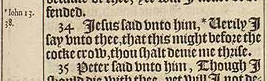
1. Printing Errors in the 1611

Matthew 26:34 Iesus said vnto him, Uerily I say vnto thee, that this might before the cocke crow, thou shalt denie me thrise.


The word "might" should be "night" as later editions of the KJV corrected.

2. Misleading Translation

Psalm 29:6

He maketh them also to skip like a calf; Lebanon and Sirion like a young unicorn.

(together with the other references to unicorns)

3. Dynamic Equivalent Rather than Literal

Joshua 22:29
God forbid that we should rebel against the LORD, and turn this day from following the LORD, to build an altar for burnt offerings, for meat offerings, or for sacrifices, beside the altar of the LORD our God that is before his tabernacle.

Romans 9:14 
What shall we say then? Is there unrighteousness with God? God forbid.

"God Forbid" both in the Old Testament (9x) and the New Testament (15x) 

4. Translation Error Corrected by the 2016 KJV

Mark 6:20 - (KJV) For Herod feared John, knowing that he was a just man and an holy, and observed him; and when he heard him, he did many things, and heard him gladly.

Note “or, kept him or saved him” as the marginal note.

Mark 6:20 - (‘16) because, Herod feared John, knowing that he was a just and holy man, and protected him. And when he heard him, he did many things, and heard him gladly.

Mark 6:20 (TR) ὁ γὰρ Ἡρῴδης ἐφοβεῖτο τὸν Ἰωάννην εἰδὼς αὐτὸν ἄνδρα δίκαιον καὶ ἅγιον καὶ συνετήρει αὐτόν καὶ ἀκούσας αὐτοῦ πολλὰ ἐποίει, καὶ ἡδέως αὐτοῦ ἤκουεν

5. Translation Error in Old Testament (not covered by 2016 KJV) but correct in 1611 Margin

Isaiah 65:11 But ye are they that forsake the LORD, that forget my holy mountain, that prepare a table for that troop, and that furnish the drink offering unto that number.

In general, this illustrates the value of having marginal readings.  

6. Translation Errors Not Corrected by the 2016 KJV nor the 1611 margin

Acts 12:4 - And when he had apprehended him, he put him in prison, and delivered him to four quaternions of soldiers to keep him; intending after Easter to bring him forth to the people.

The annual Christian celebration of Christ's resurrection was not yet established at that time, and even if it were, there is no reason Herod would be interested in observing it.  

The correct translation here is Passover.  

7. Errors due to Greek Text - Beza's "Conjecture" at Revelation 16:5

Revelation 16:5 (KJV) And I heard the angel of the waters say, Thou art righteous, O Lord, which art, and wast, and shalt be, because thou hast judged thus.

Revelation 16:5 (ESV) And I heard the angel in charge of the waters[a] say, “Just are you, O Holy One, who is and who was, for you brought these judgments.

8. Errors due to Greek Text - Scribal Addition of Doxology at Matthew 6:13

Matthew 6:13 And lead us not into temptation, but deliver us from evil: For thine is the kingdom, and the power, and the glory, for ever. Amen.

9. Errors due to Greek Text - Late Scribal Copying Error at Ephesians 3:9

Ephesians 3:9 And to make all men see what is the fellowship of the mystery, which from the beginning of the world hath been hid in God, who created all things by Jesus Christ:

10. Errors due to Latin Corruption - 1 John 5:7-8

1 John 5:7-8
For there are three that bear record in heaven, the Father, the Word, and the Holy Ghost: and these three are one. And there are three that bear witness in earth, the Spirit, and the water, and the blood: and these three agree in one.

Monday, March 28, 2016

Confucianism, Islam, and Christianity - One Point of Contrast

Qin Shi Huang (260 - 210 BC) is the most prominent of the Chinese emperors. He united China through conquest, began the Great Wall of China, and had the Terra Cotta warriors built. He's significant to Confucianism - and especially the textual transmission of Confucius' works - because toward the end of his reign he engaged in a process of burning books and burying scholars. The scholars that were allegedly buried alive were apparently Confucian scholars, and Confucian works were apparently largely destroyed by the Emperor's decree.

The Qin dynasty ended shortly after Qin's death, and was replaced by the Han dynasty. In A.D. 9, Wang Mang (45 BC - A.D. 23) usurped the throne from the ruling family and set up his own short-lived dynasty. During Wang Mang's reign, it was alleged that some of Confucius' writings had been rediscovered. Wang Mang apparently used these texts in an attempt to support his own reforms.

Robert Greene (in "The 48 Laws of Power," p. 397) explains it this way:
Reigning from A.D. 8 to A.D. 23, the Chinese emperor Wang Mang emerged from a period of great historical turbulence in which the people yearned for order, an order represented for them by Confucius. Some two hundred years earlier, however, Emperor Ch'in had ordered the writings of Confucius burned. A few years later, word had spread that certain texts had miraculously survived, hidden under the scholar's house. These texts may not have been genuine, but they gave Wang his opportunity: He first confiscated them, then had his scribes insert passages into them that seemed to support the changes he had been imposing on the country. When he released the texts, it seemed that Confucius sanctioned Wang's reforms, and the people felt comforted and accepted them more easily.

Burning Books, by Matthew Fishburn similarly reports:
The first recorded state-sponsored book burning is the destruction ordered by Grand Councillor Li Ssu in Ch’in China in 213 BC. The country had been newly unified under Ch’in Shih-huang-ti, and he signified his rule with the order to burn the books of any historian or partisan of the defeated Shih or Shu. The Emperor is also known for beginning construction of the Great Wall, and even forced people convicted of protecting books to work on its construction; condemning, as Borges incisively commented, ‘those who adored the past to a work as vast as the past, as stupid and as useless’. This was not, as Lois Mai Chan has emphasized, unmediated destruction. There were exemptions for all manner of practical or scientific works and, just as importantly, even the objectionable books were preserved in imperial archives and allowed to be kept by the official scholars. As is often the case with such suppression, it is difficult to assess the extent of the initial destruction, but it is certain that this centralization of the written record increased the devastation when the Imperial Archives were attacked and destroyed in 206 BC. The association between censorship and aridity has its symbol in the legend that grass never grew on the spot where the books of the scholars were burned.
(p. 2)

While there is controversy (apparently to this day) about the nature and extent of Qin's burning of books, and of Wang Mang's (or others') possible editing or forging of Confucian writings, these controversies were all made possible by the fact that Qin had control of the geographic area where Confucius' works circulated, and the means for effectively destroying those works.

This parallels the history of the transmission of the Qur'an. The first caliph of Islam, Abu Bakr, is said to have collected the Qur'an in A.D. 634. Nevertheless, various versions of the Qur'an were apparently circulating during reign of the third caliph, Uthman (reigned A.D. 644 - 656). Uthman created a standard text of the Qur'an and had the other copies burned. This was possible because Uthman had control of the geographic area where the Qur'an circulated and the means for effectively destroying competing copies.

There is, however, no close parallel in Christianity. Christianity rapidly spread copies of books of the Bible (both Old and New Testaments) beyond the reach of the Roman Empire. Christianity had no centralized earthly ruler and by the time emperors like Constantine or Roman bishops tried to operate in such a capacity, the text of the New Testament was so well established and widespread that any attempt to edit or control the text would have been ineffective. While this uncontrolled transmission of the text may seem messy it is one of the means by which we can have confidence in the text today, without the need for a continued prophetic witness.

P.S. For your interest:
There is considerable debate about which, if any, of these books were directly written by Confucius himself. The main source of his quotations, the Analects, was not written by him. As with many other spiritual leaders such as Siddhartha Gautama, Jesus, or Socrates, our main source of Confucius' thought, the Analects, was written down by his disciples. Some of the core canon is argued to have been written by Confucius himself, such as the Spring and Autumn Annals. There is considerable debate about this, however.
This factor is further complicated by the "Burning of the Books and Burying of the Scholars", a massive suppression of dissenting thought during the Qin Dynasty, more than two centuries after Confucius' death. The emperor Qin Shi Huang destroyed a great number of books, possibly destroying other books written by Confucius or his disciples in the process.
The current canon of Four Books and Five Classics was formulated by Zhu Xi. Many versions contain his extensive commentaries on the books. The fact that his specific version of the Confucian canon became the core canon can be seen as an example of his influence in Confucianism.
Other books are not included in the current canon but once were. The major example is the Xun Zi.
(source)


See also:
In AD 9, Wang Mang usurped the throne and created the Xin Dynasty. The Western Han dynasty had ended after 198 years of consecutive rule.
Wang Mang hoped to gather support from the peasantry be introducing reforms. Wang Mang announced the discovery of books written by Confucius, which were supposedly discovered after Confucius’ house, was destroyed more than two hundred years ago. The discovered work supported the same kind of reform that Wang Mang sought.
Wang Mang defended his policies by quoting from the discovered books. Following what was portrayed as Confucian scripture; he decreed a return to the golden times when every man had his measure of land to till, land that in principle belonged to the state. He declared that a family of less than eight that had more than fifteen acres was obligated to distribute the excess amount of land to those who had none.
(source)

Monday, April 13, 2015

Matt Slick Errs on Textual Transmission / Textual Criticism Again

Matt Slick has again (The Bible Thumping Wingnut, Episode 61, around 30 minutes into the episode) erred on the topic of textual criticism.

Unfortunately, Mr. Slick seems to be confused about the transmission of the New Testament compared to the translation of the Old Testament. His comment about adding up numbers seems to be based on something Mr. Slick has heard about the process used by the Masoretes (and it doesn't even appear to be accurate regarding their process). It does not describe the Christian process, especially not in the early Christian period. Early Christian textual transmission was, as far as we know, not done by professional scribes and did not include letter-counting techniques (such as those later used by the Masoretes) to ensure the reliability of the copies. These facts don't undermine the reliability of the New Testament text, but making errors in this area may undermine the other valid points that Mr. Slick is trying to offer.

Additionally, Mr. Slick repeated the same error regarding how textual variants are counted (which we already corrected here).

It's great that Mr. Slick is going to be debating a Muslim on the divinity of Jesus soon, but it seems likely that these issues of textual transmission will crop up in apologetics with Muslims (as they frequently do), and it would be good for one of Mr. Slick's friends to help get him straight on these issues before then.

*** Updated 4/13/2015

By the way, Mr. Slick should probably update his own web pages once he realizes his mistake. This same repeated error about how to count variants appears on at least the following pages of carm.org :

https://carm.org/bible-text-manuscript-tree

That same page also claims "Furthermore, the New Testament is approximately 99.5% textually pure. This means that of all the manuscripts in existence they agree completely 99.5% of the time." That's also not the case.

https://school.carm.org/amember/files/demo2/bible/reliable.htm

This page claims "The copies are so accurate that all of the biblical documents are 98.5% textually pure." Even if Mr. Slick decides he has some insight into textual transmission, he should presumably harmonize his own pages.

This page also claims (similar to Mr. Slick's comments on the show): "Similarly, the Greek writers of the New Testament would copy the biblical manuscripts. By default, every letter also has a numeric value. When the copies were done, the copyists would add up the numeric values of the words copied and compare them to the original copy. If there was an error, the copy was destroyed and a new one was begun. This was done with both the Hebrew and Greek writings of the Bible. Therefore, the Bible was copied with extreme care." That's not an accurate depiction of the New Testament transmission. It seems to be taken from some information regarding the extreme care the Masoretes took in copying the Old Testament, but even then it's not quite right.

The page also mentions the accuracy of the Isaiah scroll in the Dead Sea scrolls compared to the Masoretic text. It's true that the texts were very close. Not all the scrolls share that same closeness, however, especially in Jeremiah. So, it might be good to provide some additional information and caveats regarding the reliability of the Masoretic textual transmission.

Thursday, August 22, 2013

Textual Preservation of the Old Testament

Each of the books of the New Testament is well preserved as can be seen using the tools of historical research. Historical research, however, can only get us so far with respect to the Old Testament. For example, until recently the oldest Hebrew manuscripts of the Old Testament were not very old, and the oldest Greek manuscripts of the Old Testament were only about as old as the oldest Greek manuscripts of the New Testament. The Dead Sea Scrolls helped the situation out somewhat. Nevertheless, we have no large segments of the Old Testament Scriptures that can be dated to before the 6th century B.C. (before the captivity in Babylon). Moses, however, wrote the first books of Scripture hundreds of years before that, perhaps even a thousand years before that.

Moreover, while the Dead Sea Scrolls were an amazing archaeological find that boosted our knowledge of the state of the text in ancient times, it represents a geographically non-diverse transmission. Likewise, while the Masoretes (especially in the medieval period) were fastidious, they also left a very controlled transmission of the text.

The Septuagint transmission is slightly more interesting than that of the MT. The LXX, however, at best represents a post-inspiration translation of the text - and its early transmission is shrouded in legend.

All that said, it would be great if we could know that the text of Moses had survived substantially intact down to the days of Jesus.

And we can know that. Abraham said, "They have Moses." That wouldn't be true if they did not have the Torah. Recall that Jesus recounts in the parable of Lazarus:

Luke 16:29
Abraham saith unto him, "They have Moses and the prophets; let them hear them."

Moreover, Jesus and the apostles appealed constantly to the Old Testament Scriptures. Likewise, Jesus told the Pharisees:

John 5:39
Search the scriptures; for in them ye think ye have eternal life: and they are they which testify of me.

They could not testify to Jesus if they did not exist.

Thus, while we may be unable to provide historical proof that the Old Testament Scriptures are in the form they existed before the 6th century B.C., we can demonstrate from Jesus' own testimony that they were intact in his day. Moreover, we know what they said in Jesus' day. Therefore, we can have confidence that we have a well-preserved Old Testament and not only a well-preserved New Testament.


-TurretinFan

Monday, January 28, 2013

Textual "Corruption" of the Quran

A very impressive presentation on the corruption of Quran may be found at this link (link to beginning of relevant section). This was much more detailed than any similar presentation I had seen before. The following is a brief outline:

1. Preservation of the Bible

[I will omit these points, which were things I already knew, but which are important.]

2. Preservation of the Qur'an
a. Hadith Demonstrates variation (Bukhari, v. 6, b. 60, n. 468; see also 6.60.467 and Muslim 4.1799-1802).
b. al-NAdim's catalog of books (4th Islamic century) included early literature on the discrepencies among Quranic manuscripts (the presentation lists 7 books from the catalog).
c. Uthman's destruction of the other Qurans (Bukhari, 6.61.510) and Abdullah ibn Masud's resistance.
d. Four common versions of the Qur'an: The Qur'an According to Imam Hafs, The Qur'an According to Imam Warsh, The Qur'an According to Imam Qulan, and The Qur'an According to Imam al-Duri.
e. Example of difference between Warsh and Hafs at 21:4 ("Say ..." vs. "He said ...")
f. Example of difference between Warsh and Hafs at 3:146 ("fought" vs. "was killed")
g. Quran showing the differences among the ten major versions in the margin.
h. Between two versions of the Quran (he didn't specify which two), there are 1354 differences.
i. The Bismallah - Hafs says it is a verse of the Quran, but Warsh says it is just part of the title (appears 113 times, and has 4 words, for a total of 452 words difference).
j. Analysis of the Chain of Narration (Isnad) for the Hafs Quran, but that chain is not historically possible, because Abdullah ibn Masud rejected the Uthman Qur'an.

3. The Qur'an's testimony to the Bible

[Some good points that I had heard before about how the Qur'an testifies to the reliability of the Bible.]

If anyone has Samuel Green's written version of his presentation and his permission to post it on-line, I would love to be able to repost it here. Unfortunately, I do not know how to contact Mr. Green.

-TurretinFan

Tuesday, February 07, 2012

Does Allah Preserve His Words?

Since I am on James White's blogging team, and am friends with him, I was sure to carefully read an article posted with the alarming title, "Exposing James White’s Deceit and Ignorance of Islamic Scripture," from the "Calling Christians" website.

The title wasn't supported by the body of the piece. "Deceit and Ignorance" turned out to be, at most, a difference of opinion between the author of the piece and my friend, Dr. White. The article begins thus:
In a recent twitter exchange with James White, I found him proposing such an absurd view of Islamic ‘aqidah that I simply had to write an article to correct his misinformation. In the field of academia, we try our best to uphold certain standards, however Alpha and Omega Ministries as missionary zealots don’t have to appeal to this high standard of intellectualism. So what exactly is James’ problem this time around? Let’s see:

[twitter post images here, in which Dr. White states: "How do you explain such texts as 5:47, 5:68, and 10:94 if you affirm (as you have) tahrif il-lafzi?"]

In essence, James White is appealing to the fallacious argument of appeal to ad ignorantium. Summarily, he’s trying to expound the concept that Muslims believe in a self contradicting tenet. This being, that in Islam, while we believe God’s word cannot become corrupted, we also believe that “God’s word” did come corrupt. For example, we say the Qur’an is the word of Allaah and therefore it cannot be changed or corrupted, yet in the same voice, supposedly we claim that the Injil and Tawrah, which are also the words of Allaah, have been altered. The terms which James is trying to use are, Tahrif ul Lafzi (corruption of written words) and Tahrif ul M’anavi (corruption of meaning).

What James White and his missionary zealot friends try to assert is that Muslims have not only a contradicting belief, but because of this belief it is the Qur’an which is wrong and the Bible is the true word of God.
There is a lot of baggage mixed in there, but the author of the piece is correct that we think that it is inconsistent to hold to the ideas that (1) Allah preserves his word, (2) the Old and New Testaments are the word of Allah, and (3) the Old and New Testaments are corrupt.

We are aware that the way Muslims attempt to hold these two ideas is by limiting (1) to simply saying that Allah preserves some portion (or all) of the Qur'an and/or by denying that the Old and New Testaments correspond to the Torah and Injeel.

This particular author begins his response, following the introduction above:
The Islamic belief is that God protects His revelations from becoming corrupt, altered and interfered with. In this regard, we do not hold the belief that God’s words can succumb to corruption, alteration and human interference.
Thus, this particular author has made a more general statement, akin to our (1) above.

The author continues:
Therefore we must correct James’ assertion that we believe God’s words can be corrupted by man, the Qur’an is clear that God would not allow this. It is the belief of all Muslims and if one did not know this belief (you now kn0w) that it is impermissible for a Muslim to believe that God’s words can become corrupted.
Clearly, the author has misunderstood Dr. White's point. Dr. White was not arguing for corruption of God's word, but simply noting a contradiction within Islamic views.

The author proceeds:
With that in mind what about the verses in the Qur’an which mention the corruption of the previous scriptures such as the Injil, Tawrah and Zabur?
The author then sets forth the basic gist of the points about corruption:
There are many verses in the Qur’an which indicate to us that God’s wahy (revelation) has been skewered by the hands of man, both literal words changes and contextual alterations (interpretations):
يُحَرِّ‌فُونَ الْكَلِمَ عَنْ مَوَاضِعِهِ ۙ وَنَسُوا حَظًّا مِمَّا ذُكِّرُ‌وا بِهِ ۚ وَلَا تَزَالُ تَطَّلِعُ عَلَىٰ خَائِنَةٍ مِنْهُمْ إِلَّا قَلِيلًا مِنْهُمْ ۖ فَاعْفُ عَنْهُمْ وَاصْفَحْ ۚ إِنَّ اللَّـهَ يُحِبُّ الْمُحْسِنِي
They distort words from their [proper] usages and have forgotten a portion of that of which they were reminded. And you will still observe deceit among them, except a few of them. But pardon them and overlook [their misdeeds]. Indeed, Allah loves the doers of good. – Qur’an : 5 : 13.

وَإِنَّ مِنْهُمْ لَفَرِ‌يقًا يَلْوُونَ أَلْسِنَتَهُمْ بِالْكِتَابِ لِتَحْسَبُوهُ مِنَ الْكِتَابِ وَمَا هُوَ مِنَ الْكِتَابِ وَيَقُولُونَ هُوَ مِنْ عِنْدِ اللَّـهِ وَمَا هُوَ مِنْ عِنْدِ اللَّـهِ وَيَقُولُونَ عَلَى اللَّـهِ الْكَذِبَ وَهُمْ يَعْلَمُونَ
And indeed, there is among them a party who alter the Scripture with their tongues so you may think it is from the Scripture, but it is not from the Scripture. And they say, “This is from Allah,” but it is not from Allah. And they speak untruth about Allah while they know. – Qur’an : 3 : 78.

مِنَ الَّذِينَ هَادُوا يُحَرِّ‌فُونَ الْكَلِمَ عَنْ مَوَاضِعِهِ وَيَقُولُونَ سَمِعْنَا وَعَصَيْنَا وَاسْمَعْ غَيْرَ‌ مُسْمَعٍ وَرَ‌اعِنَا لَيًّا بِأَلْسِنَتِهِمْ وَطَعْنًا فِي الدِّينِ ۚ وَلَوْ أَنَّهُمْ قَالُوا سَمِعْنَا وَأَطَعْنَا وَاسْمَعْ وَانْظُرْ‌نَا لَكَانَ خَيْرً‌ا لَهُمْ وَأَقْوَمَ وَلَـٰكِنْ لَعَنَهُمُ اللَّـهُ بِكُفْرِ‌هِمْ فَلَا يُؤْمِنُونَ إِلَّا قَلِيلًا
Among the Jews are those who distort words from their [proper] usages and say, “We hear and disobey” and “Hear but be not heard” and “Ra’ina,” twisting their tongues and defaming the religion. And if they had said [instead], “We hear and obey” and “Wait for us [to understand],” it would have been better for them and more suitable. But Allah has cursed them for their disbelief, so they believe not, except for a few. – Qur’an : 4 : 46.
We seemingly have arrived at a theological impasse. On one end, we read above that God would protect His revelations and now we’re reading that God’s revelations were altered by men, corrupted, their meanings and letters distorted. Yet, before we jump to conclusions, we have to analyse what we have attained so far:

(1) God’s words cannot become corrupted.
(2) God’s words did become corrupted.

There seems to be a clear disconnect here.
So far, the author seems to have provided a reasonable presentation of the position he is arguing against, although we would say "God's word" rather than "God's words."

The author then attempts to identify a solution to the disconnect:
Something’s missing from this puzzle and we know what it is. Context. Did God’s word in itself become corrupted? And this is a question we must take seriously into consideration. What we see from the above verses is that there are two cases for God’s word apparently becoming corrupted:

(1) Interpretative alterations.
(2) Textual alterations.

With this in mind, let’s examine both cases.
We certainly have no objection to contextual consideration of the Qur'an, despite the seeming possible futility of applying a contextual method to what amounts to a posthumous topical collection of recalled sayings.

The author then posed the argument based on context:
It is true as we read from the Qur’aan: 5:13, 4:46, 3:78 that God’s revelations were reinterpreted. These interpretations followed the folly desires of men, in some areas to abrogate God’s law to suit material wants and desires, for power, even for illicit pleasures:
Their gist is that the Jews were habitually used to issuing religious edicts as desired by the people, either for the benefit of relatives or to satisfy their greed for money, property, influence, and recognition. This had become a common custom particularly in matters involving punishments that they would, if the crime was committed by an influential person, change the severe punishment of the Torah into an ordinary one. It is this behaviour, part of theirs which has been described in the first verse (41) in the following words: يُحَرِّ‌فُونَ الْكَلِمَ مِنْ بَعْدِ مَوَاضِعِهِ (They displace the words after their having been placed properly).

Now the people who were used to making the severe punishments of the Torah easy for their clients by changing them saw an opportunity for themselves whereby they could take such shady matters to the Holy Prophet {saw} and make him their judge or arbitrator. The dual advantage they saw in it was that they would reap the benefits of all easy and light rules of Islamic law, while at the same time, they would not have to commit the crime of altering the Torah. But, here too, they had their crookedness at work as they would hold on to their decision of taking their case to him until such time that they succeeded in finding out beforehand through some source or ruse as to the actual verdict which would be delivered in their case when presented. Then, if they found this verdict matching their wishes, they would make him their arbitrator and have him decide their case. If it happened to be contrary to their wishses, they would leave it at that.- Tafsir Maar’iful Qur’aan : Mufti Rafi Uthmani, pages 164- 165.
However, God did guard the message (risalah) of the revelations (wahy). God sent messengers, prophets to correct the wrong interpretations by these pseudo religious scholars:
إِذْ أَرْ‌سَلْنَا إِلَيْهِمُ اثْنَيْنِ فَكَذَّبُوهُمَا فَعَزَّزْنَا بِثَالِثٍ فَقَالُوا إِنَّا إِلَيْكُمْ مُرْ‌سَلُونَ
When We sent to them two but they denied them, so We strengthened them with a third, and they said, “Indeed, we are messengers to you.” – Qur’an : Suratul Yasin (36) : 14.
In fact, the New Testament, confirms that Messengers were sent to the people who tried to alter His message through new interpretations:
“Jerusalem, Jerusalem, you who kill the prophets and stone those sent to you, how often I have longed to gather your children together, as a hen gathers her chicks under her wings, and you were not willing. – Bible : Matthew (23) : 37.
So as we can see, the Qur’an is correct, God did protect the meaning of His message, until newer revelation was sent. For example the Qur’an abrogates the Injil as the Injil abrogated the Tawrah, and if the case arose where persons were distorting the meaning of a scripture or Prophet’s message, we read that God sent apostles, messengers, Prophets in some instances to correct the people (see 36:14 above).
Regarding the author's conclusion, the solution he is offering is a qualification on the protection of "until newer revelation was sent." That solution is not actually found in the materials he has identified.  In other words, the context has not substantiated his charge.

It seems that (for part of the argument) the author is trying to argue that the Qur'an's references to corruption relate to attempted corruption of the meaning, but that this attempted corruption was essentially ineffective.  This approach might make sense, but would imply that the meaning remains intact.  That solution implies that the Old and New Testaments are intact in their meaning (within the context of Dr. White's criticism).

But the author of the article is not finished.  He continues:
However, now we’ve arrived at the crux of the matter, textual corruption. As Muslims we assert that God’s message is preserved by God (as seen above, contextually), but what about textually? We read earlier that God protects His message in totality, that is, textually and contextually (meanings, interpretations). However as Muslims, we also do say that we do not believe in the Old Testaments of the Jews and Christians nor do we believe in the New Testaments of the Christians as being valid, because we assert they are not the words of God. Since they are not the words of God, they can indeed become corrupted and God did not promise to guard the works of man, but only His words.
This is the approach mentioned above of denying that the Old and New Testaments correspond to the Torah and Injeel. But is this feasible? Let's consider how the author of the article tries to defend this approach:
For example, in the case of the Old Testament, where missionary zealots such as Sam Shamoun and James White try to propose, that their Torah is the Torah from Allaah, we have to correct that appeal to ignorance. The Qur’an does not say that the Old Testament is the word of God, in fact, we read above (5:13) where the Qur’an calls the Torah/ Old Testament of the Jews and Christians as being interpolations from the tongues and minds of men. It is in this regard that the Islamic belief is not that God’s word was corrupted, but that people wrote words and then claimed them to be God’s:
فَوَيْلٌ لِلَّذِينَ يَكْتُبُونَ الْكِتَابَ بِأَيْدِيهِمْ ثُمَّ يَقُولُونَ هَـٰذَا مِنْ عِنْدِ اللَّـهِ لِيَشْتَرُ‌وا بِهِ ثَمَنًا قَلِيلًا ۖ فَوَيْلٌ لَهُمْ مِمَّا كَتَبَتْ أَيْدِيهِمْ وَوَيْلٌ لَهُمْ مِمَّا يَكْسِبُونَ
So woe to those who write the “scripture” with their own hands, then say, “This is from Allah,” in order to exchange it for a small price. Woe to them for what their hands have written and woe to them for what they earn. – Qur’an : Suratul Baqarah (2) : 79.
With that being said, we must come to the understanding that when the Qur’an says that the message became corrupted, that is textually, it refers to those who put aside God’s revelation and in its stead, replaced the void with their own sayings, beliefs and propaganda. One example is of the Christian New Testament. The Qur’an says that a scripture (Injil) was given to Jesus (Issa, may God be pleased with him):
وَقَفَّيْنَا عَلَىٰ آثَارِ‌هِمْ بِعِيسَى ابْنِ مَرْ‌يَمَ مُصَدِّقًا لِمَا بَيْنَ يَدَيْهِ مِنَ التَّوْرَ‌اةِ ۖ وَآتَيْنَاهُ الْإِنْجِيلَ فِيهِ هُدًى وَنُورٌ‌ وَمُصَدِّقًا لِمَا بَيْنَ يَدَيْهِ مِنَ التَّوْرَ‌اةِ وَهُدًى وَمَوْعِظَةً لِلْمُتَّقِي
And We sent, following in their footsteps, Jesus, the son of Mary, confirming that which came before him in the Torah; and We gave him the Gospel, in which was guidance and light and confirming that which preceded it of the Torah as guidance and instruction for the righteous. – Qur’an : 5: 46.
However Christians by themselves prove the Islamic belief of textual corruption as displayed above:

(1) Muslims believe that Jesus (Issa, may God be pleased with him) was given a revelation by God called the Injil.
(2) Christians believe that inspired scripture about Jesus originated with the apostles of Christ.

Therefore the Christian argument in reality disproves itself.
As for the last argument, this argument is only relevant to the Gospels, not to the Torah or the Zabur (Psalter, book of Psalms). Moreover, this argument presupposes that it is true that the Injil was given as a revelation to Jesus. However, this assertion itself is not correct. Indeed, it is simply another error of Mohamed's teaching.

This point is also something of a red herring. Even if there were a different book called the Injil that was allegedly given to Jesus, where has this been preserved at all? In other words, the situation is much worse for the Muslim who tries to avail himself of this particular argument. Instead of simply small textual variants in the New Testament, now the Muslim must account for the seeming complete destruction of the whole book and any record of its existence. After all, there is no record before Mohammed of any book given to Jesus.

There is a similar problem with respect to the argument about the Torah. So, the Muslim is claiming that the Torah which has been preserved is not the Torah referenced in the Qur'an. But then the lack of preservation is much worse than the Muslim has contended - the original Torah is completely gone if the one we have is not the original Torah but some new fake Torah.

Moreover, there is another problem, the Koran seems to suggest that the Torah and Injil are in the possession of the people of Mohammed's day:
وَلَمَّا جَاءَهُمْ كِتَابٌ مِّنْ عِندِ اللَّهِ مُصَدِّقٌ لِّمَا مَعَهُمْ وَكَانُوا مِن قَبْلُ يَسْتَفْتِحُونَ عَلَى الَّذِينَ كَفَرُوا فَلَمَّا جَاءَهُم مَّا عَرَفُوا كَفَرُوا بِهِ ۚ فَلَعْنَةُ اللَّهِ عَلَى الْكَافِرِينَ And when there comes to them a Book from Allah, confirming what is with them,- although from of old they had prayed for victory against those without Faith,- when there comes to them that which they (should) have recognised, they refuse to believe in it but the curse of Allah is on those without Faith. Qur'an 2:89 (Yusuf Ali translation)
If the Torah and Injil are something that were with Christians and Jews in the 7th century, then they weren't destroyed. Moreover, we know what the Old and New Testaments looked like in the 7th century - in fact we have even older copies than that.

So, it seems that the problem hasn't really been addressed. But let's consider how the author tries to wrap up this argument:
They have now failed on two fronts. Firstly, the premise that Muslims contradict themselves when they say the Bible is corrupted is proven false as we do not believe the Bible is the word of God. We don’t believe it is the word of God for namely two reasons:

(1) Christians assert it’s from the apostles and not from the Prophet Jesus (may God be pleased with him).
(2) Christians assert the revelation (wahy) isn’t revelation verbatim from God, which is what Muslims believe, but that the Bible is an inspired word from God, through the words of men.

Secondly, since they have made significant distinctions with what the Muslim concept of revelation is and what their scripture is actually comprised of, then they have shown that the Bible (New Testament) is not the Injil and as it follows, the Injil is not the Bible.
Most of this argument is already addressed above. Some people who call themselves Christians may not believe that the Bible is the very word of God, but verbal plenary inspiration is an important part of orthodox Christian belief. We do not believe that only the ideas but not the words are inspired. Our view of the mechanism of inspiration may differ from that of Muslims (we don't believe that the words simply are spoken, as it were, in the ears of the prophets), but that difference seems to be irrelevant to this particular argument.

The author of the article then provides a section designated as "conclusion":
Therefore, we must come to a logical conclusion. When missionary zealots such as Sam Shamoun and James White, along with their propganda team at AI, state that the Qur’an is wrong for saying the Bible is corrupted because Muslims believe the word of God can’t be corrupted, we must educate them. It is in this light, that our response should be, as such:
  • Muslims believe the word of God cannot be corrupted.
  • We believe the Bible is corrupted because it is not the word of God.
We do not believe it is the word of God because:
  • Christians do not believe the Bible is the verbatim word of God, but inspired ideas from God through the words of men.
In conclusion:
  • Therefore the Bible is corrupted because it is not the word of God and as such Muslims do not believe in it.
What was wrong with James White’s missionary belief, is that they think the Bible is the word of God and therefore we should accept this belief and as a consequence adhere to it, however as displayed above they don’t believe in the kind of scripture we do, they make a clear distinction between the Injil which we believe God revealed to Isa (Jesus, may God be pleased with him), while they believe in a scripture inspired by God, worded by the minds of men, which manifested after Jesus had walked the earth.

May God guide those who appeal to the fallacy of ad ignorantium.
As noted above, however, this doesn't really solve the problem - it just makes it worse. The Torah and Injil are now not merely somehow obscured through textual variation, but instead are completely destroyed. Under this theory, they are preserved much worse than if the Old and New Testaments are the Torah and Injil.

Moreover, there is no good argument provided for the assertion that the Torah and Injil do not correspond to Old and New Testament. Regarding the Injil, the argument that it cannot be the New Testament because of the mode of transmission (a) makes the problem even worse for the Muslim and (b) assumes both the reliability of the Qur'an on this point and the reliability of Christian accounts of how the gospels were given.

As for the fallacy of ad ignorantium, it has not been substantiated by the author of the article, and so we may leave our response at that.

-TurretinFan

Monday, March 22, 2010

More Important than the Dead Sea Scrolls?

That's what this article (link to article) claims about the Faddan More Psalter. The article reports that about 15 percent of the text has survived the supermillenial bog burial. I think the claim is somewhat exaggerated, though doubtless one would never have expected to find such an item in a bog, nor would one ever hope to find such an item in a bog again. The text provides a valuable early testimony to the transmission of the Latin text.

- TurretinFan

Thursday, January 14, 2010

Adventures in Textual Discovery

Dan Wallace reports on an interesting experience he had in examining a manuscript of the New Testament (link to report). The report illustrates the steps that are, even to this day, being undertaken to preserve the text of Scripture. Of course, not every manuscript find has the same excitement to a layman as the one Wallace is reporting. Nevertheless, the fact is that folks like Wallace are doing a remarkable service to the kingdom of God by tracking down and investigating the numerous manuscript copies of the New Testament.

-TurretinFan

Friday, January 08, 2010

Most Ancient Hebrew Inscription

Here is an interesting article about a pottery fragment with inscribed words found near the place that is thought to be the site of David's victory over Goliath (link). One of the most important notes from the article is the fact that this new artifact pushes back the secular chronology of Israel by centuries:
According to the university’s statement, such early Hebrew inscriptions make possible the idea that the Bible could have been written hundreds of years before current estimates.
Also of note is the similarity between the text and Scripture. Although the article states:
"The inscription is similar in its content to biblical scriptures, but it is clear that it is not copied from any biblical text.”
The following is the text that has been deciphered:
1' you shall not do [it], but worship the [Lord].

2' Judge the sla[ve] and the wid[ow] / Judge the orph[an]

3' [and] the stranger. [Pl]ead for the infant / plead for the po[or and]

4' the widow. Rehabilitate [the poor] at the hands of the king.

5' Protect the po[or and] the slave / [supp]ort the stranger.
(source)

Compare:

Psa 82:3 Defend the poor and fatherless: do justice to the afflicted and needy.
Psa 82:4 Deliver the poor and needy: rid them out of the hand of the wicked.

Psa 68:4 Sing unto God, sing praises to his name: extol him that rideth upon the heavens by his name JAH, and rejoice before him.
Psa 68:5 A father of the fatherless, and a judge of the widows, is God in his holy habitation.

Isa 1:17 Learn to do well; seek judgment, relieve the oppressed, judge the fatherless, plead for the widow.

-TurretinFan

CAVEAT: Archaeology is a science in flux. Today's remarkable discoveries sometimes turn out to be yesterday's frauds. Take all this sort of thing with a grain of salt. We know that Moses wrote the Pentateuch from divine revelation, not because of archaeology. Indeed, we recognize that it is possible that this archaeology is correct because it is consistent with Scripture, not the other way 'round.

Hat Tip to Randall Buth at the Evangelical Textual Criticism blog for pointing out the translation to me.

Monday, October 12, 2009

Augustine on the "We Gave You the Scriptures" Argument

One argument that we sometimes hear from Roman Catholic apologists is an argument that Roman Catholicism gave us the Scriptures, in the sense of preserving them for us over the centuries. This claim is, of course, anachronistic (the folks who preserved the Scriptures from the 4th decade to the 4th century, for example, could hardly be called "Roman Catholic" in their doctrines and practices). Nevertheless, for some folks the argument seems to have some bite.

Like so many arguments, though, it is not a new argument. In the times of persecution there were times when the government attempted to destroy the Scriptures and commanded Christians to hand over the sacred writings for destruction. Christians, viewing the Scripture as inspired by God and absolutely necessary, did not willingly cooperate with these commands.

In fact, many were persecuted and even martyred for failing to turn over their Bibles to the government. Not everyone was equally willing to suffer and die for the Word of God. Some folks turned over the Scriptures to the government, and these were known as traditores (meaning someone who hands over), from which we get our word "traitor."

Later, in theological disputes, some folks attempted to use the faithfulness of their spiritual forebearers against the spiritual unfaithfulness of their oponenents' spiritual forebearers with respect to the preservation of Scripture. They essentially would say that theirs preserved Scripture, while their opponents' turned it over. Augustine addresses this argument in a powerful way in the following quotation that Pastor King brought to my attention.

Augustine (354-430) commenting on Psalm 58:3:
But they [i.e., the Donatists] grow too deaf to hear the gospel, and will not allow us to read them the words of God. How ironic: they boast of having saved those words from the fire, but try to delete them with their tongues! Instead they speak words that are their own, and therefore empty. “That fellow handed over the books,” they say, “and that other one too.” Yes, all right; I will say the same: “That fellow handed them over, and so did that other,” and I am speaking the truth. But what has that to do with me? You can’t find the names of those you accuse in the gospel, can you? Nor can I read out to you from the gospel the names of those I mentioned. Let our documents be moved out of the way and God’s book take center stage. Listen to what Christ says, listen to truth speaking: And for repentance and forgiveness of sins to be preached in his name throughout all nations, beginning from Jerusalem. “No,” they reply, “listen to what we have to say. We don’t want to hear what the gospel says.” Sinners have been alienated even from the womb, they have gone astray even from the belly, they have spoken falsehoods. Let us speak the truth, because we have heard the truth, the truth that the Lord speaks, not what humans tell us. A human being can lie, but it is not possible for Truth to lie. From the womb of truth I recognize Christ, who is Truth itself, and from the words of Truth I recognize the Church, which participates in the Truth. Let no one who has strayed away from that matrix in the bowels of the Church speak falsehoods to me; I would wish to find out first what he wants to teach me. I see him as alienated from the womb, astray even from the belly; so what am I likely to hear from him, except falsehoods? They have gone astray even from the belly, they have spoken falsehoods.
John E. Rotelle, O.S.A., ed., Works of Saint Augustine, Expositions of the Psalms 51-72, Part 3, Vol. 17, trans. Maria Boulding, O.S.B. (Hyde Park: New City Press, 2001), Exposition of Psalm 57 (58), p. 128 (editor's footnotes omitted)(read for yourself here).

I realize that there will be many Roman Catholics who would like to focus only on the womb/church analogy. Furthermore, it should be noted that Augustine viewed himself as "Catholic" (not Roman Catholic) as distinct from the sectarian Donatists. He viewed them as having left the Catholic church and consequently as having spoken lies. That is the context for this discussion, and we realize that Rome would like to assert that the Reformed churches are in the same position as the Donatists (although there are numerous reasons to reject such a comparison).

Nevertheless, note that Augustine is quite willing to set aside the personalities (since they are not mentioned in Scripture) and to focus on the Scripture. Let Scripture take center stage, and let all the other things stand aside. Another friend of mine has stated that "I happen to agree with Warfield when, evaluating Augustine's theology, he concluded that the Reformation, inwardly considered, was just the victory of Augustine's doctrine of grace over Augustine's doctrine of the church." That may be the case (I'm less convinced that Augustine's doctrine of the church was accurately represented by the Romanists), but it should be noted that Augustine was willing to submit his doctrine of the church to the authority of Scripture: to let Scripture take precedence over history and to let the issue be "what does the Scripture say," as opposed to "who preserved the Scriptures."

-TurretinFan

Saturday, September 26, 2009

Jerome Regarding the Septuagint

I recently happened to stumble across this interesting translation of Jerome's Prologue to Chronicles (link). Jerome makes a number of interesting comments about the Septuagint:

1) Jerome begins by noting that the Septuagint is not a pure translation:
If the version of the Seventy translators is pure and has remained as it was rendered by them into Greek ... Now, in fact, when different versions are held by a variety of regions, and this genuine and ancient translation is corrupted and violated, you have considered our opinion, either to judge which of the many is the true one, or to put together new work with old work, and shutting off to the Jews, as it is said, "a horn to pierce the eyes."
- Jerome, Prologue to Chronicles

2) Jerome continues by noting that in his day it was famous that there were three regional varieties of the Septuagint:
The region of Alexandria and Egypt praises in their Seventy the authority of Hesychius; the region from Constantinople to Antioch approves the version of Lucian the Martyr; in the middle, between these provinces, the people of Palestine read the books which, having been labored over by Origen, Eusebius and Pamphilius published.
- Jerome, Prologue to Chronicles

3) Jerome argues that although Jesus knew the Septuagint translation, he used the Hebrew, arguing from various passages:
I have recently written a book, "On the best kind of translating," showing these things in the Gospel, and others similar to these, to be found in the books of the Hebrews: "Out of Egypt I called my son," and "For he will be called a Nazarene," and "They will look on him whom they have pierced," and that of the Apostle, "Things which eye has not seen, nor ear heard, and had not arisen in the heart of man, which God has prepared for those loving Him." The Apostles and Evangelists were certainly acquainted with (the version of) the Seventy interpreters, but from where (were) they (supposed) to say these things which are not in the Seventy?
- Jerome, Prologue to Chronicles

4) Jerome notes that the church of his day did not accept the apocrypha, but only the Hebrew books, as can be seen from the middle of Jerome's punchline for his argument about the Septuagint:
Certainly, whatever is witnessed by the Savior to be written, is written. Where is it written? The Seventy don't have it; the Church ignores the apocrypha; thus the turning back to the Hebrew (books), from which the Lord spoke and and the disciples took forth texts.
- Jerome, Prologue to Chronicles

5) In the conclusion of the prologue, Jerome explains the fact that he was coming under a lot of fire for his new translation, since popular opinion was fond of (their own version of) the Septuagint:
In peace I will say these things of the ancients, and I respond only to my detractors, who bite me with dogs' teeth, slandering me in public, speaking at corners, the same (being) both accusers and defenders, when approving for others what they reprove me for, as though virtue and error were not in conflict, but change with the author. I have recalled another edition of the Seventy translators corrected from the Greek to have been distributed by us, and me not to need to be considered their enemy, which things I always explain in the gatherings of the brothers.
- Jerome, Prologue to Chronicles

Thanks very much to Kevin P. Edgecomb who provided this translation and released it into the public domain.

-TurretinFan

UPDATE:

One Roman Catholic reader (I'm not sure whether he'd want attribution or not, so I've not given it to him for now. If he wants it, he knows how to let me know) pointed me to the fact that one can find translations of many of the prologues to the Vulgate books (link). Some have suggested that the later prologues show Jerome softening in his opposition to the apocrypha, though you will note:
Also included is the book of the model of virtue Jesus son of Sirach, and another falsely ascribed work which is titled Wisdom of Solomon. The former of these I have also found in Hebrew, titled not Ecclesiasticus as among the Latins, but Parables, to which were joined Ecclesiastes and Song of Songs, as though it made of equal worth the likeness not only of the number of the books of Solomon, but also the kind of subjects. The second was never among the Hebrews, the very style of which 18is redolent of Greek speech. And several of the ancient scribes affirm this one is of Philo Judaeus. Therefore, just as the Church also reads the books of Judith, Tobias, and the Maccabees, but does not receive them among the canonical Scriptures, so also one may read these two scrolls for the strengthening of the people, (but) not for confirming the authority of ecclesiastical dogmas.
- Jerome, Prologue to the books of Solomon

Similarly:
This prologue to the Scriptures may be appropriate as a helmeted introduction to all the books which we turn from Hebrew into Latin, so we may be able to know whatever is outside of these is to be set apart among the apocrypha. Therefore, Wisdom, which is commonly ascribed to Solomon, and the book of Jesus son of Sirach, and Judith and Tobias, and The Shepherd are not in the canon. I have found the First Book of the Maccabees is Hebrew, the Second is Greek, which may also be proven by their styles.
- Jerome, Prologue to the Book of Kings

Yet it was demanded of Jerome that he translate the Apocrypha, to which command he grudgingly complied:
I do not cease to wonder at the constancy of your demanding. For you demand that I bring a book written in the Chaldean language into Latin writing, indeed the book of Tobias, which the Hebrews exclude from the catalogue of Divine Scriptures, being mindful of those things which they have titled Hagiographa. I have done enough for your desire, yet not by my study. For the studies of the Hebrews rebuke us and find fault with us, to translate this for the ears of Latins contrary to their canon. But it is better to be judging the opinion of the Pharisees to displease and to be subject to the commands of bishops. I have persisted as I have been able, and because the language of the Chaldeans is close to Hebrew speech, finding a speaker very skilled in both languages, I took to the work of one day, and whatever he expressed to me in Hebrew words, this, with a summoned scribe, I have set forth in Latin words.
- Jerome, Prologue to Tobias

Likewise:
Among the Hebrews the Book of Judith is found among the Hagiographa, the authority of which toward confirming those which have come into contention is judged less appropriate. Yet having been written in Chaldean words, it is counted among the histories. But because this book is found by the Nicene Council to have been counted among the number of the Sacred Scriptures, I have acquiesced to your request, indeed a demand, and works having been set aside from which I was forcibly curtailed, I have given to this (book) one short night’s work translating more sense from sense than word from word. I have removed the extremely faulty variety of the many books; only those which I was able to find in the Chaldean words with understanding intact did I express in Latin ones.
- Jerome, Prologue to Judith (It's not clear to me whether Jerome was being confused or sarcastic. Nicaea did not decide the canon, and had they done so, one would hardly expect the later councils of Hippo and Carthage to omit reference to this fact.)

Monday, June 08, 2009

Tenacity of the Text - a Response

Introduction

The issue of the tenacity of the text is one of the important points that was raised by Dr. White in his debate with Dr. Ehrman recently (the debate can be obtained here). One of the illustrations of the tenacity of the text is the illustration of a jigsaw puzzle set that includes 1,010 pieces although only 1,000 are the pieces to be included (with 10 pieces that are additional). Ehrman does not admit this principle of the tenacity of the text, insisting instead that there are places (at least one - perhaps many) where the original reading of a text is lost. There may, in Ehrman's mind, be 1,010 pieces but less than 1,000 of those go with this puzzle.

It's important to distinguish the issue of tenacity; in its most basic form the tenacity argument simply asserts that we have all the pieces that make up the original text. It does not say that we can easily distinguish between readings. It also does not say whether the majority text has been interpolated (the prevailing view in modern criticism) or whether the older texts are deficient (a view popular among advocates of the majority text).

I came across the following comment on a theological discussion forum:
At best [The 1,010 pieces for a 1,000 piece jigsaw puzzle illustration] gives an understandable graphic/picture that is helpful in presenting the nature of the situation faced by text critics. However, despite the reality of "tenacity" it would be overly optimistic and wrong to presume that we nevertheless possess all the pieces that are required to perfectly complete the puzzle. Indeed we do have an overabundance of pieces regarding certain aspects of the puzzle picture, but it is not correct to suggest we have no vital pieces yet missing. We do not, and cannot, know that we possess somewhere in the available manuscripts the autographa, however autographa may be defined! We cannot say that if we have three manuscripts of a text that one of them accurately reflects the original.
(source)

This comment was questioned by one of the participants, and the following clarification was provided:
My point is simply that at this juncture we cannot affirm with surety that no vital pieces are yet missing. The problem here is simply that the text witnesses we possess only touch the fringes of the 2nd century. We have, at present, no way of knowing what may have dropped out very very early in manuscript transmission, in first century or early second century. In respect to the New Testament the earliest manuscript witnesses are of varying earliest age. We can presume we have all the vital pieces, and it is indeed possible, perhaps even probable, that we have them. But to suggest that is the case is by no means a certainty.
(same source)

What can we make of this sort of rejoinder? There are several answers to be given.

1. Speculation

From a purely materialistic standpoint (ignoring the supernatural), it is possible to be radically skeptical of anything. The radical skeptic demands proof beyond any doubt, and there are few things that the radical skeptic is willing not to doubt. Such a process, though, is just speculation.

An argument premised on skepticism is fundamentally flawed. It employs what I refer to as the skeptical fallacy. The skeptical fallacy is seen in the following:

1) P should be accepted IFF (i.e. if and only if) it has sufficient warrant.
2) P is susceptible to doubt and consequently P does not have sufficient warrant.
3) Therefore P should be rejected.

I've stated it a bit informally to compress it. The fallacy lies in the fact that the reasoning, if it were true, undermines the minor premise. After all the minor premise is itself a proposition that is subject to doubt. That is to say, one can doubt whether susceptibility to doubt is a legitimate attack on warrant.

But I digress. The point is that bare speculation over the merely hypothetical possibility of matter being lost in transmission is not a well-grounded and reasonable objection to the position of tenacity. Thus, to the extent that the rejection is based solely on speculation, it is an unreasonable objection.

2. Confusing the Issues

The issue of whether we can "perfectly complete the puzzle" is not the same as the issue of tenacity. I suppose it is reasonable to mention this concern, because completing a 1,000 piece jigsaw perfectly with extremely high confidence of having obtained the proper result is possible by nature of the way that pieces fit together (or don't, in the case of the extraneous pieces).

In other words, it is easy to see how the illustration could (through the fact that the analogy is not perfect) lead someone to an incorrect conclusion. It is important to understand that not every textual variant is easy to resolve. Picking at random from my copy of Metzger's Textual Commentary on the Greek New Testament, I note that there is a textual variant with respect to the word "γὰρ" ("gar") in Romans 14:5. The majority text omits the word, but a number of ancient copies of the text, ancient translations of the text, and early Christian and heretical usages of the text include the word. Is the word original? It may be hard to tell, and the fact of tenacity doesn't make the life of the textual critic much easier for puzzles like this one.

What tenacity does do is suggest that the original text was either with the γὰρ or without the γὰρ, but not with some other word than γὰρ in the place of γὰρ, or with a word or phrase following γὰρ that cannot be found in any manuscript, translation, or ancient quotation. Tenacity of the text suggests merely that we have the original reading, not that we know with 100% in each case what that original reading was.

3. Rapid, Decentralized Transmission

Despite the claims of some modern Roman Catholics, the text of the New Testament was recognized as Scripture while the apostles were still alive and was distributed by the apostles and the other disciples widely. We can see that it was treated as Scripture during the lives of the apostles from Peter's reference to Paul's writings as Scripture (2 Peter 3:16 As also in all his epistles, speaking in them of these things; in which are some things hard to be understood, which they that are unlearned and unstable wrest, as they do also the other scriptures, unto their own destruction.) as well as Paul's reference to Matthew's gospel as Scripture (1 Timothy 5:18 For the scripture saith, Thou shalt not muzzle the ox that treadeth out the corn. And, The labourer is worthy of his reward. & Matthew 10:10 Nor scrip for your journey, neither two coats, neither shoes, nor yet staves: for the workman is worthy of his meat.) as well as his reference to the gospels generally as Scripture (1 Corinthians 15:3-4: For I delivered unto you first of all that which I also received, how that Christ died for our sins according to the scriptures; And that he was buried, and that he rose again the third day according to the scriptures:).

Indeed, some of Paul's epistles were intended as circular letters to be distributed to multiple churches. Thus, for example, the Epistle to the Galatians is addressed to "the churches of Galatia" (Galatians 1:2) and likewise the Revelation of John is addressed to seven specific churches (John 1:4 and following) in Asia minor. Furthermore, undermining the idea that there was a central papal authority and unity church at Rome, Paul addresses his epistle to the Romans to "all that be in Rome" (Romans 1:7 - see also the litany of salutations in chapter 16).

Paul founded churches over a wide geographic area constantly commended the Scriptures - especially the Old Testament but also the New (Acts 17:2 And Paul, as his manner was, went in unto them, and three sabbath days reasoned with them out of the scriptures,). Paul even intentionally did not go places that other Christian missionaries had gone (Romans 15:20 Yea, so have I strived to preach the gospel, not where Christ was named, lest I should build upon another man's foundation:).

This wide geographic dissemination of churches and emphasis on Scripture naturally lead to a widespread dissemination of Scripture fairly quickly. Especially since ministers were supposed to be preaching not their own ideas or thoughts but the Word of God (2 Timothy 4:2 Preach the word; be instant in season, out of season; reprove, rebuke, exhort with all longsuffering and doctrine.)

Furthermore, once the Scriptures were widely disseminated, there was no mechanism for central control that could be effective until the time of Constantine when Christianity began to have strong political connections. By then it was too late - there were manuscripts and translations of the New Testament across an enormous geographical region extending at least as far south as Ethiopia, east to Persia, West to what is now France and north to Scotland. There is evidence that some fairly early Christians even evangelized western China (legend - at least - has it that the Apostle Thomas was the early missionary in this direction), although I am not aware of any textual manuscripts that they left behind from the earliest days.

In view of this widespread dissemination of the text, we have an enormous number of witnesses to the ancient text of the New Testament. Some parts of Scripture (for example the Gospels) may have more copies and other parts (for example, John's epistles) may have fewer copies. Likewise a few books (Hebrews and Revelation, for example) may have more copies in one geographic area than another. Likewise, some manuscripts are more or less highly correlated with other manuscripts, to be sure (for example, there are a significant number of Byzantine manuscripts that are similar to one another from the 10th century to the 16th century). Nevertheless, the widespread dissemination of the text during the times of persecution guarantees (as much as is possible) that we have a text that has been free from any intentional tinkering. Likewise the large number of extant texts confirms (again, as much as is possible) that nothing has been lost inadvertently in the course of transmission. If there were only one or two copies, something could accidentally fall out in transmission. However, when there are hundreds or thousands of copying procedures going on independently over the globe in a variety of languages, the chances of the same thing falling out by accident is fairly remote.

4. Providential Preservation

Although the item (3) above does get us back at least to the state of the text in the late second or early third century with an extremely high level of confidence as to tenacity, there remains the issue of whether there was any significant alteration in the first century or the early second century. On challenge in this area is that the papyrus upon which 1st and 2nd century manuscripts were written is not an especially durable material. Thus, while it is reasonable to expect that there were a vast number of manuscripts of the text of the New Testament at this time, there are only about 12 manuscripts that date back to the second century (one or more of which may possibly date back to the first century).

This is by no means a small feat. It is fair to say that there is no contemporaneous text with any similar level of attestation. As Dr. Ehrman was forced to concede, if one calls the gap between the originals and the copies "enormous" one must call the gap between the originals and copies of other ancient texts "ginormous" by comparison.

But science can take one only so far. Textual criticism as an art cannot absolutely ensure the reliability of transmission of the text back to the very beginning.

There is, however, another reason to believe that no vital part of the text has been lost:

Matthew 24:35, Mark 13:31, and Luke 21:33 each state: Heaven and earth shall pass away, but my words shall not pass away.

Likewise, Isaiah 55:11 states: So shall my word be that goeth forth out of my mouth: it shall not return unto me void, but it shall accomplish that which I please, and it shall prosper in the thing whereto I sent it.

These passages assure us that no important part of Scripture will be lost. Someone may point out that the passages mentioned above in the gospels relate to Jesus' prophecy in particular and that the Isaiah text (as in Isaiah 45:23) is relating specifically to Isaiah's prophecy. Nevertheless, these passages inform us as to the character of God and his care for his word.

Likewise we read in 2 Timothy 3:16-17: "All scripture is given by inspiration of God, and is profitable for doctrine, for reproof, for correction, for instruction in righteousness: that the man of God may be perfect, throughly furnished unto all good works." This passages shows the value of the word of God and again, when taken with God's many statements about his care for his people, confirm that no important text of Scripture will be lost.

We additionally see the care of God's word in the transmission of the book of Jeremiah. There were two forms of the book. The original of the first form was destroyed by an ungodly king, but God ensured that Jeremiah would rewrite the original and add to it many additional words:

Jeremiah 36:23-32
23 And it came to pass, that when Jehudi had read three or four leaves, he cut it with the penknife, and cast it into the fire that was on the hearth, until all the roll was consumed in the fire that was on the hearth. 24 Yet they were not afraid, nor rent their garments, neither the king, nor any of his servants that heard all these words. 25 Nevertheless Elnathan and Delaiah and Gemariah had made intercession to the king that he would not burn the roll: but he would not hear them. 26 But the king commanded Jerahmeel the son of Hammelech, and Seraiah the son of Azriel, and Shelemiah the son of Abdeel, to take Baruch the scribe and Jeremiah the prophet: but the LORD hid them. 27 Then the word of the LORD came to Jeremiah, after that the king had burned the roll, and the words which Baruch wrote at the mouth of Jeremiah, saying, 28 Take thee again another roll, and write in it all the former words that were in the first roll, which Jehoiakim the king of Judah hath burned. 29 And thou shalt say to Jehoiakim king of Judah, Thus saith the LORD; Thou hast burned this roll, saying, Why hast thou written therein, saying, The king of Babylon shall certainly come and destroy this land, and shall cause to cease from thence man and beast? 30 Therefore thus saith the LORD of Jehoiakim king of Judah; He shall have none to sit upon the throne of David: and his dead body shall be cast out in the day to the heat, and in the night to the frost. 31 And I will punish him and his seed and his servants for their iniquity; and I will bring upon them, and upon the inhabitants of Jerusalem, and upon the men of Judah, all the evil that I have pronounced against them; but they hearkened not. 32 Then took Jeremiah another roll, and gave it to Baruch the scribe, the son of Neriah; who wrote therein from the mouth of Jeremiah all the words of the book which Jehoiakim king of Judah had burned in the fire: and there were added besides unto them many like words.

Likewise, when Moses broke the first tables of the law, God gave him a new copy:

Exodus 32:19 And it came to pass, as soon as he came nigh unto the camp, that he saw the calf, and the dancing: and Moses' anger waxed hot, and he cast the tables out of his hands, and brake them beneath the mount.

Deuteronomy 9:17 And I took the two tables, and cast them out of my two hands, and brake them before your eyes.

Exodus 34:1-5
1 And the LORD said unto Moses, Hew thee two tables of stone like unto the first: and I will write upon these tables the words that were in the first tables, which thou brakest. 2 And be ready in the morning, and come up in the morning unto mount Sinai, and present thyself there to me in the top of the mount. 3 And no man shall come up with thee, neither let any man be seen throughout all the mount; neither let the flocks nor herds feed before that mount. 4 And he hewed two tables of stone like unto the first; and Moses rose up early in the morning, and went up unto mount Sinai, as the LORD had commanded him, and took in his hand the two tables of stone. 5 And the LORD descended in the cloud, and stood with him there, and proclaimed the name of the LORD.

Finally, we see further evidence of God's care for the text of Scripture in the specific admonitions given both to Moses and the Apostle John:

Deuteronomy 12:32 What thing soever I command you, observe to do it: thou shalt not add thereto, nor diminish from it.

Deuteronomy 17:18-20
18 And it shall be, when he sitteth upon the throne of his kingdom, that he shall write him a copy of this law in a book out of that which is before the priests the Levites: 19 And it shall be with him, and he shall read therein all the days of his life: that he may learn to fear the LORD his God, to keep all the words of this law and these statutes, to do them: 20 That his heart be not lifted up above his brethren, and that he turn not aside from the commandment, to the right hand, or to the left: to the end that he may prolong his days in his kingdom, he, and his children, in the midst of Israel.

Revelation 22:18-19
18 For I testify unto every man that heareth the words of the prophecy of this book, If any man shall add unto these things, God shall add unto him the plagues that are written in this book: 19 And if any man shall take away from the words of the book of this prophecy, God shall take away his part out of the book of life, and out of the holy city, and from the things which are written in this book.

Even someone will rightly say that the first set of admonitions were specifically for the Pentateuch (Genesis through Deuteronomy), and even if someone will further claim that the last admonition should be limited to the book Revelation, nevertheless all three passages show the care that God has of his word.

This is confirmed by the fact that the Word of God is our spiritual bread:

Deuteronomy 8:3 And he humbled thee, and suffered thee to hunger, and fed thee with manna, which thou knewest not, neither did thy fathers know; that he might make thee know that man doth not live by bread only, but by every word that proceedeth out of the mouth of the LORD doth man live.

Matthew 4:4 But he answered and said, It is written, Man shall not live by bread alone, but by every word that proceedeth out of the mouth of God.

And finally by the fact that failure to heed the word of God results in judgment:

2 Chronicles 34:21 Go, enquire of the LORD for me, and for them that are left in Israel and in Judah, concerning the words of the book that is found: for great is the wrath of the LORD that is poured out upon us, because our fathers have not kept the word of the LORD, to do after all that is written in this book.

Conclusion

The text of the New Testament has been preserved for us in the myriad copies that exist - there are some extra pieces thrown into the jig saw puzzle kit, but all the authentic pieces are there for us. There is excellent scientific evidence in support of this conclusion, in the form of the enormous number and extreme antiquity of the copies that we possess. Although science can only take us so far, only through the fallacy of skepticism can folks doubt that the text we have is substantially the same as the text that was given. Finally, of course, it must be emphasized that the science of textual criticism, as valuable as it may be, is not the ground of our faith.

When we are presented with a copy of the Bible we do not accept it as God's word simply because its transmission is well-attested. The reliability of its transmission is simply a confirmation to us. In fact, of course, natural science could never provide the answer to the most important question of authorship.

Accepting the Bible as God's word may be supported by various reasons, but is ultimately a matter of faith through the work of the Holy Spirit in a person's heart:

Hebrews 11:1 Now faith is the substance of things hoped for, the evidence of things not seen.

Galatians 5:22 But the fruit of the Spirit is love, joy, peace, longsuffering, gentleness, goodness, faith,

1 Thessalonians 2:13 For this cause also thank we God without ceasing, because, when ye received the word of God which ye heard of us, ye received it not as the word of men, but as it is in truth, the word of God, which effectually worketh also in you that believe.

-TurretinFan

Wednesday, March 18, 2009

Understanding Textual Variants

Dan Wallace at Parchment and Pen has an interesting post (link) that explains textual variants as well as a common mistake made by some "Evangelicals" who try to explain away the textual data, without really understanding it. I'm posting this link both because it is an interesting article, and also in attempt to falsify his quite reasonable prediction: "I suspect that more anti-Christian websites will link to this blog than Christian websites. That’s because these numbers feed their agenda."

-Turretinfan

Monday, February 23, 2009

Dr. White's Humanity and Augustine on the Bodily Presence of Christ

Dr. White is human. To those of us who know and love him, this is no surprise. We realize that he is a man, just like us, and that consequently he makes mistakes. As Alexander Pope said, "To err is human, to forgive divine." Dr. White is human and he, from time to time, errs.
Recently a lay apologist for Catholicism identified one such proof of Dr. White's humanity. Specifically, the apologist identified a quotation that should have read:
In other words, in respect of His divine presence we always have Christ; in respect of His presence in the flesh it was rightly said to the disciples, 'Me you will not have always.' In this respect the Church enjoyed His presence only for a few days: now it possesses Him by faith, without seeing Him with the eyes....He left the world by a bodily withdrawal, He proceeded to the Father by His ascension man, but He forsook not the world in the ruling activity of His presence.
The Lord Jesus, in the discourse which He addressed to His disciples after the supper, when Himself in immediate proximity to His passion, and, as it were, on the eve of departure, and of depriving them of His bodily presence while continuing His spiritual presence to all His disciples till the very end of the world...." (Augustine, John: Tractates 50, 92, 102, and 118).
Instead, the quotation omitted "of departure, and" and also changed "eve" to "even."
This was a transcription error that Dr. White either made himself or failed to correct (if he took the quotation from another source). Either way, this error is an example of one of the most common kinds of scribal errors: homoeoteleuton owing to (or occasioned by) parablepsis. Those who have listened to the debate on "Misquoting Jesus" between Dr. White and Dr. Bart Ehrman (link) will know what I am referencing. This is an error where a portion of the text (in this case "of departure, and" is omitted due to the transcriber's eye confusing two similar-looking series of letters. In this case "of departure" and "of depriving" begin with the same first five letters. Thus, Dr. White looked away from the text perhaps while typing "even [sic] of dep..." and landed back on "of depriving" rather than on "of departure," resulting in the error we see. The spelling variant of "even" for "eve" could be attributed to any number of issues too, but it likewise appears to be occasioned simply by an error in typing. Perhaps Dr. White (or whoever transcribed the text) had recently been reading the KJV, which tends to prefer the spelling "even" (e.g. Exodus 12:18 In the first month, on the fourteenth day of the month at even, ye shall eat unleavened bread, until the one and twentieth day of the month at even.)
This error was brought to our attention by an apologist for Catholicism who identified it as Dr. White's "MISUSE" (caps in original) and "mishandling" of Augustine. He's right in saying that the quotation was inaccurate, in that it included this transcription error. On the other hand, this sort of error was really trivial. The inadvertent omission of "of departure, and" was simply a formal error, not a substantive one.
In fact, the apologist for Catholicism actually noted only the minor transcription error in the second paragraph of the quotation, but overlooked a similar instance of homoeoteleuton occasioned by parablepsis in the first paragraph it was written "In other words, in respect of His divine presence in the flesh it was rightly said to the disciples," but the full quotation should be "In other words, in respect of His divine presence we always have Christ; in respect of His presence in the flesh it was rightly said to the disciples," (omitted part shown with underscore). Here the matching series of letters is "in respect of His [divine] presence." Dr. White, or whoever was transcribing the quotation, appears to have accidentally jumped from one "presence" to the next, and picked up at the second "presence."
We have fixed all three of these errors at the original web page where they occurred (link).
Unfortunately, however, the apologist for Catholicism by focusing on the transcription error missed the point for which Augustine was cited. Augustine believed that Christ's bodily presence was removed to heaven. Thus, although Augustine agreed that Christ's divine presence continued to be with his disciples, Augustine believed that the ascension of Jesus into heaven "deprived" the disciples of Jesus' presence "in the flesh."
What does this demonstrate?
This demonstrates that Augustine did not hold to the later medieval innovation of transubstantiation. This fact is not surprising to those who permit the church fathers to be the church fathers. This may, however, be surprising to those who imagine that the church fathers believed everything that the Vatican teaches today.
In conclusion, yes - Dr. White is human and sometimes falls into homoeoteleuton owing to parablepsis, just like any other scribe. Such changes to the text of Augustine are not intentional and do not (at least not in these cases) change the meaning of what Augustine was saying. In fact, with the omitted material reinserted, the text of Augustine and his rejection of the literal bodily presence of Jesus on earth after the ascension becomes even more clear than it was before. Accordingly, I would like to thank the apologist in question (William Albrecht) for bringing this to our attention, but I would also like to encourage this apologist to focus on the fact that Augustine clearly did not view the Eucharist as providing a continued, literal bodily presence of Jesus on Earth, consistent with the Scriptures which teach:

Matthew 26:11 For ye have the poor always with you; but me ye have not always.

("Didn't he know that he'd be sitting in tabernacles of gold in the altars of churches?")

-TurretinFan

Thursday, February 05, 2009

This Bible is a Little Too Old

I was amused by the headline "Nine arrested over 2,000 year-old Assyrian Bible." (link to article) That would put it at A.D. 9, or a minimum of about 30 years before the earliest autographs of the New Testament books!

It is a truly beautiful Bible, written in gold letters. However, as one finds upon reading further into the article, the manuscript is not likely to be any earlier than the fourth century, and is probably several centuries younger (later) than that. In short, a more accurate headline probably would have read, "Nine arrested over 1,500 year-old Assyrian Bible."

I think it is highly unlikely that the Bible dates to the 4th century. The oldest known (at least to me) Syriac manuscript is 5th century. I would guess 6th century is a more likely earliest date for this particular Bible given the limited evidence available. In a related article (link), there is an interesting discussion of a 1,000 year-old Syriac Bible that is alleged to be a faithful copy of a now-lost 2nd century Aramaic manuscript. There a number of reasons to be dubious of these claims (especially because they are normally accompanied by assertions of Aramaic priority, i.e. untenable claims that the Greek was actually a translation of Aramaic originals), but still the basic concept demonstrates the concern people should have over automatically dismissing a document because it is not itself one of the earliest manuscripts available. But this is a tangent.

Generally speaking, gilt Bibles were for royalty, and consequently if this particular codex is intact, it may be possible to more exactly date this Bible from a dedication or similar preface. I am sure that Dan Wallace would love to be able to image this document, and hopefully it will not disappear before he or other manuscript preservers have a chance to make some high quality images of its text.

-TurretinFan

Wednesday, February 04, 2009

Response to Ehrman (part I): God Has Preserved His Word

Introduction:

In listening to the debate, I think Ehrman provided a very good summary of his position in what he called (in his opening statement), a "very quick conclusion." Ehrman stated:
Do we have a reliable text of the New Testament? Are there places where the Bible misquotes Jesus? The short answer is, there is no way to tell. We don't have the originals, or the original copies, or copies of the copies. There are passages that scholars continue to debate: is this the original text or not? and there are some passages where we will never know the answer.
To this conclusion, I direct a few points of criticism.

1) Ill-formed Set / False Dichotomy

Ehrman seems to try to break things down into two possible categories: (1) The Text is Reliable or (2) The Bible's Text is Uncertain in Some Places. These categories are not mutually exclusive. There is a difference between a "reliable" text and a "perfect text." The argument is that the text has been substantially preserved, not perfectly preserved. The argument is that the text we have is reliable, substantially unaltered from the original.

On this issue, Erhman and our KJVO brethren agree. They both consider that the text is only reliable if it has been perfectly preserved. The KJVO folks assert that it has been perfectly preserved, whereas Ehrman says it has not. Both groups, however, seem to assert that the only way the text is reliable is if it has zero uncertainties.

This is not a standard that we normally apply to the word "reliable." If say that so-and-so is a "reliable preacher" we don't mean that he never makes mistakes. If we say that our car is a "reliable machine" we don't mean it never breaks down. If we consider rail to be reliable form of transportation, it doesn't mean that there are never stoppages.

2) "There is no way to tell."

This is simply a rejection of conventional textual criticism. That is to say, his claim that "there is no way to tell" is basically a rejection of the idea that we can determine with a high degree of confidence the text of an original document from the copies that remain.

Ehrman is not open about the fact that his conclusion that there is no way to tell is a break with almost 300 years of modern textual critical scholarship. Thankfully, later in the debate, Dr. White was able to bring to light the fact that other scholars believe that we can know what the original said, and consequently can know whether a particular manuscript has an original reading or a misquotation at a particular point, in most cases.

This throwing up of one's hands, is the reason Dr. White refers to Dr. Ehrman's position as "radical skepticism." What is interesting is that Dr. Ehrman doesn't seem afraid of the fact that the conclusion is that we cannot know about anything where we don't possess the particular artifact in question (or an exact replica of it).

3) "We don't have the originals, or the original copies, or copies of the copies."

I bet Ehrman is right about this. I think it is reasonably certain that we don't have even any fragments of the original, autographs themselves. It seems probable that we also don't have any copies that were made directly from the autographs. How on earth, though, can Dr. Ehrman assert that he knows we don't have any second generation copies. Keep in mind that all that would be necessary for a second generation copy to exist is this: (1) an autograph survived for a couple of hundred years, and was copied by a scribe, then (2) the first generation copy survived for about 800 years, and was copied by another scribe. That would put our "third generation" copy in among the large number of manuscripts that exist from 11th or 12th century.

There are two questions though: how can Ehrman be so sure that there are no copies or copies of copies, and why should it matter? After all, why must we insist that we would need the originals, or first or second generation copies in order to know what the original text said? Why should that be the standard?

Ehrman pointed out that there was the possibility of accidental errors in the transmission of the text and of intentional alterations to the text (either to fix errors or for other reasons). These possibilities, however, only reduce our knowledge of the text from 100% regarding 100% of the words, to a standard of the text being merely "reliable."

4) "There are passages that scholars continue to debate: is this the original text or not? and there are some passages where we will never know the answer."

This may be true as well, but these are very weak claims compared to the very strong claims that preceded it. There are a few places (a very small fraction of the text) where scholars disagree over what the original says, and sometimes the issues are very hard to resolve (to the point where the scholars may disagree with each other). This, however, undercuts Ehrman's thesis.

First, because the number of such places is relatively small, the arguments about those few small places normally involve arguing from the "internal" evidence of the context. Of course, one could never argue from the internal evidence, if one doesn't know what the internal evidence is.

Second, the scholars that are engaged in this activity either do not share Ehrman's extreme cynicism or they are deceivers. The scholars that are engaged in this activity normally purport to be engaged in this activity in order to determine what the original reading of the text is. Thus, the very fact that they are engaged in the activity (leaving aside the idea that they may just be frauds) demonstrates that they disagree with Ehrman's view as a practical matter.

Conclusion:

I was not impressed by Dr. Ehrman's glib claims. His presentation emphasized heavily the fact that there were mechanisms for manuscript change in the manuscript tradition. His presentation, however, failed to account for the fact that there are mechanisms (especially the large number of copies made, the geographic distribution of the copies, the large number of translations made, and the relative isolation of the translations and copies especially in the early centuries) that God providentially provided for the preservation of the text.

His presentation failed to provide an adequate reason for departure from the 300 years of textual criticism, and relied on an extreme standard of "perfect preservation" to assert that the Bible is not reliable. If all that Ehrman means is that we are not 100% certain about the precise spelling and word order of 100% of the words of the New Testament, he's right - but that doesn't mean we have an unreliable text.

God has preserved his word for us. Does the Bible misquote Jesus? The answer is "no," which we can know from God's promise to preserve his Word, and which we can see evidence of in the science of textual criticism. I don't believe that God has preserved his word because Dr. Bruce Metzger (Ehrman's former teacher, with whom Ehrman now disagrees) says so, but yet Dr. Metzger's work confirms the fact that the text we have today is substantially the same as the text that the prophets, apostles, and evangelists wrote.

-TurretinFan

Tuesday, October 07, 2008

BBC on Siniaticus - Three Reactions

As someone once pointed out to me, it seems journalists are able to get a handle on most topics. The topics that they really botch are the ones you personally happen to know something about.

Three blogs that know something about the textual transmission of the New Testament react to the BBC's discussion of Siniaticus:

Dr. James White at the Team Apologian blog (link).

MAV at the HoldFast blog (link).

Dirk Jongkind at the Evangelical Textual Criticism blog (link).

Enjoy!

-TurretinFan