Showing posts with label Textus Receptus. Show all posts

Friday, February 27, 2026

2 John 1 and the Textus Receptus - Room to Improve the King James Version

Nick Sayers (in his 2 John Bible Study video) has identified an interesting difference between Beza's 1598 Greek New Testament, the primary basis of the New Testament of the King James Version, and Scrivener's Textus Receptus, the usual TR edition that TR advocates reference.  This difference highlights an opportunity to improve the King James Version.

Here is the KJV:

2 John 1 (KJV) The elder unto the elect lady and her children, whom I love in the truth; and not I only, but also all they that have known the truth;

The phrase "in the truth" should be rendered "truly" or "in truth" (for a more word-for-word translation) rather than "in the truth."  Beza identified this issue as early as 1556, and suggested changing the Vulgate translation of "in veritate" ("in truth" or "in the truth" - Latin lacks articles) to "verè" ("truly") to better convey the sense of the Greek.  Beza, in his annotations (discussed in more detail below), recognized the connection between John's Greek phrase ἐν ἀληθείᾳ (en aletheia - in truth) and a corresponding Hebrew word b'emet, which has the sense of "in truth" or really/seriously.  Thus, Beza argued that the text ought to be translated with "verè" to convey the sense rather than "in veritate," though the latter is a word-for-word formal equivalent translation.

An odd thing happened, though, and Beza's main text in 1598 did not align with his Latin text nor with the (much, much later) text of Scrivener.

Beza's 1598 edition has the text of 2 John 1 as follows: 

The relevant difference is the presence (in Beza) of an article before the word aletheia (truth) the first time it appears in the verse:

2 John 1 (Scrivener) ὁ πρεσβύτεροσ ἐκλεκτῇ κυρίᾳ, καὶ τοῖς τέκνοις αὐτῆς, οὓς ἐγὼ ἀγαπῶ ἐν ἀληθείᾳ, καὶ οὐκ ἐγὼ μόνος, ἀλλὰ καὶ πάντες οἱ ἐγνωκότες τὴν ἀλήθειαν

2 John 1 (Beza) ὁ πρεσβύτεροσ ἐκλεκτῇ κυρίᾳ, καὶ τοῖς τέκνοις αὐτῆς, οὓς ἐγὼ ἀγαπῶ ἐν τῇ ἀληθείᾳ, καὶ οὐκ ἐγὼ μόνος, ἀλλὰ καὶ πάντες οἱ ἐγνωκότες τὴν ἀλήθειαν

One might wonder whether Beza's annotations shed any light.  Beza's Annotation is as follows:

In the following transcription, I've added modern vowel points to the Hebrew b'emet, meaning "in truth" or "really/seriously" although for reasons unknown to me, Beza used unpointed letters (perhaps it was all his printer had available?).

Verè, ἐν ἀληθείᾳ, Heb. בֶּאֱמֶת [beemeth.] Vulg. & Erasm. ad verbum, In veritate. ¶ Veritatem, τὴν ἀλήθειαν. i. Christum, vel Evangelium. quae phrasis saepe, apud Ioannem praefertim, occurrit. Idem itiam eiusmodi unius verbi geminatione gaudet: sicut singulis penè paginis licet observare, tum in Evangelio, tum in epistola superiore.

My own amateurish translation:

¶ Truly, ἐν ἀληθείᾳ, Heb. בֶּאֱמֶת [beemeth.] Vulg. & Erasm. word for word, In veritate (“In truth”). ¶ “The truth,” τὴν ἀληθείᾳ. that is, Christ, or the Gospel; which manner of speaking occurs often, especially with John. He also indeed delights in such a doubling of one word: just as in almost every single page it can be observed, both in the Gospel and in the former epistle.

Note, however, that Beza's own Latin follows "truly" (verè) not "in the truth" in all his editions, including the 1598.  Moreover, while we may question the Greek and/or Hebrew skills of some of the King James translators, we certainly must believe that they knew how to read Latin, and could tell the difference between the Latin for "Truly" and the Latin for "In [the] truth".  

Moreover, note that while Beza's annotation may be a little confusing in view of the text as printed, Beza's annotation is best understood not as proposing the alternative reading "love in the truth" for "truly love" but rather as referring to the portion of the text about "knowing the truth".  In other words, Beza is saying that John is making a play on words, referring to his sincere love and also knowing about Christ and/or the Gospel.

It does not seem that there is any textual critical basis for adding the article into the text.  For example, 
Stephanus' 1550 (Beza's primary source for textual critical material) does not offer any textual variant information regarding 2 John 1 and does not include the article in the main text:

Furthermore, Beza's own editions, before and after the 1598 edition, are inconsistent.  

1604. The 1604 "minor" edition (which does not have full annotations) omits the article in the text:

(source, vol. 2)

1594. The 1594 Annotations-only printing contains the same annotation:

(source at [1237])

1590. The 1590 "minor" edition (which does not have full annotations) omits the article in the text:

(source, at [899])

1589. The same text (with the article) and annotation as in the 1598 are present in Beza's 1588/89:

1582. Likewise in Beza's 1582, the article and the annotations are present:

(source, at [990])

1580. The 1580 "minor" edition (which does not have full annotations) omits the article in the text:

1575. The Latin-only 1575 edition has the same Latin text as Beza offers consistently throughout:

1567. In the 1567 "minor" edition (which does not have full annotations), the text omits the article:

(source, at [775])

1565. Likewise, in his 1565 edition, his text omits the article, despite his annotations:

(source, at [1073])
(source, at [1074])

1557. Beza's Latin edition of 1556/57 includes the same annotation:

(source, at vol. 2, [1178])

In summary, all his editions have the Latin for "truly" and all his editions with annotations seem to have essentially the same annotations.  On the other hand, Beza's three final major editions of 1582, 1589, and 1598 all have the article, but the first major Greek edition (1565) and all the other minor editions lack the article.  

The article issue is not listed among the NT Conjectures. Likewise, I could not find any mention of this change in "Beyond What Is Written: Erasmus and Beza as Conjectural Critics of the New Testament," by Jan Krans.  Based on the collation provided via INTF, I was not able to locate any transcribed manuscript with an article in the position that Beza places it here.  So, if a deliberate insertion, it would seem to be a conjectural emendation of the text.

Given the presence of the "truly" reading in Beza's Latin and the presence of the seemingly conflicting annotation in all of the editions that have article present in the text, I think it's most reasonable to assume that the presence of the article in the text in the major editions of 1582, 1588/89, and 1598 was a typographic error in the 1582 that was subsequently copied in the following major editions without being noticed by Beza.

The King James translators, who we believe relied upon Beza's 1598 as their primary text, seem to have followed Beza's main text over his annotation.  They did not translate as "in truth," "truly," "indeed," or the like.  Instead, they translated as "in the truth" without any indication that "the" was being supplied:

Blaney's 1769 KJV similarly does not italicize the "the" in the verse:

Matthew Verschuur's "Pure Cambridge Edition" (published in 2006) claims to be scrupulous about italics and likewise does not italicize:

On the other hand, although Wycliffe's 1398 had "in treuthe" (source), English translations starting with Tyndale had included the English article (I have not extensively researched whether there were any better English translations available at the time).

1568 Bishops' Bible (per BibleHub)
2 John 1: The elder to the elect Lady & her chyldren, whom I loue in the trueth: and not I only, but also all that haue knowen ye trueth:
1560 Geneva Bible (scanned)
2 John 1: The Elder to the elect Ladie, and her children, whome I loue in [a] the trueth: and not I onely, but also all that have knowen ye trueth, [a: According to godliness & not with anie wordlie affection.]
Tyndale New Testament (per WikiSource) 
2 John 1: The elder to the electe lady and her chyldren which I love in the trueth: and not I only but also all that have knowe the trueth

Given that the King James translators were aiming to edit the Bishops' Bible only where the originals demanded it, and given that Beza's 1598 seemed to support for the article present in the Bishops' Bible, it seems that King James translators followed Beza's main text over his Latin translation and his annotations, thereby maintaining Tyndale's improvable translation.

As can be seen from Beza's notes, Tyndale did not have a Greek text with the article in front of him.  He had Erasmus' 1516 text and annotations.  The annotations on 2 John (reproduced below in their entirety) did not mention this issue, and the main text lacked the article:

(source) 

An interesting collision of a weak (but by 1611 already traditional) translation by Tyndale coupled with either a typographic error or conjectural emendation in Beza's 1598 resulted in the King James Version at 2 John 1 having some room for minor improvement by omitting the definite article.

Friday, November 15, 2019

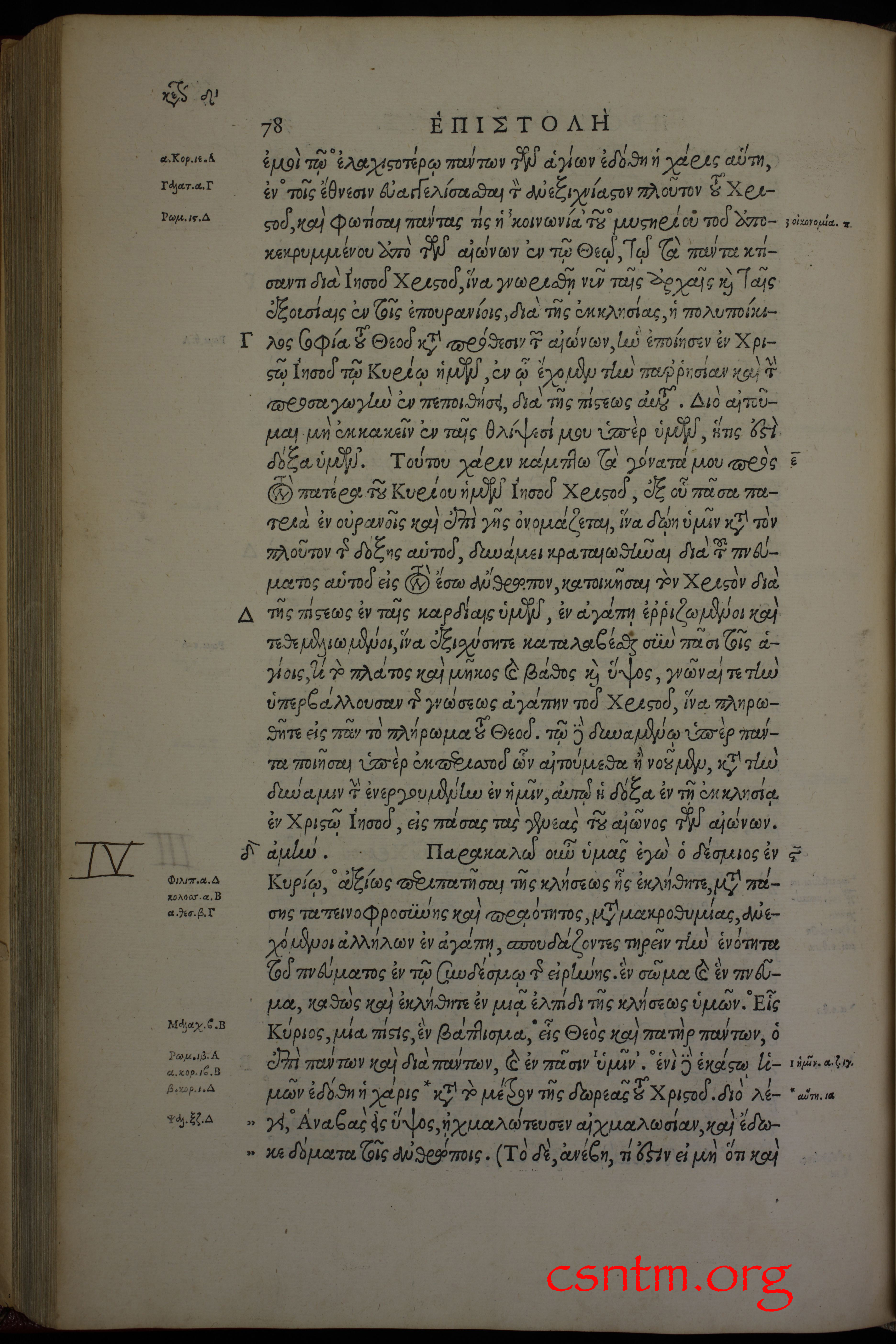
Jeff Riddle and Ephesians 3:9

Jeff Riddle recently posted a lengthy "text note" regarding Ephesians 3:9.  My reactions follow.

The post is riddled with an even worse radical skepticism than that of Bart Ehrman.  Both Ehrman and Riddle oppose the Reformed orthodox position that we can reconstruct the original text from the extant copies. Ehrman, however, at least acknowledges that for the New Testament we have "much earlier attestation than for any other book from antiquity."

Erhman's radical skepticism is linked to his rejection of supernaturalism.  What about JR's?  JR's seems to be theologically motivated. He writes: "In the end, we can only be sure that in the providence of God the reading “the fellowship of the mystery” was that preserved in the TR."  That's the only thing that JR thinks we can know for sure.  Yet JR knows more than that conclusion lets on.  JR knows, for example, "Among current extant Greek manuscripts, of all eras, the Majority reading is indeed η οικονομια. In fact, the external evidence is so overwhelming that the NA28 does not even list any variants at this point in its critical apparatus."  Therefore, JR also know for sure that this state of affairs is also in the providence of God.  Why does JR pick God's providential ordering of the TR rather than God's providential preservation of Greek copies? Let the reader decide.

JR seems to acknowledge that there is no real argument to be made in defense of the TR position from the textual evidence.  Instead, after pointing out the obvious fact that one reading is likely a scribal error for the other reading (rather than a deliberate change) he offers a variety of mostly skeptical arguments:

1) Reasoned Eclecticism vs. Majority Text
JR states: "It seems particularly odd for [Dr. James R. White] to reject the TR reading at Ephesians 3:9 based on the fact that it is not the Majority reading since, supposedly, he is not himself an advocate for the Majority text but, instead, embraces an eclectic method (reasoned eclecticism)."
It's hard to figure out if JR just doesn't understand reasoned eclecticism or what.  Does he seriously not understand why reasoned eclecticism would favor a text that is supported by "p46, all known uncials, almost all minuscules, all known versions, and patristic quotations"? That's not simply picking the text because it is the majority text.  I think JR knows this.  Moreover, in any other case where "p46, all known uncials, almost all minuscules, all known versions, and patristic quotations" support a given reading, it would be shocking of editors following reasoned eclecticism concluded that a very late poorly attested minority reading were the original.  JR points to the variant of "through Jesus Christ" in the sane verse and asks why the majority is not followed here.  JR should know the answer: the situation is quite different.  "through Jesus Christ" is not found in "p46, all known uncials, almost all minuscules, all known versions, and patristic quotations."  There may be a majority in favor of inclusion of the phrase, but the witnesses for omission are not just a few scattered late manuscripts.  JR surely knows this, but chooses to ask the question as though he does not.

2) CBGM supports conjectural emendation?

JR states: "Furthermore, [Dr. James R. White] expresses great confidence in the new CBGM, despite the fact that in the NA28 it favors a reading in 2 Peter 3:10 based on NO extant Greek mss.! There seems to be a problem with consistency."

It's unclear whether JR is aware that Dr. White rejects the conjectural emendation proposed at 2 Peter 3:10.  It also seems that JR thinks that the CBGM some how spit out this conjectural emendation.  That's not the case.  The fault here lies with the ECM editors, not with the CBGM.

3) "Major Problem" of Insufficient Analysis

JR is aware that an analysis of the textual evidence has been done.  He quotes from Bruce Metzger, who provides a summary of the analysis. Nevertheless, JR asserts that Dr. White's analysis of the Greek manuscript evidence falls short.  JR implies that "proper analytical study" requires identifying the list of late manuscripts that apparently contain the TR reading. One wonders from where JR gets this standard.  It looks like he just made it up, presumably because he himself is having trouble finding any late manuscripts that support the TR reading.

Does JR offer any analysis that contradicts Metzger?  No. He just throws out a made-up standard and says it wasn't met.

4) Sometimes late manuscripts have early readings
This is one of those "true but irrelevant" statements, also known as red herrings.  There are a few late manuscripts that seem to be copied from very old manuscripts, and which consequently have early readings.  This is one thing that the CBGM should be good at helping us identify.

5) "Extremely thin" early Greek manuscript evidence?
What JR characterizes as "extremely thin" is actually pretty remarkable.  We have one papyrus that, despite bad damage to the edges of the page, does have this portion of the verse, dating back to about A.D. 200.  It contradicts the TR.  Then from the fourth to the seventh centuries we have five more uncial manuscripts.  As JR concedes, "Yes, η οικονομια is the reading found in the five early uncials and became the Majority reading ... ." 

6) Versional and Patristic Evidence
Once again, JR complains that Dr. White doesn't provide him with the information that JR himself can get from Metzger.  He says that Dr. White "never provides any specific examples from the versions for our comparison and analysis."  Here's an easy one: Codex Amiatinus (A.D. 700) is a Latin Vulgate manuscript produced in England.  It has "dispensatio", which is a Latin translation of the Greek. But, of course, where does this standard of having to provide specific examples come from? It's just something JR made up.

7) Why does the TR have the reading it has?
JR doesn't know why. Erasmus' first edition has the reading, and Stephanus and Beza maintained it.  The only 17th century (or earlier) exegete that I could find that mentioned the discrepancy was a Jesuit, Cornelius à Lapide.

JR says: "On what basis did the Reformed men affirm 'fellowship' here as the true reading, over against the Majority Greek ms. tradition? We do not know."
I reply: To the extent we don't know, it's because it seems they got the reading from the Roman Catholic, Erasmus, and didn't double check his work.  JR's comments seems to suppose some group of "Reformed men" huddling around the text and coming to a decision about whether to accept or reject each reading.  That's not how it worked.  There were some readings that were disputed, to be sure.  This does not appear to have been one of them.

Stephanus noted the variant issue in his 1550 edition (link to image - it's note 3) but we know he used the same manuscript Erasmus had (mentioned below).  If anyone digs up additional information, it would be interesting and useful.  As far as I know, Stephanus does not explain the decision to continue with Erasmus' choice.

8) They might have had other manuscripts!
JR makes the assertion: "It is certainly possible that they had access to Greek mss. which are no longer available to us."
I reply: "Certainly possible" sounds so much better than "this is just wild speculation, but ...." It means the same thing here.

We have figured out which manuscripts Erasmus borrowed for his work.  One of those was Minuscule 2817, which has the reading (both in the main text and apparently in the accompanying commentary)(link to whole manuscript)(editorial note: it's cool to be reading from the same page Erasmus read from). So, it would be most natural to blame this reading on that manuscript, rather than blaming it on Erasmus or his printer.  I have not checked the other three manuscripts that Erasmus had.

9) Some manuscripts have been lost since the 16th-17th centuries
Yes, some have. On the other hand, the ones that Erasmus used have survived.  It sad when Biblical manuscripts perish, but in God's providence, we still have most of the manuscripts identified in the 16th century, and others they did not know about.

10) The printed editions may testify to lost manuscripts
In the case of Erasmus' base text, we have reasons for thinking we know what manuscripts he worked from.  Accordingly, there is no particular need for its testimony.  Similarly, my recollection is that we have identified the manuscripts that Stephanus mentions.  If any of those are now lost, his marginal notes can provide a form of testimony to them.  But JR has not given us a reason to think that any relevant manuscripts have been lost, that any relevant manuscripts were used in the preparation of Erasmus' text, or that

Conclusion
JR argues: "It is only in the modern era that “Reformed” men have abandoned the traditional text for the modern reconstructed text."  Actually, the Reformers (especially Beza) worked on reconstructing the text and the high orthodox (e.g. Turretin) affirmed the continued use of collation to reconstruct the text.  This is nothing new or modern.

JR argues: "In so doing they have embraced a religious epistemology that abandons stability, continuity, and consistency." Actually, the Reformers fought against Rome's similar assertions for the Vulgate text.  They argued that the Greek apographa - the copies - provide the original text.

-TurretinFan


PS Upon reviewing this post before publishing, I note that there is an unintentional pun in the opening paragraph. No disrespect was intended to Pastor Riddle.

Monday, May 15, 2017

Muller on Turretin and Textual Criticism - Follow-Up Response to Jeff Riddle (and company)

Our brother in Christ, Jeff Riddle, provided a follow-up post (link to post) responding to my previous post (link to post) to him.

Unfortunately, brother Riddle's post entirely misses the main point of my response. I argued:
Moreover, methodologically, Turretin agrees with JW. For example, Turretin endorses the approach of using the collation of various copies to restore the original readings.
Riddle responded by quoting Richard Muller's discussion of views of issues related to inerrancy, contrasting folks like Turretin with later folks like B.B. Warfield. Even assuming that what Muller says is correct, Muller is addressing a different issue from the one I was addressing.

When Muller gets to the issue I was discussing, you will find him saying things like this:
Not only was the era of orthodoxy a time of the flowering of textual criticism, it was also an era in which the critical establishment of the text of the Bible on the basis of collation and comparison of manuscripts and codices was understood as fundamental to the task of the orthodox exegete and theologian.
(Post-Reformation Reformed Dogmatics: Holy Scripture: the Cognitive Foundation of Theology, p. 398)

Similarly (and more telling):
... Testament published in Geneva and the annotated texts offered by Beza were all produced by using the critically established texts of Erasmus and the Complutensian Polyglot together with an examination of the available codices, with variants noted, typically in the annotations. Beza and other humanistically trained editors of the Bible saw no problem in establishing the text on the basis of a comparison of the available codices, nor did they blanch at the work of sorting out corruptions that had crept in during the historical transmission of the text - drew the line, however, at the point of emendation of an original language of the text on the basis of pure conjecture, or of the witness of a single variant codex, or of the sole witness of ancient versions, unconfirmed by the original languages. Using a method similar to that of Beatus Rhenanus, Protestant editors of the biblical text typically confined such variant readings to the annotations and viewed them as a matter of interpretation rather than as a basis of textual emendation. We have, for example, Beza's comment ont he publication of a highly variant Greek New Testament by Simon de Colines: Beza commented that he could not "give much weight to it" unless its variant readings were "supported by other codices" and criticized what he viewed as unsupported conjectural emendation. Emendation of the Hebrew text of the Old Testament and the Greek text of the New on the basis of ancient versions would become a matter of extended controversy in the seventeenth century.
It needs be noted here that the so-called textus receptus, was merely a part of the sixteenth- and seventeen-century process of establishing a normative or definitive text of the New Testament. The phrase "textus receptus" or "received text" comes from the Elzevir New Testament of 1633 — and as the context of the phrase itself and the use of the Greek New Testament in the seventeenth century both testify, there was no claim, in the era of orthodoxy, of a sacrosanct text in this particular edition. Nor did it, in the era of orthodoxy, provide some sort of terminus ad quem for the editing of the text of the Bible: the statement that this was the "text now received by all" simply meant that it was the text, produced by Stephanus and Beza, and slightly reedited by the Elzevirs, that was then regarded (by Protestants!) as the best available text of the Bible: namely, the critically examined combination of the Masoretic text of the Old Testament and the so-called Byzantine ...
(Post-Reformation Reformed Dogmatics: Holy Scripture: the Cognitive Foundation of Theology, p. 399)

Hopefully you get the point this discussion.

Now, was Turretin's view of textual criticism exactly the same as ours today? Probably not. For example, as hinted at in Muller's discussion above, folks like Turretin insisted that the Vulgate, Septuagint, and other ancient translations should essentially have no weight at all in textual criticism. By contrast, we would probably grant them at least a little weight. That, however, actually puts Turretin (and company) farther from Textus Receptus advocates of today, as the latter adopt a number of passages where the strongest textual transmission evidence comes from translations (1 John 5:7 is the most prominent example).

I got a few other responses, as well, so I'll briefly address them here:

Robert Wieland wrote: "Since the matter of collating mss is not the issue, then it would follow that your statement above is a non sequiter. The issue is not collation. The issue is what is collated."

I respectfully disagree that collating manuscripts is not the issue. It is the main issue. Certain TR advocates would like to (in essence) lock in the TR on the basis of it (or some form of it) being widely accepted by Protestants in the 17th century. There are separate (and less significant) debates over things like whether the Byzantine text type should be given priority, or whether non-Greek sources should be used for determining the text of the NT. Likewise, there are questions about whether to give priority to age of the manuscripts or number of the manuscripts, how much weight to give to internal evidence, and the like. These are all subordinate questions to the question of whether collation should be used.

RW again: "Again, the issue is not the use of Textual Criticism, but the practice of it. Turretin/Calvin/Stephens/Beza did not use modern principles like: Genealogy, The Shorter Reading is to be Preferred, the Harder Reading is to be Preferred, or Conflation (to name a few)."

The tools of textual criticism have improved over the years, but they all flow from the basic idea of the need for collation. If TR advocates (or anyone else) can make a case for why alternatives to these tools are better, then that's one of those subordinate debates I mentioned above. Turretin didn't have all the original language study tools that we have today, but his basic principles of exegesis are the same. The same goes for textual criticism.

I had written: "...those ancients texts certainly have the advantage of being older..."
RW responded: "This is the part of the modern philosophy where if it is older it is better, and if it is younger it is false. (I am parodying JW)."

Having older copies is advantageous, if you're trying to do collation to determine the original readings. That's not "modern philosophy." For example, even if one has a Byzantine priority view, one is going to favor older Byzantine copies to a copy that a seminary student created for his Greek class last week. It doesn't mean that the younger copy is "false," just that it carries less evidentiary weight.

RW: "Can you define for us what an "Alexandrian Text Type" or "Alexandrian Form" (as JW puts it) looks like? Can you show us in the apparatus of the Nestle/Aland text (any of the 28 editions) the symbol used for the Alexandrian Text Type? Maybe you can answer these questions that JW has been avoiding for years? One has to say that when two mss P75 and B happen to agree in many parts (not all) means that all mss fall into families? Such defies credibility."

You can read about it here: (link to wikipedia page). In very short, it's a label that textual critics apply to a group of texts that have similar characteristics and some historical connection with Alexandria, Egypt. The other two main groupings are Byzantine and Western, although the use of the Western label is (I think) falling out of favor.

-TurretinFan

Monday, June 16, 2008

Dr. White Explains Textual Transmission to Kent Hovind

Dr. White has provided a series of three video responses to some rather uninformed comments by Kent Hovind on Bible versions. Hovind's comments appear to be gleaned from the book he recommends, a book by Gail Riplinger, one of the prominent promoters of KJV-Onlyism.

The problems in Hovind's presentation are numerous, and even Dr. White's presentation is unable to snag all of them.

Part I


Part II


Part III


Ultimately, the video series demonstrates that one has to be careful in who one listens to. Hovind probably sounds like he knows what he is talking about to someone who doesn't understand the history of the transmission of the text of Scripture. In fact, however, he's wildly off the mark.

Some of his points may ring true (for example, a manuscript in constant use is less likely to survive for more than a millennium while a manuscript in disuse will last a long time). On the other hand he makes such egregious errors as to identify the Textus Receptus with the Majority Text and to imagine that the Textus Receptus was based on 5,000 or so Greek manuscripts (when, in fact, more realistic estimates are at least a couple of orders of magnitude less), as well as to confuse the manner of transmission of the Hebrew text by the Jews with the manner of transmission of the Greek text by the Christians.

All in all, I found the video series enjoyable and educational. I hope that if the transmission of the text of the New Testament interests you, you'll also find the series profitable.

-TurretinFan

P.S. As an aside, I would be very cautious about relying on Hovind's work. That's not to say that everything he says is wrong - for example he has many right things to say in other areas than the areas noted in the video series above. The problem is that Hovind doesn't appear to have a good idea of the limits of his own knowledge, as demonstrated in this video series.