Showing posts with label KJV. Show all posts

Tuesday, July 14, 2026

The Grammatical Argument for the Johannine Comma

This is a response to, "Johannine Comma and Georgios Babiniotis," by Nick Sayers (as retrieved on April 27, 2025).  The article starts with the suggestion: "Voulgaris Vindicated by Leading Greek Expert." That refers to an argument made by Eugenios Voulgaris (aka Eugenius Bulgaris) that argues that the text of 1 John 5 contains a grammatical solecism that is avoided only if the Johannine Comma is included. (text of Voulgaris available here, as retrieved on July 12, 2024)

Sayers begins:

Most critical text proponents don't even engage in the grammatical issues surrounding the Johannine Comma, and those who do, such as Barry Hofstetter, or James White, only reveal that they are not adequately informed about this issue.

This blog does address all sorts of arguments that others do not.

Sayers continues:

In an email discussion with Professor Georgios Babiniotis a few months ago, I asked him about the validity of the claims of legendary Greek professor Eugenius Voulgaris concerning the Johannine Comma. Those familiar with the grammatical arguments made by Voulgaris will be pleased to know that Babiniotis, who is probably one of the most important Greek linguists alive today, said that not only was Voulgaris correct to say we need to keep the Comma for grammatical reasons, and he also took it a step further by pointing out that verse 7 justifies verse 8 because of the “syntactic parallelism” of these two verses.

One of the challenges with interacting with this argument is that we are not given the correspondence that Sayers provided to Babiniotis, in order to understand what question was asked, and how it was asked. We have to make certain assumptions, and that can lead to mistaken conclusions about what is meant by the answers that Sayers reports.  

Let me be clear: I am not impugning Sayers' integrity in the least.  I take for granted that Sayers is honestly and accurately reporting what Babiniotis said and that if there is any error in such reporting, it is unintentional.  It's just that, as it stands, the context we have is incomplete.

Sayers continued:

Babiniotis is a Greek linguist and philologist who has written several books about Greek grammar, etymology, and other Greek language-related topics. He is the former Minister of Education and Religious Affairs of Greece and previously served as rector of Athens University.

As David Crystal is to English-speaking people, so Georgios Babiniotis is to the Greek speaker. Here are some of the books he has written here: https://babiniotis.gr/ergografia/vivlia.

You may know of Babiniotis from his Greek dictionary which is often simply called the "Babiniotis" dictionary.

Prof. Babiniotis is now 87 years old.  His academic credentials seem to be that he has a bachelors in Philology from the University of Athens, and subsequently served as a professor at the University of Athens.  His political appointments are impressive: he clearly is very connected.  I'm not sure in what year Sayers contacted him, but my impression is that it was in 2021.

I don't bring these things up to disparage Prof. Babiniotis.  In 2021, La Linguistique published an article by Babiniotis: "Modern Greek Interpretive Lexicography: from the 18th century to the present day."  The article focuses on Greek dictionaries and suggests the possibility of a new and significant Greek dictionary in the near future.  He certainly is a recognized scholar in the field of dictionaries, as Sayers has highlighted.

Sayers continued:

In May he wrote the following and attached a word doc:

“...Dear Mr Sayers,

I apologize that only now I can answer your kind letter about the N.T. passage discussed by Ευγένιος Βούλγαρης.

Here is my opinion as a linguist, not as an expert in theology.

Γ. Μπαμπινιώτης...”

I don't know why Sayers includes ellipses.  I assume that the meaning is that perhaps Sayers has omitted some other material from the email (for legitimate reasons of privacy, or the like).  There is, of course, nothing much to address in the email itself.  

I appreciate that Babiniotis is focused on his own linguistic skills as distinct from any theological skills.  This may, however, pose a small problem for his analysis, as we shall see.

Sayers then offers "(Word Doc):" followed by the following text, which I understand to be the entirety of Babiniotis' comments.  If there is anything missing, of course, that could alter the analysis of what is provided.

Babiniotis begins:

I will not discuss the opinion of the really great theologist and scholar (yet not a linguist) bishop Ευγένιος Βούλγαρης as I do not know on what conditions it was formulated. However, linguistically —though with another explanation— Ευγένιος Βούλγαρης is right to consider verse 5.7 obligatory for the existence of verse 5.8.

As I understand it, Babiniotis is saying that Voulgaris has reached the right conclusion, but not for the right linguistic reasons.

Babiniotis continues:

What you are asking has two aspects: a theological and a linguistic one. I can only say my own opinion on the linguistic aspect of the specific text within the frame of what is quite often used in regard to the Greek language and passages of New Testament Greek.

As I understand it, Babiniotis is being careful in view of various changes to the Greek language over time to couch his answer in terms of his understanding of New Testament Greek.  His interpretation might be different if he were dealing with Attic Greek or Modern Greek.  Keep in mind that, of course, New Testament Greek is not Babiniotis' central area of study.

 Babiniotis opines:

The use of masculine gender and not neuter on 5.8.

«καὶ τρεῖς εἰσιν οἱ μαρτυροῦντες ἐν τῇ γῇ,

τὸ Πνεῦμα καὶ τὸ ὕδωρ καὶ τὸ αἷμα

καὶ οἱ τρεῖς εἰς τὸ ἕν εἰσιν»

is linguistically justified on the pattern of “syntactic parallelism”, i.e. on the ground that it makes a pattern completely the same (“parallel”) in structure with that of 5.7.

ὅτι τρεῖς εἰσιν οἱ μαρτυροῦντες ἐν τῷ οὐρανῷ,

ὁ Πατήρ, ὁ Λόγος καὶ τὸ Ἅγιον Πνεῦμα

καὶ οὗτοι οἱ τρεῖς ἕν είσι

Presumably, Babiniotis means that each word of the three words, "τρεῖς ... οἱ μαρτυροῦντες," in verse 8, is masculine because of the parallel to "τρεῖς ... οἱ μαρτυροῦντες" in verse 7, where each of those is masculine.  To be more specific, though, the issue is really about the word μαρτυροῦντες - if that were something other than masculine, both the number and article would surely follow.

It is easy to see the parallelism, but how does Prof. Babiniotis explain the justification?

So for Modern Linguistic analysis what is important is not the mere grammatical “gender agreement rule” (which would lead to the usage of neuter gender : «καὶ τρία εἰσὶ τὰ μαρτυροῦντα ἐν τῇ γῇ…»), but the overruling schema of “syntactic parallelism” which is much more stronger than a simple gender agreement rule.

Conclusion. The issue we refer to has more to do with the linguistic style of the passage; it is the result of a stylistic selection which is far beyond the usage of a grammatical/syntactic rule that would lead to neuter gender and which furthermore would eliminate verse 5.7.

(End of word doc)

Style over syntax seems to be Babiniotis' point.  Following the gender agreement rule (in which case "witness" would be neuter instead of masculine) would damage the style of providing a syntactic parallel between the three heavenly witnesses and three earthly witnesses.

I must admit that even after puzzling over it for a while, it is unclear what Babiniotis means by saying "eliminate verse 5.7." 

We don't know, because Sayers hasn't told us, but presumably Sayers had some unanswered questions as well.  He adds:

George later said in an email:

“...I have given you my own linguistic explanation which is to keep verse 5.7. which justifies verse 5.8. It is grammatical and mainly “syntactic parallelism” of these two verses...”

Unfortunately, we do not even get two full sentences of the explanation offered by Prof. Babiniotis (I'm not even sure that the first part of the quotation is a full sentence).  Moreover, at least as to what he means by "eliminate verse 5.7," the meaning is not at all clear.

All that said, there is no need to agree or disagree with Babiniotis as to things he has not said clearly.  As to what he said clearly, it seems:

  1. Babiniotis does not agree with or accept Voulgaris' linguistic argument, only the conclusion;
  2. Babiniotis thinks that the syntactic parallelism with 5.7 is an adequate explanation for 5.8 having the masculine gender (notwithstanding that it violates the gender agreement rule); and
  3. Babiniotis thinks that if 5.7 needs to be present in order to justify 5.8 on the grounds of syntactic parallelism.

I do not think that my analysis of Babiniotis is unfair or in the least controversial.  I don't think it requires taking a low view of Babiniotis' linguistic abilities, credentials, acumen, or intelligence to conclude that his analysis can be boiled down to those three salient aspects.  Before providing my response, let's see what else Sayers offers:

So I hereby challenge those of the Anglo Sanhedrin who desire to delete the Comma, such as James White, Dan Wallace, Barry Hofstetter, James Snapp Jr, Stephen Boyce, Bill Brown, Bart Ehrman, Elijah Hixson, etc, to refute the claims of this top Greek linguist, who has basically just confirmed that the Greek grammatical argumentation that myself (Nick Sayers), Steven Avery, Will Kinney, Edward Hill, Jack Moorman, and many other TR/KJV people hold to, is not only correct but that the Comma is also linguistically justified on the pattern of “syntactic parallelism”.

I don't think that Sayers has correctly understood Babiniotis, if he thinks that Babiniotis is endorsing anyone else's "Greek grammatical argumentation."  Then again, I don't have access to the additional documentation that presumably Sayers himself has.  Suffice that in the released material, that is not what Babiniotis said in the published correspondence.

The bigger issue, however, is what was not considered by Babiniotis, but what was not considered by Babiniotis: is there another justification for the use of the masculine gender in 1 John 5:8, even without the justification of syntactic parallelism?

In other words, the big question is why John would refer to the three witnesses using the masculine gender and not using the neuter, even in the absence of 1 John 5:7.  There is a better explanation for why John referred to the three witnesses using the masculine gender: although the nouns themselves are not masculine, they are being anthropomorphized as witnesses.  An alternative explanation is that although the nouns themselves are not masculine, they are to be understood analogically as referring to the three persons of the Trinity.  

Unfortunately, there is no evidence of Babiniotis considering these alternative explanations for the violation of the gender agreement rule. Had Babiniotis done so, perhaps he would simply agree that these considerations may likewise trump the gender agreement rule. 

The most likely explanation is that John means to evoke the "three witnesses" rule in the Mosaic law, which both Jesus and Paul reference:

  • Deuteronomy 17:6 At the mouth of two witnesses, or three witnesses, shall he that is worthy of death be put to death; [but] at the mouth of one witness he shall not be put to death.
  • Deuteronomy 19:15 One witness shall not rise up against a man for any iniquity, or for any sin, in any sin that he sinneth: at the mouth of two witnesses, or at the mouth of three witnesses, shall the matter be established.
  • Matthew 18:16 But if he will not hear [thee, then] take with thee one or two more, that in the mouth of two or three witnesses every word may be established.
  • 2 Corinthians 13:1 This [is] the third [time] I am coming to you. In the mouth of two or three witnesses shall every word be established.
  • 1 Timothy 5:19 Against an elder receive not an accusation, but before two or three witnesses.
  • Hebrews 10:28 He that despised Moses' law died without mercy under two or three witnesses:

Assuming that this is indeed John's intent, then the use of the masculine as consistent with treating these witnesses as people.

There is also possible precedent for doing something similar in Psalm 89:37 (Septuagint numbering 88:38): καὶ ὡς ἡ σελήνη κατηρτισμένη εἰς τὸν αἰῶνα καὶ ὁ μάρτυς ἐν οὐρανῷ πιστός διάψαλμα

In this place, witness (μάρτυς) is masculine, whereas moon (σελήνη) is feminine. One might argue, however, that the antecedent reference witness is making here should be taken as throne (θρόνος), which is masculine.

There are at least two other cases of impersonal witnesses being referenced in the Septuagint, where there is a gender agreement mismatch between the witness and the word that the witness describes. 

Septuagint Joshua 22:34 provides a first example of a non-personal witness:

καὶ ἐπωνόμασεν Ἰησοῦς τὸν βωμὸν τῶν Ρουβην καὶ τῶν Γαδ καὶ τοῦ ἡμίσους φυλῆς Μανασση καὶ εἶπεν ὅτι μαρτύριόν ἐστιν ἀνὰ μέσον αὐτῶν ὅτι κύριος ὁ θεὸς αὐτῶν ἐστιν

Note that altar (βωμὸν) is masculine, but witness (μαρτύριόν) is neuter.

Septuagint Joshua 24:27 provides a second example of a non-personal witness:

καὶ εἶπεν Ἰησοῦς πρὸς τὸν λαόν ἰδοὺ ὁ λίθος οὗτος ἔσται ἐν ὑμῖν εἰς μαρτύριον ὅτι αὐτὸς ἀκήκοεν πάντα τὰ λεχθέντα αὐτῷ ὑπὸ κυρίου ὅ τι ἐλάλησεν πρὸς ἡμᾶς σήμερον καὶ ἔσται οὗτος ἐν ὑμῖν εἰς μαρτύριον ἐπ᾽ ἐσχάτων τῶν ἡμερῶν ἡνίκα ἐὰν ψεύσησθε κυρίῳ τῷ θεῷ μου

Note that stone (λίθος) is masculine but witness (μαρτύριον) is neuter.


Note about content:

The content of this article (at least in part), appeared previously on my youtube channel (here).  The video may contain some additional content not captured in this post, and - of course - vice versa.

Timothy Decker has posted a very interesting item on the same subject, which can be found here: (link to post).


Thursday, July 02, 2026

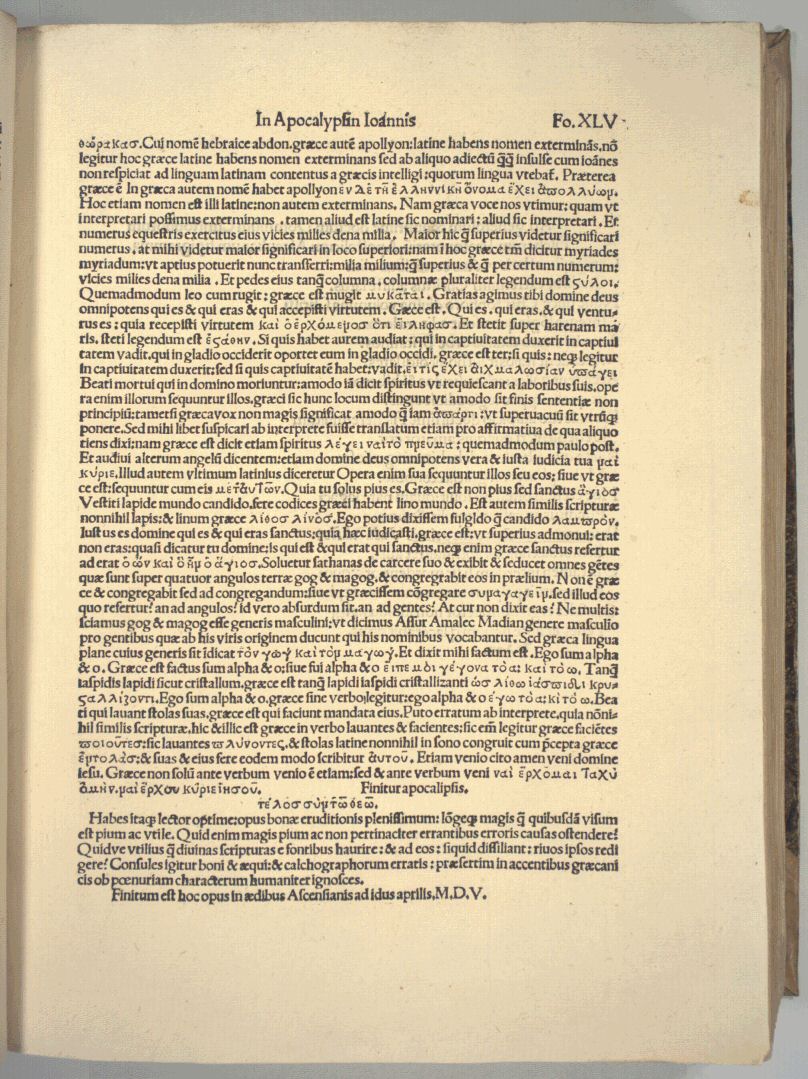
Erasmus' Annotations on Revelation 22

The final two pages of Erasmus' annotations on Revelation from his 1516 printing of the New Testament contain the following comments about the text:

(1114/1126)

(1115/1126)

The following is a transcription and my amateur translation thereof, together with some notes.

EX CAPITE XIII

From Chapter 13 

Et admirata est universa terra post bestiam.) καὶ ἐθαυμάσθη ἐν ὅλῃ τῇ γῇ ὀπίσω τῷ θηρίου, id est admiratio fuit in tota terra post bestiam.

“And all the earth wondered after the beast.” καὶ ἐθαυμάσθη ἐν ὅλῃ τῇ γῇ ὀπίσω τῷ θηρίου That is, “there was wonder in the whole earth after the beast.”

Qui in captivitatem duxerit.) εἴ τις αἰχμαλωσίαν συνάγει, εἰς αἰχμαλωσίαν ὑπάγει. i. qui captivitatem contrahit, in captivitatem abit. Laurentius secus legit.

“He who will have led into captivity.” εἴ τις αἰχμαλωσίαν συνάγει, εἰς αἰχμαλωσίαν ὑπάγει. That is, “he who gathers captivity goes away into captivity.” That is, “he who draws together captivity goes into captivity.” Laurentius reads otherwise. 

TF note: Laurentius here refers to Lorenzo Valla.  Valla's annotation on this point reads:

Thus, Valla's Greek text (as reported) had an ἔχει before αἰχμαλωσίαν, which is certainly different.

Continuing with Erasmus:

Characterem in dextra.) χάραγμα, id est notam impressam, sive insculptam.

“The mark in the right hand.” χάραγμα, that is, an impressed mark, or an engraved one.

EX CAPITE XIIII

From Chapter 14 

Quod mixtum est mero.) τοῦ κεκερασμένου ἀκράτου; ut mero sit ablativi casus, et referatur ad vino. Nam Graecis κεράννυσθαι dicitur, quod infunditur in calicem bibituro, etiam si non diluatur aqua, aut alio potus genere.

 “That which is mixed with pure wine.” τοῦ κεκερασμένου ἀκράτου; Thus, “with pure” [TF note: lit. in Latin the word "mero" sometimes means "unmixed" (pure from admixture with water or other dilutants) with reference to wine, leading to an odd paradox that the mixed wine is unmixed.] is an ablative case and refers to “wine.” For among the Greeks to mix is said of what is poured into the cup for the one about to drink, even if it is not diluted with water or with another kind of drink.

Amodo iam dicit spiritus.) Graeci sic distinguunt, ut amodo sit finis sententiae, ut sit sensus post hac fore beatos qui in domino fuerint mortui. Deinde sequitur ναὶ λέγει τὸ πνεῦμα. Etiam dicit spiritus. Et hic etiam confirmantis est.

 “From now on, now says the Spirit.” The Greeks punctuate thus: that “from now on” is the end of the sentence, so that the sense is that thereafter those who have died in the Lord will be blessed. Then follows, “Yes, says the Spirit.” And here “yes” is also a word of one confirming. [TF note: In Latin, etiam can have the sense of "yes/actually" (as it does here] as well as "and also".  This explains Erasmus' felt need to explain what sense of etiam he means.  I can't think of a good English word that has a similar ambiguity to better translate Erasmus here.]

In lacum irae dei.) ληνόν, qui est lacus, in quem exprimitur uvarum liquor.

“Into the lake of the wrath of God.” The Greek is ληνόν, which is a vat into which the liquid of grapes is pressed out.

EX CAPITE XV

From Chapter 15 

Quia solus pius es.) ὅσιος. Laurentius legit ἅγιος, id est sanctus.

“Because you alone are pious.” ὅσιος Laurentius reads ἅγιος, that is, “holy.”

TF note: Lauentius here again refers to Valla. Valla's annotation on this point reads:

In other words, Valla claims that the Greek is ἅγιος, which contradicts what Erasmus found in his Greek manuscript.

Continuing with Erasmus:

Vestiri lapide mundo et candido.) Graece est λίνον, id est lino mundo. Interpres legisse videtur λίθον, quae dictio una duntaxat literula differt a lino. Et splendidum magis est quam candidum, λαμπρόν.

“To be clothed with a clean and white stone.” In Greek it is λίνον, that is, “with clean linen.” The translator seems to have read λίθον [TF: lit. “stone”], a word which differs by only one little letter from “linen.” And it  [TF: lit. “bright"] is more splendid than gleaming white [TF: translating "candidum" as "gleaming white" which seems to be an approximate synonym for the Greek word, so I don't know if Erasmus means to use the Greek word as appositive for candidum or if Erasmus is saying that the Latin word doesn't capture the true splendor, though I suspect the latter.], λαμπρόν.

EX CAPITE XVI

From Chapter 16 

Vulnus saevum ac pessimum.) κακὸν καὶ πονηρόν. i. malum ac malum; Graece enim bis idem dicitur. Nisi mavis miserum ac malum.

“A savage and very bad wound.” κακὸν καὶ πονηρόν. That is, “bad and bad,” for in Greek the same thing is said twice—unless you prefer “wretched and bad.”

Qui es, et qui eras.) Quamquam interpres mutavit personam, tamen totidem syllabis dictum est, quibus superius: qui est, qui erat, qui venturus est, ὁ ὢν, ὁ ἦν, ὁ ἐρχόμενος.

“You who are, and who were.” Although the translator changed the person [TF: that is, from third person "he is" to second person "you are".], nevertheless it is said with just as many syllables as above: “who is, who was, who is to come,” ὁ ὢν, ὁ ἦν, ὁ ἐρχόμενος.

Etiam domine.) ναὶ κύριε. Etiam confirmantis est.

“Even so, Lord.” ναὶ κύριε. “Yes” is again a word of one confirming. [TF: see note above regarding etiam.]

Grando magna sicut talentum.) ὡς ταλαντιαία. i. talentaris et magnitudine talenti. Talentum magnum antiquis dicebatur, unde quicquid ingens esset, id ταλαντιαῖον vocabant.

“Great hail as a talent.” ὡς ταλαντιαία. That is, of a talent, and of the size of a talent. A great weight was called by the ancients a talent; hence whatever was huge, they called talent-like. [TF: Without commenting Erasmus' more general usage point, from Josephus and other ancient sources (source) we find a meaning of talent as a unit of weight of approximately 120 lbs. The main point that this hail is being described as huge, is surely correct, whether John means a literal unit of measurement or not.] 

EX CAPITE XVII

From Chapter 17 

Supra bestiam coccineam.) κόκκινον, id est coccinam, purpuram regiam indicans.

 “Upon the scarlet beast.” κόκκινον, that is, scarlet-colored, indicating royal purple.

Et hic est sensus.) ὧδε ὁ νοῦς. i. haec est mens, sive intellectus.

“And here is the sense.” ὧδε ὁ νοῦς.  That is, “this is the meaning,” or “understanding.”

EX CAPITE XVIII

From Chapter 18 

Et in delitiis fuit.) καὶ ἐστρηνίασε, idem verbum, quo composito usus est Paulus in epistola ad Corinthios. Cum autem luxuriatae fuerint in Christo, volunt nubere; de quo pluribus suo dictum est loco. Item paulo post, οἱ στρηνιάσαντες, i. et lascivierunt.

“And she was in delights.” καὶ ἐστρηνίασε, this is the same word of which Paul used a compound in the epistle to the Corinthians: “When they have become wanton in Christ, they wish to marry” [TF note: I assume that Erasmus is referring to 1 Timothy 5:11, which in the TR has καταστρηνιάσωσιν "they have begun to wax wanton against" - presumably Erasmus is simply making an error of memory, thinking of the passage on marriage in 1 Corinthians 7, and conflating the admonition from 1 Timothy 5:11 with the "better to marry than to burn" in 1 Corinthians 7:9] ; concerning which more was said in its own place. Likewise a little later, οἱ στρηνιάσαντες that is, “and they acted wantonly.”

Lignum tinium.) θύϊνον.

 Wood of the Laurustinus. θύϊνον.

Et similae.) καὶ σεμίδαλιν.

 “And fine flour.” καὶ σεμίδαλιν.

Lapidem molarem magnum.) λίθον ὡς μύλον, id est lapide tanquam molam.

 “A great millstone.” λίθον ὡς μύλον that is, “a stone as though a millstone.” [TF note: I'm not sure if Erasmus here means molam to mean mill or millstone, but I've assumed the latter.]

Hoc impetu mittetur.) οὕτως ὁρμήματι βληθήσεται, id est impetu mittetur.

“With this impulse it will be thrown.” οὕτως ὁρμήματι βληθήσεται, that is, “it will be thrown with force.”

EX CAPITE XIX

From Chapter 19 

Quasi vocem magnam tubarum multarum.) ἤκουσα φωνὴν ὄχλου πολλοῦ. i. audivi vocem turbae multae. Proinde consentaneum est interpretem scripsisse turbarum, non tubarum.

“As a great voice of many trumpets.” ἤκουσα φωνὴν ὄχλου πολλοῦ, that is, “I heard the voice of a great multitude.” Therefore it is consistent that the translator wrote “of crowds,” not “of trumpets.” [TF note: I think Erasmus' point is that the original translator to Latin probably wrote "turbarum" (crowds/multitudes) not "tubarum" (trumpets), a difference of one letter in Latin.] 

Alleluia.) Quod Hebraeis sonat, laudate dominum. Siquidem הללו laudate, et יה dominus. Ea vox crebra est in psalmis: laudate dominum.

“Alleluia.” In Hebrew this sounds: “Praise the Lord.” For hallelu (הללו) means “praise,” and Jah (יה) means “Lord.” This expression is frequent in the Psalms: “Praise the Lord.”

Vide ne feceris.) ὅρα μή. i. vide ne. Feceris addidit interpres, quo magis explanaret sententiam.

 “See that you do not do it.” ὅρα μή that is, “see that not.” The translator added “do it” in order to explain the sentence more fully.

Et calcat torcular vini.) ληνόν, quod ante vertit lacum.

 “And he treads the winepress of wine.” The Greek is ληνόν, which earlier he translated “lake.”

[TF: From Chapter 20 - For no obvious reason, Erasmus didn't bother to provide chapter section headings beyond Chapter 19, but I have added them for the reader's convenience.]

Gog et Magog.) Accusativus casus est utriusque et generis masculini, quod articulus Graecus declarat: τὸν Γὼγ καὶ τὸν Μαγώγ, sive pro hominibus accipienda sunt sive pro gente. Nec est congregabit, sed συναγαγεῖν, i. ad congregandum, aut ut congreget eos. Porro eos non refert ad angulos, aut gentes, sed ad Gog et Magog.

“Gog and Magog.” The case is accusative for both, and masculine in gender, which the Greek article shows: τὸν Γὼγ καὶ τὸν Μαγώγ, whether they are to be taken for men or for a people. Nor is it “he will gather,” but συναγαγεῖν that is, “for gathering,” or “so that he may gather them.” [TF note: literally συναγαγεῖν is an aorist active infinitive and the KJV renders with an infinitive, more similar to Erasmus' second option],  Furthermore, “them” does not refer to the corners or to the nations, but to Gog and Magog. [TF: of course, if you agree with Erasmus about this, you will have to go with his view that Gog and Magog refer to nations, given what follows: "the number of whom is as the sand of the sea".]

[TF: From Chapter 21]

Ego sum alpha et ω.) γέγονα τὸ ἄλφα καὶ τὸ ὦ. Noster codex consentiebat cum vulgata horum temporum additione.

“I am Alpha and Omega.” γέγονα τὸ ἄλφα καὶ τὸ ὦ. Our manuscript agreed with the addition common in the edition of these times. [TF note: I am not sure what addition Erasmus has in mind here.  My guess is that he means "the beginning and end," which is present here but not Revelation 1:8, where it was added.]

Iaspidi sicut crystallum.) κρυσταλλίζοντι, id est crystallizanti, ut referat ad lapidem.

“Jasper, like crystal.” κρυσταλλίζοντι that is, “shining like crystal,” so that it refers to the stone. 

[TF: From Chapter 22]

Qui nocet noceat.) ὁ ἀδικῶν, id est qui male agit, sive qui iniustus. Et adhuc positum est pro amplius.

“He who harms, let him harm.” ὁ ἀδικῶν, that is, “he who acts badly,” or “he who is unjust.” And “still” is put for “further.”

Beati qui lavant stolas suas.) Longe aliud Graeci. μακάριοι οἱ ποιοῦντες τὰς ἐντολὰς αὐτοῦ, (Revelation 22:14) id est, beati qui faciunt mandata eius. Interpres legisse videtur, οἱ πλύνοντες τὰς στολὰς. Sed unde quod sequitur in sanguine agni? Nam id quidem apud Graecos prorsus non legitur.

“Blessed are those who wash their robes.” The Greek has something very different. μακάριοι οἱ ποιοῦντες τὰς ἐντολὰς αὐτοῦ, (Revelation 22:14) that is, "blessed are those who do his commandments." The translator seems to have read, οἱ πλύνοντες τὰς στολὰς. [TF note: lit. those washing the robes; the difference is of one Greek letter.] But whence is that which follows, ‘in the blood of the Lamb’? For that indeed is altogether not read among the Greeks. [TF: I have not studied this textual variant, but if there is no textual variant in the Greek, then the most likely source would be from Revelation 7:14]

Etiam venio cito. ναὶ ἔρχομαι ταχύ. (Revelation 22:20) Ναί est confirmantis. At idem adverbium mox repetitur Graecis, ναὶ ἔρχου κύριε Ἰησοῦ, id est, etiam veni domine Iesu.

"Indeed, I come quickly." ναὶ ἔρχομαι ταχύ. (Revelation 22:20) Ναί (TF: lit. yes/truly) is the word of one confirming. But the same adverb is soon repeated in the Greek: ναὶ ἔρχου κύριε Ἰησοῦ, that is, "indeed, come, Lord Jesus." 

TF: This verse is not found in the only Greek manuscript that Erasmus had, a fact that he alludes to in the very next portion of the annotations.  For this observation about verse 20, Erasmus seems to be dependent on Lorenzo Valla, although Erasmus does not expressly mention his name here. Specifically, Valla's Annotation says:


Transcription of Valla: Etiam venio cito amen veni domine Iesu. Graece non solum ante verbum venio est etiam; sed et ante verbum veni ναὶ ἔρχομαι ταχύ· ἀμήν, ναὶ ἔρχου κύριε Ἰησοῦ. 

Translation of Valla: "Yes, I come quickly; amen, come, Lord Jesus." In Greek, not only before the word “I come” is there “yes,” but also before the word “come”: ναὶ ἔρχομαι ταχύ· ἀμήν, ναὶ ἔρχου κύριε Ἰησοῦ.

Continuing with Erasmus:

Quamquam in calce huius libri, nonnulla verba reperi apud nostros, quae aberant in Graecis exemplaribus, ea tamen ex Latinis adiecimus. Testatur divus Hieronymus Apocalypsim, ne sua quidem aetate fuisse receptam a Graecis. Ad haec quosdam eruditissimos viros, totum hoc argumentum, ceu fictum, multis conviciis insectatos fuisse, quasi nihil haberet apostolicae gravitatis, sed vulgatam tantum rerum historiam figurarum involucris adumbratam.

Although at the end of this book I found among our people some words which were absent in the Greek copies, nevertheless we added them from the Latin copies. Saint Jerome testifies that the Apocalypse, not even in his own age, had been received by the Greeks. Besides these things, some very learned men attacked this whole subject, as though fictitious, with many reproaches, as if it had nothing of apostolic gravity, but only a common history of events sketched under the coverings of figures. 

Ut de his interim nihil dicam, me nonnihil moverunt tum aliae coniecturae, tum illa, quod revelationes scribens tam sollicite suum inculcat nomen: Ego Ioannes, ego Ioannes; perinde quasi syngrapham scriberet, non librum; idque non solum praeter morem aliorum apostolorum, verum multo magis praeter suum morem, qui in evangelio modestiora narrans, non exprimit tamen usquam suum vocabulum, sed notulis indicat. Et Paulus coactus referre de visionibus suis, rem sub alterius exponit persona. At hic tam arcana cum angelis colloquia describens, quot locis inculcat, Ego Ioannes.

That I may say nothing for the moment about these things, some other conjectures moved me somewhat, and also this one: that, while writing the revelations, he so carefully presses his own name: ‘I John, I John,’ just as though he were writing a contract, not a book; and this not only contrary to the custom of the other apostles, but much more contrary to his own custom, who, while narrating more modest things in the Gospel, nevertheless nowhere expresses his own name, but indicates it by little signs. And Paul, when compelled to report concerning his own visions, sets forth the matter under the person of another. But this man, while describing such secret conversations with angels, in how many places does he press the words, ‘I John.’ 

Ad haec in Graecis quos ego viderim codicibus, non erat titulus Ioannis evangelistae, sed Ioannis theologi, ut ne commemorem stilum non parum dissonantem ab eo qui est in evangelio et epistola. Nam de locis, quos quidam calumniati sunt, velut haereticorum quorundam dogmata redolentes, non magni negotii sit diluere; haec, inquam, me nonnihil moverunt, quo minus crederem esse Ioannis evangelistae, nisi me consensus orbis alio vocaret, praecipue vero autoritas ecclesiae, si tamen hoc opus hoc animo comprobat ecclesia, ut Ioannis evangelistae velit haberi, et pari esse pondere cum caeteris canonicis libris.

Besides these things, in the Greek manuscripts which I have seen, the title was not ‘of John the Evangelist,’ but ‘of John the Theologian’; not to mention the style, which is not a little discordant from that which is in the Gospel and the Epistle. For concerning the passages which some have accused, as though smelling of the doctrines of certain heretics, it would not be a matter of great business to refute them. These things, I say, moved me somewhat, so that I was less inclined to believe it to be of John the Evangelist, unless the consensus of the world were calling me elsewhere, and especially the authority of the Church—if, however, the Church approves this work with this intention, that it wishes it to be held as belonging to John the Evangelist, and to be of equal weight with the other canonical books. 

Iam Dorotheus Tyri episcopus ac martyr in compendio vitarum prodidit Ioannem evangelium suum scripsisse in insula Patmo. Caeterum de Apocalypsi nullam omnino facit mentionem. Nec Anastasius quidem in suo Catalogo audet affirmare opus hoc illius esse; tantum ait receptum a quibusdam tanquam illius opus. Equidem video veteres theologos magis ornandae rei gratia hinc adducere testimonia, quam ut rem seriam evincant. Quandoquidem inter gemmas etiam nonnihil est discriminis, et aurum est auro purius ac probatius. In sacris quoque rebus, aliud est alio sacratius. Qui spiritualis est, ut inquit Paulus, omnia diiudicat et a nemine diiudicatur.

Now Dorotheus, bishop of Tyre and martyr, has handed down in his compendium of lives that John wrote his Gospel on the island Patmos. But concerning the Apocalypse he makes absolutely no mention. Nor indeed does Anastasius, in his Catalogue, dare to affirm that this work is his; he says only that it was received by some as though it were his work. Indeed, I see that the ancient theologians bring testimonies from here more for the sake of adorning a matter than so that they may prove a serious matter. Since even among gems there is some distinction, and gold is purer and more approved than gold. Also in sacred things, one thing is more sacred than another. He who is spiritual, as Paul says, judges all things and is judged by no one.” 

TF note: I obviously don't agree with or endorse Erasmus' skepticism regarding the authority of Revelation.  I am simply reporting what he wrote.  

Friday, March 27, 2026

An Improvement to the so-called "Pure Cambridge Edition" (2006) of Matthew Verschuur

Matthew Verschuur published his own minor edition of the King James Version, which he refers to as "the Pure Cambridge Edition."  This edition was first published in 2006, although it is sometimes promoted as "circa 1900."  Verschuur has managed to attract some measure of following to his position that the PCE is absolutely perfect, although Verschuur's position has been criticized by King James advocates, such as the Trinitarian Bible Society, and many others.  Quite recently, Bryan Ross has offered a devastating critique of the PCE position in a series of lectures accompanied by a book-length (200+ pp.) set of notes (link to "Assessing the Pure Cambridge Edition Position"). MV has offered a few responses to Bryan Ross (most recently on March 24).  If you want to see the hubris of MV, you may consider this table his most recent response offers (March 10 post):

The Scripture is more pure than other writings.

The KJB’s version is more pure than any TR or version.

The KJB’s translation is more pure than any other English Bible.

The PCE is a more pure Edition than any other Edition/edition.

Bible Protector’s text file and collation of the PCE is more pure than any other text file or representation.

MV claims that that this edition is correct even as to such things as the capitalization of words.  In fact, he provides capitalization as being an important reason for his edition.  For example, he states (Guide to PCE):

I thought my Cambridge Edition was correct, but when I examined the case of the letter “s” on the word “spirit” at various places, I discovered that in 1 John 5:8 my Cambridge book differed from Pastor Savige’s Collins Bible. I then inquired concerning this area, and wrote to various King James Bible experts about it. One said, “follow Scrivener” (see below), another said, “it is up to the interpreter”, another said, “probably capital”, another said to effect, “both are correct concurrently”, and yet another, a textual critic and Cambridge King James Bible editor, plainly said, “there is no ‘correct’ edition”. I was unsettled on the matter for a while. 

In another place, he states (Guide to PCE):

In November 2005, it became apparent that there must be a settling of a difference found in Collins editions as opposed to Cambridge printed Bibles of the Pure Cambridge Edition, that is, at 1 Chronicles 14:10 where Collins capitalised the “A” of “and wilt thou”. In addressing this particular issue, I understood that while there were differences between all representations of the Pure Cambridge Edition, none was necessarily definitive, neither was there one that I could be sure was free from typographical errors. I saw that the Scripture indicated, and that it was in line with God’s nature, that there should be a definitive and scrupulously correct representation. Therefore, I reasoned that such a text would have to be resolved, and that it would be commendable to create it in an electronic text which would be able to be disseminated abroad and become a universal standard. 

Moreover, when it comes to the marks of a PCE, MV points to 12 readings, six of which have to do with the capitalization of the English word "spirit" (source) -- this is beyond the capitalization of "and" in "and wilt thou" in 1 Chronicles 14:10, mentioned by MV above  (Guide to PCE):

  1. “or Sheba” not “and Sheba” in Joshua 19:2
  2. “sin” not “sins” in 2 Chronicles 33:19
  3. “Spirit of God” not “spirit of God” in Job 33:4
  4. “whom ye” not “whom he” in Jeremiah 34:16
  5. “Spirit of God” not “spirit of God” in Ezekiel 11:24
  6. “flieth” not “fleeth” in Nahum 3:16
  7. “Spirit” not “spirit” in Matthew 4:1
  8. “further” not “farther” in Matthew 26:39
  9. “bewrayeth” not “betrayeth” in Matthew 26:73
  10. “Spirit” not “spirit” in Mark 1:12
  11. “spirit” not “Spirit” in Acts 11:28
  12. “spirit” not “Spirit” in 1 John 5:8

MV distinguishes between something being "actually an 'error' in the Bible" and something being a "presentation error." He states (source): "A typographical error is not actually an "error" in the Bible, because it is only a presentation error." 

I have a few problems with this kind of distinction, which I have seen in various King James advocacy circles.  They seem to be aiming to distinguish between the source of the errors (namely the translators/editors vs. the printers; in his March 24 post, MV seeks to divide amongst "Scripture," "Version," "Translation," "Edition," and "Setting Forth."), but they are arguing it as though it were a difference in the kind of error.  However, these (alleged) errors are the following kinds:

  • word (1, 2, 4);
  • spelling? (6, 8, 9); and
  • capitalization (3, 5, 7, 10, 11, 12)

In theory, these could be attributable to the translators (either in terms of their translation text or their translation choices/methodologies) or to the printers (either in terms of failing to read the translators' notes correctly or failing to print what the translators requested).  There may be good reasons to argue for a particular source of a particular error.

However, I must point that when it comes to capitalization, MV sometimes goes so far as to say (Guide to PCE):

The Pure Cambridge Edition is consistent in its usage of “Son of David”, as the Oxford is consistent in its blasphemous “son of David”. The Oxford is obviously wrong. 

Notice that even if MV is willing to say that matters of capitalization are not "actually an error" but "only a presentation error," he's also willing to call the Oxford editions reading "blasphemous".  He does this also with the Oxford capitalization at Matthew 4:1.  MV writes (Guide to PCE):

Matthew 4:1
If Jesus was led of the “spirit” lowercase, then He was relying on something out of the realm of the normal believer, being His own spirit. Yet, the Scripture teaches that Christ is our example, and that we ought “to walk, even as he walked.” (1 John 2:6a). The Scripture even shows that Christ promised, “Verily, verily, I say unto you, He that believeth on me, the works that I do shall he do also; and greater works than these shall he do; because I go unto my Father.” (John 14:12). If Christ was led merely by his own spirit, then this would disallow believers to be able to walk or do exactly as Christ had done. Such a thing could not be walked in by anyone without the Holy Ghost — no one in their own merits could even get close to the standard of Christ. However, if Jesus was relying on the “Spirit” as the Cambridge reading shows, then He was relying on something that became available to all believers, namely, the Holy Ghost. Thus, the Oxford reading makes a blasphemy and a mockery of Christianity. Whereas the Cambridge shows that man needs the Spirit of God to lead him to Christ, and this would eventually lead to the Pentecostal manifestation, which is available for all. There are many indications that the Spirit would come upon or fill certain people in the Old Testament or before the day of Pentecost, but Christians who follow Christ as an example are able to do so after Pentecost because the Spirit has been made available to all since that time, if people will believe and receive that baptism. 

Notice that by something as seemingly trivial as a capital letter, MV claims: "the Oxford reading makes a blasphemy and a mockery of Christianity."

Knowing that capitalization issues are half of the marks that MV offers and that capitalization is especially important to MV when it comes to God, I happened to read Philippians 3.  There I found this reading in MV's text:

Philippians 3:19 (source) 

Whose end [is] destruction, whose God [is their] belly, and [whose] glory [is] in their shame, who mind earthly things.)


Notice that "God" is capitalized in Philippians 3:19.  However, notice that in places where something other than the true God is referred to as "god," the convention is to use lowercase:

(Exodus 7:1, p. 59)
(Judges 6:31, p. 252)
(1 Kings 18:27, p. 363)
(2 Kings 1:6, p. 371)

Notice especially the last example, where "a God" (true God) is contrasted with "the god" (not the true God). 

This English convention is one that is done out of reverence and respect for God.  It is also the underlying premise behind MV's rather provocative claim that "son of David" is "blasphemous" or that Jesus being led of the "spirit" "makes a blasphemy and a mockery of Christianity."

If one were to apply the same standard to MV's reading at Philippians 3:19, one could just as easily argue that MV's reading blasphemously portrays God as someone's belly, making a sort of Buddhist mockery of Christianity.

Naturally, I don't agree with MV's standard, though I do like the capitalization convention that we use in the 21st century to distinguish between a "god" and the "God".  Following that convention, MV's reading is "obviously wrong" - much more so than the Oxford's, "son of David," where - in fact - the Oxford's capitalization is better, because Jesus is the Son of God according to his divinity and the son of David according to his humanity, being both God and man in two distinct natures and one person.

These are not faults of the 1611 KJV, because at that time English capitalization conventions were not the same as today, and it would be anachronistic to judge the 1611 by modern capitalization conventions.

Additionally, neither the Hebrew nor the Greek contains capital letters.  Thus, using a capital/lowercase distinction in the KJV to argue for some doctrinal conclusion is to rest upon the wisdom of the translators, as distinct from relying on the underlying text of the Holy Scriptures, as inspired by God.  

Friday, February 27, 2026

2 John 1 and the Textus Receptus - Room to Improve the King James Version

Nick Sayers (in his 2 John Bible Study video) has identified an interesting difference between Beza's 1598 Greek New Testament, the primary basis of the New Testament of the King James Version, and Scrivener's Textus Receptus, the usual TR edition that TR advocates reference.  This difference highlights an opportunity to improve the King James Version.

Here is the KJV:

2 John 1 (KJV) The elder unto the elect lady and her children, whom I love in the truth; and not I only, but also all they that have known the truth;

The phrase "in the truth" should be rendered "truly" or "in truth" (for a more word-for-word translation) rather than "in the truth."  Beza identified this issue as early as 1556, and suggested changing the Vulgate translation of "in veritate" ("in truth" or "in the truth" - Latin lacks articles) to "verè" ("truly") to better convey the sense of the Greek.  Beza, in his annotations (discussed in more detail below), recognized the connection between John's Greek phrase ἐν ἀληθείᾳ (en aletheia - in truth) and a corresponding Hebrew word b'emet, which has the sense of "in truth" or really/seriously.  Thus, Beza argued that the text ought to be translated with "verè" to convey the sense rather than "in veritate," though the latter is a word-for-word formal equivalent translation.

An odd thing happened, though, and Beza's main text in 1598 did not align with his Latin text nor with the (much, much later) text of Scrivener.

Beza's 1598 edition has the text of 2 John 1 as follows: 

The relevant difference is the presence (in Beza) of an article before the word aletheia (truth) the first time it appears in the verse:

2 John 1 (Scrivener) ὁ πρεσβύτεροσ ἐκλεκτῇ κυρίᾳ, καὶ τοῖς τέκνοις αὐτῆς, οὓς ἐγὼ ἀγαπῶ ἐν ἀληθείᾳ, καὶ οὐκ ἐγὼ μόνος, ἀλλὰ καὶ πάντες οἱ ἐγνωκότες τὴν ἀλήθειαν

2 John 1 (Beza) ὁ πρεσβύτεροσ ἐκλεκτῇ κυρίᾳ, καὶ τοῖς τέκνοις αὐτῆς, οὓς ἐγὼ ἀγαπῶ ἐν τῇ ἀληθείᾳ, καὶ οὐκ ἐγὼ μόνος, ἀλλὰ καὶ πάντες οἱ ἐγνωκότες τὴν ἀλήθειαν

One might wonder whether Beza's annotations shed any light.  Beza's Annotation is as follows:

In the following transcription, I've added modern vowel points to the Hebrew b'emet, meaning "in truth" or "really/seriously" although for reasons unknown to me, Beza used unpointed letters (perhaps it was all his printer had available?).

Verè, ἐν ἀληθείᾳ, Heb. בֶּאֱמֶת [beemeth.] Vulg. & Erasm. ad verbum, In veritate. ¶ Veritatem, τὴν ἀλήθειαν. i. Christum, vel Evangelium. quae phrasis saepe, apud Ioannem praefertim, occurrit. Idem itiam eiusmodi unius verbi geminatione gaudet: sicut singulis penè paginis licet observare, tum in Evangelio, tum in epistola superiore.

My own amateurish translation:

¶ Truly, ἐν ἀληθείᾳ, Heb. בֶּאֱמֶת [beemeth.] Vulg. & Erasm. word for word, In veritate (“In truth”). ¶ “The truth,” τὴν ἀληθείᾳ. that is, Christ, or the Gospel; which manner of speaking occurs often, especially with John. He also indeed delights in such a doubling of one word: just as in almost every single page it can be observed, both in the Gospel and in the former epistle.

Note, however, that Beza's own Latin follows "truly" (verè) not "in the truth" in all his editions, including the 1598.  Moreover, while we may question the Greek and/or Hebrew skills of some of the King James translators, we certainly must believe that they knew how to read Latin, and could tell the difference between the Latin for "Truly" and the Latin for "In [the] truth".  

Moreover, note that while Beza's annotation may be a little confusing in view of the text as printed, Beza's annotation is best understood not as proposing the alternative reading "love in the truth" for "truly love" but rather as referring to the portion of the text about "knowing the truth".  In other words, Beza is saying that John is making a play on words, referring to his sincere love and also knowing about Christ and/or the Gospel.

It does not seem that there is any textual critical basis for adding the article into the text.  For example, 
Stephanus' 1550 (Beza's primary source for textual critical material) does not offer any textual variant information regarding 2 John 1 and does not include the article in the main text:

Furthermore, Beza's own editions, before and after the 1598 edition, are inconsistent.  

1604. The 1604 "minor" edition (which does not have full annotations) omits the article in the text:

(source, vol. 2)

1594. The 1594 Annotations-only printing contains the same annotation:

(source at [1237])

1590. The 1590 "minor" edition (which does not have full annotations) omits the article in the text:

(source, at [899])

1589. The same text (with the article) and annotation as in the 1598 are present in Beza's 1588/89:

1582. Likewise in Beza's 1582, the article and the annotations are present:

(source, at [990])

1580. The 1580 "minor" edition (which does not have full annotations) omits the article in the text:

1575. The Latin-only 1575 edition has the same Latin text as Beza offers consistently throughout:

1567. In the 1567 "minor" edition (which does not have full annotations), the text omits the article:

(source, at [775])

1565. Likewise, in his 1565 edition, his text omits the article, despite his annotations:

(source, at [1073])
(source, at [1074])

1557. Beza's Latin edition of 1556/57 includes the same annotation:

(source, at vol. 2, [1178])

In summary, all his editions have the Latin for "truly" and all his editions with annotations seem to have essentially the same annotations.  On the other hand, Beza's three final major editions of 1582, 1589, and 1598 all have the article, but the first major Greek edition (1565) and all the other minor editions lack the article.  

The article issue is not listed among the NT Conjectures. Likewise, I could not find any mention of this change in "Beyond What Is Written: Erasmus and Beza as Conjectural Critics of the New Testament," by Jan Krans.  Based on the collation provided via INTF, I was not able to locate any transcribed manuscript with an article in the position that Beza places it here.  So, if a deliberate insertion, it would seem to be a conjectural emendation of the text.

Given the presence of the "truly" reading in Beza's Latin and the presence of the seemingly conflicting annotation in all of the editions that have article present in the text, I think it's most reasonable to assume that the presence of the article in the text in the major editions of 1582, 1588/89, and 1598 was a typographic error in the 1582 that was subsequently copied in the following major editions without being noticed by Beza.

The King James translators, who we believe relied upon Beza's 1598 as their primary text, seem to have followed Beza's main text over his annotation.  They did not translate as "in truth," "truly," "indeed," or the like.  Instead, they translated as "in the truth" without any indication that "the" was being supplied:

Blaney's 1769 KJV similarly does not italicize the "the" in the verse:

Matthew Verschuur's "Pure Cambridge Edition" (published in 2006) claims to be scrupulous about italics and likewise does not italicize:

On the other hand, although Wycliffe's 1398 had "in treuthe" (source), English translations starting with Tyndale had included the English article (I have not extensively researched whether there were any better English translations available at the time).

1568 Bishops' Bible (per BibleHub)
2 John 1: The elder to the elect Lady & her chyldren, whom I loue in the trueth: and not I only, but also all that haue knowen ye trueth:
1560 Geneva Bible (scanned)
2 John 1: The Elder to the elect Ladie, and her children, whome I loue in [a] the trueth: and not I onely, but also all that have knowen ye trueth, [a: According to godliness & not with anie wordlie affection.]
Tyndale New Testament (per WikiSource) 
2 John 1: The elder to the electe lady and her chyldren which I love in the trueth: and not I only but also all that have knowe the trueth

Given that the King James translators were aiming to edit the Bishops' Bible only where the originals demanded it, and given that Beza's 1598 seemed to support for the article present in the Bishops' Bible, it seems that King James translators followed Beza's main text over his Latin translation and his annotations, thereby maintaining Tyndale's improvable translation.

As can be seen from Beza's notes, Tyndale did not have a Greek text with the article in front of him.  He had Erasmus' 1516 text and annotations.  The annotations on 2 John (reproduced below in their entirety) did not mention this issue, and the main text lacked the article:

(source) 

An interesting collision of a weak (but by 1611 already traditional) translation by Tyndale coupled with either a typographic error or conjectural emendation in Beza's 1598 resulted in the King James Version at 2 John 1 having some room for minor improvement by omitting the definite article.

Friday, February 06, 2026

Pure Cambridge Edition (PCE) of the King James Version - Clearing the Myths

I recently asked Pastor Bryan Ross (link to my question):

I noticed something in your notes that I myself have been puzzling about for about the last year or two. What is the actual first publication date for the PCE? Usually I hear "around 1900", which strikes me as odd. Surely someone who loves the PCE (perhaps Mr. Kinney?) should have been able to identify the first printing of that edition by now.

Pastor Ross responded by informing me that he would begin addressing that very question in an upcoming lesson.  He has now responded with a video lesson (link to video).  The accompanying notes (link to the notes) are a treasure trove of information, which directly and thoroughly answers my question.

The key insight from that article, as it relates to my question, is this:

The first “definitive” PCE was actually the 2006 electronic edition.

In more detail:

As the Guide describes the process, Verschuur and his associates spent several years comparing historical Cambridge/Collins printings, reconciling differences, and correcting perceived errors. This project culminated in 2006, when Verschuur completed what he calls the first truly authoritative PCE text. The Guide states plainly, “The electronic file was finalised… July 2006.” This finalized electronic edition is the first version that the Guide presents as complete, perfect, and definitive. In effect, the PCE—understood as a precise, unified, authoritative text—came into existence not in the early 1900s but in 2006, through deliberate editorial reconstruction.

The "Guide" refers to Matthew Verschuur's Guide to the Pure Cambridge Edition. Bible Protector, 2013 (link to source).

I suppose that this July will mark the 20th anniversary of the creation of the PCE, an edition that has obtained the support of many King James advocates in this century.  I am unaware of any response as yet from Mr. Verschuur; at this time of this writing, Pastor Ross's comments are only a few days old, so it's not as though Mr. Verschuur has had a full opportunity to respond to them.  His initial response seems to have been to accuse Pastor Ross of unspecified "misinterpretations and wrong implications" (link to source). As a minor aside, I would like to hear from Will Kinney regarding his claim that his standard (which I believe he says is "the Cambridge," by which I think he means the PCE, though perhaps he means a different Cambridge edition) was around before he was born.

I noticed that Mr. Verschuur also posted a video, "9 Decades of PCES," after he left his comment alleging misrepresentation.  His video points to a printed 1911 KJV printed by the British and Foreign Bible Society on the Cambridge University Press. Mr. Verschuur asserts that this is an example of the PCE.  His justification for this assertion is that the copy in question "matches a set of readings that are consistent across the 20th century." He also asserts that there is "a continuum of the same editorial set of readings in the 1911, the 1990s..."  and argues that the question is not when the PCE was first printed but whether there is a "collective of editions with the same set of readings."  Mr. Verschuur acknowledges that there may be errors in the editions, which he characterizes as "mistakes somewhere in the typesetting."  He asks: "Does that make a Bible invalid?" and he answers it: "Of course not."  So, even after pointing to the 1911 printing, Verschuur does not say that the 1911 cannot be further improved.  Instead, Verschuur reserves that for what he refers to as a "text file," presumably the output of July 2006 (or perhaps even a later date, if Verschuur detected any perceived errors in the 2006 file).

From my standpoint, while it is interesting that Mr. Verschuur identifies a specific 1911 printed edition as an example of the PCE, since PCE is defined as merely any one of potentially numerous and at least multiple editions that share a collection of readings that were selected by Mr. Verschuur.

If the standard of perfection is complete perfection, then it's hard to see how a version that falls short of that perfection in something as seemingly trivial as a "full stop" ("."), which is one of Mr. Verschuur's examples, is perfect.

Mr. Verschuur is right to say that it is not reasonable to say that the Bible is not a "valid" Bible because of the absence of a period.  However, that also applies to other minor errors, and there is no bright line between major and minor errors.  I think we would all agree that the so-called "wicked Bible" (a printing of the KJV that had "thou shalt commit adultery") contains an error that is major in one sense and yet also minor in another sense.

Prior to his "9 Decades" video, Mr. Verschuur posted (within the last month or so) three other videos: a three minute video showing different printings of what he asserts are examples of the PCE (link to video) and two two-hour long videos, respectively parts 1 and 2, of "Assessing the assessor of the Pure Cambridge Edition position" (part 1)(part 2).  There is also a three-minute video called "Noble Empire," which appears to be a Udio-generated song, but with no argumentative substance (link to video).

Interestingly, one of the allegedly PCE Bibles shown in the first video is printed on the occasion of the coronation of Her Majesty Queen Elizabeth II, but is only a New Testament.   Given that 6 of the 12 markers identified by Verschuur are in the Old Testament, I suppose it's naturally easier for a New Testament to qualify if one doesn't have to have the markers for books that are not included.  Of course, that logic leads to the absurd result that my Scottish metrical psalter is a PCE printing, since the 12 PCE criteria do not include any markers in Psalms.

In the "Assessing the assessor" videos, Verschuur names Bryan Ross and offers some responses to earlier videos in Ross's series (the video by Ross, which I've linked above, is not the first of the series).  Interestingly (to me), Verschuur complains that he's being misrepresented, while simultaneously making comments suggesting that his own edition (which he says he brought out in 2007, "And so you can actually see that it was then in 2007 when I brought out my website that an electronic copy of the Pure Cambridge Edition was published.") is the standard and suggesting that others don't agree because they don't want there to be any standard.

Unfortunately, for Verschuur, he does not seem to be able to engage the same level of dialog or research as Pastor Ross.  Instead of pointing to concrete errors in Ross's research or identifying flawed arguments offered by Ross, Verschuur resorts to what can best be described as hand-waving, such as by asserting that Ross is offering a "human rationalistic exercise" (around 13 minutes in in part 1).  He shortly thereafter says he doesn't want to say that Ross is "a rank Modernist or heretic or something like that."  His meandering thoughts, however, do not appear to provide any concrete rebuttal to anything that Ross offered.  One could adequately, I think, summarize Verschuur's response as consisting of a reiteration of positions already mentioned by Ross coupled with statements suggesting that somehow the rhetorical flavor of his position has been misrepresented through accurate but selective quotation of his comments.

After listening to both parts of Verschuur's "Assessing the assessor" video, I think the biggest question that his position poses is this: how does Verschuur know that the PCE is perfect (as to spelling, capitalization, punctuation, italics, and so on)? Likewise, why hesitate to use the word "error" to describe a deviation from this standard (e.g., in part 2, around 1 hr, 36 minutes in, he states: "So that's why I say here that the we're talking about the pure Cambridge edition that not only is the edition correct, which is an editorial form, but then in a copy editing sense of even having no typographical error and resolving edition variation errors. I wouldn't really use the word error so much as they're not error errors like 'oh no that's an error.' I'm just using the word error as in like it's not the actual standard. And I think probably I've consciously tried to not use the word error to mean that because it would lead people like Brian Ross to say, 'Whoa, he said there's errors in PCE printings. Oh no.' Like he's would totally be misrepresenting things to say that. But no, that's not what I'm talking about.")?

Finally, Mr. Verschuur does protest the idea that his Pentecostalist views are the basis for his identification of the PCE.  However, it's hard to come up with any better explanation for Verschuur's seemingly arbitrary identification of 12 marks of the PCE, half of which have to do with the capitalization of the word "Spirit" (or "spirit").  I'm certainly willing to acknowledge that Verschuur's background pre-commitment to Pentecostal/Continuationist views does not necessitate his seemingly arbitrary list of marks of the PCE, but mostly because of how arbitrarily the marks seem to be selected.  For Bryan Ross's arguments how Mr. Verschuur's Pentecostal beliefs influence his determination of which readings are "pure," see Pastor Ross's Lesson 273, "PCE Pillars and Pentecostalism" and accompanying notes (link to notes).

For all his complaining about being cast as extreme, Mr. Verschuur does not hesitate to accuse Pastor Ross: "But Brian Ross is the other extreme of almost compromising with with sort of modernistic thought. Like he'll happily go to the Hebrew and Greek. he'll happily you know sort of try to say well additions don't matter. So he's on the other end. Now I'm talking in the spectrum of what we'll call believing the King James Bible but he's really on an extreme edge and there's plenty of stuff he says is great but he's still like on the edge as far as that." (around 1 hr, 55 minutes into part 2) Imagine the extreme of being happy to go to the Hebrew and Greek! Of course, a few seconds later, Verschuur seems to take it back with "it's not that extreme what he's saying ...."

Update: February 9, 2026.  Pastor Ross has released another lesson with more research (link to notes for Lesson 277)  Also, although it is not new, I take note of a video (audio only) from March 2, 2025, by Mr. Verschuur that attempts to criticize Pastor Ross's position (link to video).  Despite some wavering between calling all other KJVs "impure" and saying that even the most minor departure from his PCE is a "problem" (on the one hand) and saying that the other KJVs are not "invalidated" by his position, the video seems to confirm Ross's analysis of Verschuur's position.