Showing posts with label Theodore Beza. Show all posts

Friday, October 03, 2025

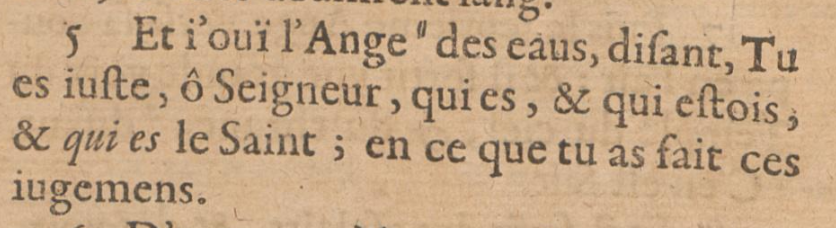
Who First Identified that Beza's Conjecture at Revelation 16:5 was a conjecture?

 A reader recently emailed with a question, which I am paraphrasing in the following way:

Who is the first person to claim that Beza was engaging in conjectural emendation by replacing hosios with esomenos? 

This is a difficult question. 

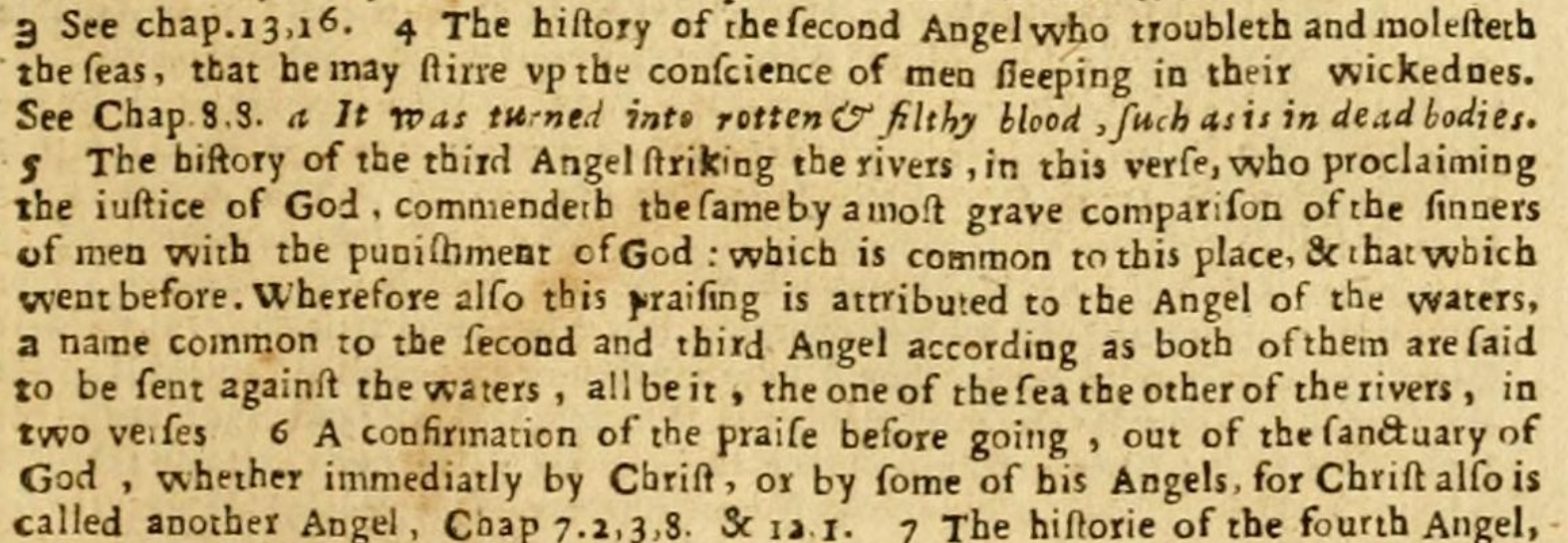
As early as 1764, in Anthony Purver's "A New and Literal Translation of the All the Books of the Old and New Testament; with Notes Critical and Explanatory," vol. II, p. 332, we find the following:

"Ver. 5 holy] shalt be only on Beza's slender Authority, that being not in all the various Readings of Mills, Kuster, Wetsten, Etc. though Doddr. says other Copies have it so, which however he does not follow. By Wesl. the Gracious one, but wrong.

In 1861, William Webster's "The Greek Testament with Notes Grammatical and Exegetical," vol. II, p. 816 states:

A.V. has ' and shalt be ; ' reading ὁ ἐσόμενος from Beza on insufficient authority 

Saying, "Beza's slender authority" and "on insufficient authority" are not quite fully saying that the conjecture was a conjecture.  The reason for hesitancy was, of course, that Beza's own annotations most naturally indicate that Beza had amended in some way based on a manuscript.

In 1881, "The Holy Bible ... with Explanatory and Critical Commentary and a Revision of the Translation ..." (Cook, ed.) (p. 463)(similarly, in the 1890 printing, p. 463), states:

The third edition of Stephens (A.D. 1550) was the basis both of the editions of Beza (Geneva, 1559, 1565, 1582, 1589, 1598,-- see Scrivener l. c. p. 390) and of the Textus Receptus. Beza's edition of 1589² (or 1598) was taken as the basis of our Authorized Version, by the Translators of 1611:  and thus the English Version of the Apocalypse represents a Greek text which does not rest upon the same authority as that of the other Books of the New Testament³ E.g. in ch. xvi. 5, the conjectural reading of Beza's last three editions (ἐσόμενος for ὅσιος, which rests on no authority whatever) is still represented in the words of the Authorized Version "and shalt be." 

This is one of the earliest English-language references to Beza's conjecture, as such, but the study of the New Testament is not limited to English. 

In 1833, Commentationes Latinae, Tertiae Classis, Instituti Regii Belgici, Volumen Quartum, (Disputation with Valckenaerii, p. 17) says:

c. XVI. 5. Καὶ Ὁ ἐσόμενος Ende Die zijn fal. Complutenses, ERASMUS et STEPHANUS, ediderant, quod omnes agnoscunt versiones, et codices Gr. fere omnes: καὶ ὁ ὅσιος, estque ea lectio, ab ELZEVIRIIS recepta, huic loco valde apta. Recte igitur eam, in I. et II. editione, secutus fuerat BEZA: sed in III. IV. et V. eius in locum substituit lectionem a PISCATORE et BELGIS praelatam, hac addita annotatione: Legitur vulgo καὶ ὁ ὅσιος, ostendente articulo, praeter omnem loquendi morem, depravatam esse scripturam. Vulgata vero, sive articulum legit, seu non legit, nihilo rectius vertit ὅσιος, sanctus, male extrita particula καὶ, prorsus necessaria, ut δίκαιος et ὅσιος connectantur. Sed quum Johannes reliquis omnibus locis, ubi Jehovae nomen explicat, sicuti diximus supra 1. 4. addere consueverit tertium, nempe καὶ ̔Ὁ ἐρχόμενος, cur istud h. 1. praeteriisset? Itaque ambigere non possum, quin germana sit scriptura, quam ex vetusto bonae fidei manus. codice restitui, nempe Ὁ ἐσόμενος. 

Haec BEZA, quibus vero hodie nemini persuadebitur. Nec persuasum fuit ROLANDO, qui Graece scripsit: καὶ ὁ ὅσιος, Belg. en die heylige. Eamque germanam lectionem, in veteri quoque belg. versione expressam, in notis commemorant BELGAE. Intelligitur autem e BEZAE annotatione, alteram lectionem, unius codicis auctoritate, non autem, ut VALCKENAERIO visum fuit, (p. 334.) nuda coniectura assumtam esse a nostratibus. Cf. ELUIT, p. 703.

The reference to "Valckenaerio" seems to refer to Lodewijk Caspar Valckenaer, a Dutch classicist (1715-1785).  I could not immediately locate the specific printed edition (or maybe not even the correct work), but I did find the same point expressed here:


Apocal. c. XVI, 5, in istis, ὁ ὢν, καὶ ὁ ἦν, καὶ ὁ ὅσιος⋅ legendum καὶ ὁ ἐσόμενος, pro ὅσιος, suspicati sunt Piscator et Beza: vera suspicio visa fuit Belgis Interpretibus; dederunt enim: die is, ende die was, ende die zyn sal. Suam, ut puto, coniecturam expresserunt eiusdem 

Ludovici Caspari Valckenaerii Opuscula philologica, critica, oratoria nunc primum coniunctim edita ; accedunt indices · Volume 2, (p. 241)

Update: I found what I believe to be the actually cited work, which as the same statements: (p. 334)

Tiberus Hemesterhusii et L.C. Valckenari Orationes (1784)

I'm not sure who literally is the first who came out and said that he believed it to be a conjecture, in so many words. However, I don't claim to have done an exhaustive research of the topic.

*** 

Same Day Update:

The "NT Conjectures" page notes a variety of historic comments about Beza's conjecture (link to page). That list does not (at the time of this post) mention Valckenaer, but it does mention  Johann Christoph Wolf, Curae 4 (11735), 566–567, which says (in 1735):

καὶ ὁ ἐσόμενος Beza: ex vetusto, ut ait, bonae fidei ms. codice. nec tamen nihil dedisse coniecturae videtur. cur enim in nullo alio Apocalypseos loco illum codicem annotationes Bezae memorant? aut cur Rob. Stephani margo nil hoc loco variat? Bezam tamen sequitur H. Stephanus, Pareus, Piscator, Amama: ac plenius. adhibita parenthesi, (καὶ ὁ ἐσόμενος,) καὶ ὅσιος E. Schmidii textus habet. sed Bezam reprehendit Marckius ad h. l. et gravius Zeltnerus in Diss. de Evangelio Tetragrammato p. 29.

καὶ ὁ ἐσόμενος  Beza: from an ancient, as he says, manuscript of good faith. Nor, however, does he seem to have contributed nothing from conjecture. For why, in no other place of the Apocalypse, do Beza’s annotations mention that codex? Or why does Robert Stephanus’ margin vary nothing in this place? Yet H. Stephanus, Pareus, Piscator, Amama follow Beza: and more fully, with the parenthesis applied, (καὶ ὁ ἐσόμενος,) καὶ ὅσιος the text of E. Schmid has. But Marckius criticizes Beza at this place, and more seriously Zeltner in the Dissertation on the Tetragrammaton Gospel, p. 29.

So, this is actually an earlier example than what I provided in the original post. 

Also we find Adriaan Kluit, Vindiciae 1.3 (1771), 703–704 , which says (in 1771):

De Recepta Lectio heeft: δίκαιος, Κύριε, εἶ, ὁ ὤν, καὶ ὁ ἦν καὶ Ὁ ὍΣΙΟΣ—. Gij zijt rechtveerdig, heere, die is, en die was, en de heilige, dat gij dit geoordeeld hebt. Maar de Ned. Overz. — die is en die was en die zijn zal, dat gij — Kantteekening: “Andere lesen, ende de Heylige. —” Doch deze aanteekening voldoet geenzins. Want niet alleen, dat andere lezen de heilige, maar ’t is opmerkelijk: daar is noch nooit een eenig MS. vertoont, waarin dit onzer Nederd. Overz, die zijn zal, ὁ ἐσόμενος, te vinden is. En niet alleen dit, maar zelfs alle Uitgaven, van eerst tot lest hebben ὅσιος, heilige, ’t is alleen beza, die in Edit. 3–5. zich de vrijheid aangematigd heeft om hier ὁ ἐσόμενος te zetten, gelijk Wolff h. l. toont; maar de Recepta Lectio behoudt noch heden bij allen ὁ ὅσιος. De meeste MSS. leiden ons intusschen daarhenen, om hier te lezen eenvoudig: Δίκαιος εἶ ὁ ὢν καὶ ὁ ἦν ὅσιος, ὅτι ταῦτα ἔκρινας· of ὁ ἦν, ὁ ὅσιος, gelijk H. I, 8.

“The Received Reading has: δίκαιος, Κύριε, εἶ, ὁ ὤν, καὶ ὁ ἦν καὶ ὁ ὅσιος—. ‘Thou art righteous, Lord, who is, and who was, and the Holy One, because thou hast judged these things.’ But the Dutch Version: — ‘who is and who was and who shall be, because thou—’ Marginal note: ‘Others read, and the Holy One.—’ Yet this note by no means suffices. For not only that others read ‘the Holy One,’ but it is remarkable: there has never yet been produced a single manuscript in which this, of our Dutch Version, ‘who shall be,’ ὁ ἐσόμενος, is to be found. And not only this, but even all editions, from first to last, have ὅσιος, ‘holy’; it is only Beza, who in Editions 3–5 has assumed the liberty to put here ὁ ἐσόμενος, as Wolff in this place shows; but the Received Reading still retains with all, ὁ ὅσιος. The majority of manuscripts, meanwhile, lead us thither, to read here simply: Δίκαιος εἶ ὁ ὢν καὶ ὁ ἦν ὅσιος, ὅτι ταῦτα ἔκρινας· or, ὁ ἦν, ὁ ὅσιος, just as [in] I, 8.”

This comes very close to saying that it is a conjecture, and clearly endorses Wolf, who does say that.

(Thanks to Nick Sayers, who reminded me about the NT Conjectures page.)

Tuesday, February 18, 2025

Diodati's Versions at Revelation 16:5

Jean Diodati was born in Geneva to a family exiled from Italy for being Protestants.  He became a professor of Hebrew at 21 years old (at Beza's recommendation), and in 1609 he succeeded Beza as professor of theology in Geneva.  He attended the Synod of Dordt and was one of the six men who drew up the Canons of Dordt.

At Revelation 16:5, Diodati's 1607 Italian Bible has:

(p. 309, 1228/1234)

In his 1641 edition, Diodati's Italian Bible has this:


Diodati's Annotations were translated into English (much as were the annotations of the Dutch State Bible).  His annotations (translated) are these:

It's worth noting that Diodati while he reads "Holy" in both Revelation 15:4 and Revelation 16:5, does not make the connection between them, and does not recognize that hosios is for hesed not qadosh.

Diodati's Italian Bible was apparently well-received in Geneva -- in fact it is still what he is best known for today.  He wanted to do the same for the French Bible, but this was not well-received, presumably because of a much stronger emotional attachment to the existing French Bible.  B. M. Armstrong provides a fascinating account of the struggles Diodati faced. (See "Geneva and the Theology and Politics of French Calvinism: the Embarrassment of the 1588 Edition of the Bible of the Pastors and Professors of Geneva," pp. 113-33, in Calvinus Ecclesiae Genevensis Custos (1982).

The 1588 Geneva Bible, edited by Theodore Beza himself, has a lovely Psalter (with metrical Psalms prepared in part by Beza) and at Revelation 16:5 has the following:

(p. 131, image 1397)

I think it's worth noting that even Beza himself (like the Dutch State Bible) has "Holy" in the margin.

Diodati's French Bible finally was published in 1644. At Revelation 16:5 he has:


In short, Beza's successor in Geneva did not accept Beza's change to Revelation 16:5 and both in his Italian and French Bibles maintained respectively the Italian and French words for "Holy".

In 1645, Diodati resigned his professorship.  He went to be with the Lord in 1649.  As you may recall, Francis Turretin became the professor of theology at Geneva in 1653.


Monday, February 10, 2025

Revelation 16:5 in Tomson's New Testament of 1576

In 1576, Laurence Tomson (1539-1608) published a New Testament based on Beza's then-current annotations (as well as other materials).  

His Revelation 16:5 is as follows:

(p. 118, image 234/268)

5 And I heard the Angel of the waters say, Lord, Thou art just, which art, and Which was: and Holy, because thou hast judged these things.

The punctuation itself tells us how "Holy" is understood grammatically.  Tomson's commentary does not directly address the grammatical challenges of the text:

(p. 118, image 234/268)

At Revelation 1:4, Tomson provides the typical connection between the verse and the name, Jehovah.  Tomson follows Beza's capitalization and glosses "and which is to come" in his commentary.  Specifically, he writes: "By these three times, Is, Was and shall be, is signified this word Jehovah, which is the proper name of God. ∵ Exod. 3. 14." 

(p. 111, 220/268)

This view erroneously overlooks the fact that the title, "The Coming One," is about the coming of God not about God being one who will exist at some future time.

H.T. to Irena Backus who points out this translation and its relationship to Beza in "The Reformed Roots of the English New Testament: the Influence of Theodore Beza on the English New Testament."

Friday, September 27, 2024

Beza's Ancient Codices at Luke 17:36

 In a recent video, Dwayne Green commented on Theodore Beza's Annotations on Luke 17:36.  His comments should be visible in the right column of this screenshot:

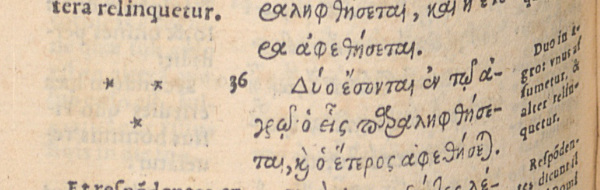
Beza says that the verse is found in the Complutensian edition and in four old/aged/ancient (vetustis) codices.  Dwayne asked folks if they could identify the codices in question. The answer is that they are the four manuscripts listed after the Computensian in Stephanus' 1550 edition:


For a higher quality scan of the same portion:


Here Beza seems rightly to have identified that alpha refers to the Complutensian.  Beta is Codex B, GA 05, also known as Codex Bezae, and dated to the fifth century.  The GA numbers for the remainder are: 4 (13th century), 7 (12th century), and 8 (11th century), each of which are in the National Library of France in Paris.  I'm indebted to J. K. Elliot for providing the mapping of manuscripts to Stephanus' notations.

Why did Beza include the verse in the text, when the Stephanus 1550 (apparently following Erasmus) had omitted it? It's hard to know for sure, but it may well have been of significance that Stephanus 1551 included it:


The three stars are because there is no corresponding Latin translation by Erasmus, if my understanding is correct (as Erasmus' editions did not include the verse).

Thursday, January 04, 2024

External Evidence against Beza's Reading at Revelation 16:5

In his 1582 edition, Beza changed Revelation 16:5 from "και ο οσιος" to "και ο εσομενος".  There are no extant Greek manuscripts with "εσομενος" in the main text.  The one extant Greek manuscript with "εσομενος" in the margin is from the late 1600s, presumably derived from Beza.

In short, there is no meaningful Greek manuscript evidence that corresponds to Beza's substitution. There is also no meaningful versional evidence that corresponds to Beza's substitution.  Thus, although Beza does not explicitly describe his change as a conjecture, I am comfortable doing so.

Nevertheless, there are additional ways that the external evidence undermines Beza's substitution. Recall that Beza's rationale was this (link):

It is commonly read, καὶ ὁ ὅσιος, the article indicating, against all manner of speaking, that the scripture has been corrupted. But whether the Vulgate reads the article or not, it translates ὅσιος no more correctly as "Sanctus" (Holy), wrongly omitting the particle καὶ, which is absolutely necessary to connect δίκαιος (righteous) & ὅσιος. But when John, in all the other places where he explains the name of Jehovah, as we said above, I.4, usually adds the third, namely καὶ Ό ἐρχόμενος, why would he have omitted that here? Therefore, I cannot doubt that the genuine scripture is what I have restored from an old bona fide manuscript (lit. old manuscript of good faith), namely Ό ἐσόμενος. The reason why Ό ἐρχόμενος is not written here, as in the four places above, namely I.4 & 8, likewise 4.8 & 11.17, is this: because there it deals with Christ as the judge who is to come; but in this vision, He is presented as already sitting on the tribunal, and exercising the decreed judgments, and indeed eternal ones.

If Beza's conjecture were correct, one would expect that at least some of the manuscripts, versions, patristic commentaries, and/or patristic citations would reflect the reading of "shall be" in place of "holy."  The closest one can come to finding such a thing is a set of possible allusions, which should be given almost no weight in the discussion because they are much more easily associated with Plato than with Scripture (link).

Similarly, even if all traces of the alleged original reading of "esomenos" were gone from the manuscript tradition, the most natural textual variant to arise as an alternative to "esomenos" would be "erchomenos" in an attempt to harmonize the text with the preceding readings in Revelation 1:4, 1:8, and 4:8, as was also done by some scribes (in error) at Revelation 11:17.

Nevertheless, a survey of the extant manuscripts (such as this one) does not show any examples of Greek manuscripts with a variant reading ερχομενος in place of οσιος.  Likewise, there are no versional witnesses that evidence a source having a substituted ερχομενος for οσιος.  There is also no clear patristic evidence of such a substitution.

Thus, in this additional way, the external evidence disfavors Beza's conclusion.  In fact, while Beza takes pains to respond to Erasmus' conjecture that ερχομενος could have been original, Beza does not explain how οσιος could have arisen in the manuscript tradition.

Someone (I think it was Dr. Thomas Holland) developed the following incorrect translation of Beza's annotation (emphasis added):

"And shall be": The usual publication is "holy one," which shows a division, contrary to the whole phrase which is foolish, distorting what is put forth in scripture. The Vulgate, however, whether it is articulately correct or not, is not proper in making the change to "holy," since a section (of the text) has worn away the part after "and," which would be absolutely necessary in connecting "righteous" and "holy one." But with John there remains a completeness where the name of Jehovah (the Lord) is used, just as we have said before, 1:4; he always uses the three closely together, therefore it is certainly "and shall be," for why would he pass over it in this place? And so without doubting the genuine writing in this ancient manuscript, I faithfully restored in the good book what was certainly there, "shall be." So why not truthfully, with good reason, write "which is to come" as before in four other places, namely 1:4 and 8; likewise in 4:3 and 11:17, because the point is the just Christ shall come away from there and bring them into being: in this way he will in fact appear setting in judgment and exercising his just and eternal decrees.

This is wrong, because it mistranslates Beza's Latin:

5 Et qui eris, καὶ Ό ἐσόμενος. Legitur vulgo, καὶ ὁ ὅσιος, ostendente articulo, praeter omnem loquendi morem, depravatam esse scripturam. Vulgata vero sive articulum legit sive non legit, nihilo rectius vertit ὅσιος, Sanctus, male extrita particula καὶ, prorsus necessaria ut δίκαιος & ὅσιος connectantur. Sed quum Ioannes reliquis omnibus locis ubi Iehouae nomen explicat, sicuti diximus supra, I.4. addere consueuerit tertium, nempe καὶ Ό ἐρχόμενος, cur istud hoc loco praeteriisset? Itaque ambigere non possum quin germana sit scriptura quam ex vetusto bonae fidei manuscripto codice restitui nempe Ό ἐσόμενος. Causa vero cur hîc non scribatur Ό ἐρχόμενος, ut supra quatuor locis, nempe I.4&8. item 4.8:& 11.17, haec est, quoniam ibi de Christo ut iudice venturo agitur: in hac vero visione proponitur ut iam in tribunali sedens, & decreta iudicia, & ea quidem aeterna exercens.

There is nothing corresponding to "a section ... has worn away the part after 'and'" in Beza's Latin.  Moreover, in case you want to verify the transcription, here are Beza's annotations in his various editions.  As you will note, the relevant annotation entered in 1580 and remained unchanged from 1580 onward:

(1556/7, vol. 2, image 1200, p. 330v)


(1580 edition, image 1025, p. 475)

Thus, I don't think Dr. Holland's interpretation of Beza is the same as Beza.  Nevertheless, Holland's view would seemingly reconcile Beza's view with the external manuscript evidence in the sense that there may be some manuscripts where the "ο οσιος" is sufficiently obliterated to require guesswork as to whether it read "ο οσιος" or "o ερχομενος" or "ο εσομενος" (Ms. 2344 comes to mind).

Regardless, Holland's view faces the same external evidence problem.  If we are to understand that "ο οσιος" arose from a corruption of "ο εσομενος," it is hard to understand that happening during the time of uncial transmission, because of the much greater letter count of the latter and the width of capital mu and chi.  Moreover, given the testimony of most of the ancient witnesses to a corresponding exemplar with "ο οσιος", it could not have arisen only in the time of the minuscules.

Nick Sayers, on the other hand, has a radically different explanation.  In Nick's view, the word "οσιος" is a reverential scribal substitution for "εσομενος".  There are numerous weaknesses to this position including, (1) no one before the 21st century seems ever to have thought of this, including no Greek or other commentator before the 21st century, no translator into any language before the 21st century, and no expert in scribal habits of the apostolic or patristic period; and (2) while creative, the explanation is transparently specially plead: there is no other case where "οσιος" was used as a reverential substitution, there are potentially reverential substitutions in Greek (such as "Lord" rather than a transliteration of YHWH) but this is not one, and there are potentially reverential abbreviations known as "nomina sacra," but this does not fit that model of abbreviation.

Moreover, the external evidence suggests that scribes felt (as Beza also did) that "ο οσιος" here seemed awkward and attempted to remedy it in various ways, including by omitting the article and/or adding a και.  These would not have been needed if the scribes understood οσιος the way that Nick proposes it should be understood.

Moreover, two specific textual variants show that scribes did not understand the text Nick's way:

  • Minuscule 469 (13th century) adds "και ο αγιος·" after "ο οσιος."  This suggests that the scribe understood οσιος as having its usual literal sense and employed an expansion of piety by compounding its synonym αγιος.  
  • Minuscule 2026 (15th century) adds "εν τοις εργοις σου" ("in your works").  This suggests that the scribe understood οσιος as having its usual literal sense and added "in your works" to provide an explanation of God's holiness that fits the context.

Neither of these variants is the original reading, of course, but they illustrate the scribes' mindset.  More specifically, they show that the scribes did not share Nick's view.

Thursday, December 14, 2023

How Dare I Appeal to the Majority of Greek Manuscripts!

In some places where the King James Version follows the wrong Greek text, it is fairly straightforward to demonstrate this from an appeal to the fact that the majority of texts disagree.  When this happens we tend to get the following kind of pushback:

Nick mistakenly assumes that "critical text guys" have such a strong partisanship with the main text reading of the NA28 (or other current critical text of the New Testament) that they will just defend its readings at all cost.  Maybe there are some folks like that, but that's more the mentality of many Textus Receptus advocates: they are examining the evidence to try to defend their initial views, as opposed to examining the evidence to try to form a conclusion from the evidence. 

I would like to believe that some folks hold to the Textus Receptus because they think that the manuscript evidence actually supports the Textus Receptus.  However, that's not the case with folks Drs. Peter van Kleek or Dr. Riddle who have abandoned the Reformation era Protestant understanding of textual criticism in favor of the Reformation era Roman Catholic understanding of textual criticism.  For them, the manuscript evidence may be interesting, but the manuscripts are not to be used to edit the text before us.

Sometimes the same error Nick is illustrating is done the other way: there is an assumption that due to partisanship for the NA28, "critical text guys" just want to attack the readings of the TR, even when such an attack is unwarranted.  From this point, the error seems even more unreasonable.  How does such a person think that the battleground texts are selected? The reason that "critical text guys" have a problem with specific TR readings is because they think that the original text is not what the TR has.

Nick's main argument is an appeal to consistency.  If we think the TR is wrong because of a majority text principle at Revelation 16:5 or Revelation 11:17 or anywhere else, then we must acknowledge on the same majority text principle that the NA28 is wrong at 1 Timothy 3:16.

The problem with Nick's argument is that it is an oversimplification of the process.

According to Bart Ehrman a low estimate for the total number of textual variants in the New Testament is around 200k.  D. A. Waite claims that there are 5,604 differences between the TR and the CT.  Thus, even if the KJV were always following the majority, that would mean the CT would be following the majority text at least 97% of the time.  

This then is an example of the saying, "the exception proves the rule."  In the 2% (or whatever the real number) of cases where TR does not follow the majority of manuscripts, there must be some good reason for doing so. I don't mean just that there must be some good reason, and maybe some day we will find the reason.  I mean instead that the editors of the text have to justify their decision. 

So does Beza.  We don't have to accept Beza's departure from the majority because he's Beza or because he was followed by the KJV translators.    

Thus, we are right to challenge Beza's adoption of a minority reading at Revelation 11:17.  What's the good reason to follow the minority of manuscripts, particularly when the minority reading is later than the majority reading?  The short answer is that there isn't a good reason to do so, which is why we don't follow Beza on this point, even though the KJV translators did.

As for 1 Timothy 3:16, if someone is going to follow the main text reading of the NA28, they should have a good reason for doing so, not simply because the NA28 editors have said so.  This isn't the post to debate that particular point, but simply to acknowledge that the scales do need to be even.  We shouldn't automatically accept the NA28 readings because they are NA28, just as the TR folks shouldn't automatically accept the TR readings because they are TR.

By default, the reading found in the majority of Greek manuscripts is right.  That method works (at least) 97% of the time or so, and is especially the cases when the contrary Greek manuscripts are alone in their reading against all the other Greek manuscripts.  As the size of the minority grows, the need for justification of the reading grows.  As the age of the minority grows (i.e. becomes older), the need for justification of the reading grows.  These are not rigid rules like "the oldest manuscript is always right" or "the reading with the most manuscripts is always right," and I understand how that can make some people feel uncomfortable.  Nevertheless, that is why we do (as our spiritual forefathers have done since at least the 2nd century) collation.

Sunday, November 19, 2023

Richard Brett and Ethiopic

There are claims on the internet that Richard Brett (one of the KJV translators) had some knowledge of Ethiopic.  

Oxford University provided the following biography (link to source) in Alumni Oxonienses 1500-1714.

Brett, Richard gent., born in London. Hart Hall, matric. 8 Feb., 1582-3, aged 15; fellow of Lincoln Coll., B.A. 12 Oct., 1586, M.A. 9 July, 1589, licenced to preach 16 July, 1596, B.D. 6 June, 1597, D.D. 13 June, 1605 (son of Robert, of White Stanton, Somerset), rector of Quainton, Bucks, 1595, one of the translators of the Bible 1604, one of the first fellows of Chelsea College 1616, died 15 April, 1637. See Ath., ii. 611; & D.N.B.

There is also a biographical sketch in The Translators Revived: A Biographical Memoir of the Authors of the English Version of the Holy Bible, by Alexander Wilson M'Clure (1853)(link to source).

This reverend clergyman was of a respectable family, and was born at London, in 1567. He entered at Hart Hall, Oxford, where he took his first degree. He was then elected Fellow of Lincoln College, where, by unwearied industry he became very eminent in the languages, divinity, and other branches of science. Having taken his degrees in arts, he became, in 1595, Rector of Quainton in Buckinghamshire, in which benefice he spent his days. He was made Doctor in Divinity in 1605. He was renowned in his time for vast attainments as well as revered for his piety. "He was skilled and versed to a criticism" in the Latin, Greek, Hebrew, Chaldee, Arabic, and Ethiopic tongues. He published a number of erudite works, all in Latin. It is recorded of him, that "he was a most vigilant pastor, a diligent preacher of God's word, a liberal benefactor to the poor, a faithful friend, and a good neighbor." This studious and exemplary minister having attained this exalted reputation died in 1637, at the age of seventy, and lies buried in the chancel of Quainton Church, where he had dispensed the word and ordinances for three and forty years.

Although M'Clure does not seem to cite his source, it appears to come from Henry John Todd''s 1821 "Memoirs of the Life and Writings of the Right Rev. Brian Walton, D.D., Lord Bishop of Chester...with Notices of His Coadjutors in that Illustrious Work...and of the Authorized English Version of the Bible...to which is Added Dr. Walton's Own Vindication of the London Polyglot," which states (p. 117)

Dr. Miles Smith and Dr. Richard Brett, follow; the former so conversant and expert in the Chaldee, Syriac, and Arabic that he made them as familiar to him, almost, as his native tongue; and had Hebrew also at his fingers' ends: the latter, skilled and versed to a criticism in the Latin, Greek, Hebrew, Chaldee, Arabic, and Ethiopic tongues. 

That work also describes (p. 127):

Of similar rank was John Gregory, called the miracle of his age for critical and curious learning; having attained to a learned elegance in English, Latin, and Greek, and to an exact skill in Hebrew, Syriac, Chaldee, Arabic, and Ethiopic.

Thankfully, Todd does cite his source, which is "Athenae Oxonienses. An Exact History of All the Writers and Bishops, who Have Had Their Education in the ... University of Oxford from the Year 1500 to the End of the Year 1690. (etc.)" by Anthonya Wood (1691), vol. 1 (col. 517).  


Note that in this biography, it was not until after he entered University in 1582 and got a degree in Arts that he become a fellow of Lincoln college where, "by the benefit of a good Tutor," he became "eminent in the tongues."  Thus, it seems unlikely that he was in any way involved in assisting Beza for Beza's 1582 edition.

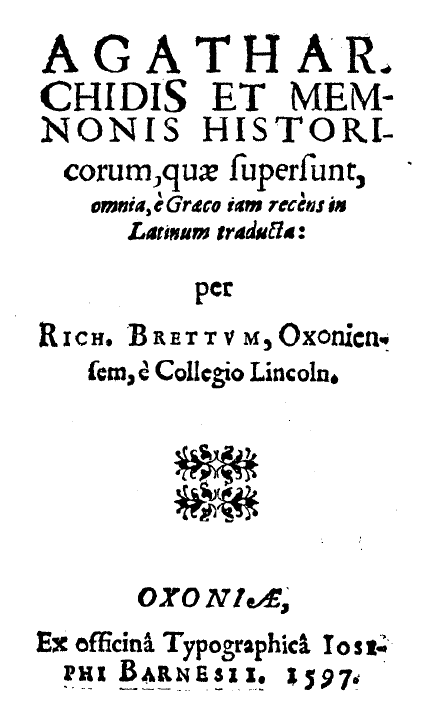
Moreover, the entirety of Richard Brett's published work as it pertains to Ethiopic seems to be the following six words from his 1597 theses (available here):

Although he seems to be using the space (:) and sentence end (::) characters correctly, the orthography of his letters leaves something to be desired.  They definitely look like they are based on Ge'ez characters.

In fact, the first letter of the first word looks like ቸሁባ, which requires an Amharic letter not part of Ge'ez.   

Source:


Richard Brett's translation included a section on the Rhinoceros (see the discussion here), further confirming that "rhinoceros" was not what the KJV translators intended when they wrote "unicorn".


Brett's learning was presumably assisted by Chaldeae seu aethiopicae linguae institutiones: Nunquam antea a Latinis visae, opus utile, ac eruditem ; Item omnium Aethiopiae regum, qui ... usque ad nostra tempora imperarunt, libellus; ex aethiopica translatus lingua by Marianus Vittorio (1552), although it is actually a bit hard to be sure how he studied.  Another source for Brett's learning could be "Institutiones linguae Syriacae, Assyriacae atque Thalmudicae, vnà cum AEthiopicae atque Arabicae collatione. Addita est ad calcem, Noui Testamenti multorum locorum historica enarratio"
by Angelo Canini (1521-1557), which identified Aethiopic as a "dialect" of Hebrew (link to copy)(see the preface).  ("Nam quomodo Graecae linguae dialecti multae ac variae sunt, interse tamen cognatae: sic linguarum peregrinarum fons atque origo est Hebraica, cuius dialecti sunt, Syriaca, Arabica, atque Aethiopica, omnium citra controversiam vetustissimae." which is translated as "For as there are many and varied dialects of the Greek language, yet they are related to each other: so the source and origin of foreign languages is Hebrew, whose dialects are Syriac, Arabic, and Ethiopian, all of them without controversy the most ancient.")

The latter book does have little factoids about Aethiopic, such as that in Ethiopic the vowels aren't separate from the consonants.


The work is also bound with another work, which fascinatingly happens to discuss the name of God:
Interestingly, while this work does not use the exact lettering, "Yahweh," it uses " Ioua" as one of the spellings.

When it comes to the Aethiopic names of God, the author uses Hebrew letters rather than Ge'ez:
Notice Canini's explicit reliance on others to explain the Ethiopic language: 

"Eghzaibher" componitur ex "Eghzia" domino, "Ab" patre, "her" bono: quod est dominus pater bonus: ut illi Aethiopes, qui Romae habitant, interpretantur.

"Eghzaibher" is composed of "Eghzia" meaning lord or master, "Ab" meaning father, and "her" meaning good: which is 'good lord father,' as those Ethiopians who live in Rome interpret it.

This provides further confirmation that, at this time, the Ethiopians living in Rome were the place to go if you wanted someone who could read and understand Ethiopic.

The book is summarized thus:

The entry on John Gregory (Vol. 2, cols. 51-52) is similarly positive:


Thus, John Gregory, the "miracle of his age for critical and curious learning," was born 
November 10, 1607, and thus cannot be viewed as particularly helpful to either Beza or the KJV, despite being quite prodigious in his intellect.

Incidentally, Elias Hutter knew of the existence of the Ethiopian language, as such, and even of some origin myths of the language and people of Ethiopia, as evidenced here:


Another source, Bibliotheca apostolica vaticana a Sixto V. Pont. Max. in splendidiorem, commodioremq. locum translata, et a fratre Angelo Roccha a Camerino ... commentario variarum artium ... illustrata, by Angelo Rocca (1591), describes the conventional knowledge of the subject at that time:


However, there were also exceptions.  Sebastian Münster's "Grammatica Chaldaica" (1527) mis-labels Ge'ez as being Indian, but provides an impressive basic description of the alphabet:

(source, p. 14)
This is followed by a short selection from the Psalter:
(source, p. 16)
Finally, some words are provided by way of example:
(source, p. 17)

It may not be a lot, but it shows a basic familiarity with the language, even before the 1548/9 Ethiopic Bible was printed.  Incidentally, according to the Encyclopedia Britannica, Sebastian Munster was a Hebraist and former Franciscan who became Lutheran around 1529.  His tombstone described him as "the Ezra and the Strabo of the Germans." 

Beza immortalized him in his "Icons" (1580):

And described him thus:

In terms of sources that Beza had access to, here is one that would have given him at least a little information about the Ethiopic language.

Conrad Gessner (1516-1565) in Mithridates (pp. 6-8) noted Munster's work, provided a phonetic transcription of the Lord's prayer, citing the New Testament printed in Rome (i.e. the 1549 Ethiopic), and the Symbol and Confession of Simeon the Just in phonetic spelling, which seems to come from the work of Theodore Bibliandri (1548) (link to source)(see also, p. 6 for a discussion of the language).  Gessner was also directly connected to Beza, and actually appeared as the entry directly after Munster in Icons:

Regarding knowledge of Aethiopic during the 14th through 17th centuries, I found an interesting article by Dejazmatch (ደጃዝማች, Commander or general of the Gate) Zewde Gebre-Sellassie (1926-2008) who was not only a deputy prime minister in Ethiopia, but also earned a PhD from Oxford.  In the 1996 article, Dr. Gebre-Sellassie explains (source - notice the source seems to be an OCR result, and consequently contains numerous typographic errors):

In the middle of the 14th century (1351) some Ethiopians began coming to Rome through the Holy Land and in 1441 during the Council of Florence Abba Niqodimos, the Abbot of the Ethiopian monastery of Jerusalem, is said to have sent a delegation of Ethiopian monks. The number of Ethiopian pilgrims in Rome gradually increased during the papacy of Sisto IV (1471-1484). At that time the Church of Santo Stefano in Vaticano (St Stephen within the wall of the Vatican) and the adjoining hospice were granted by the Pope to the Ethiopian pilgrims. This property remains to this day in their possession, known as San Stefano dei Mon or degli Abissini (St. Stephen of the Abyssinians).

The Ottoman Turks occupied Syria and Palestine in 1516, Egypt in 1517; and Ethiopia was in a turmoil by the Islamic Jihad during the First half of the Sixteenth Century. During this period the Ethiopian monks in Jerusalem were in a desperate situation and many of them joined the different Catholic orders, such as the Franciscans and the Benedictines some of them migrated to Southern Europe, to Austria, Spain and mostly to Italy.

Some of these monks were eminent scholars well versed in Ethiopian languages, history and culture as well as theology and philosophy. Among those who settled at San Stefano in the Vatican, the most outstanding scholars who deserve special mention, are the following: Abba Tomas of Waldiba; Abba Tesfa Tsion Mallizo, who was commonly known in Rome as Pietro Indiano - Peter the Indian; Abba Gorgorios of Mekane Sellassie and, later on during the 19th Century, Debtera Kifle Giorgis.

Abba Tomas of Waldiba, who called himself son of Samuel, after the patron saint and founder of his monastery, was the pioneer in the scholastic endeavor of teaching the Geez alphabet and grammar in Europe. Among his students was the German scholar Johannes Potken, who for the first time printed the Psalms of David in Geez on June 30th, 1513.

Abba Tesfa-Tsion Mallizo, known in Rome as Pietro Indiano (Peter the Indian), is referred to as erudite and full of humility and love. He had published the New Testament in Geez in 1548-1549. He also translated the Anaphora of the Apostles and the Baptismal prayers of the Ethiopian Church into Latin, with the help of two Italian scholars, Paolo Giovo and Pietro Gualtieri who was a polyglot and secretary to the Pope. Subsequently, with the help of Mario Vittorio di Rieti (who later became a bishop of his native region Rieti) he published a grammar of the Geez language and a list of Ethiopian sovereigns. Abba Tesfa Tsion came from Jerusalem to Rome in 1538 and stayed there for twelve years. He died in Tivoli at the age of forty-two in 1550.

Among the well known Europeans who were instructed by the Ethiopian monks were Atanasio Kircher and Jacobus Wemmers, the author of the first Geez or Ethiopic-Latin dictionary during the first half of the 17th century. The Danish scholar Theodor Peter, who edited a number of Ethiopian studies and the Dominican Maria Wansleb, are also credited for considerable achievements.

However, no one has profited and utilized his learning as much as Hiob Ludolf, the German scholar who was instructed by Abba Gorgorios or Gregory of Mekane Sellassie, assisted for translation from Amharic to German by D'Andrade Antonio, son of a Portugese father and an Ethiopian mother. Ludolf's Grammatica Aethiopica (1661), Historia Aethiopica (1681), which was translated into English, French and Dutch; Commentary on the History (1691), Grammatica Linguae Amharicae (1698), and Lexicon Aethiopico - Latinum (1661) became the standard authoritative texts for teaching Ethiopian studies in European universities and centers of learning until Dillmann's monumental works in the nineteenth century published between 1847 and 1894, notably his Lexicon (1865) and Grammar (in 1857 in German, English translation in 1907), as well as the Ethiopian version of the books of Enoch (1851), Jubilees (1859), Ascencion of Isaiah (1877), and the Histories of Arride Tsion and Zera Yacob (1884).

One thing I found particularly notable was that Dr. Gebre-Sellassie believes that Potken not only printed the text but also studied the language under Abba Tomas of Waldiba, suggesting that Potken had some understanding of the language.

Also interesting, while Potken's 1513 Psalter focuses on the Ethiopic itself, it appears that Potken also published a four-language Psalter in 1518, making it easier to compare the Ethiopic with other languages in the Psalms (available here).

The "well known Europeans who were instructed by the Ethiopian monks" include Athanasius Kircher (1602-1680) and Jacobus Wemmers (1598-1645).  Wemmers is credited by Dr. Gebre-Sellassie with creating the first Latin-Ge'ez dictionary.  Meanwhile, Hiob Ludolf is credited with providing definitive works on Ethiopic including an Ethiopic Grammar (1661 - link to 1698 edition, which has the tetragrammaton on the cover page) and Latin-Ethiopic Dictionary (1661).

All this to say that Ethiopic, while not widely familiar to 16th century European scholarship, was certainly more well-known at the time than Chinese to which I compared it in a video.  That said, it would be mistake to think that Ethiopic was a familiar or well-studied language by European scholarship prior to Ludolf's 1660s publications.

Friday, November 10, 2023

Beza, Plato, and the "Shall Be" Speculative Restoration at Revelation 16:5

Beza speculatively replaced "ὅσιος" with "ἐσόμενος" in Revelation 16:5.  Sometimes advocates of the King James Version (or Scrivener's Textus Receptus, which was based on the KJV), will try to find some hint that this text existed in some now-lost copies of Scripture. To that end, I've done my best to survive the roughly 266 places in which the exact expression "ἐσόμενος" appears in any Greek writing in the Thesaurus Linguae Gracae (TLG) library of Greek Literature (as of November 10, 2023).

There is one Biblical use, namely in the Septuagint translation of Job:

Septuagint, Job 15:14 "τίς γὰρ ὢν βροτός, ὅτι ἔσται ἄμεμπτος, ἢ ὡς ἐσόμενος δίκαιος γεννητὸς γυναικός;" (NETS: For who, being mortal, can be blameless, or who can be in the right, born of woman?)

While this is an important verse for total depravity, it has no obvious connection to Revelation 16:5.

A much more interesting use is found in Plato's Timaeus.  I don't know whether Plato's Timaeus is itself included in the TLG, but beginning with Stobaeus (5th century, AD) there are multiple quotations of Plato's use (Stobaeus, Proclus, Simplicius, and especially Philoponus provide this quotation).   

In a paper (link), I found the following text and translation of Timaeus 38b 6-c 3.

χρόνος δ᾽ οὖν μετ᾽ οὐρανοῦ γέγονεν, ἵνα ἅμα γεννηθέντες ἅμα καὶ λυθῶσιν, ἄν ποτε λύσις τις αὐτῶν γίγνηται, καὶ κατὰ τὸ παράδειγμα τῆς διαιωνίας φύσεως, ἵν’ὡς ὁμοιότατος αὐτῷ κατὰ δύναμιν ᾖ· τὸ μὲν γὰρ δὴ παράδειγμα πάντα αἰῶνά ἐστιν ὄν, ὁ δ᾽ αὖ διὰ τέλους τὸν ἅπαντα χρόνον γεγονώς τε καὶ ὢν καὶ ἐσόμενος.

...

Now, χρόνος has come into being with the οὐρανός (χρόνος δ᾽ οὖν μετ᾽ οὐρανοῦ γέγονεν), so that, together (ἅμα) having been engendered, together (ἅμα) they may perish, should some dissolution (λύσις) of either the one or the other ever occur, and it has come into being [sc. γέγονεν] in accordance with the paradigm which is possessed of a thoroughly everlasting nature (τὸ παράδειγμα τῆς διαιωνίας φύσεως), so that it should prove to be as similar as possible to that paradigm, relative to its capacity (ἵν’ὡς ὁμοιότατος αὐτῷ κατὰ δύναμιν ᾖ); for that paradigm ‘is’ for all Eternity, being, whereas the other (ὁ δ᾽ αὖ, that is, its ‘image’), lasting through and through (διὰ τέλους), ‘is’ [sc. ἐστιν] for all time, having come into being, and also being and going to be’.

It's easy to observe the three times (past, present, and future) mentioned in connection with the concept of Eternity.  There is no reason to think that John would have been influenced by Plato, and in context John is quoting an angel, who would have no reason to be have been influenced by Plato.  Nevertheless, it is more reasonable to suppose that Beza was influenced by Plato.

In 1513, Aldus Manutius provided the first printed edition of Plato's works in Greek, which included Timaeus (link to relevant page):


Notice the "καὶ ὢν καὶ ἐσόμενος" as the final words of the last line of the clip. It is 

Beza may not have always agreed with Plato, but he had read him, at least enough to disagree with him. For example, "Beza does not favour Plato's philosophy, and often finds him an inept philosopher," Mallinson, Jeffrey, 'Beza’s Academic Challenge', Faith, Reason, and Revelation in Theodore Beza (1519–1605), Oxford Theological Monographs (Oxford, 2003; online edn, Oxford Academic, 3 Oct. 2011).

Setting aside the people quoting or commenting on Plato himself, and setting aside the many places where the use of the word seems utterly irrelevant to the question at hand, I have found the following places of interest (some of which were already pointed out by Nick Sayers in his book on Revelation 16:5, defending Beza's reading).

1. Clement of Alexandria (d. c. 215), Stromata, Book 5, Chapter 6 (translation)(Greek can be found here):

So very mystically the five loaves are broken by the Saviour, and fill the crowd of the listeners. For great is the crowd that keep to the things of sense, as if they were the only things in existence. "Cast your eyes round, and see," says Plato, "that none of the uninitiated listen." Such are they who think that nothing else exists, but what they can hold tight with their hands; but do not admit as in the department of existence, actions and processes of generation, and the whole of the unseen. For such are those who keep by the five senses. But the knowledge of God is a thing inaccessible to the ears and like organs of this kind of people. Hence the Son is said to be the Father's face, being the revealer of the Father's character to the five senses by clothing Himself with flesh. "But if we live in the Spirit, let us also walk in the Spirit." "For we walk by faith, not by sight," the noble apostle says. Within the veil, then, is concealed the sacerdotal service; and it keeps those engaged in it far from those without.

Again, there is the veil of the entrance into the holy of holies. Four pillars there are, the sign of the sacred tetrad of the ancient covenants. Further, the mystic name of four letters which was affixed to those alone to whom the adytum was accessible, is called Jave, which is interpreted, "Who is and shall be." The name of God, too, among the Greeks contains four letters.

ταύτῃ τοι μυστικώτατα πέντε ἄρτοι πρὸς τοῦ σωτῆρος κατακλῶνται καὶ πληθύνουσι τῷ ὄχλῳ τῶν ἀκροωμένων. πολὺς γὰρ ὁ τοῖς αἰσθητοῖς ὡς μόνοις οὖσι προσανέχων. «ἄθρει δὴ περισκοπῶν,» φησὶν ὁ Πλάτων, «μή τις τῶν ἀμυήτων ἐπακούῃ. εἰσὶ δὲ οὗτοι οἱ οὐδὲν ἄλλο οἰόμενοι εἶναι ἢ οὗ ἂν ἀπρὶξ τοῖν χειροῖν λαβέσθαι δύναιντο, πράξεις δὲ καὶ γενέσεις καὶ πᾶν τὸ ἀόρατον οὐκ ἀποδεχόμενοι ὡς ἐν οὐσίας μέρει·» τοιοῦτοι γὰρ οἱ τῇ πεντάδι τῶν αἰσθήσεων προσανέχοντες μόνῃ. ἄβατον δὲ ἀκοαῖς καὶ τοῖς ὁμογενέσιν ἡ νόησις τοῦ θεοῦ. ἐντεῦθεν πρόσωπον εἴρηται τοῦ πατρὸς ὁ υἱός, αἰσθήσεων πεντάδι σαρκοφόρος γενόμενος, ὁ λόγος ὁ τοῦ πατρῴου μηνυτὴς ἰδιώματος. «εἰ δὲ ζῶμεν πνεύματι, πνεύματι καὶ στοιχῶμεν.» «διὰ πίστεως περιπατοῦμεν, οὐ διὰ εἴδους,» ὁ καλὸς ἀπόστολος λέγει. ἔνδον μὲν οὖν τοῦ καλύμματος ἱερατικὴ κέκρυπται διακονία καὶ τοὺς ἐν αὐτῇ πονουμένους πολὺ τῶν ἔξω εἴργει. 

πάλιν τὸ παραπέτασμα τῆς εἰς τὰ ἅγια τῶν ἁγίων παρόδου, κίονες τέτταρες αὐτόθι, ἁγίας μήνυμα τετράδος διαθηκῶν παλαιῶν, ἀτὰρ καὶ τὸ τετράγραμμον ὄνομα τὸ μυστικόν, ὃ περιέκειντο οἷς μόνοις τὸ ἄδυτον βάσιμον ἦν· λέγεται δὲ Ἰαουε, ὃ μεθερμηνεύεται ὁ ὢν καὶ ὁ ἐσόμενος. καὶ μὴν καὶ καθ’ Ἕλληνας θεὸς τὸ ὄνομα τετράδα περιέχει γραμμάτων. 

It is interesting to see the earliest Christian writer who is defining the tetragrammaton as "who is and shall be" has clearly been influenced by Plato. This is an example of a "possible allusion" but considering that the phrase wording doesn't align with the phrase wording of Beza's Revelation 16:5, it seems unreasonable to put much weight on it.


2. Gregory of Nyssa (d. 395), On the Baptism of Christ, A Sermon for the Day of the Lights. (link to translation) 

Διὰ δὴ ταῦτα πάντα τὸν τῆς χαρᾶς ὕμνον ἄσωμεν τῷ θεῷ, ὃν στόμα τῷ πνεύματι κάτοχον πάλαι προφητικῶς ἐξεβόησεν· Ἀγαλλιάσθω ἡ ψυχή μου ἐπὶ τῷ κυρίῳ· ἐνέδυσε γάρ με ἱμάτιον σωτηρίου καὶ χιτῶνα εὐφροσύνης περιέβαλέ μοι, ὡς νυμφίῳ περιέθηκέ μοι μίτραν καὶ ὡς νύμφην κατεκόσμησέ με κόσμῳ. κοσμήτωρ δὲ πάντως τῆς νύμφης ὁ Χριστὸς ὁ ὢν καὶ πρόων καὶ ἐσόμενος, εὐλογητὸς νῦν καὶ εἰς τοὺς αἰῶνας τῶν αἰώνων, ἀμήν. 

For all these things then let us sing to God that hymn of joy, which lips touched by the Spirit long ago sang loudly: Let my soul be joyful in the Lord: for He has clothed me with a garment of salvation, and has put upon me a robe of gladness: as on a bridegroom He has set a mitre upon me, and as a bride has He adorned me with fair array.  And verily the Adorner of the bride is Christ, Who is, and was, and shall be, blessed now and for evermore. Amen.

The reference to the Adorner of the bride is probably a reference to Septuagint Isaiah 61:10: "... Let my soul be glad in the Lord, for he has clothed me with a garment of salvation and with a tunic of joy; he has put on me a headdress as on a bridegroom and adorned me with ornaments like a bride." (NETS) ("... ἀγαλλιάσθω ἡ ψυχή μου ἐπὶ τῷ κυρίῳ ἐνέδυσεν γάρ με ἱμάτιον σωτηρίου καὶ χιτῶνα εὐφροσύνης ὡς νυμφίῳ περιέθηκέν μοι μίτραν καὶ ὡς νύμφην κατεκόσμησέν με κόσμῳ")  The reference to the lips touched by the Spirit is undoubtedly a reference to the account of the purification of Isaiah's lips (Isaiah 6:5-6)

Gregory's doxological conclusion is an explanation of Jesus as the Adorner together with praise of Jesus, calling him blessed and eternal.  This is an example of a "possible allusion" but considering that the phrase wording doesn't align with the phrase wording of Beza's Revelation 16:5, it seems unreasonable to put much weight on it.


3. Cyril of Alexandria (d. 444), Commentary on Isaiah, Book 4, Oration II, at Isaiah 44:6-7 (Greek at 924 D)

Thus says the Lord, the God, the King of Israel, the God of hosts who saved him: I am the first, and I am after these; besides me there is no God. Who is like me? Let him stand up, call, and prepare for me, since I made man into the world. And let them declare to you the things that are to come before they happen. Do not be deceived, and I have announced to you.

Making a remembrance of the knowledge in Christ through the readings now given to us, he shifts the discourse to another of the necessary things. For at that time, when the divine prophet Isaiah was composing such words for us, reigning among them was the hater of God, and he was in unbearable errors. For each had his own so-called god and reverence; God made it necessary for them to have advice, interwoven with the most ingenious reproaches; moving them away from polytheism and its infirmities; and inviting them through recognition to the knowledge of truth, and of His own glory and incomparable power, bringing it to memory. In this regard, he says: Thus says the Lord, the King of Israel, the God of hosts who saved him. For He wants it to be known that He is God and the Lord of powers, and to be lifted up as if from drunkenness to see that they have been delivered from the greed of the Egyptians, performing wonders, and showing the greatness of His power and superiority. For what has not been done of the things wondered at? What plague has not been inflicted on those who oppressed them? Or how could there not be a clear demonstration of His indescribable power, with the sea standing apart, the waters freezing and forming like a wall, and the fleeing ones walking through the middle? And what about the miracles in the wilderness after this? Did He not give them bread from heaven? Did He not break open a rock in the wilderness, and water them as in a great abyss; and brought down waters like rivers? Did He not, by placing a sort of bridle on the waters of the Jordan, make a way to pass with a foot? Therefore, He rightly calls Himself not simply Lord and God in these things; but He added, And having saved him, bringing to memory, as I said, the paradoxically accomplished things through Him. Know then, he says, that I am God first, and I am after these, and besides me there was no God.

For God is the beginning of everything, being Himself without beginning, and everything was brought forth by Him into being; He then became under no one, but is, was, and will be. For this is His name, and an eternal memorial for generations of generations. Therefore, neither was there another God before Him, nor will there be one after Him. For there is one God by nature, and no other besides Him. This advice is very useful for those who have denied Him, and who have slipped into great folly in thinking that there are many gods. That no one else or different one can be counted upon Him, He demonstrates by saying: Who is like me? Who among the gods you have thought of, or named senselessly, will be according to my glory and power? From what great deeds have you believed them to be gods? Let someone stand, if there is one like me. Let someone prepare who has a nature equal in strength or glory. Let them call whoever they choose of the falsely-named gods, since I made man into the world. For I, he says, have created the heavens and the things in them, having flocks of countless holy spirits worshiping and serving me, but since I made man upon the earth, and in the following, that is, into the world, let someone show me one like me. But again saying, Since I made man, he shows himself to be the creator, and the falsely-named gods to be completely non-existent. For what of those worshiping them have they brought into being? But I, being a creator, am known, and the creator of everything, and having knowledge of all. Investigate this with the gods spoken of among you, let them declare to you the things that are to come before they happen. For it would be fitting for a god by nature to have all knowledge of both what has already happened and what will be. But if none among the falsely-named gods is found to have this, it is evident that those who do not have the knowledge of God could not be gods. Do not be deceived, instead of, Do not be silent, nor pretend.

 Οὕτω λέγει Κύριος ὁ Θεὸς ὁ βασιλεὺς τοῦ Ἰσραὴλ, ὁ ῥυσάμενος αὐτὸν Θεὸς Σαβαώθ· Ἐγὼ πρῶτος, καὶ ἐγὼ μετὰ ταῦτα· πλὴν ἐμοῦ οὐκ ἔστι Θεός. Τίς ὥσπερ ἐγώ; Στήτω, καὶ καλεσάτω, καὶ ἑτοιμασάτω μοι, ἀφ’ οὗ ἐποίησα ἄνθρωπον εἰς τὸν αἰῶνα. Καὶ τὰ ἐπερχόμενα πρὸ τοῦ ἐλθεῖν ἀναγγειλάτωσαν ὑμῖν. Μὴ παρακαλύπτεσθε, καὶ ἀπήγγειλα ὑμῖν.

  Τῆς ἐν Χριστῷ γνώσεως διὰ τῶν ἀρτίως ἡμῖν ἀναγνώσεων ποιησάμενος μνήμην, μεθίστησι τὸν λόγον ἐφ’ ἕτερόν τι τῶν ἀναγκαίων. Ἐπειδὴ γὰρ κατ’ ἐκεῖνο καιροῦ, καθ’ ὃν ὁ θεσπέσιος προφήτης Ἡσαΐας τοὺς περὶ τῶν τοιούτων ἡμῖν συνετίθει λόγους, βασιλεύοντος παρ’ αὐτοῖς θεομισοῦς, καὶ ἐν ἀφορήτοις γέγονεν ὀλισθήμασιν. Ἦν γὰρ ἑκάστῳ τὸ δοκοῦν θεὸς καὶ σέβας· ἀναγκαίαν αὐτοῖς τὴν παραίνεσιν εὐφυεστάτοις ἐλέγχοις ἐγκεκλωσμένην ποιεῖται Θεός· μεθιστὰς μὲν αὐτοὺς τῆς πολυθεΐας, καὶ τῶν ἐν τούτοις ἀῤῥωστημάτων· προσκαλούμενος δὲ διὰ μεταγνώσεως εἰς ἐπίγνωσιν ἀληθείας, καὶ τῆς αὐτοῦ δόξης, καὶ ἀσυγκρίτου δυνάμεως ἀνακομίζων εἰς ἀνάμνησιν. Ταύτῃ τοι φησίν· Οὕτω λέγει Κύριος ὁ βασιλεὺς τοῦ Ἰσραὴλ, ὁ ῥυσάμενος αὐτὸν Θεὸς Σαβαώθ. Ὅτι γὰρ Θεός ἐστι καὶ τῶν δυνάμεων Κύριος, εἰδέναι βούλεται, καὶ καθάπερ ἐκ μέθης ἀνενεγκόντας ἰδεῖν, ὅτι καὶ τῆς Αἰγυπτίων πλεονεξίας ἐξῄρηνται, θαυματουργοῦντος αὐτοῦ, καὶ τῆς ἐνούσης αὐτῷ δυνάμεως, καὶ ὑπεροχῆς τὸ μέγεθος ἐμφανίζοντος. Τί γὰρ οὐ πέπρακται τῶν τεθαυμασμένων; Ποία δὲ τοῖς πλεονεκτοῦσιν αὐτοὺς οὐκ ἐπηνέχθη πληγή; Ἢ πῶς τῆς ἀφράστου δυνάμεως αὐτοῦ οὐκ ἂν γένοιτο σαφὴς ἀπόδειξις, τὸ διαστῆναι μὲν θάλασσαν, παγῆναι δὲ καὶ ὡσεὶ τεῖχος τὰ ὕδατα, καὶ διὰ μέσων ἰέναι τοὺς φεύγοντας; Τί δὲ δὴ τὰ ἐν τῇ ἐρήμῳ μετὰ τοῦτο θαυματουργήματα; Οὐκ ἄρτον αὐτοῖς ἔδωκε τὸν ἐξ οὐρανοῦ; Οὐ διέῤῥηξε πέτραν ἐν ἐρήμῳ, καὶ ἐπότισεν αὐτοὺς ὡς ἐν ἀβύσσῳ πολλῇ; καὶ κατήγαγεν ὡς ποταμοὺς ὕδατα; οὐ τοῖς Ἰορδάνου νάμασιν οἷά τινα χαλινὸν ἐπιθεὶς, ποδὶ παρεσκεύασε παρελθεῖν; Ἀναγκαίως τοίνυν, οὐχ ἁπλῶς Κύριόν τε καὶ Θεὸν ἐν τούτοις ἑαυτὸν ἀποκαλεῖ· προσεπήγαγε δὲ, ὅτι Καὶ ῥυσάμενος αὐτὸν, εἰς ἀνάμνησιν ἀνακομίζων, ὡς ἔφην, τῶν δι’ αὐτὸν παραδόξως τετελεσμένων. Ἴσθι δὴ οὖν, φησὶν, ὅτι Ἐγὼ Θεὸς πρῶτος, καὶ ἐγὼ μετὰ ταῦτα, καὶ πλὴν ἐμοῦ οὐκ ἦν Θεός. 

Ἀρχὴ γὰρ τῶν ὅλων Θεὸς, ἄναρχος ὢν αὐτὸς, καὶ παρ’ αὐτοῦ πάντα παρήχθη πρὸς γένεσιν· αὐτὸς μὲν οὖν γέγονεν ὑπ’ οὐδενὸς, ἀλλ’ ἔστιν ὤν τε καὶ ἐσόμενος. Τοῦτο γὰρ ὄνομα αὐτῷ, καὶ μνημόσυνον αἰώνιον γενεῶν γενεαῖς. Οὔτε τοίνυν πρὸ αὐτοῦ Θεὸς ἕτερος ἦν, οὔτε τις ἔσται μετ’ αὐτόν. Εἷς γὰρ φύσει Θεὸς, καὶ ἕτερος παρ’ αὐτὸν οὐδείς. Χρησιμωτάτη δὲ λίαν ἡ παραίνεσις τοῖς ἀρνησαμένοις αὐτὸν, καὶ ἐκ πολλῆς ἄγαν ἀσυνεσίας ὠλισθηκόσιν εἴς γε τὸ οἴεσθαι θεοὺς εἶναι πολλούς. Ὅτι δὲ κατ’ αὐτὸν οὐδεὶς ἤγουν ἕτερος ἐπ’ αὐτῷ καταλογισθῆναι, διαδείκνυσι λέγων· Τίς ὥσπερ ἐγώ; Ποῖος ἄρα τοῖς παρ’ ὑμῶν ὑπονοηθεῖσι θεοῖς, ἤγουν ἀσυνέτως ὠνομασμένοις, κατὰ τὴν ἐμὴν ἔσται δόξαν τε καὶ δύναμιν; Ἐκ ποίας ἄρα μεγαλουργίας θεοὺς αὐτοὺς εἶναι πεπιστεύκατε; Στήτω τις, εἴπερ ἐστὶ κατ’ ἐμέ. Ἑτοιμασάτω τις τὸν ἰσόῤῥοπον ἔχοντα φύσιν, ἢ κατ’ ἰσχὺν ἢ δόξαν. Καλεσάτωσαν οὓς ἂν ἕλοιντο τῶν ψευδωνύμων θεῶν, ἀφ’ οὗ ἐποίησα ἄνθρωπον εἰς τὸν αἰῶνα. Ἐκτισάμην γὰρ, φησὶν, οὐρανοὺς, καὶ τὰ ἐν αὐτοῖς, ἀναριθμήτων ἁγίων πνευμάτων ἀγέλας προσκυνούσας ἔχων καὶ λατρευούσας ἐμοὶ, πλὴν ἀφ’ οὗ πεποίηκα τὸν ἄνθρωπον ἐπὶ τῆς γῆς, καὶ ἐν τοῖς ἐφεξῆς, τοῦτ’ ἔστιν, εἰς τὸν αἰῶνα, δειξάτω μοί τις τὸν κατ’ ἐμέ. Λέγων δὲ πάλιν τὸ, Ἀφ’ οὗ ἐποίησα ἄνθρωπον, ἑαυτὸν μὲν δείκνυσιν ὄντα δημιουργὸν, τοὺς δὲ ψευδωνύμους θεοὺς οὐδὲν ὄντας παντελῶς. Τίνα γὰρ τῶν προσκυνούντων αὐτοὺς εἰς τὸ εἶναι παρήνεγκαν; πλὴν δημιουργὸς ἐγὼ ὑπάρχων γνωρίζομαι, καὶ κτίστης τῶν ὅλων, καὶ ἁπάντων ἔχων τὴν γνῶσιν. Ἐρευνήσατε τοῦτο παρὰ τοῖς παρ’ ὑμῶν ῥηθεῖσι θεοῖς, τὰ ἐπερχόμενα πρὸ τοῦ ἐλθεῖν ἀναγγειλάτωσαν ὑμῖν. Θεῷ γὰρ κατὰ φύσιν πρέποι ἂν τὸ πᾶσαν ἔχειν τὴν γνῶσιν τῶν τε ἤδη παρῳχηκότων, καὶ τῶν ἐσομένων. Εἰ δὲ οὐδεὶς ἐν τοῖς ψευδωνύμοις θεοῖς τοῦτο λαχὼν εὑρίσκεται, ἀσυμφανὲς, ὅτι οἱ τὴν Θεοῦ γνῶσιν οὐκ ἔχοντες, οὐκ ἂν εἶεν θεοί. Μὴ παρακαλύπτεσθε, ἀντὶ τοῦ, Μὴ σιωπᾶτε, μηδὲ ἀποπροσποιεῖσθε.

This is an example of a "possible allusion" but considering that the phrase wording doesn't align with the phrase wording of Beza's Revelation 16:5, it seems unreasonable to put much weight on it.


4. Olympiodorus the Deacon (of Alexandria?)(Sixth Century?), Commentary on Jeremiah (taken from catena fragments):

 «Ἰωσεδέκ.» Ἰωσεδὲκ ἑρμηνεύεται, Ἰωὰ δίκαιος, τουτέστι δικαιοσύνη ἡμῶν· ἢ Ἰωὰ, ὢν καὶ ἐσόμενος, Ἰωσεδέκ· καὶ διὰ τὴν ὁμωνυμίαν υἱοῦ τοῦ Ἰωσεδὲκ, τοῦ ἡγησαμένου τῶν υἱῶν Ἰσραὴλ ἀπὸ τῆς αἰχμαλωσίας. Πολλάκις γὰρ ἡ Γραφὴ καὶ ἀπὸ ὀνομάτων τὰ πράγματα κρίνει· ὡς ἐπὶ τοῦ Μελχισεδὲκ, ὃς ἑρμηνεύεται βασιλεὺς εἰρήνης. Ἐν τοῖς προφήταις ἐπειδὴ καὶ προφήτης ἠξίωσε κληθῆναι, καθὸ γέγονεν ἅνθρωπος, ὁ τοῦ Θεοῦ Υἱὸς, ὁ τῶν προφητῶν Δεσπότης, κατὰ τὸν διὰ Μωσέως χρησμὸν λέγοντα, Προφήτην ὑμῖν ἀναστήσει Κύριος ὁ Θεὸς ὑμῶν ὡς ἐμέ· κατὰ πάντα αὐτοῦ ἀκούσεσθε.

"Ἰωσεδέκ." Ἰωσεδέκ is interpreted as "Ἰωὰ the righteous," which means our righteousness. Or "Ἰωὰ," meaning "being and becoming," Josedek. And because of the similarity in name, it refers to the son of Josedek, who led the sons of Israel out of captivity. For often, Scripture judges things based on names, as in the case of Melchizedek, who is interpreted as the "king of peace." In the prophets, since even a prophet was deemed worthy to be called, just as it happened, a man, the Son of God, the Lord, the Master of the prophets, according to the prophecy through Moses, saying, "The Lord your God will raise up for you a Prophet like me; you shall listen to Him in everything."

As to the substance of this commentary, the author is clearly working from Septuagint Jeremiah, which has the text as: "ἐν ταῖς ἡμέραις αὐτοῦ σωθήσεται Ιουδας καὶ Ισραηλ κατασκηνώσει πεποιθώς καὶ τοῦτο τὸ ὄνομα αὐτοῦ ὃ καλέσει αὐτὸν κύριος Ιωσεδεκ."  The KJV provides "THE LORD OUR RIGHTEOUSNESS," as the translation of "יְהוָה צִדְקֵֽנוּ" (YHWH tzidkenu).

What's interesting about this is the underlying idea that the Greek name Ἰωσεδέκ (Josedek) means "Ἰωὰ the righteous," with Ἰωὰ being a name of God.

Please note that this passage does not align with the text of the commentary on Jeremiah (per TA Virginia, Jr.), nor does it align with the text of the commentary on Baruch (per M Smensgård). So, perhaps the attribution is wrong, either perhaps it is in the Lamentations commentary, or perhaps it's spuriously attributed. 

5. Euthymius Protasecretis (10th century?)  "For me, to live is Christ, who is all in all, both now and forever; and to die is eternal, undying gain." ("Ἐμοὶ γοῦν τὸ ζῆν Χριστός, ὁ τὰ πάντα ἐν πᾶσι καὶ ὢν καὶ ἐσόμενος· τὸ δὲ ἀποθανεῖν κέρδος αἰωνίως ἀθάνατον.")(context and translation here)

This is best seen as an expansion of Philippians 1:21 For to me to live is Christ, and to die is gain. ( ἐμοὶ γὰρ τὸ ζῆν Χριστὸς καὶ τὸ ἀποθανεῖν κέρδος) (compare: Ἐμοὶ γοῦν τὸ ζῆν Χριστός, ὁ τὰ πάντα ἐν πᾶσι καὶ ὢν καὶ ἐσόμενος· τὸ δὲ ἀποθανεῖν κέρδος αἰωνίως ἀθάνατον.)   The expansion "all in all" seems potentially to be taken from Ephesians 1:23 ("all in all" "τοῦ πάντα ἐν πᾶσιν") or perhaps 1 Corinthians 15:28 ("all in all" "τὰ πάντα ἐν πᾶσιν").  The concept of "now and always" ("καὶ ὢν καὶ ἐσόμενος") is similar conceptually with 2 Peter 3:18 and Jude 25, while "eternal undying" has broad conceptual support in terms of "eternal life" and similar New Testament concepts.

This is an example of a "possible allusion" but considering that the phrase wording doesn't align with the phrase wording of Beza's Revelation 16:5, it seems unreasonable to put much weight on it.


The following were some results that were interesting (at least to me, but not particularly relevant):

6. John Climacus (d. 649), Ladder to Paradise (Scaala Paradisi), Step (Chapter) 29, section 10: "I am wholly united with God, and always will be" (ἡνωμένος ὅλος ὢν, καὶ ἀεὶ ἐσόμενος Θεῷ) (link to translation).

I don't see this as having any real likelihood of being seen as an allusion to Revelation 16:5, since it is about the person himself, and speaks more to something like eternal security through unity with Christ.  Nevertheless, it is beautiful, and I include it for completeness.


7. Manuel Chrysoloras (d. 1415), Questions of the Art of Grammar, Section 63 (with English interspersed):

Μετοχή· (participle) ὁ ὤν ὄντος (the being, of the being [masculine]), ἡ οὖσα οὔσης (the being, of the being [feminine]), τὸ ὄν ὄντος (the being, of the being [neuter]).

Μέλλων· (future) ὁ ἐσόμενος τοῦ –μένου (the one who will be, of the -ing [masculine]), ἡ ἐσομένη τῆς –μένης (the one who will be, of the -ing [feminine]), τὸ ἐσόμενον τοῦ –μένου (the one who will be, of the -ing [neuter]). 

Obviously not an allusion to any particular text, just an interesting Greek grammar in Greek.


8. Cyril of Alexandria (d. 444), Exposition on the Psalms (Greek available here) at LXX Psalm 40 (Psalm 41:10 in our Bibles)

"But you, O Lord, have mercy on me, and raise me up, and I will repay them."

"These things are fitting for Christ because of the measure of humanity. For again, consider for me the Word of God, who exists in the form of God and equal with God the Father, revealed from His essence, co-throned and co-ruling over all, as being in a state of submission and diminishment due to His likeness to us, and more humanly due to His self-emptying, or rather divinely, the words He makes towards His own Father: 'Have mercy on me, he says, and raise me up.' And yet, how is it not clear to all that He Himself is naturally the mercy of God the Father? And likewise, He is the resurrection and the life, according to His own voice. But it was necessary for Him to fulfill all righteousness; and since He became a man, not to reject the humility of humanity, nor to disdain the words befitting it, due to the skill of His dispensation. We say, then, that He asks for mercy and, in conjunction with it, resurrection, not so much for Himself, but for us who are in need of mercy and resurrection. For as sin entered the world, and death through and because of it, so, with the expulsion of sin from the world, death is expelled. For we are justified in Christ by the merciful God the Father. Therefore, death has its solution in the resurrection of Christ, through whom and in whom human nature sprouted towards incorruptibility and life. 'When you raise me up, Father,' he says, 'then I will repay them,' clearly meaning those who have wronged Him. But still, he returns again from our human humility to the divine propriety. For He did not say to the Father in heaven, 'When you raise me, then you will repay them,' but as Himself being the judge of all and understood as God, 'I will repay them,' he says. As He Himself again says, 'The Father judges no one, but has given all judgment to the Son, that all may honor the Son, just as they honor the Father.' And that our Lord Jesus being raised by the Father from the dead is accomplished through Him, how could one doubt? For He is, as I said, the resurrection and the life. And so He also said to the Jews about His own body, 'Destroy this temple, and in three days I will raise it.' And that the Jews have exacted retribution for their impiety towards Him, it would not take long words to demonstrate, they themselves having proclaimed what happened to them. For He repaid them, having delivered them to the Romans. Then again He humanly says..."

Σὺ δὲ, Κύριε, ἐλέησόν με, καὶ ἀνάστησόν με, καὶ ἀνταποδώσω αὐτοῖς.

Ταῦτα ἁρμόττει τῷ Χριστῷ διὰ τὸ τῆς ἀνθρωπότητος μέτρον. Ἄθρει γάρ μοι πάλιν τὸν ὑπάρχοντα μὲν ἐν μορφῇ καὶ ἰσότητι τοῦ Θεοῦ καὶ Πατρὸς Θεὸν Λόγον, τὸν ἐκ τῆς οὐσίας αὐτοῦ πεφηνότα, σύνθρονόν τε αὐτοῦ καὶ συγκατάρχοντα τῶν ὅλων, ὡς ἐν ὑφέσει τε ὄντα καὶ ἐν μείοσιν διά τοι τὴν πρὸς ἡμᾶς ὁμοίωσιν, καὶ ἀνθρωπίνως μᾶλλον διὰ τὴν κένωσιν, ἤγουν θεοπρεπῶς, τοὺς πρός γε τὸν ἑαυτοῦ Πατέρα ποιούμενον λόγους· «Ἐλέησόν με γὰρ, φησὶν, καὶ ἀνάστησόν με.» Καίτοι πῶς οὐχ ἅπασιν ἐναργὲς ὡς αὐτός ἐστιν κατὰ φύσιν τὸ ἔλεος τοῦ Θεοῦ καὶ Πατρός; αὐτὸς δὲ ὁμοίως ἡ ἀνάστασις καὶ ἡ ζωὴ, κατὰ τὴν αὐτοῦ φωνήν. Ἀλλ’ ἦν ἀναγκαῖον πᾶσαν αὐτὸν πληρῶσαι δικαιοσύνην· καὶ ἐπειδὴ γέγονεν ἄνθρωπος, τὸ τῆς ἀνθρωπότητος μὴ παραιτεῖσθαι σμικροπρεπὲς, μήτε μὴν τοὺς αὐτῇ πρέποντας ἀπαξιῶσαι λόγους, διὰ τὸ τῆς οἰκονομίας εὐτεχνές. Φαμὲν δὲ ὅτι τὸν ἔλεον, καὶ συνεζευγμένως αὐτῷ τὴν ἀνάστασιν, οὐχ ἑαυτῷ μᾶλλον, ἀλλ’ ἡμῖν αἰτεῖ τοῖς ἐν χρείᾳ καθεστηκόσιν ἐλέου καὶ ἀναστάσεως. Ὥσπερ γὰρ εἰσελθούσης εἰς τὸν κόσμον τῆς ἁμαρτίας, συνεισήλατο καθάπερ ἰδίᾳ μητρὶ, καὶ ὁ δι’ αὐτήν τε καὶ δι’ αὐτῆς ἀναφὺς θάνατος· οὕτως ἐξωσθείσης ἐκ τοῦ κόσμου τῆς ἁμαρτίας, συνεξήλατο καὶ ὁ θάνατος. Δικαιούμεθα γὰρ ἐν Χριστῷ κατοικτείροντος ἡμᾶς τοῦ Θεοῦ καὶ Πατρός. Λύσιν οὖν ὁ θάνατος ἔχει τὴν ἀνάστασιν τοῦ Χριστοῦ, δι’ οὗ καὶ ἐν ᾧ πρὸς ἀφθαρσίαν καὶ ζωὴν ἀνέθαλεν ἡ ἀνθρώπου φύσις. Ὅταν τοίνυν ἀναστήσῃς με, φησὶν, ὦ Πάτερ, τότε καὶ ἀνταποδώσω αὐτοῖς, δῆλον δὲ ὅτι τοῖς εἰς αὐτὸν πεπαρῳνηκόσιν. Ἐπιτήρει δ’ ὅμως, ὡς ἐκ τῆς καθ’ ἡμᾶς σμικροπρεπείας ἀναφοιτᾷ πάλιν .. [εἰς τὸ] θεοπρεπές. Οὐ γὰρ ἔφη πρὸς τὸν ἐν τοῖς οὐρανοῖς Πατέρα, ὅτι Ὅταν ἀναστήσῃς με, τότε καὶ ἀνταποδώσεις αὐτοῖς, ἀλλ’ ὡς αὐτὸς ἐσόμενος τῶν ὅλων κριτὴς καὶ ἔστι καὶ νοεῖται Θεὸς, «Ἀνταποδώσω, φησὶν, αὐτοῖς.» Ὡς γὰρ αὐτός που πάλιν φησὶν, «Ὁ Πατὴρ κρίνει οὐδένα, ἀλλὰ τὴν πᾶσαν κρίσιν δέδωκεν τῷ Υἱῷ, ἵνα πάντες τιμῶσι τὸν Υἱὸν, καθὼς τιμῶσι τὸν Πατέρα.» Ὅτι δὲ τοῦ Πατρὸς ἀναστῆσαι λεγομένου τὸν Κύριον ἡμῶν Ἰησοῦν ἐκ νεκρῶν, δι’ αὐτοῦ καὶ τοῦτο κατώρθωται, πῶς ἂν ἐνδοιάσειέ τις; Αὐτὸς γάρ ἐστιν, ὡς ἔφην, ἀνάστασις καὶ ἡ ζωή· Τοιγάρτοι καὶ ἔφη πρὸς Ἰουδαίους περὶ τοῦ ἰδίου σώματος· «Λύσατε τὸν ναὸν τοῦτον, καὶ ἐν τρισὶν ἡμέραις ἐγερῶ αὐτόν.» Ὅτι δὲ δίκας ἐκτετίκασιν Ἰουδαῖοι τῆς εἰς αὐτὸν γενομένης δυσσεβείας, οὐ μακρῶν ἂν γένοιτο χρεία λόγων, αὐτῶν τοῦτο κεκραγότων τῶν συμβεβηκότων αὐτοῖς. Ἀνταπέδωκε γὰρ, Ῥωμαίοις αὐτοὺς παραδούς. Εἶτα πάλιν ἀνθρωπίνως φησίν·

I don't think this is even a possible allusion, but still interesting.