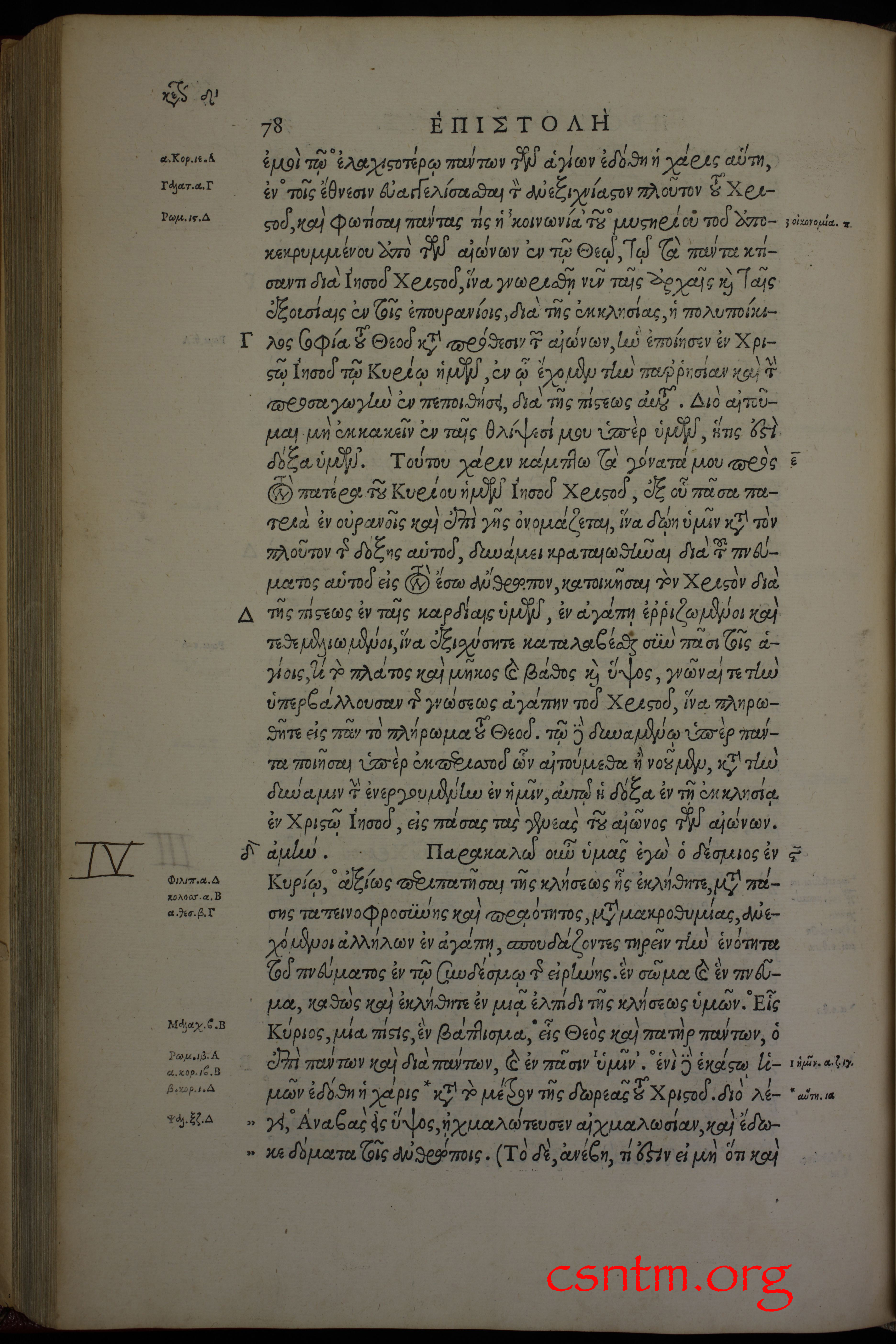
Jeff Riddle recently posted a lengthy "text note" regarding Ephesians 3:9. My reactions follow.
The post is riddled with an even worse radical skepticism than that of Bart Ehrman. Both Ehrman and Riddle oppose the Reformed orthodox position that we can reconstruct the original text from the extant copies. Ehrman, however, at least acknowledges that for the New Testament we have "much earlier attestation than for any other book from antiquity."
Erhman's radical skepticism is linked to his rejection of supernaturalism. What about JR's? JR's seems to be theologically motivated. He writes: "In the end, we can only be sure that in the providence of God the reading “the fellowship of the mystery” was that preserved in the TR." That's the only thing that JR thinks we can know for sure. Yet JR knows more than that conclusion lets on. JR knows, for example, "Among current extant Greek manuscripts, of all eras, the Majority reading is indeed η οικονομια. In fact, the external evidence is so overwhelming that the NA28 does not even list any variants at this point in its critical apparatus." Therefore, JR also know for sure that this state of affairs is also in the providence of God. Why does JR pick God's providential ordering of the TR rather than God's providential preservation of Greek copies? Let the reader decide.
JR seems to acknowledge that there is no real argument to be made in defense of the TR position from the textual evidence. Instead, after pointing out the obvious fact that one reading is likely a scribal error for the other reading (rather than a deliberate change) he offers a variety of mostly skeptical arguments:
1) Reasoned Eclecticism vs. Majority Text
JR states: "It seems particularly odd for [Dr. James R. White] to reject the TR reading at Ephesians 3:9 based on the fact that it is not the Majority reading since, supposedly, he is not himself an advocate for the Majority text but, instead, embraces an eclectic method (reasoned eclecticism)."
It's hard to figure out if JR just doesn't understand reasoned eclecticism or what. Does he seriously not understand why reasoned eclecticism would favor a text that is supported by "p46, all known uncials, almost all minuscules, all known versions, and patristic quotations"? That's not simply picking the text because it is the majority text. I think JR knows this. Moreover, in any other case where "p46, all known uncials, almost all minuscules, all known versions, and patristic quotations" support a given reading, it would be shocking of editors following reasoned eclecticism concluded that a very late poorly attested minority reading were the original. JR points to the variant of "through Jesus Christ" in the sane verse and asks why the majority is not followed here. JR should know the answer: the situation is quite different. "through Jesus Christ" is not found in "p46, all known uncials, almost all minuscules, all known versions, and patristic quotations." There may be a majority in favor of inclusion of the phrase, but the witnesses for omission are not just a few scattered late manuscripts. JR surely knows this, but chooses to ask the question as though he does not.
2) CBGM supports conjectural emendation?
JR states: "Furthermore, [Dr. James R. White] expresses great confidence in the new CBGM, despite the fact that in the NA28 it favors a reading in 2 Peter 3:10 based on NO extant Greek mss.! There seems to be a problem with consistency."
It's unclear whether JR is aware that Dr. White rejects the conjectural emendation proposed at 2 Peter 3:10. It also seems that JR thinks that the CBGM some how spit out this conjectural emendation. That's not the case. The fault here lies with the ECM editors, not with the CBGM.
3) "Major Problem" of Insufficient Analysis
JR is aware that an analysis of the textual evidence has been done. He quotes from Bruce Metzger, who provides a summary of the analysis. Nevertheless, JR asserts that Dr. White's analysis of the Greek manuscript evidence falls short. JR implies that "proper analytical study" requires identifying the list of late manuscripts that apparently contain the TR reading. One wonders from where JR gets this standard. It looks like he just made it up, presumably because he himself is having trouble finding any late manuscripts that support the TR reading.
Does JR offer any analysis that contradicts Metzger? No. He just throws out a made-up standard and says it wasn't met.
4) Sometimes late manuscripts have early readings
This is one of those "true but irrelevant" statements, also known as red herrings. There are a few late manuscripts that seem to be copied from very old manuscripts, and which consequently have early readings. This is one thing that the CBGM should be good at helping us identify.
5) "Extremely thin" early Greek manuscript evidence?
What JR characterizes as "extremely thin" is actually pretty remarkable. We have one papyrus that, despite bad damage to the edges of the page, does have this portion of the verse, dating back to about A.D. 200. It contradicts the TR. Then from the fourth to the seventh centuries we have five more uncial manuscripts. As JR concedes, "Yes, η οικονομια is the reading found in the five early uncials and became the Majority reading ... ."
6) Versional and Patristic Evidence
Once again, JR complains that Dr. White doesn't provide him with the information that JR himself can get from Metzger. He says that Dr. White "never provides any specific examples from the versions for our comparison and analysis." Here's an easy one: Codex Amiatinus (A.D. 700) is a Latin Vulgate manuscript produced in England. It has "dispensatio", which is a Latin translation of the Greek. But, of course, where does this standard of having to provide specific examples come from? It's just something JR made up.
7) Why does the TR have the reading it has?
JR doesn't know why. Erasmus' first edition has the reading, and Stephanus and Beza maintained it. The only 17th century (or earlier) exegete that I could find that mentioned the discrepancy was a Jesuit, Cornelius à Lapide.
JR says: "On what basis did the Reformed men affirm 'fellowship' here as the true reading, over against the Majority Greek ms. tradition? We do not know."
I reply: To the extent we don't know, it's because it seems they got the reading from the Roman Catholic, Erasmus, and didn't double check his work. JR's comments seems to suppose some group of "Reformed men" huddling around the text and coming to a decision about whether to accept or reject each reading. That's not how it worked. There were some readings that were disputed, to be sure. This does not appear to have been one of them.
Stephanus noted the variant issue in his 1550 edition (link to image - it's note 3) but we know he used the same manuscript Erasmus had (mentioned below). If anyone digs up additional information, it would be interesting and useful. As far as I know, Stephanus does not explain the decision to continue with Erasmus' choice.
8) They might have had other manuscripts!
JR makes the assertion: "It is certainly possible that they had access to Greek mss. which are no longer available to us."
I reply: "Certainly possible" sounds so much better than "this is just wild speculation, but ...." It means the same thing here.
We have figured out which manuscripts Erasmus borrowed for his work. One of those was Minuscule 2817, which has the reading (both in the main text and apparently in the accompanying commentary)(link to whole manuscript)(editorial note: it's cool to be reading from the same page Erasmus read from). So, it would be most natural to blame this reading on that manuscript, rather than blaming it on Erasmus or his printer. I have not checked the other three manuscripts that Erasmus had.
9) Some manuscripts have been lost since the 16th-17th centuries
Yes, some have. On the other hand, the ones that Erasmus used have survived. It sad when Biblical manuscripts perish, but in God's providence, we still have most of the manuscripts identified in the 16th century, and others they did not know about.
10) The printed editions may testify to lost manuscripts
In the case of Erasmus' base text, we have reasons for thinking we know what manuscripts he worked from. Accordingly, there is no particular need for its testimony. Similarly, my recollection is that we have identified the manuscripts that Stephanus mentions. If any of those are now lost, his marginal notes can provide a form of testimony to them. But JR has not given us a reason to think that any relevant manuscripts have been lost, that any relevant manuscripts were used in the preparation of Erasmus' text, or that
Conclusion
JR argues: "It is only in the modern era that “Reformed” men have abandoned the traditional text for the modern reconstructed text." Actually, the Reformers (especially Beza) worked on reconstructing the text and the high orthodox (e.g. Turretin) affirmed the continued use of collation to reconstruct the text. This is nothing new or modern.
JR argues: "In so doing they have embraced a religious epistemology that abandons stability, continuity, and consistency." Actually, the Reformers fought against Rome's similar assertions for the Vulgate text. They argued that the Greek apographa - the copies - provide the original text.
-TurretinFan
PS Upon reviewing this post before publishing, I note that there is an unintentional pun in the opening paragraph. No disrespect was intended to Pastor Riddle.
Friday, November 15, 2019

Thursday, November 14, 2019
John Owen versus the MARTs
The Modern Advocates of the Received Texts (MARTs) are a group of folks who argue that the textus receptus is not just the best text out there, it's jot and tittle the same as the original. Their position is thoroughly modern. Despite the fact that they like to characterize their position as being "Reformed Bibliology" or "Confessional Bibliology" or "The Confessional Text" position, their position is not one of the positions held by the early Reformers (obviously Luther was against their view, but also Calvin and Beza held a position contradictory to their view). It is also not the position expressed by the leading Reformed of the 17th century. One of the folks that I would associate with the MART viewpoint, Jeff Riddle, recently stated that John Owen is a "gold mine." I suspect that some of Owen's statements definitely will sound helpful. On the other hand, here are five examples of why it would be inaccurate to categorize the great John Owen as a proto-MART.
Example 1
Nature and Causes of Apostasy from the Gospel, Chapter 1
The variant being addressed her is the omission or inclusion of ἑαυτοῖς at Hebrews 6:6. Beza's 1598 printing includes the word in the text. What is significant here is that Owen does not simply rely on Beza's main reading of Hebrews 6:4-6, but Owen also consults the alleged variant reading that he says Beza mentions, and he does so in interpreting the text. Owen ultimately adopts the main reading, but look at the justification (on the next page of the same chapter):
Notice that Beza relies on both external and internal evidence (i.e. evidence from the copies and evidence from the flow of the text). Most critically, notice that Owen places weight on the copies being ancient. Owen does not presume that ancient copies are worse because they are ancient. Instead, Owen takes for granted that the ancient copies should be a standard for evaluating the printed text reading.
Example 2
The Death of Death, Book 1, Chapter 5:
The variant being addressed here is the substitution of αἰωνίου (eternal) for ἁγίου (holy) or vice versa. The main reading in Beza's 1598 is eternal, but notice that Owen goes to the variant reading both in the Greek and also in the Latin to interpret the text.
Example 3
The Death of Death, Book 1, Chapter 3:
The variant being addressed her is the inclusion or omission of καὶ (and). Notice that Owen considers the variant, identifies the variant as a probable orthodox corruption, and then instead confirms the point from a place where there is no such variant issue.
Example 4
Vinidiciae Evangelicae, Chapter 22
The variant of interest here is the inclusion or omission of οὐκ. Interestingly enough, Beza's 1598 has the οὐκ. Owen seems to be willing to depart from Beza because the wording Owen adopts is allegedly found in "most copies."
Example 5
Vinidiciae Evangelicae, Chapter 13
Owen presents the following Q/A from his theological opponent:
Owen replies:
The variant here is the substitution of ὅς (he) for Θεὸς (God) or vice versa. Owen argues that the unanimous consent of the Greek trumps the Latin. Note as well that Owen is plainly relying only on the printed texts himself: particularly Erasmus and Beza. Owen does not pretend to be an expert in textual criticism himself, nor is he claiming personal knowledge about all the manuscripts.
Shortly thereafter, Owen responds to Grotius:
Note especially Owen's assertion: "if the agreement of all original copies may be thus contemned, we shall have nothing certain left us." That is something we have heard Dr. James White say numerous times in other contexts. Owen does not appeal to some kind of TR canonization. Instead he appeals to the extant Greek copies. Owen also argues from the probabilities as to what possible heretical source of corruption may have affected the text. Furthermore, Owen downplays the significance of the translations.
Continuing in Chapter 14, Owen states:
Once again, Owen appeals to "all original copies whatever, constantly, without any exception, do read it" to settle the question.
Interestingly enough, there are indeed ancient copies that have the pronoun rather than the word "God." So, it turns out that Owen was mistaken about the issue of unanimity.
Conclusion
John Owen ardently defended many TR readings, including readings close to the heart of MARTs. John Owen did so, however, from a point of view that is not a MART point of view. Indeed, Owen did not feel compelled to follow Beza's 1598 printing, but departed when he believed the Greek copy evidence warranted. Moreover, it's fair to say we know more now about the Greek copies than Owen did. A lot of textual critical work, especially finding and collating manuscripts, has been done since the days of Erasmus and Beza - and even since the days of Owen himself.
Example 1
Nature and Causes of Apostasy from the Gospel, Chapter 1
2. Ἀνασταυροῦντας ἑαυτοῖς τὸν Υἱὸν τοῦ Θεοῦ. Beza affirms that ἑαυτοῖς, “to themselves,” is absent from some copies, and then the words may admit of a sense diverse from that which is commonly received; for ἀνασταυροῦντας, “crucifying again;” may refer unto τινάς included and supposed in ἀνακινίζειν, that some or any should renew them. It is impossible that any should renew them to repentance; for this cannot be done without crucifying the Son of God again, since these apostates have utterly rejected all interest in and benefit by his death, as once undergone for sinners.
The variant being addressed her is the omission or inclusion of ἑαυτοῖς at Hebrews 6:6. Beza's 1598 printing includes the word in the text. What is significant here is that Owen does not simply rely on Beza's main reading of Hebrews 6:4-6, but Owen also consults the alleged variant reading that he says Beza mentions, and he does so in interpreting the text. Owen ultimately adopts the main reading, but look at the justification (on the next page of the same chapter):
But the word is constant enough in ancient copies to maintain its own station, and the context requires its continuance; and this makes the work of "crucifying again" to be the act of the apostates themselves, and to be asserted as that which belongs unto their sin, and not denied as belonging to a relief from their sin: "They crucify him again to themselves."
Notice that Beza relies on both external and internal evidence (i.e. evidence from the copies and evidence from the flow of the text). Most critically, notice that Owen places weight on the copies being ancient. Owen does not presume that ancient copies are worse because they are ancient. Instead, Owen takes for granted that the ancient copies should be a standard for evaluating the printed text reading.
Example 2
The Death of Death, Book 1, Chapter 5:
That which some contend, that by the eternal Spirit is here meant our Saviour’s own Deity, I see no great ground for. Some Greek and Latin copies read, not, as we commonly, Πνεύματος αἰωνίου, but Πνεύματος ἁγίου, and so the doubt is quite removed: and I see no reason why he may not as well be said to offer himself through the Holy Spirit, as to be “declared to be the Son of God, according to the Spirit of holiness, by the resurrection from the dead,” as Rom. i. 4; as also to be “quickened by the Spirit,” 1 Pet. iii. 18. The working of the Spirit was required as well in his oblation as resurrection, in his dying, as quickening.
The variant being addressed here is the substitution of αἰωνίου (eternal) for ἁγίου (holy) or vice versa. The main reading in Beza's 1598 is eternal, but notice that Owen goes to the variant reading both in the Greek and also in the Latin to interpret the text.
Example 3
The Death of Death, Book 1, Chapter 3:
Hence the Father himself is sometimes called our Saviour: 1 Tim. i. 1, “According to the commandment Θεοῦ σωτῆρος ἡμῶν,” — “of God our Saviour.” Some copies, indeed, read it, Θεοῦ καὶ σωτῆρος ἡμῶν, — “of God and our Saviour;” but the interposition of that particle καὶ arose, doubtless, from a misprision that Christ alone is called Saviour. But directly this is the same with that parallel place of Tit. i. 3, Κατ’ ἐπιταγὴν τοῦ σωτῆρος ἡμῶν Θεοῦ, — “According to the commandment of God our Saviour,” where no interposition of that conjunctive particle can have place; the same title being also in other places ascribed to him, as Luke i. 47, “My spirit hath rejoiced in God my Saviour.”
The variant being addressed her is the inclusion or omission of καὶ (and). Notice that Owen considers the variant, identifies the variant as a probable orthodox corruption, and then instead confirms the point from a place where there is no such variant issue.
Example 4
Vinidiciae Evangelicae, Chapter 22
1st. From the event: Heb. x. 2, 3, “For then would they not have ceased to be offered? because that the worshippers once purged should have had no more conscience of sins. But in those sacrifices there was a remembrance again made of sins every year.” The words of the second verse are to be read with an interrogation, conclusive in the negative: “Would they not have ceased to have been offered?” that is, certainly they would. And because they did not do so, it is evident from the event that they could not take away sin. In most copies the words are, Ἐπεὶ ἂ ἐπαύσαντο προσφερόμεναι. Those that add the negative particle οὐκ put it for οὐχί,. as it is frequently used.
The variant of interest here is the inclusion or omission of οὐκ. Interestingly enough, Beza's 1598 has the οὐκ. Owen seems to be willing to depart from Beza because the wording Owen adopts is allegedly found in "most copies."
Example 5
Vinidiciae Evangelicae, Chapter 13
Owen presents the following Q/A from his theological opponent:
Q. What dost thou answer to 1 Tim. iii. 16?
A. 1. That in many ancient copies, and in the Vulgar Latin itself, the word “God” is not read; wherefore from that place nothing certain can be concluded.
Owen replies:
1. Though the word “God,” be not in the Vulgar Latin, yet the unanimous, constant consent of all the original copies, confessed to be so both by Beza and Erasmus, is sufficient to evince that the loss of that translation is not of any import to weaken the sense of the place. Of other ancient copies, whereof they boast, they cannot instance one.
The variant here is the substitution of ὅς (he) for Θεὸς (God) or vice versa. Owen argues that the unanimous consent of the Greek trumps the Latin. Note as well that Owen is plainly relying only on the printed texts himself: particularly Erasmus and Beza. Owen does not pretend to be an expert in textual criticism himself, nor is he claiming personal knowledge about all the manuscripts.
Shortly thereafter, Owen responds to Grotius:
Θεὸς ἐφανερώθη ἐν σαρκί. “Suspectam nobis hanc lectionem faciunt interpretes veteres, Latinus, Syrus, Arabs, et Ambrosius, qui omnes legunt, ο` ἐφανερώθη.” Addit Hincmarus Opusculo 55. illud Θεός, “hic positum a Nestorianis.” 1. But this suspicion might well have been removed from this learned man by the universal consent of all original copies, wherein, as it seems, his own manuscript, that sometimes helps him at a need, doth not differ. 2. One corruption in one translation makes many. 3. The Syriac reads the word “God,” and so Tremellius hath rendered it; Ambrose and Hincmarus followed the Latin translation; and there is a thousand times more probability that the word Θεός was filched out by the Arians than that it was foisted in by the Nestorians. But if the agreement of all original copies may be thus contemned, we shall have nothing certain left us.
Note especially Owen's assertion: "if the agreement of all original copies may be thus contemned, we shall have nothing certain left us." That is something we have heard Dr. James White say numerous times in other contexts. Owen does not appeal to some kind of TR canonization. Instead he appeals to the extant Greek copies. Owen also argues from the probabilities as to what possible heretical source of corruption may have affected the text. Furthermore, Owen downplays the significance of the translations.
Continuing in Chapter 14, Owen states:
The learned Grotius is pitifully entangled about the last two places urged by our catechists. Of his sleight in dealing with that of John xx. 28, I have spoken before, and discovered the vanity of his insinuations. Here he tells you, that after Christ’s resurrection, it grew common with the Christians to call him God, and urges Rom. ix. 5; but coming to expound that place, he finds that shift will not serve the turn, it being not any Christians calling him God that there is mentioned, but the blessed apostle plainly affirming that he is “God over all, blessed for ever;” and therefore, forgetting what he had said before, he falls upon a worse and more desperate evasion, affirming that the word Θεός ought not to be in the text, because Erasmus had observed that Cyprian and Hilary, citing this text, did not name the word! And this he rests upon, although he knew that all original copies whatever, constantly, without any exception, do read it, and that Beza had manifested, against Erasmus, that Cyprian adver. Judæos, lib. ii. cap. vi., and Hilary ad Ps. xii., do both cite this place to prove that Christ is called God, though they do not express the text to the full; and it is known how Athanasius used it against the Arians, without any hesitation as to the corruption of the text. This way of shifting indeed is very wretched, and not to be pardoned. I am well contented with all who, from what he writes on John i. 1 (the first place mentioned), do apprehend that when he wrote his annotations on that place he was no opposer of the deity of Christ; but I must take leave to say, that, for mine own part, I am not able to collect from all there spoken in his own words that he doth at all assert the assuming of the human nature into personal subsistence with the Son of God. I speak as to the thing itself, and not to the expressions which he disallows.
Once again, Owen appeals to "all original copies whatever, constantly, without any exception, do read it" to settle the question.
Interestingly enough, there are indeed ancient copies that have the pronoun rather than the word "God." So, it turns out that Owen was mistaken about the issue of unanimity.
Conclusion
John Owen ardently defended many TR readings, including readings close to the heart of MARTs. John Owen did so, however, from a point of view that is not a MART point of view. Indeed, Owen did not feel compelled to follow Beza's 1598 printing, but departed when he believed the Greek copy evidence warranted. Moreover, it's fair to say we know more now about the Greek copies than Owen did. A lot of textual critical work, especially finding and collating manuscripts, has been done since the days of Erasmus and Beza - and even since the days of Owen himself.
Saturday, September 28, 2019
Francis Turretin - the "Received Text" - "Confessional Text" and related Textual Critical Issues
Background - Name and the significance of Methodology
I've been using the nom de plume, TurretinFan, for over a decade. Why? It's certainly not because I slavishly follow everything that theologian taught. On the contrary, I have a number of disagreements with him, though typically about things that don't or shouldn't matter. The big examples that come to mind are geocentrism and the perpetual virginity of Mary. From time to time this leads to taunts of "You should stop calling yourself 'Francis Turretin'" or the like. I can live with that.
My reason for using that pen-name is because I enjoy the clarity of thinking that the real Francis Turretin had, as expressed in his elenctic methodology. His methodology has led to him sometimes being referred to as a Reformed scholastic. I don't think he would want to be lumped in with the medieval scholastics, but at least some of them (for example, Thomas Aquinas) can be admired for their systematic consideration of issues.
Methodology and Textual Positions
Methodology is key in distinguishing different textual positions, not just in distinguishing presentations of theology. I myself enjoy the King James Version and appreciate the beauty of the language used, as well as the useful clarity provided by distinguishing between "thou" and "you." Enjoying, however, is not really a methodology. I don't just enjoy the KJV, I preferentially use it as an English translation. Yet again, however, mere use is not a methodology.
When it comes to the text of the New Testament, there are many schools of thought. Depending on who you listen to, you may hear terms like "Critical Text," "Received Text," "Ecclesiastical Text," "King James Only," "Majority Text," "Byzantine Text," "Westcott and Hort Text" and so on.
At the risk of over-simplification, we can broadly group the positions into four schools of thought.
A. Non-Preservationist
This school of thought sees nothing particularly special about the Scriptures and treats them as being the same as any other ancient text. This group could be further sub-divided into naturalists (like atheists) and super-naturalists (like Muslims and Mormons). The latter groups may think that the New Testament was a special book, but they nevertheless insist that it was hopelessly corrupted due to (among other things) a lack of divine preservation.
Interestingly enough, when we read Reformation-era Reformers, we see them contending against Roman Catholics who had this same non-preservationist mindset as it applies to the Greek text. They would insist that the Latin was preserved, but would not extend this to the original Greek. Interestingly enough, we also see a similar mixture of views in certain KJV only groups who are open to the idea the New Testament has been preserved (in this time) only in English and not in the original language. Modern Roman Catholics (post Vatican II) seem to accept the preservation of the original text of the New Testament, and the Nova Vulgata reflects a reliance on the Greek text to correct the Latin text.
B. Preservationist
This school of thought views the Scriptures as the Word of God and understands (hopefully from the Scriptures themselves) that because of the Scriptures' purpose and nature, God will preserve them forever, or at least until we see God face to face.
1. Hard Traditionalist
This sub-group of preservationists take the position that the preserved text is a matter of hard tradition. This may take the form of a particular text being widely used by "the church" or the form of a particular text being supposedly authoritatively accepted by the church.
2. Soft Traditionalist
This sub-group of preservationists take the position that the preserved text is a matter of what we might call "lower case t tradition." They believe that because God has preserved his word through every generation, therefore we can examine tradition to see what text has been handed down.
3. Rationalist
This sub-group of preservationists take the position that the preserved text can be obtained without any particular reference to tradition, as such. In this view, the New Testament text can be established more or less the same way that we would establish the text of Homer's works, but with much higher certainty because of the much better evidence.
This is, of course, an over-simplification. Among the preservationists, there is probably something more resembling a spectrum, rather than the neat boxes I've provided.
The Confessional Position
The Westminster Confession of Faith and the London Baptist Confession have identical text at I:6:
The quoted phrase means at least that only the views in group B are confessional, while the views in group A should not be taught in the church. The confession does not specify to what degree we should be relying on tradition or reason to identify the providentially preserved Scriptures. As a result, the big tent of the confession is broad enough for a variety of views on this. There is not just one "ye olde Confessional Position" on that level of detail. I leave it to someone with more time on their hands to review the minutes of the Assembly to see if the wording was debated, but ultimately it matters what made it into the Confession, and such further detail did not.
The Confession's Proof Texts
Some folks like to point out that the Confession uses as proof texts, the following:
To further complicate things, when the American Presbyterians revised the confession to (among other things) update the proof texts, those references were removed, such that the version of the WCF on the OPC website today does not use those proof texts (link to pdf version).
So, saying that the inclusion of the long ending of Mark and the Comma Johanneum is "confessional," is strained. It is probably most accurate to say that the original authors of the Confession probably accepted those passages without seriously investigating the matter.
The Real Francis Turretin's Position
The real Francis Turretin, however, did not simply hastily add a proof text to his work. In 1674, Turretin published a treatise, "De Tribus Testibus Coelestibus ex 1 Joann. V, 7" and in 1676 he published "De Spiritu, Aqua et Sanguine in terra testantibus, ex 1 Joann. V, 8." Moreover, near the start of the former treatise, Turretin attempts a defense of the passage against the Socinian accusation of insertion. His first argument? an appeal to the historical evidence as he understood it, with reference to Jerome and to the work of Erasmus, Complutensis, and Stephanus, among others who provided printed Greek New Testaments, based on his understanding that they drew the reading from the most ancient codices.
Turretin's second argument was an appeal to the wording of the remainder of the text. He reasons that verse 9's comparison between human and divine testimony only makes sense if the three earthly testimonies are in parallel with three heavenly testimonies.
Turretin's third argument is to appeal to the writings of Cyprian, Athanasius, and Fulgentius, who (he thought) used the verse approvingly.
Turretin's fourth argument is to question whether it is more probable that the Arians removed the verse or the orthodox added the verse.
In other words, while Turretin obviously reaches the opposite conclusion of the current editors of the ECM, he does so using a very similar methodology. In fact, the question of orthodox corruption of the text is one that remains of interest today (hundreds of years later).
This may not persuade the harder-tradition folk. So, an easier example is Turretin's rejection of the word "Cainan" in Luke 3:36. According to Turretin, the best explanation here is that the word was spuriously added by corruption via the Septuagint (see vol. 1, pp. 73-74 of Turretin's Institutes, 1.2.5.12). In that case, Turretin is clearly departing from the "Textus Receptus" reading. His reason for doing so is mostly on internal grounds of needing to harmonize with the Old Testament.
And, of course, this gets us to Turretin's own clear statement about his methodology (emphasis supplied):
Turretin was not unique in these views. He was not alone in mistakenly accepting the Comma Johanneum, nor was he alone in doing so on faulty textual critical grounds. He was not alone in being unfamiliar with the manuscripts in existence, and he was not alone in relying heavily on the printed editions (and perhaps even only on reports about those printed editions).
I've been using the nom de plume, TurretinFan, for over a decade. Why? It's certainly not because I slavishly follow everything that theologian taught. On the contrary, I have a number of disagreements with him, though typically about things that don't or shouldn't matter. The big examples that come to mind are geocentrism and the perpetual virginity of Mary. From time to time this leads to taunts of "You should stop calling yourself 'Francis Turretin'" or the like. I can live with that.
My reason for using that pen-name is because I enjoy the clarity of thinking that the real Francis Turretin had, as expressed in his elenctic methodology. His methodology has led to him sometimes being referred to as a Reformed scholastic. I don't think he would want to be lumped in with the medieval scholastics, but at least some of them (for example, Thomas Aquinas) can be admired for their systematic consideration of issues.
Methodology and Textual Positions
Methodology is key in distinguishing different textual positions, not just in distinguishing presentations of theology. I myself enjoy the King James Version and appreciate the beauty of the language used, as well as the useful clarity provided by distinguishing between "thou" and "you." Enjoying, however, is not really a methodology. I don't just enjoy the KJV, I preferentially use it as an English translation. Yet again, however, mere use is not a methodology.
When it comes to the text of the New Testament, there are many schools of thought. Depending on who you listen to, you may hear terms like "Critical Text," "Received Text," "Ecclesiastical Text," "King James Only," "Majority Text," "Byzantine Text," "Westcott and Hort Text" and so on.
At the risk of over-simplification, we can broadly group the positions into four schools of thought.
A. Non-Preservationist
This school of thought sees nothing particularly special about the Scriptures and treats them as being the same as any other ancient text. This group could be further sub-divided into naturalists (like atheists) and super-naturalists (like Muslims and Mormons). The latter groups may think that the New Testament was a special book, but they nevertheless insist that it was hopelessly corrupted due to (among other things) a lack of divine preservation.
Interestingly enough, when we read Reformation-era Reformers, we see them contending against Roman Catholics who had this same non-preservationist mindset as it applies to the Greek text. They would insist that the Latin was preserved, but would not extend this to the original Greek. Interestingly enough, we also see a similar mixture of views in certain KJV only groups who are open to the idea the New Testament has been preserved (in this time) only in English and not in the original language. Modern Roman Catholics (post Vatican II) seem to accept the preservation of the original text of the New Testament, and the Nova Vulgata reflects a reliance on the Greek text to correct the Latin text.
B. Preservationist
This school of thought views the Scriptures as the Word of God and understands (hopefully from the Scriptures themselves) that because of the Scriptures' purpose and nature, God will preserve them forever, or at least until we see God face to face.
1. Hard Traditionalist
This sub-group of preservationists take the position that the preserved text is a matter of hard tradition. This may take the form of a particular text being widely used by "the church" or the form of a particular text being supposedly authoritatively accepted by the church.
2. Soft Traditionalist
This sub-group of preservationists take the position that the preserved text is a matter of what we might call "lower case t tradition." They believe that because God has preserved his word through every generation, therefore we can examine tradition to see what text has been handed down.
3. Rationalist
This sub-group of preservationists take the position that the preserved text can be obtained without any particular reference to tradition, as such. In this view, the New Testament text can be established more or less the same way that we would establish the text of Homer's works, but with much higher certainty because of the much better evidence.
This is, of course, an over-simplification. Among the preservationists, there is probably something more resembling a spectrum, rather than the neat boxes I've provided.
The Confessional Position
The Westminster Confession of Faith and the London Baptist Confession have identical text at I:6:
8. The Old Testament in Hebrew (which was the native language of the people of God of old), and the New Testament in Greek (which at the time of the writing of it was most generally known to the nations), being immediately inspired by God, and by his singular care and providence kept pure in all ages, are therefore authentical; so as in all controversies of religion the Church is finally to appeal unto them. But because these original tongues are not known to all the people of God who have right unto, and interest in, the Scriptures, and are commanded, in the fear of God, to read and search them, therefore they are to be translated into the language of every people unto which they come, that the Word of God dwelling plentifully in all, they may worship him in an acceptable manner, and, through patience and comfort of the Scriptures, may have hope.The key phrase for our discussion is, of course, "by his singular care and providence kept pure in all ages."
The quoted phrase means at least that only the views in group B are confessional, while the views in group A should not be taught in the church. The confession does not specify to what degree we should be relying on tradition or reason to identify the providentially preserved Scriptures. As a result, the big tent of the confession is broad enough for a variety of views on this. There is not just one "ye olde Confessional Position" on that level of detail. I leave it to someone with more time on their hands to review the minutes of the Assembly to see if the wording was debated, but ultimately it matters what made it into the Confession, and such further detail did not.
The Confession's Proof Texts
Some folks like to point out that the Confession uses as proof texts, the following:
- The long ending of Mark: 7:3(f), 8:4(g), and 17:3(m)
- The Comma Johanneum: 2:3(o)
To further complicate things, when the American Presbyterians revised the confession to (among other things) update the proof texts, those references were removed, such that the version of the WCF on the OPC website today does not use those proof texts (link to pdf version).
So, saying that the inclusion of the long ending of Mark and the Comma Johanneum is "confessional," is strained. It is probably most accurate to say that the original authors of the Confession probably accepted those passages without seriously investigating the matter.
The Real Francis Turretin's Position
The real Francis Turretin, however, did not simply hastily add a proof text to his work. In 1674, Turretin published a treatise, "De Tribus Testibus Coelestibus ex 1 Joann. V, 7" and in 1676 he published "De Spiritu, Aqua et Sanguine in terra testantibus, ex 1 Joann. V, 8." Moreover, near the start of the former treatise, Turretin attempts a defense of the passage against the Socinian accusation of insertion. His first argument? an appeal to the historical evidence as he understood it, with reference to Jerome and to the work of Erasmus, Complutensis, and Stephanus, among others who provided printed Greek New Testaments, based on his understanding that they drew the reading from the most ancient codices.
Turretin's second argument was an appeal to the wording of the remainder of the text. He reasons that verse 9's comparison between human and divine testimony only makes sense if the three earthly testimonies are in parallel with three heavenly testimonies.
Turretin's third argument is to appeal to the writings of Cyprian, Athanasius, and Fulgentius, who (he thought) used the verse approvingly.
Turretin's fourth argument is to question whether it is more probable that the Arians removed the verse or the orthodox added the verse.
In other words, while Turretin obviously reaches the opposite conclusion of the current editors of the ECM, he does so using a very similar methodology. In fact, the question of orthodox corruption of the text is one that remains of interest today (hundreds of years later).
This may not persuade the harder-tradition folk. So, an easier example is Turretin's rejection of the word "Cainan" in Luke 3:36. According to Turretin, the best explanation here is that the word was spuriously added by corruption via the Septuagint (see vol. 1, pp. 73-74 of Turretin's Institutes, 1.2.5.12). In that case, Turretin is clearly departing from the "Textus Receptus" reading. His reason for doing so is mostly on internal grounds of needing to harmonize with the Old Testament.
And, of course, this gets us to Turretin's own clear statement about his methodology (emphasis supplied):
The question is not as to the particular corruption of some manuscripts or as to the errors which have crept into the books of particular editions through the negligence of copyists or printers. All acknowledge the existence of many such small corruptions. The question is whether there are universal corruptions and errors so diffused through all the copies (both manuscript and edited) as that they cannot be restored and corrected by any collation of various copies, or of Scripture itself and of parallel passages.Notice that Turretin explicitly acknowledges small corruptions and argues that these can be restored and corrected. The tools for such correction are collation (which is exactly what CBGM and other "modern" textual critical techniques primarily rely on) and comparison with Scripture itself (the internal evidences that CBGM is (to my knowledge) less well equipped to perform, but which human editors nevertheless have to employ, and which we see in the most recent texts of the New Testament.
Turretin was not unique in these views. He was not alone in mistakenly accepting the Comma Johanneum, nor was he alone in doing so on faulty textual critical grounds. He was not alone in being unfamiliar with the manuscripts in existence, and he was not alone in relying heavily on the printed editions (and perhaps even only on reports about those printed editions).
Wednesday, June 19, 2019
Responding to Leighton Flowers' "Choice Beef" Argument
Leighton Flowers (transcription of oral comments):
We see that use of the term "choice" in its superlative form ("choicest") in a couple of King James verses:
Isaiah 5:2 And he fenced it, and gathered out the stones thereof, and planted it with the choicest vine, and built a tower in the midst of it, and also made a winepress therein: and he looked that it should bring forth grapes, and it brought forth wild grapes.
Isaiah 22:7 And it shall come to pass, that thy choicest valleys shall be full of chariots, and the horsemen shall set themselves in array at the gate.
We also see it in its simple form in other verses:
Genesis 49:11 Binding his foal unto the vine, and his ass's colt unto the choice vine; he washed his garments in wine, and his clothes in the blood of grapes:
We actually see it in connection with choosing in at least one verse:
2 Samuel 10:9 When Joab saw that the front of the battle was against him before and behind, he chose of all the choice men of Israel, and put them in array against the Syrians:
The thing is, God does not choose the way men choose, but sometimes just the opposite:
1 Corinthians 1:22-29
For the Jews require a sign, and the Greeks seek after wisdom: but we preach Christ crucified, unto the Jews a stumblingblock, and unto the Greeks foolishness; but unto them which are called, both Jews and Greeks, Christ the power of God, and the wisdom of God. Because the foolishness of God is wiser than men; and the weakness of God is stronger than men. For ye see your calling, brethren, how that not many wise men after the flesh, not many mighty, not many noble, are called: but God hath chosen the foolish things of the world to confound the wise; and God hath chosen the weak things of the world to confound the things which are mighty; and base things of the world, and things which are despised, hath God chosen, yea, and things which are not, to bring to nought things that are: that no flesh should glory in his presence.
Second, God choosing for "no apparent reason" is not the same as God choosing "for no reason." The reason for God's choices may not be apparent to us, but that does not mean that there is no reason.
T-Fan
When we ask about election, we're talking about mainly God having favor - Him choosing somebody over someone else. Matter of fact, when we use the word "choice," a lot of times we're thinking of kind of the verb form of it, like, "I made a choice between these options." But if you go into the grocery store, later today, and you go to the "choice meat" section. The word "choice" there is used more as an adjective. It's describing the type of meat. It's the type of meat that is favorable over the other lesser favorable meat. And so when you talk about something that is choice, you are not always talking about necessarily God choosing something for no apparent reason, but you're choosing that meat because it's a favorable meat. There's a reason to have the choice of that meat.First, "choice" is usually the noun form of the verb "to choose." It is sometimes used as an adjective, where it typically connotes "the best." As Webster's dictionary explains (source):
choice adjective
choicer; choicest
Definition of choice (Entry 2 of 2)
1 : worthy of being chosen
accepting the choicest candidates
2 : selected with care
prepared his report with choice words
3a : of high quality
served choice wine with the dinner
b : of a grade between prime and good
choice meat
We see that use of the term "choice" in its superlative form ("choicest") in a couple of King James verses:
Isaiah 5:2 And he fenced it, and gathered out the stones thereof, and planted it with the choicest vine, and built a tower in the midst of it, and also made a winepress therein: and he looked that it should bring forth grapes, and it brought forth wild grapes.
Isaiah 22:7 And it shall come to pass, that thy choicest valleys shall be full of chariots, and the horsemen shall set themselves in array at the gate.
We also see it in its simple form in other verses:
Genesis 49:11 Binding his foal unto the vine, and his ass's colt unto the choice vine; he washed his garments in wine, and his clothes in the blood of grapes:
We actually see it in connection with choosing in at least one verse:
2 Samuel 10:9 When Joab saw that the front of the battle was against him before and behind, he chose of all the choice men of Israel, and put them in array against the Syrians:
The thing is, God does not choose the way men choose, but sometimes just the opposite:
1 Corinthians 1:22-29
For the Jews require a sign, and the Greeks seek after wisdom: but we preach Christ crucified, unto the Jews a stumblingblock, and unto the Greeks foolishness; but unto them which are called, both Jews and Greeks, Christ the power of God, and the wisdom of God. Because the foolishness of God is wiser than men; and the weakness of God is stronger than men. For ye see your calling, brethren, how that not many wise men after the flesh, not many mighty, not many noble, are called: but God hath chosen the foolish things of the world to confound the wise; and God hath chosen the weak things of the world to confound the things which are mighty; and base things of the world, and things which are despised, hath God chosen, yea, and things which are not, to bring to nought things that are: that no flesh should glory in his presence.
Second, God choosing for "no apparent reason" is not the same as God choosing "for no reason." The reason for God's choices may not be apparent to us, but that does not mean that there is no reason.
T-Fan
Thursday, May 30, 2019
"Behold Your Mother" by Tim Staples - a Review by TurretinFan
"Behold Your Mother," by Tim Staples, "respectfully but clearly answers every conceivable Protestant objection to Mary, the Mother of God," according to Mitch Pacwa. Of course, Protestants don't object to Mary, but we understand he means the Marian dogmas of Roman Catholicism. Al Kresta, with unintentional irony, states that Tim "addresses objections I haven't seen addressed elsewhere." Robert Spitzer puts it this way: "Tim Staples presents a remarkable defense of the six major Marian doctrines, including a veritable compendium of source material from the Bible, Fathers, and Church documents." These quotations come from the endorsements on the back cover of Tim's book. Absent from the book are any official nihil obstat or imprimatur. Tim may have "street cred" with Mitch Pacwa, but he lacks the official approval of the magisterium.
Tim's book is dedicated, "For Valerie," presumably referring to his wife.
The book is not written to an academic audience. "Behold Your Mother" has about 473 footnotes and 352 pages. The list of works cited is the last five pages of the book. After Pacwa's claims for thoroughness, you may be surprised to discover that notable Protestant responses to the Marian dogmas are not listed. For example, Svendsen's "Who is My Mother," is not listed (though his much less relevant "Evangelical Answers: a Critique of Roman Catholic Apologists," is listed). Tim does include a few Protestant works, notably James White's "Mary--Another Redeemer" and Lorraine Boettner's "Roman Catholicism." Nevertheless, Tim does not provide much evidence of a deep familiarity with Protestant or other historical scholarship on the issues involved.
The book is structured around the five Marian Dogmas. After a brief introduction, the book is divided into the following parts:
The book then includes a section on "Queen of Queens: Mary's Regal Role in the Kingdom of God" (pp. 273-289) and a section on "Mary's Ongoing Place in our Lives" (pp. 291-92). A set of appendices follow, addressed to a variety of topics including things, namely: "Patristic Evidence for Theotokos," "Patristic Evidence for Mary's Perpetual Virginity," "Mary's Virginity in Partu," "Mary's Freedom from the Pains of Labor," "Answering Four False Charges about Patristic Mariology," and "Queenship has its Privileges."
Introduction
The introduction is subtitled "Why Mary Matters." In some ways, the introduction serves to mis-frame the issues. It is true that among the Protestant objections are objections that Roman Catholic emphasis on Mary detracts from Jesus. That would be an objection that might be raised, even if the Marian dogmas were all true. What is even more significant, however, is the fact that Rome has dogmatized false doctrines. Some of the errors Rome teaches on these topics are allegedly essential to the Christian life.
Tim tries to address the first objection by suggesting that Mary should be an instrument of faith to lead us to Jesus. That doesn't fully answer the objection. You cannot fully answer a pragmatic objection with a merely theoretical response. The answer to "the emphasis on Mary detracts from Jesus" is not really answered by "well, it's not supposed to be that way." Even if we grant that Roman Catholicism teaches that Mary should point people to Jesus, we still often see that in practice the emphasis on Mary does not lead to Jesus, but rather leads to Mary.
Moreover, the emphasis on Mary is not a Biblical emphasis. The last clear reference to Mary is in Acts 1, where she and her other sons (described as Jesus' brothers) finally join the disciples. The Biblical emphasis is on Jesus, not Mary. Scripture is Christocentric.
Tim argues that "In seeing the truth about Mary's Immaculate Conception and Assumption, we will not only see the glory of Mary, but we will see the immeasurable dignity and calling of all Christians in her" (emphasis original). That has a vaguely Scriptural sound to it, but recall that Tim has (perhaps unwittingly) stolen from Abraham to give to Mary: "And the scripture, foreseeing that God would justify the heathen through faith, preached before the gospel unto Abraham, saying, In thee shall all nations be blessed" (Galatians 3:8) or perhaps from Jesus himself: I marvel that ye are so soon removed from him that called you into the grace of Christ unto another gospel:" (Galatians 1:6) or "But ye are a chosen generation, a royal priesthood, an holy nation, a peculiar people; that ye should shew forth the praises of him who hath called you out of darkness into his marvellous light;" (1 Peter 2:9).
In point of fact, Christians are not called in Mary. They are called in Jesus. "Behold my servant, whom I uphold; mine elect, in whom my soul delighteth; I have put my spirit upon him: he shall bring forth judgment to the Gentiles." (Isaiah 42:1) "Who hath saved us, and called us with an holy calling, not according to our works, but according to his own purpose and grace, which was given us in Christ Jesus before the world began," (2 Timothy 1:9).
Similarly, Tim argues that "we will see God's glory and faithfulness to his promises concretized--his grace perfected--in the life of a real human person." Once again, Tim is stealing from Jesus to give to Mary: "But the God of all grace, who hath called us unto his eternal glory by Christ Jesus, after that ye have suffered a while, make you perfect, stablish, strengthen, settle you" (1 Peter 5:10) and "And he said unto me, My grace is sufficient for thee: for my strength is made perfect in weakness. Most gladly therefore will I rather glory in my infirmities, that the power of Christ may rest upon me" (2 Corinthians 12:9). Tim's comment about "real human person" leaves one wondering whether Tim is refusing to acknowledge that Jesus is one person who is fully and really human while also fully and really divine.
Tim tells us that "Our Lady will teach us of the holiness of marriage ... ." This is truly a most curious assertion. According to Rome's view of Mary's virginity, she never knew her husband, Joseph. What a curious model for marriage!
Tim argues that "Behold your mother" (John 19:27) were Jesus' words not only to John but "to each of us." No argument is presented (at least, in the introduction) for this assertion. The text states: "When Jesus therefore saw his mother, and the disciple standing by, whom he loved, he saith unto his mother, Woman, behold thy son! Then saith he to the disciple, Behold thy mother! And from that hour that disciple took her unto his own home." (John 19:26-27) I've maintained the KJV wording here partly to make clear that the text says "thee" singular and not "you" plural. There is nothing in the text or the context that imply that Jesus had in mind something other than John caring for his mother after Jesus' death. There is nothing here to suggest the universal motherhood of Mary any more than there is anything to suggest the universal sonship of John. Is John the son of every woman? Surely not. Likewise, Mary is not the mother of every Christian. The text itself shows how John interpreted this command. He did not start praying the not-yet-invented rosary, he took her to his house.
In the next post in this series, we will take a look at "Part I" of Tim's book.
Tim's book is dedicated, "For Valerie," presumably referring to his wife.
The book is not written to an academic audience. "Behold Your Mother" has about 473 footnotes and 352 pages. The list of works cited is the last five pages of the book. After Pacwa's claims for thoroughness, you may be surprised to discover that notable Protestant responses to the Marian dogmas are not listed. For example, Svendsen's "Who is My Mother," is not listed (though his much less relevant "Evangelical Answers: a Critique of Roman Catholic Apologists," is listed). Tim does include a few Protestant works, notably James White's "Mary--Another Redeemer" and Lorraine Boettner's "Roman Catholicism." Nevertheless, Tim does not provide much evidence of a deep familiarity with Protestant or other historical scholarship on the issues involved.
The book is structured around the five Marian Dogmas. After a brief introduction, the book is divided into the following parts:
- Part I "Mother of God" (pp. 17-50);
- Part II "Full of Grace" (pp. 55-127);
- Part III "Ever-Virgin" (pp. 131-192);
- Part IV "Assumed into Heaven" (pp. 197-230); and
- Part V "Mediatrix and Co-Redemptrix" (pp. 235-272).
The book then includes a section on "Queen of Queens: Mary's Regal Role in the Kingdom of God" (pp. 273-289) and a section on "Mary's Ongoing Place in our Lives" (pp. 291-92). A set of appendices follow, addressed to a variety of topics including things, namely: "Patristic Evidence for Theotokos," "Patristic Evidence for Mary's Perpetual Virginity," "Mary's Virginity in Partu," "Mary's Freedom from the Pains of Labor," "Answering Four False Charges about Patristic Mariology," and "Queenship has its Privileges."
Introduction
The introduction is subtitled "Why Mary Matters." In some ways, the introduction serves to mis-frame the issues. It is true that among the Protestant objections are objections that Roman Catholic emphasis on Mary detracts from Jesus. That would be an objection that might be raised, even if the Marian dogmas were all true. What is even more significant, however, is the fact that Rome has dogmatized false doctrines. Some of the errors Rome teaches on these topics are allegedly essential to the Christian life.
Tim tries to address the first objection by suggesting that Mary should be an instrument of faith to lead us to Jesus. That doesn't fully answer the objection. You cannot fully answer a pragmatic objection with a merely theoretical response. The answer to "the emphasis on Mary detracts from Jesus" is not really answered by "well, it's not supposed to be that way." Even if we grant that Roman Catholicism teaches that Mary should point people to Jesus, we still often see that in practice the emphasis on Mary does not lead to Jesus, but rather leads to Mary.
Moreover, the emphasis on Mary is not a Biblical emphasis. The last clear reference to Mary is in Acts 1, where she and her other sons (described as Jesus' brothers) finally join the disciples. The Biblical emphasis is on Jesus, not Mary. Scripture is Christocentric.
Tim argues that "In seeing the truth about Mary's Immaculate Conception and Assumption, we will not only see the glory of Mary, but we will see the immeasurable dignity and calling of all Christians in her" (emphasis original). That has a vaguely Scriptural sound to it, but recall that Tim has (perhaps unwittingly) stolen from Abraham to give to Mary: "And the scripture, foreseeing that God would justify the heathen through faith, preached before the gospel unto Abraham, saying, In thee shall all nations be blessed" (Galatians 3:8) or perhaps from Jesus himself: I marvel that ye are so soon removed from him that called you into the grace of Christ unto another gospel:" (Galatians 1:6) or "But ye are a chosen generation, a royal priesthood, an holy nation, a peculiar people; that ye should shew forth the praises of him who hath called you out of darkness into his marvellous light;" (1 Peter 2:9).
In point of fact, Christians are not called in Mary. They are called in Jesus. "Behold my servant, whom I uphold; mine elect, in whom my soul delighteth; I have put my spirit upon him: he shall bring forth judgment to the Gentiles." (Isaiah 42:1) "Who hath saved us, and called us with an holy calling, not according to our works, but according to his own purpose and grace, which was given us in Christ Jesus before the world began," (2 Timothy 1:9).
Similarly, Tim argues that "we will see God's glory and faithfulness to his promises concretized--his grace perfected--in the life of a real human person." Once again, Tim is stealing from Jesus to give to Mary: "But the God of all grace, who hath called us unto his eternal glory by Christ Jesus, after that ye have suffered a while, make you perfect, stablish, strengthen, settle you" (1 Peter 5:10) and "And he said unto me, My grace is sufficient for thee: for my strength is made perfect in weakness. Most gladly therefore will I rather glory in my infirmities, that the power of Christ may rest upon me" (2 Corinthians 12:9). Tim's comment about "real human person" leaves one wondering whether Tim is refusing to acknowledge that Jesus is one person who is fully and really human while also fully and really divine.
Tim tells us that "Our Lady will teach us of the holiness of marriage ... ." This is truly a most curious assertion. According to Rome's view of Mary's virginity, she never knew her husband, Joseph. What a curious model for marriage!
Tim argues that "Behold your mother" (John 19:27) were Jesus' words not only to John but "to each of us." No argument is presented (at least, in the introduction) for this assertion. The text states: "When Jesus therefore saw his mother, and the disciple standing by, whom he loved, he saith unto his mother, Woman, behold thy son! Then saith he to the disciple, Behold thy mother! And from that hour that disciple took her unto his own home." (John 19:26-27) I've maintained the KJV wording here partly to make clear that the text says "thee" singular and not "you" plural. There is nothing in the text or the context that imply that Jesus had in mind something other than John caring for his mother after Jesus' death. There is nothing here to suggest the universal motherhood of Mary any more than there is anything to suggest the universal sonship of John. Is John the son of every woman? Surely not. Likewise, Mary is not the mother of every Christian. The text itself shows how John interpreted this command. He did not start praying the not-yet-invented rosary, he took her to his house.
In the next post in this series, we will take a look at "Part I" of Tim's book.
Wednesday, December 19, 2018
Later Alexandrian Manuscripts
Some of my Reformed brothers who (like me) prefer the KJV, seem to have a very low information understanding of textual criticism. For example, there seems to be a myth that manuscripts in the "Alexandrian text-type" family stopped being produced around the turn of the millenium. In fact, there are manuscripts dated from the 12th to 15th centuries (all are minuscules):
12th Century:
157 (A.D. 1122)
323 (12th)
850 (12th)
1241 (except Acts) (12th)
2298 (12th)
12th or 13th Century:
94 (12th or 13th)
442 (12th or 13th)
13th Century:
383 (13th)
579 (13th)
614 (13th)
1292 (Catholic Epistles) (13th)
1852 (13th)
2053 (13th)
2062 (13th)
13th or 14th Century:
1342 (Mark) (13th or 14th)
14th Century:
1506 (Romans and the first part of First Corinthians) (A.D. 1320)
718 (14th)
15th Century:
322 (15th)
12th Century:
157 (A.D. 1122)
323 (12th)
850 (12th)
1241 (except Acts) (12th)
2298 (12th)
12th or 13th Century:
94 (12th or 13th)
442 (12th or 13th)
13th Century:
383 (13th)
579 (13th)
614 (13th)
1292 (Catholic Epistles) (13th)
1852 (13th)
2053 (13th)
2062 (13th)
13th or 14th Century:
1342 (Mark) (13th or 14th)
14th Century:
1506 (Romans and the first part of First Corinthians) (A.D. 1320)
718 (14th)
15th Century:
322 (15th)
Friday, December 07, 2018
Flat Earth Problems
I hear the "NASA lies" claim a few times from Flat Earth people, and it makes me wonder: does anyone actually believe Flat Earth views? For months I've been hearing about such positions, but I assumed that these were just atheist trolls having fun on the Internet. Apparently, that's not the case. So, here are a few problems for "flat earth" views:
1) Circumnavigation
There is not a "west edge" or an "east edge" of the world, except as defined by an arbitrary meridian, like the international date line. The modern "flat earth" folks seem to propose that instead the world is disk shaped, such that "north" is the center of the disk and "south" is the edge of the disk. I suspect the reason for this (instead of the opposite polarity) is that there are more commercial flights over the Artic circle than over the Antarctic circle.
2) South Pole
There is, however, a south pole. It's expensive to vacation there, but you can in fact go to the south pole. Just like the North Pole (when it's ice covered), you can go through all 24 hours of the day in thirty seconds or so. Some flat earth folks suggest that there is an enormous ice wall at the southern edge of the world, but instead you'll find a south pole. In theory, you should be able to charter a flight from Argentina to Australia, which could be directed to fly over the South Pole on the shortest great circle path (for example, there is a 12500 km / 7800 mile path over Antarctica from Buenos Aires, Argentina to Perth, Australia, which would be very close to going directly over the South Pole).
3) Southern Hemisphere Driving
Similarly, the disk projections of the world end up creating very distorted wide images of Australia, compared to the standard globe-based images of Australia. One could go to Australia and using a car's odometer to compare north, south, east, and west mileages between cities and see whether the projections align with the reality.
4) GPS
How on earth is GPS supposed to work if the world is not a globe. GPS works based on satellites circling the globe. You can actually get a map of their current positions (link). What's the theory here? They don't really exist? They are just flying around like airplanes? How do they stay up so long if they are not actually in orbit? Once again, if you want you can get a GPS receiver that outputs the raw data and actually see the messages from the satellites in the sky over you right now. You can then use math to get your current position from their messages. That's what a GPS device does to get your position, and it works with some amount of accuracy. Maybe NASA lies, but how could they possibly be making up GPS? Everyone uses it these days. You can even use it at the South Pole (granted that it's not the most ideal spot because the satellites are lower on the horizon there, but you can still use it).
5) Satellite Maps
How do satellite maps work? Why is it that you can go to some remote location, arrange fallen trees in an "X" and see it show up on Google maps in a short time?
-TurretinFan
1) Circumnavigation
There is not a "west edge" or an "east edge" of the world, except as defined by an arbitrary meridian, like the international date line. The modern "flat earth" folks seem to propose that instead the world is disk shaped, such that "north" is the center of the disk and "south" is the edge of the disk. I suspect the reason for this (instead of the opposite polarity) is that there are more commercial flights over the Artic circle than over the Antarctic circle.
2) South Pole
There is, however, a south pole. It's expensive to vacation there, but you can in fact go to the south pole. Just like the North Pole (when it's ice covered), you can go through all 24 hours of the day in thirty seconds or so. Some flat earth folks suggest that there is an enormous ice wall at the southern edge of the world, but instead you'll find a south pole. In theory, you should be able to charter a flight from Argentina to Australia, which could be directed to fly over the South Pole on the shortest great circle path (for example, there is a 12500 km / 7800 mile path over Antarctica from Buenos Aires, Argentina to Perth, Australia, which would be very close to going directly over the South Pole).
3) Southern Hemisphere Driving
Similarly, the disk projections of the world end up creating very distorted wide images of Australia, compared to the standard globe-based images of Australia. One could go to Australia and using a car's odometer to compare north, south, east, and west mileages between cities and see whether the projections align with the reality.
4) GPS
How on earth is GPS supposed to work if the world is not a globe. GPS works based on satellites circling the globe. You can actually get a map of their current positions (link). What's the theory here? They don't really exist? They are just flying around like airplanes? How do they stay up so long if they are not actually in orbit? Once again, if you want you can get a GPS receiver that outputs the raw data and actually see the messages from the satellites in the sky over you right now. You can then use math to get your current position from their messages. That's what a GPS device does to get your position, and it works with some amount of accuracy. Maybe NASA lies, but how could they possibly be making up GPS? Everyone uses it these days. You can even use it at the South Pole (granted that it's not the most ideal spot because the satellites are lower on the horizon there, but you can still use it).
5) Satellite Maps
How do satellite maps work? Why is it that you can go to some remote location, arrange fallen trees in an "X" and see it show up on Google maps in a short time?
-TurretinFan
Thursday, December 06, 2018
Podcast Questions?
Does anyone have any questions that they would like me to address on my upcoming podcast?
Wednesday, October 31, 2018
Reason for Corruption?
One possible reason for corruption of the patristic church was the influence of outside religions, particularly the idol-heavy pagan religions:
C. Guignebert, in an illuminating article, [FN 59] points out that for the first five centuries many converts from paganism to Christianity lived a sort of double religious life, which made them what he calls demi-Christians. Among the reasons he gives for this situation are syncretism, poor instruction in the faith, and the scandal of Christian converts who lapsed back into either partial or total paganism.From Fathers of the Church series (vol. 68), St. John Chrysostom, Discourses Against Judaizing Christians, translated by Paul W. Harkins, p. xxxiv.
[FN 59: "Les Demi-chrétiens" 65-102.]
Tuesday, October 16, 2018
Responding to Tyler Vela on Genesis 1
Tyler Vela has some "Responses to Common YEC Arguments" to which I offer the following rebuttal points. The common argument is in bold, Tyler's response is quoted, and my response follows Tyler's comments.
1. OEC’s are intimidated by secular scientists and so they reject what they know the text says.
Tyler says we should be asking what the evidence is showing. What Tyler seems to be missing is that natural science can only ever provide a natural explanation. Scientists can be baffled and unable to provide an explanation, but science cannot say "that was supernatural."
I'll leave the discussion of older views of astronomy to the side. Personally, I think the lesson to learn from those failures of science is that we should remember that science has been sure about a lot of things in the past, and has been wrong about those very things. For example, I cannot think of a single astronomer today who thinks that the Sun is stationary.
2. If you just take the plain meaning of the text, it clearly means 6 literal solar days.
The usual argument is not that they are "solar" days, but rather that they were days of the normal 24-hour kind. Response to the questions:
- How was there light without the sun? God said, "Let there be light." In Revelation 21:23 we are told of a city with no need for sun or moon, because the glory of God illuminates it. Moses face likewise shone when illuminated by God's glory. Also, has Tyler ever used a lightbulb or even a candle? You can have light without the sun. This is a trivial and absurd objection.
- If having God as king of Israel was good, why permit the Saulic or Davidic monarchies? Or indeed, since God surely is able to provide light without the sun, why create the sun at all? The question is impertinent, since it demands a "why" answer of God. Nevertheless, God does provide some answer: the sun was created to rule the day, while the moon was created to rule the night. In essence, these could be viewed as delegations of God's own power.
- The idea that you can't have days without a tool for measuring them is rather like saying you can't have length without having a ruler to measure it. Interestingly, as well, Genesis 1:16 does not say that their entire purpose was to mark out.
- This final objection about the plants is probably the best of all these objections, but it too falls short. Let's look at it again:
The supposed contradiction between Genesis 1 (with the plants created on Tuesday) and Genesis 2:5, is therefore quickly resolved with reference to the surrounding verses.
3. Genesis is literal history and not allegory.
Are there historical accounts in poetic form in Scripture? Of course there are! Psalm 105 is a great example of this. Nevertheless, Psalm 105 is still historically accurate. Genesis 1 is historically accurate too, whether or not it has some specific literary form, whether poetry, temple text, or whatever one might want to claim.
4. Jesus took Genesis literally and so should we.
The fact that Jesus treated Adam and Eve as historical people is significant, because they are characters from the beginning of Genesis. Likewise, to a lesser extent, the fact that Jesus treated Abraham as a real historical figure is significant, because he is a character from Genesis. Similarly, Sodom and Gomorrah being historical cities is significant because they are places from Genesis. These imply that Jesus took the historical narrative of Genesis as such, not as a mere extended allegory.
Regarding Jacob's blessing - while the account of the blessing is historical narrative, obviously the blessings themselves would be considered prophetic. Similarly, while the record of various songs in the historical books are historical accounts of the songs, the songs themselves are poetry. This once again looks like a trivial objection.
Regarding Mark 10, what the text means is that when God created mankind he created one of each sex. I'm not sure what additional weight Tyler has heard people apply to the text, but it seems clear that Jesus is using "in the beginning" to refer people back to the historical narrative of Genesis 1-3.
Several of Tyler's objections seem to be that some referenced events took place maybe a week from the very beginning of time, as opposed to being from the very instant when God said "let there be light." I'm not sure what Tyler sees as the significance of this, but surely Tyler would have to say that a week from 6k BC is pretty close to the beginning, as opposed to being just 0.00001 billion years ago out of 13.8 billion years. In isolation, we might even take some of these references to refer to the beginning of humanity as opposed to the beginning of Creation, but the point is that Jesus is taking his characters from a story that begins "in the beginning ..." and then goes on to provide a historical chronology of a cosmology.
Tyler's concluding sentences of this response are rather bizarre: "In fact, what is surprising is that if the timeline of creation was so pivotal, so vital to the conflict of worldviews between Christians and unbelievers, it is the most important thing never directly stated anywhere in the Bible. God doesn’t inspire a single author in the Scriptures to spell it out." You mean, aside from having Moses spell it out in the very first chapter of the Pentateuch? It's not just there. It's also spelled out again in Exodus 20:11, one of the few verses in the Bible that was not written in the first instance by Moses, but instead was written directly by God in tables of stone.
5. Moses bases the Sabbath as the 7th day on the 7 literal day structure of Genesis 1.
It's really incontestable that the days in Exodus 20 are conventional days, not merely a seven part paradigm.
Day 7 was a conventional day. Jesus' point was that God rested from Creation but did not rest from Providence on the seventh day. It does not mean that the seventh day is on-going. Jesus' defense was a defense of his own work on the 7th day, not a denial of the fact that God rested from Creation on the seventh day. The idea is not that God creates six days a week but rests every seventh day, but rather that God did rest from creation on the seventh day.
Sabbath years, interestingly, are not justified on the basis of the Creation week. New moons are also not justified in that way. The Jubilee year is the fiftieth year. None of these non-weekly observances has much to do with the points at hand, however.
Psalm 90 refers to the fact that time has no effect on God. By contrast, God's creation does experience time, and Psalm 90:10 gets very literal in describing life expectancy of humans.
6. Yom plus “morning and evening” in the Hebrew always refers to a literal solar day.
7. Yom plus an ordinal or cardinal number in the Hebrew always refers to a literal solar day.
8. We see the use of the waw-consecutive construction in the Hebrew which is how Hebrew marks out historical narrative and thus we should take Genesis 1 as literal history.
That's all for now.
-T-Fan
1. OEC’s are intimidated by secular scientists and so they reject what they know the text says.
This is condescending at best. Not only do most people who do not take YEC views driven by textual concerns and a desire to follow what they see in the scriptures, this is also wildly problematic in its view of what science is. Notice the false attribution of “secular” science which effectively means whatever science disagrees with their view. It’s a kind of questing begging that sees anything that disagrees with their view of Genesis as “secular” and as such disqualifies anything that disagrees with them from consideration. This is the other side of the coin from atheists who say that whatever is “creation science” must be wrong because it is “Christian.” Well really we should be asking what the evidence is showing, and not disqualifying something just because it disagrees with us (not to mention that many scientists are Christians or religious who disagree with YEC and who do good science). Notice these scientists are only “secular” (which ones? Who are they? How do they know they are driven by “secular “concerns”?) in this area but not with regard to any other area of science where they uses the same methods and such but which do not rub up against YEC literalism.The desire to fit in and be accepted is real. That's one reason that people are tempted by some of the OEC models. They see them as opportunities to avoid conflict with prevalent non-theistic positions, such as the Big Bang or Darwinian Evolution.
I’m also surprised that no one sees that start irony that this was some of the same kind of rhetoric used against heliocentrism several centuries ago. We have by and large altered how we understand some of the cosmology found in the Bible as being less than literal precisely because it could not accord with the findings of “secular” science. It’s just too far in our rear view mirror for people to remember that. We could see this in the historical move from a flat earth three-tier cosmology common to all ANE cultures (Israel included) and a spherical globe earth. Or do many of you think that the earth does indeed rest on literal pillars and is covered by a firm glass like dome called a firmament? Everyone in the ANE context of the OT would have read that in the same way we do comments about the sky being blue and the earth orbiting the sun.
Tyler says we should be asking what the evidence is showing. What Tyler seems to be missing is that natural science can only ever provide a natural explanation. Scientists can be baffled and unable to provide an explanation, but science cannot say "that was supernatural."
I'll leave the discussion of older views of astronomy to the side. Personally, I think the lesson to learn from those failures of science is that we should remember that science has been sure about a lot of things in the past, and has been wrong about those very things. For example, I cannot think of a single astronomer today who thinks that the Sun is stationary.
2. If you just take the plain meaning of the text, it clearly means 6 literal solar days.
While this does touch on what I will address in later articles in a more robust manner, let me simply state that this is clearly false. In fact it was precisely the plain meaning of the text which drove myself and many others away from a literalist understanding of Genesis 1. A plethora of questions arise from such a reading:I'm not sure if Tyler has provided the more robust articles he mentions.
- How is there morning and evening with no sun?
- Is this supernatural light “good” and if so why did God scrap it and replace it just a few days later with the sun?
- How are there days when God says that the whole purpose of the sun and moon and stars was for the purpose of marking out days and seasons in Day 4?
- The light and the darkness are separated on Day 1 but then God creates the sun and the moon for the purpose of separating the light and the darkness on Day 4. But if that had already happened on Day 1, then what light and darkness are being separated on Day 4? Did they fuse back together at some time?
- How is it literal days if plants are created on day 3 but we are told in Genesis 2 that no plants had grown because it had not yet rained and man was not yet created to work the earth? Could they not survive the 3 days without water until man was created?
And on and on. There are numerous problems with reading Genesis 1 as a literal diachronic account of creation, not to mention the numerous reasons to read it along literary framework lines. Thus for many of us, a straight forward reading will not yield 6 literal days. It simply is not the clear and plain meaning of the text like they imagine it to be.
The usual argument is not that they are "solar" days, but rather that they were days of the normal 24-hour kind. Response to the questions:
- How was there light without the sun? God said, "Let there be light." In Revelation 21:23 we are told of a city with no need for sun or moon, because the glory of God illuminates it. Moses face likewise shone when illuminated by God's glory. Also, has Tyler ever used a lightbulb or even a candle? You can have light without the sun. This is a trivial and absurd objection.
- If having God as king of Israel was good, why permit the Saulic or Davidic monarchies? Or indeed, since God surely is able to provide light without the sun, why create the sun at all? The question is impertinent, since it demands a "why" answer of God. Nevertheless, God does provide some answer: the sun was created to rule the day, while the moon was created to rule the night. In essence, these could be viewed as delegations of God's own power.
- The idea that you can't have days without a tool for measuring them is rather like saying you can't have length without having a ruler to measure it. Interestingly, as well, Genesis 1:16 does not say that their entire purpose was to mark out.
- This final objection about the plants is probably the best of all these objections, but it too falls short. Let's look at it again:
How is it literal days if plants are created on day 3 but we are told in Genesis 2 that no plants had grown because it had not yet rained and man was not yet created to work the earth? Could they not survive the 3 days without water until man was created?What does Genesis 2 say?
Genesis 2:5-8The comments about "before it was in the earth" and "before it grew" are, in context, references to cultivation and agriculture. We can see this from the fact that although it says "it had not yet rained" it nevertheless states "there went up a mist from the earth, and watered the whole face of the ground." Moreover, it says that there was no man to till the ground, and nevertheless God created the garden of Eden.
And every plant of the field before it was in the earth, and every herb of the field before it grew: for the LORD God had not caused it to rain upon the earth, and there was not a man to till the ground. But there went up a mist from the earth, and watered the whole face of the ground.
And the LORD God formed man of the dust of the ground, and breathed into his nostrils the breath of life; and man became a living soul.
And the LORD God planted a garden eastward in Eden; and there he put the man whom he had formed.
The supposed contradiction between Genesis 1 (with the plants created on Tuesday) and Genesis 2:5, is therefore quickly resolved with reference to the surrounding verses.
3. Genesis is literal history and not allegory.
I will quickly state that this is just a false dichotomy. In fact most Bible students should readily identify this fact. Several examples can be used to show this from the Scripture (though this is far from exhaustive):Literal history can serve an allegorical purpose. An example of this is where Paul uses Ishmael and Isaac allegorically, even though they were historical people. Nevertheless, the real point of this argument is that Genesis 1 was intended to convey history - it was not intended to be merely an allegory. Mere allegory, like most of Jesus' parables, may be presented in the form of a historical narrative, but it is not intended to convey history. By contrast, history can be conveyed in a variety of ways - even in poetic ways. History can be presented in chronological and non-chronological ways. We see examples of non-chronological history in some of the gospel accounts. Nevertheless, most of Genesis can accurately be described as historical narrative. That is both the style of writing and the purpose. Genesis is not, for example, an extended work of historical fiction. Nor is Genesis merely a parable intended to illustrate various principles about God and God's character.
- Chapters like Exodus 15 and Judges 5 are songs/poems that recount historical events but they do so in a poetic and non-literal genre. Does this mean that the events they recount did not happen historically? Does it mean that they are allegorical? Do we read them as literal or allegorical? Well neither. They are poetic retellings of historical events and are thus literal history but told with highly stylized language and flair.
- The gospels are not told in historical order. They are often arranged by theme or message and thus present a synchronic account of the life and teaching of Jesus. In fact, several of his sermons are likely amalgamations and combinations of several sermons. This is common faire for undergraduate Bible students at even the most conservative Bible colleges. Does this mean that because they are literary and theological retellings of the life and teaching of our Lord in a synchronic manner that they are therefore allegory or non-literal? Does it mean we are saying that they are false or unhistorical or that in saying this I am somehow rejecting the inspiration, inerrancy or perspicuity of the Scripture? Of course not.
Really what this argument does is simply perpetuate a false dichotomy as a hermeneutic – the kind of vague “literalism” that dispensationalists will often use in an attempt to accuse other theological positions of not taking the text seriously by either being inconsistently “literal” or “allegorical,” when in fact it is often far more complex than that with many more options available to the exegete.
Are there historical accounts in poetic form in Scripture? Of course there are! Psalm 105 is a great example of this. Nevertheless, Psalm 105 is still historically accurate. Genesis 1 is historically accurate too, whether or not it has some specific literary form, whether poetry, temple text, or whatever one might want to claim.
4. Jesus took Genesis literally and so should we.
There are two major problems with this argument. Firstly, it treat Genesis as a singular genre – historical narrative. This means that if they can show some passage where Jesus assumes the historical reality of Adam and Eve or the Patriarchs or cities such as Sodom and Gomorrah, that they have thus proven that all of Genesis (and thus chapter 1) is literal history as well. This not only makes the confusion above of equivocating between historical and literal (see Moses’ and Deborah’s songs which are historical but non-literal) but it also does not allow for genre variation within a book like Genesis. We see blended genre in other historical books like Exodus and Numbers (I would argue both penned by Moses), but we also see it in Genesis itself. Or do we think that Jacob’s blessings on his sons are all historical literal narrative? Of course not.There is a good reason to treat Genesis through mid-Exodus as historical narrative, namely because that's how it's written.
The second major problem is that the passages used to support this kind of argument often prove far too much. A common passage used for this is Mark 10:6. It is argued that Jesus believed that men and women were present at the beginning of creation due to his statement in Mark 10:6 that they were created male and female “from the beginning.” There are several problems with this:
- Whatever is meant by Jesus in Mk 10:6, it cannot be what the YEC means for it. Even to remain consistent they must maintain that Adam and Eve were not created from the beginning moment of creation but rather at the end of the creation event (on day 6 – the final stage of creation). At the very most then, Jesus could be read to me mean that man and woman were present from the beginning of creation (referring to the whole of the creation period before God’s Sabbath rest), at the point when he created humans, he created them male and female. This means that however long it took from the beginning of creation to the beginning of humanity would not be accounted for in this verse.
- This means that the other option would be that Jesus is referring not to the beginning of all of creation, but to the beginning of the creation of humanity. However, this would hold regardless of the view one holds of Gen 1 since one could maintain that from the creation of humans (at their point of creation during the creation event) that they were created male and female. This could be true if that point of creation was 6 days or 14 billion years into the creation event. When humans arrived on the scene, they were male and female.
- Furthermore, the parallel passage shows that the import of Jesus’ point is in fact the creation of humanity and the development of divorce as a practice later in history. Of course there could not be divorce prior to the creation of humans. So Jesus said that Moses allowed for it because of the sin of the people, but that it was not that way from the beginning. Well if we are talking about divorce then that would only even become possible on day 6 anyway (which again could be 6 days or 14 billion years later).
- In addition, the use of the phrase, “since the beginning” also appears in John 8:44 referencing Satan being a murderer since the beginning. Well was Satan a murderer before humans existed – from the moment of creation? That would be a huge stretch to imagine that before the fall in the garden.
- Finally, there are other questionable uses of the phrase that would be problematic if we held that it must mean from the very instant of the start of creation.
So when the YEC says that Jesus held to a literal reading of Genesis 1, they are making a wild over statement. In fact, what is surprising is that if the timeline of creation was so pivotal, so vital to the conflict of worldviews between Christians and unbelievers, it is the most important thing never directly stated anywhere in the Bible. God doesn’t inspire a single author in the Scriptures to spell it out.
The fact that Jesus treated Adam and Eve as historical people is significant, because they are characters from the beginning of Genesis. Likewise, to a lesser extent, the fact that Jesus treated Abraham as a real historical figure is significant, because he is a character from Genesis. Similarly, Sodom and Gomorrah being historical cities is significant because they are places from Genesis. These imply that Jesus took the historical narrative of Genesis as such, not as a mere extended allegory.
Regarding Jacob's blessing - while the account of the blessing is historical narrative, obviously the blessings themselves would be considered prophetic. Similarly, while the record of various songs in the historical books are historical accounts of the songs, the songs themselves are poetry. This once again looks like a trivial objection.
Regarding Mark 10, what the text means is that when God created mankind he created one of each sex. I'm not sure what additional weight Tyler has heard people apply to the text, but it seems clear that Jesus is using "in the beginning" to refer people back to the historical narrative of Genesis 1-3.
Several of Tyler's objections seem to be that some referenced events took place maybe a week from the very beginning of time, as opposed to being from the very instant when God said "let there be light." I'm not sure what Tyler sees as the significance of this, but surely Tyler would have to say that a week from 6k BC is pretty close to the beginning, as opposed to being just 0.00001 billion years ago out of 13.8 billion years. In isolation, we might even take some of these references to refer to the beginning of humanity as opposed to the beginning of Creation, but the point is that Jesus is taking his characters from a story that begins "in the beginning ..." and then goes on to provide a historical chronology of a cosmology.
Tyler's concluding sentences of this response are rather bizarre: "In fact, what is surprising is that if the timeline of creation was so pivotal, so vital to the conflict of worldviews between Christians and unbelievers, it is the most important thing never directly stated anywhere in the Bible. God doesn’t inspire a single author in the Scriptures to spell it out." You mean, aside from having Moses spell it out in the very first chapter of the Pentateuch? It's not just there. It's also spelled out again in Exodus 20:11, one of the few verses in the Bible that was not written in the first instance by Moses, but instead was written directly by God in tables of stone.
5. Moses bases the Sabbath as the 7th day on the 7 literal day structure of Genesis 1.
When giving the 10 commandments, Moses writes this on the Sabbath:Actually, Moses was the copyist of the ten commandments. They were written by God himself (Deuteronomy 10:1-5).
8 “Remember the sabbath day, to keep it holy. 9 Six days you shall labor and do all your work, 10 but the seventh day is a sabbath of the LORD your God; in it you shall not do any work, you or your son or your daughter, your male or your female servant or your cattle or your sojourner who stays with you. 11 For in six days the LORD made the heavens and the earth, the sea and all that is in them, and rested on the seventh day; therefore the LORD blessed the sabbath day and made it holy.”
The argument from YECs is to say that Moses is here proving that Genesis 1 teaches 6 literal days because it is the framework that Moses appeals to in order to set the 7 day Sabbath cycle for Israel. This argument has several deep flaws with it:
- I would argue that Moses was the author of both Genesis and Exodus and so he would know what he meant in Genesis 1 and would mean the same in Exodus 20. This much, the YECs and I agree. The problem is that if that is the case then the verse no longer proves what they say it does. Since Exodus is reliant on Genesis 1 and its meaning, then whatever is meant in Genesis 1 would also be meant in Exodus 20. If Moses meant simply a 7 division paradigm, or the 7 days as a framework for a synchronic creation account, then all he would be doing is repeating that same thing in Exodus 20. This means that Exodus 20 cannot be used as an argument for or against YEC because it would mean whatever Moses meant in Genesis 1, which is the very thing under dispute. To say that it means literal days is to simply beg the question of what Genesis 1 means in order to argue a verse that Genesis 1 means that. That’s just poor hermeneutics and logic.
- We have further evidence that Moses did not mean literal days in Genesis 1 because if that were the case, then day 7 would be a literal solar day. This means God would have only rested from creation for 24 hours, which we know is not the biblical view. In John 5, Jesus is challenged on why he is working on the Sabbath and he gives an interesting response. In v17, we read, “But He answered them, "My Father is working until now, and I Myself am working."” Think about what Jesus was saying for a moment. If God’s Sabbath had ended after 24 hours, then of course God would be working after that, he was no longer resting – and so that would not serve as a defense of Jesus’ actions any more than me saying that I work on Sunday because Jesus worked on Tuesdays. In order for Jesus’ defense to make sense, he would have to be saying that God worked redemption during his Sabbath rest “up until now” and that Jesus is just doing what his father has been doing. The Sabbath rest of day 7 began after creation and has continued “until now.” It is not a literal 24 hour day. So if Moses was trying to find an exact literal analogue for the Sabbath, then that would mean the Jews would work for 6 days and then rest for the rest of their lives. That is clearly not what is being said here. Rather he is appealing to the paradigm of 6 periods followed by a period of rest.
- This is further supported by the laws regarding Sabbath years and Sabbaths of Sabbaths (Jubilee years). They all follow the creation paradigm of 6 periods of labor followed by a period of rest but do not follow it in an exacting manner. They follow the paradigm laid out in Genesis 1. Which again means that whatever Moses meant in Genesis 1, is upheld in the paradigm in the Sabbath laws and as such cannot be used to say that Genesis 1 must be 6 literal solar days.
- Considering that Psalm 90 is attributed to Moses and it is there that we read “For a thousand years in your sight are but as yesterday when it is past, or as a watch in the night.” Moses is apparently very clear that a day is a flexible concept even to the point where 1000 years, a full day (yesterday) and a single watch of the night are all symbolically interchangeable.
It's really incontestable that the days in Exodus 20 are conventional days, not merely a seven part paradigm.
Day 7 was a conventional day. Jesus' point was that God rested from Creation but did not rest from Providence on the seventh day. It does not mean that the seventh day is on-going. Jesus' defense was a defense of his own work on the 7th day, not a denial of the fact that God rested from Creation on the seventh day. The idea is not that God creates six days a week but rests every seventh day, but rather that God did rest from creation on the seventh day.
Sabbath years, interestingly, are not justified on the basis of the Creation week. New moons are also not justified in that way. The Jubilee year is the fiftieth year. None of these non-weekly observances has much to do with the points at hand, however.
Psalm 90 refers to the fact that time has no effect on God. By contrast, God's creation does experience time, and Psalm 90:10 gets very literal in describing life expectancy of humans.
6. Yom plus “morning and evening” in the Hebrew always refers to a literal solar day.
This is simply a false assertion about the Hebrew construction. The problem is that “morning and evening” is never used in the same way in conjunction with “yom” like it is in Gen 1. The few times that the phrase “morning and evening” is used (only about a dozen times) it is used either of the daily events of a battle or of the daily sin offering, in which the 24 hour day is supported by other clear textual and narratival markers that determine the kind of interval that is being spoken of. This means that the set of verses outside of Genesis 1 that uses the same grammatical structure is a null set – it does not exist. Therefore such a use in Gen 1 serves as a kind of hapax legommena and as such we cannot appeal to any external grammatical rules to demonstrate any particular reading of it. This means that we cannot say that in Genesis 1 it must mean a literal 24 hour day because of some grammatical construction of yom plus ”morning and evening” because there are no other parallel passages in which to derive this rule.I'm not a fan of these sorts of usage rules as arguments, when there is not a lot of such usage. The underlying point of the argument is correct, namely that the fact that the verse specifies what kind of day we are talking about.
7. Yom plus an ordinal or cardinal number in the Hebrew always refers to a literal solar day.
This again is simply a false statement about Hebrew, and yet it is probably one of the most oft repeated truisms of the YEC movement. Countless books, articles, blogs, debates and lectures assert this truism, apparently without ever checking to see if it is true or not. Let me rebut this by simply giving several counter examples:Again, I'm not a big fan of alleged rules of usage that aren't supported by a wide body of evidence. On the other hand, it probably is fair to say that usually when yom is accompanied by other ordinal or cardinal numbers than one or first, it is a reference to a literal number of units of time. The burden would then be on the non-literal folks to demonstrate that this should be an exception.
- Zechariah 14:7-9 in reference to the day of the Lord says, “And there shall be a unique day, which is known to the LORD, neither day nor night, but at evening time there shall be light.” The “unique day” is a reference to the coming day of the Lord which we know will not be a singular day. In fact the context even says that there will not be day or night but it will be light all the time. This verse pairs yom with a cardinal number and yet clearly is not a 24 hour solar dar.
- Deuteronomy 10:10 reads, “I myself stayed on the mountain, as at the first time, forty days and forty nights, and the LORD listened to me that time also. The LORD was unwilling to destroy you.” In this verse when Moses said “as at the first time,” he pairs yom with an ordinal number. This is a reference to his first trip up the mountain to the Lord and which he says lasted 40 days and 40 nights. If we were to follow the YEC rule that yom plus an ordinal number always means a 24 hour solar day, then Moses would be lying to us when he said that first yom (yom+ordinal) lasted for 40 days.
- In Isaiah 9:14 we read that God cut off Israel and struck them down “in one day,” (yom+cardinal) and yet this judgement on Israel we know took centuries.
- In Hosea 6:2 we read, “After two days he will revive us; on the third day he will raise us up, that we may live before him.” This is referring to the restoration of Israel and not only is it highly poetic (formed around Hebraic parallelism) but it is clearly not limited to two or three days that God restored Israel to the land. This is a non-literal usage of yom even though it is twice paired with a cardinal number.
More examples could be adduced but this goes to show that the “rule” often repeated by YECs is simply not a real or valid rule in Hebrew. They have been repeating something that was created by grammatical fiat and as such should be rejected. We do not just get to make up rules to support our views while ignoring the many exceptions that invalidate the rule.
8. We see the use of the waw-consecutive construction in the Hebrew which is how Hebrew marks out historical narrative and thus we should take Genesis 1 as literal history.
Like the “rule” listed above, this is simply not a real rule. While the waw-consecutive (also called the vav-consecutive) construction is a well-known feature of Hebrew narrative (or rather Hebrew narration), it is simply not the case that it denotes historical narrative. The waw-consecutive is a construction of an imperfect verb preceeded by the Hebrew letter waw (“and”). If one reads the King James Bible they will quickly see the rather awkward plot device of beginning many sentences in a row with “and.” When this happens, the translators have chosen to make the waw explicit in the translation. What this does it is moves the plot of a narrative along. Think of it like, “and this happened, and then this happened, and this this happened.” The problem here is not that waw-consecutive is a rule to identify narrative, it is that the YECs are incorrect in saying that the rule is that it shows literal/historical narrative. They make the rule prove far too much. Again, without going into a ton of detail, let me merely present several counter examples that invalidate the “rule” as asserted by YECs:Once again, I'm not a fan of these supposed rules.
1. The waw-consecutive appears 7 times in Moses’ song of Exodus 15. This is a historical poem, not a historical narrative.
2. The waw-consecutive drives the parable given by Jotham in Judges 9:8-15.
3. Nathan’s parable in rebuke of David in 2 Samuel 12:1-4 employs the waw-consecutive several times.
4. The waw-consecutive can be replaced in Hebrew poetry and prose with the use of the jussive case and genre does not appear to matter.
5. The waw-consecutive can actually be missing the imperfect verb and yet refer to the movement of action in a future tense (see Ex. 22:26)
6. The waw-consecutive is even found at times in Hebrew poetry, such as Psalm 22:6: “But I am a worm and not a man, A reproach of men and despised by the people.” In cases such as these, it’s use does not indicate plot progression but logical or temporal sequences.
7. We can see many other examples in Hebrew poetry such as 47 uses in Psalm 18. (For more on this, see “A Royal Song of Thanksgiving, II Samuel 22 = Psalm 18” in Studies in Ancient Yahwistic Poetry, edited by Cross and Freedman.)
So unless the YEC wants us to read clear poetry as literal historical narrative, or the same for allegory such as Jotham’s allegory of the bramble and the trees, or known parable such as Nathan’s parable of the stolen sheep, then this clearly cannot be a hermeneutical rule that whenever we see the waw-consecutive it automatically means that we must be reading literal historical narrative. Rather, what the waw-consecutive shows is the movement of a story along – it pushes the actions by moving from one verb to the next in a logical and/or temporal progression. That is, it is a feature of narration not necessarily literal history. This can happen in Hebrew narrative, parable, allegory, or poetry.
That's all for now.
-T-Fan
Thursday, May 18, 2017
Henry Newcome on Ignatius and Transubstantiation
Henry Newcome, in 1705, tackled the question of Ignatius and Transubstantiation, in response to a Roman Catholic priest identified as T.B.:
Theodoret's Dialogue 3 "The Impasible" (mentioned by Bellarmine)
I should caution that I believe Bellarmine may, on some other occasion, have attempted to use Ignatius against a symbolic understanding of the Eucharist. In any event, however, Bellarmine (as alleged by Newcome) is correct in stating that the objection of the heretics to the Eucharist was a denial of Christ's true humanity - not a denial of a change of the elements.
-TurretinFan
He begins with Ignatius, concerning some Heretics, (Ignatius' Epistle to the Smyrneans) that received not Eucharist or Oblations, because they confess not the Eucharist to be the Flesh of Christ. (T. B. Section 1)(Part 1, "An Answer to Some Testimonies produced by T. B. from the Fathers of the Six First Centuries, for Transubstantiation," pp. 49-50 - spellings modernized)
The Heretics he means, were the Followers of Simon and Menander, who denied the reality of Christ's Flesh, and for that Reason admitted not the Eucharist. And what is this to Transubstantiation, that some Heretics, because they did not believe that Christ was really Incarnate, would not admit the Eucharist, the Symbols whereof represented and supposed a real Incarnation? Heresy is prolific of Heresy, and their Disbelief of the Incarnation made them reject the Eucharist, lest they would be forced to confess the Flesh of Christ. For if they allowed the Symbols of a true Body, they would be obliged to grant a true Body, since a mere Phantom can have no Sign or Symbol. Thus your Cardinal Bellarmine answers for us (Bellarmine On the Eucharist, book 1, chapter 1, p. 400), Lest the Calvinists (says he) should Glory of the Antiquity of their Opinion, it is to be observed, that those ancient Heretics did not so much oppose the Eucharist as the Mystery of the Incarnation. For therefore (as Ignatius shows in the same place) they denied the Eucharist to be the Flesh of the Lord, because they denied the Lord to have Flesh. If then in the Judgment of your Cardinal these Heretics were no Calvinists, Ignatius in condemning them, neither condemns Calvinists, nor countenances Transubstantiators: What we teach, that the Elements are Sacramental Signs of Christ's Body, is as inconsistent with the Sentiments of those Heretics as Transubstantiation, since such Figures of a Body (as Tertullian argues against the Marcionites) prove the Reality of Christ's Flesh, and that it was no Phantom, which can have no Figure. I may add, That Theodoret, out of whose third Dialogue this Passage of Ignatius is restored (which was not to be found in former Editions of Ignatius) hath plainly declared against the Eutychians (as I have formerly observed) that the Symbols after Consecration recede not from their own Nature, but remain in their former Substance. And he must have a very mean Opinion of Theodoret's Judgment, who can think he imagined this Passage of Ignatius inconsistent with his own Opinion; which would have been to have helped the Heretics instead of confuting them. To conclude, examine this Testimony by the latter part of my fifth Rule, and show us where Ignatius says a Word of the changing of the Substance of the Bread into the Substance of Christ's Body: Which is the Doctrine of the Trent Council, and what T. B. was to prove.
Theodoret's Dialogue 3 "The Impasible" (mentioned by Bellarmine)
I should caution that I believe Bellarmine may, on some other occasion, have attempted to use Ignatius against a symbolic understanding of the Eucharist. In any event, however, Bellarmine (as alleged by Newcome) is correct in stating that the objection of the heretics to the Eucharist was a denial of Christ's true humanity - not a denial of a change of the elements.
-TurretinFan
Wednesday, May 17, 2017
Dr Joe Mizzi on Ignatius and Transubstantiation
Dr Joe Mizzi has an interesting article (link to article) on the church fathers and transubstantiation, which includes the following:
-TurretinFan
IgnatiusMizzi is right. Ignatius was arguing against the Docetists, who denied that Jesus had flesh, who denied that he suffered, and denied that he was raised to life (because they denied he died). They said he only "seemed" to be a man. This explains, therefore, why they abstain from the Eucharist, because the Eucharist is a memorial specifically of Jesus body and blood.
Ignatius argued against the Gnostic Docetists. They denied the true physical existence of our Lord; thus they also denied his death and resurrection. Ignatius wrote:
They abstain from the Eucharist and from prayer, because they do not confess that the Eucharist is the flesh of our Savior Jesus Christ, Flesh which suffered for our sins and which the Father, in His goodness, raised up again.
The problem with the Gnostics concerned the person of Christ and not the nature of the Eucharist. The heretics did not participate in the Eucharist because they did not believe in what the Eucharist represents, namely the true, physical flesh of Jesus, who actually and really suffered on the cross, and who was really resurrected from the dead.
We do not have to take the phrase "the Eucharist is the flesh" in a literalistic manner. As in everyday speech, as well as in the Bible, it could simply mean that the Eucharist represents the flesh of Christ. To illustrate, take a similar argument by Tertullian. He is also using the Eucharist to combat Docetism:
Then, having taken the bread and given it to His disciples, He made it His own body, by saying, "This is my body," that is, the figure of my body. A figure, however, there could not have been, unless there were first a veritable body (Against Marcion, Bk 4).
Tertullian is even more emphatic than Ignatius. He says that Jesus made the bread his own body. But unlike Ignatius, Tertullian goes on to clarify what he meant. Rather than saying that the bread ceases to exist, he calls it the “the figure” of the body of Christ and maintains a clear distinction between the figure and what it represents, namely the “veritable body” of our Lord.
-TurretinFan
Monday, May 15, 2017
Problems in Doctrines and Covenants: Discovery and Naming of Egypt
Doctrine and Covenants, Book of Abraham 1:23, states:
a) Egyptus
The -us ending is typical of masculine Latin nouns. It's not a typical way of ending Chaldean nouns (masculine or otherwise).
b) Egypt's Discovery
If one of Ham's daughters discovered Egypt, she would roughly precede Nimrod (the grandson of Ham), who founded Babel.
c) Etymology of Egypt
From etymonline.com
-TurretinFan
The land of Egypt being first discovered by a woman, who was the daughter of Ham, and the daughter of Egyptus, which in the Chaldean signifies Egypt, which signifies that which is forbidden;There are a number of issues here.
a) Egyptus
The -us ending is typical of masculine Latin nouns. It's not a typical way of ending Chaldean nouns (masculine or otherwise).
b) Egypt's Discovery
If one of Ham's daughters discovered Egypt, she would roughly precede Nimrod (the grandson of Ham), who founded Babel.
Genesis 10:8-10Thus, there would be no reason that her name would have any particular "Chaldean" meaning.
And Cush begat Nimrod: he began to be a mighty one in the earth. He was a mighty hunter before the Lord: wherefore it is said, Even as Nimrod the mighty hunter before the Lord. And the beginning of his kingdom was Babel, and Erech, and Accad, and Calneh, in the land of Shinar.
c) Etymology of Egypt
From etymonline.com
EgyptSo, notice that the name "Egypt" comes from the Amarna language, and means "temple of the soul of Ptah," not something to do with being forbidden.
Old English Egipte "the Egyptians," from French Egypte, from Greek Aigyptos "the river Nile, Egypt," from Amarna Hikuptah, corresponding to Egyptian Ha(t)-ka-ptah "temple of the soul of Ptah," the creative god associated with Memphis, the ancient city of Egypt.
Strictly one of the names of Memphis, it was taken by the Greeks as the name of the whole country. The Egyptian name, Kemet, means "black country," possibly in reference to the rich delta soil. The Arabic is Misr, which is derived from Mizraim, the name of a son of Biblical Ham.
-TurretinFan
Muller on Turretin and Textual Criticism - Follow-Up Response to Jeff Riddle (and company)
Our brother in Christ, Jeff Riddle, provided a follow-up post (link to post) responding to my previous post (link to post) to him.
Unfortunately, brother Riddle's post entirely misses the main point of my response. I argued:
When Muller gets to the issue I was discussing, you will find him saying things like this:
Similarly (and more telling):
Hopefully you get the point this discussion.
Now, was Turretin's view of textual criticism exactly the same as ours today? Probably not. For example, as hinted at in Muller's discussion above, folks like Turretin insisted that the Vulgate, Septuagint, and other ancient translations should essentially have no weight at all in textual criticism. By contrast, we would probably grant them at least a little weight. That, however, actually puts Turretin (and company) farther from Textus Receptus advocates of today, as the latter adopt a number of passages where the strongest textual transmission evidence comes from translations (1 John 5:7 is the most prominent example).
I got a few other responses, as well, so I'll briefly address them here:
Robert Wieland wrote: "Since the matter of collating mss is not the issue, then it would follow that your statement above is a non sequiter. The issue is not collation. The issue is what is collated."
I respectfully disagree that collating manuscripts is not the issue. It is the main issue. Certain TR advocates would like to (in essence) lock in the TR on the basis of it (or some form of it) being widely accepted by Protestants in the 17th century. There are separate (and less significant) debates over things like whether the Byzantine text type should be given priority, or whether non-Greek sources should be used for determining the text of the NT. Likewise, there are questions about whether to give priority to age of the manuscripts or number of the manuscripts, how much weight to give to internal evidence, and the like. These are all subordinate questions to the question of whether collation should be used.
RW again: "Again, the issue is not the use of Textual Criticism, but the practice of it. Turretin/Calvin/Stephens/Beza did not use modern principles like: Genealogy, The Shorter Reading is to be Preferred, the Harder Reading is to be Preferred, or Conflation (to name a few)."
The tools of textual criticism have improved over the years, but they all flow from the basic idea of the need for collation. If TR advocates (or anyone else) can make a case for why alternatives to these tools are better, then that's one of those subordinate debates I mentioned above. Turretin didn't have all the original language study tools that we have today, but his basic principles of exegesis are the same. The same goes for textual criticism.
I had written: "...those ancients texts certainly have the advantage of being older..."
RW responded: "This is the part of the modern philosophy where if it is older it is better, and if it is younger it is false. (I am parodying JW)."
Having older copies is advantageous, if you're trying to do collation to determine the original readings. That's not "modern philosophy." For example, even if one has a Byzantine priority view, one is going to favor older Byzantine copies to a copy that a seminary student created for his Greek class last week. It doesn't mean that the younger copy is "false," just that it carries less evidentiary weight.
RW: "Can you define for us what an "Alexandrian Text Type" or "Alexandrian Form" (as JW puts it) looks like? Can you show us in the apparatus of the Nestle/Aland text (any of the 28 editions) the symbol used for the Alexandrian Text Type? Maybe you can answer these questions that JW has been avoiding for years? One has to say that when two mss P75 and B happen to agree in many parts (not all) means that all mss fall into families? Such defies credibility."
You can read about it here: (link to wikipedia page). In very short, it's a label that textual critics apply to a group of texts that have similar characteristics and some historical connection with Alexandria, Egypt. The other two main groupings are Byzantine and Western, although the use of the Western label is (I think) falling out of favor.
-TurretinFan
Unfortunately, brother Riddle's post entirely misses the main point of my response. I argued:
Moreover, methodologically, Turretin agrees with JW. For example, Turretin endorses the approach of using the collation of various copies to restore the original readings.Riddle responded by quoting Richard Muller's discussion of views of issues related to inerrancy, contrasting folks like Turretin with later folks like B.B. Warfield. Even assuming that what Muller says is correct, Muller is addressing a different issue from the one I was addressing.
When Muller gets to the issue I was discussing, you will find him saying things like this:
Not only was the era of orthodoxy a time of the flowering of textual criticism, it was also an era in which the critical establishment of the text of the Bible on the basis of collation and comparison of manuscripts and codices was understood as fundamental to the task of the orthodox exegete and theologian.(Post-Reformation Reformed Dogmatics: Holy Scripture: the Cognitive Foundation of Theology, p. 398)
Similarly (and more telling):
... Testament published in Geneva and the annotated texts offered by Beza were all produced by using the critically established texts of Erasmus and the Complutensian Polyglot together with an examination of the available codices, with variants noted, typically in the annotations. Beza and other humanistically trained editors of the Bible saw no problem in establishing the text on the basis of a comparison of the available codices, nor did they blanch at the work of sorting out corruptions that had crept in during the historical transmission of the text - drew the line, however, at the point of emendation of an original language of the text on the basis of pure conjecture, or of the witness of a single variant codex, or of the sole witness of ancient versions, unconfirmed by the original languages. Using a method similar to that of Beatus Rhenanus, Protestant editors of the biblical text typically confined such variant readings to the annotations and viewed them as a matter of interpretation rather than as a basis of textual emendation. We have, for example, Beza's comment ont he publication of a highly variant Greek New Testament by Simon de Colines: Beza commented that he could not "give much weight to it" unless its variant readings were "supported by other codices" and criticized what he viewed as unsupported conjectural emendation. Emendation of the Hebrew text of the Old Testament and the Greek text of the New on the basis of ancient versions would become a matter of extended controversy in the seventeenth century.(Post-Reformation Reformed Dogmatics: Holy Scripture: the Cognitive Foundation of Theology, p. 399)
It needs be noted here that the so-called textus receptus, was merely a part of the sixteenth- and seventeen-century process of establishing a normative or definitive text of the New Testament. The phrase "textus receptus" or "received text" comes from the Elzevir New Testament of 1633 — and as the context of the phrase itself and the use of the Greek New Testament in the seventeenth century both testify, there was no claim, in the era of orthodoxy, of a sacrosanct text in this particular edition. Nor did it, in the era of orthodoxy, provide some sort of terminus ad quem for the editing of the text of the Bible: the statement that this was the "text now received by all" simply meant that it was the text, produced by Stephanus and Beza, and slightly reedited by the Elzevirs, that was then regarded (by Protestants!) as the best available text of the Bible: namely, the critically examined combination of the Masoretic text of the Old Testament and the so-called Byzantine ...
Hopefully you get the point this discussion.
Now, was Turretin's view of textual criticism exactly the same as ours today? Probably not. For example, as hinted at in Muller's discussion above, folks like Turretin insisted that the Vulgate, Septuagint, and other ancient translations should essentially have no weight at all in textual criticism. By contrast, we would probably grant them at least a little weight. That, however, actually puts Turretin (and company) farther from Textus Receptus advocates of today, as the latter adopt a number of passages where the strongest textual transmission evidence comes from translations (1 John 5:7 is the most prominent example).
I got a few other responses, as well, so I'll briefly address them here:
Robert Wieland wrote: "Since the matter of collating mss is not the issue, then it would follow that your statement above is a non sequiter. The issue is not collation. The issue is what is collated."
I respectfully disagree that collating manuscripts is not the issue. It is the main issue. Certain TR advocates would like to (in essence) lock in the TR on the basis of it (or some form of it) being widely accepted by Protestants in the 17th century. There are separate (and less significant) debates over things like whether the Byzantine text type should be given priority, or whether non-Greek sources should be used for determining the text of the NT. Likewise, there are questions about whether to give priority to age of the manuscripts or number of the manuscripts, how much weight to give to internal evidence, and the like. These are all subordinate questions to the question of whether collation should be used.
RW again: "Again, the issue is not the use of Textual Criticism, but the practice of it. Turretin/Calvin/Stephens/Beza did not use modern principles like: Genealogy, The Shorter Reading is to be Preferred, the Harder Reading is to be Preferred, or Conflation (to name a few)."
The tools of textual criticism have improved over the years, but they all flow from the basic idea of the need for collation. If TR advocates (or anyone else) can make a case for why alternatives to these tools are better, then that's one of those subordinate debates I mentioned above. Turretin didn't have all the original language study tools that we have today, but his basic principles of exegesis are the same. The same goes for textual criticism.
I had written: "...those ancients texts certainly have the advantage of being older..."
RW responded: "This is the part of the modern philosophy where if it is older it is better, and if it is younger it is false. (I am parodying JW)."
Having older copies is advantageous, if you're trying to do collation to determine the original readings. That's not "modern philosophy." For example, even if one has a Byzantine priority view, one is going to favor older Byzantine copies to a copy that a seminary student created for his Greek class last week. It doesn't mean that the younger copy is "false," just that it carries less evidentiary weight.
RW: "Can you define for us what an "Alexandrian Text Type" or "Alexandrian Form" (as JW puts it) looks like? Can you show us in the apparatus of the Nestle/Aland text (any of the 28 editions) the symbol used for the Alexandrian Text Type? Maybe you can answer these questions that JW has been avoiding for years? One has to say that when two mss P75 and B happen to agree in many parts (not all) means that all mss fall into families? Such defies credibility."
You can read about it here: (link to wikipedia page). In very short, it's a label that textual critics apply to a group of texts that have similar characteristics and some historical connection with Alexandria, Egypt. The other two main groupings are Byzantine and Western, although the use of the Western label is (I think) falling out of favor.
-TurretinFan
Friday, May 12, 2017
Responding to Jeff Riddle - Regarding James White and (the real) Turretin
Our brother in Christ, Jeff Riddle (JR), has posted some comments regarding James White (JW) and the real Francis Turretin (FT), which because I'm a friend of the former and a fan of the latter, I would like to address:
JR wrote:
b) JW agrees with JR that one reason KJVO is wrong is that the text was inspired in the original languages as distinct from the translations. However, there are also other reasons for opposing the KJVO position. Moreover, not all KJVO folks necessarily say that the KJV/KJB was immediately inspired.
JR wrote:
JR:
JR:
JR:
JR:
b) The Alexandrian text type definitely was copied less after Muslims decimated the Christian populations in North Africa and the middle east.
c) But there is at least one Alexandrian text type manuscript from as late as 1044 (minuscule 81). There is also ninth century minuscules (minuscules 33 and 892), which are from the Alexandrian text type. So, the "ceased to be copied" claim is not really true.
JR:
JR:
-TurretinFan
JR wrote:
1. JW typically confuses the TR and Majority text position with KJV-Onlyism. Furthermore, he criticizes KJV-Onlyism for all the wrong reason.a) JW distinguishes amongst a variety of related positions in his book, the King James Only Controversy. So, I don't think "typically confuses" is very accurate. He does sometimes lump them together, but that's because they often use similar (flawed) arguments.
I note that the problem with KJV-Onlyism is not, as JW argues, that the KJV was translated from 1604-11 and is, therefore, outdated, but that KJV-Onlyism is inconsistent with confessional Christianity’s assertion that the Bible was immediately inspired in the original languages (Hebrew and Greek) and not in an English translation.
b) JW agrees with JR that one reason KJVO is wrong is that the text was inspired in the original languages as distinct from the translations. However, there are also other reasons for opposing the KJVO position. Moreover, not all KJVO folks necessarily say that the KJV/KJB was immediately inspired.
JR wrote:
2. JW wrongly describes Scrivener’s edition of the Greek NT as “not a real Greek NT” since it represents an edition of the TR which underlies the KJV.Scrivener's edition is an attempt to (in essence) create a Greek text from the English text, by matching up the corresponding Greek reading that would go with the English reading. In that sense, it's like a back translation into Greek from another language, and consequently although it is in Greek, it's not a Greek text in the usual sense.
JR:
3. JW rejects the TR and Majority text positions on the basis of the fact that this is not, at present, the position taught “in every major” Reformed seminary” or by “leading scholars.”JW may mention that point, but it's not the main reason for rejecting the TR position or any of the Majority text positions.
JR:
4. JW asserts that Protestant scholastics, like Francis Turretin, were just “wrong” when they defended the traditional text of the Bible, including texts like the traditional rendering of 1 Corinthians 15:47, the ending of Mark, the pericope adulterae, and the comma Johanneum.He does assert that they were wrong (in specific cases), but he also explains why they were wrong (in those cases where JW thinks they are wrong). Moreover, methodologically, Turretin agrees with JW. For example, Turretin endorses the approach of using the collation of various copies to restore the original readings.
I point out that Turretin likely was not denying the existence of textual variants but affirming that the traditional text was indeed found in all “faithful,” “received,” or “orthodox” copies of the Bible. See my upcoming article in PRJ “John Calvin and Text Criticism.”
JR:
5. JW argues that p75 and Vaticanus (B) were “the text of the early church” and were more reliable than the text which was affirmed in the Reformation era.There was not one single text that was affirmed in the Reformation era. There were multiple printed editions, and folks like Calvin and Turretin endorsed the use of textual criticism to restore the original text. Hopefully it is also clear that there was not one single text of the early church, either, for the ancient uncials and papyri have differences amongst them. Nevertheless, those ancients texts certainly have the advantage of being older, whatever else one might say about their reliability.
JR:
I point out that although the TR was not printed until the Reformation era, it was based on mss. with antiquity equal to that of p75 and B. In addition, the line represented by p75 and B came to an end in the 500s and ceased to be copied, not appearing again till revived in the 1800s.a) It's simply not true that the TR was based on manuscripts with antiquity equal to P75 and B.
b) The Alexandrian text type definitely was copied less after Muslims decimated the Christian populations in North Africa and the middle east.
c) But there is at least one Alexandrian text type manuscript from as late as 1044 (minuscule 81). There is also ninth century minuscules (minuscules 33 and 892), which are from the Alexandrian text type. So, the "ceased to be copied" claim is not really true.
JR:
JW and other Reformed evangelicals who embrace the modern critical text have a rather difficult problem on their hands. They express admiration for the Protestant fathers (like Turretin—or Calvin, Owen, the framers of the 1689 confession, etc.) then are rather embarrassed to discover that these men defended the traditional text out of conviction and not, as they too often assume, out of ignorance.Conviction and ignorance aren't opposites. Knowledge and ignorance are opposites. As mentioned above, Turretin (and other Reformers) methodologically agreed with the use of collation to obtain the original readings. We have more knowledge of the text than they did. Thus, the difference between JW's position and FT's position is not so much much because of different convictions, but because of different information.
JR:
Lastly, I make reference to my sermon last Sunday on the Trinity based on chapter two, paragraph three of the 1689 confession, noting not only the use of 1 John 5:7 there as a leading prooftext for the Trinity but also how the 1689 Baptist Confession refers to the second person of the Godhead as “the Word or the Son,” making specific and explicit use of the comma Johanneum in the articulation of the Trinity (cf. chapter two, paragraph three in the 1689 with the WCF and the Savoy here). This represents a significant problem for those who affirm the 1689 confession but reject the comma.John 1:1 teaches that Jesus is the Word, and John 1:34 teaches that Jesus is the Son of God. So, there is no problem. The comma does not use the phrase "Word or the Son," so that is not an explicit or specific use of the comma. Moreover, while the prooftexts of the confessions include I John 5:7, that's obviously not the only prooftext provided, and the doctrine of the Trinity does not depend on the authenticity of that text.
-TurretinFan
Subscribe to:
Posts (Atom)