
David "SoCal" Preston's Rebuttal arguments (in a debate with Steve Christie) were as follows:
1. "There is no such thing as an official King James Bible website."
Cambridge, which claims to have the official rights to the King James version, does have a website (for example, here). There are, however, lots of other websites out there promoting the King James version. Ultimately, this point of Preston's rebuttal seemed to be a throw-away point. The website mentioned by Preston's debate opponent does exist and does say what his opponent said. I suppose ultimately Preston's point ought to be about the authority of the website, which is more of a "KJV fan" site, than being the official Cambridge University page. The specific cited page can be found here: (link).
2. The Reformers "talked out of both sides of their mouth, there is definitely contradictions in what they say"
Preston does not elaborate on this. Preston's theory about the Reformers' words is one theory: a theory that the scholars he mentions were inconsistent. Another theory is that Preston himself is confused. I'm sure Preston does not love this alternative theory, but I think it's correct.
3. It is "very un-scholarly" and "dishonest" to only define "Apocrypha" as "Spurious"
The Oxford English Dictionary (1913 ed.) defines Apocrypha this way:


As can be seen from this definition, the idea of "hidden" is etymologically related to the word, but the meaning of the word "Apocrypha" in English has a more specific meaning, with "Hidden" being a "rare" use of the word, not the use in connection with Scripture.
On the other hand, the meaning "without authority" is attested by Coverdale (in his translation of Erasmus' Paraphrase, in the introduction to Jude). There are also multiple citations of examples for the usual meaning of "books ... having no well-grounded claim to inspired authorship", including examples from Golding and Hooker from the late 1500s, with the negative "lack of authority" connotation, not vague hiddenness.The Oxford English Dictionary is certainly fallible and able to be corrected, but it is not even a little "un-scholarly" and its citation of Coverdale checks out, so it is not "dishonest," either. Ultimately, it seems that Preston is the one who has not done his homework.
Preston offers the straw man that his opponents position is that labeling the books Apocrypha means saying that the books are "filled with lies and heresies." But, of course, that's not what his opponent said. Assuming that this was not deliberate on Preston's part, it seems to suggest some difficulty in understanding the difference between the books being non-inspired and the books being utterly worthless.
In his second rebuttal, Preston seemed to retreat a bit from his first rebuttal position and argued instead that "Apocrypha" can mean other things besides spurious and that the corresponding Greek word is translated by "hidden" in the New Testament (a point that seems utterly irrelevant).
Preston, however, re-emphasized the straw man "filled with lies" and suggested that the translators of the KJV spent seven years of their life translating these books, which does not seem to have been the case at all.
4. The Hagiographa / Apocrypha / Ketuvim Connection
Preston tries to make a connection between the term, "Ketuvim," and the term "Hagiographa" and between the term, "Apocrypha," and the term, "Hagiographa."
Preston tries to argue that the Great Bible used the term "hagiographa" instead of the word "Apocrypha." He then said that the term "Hagiographa" refers to the "third section of the Hebrew Scriptures." It should be noted, though, that Great Bible lists the "hagiographa" (as it calls them) as separate from what it identifies as the third section, and not as a "fourth section."

As bad as this may seem, it gets worse for Preston. The introduction to the "Hagiographa" section of the 1540 Great Bible says this:

According to this introduction, the reason for calling these books "hagiographa" is "because they were wont to be read, not openly and in common, but as it were in secret and apart" (spelling modernized). This portion, Preston seizes upon to associate the Hagiographa with the "hidden" sense of Apocrypha. However, the text continues: "And that also they are not received nor taken as legitimate and lawful, as well of the Hebrews as of the whole Church, as St. Jerome sheweth: we have separated them, and set them aside, that they may the better be known: to the intent that men may know of which books witness ought to be received, and of which not." (spelling modernized)
The association he is making is not altogether warrantless. After all, this appears to be a minor revision of the same introduction from another Bible, with the word "Apocrphya" replaced by the word "Hagiographa". Specifically, the so-called Matthews Bible, published by John Rogers in 1537 under the pseudonym, Thomas Matthew, had essentially the same introduction, but with the word "Apocrypha" rather than "Hagiographa."

The International Journal of the Apocrypha explains the source of this introduction, and offers a patrial transcription with modern characters:
Behind the second title page in this Bible we have a new apologia for the separation of the Apocrypha from the other books of the Bible. This was literally translated from the French Bible of Olivetan published in 1535. It is in these terms:
To the Reader
In consyderacyon that the bokes before are founde in the Hebrue tongue receaved of all men and that the other fol owing which are called Apocripha because they were wont to be reade not openly and in comen but as it were in secret and aparte are neither founde in the Hebrew nor in the Chalde in which tonges they have not of longe bene written in lesse then it were happily the boke of Sapience whereupon it were now very harde to repaye and amende them And that also they are not receaved nor taken as legyttymate and leafull as well of the Hebrues as of the whole Churche as S Hierome sheweth we have separat them and sett them asyde that they may the better be knowen to thintent that men maye knowe of which bokes witnes ought to be receaved and of which not For the sayde S Hierome speakynge of the boke of Judith which is Apocriphe sayth that the autorytye thereof is not esteamed worthy and suffycyent to confyrme and stablysh the thynges that lyght in dysputacyon And generally of all the bokes called Apocripha he sayth that men maye reade them to the edyfyinge of the people but not to confyrme and strengthen the doctryne of the Churche I leave oute here the lawe as they call it of Canon c Sancta Romana xv distinct which sayth that men reade them but not in generall as though he shulde saye that generally and throuly they are not alowed And not without a cause For that they have been corrupted and falsyfyed in many places it appeareth sufficiently by Eusebius in his boke callud Historia Ecclesiastica Which thinge is easye to be knowen even now adayes in certen poyntes namely in the bokes of the Machabees whose second boke S Hiero confesseth that he founde not in the Hebrue by the meanes whereof it is become unto us the more suspect and the less receaved In lyke maner is it of the thyrde and fourthe boke of Esdras which S Hierome protesteth that he wolde not have translated esteamyng them for dreames whereas Josephus yet in his boke of his Antiquities declareth ye summe of the matter after the maner of a storye as well of the boke of Machabees as of the iii of Esdras althouh he esteame the bokes compyled from the raygne of King Artaxerses unto hys tyme to be Apocripha .....
(International Journal of Apocrypha, No. 33 (Series IX), April. 1913, p. 39)
On the other hand, the 1535 Coverdale Bible warned the reader thus:

In short, although there is an odd editorial choice to replace the word "Apocrypha" with the word "Hagiographa" in 1540, the warning about the books is still present. My best bet is that the choice to substitute the word was political, coming from Thomas Cromwell, who was ultimately executed in 1540 or Thomas Cranmer, who apparently was involved in writing prefatory material for the version. (if Bryan Ross happens to read this, I suspect that the background regarding the multiple editions in 1540 may help reassure him of the accuracy of one of his sources)

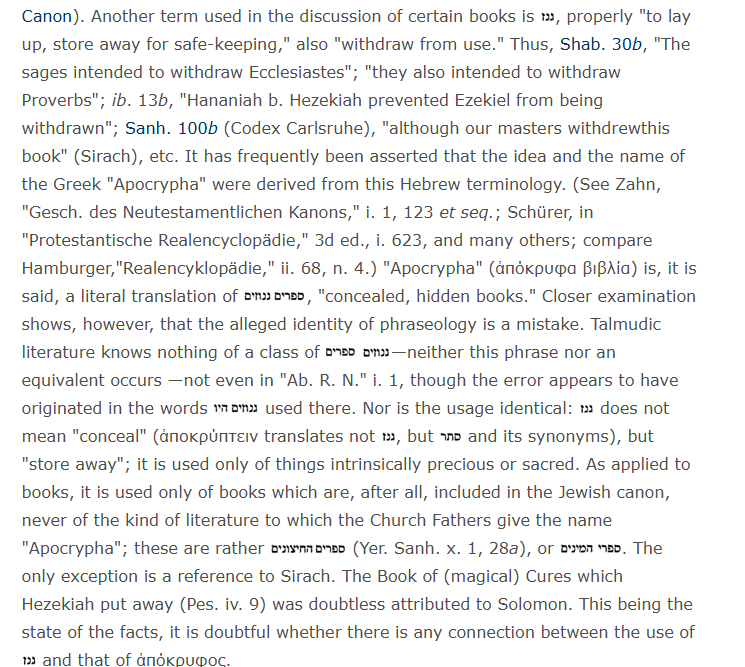
Another term used in the discussion of certain books is , properly "to lay up, store away for safe-keeping," also "withdraw from use." Thus, Shab. 30b, "The sages intended to withdraw Ecclesiastes"; "they also intended to withdraw Proverbs"; ib. 13b, "Hananiah b. Hezekiah prevented Ezekiel from being withdrawn"; Sanh. 100b (Codex Carlsruhe), "although our masters withdrewthis book" (Sirach), etc.
The article goes on to deny that the term "Apocrypha" derives from Jewish usage. The article explains (link to article):
Nor is the usage identical: does not mean "conceal" (ἀποκρύπτειν translates not , but and its synonyms), but "store away"; it is used only of things intrinsically precious or sacred. As applied to books, it is used only of books which are, after all, included in the Jewish canon, never of the kind of literature to which the Church Fathers give the name "Apocrypha"; these are rather (Yer. Sanh. x. 1, 28a), or . The only exception is a reference to Sirach. The Book of (magical) Cures which Hezekiah put away (Pes. iv. 9) was doubtless attributed to Solomon.


5. "We don't know specifically what books [King James] thought were Apocrypha"
One of King James' most famous literary outputs was his, ""Basilikon dōron. Or His Majesties instructions to his dearest sonne, Henry the prince." Book 1 is "OF A KINGS CHRISTIAN DVETIE TO WARDS GOD." At pp. 9-10, he writes: "And as to the Apocriphe bookes, I omitte them, because I am no Papist, as I saide before, & indeed some of them are no wayes like the dytement of the Spirite of God." (source)
Preston behaves as though he is unfamiliar with associating books like Sirach with the Old Testament, while simultaneously considering them Apocrypha (example of this practice from 1604). So, when Preston reads James summarizing a group of Cardinal Bellarmine's citations as being from "the Old Testament," Preston takes that as suggesting that James thinks that the cited material is inspired Scripture:
The Cardinall, in his booke of Controuersies bringeth sowerplaces of Scripture for probation of this idle dreame: two in the Olde Testament, Malachie and Ecclesiasticus, and two in the New, CHRIST in Matthew (hee might haue added Marke too) and Iohn in the xi. of the Apocalyps. (p. 63)
Now for that place of Ecclesiasticus; as the sonne of Syrach onely borroweth it from Ma∣lachie (as appeareth by these wordes of his, of conuerting the sonnes hearts to their Fa∣thers, which are Malachies owne words) so doth CHRISTS Comentary serue as well to interprete the one as the other: it being no shame for that mortall Iesus to bee commented and interpreted by the immortall and true IE∣SVS, though to the shame and confusion of the Iesuits heresies herein. But Enoch must bee ioyned to Elias in this errand, onely to beare vp the couples, as I thinke. For no place of Scripture speaketh of his returning againe, only it is said in Ecclesia∣sticus the xliiij, that Enoch pleased GOD, and was translated to Paradise, vt daret Gen∣tibus sapientiam, or poenitentiam; since they will haue it so.(pp. 66-67)
(source)
6. Preston says, of himself, that it "blows my mind" that King James would appeal to the fathers to reject the Apocrypha
The problem with Preston's thinking, of course, is that the study of the fathers is the same problem as the study of King James himself, but magnified in several ways, most especially that there are more authors to study and not all have explicit comments on the subject, like James did.
Preston even half-acknowledges this, saying that the same kind of "contradiction" that he perceives in King James is found in the Reformers and early church writers.
7. The "Used to Build Doctrine" Argument
Preston thinks that the Apocrypha are "used to build doctrine," and consequently must be Scripture. This is the fallacy of affirming the consequent.
8. The King James lists the Apocrypha for Liturgical Readings
Preston puts stock in the fact that there were Church of England public readings of the Apocrypha amongst the liturgical reading of Scripture.
9. Miles Coverdale claimed that Judith is Holy Scripture
Preston says that this is in the same book that his opponent cited.
First, here's the material quoted, with the word "Judith" highlighted.


Here is a transcription from the version printed above:
Sidrach, Misach, and Abenago preserved he from the flaming furnace of burning fire; and Daniel he delivered from the devouring mouths of the hungry lions. Moyses, among the reeds and flags hid and hanged by the water-side in a basket, was restored again to his natural mother to be nursed of her. Paul was let down in a basket, and so escaped the hands of his persecutors. Susannah was preserved and defended pure and undefiled from [four words omitted] the false priests and judges. Judith, with much joy and victory, was delivered from the fiery violence and mighty power of all the enemies of God. These and many more godly ensamples be left in the holy scriptures, to the great comfort and consolation of them that suffer persecution for Christ's sake, according to the saying of Christ himself: "Blessed are all they which suffer persecution for righteousness' sake ; for theirs is the kingdom of heaven." Again, "as many as will live godly in Christ Jesus must suffer persecution."
One can easily see how that may sound as though the author is endorsing Judith and Susannah as being from the inspired and canonical Scriptures. He does not say that they are, but since that's what we would mean when we say "holy scriptures," it's quite natural for us to assume that the author would have meant the same thing. That said, however, it is important to note that the author in this case is a Dutch noble, and Miles Coverdale is the translator.
By contrast, in a work by Coverdale himself in the same volume, we find this:
It is a token, that your doctrine hath but a weak foundation, when ye go about to prove it by a dream, yea, and that out of such a book, as serveth not for the confirmation of the doctrine of Christ's church : for though it be read among the stories of other books, yet did not the church receive it among the canonical scriptures in St Hierome's time.[fn1: Sicut ergo Judith, et Tobise, et Machabseorum libros legit qmdem ecclesia, sed eos inter canonicas scripturas non recipit ; sic et hoc, &c. — Hieron. in Prov. Eccles. et Cant. Cantic. Praefat. Tom. in. p. 346. Antverp. 1579.]
I don't think the footnote is Coverdale's, though it does seem to accurately capture the sentiment of Jerome's to which Coverdale was referring.
In another place, we find Coverdale making the "canonical" qualification regarding Scripture:
Now as concerning the third, that is, praying for the dead and sacrificing for them, as in the other we confess, teach, and believe according to God's word, so do we in this; namely, that in holy scripture, throughout the canonical books of the old and new Testament, we find neither precept nor ensample of praying for any, when they be departed this life ; but as men die, so shall they arise : if in faith in the Lord towards the south, then need they no prayers ; then are they presently happy, and shall arise in glory : if in unbelief without the Lord towards the north, then are they past all help, in the damned state presently, and shall rise to eternal shame
("An Exhortation to the Carrying of Christ's Cross," p. 258)
The "canonical" qualification is necessary, because we do see an example of praying for the dead in 2 Maccabees.

