Showing posts with label Textual Criticism. Show all posts

Sunday, August 23, 2026

A Brief Rejoinder to Mr. Sheffield on 1 John 5:7

Jonathan Sheffield recently wrote (source):

After reviewing several Francis Turretin points on the subject, his thesis amounts to a poorly constructed postmodern narrative with no basis in history. Appealing to "some scribe" is not evidence for his position, but a deus ex machina to avoid addressing the positive evidence for the passage.

After I asked if he was ok, Sheffield responded: "Francis Turretin, have you ever had the opportunity to Beta Test your thesis?" (source)

The reason for my question was that I have seen Mr. Sheffield present cogent statements in other contexts.  However, in this particular context, what he offered is hard to connect to anything I've said/written.

First: "After reviewing several Francis Turretin points on the subject, his thesis amounts to a poorly constructed postmodern narrative with no basis in history."  

Based on his follow-up message, I gather that he did not have some third party's thesis in mind. He simply misplaced his modifier.  I'm sure I've done the same in informal contexts like Facebook. However, I have no idea which of my "points" JS has in mind.  His comment is too vague for me to guess which points from the many Comma Johanneum articles I've posted he means to reference (link to tagged posts).  

Likewise, the reference to my "thesis" is not entirely clear.  My overall thesis (if one wants to call it that) on the text of 1 John 5 is that John's letter originally said (though in simple uncial without diacritical marks, spaces, and punctuation): "... ὅτι τὸ πνεῦμά ἐστιν ἡ ἀλήθεια. ὅτι τρεῖς εἰσιν οἱ μαρτυροῦντες, τὸ πνεῦμα καὶ τὸ ὕδωρ καὶ τὸ αἷμα, καὶ οἱ τρεῖς εἰς τὸ ἕν εἰσιν. εἰ τὴν μαρτυρίαν τῶν ἀνθρώπων λαμβάνομεν, ἡ μαρτυρία τοῦ θεοῦ μείζων ἐστίν ... " (see here) and specifically without the additions proposed by Erasmus, the Complutensian editors, and others over the years on the basis (directly or indirectly) of a Latin tradition.

There's a mountain of evidence to support my thesis, especially that the overwhelming majority of Greek manuscripts support this thesis - particularly the non-insertion of "in earth" and of the heavenly witnesses parallel is evidenced in literally hundreds of Greek manuscripts ranging from the fourth century up to the age of printing (and beyond, for whatever little that might be worth).  (a sorted list of manuscripts can be seen here)

Further support comes from all the ancient versions, except for a subset of the Latin. For example, the Coptic versions follow the Greek (Bohairic)(Sahidic).  So does the Old Georgian (source).

Additional support comes from writings of the fathers and other early Christian authors, even amongst the Latin tradition:

  • Cassiodorus' (Latin, 485–585) translation of Clement of Alexandria's (Greek 147-215) comments on 1 John (available here);
  • A 3rd or 4th century opponent of Cyprian on rebaptism (available here); 
  • Ambrose (339-397) in his treatise on the Holy Spirit (available here); and
  • Leo the Great (391-461): the Tome of Leo (available here).

So much for "no basis in history."  It's hard to respond to the claim of poor construction or a postmodern narrative, because no specific narrative is identified. In other comments in the thread JS offered some clarification (source):

Hefin Jones, let me give you an example.

In my debate with Ehrman on Gospel Authorship, his response to the evidence I presented in support of Matthew, Mark, Luke, and John as the actual authors was this:

Actual quote: "But once somebody puts a name on them, apparently somebody in Rome, which at this time is becoming the biggest church and the most influential church in the empire, uh, somebody puts a name on these things, Matthew, Mark, Luke, and John. And everybody else afterwards calls them Matthew, Mark, Luke, and John. So, uh, what, you know, what else are they going to call them? That's what people are starting to call them"

That is a postmodern narrative, not actual objective evidence for his position.

He doesn't produce any documentation to that effect: no letter, where the location was (i.e., Rome, Alexandria, North Africa), - note he dropped the Rome claim when I pressed him on it. Additionally, who the person was that decided, and then which churches copied. It was like a world of make-believe. No one said what he was advocating in the ancient world.

The Critical Text Scholarship uses a similar postmodern narrative in trying to defend the premise that 1 John 5:7 is not original to the epistle of John. While taking the position that 1 John 5:7 is not original is a valid position, instead of advocating a postmodern narrative, present evidence for it in the same way as we have for any other now-credible theory of the world. “Evidence” in that sense must mean facts, which are beyond dispute as they are, whose existence is more likely, more probable, if the proposed theory is true than if any competing theory were true instead. Hope that helps. Pax Christi,

I cannot see the relevance of Ehrman's theory regarding the names of the gospels to the present controversy. JS seems to concede that my overall thesis is "a valid position" and that my approach of offering evidence in support of my position is an appropriate mode of investigating the problem.

JS continued: "Appealing to 'some scribe' is not evidence for his position, but a deus ex machina to avoid addressing the positive evidence for the passage."

What positive evidence?  I've dealt with the very few, inconsistent, and late Greek manuscripts offered in support of any version of the comma (see my post).   Before the life of Erasmus, they amount to a single Greek manuscript (GA 629). The two competing theories about that manuscript are (1) that the scribe producing the manuscript copied from a now lost Greek exemplar and (2) that the scribe producing the manuscript back-translated from his Latin exemplar into Greek to supply what he assumed was an omission in his Greek exemplar. Given the popularity of the comma among Latin readers in the West by the mid-1300s when the manuscript was made, and given the absence of known early Greek exemplars, the second of the two theories is the one more supported by the evidence. However, if an advocate of the TR wanted to go with the former theory, one might reasonably ask (as I did during my recent debate) why the Greek prepositions of the TR are different from those of GA 629. I'm not sure what appeal to "some scribe" JS has in mind. Without some clarification it's basically impossible to provide a helpful response.

As for "have you ever had the opportunity to Beta Test your thesis?" Again, this seems a bit vague. The phrase "beta test" has a meaning in software development, but I'm not sure how JS means to apply that to this topic. If he's asking if I have taken this into debate - yes, I have. There is a link above to my recent debate with CJ Cox and the topic came up in my debate with Nick Sayers (link), though I don't think I offered much (if anything!) on that topic then.

Tuesday, July 14, 2026

The Greek Manuscripts of the Johannine Comma

The present post is largely drawn from Elijah Hixon's helpful post (link to post) over at the Evangelical Textual Criticism blog.  

Hixon writes:

There are 10 Greek manuscripts that have the CJ, but only three of them have it in the same form as in Stephanus’ 1550 edition and Scrivener’s edition reprinted by the TBS—these three are 221marg, 2318 and 2473. All ten of these manuscripts are indexed for 1 John 5:7–8 at the INTF’s VMR, so you are free to verify them yourself. 

Hixon goes on to note: "Before I get there, I want to mention that sometimes an eleventh Greek manuscript is cited. GA 635 is sometimes cited as having the CJ in the margin, but it does not."

In addition to what Hixon has mentioned, I've added a line for the Complutensian Polyglot, since some folks like to suggest that the Complutensian editors transcribed their text from a manuscript, rather than emending based on the Latin (despite Stunica himself acknowledging the opposite, as explained here).

In a nutshell, before Erasmus' fourth edition, what is today the "TR" Johannine Comma did not exist. Of the four manuscripts with something Comma-like in the main text, the only one that is before the time of Erasmus is transparently a back-translation from the Latin, in the context of a Greek-Latin diglot text.  The only one from the time of Erasmus likewise appears to be a back-translation from the Latin, because it lacks the articles.  The remaining two match the TR text, but both are from long after the age of printing (i.e., 16th or 17th century), and are thought to be based on a printed Greek text.

Even if we were to consider the marginal readings in manuscripts that contain them, only one of the marginal notes is a viable candidate to be before the time of Erasmus, and this one is likewise a transparent back-translation from Latin.

In short, the Greek evidence confirms that the Comma Johanneum (CJ) is a Latin interpolation.   

Manuscript Evidence of Latin influence Has the TR reading? Margin/Main Text
GA 635 (11th Century) Hixon notes that GA 635 is sometimes cited as containing the Comma, but does not. Others have suggested that this has been cited in error for 636 (see below)  Does not actually contain the Comma. N/A
GA 629 (14th century) Latin-Greek diglot; the Greek lacks articles before the heavenly witnesses, suggesting translation from Latin. No; has ἀπὸ τοῦ οὐρανοῦ / ἀπὸ τῆς γῆς, lacks articles, reads Πνεῦμα Ἅγιον, and has εἰς τὸ ἕν. Main text
GA 61 (15th-16th)  Franciscan provenance; copied from GA 326 while adding Vulgate-derived readings, and the Comma lacks Greek articles. No; lacks the articles and reads Πνεῦμα Ἅγιον. Main text
GA 429marg (margin after 1522) Marginal addition copied from Erasmus’s third edition, the article-less form of the Comma. No; lacks the articles and follows Erasmus’s third-edition form. Margin
GA 918 (late 16th century) Spanish Catholic provenance; the Comma appears to have been added from Erasmus’s third edition. No; lacks the articles and follows Erasmus’s third-edition form. Main text
GA 2473 (17th century) Apparently copied from a later printed Textus Receptus edition rather than from an independent Greek manuscript tradition. Main text
GA 2318 (18th century) Late commentary manuscript; Wachtel considered its biblical text copied from a later Textus Receptus edition. Main text
GA 177marg (margin 18th century) Marginal addition by the Catholic priest Ignatius Hardt in 1785; the verse numbering points to a printed source. No; lacks articles and οὗτοι, reads εἰς τὸ ἕν, and omits the continuation into v. 8. Margin
GA 221marg (margin 19th century) Marginal addition made after a 1854 catalogue stated that the manuscript lacked 1 John 5:7, suggesting dependence on a printed source. Margin
GA 88marg (16th or later century) Later marginal hand; Latin note, Counter-Reformation provenance, Latin-looking alpha, and no nomina sacra suggest printed or Latin influence. No; apparently lacks the articles before the heavenly witnesses. Margin
GA 636marg (15th or later) Later marginal hand; lacks definite articles and appears amid Greek and Latin notes, suggesting possible translation from Latin. No; lacks the articles and omits οὗτοι. Margin
Complutensian Polyglot (16th) Printed Greek-Latin New Testament; the Comma is printed in the Greek column alongside the Latin tradition. No; includes καί before ὁ λόγος, omits οὗτοι, and reads εἰς τὸ ἕν. Main text

Tuesday, June 23, 2026

Peter of Laodicea on the Lord's Prayer

Peter of Laodicea (7th or 8th century?) created a commentary on Matthew that, as far as I have been able to determine, has been published only in Greek (link to 1905 publication, or at least, not in English).  As I'm compiling patristic commentaries on the Lord's Prayer, I was pointed to this work. I now offer my amateur attempt at a transcription and translation of his commentary on Matthew 6:9-13. 

Τότε πατὴρ ἡμῶν ὁ θεὸς χρηματίζει, ὅτε διὰ τῆς τοῦ πνεύματος ἐπιφοιτήσεως τῆς υἱοθεσίας Χριστοῦ ἀξιωθῶμεν. ὁ γὰρ πατέρα καλῶν τὸν θεὸν ὀφείλει καθαρὸς εἶναι ἀπὸ ἁμαρτιῶν καὶ κληρονόμος τῆς βασιλείας τῶν οὐρανῶν· θρασὺς δὲ ὁ μορφωθεὶς πρὸς τὸν διάβολον, λέγων πατέρα τὸν θεὸν, ὃν οὐ δοξάζει. εἰπὼν δὲ τὸ ἡμῶν ἕνα τοὺς πολλοὺς δείκνυσιν ὡς ἑνὸς σώματος, μιᾶς ἁπάντων οὔσης κεφαλῆς τοῦ θεοῦ· ὑπεμφαίνει δὲ καὶ τὸ ὑπὲρ ἀλλήλων εὔχεσθαι ὡς ὅτι πάντες ἀδελφοί ἐσμεν. 

Then God is called our Father, when through the visitation of the Spirit we have been deemed worthy of the adoption of Christ. For the one calling God Father ought to be clean from sins and an heir of the kingdom of the heavens; but bold is the one who has been formed toward the devil, saying that God is Father, whom he does not glorify. And by saying the “our,” he shows the many to be one, as of one body, God being the one head of all; and he also intimates the praying for one another, since we are all brothers.

τὸ δὲ ἐν τοῖς οὐρανοῖς ὅταν εἴπῃ, οὐκ ἐκεῖ τὸν θεὸν συγκλείων τοῦτό φησιν, ἀλλὰ τῆς γῆς ἀπάγων τὸν εὐχόμενον καὶ τοῖς ὑψηλοῖς προσηλῶν. τὸ δὲ ἁγιασθήτω οὐ προστακτικῶς, εὐκτικῶς δέ, οἷον ἁγιασθείη, οὐχ ἵνα ἐκ βεβήλου ἁγιασθῇ, ἀλλ’ ἵνα ἡμῖν ἀποκαλυφθείσης τῆς ἀγαθότητος αὐτοῦ ἀξίως αὐτοῦ διδῶμεν ἁγιότητα ὀνομάζοντες θεόν. βασιλείαν δὲ θεοῦ ἢ τὴν μέλλουσαν τῶν ἀγαθῶν ἀπόλαυσιν φησὶν ἢ τὴν διὰ τοῦ ἁγίου πνεύματος δωρεὰν ἢ τὴν δευτέραν αὐτοῦ παρουσίαν. ἐπειδὴ δὲ φύσει θεὸς ὢν ὁ Χριστὸς οἰκονομικῶς καλεῖται βασιλεὺς ὡς ἄνθρωπος, ἐπεύχονται οἱ πιστοὶ τοῦτο καὶ ἐπὶ τοὺς ἀπίστους ἐλθεῖν, ἵνα εἰς Χριστὸν πιστεύσαντες βασιλέα ἴδιον ἐπιγράφωνται αὐτόν. 

And whenever he says the “in the heavens,” he says this not as shutting God up there, but as leading away the one praying from the earth and nailing him to the things on high.

And the “let it be hallowed” is not imperatively, but optatively, as, “may it be hallowed”; not so that it may be hallowed from being profane, but so that, his goodness having been revealed to us, we may fittingly give holiness to him, naming him God.

And by “kingdom of God” he means either the future enjoyment of good things, or the gift through the Holy Spirit, or his second coming. And since Christ, being God by nature, is called King economically as man, the faithful pray also that this may come upon the unbelievers, so that, having believed in Christ, they may inscribe him as their own King.

τὸ δὲ γενηθήτω τὸ θέλημά σου τοῦτο δηλοῖ· ὥσπερ ἐν οὐρανῷ καθαρῶς καὶ ἀμέμπτως πάντες οἱ ἄγγελοι πολιτεύονται, οὕτω καὶ τοὺς ἀνθρώπους ἐν τῇ γῇ ποίησον. ἢ οὕτως· ὥσπερ οἱ ἄγγελοι ἐν οὐρανοῖς εἰσιν, οὕτω καὶ ἡμᾶς ἀξίωσον ἐν τῇ ἀναστάσει τοῦ πνευματικοῦ καὶ καθαροῦ σώματος. Ἐπιούσιον δὲ ἄρτον ἢ τὸν συνιστῶντα τὸ σῶμα ἡμῶν φησι, τουτέστι τὸν ἐφήμερον, ἤτοι τὸν ἐπιόντα καὶ προσδοκώμενον τοῦ πνεύματος ζωοποιὸν ἄρτον, τουτέστι τὸν μέλλοντα. ὠνοματοπεποίηται τοίνυν τὸ ἐπιούσιον ἢ παρὰ τὸ ἐπιέναι καὶ ἐπέρχεσθαι, ἢ τὸν μὴ τοῦ ἐνεστῶτος αἰῶνος οἰκεῖον, ἀλλὰ τὸν ἀποδοθησόμενον ἐν τῷ μέλλοντι τοῖς ἁγίοις δὸς ἡμῖν ἤδη· ἢ ἐπείπερ οὐσία κυρίως ἐστὶν ἡ ἑστῶσα καὶ βέβαιος, οἷα ἡ τῆς ψυχῆς ἡμῶν φύσις φοροῦσα τὸ κατ’ εἰκόνα τοῦ ἀοράτου θεοῦ, κατὰ τοῦτο λέγοιτ’ ἂν ὁ τῇ κυρίως οὐσίᾳ ὁμιλῶν ἄρτος, ἐπιούσιος θεὸς ὢν, λόγος, ζῶν ἄρτος. 

And the “Let your will be done” makes this clear: just as in heaven all the angels conduct themselves purely and blamelessly, so also make human beings on the earth [to do so].

Or thus: just as the angels are in the heavens, so also count us worthy, in the resurrection, of the spiritual and pure body.

And by “supersubstantial bread” he means either the bread that sustains our body, that is, the bread for the day; or else the coming and expected life-giving bread of the Spirit, that is, the future bread. Therefore the word “supersubstantial” has been named either from “to come on” and “to approach,” or [it means]: “Give us already the bread that is not proper to the present age, but that which is going to be given in the future to the saints.”

Or, since “substance” in the proper sense is that which stands firm and is sure, such as the nature of our soul, bearing that which is according to the image of the invisible God, according to this the bread that has dealings with the substance in the proper sense might be called “supersubstantial,” being God, Word, living bread.

εἶτα δυσωπῶν ὁ λόγος ἀμνησικακεῖν, συνειδότας ἑαυτοῖς ἁμαρτίας μετριάζειν διδάσκει τὸ τῶν ἴσων θέλειν τυχεῖν. φησὶ γάρ· καὶ ἄφες ἡμῖν τὰ ὀφειλήματα ἡμῶν. πᾶν δὲ ἁμάρτημα ὀφείλημά ἐστιν· εἰ γὰρ μὴ ἐνδύσηταί τις τὴν τῆς ἀμνησικακίας ἀρετήν, οὐ δύναται τυχεῖν ἀφέσεως. εἶτα διδάσκει μὴ παραιτεῖσθαι τοὺς ἀγῶνας, πλὴν μὴ ἐπιρρίπτειν ἑαυτούς· εἰ δὲ ἀνάγκη καλέσοι, δεῖ εὔχεσθαι τοῦ ῥυσθῆναι· ὁ γὰρ ἐν τῇ πάλη νικῶν καὶ μὴ ἐγκαταλειπόμενος οὐκ εἰσέρχεται εἰς πειρασμόν. πειρασμὸς γάρ ἐστιν ἡ ἧττα καὶ ἡ ἀπὸ τοῦ διαβόλου πλάνη· ὁ δὲ μὴ εἰσελθὼν εἰς δίκτυα πειρασμοῦ ἐρρύσθη ἀπὸ τοῦ πονηροῦ. πονηρὸς δέ ἐστιν ὁ διάβολος οὐ φύσει, ἀλλὰ προαιρέσει·οὐ γὰρ τῶν ἐκ φύσεως ἐστὶν ἡ πονηρία, ἀλλ’ ἐξ αὐτεξουσίου κακίας καὶ πονηρίας γίνεται· κατ’ ἐξοχὴν δὲ οὗτος καλεῖται διὰ τὴν ὑπερβολὴν τῆς κακίας. τὸ δὲ ὅτι σοῦ ἐστιν ἡ βασιλεία καὶ ἡ δύναμις ἐν τισιν οὐ κεῖται μέχρι τοῦ ἀμήν.

Then, the Word, importuning [us] to be without remembrance of wrongs, teaches those conscious to themselves of sins to be moderate, by wishing to obtain equal things. For he says: “And forgive us our debts.”

And every sin is a debt; for unless someone puts on the virtue of not remembering wrongs, he is not able to obtain forgiveness.

Then he teaches not to decline the contests, yet not to throw ourselves upon them; but if necessity should call, it is necessary to pray to be delivered. For the one conquering in the wrestling and not being abandoned does not enter into temptation. For temptation is defeat and the deception from the devil; but the one who has not entered into the nets of temptation has been delivered from the evil one.

And the devil is evil, not by nature, but by choice; for wickedness is not among the things from nature, but comes to be from self-chosen evil and wickedness. And he is called this preeminently because of the excess of his wickedness.

And the “For yours is the kingdom and the power” is not found in some [copies] as far as the “Amen.”

What is particularly interesting here is that Peter recognizes the division among the Greek copies, with some including a doxology and others not including it.  Peter opts not to comment on this portion, possibly suggesting that he does not think it is original.  However, since he does not say that it is not original, we can only be confident that he was aware that there was, at his time, a textual variant in the Greek copies on this particular point.

Friday, February 27, 2026

2 John 1 and the Textus Receptus - Room to Improve the King James Version

Nick Sayers (in his 2 John Bible Study video) has identified an interesting difference between Beza's 1598 Greek New Testament, the primary basis of the New Testament of the King James Version, and Scrivener's Textus Receptus, the usual TR edition that TR advocates reference.  This difference highlights an opportunity to improve the King James Version.

Here is the KJV:

2 John 1 (KJV) The elder unto the elect lady and her children, whom I love in the truth; and not I only, but also all they that have known the truth;

The phrase "in the truth" should be rendered "truly" or "in truth" (for a more word-for-word translation) rather than "in the truth."  Beza identified this issue as early as 1556, and suggested changing the Vulgate translation of "in veritate" ("in truth" or "in the truth" - Latin lacks articles) to "verè" ("truly") to better convey the sense of the Greek.  Beza, in his annotations (discussed in more detail below), recognized the connection between John's Greek phrase ἐν ἀληθείᾳ (en aletheia - in truth) and a corresponding Hebrew word b'emet, which has the sense of "in truth" or really/seriously.  Thus, Beza argued that the text ought to be translated with "verè" to convey the sense rather than "in veritate," though the latter is a word-for-word formal equivalent translation.

An odd thing happened, though, and Beza's main text in 1598 did not align with his Latin text nor with the (much, much later) text of Scrivener.

Beza's 1598 edition has the text of 2 John 1 as follows: 

The relevant difference is the presence (in Beza) of an article before the word aletheia (truth) the first time it appears in the verse:

2 John 1 (Scrivener) ὁ πρεσβύτεροσ ἐκλεκτῇ κυρίᾳ, καὶ τοῖς τέκνοις αὐτῆς, οὓς ἐγὼ ἀγαπῶ ἐν ἀληθείᾳ, καὶ οὐκ ἐγὼ μόνος, ἀλλὰ καὶ πάντες οἱ ἐγνωκότες τὴν ἀλήθειαν

2 John 1 (Beza) ὁ πρεσβύτεροσ ἐκλεκτῇ κυρίᾳ, καὶ τοῖς τέκνοις αὐτῆς, οὓς ἐγὼ ἀγαπῶ ἐν τῇ ἀληθείᾳ, καὶ οὐκ ἐγὼ μόνος, ἀλλὰ καὶ πάντες οἱ ἐγνωκότες τὴν ἀλήθειαν

One might wonder whether Beza's annotations shed any light.  Beza's Annotation is as follows:

In the following transcription, I've added modern vowel points to the Hebrew b'emet, meaning "in truth" or "really/seriously" although for reasons unknown to me, Beza used unpointed letters (perhaps it was all his printer had available?).

Verè, ἐν ἀληθείᾳ, Heb. בֶּאֱמֶת [beemeth.] Vulg. & Erasm. ad verbum, In veritate. ¶ Veritatem, τὴν ἀλήθειαν. i. Christum, vel Evangelium. quae phrasis saepe, apud Ioannem praefertim, occurrit. Idem itiam eiusmodi unius verbi geminatione gaudet: sicut singulis penè paginis licet observare, tum in Evangelio, tum in epistola superiore.

My own amateurish translation:

¶ Truly, ἐν ἀληθείᾳ, Heb. בֶּאֱמֶת [beemeth.] Vulg. & Erasm. word for word, In veritate (“In truth”). ¶ “The truth,” τὴν ἀληθείᾳ. that is, Christ, or the Gospel; which manner of speaking occurs often, especially with John. He also indeed delights in such a doubling of one word: just as in almost every single page it can be observed, both in the Gospel and in the former epistle.

Note, however, that Beza's own Latin follows "truly" (verè) not "in the truth" in all his editions, including the 1598.  Moreover, while we may question the Greek and/or Hebrew skills of some of the King James translators, we certainly must believe that they knew how to read Latin, and could tell the difference between the Latin for "Truly" and the Latin for "In [the] truth".  

Moreover, note that while Beza's annotation may be a little confusing in view of the text as printed, Beza's annotation is best understood not as proposing the alternative reading "love in the truth" for "truly love" but rather as referring to the portion of the text about "knowing the truth".  In other words, Beza is saying that John is making a play on words, referring to his sincere love and also knowing about Christ and/or the Gospel.

It does not seem that there is any textual critical basis for adding the article into the text.  For example, 
Stephanus' 1550 (Beza's primary source for textual critical material) does not offer any textual variant information regarding 2 John 1 and does not include the article in the main text:

Furthermore, Beza's own editions, before and after the 1598 edition, are inconsistent.  

1604. The 1604 "minor" edition (which does not have full annotations) omits the article in the text:

(source, vol. 2)

1594. The 1594 Annotations-only printing contains the same annotation:

(source at [1237])

1590. The 1590 "minor" edition (which does not have full annotations) omits the article in the text:

(source, at [899])

1589. The same text (with the article) and annotation as in the 1598 are present in Beza's 1588/89:

1582. Likewise in Beza's 1582, the article and the annotations are present:

(source, at [990])

1580. The 1580 "minor" edition (which does not have full annotations) omits the article in the text:

1575. The Latin-only 1575 edition has the same Latin text as Beza offers consistently throughout:

1567. In the 1567 "minor" edition (which does not have full annotations), the text omits the article:

(source, at [775])

1565. Likewise, in his 1565 edition, his text omits the article, despite his annotations:

(source, at [1073])
(source, at [1074])

1557. Beza's Latin edition of 1556/57 includes the same annotation:

(source, at vol. 2, [1178])

In summary, all his editions have the Latin for "truly" and all his editions with annotations seem to have essentially the same annotations.  On the other hand, Beza's three final major editions of 1582, 1589, and 1598 all have the article, but the first major Greek edition (1565) and all the other minor editions lack the article.  

The article issue is not listed among the NT Conjectures. Likewise, I could not find any mention of this change in "Beyond What Is Written: Erasmus and Beza as Conjectural Critics of the New Testament," by Jan Krans.  Based on the collation provided via INTF, I was not able to locate any transcribed manuscript with an article in the position that Beza places it here.  So, if a deliberate insertion, it would seem to be a conjectural emendation of the text.

Given the presence of the "truly" reading in Beza's Latin and the presence of the seemingly conflicting annotation in all of the editions that have article present in the text, I think it's most reasonable to assume that the presence of the article in the text in the major editions of 1582, 1588/89, and 1598 was a typographic error in the 1582 that was subsequently copied in the following major editions without being noticed by Beza.

The King James translators, who we believe relied upon Beza's 1598 as their primary text, seem to have followed Beza's main text over his annotation.  They did not translate as "in truth," "truly," "indeed," or the like.  Instead, they translated as "in the truth" without any indication that "the" was being supplied:

Blaney's 1769 KJV similarly does not italicize the "the" in the verse:

Matthew Verschuur's "Pure Cambridge Edition" (published in 2006) claims to be scrupulous about italics and likewise does not italicize:

On the other hand, although Wycliffe's 1398 had "in treuthe" (source), English translations starting with Tyndale had included the English article (I have not extensively researched whether there were any better English translations available at the time).

1568 Bishops' Bible (per BibleHub)
2 John 1: The elder to the elect Lady & her chyldren, whom I loue in the trueth: and not I only, but also all that haue knowen ye trueth:
1560 Geneva Bible (scanned)
2 John 1: The Elder to the elect Ladie, and her children, whome I loue in [a] the trueth: and not I onely, but also all that have knowen ye trueth, [a: According to godliness & not with anie wordlie affection.]
Tyndale New Testament (per WikiSource
2 John 1: The elder to the electe lady and her chyldren which I love in the trueth: and not I only but also all that have knowe the trueth

Given that the King James translators were aiming to edit the Bishops' Bible only where the originals demanded it, and given that Beza's 1598 seemed to support for the article present in the Bishops' Bible, it seems that King James translators followed Beza's main text over his Latin translation and his annotations, thereby maintaining Tyndale's improvable translation.

As can be seen from Beza's notes, Tyndale did not have a Greek text with the article in front of him.  He had Erasmus' 1516 text and annotations.  The annotations on 2 John (reproduced below in their entirety) did not mention this issue, and the main text lacked the article:

(source

An interesting collision of a weak (but by 1611 already traditional) translation by Tyndale coupled with either a typographic error or conjectural emendation in Beza's 1598 resulted in the King James Version at 2 John 1 having some room for minor improvement by omitting the definite article.

Friday, February 06, 2026

Pure Cambridge Edition (PCE) of the King James Version - Clearing the Myths

I recently asked Pastor Bryan Ross (link to my question):

I noticed something in your notes that I myself have been puzzling about for about the last year or two. What is the actual first publication date for the PCE? Usually I hear "around 1900", which strikes me as odd. Surely someone who loves the PCE (perhaps Mr. Kinney?) should have been able to identify the first printing of that edition by now.

Pastor Ross responded by informing me that he would begin addressing that very question in an upcoming lesson.  He has now responded with a video lesson (link to video).  The accompanying notes (link to the notes) are a treasure trove of information, which directly and thoroughly answers my question.

The key insight from that article, as it relates to my question, is this:

The first “definitive” PCE was actually the 2006 electronic edition.

In more detail:

As the Guide describes the process, Verschuur and his associates spent several years comparing historical Cambridge/Collins printings, reconciling differences, and correcting perceived errors. This project culminated in 2006, when Verschuur completed what he calls the first truly authoritative PCE text. The Guide states plainly, “The electronic file was finalised… July 2006.” This finalized electronic edition is the first version that the Guide presents as complete, perfect, and definitive. In effect, the PCE—understood as a precise, unified, authoritative text—came into existence not in the early 1900s but in 2006, through deliberate editorial reconstruction.

The "Guide" refers to Matthew Verschuur's Guide to the Pure Cambridge Edition. Bible Protector, 2013 (link to source).

I suppose that this July will mark the 20th anniversary of the creation of the PCE, an edition that has obtained the support of many King James advocates in this century.  I am unaware of any response as yet from Mr. Verschuur; at this time of this writing, Pastor Ross's comments are only a few days old, so it's not as though Mr. Verschuur has had a full opportunity to respond to them.  His initial response seems to have been to accuse Pastor Ross of unspecified "misinterpretations and wrong implications" (link to source). As a minor aside, I would like to hear from Will Kinney regarding his claim that his standard (which I believe he says is "the Cambridge," by which I think he means the PCE, though perhaps he means a different Cambridge edition) was around before he was born.

I noticed that Mr. Verschuur also posted a video, "9 Decades of PCES," after he left his comment alleging misrepresentation.  His video points to a printed 1911 KJV printed by the British and Foreign Bible Society on the Cambridge University Press. Mr. Verschuur asserts that this is an example of the PCE.  His justification for this assertion is that the copy in question "matches a set of readings that are consistent across the 20th century." He also asserts that there is "a continuum of the same editorial set of readings in the 1911, the 1990s..."  and argues that the question is not when the PCE was first printed but whether there is a "collective of editions with the same set of readings."  Mr. Verschuur acknowledges that there may be errors in the editions, which he characterizes as "mistakes somewhere in the typesetting."  He asks: "Does that make a Bible invalid?" and he answers it: "Of course not."  So, even after pointing to the 1911 printing, Verschuur does not say that the 1911 cannot be further improved.  Instead, Verschuur reserves that for what he refers to as a "text file," presumably the output of July 2006 (or perhaps even a later date, if Verschuur detected any perceived errors in the 2006 file).

From my standpoint, while it is interesting that Mr. Verschuur identifies a specific 1911 printed edition as an example of the PCE, since PCE is defined as merely any one of potentially numerous and at least multiple editions that share a collection of readings that were selected by Mr. Verschuur.

If the standard of perfection is complete perfection, then it's hard to see how a version that falls short of that perfection in something as seemingly trivial as a "full stop" ("."), which is one of Mr. Verschuur's examples, is perfect.

Mr. Verschuur is right to say that it is not reasonable to say that the Bible is not a "valid" Bible because of the absence of a period.  However, that also applies to other minor errors, and there is no bright line between major and minor errors.  I think we would all agree that the so-called "wicked Bible" (a printing of the KJV that had "thou shalt commit adultery") contains an error that is major in one sense and yet also minor in another sense.

Prior to his "9 Decades" video, Mr. Verschuur posted (within the last month or so) three other videos: a three minute video showing different printings of what he asserts are examples of the PCE (link to video) and two two-hour long videos, respectively parts 1 and 2, of "Assessing the assessor of the Pure Cambridge Edition position" (part 1)(part 2).  There is also a three-minute video called "Noble Empire," which appears to be a Udio-generated song, but with no argumentative substance (link to video).

Interestingly, one of the allegedly PCE Bibles shown in the first video is printed on the occasion of the coronation of Her Majesty Queen Elizabeth II, but is only a New Testament.   Given that 6 of the 12 markers identified by Verschuur are in the Old Testament, I suppose it's naturally easier for a New Testament to qualify if one doesn't have to have the markers for books that are not included.  Of course, that logic leads to the absurd result that my Scottish metrical psalter is a PCE printing, since the 12 PCE criteria do not include any markers in Psalms.

In the "Assessing the assessor" videos, Verschuur names Bryan Ross and offers some responses to earlier videos in Ross's series (the video by Ross, which I've linked above, is not the first of the series).  Interestingly (to me), Verschuur complains that he's being misrepresented, while simultaneously making comments suggesting that his own edition (which he says he brought out in 2007, "And so you can actually see that it was then in 2007 when I brought out my website that an electronic copy of the Pure Cambridge Edition was published.") is the standard and suggesting that others don't agree because they don't want there to be any standard.

Unfortunately, for Verschuur, he does not seem to be able to engage the same level of dialog or research as Pastor Ross.  Instead of pointing to concrete errors in Ross's research or identifying flawed arguments offered by Ross, Verschuur resorts to what can best be described as hand-waving, such as by asserting that Ross is offering a "human rationalistic exercise" (around 13 minutes in in part 1).  He shortly thereafter says he doesn't want to say that Ross is "a rank Modernist or heretic or something like that."  His meandering thoughts, however, do not appear to provide any concrete rebuttal to anything that Ross offered.  One could adequately, I think, summarize Verschuur's response as consisting of a reiteration of positions already mentioned by Ross coupled with statements suggesting that somehow the rhetorical flavor of his position has been misrepresented through accurate but selective quotation of his comments.

After listening to both parts of Verschuur's "Assessing the assessor" video, I think the biggest question that his position poses is this: how does Verschuur know that the PCE is perfect (as to spelling, capitalization, punctuation, italics, and so on)? Likewise, why hesitate to use the word "error" to describe a deviation from this standard (e.g., in part 2, around 1 hr, 36 minutes in, he states: "So that's why I say here that the we're talking about the pure Cambridge edition that not only is the edition correct, which is an editorial form, but then in a copy editing sense of even having no typographical error and resolving edition variation errors. I wouldn't really use the word error so much as they're not error errors like 'oh no that's an error.' I'm just using the word error as in like it's not the actual standard. And I think probably I've consciously tried to not use the word error to mean that because it would lead people like Brian Ross to say, 'Whoa, he said there's errors in PCE printings. Oh no.' Like he's would totally be misrepresenting things to say that. But no, that's not what I'm talking about.")?

Finally, Mr. Verschuur does protest the idea that his Pentecostalist views are the basis for his identification of the PCE.  However, it's hard to come up with any better explanation for Verschuur's seemingly arbitrary identification of 12 marks of the PCE, half of which have to do with the capitalization of the word "Spirit" (or "spirit").  I'm certainly willing to acknowledge that Verschuur's background pre-commitment to Pentecostal/Continuationist views does not necessitate his seemingly arbitrary list of marks of the PCE, but mostly because of how arbitrarily the marks seem to be selected.  For Bryan Ross's arguments how Mr. Verschuur's Pentecostal beliefs influence his determination of which readings are "pure," see Pastor Ross's Lesson 273, "PCE Pillars and Pentecostalism" and accompanying notes (link to notes).

For all his complaining about being cast as extreme, Mr. Verschuur does not hesitate to accuse Pastor Ross: "But Brian Ross is the other extreme of almost compromising with with sort of modernistic thought. Like he'll happily go to the Hebrew and Greek. he'll happily you know sort of try to say well additions don't matter. So he's on the other end. Now I'm talking in the spectrum of what we'll call believing the King James Bible but he's really on an extreme edge and there's plenty of stuff he says is great but he's still like on the edge as far as that." (around 1 hr, 55 minutes into part 2) Imagine the extreme of being happy to go to the Hebrew and Greek! Of course, a few seconds later, Verschuur seems to take it back with "it's not that extreme what he's saying ...."

Update: February 9, 2026.  Pastor Ross has released another lesson with more research (link to notes for Lesson 277)  Also, although it is not new, I take note of a video (audio only) from March 2, 2025, by Mr. Verschuur that attempts to criticize Pastor Ross's position (link to video).  Despite some wavering between calling all other KJVs "impure" and saying that even the most minor departure from his PCE is a "problem" (on the one hand) and saying that the other KJVs are not "invalidated" by his position, the video seems to confirm Ross's analysis of Verschuur's position. 

Thursday, January 29, 2026

Scale of Differences between Texts

The Center for New Testament Restoration offered an interesting tool that allows the user to compare two witnesses to the text of the New Testament.  They don't offer all the possible witnesses, or even all the possible Greek witnesses, but they do offer an impressive collection.  

Tale these results with a grain of salt, because they are automated results, and because it's hard to put much weight in their outcome.  However, I ran a few comparisons on P47, one of the earliest witnesses to the text of Revelation.

P47 vs. 01 (Codex Sinaiticus)

Variant unit differences: 257 of 525

Word differences: 425 / 3138 (13.54%)

P47 vs. the KJTR (I believe this is Scrivener's TR)

Variant unit differences: 248 of 525

Word differences: 359 / 3138 (11.44%)

P47 vs. 02 (Codex Alexandrinus)

Variant unit differences: 233 of 521

Word differences: 330 / 3138 (10.52%)

P47 vs. NA (28th, I think)

Variant unit differences: 200 of 525

Word differences: 279 / 3138 (8.89%)

As you can probably see, I've sorted the results in terms of decreasing word differences.  With that in mind, it is interesting to see the overall similarity amongst the various witnesses and particularly the fact that by this measure (the significance of which has not been established), the KJTR is closer to P47 than Codex Sinaiticus is. 

I wanted to the same comparison with the NA as the base text, but the challenge is that there is not an option to limit to the text of Revelation.  Nevertheless, here are a few of the comparisons:

NA vs. KJTR

Variant unit differences: 6207 of 20991

Word differences: 7992 / 137606 (5.81%)

NA vs. 01

Variant unit differences: 4466 of 20991

Word differences: 5689 / 137606 (4.13%)

NA vs. 02

Variant unit differences: 4379 of 18346

Word differences: 5692 / 119102 (4.78%)

NA vs. 03 (Codex Vaticanus)

Variant unit differences: 1946 of 18816

Word differences: 2239 / 121223 (1.85%)

Finally, we might as well compare the KJTR to the big three:

KJTR vs. 01

Variant unit differences: 8702 of 20991

Word differences: 11563 / 137939 (8.38%)

KJTR vs. 02

Variant unit differences: 5094 of 18346

Word differences: 6383 / 119102 (5.36%)

KJTR vs. 03

Variant unit differences: 6823 of 18816

Word differences: 8758 / 121223 (7.22%)

Once again, a word of caution.  Statistics can be fun, but there is a limit on the value of counting "variant unit differences" and "Word differences". 

Tuesday, May 20, 2025

Lord's Prayer in a Papyrus (Probable Amulet)

Brent Nongbri in “The Lord’s Prayer and XMΓ: Two Christian Papyrus Amulets,” The Harvard Theological Review, vol. 104, no. 1, 2011, pp. 59–68 (JSTOR), presented a papyrus tentatively dated to the 6th or 7th century.  The papyrus is thought to have been an amulet papyrus, something folded up and worn on the body of the person who owned it.  The text of the Lord's Prayer on the papyrus ends (as in other early witnesses) without the doxology familiar to KJV readers.  This is the opposite of what one's expectation would be if (1) this was intended as being worn for the purpose of having some kind of special power and (2) if the person who made it thought that the prayer included the doxology.  The best explanation seems to be that this early witnesses (identified as P.CtTBR inv. 4600 in the article) was created by someone who did not think that the doxology was a part of the Lord's Prayer.  Of course, it is not certain that this was an amulet (only "probably an amulet" according to the article).  The papyrus itself is not the best possible witness to the text of the Lord's Prayer for lots of reasons (there is some wear and tear, and poor spelling).  Nevertheless, if one holds that the doxology was originally part of the Lord's Prayer, this kind of document seems hard to explain. 


Saturday, February 08, 2025

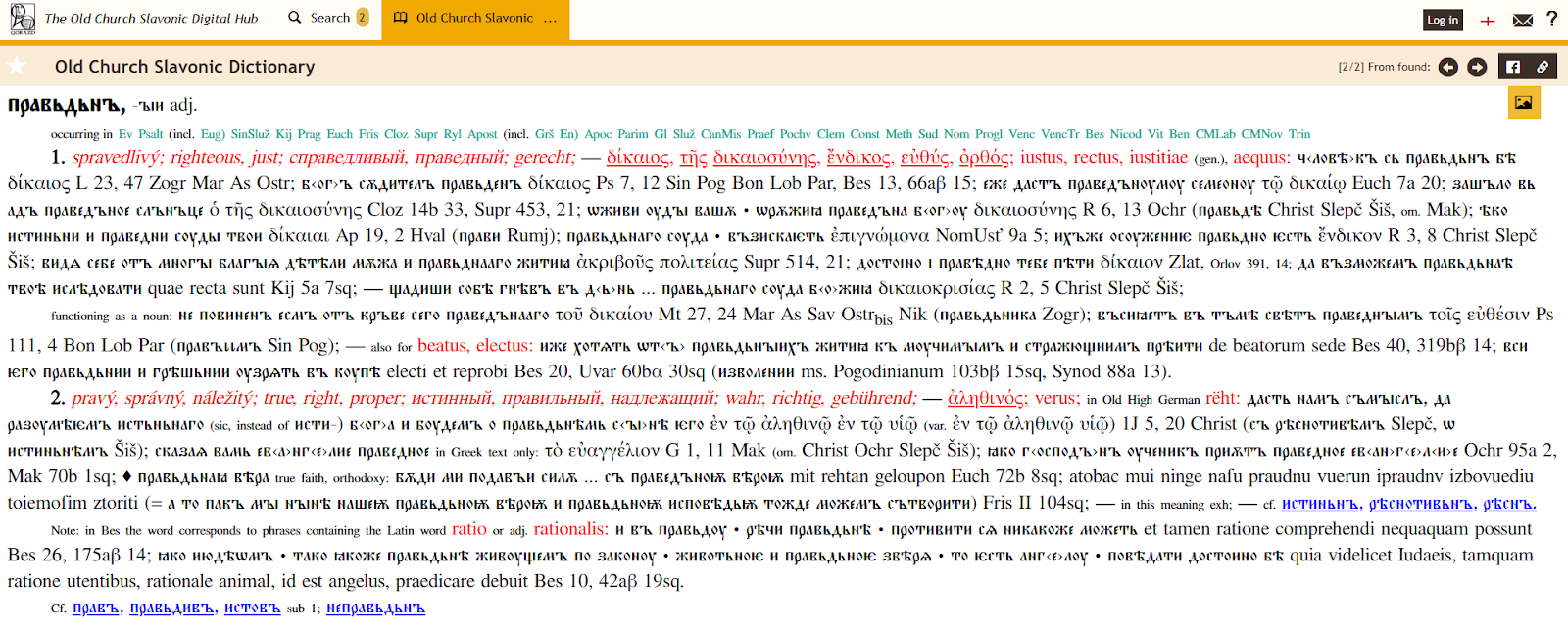
Old Church Slavonic - Revelation 16:5

The OCS Apocalypse apparently goes back to Methodius' translation in 885 (link to source), however the oldest manuscripts may only be from the 14th century (link to source).

I was able to find a printed OCS text beautifully typeset, which had the following text:

(p. 2683/2696)

My own translation is this:

And I heard the angel of the waters say: righteous you are, O Lord, [the] being [one] and which was, and holy, because thus judged you:

(both instances of "you" are singular) 

A corresponding transliteration of the OCS to modern Russian (Cyrillic) letters is this:
  
И слышах Ангела воднаго глаголюща: праведен еси, Господи, сый и Иже бе, и преподобн, яко сия судил еси: (source)(Step Bible offers here as the 1757 Church Slavonic Elizabeth Bible)

The word "преподобн" is an OCS word used to translate hosios. So, in terms of being an additional confirmation of the pre-Bezean form of the text, the OCS seems to be fairly mainstream.  Unfortunately, however, I do not know how critical this printed text is, and whether, as Metzger (p. 430) suggests, it was influenced by Latin at an early (9th or 10th century) stage.  It is even possible that the printed OCS text I located was amended to align with an early printed Greek text.      

H.T. "Base form dictionary"

H.T. Slavonic Titlo

H.T. Slavonic conjugation of "to be"

H.T. Dictionary of the Oldest Old Church Slavonic Manuscripts:


Wednesday, February 05, 2025

Armenian version at Revelation 16:5

The Armenian alphabet was apparently invented in AD 405 by Mesrop Mashtots and Isaac of Armenia for the purpose of having a written language into which to translate Scripture.  The translation was apparently initially made from Syriac and then subsequently retranslated Greek. (The Heritage of Armenian Literature) (further thoughts on the Armenian version here)  

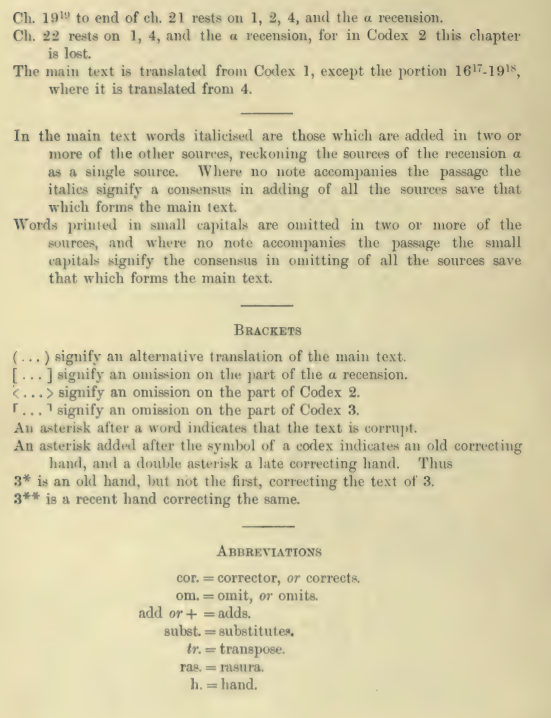
In 1907, the Text and Translation Society published Frederick Cornwallis Conybeare's critical edition of the Armenian translated into English. Below, I've transcribed the text he offers (as well as his marginal readings), followed by images of the transcribed text and images of the explanation of the apparatus.

For us, Conybeare's work is useful, even despite  

5    And I heard from the angel of the waters that he said, Righteous is he which exists and holy. For thus he hath judged. 

5    of the waters] 2 4——that he] who a——Righteous art thou, the existent, thy existent, thou holy, for this hast thou judged 4——exists and which is, holy 2: exists and is and holy 3 (holy over a rasura of alone): exists and is and holy in his works a

5    Եւ լուայ ի հրեշտակէն զի ասէր, արդար է որ էնն և սբ. զի այն. պէս դատեցաւ։ 

Proposed 

  • Եւ (yev) – "And"
  • լուայ (luay) – "I heard"
  • ի հրեշտակէն (i hreshdaken) – "from the angel"
  • զի (zi) – "that" (introducing indirect speech)
  • ասէր (aser) – "he said" (imperfect)
  • արդար է (ardar e) – "righteous is"
  • որ (vor) – "who"
  • էնն (enn) – "is" (a form of "to be")
  • և (yev) – "and"
  • սբ. (sb.) – "holy" (abbreviation for "սուրբ")
  • զի (zi) – "because"
  • այն. (ayn.) – "thus" (possibly an abbreviation for "այնպէս")
  • պէս դատեցաւ (pes datets’av) – "thus was judged" (passive form of "judge")
My main conclusions from this are as follows. The Armenian is opposed to Beza's emendation of the text.  Additionally, it seems that the Armenian translators struggled in how to accurately capture the meaning of "the being one and the has been." As an interesting point, the text (at least as presented by Conybeare) seems to employ an abbreviation of the word for holy.  This is only interesting by way of coincidence in view of the 21st century theory that "holy" may itself have been intended as an abbreviation for something else.   


Monday, February 03, 2025

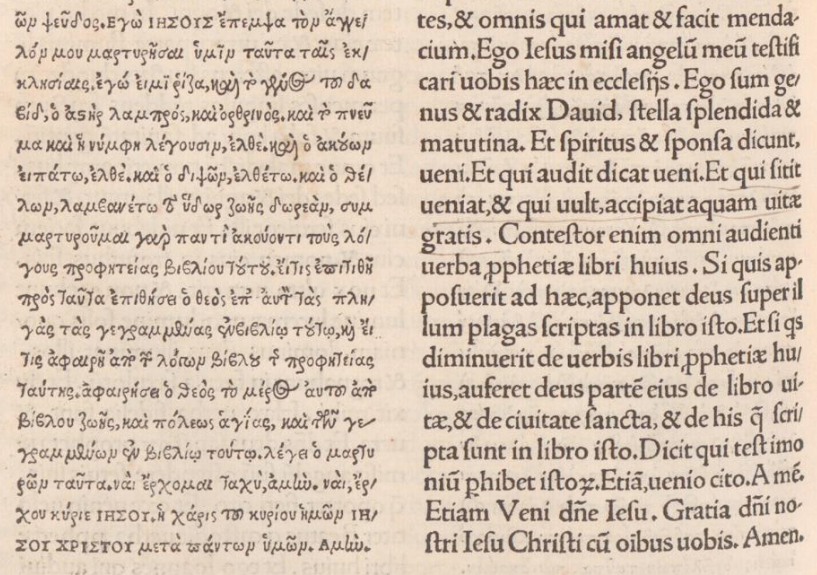
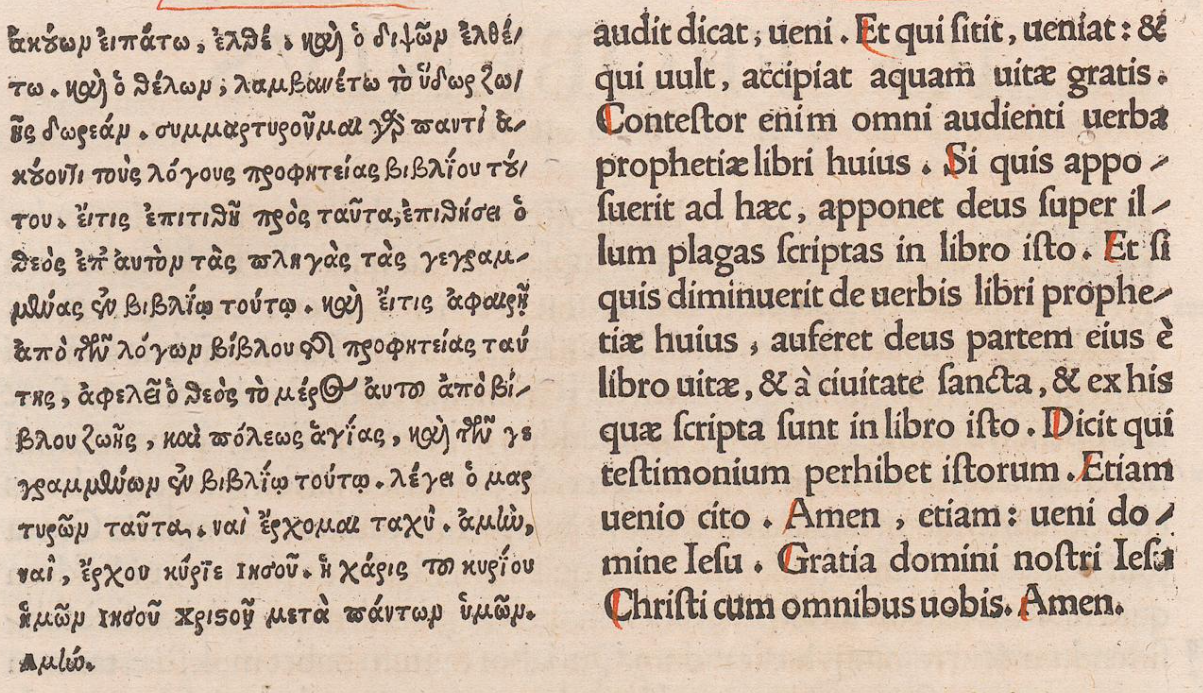
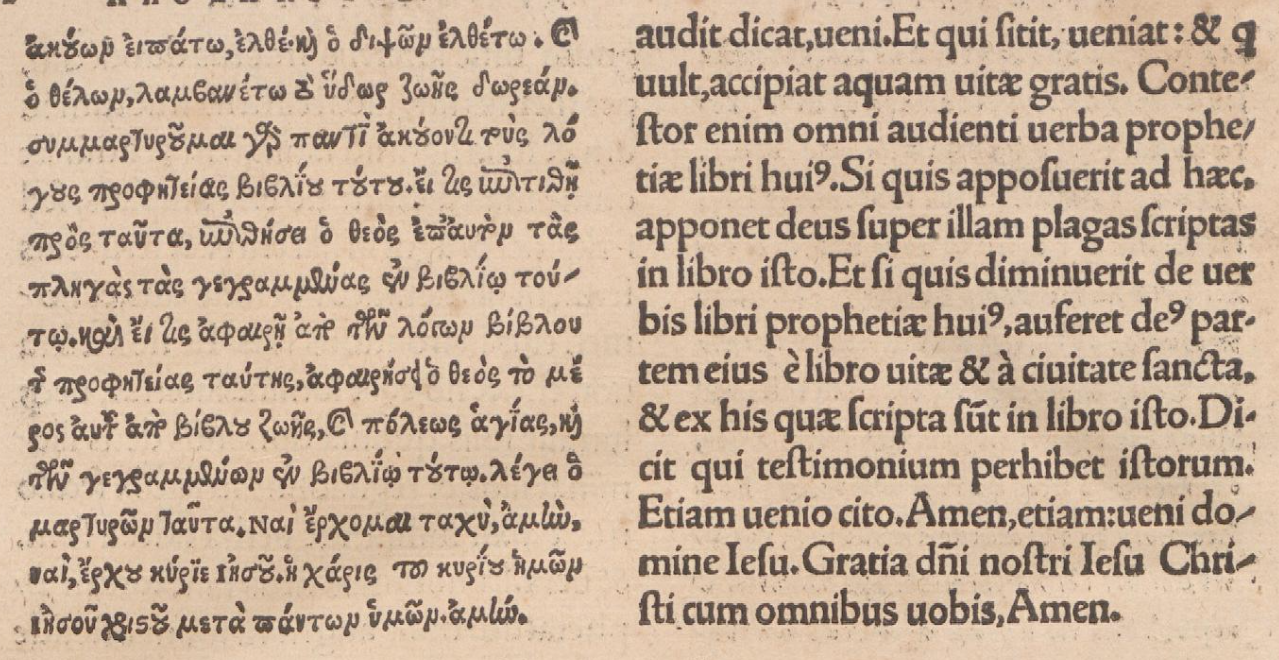
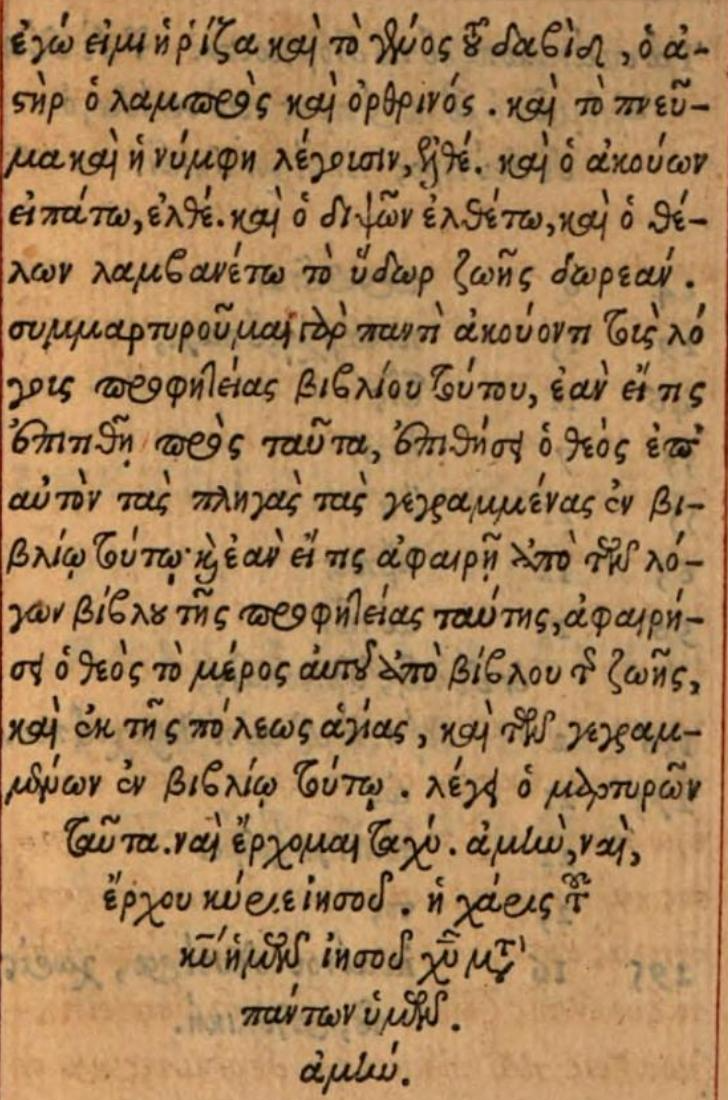
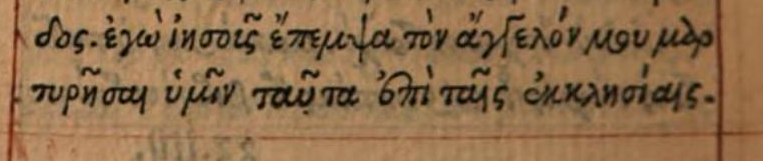
Revelation 22:16-22 in the various editions of Erasmus

The last six verses of Revelation 22 have been the topic of criticism (or praise) of Erasmus' work because apparently Erasmus' only manuscript of Revelation (GA 2814) was missing the last six verses (see the discussion from Pastor Jeffrey Stivason, here). 

The usual explanation is that Erasmus, being knowledgeable in Greek, back translated the final six verse of Revelation 22 from the Vulgate Latin.

I plan to update this page as time permits.  However, for now I want to provide the five editions of Erasmus (including Greek and Latin) for the passage in question, as well as the four editions of Stephanus (only one of which includes Latin).

(1516, image 584)
(1519, image 690)
(1519, p. 565, image 691)
(1522, p. 561, image 633)
(1522, p. 562, image 634)
(1527, p. 545, image 597)
(1535, p. 429, image 477)
H.T. to Jan Krans for this helpful list of online editions of Erasmus (link).


(1546, p. 360)
(1546, p. 361)
(1549, p. 360)
(1549, p. 361)
(1550, p. 202)
(1551, p. 312r)
(1551, p. 312v)

H.T. also to Jan Krans for this helpful list of online editions of Stephanus (link).