Showing posts with label Jan Krans. Show all posts

Monday, February 03, 2025

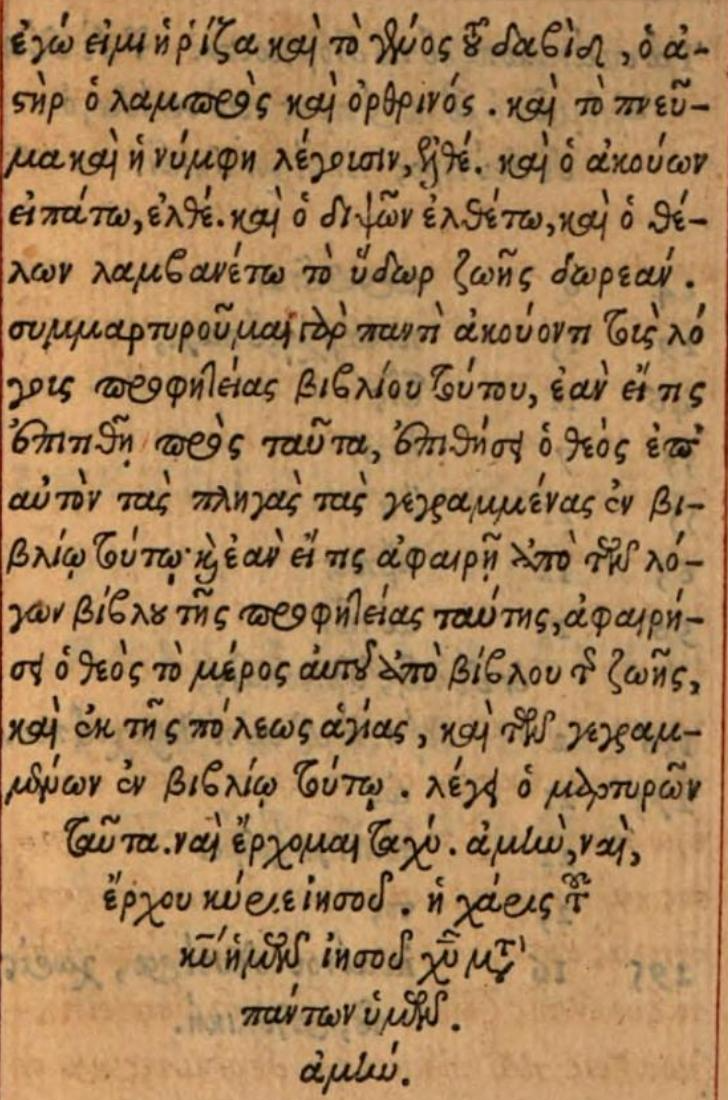
Revelation 22:16-22 in the various editions of Erasmus

The last six verses of Revelation 22 have been the topic of criticism (or praise) of Erasmus' work because apparently Erasmus' only manuscript of Revelation (GA 2814) was missing the last six verses (see the discussion from Pastor Jeffrey Stivason, here). 

The usual explanation is that Erasmus, being knowledgeable in Greek, back translated the final six verse of Revelation 22 from the Vulgate Latin.

I plan to update this page as time permits.  However, for now I want to provide the five editions of Erasmus (including Greek and Latin) for the passage in question, as well as the four editions of Stephanus (only one of which includes Latin).

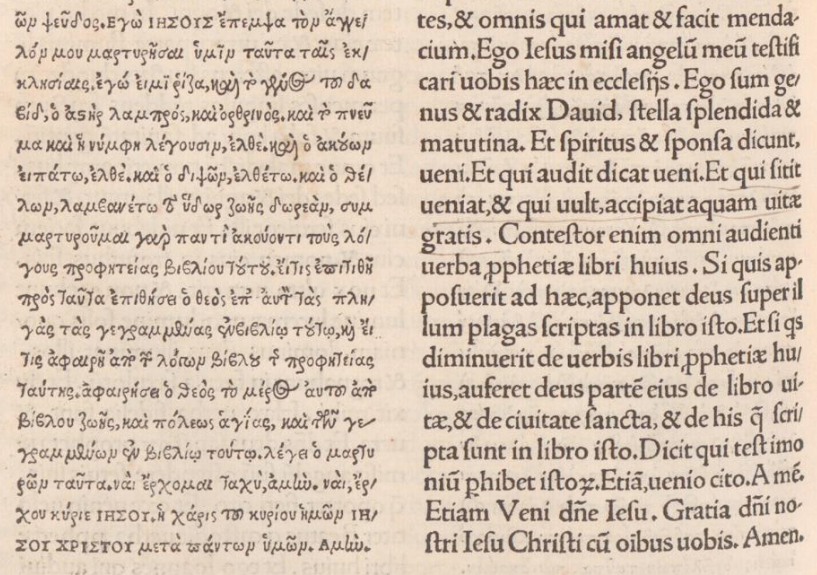
(1516, image 584)
(1519, image 690)
(1519, p. 565, image 691)
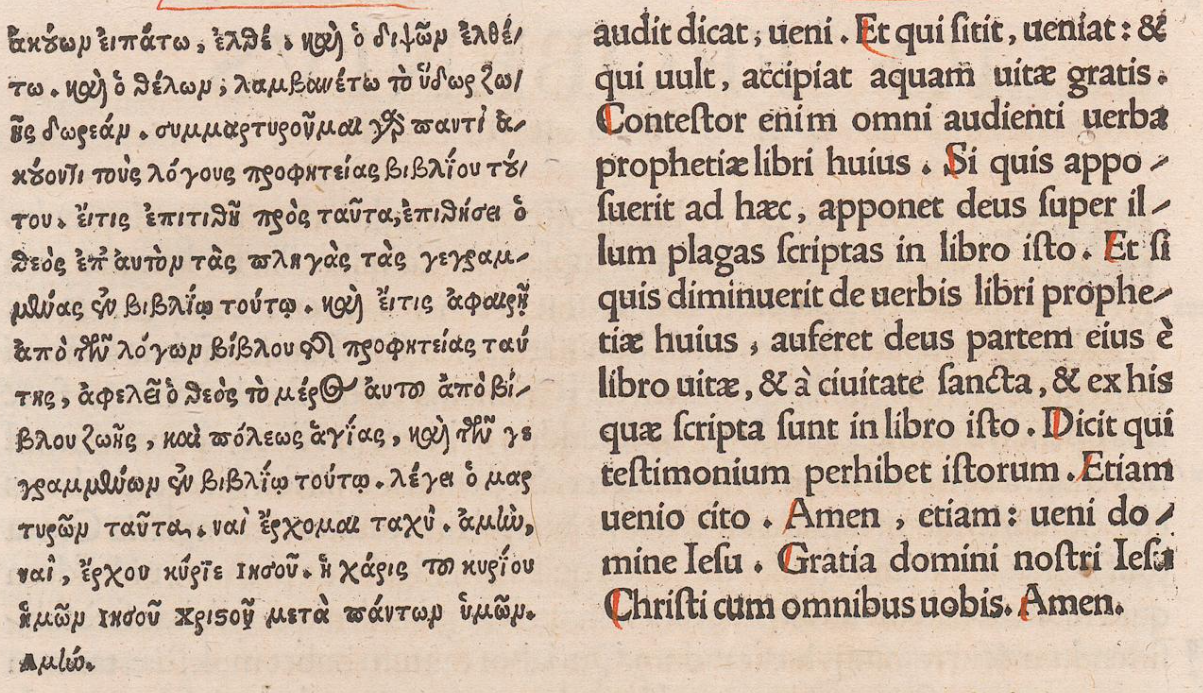
(1522, p. 561, image 633)
(1522, p. 562, image 634)
(1527, p. 545, image 597)
(1535, p. 429, image 477)
H.T. to Jan Krans for this helpful list of online editions of Erasmus (link).


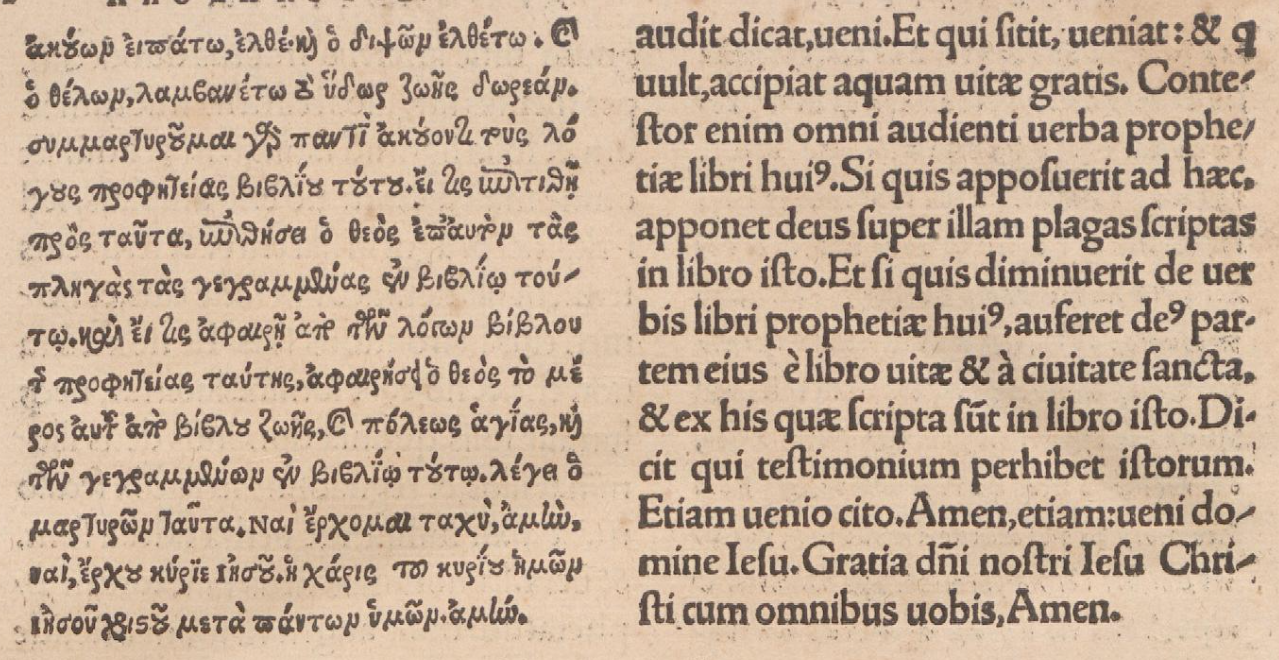
(1546, p. 360)
(1546, p. 361)
(1549, p. 360)
(1549, p. 361)
(1550, p. 202)
(1551, p. 312r)
(1551, p. 312v)

H.T. also to Jan Krans for this helpful list of online editions of Stephanus (link).

Monday, December 02, 2024

Jan Krans on Beza's Emendation of Revelation 16:5

Dr. Jan Krans, who has provided the definitive treatment of conjectural emendation by Erasmus and  Beza, provided an article on conjectural emendation as it relates to Revelation in the Editio Critica Maior of Revelation (VI/3.1, pp. 419-20).  In this article, Dr. Krans addresses Beza and Revelation 16:5.  The following is my own English translation of Krans' German original (the translation has not been approved in any way by Dr. Krans, and I have omitted the two footnotes for this section of the text):

A fairly famous case that I did not mention in my 2006 doctoral thesis is Revelation 16:5. Here, in his third edition (1582), Beza replaced ὁ ὅσιος with ὁ ἐσόμενος, even in his Greek text and in his translation, not just in his Annotations. At the time, I thought that the reading ὁ ἐσόμενος was not a conjecture, because Beza himself said that he knew of an old manuscript with this reading. But now I know that in all probability such a manuscript does not exist and never has existed. As we will see, it is quite possible that Beza deceived himself as well as everyone else. Let us first take a closer look at Beza's remark:

"And he will be, καὶ ὁ ἐσόμενος. Usually καὶ ὁ ὅσιος is read, but the article is contrary to all rules of language and shows that the reading is corrupt. The Vulgate, whether it reads the article or not, has by no means a more correct "Sanctus" ("holy"), ὅσιος, whereby the particle καί is wrongly omitted, although it is necessary to connect δίκαιος and ὅσιος. But as we said above on Rev. 1:4, John was accustomed to add a third element in all other places where he extended the name of Jehovah, namely ὁ ἐρχόμενος. Why then would he have omitted this in this place? Therefore I cannot doubt that the original reading is the one which I have restored on the basis of an ancient and reliable manuscript, namely ὁ ἐσόμενος. Here is not ὁ ἐρχόμενος, as in the four places above (1:4, 1:8, 4:8 and 11:17), probably for the reason that there it is Christ as the coming judge, while in this vision is presented as already sitting on the judge's seat and delivering legal orders. "

Beza here presents several arguments to change the reading. It is clear, however, that this is different from earlier passages, such as in Revelation 1:4. The reason for his conjecture is thus given: the author of the Apocalypse seems to be inconsistent, because otherwise the expression ὁ ὢν καὶ ὁ ἦν is always ended by ὁ ἐρχόμενος. This pattern is restored by Beza, and at the same time changed, for the sake of context, for his conjecture here has ἐσόμενος instead of this ἐρχόμενος, because Christ in the previous passages (Rev 1:4,8; 4:8; 11:17) was the coming judge, but now already sits on the judgment seat.

But what about the "old and reliable manuscript" to which Beza refers? I do not claim to have solved the riddle, but I will make a suggestion for a possible sequence of events. It is fortunate that the hand copy of his second edition from 1565, which Beza used during the preparation of the third edition (1582), has survived. There are only a few entries in the Apocalypse, but here in Revelation 16:5 Beza has underlined ὁ ὅσιος and written in the margin ὁ ἐσόμενος, i.e. his conjecture, but nothing more. A similar entry can be found in Revelation 1:4, where he has underlined τοῦ and noted in the margin "In vetusto c[odice] legatur θεοῦ", "In an old manuscript it says θεοῦ." The difference is that here it is already explicitly a manuscript was mentioned, although Beza, in characteristic fashion, does not care which manuscript is meant. What I now suspect - also a kind of conjecture - is the following: In Revelation 16:5, Beza added ὁ ἐσόμενος early on, not from a manuscript, perhaps not even as a conjecture, but as the reading he would have expected, according to the pattern described above. Later, let us say when preparing the third edition for printing itself, i.e. around 1582, he simply forgot where this ὁ ἐσόμενος came from, and, following the example of Revelation 1:4, assumed that it was the same "old and [now because he liked the reading] reliable manuscript". This alone can explain why Beza referred to a manuscript that in all probability never existed. 

Had Beza known that ὁ ἐσόμενος was actually nothing more than his own guess (or exegetical remark), he would probably never have included the reading in his text. There is a certain irony to the whole story. Be that as it may, one can see here again the expectation of coherence and its devastating effect. The case is well known because it plays a role in the ongoing discussion on the Internet about the King James Version and the Textus Receptus (comparable to that about Erasmus and the conclusion of the Apocalypse). "O Beza, why did you do that?" asks one person. A question to which, in my opinion, there is only one answer: so that future generations can be left with a clear, all too clear example of the historical contingency of the Textus Receptus.

I tend to agree with Dr. Krans' analysis.  The reading "θεοῦ" is a variant found in Stephanus' margin.  We have good reason to believe that Beza had access to Stephanus' textual apparatus as it appears in the 1550 edition.  It is also believed that Beza may have had access to a more detailed unpublished apparatus prepared by Henri Stephanus.  

Stephanus identifies the manuscript in question as 15(ιε), namely GA 82, a tenth century miniscule.


GA 82 is available online.  The relevant portion of the manuscript is this:

GA 82 differs slightly from the text of Beza (pre-1582) in terms of having "ο ων. και ος ην οσιος(INTF transcription).  Similarly, GA 82 differs from the main text of the Stephanus 1550.

Stephanus' margin does note a variant at Revelation 16:5 and points to the same manuscript: 15(ιε), namely GA 82.  In this case, though, I believe Stephanus intended to direct the reader to the fact that GA 82 does not insert "Lord" into the text.  

Of course, it is possible that Henri Stephanus' more complete apparatus (assuming this in fact existed and that Beza had it) may have mentioned the absence of the "και ο" before the "οσιος".  These are details that Beza's explanation aims to address, at least in part.

That leaves the question of whether possibly Henri Stephanus himself in his more complete apparatus suggested the conjectural emendation adopted by Beza.  We must admit, however, that this is simply speculation, as the more complete apparatus (if it existed) seems to have been lost to time.

Based on my reading of Dr. Krans' thesis, I believe it would be accurate to say that Beza generally only identified the two codices in his possession: Codex Claromontanus and Codex Bezae Cantabrigiensis. Neither of these manuscripts includes Revelation.  

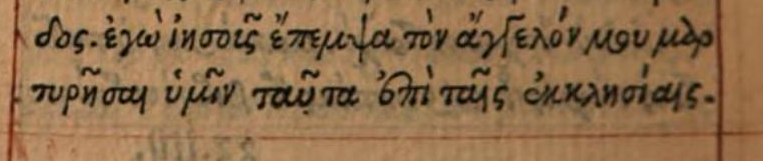
I don't think Dr. Krans' take is too harsh, namely that Beza did not particularly care which manuscript had a given reading.  So, it makes sense that his handwritten notes mention a manuscript, but not which manuscript (the note referenced by Dr. Krans at Revelation 1:4 is reproduced below):


Whether Beza was then tripped up by the excessive brevity of his note at Revelation 16:5 (reproduced below) or whether Beza misread the notes of Henri Stephanus, we may never know.

It was interesting to note that Dr. Krans had not included Revelation 16:5 in his thesis because Beza asserted he had based his change on a manuscript.  What seems inescapable, however, is that Beza seems to have been wrong in that claim.  As we have no reason to think Beza a liar, we must conclude that he came to this error honestly. 

Update note: Updated 12/3/2024 to correct "co-expectation of heresy" (which was my mistranslation) with "expectation of coherence". 

Tuesday, November 14, 2023

Beza's Sources as it relates to Revelation 16:5

Jan Krans devoted two appendices of Beyond What is Written to the identification of the Greek manuscripts and editions used by Erasmus (Appendix One) and the Manuscripts used in Stephanus' third edition (1550)(Appendix Two).  At p. 206, Krans begins section 8.3 "Beza's Sources" thus:

1. Stephanus' 1551 edition at Revelation 16:5 has (link):


2. Stephanus' 1550 edition at Revelation 16:5 has (link):


3. The Complutensian Polyglot (printed 1514-1517, pub. 1520), referenced by Stephanus' 1550 has (link): 


You will notice that the difference is the inclusion/omission of the word for "Lord."

4. Coline's 1534 Greek NT (also called Colinaeus) is another possible source for Beza (link), although it appears to align with the Erasmus text in Revelation (Krans mentions it briefly at p. 147 in an unrelated section of Beyond What is Written):


6. Aldine 1518 Greek NT is also a possible source for Beza (link), but this appears simply to repeat the Erasmus Greek text, and is somewhat harder to use, in view of the absence of chapter marks.


At p. 207, Krans goes on to identify "Froben's edition" (probably the 1535 edition of Erasmus' NT or Volume VI of the 1540 Opera Omnia) and to "Greek scholia," which refers to Bernardus Donatus' 1532 edition.  

7. Erasmus' 1535 NT (link to page) at Revelation 16:5


8. Erasmus' 1535 Annotations (link to page) at Revelation 1:4


9. Erasmus' 1535 Annotations (link to page) at Revelation 16:5


10. Bernardus Donatus' 1532 edition, (Exegeseis palaiai kai lianophelimoi brachulogian te sapheneian... Expositiones antiquae ac valde vtiles breuitatem vna cum perspicuitate habentes mirabilem, ex diuersis sanctorum patrum commentariis ab Oecumenio et Aretha collectae in hosce noui testamenti tractatus. Oecumenii quidem In Acta Apostolorum. In septem epistolas quae Catholicae dicuntur. In Pauli omnes. Arethae vero In Ioannis Apocalypsim By Oecumenius de Tricca, Donato (aka Bernardus Donatus) · 1532) was one of the sources that Beza relies on.  The edition includes, corresponding to Revelation, a commentary identified as being of Arethas.  Bernardus Donatus' 1532 text from patristic sources including the "Arethas" commentary on the Apocalypse, has (both in the text and the commentary): 


11. Erasmus, Opera Omnia (1540), Vol. 6, New Testament at Revelation 16:5 (p. 421

12. Erasmus, Opera Omnia (1540), Vol. 6, Annotations at Revelation 1:4 (p. 777)


13. Erasmus, Opera Omnia (1540), Vol. 6, Annotations at Revelation 16:5 (p. 781)


Response to Castellio (1563) (Responsio ad defensiones et reprehensiones Sebastiani Castellionis, (etc.) By Theodore de Beze · 1563).  According to Krans (Beyond What is Written, p. 195), Beza aimed to provide a better Latin translation than either Erasmus or Castellio.  Beza's Response to Castellio's work includes an interesting comment on Passover (relevant to the Easter discussion that Nick Sayers and I had):

There were a few places where Revelation came up in the Response, but nothing significant and nothing clearly pertinent to Revelation 16:5.

14. Castellio's Latin Bible (published in Basle by Oporinus in 1551) has  (Testamentum novum, interpr. Sebastiano Castalione, 1551, at Rev. 16:5):

... Iustus es, Domine, qui es, quinque fuisti, quique augustus es, qui haec ita facienda iudicaveris ... 

Beza also relied on editions of Tremelius (Syriac) and Junius (Arabic). Krans, p. 208, says:


15. Tremelius' 1569 (first volume: available here), has the following at Revelation 16:5:


Why is there no Syriac here? Presumably because the Peshitta does not include Revelation.

Junius (who assisted Tremellius and married his daughter) provided comments on Revelation, but they seem to have been published in 1591, and the Greek text seems to follow Beza without additional comment on the textual issue. His Acts of the Apostles translation, however, was available sooner (link to a copy here).

16. David Chytraus (1563). I don't recall Beza specifically mentioning David Chytraus, but he was a notable enough Lutheran (one of the authors of the Formula of Concord) that one would assume that Beza would be interested to read his work. As you can see from the following excerpt from his Revelation commentary Chytraus was viewing the name of God given in Revelation 1:4 as related to YHWH and as involving the past, present, and future.


(Explicatio apocalypsis Johannis perspicua & brevis By David Chyträus · 1563) (see also, Chytraus' Exodus commentary at Exodus 3:14)

Of course, I mention this Lutheran writer as merely one example of a pre-1582 view that is similar to the underlying argument that Beza used.

Beza did have, as Krans acknowledges (p. 208) "a rather large scholarly network." Krans identifies (pp. 208-10 the following scholars as folks that Beza appears to have consulted regarding his New Testament (not specifically Revelation 16:5): Calvin, Joachim Camerarius, Pierre Pithou (who lent him an old manuscript, that Krans thinks is Codex Claramontanus), Patricius Junius, Johannes Grynaeus, Girolamo Zanchi, Meletius Pigas, Johannes Piscator (mentioned in the fourth and fifth edition prefaces), Johannes Drusius (mentioned in the fourth edition preface), Tussanus Berchetus (fifth edition preface), Corenlius Bertram (mentioned in the annotations at Acts 7:14), Matthaeus Beroaldus (Annotations at Acts 13:20), Isaac Casaubon (annotations Mark 5:38). 

Irena Backus, "The Reformed Roots of the English New Testament," pp. 2-3, provides some discussion of Beza's sources, according to Beza himself.  The 1598 edition of Beza contains a dedicatory epistle to Queen Elizabeth I and a preface to the Christian reader.  Backus informus: "in the the epistle Beza says that, as well as referring to the works of his contemporaries and Greek and Latin fathers (all of which he diligently collated), he also had access to an 'exemplar' from the library of Robert Stephanus. This 'exemplar' had been collated by Henri Stephanus (Robert's son) with 'more or less' twenty-five Greek MSS and nearly all the printed versions. Beza says that this 'exemplar' provided the sole source for his minuscule MS variants." (pp. 2-3, endnote omitted) Backus tells us that in the preface to the Christian reader, "Beza is more specific stating that he referred to nineteen ancient MSS." (p. 3).

Backus identifies the first three of Beza's nineteen as being D, D*, and the 'versio Arabica'.  Backus then indicates that Beza's other 16 were the 16 identified by number in Stephanus' edition.


Jacques Lefèvre d'Étaples French New Testament · 1523 (link to page) via a 1600's reproduction, apparently:


Appendix I: Estienne and Textual Criticism

Henri Estienne was not only a printer of the Bible, but of other works as well.  


(Joseph Scaliger, a Study in the History of Classical Scholarship, by Anthony Grafton, pp. 86-97)

As may be gleaned from the above, Estienne has an interest in textual criticism, but not necessarily a bondage to the manuscripts as such, at least not when it came to non-biblical literature, like Aeschylus.

Appendix II: Erasmus' Manuscripts

There are eight "undisputed" manuscripts used by Erasmus.

In addition to these eight, various others have been proposed
("Structure and History of the Biblical Manuscripts Used by Erasmus for His 1516 Edition," p. 84)

("Structure and History of the Biblical Manuscripts Used by Erasmus for His 1516 Edition," p. 85)

I realize it is popular in certain pro-TR circles to speculate that Erasmus had access to and used many other manuscripts beside these, but I think it's worth noting what the study of history has shown so far.

Appendix III:

(Collected Works of Erasmus, vol. 41, Palpable and Unpardonable Solecisms Perpetrated by the Translator, a Few Examples out of a Great Many, pp. 882-3) 

[44] Revelation, chapter 1:4. There is a quite extraordinary solecism in the Greek text ἀπὸ τοῦ ὁ ὢν καὶ ὁ ἦν καὶ ὁ ἐρχόμενος [‘from him who is, and was, and is to come’]. For how can ὁ ὤν be construed with the preceding ἀπό? Second, what possible meaning has ὁ ἦν? Then, how does ὁ ἐρχόμενος square with ἀπὸ τοῦ? Let those who think the Apocalypse was written by John deny, if they will, that the apostles ever spoke bad Greek! For this is the view of certain people, the defenders of the apostles.[FN22]
[FN22] Erasmus held that the apostles learned their Greek from contemporary speech, a form of the language corrupted by popular and vernacular influences. The contrary view, that the apostles were inspired by the Holy Spirit and therefore could not write bad Greek, was expressed, for example, by Eck (Ep 769:69–92), claiming to speak for the majority opinion; cf Translator’s Note to ‘Solecisms’ n3. For the controversy see Ep 844:63–108, and the annotations on Matt 2:6 (et tu Bethlehem) and on Acts 10:38 (quomodo unxit eum); also López Zúñiga Assertio E 3V–F 1r (Rome 1524).