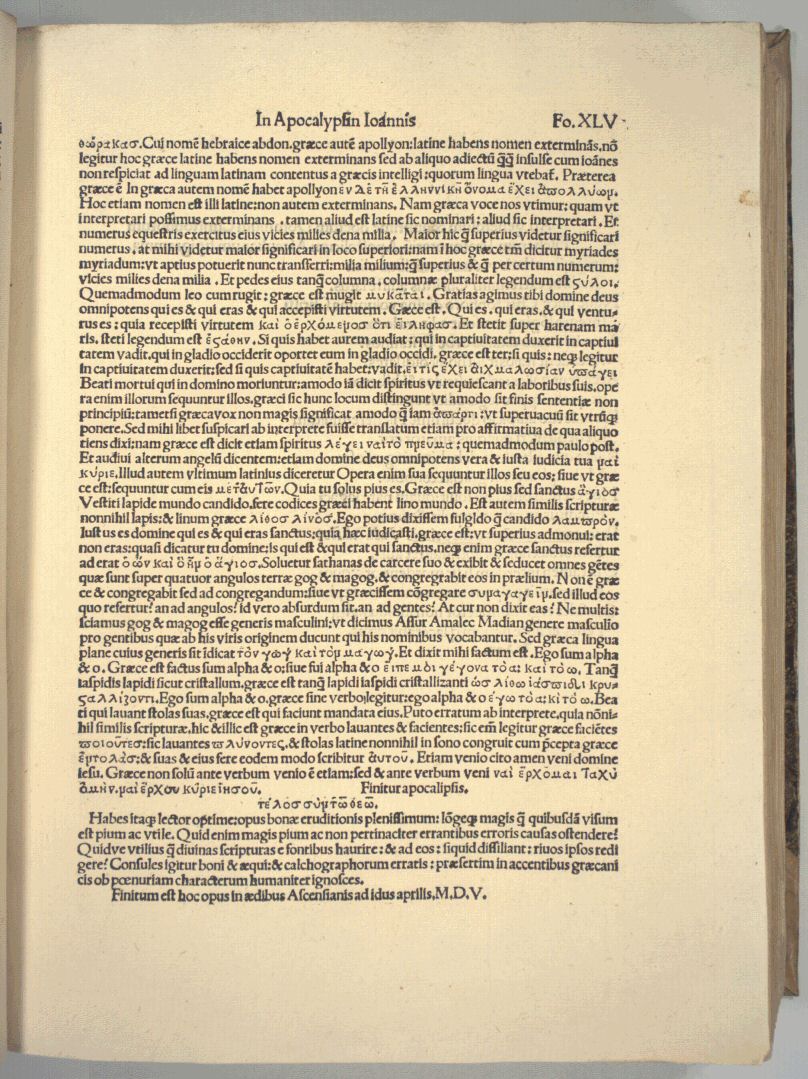
The final two pages of Erasmus' annotations on Revelation from his 1516 printing of the New Testament contain the following comments about the text:


EX CAPITE XIII
From Chapter 13
Et admirata est universa terra post bestiam.) καὶ ἐθαυμάσθη ἐν ὅλῃ τῇ γῇ ὀπίσω τῷ θηρίου, id est admiratio fuit in tota terra post bestiam.
“And all the earth wondered after the beast.” καὶ ἐθαυμάσθη ἐν ὅλῃ τῇ γῇ ὀπίσω τῷ θηρίου That is, “there was wonder in the whole earth after the beast.”
Qui in captivitatem duxerit.) εἴ τις αἰχμαλωσίαν συνάγει, εἰς αἰχμαλωσίαν ὑπάγει. i. qui captivitatem contrahit, in captivitatem abit. Laurentius secus legit.
“He who will have led into captivity.” εἴ τις αἰχμαλωσίαν συνάγει, εἰς αἰχμαλωσίαν ὑπάγει. That is, “he who gathers captivity goes away into captivity.” That is, “he who draws together captivity goes into captivity.” Laurentius reads otherwise.
TF note: Laurentius here refers to Lorenzo Valla. Valla's annotation on this point reads:

Thus, Valla's Greek text (as reported) had an ἔχει before αἰχμαλωσίαν, which is certainly different.
Continuing with Erasmus:Characterem in dextra.) χάραγμα, id est notam impressam, sive insculptam.
“The mark in the right hand.” χάραγμα, that is, an impressed mark, or an engraved one.
EX CAPITE XIIII
From Chapter 14
Quod mixtum est mero.) τοῦ κεκερασμένου ἀκράτου; ut mero sit ablativi casus, et referatur ad vino. Nam Graecis κεράννυσθαι dicitur, quod infunditur in calicem bibituro, etiam si non diluatur aqua, aut alio potus genere.
“That which is mixed with pure wine.” τοῦ κεκερασμένου ἀκράτου; Thus, “with pure” [TF note: lit. in Latin the word "mero" sometimes means "unmixed" (pure from admixture with water or other dilutants) with reference to wine, leading to an odd paradox that the mixed wine is unmixed.] is an ablative case and refers to “wine.” For among the Greeks to mix is said of what is poured into the cup for the one about to drink, even if it is not diluted with water or with another kind of drink.
Amodo iam dicit spiritus.) Graeci sic distinguunt, ut amodo sit finis sententiae, ut sit sensus post hac fore beatos qui in domino fuerint mortui. Deinde sequitur ναὶ λέγει τὸ πνεῦμα. Etiam dicit spiritus. Et hic etiam confirmantis est.
“From now on, now says the Spirit.” The Greeks punctuate thus: that “from now on” is the end of the sentence, so that the sense is that thereafter those who have died in the Lord will be blessed. Then follows, “Yes, says the Spirit.” And here “yes” is also a word of one confirming. [TF note: In Latin, etiam can have the sense of "yes/actually" (as it does here] as well as "and also". This explains Erasmus' felt need to explain what sense of etiam he means. I can't think of a good English word that has a similar ambiguity to better translate Erasmus here.]
In lacum irae dei.) ληνόν, qui est lacus, in quem exprimitur uvarum liquor.
“Into the lake of the wrath of God.” The Greek is ληνόν, which is a vat into which the liquid of grapes is pressed out.
EX CAPITE XV
From Chapter 15
Quia solus pius es.) ὅσιος. Laurentius legit ἅγιος, id est sanctus.
“Because you alone are pious.” ὅσιος Laurentius reads ἅγιος, that is, “holy.”
TF note: Lauentius here again refers to Valla. Valla's annotation on this point reads:

In other words, Valla claims that the Greek is ἅγιος, which contradicts what Erasmus found in his Greek manuscript.
Vestiri lapide mundo et candido.) Graece est λίνον, id est lino mundo. Interpres legisse videtur λίθον, quae dictio una duntaxat literula differt a lino. Et splendidum magis est quam candidum, λαμπρόν.
“To be clothed with a clean and white stone.” In Greek it is λίνον, that is, “with clean linen.” The translator seems to have read λίθον [TF: lit. “stone”], a word which differs by only one little letter from “linen.” And it [TF: lit. “bright"] is more splendid than gleaming white [TF: translating "candidum" as "gleaming white" which seems to be an approximate synonym for the Greek word, so I don't know if Erasmus means to use the Greek word as appositive for candidum or if Erasmus is saying that the Latin word doesn't capture the true splendor, though I suspect the latter.], λαμπρόν.
EX CAPITE XVI
From Chapter 16
Vulnus saevum ac pessimum.) κακὸν καὶ πονηρόν. i. malum ac malum; Graece enim bis idem dicitur. Nisi mavis miserum ac malum.
“A savage and very bad wound.” κακὸν καὶ πονηρόν. That is, “bad and bad,” for in Greek the same thing is said twice—unless you prefer “wretched and bad.”
Qui es, et qui eras.) Quamquam interpres mutavit personam, tamen totidem syllabis dictum est, quibus superius: qui est, qui erat, qui venturus est, ὁ ὢν, ὁ ἦν, ὁ ἐρχόμενος.
“You who are, and who were.” Although the translator changed the person [TF: that is, from third person "he is" to second person "you are".], nevertheless it is said with just as many syllables as above: “who is, who was, who is to come,” ὁ ὢν, ὁ ἦν, ὁ ἐρχόμενος.
Etiam domine.) ναὶ κύριε. Etiam confirmantis est.
“Even so, Lord.” ναὶ κύριε. “Yes” is again a word of one confirming. [TF: see note above regarding etiam.]
Grando magna sicut talentum.) ὡς ταλαντιαία. i. talentaris et magnitudine talenti. Talentum magnum antiquis dicebatur, unde quicquid ingens esset, id ταλαντιαῖον vocabant.
“Great hail as a talent.” ὡς ταλαντιαία. That is, of a talent, and of the size of a talent. A great weight was called by the ancients a talent; hence whatever was huge, they called talent-like. [TF: Without commenting Erasmus' more general usage point, from Josephus and other ancient sources (source) we find a meaning of talent as a unit of weight of approximately 120 lbs. The main point that this hail is being described as huge, is surely correct, whether John means a literal unit of measurement or not.]
EX CAPITE XVII
From Chapter 17
Supra bestiam coccineam.) κόκκινον, id est coccinam, purpuram regiam indicans.
“Upon the scarlet beast.” κόκκινον, that is, scarlet-colored, indicating royal purple.
Et hic est sensus.) ὧδε ὁ νοῦς. i. haec est mens, sive intellectus.
“And here is the sense.” ὧδε ὁ νοῦς. That is, “this is the meaning,” or “understanding.”
EX CAPITE XVIII
From Chapter 18
Et in delitiis fuit.) καὶ ἐστρηνίασε, idem verbum, quo composito usus est Paulus in epistola ad Corinthios. Cum autem luxuriatae fuerint in Christo, volunt nubere; de quo pluribus suo dictum est loco. Item paulo post, οἱ στρηνιάσαντες, i. et lascivierunt.
“And she was in delights.” καὶ ἐστρηνίασε, this is the same word of which Paul used a compound in the epistle to the Corinthians: “When they have become wanton in Christ, they wish to marry” [TF note: I assume that Erasmus is referring to 1 Timothy 5:11, which in the TR has καταστρηνιάσωσιν "they have begun to wax wanton against" - presumably Erasmus is simply making an error of memory, thinking of the passage on marriage in 1 Corinthians 7, and conflating the admonition from 1 Timothy 5:11 with the "better to marry than to burn" in 1 Corinthians 7:9] ; concerning which more was said in its own place. Likewise a little later, οἱ στρηνιάσαντες that is, “and they acted wantonly.”
Lignum tinium.) θύϊνον.
Wood of the Laurustinus. θύϊνον.
Et similae.) καὶ σεμίδαλιν.
“And fine flour.” καὶ σεμίδαλιν.
Lapidem molarem magnum.) λίθον ὡς μύλον, id est lapide tanquam molam.
“A great millstone.” λίθον ὡς μύλον that is, “a stone as though a millstone.” [TF note: I'm not sure if Erasmus here means molam to mean mill or millstone, but I've assumed the latter.]
Hoc impetu mittetur.) οὕτως ὁρμήματι βληθήσεται, id est impetu mittetur.
“With this impulse it will be thrown.” οὕτως ὁρμήματι βληθήσεται, that is, “it will be thrown with force.”
EX CAPITE XIX
From Chapter 19
Quasi vocem magnam tubarum multarum.) ἤκουσα φωνὴν ὄχλου πολλοῦ. i. audivi vocem turbae multae. Proinde consentaneum est interpretem scripsisse turbarum, non tubarum.
“As a great voice of many trumpets.” ἤκουσα φωνὴν ὄχλου πολλοῦ, that is, “I heard the voice of a great multitude.” Therefore it is consistent that the translator wrote “of crowds,” not “of trumpets.” [TF note: I think Erasmus' point is that the original translator to Latin probably wrote "turbarum" (crowds/multitudes) not "tubarum" (trumpets), a difference of one letter in Latin.]
Alleluia.) Quod Hebraeis sonat, laudate dominum. Siquidem הללו laudate, et יה dominus. Ea vox crebra est in psalmis: laudate dominum.
“Alleluia.” In Hebrew this sounds: “Praise the Lord.” For hallelu (הללו) means “praise,” and Jah (יה) means “Lord.” This expression is frequent in the Psalms: “Praise the Lord.”
Vide ne feceris.) ὅρα μή. i. vide ne. Feceris addidit interpres, quo magis explanaret sententiam.
“See that you do not do it.” ὅρα μή that is, “see that not.” The translator added “do it” in order to explain the sentence more fully.
Et calcat torcular vini.) ληνόν, quod ante vertit lacum.
“And he treads the winepress of wine.” The Greek is ληνόν, which earlier he translated “lake.”
[TF: From Chapter 20 - For no obvious reason, Erasmus didn't bother to provide chapter section headings beyond Chapter 19, but I have added them for the reader's convenience.]
Gog et Magog.) Accusativus casus est utriusque et generis masculini, quod articulus Graecus declarat: τὸν Γὼγ καὶ τὸν Μαγώγ, sive pro hominibus accipienda sunt sive pro gente. Nec est congregabit, sed συναγαγεῖν, i. ad congregandum, aut ut congreget eos. Porro eos non refert ad angulos, aut gentes, sed ad Gog et Magog.
“Gog and Magog.” The case is accusative for both, and masculine in gender, which the Greek article shows: τὸν Γὼγ καὶ τὸν Μαγώγ, whether they are to be taken for men or for a people. Nor is it “he will gather,” but συναγαγεῖν that is, “for gathering,” or “so that he may gather them.” [TF note: literally συναγαγεῖν is an aorist active infinitive and the KJV renders with an infinitive, more similar to Erasmus' second option], Furthermore, “them” does not refer to the corners or to the nations, but to Gog and Magog. [TF: of course, if you agree with Erasmus about this, you will have to go with his view that Gog and Magog refer to nations, given what follows: "the number of whom is as the sand of the sea".]
[TF: From Chapter 21]
Ego sum alpha et ω.) γέγονα τὸ ἄλφα καὶ τὸ ὦ. Noster codex consentiebat cum vulgata horum temporum additione.
“I am Alpha and Omega.” γέγονα τὸ ἄλφα καὶ τὸ ὦ. Our manuscript agreed with the addition common in the edition of these times. [TF note: I am not sure what addition Erasmus has in mind here. My guess is that he means "the beginning and end," which is present here but not Revelation 1:8, where it was added.]
Iaspidi sicut crystallum.) κρυσταλλίζοντι, id est crystallizanti, ut referat ad lapidem.
“Jasper, like crystal.” κρυσταλλίζοντι that is, “shining like crystal,” so that it refers to the stone.
[TF: From Chapter 22]
Qui nocet noceat.) ὁ ἀδικῶν, id est qui male agit, sive qui iniustus. Et adhuc positum est pro amplius.
“He who harms, let him harm.” ὁ ἀδικῶν, that is, “he who acts badly,” or “he who is unjust.” And “still” is put for “further.”
Beati qui lavant stolas suas.) Longe aliud Graeci. μακάριοι οἱ ποιοῦντες τὰς ἐντολὰς αὐτοῦ, (Revelation 22:14) id est, beati qui faciunt mandata eius. Interpres legisse videtur, οἱ πλύνοντες τὰς στολὰς. Sed unde quod sequitur in sanguine agni? Nam id quidem apud Graecos prorsus non legitur.
“Blessed are those who wash their robes.” The Greek has something very different. μακάριοι οἱ ποιοῦντες τὰς ἐντολὰς αὐτοῦ, (Revelation 22:14) that is, "blessed are those who do his commandments." The translator seems to have read, οἱ πλύνοντες τὰς στολὰς. [TF note: lit. those washing the robes; the difference is of one Greek letter.] But whence is that which follows, ‘in the blood of the Lamb’? For that indeed is altogether not read among the Greeks. [TF: I have not studied this textual variant, but if there is no textual variant in the Greek, then the most likely source would be from Revelation 7:14]
Etiam venio cito. ναὶ ἔρχομαι ταχύ. (Revelation 22:20) Ναί est confirmantis. At idem adverbium mox repetitur Graecis, ναὶ ἔρχου κύριε Ἰησοῦ, id est, etiam veni domine Iesu.
"Indeed, I come quickly." ναὶ ἔρχομαι ταχύ. (Revelation 22:20) Ναί (TF: lit. yes/truly) is the word of one confirming. But the same adverb is soon repeated in the Greek: ναὶ ἔρχου κύριε Ἰησοῦ, that is, "indeed, come, Lord Jesus."
TF: This verse is not found in the only Greek manuscript that Erasmus had, a fact that he alludes to in the very next portion of the annotations. For this observation about verse 20, Erasmus seems to be dependent on Lorenzo Valla, although Erasmus does not expressly mention his name here. Specifically, Valla's Annotation says:

Transcription of Valla: Etiam venio cito amen veni domine Iesu. Graece non solum ante verbum venio est etiam; sed et ante verbum veni ναὶ ἔρχομαι ταχύ· ἀμήν, ναὶ ἔρχου κύριε Ἰησοῦ.
Translation of Valla: "Yes, I come quickly; amen, come, Lord Jesus." In Greek, not only before the word “I come” is there “yes,” but also before the word “come”: ναὶ ἔρχομαι ταχύ· ἀμήν, ναὶ ἔρχου κύριε Ἰησοῦ.
Continuing with Erasmus:
Quamquam in calce huius libri, nonnulla verba reperi apud nostros, quae aberant in Graecis exemplaribus, ea tamen ex Latinis adiecimus. Testatur divus Hieronymus Apocalypsim, ne sua quidem aetate fuisse receptam a Graecis. Ad haec quosdam eruditissimos viros, totum hoc argumentum, ceu fictum, multis conviciis insectatos fuisse, quasi nihil haberet apostolicae gravitatis, sed vulgatam tantum rerum historiam figurarum involucris adumbratam.
Although at the end of this book I found among our people some words which were absent in the Greek copies, nevertheless we added them from the Latin copies. Saint Jerome testifies that the Apocalypse, not even in his own age, had been received by the Greeks. Besides these things, some very learned men attacked this whole subject, as though fictitious, with many reproaches, as if it had nothing of apostolic gravity, but only a common history of events sketched under the coverings of figures.
Ut de his interim nihil dicam, me nonnihil moverunt tum aliae coniecturae, tum illa, quod revelationes scribens tam sollicite suum inculcat nomen: Ego Ioannes, ego Ioannes; perinde quasi syngrapham scriberet, non librum; idque non solum praeter morem aliorum apostolorum, verum multo magis praeter suum morem, qui in evangelio modestiora narrans, non exprimit tamen usquam suum vocabulum, sed notulis indicat. Et Paulus coactus referre de visionibus suis, rem sub alterius exponit persona. At hic tam arcana cum angelis colloquia describens, quot locis inculcat, Ego Ioannes.
That I may say nothing for the moment about these things, some other conjectures moved me somewhat, and also this one: that, while writing the revelations, he so carefully presses his own name: ‘I John, I John,’ just as though he were writing a contract, not a book; and this not only contrary to the custom of the other apostles, but much more contrary to his own custom, who, while narrating more modest things in the Gospel, nevertheless nowhere expresses his own name, but indicates it by little signs. And Paul, when compelled to report concerning his own visions, sets forth the matter under the person of another. But this man, while describing such secret conversations with angels, in how many places does he press the words, ‘I John.’
Ad haec in Graecis quos ego viderim codicibus, non erat titulus Ioannis evangelistae, sed Ioannis theologi, ut ne commemorem stilum non parum dissonantem ab eo qui est in evangelio et epistola. Nam de locis, quos quidam calumniati sunt, velut haereticorum quorundam dogmata redolentes, non magni negotii sit diluere; haec, inquam, me nonnihil moverunt, quo minus crederem esse Ioannis evangelistae, nisi me consensus orbis alio vocaret, praecipue vero autoritas ecclesiae, si tamen hoc opus hoc animo comprobat ecclesia, ut Ioannis evangelistae velit haberi, et pari esse pondere cum caeteris canonicis libris.
Besides these things, in the Greek manuscripts which I have seen, the title was not ‘of John the Evangelist,’ but ‘of John the Theologian’; not to mention the style, which is not a little discordant from that which is in the Gospel and the Epistle. For concerning the passages which some have accused, as though smelling of the doctrines of certain heretics, it would not be a matter of great business to refute them. These things, I say, moved me somewhat, so that I was less inclined to believe it to be of John the Evangelist, unless the consensus of the world were calling me elsewhere, and especially the authority of the Church—if, however, the Church approves this work with this intention, that it wishes it to be held as belonging to John the Evangelist, and to be of equal weight with the other canonical books.
Iam Dorotheus Tyri episcopus ac martyr in compendio vitarum prodidit Ioannem evangelium suum scripsisse in insula Patmo. Caeterum de Apocalypsi nullam omnino facit mentionem. Nec Anastasius quidem in suo Catalogo audet affirmare opus hoc illius esse; tantum ait receptum a quibusdam tanquam illius opus. Equidem video veteres theologos magis ornandae rei gratia hinc adducere testimonia, quam ut rem seriam evincant. Quandoquidem inter gemmas etiam nonnihil est discriminis, et aurum est auro purius ac probatius. In sacris quoque rebus, aliud est alio sacratius. Qui spiritualis est, ut inquit Paulus, omnia diiudicat et a nemine diiudicatur.
Now Dorotheus, bishop of Tyre and martyr, has handed down in his compendium of lives that John wrote his Gospel on the island Patmos. But concerning the Apocalypse he makes absolutely no mention. Nor indeed does Anastasius, in his Catalogue, dare to affirm that this work is his; he says only that it was received by some as though it were his work. Indeed, I see that the ancient theologians bring testimonies from here more for the sake of adorning a matter than so that they may prove a serious matter. Since even among gems there is some distinction, and gold is purer and more approved than gold. Also in sacred things, one thing is more sacred than another. He who is spiritual, as Paul says, judges all things and is judged by no one.”
TF note: I obviously don't agree with or endorse Erasmus' skepticism regarding the authority of Revelation. I am simply reporting what he wrote.