Tuesday, August 04, 2009

Mary Crowned in Revelation?

In a previous point (link), I pointed out the glaring reality of Marian idolatry and the fact that such idolatry was unknown and foreign to Tertullian. I finally have received one of the responses that I expected to receive. This response comes from someone who posted using the name "John":
Mary is depicted with a crown because scripture does (Rev 12).
I answer:

Revelation 12 is not about Mary, it is about the ancient church. I could quote the standard Reformed expositors on this, but perhaps you'd be more persuaded by the fact that this interpretation is, as far as I have been able to find, the unanimous consent of the fathers. Victorinus of Petau (died about A.D. 303) explained:
“And there was seen a great sign in heaven. A woman clothed with the sun, and the moon under her feet, and on her head a crown of twelve stars. And being with child, she cried out travailing, and bearing torments that she might bring forth.”] The woman clothed with the sun, and having the moon under her feet, and wearing a crown of twelve stars upon her head, and travailing in her pains, is the ancient Church of fathers, and prophets, and saints, and apostles, which had the groans and torments of its longing until it saw that Christ, the fruit of its people according to the flesh long promised to it, had taken flesh out of the selfsame people. Moreover, being clothed with the sun intimates the hope of resurrection and the glory of the promise. And the moon intimates the fall of the bodies of the saints under the obligation of death, which never can fail. For even as life is diminished, so also it is increased. Nor is the hope of those that sleep extinguished absolutely, as some think, but they have in their darkness a light such as the moon. And the crown of twelve stars signifies the choir of fathers, according to the fleshly birth, of whom Christ was to take flesh.
- Victorinus, Commentary on the Apocalypse, at Revelation 12:1-2

Likewise, Hippolytus (about A.D. 170 – 236) concurs:
60. Now, concerning the tribulation of the persecution which is to fall upon the Church from the adversary, John also speaks thus: “And I saw a great and wondrous sign in heaven; a woman clothed with the sun, and the moon under her feet, and upon her head a crown of twelve stars. And she, being with child, cries, travailing in birth, and pained to be delivered. And the dragon stood before the woman which was ready to be delivered, for to devour her child as soon as it was born. And she brought forth a man-child, who is to rule all the nations: and the child was caught up unto God and to His throne. And the woman fled into the wilderness, where she hath the place prepared of God, that they should feed her there a thousand two hundred and threescore days. And then when the dragon saw it, he persecuted the woman which brought forth the man-child. And to the woman were given two wings of the great eagle, that she might fly into the wilderness, where she is nourished for a time, and times, and half a time, from the face of the serpent. And the serpent cast (out of his mouth water as a flood after the woman, that he might cause her to be carried away of the flood. And the earth helped the woman, and opened her mouth, and swallowed up the flood which the dragon cast) out of his mouth. And the dragon was wroth with the woman, and went to make war with the saints of her seed, which keep the commandments of God, and have the testimony of Jesus.” [Rev. xii. 1–6, etc.]

61. By the woman then clothed with the sun,” he meant most manifestly the Church, endued with the Father’s word, whose brightness is above the sun. And by the “moon under her feet” he referred to her being adorned, like the moon, with heavenly glory. And the words, “upon her head a crown of twelve stars,” refer to the twelve apostles by whom the Church was founded. And those, “she, being with child, cries, travailing in birth, and pained to be delivered,” mean that the Church will not cease to bear from her heart the Word that is persecuted by the unbelieving in the world. “And she brought forth,” he says, “a man-child, who is to rule all the nations;” by which is meant that the Church, always bringing forth Christ, the perfect man-child of God, who is declared to be God and man, becomes the instructor of all the nations. And the words, “her child was caught up unto God and to His throne,” signify that he who is always born of her is a heavenly king, and not an earthly; even as David also declared of old when he said, “The Lord said unto my Lord, Sit Thou at my right hand, until I make Thine enemies Thy footstool.” [Ps. cx. 1.] “And the dragon,” he says, “saw and persecuted the woman which brought forth the man-child. And to the woman were given two wings of the great eagle, that she might fly into the wilderness, where she is nourished for a time, and times, and half a time, from the face of the serpent.” [Rev. xi. 3.] That refers to the one thousand two hundred and threescore days (the half of the week) during which the tyrant is to reign and persecute the Church, which flees from city to city, and seeks concealment in the wilderness among the mountains, possessed of no other defence than the two wings of the great eagle, that is to say, the faith of Jesus Christ, who, in stretching forth His holy hands on the holy tree, unfolded two wings, the right and the left, and called to Him all who believed upon Him, and covered them as a hen her chickens. For by the mouth of Malachi also He speaks thus: “And unto you that fear my name shall the Sun of righteousness arise with healing in His wings.” [Mal. iv. 2.]
- Hippolytus, Treatise on Christ and Antichrist, Sections 60-61

Furthermore Methodius of Olympus and Patara (about A.D. 260 – 312), explained:
John, in the course of the Apocalypse, says: [Rev. xii. 1–6.] “And there appeared a great wonder in heaven; a woman clothed with the sun, and the moon under her feet, and upon her head a crown of twelve stars: and she, being with child, cried, travailing in birth, and pained to be delivered. And there appeared another wonder in heaven; and behold a great red dragon, having seven heads and ten horns, and seven crowns upon his heads. And his tail drew the third part of the stars of heaven, and did cast them to the earth: and the dragon stood before the woman which was ready to be delivered, for to devour her child as soon as it was born. And she brought forth a man-child, who was to rule all nations with a rod of iron: and her child was caught up unto God, and to His throne. And the woman fled into the wilderness, where she hath a place prepared of God, that they should feed her there a thousand two hundred and threescore days.” So far we have given, in brief, the history of the woman and the dragon. But to search out and explain the solution of them is beyond my powers. Nevertheless, let me venture, trusting in Him who commanded to search the Scriptures. [St. John v. 39.] If, then, you agree with this, it will not be difficult to undertake it; for you will quite pardon me, if I am unable sufficiently to explain the exact meaning of the Scripture.
The woman who appeared in heaven clothed with the sun, and crowned with twelve stars, and having the moon for her footstool, and being with child, and travailing in birth, is certainly, according to the accurate interpretation, our mother,[Editor's note in Schaff's edition: "i.e., the Church. See p 337, note 4, infra."] O virgins, being a power by herself distinct from her children; whom the prophets, according to the aspect of their subjects, have called sometimes Jerusalem, sometimes a Bride, sometimes Mount Zion, and sometimes the Temple and Tabernacle of God. For she is the power which is desired to give light in the prophet, the Spirit crying to her: [Isa. lx. 1–4.] “Arise, shine; for thy light is come, and the glory of the Lord is risen upon thee. For, behold, the darkness shall cover the earth, and gross darkness the people: but the Lord shall arise upon thee, and His glory shall be seen upon thee. And the Gentiles shall come to thy light, and kings to the brightness of thy rising. Lift up thine eyes round about, and see; all they gather themselves together, they come to thee: thy sons shall come from far, and thy daughters shall be nursed at thy side.” It is the Church whose children shall come to her with all speed after the resurrection, running to her from all quarters. She rejoices receiving the light which never goes down, and clothed with the brightness of the Word as with a robe. For with what other more precious or honourable ornament was it becoming that the queen should be adorned, to be led as a Bride to the Lord, when she had received a garment of light, and therefore was called by the Father? Come, then, let us go forward in our discourse, and look upon this marvelous woman as upon virgins prepared for a marriage, pure and undefiled, perfect and radiating a permanent beauty, wanting nothing of the brightness of light; and instead of a dress, clothed with light itself; and instead of precious stones, her head adorned with shining stars. For instead of the clothing which we have, she had light; and for gold and brilliant stones, she had stars; but stars not such as those which are set in the invisible heaven, but better and more resplendent, so that those may rather be considered as their images and likenesses.
Now the statement that she stands upon the moon, as I consider, denotes the faith of those who are cleansed from corruption in the laver of regeneration, because the light of the moon has more resemblance to tepid water, and all moist substance is dependent upon her. The Church, then, stands upon our faith and adoption, under the figure of the moon, until the fulness of the nations come in, labouring and bringing forth natural men as spiritual men; for which reason too she is a mother. For just as a woman receiving the unformed seed of a man, within a certain time brings forth a perfect man, in the same way, one should say, does the Church conceive those who flee to the Word, and, forming them according to the likeness and form of Christ, after a certain time produce them as citizens of that blessed state. Whence it is necessary that she should stand upon the laver, bringing forth those who are washed in it. And in this way the power which she has in connection with the laver is called the moon, because the regenerate shine being renewed with a new ray, that is, a new light. Whence, also, they are by a descriptive term called newly-enlightened; the moon ever showing forth anew to them the spiritual full moon, namely, the period and the memorial of the passion, until the glory and the perfect light of the great day arise.
- Methodius, The Banquet of the Ten Virgins, Thekla (Discourse 8), Chapters 4-6

Gregory the Great (about A.D. 540 - 604) takes the same position:
For in Holy Scripture when the 'sun' is used figuratively, there is designated sometimes the Lord, sometimes persecution, sometimes the display of an open sight of any thing, but sometimes the understanding of the wise. For by the 'sun' the Lord is typified, as is said in the Book of Wisdom, that all the ungodly in the day of the last judgment, on knowing their own condemnation, are about to say: "We have erred from the way of truth, and the light of righteousness hath not shined unto us, and the sun rose not upon us." [Wis. 5:6] As if they plainly said: The ray of inward light has not shone on us. Whence also John says: "A woman clothed with the sun and the moon under her feet." [Rev. 12:1] For by the 'sun' is understood the illumination of truth, but by the moon, which wanes and is filled up every month, the changeableness of temporal things. But Holy Church, because she is protected with the splendour of the heavenly light, is clothed, as it were, with the sun; but, because she despises all temporal things, she tramples the moon under her feet.
- Gregory the Great, Morals, Book XXXIV, at Job 41:21

Still further, in his Golden Chain, Aquinas provides the following patristic commentary on the list of the twelve apostles in Matthew 10:1-4, drawing specifically from Rabanus (about A.D. 780 - 856):
Rabanus, and cf. Tertullian, cont. Marc. iv, 13: This number is typified by many things in the Old Testament; by the twelve sons of Jacob, by the twelve princes of the children of Israel, by the twelve running springs in Helim, by the twelve stones in Aaron’s breastplate, by the twelve loaves of the shew-bread, by the twelve spies sent by Moses, by the twelve stones of which the altar was made, by the twelve stones taken out of Jordan, by the twelve oxen which bare the brazen sea. Also in the New Testament, by the twelve stars in the bride’s crown, by the twelve foundations of Jerusalem which John saw, and her twelve gates.
- Rabanus, according to Aqunias, on Matt. 10:1-4

Now, I realize that modern Romanism teaches that the woman is both Mary and the Church (see, for example, sections 103-04 of Evangelium Vitae, pope John Paul II, 1995, although pope Pius X seems to have thought that it referred only or primarily to Mary, see Ad Diem Illum Laetissimum, Section 24, 1904 - see also pope Paul VI Signum Magnum, 1967, and Redemptoris Mater, pope John Paul II, 1987, and contrast the tenuous identification with Mary, with the Church being the primary referent in the Haydock's Bible Commentary, 1859 ed.), but my point is that nowhere do we see the fathers making this identification. In the 19th century we see a tenuous identification being made to Mary, and then in the 20th century we see that tenuous identification becoming the primary identification within the evermore mariolatrous religion of Rome.

The same commenter also added:
And with all due respect to Tertullian's ignorance of what priests and rulers wore crowns, priests wore a kind of a crown (Exod 39:28), people getting married wore a crown (Is. 61:10), kings of Israel wore crowns (2 Sam 12:30), saints in heaven wear crowns (Rev. 4:4) and so forth.
I answer:

Exodus 39:28 mentions the priests wearing a "mitre of fine linen, and goodly bonnets of fine linen, and linen breeches of fine twined linen," and provides no reference to a crown. Not everything that covers a man's head is a crown.

Isaiah 61:10 also does not mention a crown. It states:

Isaiah 61:10 I will greatly rejoice in the LORD, my soul shall be joyful in my God; for he hath clothed me with the garments of salvation, he hath covered me with the robe of righteousness, as a bridegroom decketh himself with ornaments, and as a bride adorneth herself with her jewels.

Yes, the kings of Israel wore crowns, but the King of Spiritual Israel, the fulfilment of national Israel, is Christ.

While the elders had gold crown in Revelation 4:4, they cast those crowns before the throne of the Lord in Revelation 4:10, saying:

Revelation 4:11 Thou art worthy, O Lord, to receive glory and honour and power: for thou hast created all things, and for thy pleasure they are and were created.

So ought the prayer of all Christians to be.

- TurretinFan

Monday, August 03, 2009

Why Say Mass Sacrifices Christ Again?

Luka asked:
If You truly understand how both biblical statements: that Christ died once for sins, and that -at the same time- He was the Lamb slain from the foundation of the world, are simultaneously correct, then why do You persist in Your conviction that Mass or Liturgy sacrifice Christ "again"? :-|
I answer:

a) As I pointed out at this link, the term "from the foundation of the world" is best understood as modifying "written" not "slain."

b) As also pointed out there, if the term were to be referred to "slain" we would simply understand that as being a figurative expression as to the intent and purpose of the lamb from all eternity, namely to be slain.

c) One of our complaints about the Roman masses is that they don't claim to represent the sacrifice of Christ, but actually to involve the sacrificing of Christ. The Lord's Supper does illustrate for us the death of Christ: it is the true icon of his body and blood, which was shed for many for the remission of sins. The historical event of the cross, however, is complete. It is finished. It cannot be repeated or continued.

-TurretinFan

How then Four Hundred, Thirty Years?

One person asked (anonymously, against which I have nothing):
Hi Turretin Fan, I just have one quick question about the Camping Jenga article. If Amram was Aaron's dad, how on earth do we account for the 430 year sojourn in Egypt? Thanks in advance for taking the time to respond.
I answer:

The Israelites did not sojourn 430 years in Egypt. Look at the verses that are relevant more closely:

Exodus 12:40-41
Now the sojourning of the children of Israel, who dwelt in Egypt, was four hundred and thirty years. And it came to pass at the end of the four hundred and thirty years, even the selfsame day it came to pass, that all the hosts of the LORD went out from the land of Egypt.

Genesis 15:13 And he said unto Abram, Know of a surety that thy seed shall be a stranger in a land that is not theirs, and shall serve them; and they shall afflict them four hundred years;

You will notice that neither of these verses say that the Hebrews were in Egypt for 430 years, but that they were sojourning for 430 years. When we compare Scripture to Scripture, we discover what the starting point of the 430 years is:

Galatians 3:16-17
Now to Abraham and his seed were the promises made. He saith not, And to seeds, as of many; but as of one, And to thy seed, which is Christ. And this I say, that the covenant, that was confirmed before of God in Christ, the law, which was four hundred and thirty years after, cannot disannul, that it should make the promise of none effect.

Paul here clearly explains that the promise came to Abraham 430 years before the giving of the law. Therefore, the 430 years should be counted not from the entry into Egypt by Jacob and his sons and grandsons, but from the date of the promise.

This particular commenter didn't specifically state whether he accepts Mr. Camping's chronology, but let's be perfectly clear: if one accepts Mr. Camping's chronology, one contradicts Paul in Galatians 3:16-17, because Mr. Camping's chronology makes the period from the promise to the law much longer than 430 years. In fact, Mr. Camping dates the birth of Isaac at 2068 B.C. and the exodus at 1447 B.C., over 600 years later. (Biblical Calendar of History, pp. 6-7)

Recall as well the remainder of the promise:

Genesis 15:13-16
And he said unto Abram, Know of a surety that thy seed shall be a stranger in a land that is not theirs, and shall serve them; and they shall afflict them four hundred years; and also that nation, whom they shall serve, will I judge: and afterward shall they come out with great substance. And thou shalt go to thy fathers in peace; thou shalt be buried in a good old age. but in the fourth generation they shall come hither again: for the iniquity of the Amorites is not yet full.

Abraham died seeing only his grandson Jacob, but not his great-grandchildren from Jacob. We know this from the fact that Abraham died at 175 (Genesis 25:7), that his son Isaac was born when Abraham was 100 (Genesis 17:17), and that Jacob was born when Isaac was 60 (Genesis 26:26).

Who then is the fourth generation? It is the fourth generation of descendants that Abraham did not see.

1) Levi, the son of Jacob

2) Kohath, the son of Levi

3) Amram, the son of Kohath

4) Aaron and Moses, the sons of Amram

But again, if one takes Mr. Camping's view, one must deny the truth of the promise to Abraham, because if Amram was not Moses' and Aaron's father, then they were more than four generations past Abraham's death. I realize that Mr. Camping attempts to defuse this objection by suggesting an odd way of doing the chronology, such that "generation" is actually not the way we consider generations today.

So, as you can see, Mr. Camping's error regarding the relatively simple question of "who is Moses' father?" (correct answer, according to Exodus 6:20, Numbers 26:59, 1 Chronicles 6:3, and 1 Chronicles 23:13, is "Amram") actually ends up in his having not only to deny the plain sense of the term "four generations" but having to contradict Paul's chronology in Galatians.

Before signing off, for those interested, I'd like to add one additional plain contradiction to the growing pile. You'll recall that Mr. Camping's chronology calculated 430 years thus:

Levi (77 years in Egypt)
Kohath (133 years in Egypt)
Amram (137 years in Egypt)
Aaron (83 years in Egypt)
Total = 430 years total time

The last plain contradiction that I'll point out is this. Kohath was Levi's son (Exodus 6:16), Kohath lived a total of 133 years (Exodcuse 6:18), and Kohath came into Egypt with Levi (Genesis 46:8-26, especially vs. 11). Thus, Kohath was born before he and Levi came into Egypt, and Levi's time in Egypt is not properly added to Kohath's time in Egypt, since their time in Egypt was overlapping.

In case anyone thinks that this was a different Kohath in Genesis 46 as opposed to Exodus 6, Scripture confirms the identity of Kohath for us:

Genesis 46:11 And the sons of Levi; Gershon, Kohath, and Merari.

and

Exodus 6:16 And these are the names of the sons of Levi according to their generations; Gershon, and Kohath, and Merari: and the years of the life of Levi were an hundred thirty and seven years.

-TurretinFan

Addendum: For those interested in what more significant Bible scholars than myself have said about this topic, the following quotations are provided from John Gill, John Calvin, and Matthew Henry

Gill explains:
The Septuagint version adds, "and in the land of Canaan"; and the Samaritan version is,"the sojourning of the children of Israel, and of their fathers, in the land of Canaan, and in the land of Egypt.''Agreeably to which are both the Talmuds: in one (o) of them the words are,"in Egypt and in all lands,''and in the other (p),"in Egypt, and in the rest of the lands;''and in the same way Aben Ezra interprets the words. And certain it is, that Israel did not dwell in Egypt four hundred and thirty years, and even not much more than two hundred years; but then they and their fathers, Abraham, Isaac, and Jacob, dwelt so long in Mesopotamia, in Canaan, and in Egypt, in foreign countries, in a land not theirs, as the phrase is, Gen 15:13 where the place of their sojourning, and the time of it, are given by way of prophecy. The Jews reckon from the vision of God to Abraham between the pieces to the birth of Isaac thirty years, so the Targum of Jonathan; but that cannot be, though from his coming out of his own native place, Ur of the Chaldeans, to the birth of Isaac, might be so many years, since he was seventy five years of age when he came out of Haran, and if he stayed at Haran five years, as probably he did, then there were just thirty from his coming out of Ur of the Chaldees to Isaac's birth, since he was born when he was one hundred years old; and from the birth of Isaac to the birth of Jacob was sixty years, and from thence to his going down to Egypt was one hundred and thirty, and from thence to the coming of Israel out of Egypt were two hundred and ten years, as is generally computed, which make the exact sum of four hundred and thirty years.


Calvin explains:
The beginning of this period is not reckoned from the coming down of Jacob, for it is very clear from other passages, that, from the time that Jacob entered into Egypt to the Exodus, not more than 230 years at most had passed. The Jews generally only reckon 210; but Moses includes also the period during which Abraham and his children were not in possession of the promised land. The meaning therefore is, that from the time that the inheritance of the land of Canaan was given to Abraham, the promise was suspended for 400, years before his posterity enjoyed their right. For Paul also thus explains this difficulty, (Gal. 3:17) where he says, that God had confirmed his covenant with Abraham 430 years before the law was promulgated. Moses, therefore, dates the commencement of this period from the sojourning of Abraham, when he was still the lord of the land of Canaan by the just title of donation. With respect to the omission of the thirty years in the 15th chapter of Genesis, in this there is no contradiction, because the land had already been promised to Abraham some years previously, though, so far from obtaining dominion over it, he had scarcely been permitted to occupy it as “a stranger.” Therefore God apprizes him, that 400 years still remained before he would put his descendants into possession of it; and, consequently, that the little time which had elapsed was not sufficient for the trial of his patience, but that both for himself and for his posterity there was need of extraordinary endurance, lest they should faint under the weariness of the long delay. Moreover, there is no departure from the usual manner of speaking, in His not exactly reckoning the number of years. More than 400 years, some twenty, or thereabouts, indeed, remained; but, since God had no other object than to exhort His people to patience, He does not accurately compute or define the exact number of years, because it was sufficient to put before them 400 years in a round sum. In the same way, it is added in the next verse, “at the end of 430years,” viz., from the time that Abraham had begun to be the legitimate lord of the land; for Moses wished to show, that although God had long delayed the fulfillment of His promise, still His truth and faithfulness were certainly proved, not only because He had precisely performed what He had promised, but because He had observed the: foreappointed time. He calls the people, weak as they were, by an honorable title, “the hosts of the Lord,” both to enforce again the power of God’s blessing,and to give due honor to His grace in ruling and marshalling so confused a band. Although soldiers may be accustomed to obedience, and have learnt from exercise to keep their ranks; although they may have generals, commandants, and captains, and banners also under which to range themselves, still it is a very difficult thing to march an army of 20,000, or 30,000 men by night without. confusion, and in good order; how great a miracle was it, then, for 600,000 men, with women and children, much baggage, herds, and flocks, and other encumbrances, to pass by night through the midst of enemies, and all to escape safely without a single exception! To the same effect, Moses repeats in the last verse of this chapter, that “the Lord did bring the children of Israel out — by their armies,” as much as to say, that there was no confusion in that immense multitude; since God performed the part of an incomparable Leader in His marvelous power.


Matthew Henry explains:
5. Of the date of this great event: it was just 430 years from the promise made to Abraham (as the apostle explains it, Galatians 3:17) at his first coming into Canaan, during all which time the children of Israel, that is, the Hebrews, the distinguished chosen seed, were sojourners in a land that was not theirs, either Canaan or Egypt. So long the promise God made to Abraham of a settlement lay dormant and unfulfilled, but now, at length, it revived, and things began to work towards the accomplishment of it. The first day of the march of Abraham's seed towards Canaan was just 430 years (it should seem to a day) from the promise made to Abraham, Genesis 12:2, I will make of thee a great nation. See how punctual God is to his time; though his promises be not performed quickly, they will be accomplished in their season.

Sunday, August 02, 2009

Paul Helm on Calvin and the Stoics

If you are interested in the relationships, both similarities and differences, between Calvinism and Stoicism, I highly recommend Paul Helm's excellent recent philosophical post on Calvin and the Stoics (link). The article is also helpful in terms of explaining how Calvinism is not fatalism, a pit into which William Lane Craig, with many of his followers, falls.

-TurretinFan

Saturday, August 01, 2009

Camping and the Atonement

In a previous post (link) we discussed how Mr. Harold Camping errs on the simple question of who Moses' father is, according to the Scriptures, and how this has a chain reaction effect on his chronology. There are other clear errors in Mr. Camping's theology that relate less directly to his date-setting error.

Scripture Says Christ Died Once

Scripture is perfectly clear that Christ died only once:

Hebrews 9:26-28
For then must he often have suffered since the foundation of the world: but now once in the end of the world hath he appeared to put away sin by the sacrifice of himself. And as it is appointed unto men once to die, but after this the judgment: so Christ was once offered to bear the sins of many; and unto them that look for him shall he appear the second time without sin unto salvation.

And again, we see the same clear teaching in Paul's Epistle to the Romans:

Romans 6:8-10
Now if we be dead with Christ, we believe that we shall also live with him: knowing that Christ being raised from the dead dieth no more; death hath no more dominion over him. For in that he died, he died unto sin once: but in that he liveth, he liveth unto God.

Mr. Camping Says Christ Died Twice

Mr. Camping claims:
Later in this study, we will learn that the Lord Jesus Christ died twice in connection with the atonement. He died before the foundation of the world as the Lamb that was slain (Revelation 13:8). He also died when He was on the cross, demonstrating to us and the world how He paid for our sins. The doubling of His punishment agrees with the principle set forth in Genesis 41:32, that is, that which is doubled is established by God.
(To God be the Glory, p. 25)

Mr. Camping also claims:
Now we understand that Christ suffered once to pay for our sins, and He suffered a second time to demonstrate how He paid for our sins. Now we can understand why Pilate, the Roman governor, repeated again and again, “I find no fault in him” (Luke 23:4, 22; John 19:4, 6; also see Matthew 27:19, 24). Christ stood before him absolutely sinless. Yet He had to be punished as if He were still laden with all of the sins of those who were elected to become saved in order to demonstrate how He suffered for those sins.
(To God be the Glory, p. 34)

Exploring Camping's View of Revelation 13:8

As to Mr. Camping's view of Revelation 13:8, the verse states:

Revelation 13:8 And all that dwell upon the earth shall worship him, whose names are not written in the book of life of the Lamb slain from the foundation of the world.

I can understand how that verse might sound at first (and in English) as though it were saying that the Lamb was slain from the foundation of the world. It is, however, also legitimate to understand "slain" as modifying "Lamb" and "from the foundation of the world" as modifying "written." We find confirmation of this from another discussion of this book:

Revelation 17:8 The beast that thou sawest was, and is not; and shall ascend out of the bottomless pit, and go into perdition: and they that dwell on the earth shall wonder, whose names were not written in the book of life from the foundation of the world, when they behold the beast that was, and is not, and yet is.

Notice how here, again, "from the foundation of the world" is not right next to "written" but nevertheless the reader can figure out that it does not modify "life" but "written."

There's another aspect that we must consider as well. The expression "the Lamb slain" is a picture that John used previously in Revelation 5:

Revelation 5:6 And I beheld, and, lo, in the midst of the throne and of the four beasts, and in the midst of the elders, stood a Lamb as it had been slain, having seven horns and seven eyes, which are the seven Spirits of God sent forth into all the earth.

Revelation 5:12 Saying with a loud voice, Worthy is the Lamb that was slain to receive power, and riches, and wisdom, and strength, and honour, and glory, and blessing.

Finally, we see a parallel expression to that in Revelation 13:8 without the reference to slaying:

Revelation 21:27 And there shall in no wise enter into it any thing that defileth, neither whatsoever worketh abomination, or maketh a lie: but they which are written in the Lamb's book of life.

Mr. Camping, however, prefers to quote Revelation 13:8 selectively. For example:
  • "The first surprising information that we learn as we carefully study all that God teaches us in the Bible about the atonement is that it was completely finished before God created mankind. In Revelation 13:8, we read of “…the Lamb slain from the foundation of the world.”" (To God be the Glory, p. 32)
  • "Now, Jesus is the great “I AM,” God Himself, who has no beginning, and the Bible tells us in Revelation 13:8, that He is “the Lamb slain from the foundation of the world.”" (I Hope God Will Save Me, p. 8)
  • "But nobody except God Himself knows who they are. Only after they receive their new resurrected soul, that is, after they have become saved, will they begin to understand that God had saved them. But the fact is that they were justified from the beginning of time because Christ is the Lamb slain from the foundation of the world (Revelation 13:8)."(I Hope God Will Save Me, p. 9)
  • "Since Christ was "the Lamb slain from the foundation of the world" (rev. 13:8), this again shows that it has always been God’s intention to save people out of the Gentile nations as well as out of the nation of Israel."(An Exposition of Galatians, at Galations 3:14, p. 15)
Mr. Camping doesn't always quote the verse without context, but the many times he does tend to reinforce the reading he is insisting on, even when he occasionally provides the more complete context.

Incidentally, this ambiguity regarding the reference of "from the foundation of the world" is removed in many more recent translations:
  • (ASV) And all that dwell on the earth shall worship him, every one whose name hath not been written from the foundation of the world in the book of life of the Lamb that hath been slain.
  • (BBE) And all who are on the earth will give him worship, everyone whose name has not been from the first in the book of life of the Lamb who was put to death.
  • (CEV) The beast was worshiped by everyone whose name wasn't written before the time of creation in the book of the Lamb who was killed.
  • (Darby) and all that dwell on the earth shall do it homage, every one whose name had not been written from the founding of the world in the book of life of the slain Lamb.
  • (ESV) and all who dwell on earth will worship it, everyone whose name has not been written before the foundation of the world in the book of life of the Lamb that was slain.
  • (GNB) All people living on earth will worship it, except those whose names were written before the creation of the world in the book of the living which belongs to the Lamb that was killed.
  • (Holman NT) All those who live on the earth will worship him, everyone whose name was not written from the foundation of the world in the book of life of the Lamb who was slaughtered.
  • (NASB) All who dwell on the earth will worship him, everyone whose name has not been written from the foundation of the world in the book of life of the Lamb who has been slain.
  • (MKJV) And all dwelling on the earth will worship it, those whose names have not been written in the Book of Life of the Lamb slain, from the foundation of the world.
  • (MSG) Everyone on earth whose name was not written from the world's foundation in the slaughtered Lamb's Book of Life will worship the Beast.
  • (RSV) and all who dwell on earth will worship it, every one whose name has not been written before the foundation of the world in the book of life of the Lamb that was slain.
  • (TEV) All people living on earth will worship it, except those whose names were written before the creation of the world in the book of the living which belongs to the Lamb that was killed.
  • (WE) Everyone on earth will worship the beast, if they do not have their names in the book of life. The book of life belongs to the Lamb who was killed. That was God's plan since the world was made.
Additionally, the NIV provides as its main reading a form similar to the KJV, but provides as a footnote: (a) Revelation 13:8 Or written from the creation of the world in the book of life belonging to the Lamb that was slain

Same for the TNIV, and the Amplified Bible provides a similar footnote (a): 'Revelation 13:8 Alternate translation: "recorded from the foundation of the world in the Book of Life of the Lamb that was slain [in sacrifice].'"

My reason for pointing this out is not to try to win the battle by pointing out that more translators translate the text one way than anther way. Nor am I trying to cast negative light on the most popular edition of the KJV, a version that preserves the ambiguity in a way that I think is admirable. Instead, I'm simply pointing out that a significant number of committees and translators of the Greek have viewed the phrase "from the foundation of the world" as modifying the writing, rather than as modifying the slaying.

What if "from the foundation of the world" Modifies "slain"?

I should point out that the first edition of the KJV (like the prior printed English versions, such as the Bishops' Bible and the Geneva Bible) punctuated the verse in a way that is different from the most popular edition of the KJV. Specifically, the KJV1611 places a comma between "Lambe" and "slaine," which tends to force the "from the foundation of the world" to modify "slain."

So, what about my dear friends who only use KJV1611 or who strongly prefer it. Does that version support Mr. Camping's view? Is the KJV1611 endorsing a "two deaths of Christ" view? Of course not.

Even if we are to read "from the foundation of the world" as modifying "slain," the bigger question is why on earth anyone would interpret that literally? No one in their right mind interprets "Lamb" literally, and most people would have the sense to realize that there could be no literal book before the foundation of the world.

No, even if "from the foundation of the world" as modifying "slain," we would still view the imagery as symbolic and not literal. We would view him as "slain from the foundation of the earth" in the sense of that being his eternal purpose, not as him actually having been slain before the world was founded. There's no particular reason to take that kind of plainly symbolic comment literally: we don't view Jesus as a literal lamb, we don't view the book of Life as a literal book, and we don't view the writing in the book as literal writing. Jesus is a lamb in that he is the sacrifice for sin. The writing in a book symbolizes the fixity of God's decrees.

This is confirmed by, for example, the marginal note in the Geneva Bible (1599) on the word slain: "As God ordained from before all beginning, and all the sacrifices were as signs and sacraments of Christ’s death."

In short, there is no reason to think that there was a literal slaying before the foundation of the world, even if the phrase "from the foundation of the world" as modifying "slain," which does not appear to be the best understanding of the text.

Conclusion

How does this error on Mr. Camping's part influence his end times prediction? It does not have a very direct and immediate impact. It's significance is that it is one of several ways that Mr. Camping tries to treat the entire life of Jesus as simply being a spiritual picture, thereby reinforcing Mr. Camping's attempt to avoid the literal sense of Scripture in favor of specific, selective spiritualizing interpretations. This particular error does not have such a direct, chain reaction effect as Mr. Camping's error regarding Moses' father, but it does help to serve to show a second instance in which Mr. Camping's spiritualizing agenda places him in direct contradiction with the plain teachings of Scripture.

-TurretinFan

Friday, July 31, 2009

Camping Jenga

Mr. Harold Camping's views of the end times are extremely complex, which is one of the reason that they attract many folks. In some ways, they are like a more complicated version of Jenga, in which a tower is constructed from numerous sticks that seem to be more or less separable from the tower. One problem with the extreme complexity of his views, however, is that there are numerous single points of failure for his entire system. For example, if Mr. Camping is wrong about the spiritual significance of the number 23 (which happens to be the age that Jehoahaz was when he began to reign, and the length of the period of judging of the pre-regnum judge Tola), many of his arguments would collapse. But how could one prove that 23 is supposed to be the number of "ruling" or "reigning" (both Tola and Jehoahaz were rulers) as opposed to "obscurity" (both men are relatively obscure Biblical characters) or as opposed to "God's wrath or judgment" (one "judged" Israel, the other was taken prisoner by the King of Egypt)? No one really can: Mr. Camping can assert one of those, or any of those, without anyone being able to tell him that the Bible clearly contradicts him, because the sort of identification he's making is essentially arbitrary. In fact, selecting "judgment" has the weakest argument of those three possibilities, since Tola "judging" Israel basically meant protecting it, whereas the judgment that fell on Jehoahaz resulted in Israel becoming a tributary to Egypt.

As you can see, though, the argument regarding the significance of numbers ends up being something like the reverse of the game of Jenga. We pull something out of the tower that Mr. Camping has constructed, and while it might wobble a bit, it doesn't immediately come crashing down. Why is that? Because Mr. Camping's complex approach is used as a support for each tenuous argument. "Maybe the biblical evidence is quite weak for 23 being a spiritual number," we can imagine him saying, "but then isn't it a strange coincidence that it fits together with all of these other pieces of the puzzle?" Of course, those other pieces of the puzzle are tenuous themselves: in fact we could legitimately question the spiritual significance he gives to almost every number in his list of spiritually significant numbers.

That said, having observed Jenga played, I recognize that there are some points of any tower that are fundamental, which if removed do undermine the entire building. What are those fundamental planks in Mr. Camping's system?

One of the fundamental planks in Mr. Camping's system is his rejection of the grammatical-historical hermeneutic. Mr. Camping recognizes this and states: "For example, anyone who follows the man-made, grammatical, historical hermeneutic, which is utilized throughout the church world, will not be able to correctly understand many very important truths of the Bible. This includes the Bible's teachings concerning the end of the church age, and the fact that the true believers can know much about the timetable and details of the end of the world." (We Are Almost There, Chapter 1, pp. 4-5)

What Mr. Camping fails to recognize or appreciate is that his own system has many planks built on the grammatical-historical hermeneutic, either directly or indirectly. For example, in most cases, the spiritual signification of the numbers is derived from looking at the passage in which they appear, applying a grammatical-historical hermeneutic to understand the sense of that passage, and then selecting one or more item from that passage to have spiritual significance. In the case of the 153 fishes in John 21:11, Mr. Camping recognizes a grammatical-historical sense to the passage before imposing his spiritualizing interpretation on it.

The grammatical-historical hermeneutic aspect to Mr. Camping's interpretation with respect to John 21:11 is rather trivial: the story is quite straightforward and easy to understand at the grammatical-historical level. That's not always the case. Sometimes Mr. Camping blunders in his analysis, even at the grammatical-historical level of the investigation.

I'll try to provide an example of Mr. Camping's grammatical-historical blunder, but first let me show you the significance of this particular Jenga piece. One way that Mr. Camping derives May 21, 2011, as the day of the Rapture is based on a comparison of relative dates of various historical events, including not only the crucifixion, but also the Flood, and apparently even Creation. Mr. Camping rejects Ussher's careful and studied chronology in favor of a chronology that appears to be entirely of his own creation. One of the keys to Mr. Camping's chronology is a view that Biblical genealogies are not necessarily the same as modern genealogies.

If Mr. Camping's view of the Biblical genealogies is wrong, then his chronology is not reliable, and if his chronology is not reliable, then his prediction based on that chronology is not reliable. Now, of course, he may simply resort to saying that he has also confirmed the date some other way, but those other ways are also similarly tenuous, so that's not a valid rebuttal on his part.

Where is the blunder in Mr. Camping's view of Biblical genealogies? Mr. Camping builds his geneaologies based on a principle that passages like Genesis 5 should not be viewed as providing a series of fathers and sons, but as providing representative men of each era of mankind. The basis for this claim is an analysis of the genealogies in Exodus particularly with respect to the duration of the sojourn in Egypt.

Using the grammatical-historical hermeneutic, Mr. Camping recognizes that the Israelites sojourned in Egypt four hundred, thirty years.

Exodus 12:40-41
Now the sojourning of the children of Israel, who dwelt in Egypt, was four hundred and thirty years. And it came to pass at the end of the four hundred and thirty years, even the selfsame day it came to pass, that all the hosts of the LORD went out from the land of Egypt.

Next, Mr. Camping provides a genealogical account that he believes corresponds to those four hundred, thirty years. Specifically, Mr. Camping provides the following summation:

Levi (77 years in Egypt)
Kohath (133 years in Egypt)
Amram (137 years in Egypt)
Aaron (83 years in Egypt)
Total = 430 years total time

The numbers do sum to four hundred, thirty years, and Aaron was in Egypt for 83 years. Also, Amram was in Egypt his whole life, which was 137 years. There is, however, a small problem with Mr. Camping's methodology. Amram is the father of Aaron. We know this from Exodus 6:20, the same place that we know that Amram was 137 years old:

Exodus 6:20 And Amram took him Jochebed his father's sister to wife; and she bare him Aaron and Moses: and the years of the life of Amram were an hundred and thirty and seven years.

In view of the fact that Amram is Aaron's father, it does not make sense to simply add his age to Aaron's age. After all, one would expect some overlap between a father and his son. Mr. Camping, however, insists that Amram died the year that Aaron was born: "Aaron in turn was born the year of Amram’s death, and was descended from Amram." (Biblical Calendar of History, p. 3) In itself, this claim is not necessarily problematic. After all, a father could die the same year as his son is born. In fact, a father could die up to 9 months or so before his son is born.

The problem is that Amram is also the father of Moses (as we saw above), and Moses was three years younger than Aaron:

Exodus 7:7 And Moses was fourscore years old, and Aaron fourscore and three years old, when they spake unto Pharaoh.

Even if we assume that Aaron was born on the first day of year X and that Amram died the last day of year X, Moses could only be at most about 1 year and 9 months younger than Aaron. Even if Moses was born a full month late, and was conceived on the day that Amram died, he'd be less than two years younger than Aaron. Maybe it would help to put in numbers treating Aaron as though he were born on January 1, 1900:

Aaron: January 1, 1900
Amram dies: December 31, 1900
Moses born: October 31, 1901
From October 31, 1901, to December 31, 1901, Aaron would be 1, while Moses was 0, and then from January 1, 1902, to October 30, 1902, Aaron would be 2, while Moses would be 0. Thus, part of the year Aaron would seem to be two years older, and part of the year Aaron would be one year older. It would never be, however, that Moses would be three years younger, counting by birthdays. So, it is impossible that Amram died the year Aaron was born.

Mr. Camping, however, insists that Amram is not actually Aaron's father, but simply an ancestor of Aaron. This is contradicted by the Scriptures, which declare Aaron and Moses both to be the sons of Amram, to be the children that Jochebed, his father's sister, bare to him:

1 Chronicles 23:13 The sons of Amram; Aaron and Moses: and Aaron was separated, that he should sanctify the most holy things, he and his sons for ever, to burn incense before the LORD, to minister unto him, and to bless in his name for ever.

1 Chronicles 6:3 And the children of Amram; Aaron, and Moses, and Miriam. The sons also of Aaron; Nadab, and Abihu, Eleazar, and Ithamar.

Numbers 26:59 And the name of Amram's wife was Jochebed, the daughter of Levi, whom her mother bare to Levi in Egypt: and she bare unto Amram Aaron and Moses, and Miriam their sister.

Exodus 6:20 And Amram took him Jochebed his father's sister to wife; and she bare him Aaron and Moses: and the years of the life of Amram were an hundred and thirty and seven years.

Mr. Camping's teachings on this matter are clearly contrary to Scripture, which declares that Amram and Jochebed were the parents of Moses, Aaron, and Miriam. But what can Mr. Camping say to respond to this problem?

Mr. Camping's primary response is to appeal to "The Clue Phrase 'Called His Name'." (Biblical Calendar of History, p. 1). Mr. Camping insists that "Called his Name" is a secret clue word to the fact that the relationship being discussed is true parent-child relationship: "A more careful examination of the Scriptures reveals why the phrase "called his name" which is the Hebrew qara, was used. In every place where this phrase is employed, there can be no doubt of the existing relationship; invariably it is indicative of parent and child." (Biblical Calendar of History, p. 1) We can easily rebut this argument:

a) Mr. Camping has to appeal to grammatical-historical exegesis to determine whether in those other cases a parent-child relationship is, in fact, present. Then, having no further use for that method, he acts like a child who has climbed into his father's lap, and slaps the method in the face. The self-contradictory nature of such an approach should be evident to all.

b) Even if it were true that qara always correlated with a parent/child relationship, that would not establish that qara is a clue word to any secret meaning.

c) Mr. Camping is wrong about the claim that it is "invariably ... indicative of parent and child." (Biblical Calendar of History, p. 1) In fact, the very first instance of the word is when Adam calls his wife's name, Eve:

Genesis 3:20 And Adam called his wife's name Eve; because she was the mother of all living.

Additionally, the expression is used of inanimate objects such as a rock:

1 Samuel 7:12 Then Samuel took a stone, and set it between Mizpeh and Shen, and called the name of it Ebenezer, saying, Hitherto hath the LORD helped us.

or a city:

Judges 18:29 And they called the name of the city Dan, after the name of Dan their father, who was born unto Israel: howbeit the name of the city was Laish at the first.

More importantly, the expression is used of naming children, when the person naming the child is plainly not his father or mother:

Ruth 4:17 And the women her neighbours gave it a name, saying, There is a son born to Naomi; and they called his name Obed: he is the father of Jesse, the father of David.

Both "gave" and "called" are from qara.

And most amusingly, this is even the case with Moses, who was called Moses not by his parents (Amram and Jochabed) but by Pharaoh's daughter:

Exodus 2:10 And the child grew, and she brought him unto Pharaoh's daughter, and he became her son. And she called his name Moses: and she said, Because I drew him out of the water.

In short, Mr. Camping's supposed key to unlocking these genealogies is wrong. And, without that key, we have no reason to trust his chronologies. Furthermore, without his chronologies, we have no reason to trust the date of the flood that he gives. Furthermore, since we have no reason to trust the date of the flood, we have no reason to trust his date of Christ's second coming. The Jenga tower comes crashing down, not only because we have shown that the grammatical-historical hermeneutic is simply inescapable, but because the entire system of chronology is rotten at its core.

-TurretinFan

Wednesday, July 29, 2009

Works of Hugh Binning - Index

Hugh Binning is little known today. However, in his day he was viewed as one of the leading young Scottish ministers. It is even reported that John Owen was left unable to answer his arguments. (link to a brief biography - slightly longer version) He died at the young age of 26, but left behind a body of works that continue to testify to the Spirit that worked in him. Perhaps his works, as well as the more complete biography found in the 1851 edition of his works, will serve as encouragement for young men embarking on ministry, evangelism, and apologetics.

Via Google (1735 Edition)
Via Archive Volume 1 (1839 Edition)
Via Archive Volume 2 (1839 Edition)
Via Archive - Unified Edition (3rd Edition, 1851)

Several of Binning's works are available in html format, as follows:

The Common Principles of the Christian Religion, Clearly Proved, and Singularly Improved; or, A Practical Catechism.

An Useful Case of Conscience, Learnedly and Accurately Discussed and Resolved, Concerning Associations and Confederacies with Idolaters, Infidels, Heretics, Malignants or any other Known Enemies of Truth and Godliness.

A Treatise of Christian Love.

Enjoy!

-TurretinFan

(More Binning Resources Here)

Tuesday, July 28, 2009

No Women Pastors

It is crystal clear in Scripture that pastors must be men. It is totally unequivocal. Yet we still hear folks attempting to get around this:

1) Objection: The Scriptures are Culturally Conditioned

The reason given for women not teaching in the church goes back to the garden of Eden. That's not something culturally conditioned.

2) Objection: What if the woman is really edifying?

Given that Scripture clearly prohibits it, the answer is still "no," even if the woman is the best preacher since Spurgeon or Whitfield. We don't break God's commands because we think it's practical.

If one would permit one's wife or daughter to be a preacher on that ground, one might as well permit one's wife or daughter to be a harlot on the ground that it will permit her to evangelize more men that desperately need it. Surely there are few folks with consciences so seared that think that an acceptable mode of proceeding. The only reason then that people find Objection 2 persuasive is because they don't take God's prohibition on women pastors as seriously as they take the 7th commandment.

3) Objection: Not enough Bible verses say it!

How many times does God have to tell you something for you to believe it? All the objections are bad, but this one has to be the worst.

-TurretinFan

Monday, July 27, 2009

Whose Line Is It Anyway?

I was amused to note one example of Rome's improvisational informal magisterium at work to poach another Reformed slogan. It's not one of the slogans that the first generation reformers used (Sola Scriptura, Sola Fide, Sola Gratia, Solus Christus, Sola Deo Gloria), but one that became popular in the 17th century:

“Ecclesia reformata quia semper reformanda est” (“The Church is Reformed, because Always Reforming”) - Jodocus von Lodenstein (Dutch Reformed Theologian 1620-1677)

“Numquam reformata quia numquam deformata” (“Never reformed because never deformed”) - Pope Innocent XI (pope from 1676 to 1689) (speaking of the Carthusian order)

“Always reforming, always in need of reform.” - Steve Ray (calling it "One of the Church’s mottos")(source - H.T. to James Swan for pointing this out to me) (see also "The Catholic Church is in need of reform and always reforming." "The Church is like a roller coaster zooming through the centuries. There are high points and low points. The Church is always reforming and always in need of reform."

Steve Ray's main quotation is right, but only because he said "the Church" and not "Rome." It's a very popular motto of a number of the Reformed churches, especially the Presbyterian churches, which make up (together with all those churches that profess faith in Christ alone for salvation) the visible Church. It's not a particularly popular slogan among the popes, especially not Innocent XI.

Of course, obviously, "reformation" is not necessarily a dirty word in Catholicism. Trent's purpose was, among other things, reformation:
Doth it please you, --unto the praise and glory of the holy and undivided Trinity, Father, and Son, and Holy Ghost; for the increase and exaltation of the Christian faith and religion; for the extirpation of heresies; for the peace and union of the Church; for the reformation of the Clergy and Christian people; for the depression and extinction of the enemies of the Christian name,-- to decree and declare that the sacred and general council of Trent do begin, and hath begun?
They answered: It pleaseth us.
- Trent, Decree Touching the Opening of the Council.

To the extent that Mr. Ray was recognizing that his church is in need of reform, Praise be to God that he has recognized this and if God brings another great Reformation, we will rejoice!

Until then we will note that Rome's motto has been the false claim: Semper Eadem (Always the Same)

Whereas the Reformed churches have sought to have the motto: Ecclesia reformata semper reformanda secundum verbum Dei - for it is Verbum Dei (the word of God) that is truly semper eadem (always the same), and men and churches need to submit to the Word of God and reform themselves to it, whenever they discover they have strayed from it.

-TurretinFan

Whitfield Criticized for Breaking a Child's Will

Challies endorses criticism of Whitfield for requiring a boy to pray, even to the point of using corporal discipline (link). Challies passes judgment on Pastor Whitfield by endorsing this comment: "We must deplore both the custom [of attempting to conquer a child’s will] and Whitefield’s action on the basis of it." (brackets are Challies') Challies does not, however, provide any explanation for this moral judgment. That's rather disappointing. I'd love know on what basis Challies thinks that Whitfield was wrong - what standard of judgment he's using to judge Whitfield. In the absence of such basis, this rather resembles one of those hand-drawn mustaches one sees imposed on posters: an attempt to make someone more famous than the emending artist look bad.

Friday, July 24, 2009

Surprising Wisdom from Harold Camping

"If this world is still in existence after the end of 2011, we will know that there is still much more we can learn from the Bible."

- Harold Camping, "Time Has an End," Preface, page xxii

Mr. Camping is right about this. The problem, I fear, is that on January 1, 2012, he will not recognize that his fundamental view of the Bible as a sort of code book for the end times. Instead, he'll just try to find where he made a math error, as he did after his previous book (1994?) proved to be erroneous.

While we appreciate Mr. Camping's recognition of his own fallibility: "We are the first ones to understand that we are not infallible in our conclusions, and that there may be correction at some time in the future," and while we recognize that he is showing some prudence in not fully expecting that the 2011 claim will come true, "we make decisions as if the end could be quite far away ... contracts are negotiated as if the future was altogether indefinite," still it would be better for him to recognize the purpose of Scripture:

John 20:31 But these are written, that ye might believe that Jesus is the Christ, the Son of God; and that believing ye might have life through his name.

The purpose of John's gospel is to write so that people would believe and be saved.

1 John 5:13 These things have I written unto you that believe on the name of the Son of God; that ye may know that ye have eternal life, and that ye may believe on the name of the Son of God.

Same for John's catholic epistle as for his gospel. He wrote so that we would believe.

2 Timothy 3:15 And that from a child thou hast known the holy scriptures, which are able to make thee wise unto salvation through faith which is in Christ Jesus.

The Scriptures are able to make one wise to salvation, which (as noted above) is their purpose.

2 Timothy 3:16-17
All scripture is given by inspiration of God, and is profitable for doctrine, for reproof, for correction, for instruction in righteousness: that the man of God may be perfect, throughly furnished unto all good works.

Again, the very purpose of Scripture is not just to furnish the believer but to do so "throughly."

John 5:39 Search the scriptures; for in them ye think ye have eternal life: and they are they which testify of me.

Scripture reveals Christ, and the command to "search" at least suggests that Christ can be found by those who search - but we are to be searching for Christ, not for the date of His second coming.

1 Corinthians 10:11 Now all these things happened unto them for ensamples: and they are written for our admonition, upon whom the ends of the world are come.

Scripture is written for our admonition, for us to learn to walk godly.

Romans 15:4 For whatsoever things were written aforetime were written for our learning, that we through patience and comfort of the scriptures might have hope.

The Scriptures were written for our learning, comfort, and hope - not as book of codes. (See also Romans 4:23-25)

So I do hope that Mr. Camping will know that there is much more for him to learn about the Bible, and the above are some places for him to begin.

-TurretinFan

Perspicuity of Scripture Contra Bellisario - Part 1

Introduction

The path to this post is hardly perspicuous in itself. This post is a response to Mr. Matthew Bellisario (link), who is responding to my earlier post (link), which was a response to Mr. Mark Shea's post (link), which was a response to Dr. White's post (link), which was a response to a post by Mr. Mark Shea (link), which made (or at least now makes ... the post has been updated, it seems) reference to an earlier discussion between Dr. White and Mr. Shea (link).

Mr. Bellisario has provided a lengthy response to my post. For a variety of reasons, I think it may be best to address his comments in a series of posts, particularly, since there are some natural divisions in Mr. Bellisario's article, and permit the reader (and the writer) to consider the issue in manageable chunks.

Without further ado:

Mr. Bellisario begins his post:
I ran across another post by one of the "Reformed" apologists who once again has taken many early Church Father writings out of context to try and bolster his case for Sola Scriptura. Of course we all know who these guys are that twist the Scriptures and the Fathers to their own destruction. I wanted to peruse through a post by Turretin Fan and show you just how bad his arguments are pertaining to understanding the Scriptures and Sola Scriptura. He calls one of his latest posts,"Flattening Flimsy Flam", where he insults the Catholic apologist Mark Shea. What is amusing is that his own post is what is really the flimsy flam because his arguments are really bad. Lets look at some of the quotes this guy cuts and pastes for his arguments to defend his position of Sola Scriptura as well as the ease of understanding the Scriptures without the help of apostolic Tradition.
I answer:

1) Obviously, a number of Bellisario's remarks are just chest-pounding about how he's going to criticize my post, how bad he thinks my arguments are, etc.

a) "once again has taken many early Church Father writings out of context"

b) "Of course we all know who these guys are that twist the Scriptures and the Fathers to their own destruction"

c) "I wanted to ... show you just how bad his arguments are pertaining to understanding the Scriptures and Sola Scriptura."

d) "is amusing is that his own post is what is really the flimsy flam because his arguments are really bad"

My response is simply that we will see how much he can substantiate these assertions in the segments that follow. If he can show that the arguments were bad, I'll happily replace or recant them. If not, I'll encourage Mr. Bellisario to be more modest in his claims.

2) Remarks about motive: "to try and bolster his case for Sola Scriptura" / "to defend his position of Sola Scriptura"

Actually, while perspicuity is one aspect of Sola Scriptura, this post was primarily about perspicuity, not about Sola Scriptura more generally.

3) Odd usage: "He calls one of his latest posts,'Flattening Flimsy Flam'" / "his own post is what is really the flimsy flam"

No, actually, I called it "Flattening Flimsy Flim-Flam." The word "flam" is a word, but it has nothing to do with "flim-flam." I have no idea what Mr. Bellisario means by "flam" in his post. Presumably he's just inaccurately aping me.

4) Remarks about tone: "where he insults the Catholic apologist Mark Shea"

No, I don't insult him. I respond to his claims, but I don't insult him.

5) Remarks about ... effort? "quotes this guy cuts and pastes"

It's in the nature of quotations to be cut from the source and pasted into the target. Surely Mr. Bellisario is not suggesting that one should merely paraphrase those one is quoting. In the absence of such an event, however, it seems Mr. Bellisario is just trying to downplay the work involved in transcribing these quotations (in fact, as to the mechanism, it was not a simple "cut-and-paste," but that is neither here nor there).

6) More remarks about motive: "to defend his position of ... the ease of understanding the Scriptures without the help of apostolic Tradition"

This is closer to the mark than item (2) above. Nevertheless, the point of my article was that the important things in Scripture are plain. The necessary things are all manifest. Not everything is equally clear, but the Scriptures were written to be read and understood. Furthermore, the scriptures are able to make one wise unto salvation and to thoroughly equip the man of God to every good work.

There was some brief discussion toward the end about the lack of need for additional Apostolic tradition. In fact, as was pointed out in the article, the argument that Scripture is ambiguous and needs apostolic tradition is itself a Gnostic argument, not an Apostolic tradition.

With that, let's move on to the place where Mr. Bellisario will attempt to substantiate his claims regarding the quality etc. of my arguments and quotations.

-TurretinFan

Thursday, July 23, 2009

Valid or Invalid Comparison?

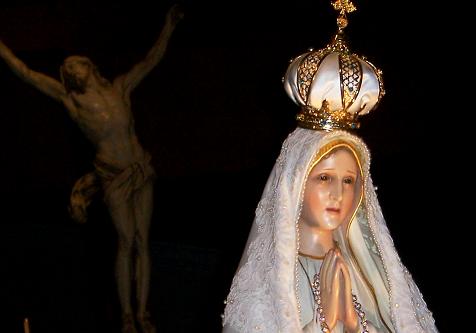
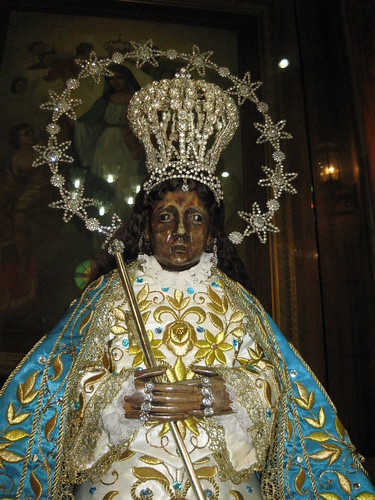
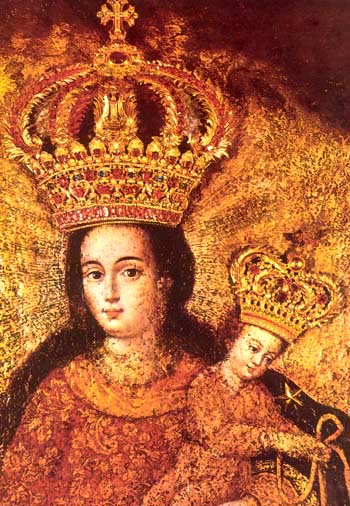
How dare I suggest that this story (link) about an Indian idol's problem with folks outdoing themselves by giving their idols large crowns have anything to do either with this photo of an idol to Mary (attempted image of Jesus in the background) or these similar idols (first, second, third, fourth, fifth, sixth, seventh, and eighth) or similar to this gift of a golden rose to an idol of Mary (link)? I dare because I think those who are willing to seriously consider the matter must see that Roman Catholicism treats Mary as a goddess in every way except actually saying the word "goddess."

But I know my words have little influence. After all, who am I? Just an anonymous Reformed apologist. Perhaps you think my judgment is biased. Perhaps then you will hear what Tertullian ("the Father of Latin Christianity") had to say.

He explained that it was the mark of a Christian man not to wear a crown:
Very lately it happened thus: while the bounty of our most excellent emperors was dispensed in the camp, the soldiers, laurel-crowned, were approaching. One of them, more a soldier of God, more steadfast than the rest of his brethren, who had imagined that they could serve two masters, his head alone uncovered, the useless crown in his hand— already even by that peculiarity known to every one as a Christian— was nobly conspicuous. Accordingly, all began to mark him out, jeering him at a distance, gnashing on him near at hand. The murmur is wafted to the tribune, when the person had just left the ranks. The tribune at once puts the question to him, Why are you so different in your attire? He declared that he had no liberty to wear the crown with the rest. Being urgently asked for his reasons, he answered, I am a Christian.
- Tertullian, On the Crown, Chapter 1

And again he explained that none of the religious leaders either of the Old Testament or the New Testament (up to his day) wore crowns (though, sadly, we have seen that change in some churches that claim to be ancient). He also points out that God himself did not wish to be worshiped with crowns:
In short, what patriarch, what prophet, what Levite, or priest, or ruler, or at a later period what apostle, or preacher of the gospel, or bishop, do you ever find the wearer of a crown? I think not even the temple of God itself was crowned; as neither was the ark of the testament, nor the tabernacle of witness, nor the altar, nor the candlestick crowned though certainly, both on that first solemnity of the dedication, and in that second rejoicing for the restoration, crowning would have been most suitable if it were worthy of God. But if these things were figures of us (for we are temples of God, and altars, and lights, and sacred vessels), this too they in figure set forth, that the people of God ought not to be crowned. The reality must always correspond with the image. If, perhaps, you object that Christ Himself was crowned, to that you will get the brief reply: Be you too crowned, as He was; you have full permission. Yet even that crown of insolent ungodliness was not of any decree of the Jewish people. It was a device of the Roman soldiers, taken from the practice of the world—a practice which the people of God never allowed either on the occasion of public rejoicing or to gratify innate luxury: so they returned from the Babylonish captivity with timbrels, and flutes, and psalteries, more suitably than with crowns; and after eating and drinking, uncrowned, they rose up to play. Neither would the account of the rejoicing nor the exposure of the luxury have been silent touching the honour or dishonour of the crown. Thus too Isaiah, as he says, "With timbrels, and psalteries, and flutes they drink wine," [Isaiah 5:12] would have added "with crowns," if this practice had ever had place in the things of God.
- Tertullian, On the Crown, Chapter 10

And further Tertullian argues that crowns are tightly linked to idolatry, and consequently unworthy of Christian worship:
So, when you allege that the ornaments of the heathen deities are found no less with God, with the object of claiming among these for general use the head-crown, you already lay it down for yourself, that we must not have among us, as a thing whose use we are to share with others, what is not to be found in the service of God. Well, what is so unworthy of God indeed as that which is worthy of an idol? But what is so worthy of an idol as that which is also worthy of a dead man? For it is the privilege of the dead also to be thus crowned, as they too straightway become idols, both by their dress and the service of deification, which (deification) is with us a second idolatry.
- Tertullian, On the Crown, Chapter 9

And further, Tertullian explains that we should keep ourselves from any resemblance to idols:
Thus the crown also is made out to be an offering to idols; for with this ceremony, and dress, and pomp, it is presented in sacrifice to idols, its originators, to whom its use is specially given over, and chiefly on this account, that what has no place among the things of God may not be admitted into use with us as with others. Wherefore the apostle exclaims, "Flee idolatry:" [1 Corinthians 10:14] certainly idolatry whole and entire he means. Reflect on what a thicket it is, and how many thorns lie hidden in it. Nothing must be given to an idol, and so nothing must be taken from one. If it is inconsistent with faith to recline in an idol temple, what is it to appear in an idol dress? What communion have Christ and Belial? Therefore flee from it; for he enjoins us to keep at a distance from idolatry— to have no close dealings with it of any kind. Even an earthly serpent sucks in men at some distance with its breath. Going still further, John says, "My little children, keep yourselves from idols," [1 John 5:21] — not now from idolatry, as if from the service of it, but from idols— that is, from any resemblance to them: for it is an unworthy thing that you, the image of the living God, should become the likeness of an idol and a dead man. Thus far we assert, that this attire belongs to idols, both from the history of its origin, and from its use by false religion; on this ground, besides, that while it is not mentioned as connected with the worship of God, it is more and more given over to those in whose antiquities, as well as festivals and services, it is found. In a word, the very doors, the very victims and altars, the very servants and priests, are crowned.
- Tertullian, On the Crown, Chapter 10

And still further Tertullian explains how the Crown of Christians is Christ, not gold:
For state reasons, the various orders of the citizens also are crowned with laurel crowns; but the magistrates besides with golden ones, as at Athens, and at Rome. Even to those are preferred the Etruscan. This appellation is given to the crowns which, distinguished by their gems and oak leaves of gold, they put on, with mantles having an embroidery of palm branches, to conduct the chariots containing the images of the gods to the circus. There are also provincial crowns of gold, needing now the larger heads of images instead of those of men. But your orders, and your magistracies, and your very place of meeting, the church, are Christ's. You belong to Him, for you have been enrolled in the books of life. [Philippians 4:3] There the blood of the Lord serves for your purple robe, and your broad stripe is His own cross; there the axe is already laid to the trunk of the tree; [Matthew 3:10] there is the branch out of the root of Jesse. [Isaiah 11:1] Never mind the state horses with their crown. Your Lord, when, according to the Scripture, He would enter Jerusalem in triumph, had not even an ass of His own. These (put their trust) in chariots, and these in horses; but we will seek our help in the name of the Lord our God.
- Tertullian, On the Crown, Chapter 13

Tertullian is particularly express in pointing out the impropriety of crowns on the head of Christian women, who ought not to have their heads uncovered, much less crowned. Should you wish to honor Mary as being a woman of virtue, you would preserve her modesty. When you crown her, in Tertullian's words, you mark her with "utter wantonness":
Much less may the Christian put the service of idolatry on his own head— nay, I might have said, upon Christ, since Christ is the Head of the Christian man— (for his head) is as free as even Christ is, under no obligation to wear a covering, not to say a band. But even the head which is bound to have the veil, I mean woman's, as already taken possession of by this very thing, is not open also to a band. She has the burden of her own humility to bear. If she ought not to appear with her head uncovered on account of the angels, much more with a crown on it will she offend those (elders) who perhaps are then wearing crowns above. [Revelation 4:4] For what is a crown on the head of a woman, but beauty made seductive, but mark of utter wantonness—a notable casting away of modesty, a setting temptation on fire? Therefore a woman, taking counsel from the apostles' foresight, will not too elaborately adorn herself, that she may not either be crowned with any exquisite arrangement of her hair. What sort of garland, however, I pray you, did He who is the Head of the man and the glory of the woman, Christ Jesus, the Husband of the church, submit to in behalf of both sexes? Of thorns, I think, and thistles—a figure of the sins which the soil of the flesh brought forth for us, but which the power of the cross removed, blunting, in its endurance by the head of our Lord, death's every sting. Yes, and besides the figure, there is contumely with ready lip, and dishonour, and infamy, and the ferocity involved in the cruel things which then disfigured and lacerated the temples of the Lord, that you may now be crowned with laurel, and myrtle, and olive, and any famous branch, and which is of more use, with hundred-leaved roses too, culled from the garden of Midas, and with both kinds of lily, and with violets of all sorts, perhaps also with gems and gold, so as even to rival that crown of Christ which He afterwards obtained. For it was after the gall He tasted the honeycomb and He was not greeted as King of Glory in heavenly places till He had been condemned to the cross as King of the Jews, having first been made by the Father for a time a little less than the angels, and so crowned with glory and honour. If for these things, you owe your own head to Him, repay it if you can, such as He presented His for yours; or be not crowned with flowers at all, if you cannot be with thorns, because you may not be with flowers.
- Tertullian, On the Crown, Chapter 14

Here then is Tertullian's conclusion, that we await any crowns God may give us in heaven. By comparison, any earthly crown is a mere chaplet. Be shamed by the infidel follower of Mithras who refused an earthly crown claiming that Mithras was his crown:
Keep for God His own property untainted; He will crown it if He choose. Nay, then, He does even choose. He calls us to it. To him who conquers He says, "I will give a crown of life." Be you, too, faithful unto death, and fight you, too, the good fight, whose crown the apostle [2 Timothy 4:8] feels so justly confident has been laid up for him. The angel [Revelation 6:2] also, as he goes forth on a white horse, conquering and to conquer, receives a crown of victory; and another [Revelation 10:1] is adorned with an encircling rainbow (as it were in its fair colours)— a celestial meadow. In like manner, the elders sit crowned around, crowned too with a crown of gold, and the Son of Man Himself flashes out above the clouds. If such are the appearances in the vision of the seer, of what sort will be the realities in the actual manifestation? Look at those crowns. Inhale those odours. Why condemn you to a little chaplet, or a twisted headband, the brow which has been destined for a diadem? For Christ Jesus has made us even kings to God and His Father. What have you in common with the flower which is to die? You have a flower in the Branch of Jesse, upon which the grace of the Divine Spirit in all its fullness rested— a flower undefiled, unfading, everlasting, by choosing which the good soldier, too, has got promotion in the heavenly ranks. Blush, you fellow-soldiers of his, henceforth not to be condemned even by him, but by some soldier of Mithras, who, at his initiation in the gloomy cavern, in the camp, it may well be said, of darkness, when at the sword's point a crown is presented to him, as though in mimicry of martyrdom, and thereupon put upon his head, is admonished to resist and cast it off, and, if you like, transfer it to his shoulder, saying that Mithras is his crown. And thenceforth he is never crowned; and he has that for a mark to show who he is, if anywhere he be subjected to trial in respect of his religion; and he is at once believed to be a soldier of Mithras if he throws the crown away— if he say that in his god he has his crown. Let us take note of the devices of the devil, who is wont to ape some of God's things with no other design than, by the faithfulness of his servants, to put us to shame, and to condemn us.
- Tertullian, On the Crown, Chapter 15

But if you will not hear the words of an anonymous Reformed Apologist, or the words of the "founder of Latin Christianity," then perhaps you will hear the words of the apostle John.

1 John 5:21 Little children, keep yourselves from idols. Amen.

-TurretinFan

Tuesday, July 21, 2009

Flattening Flimsy Flim-Flam

Mr. Mark Shea (link) seems to think that Dr. White's post (link) is so much "huff-puffery." Thankfully, the flim-flam from which Mr. Shea's argument is constructed is so flimsy that it is flattened by even fairly rudimentary analysis.

Mr. Shea seems to have forgotten the important lesson of the story of the three little pigs. The lesson wasn't so much that one needs to label the bad guy as a wolf or call his arguments huffing and puffing, but that one needs to have a house built out of something more substantial than straw and/or sticks. In this case, Mr. Shea's arguments are the argumentative equivalent of the straw house. Why? Because they lack the solid foundation of Scripture. As Cyril of Jerusalem (about A.D. 315 – 386) put it:
Even to me, who tell thee these things, give not absolute credence, unless thou receive the proof of the things which I announce from the Divine Scriptures. For this salvation which we believe depends not on ingenious reasoning, but on demonstration of the Holy Scriptures.
- Cyril of Jerusalem, Catechetical Lecture IV, Section 17

Mr. Shea is clearly not fond of the doctrine of the perspicuity of Scripture. He writes: "The whole 'Scripture is perspicuous' thing is a classic case of elevating human tradition to the level of equality with the word of God." We chuckle to ourselves wondering whether Mr. Shea, adhering to papal traditions as he does, means that as a criticism or a compliment.

After all, the doctrine of the perspicuity of Scripture goes back to the earliest Christian writers. For example, Justin Martyr (about A.D. 100 – 165) suggests that at least some of the Scriptures have a clear meaning that requires no interpretation:
Pay attention, therefore, to what I shall record out of the holy Scriptures, which do not need to be expounded, but only listened to.
- Justin Martyr, Dialog With Trypho, Chapter 55

Mr. Shea's straw (over twigs) construction choice is revealed in his straw man argument:
It works like this: the enthusiast for the doctrine of the "perspicuity of Scripure" [sic] reasons "God always does what is best. Having a Bible that is perspicuous is best. Therefore, God has done that."
Of course, neither Dr. White nor any serious proponent for Scripture's perspicuity argues that way.

We have many arguments at our disposal, we might, as Irenaeus (about A.D. 130 - 200) did and take the position that the perspicuity of Scripture is self-evident, hidden only from the blind:
Since, therefore, the entire Scriptures, the prophets, and the Gospels, can be clearly, unambiguously, and harmoniously understood by all, although all do not believe them; and since they proclaim that one only God, to the exclusion of all others, formed all things by His word, whether visible or invisible, heavenly or earthly, in the water or under the earth, as I have shown from the very words of Scripture; and since the very system of creation to which we belong testifies, by what falls under our notice, that one Being made and governs it,—those persons will seem truly foolish who blind their eyes to such a clear demonstration, and will not behold the light of the announcement [made to them]; but they put fetters upon themselves, and every one of them imagines, by means of their obscure interpretations of the parables, that he has found out a God of his own.
- Irenaeus, Against Heresies, Book 2, Chapter 27, Section 2

But alas, while some of Mr. Shea's colorful rhetoric (which we have striven, by way of flattery through imitation, to duplicate) may be fresh, some of the strawy arguments he uses are quite moldy by now. For example, he argues:
You can always find some sort of biblical justification for your pet idea. And with sufficient will power or ego, you can trumpet your pet idea as the Revealed Will of God Almighty, denouncing anybody who questions your pet theory, not as somebody who questions your pet theory, but as an enemy of God who "rails away" at God Almighty, while "The child of God knows better." It's a very cozy way to congratulate yourself.
This characterization of Scripture (in addition to leading one to make a note to oneself: "remember not to trust Mr. Shea's biblical self-justifications") is contrary to that of the founder of Latin Christianity, Tertullian (about A.D. 160 -220) who stated:
Then, if even the heretic seek refuge in the depraved thoughts of the vulgar, or the imaginations of the world, I must say to him: Part company with the heathen, O heretic! for although you are all agreed in imagining a God, yet while you do so in the name of Christ, so long as you deem yourself a Christian, you are a different man from a heathen: give him back his own views of things, since he does not himself learn from yours. Why lean upon a blind guide, if you have eyes of your own? Why be clothed by one who is naked, if you have put on Christ? Why use the shield of another, when the apostle gives you armour of your own? It would be better for him to learn from you to acknowledge the resurrection of the flesh, than for you from him to deny it; because if Christians must needs deny it, it would be sufficient if they did so from their own knowledge, without any instruction from the ignorant multitude. He, therefore, will not be a Christian who shall deny this doctrine which is confessed by Christians; denying it, moreover, on grounds which are adopted by a man who is not a Christian. Take away, indeed, from the heretics the wisdom which they share with the heathen, and let them support their inquiries from the Scriptures alone: they will then be unable to keep their ground. For that which commends men’s common sense is its very simplicity, and its participation in the same feelings, and its community of opinions; and it is deemed to be all the more trustworthy, inasmuch as its definitive statements are naked and open, and known to all. Divine reason, on the contrary, lies in the very pith and marrow of things, not on the surface, and very often is at variance with appearances.
- Tertullian, On the Resurrection of the Flesh, Chapter 3

Mr. Shea doesn't limit himself to suggesting that Scripture is ambiguous, he also argues that experience tells us that this is so:
The thing is, the perspicuity of Scripture is one of those ideas, like Marxism, that is the result of theory run amuck and removed entirely from the laboratory of real life ... people who assert things like the Perspicuity of Scripture as Revealed Truth have to face the fact that the Laboratory of Experience is simply against them. The one thing Scripture is not is perspicuous.
I wonder if this is where Mr. Shea hopes to gain an edge on folks with less experience in the laboratory than he. I refer to folks like Athanasius (about A.D. 297 - 373) who wrote:
And this is usual with Scriptures, to express itself in inartificial and simple phrases.
- Athanasius, Four Discourses Against the Arians, Discourse 3

And again:
These are fountains of salvation, that they who thirst may be satisfied with the living words they contain. In these alone is proclaimed the doctrine of godliness. Let no man add to these, neither let him take ought from these. For concerning these the Lord put to shame the Sadducees, and said, ‘Ye do err, not knowing the Scriptures.’ And He reproved the Jews, saying, ‘Search the Scriptures, for these are they that testify of Me.
- Athanasius, Letter 39, Section 6

Perhaps, as I say, Mr. Shea believes himself a better Christian scientist or laboratory technician in the laboratory of life than Athanasius. If so, then no doubt he will not be shy to proclaim his experimental superiority over Hilary of Poitiers (about A.D. 315 - 367) who declared:
The Lord enunciated the faith of the Gospel in the simplest words that could be found, and fitted His discourses to our understanding, so far as the weakness of our nature allowed Him, without saying anything unworthy of the majesty of His own nature.
- Hilary of Poitiers, On the Trinity, Book 9, Section 40

Mr. Shea assures us (attempting to justify his pet idea from Scripture - see above) that:
That's not me talking, that's 2 Peter:
So also our beloved brother Paul wrote to you according to the wisdom given him, 16 speaking of this as he does in all his letters. There are some things in them hard to understand, which the ignorant and unstable twist to their own destruction, as they do the other scriptures. (2 Peter 3:15-16)
One wonders if Mr. Shea is aware of how this verse was understood by the early Christians. Augustine (about A.D. 354 - 430) explains:
For it is none other than the question of God's grace which has caused persons of no understanding to think that the Apostle Paul prescribes it to us as a rule, "Let us do evil that good may come." It is in reference to these that the Apostle Peter writes in his second Epistle; "Wherefore, beloved, seeing that you look for such things, be diligent, that you may be found of Him in peace, without spot and blameless and account that the long-suffering of our Lord is salvation; even as our beloved brother Paul also, according to the wisdom given unto him, has written unto you; as also in all his epistles, speaking in them of these things: in which are some things hard to be understood, which they that are unlearned and unstable wrest, as they do also the other Scriptures, unto their own destruction." Take good heed, then, to these fearful words of the great apostle; and when you feel that you do not understand, put your faith in the meanwhile in the inspired word of God, and believe both that man's will is free, and that there is also God's grace, without whose help man's free will can neither be turned towards God, nor make any progress in God. And what you piously believe, that pray that you may have a wise understanding of.
- Augustine, Letter 214, Sections 6-7

Augustine understood Peter to be saying that it may be very hard to reconcile Paul's teaching of Grace and of Free Will, but we should simply accept the plain teaching both that men have wills and that God gives grace. I won't derail this with a further discussion of Augustine's compatibilism, but suffice that this passage demonstrates that Augustine at least viewed Peter as suggesting that the error is not in thinking that Paul speaks in riddles, but simply that he speaks about things that are hard fully to understand.

Shea throws another straw man into the pile by asserting that the rebuttal to citation of 2 Peter 3:15-16 is as follows:
Standard boilerplate replies generally run toward saying things like "Paul's writing is perspicuous, it's just the ignorant and unstable who screw things up."
Of course, that's not the primary response although it does sound a bit like what Augustine and other fathers have said.

The primary response is that the doctrine of perspicuity doesn't claim that every text of Scripture is equally clear. Just that the necessary things are clear. And the second is like it: "some things hard to understand" suggests what should be blindingly obvious to all, namely that Paul's letters also contain some things not hard to understand (not by logical necessity, of course, but simply common inference).

After chopping the straw man into little bits with reference to Revelation and Job, Mr. Shea decides to present a view of perspicuity that is a little closer to accurate mixed in with more straw:
What doctrines like the "perspicuity of Scripture" *really* mean is "Scripture means what I take it to mean, no more, no less. The easy to understand parts are the parts that agree with what I think. The hard to understand parts are the parts that a) talk about unimportant stuff or b) must be subordinated to what I understand."
Most of that, the part about perspicuity meaning that "Scripture means what I take it to mean," is just another straw man, but you'll recognize hiding behind the bulky straw man the actual position lurking as a sub-point.

One wonders whether Mr. Shea is even aware of what John Chrysostom (A.D. 347 - 407) spoke about the perspicuity of Scripture:
What do I come in for, you say, if I do not hear some one discoursing? This is the ruin and destruction of all. For what need of a person to discourse? This necessity arises from our sloth. Wherefore any necessity for a homily? All things are clear and open that are in the divine Scriptures; the necessary things are all plain. But because ye are hearers for pleasure’s sake, for that reason also you seek these things. For tell me, with what pomp of words did Paul speak? and yet he converted the world. Or with what the unlettered Peter? But I know not, you say, the things that are contained in the Scriptures. Why? For are they spoken in Hebrew? Are they in Latin, or in foreign tongues? Are they not in Greek? But they are expressed obscurely, you say: What is it that is obscure? Tell me. Are there not histories? For (of course) you know the plain parts, in that you enquire about the obscure. There are numberless histories in the Scriptures. Tell me one of these. But you cannot. These things are an excuse, and mere words. Every day, you say, one hears the same things. Tell me, then, do you not hear the same things in the theaters? Do you not see the same things in the race-course? Are not all things the same? Is it not always the same sun that rises? Is it not the same food that we use? I should like to ask you, since you say that you every day hear the same things; tell me, from what Prophet was the passage that was read? from what Apostle, or what Epistle? But you cannot tell me—you seem to hear strange things. When therefore you wish to be slothful, you say that they are the same things. But when you are questioned, you are in the case of one who never heard them. If they are the same, you ought to know them. But you are ignorant of them.
- John Chrysostom, Homily 3 on 2 Thessalonians

I realize that this may sound to Mr. Shea like John Chrysostom is saying:
"Ignorant and unstable people may twist Scripture, but I am safe from all that so I understand perfectly what Scripture means. And when the Church disagrees with me, that's because the ignorant and unstable are disagreeing with me, who am not ignorant or unstable."[the argument he puts in the mouth of perspicuity advocates]
But I wonder if he'd be so bold as to claim that Athanasius was saying almost exactly that when Athanasius (against the vast majority of the church of his day) contended:
"But," says the Arian, "is it not written?" Yes, it is written! And it is necessary that it should be said. But what is well written is ill understood by heretics. If they had understood and grasped the terms in which Christianity is expressed, they would not have called the Lord of glory [1 Corinthians 2:8; cf. James 2:1] a creature nor stumbled over what is well written.
- Athanasius, Epistle to Serapion

But perhaps he just means that the church fathers were unaware of the practical consequences of their doctrines. After all, Mr. Shea points out the large number of denominations of Protestants relying on the false 33,000 number (previously shown to be false). The early church fathers, after all, were not around to see this consequence that Mr. Shea attributes to the doctrine of perspicuity. But Mr. Shea downplays the issue of divisions because he recognizes that there are many divisions within his own church.

Instead, Mr. Shea plays up what he thinks are major differences, for example: "you are still faced," he says, "with colossal and mutually contradictory differences between say, Oneness Pentecostals (who deny the Trinity) and Trinitarian Protestant." One wonders if Mr. Shea really thinks the core Trinitarian and especially Christological doctrines are not clear from Scripture. On such a point he would seem to be at odds with men like Theodoret (about A.D. 393 - 457) who stated:
Although you have not yet met me, I think that your excellency is aware of the open calumnies that have been published against me, for you have often heard me preaching in church, when I have proclaimed the Lord Jesus, and have pointed out the properties alike of the Godhead and of the manhood; for we do not divide one Son into two, but, worshipping the Only-begotten, point out the distinction between flesh and Godhead. This, indeed, is I think confessed even by the Arians, who do not call the flesh Godhead, nor address the Godhead as flesh. Holy Scripture clearly teaches us both natures.
- Theordoret, Letter 99

Or Augustine:
In order, therefore, that the human mind might be purged from falsities of this kind, Holy Scripture, which suits itself to babes has not avoided words drawn from any class of things really existing, through which, as by nourishment, our understanding might rise gradually to things divine and transcendent.
- Augustine, On the Trinity, Book 1, Chapter 1, Section 2

Or Novation (about A.D. 200 - 251) who proves the Trinity from Scripture:
Unless, therefore, we hold all this with fitting veneration and lawful argument, we shall reasonably be thought to have furnished a scandal to the heretics, not assuredly by the fault of the heavenly Scriptures, which never deceive; but by the presumption of human error, whereby they have chosen to be heretics.
- Novation, On the Trinity, Chapter 30

If so, if Mr. Shea really thinks that the Scripture is not clear on the important topic of the Trinity, we are puzzled why he thinks the Bible is clear on other things. For example, Mr. Shea himself confessed the perspicuity of Scripture with respect to the at least occasional permissibility of the death penalty:
Some Catholics are fine with this. The reasons for this vary. Some already oppose the death penalty on other grounds and, in fact, go further than the Church by trying to say the Church errs in permitting it at all. I think they are wrong both for theological reasons (i.e. Scripture clearly permits it at times) and for practical reasons (sometimes people just need killing for the common good). Some agree with the Church's teaching as it is laid out in Evangelium Vitae.
(source)

Likewise, Mr. Shea thinks that Scripture teaches clearly that we will get our wish:
Ask yourself: is Islam or the West more likely to produce such a person? Personally, I have a lot of trouble seeing such a figure arising in Islam, with it rock hard insistence on the distinction between creature and Creator. The West, on the other hand, is chockablock with philosophies, religious movements, pop psych, technology, literary movements, art, music, and politics which are all, in their own ways, laboring to summon just such a one from our midst. Scripture says pretty clearly that we will get our wish.
(source)

So strange that God would, in his Word, make such relatively trivial things clear while leaving more important things mired in ambiguity.

But Mr. Shea's straw house will collapse. It collapses in the face of a few small puffs from Scripture:

John 20:31 But these are written, that ye might believe that Jesus is the Christ, the Son of God; and that believing ye might have life through his name.

The purpose of John's gospel is to write so that people would believe and be saved. Implicitly, this shows that the necessary things for salvation may be understood from John's gospel.

1 John 5:13 These things have I written unto you that believe on the name of the Son of God; that ye may know that ye have eternal life, and that ye may believe on the name of the Son of God.

Same for John's catholic epistle as for his gospel. He wrote so that we would believe.

2 Timothy 3:15 And that from a child thou hast known the holy scriptures, which are able to make thee wise unto salvation through faith which is in Christ Jesus.

The Scriptures are able to make one wise to salvation. This, again, implies that they teach with sufficient clarity the things necessary to be known for salvation.

2 Timothy 3:16-17
All scripture is given by inspiration of God, and is profitable for doctrine, for reproof, for correction, for instruction in righteousness: that the man of God may be perfect, throughly furnished unto all good works.

Again, the very purpose of Scripture is not just to furnish the believer but to do so "throughly."

John 5:39 Search the scriptures; for in them ye think ye have eternal life: and they are they which testify of me.

Scripture reveals Christ, and the command to "search" at least suggests that Christ can be found by those who search.

1 Corinthians 10:11 Now all these things happened unto them for ensamples: and they are written for our admonition, upon whom the ends of the world are come.

Scripture is written for our admonition, which implies that we can read it and be admonished.

Rom 15:4 For whatsoever things were written aforetime were written for our learning, that we through patience and comfort of the scriptures might have hope.

The Scriptures were written for our learning, which likewise implies that we can read it and learn. (See also Romans 4:23-25)

But what about those folks who claim that Scripture is ambiguous and cannot be understood without tradition? We give them the following answer from tradition:
When, however, they are confuted from the Scriptures, they turn round and accuse these same Scriptures, as if they were not correct, nor of authority, and [assert] that they are ambiguous, and that the truth cannot be extracted from them by those who are ignorant of tradition. For [they allege] that the truth was not delivered by means of written documents, but vivâ voce: wherefore also Paul declared, “But we speak wisdom among those that are perfect, but not the wisdom of this world” [1 Cor. ii. 6]. And this wisdom each one of them alleges to be the fiction of his own inventing, forsooth; so that, according to their idea, the truth properly resides at one time in Valentinus, at another in Marcion, at another in Cerinthus, then afterwards in Basilides, or has even been indifferently in any other opponent, who could speak nothing pertaining to salvation. For every one of these men, being altogether of a perverse disposition, depraving the system of truth, is not ashamed to preach himself.

2. But, again, when we refer them to that tradition which originates from the apostles, [and] which is preserved by means of the succession of presbyters in the Churches, they object to tradition, saying that they themselves are wiser not merely than the presbyters, but even than the apostles, because they have discovered the unadulterated truth. For [they maintain] that the apostles intermingled the things of the law with the words of the Saviour; and that not the apostles alone, but even the Lord Himself, spoke as at one time from the Demiurge, at another from the intermediate place, and yet again from the Pleroma, but that they themselves, indubitably, unsulliedly, and purely, have knowledge of the hidden mystery: this is, indeed, to blaspheme their Creator after a most impudent manner! It comes to this, therefore, that these men do now consent neither to Scripture nor to tradition.

3. Such are the adversaries with whom we have to deal, my very dear friend, endeavouring like slippery serpents to escape at all points. Where-fore they must be opposed at all points, if per-chance, by cutting off their retreat, we may succeed in turning them back to the truth. For, though it is not an easy thing for a soul under the influence of error to repent, yet, on the other hand, it is not altogether impossible to escape from error when the truth is brought alongside it.
- Irenaeus, Against Heresies, Book 3, Chapter 2, Section 1

Yes, we face the same straw houses today that Irenaeus did then. We have shown that Scripture claims perspicuity for itself at least implicitly. Perhaps, in Mr. Shea's metaphor, that's our "huff." Furthermore, we have shown that the tradition of the early church acknowledged that perspicuity as well - our "puff" I suppose. But we see that Mr. Shea accepts neither Scripture nor Tradition, just as the heretics did not with whom Irenaeus dealt. And so Mr. Shea's house of flim-flam straw-men arguments falls, flattened by the weight of Scripture and Tradition with our meager "huff-puffery" serving only to present the truths as they are and not to add any weight of our own authority to the mix.

-TurretinFan