
Some of these works may be of greater interest to some of my audience than to others, but I'm thankful that each of the following currently available for free. Thanks to Roger Pearse for pointing me in the right direction:
Armistead, Mary Allyson - The Middle English Physiologus: A Critical Translation and Commentary (link) (127 pp.)
Bennett, Byard John - The Origin of Evil: Didymus the Blind's Contra Manichaeos and its Debt to Origen's Theology and Exegesis (link) (404 pp.)
Croft, Alice Thomspon - Didymus the Blind on 1 Corinthians 15 (link) (146 pp.)
Haase, Barbara S. - Ennodius' panegyric to Theoderic to Great: A translation and commentary. (link) (110 pp.)
Hegedus, Timothy Michael - Jerome's commentary on Jonah: Translation with introduction and critical notes (link) (pp. 163)
Heisler, Jeanne Marie - Gnat or Apostolic Bee: A Translation and Commentary on Theodoret's Commentary on Jonah (link) (242 pp.)
Pettipiece, Timothy James - Heracleon: Fragments of early Valentinian exegesis. Text, translation, and commentary (link) (189 pp.)
Pratelli, Simone Isacco Maria - Gregory Barhebraeus' Commentary on the Twelve Prophets in the "Storehouse of Mysteries". Introduction, Critical Text, and Translation. (link) (164 pp. + 44 pp.)
Shute, Dan - Peter Martyr and the Rabbinic Bible in the Interpretation of Lamentations (link) (908 pp.)
Smith, Yancy Warren - Hippolytus' Commentary on the Song of Songs in Social and Critical Context (link) (578 pp.)
-TurretinFan
Friday, April 12, 2013

Thursday, April 11, 2013
Limits on Patriarchy - Deborah and other Prophetesses
Apparently all but one of the judges that judged Israel were male. The one exception was Deborah. She provides us with an example of a limit on the patriarchy:
We aren't told much about how she judged Israel. From the context, it appears that she was a prophetess and thus people came to her to hear judgment from God.
Nevertheless, notice that her title is male-defined. She's not simply "Deborah," but "Deborah ... the wife of Lapidoth."
Moreover, while she gives orders to Barak (from God), when Barak insists on having her come with him to the battle, God punishes Barak by giving the glory of killing Sisera to a woman.
Deborah is not the only prophetess in Scripture. The prophet Joel prophesied:
1. Anna
As well as two false prophetesses:
1. Jezebel
To the list of prophetesses, we might also consider adding Elizabeth and Mary. After all, recall:
We also may consider adding the author of the Song of Solomon, if that work is written to him, rather than by him. Recall that the book begins:
That sounds like a woman speaking to Solomon, rather than Solomon himself speaking.
Finally, to the list above, we may add the "wise woman," mentioned here:
We may also add the young lady who had the spirit of divination, though she would seem to be a false prophetess who happened to speak the truth:
In short, Deborah and the other prophetesses help to emphasize the fact that prophecy is a gift from God given to humans (not simply to males). It provides a limitation on the patriarchy, in that it shows that God can dispense his gifts to whomever he pleases, not only to males but also to females.
-TurretinFan
Judges 4:4-9Notice that Deborah is described as having "judged" Israel. Moreover, she is also described as a "prophetess."
And Deborah, a prophetess, the wife of Lapidoth, she judged Israel at that time. And she dwelt under the palm tree of Deborah between Ramah and Bethel in mount Ephraim: and the children of Israel came up to her for judgment.
And she sent and called Barak the son of Abinoam out of Kedeshnaphtali, and said unto him, "Hath not the Lord God of Israel commanded, saying, 'Go and draw toward mount Tabor, and take with thee ten thousand men of the children of Naphtali and of the children of Zebulun? And I will draw unto thee to the river Kishon Sisera, the captain of Jabin's army, with his chariots and his multitude; and I will deliver him into thine hand.'"
And Barak said unto her, "If thou wilt go with me, then I will go: but if thou wilt not go with me, then I will not go."
And she said, "I will surely go with thee: notwithstanding the journey that thou takest shall not be for thine honour; for the Lord shall sell Sisera into the hand of a woman." And Deborah arose, and went with Barak to Kedesh.
We aren't told much about how she judged Israel. From the context, it appears that she was a prophetess and thus people came to her to hear judgment from God.
Nevertheless, notice that her title is male-defined. She's not simply "Deborah," but "Deborah ... the wife of Lapidoth."
Moreover, while she gives orders to Barak (from God), when Barak insists on having her come with him to the battle, God punishes Barak by giving the glory of killing Sisera to a woman.
Deborah is not the only prophetess in Scripture. The prophet Joel prophesied:
Joel 2:32The Apostle Peter applies these to the extraordinary gifts first given at Pentecost:
And it shall come to pass afterward, that I will pour out my spirit upon all flesh; and your sons and your daughters shall prophesy, your old men shall dream dreams, your young men shall see visions: and also upon the servants and upon the handmaids in those days will I pour out my spirit. And I will shew wonders in the heavens and in the earth, blood, and fire, and pillars of smoke. The sun shall be turned into darkness, and the moon into blood, before the great and terrible day of the Lord come. And it shall come to pass, that whosoever shall call on the name of the Lord shall be delivered: for in mount Zion and in Jerusalem shall be deliverance, as the Lord hath said, and in the remnant whom the Lord shall call.
Acts 2:14-21The only recorded instances of this fulfillment were the daughters of Philip:
But Peter, standing up with the eleven, lifted up his voice, and said unto them, Ye men of Judaea, and all ye that dwell at Jerusalem, be this known unto you, and hearken to my words: for these are not drunken, as ye suppose, seeing it is but the third hour of the day.
But this is that which was spoken by the prophet Joel; "and it shall come to pass in the last days, saith God, I will pour out of my Spirit upon all flesh: and your sons and your daughters shall prophesy, and your young men shall see visions, and your old men shall dream dreams: and on my servants and on my handmaidens I will pour out in those days of my Spirit; and they shall prophesy: and I will shew wonders in heaven above, and signs in the earth beneath; blood, and fire, and vapour of smoke: the sun shall be turned into darkness, and the moon into blood, before the great and notable day of the Lord come: and it shall come to pass, that whosoever shall call on the name of the Lord shall be saved."
Acts 21:8-9There were also a few other pre-Pentecost prophetesses:
And the next day we that were of Paul's company departed, and came unto Caesarea: and we entered into the house of Philip the evangelist, which was one of the seven; and abode with him. And the same man had four daughters, virgins, which did prophesy.
1. Anna
Luke 2:362. Isaiah's Wife
And there was one Anna, a prophetess, the daughter of Phanuel, of the tribe of Aser: she was of a great age, and had lived with an husband seven years from her virginity;
Isaiah 8:33. Huldah
And I went unto the prophetess; and she conceived, and bare a son. Then said the Lord to me, Call his name Mahershalalhashbaz.
2 Kings 22:144. Miriam
So Hilkiah the priest, and Ahikam, and Achbor, and Shaphan, and Asahiah, went unto Huldah the prophetess, the wife of Shallum the son of Tikvah, the son of Harhas, keeper of the wardrobe; (now she dwelt in Jerusalem in the college;) and they communed with her.
2 Chronicles 34:22
And Hilkiah, and they that the king had appointed, went to Huldah the prophetess, the wife of Shallum the son of Tikvath, the son of Hasrah, keeper of the wardrobe; (now she dwelt in Jerusalem in the college:) and they spake to her to that effect.
Exodus 15:20You will notice that Huldah is "the wife of Shallum," Isaiah's wife is his wife, and Miriam is the sister of Aaron and Moses. The only woman among them who is not defined in large measure by her male relations is Anna, who was a widow. Widowhood was one way for a woman in a patriarchy to have a measure of autonomy. It is a sad an unnatural thing, of course, but it did happen.
And Miriam the prophetess, the sister of Aaron, took a timbrel in her hand; and all the women went out after her with timbrels and with dances.
As well as two false prophetesses:
1. Jezebel
Revelation 2:202. Noadiah
Notwithstanding I have a few things against thee, because thou sufferest that woman Jezebel, which calleth herself a prophetess, to teach and to seduce my servants to commit fornication, and to eat things sacrificed unto idols.
Nehemiah 6:14It may simply be coincidence, but it is interesting that neither Revelation's Jezebel, nor Noahdiah is described in terms of her male relationships.
My God, think thou upon Tobiah and Sanballat according to these their works, and on the prophetess Noadiah, and the rest of the prophets, that would have put me in fear.
To the list of prophetesses, we might also consider adding Elizabeth and Mary. After all, recall:
Luke 1:41-55
And it came to pass, that, when Elisabeth heard the salutation of Mary, the babe leaped in her womb; and Elisabeth was filled with the Holy Ghost: and she spake out with a loud voice, and said, Blessed art thou among women, and blessed is the fruit of thy womb. And whence is this to me, that the mother of my Lord should come to me? For, lo, as soon as the voice of thy salutation sounded in mine ears, the babe leaped in my womb for joy. And blessed is she that believed: for there shall be a performance of those things which were told her from the Lord.
And Mary said, My soul doth magnify the Lord, and my spirit hath rejoiced in God my Saviour. For he hath regarded the low estate of his handmaiden: for, behold, from henceforth all generations shall call me blessed. For he that is mighty hath done to me great things; and holy is his name. And his mercy is on them that fear him from generation to generation. He hath shewed strength with his arm; he hath scattered the proud in the imagination of their hearts. He hath put down the mighty from their seats, and exalted them of low degree. He hath filled the hungry with good things; and the rich he hath sent empty away. He hath helped his servant Israel, in remembrance of his mercy; as he spake to our fathers, to Abraham, and to his seed for ever.
We also may consider adding the author of the Song of Solomon, if that work is written to him, rather than by him. Recall that the book begins:
Song of Solomon 1:1-2
The song of songs, which is Solomon's. Let him kiss me with the kisses of his mouth: for thy love is better than wine.
That sounds like a woman speaking to Solomon, rather than Solomon himself speaking.
Finally, to the list above, we may add the "wise woman," mentioned here:
2 Samuel 20:16
Then cried a wise woman out of the city, Hear, hear; say, I pray you, unto Joab, Come near hither, that I may speak with thee.
We may also add the young lady who had the spirit of divination, though she would seem to be a false prophetess who happened to speak the truth:
Acts 16:16-18In any event, these cases of prophetesses are an exception rather than a rule, and generally even they are under the headship of their husband, betrothed, or father in the patriarchy (the exception being a widow). Deborah seems to be the one with the most power, since she is identified as a judge, but even in that case it is clear that she was not supposed to be a military leader, like the male judges.
And it came to pass, as we went to prayer, a certain damsel possessed with a spirit of divination met us, which brought her masters much gain by soothsaying: The same followed Paul and us, and cried, saying, These men are the servants of the most high God, which shew unto us the way of salvation. And this did she many days. But Paul, being grieved, turned and said to the spirit, I command thee in the name of Jesus Christ to come out of her. And he came out the same hour.
In short, Deborah and the other prophetesses help to emphasize the fact that prophecy is a gift from God given to humans (not simply to males). It provides a limitation on the patriarchy, in that it shows that God can dispense his gifts to whomever he pleases, not only to males but also to females.
-TurretinFan
Free Debates Featuring James White
I was reluctant to post this list, because I'm concerned that people who might otherwise support Dr. White's ministry by buying copies of the debates will just watch them for free. However, I trust that people who would support Dr. White's ministry by buying his debates will consider doing so in some other way, since his ministry is reliant on support of Christians who support what he's doing.
Moreover, keep in mind that the debates below represent less than a quarter of the debates Dr. White has done. (see here for a list of debates you can get at store.aomin.org - that list may need to be updated at some point)
1. David Bernard vs. James White, "Are Tongues Necessary?" (informal radio debate on WMCA radio in New York, circa August 18, 2003) (mp3) (Audio-only on Youtube part 1/5)(part 2/5)(part 3/5)(part 4/5)(part 5/5)
2. Jack Moorman vs. James White, "Should we Exclusively Use the King James Bible?" (television debate on Revelation TV, February 2, 2011) (Youtube)
3. Jalal Abualrub vs. James White, "Is Jesus Christ God?" (March 2008) (Youtube - Part 1)(Youtube - Part 2)
4. Nadir Ahmed vs. James White, "Can We Trust What the New Testament Tells Us about Jesus and the Gospel?" (March 21, 2008) (Youtube)
5. Ehteshaam Gulam vs. James White, "Jesus: A Prophet of Allah or Divine Son of God?" (June 21, 2010) (Youtube)
6. Robert Fastiggi vs. James White, "The Doctrine of Mary Debate" (Youtube - part 1)(part 2)(part 3)(part 4)(part 5)(part 6)(part 7)(part 8)(part 9)
7. Robert Fastiggi vs. James White, "Indulgences Debate" (Youtube)
8. Abdullah al Andalusi vs. James White, "The Big Trinity Debate" (Youtube - part 1)(part 2)(part 3)
9. Abdullah al Andalusi vs. James White, "Does the Trinity Equal Polytheism?" (The "Unbelievable" radio show on Premier Christian Radio)(Youtube - video)
10. Robert Fastiggi vs. James White, "Papal Infallibility Debate" (Youtube)
11. James White vs. Adnan Rashid, "Did Jesus & Mohammed preach the same thing?" (Trinity College) (Youtube - Part 1)(Youtube - Part 2)
12. James White vs. Adnan Rashid "Bible or the Qur'an?" (UCD, Ireland) (Youtube - Part 1) (Youtube - Part 2)
13. NT Wright vs. James White "St. Paul and Justification" (Unbelievable Radio) (Youtube)
14. James White vs Shabir Ally - Did Jesus Claim Deity? (2012) (Youtube)
15. Shabir Ally vs James White - "Is the Bible the inspired Word Of God" (Youtube)
16. James White vs. Robert Sungenis "Predestination Debate 2010" (part 1)(part 2)(part 3)(part 4)(part 5)(part 6)(part 7)(part 8)(part 9)(part 10)(part 11)
17. James White vs. Robert Sungenis "Purgatory Debate 2010" (part 1)(part 2)
18. James White vs. Robert Sungenis "Papal Infallibility Debate" (Youtube)
19. James White vs. Robert Sungenis "Is the Roman Mass a Propitiatory Sacrifice" (Youtube)
20. James White vs. Robert Sungenis "Assumption Debate 2010" (part 1)(part 2)(part 3)(part 4)(part 5)(part 6)(part 7)(part 8)(part 9)(part 10)(part 11)
21. Dr. James White - Two Different Views on Hell Debated (Unbelievable Radio Program) (Youtube)
22. James White vs Zakir Hussain "Is Muhammed Prophesied in the Bible?" (Youtube)
23. James White vs. Sami Zaatari "Was Jesus Crucified?" (Youtube)
24. Dr. Anthony Buzzard vs Dr. James White "Is Jesus God?" (part 1) (part 2) (part 3)
25. Daniel Peterson/William Hamblin vs. James White (Mormonism topic) (Youtube Playlist)
Wednesday, April 10, 2013
Clarifying the Rebuttal to the Necessity Argument for the Papacy
Scott Alt has posted a response to my earlier post, which mentioned the fact that the papacy is not necessary. Mr. Alt's primary error is confusing a rebuttal argument and a positive argument. Mr. Alt misunderstood my post as something like the following argument:
3) Therefore, the papacy is not true.
But to extend Mr. Alt's own analogy, we know that having a succession of presidents is what the founders wanted, because they left behind documents describing what they wanted, most significantly the Constitution. By contrast, what Jesus and the apostles left behind as documentation of what they want is the New Testament, which makes no mention at all of any papacy (Roman or otherwise).
Mr. Alt has some comments on the "unbroken succession" claim, but as I've already pointed out, that claim is meaningless. Apparently, Mr. Alt finds it "sophomoric" to point out when Rome makes meaningless claims, but so be it.
Mr. Alt asks "does TF really mean for us to believe that when there’s a sede vacante the slate is wiped clean and the Church has to start over again as if it were 33 A.D.?" Obviously, that is not what I mean for him to believe. I mean for him to believe that the Roman system of ecclesiology is not the system of ecclesiology that Jesus and the apostles appointed. In fact, it hardly has any resemblance to it. I also mean for him to believe that Rome's claim to "unbroken succession" is not simply flawed, it's meaningless.
Mr. Alt tries to turn the tables by pointing out that the elders in Reformed churches are not necessary, in the sense that Christ could have established things differently. The difference, of course, is that Jesus through the apostles actually established churches in which there is oversight by elders. Jesus through the apostles did not establish a papacy.
Mr. Alt concludes:
-TurretinFan
1) If something is not necessary, it is not true;
2) The papacy is not necessary;
That argument is not correct, because (1) is false. That was not my argument.
Rather my argument was a rebuttal to the often-heard allegation that the papacy must be true because it is necessary. In other words, my actual argument was a response to this argument:
1) If the papacy is necessary, it must be true;
2) The papacy is necessary;
3) Therefore, the papacy must be true.
My rebuttal is that (2) is false. The papacy is not necessary. Therefore, as I said, "Any argument for the papacy … needs to come from some other quarter than from necessity."
Mr. Alt makes a comparison to the U.S. presidency. But no one argues that we have a president because that's necessary. They argue that we have a president because that's what the U.S. constitution provides for. We could have a parliamentarian form of government or a monarchy or any number of other forms of government. A presidency is not necessary. And indeed, Mr. Alt himself states "the point, rather, is what the Founders intended to give us."
Then, Mr. Alt tries make an analogous argument for the papacy:
The papacy isn’t “necessary”; but the point isn’t what is “necessary,” but what Christ intended for His Church. ... The point is what God chooses, not what human beings feel they need.This, however, is an assertion in search of an argument. The argument it is looking for is not the kind rebutted in my post. So far, so good.
But to extend Mr. Alt's own analogy, we know that having a succession of presidents is what the founders wanted, because they left behind documents describing what they wanted, most significantly the Constitution. By contrast, what Jesus and the apostles left behind as documentation of what they want is the New Testament, which makes no mention at all of any papacy (Roman or otherwise).
Mr. Alt has some comments on the "unbroken succession" claim, but as I've already pointed out, that claim is meaningless. Apparently, Mr. Alt finds it "sophomoric" to point out when Rome makes meaningless claims, but so be it.
Mr. Alt asks "does TF really mean for us to believe that when there’s a sede vacante the slate is wiped clean and the Church has to start over again as if it were 33 A.D.?" Obviously, that is not what I mean for him to believe. I mean for him to believe that the Roman system of ecclesiology is not the system of ecclesiology that Jesus and the apostles appointed. In fact, it hardly has any resemblance to it. I also mean for him to believe that Rome's claim to "unbroken succession" is not simply flawed, it's meaningless.
Mr. Alt tries to turn the tables by pointing out that the elders in Reformed churches are not necessary, in the sense that Christ could have established things differently. The difference, of course, is that Jesus through the apostles actually established churches in which there is oversight by elders. Jesus through the apostles did not establish a papacy.
Mr. Alt concludes:
Really, those on the Reformed side need to come up with better arguments. Any argument against the papacy must be made on the basis of what Christ did or did not intend, not on any subjective, earth-bound idea about what’s “necessary.”Actually, it is the advocates for the papacy that need better arguments. Strictly speaking, those who want to advocate for a papacy need to make the argument for the papacy. We can limit ourselves to rebuttal arguments - arguments that demonstrate the flaws in the various and sundry arguments for the papacy. We do not need to provide a definitive disproof of the papacy (although that has been done as well). Most importantly, not every post needs to be such a definitive disproof - it can simply be a rebuttal to a specific pro-papal argument.
-TurretinFan
What's Wrong with This Image? (Blessed Virgin Mary Meets Grandma Eve)
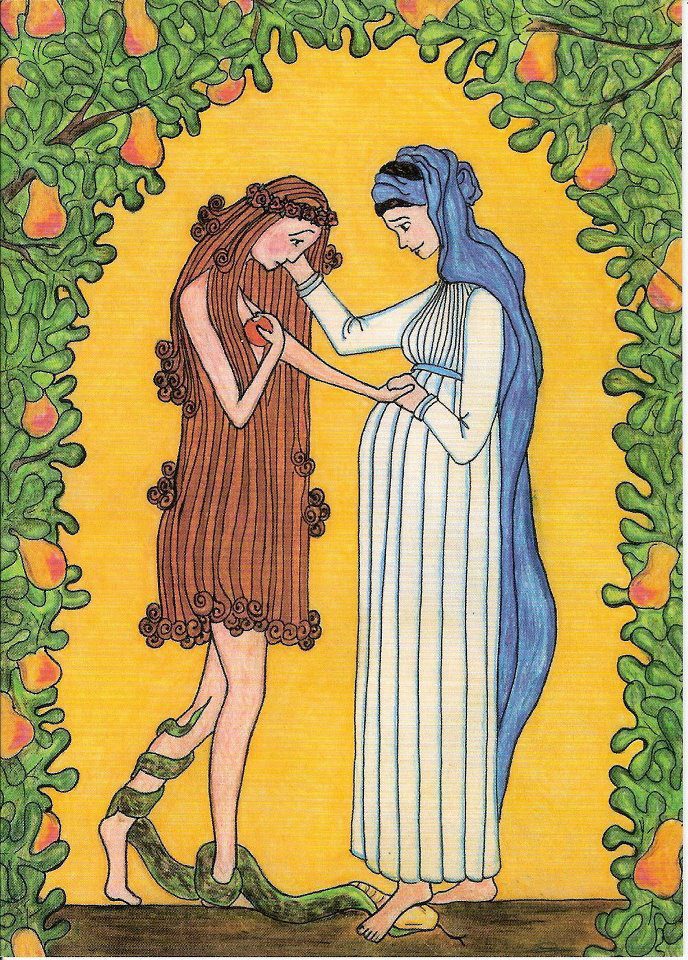 |
| Can You Spot the Errors? |
1) Grandma Eve's Legs and Looks
For some reason, Eve has a fruit in hand, but no fig leaves yet. Nevertheless she seems to have a 21st century conception of female modesty, feeling the need to wear her hair so as to cover only from the top of the legs up. Also, why make Eve and Mary look like Western Europeans? These are really the least of our problems with this picture, though.
2) Who is the New Eve?
Eve was the bride of Adam. Mary is not the bride of Christ, the church is.
Eve is our physical mother. Mary is not our spiritual mother, the church is.
Adam brought forth Eve. Jesus brought forth the church.
Mary is not the "new Eve" - if anything is, the church is. Mary, as greatly blessed as she was, is merely a member of that church.
3) Who crushed the head of the serpent?
The picture reflects the old Vulgate's erroneous translation "ipsa conteret caput tuum" (she will crush your head) rather than the new Vulgate's more accurate translation "ipsum conteret caput tuum" (it [i.e. the seed] will crush your head).
-TurretinFan
Sabas on The Twenty-Two Greek Letters and Their Significance
I had heard of a number of authors who testify to the fact that the Jewish canon is (and has for millenia been) twenty-two books. It was interesting to see confirmation of this fact in "Mysteries of the Greek Alphabet." The surprising thing about this is that the author chalks up the canon of the Jews as being twenty-two books, not based on the Hebrew Alphabet, but based on the Greek alphabet (claiming that two of the Greek letters are later additions). The author writes:
The manuscript itself is late 14th century (interesting to me given my recent review, its date is in relation to the "Age of the Martyrs," dating the beginning of the age to beginning of the reign of Diocletian, 284), but apparently is based on a much older original. If we accept the authorship identified with the manuscript it is apparently the work of St. Sabas (439-532). The main objection to this date is the fact that the third section of the work mentions the Arabic alphabet. Alcock seems to think that this reference makes Sabastian authorship impossible, although he notes the possibility that the references to the Arabic may be a later addition. This is possible, of course, since the Sahidic Coptic that we have is a translation from the Greek original, the Coptic people had interaction with the Arabic-speaking people.
I'm more optimistic that the references may possibly be original. The modern Arabic alphabet was just beginning to be developed in the 4th and 5th centuries, but there were Arab (broadly defined) peoples who used an alphabet (the Nabataean alphabet) before then. Moreover, the author refers to the fact that Alif is used for "1000," which was presumably true of Arabic before the positional number system was introduced to the Arabs (around 500 and increasingly used thereafter). Moreover, unlike Hebrew and the author's ancient Greek (according to the author), modern Arabic has 28 letters (based on 18 basic symbols, or rasm, plus various dottings). This argues for an earlier date for the work, from my point of view. I'm not aware of any scholarly study of the work aside from the notes provided with the text in Le Muséon.
I mention above that we have the Coptic translation of the text. Apparently Joseph Paramelle found a Greek copy of the text (per this entry). Unfortunately, I cannot tell what happened to that Greek copy since its discovery in 1989. Paramelle has come before his maker, so I cannot ask him. I wonder if it is one of the works in "Extraits hermétiques inédits dans un manuscrit d'Oxford" Mahé, Jean-Pierre • Para Melle, Joseph . (1991) in Revue des études grecques vol. 104 (1991) p. 109-139.
In any event, I simply add this reference to the already-existing pile of references from the patristic era that confirm a short Jewish canon.
-TurretinFan
Update: Apparently there is a German translation of the original Greek (here). The relevant portion of the text is substantially the same in Greek (regarding the twenty-two books) and the Greek also seems to make the reference to the Arabic, which seems to undermine my Coptic-Arabic suggestion.
Among them are twenty-two letters, apart from the xi and the psi, added by philosophers(Anthony Alcock, English translator, Roger Pearse, Publisher)
at the end. In this way, I am speaking of twenty-two letters: they correspond to the
number of the twenty-two works made by God in the creation, which are as follows.
The first: the first heaven.
The second: the earth below the abyss.
The third: the water on the face of the earth and below it.
The fourth: the other earth, which is the void.
The fifth: the spirit on the face of water, which is the air.
The sixth: the darkness upon the face of the abyss.
The seventh: the light that is called fire.
The eighth: the firmament called sky
The ninth: the separation of the two waters, above the firmament and below it.
The tenth: the emergence of the earth from the depths of the water.
The eleventh: the appearance of plants upon the face of the earth.
The twelfth: fruit-bearing trees with seeds on them.
The 13th: all beacons that bring light.
The fourteenth: the sun and the moon.
The fifteenth: their emplacement in the firmament of heaven.
The sixteenth: the fish in the waters.
The seventeenth: the birds of the air.
The eighteenth: all sea creatures that are large and those in the waters.
The nineteenth: all the animals.
The twentieth: all the poisonous reptiles
The twenty-first: all the beasts upon the earth.
The twenty-second: man of reason, the perfection of the entire world.
These are the works which God that came into being in the creation of the world, twenty-two of them.
For this reason there are twenty-two books counted in the Old Testament by the Jews.
For this reason, twenty-two thousand cattle were slaughtered by Solomon in dedicating the
Temple.
The manuscript itself is late 14th century (interesting to me given my recent review, its date is in relation to the "Age of the Martyrs," dating the beginning of the age to beginning of the reign of Diocletian, 284), but apparently is based on a much older original. If we accept the authorship identified with the manuscript it is apparently the work of St. Sabas (439-532). The main objection to this date is the fact that the third section of the work mentions the Arabic alphabet. Alcock seems to think that this reference makes Sabastian authorship impossible, although he notes the possibility that the references to the Arabic may be a later addition. This is possible, of course, since the Sahidic Coptic that we have is a translation from the Greek original, the Coptic people had interaction with the Arabic-speaking people.
I'm more optimistic that the references may possibly be original. The modern Arabic alphabet was just beginning to be developed in the 4th and 5th centuries, but there were Arab (broadly defined) peoples who used an alphabet (the Nabataean alphabet) before then. Moreover, the author refers to the fact that Alif is used for "1000," which was presumably true of Arabic before the positional number system was introduced to the Arabs (around 500 and increasingly used thereafter). Moreover, unlike Hebrew and the author's ancient Greek (according to the author), modern Arabic has 28 letters (based on 18 basic symbols, or rasm, plus various dottings). This argues for an earlier date for the work, from my point of view. I'm not aware of any scholarly study of the work aside from the notes provided with the text in Le Muséon.
I mention above that we have the Coptic translation of the text. Apparently Joseph Paramelle found a Greek copy of the text (per this entry). Unfortunately, I cannot tell what happened to that Greek copy since its discovery in 1989. Paramelle has come before his maker, so I cannot ask him. I wonder if it is one of the works in "Extraits hermétiques inédits dans un manuscrit d'Oxford" Mahé, Jean-Pierre • Para Melle, Joseph . (1991) in Revue des études grecques vol. 104 (1991) p. 109-139.
In any event, I simply add this reference to the already-existing pile of references from the patristic era that confirm a short Jewish canon.
-TurretinFan
Update: Apparently there is a German translation of the original Greek (here). The relevant portion of the text is substantially the same in Greek (regarding the twenty-two books) and the Greek also seems to make the reference to the Arabic, which seems to undermine my Coptic-Arabic suggestion.
Tuesday, April 09, 2013
Vatican Vacancy and Papal Necessity
For a brief time earlier this year, there was no pope - no bishop of Rome for the Roman Catholics. The "Camerlengo of the Holy Roman Church" (Cardinal Tarcisio Bertone held this office at that time) was in charge of Vatican City and Gandalf Castle and the few other "temporal powers" that still exist. Yet there was no "visible head" or "earthly head" or the like. There was a break, of sorts, in the supposedly "unbroken succession"! (see more on this point)
And more fundamentally, life went on. Life would have gone on had the cardinals not picked a successor. The bishop of Rome is really not necessary for anyone. People who had questions about the meaning of Scripture found answers. The Bible is no more or less clear today than it was during that time.
The Roman Catholic Church couldn't exist as such without a pope for the long run, because of various administrative tasks that fall to the pope (like appointing new bishops and elevating new cardinals). But those tasks are not tasks that are really necessary for the bishop of Rome to be doing.
What's the point? Simply that the papacy isn't necessary. It wasn't necessary in the time of the apostles and it is not necessary now. Any argument for the papacy, therefore, needs to come from some other quarter than from necessity.
-TurretinFan
Pressing Chris Date's Retreat
Over at "Rethinking Hell," Mr. Chris Date has retreated a few steps in his discussion of the meaning of the term "punishment."
Recall that the argument that "punishment" in this case was a "result" noun was one of Mr. Date's first supposedly "positive" arguments for his position. Now, Mr. Date tries to argue for ambiguity. He states: "First, it should be noted that many deverbal nouns are polysemous, ambiguous between a process or result meaning."
Of course, this is true - it's something that Mr. Blauser and I already pointed out in our supplement. It's true, but it's not necessarily relevant.
Moreover, while it is true, it can be misleading. While - in some cases - a word standing alone can be ambiguous, even words with a range of meaning that includes both process and result can unambiguously express one or the other in context. In other words, the fact that something is a deverbal noun doesn't make it automatically ambiguous in a particular context.
Mr. Date even admits:
Similarly, it's not true that just because some (or many) deverbal nouns are polysemous, that therefore all deverbal nouns are polysemous. Moreover, there are kinds and degrees of polysemeity. For example, there are words like "punishment" that (in English) nearly always refer to a process, just like there are words like "injury" that almost always refer to a result.
After an irrelevant tangent over whether a fine is a process or result (it's a result), Mr. Date points out that "capital punishment" is a use of "punishment" that carries a "result" sense.
Of course, the only reason it carries a "result" sense in English is that it is being modified by a term that requires that sense. In other words, it is the modifier that goes with the word "punishment" that determines whether it carries its usual process sense, or this exceptional "result" sense.
In like way, "fine" can refer to the process of transferring the money. For example, "During the fine of Mr. Date, the bank discovered that there were insufficient funds in his account." In this case, a word that normally refers to a result carries a meaning that refers to a process.
"Capital punishment" is just an example in the opposite direction, where a term that is normally about the process is used to refer to a result. Just as we make result nouns function as though they were process nouns, we can make process nouns function as though they were result nouns. For example, slap "completed" on a process noun, and you now have a usage that refers to result.
Moreover, "capital punishment" is not a term used in Scripture, and this particular example of the semantic domain of "punishment", therefore, does not have a corresponding expression in Koine Greek (that I could locate - perhaps there's some use I'm unaware of). In short, this is an exception to the general rule in English - but not one that Mr. Date will find in the Biblical text.
Taking the usage of "punishment" in the King James Version, the only modifiers aside from "everlasting" in Matthew 25:46, are "my" (Genesis 4:13), "no" (1 Samuel 18:10), "strange" (Job 31:3), and "sorer" (Hebrews 10:29). The only other place where the corresponding Greek word is used, the KJV translates it as torment, not punishment.
Moreover, in this case - the word that modifies "punishment" is the word that means "everlasting." It's a word that relates to duration. As such, it's a word that unmistakably suggests that "process" or "manner" sense of "punishment" is intended, just as if it had said "long punishment," "lengthy punishment," or "short punishment."
So, Chris Date has two uphill battles to try to make his supposedly positive case. First, he has to deal with the fact that "everlasting" here suggests a process, and second he has to deal with the fact that "punishment" normally refers to a process.
Chris Date attempted to rely on Augustine. Regarding his misuse of Augustine, Mr. Date asks:
Mr. Date turns from there to a rebuttal argument extracted from Jonathan Edwards. Jonathan Edwards argues that if the Biblical descriptions of punishment in the afterlife all refer simply to a state of annihilation, and if being in that state eternally meets the description of "eternal punishment," then there is no reason for a lengthy period of suffering prior to such annihilation.
Mr. Date mistakenly takes comfort in this argument, supposing that Edwards is saying that continuing in the state of being annihilated is legitimately viewed as an "eternal punishment." On the contrary, while Mr. Date cited section 31 of the chapter, in section 1 Edwards explicitly states "Eternal punishment is not eternal annihilation." (get the book, here)
Finally, Mr. Date uses an argument worth laying to rest here, although perhaps it could be addressed anywhere. He writes:
Thus, in this example:
It's also referred to earlier in Matthew:
And, I should add, this concept of fire that burns forever is not a strictly New Testament concept:
Or to take another example:
The fire on the altar, like the fire that consumed Sodom, are pictures of the unquenchable fire that is coming:
If we are to read "eternal" as merely "from God" with respect to the fire and the punishment, then we should do so also with "eternal life." But surely Scripture makes it abundantly clear that eternal life is forever.
All this to say this verse:
-TurretinFan
Recall that the argument that "punishment" in this case was a "result" noun was one of Mr. Date's first supposedly "positive" arguments for his position. Now, Mr. Date tries to argue for ambiguity. He states: "First, it should be noted that many deverbal nouns are polysemous, ambiguous between a process or result meaning."
Of course, this is true - it's something that Mr. Blauser and I already pointed out in our supplement. It's true, but it's not necessarily relevant.
Moreover, while it is true, it can be misleading. While - in some cases - a word standing alone can be ambiguous, even words with a range of meaning that includes both process and result can unambiguously express one or the other in context. In other words, the fact that something is a deverbal noun doesn't make it automatically ambiguous in a particular context.
Mr. Date even admits:
I do not dispute that “punishment” does sometimes—even often—refer to the process of punishing. But since such deverbal nouns are often polysemous, it does not follow that therefore “punishment” carries a process meaning every time it’s used. “Punishment” may often describe “a manner of treatment, not the result of that treatment,” but this is not always the case.This is similar to the post-modern fallacy of assuming that just because people sometimes revise their opinions - or even often revise their opinions on many things - that therefore there is nothing that should be held absolutely.
Similarly, it's not true that just because some (or many) deverbal nouns are polysemous, that therefore all deverbal nouns are polysemous. Moreover, there are kinds and degrees of polysemeity. For example, there are words like "punishment" that (in English) nearly always refer to a process, just like there are words like "injury" that almost always refer to a result.
After an irrelevant tangent over whether a fine is a process or result (it's a result), Mr. Date points out that "capital punishment" is a use of "punishment" that carries a "result" sense.
Of course, the only reason it carries a "result" sense in English is that it is being modified by a term that requires that sense. In other words, it is the modifier that goes with the word "punishment" that determines whether it carries its usual process sense, or this exceptional "result" sense.
In like way, "fine" can refer to the process of transferring the money. For example, "During the fine of Mr. Date, the bank discovered that there were insufficient funds in his account." In this case, a word that normally refers to a result carries a meaning that refers to a process.
"Capital punishment" is just an example in the opposite direction, where a term that is normally about the process is used to refer to a result. Just as we make result nouns function as though they were process nouns, we can make process nouns function as though they were result nouns. For example, slap "completed" on a process noun, and you now have a usage that refers to result.
Moreover, "capital punishment" is not a term used in Scripture, and this particular example of the semantic domain of "punishment", therefore, does not have a corresponding expression in Koine Greek (that I could locate - perhaps there's some use I'm unaware of). In short, this is an exception to the general rule in English - but not one that Mr. Date will find in the Biblical text.
Taking the usage of "punishment" in the King James Version, the only modifiers aside from "everlasting" in Matthew 25:46, are "my" (Genesis 4:13), "no" (1 Samuel 18:10), "strange" (Job 31:3), and "sorer" (Hebrews 10:29). The only other place where the corresponding Greek word is used, the KJV translates it as torment, not punishment.
Moreover, in this case - the word that modifies "punishment" is the word that means "everlasting." It's a word that relates to duration. As such, it's a word that unmistakably suggests that "process" or "manner" sense of "punishment" is intended, just as if it had said "long punishment," "lengthy punishment," or "short punishment."
So, Chris Date has two uphill battles to try to make his supposedly positive case. First, he has to deal with the fact that "everlasting" here suggests a process, and second he has to deal with the fact that "punishment" normally refers to a process.
Chris Date attempted to rely on Augustine. Regarding his misuse of Augustine, Mr. Date asks:
Did we not see Augustine explicitly stating that the measure of capital punishment is not in the duration of the punishing, but rather in the duration of the consequent lifelessness?No, we did not. We saw him explicitly saying that it was not in the duration of the act of killing but in the duration of the exile ("As to the award of death for any great crime, do the laws reckon the punishment to consist in the brief moment in which death is inflicted, or in this, that the offender is eternally banished from the society of the living?").
Mr. Date turns from there to a rebuttal argument extracted from Jonathan Edwards. Jonathan Edwards argues that if the Biblical descriptions of punishment in the afterlife all refer simply to a state of annihilation, and if being in that state eternally meets the description of "eternal punishment," then there is no reason for a lengthy period of suffering prior to such annihilation.
Mr. Date mistakenly takes comfort in this argument, supposing that Edwards is saying that continuing in the state of being annihilated is legitimately viewed as an "eternal punishment." On the contrary, while Mr. Date cited section 31 of the chapter, in section 1 Edwards explicitly states "Eternal punishment is not eternal annihilation." (get the book, here)
Finally, Mr. Date uses an argument worth laying to rest here, although perhaps it could be addressed anywhere. He writes:
The phrase Jesus uses a mere verses earlier, “eternal fire,” carries a certain meaning elsewhere, which along with the rest of Scripture must be the lens through which we interpret “eternal punishment,” rather than the other way around.The argument Mr. Date is referring to here attempts to read the shadow into the substance, instead of recognizing that the shadow is just a shadow.
Thus, in this example:
Matthew 25:41There is that fire that lasts forever. It's the same fire that whose smoke will rise up forever (as we discussed here).
Then shall he say also unto them on the left hand, Depart from me, ye cursed, into everlasting fire, prepared for the devil and his angels:
It's also referred to earlier in Matthew:
Matthew 18:8
Wherefore if thy hand or thy foot offend thee, cut them off, and cast them from thee: it is better for thee to enter into life halt or maimed, rather than having two hands or two feet to be cast into everlasting fire.
Chris Date's argument is to rely on the fact that the fire sent against Sodom and Gomoorrha is also called "eternal fire."
Jude 7The argument is that the fire and brimstone against Sodom was not eternal in the duration of its burning. But Sodom is just an example - a shadow or type of future punishment. Similarly, Gehenna and Tophet/Topheth are types of the future burning, but the fires there were not literally unending.
Even as Sodom and Gomorrha, and the cities about them in like manner, giving themselves over to fornication, and going after strange flesh, are set forth for an example, suffering the vengeance of eternal fire.
And, I should add, this concept of fire that burns forever is not a strictly New Testament concept:
Isaiah 33:14I should note that a similar thing occurs when the "read the limitations of the shadow into the substance" hermeneutic encounters similar types:
The sinners in Zion are afraid; fearfulness hath surprised the hypocrites. Who among us shall dwell with the devouring fire? who among us shall dwell with everlasting burnings?
Jeremiah 17:4Yet the Babylonian captivity was only for a matter of years.
And thou, even thyself, shalt discontinue from thine heritage that I gave thee; and I will cause thee to serve thine enemies in the land which thou knowest not: for ye have kindled a fire in mine anger, which shall burn for ever.
Or to take another example:
Leviticus 6:13Nevertheless, the fire on the altar did go out. It was relit by God at the building of Solomon's temple, and then went out again, at the latest at the time of the captivity (but probably significantly before then).
The fire shall ever be burning upon the altar; it shall never go out.
The fire on the altar, like the fire that consumed Sodom, are pictures of the unquenchable fire that is coming:
Matthew 3:12Trying to reconcile the idea that the "fire" is "eternal" with the claim that it is not unending results in people like Mr. Date having to argue that the fire is only "eternal" in the sense of being from the eternal God.
Whose fan is in his hand, and he will throughly purge his floor, and gather his wheat into the garner; but he will burn up the chaff with unquenchable fire.
Luke 3:17
Whose fan is in his hand, and he will throughly purge his floor, and will gather the wheat into his garner; but the chaff he will burn with fire unquenchable.
If we are to read "eternal" as merely "from God" with respect to the fire and the punishment, then we should do so also with "eternal life." But surely Scripture makes it abundantly clear that eternal life is forever.
All this to say this verse:
Matthew 25:46makes it perfectly clear that both hell (i.e. the lake of fire) and heaven are eternal.
And these shall go away into everlasting punishment: but the righteous into life eternal.
-TurretinFan
Review of "The Myth of Persecution" by Dr. Candida Moss
Dr. Candida Moss has provided a popular-level (as distinct from scholarly-level) account of what she calls the "myth of persecution." Unfortunately, popular-level readers may be misled by the scholarly-style nuances that Dr. Moss uses to make her case. Nevertheless, there are a number of interesting features in her work.
The overall purpose of the book seems to be disabuse readers of the idea that until Constantine Christians hid in catacombs, always fearful that Roman soldiers were about to arrest them and throw them to the lions. There may have been times it was like for certain groups of Christians in certain cities (such as in Rome during the time of Nero after the great fire).
Dr. Moss points out that the vast majority of Christian martyrdom accounts from the ante-Nicene are not historically reliable. Dr. Moss points out the work by the Bollandists who, since the 16th century, have been applying historical methods to the accounts of the lives of the saints. She then takes the six accounts deemed most reliable by the Bollandists and shows how even here the accounts are not strictly historical (see my separate discussion on Polycarp).
In the process, she notes many of the tools historians use, such as looking for anachronisms and legal or other improbabilities. She observes some of these in her criticism of Eusebius, who - in her view - was trying hard to elevate the role of bishops through a variety of techniques (see my separate discussion of her comments regarding ante-nicene bishops).
Dr. Moss also points out that many of the stories of saints and martyrs are either fictions or appropriations. She points out the example of "Saint Josaphat" as relatively indisputable example (see my separate discussion on Josaphat).
Dr. Moss seems eager to address the argument that Christians are the best and/or Christianity is true, because only we Christians have martyrs. She points out that were pre-Christian martyrs (though not called "martyrs"), such as Socrates and Maccabees. She also points out a number of pagan martyrdoms, such as Achilles' giving of his life as described in Homer's Iliad. This seems to miss the argument that martyrdom does establish the sincerity of the early followers of Christ (see my separate discussion of the truth value of martyrdom).
Dr. Moss unfortunately de-emphasizes the role of Jesus and of the author of Hebrews in discussing both the certainty of Christian martyrdom to come and the unity of that martyrdom with the past (see my separate discussion of Dr. Moss' surprising omissions).
Dr. Moss is careful in how she defines "persecution" as distinct from "prosecution." Thus, for example, a law making it a capital crime to deny that Zeus reigns in Olympus would be one that might lead to prosecution of Christians, even if the author of the law had no idea what Christians are. Likewise, Dr. Moss distinguishes between hatred, prejudice, and the like, and actual attacks. Moreover, Dr. Moss distinguishes between regional persecutions of limited duration and officially sanctioned imperial actions.
While the distinctions are understandable and even, in many ways, legitimate distinction, they can lead to popular-level confusion. For example, some may come away thinking that she is saying Christians are just cry-babies who claim to be persecuted even though they are not. Rather, I think her point is intended to emphasize the need to be cautious in how we employ persecution rhetoric (see my discussion on rhetorical excess here).
Dr. Moss' book has a number of useful remedies for those with an excessively hagiographic view of church history, notwithstanding her ironic use of a little persecution rhetoric of her own (see my discussion here). Dr. Moss seems to represent a moderately liberal/modern view of the New Testament (she is a professor of New Testament at Notre Dame, in South Bend, Indiana) and her religious views are not clearly stated (she mentions attending a mass with a colleague, but nowhere explicitly states that she is a Roman Catholic). So, naturally one should use appropriate discernment in reading.
-TurretinFan
P.S. I don't intend the above to be a comprehensive review of Dr. Moss' book. There is certainly much more that could be said, though for now, I have said what I plan to say.
The Real Francis Turretin on Sin's Relation to God
The Real Francis Turretin on sin's relation to God:
Theology treats sin not as belonging to God, but as holding certain relationship to Him (either that of opposite or contrary or as coming under His providence and justice); just as medicine treats of diseases and their remedies although its principle subject is man as curable.(cited as Topic 1, Questions 5, Part X at this link)
Google Reader Replacement - Feedly?
I have enjoyed using Google Reader for keeping up to date with various blogs and other websites. However, Google is apparently going to discontinue this product. The heir apparent seems to be Feedly, which seems to be able to synch with Google Reader, and has nice apps for mobile devices. I'm not certain what will happen to Feedly when Google retires, though.
I hope that the 548 of you who subscribe to this blog in Google Reader will be able to find a suitable replacement. I know I don't always post regularly enough to give readers a reason to come here each day for something new, and feed readers can be a nice alternative to manually going to the site and checking for new posts, day after day, or hour after hour.
Assuming it doesn't get too spammy, suggestions for other alternatives are welcome in the comment box.
St. Josaphat aka Buddha
At page 88 of The Myth of Persecution, Dr. Moss drew attention to a particularly glaring case of false saints in the case of St. Josaphat. The story of "Barlaam and Josaphat" became popular in Europe after being translated into Greek, probably around the 11th century.
The name "Josaphat," as it turns out, is derived from Arabic Yūdhasaf or Būdhasaf, which is derived from the title Buddha (enlightened one) and refers to Siddhartha Gautama (c. 563-483 B.C.). The story is essentially a retelling of the life story of the Buddha.
The story was popular and eventually Josaphat managed to get assigned a day in the calendar not only in the Roman church, but also in the Greek and Slavic churches.
You have to wonder if the Serpent was laughing at professing Christians unwittingly asking Buddha to "ora pro nobis." While the fact that Josaphat = Buddha was not discovered until the 19th century, the Reformers warned against the veneration of saints, not only on the general grounds that such veneration is wrong, but also on the specific ground that many of the saints were not true believers.
Thomas Newton, in the 18th century, expressed it this way (source):
It is impossible to relate or enumerate all the various falsehoods and lies which have been invented and propagated for this purpose; the fabulous books forged under the names of apostles, saints, and martyrs; the fabulous legends of their lives, actions, sufferings, and deaths; the fabulous miracles ascribed to their sepulchres, bones, and other relics; the fabulous dreams and revelations, visions and apparitions of the dead to the living and even the fabulous saints who never existed but in the imagination of their worshippers. And all these stories the monks the priests the bishops of the church have imposed and obtruded upon mankind it is difficult to say whether with greater artifice or cruelty with greater confidence or hypocrisy and pretended sanctity, a more hardened face or a more hardened conscience.-TurretinFan
Rhetorical Excess - Religious Persecution and Idolatry
Rhetorical flourishes are like any other form of emphasis. They work well when used occasionally and accurately, and not when used constantly and diffusely.
The point here is to emphasize the heinousness of rebellion and stubbornness, by tying them rhetorically to the heinous and well-recognized sins of witchcraft and idolatry.
These are legitimate rhetorical uses of the term "idolatry." Yet we can risk watering down the word "idolatry" for using it gratuitously for every sin. Anything that leads us into sin becomes an "idol" in this rhetorical soup, and thus every sin is "idolatry," the serving of the thing (the "idol") that leads one to sin.
At which point people lose sight of both the very real problem of making images supposedly of God (2nd commandment) and of the very real problem of actually worshiping false gods (1st commandment). By constantly associating less heinous sins with the more heinous sins, we actually can lose sight of the heinousness of the heinous sins.
Christians in the U.S. are not suffering under Diocletian persecution, even if Christians lack full religious freedom, or even if they are being forced to endure laws that bear decreasing resemblance to the laws given to Old Testament Israel in terms of the ideals of Justice.
While some of Dr. Moss' concerns are probably oversensitive, she makes a good point about the need to avoid rhetorical flourishes. If we call everything "persecution," what will we call it when we are forced to pay a "Christian tax" in order to be Christians? What will we call it when our churches are required to meet secretly and in groups of 20 or fewer?
-TurretinFan
In her book, The Myth of Persecution, Dr. Moss complains that the religious right in the U.S. is too quick to decry leftist politics as religious persecution. Claiming that "Christianity is under attack" when Christians suffer any minor harm overshadows the very serious persecution of Christians in places like Africa (the "Voice of the Martyrs" website, which I mention for information only, not endorsement, has many details).
The same thing is true when call everything "idolatry." An idol is a manufactured likeness or image of something. It can be a painted likeness, an engraved likeness, a carved likeness, a molten likeness, etc. Worshiping even the true God using idols is strictly forbidden. Moreover, through metonymy we refer to the worship of false gods as "idolatry," since they are normally worshiped in this way.
But not every sin is literally "idolatry." The X-Box game console that your son hasn't stopped playing for the past ten years is not literally an idol. It's sinful that he hasn't bothered even to try to go get a job, and it's wrong for him to be so obsessed with something so trivial. The sports team that your brother can't get enough of is not an "idol." American Idol features living human beings, made in the image of God, not idols.
Not every form of devotion is religious devotion. While the American Idol contestants are honored in some sense, they are not honored religiously. Even if someone skips church to go watch football, he is not engaging in a religious observance of football.
His church skipping is a violation of the 4th commandment (Remember the Sabbath Day) not the 2nd commandment (Thou shalt not make to thyself any graven image ...). The X-Box aficionado is probably violating the eighth commandment through indolence and sloth. When we call a Muslim an "idolater," we should feel how odd the claim sounds, since Islam is not closely associated with idols.
There is a place for rhetorical flourishes. The Scriptures actually do this with idolatry in a couple of places.
1 Samuel 15:23For rebellion is as the sin of witchcraft, and stubbornness is as iniquity and idolatry. Because thou hast rejected the word of the Lord, he hath also rejected thee from being king.Samuel is condemning Saul. Saul tried to eliminate witchcraft and idolatry from the land. Then Saul turned around and was stubborn and rebelled against God. So, Samuel drew a comparison between rebellion and witchcraft and between stubbornness and idolatry.
The point here is to emphasize the heinousness of rebellion and stubbornness, by tying them rhetorically to the heinous and well-recognized sins of witchcraft and idolatry.
Colossians 3:4-7 When Christ, who is our life, shall appear, then shall ye also appear with him in glory. Mortify therefore your members which are upon the earth; fornication, uncleanness, inordinate affection, evil concupiscence, and covetousness, which is idolatry: for which things' sake the wrath of God cometh on the children of disobedience: in the which ye also walked some time, when ye lived in them.Here again, the point of referring to covetousness as "idolatry" is to emphasize its heinousness. It's not saying that the 10th commandment is the 2nd commandment (or the 1st commandment). It's saying that covetousness is a serious sin.
These are legitimate rhetorical uses of the term "idolatry." Yet we can risk watering down the word "idolatry" for using it gratuitously for every sin. Anything that leads us into sin becomes an "idol" in this rhetorical soup, and thus every sin is "idolatry," the serving of the thing (the "idol") that leads one to sin.
At which point people lose sight of both the very real problem of making images supposedly of God (2nd commandment) and of the very real problem of actually worshiping false gods (1st commandment). By constantly associating less heinous sins with the more heinous sins, we actually can lose sight of the heinousness of the heinous sins.
Christians in the U.S. are not suffering under Diocletian persecution, even if Christians lack full religious freedom, or even if they are being forced to endure laws that bear decreasing resemblance to the laws given to Old Testament Israel in terms of the ideals of Justice.
While some of Dr. Moss' concerns are probably oversensitive, she makes a good point about the need to avoid rhetorical flourishes. If we call everything "persecution," what will we call it when we are forced to pay a "Christian tax" in order to be Christians? What will we call it when our churches are required to meet secretly and in groups of 20 or fewer?
-TurretinFan
Monday, April 08, 2013
Candida Moss and the Truth Value of Martyrdom
In The Myth of Persecution, Dr. Moss repeats the assertion that martyrdom is used as proof of the truth of the martyrs' views. For example at page 43 she states, "The notion that her innocence is proved by her death is uncomfortable to us, but it is the same idea that we saw with Socrates: individuals' worth and the truth of their claims are irrefutably proved by their deaths."
Likewise, at page 17 she poses the question: "Why would the apostles have been willing to suffer and die for Jesus if he hadn't really been resurrected from the dead? Why would early Christians have been martyred if Christianity weren't true?" At page 23, Dr. Moss puts virtually the same words in the mouth of her divinity teacher.
At page 80, Dr. Moss states "the adaptation of paganism into Christianity threatens the idea that Christianity alone has the truth. Those who reject the classical tradition for religious reasons and hold Christian martyrs in high esteem tend to ignore Greek and Roman antecedents to martyrdom." Likewise, at page 81, Dr. Moss states "The problem is that this isn't what Christians have said about martyrdom. They have said that it is unique to Christianity, thoroughly new, and a mark of Christianity's sole possession of the truth. Christianity is true, it is said, because only Christians have martyrs."
At page 137, Dr. Moss states "The result of this is that the fact of the apostles' deaths cannot be used as evidence for the truth of Christianity, the resurrection, or any other detail of Jesus' ministry. We know that the apostles died, but how they died, on what charges, and in what manner are far beyond our grasp. Without that information it is impossible to state that their deaths prove anything."
At page 250, Dr. Moss states "In Christian terms, if you're being persecuted, you must be doing something right. It's a rather easy trick: if anyone can claim to stand in continuity with the martyrs and be victims of persecution, and if being persecuted authenticates one's religious message, then anyone can claim to be right."
These form a seemingly central aspect of Dr. Moss' book - her argument that martyrdom doesn't prove anything. Yet martyrdom does actually establish the sincerity of the martyr. It's not infallible, to be sure. A person may suffer martyrdom because they are suicidal, rather than because they really hold to the forbidden view.
Dr. Moss is definitely correct in rebuking those who argue "he died for Christianity, so Christianity must be true." But that is certainly not the right way to appeal to the martyrs. J. Warner Wallace is an example of a more correct use of the argument from martyrs (link), although I would point out that the source reliable historical information about the death of the apostles is canonical Scripture.
Almost none of Dr. Moss' arguments would respond to Wallace's usage. The one argument that might apply is this one: "The result of this is that the fact of the apostles' deaths cannot be used as evidence for the truth of Christianity, the resurrection, or any other detail of Jesus' ministry. We know that the apostles died, but how they died, on what charges, and in what manner are far beyond our grasp. Without that information it is impossible to state that their deaths prove anything." (p. 137)
It seems that Dr. Moss has forgotten about the martyrdom of James.
Acts 12:1-3
Now about that time Herod the king stretched forth his hands to vex certain of the church. And he killed James the brother of John with the sword. And because he saw it pleased the Jews, he proceeded further to take Peter also. (Then were the days of unleavened bread.)
Likewise, Dr. Moss seems to have forgotten about the prophecy of Peter's death:
John 21:17-19
He saith unto him the third time, Simon, son of Jonas, lovest thou me? Peter was grieved because he said unto him the third time, Lovest thou me? And he said unto him, Lord, thou knowest all things; thou knowest that I love thee. Jesus saith unto him, Feed my sheep. Verily, verily, I say unto thee, When thou wast young, thou girdest thyself, and walkedst whither thou wouldest: but when thou shalt be old, thou shalt stretch forth thy hands, and another shall gird thee, and carry thee whither thou wouldest not. This spake he, signifying by what death he should glorify God. And when he had spoken this, he saith unto him, Follow me.
Or perhaps Dr. Moss simply does not trust Acts (she seems rather uncertain that the author of Acts is Luke) or John.
It's difficult to say what her argument is, on points where she offers no argument.
-TurretinFan
Hell and Romans 12
One surprisingly compelling passage in favor of the idea of eternal conscious torment in the New Testament is Romans 12:20, where Paul explains one motive for doing good to our enemies.
Coals of fire are a symbol of the wrath of God:
Furthermore, the point of the coals is not simply annihilation, but pain. What's the value of trying to "heap" coals of fire? It really seems to make little sense outside the context of conscious torment. While the eternality of that torment is not immediately apparent from Romans 12 itself, it becomes more clear when taken with the rest of Scripture's testimony.
-TurretinFan
Romans 12:20This was nothing new. In fact, it's a paraphrase of a passage from Proverbs:
Therefore if thine enemy hunger, feed him; if he thirst, give him drink: for in so doing thou shalt heap coals of fire on his head.
Proverbs 25:21-22The significance of this passage is related to the person receiving eternal consequences. It's not simply that they will feel guilty.
If thine enemy be hungry, give him bread to eat; and if he be thirsty, give him water to drink: for thou shalt heap coals of fire upon his head, and the Lord shall reward thee.
Coals of fire are a symbol of the wrath of God:
Ezekiel 10:2More particularly, they are a symbol of the wrath of God visited on those in hell:
And he spake unto the man clothed with linen, and said, Go in between the wheels, even under the cherub, and fill thine hand with coals of fire from between the cherubims, and scatter them over the city. And he went in in my sight.
Habakkuk 3:5
Before him went the pestilence, and burning coals went forth at his feet.
Psalm 140:9-10Advocates of annihilation may be tempted to treat this as referring only to an interim punishment before the great judgment day. However, notice that this says that they will "rise not up again." The point is that they are stuck under these punishments forever.
As for the head of those that compass me about, let the mischief of their own lips cover them. Let burning coals fall upon them: let them be cast into the fire; into deep pits, that they rise not up again.
Furthermore, the point of the coals is not simply annihilation, but pain. What's the value of trying to "heap" coals of fire? It really seems to make little sense outside the context of conscious torment. While the eternality of that torment is not immediately apparent from Romans 12 itself, it becomes more clear when taken with the rest of Scripture's testimony.
-TurretinFan
The Myth of Whose Persecution?
Ironically, in the acknowledgments section, Dr. Moss portrays herself as feeling persecuted! She writes (p. 261):
I don't question that Dr. Moss' concerns are legitimate. After all I'm sure that many traditionalist Roman Catholics will be unhappy with the contents of her book.
Rather the comment is simply rather ironic in the context of a book that seems to condemn Christians for having a persecution complex.
- TurretinFan
I might not have had the courage to see this book through to completion, were it not for the friendship of Dan Myers, who directed me to various relevant news items, encouraged me to stand my ground, and assured me that I wouldn't be fired.And, of course, I certainly hope Dr. Moss is not fired. But this kind of description certainly serves to paint Dr. Moss as a crusader, risking negative consequences for the Truth!
I don't question that Dr. Moss' concerns are legitimate. After all I'm sure that many traditionalist Roman Catholics will be unhappy with the contents of her book.
Rather the comment is simply rather ironic in the context of a book that seems to condemn Christians for having a persecution complex.
- TurretinFan
Sunday, April 07, 2013
State's Interest in Marriage?
During debate in the Supreme Court, one of the justices made an interesting comment.
It is remarkable that Justice Ginsburg's question presupposes that the entire purpose of marriage relates to Federal labor and employment law or federal tax law. The answer to her question is that obviously states have other uses for having state laws including state labor and employment laws and state tax laws, but also for things like adultery, divorce, and other family law issues, and further for marital privilege in state courts.
Moreover, suppose that the whole purpose (from the state's perspective) is to allow people to benefit from Federal benefits? What is to prevent states from defining marriage as simply living at the same address, to permit roommates to secure federal benefits, regardless of sexual activity or actual marital relationship?
I realize that all this is rather trivial compared to the problem of a society ready to endorse the behavior. Still, it would be good if there were clear thinking about the issues.
-TurretinFan
JUSTICE GINSBURG: Mr. Clement, the problem is that it would totally thwart the States' decision that there is a marriage between two people, for the Federal government then to come in to say no joint return; no marital deduction; no Social Security benefits; your spouse is very sick, but you can't get leave; people - if that set of attributes, one might well ask, what kind of marriage is this?(I corrected the official transcript, which seemed to have some trouble with Justice Ginsburg's accent)
It is remarkable that Justice Ginsburg's question presupposes that the entire purpose of marriage relates to Federal labor and employment law or federal tax law. The answer to her question is that obviously states have other uses for having state laws including state labor and employment laws and state tax laws, but also for things like adultery, divorce, and other family law issues, and further for marital privilege in state courts.
Moreover, suppose that the whole purpose (from the state's perspective) is to allow people to benefit from Federal benefits? What is to prevent states from defining marriage as simply living at the same address, to permit roommates to secure federal benefits, regardless of sexual activity or actual marital relationship?
I realize that all this is rather trivial compared to the problem of a society ready to endorse the behavior. Still, it would be good if there were clear thinking about the issues.
-TurretinFan
Candida Moss on Bishops and the Bishop of Rome in the Early Church
In The Myth of Persecution, Dr. Candida Moss (professor of New Testament at Notre Dame) makes two interesting comments regarding the early church and the papacy. First, at page 227, she states:
Second, at pages 230-31, she states:
- TurretinFan
According to the Roman Catholic and Anglican churches, bishops can trace their line in an unending succession all the way back to the earliest days of the Jesus movement. The most famous example of this is the pope in Roman Catholicism, who is believed to be a direct spiritual descendant of the apostle Peter. Yet recent archaeological and historical studies of the church before the conversion of Constantine have shown that bishops were not very powerful and that the church was thoroughly disorganized.I assume she means "unbroken" rather than "unending" (but compare my previous comments). Moreover, she's right about the lack of power of the bishops and the lack of organization. Part of that, though, is the environment of persecution and hostility that Dr. Moss is reluctant to acknowledge existed.
Second, at pages 230-31, she states:
The picture we get from Eusebius is that Irenaeus, the keen fighter of heretics and chronographer of episcopal traditions, was a friend of the martyrs and was recommended for the rank of bishop by the martyrs themselves. By the time this letter reached Rome, its authors would have been dead already and moved from the category of confessors to that of martyrs. It is interesting that these Christians were writing to the Bishop of Rome, because this assumes that the Bishop of Rome had influence and perhaps even authority over ancient France in a manner similar to the pope's influence and authority over the church today. This is a charming picture of order and harmony in which martyrs defer to and support the bishops. Eusebius is able to establish, quite concretely, the lineage of episcopacy in Gaul and to justify its origins.These are pretty much the same things we've been saying to Roman Catholics, but it as at least nice to see them being said by a professor at a major Roman Catholic university. Dr. Moss mentions going to mass in her book, but I cannot recall her ever specifying whether she is Roman Catholic.
This romantic picture of harmony and hierarchy is anachronistic. In the late second century the bishop of Rome had nothing like the power that the pope has today. The famous passage from Matthew in which Jesus promises Peter, "You are Peter, and on this rock I will build my church" (16:18), which is today used to legitimize the papacy, was never quoted in full in any Christian literature until the third-century writer Tertullian. Even then Tertullian does not cite the passage in order to demonstrate the authority of the Bishop of Rome over the entire church. If the imprisoned confessors in Gaul wrote to the bishop of Rome, it was because they had strong ties to Rome, Rome was a center of finance and commerce, and the bishop of Rome was an important figure there. It was not because they were asking the head of the church for guidance. For many centuries bishops struggled to find their footing as authority figures in the church. They found themselves at odds with confessors, monks, and those who controlled the shines of saints in their regions. The picture that Eusebius gives us is incorrect, but it does valuable work in supporting church hierarchy and unity.
- TurretinFan
Saturday, April 06, 2013
Candida Moss' Surprising Omission of Jesus and Hebrews' Appeal to Abel
One surprising omission from Dr. Candida Moss' book, "The Myth of Persecution," is discussion of Jesus' own framework for persecution. Jesus, you recall, stated:
Moreover, while the term "martyr" is not used there by Jesus, the author of the book of Hebrews makes the identification:
This is a surprising omission by Dr. Moss, given that she is quick to attempt to minimize the uniqueness of Christian martyrdom.
Indeed, except briefly at page 5 and then again at page 135, Dr. Moss virtually remains silent regarding Jesus and the relation between Christianity and persecution.
Another surprising omission is the discussion in Revelation (which is Jesus' revelation to John, do not forget) about the voice of the martyrs crying out for judgment. Here the term is being used in its more technical sense:
The one theme she mentions is Jesus' comment about his followers taking up the cross, which is not just reported once, but numerous times:
-TurretinFan
Matthew 23:29-36Here Jesus connects his own persecution and the persecution of his followers with the persecution of the righteous beginning with Cain's murder of Abel, and extending down to Joash's murder of Zechariah.
Woe unto you, scribes and Pharisees, hypocrites! because ye build the tombs of the prophets, and garnish the sepulchres of the righteous, and say, "If we had been in the days of our fathers, we would not have been partakers with them in the blood of the prophets." Wherefore ye be witnesses unto yourselves, that ye are the children of them which killed the prophets. Fill ye up then the measure of your fathers.
Ye serpents, ye generation of vipers, how can ye escape the damnation of hell?
Wherefore, behold, I send unto you prophets, and wise men, and scribes: and some of them ye shall kill and crucify; and some of them shall ye scourge in your synagogues, and persecute them from city to city: that upon you may come all the righteous blood shed upon the earth, from the blood of righteous Abel unto the blood of Zacharias son of Barachias, whom ye slew between the temple and the altar. Verily I say unto you, All these things shall come upon this generation.
Moreover, while the term "martyr" is not used there by Jesus, the author of the book of Hebrews makes the identification:
Hebrews 11:4Although God is testifying initially, the "he being dead yet speaketh" refers to Abel. Moreover, it is apparent that Abel is the leading example in the Hebrews 12:1 reference to the great cloud of witnesses (μαρτύρων). Of course, it must be conceded that some of the "martyrs" here are witnesses who testified through their life, rather than strictly through their death, like Abel.
By faith Abel offered unto God a more excellent sacrifice than Cain, by which he obtained witness that he was righteous, God testifying of his gifts: and by it he being dead yet speaketh.
This is a surprising omission by Dr. Moss, given that she is quick to attempt to minimize the uniqueness of Christian martyrdom.
Indeed, except briefly at page 5 and then again at page 135, Dr. Moss virtually remains silent regarding Jesus and the relation between Christianity and persecution.
Another surprising omission is the discussion in Revelation (which is Jesus' revelation to John, do not forget) about the voice of the martyrs crying out for judgment. Here the term is being used in its more technical sense:
Revelation 2:12-13Frankly, I suppose there may be a variety of reasons for Dr. Moss' omissions of the Biblical data, mostly because she feels that Christians feeling persecuted has strong negative consequences, and she wishes to minimize those feelings.
And to the angel of the church in Pergamos write; These things saith he which hath the sharp sword with two edges; I know thy works, and where thou dwellest, even where Satan's seat is: and thou holdest fast my name, and hast not denied my faith, even in those days wherein Antipas was my faithful martyr, who was slain among you, where Satan dwelleth.
Revelation 6:9-11
And when he had opened the fifth seal, I saw under the altar the souls of them that were slain for the word of God, and for the testimony which they held: and they cried with a loud voice, saying, How long, O Lord, holy and true, dost thou not judge and avenge our blood on them that dwell on the earth? And white robes were given unto every one of them; and it was said unto them, that they should rest yet for a little season, until their fellowservants also and their brethren, that should be killed as they were, should be fulfilled.
Revelation 17:6
And I saw the woman drunken with the blood of the saints, and with the blood of the martyrs of Jesus: and when I saw her, I wondered with great admiration.
The one theme she mentions is Jesus' comment about his followers taking up the cross, which is not just reported once, but numerous times:
Matthew 10:38Moreover, while she mentions that some people spiritualize this, other passages cannot be so easily dismissed. For example, Jesus often referred explicitly to coming persecution:
And he that taketh not his cross, and followeth after me, is not worthy of me.
Matthew 16:24
Then said Jesus unto his disciples, If any man will come after me, let him deny himself, and take up his cross, and follow me.
Mark 8:34
And when he had called the people unto him with his disciples also, he said unto them, Whosoever will come after me, let him deny himself, and take up his cross, and follow me.
Mark 10:21
Then Jesus beholding him loved him, and said unto him, One thing thou lackest: go thy way, sell whatsoever thou hast, and give to the poor, and thou shalt have treasure in heaven: and come, take up the cross, and follow me.
Luke 9:23
And he said to them all, If any man will come after me, let him deny himself, and take up his cross daily, and follow me.
Matthew 5:10-12And Paul's explicit statement:
Blessed are they which are persecuted for righteousness' sake: for theirs is the kingdom of heaven. Blessed are ye, when men shall revile you, and persecute you, and shall say all manner of evil against you falsely, for my sake. Rejoice, and be exceeding glad: for great is your reward in heaven: for so persecuted they the prophets which were before you.
Matthew 5:44
But I say unto you, Love your enemies, bless them that curse you, do good to them that hate you, and pray for them which despitefully use you, and persecute you;
Matthew 10:23
But when they persecute you in this city, flee ye into another: for verily I say unto you, Ye shall not have gone over the cities of Israel, till the Son of man be come.
Matthew 13:21
Yet hath he not root in himself, but dureth for a while: for when tribulation or persecution ariseth because of the word, by and by he is offended.
Matthew 23:34
Wherefore, behold, I send unto you prophets, and wise men, and scribes: and some of them ye shall kill and crucify; and some of them shall ye scourge in your synagogues, and persecute them from city to city:
Mark 4:17
And have no root in themselves, and so endure but for a time: afterward, when affliction or persecution ariseth for the word's sake, immediately they are offended.
Mark 10:30
But he shall receive an hundredfold now in this time, houses, and brethren, and sisters, and mothers, and children, and lands, with persecutions; and in the world to come eternal life.
Luke 11:49
Therefore also said the wisdom of God, I will send them prophets and apostles, and some of them they shall slay and persecute:
Luke 21:12
But before all these, they shall lay their hands on you, and persecute you, delivering you up to the synagogues, and into prisons, being brought before kings and rulers for my name's sake.
John 5:16
And therefore did the Jews persecute Jesus, and sought to slay him, because he had done these things on the sabbath day.
John 15:20
Remember the word that I said unto you, The servant is not greater than his lord. If they have persecuted me, they will also persecute you; if they have kept my saying, they will keep yours also.
2 Timothy 3:12While I'm sure Dr. Moss is right to criticize Eusebius for embellishing or even possibly fabricating martyrdom stories from the pre-Constantine era, he is certainly not the author of the Scriptures that teach Christians to expect persecution. Furthermore, Dr. Moss may rightly be critical of those who sought voluntary martyrdom (although surprisingly I did not see Dr. Moss object to Ignatius' nearly quasi-voluntary martyrdom). Nevertheless, Dr. Moss seemed to downplay the Biblical data in her critique.
Yea, and all that will live godly in Christ Jesus shall suffer persecution.
-TurretinFan
Tuesday, April 02, 2013
The Bible and Slavery - Some Limitations
In a previous post (link), I discussed the volatile topic of slavery and the Puritans and I mentioned that the Bible does not prohibit slavery, it merely regulates it. The regulations on slavery include a number of points:
1) Slaves as Household Members
Male slaves who were not Hebrew were to be circumcised and afterwards admitted to the Passover (Exodus 12:44) as distinct from aliens and hired servants who were not welcome to the Passover (Exodus 12:45).
2) Slave Term of Ownership
Hebrew slaves were permitted to be enslaved for a maximum of six years (Exodus 21:2 and Deuteronomy 15:12). However, the male Hebrew slave could obligate himself to perpetual slavery, perhaps for the sake of a fellow-slave wife and children (Deuteronomy 15:17).
The rationale was essentially that the Hebrews were released from slavery in Egypt by God and were not to be made slaves, but instead treated like hired servants (Leviticus 25:35-42). The rationale was further that the Hebrews were specifically the slaves of God (Leviticus 25:55).
Moreover, at his release, the Hebrew slave was to be furnished freely with meat, bread, and wine (Deuteronomy 15:13-15).
3) Murder of Slaves Prohibited
If a slave (male or female) was beaten to death, the owner was required to be punished (Exodus 21:20). There was a limitation on this for the case where the death could not be closely linked to the beating (Exodus 21:21).
4) Maiming of Slaves Prohibited
If a slave suffered the permanent loss of a body part or major function, the slave was to be liberated immediately (Exodus 21:26).
5) Jubilee Release of Slaves
In the year of jubilee, male slaves and their children were to be released (Leviticus 25:39-42 &54).
6) Redemption Permitted
If a Hebrew sold himself into slavery to a foreigner in the land, the Hebrews could redeem him based on the wages of a hired servant for the amount of time remaining until the jubilee Leviticus 25:47-53).
7) Safe Harbour for Escaped Slaves
The Hebrews were not to return foreign slaves to their masters (Deuteronomy 23:15). Instead, they were supposed to permit the slaves to live within the walled cities of Israel (Deuteronomy 23:16).
8) Foreign Slave Wives Liberation at Divorce
If a female slave was acquired by war and her owner decided to marry her, then he was required to let her go free when he divorced her, as opposed to selling her away (Deuteronomy 21:10-14).
9) Limited Manner of Enslavement
It was not permitted for the Israelites to enslave other Hebrews or resident aliens by kidnapping them (Exodus 21:16 and Deuteronomy 24:7).
Perhaps there are more verses that could be brought to bear on the subject. I'm sure that the regulations above are insufficient for Enlightenment and Post-Enlightenment anti-slavery proponents, but the regulations were actually pretty substantial. While slaves were recognized as property of their owners (see the 10th commandment for example) and while God uses the master-slave metaphor to describe his relationship to us, the regulations on slavery in Israel maintained the fact that the slaves had the image of God and consequently were to receive the sign of the covenant, were to be treated leniently, were not to be killed, and were to be freed in many cases.
-TurretinFan
P.S. I would welcome in the comment box any further limitations on slavery that I've overlooked. I would not welcome any general anti-slavery comments. Perhaps there will be a time and place for those comments elsewhere another time.
The "Bind and Loose" Argument Rebutted
Over at GreenBaggins, Scott tried to make an argument for an infallible rule of faith other than the Bible. He wrote: "The fact is that Matthew 16:18-19 and Matthew 18:18 teach that man and/or those men can bind or loose, not just sin, but whatsoever they choose." Let's consider this argument piece by piece:
"that man and/or those men"
Peter and the other apostles are gone. Francis, like his predecessor Benedict XVI, is not an apostle of Jesus Christ, he did not personally receive revelation from Jesus as they did, It is a leap to say that the apostles could do X, therefore someone who is not an apostle can do X.
"bind and loose"
Of course, "bind and loose" doesn't sound anything like "define dogma." It sounds more like freeing people from their sins or leaving people in condemnation for their sins.
"not just sin"
That sounds like Scott is saying, "sin and more." But Rome's teaching of infallibility is that Rome is infallible only in her doctrinal and moral definitions, not in her exercise of discipline. So, if it is "sin and more" and implies infallibility, then Scott has proved a point that is stronger than what Rome can adopt. After all, a Roman bishop exonerated Pelagius (and then later condemned), a Roman bishop condemned Athanasius (and then later exonerated), and let's not even get into the trial of Galileo.
"whatsoever they choose"
In Roman Catholic theology, the definition of dogma is (officially) not arbitrary. For example, CCC 86 states:
“Yet this Magisterium is not superior to the Word of God, but is its servant. It teaches only what has been handed on to it. At the divine command and with the help of the Holy Spirit, it listens to this devotedly, guards it with dedication, and expounds it faithfully. All that it proposes for belief as being divinely revealed is drawn from this single deposit of faith.”Of course, I acknowledge that in practice the power is arbitrarily exercised (contrary to CCC 86), but this is just an internal inconsistency.
Likewise, to be precise the text does not mention choice, it just states that what is bound on earth will be bound in heaven and what is loosed on earth will be loosed in heaven.
- TurretinFan
Monday, April 01, 2013
Puritans, Slavery, and Exodus 21:16
A dear reader (name removed to protect the innocent) wrote (slightly edited below):
a) Which puritans exactly owned slaves and/or were slave ship chaplains? I can't recall that being the case for Owens, Burroughs, Manton, Boston or even Baxter, but perhaps I'm missing something. Even in the Americas, Puritanism was primarily a Northern thing - which was generally not associated with American slavery. The supposed "common knowledge" sounds like the lyrics to that "Precious Puritans" rap song by the aptly named artist "Propaganda", but I cannot recall it actually reflecting the situation of any of the notable Puritan writers.
b) I don't know how you define "theonomist." It would be anachronistic to call the Puritans reconstructionists. But if you mean "theonomist" so as to include Calvin - most of them tended to be theonomist, within a range of variation. Radical separation of church and state was for the Anabaptists during the height of Puritanism.
c) Exodus 21:16 prohibits kidnap of a man ("steals a man"), whether to sell him into slavery or not ("and sells him" or "if he is found in his hand") on pain of death. Within the context of the Torah, this did not apply to prisoners of war or men who were purchased as slaves. Strictly speaking, the verse does not apply to people who buy slaves who were enslaved by a man-stealer.
Henry Ainsworth (technically a non-comformist) (1571-1622) in annotating the verse just mentions that the "man" here refers specifically to an Israelite, but doesn't provide other commentary on it. The reason for this argument is the parallel account in Deuteronomy 24:7.
John Lightfoot (1602-1675) had some gleanings on Exodus, but those gleanings don't mention this particular law, that I noticed.
Andrew Willett (1562-1621) had a rather detailed work on Exodus, including some discussion of this law, but I (sadly) cannot locate a copy of it.
Symon Patrick (1626-1707) was probably too late to be a Puritan (great ejection was 1662) but he is a 17th century Anglican to comment on it - and he doesn't find any general prohibition of slavery. He seems willing to read "man" more broadly than Ainsworth to include foreigners and foreign slaves.
John Calvin's Harmony does not explicitly comment on Exodus 21:16, but at Deuteonomy 24:7 he states:
The Geneva Bible (1560 edition is the only one I checked) did not have any comments on either verse.
Frankly, I'm not aware of any pre-19th century author that treats "man stealing" in itself as equivalent to slavery absolutely. Rather, I think uniformly it would be viewed as condemning an illicit way of obtaining slaves. I don't want to address how slaves might licitly be obtained, but two ways seem obvious: voluntarily and as prisoners of war. Moreover, in view of the regulation of slavery under the Mosaic law, it would seem nonsensical to interpret Exodus 21:16 or Deuteronomy 24:7 as providing for civilly administered capital punishment for all slave owners.
That said, as far as I can tell the colonial laws of Massachusetts (which I've picked because of their obvious connection to the New England Puritans) did have a law specifically against man-stealing, and it was a capital offense, and the explicit justification was Exodus 21:26.
So, no - I don't think the charge of inconsistency can rightly be laid at the feet of the Puritans, both because the Bible does not absolutely forbid slavery (it merely regulates it) and because the Puritans (at least the American ones) did punish man-stealing with death (on the books - I did not check whether or how often this was enforced).
One other thing to consider: being the chaplain of a ship is a role that speaks to a concern for the spiritual needs of those on the boat. It is not, as far as I know, an endorsement of the particular enslavement of the particular people on the ship nor an endorsement of slavery in general. After all, wouldn't you gladly be a prison chaplain to a bunch of prisoners who were wrongly imprisoned?
I believe that the well-named rapper, Propaganda, alleges that the Puritans took the position that there were two images of God (one for slaves and one for free men). I would love to see his documentation as to which of the Puritans ever taught such a thing.
-TurretinFan
P.S. I realize that I mentioned the word "slavery," which is a hot-button topic for some people. If this is you, remember that the topic of this post is narrowly limited to the question of what the Puritans believed and whether the Puritans were consistent in their application of Old Testament law to the civil laws they enacted.
Exodus 21:16 (KJV) And he that stealeth a man, and selleth him, or if he be found in his hand, he shall surely be put to death.I answer:
a) It's common knowledge that numerous Puritans owned slaves, and at times were even chaplains on slave ships.
b) Were Puritans generally theonomist?
c) Do you know whether they ever considered that verse? It says "or if he be found in his hand". Man-stealing, and also owning the stolen "good" were worthy of capital punishment on the OT Law.
At most this would show that the Puritans were in the wrong and were inconsistent.
a) Which puritans exactly owned slaves and/or were slave ship chaplains? I can't recall that being the case for Owens, Burroughs, Manton, Boston or even Baxter, but perhaps I'm missing something. Even in the Americas, Puritanism was primarily a Northern thing - which was generally not associated with American slavery. The supposed "common knowledge" sounds like the lyrics to that "Precious Puritans" rap song by the aptly named artist "Propaganda", but I cannot recall it actually reflecting the situation of any of the notable Puritan writers.
b) I don't know how you define "theonomist." It would be anachronistic to call the Puritans reconstructionists. But if you mean "theonomist" so as to include Calvin - most of them tended to be theonomist, within a range of variation. Radical separation of church and state was for the Anabaptists during the height of Puritanism.
c) Exodus 21:16 prohibits kidnap of a man ("steals a man"), whether to sell him into slavery or not ("and sells him" or "if he is found in his hand") on pain of death. Within the context of the Torah, this did not apply to prisoners of war or men who were purchased as slaves. Strictly speaking, the verse does not apply to people who buy slaves who were enslaved by a man-stealer.
Henry Ainsworth (technically a non-comformist) (1571-1622) in annotating the verse just mentions that the "man" here refers specifically to an Israelite, but doesn't provide other commentary on it. The reason for this argument is the parallel account in Deuteronomy 24:7.
John Lightfoot (1602-1675) had some gleanings on Exodus, but those gleanings don't mention this particular law, that I noticed.
Andrew Willett (1562-1621) had a rather detailed work on Exodus, including some discussion of this law, but I (sadly) cannot locate a copy of it.
Symon Patrick (1626-1707) was probably too late to be a Puritan (great ejection was 1662) but he is a 17th century Anglican to comment on it - and he doesn't find any general prohibition of slavery. He seems willing to read "man" more broadly than Ainsworth to include foreigners and foreign slaves.
John Calvin's Harmony does not explicitly comment on Exodus 21:16, but at Deuteonomy 24:7 he states:
The same punishment is here deservedly denounced against man-stealers as against murderers; for, so wretched was the condition of slaves, that liberty was more than half of life; and hence to deprive a man of such a great blessing, was almost to destroy him. Besides, it is not man-stealing only which is here condemned, but the accompanying evils of cruelty and fraud, i.e., if he, who had stolen a man, had likewise sold him. Now, such a sale could hardly be made among the people themselves, without the crime being immediately detected; and nothing could be more hateful than that God’s children should be alienated from the Church, and delivered over to heathen nations.Matthew Henry (Presbyterian, 1662 – 1714) comments on Exodus 21:16:
III. Here is a law against man-stealing (v. 16): He that steals a man (that is, a person, man, woman, or child), with design to sell him to the Gentiles (for no Israelite would buy him), was adjudged to death by this statute, which is ratified by the apostle (1 Tim. 1:10 ), where men-stealers are reckoned among those wicked ones against whom laws must be made by Christian princes.At Deuteronomy 24:7, Henry states:
II. A law against man-stealing, v. 7. It was not death by the law of Moses to steal cattle or goods; but to steal a child, or a weak and simple man, or one that a man had in his power, and to make merchandize of him, this was a capital crime, and could not be expiated, as other thefts, by restitution—so much is a man better than a sheep, Mt. 12:12 . It was a very heinous offence, for, 1. It was robbing the public of one of its members. It was taking away a man’s liberty, the liberty of a free-born Israelite, which was next in value to his life. 3. It was driving a man out from the inheritance of the land, to the privileges of which he was entitled, and bidding him go serve other gods, as David complains against Saul, 1 Sa. 26:19John Gill (Reformed Baptist, 1697–1771)at Exodus 21:16 states:
And he that stealeth a man, and selleth himLikewise, John Gill at Deuteronomy 24:7 states:
One of the children of Israel, as the Targums of Onkelos and Jonathan, and so the Septuagint version: but though this law was given to the Israelites primarily, yet was made for men stealers in general, as the apostle observes, who plainly has reference to it, ( 1 Timothy 1:9-10 ) :
or if he be found in his hand;
before the selling of him, as Jarchi notes, since he stole him in order to sell him, he was guilty of death, as follows:
he shall surely be put to death;
with strangling, as the same Jewish writer remarks, as on the preceding verse; and Jarchi sets it down as a rule, that all death in the law, simply expressed, is strangling.
If a man be found stealing any of his brethren of the children of IsraelMatthew Poole (Noncomformist, 1624–1679) at Exodus 21:16 states:
Whether grown up or little, male or female, an Israelite or a proselyte, or a freed servant; all, as Maimonides F6 says, are included in this general word "brethren"; though Aben Ezra observes, that it is added, "of the children of Israel", for explanation, since an Edomite is called a "brother". Now, a man must be "found" committing this fact; that is, it must plainly appear, there must be full proof of it by witnesses, as Jarchi explains this word:
and maketh merchandise of him;
or rather uses him as a servant, and employs him in any service to the least profit and advantage by him, even to the value of a farthing; yea, if he does but lean upon him, and he supports him, though he is an old man that is stolen; this is serving a man's self by him, as Maimonides F7, which is what is forbidden as distinct from selling him, as follows:
or selleth him:
to others; and both these, according to the above writer F8, using him for service, and selling him, are necessary to make him guilty of death; not the one without the other; but reading them disjunctively, as we do, gives the better sense of the words:
then that thief shall die;
by strangling with a napkin, as the Targum of Jonathan; and so Maimonides F9 says, his death is by strangling:
and thou shall put evil away from among you;
both him that does evil, as the Targum of Jonathan, and the guilt of it by inflicting due punishment for it; and so deter from such practices, and prevent evil coming upon the body of the people, should such a sin be connived at; see ( Exodus 21:16 ) .
FOOTNOTES:
F6 Hichot Genibah, c. 9. sect. 6.
F7 Ib. sect. 2.
F8 Ib. sect. 3.
F9 Hilchot Genibah, c. 9. sect. 1. So R. Sol. Urbin. Ohel Moed, fol. 67. 1. interprets it of service.
i.e. in the manstealer's hand; q. d. though he he keep him in his own hands for his own use; for still it is a theft, and he is made that man's slave, and it is in his power to sell him to another when he pleaseth, and therefore deserves death.(Poole refers the reader back to Exodus 21:16 at Deuteronomy 24:7).
The Geneva Bible (1560 edition is the only one I checked) did not have any comments on either verse.
Frankly, I'm not aware of any pre-19th century author that treats "man stealing" in itself as equivalent to slavery absolutely. Rather, I think uniformly it would be viewed as condemning an illicit way of obtaining slaves. I don't want to address how slaves might licitly be obtained, but two ways seem obvious: voluntarily and as prisoners of war. Moreover, in view of the regulation of slavery under the Mosaic law, it would seem nonsensical to interpret Exodus 21:16 or Deuteronomy 24:7 as providing for civilly administered capital punishment for all slave owners.
That said, as far as I can tell the colonial laws of Massachusetts (which I've picked because of their obvious connection to the New England Puritans) did have a law specifically against man-stealing, and it was a capital offense, and the explicit justification was Exodus 21:26.
So, no - I don't think the charge of inconsistency can rightly be laid at the feet of the Puritans, both because the Bible does not absolutely forbid slavery (it merely regulates it) and because the Puritans (at least the American ones) did punish man-stealing with death (on the books - I did not check whether or how often this was enforced).
One other thing to consider: being the chaplain of a ship is a role that speaks to a concern for the spiritual needs of those on the boat. It is not, as far as I know, an endorsement of the particular enslavement of the particular people on the ship nor an endorsement of slavery in general. After all, wouldn't you gladly be a prison chaplain to a bunch of prisoners who were wrongly imprisoned?
I believe that the well-named rapper, Propaganda, alleges that the Puritans took the position that there were two images of God (one for slaves and one for free men). I would love to see his documentation as to which of the Puritans ever taught such a thing.
-TurretinFan
P.S. I realize that I mentioned the word "slavery," which is a hot-button topic for some people. If this is you, remember that the topic of this post is narrowly limited to the question of what the Puritans believed and whether the Puritans were consistent in their application of Old Testament law to the civil laws they enacted.
The Positive and Negative Claims of Sola Scriptura
I've noted a number of Roman Catholics who seem to think that the advocates of Sola Scriptura need to prove that Scripture teaches "Scripture alone is the infallible rule of faith and life." I understand (I think) this mindset - if you're advocating "Sola Scriptura" you should be able to prove it. Part of the problem is that some Roman Catholics don't seem to understand that "sola scriptura" is a name for a bundle of doctrines. There are both positive and negative positions within that bundle.
The primary positive claims of Sola Scriptura are that:
a) Everything we need to know for salvation is taught in Scripture. (Sufficiency)
b) Everything necessary for salvation is taught clearly in Scripture. (Perspicuity)
We could summarize these as simply "sufficiency."
The negative claim of Sola Scriptura is that there is nothing else like it. This is a universal negative. But there are also specific negative claims, such as:
c) Teachers that teach contrary to Scripture should be rejected. (Primacy)
d) The Bible does not err. (Inerrancy)
That the Scripture teach (a)-(d) really should be enough for anyone who properly understands Sola Scriptura. The general negative claim of "and there is no other like it" does not have the same kind of burden. In other words, having established that the Scriptures are an infallible rule of faith, we can be content to let all comers try to prove that their supposedly supplemental rule of faith is also one. It's not strictly necessary for us to remove that possibility antecedently.
Indeed, it is illogical for people to suppose that the position of sola scriptura would be defeated, simply because the negative part of the claim were unproven. Until some other infallible rule is established, Scripture alone is the default position.
I mention all of the above without getting into the question of whether the general negative claim can be established from Scripture, but rather simply observing the lack of consequences in the case that it could not. In short, sola scriptura is not discredited until either the sufficiency of Scripture is disproven or some other rule of faith established.
-TurretinFan
Subscribe to:
Posts (Atom)
