Wednesday, August 27, 2025

Pseudo-Jerome Prologue to the Catholic Epistles

Did Jerome comment on the absence of the Johannine Comma in a prologue to the Catholic Epistles?  The short answer is no.  There is a prologue to the Catholic epistles in many Latin Vulgate copies.  This prologue is sometimes ascribed to Jerome (although, interestingly, it seems it is not explicitly so ascribed in the oldest copies).  Currently, no list of the authentic works of Jerome (by any reputable scholar of Jerome) includes the material provided as a prologue to the Catholic Epistles (see this list, for example).  This prologue can, however, be found in Migne, beginning at PL 29:863C.  Migne provides the following (translation is my own, and not particularly good - Migne's original Latin can be found at this link):

That this prologue is not Jerome’s but of a man both of a much later age and almost of the lowest bench [trans. note: "bench" as an idiom for "authority"], more recent critics, and even Martianæus himself, prove with such certain arguments, that, if we should wish to show this very thing, we might seem to be doing what has already been done. For indeed the whole context of the speech cries out, badly patched together here and there from scraps of Jerome, the style itself unpolished where the Author adds certain things of his own, the sentences loose and smelling of later ages—such as is that first one concerning the order of the Epistles among the Greeks, who think soundly in all respects and follow the right faith; also new words, as when he says that these Epistles—which Jerome at once called “catholic”—are to be named “canonical”; and other things of that kind which it is long to pursue, and which you have at the end of the book refuted by the Benedictine Editor, but also long ago by Richard Simon in Critical History of the New Testament vol. I, ch. 18, and in the Itinerary of Fr. Martène, part II, p. 79 [trans. note: possibly this refers to Edmond Martène, "Voyage litteraire de deux religieux benedictins ...".

Therefore there will be someone to whom it would perhaps more have pleased to have rejected it entirely from here and consigned this writing among the spurious. But since both the manuscripts generally have it—among which also are ours, soon to be commended—and almost all the older editions of the Bible, such as the Nuremberg of the year 1475, the Venetian of the year 1498, the Basel of the year 1506, the Parisian of the year 1563, the two Lyons editions of the years 1520 and 1589, the Antwerp of 1617, etc.—it seemed better, with the Reader forewarned, to retain it.

Now, as far as our codices are concerned, none of the three of better note, which we have employed in consultation, bears Jerome’s name in the title. The first, however, older than the others as far as we have seen, is from the library once of Nonantola, now of the Holy Cross in Jerusalem at Rome; the second, from Verona, in the library of the Observant Friars of St. Bernardine—this book, although it contains the whole New Testament, nevertheless does not have the Apocalypse; the third is with us, which we received from some museum in Milan. But also it is often possible to find very many others of this sort in the libraries of Italy, and especially in Florence, in St. Mark’s and the Laurentian, as likewise others—although rarer—which, with more audacious falsehood, prefix Jerome’s name.

We will speak in its proper place below concerning others who either omit, or recite with some difference from the common reading, that verse in the Epistle of St. John concerning the heavenly witnesses, for the sake of producing which this preface was composed. These things, meanwhile, will suffice to remove the foulest of all slanders, with which Faustus Socinus, the head of his sect of evil name, sought Jerome—so to say—as the true author of this prologue; who, when he had, as he says, perhaps chanced upon some copy or even several copies in which that clause of the triple witness, namely of the Father, the Word, and the Holy Spirit bearing witness in heaven, had been added, against the testimony of other copies both Latin and Greek, began to defend and to promote that clause as though genuine, complaining publicly that by the fault and fraud of heretics it had been erased from the common codices. For indeed Jerome wrote these things not at all, nor in his time had that clause fallen out from the Latin or Greek copies, nor at last had that monster of a man burst forth from the cavern of hell, who most often would drag into the calumniation of the sacred text the carelessness of scribes meeting him. Let us hear Martianæus:

The above is followed by a fairly length quotation from Martianaeus, who is - I believe - the well-respected scholar, Jean Martianay.

Martianay's comments were as follows (again, translation is my own, and not particularly good):

The censor’s rod of a recent writer has already been felt by this prologue to the seven canonical Epistles, in which same prologue the same author indicated that he also expected our observations, when he undertook a disputation concerning especially the manuscript of the Gospels at Cambridge. Therefore, thus provoked by him, we fear lest he who said whatever he wished may hear from us that which by no means he will wish. For we are not able to do anything against the truth, but for the truth; and if once he will have joined with us in zeal for it, whatever we shall demonstrate that he has written carelessly and not with full faith, he himself will be bound to confess simply and to amend. And because the pure light of truth could by no means shine upon the reader unless first the shadows of lies and of errors were removed, it will be the task of our plan first to note those things which in the recent Critical History of the New Testament are found discordant with the truth of the matters; but these having been examined, we shall set forth with highest faith and equal diligence how the matters are in the ancient books.

Therefore, that which he first observes concerning this preface, in the first volume of his Critical History of the New Testament, chapter 18, is not sufficiently accurate nor does it come near to the truth. For whereas he asserts that the present prologue is found in Latin copies written only six hundred years ago, but in other older manuscripts not so consistently repeated, either his trust in it wavers or something of diligence is wanting. For what is certain is that those most ancient codices of the Bible in which the prologue is lacking are rarer than those which have the same assigned. And lest anyone should think me to prolong the matter for the sake of shielding the writer of the critique with these words, I will cite most abundant witnesses of my assertion.

There are two most ancient manuscript codices of the sacred Scriptures in the Royal Library, and two likewise of the same age and dignity in the Colbertine Library, noted with the royal numbers 3561 and 3564; the Colbertine ones are numbered 1 and 158. All these copies are recognized as having been written before the times of Charles the Bald or in the same time, with no one gainsaying. Yet out of those four most excellent manuscripts of outstanding quality, three of the more notable have the aforesaid prologue written before the seven canonical Epistles. Whence an evident argument arises against the opinion of the recent critic—especially if to this authority there be added the same proof from again four manuscripts of our own library of Saint-Germain, where there remain to us both our own copies and those of the monastery of Corbie, of venerable antiquity, written on parchment more than eight hundred years ago.

As in the Royal and Colbertine codices, so also in ours is the result: for there is none among them, except that noted with the number 15, who does not have the prologue to the seven apostolic Epistles. Whoever will wish to consult them may have those designated by these numbers: 2, 4, and 23. Out of eight older manuscript codices, therefore, six are those which constantly retain the preface commonly ascribed to Jerome; but in the more recent, it is not always nor everywhere read as written— for it is lacking in the Colbertine codices numbered 6155 and 6180. Certainly, if I remember well, it is even more often lacking in ours than in the already-praised older ones.

For, when I once sought this prologue in many codices written more than four hundred years ago in Occitania long ago and in Aquitaine, it seemed to me, as far as my memory serves, to be often absent from them. But even if this were so, the absence of the prologue in some of the more ancient books contributes nothing to the proof of its falsity. For certain prefaces genuinely of Jerome are likewise absent in some of the most ancient manuscripts—for example, in the Royal manuscript number 3564, the preface to the book of Ezra is absent; and what you may marvel at more, in three copies of the Canon of Hebrew Truth the preface of Jerome to the Psalter translated from the Hebrew is absent. Yet it would be a small and petty thing, because of such carelessness of ancient copyists, to deny to Jerome the aforesaid little prefaces, which, with his inscription, are read written in so many other manuscript codices. Therefore, no force has the argument of the supposition of the prologue which the recent author strives to prove from its absence in some ancient codices.

He notes, in the second place, that neither Jerome’s name nor that of another writer was placed at the front of the prologue in some older manuscripts, and from this he infers that it is in accordance with reason to believe that the author of that little preface was not Jerome. But—with the permission of this learned man—I would say that those are little exercised in the reading of ancient codices who establish their opinion on such slight conjectures. For it is most manifestly verified that no name is more often affixed in the title of Jerome’s prefaces when, having been taken up by drowsy copyists, they are written out.

Of this kind are the following manuscript codices of the Bible: the codex of our monastery of Montmajour near Arles; the codex of Cardinal de Bonzi, which is found in his library at Narbonne; the Canon of Hebrew Truth of the Church of Carcassonne; finally, the codex of our monastery of St. Mary of the Daurade at Toulouse. In all these copies, whatever name of an author might have been inserted in the heading of the prefaces is omitted, and there it is read in this way: “Here begins the Preface to the book of Joshua”; “Here begins the Prologue to the books of Kings”; “Here begins the Preface to Job”; “Prologue to the books of Ezra,” and likewise for the others.

Nor do only these, but also the Royal, Colbertine, and Saint-Germain codices omit Jerome’s name frequently. The Royal 1564 thus entitles the prologue to Daniel: “Here begins the Prologue to the prophet Daniel.” The most ancient Colbertine, number 61: “Here begins the Preface to Jesus of Nave and Judges”; and for the book of Jeremiah: “Here begins the Prologue to the prophet Jeremiah.” Our Saint-Germain codex number 15, at the beginning of Paralipomenon, reads thus: “Here begins the Book Dabre lamim”; “Here begins the Prologue if the Seventy,” etc.

And so that I may not dwell longer in reviewing these, the Saint-Germain Bible codex number 164 retains the prefaces of St. Jerome as written, without any heading or inscription. Let our critic now see how far his conjectures differ from the actual experience of the matter and the practice of daily reading—that is, from the actual, verified truth of the facts.

In the third place, it is in agreement with the truth what he says, that this prologue is not found in the Royal manuscript codex number 3564; but he is entirely mistaken when he says that there are two manuscripts of the same age in our library of Saint-Germain-des-Prés in which the prologue to the seven canonical epistles is not read. For in all the manuscripts of that same library’s codices, diligently examined by us, if you except the one noted with the number 15, that prologue is found complete and entire and perfect in all its details.

The fourth error follows—if indeed it is one and not many—where he strives to show that the author of the collection of the Bible, who first embraced in one volume all the books of the Latin Vulgate, that is, of the Old and New Testament, placed the prologue at the front of the canonical Epistles. “It is certain,” he says, “that the little preface affixed in the copies of Charles the Bald at the beginning of the Acts of the Apostles was not written for this purpose by Jerome, but is taken from his larger prologue, which we call the Galeatus, and is read conceived in these words: The Acts of the Apostles seem indeed to weave a bare history and the history of the nascent Church; but if we shall know, etc.”

It is manifest that this slipped out to him through thoughtlessness; for who does not know that in Jerome’s Galeatus prologue there is deep silence concerning the books of the New Testament? A blunder which the critic author would not have pardoned even to his own allies, if he had detected any one of them in a formal decree reciting the Galeatus prologue for Jerome’s letter to Paulinus.

On the occasion of this error there came to mind a ridiculous question, when once a man otherwise learned asked us how in the Canon of Hebrew Truth there was set the testimony of the First Epistle of John where the discourse is of the Father and the Son and the Holy Spirit. Truly it caused us shame to have found a learned man so unskilled in the field of the divine Scriptures that he sought the fifth chapter of the First Epistle of the Apostle John in the Pentateuch of Moses, or in the order of the Prophets, or of the Hagiographa.

But let us return to the proposition. The preface placed at the front of the Acts of the Apostles in the Royal manuscript of Charles the Bald is excerpted from the letter of St. Jerome to Paulinus, where, after a summary and mystical exposition of the Old Testament, he also briefly touches on the New Testament, cursorily indicating what each book contains. Of this letter we know those parts to have been taken which are read in manuscript codices written in the manner of a preface at the front of individual volumes both of the Old and of the New Testament. Whence by no means did the author of the collection of the Latin Vulgate lack some little Jerome-preface, so that he should be compelled to forge a new one according to the opinion of the above critic; for in that same letter to Paulinus, Jerome has these fine words concerning the seven canonical Epistles:

“James, Peter, John, and Jude have published seven epistles, as mystical as they are brief and succinct, and likewise long—brief in words, long in meanings—so that he is rare who does not stumble in reading them.”

In the Colbertine manuscript number 158 these words are read set at the front of the seven Epistles, although some unskilled corrector—unknown to me—attempted to expunge them. In the same place they are also written in three other manuscripts of the same Colbertine library, whose numbers are these: 2767, 3214, and 6419.

Therefore, the one who first compiled the books of the Latin Vulgate could have placed this very little preface before the seven canonical Epistles, just as he placed certain things at the front of Acts and the Apocalypse, taken from Jerome’s letter to Paulinus.

Therefore fall the massive arguments of our critic, because the whole of them hangs on conjectures in which we have shown him to have erred abundantly. We, however, having entered upon another path, will try to make clear the spuriousness of the prologue now under discussion by some stronger arguments.

The first argument is sought from the name “Canonical Epistles,” which was unknown to Jerome, as it is easy to prove from his own words, which are read in more than one place in the Catalogue of Ecclesiastical Writers.

Thus in Peter, that is, in the first chapter of this work, he writes in this way: “Simon Peter wrote two epistles, which are called CATHOLIC, the second of which is denied by many to be his, because of a style different from the first.”

In James he repeats the same thing, saying: “James, who is called the brother of the Lord, having been ordained bishop of Jerusalem, wrote only one epistle, which is one of the seven Catholic [Epistles], and this also is asserted by some to have been published under his name, although gradually, as time went on, it obtained authority.”

In Jude, finally, likewise adding about the seven Epistles, he composed the whole chapter thus: “Jude, the brother of James, left indeed a short epistle, which is one of the seven Catholic [Epistles]; and because he takes in it a testimony from the book of Enoch, which is apocryphal, it is rejected by many; yet by now it has obtained authority through age and use, and is reckoned among the Holy Scriptures.”

You see, therefore, reader, that the name “Canonical Epistles” was never employed by Jerome, but when he wrote anything concerning them, he always said, “which are called Catholic,” or “which is one of the seven Catholic [Epistles].”

But on the contrary, the contriver of the spurious prologue calls them in no other way than “Canonical.” “The order,” he says, “of the seven Epistles which are called CANONICAL is not the same,” etc.

From this designation there is no slight conjecture that the author of the prologue wrote after the age of Cassiodorus, who likewise calls these seven Epistles “Canonical” in the book On the Institution of Divine Letters, chapter 8: “The eighth codex,” he says, “contains the Canonical Epistles of the Apostles.” And again: “But when great thought about the rest of the Canonical Epistles was wearying us, suddenly a codex of Didymus, written in the Greek style, containing an exposition of the seven Canonical Epistles, was granted to us by the Lord’s favor.”

By this different usage of naming the seven Epistles of the Apostles, we easily detect in the prologue affixed to them an author different from Jerome and of a later age: he calls them “Catholic” with Athanasius in the Festal Epistle and with the author of the Synopsis ascribed to the same, but “Canonical” with Cassiodorus—this false Jerome, the writer of the suspect prologue.

However, the Synod of Laodicea called these same Epistles “Canonical” when it set forth the list and catalogue of the divine Scriptures. But under this name, so far as I know, they are nowhere enumerated by Jerome, who was always accustomed to call them Catholic Epistles. And hence we not obscurely prove that the writer of that disputed prologue—whoever he may have been, whether Victor of Vita or some anonymous person who first endeavored to bind together in one body all the books of the Latin Vulgate—is a different person altogether and plainly other than Jerome.

The supposition of this same prologue we can further prove to be unfounded from the fact that its author boasts, as if of some great achievement and benefit, that he procured for the Church of God no small service by restoring to their proper order the seven canonical Epistles, and says that their sequence is different among the Orthodox Greeks and in the Latin copies. For this latter is altogether false from canon 59 or 60 of the Synod of Laodicea, where the Epistles are read set down in this order: one of James, two of Peter, three of John, one of Jude. The same sequence of Epistles is observed by Athanasius in the Festal Epistle, and by the author of the Synopsis of the Scriptures among Athanasius, Gregory of Nazianzus in his poem on the genuine Scriptures, John Damascene in book IV On the Orthodox Faith, chapter 18, and Nicephorus in the end of his Chronology, from which Anastasius the Librarian thus rendered it into Latin: “Catholic Epistles: one of James, two of Peter, three of John, one of Jude—together seven—verses indeed 1,300.”

Whence, then, did that false Jerome get the claim that the order among the Greeks who think soundly and follow the right faith of the seven Epistles which are called Canonical is not the same as is found in the Latin copies, and that among them the two Epistles of Peter come first in the order of the rest? Who among the Greeks has followed the right faith more than Athanasius, Gregory the Theologian, and John Damascene? Yet among them the order of the seven Catholic, or Canonical, Epistles is the same as in the Latin copies.

But what of such great importance can there be in that sequence of the Epistles in which the Epistle of James is placed first, that the author of the prologue equates the restoration of this order with the purity and integrity of the Evangelists—“But just as we have corrected the Evangelists long ago according to the rule of truth, so we, with God helping, have restored these to their own order”? This certainly contributes nothing to doctrine or to right faith whether the Epistle of James is placed first or last, provided we ascribe canonical authority to it with the Catholic Church; whether the Epistles of Peter are first, those of John last, with that of James in the middle and that of Jude following—nothing is gained by those who follow the right faith, nor is anything lost to those who have more reverence for the Word of God than curiosity in retaining the order of a peculiar reading.

We also know that this order of the canonical Epistles, which the false Jerome valued so highly, was neglected by the true Jerome in his edition, if Cassiodorus is to be believed. For that most studious man Cassiodorus, when he reviewed the various divisions of the divine Scripture, never once mentioned in them the order of the Epistles which the author of the suspect prologue calls his own. Rather, he gives a different one in chapter 12 of On the Institution of Divine Letters, whose chapter title is: “The Division of Divine Scripture according to Jerome.” In this Jeromean division, or catalogue of the books of sacred Scripture, after listing the Evangelists, we read thus in Cassiodorus: “After these follow the Epistles of the Apostles, of Peter two, of Paul fourteen, of John one, of Jude one, the book of the Acts of the Apostles by Luke, one book, and the Apocalypse of John, one book.”

If we believe that this series of books is true and proper to Jerome, and do not deny faith to Cassiodorus reporting it, it will be permissible to call impostor the writer of the prologue. Add to this the canon of Scripture in Augustine, book II On Christian Doctrine, chapter 8, where there stands this order of the canonical Epistles: “To these forty-four books of the Old Testament’s authority, the New Testament is added, which contains four books of the Gospel, fourteen Epistles of the Apostle Paul, two of Peter, three of John, one of Jude, and one of James, the book of the Acts of the Apostles, one, and the Apocalypse of John, one.”

And who does not know that Augustine preferred the Jeromean edition in the New Testament above all other Latin versions? How then is it that the perpetual praiser of Jerome’s edition of the New Testament, and one who always had it in hand, cared nothing at all for the order of the canonical Epistles, which the Catholic interpreter claimed, “with God helping,” to have restored? Therefore the author of the prologue set more weight on this restored sequence of Epistles than Augustine or Jerome are found to have placed on it in the cited passages; for this reason he is to be called other than Jerome, whoever he was, who sought to defend and prop up his own writing by the authority of that name.

It is true indeed that Jerome in the letter to Paulinus discoursed in the same order as they now stand in the Latin Bibles, concerning James, Peter, John, and Jude the Apostles. But it is one thing for an old man to follow the common and received order, or even diverse orders in different places; it is quite another to hope to have earned a very great reward of labor in restoring the supposed order of the canonical Epistles.

Nor are there lacking Latin codices in which these Epistles are written according to the Greek order, giving first place to the Epistles of Peter. For the Colbertine Library’s manuscript Bible, number 245, observes this order among the Epistles: two of Peter, one of James, three of John, one of Jude. In that same book, however, we read the testimony of the First Epistle of Blessed John, where it is said, “the Father, the Word, and the Holy Spirit are one.” From these things it is plain that our opinion is correct—that the arranger or restorer of the order of the seven canonical Epistles, and likewise the author of the prologue, was later in age than Jerome.

Now, if we should form a judgment about the author of the preface from the style, the fraud at once appears in his words. He could not express that Jeromean style and form of speech, but, amid the very tricks and the guise of another person which he fraudulently assumed, he shows himself far different from Jerome. The argument is similar in the preface of Jerome to the Twelve Minor Prophets, compared with the spurious prologue of the same to the seven canonical Epistles—dissimilar, however, are the phrases and periods found in each, unequal. At the beginning of the genuine preface Jerome thus writes: “The order of the Twelve Prophets is not the same among the Hebrews as among us; wherefore, according to what is read there, they are arranged here also.” But at the beginning of the false prologue the same sense is expressed differently: “The order is not the same among the Greeks, who think soundly in all respects and follow the right faith, of the seven Epistles which are called canonical, as is found in the Latin copies. And because Peter is first in the number of the Apostles, his Epistles also should be first in the order of the rest.”

I will confidently say that there is nothing in that whole compass of words which savors of Jerome’s phrasing and style. And where will you find in Jerome that phrase of the lowest Latinity, “quod quia” (“because that”)? So great a barbarism is utterly abhorrent to Jerome’s eloquence, and he himself abhors the many faults of speech which occur frequently in the context of that prologue. Whence he is to be considered false and spurious with justice, even though the name of the virgin Eustochium is heard there. For, as the false Ambrose says in the Epistle to the Thessalonians, “Falsifiers are accustomed, under the name of some renowned man, to invent an Epistle, so that the authority of the name may commend what in itself cannot be accepted.” Thus, under the name of Jerome many things are found to have been fabricated in the course of time, which are altogether unworthy of so great a man and could in no way fit his age. In two manuscript codices of our monastery of St. Andrew near Avignon I read in this way the inscription to a certain discourse concerning the Assumption of the Blessed Virgin Mary: “Here begins the discourse of Blessed Jerome the presbyter to Paula and Eustochium and to the virgins dwelling under her, concerning the Assumption of Saint Mary.” Therefore, in a false work the name of Jerome avails nothing, nor do the apostrophes to Paula and Eustochium confer any authority, when, along with many other arguments, the fraud of a forged and spurious writing is demonstrated.

Moreover, many manuscript codices, even old ones, inscribe this spurious prologue with the name of Jerome. The Corbie codex, number 23, in our library of Saint-Germain, retains the title written in red ink: “Here begins the prologue of Saint Jerome the presbyter.” In the same way reads a very old Bible codex which now exists in the Colbertine library under number 158, although the name of Jerome seems to have been added in it by a second hand. In two manuscripts of St. Andrew’s near Avignon, it is prefixed with these words: “Here begins the prologue of Blessed Jerome the presbyter,” and the more recent ones likewise. The others, however, without the name of any author: “Here begins the prologue to the seven canonical Epistles.” So much for the prologue and for its title.

Now let us proceed to the testimony of John, on the occasion of which the prologue falsely ascribed to Jerome seems to have been composed for us. But, avoiding the weariness of a ragged disputation and compressing words into brief compass, we point out to the reader that verse 7 of chapter 5 of the First Epistle of Blessed John is lacking in many very ancient manuscript copies, and in many of the same age is supplied in the margins of the books; but in more recent ones it is always present—yet not in the same order, because there most often verse 8, that is, the things which are read at verse 8 in the Latin Vulgate, precedes verse 7, according to the following arrangement of the sacred text:

“For there are three that bear witness on earth, the Spirit and the water and the blood, and these three are one. And there are three that bear witness in heaven, the Father, the Word, and the Holy Spirit, and these three are one.”

And in the same manner the testimony of the Trinity is supplied in many older manuscript copies, in which we have said it was omitted by the first hand of the copyists. The matter indeed is so in all the manuscript copies, both old and recent; but if we remember that omissions of this sort easily slip in by chance and involuntarily among the ancient scribes, the great discord of the old codices will move no one. For nothing is easier to do than to omit words which are read a second time and consecutively. Nor will you find any kind of books in which similar faults of omission have not sprung up. Jerome teaches in book VI of his Commentary on Jeremiah, chapter 30, that many things were omitted in the Seventy Interpreters because they were said a second time. That passage is notable which fully establishes our case, and so it will be helpful to set it forth entire with its sacred context.

Therefore, in Jeremiah chapter 30, verses 14 and 15, we read thus written:

“All your lovers have forgotten you; they will not seek you. For with the wound of an enemy I have struck you, with cruel chastisement, because of the multitude of your iniquity; your sins have grown hard. Why do you cry out over your destruction? Your pain is incurable. Because of the multitude of your iniquity and because your sins have grown hard, I have done these things to you.”

Jerome, illustrating this in his Commentary, fittingly observed among other things:

“And what follows,” he says, “ ‘Why do you cry out over your destruction? Your pain is incurable. Because of the multitude of your iniquity,’ is not in the Seventy, namely, because it is said a second time, ‘Because of the multitude of your iniquity and your sins have grown hard,’ which those who wrote from the beginning thought had been added.”

Four clauses, therefore, were omitted in the Greek copies of the Seventy Interpreters because the words were said a second time and repeated by Jeremiah the prophet.

But we have found a still more suitable passage, or an example more effective for the proof of our omission, in the book of Joshua, chapter 21, verse 36, according to the division and numbering of verses in the Vulgate. For the threefold repetition of those words “The cities and their suburbs” which are read in verses 35, 36, and 37, gave occasion for error to the scribes, who omitted the middle verse—that is, verse 36—deceived by the likeness or the identical close of the phrase, which not only dulls the eyes of the careless, but sometimes also of the diligent, in writing out books. Hence among the Hebrews there were many older manuscript copies in which the words of verse 36 were entirely lacking, just as they are absent in the more accurate Latin copies of Jerome’s version, which we wish to be consulted at this place in Joshua, column 275 and following of this our edition.

Since what happens among the Hebrews and among the Greek copyists of books not rarely happens, why should the prudent reader deny that similar omissions occurred among the Latins? The slip is indeed very easy in the First Epistle of Blessed John, chapter 5, verses 7 and 8, because of the same words which are said a second time, namely, “there are three that bear witness” and “these three are one.” For those who from the beginning wrote Greek copies of the New Testament, after they had set down in the middle μάρτυρες ὅτι τρεῖς εἰσιν οἱ μαρτυροῦντες, that is, “because there are three that bear witness,” returning to the exemplar which they had before them, could easily join the earlier with the later, leaving out everything in between. And thus, by the error of the scribes, in very many books the two verses coalesced into one. And whereas there should have followed “in heaven, the Father, the Word, and the Holy Spirit, and these three are one,” immediately after the words already spoken ὅτι τρεῖς εἰσιν, etc., they placed those of another verse, ἐν τῇ γῇ τὸ Πνεῦμα καὶ τὸ ὕδωρ καὶ τὸ αἷμα, καὶ οἱ τρεῖς εἰς τὸ ἕν εἰσιν, that is, “on earth, the Spirit, and the water, and the blood, and these three are one.”

Such incomplete copies were used among the Latins by those who, translating the Greek Epistle of John, omitted the whole verse where it is said that the Father, the Word, and the Holy Spirit are one. Nor does the defect of a mutilated copy in any way hinder the emendation of Jerome, even if we grant that his own copy did not have verse 7 of chapter 5 of the First Epistle of St. John—just as it does no harm that in the true edition of the holy Doctor, in the book of Joshua of which we spoke above, the same passage was lacking which was not found in the copies of Hillel. On the contrary, defects of the translator’s version, not unlike the original exemplar, prove his fidelity. Nor indeed does he who is a faithful interpreter change anything concerning the truth of the Hebrew or the Greek by a few testimonies. Therefore, whether you say that one verse in the Epistle of John was omitted by Jerome or not omitted, you will gain nothing from it except the carelessness or error of ancient copyists, who in many copies join two verses into one.

But if it was not [in the text], why did the most holy martyr Cyprian write in the book On the Unity of the Church: “Of the Father and the Son and the Holy Spirit it is written, ‘and these three are one’”? Where are these things written unless in verse seven of the fifth chapter of the First Epistle of St. John? Why is that testimony cited by Victor of Vita, by Fulgentius, and by other more ancient writers? Would you say it was fabricated by them, or adapted to their own meanings, without the mark of rashness? Not so thought our predecessors, to whom it was a concern to gather many things from the Fathers in confirmation of that testimony which they read in the Epistle of John.

Witness is the very old Corbie manuscript codex, of the best quality, which contains the Acts along with the Apocalypse of John in one volume, and is marked in our library of Saint-Germain with the number 23. On its last page and an extra leaf, the writer of the volume appended these testimonies, so that the truth of the Scripture about which we are presently speaking might be confirmed. Thus, therefore, I found it written in it:

For there are three that bear witness on earth, the Spirit, the water, and the blood, and these three are one in Christ Jesus. And there are three that bear witness in heaven, the Father, the Word, and the Holy Spirit, and these three are one.

Likewise: These are they who bear witness in heaven, the Father and the Son and the Holy Spirit, and these three are one.

Athanasius: There are three that bear witness in heaven, the Father and the Word and the Spirit, and they are one in Christ Jesus.

Fulgentius: There are three that bear witness in heaven, the Father, the Word, and the Spirit, and the three are one.

We frankly confess that the simple faith and diligence of this copyist pleased us more than all that apparatus of words of the recent critic, with which he strives to lower the authority of the sacred text in the First Epistle of Blessed John. Nor can we see without some bitterness of spirit the author of the Catholic Commentaries striving with all his might to prove that these words in the First Epistle of John, chapter 5, verse 7—“For there are three that bear witness in heaven, the Father, the Word, and the Holy Spirit, and these three are one”—were added by the rashness of ancient scribes, and were not written by the hagiographer himself. Alas! thus the Church of God, the pillar and ground of the truth, would be thrust upon us with the mere additions of scribes in place of the sacred text, especially in those sentences of Holy Scripture on which the faith of the most holy Trinity depends.

“But the authority of the Church,” says the author, “today presents to us that testimony as authentic Scripture.” As though indeed any authority of the Church of Christ could convert corruptions, interpolations, and other additions of scribes into the word of God and into canonical Scripture! Nothing, I say, is spoken more obtusely, nothing more destructive to the faith of the divine Scriptures.

Wherefore we wish sounder counsels for the learned man, who thought he was rendering service to God in his Critical History of Holy Scripture, although many things are found in his lucubrations which overthrow the traditions of the ancient Fathers and the authority of the Scriptures.

All these things said, what does the Prologue itself say? (yet again, translation is my own, and not particularly good)

The order is not the same among the Greeks, who think soundly and follow the right faith, of the seven Epistles which are called Canonical, as is found in the Latin codices: namely, because Peter is first in the number of the apostles, his Epistles also should be first in the order of the rest. But just as we have long since corrected the evangelists according to the line of truth, so we have restored these, God helping us, to their own order. For indeed the first of them is one of James, two of Peter, three of John, and one of Jude. Which, if as they were arranged by them, so also by the translators had been faithfully rendered into the Latin utterance, neither would they make ambiguity for the readers, nor would the variety of words clash against itself: especially in that place where concerning the unity of the Trinity we read it set forth in the first Epistle of John. In which also we have found that by unfaithful translators much has been strayed from the truth of the faith: placing in their edition only the words of three, that is, of the water, of the blood, and of the spirit, and omitting the testimony of the Father, and of the Word, and of the Spirit: in which chiefly both the Catholic faith is strengthened, and the one substance of divinity of the Father and the Son and the Holy Spirit is proved. But in the other Epistles, how far our edition differs from that of others, I leave to the prudence of the reader. But you, Virgin of Christ Eustochium, while you inquire from me more earnestly the truth of Scripture, you expose my old age in a certain way to be gnawed by the teeth of the envious: who proclaim me to be a falsifier and corrupter of the holy Scriptures. But I, in such a work, neither fear the envy of my rivals, nor will I deny to those asking the truth of Holy Scripture.

As you can see, this prologue doesn't explicitly mention Jerome.  Nevertheless, Jerome was well-known to have written correspondence with Eustochium, including Letters 22, 31, 108, and 157, and specifically to have addressed many of his commentaries and some of his translations to Paula and Eustochium, including his translations of Psalms from the Greek, his commentary on Ephesians, Galatians, Philemon, and Titus, his translations of Job, Chronicles, and the books of Solomon from the Greek, his commentary on Eclesiastes, his translation of Origen's homilies on Luke, his commentary on Haggai, his commentary on Micah, his commentary on Nahum, and his commentary on Zephaniah.

So, the reference to the "Christian Virgin Eustochium" seems to be designed to imply that the author is Jerome.  Interestingly, the oldest manuscript of this prologue is in the Codex Fuldensis (link), in which, however, the text of 1 John omits the heavenly witnesses.  This text does not seem to have the barbarism ("quod quia") mentioned by one of the critics, but still does have the odd descriptor "canonical" epistles, rather than "catholic" epistles.  

Important Update:

Kevin Edgecomb pointed me to a fascinating study of the Codex Fuldensis, which demonstrates that the Codex Fuldensis has "committentes" (attach) not "omittentes" (omit).  Moreover, this manuscript is not alone in this result.  In fact, many of the copies of this prologue either have "committentes" or had "committentes" before an erasure or other correction to the manuscript.  This makes more sense with the text of Codex Fuldensis, which does not include the text.  It is not certain what the original text of this Ps.-Jerome prologue was, but if we go by the earliest manuscript, it says that unfaithful translators attached the heavenly witnesses, not omitted them.

Tuesday, August 19, 2025

Analyzing SoCal Preston's Main Constructive Argument from his Previous Canon Debate

In his previous debate on the canon (link to debate), David "SoCal" Preston did what few folks who advocate for the Apocrypha are willing to do: he took the affirmative for his own position.  In a previous post on this blog (link to post), I analyzed Preston's rebuttal arguments presented during that debate.  However, as he was affirmative, he also offered what he viewed as a constructive case for his position.

I'm not here to nitpick every speak-o.  I know that I make them myself in debates, and they do not go to the core of the substance.  For example, Preston started his presentation by framing the question as "Is the Scripture Apocrypha," when he meant (of course) "Is the Apocrypha, Scripture?" While this was not Preston's first debate, this sort of transposition speak-o is totally normal due to nerves and the pressure of the situation. He restated the topic correctly two minutes later.

At a high level, Preston used the majority of his time doing other things besides making his affirmative case.  Out of twenty minutes, there was some vague appeal to past practices (which lasted about two minutes), a more pointed appeal to historic acceptance of Tobit and Sirach (which again lasted about two minutes), and finally a section of alleged NT usage (which lasted about four minutes).

The breakdown of Preston's arguments is as follows:

  • 10:00 to 12:00 Personal Background
  • 12:00 to 19:15 Definitions of Apocrypha, Scripture, and Hagiographa

Here are a few points I noted in his comments:

- the "literal" definition of Apocrypha "is simply 'hidden or secret'" (~13:10) citing Colossians 2 and Ephesians 3:9

- definition of the Greek word that Preston says is equivalent to Apocrypha provided by "The Use of the Apocrypha in the Christian Church," by W. H. Daubney (link to book, link to page).

- Summarizes as "what I want you to understand is: the word 'Apocrypha' in its literal sense means 'hidden'" (~15:05) and adds that this is how he is using the term in the debate

- defines Scriptures as "holy writings"

- asserts that the Jews third category of "writings" is "called hagiographa"

- argues that the "hagiographa" has less authority in Judaism

- cites Cyclopedia of Biblical, Theological, and Ecclesiastical Literature (eds. John McClintock, ‎James Strong)(cited material can be found here) entry on Hagiographa for the idea that the Hagiographa had a lower authority among the Jews and also for the idea that Hagiographa and Apocrypha were sometimes used interchangeably in the medieval period 

Although couched as definitions, it did seem that Preston tried to springboard from these definitions to try to establish his case.  That jump was to say that the Apocrypha are sometimes called Hagiographa, the Ketuvim portion of the Hebrew Scriptures were sometimes called Hagiographa, the Ketuvim are sometimes held as having a lower authority in Judaism, with the implied (if not stated) conclusion being that the Apocrypha are part of this "lower authority but still inspired Scripture."  It's not an argument that in any way logically follows, and he does not make the argument explicit, so it's hard to be too tough on Preston for this point. 

  • 20:00 to  22:00 Reformers, Councils, and Church Fathers

- Claims that they "talked out of both sides of their mouth"

- Claims Coverdale says that Judith is Scripture

- Claims King James says that Ecclesiasticus is part of the Old Testament

- Makes a sweeping and vague claim about fathers and councils and points people to William Heaford Daubney's book "the Use of the Apocrypha in the Christian Church, and Gary Michuta's book, "Why Catholic Bibles are Bigger," before mentioning his debate opponent's book 

I assume Preston is being honest about his personal assessment of the evidence.  The problem is that his assessment is far off.  As mentioned in my previous post (link), the problem is that Preston's analysis is flawed.  He seems to be stuck on the rigid idea that if the word "Scripture" or "Old Testament" is used by someone to describe a book of the apocrypha, they must mean by it the same thing that he means by it.  So, the result is that he thinks that various authors are contradicting themselves.  In some cases, this is simply because he has a wrong understanding of what the authors mean by "Scripture."  In other cases, the problem is bigger.  For example, in the other post, we covered how the Coverdale claim is not supported by the evidence.

  • 22:00 to 24:15 Preston argues that Tobit and Sirach: 

- were used as Scripture by Jews,

- were found in the Dead Sea caves,

- accepted by fathers, 

- accepted by councils, and

- present in the LXX.

Here, at least, Preston offers some claims that should be evaluated.  The biggest problems with Preston's claims are that "used as Scripture by Jews" is not identical to being part of the canon of Scripture of Palestine orthodox Jews in the first half of the first century.  That's something Preston doesn't and can't establish.

Fragments of Sirach and Tobit were found in the Dead Sea caves.  Of course, Enoch, Book of Giants, the Temple Scroll and multiple fragments of the Book of Jubilees were found there as well. At least one Greek fragment of the Epistle of (Ps.)- Jeremy was found as well.  Not all of the materials found in the caves has been dated. 

Acceptance by the fathers is also a mixed bag as well.  Certainly not all the fathers accepted Sirach and Tobit as being inspired Scripture in the sense we mean today.  Likewise, not all the church councils included them.

The canon of the LXX is not easy to unwind.  As late as the fourth century, we have multiple authors saying that Sirach and Tobit were not included in the LXX.

  • 24:15 to 45 shuffling with slides
  • 24:45 to 26:00 Metonyms Explained
  • 26:00 to 30:30 Example(s) of NT usage

This section seemed to be the place where Preston had the most potential to prove his case.

A. Sirach

A1. Ephesians 5:14-15 

Ephesians 5:14-15 (KJV) Wherefore he saith, Awake thou that sleepest, and arise from the dead, and Christ shall give thee light. See then that ye walk circumspectly, not as fools, but as wise,

Cf. Sirach 13:13

Sirach 13:13 (KJV) Observe, and take good heed, for thou walkest in peril of thy overthrowing: when thou hearest these things, awake in thy sleep.

John Gill offers: "some think the apostle refers to Isaiah 9:2; others to Isaiah 26:19; others to Isaiah 60:1; some are of opinion the words are cited out of an apocryphal book of Jeremy, or from some writing now lost."

For reference:

Isaiah 9:2 (KJV) The people that walked in darkness have seen a great light: they that dwell in the land of the shadow of death, upon them hath the light shined.

Isaiah 26:19 (KJV) Thy dead men shall live, together with my dead body shall they arise. Awake and sing, ye that dwell in dust: for thy dew is as the dew of herbs, and the earth shall cast out the dead.

Isaiah 60:1 (KJV) Arise, shine; for thy light is come, and the glory of the LORD is risen upon thee.

Isaiah 60:1 seems to be the most common link, from other commentators.  Of course, it's not necessary to assume that Ephesians 5 is citing anything prior. 

Pros and Cons to Preston's Position:

There are the thematic elements of "walking and awaking" close together in the text Preston uses.  However, the more dominant theme of illumination (present in Isaiah 60:1 and Isaiah 9:2) is missing from the text Preston cites

Perhaps a more significant problem for Preston is that the "arise" part of Sirach 13:13 does not seem to be original.

Sirach 13:13 (RSV) Keep words to yourself and be very watchful, for you are walking about with your own downfall.[c]

[c: Other authorities add When you hear these things in your sleep, wake up! 14 During all your life love the Lord, and call on him for your salvation.]

In fact, the CEB, DRA, GNT, NABRE, NCB, and RSV/NRSV varieties all do not include the additional material about waking. (see here)

The NETS version (available here) brackets the "wake up" portion and incorporates it with the other bracketed material of vs. 14. At p. 715-16, the reader's introduction of the NETS Sirach section explains:

For Sirach, I have used the Göttingen edition of Joseph Ziegler (Septuaginta: Vetus Testamentum Graecum Auctoritate Academiae Litterarum Gottingensis editum XII.2: Sapientia Iesu Filii Sirach [Göttingen: Vandenhoeck & Ruprecht, 1965]). In his critical text, Ziegler places verses from a later Greek recension (GKII; see below) in smaller typeface, and I have followed his judgments as to what constitutes GKII. ...  

One additional matter that both the NETS translation of Ben Sira and the NRSV had to deal with was the presence of the later Greek recension. In the process of the textual transmission of the Greek, a number of proverbs were added to the book, and this recension is usually designated GKII. For the most part, the NRSV puts readings from this Greek recension in footnotes leaving in the main text only GKI (= OG), that is, the translation of the author’s grandson, who rendered the Hebrew text into Greek. In the NETS translation, I have worked in analogous fashion both to Ziegler and to how NETS has handled similar cases elsewhere. GKII passages appear in the running text where they should be located. I have set them off by (a) marking them with square brackets at the beginning and end of each line and (b) by placing them in italics.

So, no, this is not a quotation or allusion by Jesus to Sirach.

A2. Ephesians 5:16

Ephesians 5:16 (KJV) Redeeming the time, because the days are evil. 

Cf. Sirach 4:20

Sirach 4:20 (KJV) Observe the opportunity, and beware of evil; and be not ashamed when it concerneth thy soul.

There's not much to say about this one.  It just seems to have some vague similarity.  Hardly worthy of a rebuttal.

A3. Ephesians 5:33

Ephesians 5:33 (KJV) Nevertheless let every one of you in particular so love his wife even as himself; and the wife see that she reverence her husband.

Cf. Sirach 26:24

Sirach 26:24 (KJV) A dishonest woman contemneth shame: but an honest woman will reverence her husband.

There is a similar idea of a woman reverencing her husband in Ephesians 5:33 and the text Preston cites.  However, once again, this text does not seem to be original.  Verses 19-27 are omitted by the RSV. (see note here)  Moreover, among the versions that provide a translation of the text, the correct translation seems to be about a daughter's modesty (see the examples here), which moves the text farther from being parallel to Ephesians 5:33. The NETS version, mentioned above, similarly brackets vss. 19-27, but translates the text as "A shameless woman will exhaust dishonor, but a decorous daughter will revere even her husband." This is slightly closer to the KJV of Ephesians 5:33.  However, since this is a later recension to Sirach, it should be of no concern to us, as it cannot be something Paul was citing.

(slide with references)

B. Wisdom

B1. James 4:5

James 4:5 (KJV) Do ye think that the scripture saith in vain, The spirit that dwelleth in us lusteth to envy?

Cf. Wisdom 1:4-5

Wisdom 1:4-5 (KJV) For into a malicious soul wisdom shall not enter; nor dwell in the body that is subject unto sin. For the holy spirit of discipline will flee deceit, and remove from thoughts that are without understanding, and will not abide when unrighteousness cometh in.

Cf. Wisdom 6:23

Wisdom 6:23 (KJV) Neither will I go with consuming envy; for such a man shall have no fellowship with wisdom.

John Gill states:

Some think that the apostle refers to a particular passage of Scripture in the Old Testament, and that he took it from Genesis 6:5 as some; or from Exodus 20:5, as others; or from Deuteronomy 7:2 or from Job 5:7 or from Proverbs 21:10 others think he had in view some text in the New Testament; either Romans 12:2 or Galatians 5:17 and some have imagined that he refers to a passage in the apocryphal book: "For into a malicious soul wisdom shall not enter; nor dwell in the body that is subject unto sin." (Wisdom 1:4) and others have been of opinion that it is taken out of some book of Scripture then extant, but now lost, which by no means can be allowed of: the generality of interpreters, who suppose a particular text of Scripture is referred to, fetch it from Numbers 11:29 but it seems best of all to conclude that the apostle has no regard to any one particular passage of Scripture, in which the following words are expressly had, since no such passage appears; but that his meaning is, the sense of the Scripture everywhere, where it speaks of this matter, is to this purpose: 

The two cited passages cited Preston seem to suggest that sin (especially envy) is antithetical to wisdom. By contrast, the Scripture being cited is one that talks about the spirit of man. 

Gen 6:5 And GOD saw that the wickedness of man was great in the earth, and that every imagination of the thoughts of his heart was only evil continually.

Job 5:7 Yet man is born unto trouble, as the sparks fly upward.

Pro 21:10 The soul of the wicked desireth evil: his neighbour findeth no favour in his eyes.

Num 11:29 And Moses said unto him, Enviest thou for my sake? would God that all the LORD'S people were prophets, and that the LORD would put his spirit upon them!

For a few seconds (starting at 28:38), Preston offered the following slide:


This slide provides a list of phrases from Sirach and phrases from the New Testament (especially James) that Preston thinks are similar.  He didn't go through them in detail.

There were some obvious (and some less obvious) typographic errors in the chart.  The cited phrases from the NETS | KJV are (I think, and sometimes with more context added by me):

Sirach 15:6 "Gladness and a garland of rejoicing"  | James 1:12 "crown of life" (Cf. Rev. 2:10)

Sirach 1:28 "double heart" | James 1:8 and 4:8 "double minded" 

Sirach 4:26 "do not be ashamed to acknowledge your sins" | James 5:16 "confess your faults"

Sir. 20:3 "and he who admits freely will be kept from disparagement" | James 5:16 "confess your faults"

Sir. 43:26 "by his word all things hold together" | Colossians 1:17 "by him all things consist"

Sir. 51:30 "Accomplish your work" | James 1:25 "doer of the work"

Sir. 14:1 "pain of sins" | James 5:20 "multitude of sins" (Cf. 1 Peter 4:8 and Jeremiah 30:14)

Sir. 18:21 "before you fall ill, humble yourself" | James 4:10 "humble yourselves" (cf. 1 Peter 5:6 and Jeremiah 13:18)

Sir. 15:12 "Do not say, 'it was he who led me astray'" | James 1:13 "Let no man say when he is tempted, I am tempted of God"

Sir. 20:15 "reproach" | James 1:5 "upbraideth not" 

Sir. 11:1 "A humble person's wisdom ..." | James 1:9 "brother of low degree" (Cf. Luke 1:52 and Psalm 62:9)

Sir. 43:3 "burning heat" | James 1:11 "burning heat" 

Sir. 34:2 "grasps a shadow" | James 1:17 "shadow of turning"

Sir. 5:11 "quick in your hearing" | James 1:19 "swift to hear"

Sir. 11:4 "the putting-on of clothes" | James 2:2 "goodly apparel ... vile raiment"

Sir. 19:3 "decay and worms" | James 5:2 "motheaten"

Some of these parallels are not particularly close at all.  Others at least have a similar expression conveying a similar thought.  Preston didn't go through the slide in detail, which is probably for the best, since it is not especially impressive.

B2. James 1:5

James 1:5 (KJV) If any of you lack wisdom, let him ask of God, that giveth to all men liberally, and upbraideth not; and it shall be given him.

Cf. Wisdom 7:13

Wisdom 7:13 (KJV) I learned diligently, and do communicate her liberally: I do not hide her riches.

This was based on the word "liberally."  The big problem, of course, is that the one communicating wisdom (if that's what's being communicated) is someone learned it.  There are plenty of canonical Scriptures that say that God gives wisdom.

During Cross-Examination, Preston brought up additional texts. 

C. 2 Esdras

C1. Luke 11:49

Luke 11:49 (KJV) Therefore also said the wisdom of God, I will send them prophets and apostles, and some of them they shall slay and persecute:

Cf. 2 Esdras 1:32

2 Esdras 1:32 (KJV) I sent unto you my servants the prophets, whom ye have taken and slain, and torn their bodies in pieces, whose blood I will require of your hands, saith the Lord.

2 Esdras seems to be retrospective, whereas Luke is prospective.  This makes sense if, as is usually believed, 2 Esdras was written after Luke.  However, it makes much less sense the other way around.

C2. Matthew 23:37-38

Matthew 23:37-38 (KJV) O Jerusalem, Jerusalem, thou that killest the prophets, and stonest them which are sent unto thee, how often would I have gathered thy children together, even as a hen gathereth her chickens under her wings, and ye would not! Behold, your house is left unto you desolate.

Cf. 2 Esdras 1:30 and 33

2 Esdras 1:30 (KJV) I gathered you together, as a hen gathereth her chickens under her wings: but now, what shall I do unto you? I will cast you out from my face.

2 Esdras 1:33 (KJV) Thus saith the Almighty Lord, Your house is desolate, I will cast you out as the wind doth stubble.

This should probably be combined with the preceding one, as they are part of a similar thought.  I think it's reasonable to find literary dependency here.  On the other hand, 2 Esdras seems to say that God actually did do the gathering - there is no mention of the "ye would not" that is present in Jesus' speech.

2 Esdras 1:30-33 reminds me of another apocryphal work, which likewise adopts the famous expression from Jesus' mouth for its own purpose.

3 Nephi 10:5-6:

5 And again, how oft would I have gathered you as a hen gathereth her chickens under her wings, yea, O ye people of the house of Israel, who have fallen; yea, O ye people of the house of Israel, ye that dwell at Jerusalem, as ye that have fallen; yea, how oft would I have gathered you as a hen gathereth her chickens, and ye would not.

6 O ye house of Israel whom I have spared, how oft will I gather you as a hen gathereth her chickens under her wings, if ye will repent and return unto me with full purpose of heart.

Of course, 3 Nephi was composed in the 1800s, so it is simply literary dependency on the New Testament, which was accessible to its author, much as the gospels were accessible to the author of 2 Esdras.

C3. Matthew 20:16

Matthew 20:16 (KJV) So the last shall be first, and the first last: for many be called, but few chosen.

Cf. 2 Esdras 8:3

2 Esdras 8:3 (KJV) There be many created, but few shall be saved.

There is some thematic similarity here, as to the number of saved being "few." 

Conclusion

My own conclusion from the above is that Preston offered precious little to go on in terms of an actual constructive case for his canonical view.  For the bulk of the Apocryphal books and parts in the KJV, Preston offered no substantial argument at all.  For Tobit, Sirach, Wisdom of Solomon, and 2 Esdras, Preston offered a relatively weak case.  On the other hand, Preston was tackling a challenge that few from his side are willing to attempt: making a positive case for the Apocrypha.  In that, we can laud his attempt.  However, I cannot agree with his time allocation nor do I find any real strength in his arguments.

Saturday, August 16, 2025

Analyzing SoCal Preston's Rebuttal Material from his Previous Canon Debate

David "SoCal" Preston's Rebuttal arguments (in a debate with Steve Christie) were as follows:

1. "There is no such thing as an official King James Bible website."

Cambridge, which claims to have the official rights to the King James version, does have a website (for example, here). There are, however, lots of other websites out there promoting the King James version.  Ultimately, this point of Preston's rebuttal seemed to be a throw-away point.  The website mentioned by Preston's debate opponent does exist and does say what his opponent said.  I suppose ultimately Preston's point ought to be about the authority of the website, which is more of a "KJV fan" site, than being the official Cambridge University page.  The specific cited page can be found here: (link).

2. The Reformers "talked out of both sides of their mouth, there is definitely contradictions in what they say" 

Preston does not elaborate on this.  Preston's theory about the Reformers' words is one theory: a theory that the scholars he mentions were inconsistent.  Another theory is that Preston himself is confused.  I'm sure Preston does not love this alternative theory, but I think it's correct. 

3. It is "very un-scholarly" and "dishonest" to only define "Apocrypha" as "Spurious"

The Oxford English Dictionary (1913 ed.) defines Apocrypha this way:


As can be seen from this definition, the idea of "hidden" is etymologically related to the word, but the meaning of the word "Apocrypha" in English has a more specific meaning, with "Hidden" being a "rare" use of the word, not the use in connection with Scripture.

On the other hand, the meaning "without authority" is attested by Coverdale (in his translation of Erasmus' Paraphrase, in the introduction to Jude).  There are also multiple citations of examples for the usual meaning of "books ... having no well-grounded claim to inspired authorship", including examples from Golding and Hooker from the late 1500s, with the negative "lack of authority" connotation, not vague hiddenness.

The Oxford English Dictionary is certainly fallible and able to be corrected, but it is not even a little "un-scholarly" and its citation of Coverdale checks out, so it is not "dishonest," either.  Ultimately, it seems that Preston is the one who has not done his homework.

Preston offers the straw man that his opponents position is that labeling the books Apocrypha means saying that the books are "filled with lies and heresies."  But, of course, that's not what his opponent said.  Assuming that this was not deliberate on Preston's part, it seems to suggest some difficulty in understanding the difference between the books being non-inspired and the books being utterly worthless.

In his second rebuttal, Preston seemed to retreat a bit from his first rebuttal position and argued instead that "Apocrypha" can mean other things besides spurious and that the corresponding Greek word is translated by "hidden" in the New Testament (a point that seems utterly irrelevant).

Preston, however, re-emphasized the straw man "filled with lies" and suggested that the translators of the KJV spent seven years of their life translating these books, which does not seem to have been the case at all.  

4. The Hagiographa / Apocrypha / Ketuvim Connection

Preston tries to make a connection between the term, "Ketuvim," and the term "Hagiographa" and between the term, "Apocrypha," and the term, "Hagiographa."  

Preston tries to argue that the Great Bible used the term "hagiographa" instead of the word "Apocrypha."  He then said that the term "Hagiographa" refers to the "third section of the Hebrew Scriptures."  It should be noted, though, that Great Bible lists the "hagiographa" (as it calls them) as separate from what it identifies as the third section, and not as a "fourth section."   


As bad as this may seem, it gets worse for Preston.  The introduction to the "Hagiographa" section of the 1540 Great Bible says this:


According to this introduction, the reason for calling these books "hagiographa" is "because they were wont to be read, not openly and in common, but as it were in secret and apart" (spelling modernized).  This portion, Preston seizes upon to associate the Hagiographa with the "hidden" sense of Apocrypha.  However, the text continues: "And that also they are not received nor taken as legitimate and lawful, as well of the Hebrews as of the whole Church, as St. Jerome sheweth: we have separated them, and set them aside, that they may the better be known: to the intent that men may know of which books witness ought to be received, and of which not." (spelling modernized)

The association he is making is not altogether warrantless.  After all, this appears to be a minor revision of the same introduction from another Bible, with the word "Apocrphya" replaced by the word "Hagiographa".  Specifically, the so-called Matthews Bible, published by John Rogers in 1537 under the pseudonym, Thomas Matthew, had essentially the same introduction, but with the word "Apocrypha" rather than "Hagiographa."  


The International Journal of the Apocrypha explains the source of this introduction, and offers a patrial transcription with modern characters:

Behind the second title page in this Bible we have a new apologia for the separation of the Apocrypha from the other books of the Bible. This was literally translated from the French Bible of Olivetan published in 1535. It is in these terms: 

To the Reader 

In consyderacyon that the bokes before are founde in the Hebrue tongue receaved of all men and that the other fol owing which are called Apocripha because they were wont to be reade not openly and in comen but as it were in secret and aparte are neither founde in the Hebrew nor in the Chalde in which tonges they have not of longe bene written in lesse then it were happily the boke of Sapience whereupon it were now very harde to repaye and amende them And that also they are not receaved nor taken as legyttymate and leafull as well of the Hebrues as of the whole Churche as S Hierome sheweth we have separat them and sett them asyde that they may the better be knowen to thintent that men maye knowe of which bokes witnes ought to be receaved and of which not For the sayde S Hierome speakynge of the boke of Judith which is Apocriphe sayth that the autorytye thereof is not esteamed worthy and suffycyent to confyrme and stablysh the thynges that lyght in dysputacyon And generally of all the bokes called Apocripha he sayth that men maye reade them to the edyfyinge of the people but not to confyrme and strengthen the doctryne of the Churche I leave oute here the lawe as they call it of Canon c Sancta Romana xv distinct which sayth that men reade them but not in generall as though he shulde saye that generally and throuly they are not alowed And not without a cause For that they have been corrupted and falsyfyed in many places it appeareth sufficiently by Eusebius in his boke callud Historia Ecclesiastica Which thinge is easye to be knowen even now adayes in certen poyntes namely in the bokes of the Machabees whose second boke S Hiero confesseth that he founde not in the Hebrue by the meanes whereof it is become unto us the more suspect and the less receaved In lyke maner is it of the thyrde and fourthe boke of Esdras which S Hierome protesteth that he wolde not have translated esteamyng them for dreames whereas Josephus yet in his boke of his Antiquities declareth ye summe of the matter after the maner of a storye as well of the boke of Machabees as of the iii of Esdras althouh he esteame the bokes compyled from the raygne of King Artaxerses unto hys tyme to be Apocripha .....

(International Journal of Apocrypha, No. 33 (Series IX), April. 1913, p. 39)

On the other hand, the 1535 Coverdale Bible warned the reader thus:


In short, although there is an odd editorial choice to replace the word "Apocrypha" with the word "Hagiographa" in 1540, the warning about the books is still present.  My best bet is that the choice to substitute the word was political, coming from Thomas Cromwell, who was ultimately executed in 1540 or Thomas Cranmer, who apparently was involved in writing prefatory material for the version. (if Bryan Ross happens to read this, I suspect that the background regarding the multiple editions in 1540 may help reassure him of the accuracy of one of his sources)
(this colored title page to a 1539 printing shows Henry VIII flanked by Cranmer and Cromwell)

In his second rebuttal, Preston seems to emphasize that Jerome says that the Jews referred to the Apocrypha as Hagiographa.  He then says that this just means that the Jews considered these books to be part of the third section of the Scriptures.  He even says that "you can't debate" that Jews viewed the  Ketuvim ('Writings', which are eleven books by their counting) as having lower authority than the Torah (the five Books of Moses) and the Nevi'im (the Books of the Prophets).  First, we definitely can debate that assertion, if the claim is that Jesus viewed the Ketuvim as having lower authority.  Second, as a group, the Apocrypha were not part of the Ketuvim.  Whether Jerome uses the term "Hagiographa" for them or not, and whether or not Cranmer and/or Cromwell preferred the term "Hagiographa" for them or not, they are not properly categorized that way.

The Jewish Encyclopedia has its own interesting take (link to article):

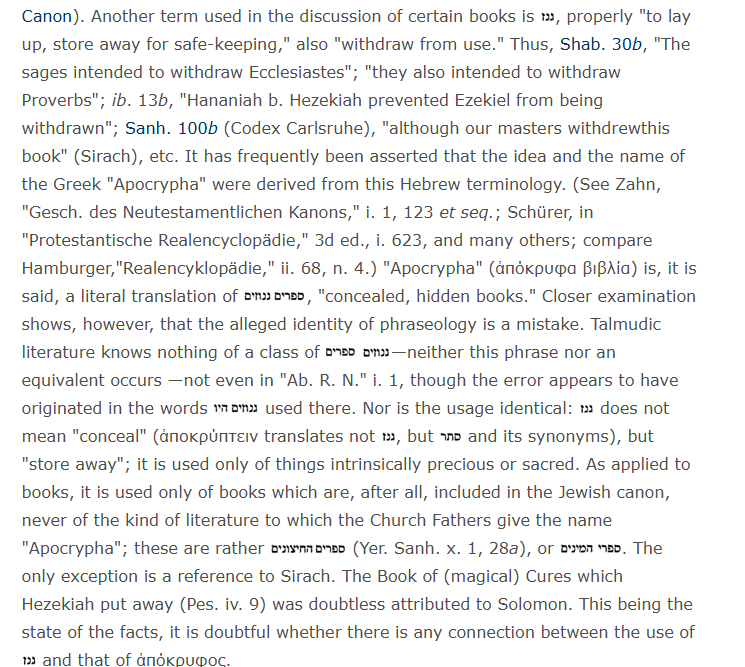
Another term used in the discussion of certain books is , properly "to lay up, store away for safe-keeping," also "withdraw from use." Thus, Shab. 30b, "The sages intended to withdraw Ecclesiastes"; "they also intended to withdraw Proverbs"; ib. 13b, "Hananiah b. Hezekiah prevented Ezekiel from being withdrawn"; Sanh. 100b (Codex Carlsruhe), "although our masters withdrewthis book" (Sirach), etc. 

The article goes on to deny that the term "Apocrypha" derives from Jewish usage. The article explains (link to article):

Nor is the usage identical:  does not mean "conceal" (ἀποκρύπτειν translates not , but  and its synonyms), but "store away"; it is used only of things intrinsically precious or sacred. As applied to books, it is used only of books which are, after all, included in the Jewish canon, never of the kind of literature to which the Church Fathers give the name "Apocrypha"; these are rather  (Yer. Sanh. x. 1, 28a), or . The only exception is a reference to Sirach. The Book of (magical) Cures which Hezekiah put away (Pes. iv. 9) was doubtless attributed to Solomon. 


As mentioned in the IJA (cited above), the prologue for the Coverdale Bible came from the French language Olivetan Bible of 1535.  Here is the cover page:
(531/877)
(532/877)
It's worth noting that the prologue in the Olivetan uses the French equivalents of Apocrypha (Apocryphe, Apocryphes), not the French equivalent of Hagiographa. 

5. "We don't know specifically what books [King James] thought were Apocrypha"

One of King James' most famous literary outputs was his, ""Basilikon dōron. Or His Majesties instructions to his dearest sonne, Henry the prince." Book 1 is "OF A KINGS CHRISTIAN DVETIE TO WARDS GOD." At pp. 9-10, he writes: "And as to the Apocriphe bookes, I omitte them, because I am no Papist, as I saide before, & indeed some of them are no wayes like the dytement of the Spirite of God." (source)

Preston behaves as though he is unfamiliar with associating books like Sirach with the Old Testament, while simultaneously considering them Apocrypha (example of this practice from 1604).  So, when Preston reads James summarizing a group of Cardinal Bellarmine's citations as being from "the Old Testament," Preston takes that as suggesting that James thinks that the cited material is inspired Scripture:

The Cardinall, in his booke of Controuersies bringeth sowerplaces of Scripture for probation of this idle dreame: two in the Olde Testament, Malachie and Ecclesiasticus, and two in the New, CHRIST in Matthew (hee might haue added Marke too) and Iohn in the xi. of the Apocalyps. (p. 63)

Now for that place of Ecclesiasticus; as the sonne of Syrach onely borroweth it from Ma∣lachie (as appeareth by these wordes of his, of conuerting the sonnes hearts to their Fa∣thers, which are Malachies owne words) so doth CHRISTS Comentary serue as well to interprete the one as the other: it being no shame for that mortall Iesus to bee commented and interpreted by the immortall and true IE∣SVS, though to the shame and confusion of the Iesuits heresies herein. But Enoch must bee ioyned to Elias in this errand, onely to beare vp the couples, as I thinke. For no place of Scripture speaketh of his returning againe, only it is said in Ecclesia∣sticus the xliiij, that Enoch pleased GOD, and was translated to Paradise, vt daret Gen∣tibus sapientiam, or poenitentiam; since they will haue it so.(pp. 66-67)

(source)

6. Preston says, of himself, that it "blows my mind" that King James would appeal to the fathers to reject the Apocrypha

The problem with Preston's thinking, of course, is that the study of the fathers is the same problem as the study of King James himself, but magnified in several ways, most especially that there are more authors to study and not all have explicit comments on the subject, like James did.  

Preston even half-acknowledges this, saying that the same kind of "contradiction" that he perceives in King James is found in the Reformers and early church writers.

7. The "Used to Build Doctrine" Argument

Preston thinks that the Apocrypha are "used to build doctrine," and consequently must be Scripture.  This is the fallacy of affirming the consequent.  

8. The King James lists the Apocrypha for Liturgical Readings

Preston puts stock in the fact that there were Church of England public readings of the Apocrypha amongst the liturgical reading of Scripture. 

9. Miles Coverdale claimed that Judith is Holy Scripture 

Preston says that this is in the same book that his opponent cited.

First, here's the material quoted, with the word "Judith" highlighted.

Here is a transcription from the version printed above:

Sidrach, Misach, and Abenago preserved he from the flaming furnace of burning fire; and Daniel he delivered from the devouring mouths of the hungry lions. Moyses, among the reeds and flags hid and hanged by the water-side in a basket, was restored again to his natural mother to be nursed of her. Paul was let down in a basket, and so escaped the hands of his persecutors. Susannah was preserved and defended pure and undefiled from [four words omitted] the false priests and judges. Judith, with much joy and victory, was delivered from the fiery violence and mighty power of all the enemies of God. These and many more godly ensamples be left in the holy scriptures, to the great comfort and consolation of them that suffer persecution for Christ's sake, according to the saying of Christ himself: "Blessed are all they which suffer persecution for righteousness' sake ; for theirs is the kingdom of heaven." Again, "as many as will live godly in Christ Jesus must suffer persecution."

One can easily see how that may sound as though the author is endorsing Judith and Susannah as being from the inspired and canonical Scriptures.  He does not say that they are, but since that's what we would mean when we say "holy scriptures," it's quite natural for us to assume that the author would have meant the same thing.  That said, however, it is important to note that the author in this case is a Dutch noble, and Miles Coverdale is the translator.

By contrast, in a work by Coverdale himself in the same volume, we find this:

It is a token, that your doctrine hath but a weak foundation, when ye go about to prove it by a dream, yea, and that out of such a book, as serveth not for the confirmation of the doctrine of Christ's church : for though it be read among the stories of other books, yet did not the church receive it among the canonical scriptures in St Hierome's time.[fn1: Sicut ergo Judith, et Tobise, et Machabseorum libros legit qmdem ecclesia, sed eos inter canonicas scripturas non recipit ; sic et hoc, &c. — Hieron. in Prov. Eccles. et Cant. Cantic. Praefat. Tom. in. p. 346. Antverp. 1579.]

I don't think the footnote is Coverdale's, though it does seem to accurately capture the sentiment of Jerome's to which Coverdale was referring.

In another place, we find Coverdale making the "canonical" qualification regarding Scripture:

Now as concerning the third, that is, praying for the dead and sacrificing for them, as in the other we confess, teach, and believe according to God's word, so do we in this; namely, that in holy scripture, throughout the canonical books of the old and new Testament, we find neither precept nor ensample of praying for any, when they be departed this life ; but as men die, so shall they arise : if in faith in the Lord towards the south, then need they no prayers ; then are they presently happy, and shall arise in glory : if in unbelief without the Lord towards the north, then are they past all help, in the damned state presently, and shall rise to eternal shame

("An Exhortation to the Carrying of Christ's Cross," p. 258)

The "canonical" qualification is necessary, because we do see an example of praying for the dead in 2 Maccabees.

Thursday, August 14, 2025

The Apocrypha and the 1611 King James - a Series by Bryan Ross

In preparation for an upcoming debate on several books in the King James Version's "Apocrypha" section, I came across a very interesting series of five videos by Bryan Ross (link to playlist).  I felt like there is very little I could criticize about this series, and what little criticism I could offer would be things as trivial as what I believe to be "speak-os" by Ross or in one place where I think he conflated "wont" (the somewhat archaic English word) with "want" due to the quality of the scanned document he was reading from.    

Ross offers a brief gospel presentation at the end of each video, but I don't know anything (either good or bad) about Ross' theology more generally. I definitely found his research regarding the word "Easter" to be very helpful in advancing the issue of the KJV's usage of that term in one place in the New Testament (it certainly was helpful in persuading me to revise my own position).  I must acknowledge that I did not attempt to fact-check things like his presentation of data on how many editions of the KJV include the apocrypha.   I did not see any videos replying his series, if they exist.

His series refers to an article of his, which I think he either did or was planning to minorly revise.  A version of this article was criticized by SoCal Preston in a video, which prompted Ross's response.  I believe the article (in some form) can be found at the following link (link).

The general takeaway from the series (and the article itself) is that the inclusion of the Apocrypha in the 1611 KJV should not be taken as suggesting that King James himself, nor the translators individually or collectively, in any way considered the Apocrypha to be Scripture, in the sense of being inspired, canonical writings.  One minor caveat I would offer is that in the 1500s and 1600s, some authors still used the word "Scripture" or even "Old Testament" to describe non-canonical and uninspired books in a way that we would not today.  There is a lot more that could be said on this point.


Postscript/Update:

Bryan Ross's playlist stands in stark contrast to a video called, "The Apocrypha Apostasy," which - while it raises a few points of interest, I cannot recommend.  The biggest point of interest was that the TAA video, toward the end, names two other gentlemen (not Mr. Preston) who are also trying to advocate for the Apocrypha while still apparently remaining some kind of Non-Roman Catholic.  

Friday, July 04, 2025

Gregory of Nazianzen and the Grammar of the Johannine Comma

Gregory Nazianzen (aka Gregory of Nazianzus) (329-390), in his Fifth Theological Oration (Oration 31), section XIX, is sometimes quoted in the battle over the Johannine Comma, because he provides one of the more notable citations of 1 John 5:7-8.  As Gregory was a Greek speaker, one presumes he did not have access to the Latin interpolation, known as the Johannine Comma, but only to the original Greek of the epistle.

Recently, certain folks have tried to argue that there is some kind of glaring grammatical error in the text of 1 John, one that would be obvious to any Greek speaker, and consequently one that would call out for correction.  The Latin interpolation is then brought forward as the possible correction to this supposed error in God's Word.

Gregory provides useful insight as someone who was fluent in Greek and who was specifically interested in Greek grammatical rules.  It is worthwhile, therefore, to consider his comments: not as being an infallible interpreter, but rather as being someone who commented on the grammatical issue before the grammar of the text was ever used to try to justify the Latin interpolation of the three heavenly witnesses. 

First, a word about the translation.  I found this interesting observation from Stephen Reynolds, who provided his own translation (link).  Reynolds writes:

The standard English translation of Gregory’s Five Theological Orations has been the one produced by Charles Gordon Browne and James Edward Swallow for the Library of Nicene and Post-Nicene Fathers, volume 7 (1893). I have used this translation in the past, but with mounting misgivings. So, for this course, I went back to the Greek text and began to revise Browne and Swallow’s version. It turned out to be a major undertaking. Browne and Swallow produced a truly awful translation – it is so literal as to be incomprehensible as English, and at many others points it is not only inaccurate but downright wrong. In my revision, I have used The Five Theological Orations of Gregory of Nazianzus, ed. Arthur James Mason (Cambridge: Cambridge University Press, 1899); and besides the Greek text there established, it will be clear that I have been heavily indebted to Mason’s notes on the text.

For those who would like to check the Greek, Mason's Greek is this (link):

I am not here to focus on the claims of Reynolds, as such, but rather to highlight the value of updating translations of works that were previously translated in the Schaff series (Nicene and Post-Nicene Fathers).

First, the Browne and Swallow translation (from the CCEL):

XIX. But to my mind, he says, those things are said to be connumerated and of the same essence of which the names also correspond, as Three Men, or Three gods, but not Three this and that. What does this concession amount to? It is suitable to one laying down the law as to names, not to one who is asserting the truth. For I also will assert that Peter and James and John are not three or consubstantial, so long as I cannot say Three Peters, or Three Jameses, or Three Johns; for what you have reserved for common names we demand also for proper names, in accordance with your arrangement; or else you will be unfair in not conceding to others what you assume for yourself. What about John then, when in his Catholic Epistle he says that there are Three that bear witness, the Spirit and the Water and the Blood? Do you think he is talking nonsense? First, because he has ventured to reckon under one numeral things which are not consubstantial, though you say this ought to be done only in the case of things which are consubstantial. For who would assert that these are consubstantial? Secondly, because he has not been consistent in the way he has happened upon his terms; for after using Three in the masculine gender he adds three words which are neuter, contrary to the definitions and laws which you and your grammarians have laid down. For what is the difference between putting a masculine Three first, and then adding One and One and One in the neuter, or after a masculine One and One and One to use the Three not in the masculine but in the neuter, which you yourself disclaim in the case of Deity? What have you to say about the Crab, which may mean either an animal, or an instrument, or a constellation? And what about the Dog, now terrestrial, now aquatic, now celestial? Do you not see that three crabs or dogs are spoken of? Why of course it is so. Well then, are they therefore of one substance? None but a fool would say that. So you see how completely your argument from connumeration has broken down, and is refuted by all these instances. For if things that are of one substance are not always counted under one numeral, and things not of one substance are thus counted, and the pronunciation of the name once for all is used in both cases, what advantage do you gain towards your doctrine?

Stephen Reynolds' translation:

§ 19. “But to my mind,” our opponent says, “those things are said to be numbered together and of the same essence when they are reciprocally designated by the same name – for example, ‘three humans’ or ‘three gods’. But this does not apply to a group of three composed of different things.” What does this retort amount to? It befits someone laying down the law as to names, not to one who is asserting the truth. I also will concede that Peter, Paul, and John are not three and are not “of the same being [homoousioi],” insofar as I cannot say “three Peters,” or “three Pauls,” or “three Johns”. counting them under one designation [i.e. “master”] despite the vast difference between them, I should probably be even more ridiculous in your eyes for my method of numbering things together.

What does John say? In his Catholic Epistles he says: There are three that bear witness: the Spirit and the water and the blood. For what you have reserved for names which are common to a general class of things, we claim – in conformity with your analytical figment – for proper names as well; otherwise, you will be unfair in not conceding to others what you arrogate for yourself.  Do you think he is talking nonsense? – Talking nonsense, first, because he has been so bold as to assign a single numeral to things which are not “of the same being [homoousia],” though you say this ought to be done only in the case of things which are “of the same being”. For who would assert that these three “witnesses” have the same essence? Talking nonsense, secondly, because he has not been consistent in the way he happened upon his terms. For after using three in the masculine gender [τρεις – treis], he adds three words which are neuter [τα τρια – ta tria], contrary to the rules and regulations which you and your grammarians have laid down. For what is the difference between putting a masculine-gender three first, and then adding one and one and one in the neuter gender, or after a masculine-gender one and one and one to use the three not in the masculine but in the neuter gender? Is this not what you yourself reject in the case of the divinity?

What have you to say about the word καρκινος [karkinos], which can mean an animal, an instrument, and a constellation? And what about the word “dog”? – now something which runs on the ground, now something which swims in the sea, now something which sits in the heavens? Do you not see that three crabs or three dogs are being spoken of? – “Why, certainly.” – Well then, are they therefore of the same essence [homoousia]? – “Only a fool would say that.” – So you see how completely your argument – that only things of the same essence [homoousia] can be counted together – has broken down, and is refuted by all these instances. For if things of same essence are not always designated by the same numeral, and things not of the same essence can be designated by the same numeral, and if the nouns in both cases are stated with the numerals – what remains of your teachings?

There is also a Williams & Wickham translation:

But, someone may say, what I am talking about is things of the same substance being counted together that have nouns, which are mentioned as well, to match them. For example: Three men, three gods—not three odds and ends.

What answer are we to make? This is the behavior of a man who lays down the law for words, not one who uses them to speak the truth. What I am talking about is Peter, Paul, and John’s not being three or consubstantial, so long as three Pauls, three Peters, and as many Johns cannot be spoken of. We shall demand that you apply to more specific nouns the new-fangled rule you have kept to in the case of the more generic ones. Or will you break the rule by not conceding whatever rights you have assumed? Why does John in the Catholic Epistles say that there are “three who bear witness, the Spirit, the water, and the blood?” Is he not talking nonsense in your opinion? First, because he has been rash enough to count together things that are not consubstantial—and that right you only allow to things that are consubstantial. Who could call these “of one substance”? Secondly, because he happens to have got his grammar wrong. He puts the Greek word for “three” in the masculine and then tacks on three words in the neuter, in defiance of your definitive rules of grammar. Yet what is the difference between putting “three” in the masculine and tacking on single things in the neuter, and using “one” thrice in the masculine without calling them “three” in the masculine but instead “three” in the neuter? This is the very proposition you reject in the case of the Godhead!

What do we make of the fact that the same Greek word can mean the animal a crab, a pair of tongs, or the sign of the zodiac, Cancer? What about the word that can denote a dog, a dog-fish, or the dog-star in the sky? Do you not agree that people talk about “three crabs” or “three dogs”? Of course you do. Does that mean that they are of the same substance? What man in his senses would assert that? You see how your argument about counting things together has collapsed under the weight of so many proofs to the contrary. If consubstantial things are not always counted together and nonconsubstantial things are counted together, and if in both cases nouns are used along with the numerals, what is left of your doctrinaire pronouncement?

Gregory's explanation is significant in three respects.

First, Gregory is not aware of any interpretation of "Spirit, water, and blood" as being Father (who is spirit), Spirit (who hovered over the water), and Son (who shed his blood on the cross).  If He did hold to such an interpretation, he would certainly not deny that Spirit, water, and blood are consubstantial.  In context, Gregory is arguing that the Father, Son, and Holy Spirit are consubstantial, but his opponent is arguing that they are not.

Second, Gregory is aware of the difference in gender between "three" and the nouns that follow, and of the fact that this violates the gender agreement rule, but he does not think this means that the text needs to be corrected.  

Third, Gregory discards the supposed "consubstantiality rule" as a being a legitimate grammatical rule.  This is, of course, less relevant to the argument of the advocates of the Latin interpolation. 

I suppose we could add that if Gregory were aware of the so-called TR reading of 1 John 5:7-8, it would be so helpful to his argument on this point, that it seems impossible that he would not cite it.  It would satisfy his objector's so-called rule, and it would support his view that the Holy Spirit is consubstantial with the Father and the Son.

So, Gregory's citation is a powerful testimony that the Greek of 1 John 5:7-8 as it is found in the Greek manuscripts today was also the Greek of 1 John 5:7-8 in the 4th century.  This conclusion is further supported by the fourth century manuscripts of 1 John that we have. 

Tuesday, July 01, 2025

Assyrian Church of the East and the Canon

In 2006 (apparently), "The Rev’d C H Klutz, B.A., B.Th., M.Th." and "The Rev’d George Toma, B.A., M.A., D.Min," released a "Catechism," which their forward describes in these words: "We had laid before us a work which would involve many long hours and serious thought. It is the teaching (dogma) embraced within The Holy Apostolic Catholic Assyrian Church of the East. These are the Orthodox, Sacred Traditions and teachings."

The catechism offers the following definition of "Holy Scriptures":

4) What is that which you call “Holy Scriptures”?

The Holy Scriptures is a collection of books written under the inspiration of the Spirit of God, through men who were sanctified by God, these men are known as Prophets and Apostles. These books of Sacred Scriptures are collected, canonized, and are entitled “The Holy Bible.” It is written: “. . . all Scripture is given by inspiration of God, and is profitable for doctrine, for reproof, for correction, for instruction in righteousness.”(II Timothy 3:16)

I bring this up in case someone might question what canon they have in mind, such as suggesting that they are merely reproducing a Jewish canon.

When it comes to discussing the Old Testament, they write:

7) We number how many books for the Old Testament?

According to the earliest records of The Church, we have a system of numbering which may confuse the faithful; however let us state that there are a total of 46 books of the Old Testament. The early Church Fathers number a total of 22 Old Testament books, having arrived at that particular, number agreeing with the Jerusalem Jewish community, who had so reckoned them with the ancient original “Hebrew” tongue.

8) Why do we need to assent to the Jewish Jerusalem reckoning of these books?

We refer you to the writings of St Paul the Treasurer of the Church, where he states in the Epistle to the Roman Church, “. . . much every way: chiefly, because that, unto them was committed the oracles of God.” (3:2), which is by interpretation, meaning simply, that The Holy Writings of the Old Testament had been received from the Hebrew Church (in Jerusalem) by the Christian Church of the New Testament of Jerusalem.

Notice that this reasoning is similar to our view.  The church is not authorized to add to the Old Testament: we just receive what was handed down.  They then go on to provide the 

9) How do the Church Fathers of the early Church enumerate The Books of the Old Testament?

 1. The Book of Genesis;

 2. The Book of Exodus;

3. The Book of Leviticus;

4. The Book of Numbers;

5. The Book of Deuteronomy;

6. The Book of Joshua, son of Nun;

7. The Book of Judges, and with it as an appendix

 The Book of Ruth;

8. The I & II Books of Kings, as two parts of one

9. The III and IV Books of Kings;

10. The I and II Paralipomenon (I & II Chronicles);

11. The I Book of Esdras, and the II or, as it is

 Named in Nehemiah;

12. The Book of Esther;

13. The Book of Job;

14. The Psalms;

15. The Proverbs of Solomon;

16. The Ecclesiastes, also by Solomon;

17, The Song of Songs, also by Solomon;

18. The Book of the Prophet Isaiah;

19. The Book of Jeremiah;

20. The Book of the Prophet Ezekiel;

21. The Book of the Prophet Daniel;

22. The Book of the Twelve Prophets.

Notice that this is is simply the same canon as the Protestant Old Testament canon.  However, for the ACE folks, this raises a natural next question:

10) We have other Old Testament Books, but they are not noted here, such as The Wisdom of the son of Sirach, and of others, why?

These books do not exist in the Hebrew language, but they are in the Greek texts.

11) How does the Church of the East regard these other books which are not included in the original Hebrew?

St Athanasis, as a Church Father, had declared that these books were included in the reading requirements of the proselytes who are preparing for admission into the Holy Church through Holy Baptism.

Now, unfortunately for them, they go on also to have twenty-two book New Testament canon, by excluding II Peter, II John, III John, Jude, and Revelation.  They also make other errors, such as affirming the perpetual virginity of Mary and insisting on including an Icon of Christ as one part of the liturgical environment of the "Holy Qurbana" ("Holy Offering").

My reason for citing this catechism is, of course, not for endorsement of that catechism. Instead, I point it out as being of interest to folks who try to suggest that there is something "Protestant" about the 22 book Old Testament canon.  For those have the same question as I do, as to why "Lamentations" is not separately listed from Jeremiah, I have no good answer - perhaps it is just a typographic error in the Catechism.

The "46" number seems to be the 39 of the protocanon plus the seven deuterocanonical books, although they do not enumerate the deuterocanonical books.  Moreover, when discussing prayers for the dead, they write:

18) Can we substantiate through the Sacred Writing that the prayer intentions offered in behalf of the righteous deceased will benefit the soul departed?

Consider the book of Maccabees (II Maccabees 12:43) at the time of Judah who had sent to Jerusalem an offering to be presented for forgiveness at the Temple for one who had died. ...

They do go on to use actual Scripture, and it seems clear that they do not accept the Western invention of Purgatory.  To wit:

9) Where or in what state are the souls of the deceased kept until the Day of the General Resurrection?

They are kept in a place called Sheol or Abraham’s Bosom. This place is also called Paradise, the Land of the Light or the land of The Rest. Those righteous souls are kept in that land of Perpetual Light or in the Presence of Jesus our Lord; it is only a foretaste of the glorious promises of our Lord and God. Whereas the wicked and ungodly will be kept in the lower regions of Sheol which is the region of darkness and torments, and is only a foretaste of eternal damnation. The Church Fathers have written for us: “. . . as to the wicked, they shall remain upon the earth in darkness, in which none can walk, and shall be consumed with the flames of remorse; for those which denied Him, their sinfulness betrayed everlasting bliss for the temporal and deceptive enjoyments and a real possession for the dung of the Earth. This is the true Hell,’ whose fire will not quench and the worm will not die’... ” (Matthew 25:30-41, see also, Luke 16:19-26)

So, they are not Roman Catholics (even though they make some errors in common with Roman Catholics), and they are not Protestants (even though they agree with us on a number of important issues).