Saturday, November 11, 2023

Friday, November 10, 2023

Beza, Plato, and the "Shall Be" Speculative Restoration at Revelation 16:5

Beza speculatively replaced "ὅσιος" with "ἐσόμενος" in Revelation 16:5.  Sometimes advocates of the King James Version (or Scrivener's Textus Receptus, which was based on the KJV), will try to find some hint that this text existed in some now-lost copies of Scripture. To that end, I've done my best to survive the roughly 266 places in which the exact expression "ἐσόμενος" appears in any Greek writing in the Thesaurus Linguae Gracae (TLG) library of Greek Literature (as of November 10, 2023).

There is one Biblical use, namely in the Septuagint translation of Job:

Septuagint, Job 15:14 "τίς γὰρ ὢν βροτός, ὅτι ἔσται ἄμεμπτος, ἢ ὡς ἐσόμενος δίκαιος γεννητὸς γυναικός;" (NETS: For who, being mortal, can be blameless, or who can be in the right, born of woman?)

While this is an important verse for total depravity, it has no obvious connection to Revelation 16:5.

A much more interesting use is found in Plato's Timaeus.  I don't know whether Plato's Timaeus is itself included in the TLG, but beginning with Stobaeus (5th century, AD) there are multiple quotations of Plato's use (Stobaeus, Proclus, Simplicius, and especially Philoponus provide this quotation).   

In a paper (link), I found the following text and translation of Timaeus 38b 6-c 3.

χρόνος δ᾽ οὖν μετ᾽ οὐρανοῦ γέγονεν, ἵνα ἅμα γεννηθέντες ἅμα καὶ λυθῶσιν, ἄν ποτε λύσις τις αὐτῶν γίγνηται, καὶ κατὰ τὸ παράδειγμα τῆς διαιωνίας φύσεως, ἵν’ὡς ὁμοιότατος αὐτῷ κατὰ δύναμιν ᾖ· τὸ μὲν γὰρ δὴ παράδειγμα πάντα αἰῶνά ἐστιν ὄν, ὁ δ᾽ αὖ διὰ τέλους τὸν ἅπαντα χρόνον γεγονώς τε καὶ ὢν καὶ ἐσόμενος.

...

Now, χρόνος has come into being with the οὐρανός (χρόνος δ᾽ οὖν μετ᾽ οὐρανοῦ γέγονεν), so that, together (ἅμα) having been engendered, together (ἅμα) they may perish, should some dissolution (λύσις) of either the one or the other ever occur, and it has come into being [sc. γέγονεν] in accordance with the paradigm which is possessed of a thoroughly everlasting nature (τὸ παράδειγμα τῆς διαιωνίας φύσεως), so that it should prove to be as similar as possible to that paradigm, relative to its capacity (ἵν’ὡς ὁμοιότατος αὐτῷ κατὰ δύναμιν ᾖ); for that paradigm ‘is’ for all Eternity, being, whereas the other (ὁ δ᾽ αὖ, that is, its ‘image’), lasting through and through (διὰ τέλους), ‘is’ [sc. ἐστιν] for all time, having come into being, and also being and going to be’.

It's easy to observe the three times (past, present, and future) mentioned in connection with the concept of Eternity.  There is no reason to think that John would have been influenced by Plato, and in context John is quoting an angel, who would have no reason to be have been influenced by Plato.  Nevertheless, it is more reasonable to suppose that Beza was influenced by Plato.

In 1513, Aldus Manutius provided the first printed edition of Plato's works in Greek, which included Timaeus (link to relevant page):


Notice the "καὶ ὢν καὶ ἐσόμενος" as the final words of the last line of the clip. It is 

Beza may not have always agreed with Plato, but he had read him, at least enough to disagree with him. For example, "Beza does not favour Plato's philosophy, and often finds him an inept philosopher," Mallinson, Jeffrey, 'Beza’s Academic Challenge', Faith, Reason, and Revelation in Theodore Beza (1519–1605), Oxford Theological Monographs (Oxford, 2003; online edn, Oxford Academic, 3 Oct. 2011).

Setting aside the people quoting or commenting on Plato himself, and setting aside the many places where the use of the word seems utterly irrelevant to the question at hand, I have found the following places of interest (some of which were already pointed out by Nick Sayers in his book on Revelation 16:5, defending Beza's reading).

1. Clement of Alexandria (d. c. 215), Stromata, Book 5, Chapter 6 (translation)(Greek can be found here):

So very mystically the five loaves are broken by the Saviour, and fill the crowd of the listeners. For great is the crowd that keep to the things of sense, as if they were the only things in existence. "Cast your eyes round, and see," says Plato, "that none of the uninitiated listen." Such are they who think that nothing else exists, but what they can hold tight with their hands; but do not admit as in the department of existence, actions and processes of generation, and the whole of the unseen. For such are those who keep by the five senses. But the knowledge of God is a thing inaccessible to the ears and like organs of this kind of people. Hence the Son is said to be the Father's face, being the revealer of the Father's character to the five senses by clothing Himself with flesh. "But if we live in the Spirit, let us also walk in the Spirit." "For we walk by faith, not by sight," the noble apostle says. Within the veil, then, is concealed the sacerdotal service; and it keeps those engaged in it far from those without.

Again, there is the veil of the entrance into the holy of holies. Four pillars there are, the sign of the sacred tetrad of the ancient covenants. Further, the mystic name of four letters which was affixed to those alone to whom the adytum was accessible, is called Jave, which is interpreted, "Who is and shall be." The name of God, too, among the Greeks contains four letters.

ταύτῃ τοι μυστικώτατα πέντε ἄρτοι πρὸς τοῦ σωτῆρος κατακλῶνται καὶ πληθύνουσι τῷ ὄχλῳ τῶν ἀκροωμένων. πολὺς γὰρ ὁ τοῖς αἰσθητοῖς ὡς μόνοις οὖσι προσανέχων. «ἄθρει δὴ περισκοπῶν,» φησὶν ὁ Πλάτων, «μή τις τῶν ἀμυήτων ἐπακούῃ. εἰσὶ δὲ οὗτοι οἱ οὐδὲν ἄλλο οἰόμενοι εἶναι ἢ οὗ ἂν ἀπρὶξ τοῖν χειροῖν λαβέσθαι δύναιντο, πράξεις δὲ καὶ γενέσεις καὶ πᾶν τὸ ἀόρατον οὐκ ἀποδεχόμενοι ὡς ἐν οὐσίας μέρει·» τοιοῦτοι γὰρ οἱ τῇ πεντάδι τῶν αἰσθήσεων προσανέχοντες μόνῃ. ἄβατον δὲ ἀκοαῖς καὶ τοῖς ὁμογενέσιν ἡ νόησις τοῦ θεοῦ. ἐντεῦθεν πρόσωπον εἴρηται τοῦ πατρὸς ὁ υἱός, αἰσθήσεων πεντάδι σαρκοφόρος γενόμενος, ὁ λόγος ὁ τοῦ πατρῴου μηνυτὴς ἰδιώματος. «εἰ δὲ ζῶμεν πνεύματι, πνεύματι καὶ στοιχῶμεν.» «διὰ πίστεως περιπατοῦμεν, οὐ διὰ εἴδους,» ὁ καλὸς ἀπόστολος λέγει. ἔνδον μὲν οὖν τοῦ καλύμματος ἱερατικὴ κέκρυπται διακονία καὶ τοὺς ἐν αὐτῇ πονουμένους πολὺ τῶν ἔξω εἴργει. 

πάλιν τὸ παραπέτασμα τῆς εἰς τὰ ἅγια τῶν ἁγίων παρόδου, κίονες τέτταρες αὐτόθι, ἁγίας μήνυμα τετράδος διαθηκῶν παλαιῶν, ἀτὰρ καὶ τὸ τετράγραμμον ὄνομα τὸ μυστικόν, ὃ περιέκειντο οἷς μόνοις τὸ ἄδυτον βάσιμον ἦν· λέγεται δὲ Ἰαουε, ὃ μεθερμηνεύεται ὁ ὢν καὶ ὁ ἐσόμενος. καὶ μὴν καὶ καθ’ Ἕλληνας θεὸς τὸ ὄνομα τετράδα περιέχει γραμμάτων. 

It is interesting to see the earliest Christian writer who is defining the tetragrammaton as "who is and shall be" has clearly been influenced by Plato. This is an example of a "possible allusion" but considering that the phrase wording doesn't align with the phrase wording of Beza's Revelation 16:5, it seems unreasonable to put much weight on it.


2. Gregory of Nyssa (d. 395), On the Baptism of Christ, A Sermon for the Day of the Lights. (link to translation

Διὰ δὴ ταῦτα πάντα τὸν τῆς χαρᾶς ὕμνον ἄσωμεν τῷ θεῷ, ὃν στόμα τῷ πνεύματι κάτοχον πάλαι προφητικῶς ἐξεβόησεν· Ἀγαλλιάσθω ἡ ψυχή μου ἐπὶ τῷ κυρίῳ· ἐνέδυσε γάρ με ἱμάτιον σωτηρίου καὶ χιτῶνα εὐφροσύνης περιέβαλέ μοι, ὡς νυμφίῳ περιέθηκέ μοι μίτραν καὶ ὡς νύμφην κατεκόσμησέ με κόσμῳ. κοσμήτωρ δὲ πάντως τῆς νύμφης ὁ Χριστὸς ὁ ὢν καὶ πρόων καὶ ἐσόμενος, εὐλογητὸς νῦν καὶ εἰς τοὺς αἰῶνας τῶν αἰώνων, ἀμήν. 

For all these things then let us sing to God that hymn of joy, which lips touched by the Spirit long ago sang loudly: Let my soul be joyful in the Lord: for He has clothed me with a garment of salvation, and has put upon me a robe of gladness: as on a bridegroom He has set a mitre upon me, and as a bride has He adorned me with fair array.  And verily the Adorner of the bride is Christ, Who is, and was, and shall be, blessed now and for evermore. Amen.

The reference to the Adorner of the bride is probably a reference to Septuagint Isaiah 61:10: "... Let my soul be glad in the Lord, for he has clothed me with a garment of salvation and with a tunic of joy; he has put on me a headdress as on a bridegroom and adorned me with ornaments like a bride." (NETS) ("... ἀγαλλιάσθω ἡ ψυχή μου ἐπὶ τῷ κυρίῳ ἐνέδυσεν γάρ με ἱμάτιον σωτηρίου καὶ χιτῶνα εὐφροσύνης ὡς νυμφίῳ περιέθηκέν μοι μίτραν καὶ ὡς νύμφην κατεκόσμησέν με κόσμῳ")  The reference to the lips touched by the Spirit is undoubtedly a reference to the account of the purification of Isaiah's lips (Isaiah 6:5-6)

Gregory's doxological conclusion is an explanation of Jesus as the Adorner together with praise of Jesus, calling him blessed and eternal.  This is an example of a "possible allusion" but considering that the phrase wording doesn't align with the phrase wording of Beza's Revelation 16:5, it seems unreasonable to put much weight on it.


3. Cyril of Alexandria (d. 444), Commentary on Isaiah, Book 4, Oration II, at Isaiah 44:6-7 (Greek at 924 D)

Thus says the Lord, the God, the King of Israel, the God of hosts who saved him: I am the first, and I am after these; besides me there is no God. Who is like me? Let him stand up, call, and prepare for me, since I made man into the world. And let them declare to you the things that are to come before they happen. Do not be deceived, and I have announced to you.

Making a remembrance of the knowledge in Christ through the readings now given to us, he shifts the discourse to another of the necessary things. For at that time, when the divine prophet Isaiah was composing such words for us, reigning among them was the hater of God, and he was in unbearable errors. For each had his own so-called god and reverence; God made it necessary for them to have advice, interwoven with the most ingenious reproaches; moving them away from polytheism and its infirmities; and inviting them through recognition to the knowledge of truth, and of His own glory and incomparable power, bringing it to memory. In this regard, he says: Thus says the Lord, the King of Israel, the God of hosts who saved him. For He wants it to be known that He is God and the Lord of powers, and to be lifted up as if from drunkenness to see that they have been delivered from the greed of the Egyptians, performing wonders, and showing the greatness of His power and superiority. For what has not been done of the things wondered at? What plague has not been inflicted on those who oppressed them? Or how could there not be a clear demonstration of His indescribable power, with the sea standing apart, the waters freezing and forming like a wall, and the fleeing ones walking through the middle? And what about the miracles in the wilderness after this? Did He not give them bread from heaven? Did He not break open a rock in the wilderness, and water them as in a great abyss; and brought down waters like rivers? Did He not, by placing a sort of bridle on the waters of the Jordan, make a way to pass with a foot? Therefore, He rightly calls Himself not simply Lord and God in these things; but He added, And having saved him, bringing to memory, as I said, the paradoxically accomplished things through Him. Know then, he says, that I am God first, and I am after these, and besides me there was no God.

For God is the beginning of everything, being Himself without beginning, and everything was brought forth by Him into being; He then became under no one, but is, was, and will be. For this is His name, and an eternal memorial for generations of generations. Therefore, neither was there another God before Him, nor will there be one after Him. For there is one God by nature, and no other besides Him. This advice is very useful for those who have denied Him, and who have slipped into great folly in thinking that there are many gods. That no one else or different one can be counted upon Him, He demonstrates by saying: Who is like me? Who among the gods you have thought of, or named senselessly, will be according to my glory and power? From what great deeds have you believed them to be gods? Let someone stand, if there is one like me. Let someone prepare who has a nature equal in strength or glory. Let them call whoever they choose of the falsely-named gods, since I made man into the world. For I, he says, have created the heavens and the things in them, having flocks of countless holy spirits worshiping and serving me, but since I made man upon the earth, and in the following, that is, into the world, let someone show me one like me. But again saying, Since I made man, he shows himself to be the creator, and the falsely-named gods to be completely non-existent. For what of those worshiping them have they brought into being? But I, being a creator, am known, and the creator of everything, and having knowledge of all. Investigate this with the gods spoken of among you, let them declare to you the things that are to come before they happen. For it would be fitting for a god by nature to have all knowledge of both what has already happened and what will be. But if none among the falsely-named gods is found to have this, it is evident that those who do not have the knowledge of God could not be gods. Do not be deceived, instead of, Do not be silent, nor pretend.

 Οὕτω λέγει Κύριος ὁ Θεὸς ὁ βασιλεὺς τοῦ Ἰσραὴλ, ὁ ῥυσάμενος αὐτὸν Θεὸς Σαβαώθ· Ἐγὼ πρῶτος, καὶ ἐγὼ μετὰ ταῦτα· πλὴν ἐμοῦ οὐκ ἔστι Θεός. Τίς ὥσπερ ἐγώ; Στήτω, καὶ καλεσάτω, καὶ ἑτοιμασάτω μοι, ἀφ’ οὗ ἐποίησα ἄνθρωπον εἰς τὸν αἰῶνα. Καὶ τὰ ἐπερχόμενα πρὸ τοῦ ἐλθεῖν ἀναγγειλάτωσαν ὑμῖν. Μὴ παρακαλύπτεσθε, καὶ ἀπήγγειλα ὑμῖν.

  Τῆς ἐν Χριστῷ γνώσεως διὰ τῶν ἀρτίως ἡμῖν ἀναγνώσεων ποιησάμενος μνήμην, μεθίστησι τὸν λόγον ἐφ’ ἕτερόν τι τῶν ἀναγκαίων. Ἐπειδὴ γὰρ κατ’ ἐκεῖνο καιροῦ, καθ’ ὃν ὁ θεσπέσιος προφήτης Ἡσαΐας τοὺς περὶ τῶν τοιούτων ἡμῖν συνετίθει λόγους, βασιλεύοντος παρ’ αὐτοῖς θεομισοῦς, καὶ ἐν ἀφορήτοις γέγονεν ὀλισθήμασιν. Ἦν γὰρ ἑκάστῳ τὸ δοκοῦν θεὸς καὶ σέβας· ἀναγκαίαν αὐτοῖς τὴν παραίνεσιν εὐφυεστάτοις ἐλέγχοις ἐγκεκλωσμένην ποιεῖται Θεός· μεθιστὰς μὲν αὐτοὺς τῆς πολυθεΐας, καὶ τῶν ἐν τούτοις ἀῤῥωστημάτων· προσκαλούμενος δὲ διὰ μεταγνώσεως εἰς ἐπίγνωσιν ἀληθείας, καὶ τῆς αὐτοῦ δόξης, καὶ ἀσυγκρίτου δυνάμεως ἀνακομίζων εἰς ἀνάμνησιν. Ταύτῃ τοι φησίν· Οὕτω λέγει Κύριος ὁ βασιλεὺς τοῦ Ἰσραὴλ, ὁ ῥυσάμενος αὐτὸν Θεὸς Σαβαώθ. Ὅτι γὰρ Θεός ἐστι καὶ τῶν δυνάμεων Κύριος, εἰδέναι βούλεται, καὶ καθάπερ ἐκ μέθης ἀνενεγκόντας ἰδεῖν, ὅτι καὶ τῆς Αἰγυπτίων πλεονεξίας ἐξῄρηνται, θαυματουργοῦντος αὐτοῦ, καὶ τῆς ἐνούσης αὐτῷ δυνάμεως, καὶ ὑπεροχῆς τὸ μέγεθος ἐμφανίζοντος. Τί γὰρ οὐ πέπρακται τῶν τεθαυμασμένων; Ποία δὲ τοῖς πλεονεκτοῦσιν αὐτοὺς οὐκ ἐπηνέχθη πληγή; Ἢ πῶς τῆς ἀφράστου δυνάμεως αὐτοῦ οὐκ ἂν γένοιτο σαφὴς ἀπόδειξις, τὸ διαστῆναι μὲν θάλασσαν, παγῆναι δὲ καὶ ὡσεὶ τεῖχος τὰ ὕδατα, καὶ διὰ μέσων ἰέναι τοὺς φεύγοντας; Τί δὲ δὴ τὰ ἐν τῇ ἐρήμῳ μετὰ τοῦτο θαυματουργήματα; Οὐκ ἄρτον αὐτοῖς ἔδωκε τὸν ἐξ οὐρανοῦ; Οὐ διέῤῥηξε πέτραν ἐν ἐρήμῳ, καὶ ἐπότισεν αὐτοὺς ὡς ἐν ἀβύσσῳ πολλῇ; καὶ κατήγαγεν ὡς ποταμοὺς ὕδατα; οὐ τοῖς Ἰορδάνου νάμασιν οἷά τινα χαλινὸν ἐπιθεὶς, ποδὶ παρεσκεύασε παρελθεῖν; Ἀναγκαίως τοίνυν, οὐχ ἁπλῶς Κύριόν τε καὶ Θεὸν ἐν τούτοις ἑαυτὸν ἀποκαλεῖ· προσεπήγαγε δὲ, ὅτι Καὶ ῥυσάμενος αὐτὸν, εἰς ἀνάμνησιν ἀνακομίζων, ὡς ἔφην, τῶν δι’ αὐτὸν παραδόξως τετελεσμένων. Ἴσθι δὴ οὖν, φησὶν, ὅτι Ἐγὼ Θεὸς πρῶτος, καὶ ἐγὼ μετὰ ταῦτα, καὶ πλὴν ἐμοῦ οὐκ ἦν Θεός. 

Ἀρχὴ γὰρ τῶν ὅλων Θεὸς, ἄναρχος ὢν αὐτὸς, καὶ παρ’ αὐτοῦ πάντα παρήχθη πρὸς γένεσιν· αὐτὸς μὲν οὖν γέγονεν ὑπ’ οὐδενὸς, ἀλλ’ ἔστιν ὤν τε καὶ ἐσόμενος. Τοῦτο γὰρ ὄνομα αὐτῷ, καὶ μνημόσυνον αἰώνιον γενεῶν γενεαῖς. Οὔτε τοίνυν πρὸ αὐτοῦ Θεὸς ἕτερος ἦν, οὔτε τις ἔσται μετ’ αὐτόν. Εἷς γὰρ φύσει Θεὸς, καὶ ἕτερος παρ’ αὐτὸν οὐδείς. Χρησιμωτάτη δὲ λίαν ἡ παραίνεσις τοῖς ἀρνησαμένοις αὐτὸν, καὶ ἐκ πολλῆς ἄγαν ἀσυνεσίας ὠλισθηκόσιν εἴς γε τὸ οἴεσθαι θεοὺς εἶναι πολλούς. Ὅτι δὲ κατ’ αὐτὸν οὐδεὶς ἤγουν ἕτερος ἐπ’ αὐτῷ καταλογισθῆναι, διαδείκνυσι λέγων· Τίς ὥσπερ ἐγώ; Ποῖος ἄρα τοῖς παρ’ ὑμῶν ὑπονοηθεῖσι θεοῖς, ἤγουν ἀσυνέτως ὠνομασμένοις, κατὰ τὴν ἐμὴν ἔσται δόξαν τε καὶ δύναμιν; Ἐκ ποίας ἄρα μεγαλουργίας θεοὺς αὐτοὺς εἶναι πεπιστεύκατε; Στήτω τις, εἴπερ ἐστὶ κατ’ ἐμέ. Ἑτοιμασάτω τις τὸν ἰσόῤῥοπον ἔχοντα φύσιν, ἢ κατ’ ἰσχὺν ἢ δόξαν. Καλεσάτωσαν οὓς ἂν ἕλοιντο τῶν ψευδωνύμων θεῶν, ἀφ’ οὗ ἐποίησα ἄνθρωπον εἰς τὸν αἰῶνα. Ἐκτισάμην γὰρ, φησὶν, οὐρανοὺς, καὶ τὰ ἐν αὐτοῖς, ἀναριθμήτων ἁγίων πνευμάτων ἀγέλας προσκυνούσας ἔχων καὶ λατρευούσας ἐμοὶ, πλὴν ἀφ’ οὗ πεποίηκα τὸν ἄνθρωπον ἐπὶ τῆς γῆς, καὶ ἐν τοῖς ἐφεξῆς, τοῦτ’ ἔστιν, εἰς τὸν αἰῶνα, δειξάτω μοί τις τὸν κατ’ ἐμέ. Λέγων δὲ πάλιν τὸ, Ἀφ’ οὗ ἐποίησα ἄνθρωπον, ἑαυτὸν μὲν δείκνυσιν ὄντα δημιουργὸν, τοὺς δὲ ψευδωνύμους θεοὺς οὐδὲν ὄντας παντελῶς. Τίνα γὰρ τῶν προσκυνούντων αὐτοὺς εἰς τὸ εἶναι παρήνεγκαν; πλὴν δημιουργὸς ἐγὼ ὑπάρχων γνωρίζομαι, καὶ κτίστης τῶν ὅλων, καὶ ἁπάντων ἔχων τὴν γνῶσιν. Ἐρευνήσατε τοῦτο παρὰ τοῖς παρ’ ὑμῶν ῥηθεῖσι θεοῖς, τὰ ἐπερχόμενα πρὸ τοῦ ἐλθεῖν ἀναγγειλάτωσαν ὑμῖν. Θεῷ γὰρ κατὰ φύσιν πρέποι ἂν τὸ πᾶσαν ἔχειν τὴν γνῶσιν τῶν τε ἤδη παρῳχηκότων, καὶ τῶν ἐσομένων. Εἰ δὲ οὐδεὶς ἐν τοῖς ψευδωνύμοις θεοῖς τοῦτο λαχὼν εὑρίσκεται, ἀσυμφανὲς, ὅτι οἱ τὴν Θεοῦ γνῶσιν οὐκ ἔχοντες, οὐκ ἂν εἶεν θεοί. Μὴ παρακαλύπτεσθε, ἀντὶ τοῦ, Μὴ σιωπᾶτε, μηδὲ ἀποπροσποιεῖσθε.

This is an example of a "possible allusion" but considering that the phrase wording doesn't align with the phrase wording of Beza's Revelation 16:5, it seems unreasonable to put much weight on it.


4. Olympiodorus the Deacon (of Alexandria?)(Sixth Century?), Commentary on Jeremiah (taken from catena fragments):

 «Ἰωσεδέκ.» Ἰωσεδὲκ ἑρμηνεύεται, Ἰωὰ δίκαιος, τουτέστι δικαιοσύνη ἡμῶν· ἢ Ἰωὰ, ὢν καὶ ἐσόμενος, Ἰωσεδέκ· καὶ διὰ τὴν ὁμωνυμίαν υἱοῦ τοῦ Ἰωσεδὲκ, τοῦ ἡγησαμένου τῶν υἱῶν Ἰσραὴλ ἀπὸ τῆς αἰχμαλωσίας. Πολλάκις γὰρ ἡ Γραφὴ καὶ ἀπὸ ὀνομάτων τὰ πράγματα κρίνει· ὡς ἐπὶ τοῦ Μελχισεδὲκ, ὃς ἑρμηνεύεται βασιλεὺς εἰρήνης. Ἐν τοῖς προφήταις ἐπειδὴ καὶ προφήτης ἠξίωσε κληθῆναι, καθὸ γέγονεν ἅνθρωπος, ὁ τοῦ Θεοῦ Υἱὸς, ὁ τῶν προφητῶν Δεσπότης, κατὰ τὸν διὰ Μωσέως χρησμὸν λέγοντα, Προφήτην ὑμῖν ἀναστήσει Κύριος ὁ Θεὸς ὑμῶν ὡς ἐμέ· κατὰ πάντα αὐτοῦ ἀκούσεσθε.

"Ἰωσεδέκ." Ἰωσεδέκ is interpreted as "Ἰωὰ the righteous," which means our righteousness. Or "Ἰωὰ," meaning "being and becoming," Josedek. And because of the similarity in name, it refers to the son of Josedek, who led the sons of Israel out of captivity. For often, Scripture judges things based on names, as in the case of Melchizedek, who is interpreted as the "king of peace." In the prophets, since even a prophet was deemed worthy to be called, just as it happened, a man, the Son of God, the Lord, the Master of the prophets, according to the prophecy through Moses, saying, "The Lord your God will raise up for you a Prophet like me; you shall listen to Him in everything."

As to the substance of this commentary, the author is clearly working from Septuagint Jeremiah, which has the text as: "ἐν ταῖς ἡμέραις αὐτοῦ σωθήσεται Ιουδας καὶ Ισραηλ κατασκηνώσει πεποιθώς καὶ τοῦτο τὸ ὄνομα αὐτοῦ ὃ καλέσει αὐτὸν κύριος Ιωσεδεκ."  The KJV provides "THE LORD OUR RIGHTEOUSNESS," as the translation of "יְהוָה צִדְקֵֽנוּ" (YHWH tzidkenu).

What's interesting about this is the underlying idea that the Greek name Ἰωσεδέκ (Josedek) means "Ἰωὰ the righteous," with Ἰωὰ being a name of God.

Please note that this passage does not align with the text of the commentary on Jeremiah (per TA Virginia, Jr.), nor does it align with the text of the commentary on Baruch (per M Smensgård). So, perhaps the attribution is wrong, either perhaps it is in the Lamentations commentary, or perhaps it's spuriously attributed. 

5. Euthymius Protasecretis (10th century?)  "For me, to live is Christ, who is all in all, both now and forever; and to die is eternal, undying gain." ("Ἐμοὶ γοῦν τὸ ζῆν Χριστός, ὁ τὰ πάντα ἐν πᾶσι καὶ ὢν καὶ ἐσόμενος· τὸ δὲ ἀποθανεῖν κέρδος αἰωνίως ἀθάνατον.")(context and translation here)

This is best seen as an expansion of Philippians 1:21 For to me to live is Christ, and to die is gain. ( ἐμοὶ γὰρ τὸ ζῆν Χριστὸς καὶ τὸ ἀποθανεῖν κέρδος) (compare: Ἐμοὶ γοῦν τὸ ζῆν Χριστός, ὁ τὰ πάντα ἐν πᾶσι καὶ ὢν καὶ ἐσόμενος· τὸ δὲ ἀποθανεῖν κέρδος αἰωνίως ἀθάνατον.)   The expansion "all in all" seems potentially to be taken from Ephesians 1:23 ("all in all" "τοῦ πάντα ἐν πᾶσιν") or perhaps 1 Corinthians 15:28 ("all in all" "τὰ πάντα ἐν πᾶσιν").  The concept of "now and always" ("καὶ ὢν καὶ ἐσόμενος") is similar conceptually with 2 Peter 3:18 and Jude 25, while "eternal undying" has broad conceptual support in terms of "eternal life" and similar New Testament concepts.

This is an example of a "possible allusion" but considering that the phrase wording doesn't align with the phrase wording of Beza's Revelation 16:5, it seems unreasonable to put much weight on it.


The following were some results that were interesting (at least to me, but not particularly relevant):

6. John Climacus (d. 649), Ladder to Paradise (Scaala Paradisi), Step (Chapter) 29, section 10: "I am wholly united with God, and always will be" (ἡνωμένος ὅλος ὢν, καὶ ἀεὶ ἐσόμενος Θεῷ) (link to translation).

I don't see this as having any real likelihood of being seen as an allusion to Revelation 16:5, since it is about the person himself, and speaks more to something like eternal security through unity with Christ.  Nevertheless, it is beautiful, and I include it for completeness.


7. Manuel Chrysoloras (d. 1415), Questions of the Art of Grammar, Section 63 (with English interspersed):

Μετοχή· (participle) ὁ ὤν ὄντος (the being, of the being [masculine]), ἡ οὖσα οὔσης (the being, of the being [feminine]), τὸ ὄν ὄντος (the being, of the being [neuter]).

Μέλλων· (future) ὁ ἐσόμενος τοῦ –μένου (the one who will be, of the -ing [masculine]), ἡ ἐσομένη τῆς –μένης (the one who will be, of the -ing [feminine]), τὸ ἐσόμενον τοῦ –μένου (the one who will be, of the -ing [neuter]). 

Obviously not an allusion to any particular text, just an interesting Greek grammar in Greek.


8. Cyril of Alexandria (d. 444), Exposition on the Psalms (Greek available here) at LXX Psalm 40 (Psalm 41:10 in our Bibles)

"But you, O Lord, have mercy on me, and raise me up, and I will repay them."

"These things are fitting for Christ because of the measure of humanity. For again, consider for me the Word of God, who exists in the form of God and equal with God the Father, revealed from His essence, co-throned and co-ruling over all, as being in a state of submission and diminishment due to His likeness to us, and more humanly due to His self-emptying, or rather divinely, the words He makes towards His own Father: 'Have mercy on me, he says, and raise me up.' And yet, how is it not clear to all that He Himself is naturally the mercy of God the Father? And likewise, He is the resurrection and the life, according to His own voice. But it was necessary for Him to fulfill all righteousness; and since He became a man, not to reject the humility of humanity, nor to disdain the words befitting it, due to the skill of His dispensation. We say, then, that He asks for mercy and, in conjunction with it, resurrection, not so much for Himself, but for us who are in need of mercy and resurrection. For as sin entered the world, and death through and because of it, so, with the expulsion of sin from the world, death is expelled. For we are justified in Christ by the merciful God the Father. Therefore, death has its solution in the resurrection of Christ, through whom and in whom human nature sprouted towards incorruptibility and life. 'When you raise me up, Father,' he says, 'then I will repay them,' clearly meaning those who have wronged Him. But still, he returns again from our human humility to the divine propriety. For He did not say to the Father in heaven, 'When you raise me, then you will repay them,' but as Himself being the judge of all and understood as God, 'I will repay them,' he says. As He Himself again says, 'The Father judges no one, but has given all judgment to the Son, that all may honor the Son, just as they honor the Father.' And that our Lord Jesus being raised by the Father from the dead is accomplished through Him, how could one doubt? For He is, as I said, the resurrection and the life. And so He also said to the Jews about His own body, 'Destroy this temple, and in three days I will raise it.' And that the Jews have exacted retribution for their impiety towards Him, it would not take long words to demonstrate, they themselves having proclaimed what happened to them. For He repaid them, having delivered them to the Romans. Then again He humanly says..."

Σὺ δὲ, Κύριε, ἐλέησόν με, καὶ ἀνάστησόν με, καὶ ἀνταποδώσω αὐτοῖς.

Ταῦτα ἁρμόττει τῷ Χριστῷ διὰ τὸ τῆς ἀνθρωπότητος μέτρον. Ἄθρει γάρ μοι πάλιν τὸν ὑπάρχοντα μὲν ἐν μορφῇ καὶ ἰσότητι τοῦ Θεοῦ καὶ Πατρὸς Θεὸν Λόγον, τὸν ἐκ τῆς οὐσίας αὐτοῦ πεφηνότα, σύνθρονόν τε αὐτοῦ καὶ συγκατάρχοντα τῶν ὅλων, ὡς ἐν ὑφέσει τε ὄντα καὶ ἐν μείοσιν διά τοι τὴν πρὸς ἡμᾶς ὁμοίωσιν, καὶ ἀνθρωπίνως μᾶλλον διὰ τὴν κένωσιν, ἤγουν θεοπρεπῶς, τοὺς πρός γε τὸν ἑαυτοῦ Πατέρα ποιούμενον λόγους· «Ἐλέησόν με γὰρ, φησὶν, καὶ ἀνάστησόν με.» Καίτοι πῶς οὐχ ἅπασιν ἐναργὲς ὡς αὐτός ἐστιν κατὰ φύσιν τὸ ἔλεος τοῦ Θεοῦ καὶ Πατρός; αὐτὸς δὲ ὁμοίως ἡ ἀνάστασις καὶ ἡ ζωὴ, κατὰ τὴν αὐτοῦ φωνήν. Ἀλλ’ ἦν ἀναγκαῖον πᾶσαν αὐτὸν πληρῶσαι δικαιοσύνην· καὶ ἐπειδὴ γέγονεν ἄνθρωπος, τὸ τῆς ἀνθρωπότητος μὴ παραιτεῖσθαι σμικροπρεπὲς, μήτε μὴν τοὺς αὐτῇ πρέποντας ἀπαξιῶσαι λόγους, διὰ τὸ τῆς οἰκονομίας εὐτεχνές. Φαμὲν δὲ ὅτι τὸν ἔλεον, καὶ συνεζευγμένως αὐτῷ τὴν ἀνάστασιν, οὐχ ἑαυτῷ μᾶλλον, ἀλλ’ ἡμῖν αἰτεῖ τοῖς ἐν χρείᾳ καθεστηκόσιν ἐλέου καὶ ἀναστάσεως. Ὥσπερ γὰρ εἰσελθούσης εἰς τὸν κόσμον τῆς ἁμαρτίας, συνεισήλατο καθάπερ ἰδίᾳ μητρὶ, καὶ ὁ δι’ αὐτήν τε καὶ δι’ αὐτῆς ἀναφὺς θάνατος· οὕτως ἐξωσθείσης ἐκ τοῦ κόσμου τῆς ἁμαρτίας, συνεξήλατο καὶ ὁ θάνατος. Δικαιούμεθα γὰρ ἐν Χριστῷ κατοικτείροντος ἡμᾶς τοῦ Θεοῦ καὶ Πατρός. Λύσιν οὖν ὁ θάνατος ἔχει τὴν ἀνάστασιν τοῦ Χριστοῦ, δι’ οὗ καὶ ἐν ᾧ πρὸς ἀφθαρσίαν καὶ ζωὴν ἀνέθαλεν ἡ ἀνθρώπου φύσις. Ὅταν τοίνυν ἀναστήσῃς με, φησὶν, ὦ Πάτερ, τότε καὶ ἀνταποδώσω αὐτοῖς, δῆλον δὲ ὅτι τοῖς εἰς αὐτὸν πεπαρῳνηκόσιν. Ἐπιτήρει δ’ ὅμως, ὡς ἐκ τῆς καθ’ ἡμᾶς σμικροπρεπείας ἀναφοιτᾷ πάλιν .. [εἰς τὸ] θεοπρεπές. Οὐ γὰρ ἔφη πρὸς τὸν ἐν τοῖς οὐρανοῖς Πατέρα, ὅτι Ὅταν ἀναστήσῃς με, τότε καὶ ἀνταποδώσεις αὐτοῖς, ἀλλ’ ὡς αὐτὸς ἐσόμενος τῶν ὅλων κριτὴς καὶ ἔστι καὶ νοεῖται Θεὸς, «Ἀνταποδώσω, φησὶν, αὐτοῖς.» Ὡς γὰρ αὐτός που πάλιν φησὶν, «Ὁ Πατὴρ κρίνει οὐδένα, ἀλλὰ τὴν πᾶσαν κρίσιν δέδωκεν τῷ Υἱῷ, ἵνα πάντες τιμῶσι τὸν Υἱὸν, καθὼς τιμῶσι τὸν Πατέρα.» Ὅτι δὲ τοῦ Πατρὸς ἀναστῆσαι λεγομένου τὸν Κύριον ἡμῶν Ἰησοῦν ἐκ νεκρῶν, δι’ αὐτοῦ καὶ τοῦτο κατώρθωται, πῶς ἂν ἐνδοιάσειέ τις; Αὐτὸς γάρ ἐστιν, ὡς ἔφην, ἀνάστασις καὶ ἡ ζωή· Τοιγάρτοι καὶ ἔφη πρὸς Ἰουδαίους περὶ τοῦ ἰδίου σώματος· «Λύσατε τὸν ναὸν τοῦτον, καὶ ἐν τρισὶν ἡμέραις ἐγερῶ αὐτόν.» Ὅτι δὲ δίκας ἐκτετίκασιν Ἰουδαῖοι τῆς εἰς αὐτὸν γενομένης δυσσεβείας, οὐ μακρῶν ἂν γένοιτο χρεία λόγων, αὐτῶν τοῦτο κεκραγότων τῶν συμβεβηκότων αὐτοῖς. Ἀνταπέδωκε γὰρ, Ῥωμαίοις αὐτοὺς παραδούς. Εἶτα πάλιν ἀνθρωπίνως φησίν·

I don't think this is even a possible allusion, but still interesting.


Euthymius Protasecretis against Images

I came across this beautiful text from a Greek-speaking author with whom I'm not familiar.  It is interesting for a variety of reasons, including its opposition to the use of religious images:

Euthymius Protasecretis (10th century?), Encomium to St. Theodore Stratelates (d. 319) (Encomium in sanctum Theodorum stratelatem).

(7) "Do not be harsh on things you should not, O king, a man governed by understanding and reason. I have not fashioned gods but distributed gold and silver to those in need. For they were not created for worship, but to serve the restoration of necessities by God. It is full of simplicity to think that gods are made by men and that the creator is mortal while his creations are immortal. But will you say these are images of gods? Who has seen the form and character of God? It is not in the nature of the unseen, to be able to shape an image of God based on form. It is rare even for visible humans to be portrayed accurately. It is not worthy to honor materials used in life with the name of God, it is not worthy; nor would a slave be called by the name of the master, both being of similar nature; and yet, would such dishonor be attributed to the blessed nature so that the works of hands and inventions of arts share the same name? Woe to such folly; a man makes the head of a god and assembles it with mute and immobile limbs; and his own work becomes his fear and reverence? What could be more foolish than this madness? Those who make them, and those who trust in them, should become like them, I agree with the one who said so. Why, wretched ones, do you not rather worship the sculptor or the stone carver whose arts have made gods for you? But you consider the sources of your objects of worship as mortal, yet the products of them as immortal. Truly, blindness is folly, in which you are immersed, when not only do you worship human forms in the name of a superior nature, but also honor images of irrational animals as part of gods. You are completely dead to reason, descending to worship beasts, birds, sea creatures, and reptiles, by which it would have been fitting for you to be torn apart. But for me, God is the one to be worshipped, ineffable, unapproachable, incomprehensible, invisible, unchangeable, always living, having neither beginning nor end or at all having one, who by His living and subsisting Word and the Spirit of truth conformed to it brought everything into existence from non-existence. This Word, to sum up more, assumed our form for regeneration into incorruptibility and transformed it into impassibility through His own suffering and resurrection, and ascending to heaven, He gathered us with the firstfruits of our nature, honoring our race, whom He will come again with indescribable power and glory, an undoubtable hope for us, to judge the world in righteousness and to give each according to his works. This confession I cherish, for which I am ready to die; for to die in this way is to live, since it is better among the wise to choose to die nobly rather than to live in disgrace. For me, to live is Christ, who is all in all, both now and forever; and to die is eternal, undying gain. Do what you think best in haste; for if you punish me, standing as an advocate of truth, you will unjustly use your authority, setting the justice of truth below base judgment. But for me, you will have done what I desire, sending me more quickly to God."


Original Greek:

(7)     «Οὐ δεῖ χαλεπαίνειν ἐφ’ οἷς οὐ δεῖ, βασιλεῦ, συνέσει καὶ λόγῳ κυβερνώμενον ἄνθρωπον. Οὐ θεοὺς ἐγὼ ἀλλὰ χρυσὸν λεπτοποιήσας καὶ ἄργυρον ἐνδεέσι διενειμάμην. Οὐδὲ γὰρ εἰς τὸ προσκυνεῖσθαι, ἀλλ’ εἰς τὴν τῶν ἐπιτηδείων ἐπανόρθωσιν χρησιμεύειν παρήχθη παρὰ θεοῦ. Μεστὸν εὐηθείας θεοὺς πρὸς ἀνθρώπων οἴεσθαι γίνεσθαι καὶ τὸν μὲν ποιητὴν εἰδέναι θνητόν, ἀθάνατα δὲ τὰ πεποιημένα νομίζειν. Ἀλλ’ εἰκόνας ταῦτα θεῶν ἐρεῖς; Τίς ἑώρακεν εἶδος καὶ χαρακτῆρα θεοῦ; Οὐ φύσις τὸ ἀόρατον, ἵνα πίστιν δῶ πρὸς εἶδος δύνασθαι διαμορφοῦν εἰκόνα θεοῦ. Σπάνιον γὰρ καὶ ὁρωμένους ἀνθρώπους ὁμοιογραφεῖσθαι. Οὐκ ἄξιον ὕλας εἰς χρῆσιν γεγονυίας τῷ βίῳ θεοῦ προσηγορίᾳ τιμᾶν, οὐκ ἄξιον· ἀλλ’ ἀνδράποδον μὲν οὐκ ἂν προσαγορευθείη δεσπότου ὀνόματι, ὁμοιοπαθῶν ἑκατέρων ὄντων· τῇ δὲ μακαρίᾳ φύσει τοσοῦτον ἀτιμίας προσέσται ὥστε τῆς αὐτῆς μετέχειν προσηγορίας χειρῶν ἔργα καὶ τεχνῶν ἐπινοίας; Φεῦ τῆς φρενοβλαβείας· κεφαλήν τις ἐργάζεται θεοῦ ἄνθρωπος ὢν καὶ συντίθησιν ὡς ἂν ἐθέλοι μέλη κωφὰ καὶ ἀκίνητα· καὶ φόβος αὐτῷ γίνεται τὸ οἰκεῖον ἔργον καὶ σέβας; Τί ταύτης τῆς ἀνοίας ἀνοητότερον γένοιτ’ ἄν; Ὅμοιοι αὐτῶν γένοιντο οἱ ποιοῦντες αὐτά, τῷ φήσαντι σύμφημι, καὶ οἱ ἐπ’ αὐτοῖς πεποιθότες. Τί δαί, σχέτλιοι, τὸν ἀνδριαντοποιὸν ἢ τὸν λιθογλύφον οὐ προσκυνεῖτε μᾶλλον, ὧν αἱ τέχναι θεοὺς ὑμῖν ἀπετέλεσαν; Ἀλλὰ τὰς μὲν πηγὰς τῶν σεβασμάτων ὑμῶν θνητὰς νενομίκατε, ἀθάνατα δὲ τὰ ἐξ αὐτῶν ἐκβεβηκότα. Ὄντως τυφλὸν ἡ ἄνοια, ἧς ὑμεῖς ἐντός, ὁπότε μὴ μόνον τὰς ἀνθρωπείας προσκυνεῖτε μορφὰς ὀνόματι τῆς κρείττω φύσεως ἀποχρώμενοι, ἀλλὰ καὶ ἀλόγων εἰκόνας ζῴων ἐν μέρει τιμᾶτε θεῶν. Τεθνήκατε, δείλαιοι, τελείως τοῖς λογισμοῖς, καὶ μέχρι θηρίων, πετεινῶν τε καὶ ἐναλίων καὶ ἑρπετῶν εἰς προσκύνησιν κατιόντες, ὑφ’ ὧν ἦν ὑμᾶς σπαράττεσθαι ἄξιον. Ἐμοὶ δὲ Θεὸς τὸ λατρευόμενον εἷς, ἄποιος, ἄποσος, ἀνίδεος, ἀόρατος, ἀναλλοίωτος ὢν ἀεὶ καὶ ζῶν, καὶ μήτε ἀρχὴν μήτε τέλος ἔχων ἢ ὅλως ἕξων, ὃς τῷ ζῶντι καὶ ὑφεστῶτι Λόγῳ αὐτοῦ καὶ τῷ τῆς ἀληθείας ὁμοφυεῖ Πνεύματι τὸ πᾶν παρῆξε μὴ ὄν. Οὗτος ὁ Λόγος, ἵνα τὰ πλείω συνελὼν εἴπω, εἰς ἀφθαρσίαν ἀναγεννήσων τὴν καθ’ ἡμᾶς ὑπέδυ μορφὴν καὶ διὰ τοῦ ἰδίου πάθους καὶ τῆς ἀναστάσεως εἰς ἀπαθίαν μετεστοιχείωσε, καὶ πρὸς οὐρανὸν ἀνιὼν συνανήγαγε τῇ τοῦ ἐξ ἡμῶν προσλήμματος ἀπαρχῇ τιμήσας τὸ γένος, ὃν καὶ αὖθις ἥξειν μετὰ δυνάμεως ἀνεικάστου καὶ δόξης ἐλπὶς ἡμῖν ἀνενδοίαστος κρῖναι τὴν οἰκουμένην ἐν δικαιοσύνῃ καὶ ἀποδοῦναι ἑκάστῳ κατὰ τὰ ἔργα αὐτοῦ. Ταύτης ἐγὼ τῆς ὁμολογίας ὀναίμην, ἧς καὶ ὑπεραποθανεῖν ἑτοίμως ἔχω· τὸ γὰρ οὕτως ἀποθανεῖν ζῆν ἐστιν, ἐπεὶ καὶ κρεῖττον παρά γε φρονίμοις μᾶλλον αἱρεῖσθαι τεθνάναι καλῶς ἢ ζῆν αἰσχρῶς. Ἐμοὶ γοῦν τὸ ζῆν Χριστός, ὁ τὰ πάντα ἐν πᾶσι καὶ ὢν καὶ ἐσόμενος· τὸ δὲ ἀποθανεῖν κέρδος αἰωνίως ἀθάνατον. Πρὸς ταῦτα ὅ σοι τάχος ποίει δοκοῦν· εἰ γὰρ ἀληθείας συνήγορον κολάζειν σοι παριστάμενον, ἀδίκως μὲν χρήσῃ τῇ ἐξουσίᾳ, τὸ τῆς ἀληθείας παρὰ φαῦλον θέμενος δίκαιον. Ἐμοὶ δὲ τὸ κατ’ ἐπιθυμίαν ἔσῃ πεποιηκώς, πρὸς Θεόν με θᾶττον παραπεμψάμενος.»


James Arminius on the Canon of Scripture

Those who know me, know I don't endorse anything on the grounds that Arminius said it.  However, since Arminius has recently been accused of holding to the wrong canon of Scripture or somehow being at odds with Sola Scriptura, I offer the following quotations from Arminius' works, specifically Volume 2, his private disputations (link to source):

Disputation IV:

VI. Its method is defined by the command of God, and not by human choice; for the word of God is its rule and measure. And as in these days we have this word in the Scriptures of the Old and New Testament alone, we say that these Scriptures are the canon according to which religion is to be conformed. We shall soon treat more fully about the Scriptures how far it is required that we should consider them as the canon of religion. 

Disputation V:

V. God communicates this external word to man, either orally, or by writing. For, neither with respect to the whole of religion, nor with respect to its parts, is God confined to either of these modes of communication; but he sometimes uses one and sometimes another, and at other times both of them, according to his own choice and pleasure. He first employed oral enunciation in its delivery, and afterwards, writing, as a more certain means against corruption and oblivion. He has also completed it in writing; so that we now have the infallible word of God in no other place than in the Scriptures, which are therefore appropriately denominated "the instrument of religion." 


VI. These Scriptures are contained in those books of the Old and the New Testament which are called "canonical:" They consist of the five books of Moses; the books of Joshua, Judges, and of Ruth; the First and Second of Samuel; the First and Second of Kings; the First and Second of Chronicles; the books of Ezra and of Nehemiah, and the first ten chapters of that of Esther; fifteen books of the prophets, that is, the three Major and the twelve Minor Prophets; the books of Job, the Psalms, Proverbs, Ecclesiastes, the Canticles, Daniel, and of the Lamentations of Jeremiah: All these books are contained in the Old Testament. Those of the New Testament are the following: The four Evangelists; one book of the Acts of the Apostles; thirteen of St. Paul's Epistles; the Epistle to the Hebrews; that of St. James; the two of St. Peter; the three of St. John; that of St. Jude; and the Apocalypse by St. John. Some of these are without hesitation accounted authentic; but about others of them doubts have been occasionally entertained. Yet the number is quite sufficient of those about which no doubts were ever indulged. 

Disputation VI:

 IX. The Scriptures are canonical in the same way as they are divine; because they contain the rule of faith, charity, hope, and of all our inward and outward actions. They do not, therefore, require human authority in order to their being received into the canon, or considered as canonical. Nay, the relation between God and his creatures, requires that his word should be the rule of life to his creatures. 

But someone may say that Arminius held to Sirach and Wisdom as Scripture, because he cited them.  In fact, there are seven such citations in his works:

Wisdom of Solomon 5:7  (Disputation 9, Section IX

IX. (3.) An impediment is placed on the will, when by some argument it is persuaded not to will to commit a sin. But we refer the arguments by which the will is moved, to the following three classes. For they are taken, (i.) either from the impossibility or the difficulty of the thing, (ii.) from its unpleasantness or inconvenience, its usefulness or injuriousness, (iii.) or from its being dishonourable, unjust and indecorous. (i.) By the first of these, the Pharisees and Scribes were frequently prevented from laying violent hands on Christ: (Matt. xxi. 46) for they were of opinion, that he would be defended by the people, "who took him for a prophet." In the same manner were the Israelites hindered from departing to their lovers, to false gods; for God "hedged up their way with thorns, and made a wall, so that they could not find their customary paths." (Hosea ii. 6, 7.) Thus the saints are deterred from sinning, when they see wicked men "wearied in the ways of iniquity and perdition." (Wisdom v. 7.) (ii.) By the second argument, the brethren of Joseph were hindered from killing him, since they could obtain their end by selling him. (Gen. xxxvii. 26, 27.) Thus Job was prevented from sinning "with his eyes" because he knew what was "the portion of God from above, and what the inheritance of the Almighty from on high," for those who have their eyes full of adultery. (Job xxxi. 1, 2.) (iii.) By the third, Joseph was hindered from defiling himself by shameful adultery, (Gen. xxxix. 8, 9,) and David was prevented from "stretching forth his hand against the Lord’s anointed." (1 Sam. xxiv. 7.)

In this example, Arminius does cite Wisdom, and he cites it alongside Scripture.

Wisdom of Solomon 8:1 (Disputation 9, Section XVI)   

XVI. The Direction of sin is an act of Divine Providence, by which God in a manner the wisest and most potent directs sin wherever he wills, "reaching from one end to another mightily, and sweetly ordering all things." (Wisd. viii. 1.) We must consider in this direction the point at which it has its origin and that at which it terminates. For when God directs sin wherever he wills, it is understood that he leads it away from the point to which it is not His will that it should proceed. But this direction is two-fold, unto an Object, and unto an End. Direction unto an Object is when God allows the sin which He permits, to be borne, not at the option of the creature, towards an object which in any way whatsoever is exposed and liable to the injury of sin; but which he directs to a particular object, which on some occasions has either been no part of the sinner’s aim or desire, or which at least he has not absolutely desired. The Scriptures enunciate this kind of direction, generally, in the following words: "A man’s heart deviseth his way; but the Lord directeth his steps." (Prov. xvi. 9.) But, Specially, concerning the heart of a King: "As the rivers of water are in the hand of the Lord, he turneth the heart of the king whithersoever he will." (Prov. xxi. 1.) Of which we have a signal example in Nebuchadnezzar, who, after he had determined in his own mind to subjugate the nations, and hesitated whether he should move against the Ammonites, or against the Jews, God managed the king’s divinations so, that he resolved to march against the Jews, and to abstain from an attack upon the Ammonites. (Ezek. xxi. 19- 22.)

Again, in this example, Arminius does cite Wisdom, and he cites it alongside Scripture.

Wisdom of Solomon 8:1 (Disputation 10, Section X)

X. The preceding considerations relate to the Beginnings of sin. In reference to the Progress of sin, a two-fold efficiency of divine providence occurs, direction and determination. The direction of sin is an act of divine providence, by which God wisely, justly, and powerfully directs sin wherever he wills, "reaching from one end to another mightily, and sweetly ordering all things." (Wisdom viii. 1.) In the divine direction is likewise contained a leading away from that point whither it is not the will of God to direct it. This direction is two-fold, unto an object, and unto an end. Direction unto an object is when God allows the sin, which he permits, to be borne, not at the option of the creature, towards an object which, in any way whatsoever, is exposed and liable to the injury of sin; but which he directs to a particular object that sometimes has been no part of the sinner’s aim or intention, or that he has at least not absolutely intended. (Prov. xvi, 9; xxi, 1.) Of this we have a signal example in Nebuchadnezzar, who, when he had prepared himself to subjugate nations, preferred to march against the Jews rather than the Ammonites, through the divine administration of his divinations. (Ezek. xxi. 19-22.) Direction unto an end is, when God does not allow the sin, which he permits, to be conducive to any end which the creature intends; but he uses it for that end which he himself wills, whether the creature intend the same end, (by which he would not still be excused from sin,) or whether he has another purpose which is directly contrary. The vendition of Joseph into Egypt, the temptation of Job, and the expedition of the king of Assyria against the Jews, afford illustrations of these remarks. (Gen. i. 20, 21; Job 1 & 2; Isa. x. 5-12.)

Again, in this example, Arminius does cite Wisdom, and he cites it alongside Scripture.

Wisdom of Solomon 11:24-26 (Disputation 4, Section LXVII)

LXVII. Love is an affection of union in God, the objects of which are God himself and the good of justice or righteousness, the creature and its felicity. (Prov. xvi. 4; Psalm. xi. 7; John iii. 16; Wisdom xi. 24-26.) HATRED is an affection of separation in God, the object of which are the unrighteousness and misery of the creature. (Psalm v. 5; Ezek. xxv. 11; Deut. xxv. 15, 16, &c.; Isa. i. 24) But since God primarily loves himself and the good of justice, and at the same moment hates iniquity; and since He loves the creature and its happiness only secondarily, and at the same moment dislikes the misery of the creature; (Psalm xi. 5; Deut. xxviii. 63;) hence it comes to pass, that he hates a creature that pertinaciously perseveres in unrighteousness, and He loves its misery. (Isa. lxvi. 4.)

Again, in this example, Arminius does cite Wisdom, and he cites it alongside Scripture.


XV. This doctrine therefore ought to resound, not only within private walls and in schools, but also in the assemblies of the saints and in the church of God. Yet one caution ought to be strictly observed, that nothing be taught concerning it beyond what the Scriptures say, that it be propounded in the manner which the Scriptures have adopted, and that it be referred to the same end as that which the Scriptures propose when they deliver it. This, by the gracious assistance of God, we think, we have done. "Unto Him be glory in the church by Christ Jesus throughout all ages, world without end. Amen!" "The power of God is great, but it obtains glory from the humble. Do not inconsiderately seek out the things that are too hard for thee; neither foolishly search for things which surpass thy powers. But meditate with reverence upon those things which God has commanded thee: for it is not requisite for thee to see with thine eyes those things which are secret. Do not curiously handle those matters which are unprofitable and unnecessary to thy discourse: for more things are shewn unto thee, than the human understanding can comprehend. Ecclesiasticus iii. 20-23.

In this example, Arminius cites Sirach (aka Ecclesiasticus).

Sirach 20:21-23 (Disputation 9,  XV) and Sirach 31:8-10 (Disputation 9, XV)

XV. But since an act, though permitted to the capability and the will of the creature, may have been taken away from its power by legislation; [§ 7;] and since, therefore, it will very often happen, that a rational creature not altogether hardened in evil is unwilling to perform an act which is connected with sin, unless when some arguments and opportunities are presented to him, which are like incentives to commit that act; the management of this presenting of arguments and opportunities, is also in the hands of the Providence of God, who presents these excitements. (1.) Both to try whether it be the will of the creature to abstain from sinning, even when it is excited by these incentives; since small praise is due to abstaining in cases in which such excitements are absent. (S. of Sirach xx. 21-23; xxxi. 8-10.) (2.) And then, if it be the will of the creature to yield to these incentives, to effect His own work by the act of the creature; not impelled by necessity, as if God was unable to produce his own work without the intervention of the act of his creature; but moved to this by the will to illustrate his own manifold wisdom. Thus the arguments by which Joseph’s brethren were incited through their own malice to wish to kill him, and the opportunities by which it was in their power to send him out of their way, were offered by Divine dispensation, partly in an intervening manner by the mediate act of men, and partly by the immediate act of God himself. The arguments for this malignity were, Joseph’s accusation, by which he revealed to his father the wicked actions of his brethren, the peculiar regard which Jacob entertained for Joseph, the sending of a dream, and the relation of the dream after it had occurred. By these, the minds of his brethren were inflamed with envy and hatred against him. The opportunities were, the sending of Joseph to his brethren by his father, and the presenting of the Ishmaelites journeying into Egypt, at the very moment of time in which they were in deliberation about murdering their brother. (Gen. 37.) The preceding considerations have related only to the Beginning of sin; to its Progress belong direction and determination. [§ 6.]

In this example, two sections of Sirach are cited.

The underlying reasoning is that if Arminius cites it, he must view it as inspired and canonical Scripture.  However, that reasoning is flawed, as can be seen not only from his explicit canon list, but also from his citations that are clearly not to Scripture:

"Discussion between Arminius & Junius, Topic - Predestination" (Sixth Proposition of Arminius

For many things proceed from the Deity without the work of the creature, but they are things which He condescends to accomplish mediately in nature and in grace. He does, as a universal principle according to the mode of the creature, and, as Augustine says, (lib. 7, de. civit. Dei. cap. 30) "He so administers all things which He has created, as to permit them also to exercise and to perform their own motions." But "their own motions" pertain, some of them to nature and to natural instinct and are directed invariably to one certain and destined end, and others to the will in the rational nature, which are directed to various objects either good or evil, to those which are good, by the influence of the Deity, to those which are evil by His influence only so far as they are natural, and by his permission so far as they are voluntary. From which it can be established in the best and most sacred manner that all effects and defects in nature and in the will of all kinds, depend on the providence of God; yet in such a manner that, as Plato says, the creature is in fault as the proximate cause, and "God is wholly without blame."

Unless citing Plato and Augustine means considering them canonical --- but that's absurd.

Similarly:

Oration I (link to Oration)

I am fully aware that this animal life requires the discharge of various functions; that the superintendence of them must be entrusted to those persons who will execute each of them to the common advantage of the republic; and that the knowledge necessary for the right management of all such duties, can only be acquired by continued study and much labour. But if the very persons to whom the management of these concerns has been officially committed, will acknowledge the important principle—that in preference to all others, those things should be sought which appertain to the kingdom of God and his righteousness, (Matt. vi. 33,) they will confess that their ease and leisure, their meditations and cares, should yield the precedence to this momentous study. Though David himself was the king of a numerous people, and entangled in various wars, yet he never ceased to cultivate and pursue this study in preference to all others. To the benefit which he had derived from such a judicious practice, he attributes the portion of wisdom which he had obtained, and which was "greater than that of his enemies." (Psalm cxix. 98,) and by it also "he had more understanding than all his teachers." (99.) The three most noble treatises which Solomon composed, are to the present day read by the Church with admiration and thanksgiving; and they testify the great advantage which the royal author obtained from a knowledge of Divine things, while he was the chief magistrate of the same people on the throne of his Father. But since, according to the opinion of a Roman Emperor, "nothing is more difficult than to govern well" what just cause will any one be able to offer for the neglect of a study, to which even kings could devote their time and attention. Nor is it wonderful that they acted thus; for they addicted themselves to this profitable and pleasant study by the command of God; and the same Divine command has been imposed upon all and each of us, and is equally binding. It is one of Plato’s observations, that "commonwealths would at length enjoy happiness and prosperity, either when their princes and ministers of state become philosophers, or when philosophers were chosen as ministers of state and conducted the affairs of government." We may transfer this sentiment with far greater justice to Theology, which is the true and only wisdom in relation to things Divine.

Notice that he cites the words of Diocletian (though he just calls him "a Roman Emperor") and Plato alongside Scripture in this example.

Finally, just in case there was some doubt about how Arminius feels about this, consider his following comments.

Disputation 21, Section IX (On the Roman Pontiff, and the Principal Titles which are Attributed to him)

IX. First. The name of the Adulterer and The Pimp of the Church is his. (1.) He is the Adulterer of the church, both by the public and mutual profession of each other; because he calls the [Roman Catholic] church his and she neither disowns the arrogance of this title nor is afraid of the odium [attached to such assumption,] and he is the adulterer in reality. For he practices spiritual adultery with the church, and she in return with him. He commands the apocryphal writings to be accounted divine and canonical; the ancient Latin version of the Scriptures, [commonly called] the vulgate, to be every where received as the true original, and under no pretense whatever to be rejected; his own interpretations of the Scriptures to be embraced with the most undoubting faith; and unwritten traditions to be honoured with an affection and reverence equal to that evinced for the written word of God. He enacts and rescinds laws that pertain to faith and morals, and binds them as fetters on consciences. He promises and offers plenary indulgences, and the remission of all sins, through the plenitude of his power. "He exalteth himself above all that is worshipped," and offers himself as some god to be adored with religious worship. In all these acts the church, deceived by his artifices, complies with his wishes. He is, therefore, the Adulterer of the church. (2.) But he is also the Pimp or Pander of the church, because he acts towards her as the author, persuader, impelling exciter and procurer of various spiritual adulteries committed, or to be hereafter committed, with different husbands, with angels, Mary and other deceased saints, with images of God, of Christ, of the Holy Ghost, of the cross, of angels, of Mary, and of saints; with the bread in the sacrament of the Lord’s Supper; and with other inanimate objects.

It's truly remarkable that someone would think that Arminius sided against the Protestant Reformation on this issue, simply because he seven times cited Wisdom or Sirach.


Monday, November 06, 2023

Theodore Beza's Annotations at Revelation 1:4, 1:8, 4:8, 11:17, and 16:5

The following is a very lightly edited transcription of Beza's annotations at Revelation 1:4 as found in his 1598 edition (link)(compare the separate annotations from 1594).

4 A Qui est, &c. ἀπὸ τοῦ ὁ ὢν &c. Nequisquam miretur non respondere constructionem, sciendum est Apostolum ita voluisse exprimere quod scriptum est Exodi 3.14, ubi loquens Dominus Mosi nomen ipsius percontati: Dic, inquit, Israelilitis, אהיה שלחני אליכם [eheieh schelachani alechem,] id est, Sum, fui & ero, misit me ad vos. Tradunt enim doctissimi Hebraeorum, ipsique adeo Thalmudistae, verbum EHEIE tria tempora complecti, praesens, praeteritum & futurum: eoque perfectam & omnibus numeris absolutam Dei stabilitatem significari. Hoc vero quî tandem potuit unico vocabulo exprimi? Sed nondum videtur expeditus nodus. Cur enim non dixit τοῦ ὄντος; Respondeo: voluisse Ioannem sacrum illud nomen יהוה [iehovah] explicare, cuius etymologia est in illo exodi loco tradita: quod si ὢν & ἐρχόμενος usus esset tanquam participiis & verbo ἦν, tanquam verbo, nomen illud certe non expressisset sed eius notationem duntaxat: nempe si dixisset τοῦ ὄντος, και ὅσ ἦν, και τοῦ ἐρχόμενου. Itaque ὢν, ἦν &  ἐρχόμενος, non ut participia sed ut propria nomina accipienda sunt: quasi dicas ad verbum Gratia vobis & pax ab Eris, & Erat, & Venturus:  Quod ut in Graeco sermone intelligeretur, necesse fuit addi articulum praepositiuum & quidem masculinum, ipsi etiam verbo ἦν, quasi ἦν sit nomen proprium: ex quo etiam intelligitur quod ante dixi, nempe articulum ὁ in ὁ ὢν & ὁ ἐρχόμενος, non tanquam participiis, neque tanquam nominibus τεχνικως sive materialiter acceptis, sed tanquam propriis nominibus esse adiunctum. Superest adhuc unus scrupulus. Nam quum propria etiam nomina inflectantur, cur non dixit τοῦ ὄντος, και ὅσ ἦν, και τοῦ ἐρχόμενου; Nempe, huc quoq; respexit Ioannes quod apud Hebraeos nomen illud יהוה [iehovah] semper est uniforme, quanuis subjecta puncta mutentur, quae nimirum non sunt ipsius nominis propria, sed aliunde ascita: ideoque ne articulum quidem voluit Ioannes inflectere, quasi & ipse sit proprii nominis pars. Nam si τοῦ ὄντος vel τοῦ ἐρχόμενου dixisset, visa essent participia, non nomina: quod si τοῦ ἦν scripsisset, visus esset articulus neutrius generis, quasi τό ἦν materialiter (quod aiunt) acciperetur. Superest ut ὅ ἦν annotemus melius converteri Erat quam Fuit, ut perpetuitas declaretur cum aeternitate coniuncta, id est, quae principium non habuerit & sit aliena ab omni intermissione, sicut diximus Ioan. 1.1. 

¶ Et Qui venturus est, καὶ ὁ ἐρχόμενος. Cur non potius ὁ ἒςομ sicut ὁ ἦν;  Nempe duas ob causas: primum quia videretur quodammodo novum aliquod principium essentiae introducere: deinde quia Deum ut iudicem ubique statuit nobis proponere. Scimus autem fore ut Pater in Filio mundum iudicet. Vide infra, 15.5.

One assumes that 15.5 is a typo for 16.5, as there are no notes at 15.5.

The following is a translation of the Latin in the above.

4 From the One who is, &c. ἀπὸ τοῦ ὁ ὢν &c. Let no one be surprised that the construction is irregular (lit. does not answer), it must be understood that the Apostle wished to express what is written in Exodus 3:14, where the Lord speaking to Moses, asked for His name: Say, He says, to the Israelites, אהיה שלחני אליכם [eheieh schelachani alechem,] that is, I am, I was & I will be, has sent me to you. For the most learned of the Hebrews report, and indeed the Talmudists themselves, that the word EHEIE encompasses three times, present, past & future: and by it the perfect & complete stability of God in all respects is signified. But who could have expressed this with a single word? But the knot does not yet seem to be untied. For why did he not say τοῦ ὄντος? I answer: John wished to explain that sacred name יהוה [iehovah], whose etymology is given in that place in Exodus: for if he had used ὢν & ἐρχόμενος as participles and ἦν as a verb, he certainly would not have expressed that name but only its meaning: namely, if he had said τοῦ ὄντος, και ὅσ ἦν, και τοῦ ἐρχόμενου. Therefore ὢν, ἦν & ἐρχόμενος, must be taken not as participles but as proper names: as if you were to say word for word Grace to you & peace from He Who Is, & Who Was, & Who Is Coming. In order that this could be understood in the Greek language, it was necessary to add the prepositive article and indeed the masculine one, even to the verb ἦν, as if ἦν were a proper name: from which is also understood what I said before, namely that the article ὁ in ὁ ὢν & ὁ ἐρχόμενος, is joined not as participles, nor as names technically or materially accepted, but as proper names. There still remains one scruple. For when proper names also are inflected, why did he not say τοῦ ὄντος, και ὅσ ἦν, και τοῦ ἐρχόμενου? Surely, John also had in mind that among the Hebrews that name יהוה [iehovah] is always uniform, although the subjacent points change, which are indeed not proper to the name itself, but are derived from elsewhere: and therefore John did not even wish to inflect the article, as if it too were part of the proper name. For if he had said τοῦ ὄντος or τοῦ ἐρχόμενου, they would have seemed like participles, not names: and if he had written τοῦ ἦν, the article would have seemed of neuter gender, as if τό ἦν were materially (as they say) understood. It remains for us to note that ὅ ἦν is better translated as Was rather than Has Been, so that perpetuity may be declared united with eternity, that is, which has not had a beginning and is foreign to all interruption, as we said in John 1:1.

¶ And the One who is to come, καὶ ὁ ἐρχόμενος. Why not rather ὁ ἒςομ as ὁ ἦν? Certainly for two reasons: first because it would seem in some way to introduce some new principle of essence: then because it sets God up everywhere to be proposed to us as a judge. However, we know that it will happen that the Father will judge the world in the Son. See below, 15:5.

I have not provided a transcription of the notes at Revelation 1:8, as they do not address the relevant phrase. 

At Revelation 4:8 Beza provided additional notes (p. 1134):


8 Erat, Est, & Venturus est, Ό ἦν, &c. Vide supra, I.4. Vulgata & Erasmus, Qui erat, Qui est, & Qui venturus est. quam interpretationem coactus sum alicubi amplecti, ut novitatem fugerem. Alioqui satis liquet ἦν, ὢν, & ἐρχόμενος poni proprii Dei nominis loco. neque sumenda, ut in vulgari, ermone dicuntur de quopiam qui fuerit, sit, & venturus sit. Est autem insignis etiam hic locus adstruendae Christi coessentiali Deitati, quum de eo qui venturus est hîc agatur, id est, de Christo ipso. 

8 Was, Is, & Will Come, Ό ἦν, &c. See above, I.4. The Vulgate & Erasmus, Who was, Who is, & Who will come. An interpretation that I am compelled to embrace somewhat, so that I may avoid novelty. Otherwise, it is quite clear that ἦν, ὢν, & ἐρχόμενος are placed in the position of God's proper name. nor should they be understood, as in the common language, as being said about someone who was, is, & will come. Moreover, this passage is also remarkable for establishing the coessential Deity of Christ, when it is here discussed about the one who is to come, that is, about Christ himself.

The comments at Revelation 11:17 are even more terse:


17. Qui es, &c. ὁ ὢν &c. Vide supra, I.4, & 4.8.

17. Which are, &c. ὁ ὢν &c.  See above, 1.4 & 4.8.

I note that despite Beza's comments about God's name being a proper and indeclinable name at 1.8, here he conjugates the Latin to second person (rather than third person as in 1.4, 1.8, and 4.8) in accordance with his predecessors.

Finally, at Revelation 16:5 (p. 1152)


5 Et qui eris, καὶ Ό ἐσόμενος. Legitur vulgo, καὶ ὁ ὅσιος, ostendente articulo, praeter omnem loquendi morem, depravatam esse scripturam. Vulgata vero sive articulum legit sive non legit, nihilo rectius vertit ὅσιος, Sanctus, male extrita particula καὶ, prorsus necessaria ut δίκαιος & ὅσιος connectantur. Sed quum Ioannes reliquis omnibus locis ubi Iehouae nomen explicat, sicuti diximus supra, I.4. addere consueuerit tertium, nempe καὶ Ό ἐρχόμενος, cur istud hoc loco praeteriisset? Itaque ambigere non possum quin germana sit scriptura quam ex vetusto bonae fidei manuscripto codice restitui nempe Ό ἐσόμενος. Causa vero cur hîc non scribatur Ό ἐρχόμενος, ut supra quatuor locis, nempe I.4&8. item 4.8:& 11.17, haec est, quoniam ibi de Christo ut iudice venturo agitur: in hac vero visione proponitur ut iam in tribunali sedens, & decreta iudicia, & ea quidem aeterna exercens.

5 And who [you] will be, καὶ Ό ἐσόμενος. It is commonly read, καὶ ὁ ὅσιος, the article indicating, against all manner of speaking, that the scripture has been corrupted. But whether the Vulgate reads the article or not, it translates ὅσιος no more correctly as "Sanctus" (Holy), wrongly omitting the particle καὶ, which is absolutely necessary to connect δίκαιος (righteous) & ὅσιος. But when John, in all the other places where he explains the name of Jehovah, as we said above, I.4, usually adds the third, namely καὶ Ό ἐρχόμενος, why would he have omitted that here? Therefore, I cannot doubt that the genuine scripture is what I have restored from an old bona fide manuscript (lit. old manuscript of good faith), namely Ό ἐσόμενος. The reason why Ό ἐρχόμενος is not written here, as in the four places above, namely I.4 & 8, likewise 4.8 & 11.17, is this: because there it deals with Christ as the judge who is to come; but in this vision, He is presented as already sitting on the tribunal, and exercising the decreed judgments, and indeed eternal ones.

Recall that Beza's handwritten annotation to a printed 1565 text had merely proposed the substitution of ὁ ἐσόμενος for ὁ ὅσιος.


.  

Thursday, October 26, 2023

Theodore Beza at Revelation 15:3

 At Revelation 15:3, Beza has a textual note in his 1598 text, which seems wildly inaccurate, at best: 

(Zoomed into the relevant portion)


(source)

Specifically, Beza asserts:

Sanctorum, τῶν ἁγίων. Vulgata seculorum, τῶν αἰώνων, contra Graecorum omnium codicum nostrorum fidem. Arethas autem habet τῶν ἐθνῶν, gentium.

This translates to:

"Of the saints, τῶν ἁγίων (of the saints). Vulgate of the ages, τῶν αἰώνων (of the ages), against the testimony (lit. faith) of all our Greek manuscripts (lit. codices). However, Arethas has τῶν ἐθνῶν (of the nations), of the nations."

In point of fact, there don't seem to any Greek manuscripts that support Beza's reading, the vast majority agree with the Vulgate, and the reading he attributes to Arethas (presumably the Greek commentator) is the minority (possibly the earliest) Greek reading.

I haven't done the work to sort out whether the τῶν αἰώνων (of the ages) or τῶν ἐθνῶν (of the nations) is the original, but I am troubled by Beza's bold and extremely wrong assertion.

Beza seems to be following Erasmus who, from his first edition, had the "saints" reading:

(source)

There is no explanation for this in Erasmus' annotations at Revelation 15:


(source).

Erasmus' source was a copy of Andrew of Caesarea's Commentary on Revelation, but Andrew's text follows the "nations" reading:


(source)

So, it seems that Erasmus may be the one responsible for this error (unless he had a copy of Andrew's commentary that itself contained a textual variant, of course - there are multiple manuscripts of the commentary in existence).  Another option is Erasmus back translating incorrectly from a Latin abbreviated form of seculorum (scm or perhaps sclm), thinking it was meant as an abbreviation of sanctum (scm), or some similar error of sight.  It's very hard to speculate, without knowing which precise manuscript Erasmus used here.  There is some interesting debate on that point, although I believe that there is a current scholarly consensus view on that question.

Incidentally, here are Hoskier's notes on this issue:


(source)

Monday, October 23, 2023

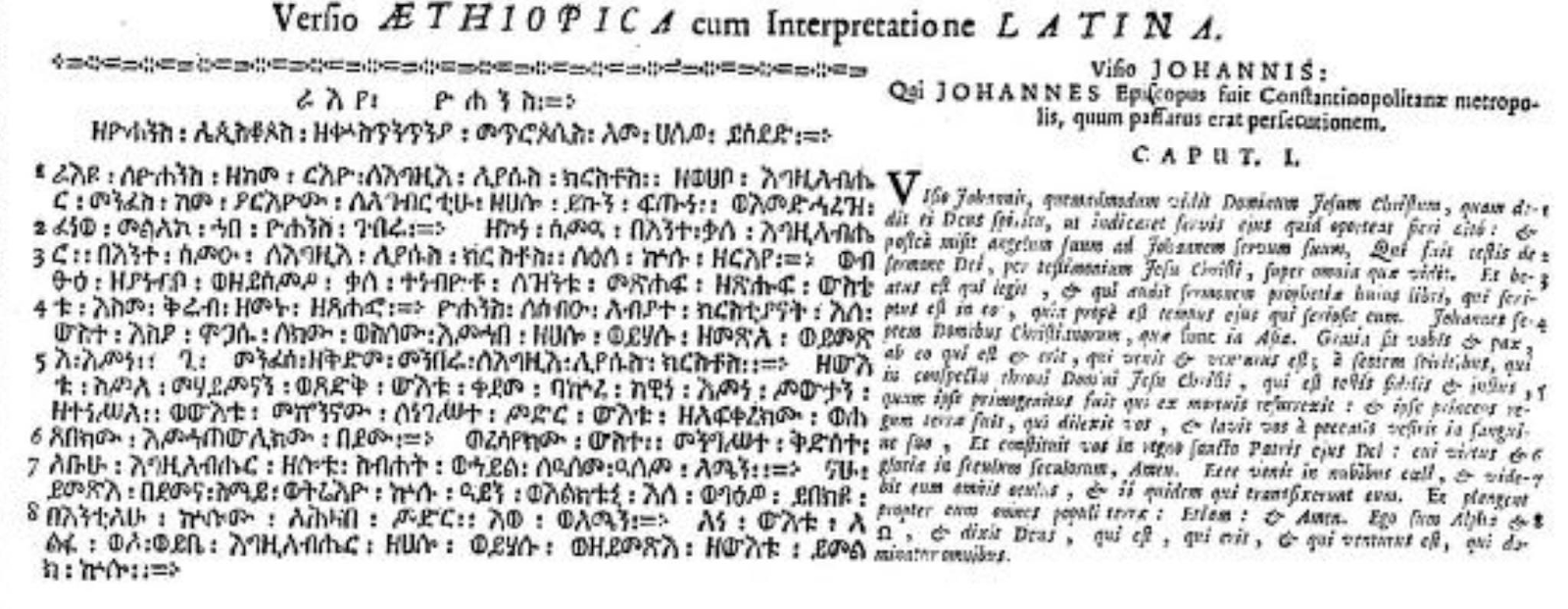
The Ge'ez (Ethiopic) Witness to the Text of Revelation 16:5

Statement of the Issue 

In the last decade, the Ethiopic has sometimes been brought out as an alleged versional witness to Beza's amended reading of Revelation 16:5.  

Instead of "εἶ ὁ ὢν καὶ ὁ ἦν καὶ ὁ ὅσιος," in 1582 Beza argued that the text should be "εἶ ὁ ὢν καὶ ὁ ἦν καὶ ὁ ἐσόμενος."  Thus, Beza's proposed variant was a substitution variant, substituting "ἐσόμενος" for "ὅσιος" (presumably he would see it as a substitute in the opposite direction).  Beza's reading also seems to have been defended by Piscator around the same time (perhaps more on this point in another post).

Interestingly, we have a hand-marked copy of a 1565 New Testament in which Beza has hand-marked this revision:

(b3052; p. 647, as cited by INTF)

The issue is whether Beza was right to make the substitution of "ἐσόμενος" for "ὅσιος" in Revelation 16:5.

In another post, we consider the background on the reception (or not) of Beza's emendation.  Nevertheless, is Beza's reading (whether or not it deserves the title, "textus receptus") supported by the Ethiopic version? 

Background: the Ethiopic Text  

Horne's "Introduction to the Critical Study and Knowledge of the Holy Scriptures," vol. 4 (1856)(pp. 315-23), provides an excellent introduction to the Ethiopic version (also referred to as the Aethiopic, and sometimes as the Abyssinian).  

In a nutshell, it is believed that the Ethiopic version was produced around the middle of the fourth century, as a result of the evangelistic efforts of Frumentius and Aedesius.  Although Horne does not mention it, it appears that it was around the same time that the Ethiopic script began to be written consistently left to right after some centuries of being right to left (following a period of apparently being written Boustrophedon (i.e. from right to left and left to right in alternating lines, like an ox ploughing a field).  It was also around this time that the Ge'ez characters began to be modified with vowel indications (similar to the later development in Hebrew).  

Some people have attributed the Ethiopic version to the work of Frumentius, but Horne doubts this.  The Ethiopic account of the translation places it at a later date, and suggests it is a translation from the Arabic (an idea that Horne rejects).  Horne does not mention, but some have suggested a date as late as the 14th century, for the date of translation into Ge'ez.  Several scholars today suggest a fifth or sixth century origin of the translation and connect it with missionary activity of the Nine Saints.  If this is correct, the Garima Gospels manuscripts may be essentially the original translation work.

The first printed edition of any part of the Ethiopic text was a Psalter printed in 1513 (Google Books suggests 1518) and mislabeled as "Chaldee."  In 1548, the New Testament except for Paul's Epistles and Hebrews were printed in Rome, with the remainder of the New Testament following in 1549 (also at Rome).  Peter and company relied on three manuscripts, two from the 15th century and one from the 16th century, and they are apparently still available.

Horne says that others have described the Roman edition as "far from accurate," but criticized the report that "a large part of the book of Acts" was "filled up" "by a translation from the Latin and Greek" (pp. 316-17).

Walton's Polyglott (1652) provided an Ethiopic text corresponding to the Roman edition but with "all the former errors retained and new ones ... introduced." (p. 317)  It also included a Latin translation, which Horne criticizes as being "far from accurate."  Christoph August Bode (around 1750) produced an allegedly improved Latin translation of the same Ethiopic text.   

About 70 years later, in 1826, Platt printed the Gospels from a collation of manuscripts, followed by the remainder of the New Testament in 1830.  Platt's edition, however, was not intended as a critical edition, but merely to give the Ethiopians the best printed text "as could be conveniently done" (p. 317).  Apparently some of his notes were provided, but only as far as the Gospels are concerned.

Horne believes that the Ethiopic is a direct translation of the Greek, but that the translator "could not have been a Greek himself" (p. 318), because of a series of translation errors he notes, which suggest a less than perfect understanding of Greek (see p. 319).  

Horne states: "It can be no cause for surprise that this version, made by such an incompetent translator, should often be very poor and incorrect." (p. 319) Horne indicates that the Gospels represent the best work of the translation. Horne quotes Platt as saying: "What gives it the appearance of a loose and paraphrastic translation is, that it contains so many repetitions, continually representing the same phrase by two different expressions immediately succeeding one another; and when these are not connected together by the requisite intermediate particles, of course a great confusion is introduced." (p. 320)  There is even some suggestion of different versions coming together, although Horne dismisses this notion.

Horne suggests that the translation may be the work of different translators, arguing: "the latter part is so much more paraphrastic than the Gospels, and shows such a general incompetence, that it looks as if it had originated with a more recent hand, perhaps the reviser of the Gospels." (p. 320)

Horne characterizes the text as "mixed" (i.e. both Byzantine and Alexandrian readings).  Moreover, the version seems to be of interest on the question of the long ending of Mark.  

Horne notes that the use of the Ethiopic version for textual criticism began "(or nearly so)" with Walton's Polyglott, as the Latin translation made the text accessible.  Based on my own notes, it seems that Owen and Gill make use of the Ethiopic in their commentaries (presumably via the Polyglott), but that there does not seem to have been much scholarly use of it before then (frankly, I have yet to see evidence of any scholarly use of it before the Polyglott).

Horne, writing in 1856, has only brought us up to the time of Platt.  Here's my more encompassing history of the relevant progress of Ethiopic scholarship, certainly not exhaustive, but hitting some high points:

Hayyim ben David Schwartz (1490-1549)

  • Psalterium in Quatvor Linguis Hebraea Graeca Chaldaea Latina.  Edited by Johann Potken, with the assistance of Johann Soter  (1518?)

Tasfa-Seyon (aka "Brother Peter the Ethiopian"), Tanse'a-Wald (aka Paulus), and Za-Sellase (aka Bernardus) (fl. 1548) 

  • Testamentum Nouum cum epistola Pauli ad Hebreos tantum, cum concordantijs euangelistarum Eusebij & numeratione omnium verborum eorundem. Missale cum benedictione incensi ceræ ... Chaldea, quæ omnia frater Petrus Ethyops ... imprimi curauit (link)

Brian Walton (1600-1661)

  • Biblia Polyglotta (1654 to 1657)(link - see vol. 10, 1657)(Dudley Loftus of Dublin translated into Latin, and Edmund Castell revised)

C.A. Bode (1722-96)

  • Gospel secundum Matthaeum ex versione Aethiopici interpretis in Bibliis polyglottis Anglicanis editum, cum graeco ipsius fonte-studiose contulitatque plurimis tam exegeticis quam philologicis observationibus textum partim, partim versionem illustravit . Hall 1749. (link)
  • Novum NJ Ch. Testamentunn, ex versione aethiopioi interpretis in bibliis polyglottis anglicanis editum, ex aethiopica lingua in latinam translatum. T.ll. Brunsv. 1752–55. (vol. 1)(vol. 2)

Thomas Pell Platt (1798-1852)

  • Novum Testamentum Domini Nostri et Servatoris Jesu Christi Aethiopice. Ad codicum manuscriptorum fidem (1830) (link)

August Dillmann (1823-1894) German orientalist.  He is well known as a commentator, but for our purposes, his great contributions relate to the Ethiopic language:

Marcel Cohen (1884-1974) French, but expert in Semitic languages, especially Ethiopic (link to Wikipedia), whose works include: 

  • 1921: "La prononciation traditionelle du Guèze (éthiopien classique)", in: Journal asiatique Sér. 11 / T. 18. (link)
  • 1924: Le système verbal sémitique et l'expression du temps. Paris: Leroux. (link)

Wolf Leslau (1906-2006) originally Polish, but expert in Ethiopian languages (Wikipedia) author of (among many others):

  • 1987: Comparative dictionary of Ge‛ez (Classical Ethiopic) : Gǝ‛ǝz-English/English-Gǝ‛ǝz with an index of the Semitic roots. Wiesbaden: Harrassowitz, xlix + 813 p. (link)
  • 1989: Concise dictionary of Gǝ‛ǝz (Classical Ethiopic). Wiesbaden: Harrassowitz, 247 p.

Leslau compiled an extensive bibliography of the relevant work before him (link to bibliography).

Leslau brings us up to near the end of the twentieth century (he was naturally less active in his 90s). I'm not sure who to name as the current leading light in Ethiopic studies.  However, I am appreciative of the following contemporaries:

  • Monica Devens
  • TraCES-Lexicon project (link to project)
  • Concordance of the Ethiopian Bible (as of Apr 25, 2021)
    • Concordance of the Acts, Catholic Epistles and Apocalypse (link)
    • Concordance of the four Gospels (link)
    • Concordance of the Pauline Epistles (link)
    • Concordance of Genesis, Exodus, and Leviticus (link)
    • Concordance of Numbers and Deuteronomy (link)
  • Daniel de Caussin
  • The Bible in ግዕዝ - Ge'ez (Ethiopic)(link)
  • Ge'ez Bible, (Genesis through Ruth plus the Psalms) (link)
  • Curt Niccum
    • Apokalypse Now: The Ethiopic Version of Revelation Fifty Years after Hofman (2017)
  • Honorable Mention (not contemporary):
    • Ethiopic Grammar, With Chrestomathy and Glossary, By Samuel Alfred Browne Mercer · 1920 (link)

Additional details may be found in Bruce Metzger's "The Early Versions of the New Testsament: Their Origen, Transmission, and Limitions" (1977), beginning at p. 215.

From my standpoint, the Ethiopic text poses a number of challenges.  First, the Ge'ez character set itself provides a hurdle.  There are some similarities of shape with a Paleo-Canaanite script (it is apparently derivative of Ancient South Arabian), and similar names and sounds of many of the characters, and the use of vowel markings on the consonants is mostly regular enough to allow for a reasonable learning curve, particularly with someone already familiar with Greek and Hebrew.  

To complicate matters, some Ge'ez reference materials for Western/European readers attempt to overcome the character hurdle by transliterating to Latin letters.  Some of these transliterations are straightforward, others less so.  While a technique of looking for matching characters can allow comparison of reference materials without learning the character set, the use of transliteration in some reference materials can defeat this.  On the bright side, the shapes of the Ge'ez characters in print is largely stable since the 16th century.  Moreover, the inclusion of Ge'ez characters in the Unicode set (probably because of their use in modern Amharic) promotes the use of digital tools without the requirement of transliterating or using elaborate font techniques.

To this, add the complexity of the language itself, which uses both prefixes and suffixes to perform declension (if one can call it that) and conjugation, but also to add conjunctions and prepositions.  Thus, parsing the language can be difficult. 

In some ways, one might observe that these difficulties are not necessarily more than a language like Greek or Hebrew, for a native English speaker.  That said, there are vastly more resources available to English speakers for those two languages, because of their significance as the original languages of Scripture.  

By way of example, consider how the second person singular masculine is indicated by a suffix ከ (sometimes transliterated as kä or ka) as opposed to the second person singular feminine, ኬ (ki or kee).  As you may notice, the difference between ka and kee is the difference between the kaf character with no vowel modification and the kaf character with a vowel modification in the lower right corner (fifth form out of seven forms that a kaf can take).     

Interestingly, Ge'ez numbers seem to be borrowed Greek numbers, perhaps via Coptic.

However, the point of this article is not to be a primer on Ge'ez, but merely to provide some background.  

Hofmann's "Die äthiopische Übersetzung der Johannes-Apokalypse – Textus" (CSCO 281; Scriptores Aethiopici 55), Leuven 1967, seems to be the most recent critical text of Apocalypse, based on about 26 manuscripts.  Since that time, the number of known manuscripts has risen to over a 100, and a few of the manuscripts are potentially even older than those used by Hofmann.  Nevertheless, as of 2019, it appears that the scholarly consensus is this: "Hofmann’s Ethiopic version of the Apocalypse remains insufficient for determining the Greek Vorlage behind the Ethiopian version." (source)

Nevertheless, Metzger (1977) (p. 232) notes that John Mill in 1707 identified some Ethiopic readings in which the Latin translation of the Ethiopic found in Walton's Polyglot agree with codex Alexandrinus, and in a few places sided with the Ethiopic either alone or with very few other witnesses.  At Revelation 16:5, Mill has:


I've included his notes at Revelation 16:4 as well as 16:5, just to show that Mill did consult the Ethiopic in Revelation 16, but did not cite it for a textual variant here. (Link to Mill - 1710, which is an expansion of the 1707 edition with the further work of Ludolph Kuster)

Metzger (1977)(p. 232) also states that Hoskier found more than fifty readings in the Pauline epistles (excluding Hebrews) where the Ethiopic is nearly alone in agreeing with P46.  

Metzger has a specific section, beginning at p. 236, on the Book of Revelation.  He concludes on the basis of Hofmann's work that all the manuscripts correspond to a single Greek Vorlage.  Hofmann, per Metzger, indicates that the Apocalypse was translated between 550 and 650 by a different translator from the Gospels.  However, Metzger (p. 237) states: "It is to be regretted, therefore, that we no longer have his rendering in its original form, for what the manuscripts offer is a text that has been greatly contaminated by various influences over the centuries, including Schlimmverbesserungen, revisions, and alterations made on the basis of other versions." Schlimmverbesserungen literally means "bad improvements."  Those "other versions" changes seem to have come from the Coptic and Arabic versions. 

Within Metzger's book, Hofmann himself offers a chapter section on "Limitations of the Ethiopic in Representing Greek," beginning at p. 240.  The limitations he identifies are phonetics (which should not affect our study of this verse, as no transliteration questions are present), morphology (a bigger issue), and syntax (which Hofmann sees as relatively slight).  Under the topic of morphology, Hofmann identifies numerous issues, such as Ethiopic having only masculine and feminine but not neuter, and Ethiopic lacking both definite and indefinite articles.  Of particular interest to us are verb forms, but Hofmann tells us (p. 244): "Ethiopic is capable of expressing only a very limited measure of the information that is contained in a Greek verb-form."  More specifically, when it comes to the question of Time of the verb: "The Ethiopic verb has no reference to time. It indicates only whether an action is regarded as complete (Perfect) or incomplete (Imperfect)." (p. 245)


(p. 245)

Perhaps even more significant for us, "εἶναι" (to be) has its own issues.  Hofmann explains: "Ethiopic lacks a precise equivalent for εἶναι used as a copula" (p. 246).  Hofmann explains (pp. 246-7):


Likewise, Hofmann explains that there are limitations on rendering participles from Greek to Ethiopic, except for the perfect passive participle (pp. 247-8).  

Dillmann himself (in Chricton's translation) explains the issues with time of verbs at pp. 166-72 of his Grammar:


Likewise, issues associated with HLW and KN are mentioned at pp. 499-500:

Niccum (2017) describes the substantial work that has been done since Hofmann, including redating of manuscripts, but also finding numerous additional manuscripts. Niccum states (p. 217): "Hofmann’s verdict that none of the extant witnesses examined preserves unadulterated the text of the initial translation, the so-called Axumite Bible, still holds true."  Niccum says that Arabic influence is present in "every manuscript" (p. 217).  

The Ethiopic Text of Revelation 1:4, 1:8, 4:8, 11:17, and 16:5

There is a similarity in the original Greek among five passages in Revelation: Revelation 1:4&8, 4:8, 11:17, and 16:5, in that each describes God with reference to multiple participles of εἶναι with different times.  Accordingly, particularly given the difficulty of translating between Greek and Ethiopic when it comes to participles, times, and specifically εἶναι, it makes sense to consider these passages together. 

Except in the case of Revelation 16:5, I am copying only the portion translating the Greek being verb participles together with a translation of "is to come" (or the like) if included.  

1548 "Peter the Ethiopian" Bible

Rev 1:4 (left page, left column, mid way down) (f. 101/p. 252)

Rev 1:8 (left page, right column, near top)(f. 101/p. 252)


Rev 4:8 (left page, right column, slightly above middle)(f. 103/p. 256)

Rev 11:17 (right page, left column, middle)(f. 106/p. 262)

Rev 16:5 (right page, right column, lower middle)(f. 106/p. 262)

Walton's Polyglot (1657)

Revelation 1:4 & 8 (p. 933)

Revelation 4:8 (p. 943)

Revelation 11:17 (p. 957)

Revelation 16:5 (p. 965)


Platt (1830) 

Rev. 1:4(p. 696)(right)

Rev. 1:8 (p. 698)(left)

Rev. 4:8 (p. 704)(right)

Rev. 11:17 (p. 718) (left)

Rev. 16:5  (p. 726) (right)

Hofmann (1967)

Rev. 1:4 (link)

Rev. 1:8 (link)


Rev. 4:8 (link)


Rev. 11:17 (link)

Rev. 16:5 (link)


Summary Comparison of the Ethiopic Printed Editions

In the following, I provide a comparison amongst the Ethiopic texts of "The Bible in Ge'ez" (BG), "The Concordance of the Ethiopian Bible" (CEB), Walton's Polyglot (EP), Peter the Ethiopian's Bible (1548), Platt's 19th century printing (Platt), and the main text of Hofmann's critical text (Hofmann). 

Revelation 1:4

  • Rev. 1:4 (BG)
    • … ዘሀሎ ወይሄሉ ዘመጽአ ወዘይመጽእ …
  • Rev. 1:4 (CEB)
    • … ዘሀሎ ወይሄሉ ዘመጽአ ወዘይመጽእ …
  • Rev. 1:4 (WP)
    • … ዘሀሎ ወይሃሉ ዘመጽአ ወይመጽእ …
  • Rev. 1:4 (1548/9)
    • … ዘሀሎ ወይሄሉ ዘመጽአ ወይመጽእ …
  • Rev. 1:4 (Platt)
    • … ዘሀሎ ወይሄሉ ወዘይመጽእ …
  • Rev. 1:4 (Hofmann)
    • … ዘሀሎ ወይሄሉ ወዘይመጽእ …

The differences amongst these versions are:
  1. Platt and Hofmann omit one word (more discussion of this below);
  2. Walton's contains a typo (transcription error - or perhaps my transcription error in reading Walton - the text base of the letter is a bit fuzzy) in the form of an unvocalized letter in one word; and
  3. Walton's, following the 1548, omits a prefix in one word. 

Revelation 1:8

  • Rev. 1:8 (BG)
    • … ዘሀሎ ወይሄሉ ዘመጽአ ወዘይመጽእ …
  • Rev. 1:8 (CEB)
    • … ዘሀሎ ወይሄሉ ዘመጽአ ወዘይመጽእ …
  • Rev. 1:8 (WP)
    • … ዘሀሎ ወይሄሉ ወዘይመጽእ …
  • Rev. 1:8 (1548)
    • … ዘሀሎ ወይሄሉ ወዘይመጽእ …
  • Rev. 1:8 (Platt)
    • … ዘሀሎ ወይሄሉ ወዘይመጽእ …
  • Rev. 1:8 Hofmann
    • … ዘሀሎ ወይሄሉ ወዘይመጽእ …

The differences amongst these versions are:

The Bible in Ge'ez and the Concordance add one word (apparently to harmonize with 1:4).  More discussion on this below.

Revelation 4:8

  • Rev. 4:8 (BG)
    • … ዘሀሎ ወይሄሉ
  • Rev. 4:8 (CEB)
    • … ዘሀሎ ወይሄሉ
  • Rev. 4:8 (WP)
    • … ዘሀሎ ወይሄሉ
  • Rev. 4:8 (1548)
    • … ዘሀሎ ወይሄሉ
  • Rev. 4:8 (Platt)
    • … ዘሀሎ ወይሄሉ
  • Rev. 4:8 (Hofmann)
    • … ዘሀሎ ወይሄሉ

For once, there seems to be perfect agreement amongst these print versions.  Notice, however, that the overall phrase has shrunk to just two words.

Revelation 11:17

  • Rev. 11:17 (BG)
    • … ዘሀሎከ ወትሄሉ …
  • Rev. 11:17 (CEB)
    • … ዘሀሎከ ወትሄሉ …
  • Rev. 11:17(1548)
    • … ዘሀሎ ወይሄሉ …
  • Rev. 11:17(WP)
    • … ዘሀሎ ወይሃሉ …
  • Rev. 11:17 (Platt)
    • … ዘሀሎከ ወትሄሉ …
  • Rev. 11:17(Hofmann)
    • … ዘሀሎ ወይሄሉ  …

The differences amongst these versions are:
  1. The transcription error in Walton's (or perhaps my error of sight) returns for one letter; 
  2. Walton's, following the 1548, and Platt omit a suffix in one word; and
  3. Platt, the BG, and CEB have a substituted prefix in one word. 

Revelation 16:5

  • Rev. 16:5 (BG)
    • … ጻድቅ አንተ እግዚኦ ወራትዕ ዘሀለውከ ወትሄሉ ወከመዝ ኰነንከ
  • Rev. 16:5 (CEB)
    • … ጻድቅ አንተ እግዚኦ ወራትዕ ዘሀሎከ ወትሄሉ ወከመዝ ኰነንከ
  • Rev. 16:5 (WP)
    • … ጻድቅ አንተ እግዚኦ ወራትዕ ዘሀሎከ ወትሄሉ ከመዝ ኰነንከው
  • Rev. 16:5 (1548/9)
    • … ጻድቅ አንተ እግዚኦ ወራትዕ ዘሀሎከ ወትሄሉ ከመዝ ኰነንከው
  • Rev. 16:5 (Platt)
    • … ጻድቅ አንተ እግዚኦ ወራትዕ ዘሀለውከ ወትሄሉ ወከመዝ ኰነንከ
  • Rev. 16:5 (Hofmann)
    • … ጻድቅ አንተ እግዚኦ ወራትዕ ዘሀሎከ ወትሄሉ ከመዝ ኰነንከ

For once, there is a non-alignment between the GB and CEB.  It was only this difference that led me to list them separately.  The differences amongst these versions are:
  1. Platt and BG provide a different vocalization and suffix in one word; 
  2. Platt and BG, joined by CEB, and Platt add a prefix to one word; and
  3. Walton, following the 1548, adds a suffix to one word. 

Latin Translational Differences

There are three professional Latin translations of the text, to my knowledge:  

  • Loftus (provided in Walton's Polyglot 1657)
  • Bode (1755) using Walton's base text with (more woodenly literal?) alternative translation in parentheses 
  • Hoffman (1967) corresponding to Hoffman's main text with alternative renderings in parenthesis.

That means that there is no "professional" Latin translation corresponding to Platt's text or to the BG/CEB text.  While there is value to machine translation, I am not confident in the ability of machine translation to handle Ge'ez, because of the relatively small number of English-Ge'ez (and vice versa) texts upon which to train.  

Loftus (1657)

Rev. 1:4 (Loftus)


... qui est & erit, qui venit & venturus est ...


Rev. 1:8 (Loftus)


... qui est, qui erit, & qui venturus est ... 


Rev. 4:8 (Loftus)

... qui est, & erit.


Rev. 11:17 (Loftus)


... qui est & erit ... 


Rev. 16:5 (Loftus)


Justus es Domine, et rectus, qui fuisti et eris, sic judicasti eos ... 

Bode (1755)

Rev. 1:4 (Bode)

... qui fuit, et erit, qui venit, et veniet ...


Rev. 1:8 (Bode)

... qui est (fuit), et erat (erit), et qui veniet ... 


Rev. 4:8 (Bode)

... qui est, et qui erat.


Rev. 11:17 (Bode)

... qui est (fuit) et erit ... 


Rev. 16:5 (Bode)

iustus tu es Domine, ac rectus (incorruptus), qui es (fuisti) et eris, dum sic judicasti eos ... 

Hofmann (1967)

Rev. 1:4 (Hofmann)

... qui est et erit (... qui-existit et-existet), et-qui-veniet  ...


Rev. 1:8 (Hofmann)

... qui est et qui erit (qui-existit et-existet) et-qui-veniet ... 


Rev. 4:8 (Hofmann)

... qui est et erit (qui-existit et-existet).


Rev. 11:17 (Hofmann)

... qui est et erit (qui-existit et-existet) ... 


Rev. 16:5 (Hofmann)

iustus es (tu) domine et-rectus qui es et eris (qui-existis et-existes) sic iudicasti  ... 


In summary:

Rev. 1:4

  • (Loftus) ... qui est & erit, qui venit & venturus est ...
  • (Bode) ... qui fuit, et erit, qui venit, et veniet ...
  • (Hofmann) ... qui est et erit (... qui-existit et-existet), et-qui-veniet  ...

Rev. 1:8

  • (Loftus) ... qui est, qui erit, & qui venturus est ... 
  • (Bode) ... qui est (fuit), et erat (erit), et qui veniet ...
  • (Hofmann) ... qui est et qui erit (qui-existit et-existet) et-qui-veniet ... 

Rev. 4:8

  • (Loftus) ... qui est, & erit.
  • (Bode) ... qui est, et qui erat.
  • (Hofmann) ... qui est et erit (qui-existit et-existet).

Rev. 11:17

  • (Loftus) ... qui est & erit ... 
  • (Bode) ... qui est (fuit) et erit ... 
  • (Hofmann) ... qui est et erit (qui-existit et-existet) ... 

Rev. 16:5

  • (Loftus) Justus es Domine, et rectus, qui fuisti et eris, sic judicasti eos ... 
  • (Bode) iustus tu es Domine, ac rectus (incorruptus), qui es (fuisti) et eris, dum sic judicasti eos ... 
  • (Hofmann) iustus es (tu) domine et-rectus qui es et eris (qui-existis et-existes) sic iudicasti  ... 

Observations:

  1. Latin "qui" can mean "which" or "who" (among other things) depending on the context.  When I convert these Latin translations to English, I favor "which" to indicate the third person, and "who" to indicate the second person.
  2. Further to 1, based on the Greek manuscripts we have, we know that the original Greek uses participles with articles.  By contrast, the translations use indicative verbs and pronouns (neither Latin nor Ge'ez has articles).  This is not a big surprise as it pertains to the articles; even though English has articles, we use articles a bit differently from Greek.  Additionally, rendering Greek participles into Ethiopic can be challenging because, as noted above, Ethiopic generally does not have equivalent participles to Greek.
  3. The key Latin phrases in the above translate to English as follows:
    1. "qui est" - "which is"
    2. "& erit" or "et erit"  - "and will be"
    3. "qui erit" - "which will be"
    4. "qui fuit" - "which has been"
    5. "qui venit" - "which comes"
    6. "& venturus est" - "and is going to come"
    7. "et veniet" - "and will come"
    8. "qui existit" - "which exists"
    9. "et existet" - "and will exist" 
    10. "et qui veniet" - "and which will come
    11. "et erat" - "and was"
    12. "et qui erat" - "and which was"
    13. "qui fuisti" - "who have been"
    14. "qui es" - "who are"
    15. "et rectus" / "ac rectus" - "and right"
    16. "eos" - "them"
  4. In the first four passages, third person singular (i.e. he/she/it) verbs  are used, whereas in Revelation 16:5, second person singular verbs (i.e. thou/you) are used.  This change in the Latin seems to accurately reflect the underlying difference in the Ge'ez.
  5. The reason for the longer reading of Rev. 1:4 in the Loftus and Bode translations is an extra word of Ge'ez.
  6. Bode has an odd inconsistency between the translation at 1:4 and at 1:8, given that the first two words (corresponding to "qui est" and "et erat" respectively) are the same in both places.
  7. Hofmann's "existit..." parenthetical readings provide an arguably better translation of the connotation.    
  8.  The absence of the "eos" (them) in Hofmann is due to the absence of the corresponding suffix in the Ge'ez text. 
  9. The difference between iudicasti and judicasti is simply a question of whether to use the letter "j" in Latin, the meaning is the same either way.

In translation:

The following is an English translation corresponding to the 1548 and Hofmann (Crit.) Ge'ez texts, respectively.

Rev. 1:4 (1548) which is and will be, which comes and will come | ዘሀሎ ወይሄሉ ዘመጽአ ወይመጽእ

Rev. 1:4 (Crit.) which is and will be, and which will come | ዘሀሎ ወይሄሉ ወዘይመጽእ

I note that I selected "which is ..." rather than "which was ..." in view of the seeming preference in the variety of places and translators, although there is a sound argument for "which was" instead of "which is" as well.  Likewise, while "is going to come" is also possible instead of "will come," I favor Bode's translation, which happens to align with Hofmann on this, and I attribute the difference in Loftus to a preference for the more classical Latin formation, although it might also represent the connotation of the Ge'ez better.

***

Rev. 1:8 (both) which is and will be, and which will come | ዘሀሎ ወይሄሉ ወዘይመጽእ

The Ge'ez text at Rev. 1:8 is the same (and same as the crit. Ge'ez at 1:4) and consequently the translation should be the same with the same rationale.

*** 

Rev. 4:8 (both) which is and will be | ዘሀሎ ወይሄሉ

Again, the translation should be the same as the words are the same.  The Ethiopic omits a form of "to come" here. 

*** 

Rev. 11:17 (both) which is and will be | ዘሀሎ ወይሄሉ

Again, the Ethiopic omits a form of "to come" here, and again the translation should be the same as the words are the same.   

*** 

Rev. 16:5 (1548) Just you are, O Lord, and right, who are and will be, thus you have judged them | ጻድቅ አንተ እግዚኦ ወራትዕ ዘሀሎከ ወትሄሉ ከመዝ ኰነንከው

Rev. 16:5 (Crit.) Just you are, O Lord, and right, who are and will be, thus you have judged | ጻድቅ አንተ እግዚኦ ወራትዕ ዘሀሎከ ወትሄሉ ከመዝ ኰነንከ

The only difference is the final suffix, which provides the "them" in the 1548.

Comparison between Revelation 16:5 and the Ge'ez

When we try to make a comparison between the Greek at Revelation 16:5 and the Ge'ez at Revelation 16:5, let's see what happens.  For the sake of completeness, I'm providing the two most likely readings based on the Greek manuscripts (reading 1 and reading 2) and the reading proposed by Beza (reading 3).

1) ὁ ὢν | καὶ ὁ ἦν | καὶ ὁ ὅσιος

2) ὁ ὢν | καὶ ὁ ἦν | ὁ ὅσιος

3) ὁ ὢν | καὶ ὁ ἦν | καὶ ὁ ἐσόμενος

In the other places that "ὁ ὢν καὶ ὁ ἦν" appear (Rev. 1:4, Rev. 1:8, and Rev. 11:17) and in the place where "ὁ ἦν καὶ ὁ ὢν" appears (Rev. 4:8), the Ge'ez uniformly translates this as "ዘሀሎ ወይሄሉ" ("which is and will be").  The only difference with the Ge'ez in Rev. 16:5 (from the previous instances) is that the Ge'ez adds the pronoun suffix kaf (ከ) to the first word, which seems to reflect the "εἶ" (you [masculine] are) immediately before this text.

It's not an exact translation of the underlying Greek any of the three places, but this can be explained because of difficulty in handling forms of "to be," participles, and times in Ge'ez when translating from other languages.

Based on this analysis, the phrase "ዘሀሎከ ወትሄሉ" here does not distinguish amongst the three candidate Greek readings.  

The Ge'ez word that helps us distinguish amongst these options is "ወራትዕ," which is composed of the conjunction prefix "" (and) and ራትዕ ("right").

The Comparative Dictionary of Ge'ez offers the following entry for this word (pp. 475-76):

Note that this word can have a range of meanings.  In this case, I believe that the translator from Greek to Ge'ez thought that the Greek was to be understood in terms of a phrase, "καὶ ὁ ὅσιος ὅτι ταῦτα ἔκρινας" (and the Holy because you have judged thus), and therefore translated ὅσιος as "right"/"true" or even "righteous" in view of correctly judging.  

It's not an exact translation, under any analysis.  However, if this analysis is correct, and I believe it is, the Ge'ez here is a witness to reading (1) above, namely "ὁ ὢν καὶ ὁ ἦν καὶ ὁ ὅσιος."  While this is not the NA28 reading (the NA28 omits the second καὶ), it is supportive of a variant that exists in a substantial minority of the Greek manuscripts.

Conclusions

I recognize that TR defenders will not welcome this analysis.  While it is true that the literal Ge'ez includes a future form of the verb "to be" (i.e. ወትሄሉ), it is inappropriate to rely on this as allegedly serving to witness to Beza's text.  The best understanding of the text to which it witnesses is "ὁ ὢν καὶ ὁ ἦν καὶ ὁ ὅσιος."  It is not a literal translation of that underlying text, but there are excellent reasons why it is not a literal translation of that underlying text, reasons grounded in the differences between Ge'ez and Greek, and a general willingness of the Ge'ez translator to try to convey the sense without being concerned with being overly literal.

TR advocates will not be impressed by the fact that the Ethiopic at Rev. 11:17 witnesses the shorter majority/critical text.  Likewise, TR advocates will not adopt the shorter reading at Rev. 4:8 found in the Ethiopic text.  

Ultimately, while interesting, the Ethiopic text is not dispositive for New Testament textual studies.  There remains work to be done in advancing Hofmann's work from the 1960s using the new manuscripts that have come to light since then.  Nevertheless, I do not anticipate seeing a significantly different result as to this specific reading.

Additionally, I add that the "literal translation" sword has two edges.  While ወትሄሉ is a future form of the verb "to be," it is not literally "ὁ ἐσόμενος," even though that also includes a future form of the verb "to be."    

Finally, I should add that it is unreasonable to suppose that Beza had access to and considered the 1548 Ge'ez text.  Peter the Ethiopian (aka Tesfa-Sion) acknowledged the challenges of printing the text (“those who composed it could not read Ethiopic, and we who read Ethiopic knew not how to compose.”) but did a remarkably good job considering.  While it is apparently true that both Gelawdewos, King of Ethiopia, and the pope of Rome consented in this project, there is nothing to suggest to us that scholars such as Beza had access to the readings of this text or consulted it for their edition.  Indeed, I would challenge anyone who thinks otherwise to point to a single instance where Beza cites to the Ethiopic at any verse.

Appendix I

The above conclusions are further supported by Dillman's Lexicon Linguae Aethiopicae (available here).  


(col. 4)

(col. 291)


(col. 811)

Appendix II

As of October 31, 2023, Munster's site provides the following note regarding Beza's conjecture:

In Beza’s hand copy (b3052; p. 647), ὁ ὅσιος is underlined, and ὁ ἐσόμενος entered in the margin.
Though Beza’s annotation states the reading is introduced “ex vetusto bonae fidei manuscripto codice” (“from an old and reliable manuscript”), there is no such Greek manuscript here. Beza probably made an error, mistaking his own conjectured reading for an attested one.
The conjecture is adopted in the Greek text and the Latin translation.
There is no versional evidence for the conjecture. The Ethiopic simply omits ὁ ὅσιος (at least in most manuscripts), and has only two elements (ዘሀሎከ ወትሄሉ ). The Ethiopic omits the equivalent of ὁ ἐρχόμενος in Rev 4:8 and 11:17, but it does not do so in Rev 1:4 en 1:8.
Wettstein (NTG 2) mentions a “Codex Stephani,” but this merely reflects his (incorrect) inference from Beza’s annotation. This inference is followed by other such as Huyshe (s30566).
For references to Erasmus see cj16082; s28499.
While various aspects of this note are outside the scope of my research above, I would simply note that I must respectfully disagree with the statement: "The Ethiopic simply omits ὁ ὅσιος (at least in most manuscripts), and has only two elements (ዘሀሎከ ወትሄሉ )."  A better characterization is that the Ethiopic is a witness to  "ὁ ὢν καὶ ὁ ἦν καὶ ὁ ὅσιος" as it uses the same words used to translate "ὁ ὢν καὶ ὁ ἦν" (in Rev. 1:4, 1:8, and 11:17, and the reversal of the phrase at Rev. 4:8) and because it appears to translate "καὶ ὁ ὅσιος" by "ወራትዕ" as testified by Dillman and as argued above.  

The presence of an additional word for holy in some manuscripts, as noted by Hofmann, is best explained by the tendency to reduplicate words (compare the expansion of "coming" statement in Rev. 1:4) and/or by a secondary corruption from the Arabic by a translator familiar with Ge'ez and Arabic, but without access to the Greek original.  Multiple redactions based on the Arabic text are noted by Metzger, although it remains for further study (from this standpoint of this post) whether the specific manuscripts with the added word are the later and further revised manuscripts. 

On the latter premise (Arabic-Ge'ez corruption), the editing translator recognized that the Ge'ez word equivalent to "righteous" was an inadequate equivalent to the Arabic word for "holy".  On the former premise (Greek-Ge'ez false correction), the editing translator recognized that the Ge'ez word equivalent to "righteous" was an inadequate equivalent to the Greek word for "holy" and consequently added a further word to expand the text and capture the full meaning.  

A further explanation (also Greek-Ge'ez false correction) is that the editing translator mistook the "just and righteous" as an Ethiopic expansion and viewed "holy" as omitted in his exemplar, and therefore intended to restore what he thought had been omitted.