Saturday, November 25, 2023

Turretin's "Sources" for 1 John 5:7

Matthew Everhard has video (link to video) in which he suggests that the historic Francis Turretin was not being honest in his defense of Johannine Comma (the longer reading at 1 John 5:7-8).  

I note that Everhard is working from a different translation of Turretin than that found in P&R's publication, namely the Dennison translation. I don't know where he got that translation, but it is fairly accurate. Starting around 4:20 into the video, Matthew Everhard states (all transcriptions are lightly edited computer-generated transcripts):

4:20-5:03 (approximately)

It just so happens that this is either a wild overstatement or he is fudging the truth or he is stretching the truth or perhaps he just doesn't know what he's talking about here because look he says "all the Greek witnesses have it." Okay, so that's a universal positive. He's making a universal positive argument here by saying that they all have it. "The words always were of unquestioned truth" okay so that's a pretty dynamic statement there, "and are read in all the Greek manuscripts from the times of the Apostles themselves." Okay, now this would be probably the sentence that we have the most trouble with because as it turns out this is just factually not true. 

I agree that it is not factually true.

6:19 to 6:59 (approximately)

Now, unfortunately this is a statement that is repeated very very often today especially by those who defend either the King James version which contains John's comma or by those who defend the textus receptus and a lot of people will point back to Turretin's statement here saying it's always been there and because Turretin is seen as a very reliable and trustworthy defender of reformed Orthodoxy this statement from him as taken as as good as gold as it comes to John's comma.

I agree that this does get trotted out by folks who totally disagree with Turretin's view on textual transmission.

10:15 to 11:43 (approximately)

And so for Francis Turretin to claim that John's comma is in all the Greek manuscripts, that is just wildly wildly inaccurate. It cannot possibly even remotely be considered accurate. It is essentially a false statement and this is the problem with making universal positives: it's in all of them or it's in none of them. It's so easy to disprove a universal positive or a universal negative because all you need is one example to the contrary to disprove the entire statement. So Francis Turretin tries to do too much here by fudging or stretching the data well well beyond the levels of truthfulness. Now one could possibly say that Turretin knew about a bunch of manuscripts that we don't have today and this is the argument that advocates of the Textus Receptus or advocates of the King James Version will commonly make. They'll say, "Well he was referring to the manuscripts that he knew of." Well where are they? Well apparently they've all gone out of existence because because of all of the myriads and myriads of plethora of manuscripts there's only this very very scant few that actually have John's comma and the oldest one with a comma in its text is from the 14th Century. Man alive, that is not great biblical support or manuscript evidence to support John's comma.

First, I would caution this "plethora" argument, unless you take the time to figure out how many Greek manuscripts of 1 John there are, because that is the first response by the more learned TR advocates.

Second, there is a more straightforward explanation for Turretin's claim.

11:54 to 12:48 (approximately)

Remember what Francis Turretin said here. He says -- "not the saying in first John 5:7, although some formerly called it into question and heretics do so today," so Turretin goes pretty far into the deep end of the pool here by saying that "formerly some called into question" that may be a reference to Calvin as we're going to see here and "heretics do so today" which again is a statement that a lot of people from the TR defense position or the King James version defense position they want to call people heretics because Francis Turretin said so well if that's true then I I guess Calvin is either one of those formerly who's just wrong here according to Turretin or he's one of those heretics as modern advocates might say.

I won't address his Calvin arguments, for a variety of reasons, but primarily because I think there is a better explanation, and Calvin's errors are different from Turretin's.

Once we understand Turretin's claim better, the heretics and "formerly some" will fall into place.

17:50 to 18:45 (approximately)

So, I think Turretin is trying to do too much. I get his point, he really does want to redress the Roman Catholic Arguments for the supremacy of the Latin Vulgate and he does so by making a great argument in general that we should rely on the Greek and the Hebrew not the Latin but this statement that we looked at today clearly he presses the boundaries of anything that could remotely even be considered true and again the argument of some modern advocates of the Textus Receptus and of the King James version that perhaps he had a just all these manuscripts they all had it and those just happened to be the one that poof disappeared from history somehow and that all that we're left with is all those plethora and myriads of manuscripts that don't have it except for one or two that were really late like yikes level late in terms of history here -- that's just not a great way to make that argument, okay? so easily testable.

This is starting to catch the correct line.  Turretin is engaging Roman Catholic claims.  By contrast, Everhard's material is probably aimed at something like this material from FBC Roy (link to video).  So, Turretin is using Roman Catholic scholarly material against themselves.

Dennison's translation of Francis Turretin's Institutes, Volume 1, p. 115, states:


Transcription:

X. There is no truth in the assertion that the Hebrew edition of the Old Testament and the Greek edition of the New Testament are said to be mutilated; nor can the arguments used by our opponents prove it. Not the history of the adulteress (Jn. 8:1-11), for although it is lacking in the Syriac version, it is found in all the Greek manuscripts. Not 1 Jn. 5:7, for although some formerly called it into question and heretics now do, yet all the Greek copies have it, as Sixtus Senensis acknowledges: "they have been the words of never-doubted truth, and contained in all the Greek copies from the very times of the apostles" (Bibliotheca sancta [1575], 2:298). Not Mk. 16 which may have been wanting in several copies in the time of Jerome (as he asserts); but now it occurs in all, even in the Syriac version, and is clearly necessary to complete the history of the resurrection of Christ.

The original text (first edition) of Second Topic, Question XI, section X says:  


Transcription:

X. Falso Editio Hebraea Vet. & Graeca N. T. dicitur mutila: Nec quae ab Adversariis afferruntur testimonia hoc evincere possunt; Non historia adulterae Io.8. licet enim desit in Syriaca Versione, reperitur in omnibus Graecis Codicibus. Non dictum 1. Io.5:7. quamvis enim quidam in dubium olim vocarint, & vocent hodie haeretici, habent tamen omnia Exemplaria Graeca, ut Sixtus Senensis agnoscit; verba indubitatae semper veritatis fuerunt, & in omnibus Graecis exemplaribus ab ipsis Apostolorum temporibus lecta. Non Marc 16. caput, quod potuit in variis exemplaribus defiderari tempore Hieronymi, ut ipse fatetur, sed nunc in omnibus habetur etiam in Syriaca versione, & est plane necessarium ad perexendam historiam resurrectionis Christi.

Translation:

X. It is falsely stated that the Hebrew edition of the Old Testament and the Greek New Testament are mutilated: The testimonies brought forth by the Adversaries cannot prove this; not the story of the adulteress in John 8, for although it is missing in the Syriac Version, it is found in all Greek Codices. Not the saying in 1 John 5:7. Although some have doubted it in the past, and heretics do so today, all Greek manuscripts, as Sixtus of Sienna acknowledges, contain it; these words have always been of undoubted truth and have been read in all Greek manuscripts since the times of the Apostles themselves. Not Mark 16, which might have been missing in various manuscripts in the time of Jerome, as he himself admits, but now is found in all, even in the Syriac version, and is absolutely necessary to completely narrate the story of Christ’s resurrection.

In short, I think Dennison's translation is perfectly fine and accurately conveys Turretin here.

Notice, however, that Turretin makes a claim about "all the Greek copies" of 1 John, based on the testimony of Sixtus of Siena (aka Sixtus Senensis).

Moreover, look at what Sixtus Senensis said (Liber Septimus, p. 597B - this is not the same printing/edition referenced by Dennison, although it is the same Bibliotheca Sancta):


Transcription:
Ipsam vero primam Ioannis Epistolam, Anabaptistae contendunt, adscititiis additionibus falsatam, sumpto hinc argumento, quod in quinto eius capita addita sit sentnentia illa: Tres sunt, qui testimonium dant in caelo, Pater, Verbum, & Spiritus Sanctus: & tres unum sunt, quam sententiam eo in loco dicunt insertam a fautoribus Trinitatis, reclamantibus omnibus vetustis Graeciae exemplaribus, in quibus ea verba olim non fuisse, etiam Hieronymus in praefatione Canonicarum Epistolarum testatus est. Erasmus vero, qui in prima editione sua Novi Testamenti eam non habet, idcirco illam se praeteriisse affirmavit, quia in Graecis codicibus ea verba non legerentur.

Translation:
Indeed, the Anabaptists contend that the first Epistle of John has been corrupted with spurious additions, drawing this argument from the fact that in its fifth chapter, the sentence has been added: 'There are three that bear witness in heaven, the Father, the Word, and the Holy Ghost: and these three are one.' They claim this sentence was inserted in that place by supporters of the Trinity, contrary to all the ancient Greek manuscripts, in which these words were not originally found, as even Jerome has testified in the preface to the Canonical Epistles. Moreover, Erasmus, who in his first edition of the New Testament does not include it, stated that he omitted it because those words were not read in the Greek codices.
Transcription:
Ad vero, quod impii Anabaptistae, ac Servetani de verbis illis, quae in quinto capite primae Ioannis adiecta contendunt, respondemus, ea verba apud Catholicos indubitate semper veritatis fuisse, & in omnibus Graecis exmplaribus ab ipsis Apostolorum temporibus lecta: nec opus est quicquam de ipsorum perpetua integritate, synceritateque dubitare, cum Iginus Papa primus, inducat ea adversus Haereticos, tanquam invictum pro summa Trinitate testimonium. Sic enim in epistola ad omnes Christi fideles scribit: Et iterum ipse Ionnes Evangelista ad Parthos scribens ait: Tres sunt, qui testimonium dant in caelo, Pater, Verbum, & Spiritum Sanctus, & hi tres unum sunt. Quin & sancta mater Ecclesia testimonium istud quotannis per octavam Paschae in sacris mysteriis, ut ex vera & germana eiusdem Evanelistae Epistola decantat. Nec Hieronymus usquan dixit, illud in codicibus Graecis Ecclesiae Catholicae defuisse, immo in Prologo Canonicarum ad Eustochium, conqueritur, haec verba ab infidelibus, & Haereticis translatoribus in Latinum versa non fuisse, cum passim in Graecis voluminibus legerentur, haec verba ab infidelibus, & Haereticis translatoribus in Latinum versa non fuisse, cum passim in Graecis voluminibus legerentur, haec enim sunt Hieronymi eo in Prologo verba: Quae scilicet Epistolae, si ut ab eis, hoc est, Graecis authoribus, digesta sunt, ita quoque ab interpretibus fideliter verterentur in Latinum eloquium, nec ambiguitatem legentibus facerent, nec sermonum sese varietas impugnaret, illo praecipuem loco, ubide unitate Trinitatis, in prima Ioannis epistola positum legimus, in quo etiam ab infidelibus translatoribus multum erratum esse a fidei veritate comperimus, trium tantummodo vocabula, hoc est Aquae, Sanguinu, & Spiritus, in ipsa sua editione ponentibus, & Patris, Verbique, ac Spiritus Sancti, testimonium omittentibus, in quo maxime & fides Catholica roberator, & Patris, & Filii, & Spritus Sancti in una Divinitatis substantia comprobatur. Hec Hieronymus. Quod autem ex prima Erasmi traductione adijciunt, nihil nos movet viti huius Authoritatas, cuius non paucas sententias nuper catholica Ecclesia damnavit, cum ea verba in Graecis exemplaribus ut ostendimus, semper fuerint, & nunc quoque in nostris Graecis codicbus palam in hunc modum legantur, τρεῖς εἰσιν οἱ μαρτυροῦντες, εν τῷ οὐρανῷ, πατήρ, λόγος, καὶ Πνεῦμα Ἅγιον καὶ οἱ τρεῖς ἕν εἰσιν Et ipsem et Erasmus in Annotationibus suis fateatur, haec eadem verba, haberi in pervetustis Graecis exemplaribus Britanniae, Hispaniae ac Rhodi.

Translation:
To the truth, regarding the words that the impious Anabaptists and followers of Servetus contend have been added to the fifth chapter of the first Epistle of John, we respond that these words have always been undoubted truth among Catholics, and read in all Greek copies since the times of the Apostles themselves. There is no need to doubt their perpetual integrity and sincerity, since Pope Eugene I used them against heretics, as an invincible testimony for the supreme Trinity. Thus, he writes in his letter to all the faithful of Christ: 'And again, John the Evangelist himself writing to the Parthians says: There are three that bear witness in heaven, the Father, the Word, and the Holy Ghost, and these three are one.' Moreover, the holy mother Church chants this testimony every year during the octave of Easter in the sacred mysteries, as from the true and genuine Epistle of the same Evangelist. Nor did Jerome ever say that it was missing in the Greek codices of the Catholic Church; on the contrary, in the Prologue to the Canonical [Epistles] to Eustochium, he complains that these words were not translated into Latin by unfaithful and heretical translators, although they were widely read in the Greek volumes. These are the words of Jerome in that Prologue: 'Which Epistles, if as they are composed by their Greek authors, were also faithfully translated by interpreters into the Latin language, they would not cause ambiguity to the readers, nor would the variety of words conflict with each other, especially in that principal place, where we read of the unity of the Trinity, in the first Epistle of John, in which we also find that much error has been made by unfaithful translators far from the truth of faith, only placing three words, that is, Water, Blood, and Spirit, in their own edition, and omitting the testimony of the Father, and of the Word, and of the Holy Ghost, in which the Catholic faith is particularly strengthened, and the Father, and the Son, and the Holy Spirit are proved to be in one substance of the Divinity.' Thus Jerome. As for what they add from the first translation of Erasmus, it does not move us because of this Author's authority, whose not a few sentences the Catholic Church has recently condemned, since as we have shown, those words have always been in the Greek copies, and are now also plainly read in our Greek codices in this manner: τρεῖς εἰσιν οἱ μαρτυροῦντες, εν τῷ οὐρανῷ, πατήρ, λόγος, καὶ Πνεῦμα Ἅγιον καὶ οἱ τρεῖς ἕν εἰσιν. And even Erasmus himself admits in his Annotations that these same words are found in very ancient Greek copies of Britain, Spain, and Rhodes.

So, we can see the basis for Turretin's claim.  I'm not sure how helpful most of the printed texts of the Greek New Testament would have been.  Even if Turretin had consulted Stephanus' 1550, the notes are not clear about the manuscript evidence for the reading.

Stephanus 1550 (link to source)


If you were reading this textual apparatus, would you think what Turretin did, namely that all the Greek manuscripts have the text?


Sunday, November 19, 2023

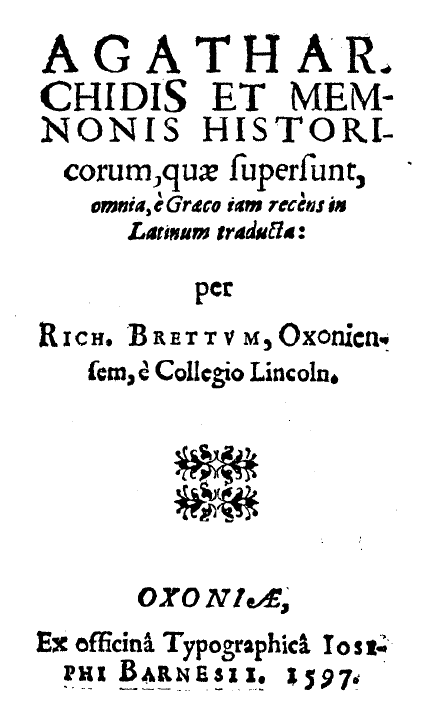
Richard Brett and Ethiopic

There are claims on the internet that Richard Brett (one of the KJV translators) had some knowledge of Ethiopic.  

Oxford University provided the following biography (link to source) in Alumni Oxonienses 1500-1714.

Brett, Richard gent., born in London. Hart Hall, matric. 8 Feb., 1582-3, aged 15; fellow of Lincoln Coll., B.A. 12 Oct., 1586, M.A. 9 July, 1589, licenced to preach 16 July, 1596, B.D. 6 June, 1597, D.D. 13 June, 1605 (son of Robert, of White Stanton, Somerset), rector of Quainton, Bucks, 1595, one of the translators of the Bible 1604, one of the first fellows of Chelsea College 1616, died 15 April, 1637. See Ath., ii. 611; & D.N.B.

There is also a biographical sketch in The Translators Revived: A Biographical Memoir of the Authors of the English Version of the Holy Bible, by Alexander Wilson M'Clure (1853)(link to source).

This reverend clergyman was of a respectable family, and was born at London, in 1567. He entered at Hart Hall, Oxford, where he took his first degree. He was then elected Fellow of Lincoln College, where, by unwearied industry he became very eminent in the languages, divinity, and other branches of science. Having taken his degrees in arts, he became, in 1595, Rector of Quainton in Buckinghamshire, in which benefice he spent his days. He was made Doctor in Divinity in 1605. He was renowned in his time for vast attainments as well as revered for his piety. "He was skilled and versed to a criticism" in the Latin, Greek, Hebrew, Chaldee, Arabic, and Ethiopic tongues. He published a number of erudite works, all in Latin. It is recorded of him, that "he was a most vigilant pastor, a diligent preacher of God's word, a liberal benefactor to the poor, a faithful friend, and a good neighbor." This studious and exemplary minister having attained this exalted reputation died in 1637, at the age of seventy, and lies buried in the chancel of Quainton Church, where he had dispensed the word and ordinances for three and forty years.

Although M'Clure does not seem to cite his source, it appears to come from Henry John Todd''s 1821 "Memoirs of the Life and Writings of the Right Rev. Brian Walton, D.D., Lord Bishop of Chester...with Notices of His Coadjutors in that Illustrious Work...and of the Authorized English Version of the Bible...to which is Added Dr. Walton's Own Vindication of the London Polyglot," which states (p. 117)

Dr. Miles Smith and Dr. Richard Brett, follow; the former so conversant and expert in the Chaldee, Syriac, and Arabic that he made them as familiar to him, almost, as his native tongue; and had Hebrew also at his fingers' ends: the latter, skilled and versed to a criticism in the Latin, Greek, Hebrew, Chaldee, Arabic, and Ethiopic tongues. 

That work also describes (p. 127):

Of similar rank was John Gregory, called the miracle of his age for critical and curious learning; having attained to a learned elegance in English, Latin, and Greek, and to an exact skill in Hebrew, Syriac, Chaldee, Arabic, and Ethiopic.

Thankfully, Todd does cite his source, which is "Athenae Oxonienses. An Exact History of All the Writers and Bishops, who Have Had Their Education in the ... University of Oxford from the Year 1500 to the End of the Year 1690. (etc.)" by Anthonya Wood (1691), vol. 1 (col. 517).  


Note that in this biography, it was not until after he entered University in 1582 and got a degree in Arts that he become a fellow of Lincoln college where, "by the benefit of a good Tutor," he became "eminent in the tongues."  Thus, it seems unlikely that he was in any way involved in assisting Beza for Beza's 1582 edition.

Moreover, the entirety of Richard Brett's published work as it pertains to Ethiopic seems to be the following six words from his 1597 theses (available here):

Although he seems to be using the space (:) and sentence end (::) characters correctly, the orthography of his letters leaves something to be desired.  They definitely look like they are based on Ge'ez characters.

In fact, the first letter of the first word looks like ቸሁባ, which requires an Amharic letter not part of Ge'ez.   

Source:


Richard Brett's translation included a section on the Rhinoceros (see the discussion here), further confirming that "rhinoceros" was not what the KJV translators intended when they wrote "unicorn".


Brett's learning was presumably assisted by Chaldeae seu aethiopicae linguae institutiones: Nunquam antea a Latinis visae, opus utile, ac eruditem ; Item omnium Aethiopiae regum, qui ... usque ad nostra tempora imperarunt, libellus; ex aethiopica translatus lingua by Marianus Vittorio (1552), although it is actually a bit hard to be sure how he studied.  Another source for Brett's learning could be "Institutiones linguae Syriacae, Assyriacae atque Thalmudicae, vnà cum AEthiopicae atque Arabicae collatione. Addita est ad calcem, Noui Testamenti multorum locorum historica enarratio"
by Angelo Canini (1521-1557), which identified Aethiopic as a "dialect" of Hebrew (link to copy)(see the preface).  ("Nam quomodo Graecae linguae dialecti multae ac variae sunt, interse tamen cognatae: sic linguarum peregrinarum fons atque origo est Hebraica, cuius dialecti sunt, Syriaca, Arabica, atque Aethiopica, omnium citra controversiam vetustissimae." which is translated as "For as there are many and varied dialects of the Greek language, yet they are related to each other: so the source and origin of foreign languages is Hebrew, whose dialects are Syriac, Arabic, and Ethiopian, all of them without controversy the most ancient.")

The latter book does have little factoids about Aethiopic, such as that in Ethiopic the vowels aren't separate from the consonants.


The work is also bound with another work, which fascinatingly happens to discuss the name of God:
Interestingly, while this work does not use the exact lettering, "Yahweh," it uses " Ioua" as one of the spellings.

When it comes to the Aethiopic names of God, the author uses Hebrew letters rather than Ge'ez:
Notice Canini's explicit reliance on others to explain the Ethiopic language: 

"Eghzaibher" componitur ex "Eghzia" domino, "Ab" patre, "her" bono: quod est dominus pater bonus: ut illi Aethiopes, qui Romae habitant, interpretantur.

"Eghzaibher" is composed of "Eghzia" meaning lord or master, "Ab" meaning father, and "her" meaning good: which is 'good lord father,' as those Ethiopians who live in Rome interpret it.

This provides further confirmation that, at this time, the Ethiopians living in Rome were the place to go if you wanted someone who could read and understand Ethiopic.

The book is summarized thus:

The entry on John Gregory (Vol. 2, cols. 51-52) is similarly positive:


Thus, John Gregory, the "miracle of his age for critical and curious learning," was born 
November 10, 1607, and thus cannot be viewed as particularly helpful to either Beza or the KJV, despite being quite prodigious in his intellect.

Incidentally, Elias Hutter knew of the existence of the Ethiopian language, as such, and even of some origin myths of the language and people of Ethiopia, as evidenced here:


Another source, Bibliotheca apostolica vaticana a Sixto V. Pont. Max. in splendidiorem, commodioremq. locum translata, et a fratre Angelo Roccha a Camerino ... commentario variarum artium ... illustrata, by Angelo Rocca (1591), describes the conventional knowledge of the subject at that time:


However, there were also exceptions.  Sebastian Münster's "Grammatica Chaldaica" (1527) mis-labels Ge'ez as being Indian, but provides an impressive basic description of the alphabet:

(source, p. 14)
This is followed by a short selection from the Psalter:
(source, p. 16)
Finally, some words are provided by way of example:
(source, p. 17)

It may not be a lot, but it shows a basic familiarity with the language, even before the 1548/9 Ethiopic Bible was printed.  Incidentally, according to the Encyclopedia Britannica, Sebastian Munster was a Hebraist and former Franciscan who became Lutheran around 1529.  His tombstone described him as "the Ezra and the Strabo of the Germans." 

Beza immortalized him in his "Icons" (1580):

And described him thus:

In terms of sources that Beza had access to, here is one that would have given him at least a little information about the Ethiopic language.

Conrad Gessner (1516-1565) in Mithridates (pp. 6-8) noted Munster's work, provided a phonetic transcription of the Lord's prayer, citing the New Testament printed in Rome (i.e. the 1549 Ethiopic), and the Symbol and Confession of Simeon the Just in phonetic spelling, which seems to come from the work of Theodore Bibliandri (1548) (link to source)(see also, p. 6 for a discussion of the language).  Gessner was also directly connected to Beza, and actually appeared as the entry directly after Munster in Icons:

Regarding knowledge of Aethiopic during the 14th through 17th centuries, I found an interesting article by Dejazmatch (ደጃዝማች, Commander or general of the Gate) Zewde Gebre-Sellassie (1926-2008) who was not only a deputy prime minister in Ethiopia, but also earned a PhD from Oxford.  In the 1996 article, Dr. Gebre-Sellassie explains (source - notice the source seems to be an OCR result, and consequently contains numerous typographic errors):

In the middle of the 14th century (1351) some Ethiopians began coming to Rome through the Holy Land and in 1441 during the Council of Florence Abba Niqodimos, the Abbot of the Ethiopian monastery of Jerusalem, is said to have sent a delegation of Ethiopian monks. The number of Ethiopian pilgrims in Rome gradually increased during the papacy of Sisto IV (1471-1484). At that time the Church of Santo Stefano in Vaticano (St Stephen within the wall of the Vatican) and the adjoining hospice were granted by the Pope to the Ethiopian pilgrims. This property remains to this day in their possession, known as San Stefano dei Mon or degli Abissini (St. Stephen of the Abyssinians).

The Ottoman Turks occupied Syria and Palestine in 1516, Egypt in 1517; and Ethiopia was in a turmoil by the Islamic Jihad during the First half of the Sixteenth Century. During this period the Ethiopian monks in Jerusalem were in a desperate situation and many of them joined the different Catholic orders, such as the Franciscans and the Benedictines some of them migrated to Southern Europe, to Austria, Spain and mostly to Italy.

Some of these monks were eminent scholars well versed in Ethiopian languages, history and culture as well as theology and philosophy. Among those who settled at San Stefano in the Vatican, the most outstanding scholars who deserve special mention, are the following: Abba Tomas of Waldiba; Abba Tesfa Tsion Mallizo, who was commonly known in Rome as Pietro Indiano - Peter the Indian; Abba Gorgorios of Mekane Sellassie and, later on during the 19th Century, Debtera Kifle Giorgis.

Abba Tomas of Waldiba, who called himself son of Samuel, after the patron saint and founder of his monastery, was the pioneer in the scholastic endeavor of teaching the Geez alphabet and grammar in Europe. Among his students was the German scholar Johannes Potken, who for the first time printed the Psalms of David in Geez on June 30th, 1513.

Abba Tesfa-Tsion Mallizo, known in Rome as Pietro Indiano (Peter the Indian), is referred to as erudite and full of humility and love. He had published the New Testament in Geez in 1548-1549. He also translated the Anaphora of the Apostles and the Baptismal prayers of the Ethiopian Church into Latin, with the help of two Italian scholars, Paolo Giovo and Pietro Gualtieri who was a polyglot and secretary to the Pope. Subsequently, with the help of Mario Vittorio di Rieti (who later became a bishop of his native region Rieti) he published a grammar of the Geez language and a list of Ethiopian sovereigns. Abba Tesfa Tsion came from Jerusalem to Rome in 1538 and stayed there for twelve years. He died in Tivoli at the age of forty-two in 1550.

Among the well known Europeans who were instructed by the Ethiopian monks were Atanasio Kircher and Jacobus Wemmers, the author of the first Geez or Ethiopic-Latin dictionary during the first half of the 17th century. The Danish scholar Theodor Peter, who edited a number of Ethiopian studies and the Dominican Maria Wansleb, are also credited for considerable achievements.

However, no one has profited and utilized his learning as much as Hiob Ludolf, the German scholar who was instructed by Abba Gorgorios or Gregory of Mekane Sellassie, assisted for translation from Amharic to German by D'Andrade Antonio, son of a Portugese father and an Ethiopian mother. Ludolf's Grammatica Aethiopica (1661), Historia Aethiopica (1681), which was translated into English, French and Dutch; Commentary on the History (1691), Grammatica Linguae Amharicae (1698), and Lexicon Aethiopico - Latinum (1661) became the standard authoritative texts for teaching Ethiopian studies in European universities and centers of learning until Dillmann's monumental works in the nineteenth century published between 1847 and 1894, notably his Lexicon (1865) and Grammar (in 1857 in German, English translation in 1907), as well as the Ethiopian version of the books of Enoch (1851), Jubilees (1859), Ascencion of Isaiah (1877), and the Histories of Arride Tsion and Zera Yacob (1884).

One thing I found particularly notable was that Dr. Gebre-Sellassie believes that Potken not only printed the text but also studied the language under Abba Tomas of Waldiba, suggesting that Potken had some understanding of the language.

Also interesting, while Potken's 1513 Psalter focuses on the Ethiopic itself, it appears that Potken also published a four-language Psalter in 1518, making it easier to compare the Ethiopic with other languages in the Psalms (available here).

The "well known Europeans who were instructed by the Ethiopian monks" include Athanasius Kircher (1602-1680) and Jacobus Wemmers (1598-1645).  Wemmers is credited by Dr. Gebre-Sellassie with creating the first Latin-Ge'ez dictionary.  Meanwhile, Hiob Ludolf is credited with providing definitive works on Ethiopic including an Ethiopic Grammar (1661 - link to 1698 edition, which has the tetragrammaton on the cover page) and Latin-Ethiopic Dictionary (1661).

All this to say that Ethiopic, while not widely familiar to 16th century European scholarship, was certainly more well-known at the time than Chinese to which I compared it in a video.  That said, it would be mistake to think that Ethiopic was a familiar or well-studied language by European scholarship prior to Ludolf's 1660s publications.

Friday, November 17, 2023

Piscator's Comments at Revelation 16:5

Piscator's comments on Revelation 16:5 are of interest to our discussion of Beza's view of the text.  (pp. 821-22 of the 1658 edition - the fourth edition)


Similarly, from the 1613 edition:


5. Angelum aquarum ] Sive angelum illum tertium qui phialam suam effuderat in fontes aquarum : sive alium aliquem angelum cuftodia aquarum prafectum. llle Ens, & ille Erat, & ille Sanctus ] ὁ ὢν καὶ ὁ ἦν καὶ ὁ ὅσιος. Pro, ὅσιος omnino legendum videtur ἐσόμενος, id est, Futurus: si quis consideret rem ipsam & descriptiones Dei similes suprà cap. 1. v. 4. & 8. item cap. 4. v. 8. & cap. 11 vers. 17. ubi pro ἐσόμενος habetur ἐρχόμενος. Cujus rei ratio probabilis affertur hac, quòd illic sermo sit de Deo ut judice venturo hic autem ut de exsequente judicia sua, idꝗ in aternum. Quòd hæc judicasti ] Quòd has plagas, sive hanc plagam (nempe tertiam) bominibus istis immisisti. 

Angelum aquarum ] "The angel of the waters" – Either that third angel who poured out his vial upon the fountains of waters: or some other angel appointed as the guardian of the waters. Ille Ens, & ille Erat, & ille Sanctus ] ὁ ὢν καὶ ὁ ἦν καὶ ὁ ὅσιος. For, ὅσιος it seems that ἐσόμενος should be read, that is, the Future: if one considers the matter itself and similar descriptions of God above in chapter 1, verse 4, & 8. Also chapter 4, verse 8, & chapter 11 verse 17. where for ἐσόμενος is read ἐρχόμενος. The probable reason for this is suggested here, because there the discourse is about God as the coming judge, but here as executing his judgments, and that forever. Quòd hæc judicasti ] "Because you have judged these things" – Because you have sent these plagues, or this plague (namely the third) upon these people.

*** 

I suppose I should add that although Piscator was alive before 1582, and even published at least one book before 1582, there does not seem to be any reason to think that Piscator preceded Beza in coming to this conclusion regarding ἐσόμενος.  The vast majority of his works that were published were published after 1582, from what I can deduce from the PRDL selection (link).  Additionally, according to the Schaff-Herzog Encyclopedia, he seems to have prepared his New Testament commentaries from 1595-1609, and thus after Beza's introduction of the ἐσόμενος substitution.

Tuesday, November 14, 2023

Beza's Sources as it relates to Revelation 16:5

Jan Krans devoted two appendices of Beyond What is Written to the identification of the Greek manuscripts and editions used by Erasmus (Appendix One) and the Manuscripts used in Stephanus' third edition (1550)(Appendix Two).  At p. 206, Krans begins section 8.3 "Beza's Sources" thus:

1. Stephanus' 1551 edition at Revelation 16:5 has (link):


2. Stephanus' 1550 edition at Revelation 16:5 has (link):


3. The Complutensian Polyglot (printed 1514-1517, pub. 1520), referenced by Stephanus' 1550 has (link): 


You will notice that the difference is the inclusion/omission of the word for "Lord."

4. Coline's 1534 Greek NT (also called Colinaeus) is another possible source for Beza (link), although it appears to align with the Erasmus text in Revelation (Krans mentions it briefly at p. 147 in an unrelated section of Beyond What is Written):


6. Aldine 1518 Greek NT is also a possible source for Beza (link), but this appears simply to repeat the Erasmus Greek text, and is somewhat harder to use, in view of the absence of chapter marks.


At p. 207, Krans goes on to identify "Froben's edition" (probably the 1535 edition of Erasmus' NT or Volume VI of the 1540 Opera Omnia) and to "Greek scholia," which refers to Bernardus Donatus' 1532 edition.  

7. Erasmus' 1535 NT (link to page) at Revelation 16:5


8. Erasmus' 1535 Annotations (link to page) at Revelation 1:4


9. Erasmus' 1535 Annotations (link to page) at Revelation 16:5


10. Bernardus Donatus' 1532 edition, (Exegeseis palaiai kai lianophelimoi brachulogian te sapheneian... Expositiones antiquae ac valde vtiles breuitatem vna cum perspicuitate habentes mirabilem, ex diuersis sanctorum patrum commentariis ab Oecumenio et Aretha collectae in hosce noui testamenti tractatus. Oecumenii quidem In Acta Apostolorum. In septem epistolas quae Catholicae dicuntur. In Pauli omnes. Arethae vero In Ioannis Apocalypsim By Oecumenius de Tricca, Donato (aka Bernardus Donatus) · 1532) was one of the sources that Beza relies on.  The edition includes, corresponding to Revelation, a commentary identified as being of Arethas.  Bernardus Donatus' 1532 text from patristic sources including the "Arethas" commentary on the Apocalypse, has (both in the text and the commentary): 


11. Erasmus, Opera Omnia (1540), Vol. 6, New Testament at Revelation 16:5 (p. 421

12. Erasmus, Opera Omnia (1540), Vol. 6, Annotations at Revelation 1:4 (p. 777)


13. Erasmus, Opera Omnia (1540), Vol. 6, Annotations at Revelation 16:5 (p. 781)


Response to Castellio (1563) (Responsio ad defensiones et reprehensiones Sebastiani Castellionis, (etc.) By Theodore de Beze · 1563).  According to Krans (Beyond What is Written, p. 195), Beza aimed to provide a better Latin translation than either Erasmus or Castellio.  Beza's Response to Castellio's work includes an interesting comment on Passover (relevant to the Easter discussion that Nick Sayers and I had):

There were a few places where Revelation came up in the Response, but nothing significant and nothing clearly pertinent to Revelation 16:5.

14. Castellio's Latin Bible (published in Basle by Oporinus in 1551) has  (Testamentum novum, interpr. Sebastiano Castalione, 1551, at Rev. 16:5):

... Iustus es, Domine, qui es, quinque fuisti, quique augustus es, qui haec ita facienda iudicaveris ... 

Beza also relied on editions of Tremelius (Syriac) and Junius (Arabic). Krans, p. 208, says:


15. Tremelius' 1569 (first volume: available here), has the following at Revelation 16:5:


Why is there no Syriac here? Presumably because the Peshitta does not include Revelation.

Junius (who assisted Tremellius and married his daughter) provided comments on Revelation, but they seem to have been published in 1591, and the Greek text seems to follow Beza without additional comment on the textual issue. His Acts of the Apostles translation, however, was available sooner (link to a copy here).

16. David Chytraus (1563). I don't recall Beza specifically mentioning David Chytraus, but he was a notable enough Lutheran (one of the authors of the Formula of Concord) that one would assume that Beza would be interested to read his work. As you can see from the following excerpt from his Revelation commentary Chytraus was viewing the name of God given in Revelation 1:4 as related to YHWH and as involving the past, present, and future.


(Explicatio apocalypsis Johannis perspicua & brevis By David Chyträus · 1563) (see also, Chytraus' Exodus commentary at Exodus 3:14)

Of course, I mention this Lutheran writer as merely one example of a pre-1582 view that is similar to the underlying argument that Beza used.

Beza did have, as Krans acknowledges (p. 208) "a rather large scholarly network." Krans identifies (pp. 208-10 the following scholars as folks that Beza appears to have consulted regarding his New Testament (not specifically Revelation 16:5): Calvin, Joachim Camerarius, Pierre Pithou (who lent him an old manuscript, that Krans thinks is Codex Claramontanus), Patricius Junius, Johannes Grynaeus, Girolamo Zanchi, Meletius Pigas, Johannes Piscator (mentioned in the fourth and fifth edition prefaces), Johannes Drusius (mentioned in the fourth edition preface), Tussanus Berchetus (fifth edition preface), Corenlius Bertram (mentioned in the annotations at Acts 7:14), Matthaeus Beroaldus (Annotations at Acts 13:20), Isaac Casaubon (annotations Mark 5:38). 

Irena Backus, "The Reformed Roots of the English New Testament," pp. 2-3, provides some discussion of Beza's sources, according to Beza himself.  The 1598 edition of Beza contains a dedicatory epistle to Queen Elizabeth I and a preface to the Christian reader.  Backus informus: "in the the epistle Beza says that, as well as referring to the works of his contemporaries and Greek and Latin fathers (all of which he diligently collated), he also had access to an 'exemplar' from the library of Robert Stephanus. This 'exemplar' had been collated by Henri Stephanus (Robert's son) with 'more or less' twenty-five Greek MSS and nearly all the printed versions. Beza says that this 'exemplar' provided the sole source for his minuscule MS variants." (pp. 2-3, endnote omitted) Backus tells us that in the preface to the Christian reader, "Beza is more specific stating that he referred to nineteen ancient MSS." (p. 3).

Backus identifies the first three of Beza's nineteen as being D, D*, and the 'versio Arabica'.  Backus then indicates that Beza's other 16 were the 16 identified by number in Stephanus' edition.


Jacques Lefèvre d'Étaples French New Testament · 1523 (link to page) via a 1600's reproduction, apparently:


Appendix I: Estienne and Textual Criticism

Henri Estienne was not only a printer of the Bible, but of other works as well.  


(Joseph Scaliger, a Study in the History of Classical Scholarship, by Anthony Grafton, pp. 86-97)

As may be gleaned from the above, Estienne has an interest in textual criticism, but not necessarily a bondage to the manuscripts as such, at least not when it came to non-biblical literature, like Aeschylus.

Appendix II: Erasmus' Manuscripts

There are eight "undisputed" manuscripts used by Erasmus.

In addition to these eight, various others have been proposed
("Structure and History of the Biblical Manuscripts Used by Erasmus for His 1516 Edition," p. 84)

("Structure and History of the Biblical Manuscripts Used by Erasmus for His 1516 Edition," p. 85)

I realize it is popular in certain pro-TR circles to speculate that Erasmus had access to and used many other manuscripts beside these, but I think it's worth noting what the study of history has shown so far.

Appendix III:

(Collected Works of Erasmus, vol. 41, Palpable and Unpardonable Solecisms Perpetrated by the Translator, a Few Examples out of a Great Many, pp. 882-3) 

[44] Revelation, chapter 1:4. There is a quite extraordinary solecism in the Greek text ἀπὸ τοῦ ὁ ὢν καὶ ὁ ἦν καὶ ὁ ἐρχόμενος [‘from him who is, and was, and is to come’]. For how can ὁ ὤν be construed with the preceding ἀπό? Second, what possible meaning has ὁ ἦν? Then, how does ὁ ἐρχόμενος square with ἀπὸ τοῦ? Let those who think the Apocalypse was written by John deny, if they will, that the apostles ever spoke bad Greek! For this is the view of certain people, the defenders of the apostles.[FN22]
[FN22] Erasmus held that the apostles learned their Greek from contemporary speech, a form of the language corrupted by popular and vernacular influences. The contrary view, that the apostles were inspired by the Holy Spirit and therefore could not write bad Greek, was expressed, for example, by Eck (Ep 769:69–92), claiming to speak for the majority opinion; cf Translator’s Note to ‘Solecisms’ n3. For the controversy see Ep 844:63–108, and the annotations on Matt 2:6 (et tu Bethlehem) and on Acts 10:38 (quomodo unxit eum); also López Zúñiga Assertio E 3V–F 1r (Rome 1524).