The following is an example of Rome's claim of "unbroken succession" - provided by pope John Paul II:
Nevertheless, the Roman Pontiffs have exercised their authority in Rome and, according to the conditions and opportunities of the times, have done so in wider and even universal areas, by virtue of their succeeding Peter. Written documents do not tell us how this succession occurred in the first link connecting Peter with the series of the bishops of Rome. It can be deduced, however, by considering everything that Pope Clement states in the letter cited above regarding the appointment of the first bishops and their successors. After recalling that the apostles, "preaching in the countryside and the cities, experienced their first fruits in the Spirit and appointed them bishops and deacons of future believers" (42, 4), St. Clement says in detail that, in order to avoid future conflicts regarding the episcopal dignity, the apostles "appointed those whom we said and then ordered that, after they had died, other proven men would succeed them in their ministry" (44, 2). The historical and canonical means by which that inheritance is passed on to them can change, and have indeed changed. But over the centuries, an unbroken chain links that transition from Peter to his first successor in the Roman See.
(
link)
This is a typical claim we hear from Roman Catholics all the time. It sounds great - but is either simply untrue, or totally meaningless. Before we get to the claim itself, look at the wind-up for the claim.
John Paul 2 asserts: "
The historical and canonical means by which that inheritance is passed on to them can change, and have indeed changed." Let's be blunt, the reason he thinks it "can change," is the fact that way by which Roman bishops have been appointed
has been repeatedly changed. There's no Biblical teaching that the way by which bishops are appointed can change. In fact, if the way by which Roman bishops
hadn't changed over the years, we'd probably be told that it was an apostolic tradition that cannot be changed. That's simply an artifact of not having a single, written rule of faith.
But that's only a small part of the reason why the "unbroken chain" claim is bogus. In other words, the fact that they pick bishops today in a way that is different from 100 years ago or 1000 years ago, each of which is different from what is now (100 years ago, there was not an age limit for voting cardinals, and 1000 years ago, there was no college of cardinals) is only one aspect. That's the aspect of the mode of succession. The mode has been broken. Roman bishops are not appointed the way they used to be - and consequently when we hear about an "unbroken chain," it cannot mean that the mechanism of succession itself is unbroken.
Another aspect, and perhaps a bigger one, is the problem of what it would take to make the chain "broken."
Is it time? Ask your Roman Catholic friends (and they are welcome to answer here) how much of a gap would constitute a break. The current way of picking new bishops of Rome necessarily involves there being gaps between the reign of popes. It's not like the British monarchy, where as soon as one monarch dies, a new monarch is automatically apparent because of the rules of hereditary succession.
Thus, there are always gaps and breaks in the chain. There was a time period that elapsed between the death of John Paul II and the election of Joseph Ratzinger (who became known as Benedict XVI).
But there is no actual standard of what gap of time is acceptable, and what gap would break succession. Thus, it is simply impossible to say what gap is acceptable. For example, according to a typical list of popes (
example) there was no pope during the whole years 259, 305-307, 639, 1242, 1269-1270, 1293, 1315, and 1416, not to mention the many partial years. That's over a half dozen breaks of over a year.
Being deposed? Benedict IX was deposed twice and restored. His biography states:
The nephew of his two immediate predecessors, Benedict IX was a man of very different character to either of them. He was a disgrace to the Chair of Peter. Regarding it as a sort of heirloom, his father Alberic placed him upon it when a mere youth ... .
It goes on to relate:
Taking advantage of the dissolute life he was leading, one of the factions in the city drove him from it (1044) amid the greatest disorder, and elected an antipope (Sylvester III) in the person of John, Bishop of Sabina (1045 -Ann. Romani, init. Victor, Dialogi, III, init.). Benedict, however, succeeded in expelling Sylvester the same year; but, as some say, that he might marry, he resigned his office into the hands of the Archpriest John Gratian for a large sum. John was then elected pope and became Gregory VI (May, 1045). Repenting of his bargain, Benedict endeavoured to depose Gregory. This resulted in the intervention of King Henry III. Benedict, Sylvester, and Gregory were deposed at the Council of Sutri (1046) and a German bishop (Suidger) became Pope Clement II. After his speedy demise, Benedict again seized Rome (November, 1047), but was driven from it to make way for a second German pope, Damasus II (November, 1048).
(
source for biography)
Being outrageously sinful? Alexander VI was another pope who allegedly obtained his position through simony, but that's not perhaps the worst of it. He not only openly acknowledged his children (yes, of course he was not married), but even used his political strength to try either to benefit or exploit them. A very favorable Roman biography of him touches on the matter in this delicate way:
Notwithstanding these and similar actions, which might seem to entitle him to no mean place in the annals of the papacy, Alexander continued as Pope the manner of life that had disgraced his cardinalate (Pastor, op. cit., III, 449 152). A stern Nemesis pursued him till death in the shape of a strong parental affection for his children.
It goes on to say:
An impartial appreciation of the career of this extraordinary person must at once distinguish between the man and the office. "An imperfect setting", says Dr. Pastor (op. cit., III, 475), "does not affect the intrinsic worth of the jewel, nor does the golden coin lose its value when it passes through impure hands. In so far as the priest is a public officer of a holy Church, a blameless life is expected from him, both because he is by his office the model of virtue to whom the laity look up, and because his life, when virtuous, inspires in onlookers respect for the society of which he is an ornament. But the treasures of the Church, her Divine character, her holiness, Divine revelation, the grace of God, spiritual authority, it is well known, are not dependent on the moral character of the agents and officers of the Church. The foremost of her priests cannot diminish by an iota the intrinsic value of the spiritual treasures confided to him." There have been at all times wicked men in the ecclesiastical ranks. Our Lord foretold, as one of its severest trials, the presence in His Church not only of false brethren, but of rulers who would offend, by various forms of selfishness, both the children of the household and "those who are without". Similarly, He compared His beloved spouse, the Church, to a threshing floor, on which fall both chaff and grain until the time of separation. The most severe arraignments of Alexander, because in a sense official, are those of his Catholic contemporaries, Pope Julius II (Gregorovius, VII, 494) and the Augustinian cardinal and reformer, Aegidius of Viterbo, in his manuscript "Historia XX Saeculorum", preserved at Rome in the Bibliotheca Angelica. The Oratorian Raynaldus (d. 1677), who continued the semi-official Annals of Baronius, gave to the world at Rome (ad an. 1460, no. 41) the above-mentioned paternal but severe reproof of the youthful Cardinal by Pius II, and stated elsewhere (ad an. 1495, no. 26) that it was in his time the opinion of historians that Alexander had obtained the papacy partly through money and partly through promises and the persuasion that he would not interfere with the lives of his electors. Mansi, the scholarly Archbishop of Lucca editor and annotator of Raynaldus, says (XI, 4155) that it is easier to keep silence than to write write moderation about this Pope. The severe judgment of the late Cardinal Hergenröther, in his "Kirchengeschichte", or Manual of Church History (4th. ed., Freiburg, 1904, II, 982-983) is too well known to need more than mention.
So little have Catholic historians defended him that in the middle of the nineteenth century Cesare Cantù could write that Alexander VI was the only Pope who had never found an apologist.
(
source for biography)
Being a heretic? Honorius I was condemned as a monophosite heretic by centuries of Roman bishops. (
see the linked article)
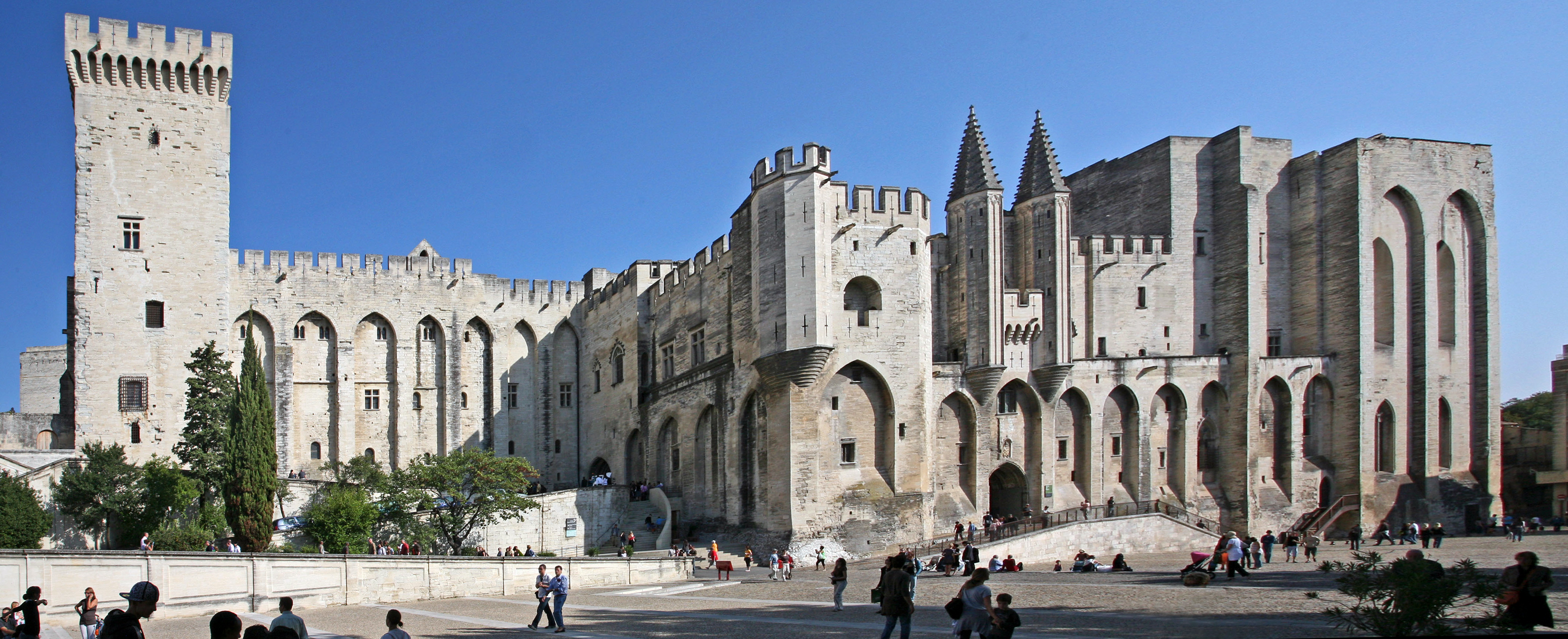
Leaving Rome? For about 70 years (and seven popes), the seat of the papacy was not in Rome but in
Avignon, France (
see the linked article).
Needing an Ecumenical Council to Jump-Start it? Among the tasks of the Council of Constance (considered the 15th Ecumenical Council by the Roman church) was to, in effect, decide who got to be pope, thereby ending a three-way dispute that had been on-going (
link to discussion of council from a Roman Catholic perspective).
How much more broken could it really get? I guess the things above could have happened more often or for longer periods of time - but is that really the appropriate measure of things? I think the short answer is that the claim of an "unbroken chain" of succession is just hot air - an empty claim supported by nothing but the wishful thinking of those who support Rome.
-TurretinFan