
In a recent livestream ("Josephus Does Not Give a Canon"), Gary Michuta argued that a famous quotation from Against Apion, usually cited in discussions of Josephus' canon, is misleading because it is based on an interpolated Greek text (via Eusebius) and because it includes a further unjustified gloss provided by the most popular translator of Josephus. Even assuming Michuta is right about the Greek text of Josephus' work and the gloss by an 18th century translator, Josephus still is referring to a closed canon of Scripture, and the citation stands.
Michuta even goes so far as to claim (source), "If you're a defender of the faith, guys, this is a silver bullet for you. You can refute probably 99% of non-Catholic apologists who are appealing to Josephus, just by this one move I'm going to show you."
It's certainly possible that many non-Roman-Catholic apologists will not be ready for Michuta's argument. In that very limited way, it could prevail. Likewise, it's certainly possible that if someone has not read anything except the two or three lines mentioned in the video, they might think that the citation has been "debunked" or the like. However, once we dig in, we see that the silver bullet ricochets harmlessly off the truth.
And it is the truth that is most important. Michuta has identified some potential problems. We should not ignore them, but instead we should address them head on.
The allegedly misleading translation, based on the allegedly interpolated Greek text, is as follows (source) Against Apion, Book I, sections 6-8 (Michuta gives credit to William Whiston for this translation and to Siwart Haverkamp for the Greek):
6. As to the care of writing down the records from the earliest antiquity among the Egyptians, and Babylonians; that the priests were entrusted therewith, and employed a philosophical concern about it; that they were the Chaldean priests that did so among the Babylonians; and that the Phoenicians, who were mingled among the Greeks, did especially make use of their letters, both for the common affairs of life, and for the delivering down the history of common transactions; I think I may omit any proof: because all men allow it so to be. But now as to our forefathers, that they took no less care about writing such records: (for I will not say they took greater care than the others I spoke of:) and that they committed that matter to their High-priests, and to their Prophets; and that these records have been written all along down to our own times, with the utmost accuracy; nay if it be not too bold for me to say it, our history will be so written hereafter; I shall endeavor briefly to inform you.
7. For our forefathers did not only appoint the best of these priests, and those that attended upon the divine worship, for that design, from the beginning; but made provision that the stock of the priests should continue unmixed, and pure. For he who is partaker of the priesthood, must propagate of a wife of the same nation; without having any regard to money, or any other dignities: but he is to make a scrutiny, and take his wife’s genealogy from the ancient tables; and procure many witnesses to it. And this is our practice, not only in Judea; but wheresoever any body of men of our nation do live: and even there an exact catalogue of our priests marriages is kept: I mean at Egypt and at Babylon; or in any other place of the rest of the habitable earth, whithersoever our priests are scattered. For they send to Jerusalem the ancient names of their parents in writing, as well as those of their remoter ancestors: and signify who are the witnesses also. But if any war falls out, such as have fallen out a great many of them already, when Antiochus Epiphanes made an invasion upon our country: as also when Pompey the great, and Quintilius Varus did so also: and principally in the wars that have happened in our own times: those priests that survive them compose new tables of genealogy, out of the old records, and examine the circumstances of the women that remain. For still they do not admit of those that have been captives; as suspecting that they have had conversation with some foreigners. But what is the strongest argument of our exact management in this matter is what I am now going to say; that we have the names of our High priests from father to son set down in our records, for the interval of two thousand years. And if any of these have been transgressors of these rules, they are prohibited to present themselves at the altar, or to be partakers of any other of our purifications. And this is justly, or rather necessarily done: because every one is not permitted of his own accord to be a writer; nor is there any disagreement in what is written. They being only prophets that have written the original and eldest accounts of things, as they learned them of God himself, by inspiration: and others have written what hath happened in their own times, and that in a very distinct manner also.
8. For we have not an innumerable multitude of books among us, disagreeing from, and contradicting one another: [as the Greeks have:] but only twenty two books: which contain the records of all the past times: which are justly believed to be divine. And of them five belong to Moses: which contain his laws, and the traditions of the origin of mankind, till his death. This interval of time was little short of three thousand years. But as to the time from the death of Moses, till the reign of Artaxerxes, King of Persia, who reigned after Xerxes, the Prophets, who were after Moses, wrote down what was done in their times, in thirteen books. The remaining four books contain hymns to God; and precepts for the conduct of human life. ’Tis true, our history hath been written since Artaxerxes very particularly; but hath not been esteemed of the like authority with the former by our forefathers; because there hath not been an exact succession of Prophets since that time. And how firmly we have given credit to these books of our own nation, is evident by what we do. For during so many ages as have already passed, no one has been so bold, as either to add any thing to them; to take any thing from them; or to make any change in them. But it is become natural to all Jews, immediately, and from their very birth, to esteem these books to contain divine doctrines; and to persist in them: and, if occasion be, willingly to die for them. For ’tis no new thing for our captives, many of them in number, and frequently in time, to be seen to endure wracks, and deaths of all kinds, upon the theatres; that they may not be obliged to say one word against our laws, and the records that contain them. Whereas there are none at all among the Greeks who would undergo the least harm on that account: no nor in case all the writings that are among them were to be destroyed. For they take them to be such discourses as are framed agreeably to the inclinations of those that write them. And they have justly the same opinion of the elder writers: since they see some of the present generation bold enough to write about such affairs, wherein they were not present; nor had concern enough to inform themselves about them from those that knew them. Examples of which may be had in this late war of ours: where some persons have written histories, and published them, without having been in the places concerned; or having been near them when the actions were done: but these men put a few things together, by hearsay; and insolently abuse the world; and call these writings by the name of Histories.
I have provided the full section with surrounding context, rather than the shorter portion Michuta offered in his video, for a couple of reasons. Most obviously, you (dear Reader) and I don't have the same time constraints in a blog post that Michuta has in a video. Also, in this case, the context matters. The portion that Michuta initially quoted was just this: "For we have not an innumerable multitude of books among us, disagreeing from, and contradicting one another: [as the Greeks have:] but only twenty two books: which contain the records of all the past times: which are justly believed to be divine."
According to Michuta, "which are just believed to be divine," is a valid translation of a Greek text but that the Greek text itself is not supported by any of the manuscripts of Josephus' Against Apion, but only by the quotation found in Eusebius. Michuta believes that either Eusebius, or someone who was copying Eusebius' manuscript, must have inserted the Greek word Theon. Michuta argues that although the most popular translation of the text has "divine" here, it is not original to Josephus.
Likewise, according to Michuta, the second highlighted portion, which says "by our forefathers" has inserted the reference to the forefathers without any corresponding Greek text, as a gloss on the sense of the text, but not actually something found in Josephus' Greek.
Admittedly, I am not addressing Michuta's textual critical claims about Josephus, because I don't think it's necessary to do so. Henry St. John Thackeray (1869–1930) provided an updated translation of Josephus in the early 1900s.
Thackery's translation (available here) of the section in question is this:
(6) Of the care bestowed by the Egyptians and Babylonians on their chronicles from the remotest ages, and how the charge and exposition of these was entrusted, in the former country to the priests, in the latter to the Chaldaeans ; and how, among the nations in touch with the Greeks, it was the Phoenicians who made the largest use of writing, both for the ordinary affairs of life and for the commemoration of public events ; of all this I think I need say nothing, as the facts are universally admitted. But that our forefathers took no less, not to say even greater, care than the nations I have mentioned in the keeping of their records—a task which they assigned to their chief priests and prophets—and that down to our own times these records have been, and if I may venture to say so, will continue to be, preserved with scrupulous accuracy, I will now endeavour briefly to demonstrate.
(7) Not only did our ancestors in the first instance set over this business men of the highest character, devoted to the service of God, but they took precautions to ensure that the priests' lineage should be kept unadulterated and pure. A member of the priestly order must, to beget a family, marry a woman of his own race, without regard to her wealth or other distinctions ; but he must investigate her pedigree, obtaining the genealogy from the archives and producing a number of witnesses. And this practice of ours is not confined to the home country of Judaea, but wherever there is a Jewish colony, there too a strict account is kept by the priests of their marriages ; I allude to the Jews in Egypt and Babylon and other parts of the world in which any of the priestly order are living in dispersion. A statement is drawn up by them and sent to Jerusalem, showing the names of the bride and her father and more remote ancestors, together with the names of the witnesses. In the not infrequent event of war, for instance when our country was invaded by Antiochus Epiphanes, by Pompey the Great, by Quintilius Varus, and above all in our own times, the surviving priests compile fresh records from the archives ; they also pass scrutiny upon the remaining women, and disallow marriage with any who have been taken captive, suspecting them of having had frequent intercourse with foreigners. But the most convincing proof of our accuracy in this matter is that our records contain the names of our high priests, with the succession from father to son for the last two thousand years. And whoever violates any of the above rules is forbidden to minister at the altars or to take any other part in divine worship.
It therefore naturally, or rather necessarily, follows (seeing that with us it is not open to everybody to write the records, and that there is no discrepancy in what is written ; seeing that, on the contrary, the prophets alone had this privilege, obtaining their knowledge of the most remote and ancient history through the inspiration which they owed to God, and committing to writing a clear account of the events of their own time just as they occurred)—it follows, I say, that (8) we do not possess myriads of inconsistent books, conflicting with each other. Our books, those which are justly accredited, are but two and twenty, and contain the record of all time.
Of these, five are the books of Moses, comprising the laws and the traditional history from the birth of man down to the death of the lawgiver. This period falls only a little short of three thousand years. From the death of Moses until Artaxerxes, who succeeded Xerxes as king of Persia, the prophets subsequent to Moses wrote the history of the events of their own times in thirteen books. The remaining four books contain hymns to God and precepts for the conduct of human life.
From Artaxerxes to our own time the complete history has been written, but has not been deemed worthy of equal credit with the earlier records, because of the failure of the exact succession of the prophets.We have given practical proof of our reverence for our own Scriptures. For, although such long ages have now passed, no one has ventured either to add, or to remove, or to alter a syllable ; and it is an instinct with every Jew, from the day of his birth, to regard them as the decrees of God, to abide by them, and, if need be, cheerfully to die for them. Time and again ere now the sight has been witnessed of prisoners enduring tortures and death in every form in the theatres, rather than utter a single word against the laws and the allied documents.What Greek would endure as much for the same cause ? Even to save the entire collection of his nation's writings from destruction he would not face the smallest personal injury. For to the Greeks they are mere stories improvised according to the fancy of their authors ; and in this estimate even of the older historians they are quite justified, when they see some of their own contemporaries venturing to describe events in which they bore no part, without taking the trouble to seek information from those who know the facts. We have actually had so-called histories even of our recent war published by persons who never visited the sites nor were anywhere near the actions described, but, having put together a few hearsay reports, have, with the gross impudence of drunken revellers, miscalled their productions by the name of history.
The relevant portion, you can see, does not include the word "divine" nor "forefathers": "Our books, those which are justly accredited, are but two and twenty, and contain the record of all time." ... "with the earlier records."
Michuta suggests that we should look at the work of the very recent Brill series (Michuta oddly refers to the editor, Steve Mason, rather than to the translator, John M.G. Barclay, although his slide is correct - perhaps Michuta was a just a bit tired when presenting, he mentioned it was around 3 or 4 am for him). John M.G. Barclay has provided what is asserted by Brill to be "a fresh English translation ... based on new textual research conducted by the Münster Josephus project." (source) Published in 2006, it benefits from an additional century of scholarship compared to Thackery. Barclay's translation offers this (pp. 28-30):
Naturally, then, or rather necessarily-- seeing that it is not open to anyone to write of their own accord, nor is there any disagreement present in what is written, but the prophets alone learned, by inspiration from God, what had happened in the distant and most ancient past and recorded plainly events in their own time just as they occurred--(1.8) among us there are not thousands of books in disagreement and conflict with each other, but only twenty-two books, containing the record of all time, which are rightly trusted. Five of these are the books of Moses, which contain both the laws and the tradition from the birth of humanity up to his death; this is a period of a little less than 3,000 years. From the death of Moses until Artaxerxes, king of the Persians after Xerxes, the prophets after Moses wrote the history of what took place in their own times in thirteen books; the remaining four books contain hymns to God and instructions for people on life. From Artaxerxes up to our own time every event has been recorded, but this is not judged worthy of the same trust, since exact line of succession of the prophets did not continue.
If you're wondering how such few lines could occupy three pages of the book, it's because about 80% of each page is commentary, with only about 6 lines of text per page.
Coming back to Michuta's claims, you will notice that both Thackery and Barclay omit "divine" and "forefathers." On the other hand, while Michuta claims that those words are responsible for misleading people into thinking this is a canon list, Barclay demonstrates otherwise.
Michuta says (source): "My assertion is, Josephus doesn't give a canon. In fact, I believe his twenty-two books that he gives in his work, Against Apion, actually isn't a canon at all. It is just a list of histories that are the most credible."
What Michuta overlooks, however, are several contextual clues. First, these are books with respect to which the Jews are not willing to add, remove, or change even a syllable. Second, there are "only" twenty-two books. Third, these are books written by prophets and maintained by prophets and priests. Fourth, these are books that Jews regard as "the decrees of God" and for which they are willing to die.
Picking Barclay's translation (for example), notice that the reason Josephus provides for the distinction between the twenty-two books (going from Creation to Artexerxes) and the remaining books is the absence of succession of prophets. Notice as well that Josephus includes four books of "hymns to God and instructions for people on life," which are not presented as being "historical" books.
Michuta argues that a canon list should identify the contents of the canon. Josephus does so in two ways: (1) by a general outline of the nature of the books; and (2) by a concluding date to the books. With respect to the first five, he also gives a specific author.
We don't need to latch on to the words "divine" and "fore-fathers" to conclude as we do.
Michuta should know this. After all, he not only screenshot Barclay's translation, but also footnote 158, which mentions that the word "divine" may be a Christian modification. Even if he had read only that footnote, he should have seen what it said, considering that he even highlighted it in his slide, namely: "anticipating the claim made in 1.42." This refers to the claim by Josephus that these books are regarded as "decrees of God."
Footnote 156, on the same page as footnote 158, has the following to say:

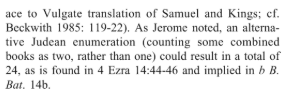
Notice that Barclay explains: "They are not characterized here as "sacred" (cf. 1.1, 54, 127), but they are clearly distinguished from other and subsequent literature (1.41), and to this extent Josephus' canon is clearly "closed" (even if the contents of these books and their textual form may have been subject to dispute); so rightly Beckwith 1985: 78-80; Mason 2002:110-27."
From my point of view, Michuta's characterization of the issue is misleading at best. While it is certainly possible that Eusebius' Greek and Whiston's English gloss may not be a woodenly literal representation of Josephus' original, even without those influences, it should be readily important that Josephus is referring to the canonical Scriptures.
Footnotes 166-67 on the next page, further underscore my point that Barclay himself sees the same thing in Josephus:


Note that Barclay is right to emphasize the fact that Josephus' motivation is to provide a low number of books. If he just meant to point to the reliable Old Testament histories, why bring in the number twenty-two in the first place? Particularly, why bring in that number when it includes the Psalms and Proverbs? The intuitively correct answer is that Josephus is appealing to an existing canon that is extrinsic to himself. This is not a list he just made up. The same explains why Josephus does not feel the need to provide the name for each book: just as people of his day knew what the names of the five books of Moses were, so also they knew which constituted the twenty-two books.
Ultimately, I fear that Michuta's video is likely to be misleading to Roman Catholic apologists who will boldly claim that Josephus didn't provide a canon or that such a view is based on a mistranslation of a faulty text. While such misleading claims may benefit my side in the sense that they can be debunked and we can demonstrate the veracity of our claims and the weakness of theirs, ultimately I think it is better for folks like Michuta to be more circumspect in their claims and analysis, to avoid misleading the next generation of apologists.
A brief postlude. There still remains the enigmatic question of which books Josephus did intend to be included in the twenty-two. Barclay provides his thoughts in footnote 165:


