Showing posts with label Irenaeus. Show all posts

Friday, October 06, 2023

Earliest Interpretations of Revelation 12 and the Woman of Revelation 12

The four earliest (that I could find so far) interpretations of Revelation 12 either state or imply that the woman of Revelation 12 is not Mary.  Irenaeus, for example, treats the dragon's attack as a still-future event, implying that the woman is not Mary.

Hippolytus, Methodius, and Victorinus are more explicit in identifying the woman as the Church.

Irenaeus (130-202), Against Heresies, Book II, Chapter XXI:

But they are altogether full of deceit of every kind, apostate inspiration, demoniacal working, and the phantasms of idolatry, and are in reality the predecessors of that dragon [Rev. xii. 14.] who, by means of a deception of the same kind, will with his tail cause a third part of the stars to fall from their place, and will cast them down to the earth.

Hippolytus (170-235),  Treatise on Christ and Antichrist: (previously discussed here)

60. Now, concerning the tribulation of the persecution which is to fall upon the Church from the adversary, John also speaks thus: And I saw a great and wondrous sign in heaven; a woman clothed with the sun, and the moon under her feet, and upon her head a crown of twelve stars. And she, being with child, cries, travailing in birth, and pained to be delivered. And the dragon stood before the woman which was ready to be delivered, for to devour her child as soon as it was born. And she brought forth a man-child, who is to rule all the nations: and the child was caught up unto God and to His throne. And the woman fled into the wilderness, where she has the place prepared of God, that they should feed her there a thousand two hundred and threescore days. And then when the dragon saw it, he persecuted the woman which brought forth the man- child. And to the woman were given two wings of the great eagle, that she might fly into the wilderness, where she is nourished for a time, and times, and half a time, from the face of the serpent. And the serpent cast (out of his mouth water as a flood after the woman, that he might cause her to be carried away of the flood. And the earth helped the woman, and opened her mouth, and swallowed up the flood which the dragon cast) out of his mouth. And the dragon was angry with the woman, and went to make war with the saints of her seed, which keep the commandments of God, and have the testimony of Jesus.

61. By the woman then clothed with the sun, he meant most manifestly the Church, endued with the Father's word, whose brightness is above the sun. And by the moon under her feet he referred to her being adorned, like the moon, with heavenly glory. And the words, upon her head a crown of twelve stars, refer to the twelve apostles by whom the Church was founded. And those, she, being with child, cries, travailing in birth, and pained to be delivered, mean that the Church will not cease to bear from her heart the Word that is persecuted by the unbelieving in the world. And she brought forth, he says, a man-child, who is to rule all the nations; by which is meant that the Church, always bringing forth Christ, the perfect man-child of God, who is declared to be God and man, becomes the instructor of all the nations. And the words, her child was caught up unto God and to His throne, signify that he who is always born of her is a heavenly king, and not an earthly; even as David also declared of old when he said, The Lord said to my Lord, Sit at my right hand, until I make Your enemies Your footstool. And the dragon, he says, saw and persecuted the woman which brought forth the man- child. And to the woman were given two wings of the great eagle, that she might fly into the wilderness, where she is nourished for a time, and times, and half a time, from the face of the serpent. That refers to the one thousand two hundred and threescore days (the half of the week) during which the tyrant is to reign and persecute the Church, which flees from city to city, and seeks conceal-meat in the wilderness among the mountains, possessed of no other defense than the two wings of the great eagle, that is to say, the faith of Jesus Christ, who, in stretching forth His holy hands on the holy tree, unfolded two wings, the right and the left, and called to Him all who believed upon Him, and covered them as a hen her chickens. For by the mouth of Malachi also He speaks thus: And unto you that fear my name shall the Sun of righteousness arise with healing in His wings. 

Methodius of Olympus (250-311) Banquet of the Ten Virgins, Discourse 8, Chapters 4-8 (previously discussed here in more detail) says that the woman is the Church.

The woman who appeared in heaven clothed with the sun, and crowned with twelve stars, and having the moon for her footstool, and being with child, and travailing in birth, is certainly, according to the accurate interpretation, our mother, O virgins, being a power by herself distinct from her children; whom the prophets, according to the aspect of their subjects, have called sometimes Jerusalem, sometimes a Bride, sometimes Mount Zion, and sometimes the Temple and Tabernacle of God. For she is the power which is desired to give light in the prophet, the Spirit crying to her: Isaiah 60:1-4 Arise, shine; for your light has come, and the glory of the Lord is risen upon you. For, behold, the darkness shall cover the earth, and gross darkness the people: but the Lord shall arise upon you, and His glory shall be seen upon you. And the Gentiles shall come to your light, and kings to the brightness of your rising. Lift up your eyes round about, and see; all they gather themselves together, they come to you: your sons shall come from far, and your daughters shall be nursed at your sideIt is the Church whose children shall come to her with all speed after the resurrection, running to her from all quarters. She rejoices receiving the light which never goes down, and clothed with the brightness of the Word as with a robe. For with what other more precious or honorable ornament was it becoming that the queen should be adorned, to be led as a Bride to the Lord, when she had received a garment of light, and therefore was called by the Father? Come, then, let us go forward in our discourse, and look upon this marvelous woman as upon virgins prepared for a marriage, pure and undefiled, perfect and radiating a permanent beauty, wanting nothing of the brightness of light; and instead of a dress, clothed with light itself; and instead of precious stones, her head adorned with shining stars. For instead of the clothing which we have, she had light; and for gold and brilliant stones, she had stars; but stars not such as those which are set in the invisible heaven, but better and more resplendent, so that those may rather be considered as their images and likenesses.

Victorinus of Pettau (250-303) Commentary on the Apocalypse (previously discussed here) says that the woman is "the ancient Church of the fathers, and prophets, and saints, and apostles."

11:19. And the temple of God was opened which is in heaven. The temple opened is a manifestation of our Lord. For the temple of God is the Son, as He Himself says: Destroy this temple, and in three days I will raise it up. And when the Jews said, Forty and six years was this temple in building, the evangelist says, He spoke of the temple of His body.

And there was seen in His temple the ark of the Lord's testament. The preaching of the Gospel and the forgiveness of sins, and all the gifts whatever that came with Him, he says, appeared therein.

12:1. And there was seen a great sign in heaven. A woman clothed with the sun, and the moon under her feet, and on her head a crown of twelve stars. And being with child, she cried out travailing, and bearing torments that she might bring forthThe woman clothed with the sun, and having the moon under her feet, and wearing a crown of twelve stars upon her head, and travailing in her pains, is the ancient Church of fathers, and prophets, and saints, and apostles, which had the groans and torments of its longing until it saw that Christ, the fruit of its people according to the flesh long promised to it, had taken flesh out of the selfsame people. Moreover, being clothed with the sun intimates the hope of resurrection and the glory of the promise. And the moon intimates the fall of the bodies of the saints under the obligation of death, which never can fail. For even as life is diminished, so also it is increased. Nor is the hope of those that sleep extinguished absolutely, as some think, but they have in their darkness a light such as the moon. And the crown of twelve stars signifies the choir of fathers, according to the fleshly birth, of whom Christ was to take flesh.


Friday, August 12, 2022

Irenaeus and the Manichaeans?

Dr. Kenneth Wilson is a contributor to the critique of Calvinism that I'm currently reviewing.  I'm not up to Wilson's chapter yet in my review, but Thuyen Tran called my attention to a rather glaring error in his chapter/article of the book, and an indication that this was not the first time this error had been seen from Wilson.  The error identified was related to a claim by Wilson regarding Irenaeus and the Manichaeans.

In an interview video that Dr. Leighton Flowers posted on February 26, 2019 (link to a few seconds before relevant point of video), Wilson made an interesting claim:

LF: Now did you, in your preparations, did you read through many of these other early church fathers as well?

KW: I did.  I have many chapters in my dissertation discussing their views, all talking about original sin, about freedom of will, and the earliest Christians - those guys you just mentioned - Irenaeus, Tertullian and Clement - they're all arguing against Stoics, and against Manichaeans and Gnostics. 

Manichaeans were followers of Mani, a 3rd century Persian, who was born around 216 and died around 276.  Tertullian died around 220.  Irenaeus died around 202. Clement of Rome is believed to have died around 100, while Clement of Alexandria died around 215.  None of them had any interaction with Mani or Mani's followers or Manichaeism.

By itself, this off-hand response during a video interview is not particularly troubling.  People make slips of the tongue all the time, and while the listed early Christians didn't interact with Mani, they did interact with other heretical, quasi-Christian, and non-Christian groups.

More troubling, though, was the following assertion Wilson makes in the critique to Calvinism edited by Allen and Lemke, and published by B&H academic:

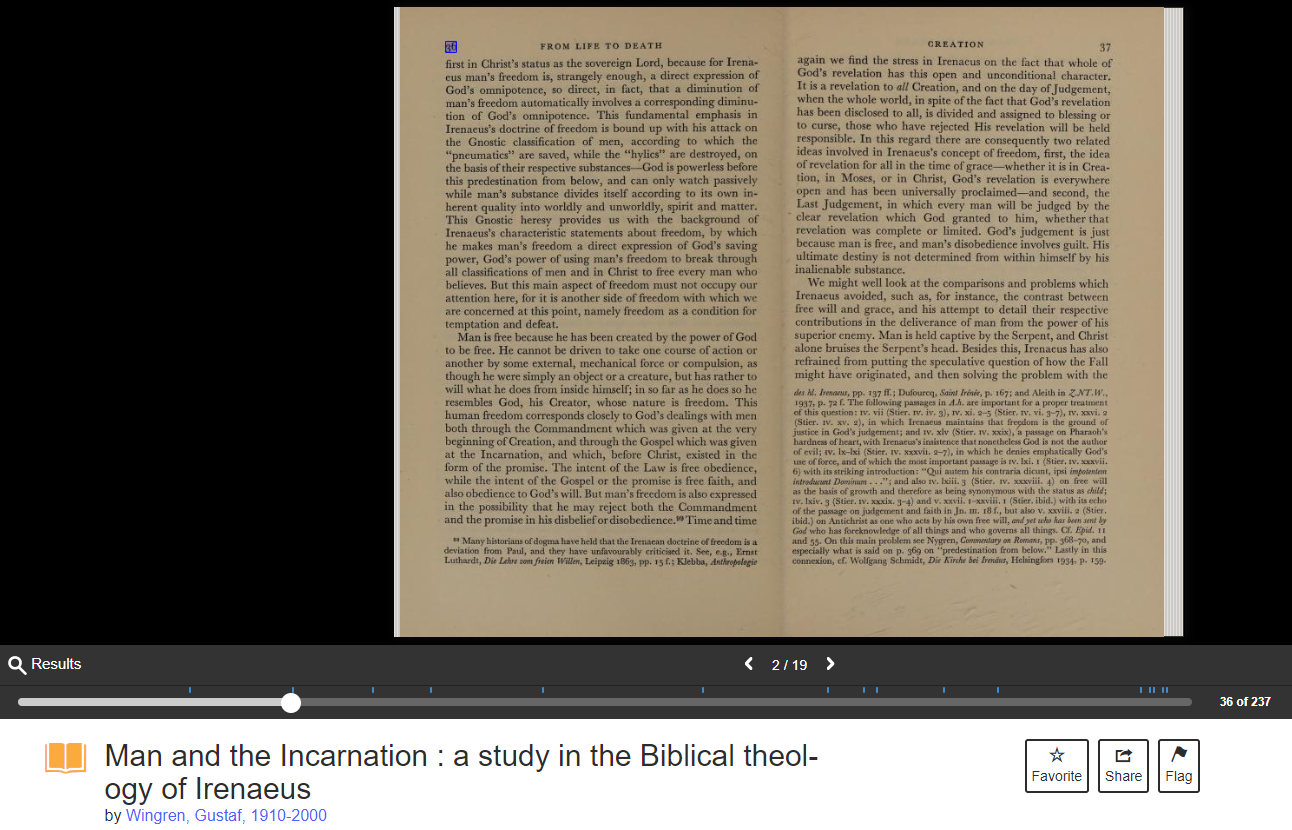
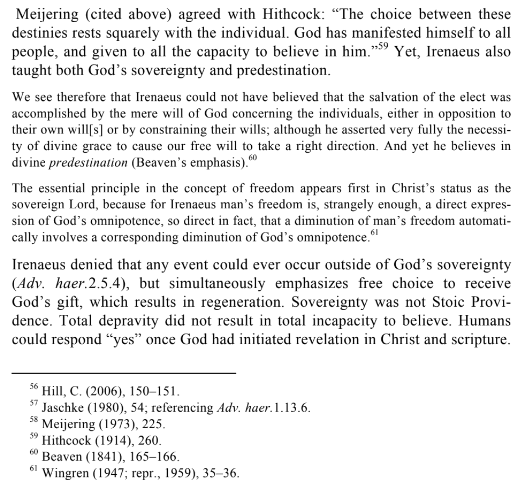
For example, Irenaeus (ca. AD 180) had argued that the Manichaean god was puny because he could only achieve his goals by micromanaging all events and persons. In contrast, the Christian God allowed humanity freedom, yet was so powerful he could still accomplish his plans.  It requires a more omnipotent and sovereign God to allow human freedom. "The essential principle in the concept of freedom appears first in Christ's status as the sovereign Lord, because for Irenaeus man's freedom is, strangely enough, a direct expression of God's omnipotence, so direct in fact, that a diminution of man's freedom automatically involves a corresponding diminution of God's omnipotence." (FN17 Gustaf Wingren ... Man and the Incarnation ... pp. 36-37)

One reason this is troubling because obviously Irenaeus was not responding to Mani or the Manichaean god.  He correctly notes the approximate date of Irenaeus's Against Heresies.  On the other hand, he did not seem to recognize that this was almost a century before the rise of Mani's religion.

Another reason this is troubling is that it is not a correct analysis of Irenaeus.  Obviously, interpretations of Irenaeus differ, but even Wilson's source, Wingren, acknowledges that the position that Irenaeus was responding to was not one of divine micromanagement, but exactly the opposite.

Wingren states, in the sentence immediately following that quoted by Wilson: 

This fundamental emphasis in Irenaeus's doctrine of freedom is bound up with his attack on the Gnostic classification of men, according to which the "pneumatics" are saved, while the "hylics" are destroyed, on the basis of their respective substances--God is powerless before this predestination from below, and can only watch passively while man's substance divides itself according to his own inherent quality into wordly and unworldly, spirit and matter. 

Thus, Irenaeus was not opposing an Augustinian or Calvinistic conception of God's providence, but a position in which God is unable to control.  Here's a copy of the relevant pages:

Finally, this is troubling because it appears to be the result of simply recycling source material.  This same quotation from Wingren is found in Wilson's book, which itself is apparently essentially his dissertation:


K. Wilson, Augustine's Conversion from Traditional Free Choice to "non-free Free Will" A Comprehensive Methodology, p. 54 (2018).

While I appreciate Wilson's attempt to contribute to patristic scholarship, I would encourage him not only to correct this error in any subsequent edition of "Calvinism: a Biblical and Theological Critique," but also to correct his underlying error of thought regarding the relationship of Irenaeus to Augustinian thought.

Tuesday, November 09, 2010

Formal Sufficiency of Scripture: Early Christian Writers (Guest Series)

Formal Sufficiency of Scripture
Stated and Examined from Scripture and the Fathers, with scholarly confirmation regarding the Fathers' views.

In an introduction section (link), we discussed the nature of formal sufficiency that we, the Reformed, affirm. In the next section (link), we saw Scripture's own testimony to its own sufficiency. If we were simply establishing the Reformed position, that would be completely sufficient. It would not be necessary to add anything to that.

Nevertheless, our challenger from the Roman side has requested some patristic confirmation. Frankly, we are not sanguine about the possibility that he'll actually carefully read and consider the evidence that we present, yet perhaps these evidences will be sufficient to help establish that our insight into Scripture is not a novel insight.

Thus, in this section, we will focus on some early Christian writers and identify what they had to say about the Scriptures. One logical place to start is with Justin Martyr.

Justin Martyr (wrote after 151)(ANF 1):
And I replied, “I would not bring forward these proofs, Trypho, by which I am aware those who worship these [idols] and such like are condemned, but such [proofs] as no one could find any objection to. They will appear strange to you, although you read them every day; so that even from this fact we understand that, because of your wickedness, God has withheld from you the ability to discern the wisdom of His Scriptures; yet [there are] some exceptions, to whom, according to the grace of His long-suffering, as Isaiah said, He has left a seed of salvation, lest your race be utterly destroyed, like Sodom and Gomorrah. Pay attention, therefore, to what I shall record out of the holy Scriptures, which do not need to be expounded, but only listened to.
ANF: Vol. I, Dialogue of Justin, Chapter 55.

There are a couple of key points to notice in this quotation from Justin. First, Justin recognizes the need for God to enlighten the mind of the hearer. He suggests that God withheld wisdom from Trypho, but Justin still insists that the testimony of Scripture is so clear that it can simply be listened to. When you compare that to our presentation in the introduction section, and when you look at the Scriptural testimony, you see that Justin's words seem to be consistent with both.

Moving on from Justin, we can consider Irenaeus. Irenaeus offers the following testimony to the perspicuity of Holy Scripture.

Irenaeus (130 - c. 200)(ANF 1):
A sound mind, and one which does not expose its possessor to danger, and is devoted to piety and the love of truth, will eagerly meditate upon those things which God has placed within the power of mankind, and has subjected to our knowledge, and will make advancement in [acquaintance with] them, rendering the knowledge of them easy to him by means of daily study. These things are such as fall [plainly] under our observation, and are clearly and unambiguously in express terms set forth in the Sacred Scriptures. And therefore the parables ought not to be adapted to ambiguous expressions. For, if this be not done, both he who explains them will do so without danger, and the parables will receive a like interpretation from all, and the body of truth remains entire, with a harmonious adaptation of its members, and without any collision [of its several parts]. But to apply expressions which are not clear or evident to interpretations of the parables, such as every one discovers for himself as inclination leads him, [is absurd.] For in this way no one will possess the rule of truth; but in accordance with the number of persons who explain the parables will be found the various systems of truth, in mutual opposition to each other, and setting forth antagonistic doctrines, like the questions current among the Gentile philosophers.
ANF: Vol. I, Against Heresies, 2:27:1.

Like Justin, Irenaeus acknowledges that a sound mind is a gift from God, and Irenaeus further explains that there are clear and unambiguous teachings in Scripture. He similarly places understanding of these Scriptures within the provenance of individual men who daily study the Word.

Here's another example from Irenaeus:

Irenaeus (130 - c. 200)(ANF 1):
According to this course of procedure, therefore, man would always be inquiring but never finding, because he has rejected the very method of discovery. And when the Bridegroom comes, he who has his lamp untrimmed, and not burning with the brightness of a steady light, is classed among those who obscure the interpretations of the parables, forsaking Him who by His plain announcements freely imparts gifts to all who come to Him, and is excluded from His marriage-chamber. Since, therefore, the entire Scriptures, the prophets, and the Gospels, can be clearly, unambiguously, and harmoniously understood by all, although all do not believe them; and since they proclaim that one only God, to the exclusion of all others, formed all things by His word, whether visible or invisible, heavenly or earthly, in the water or under the earth, as I have shown from the very words of Scripture; and since the very system of creation to which we belong testifies, by what falls under our notice, that one Being made and governs it,—those persons will seem truly foolish who blind their eyes to such a clear demonstration, and will not behold the light of the announcement [made to them]; but they put fetters upon themselves, and every one of them imagines, by means of their obscure interpretations of the parables, that he has found out a God of his own. For that there is nothing whatever openly, expressly, and without controversy said in any part of Scripture respecting the Father conceived of by those who hold a contrary opinion, they themselves testify, when they maintain that the Saviour privately taught these same things not to all, but to certain only of His disciples who could comprehend them, and who understood what was intended by Him through means of arguments, enigmas, and parables.
ANF: Vol. I, Against Heresies, 2:27:2.

This is similar to the last two quotations. It also shows that Irenaeus believed that the Scriptures could be understood by everyone, although some people handcuff themselves.

Moreover, Irenaeus informs us that the notion of a “living voice” being needed to the interpretation of Holy Scripture originated with Gnostic heretics.

Irenaeus (130 - c. 200)(ANF 1):
When, however, they are confuted from the Scriptures, they turn round and accuse these same Scriptures, as if they were not correct, nor of authority, and [assert] that they are ambiguous, and that the truth cannot be extracted from them by those who are ignorant of tradition. For [they allege] that the truth was not delivered by means of written documents, but viva voce: wherefore also Paul declared, “But we speak wisdom among those that are perfect, but not the wisdom of this world.” And this wisdom each one of them alleges to be the fiction of his own inventing, forsooth; so that, according to their idea, the truth properly resides at one time in Valentinus, at another in Marcion, at another in Cerinthus, then afterwards in Basilides, or has even been indifferently in any other opponent, who could speak nothing pertaining to salvation. For every one of these men, being altogether of a perverse disposition, depraving the system of truth, is not ashamed to preach himself.
ANF: Vol. I, Against Heresies, Book 3:2:1.

What's interesting about this point that Irenaeus raises is that he is directly addressing the error of those who try to argue that although Scripture may have the teachings, they are too ambiguous to be extracted simply by reading the Scripture, and that consequently tradition is needed.

This provides a good chance to turn to the testimonies of the ancients regarding the perspicuity of Holy Scripture.

Irenaeus (130 - c. 200)(ANF 1):
And in every Epistle the apostle [i.e. Paul] plainly testifies, that through the flesh of our Lord, and through His blood, we have been saved.
ANF: Vol. I, Against Heresies, Book 5:14:3.

Irenaeus' comments are pretty self-explanatory. We see a similar idea in Theophilus of Antioch.

Theophilus of Antioch (A.D. 115–168 or 181)(ANF 2):
Therefore, do not be skeptical, but believe; for I myself also used to disbelieve that this would take place, but now, having taken these things into consideration, I believe. At the same time, I met with the sacred Scriptures of the holy prophets, who also by the Spirit of God foretold the things that have already happened, just as they came to pass, and the things now occurring as they are now happening, and things future in the order in which they shall be accomplished. Admitting, therefore, the proof which events happening as predicted afford, I do not disbelieve, but I believe, obedient to God, whom, if you please, do you also submit to, believing Him, lest if now you continue unbelieving, you be convinced hereafter, when you are tormented with eternal punishments; which punishments, when they had been foretold by the prophets, the later-born poets and philosophers stole from the holy Scriptures, to make their doctrines worthy of credit. Yet these also have spoken beforehand of the punishments that are to light upon the profane and unbelieving, in order that none be left without a witness, or be able to say, “We have not heard, neither have we known.” But do you also, if you please, give reverential attention to the prophetic Scriptures, and they will make your way plainer for escaping the eternal punishments, and obtaining the eternal prizes of God. For He who gave the mouth for speech, and formed the ear to hear, and made the eye to see, will examine all things, and will judge righteous judgment, rendering merited awards to each. To those who by patient continuance in well-doing seek immortality, He will give life everlasting, joy, peace, rest, and abundance of good things, which neither hath eye seen, nor ear heard, nor hath it entered into the heart of man to conceive. But to the unbelieving and despisers, who obey not the truth, but are obedient to unrighteousness, when they shall have been filled with adulteries and fornications, and filthiness, and covetousness, and unlawful idolatries, there shall be anger and wrath, tribulation and anguish, and at the last everlasting fire shall possess such men. Since you said, “Show me thy God,” this is my God, and I counsel you to fear Him and to trust Him.
ANF: Vol. II, Theophilus to Autolycus, Book I, Chapter 14.

Notice how Theophilus not only explains his own personal story about coming to faith through reading the Scriptures, but also claims that the Scriptures will make things plain for others. This is the same role of illumination we discussed in the previous sections of this series.

And that's not all Theophilus has to say:

Theophilus of Antioch (A.D. 115–168 or 181) (ANF 2):
Likewise spoke the other prophets of the truth. And why should I recount the multitude of prophets, who are numerous, and said ten thousand things consistently and harmoniously? For those who desire it, can, by reading what they uttered, accurately understand the truth, and no longer be carried away by opinion and profitless labour. These, then, whom we have already mentioned, were prophets among the Hebrews,—illiterate, and shepherds, and uneducated.

Original Greek:
ὁμοίως εἶπον καὶ οἱ λοιποὶ τῆς ἀληθείας προφῆται. Καὶ τί μοι τὸ πλῆθος καταλέγειν τῶν προφητῶν, πολλῶν ὄντων καὶ μυρία φίλα καὶ σύμφωνα εἰρηκότων; οἱ γὰρ βουλόμενοι δύνανται ἐντυχόντες τοῖς διʼ αὐτῶν εἰρημένοις ἀκριβῶς γνῶναι τὸ ἀληθὲς καὶ μὴ παράγεσθαι ὑπὸ διανοίας καὶ ματαιοπονίας. οὗτοι οὖν οὓς προειρήκαμεν προφῆται ἐγένοντο ἐν Ἑβραίοις, ἀγράμματοι καὶ ποιμένες καὶ ἰδιῶται.
Ad Autolycum, Liber II, §35, PG 6:1109; ANF: Vol. II, Theophilus to Autolycus, Book II, Chapter 35.

Notice again how Theophilus views the Scriptures as something that can readily be understood through simply reading them.

Other early Christian writings that have sometimes been dated as early as the 1st or 2nd century also give a similar picture.

1 Clement has been dated by some as early as the the late 90's and as late as A.D. 140 or later. Also, the authorship of the book is uncertain. Thus, this is not necessarily the writing of a church father, but it is an early Christian writing.

1 Clement 45:1-3
(Lightfoot Translation)
Be ye contentious, brethren, and jealous about the things that pertain unto salvation. Ye have searched the scriptures, which are true, which were given through the Holy Ghost; and ye know that nothing unrighteous or counterfeit is written in them.

Alternative translation (Roberts Translation): Ye are fond of contention, brethren, and full of zeal about things which do not pertain to salvation. Look carefully into the Scriptures, which are the true utterances of the Holy Spirit. Observe that nothing of an unjust or counterfeit character is written in them.

Greek: Φιλόνεικοί ἐστε, ἀδελφοί, καὶ ζηλωταὶ περὶ τῶν ἀνηκόντων εἰς συτηρίαν ἐγκεκύφατε εἰς τὰς γραηάς, ρὰς γραγάς, τὰς ἀληθεῖς, τὰς [διὰ] τοῦ ὰγίου ἐπίστασθε ὅτι οὐδὲν ἄδικον οὐδὲ παραπεποιημένον γέγραπται ἐν αὐταῖς.
This is less explicit than some of the passages above, but it is clear that the author of 1 Clement thinks that his readers will be familiar with Scripture and that they will obtain their information about salvation from those entirely trustworthy books.

1 Clement 53:1
(Lightfoot Translation)
For ye know, and know well, the sacred scriptures, dearly beloved, and ye have searched into the oracles of God. We write these things therefore to put you in remembrance.

Alternative translation (Roberts Translation): Ye understand, beloved, you understand well the Sacred Scriptures, and you have looked very earnestly into the oracles of God. Call then these things to your remembrance.

Greek: Ἐπίστασθε γὰρ καὶ καλῶς ἐπίσταθε τὰς ὶερὰς γραφὰς, καὶ ἐγκεκύφατε εἰς τὰ λόγια τοῦ Θεοῦ πρὸς ἀνάμνησιν αῧν ταῦτα γράφομεν.
Similarly, as in the previous instance, the author of 1 Clement assumes familiarity with Scripture and does not claim to write so much to instruct as simply to remind.

A similar remark can be found in a letter ascribed to Polycarp (whether it is actually Polycarp's work is probably less certain, but it is a fairly early Christian writing):

Polycarp to the Philippians, Chapter 12:
(Roberts Translation - ANF 1)
For I trust that ye are well versed in the Sacred Scriptures, and that nothing is hid from you; but to me this privilege is not yet granted.

(Lightfoot Translation)
For I am persuaded that ye are well trained in the sacred writings, and nothing is hidden from you. But to myself this is not granted.

(Lake Translation)
For I am persuaded that ye are well trained in the sacred writings, and nothing is hidden from you. But to myself this is not granted.

Latin (the original Greek was not preserved, to my knowledge):
Confido enim vos bene exercitatos esse in sacris literis, et nihil vos latet; mihi autem non est concessum.
And there is more from Polycarp:

Polycarp to the Philippians, Chapter 3
(Roberts Translation - ANF 1)
These things, brethren, I write to you concerning righteousness, not because I take anything upon myself, but because ye have invited me to do so. For neither I, nor any other such one, can come up to the wisdom of the blessed and glorified Paul. He, when among you, accurately and stedfastly taught the word of truth in the presence of those who were then alive. And when absent from you, he wrote you a letter, which, if you carefully study, you will find to be the means of building you up in that faith which has been given you, and which, being followed by hope, and preceded by love towards God, and Christ, and our neighbour, " is the mother of us all." For if any one be inwardly possessed of these graces, he hath fulfilled ths command of righteousness, since he that hath love is far from all sin.

(Lightfoot Translation)
These things, brethren, I write unto you concerning righteousness, not because I laid this charge upon myself, but because ye invited me. For neither am I, nor is any other like unto me, able to follow the wisdom of the blessed and glorious Paul, who when he came among you taught face to face with the men of that day the word which concerneth truth carefully and surely; who also, when he was absent, wrote a letter unto you, into the which if ye look diligently, ye shall be able to be builded up unto the faith given to you, which is the mother of us all, while hope followeth after and love goeth before--love toward God and Christ and toward our neighbor. For if any man be occupied with these, he hath fulfilled the commandment of righteousness; for he that hath love is far from all sin.

(Lake Translation)
These things, brethren, I write to you concerning righteousness, not at my own instance, but because you first invited me. For neither am I, nor is any other like me, able to follow the wisdom of the blessed and glorious Paul, who when he was among you in the presence of the men of that time taught accurately and stedfastly the word of truth, and also when he was absent wrote letters to you, from the study of which you will be able to build yourselves up into the faith given you; "which is the mother of us all" when faith follows, and love of God and Christ and neighbour goes before. For if one be in this company he has fulfilled the command of righteousness, for he who has love is far from all sin.

Greek:
Ταῦτα, ἀδελφοί, οὐκ ἐμαυτῷ ἐπιτρέψας γράφω ὑμῖν περὶ τῆς δικαιοσύνης, ἀλλ' ἐπεὶ ὑμεῖς προεπεκαλέσασθέ με. Oὔτε γὰρ ἐγὼ οὔτε ἄλλος ὅμοιος ἐμοὶ δύναται κατακολουθῆσαι τῇ σοφίᾳ τοῦ μακαρίου καὶ ἐνδόξου Παύλου, ὃς γενόμενος ἐν ὑμῖν κατὰ πρόσωπον τῶν τότε ἀνθρώπων ἐδίδαξεν ἀκριβῶς καὶ βεβαίως τὸν περὶ ἀληθείας λόγον, ὃς καὶ ἀπὼν ὑμῖν ἔγραψεν ἐπιστολάς, εἰς ἃς ἐὰν ἐγκύπτητε, δυνηθήσεσθε οἰκοδομεῖσθαι εἰς τὴν δοθεῖσαν ὑμῖν πίστιν. ἥτις ἐστὶν μήτηρ πάντων ἡμῶν, ἐπακολουθούσης τῆς ἐλπίδος, προαγούσης τῆς ἀγάπης τῆς εἰς θεὸν καὶ Χριστὸν καὶ εἰς τὸν πλησίον. ἐὰν γάρ τις τούτων ἐντὸς ᾖ, πεπλήρωκεν ἐντολὴν δικαιοσύνης· ὁ γὰρ ἔχων ἀγάπην μακράν ἐστιν πάσης ἁμαρτίας.
Notice that he not only praises the wisdom of Paul, but he affirms that Paul's letter to the Philippians is "the means of building up in" the faith that Paul had delivered to them by preaching to them.

The following selections are taken from Ignatius letters. These letters are thought to be authentic, and quite early, but their existence in long and short forms suggests significant tampering. The date of the tampering is not very clear. So, I would not suggest that we should assume that these letters can be definitively dated to the first two centuries, but many folks certainly would date them that early. In general, the short recension is what we would expect to be more likely the authentic original where the long and short differ.

Ignatius to Philadelphians (Long recension only), Chapter IV (ANF 1):
Fathers, "bring up your children in the nurture and admonition of the Lord; "31 and teach them the holy Scriptures, and also trades, that they may not indulge in idleness. Now [the Scripture] says, "A righteous father educates [his children] well; his heart shall rejoice in a wise son."
The interesting thing about the preceding quotation is that Ignatius expects parents to be teaching their children the Scriptures. That may not say much directly to the topic of perspicuity, but it does suggest that the Scriptures are something that a child is capable of understanding - and that parents are competent to teach their children from the Scriptures.

Ignatius to Philadelphians, Chapter VIII (ANF 1):
(short) And I exhort you to do nothing out of strife, but according to the doctrine of Christ. When I heard some saying, If I do not find it in the ancient Scriptures, I will not believe the Gospel; on my saying to them, It is written, they answered me, That remains to be proved. But to me Jesus Christ is in the place of all that is ancient: His cross, and death, and resurrection, and the faith which is by Him, are undefiled monuments of antiquity; by which I desire, through your prayers, to be justified.

(long) I therefore exhort you that ye do nothing out of strife, but according to the doctrine of Christ. For I have heard some saying, If I do not find the Gospel in the archives, I will not believe it. To such persons I say that my archives are Jesus Christ, to disobey whom is manifest destruction. My authentic archives are His cross, and death, and resurrection, and the faith which bears on these things, by which I desire, through your prayers, to be justified. He who disbelieves the Gospel disbelieves everything along with it. For the archives ought not to be preferred to the Spirit. "It is hard to kick against the pricks;" it is hard to disbelieve Christ; it is hard to reject the preaching of the apostles.
The main point to observe here is that Ignatius seems to be addressing folks who are challenging the Gospel on the basis that it is not fully supported by the Old Testament Scriptures. Ignatius doesn't correct this essentially sola Scriptura view, but instead insists on the equal authority of the New Testament. I realize, of course, that Ignatius' words above can be explained differently. I'm simply showing that they can be reasonably understood within the milieu of other early writings and, of course, the Scriptures themselves.

Ignatius to Magnesians (long only) Chapter IX (Roberts translation):
If, then, those who were conversant with the ancient Scriptures came to newness of hope, expecting the coming of Christ, as the Lord teaches us when He says, "If ye had believed Moses, ye would have believed Me, for he wrote of Me;" and again, "Your father Abraham rejoiced to see My day, and he saw it, and was glad; for before Abraham was, I am;" how shall we be able to live without Him? The prophets were His servants, and foresaw Him by the Spirit, and waited for Him as their Teacher, and expected Him as their Lord and Saviour, saying, "He will come and save us."
Again, this testimony only touches quite obliquely on the issue of the perspicuity of Scripture. I really only have included it for the sake of completeness. It does show that Ignatius (or the author of this long version, if not Ignatius himself) viewed Christianity as an extension of the same book-taught religion as existed before the Incarnation. This then has implications for perspicuity, for the Old Testament Scriptures were less clear than the New, and yet people who were conversant with the Old Testament Scriptures expected Christ's coming with hope.

Tatian (c. 160) Chapter 29 - Account Of Tatian’s Conversion:
Wherefore, having seen these things, and moreover also having been admitted to the mysteries, and having everywhere examined the religious rites performed by the effeminate and the pathic, and having found among the Romans their Latiarian Jupiter delighting in human gore and the blood of slaughtered men, and Artemis not far from the great city sanctioning acts of the same kind, and one demon here and another there instigating to the perpetration of evil, — retiring by myself, I sought how I might be able to discover the truth. And, while I was giving my most earnest attention to the matter, I happened to meet with certain barbaric writings, too old to be compared with the opinions of the Greeks, and too divine to be compared with their errors; and I was led to put faith in these [i.e. the Scriptures] by the unpretending cast of the language, the inartificial character of the writers, the foreknowledge displayed of future events, the excellent quality of the precepts, and the declaration of the government of the universe as centered in one Being. And, my soul being taught of God, I discern that the former class of writings lead to condemnation, but that these put an end to the slavery that is in the world, and rescue us from a multiplicity of rulers and ten thousand tyrants, while they give us, not indeed what we had not before received, but what we had received but were prevented by error from retaining.

Greek:
Ταῦτʼ οὖν ἰδών, ἔτι δὲ καὶ μυστηρίων μεταλαβὼν καὶ τὰς παρὰ πᾶσι θρησκείας δοκιμάσας διὰ θηλυδριῶν καὶ ἀνδρογύνων συνισταμένας, εὑρὼν δὲ παρὰ μὲν Ῥωμαίοις τὸν κατʼ αὐτοὺς Λατιάριον Δία λύθροις ἀνθρώπων καὶ τοῖς ἀπὸ τῶν ἀνδροκτασιῶν αἵμασι τερπόμενον, Ἄρτεμιν δὲ οὐ μακρὰν τῆς Μεγάλης πόλεως τῶν αὐτῶν πράξεων ἐπανῃρημένην τὸ εἶδος ἄλλον τε ἀλλαχῆ δαίμονα κακοπραγίας ἐπαναστάσεις πραγματευόμενον, κατʼ ἐμαυτὸν γενόμενος ἐζήτουν ὅτῳ τρόπῳ τἀληθὲς ἐξευρεῖν δύνωμαι. περινοοῦντι δέ μοι τὰ σπουδαῖα συνέβη γραφαῖς τισιν ἐντυχεῖν βαρβαρικαῖς, πρεσβυτέραις μὲν ὡς πρὸς τὰ Ἑλλήνων δόγματα, θειοτέραις δὲ ὡς πρὸς τὴν ἐκείνων πλάνην· Καί μοι πεισθῆναι ταύταις συνέβη διά τε τῶν λέξεων τὸ ἄτυφον καὶ τῶν εἰπόντων τὸ ἀνεπιτήδευτον καὶ τῆς τοῦ παντὸς ποιήσεως τὸ εὐκατάληπτον καὶ τῶν μελλόντων τὸ προγνωστικὸν καὶ τῶν παραγγελμάτων τὸ ἐξαίσιον καὶ τῶν ὅλων τὸ μοναρχικόν. θεοδιδάκτου δέ μου γενομένης τῆς ψυχῆς συνῆκα ὅτι τὰ μὲν καταδίκης ἔχει τρόπον, τὰ δὲ ὅτι λύει τὴν ἐν κόσμῳ δουλείαν καὶ ἀρχόντων μὲν πολλῶν καὶ μυρίων ἡμᾶς ἀποσπᾷ τυράννων, δίδωσι δὲ ἡμῖν οὐχ ὅπερ μὴ ἐλάβομεν, ἀλλʼ ὅπερ λαβόντες ὑπὸ τῆς πλάνης ἔχειν ἐκωλύθημεν.
Oratio Adversus Graecos, Caput 29, PG 6:865, 868; translation in ANF: Vol. II, Tatian’s Address to the Greeks, Chapter 29.

Notice that Tatian attributes clarity to Scripture but simultaneously attributes his conversion to the direct work of the Holy Spirit in his heart, teaching him.

This look at the earliest period shows us some of the views of some of the earliest Christian writers, but in the coming segment or segments, we will look at some of the next generation of Christian writers, as we enter the 3rd century and beyond.

Monday, September 06, 2010

Alleged Early Testimonies to the Immaculate Conception

Sometimes Roman Catholics attempt to argue that the doctrine of the Immaculate Conception was taught in the early church. One of the more radical claims can be found at the "Catholic Basic Training" website (link to example). I'll go through their list of early fathers:

The Ascension of Isaiah

“[T]he report concerning the child was noised abroad in Bethlehem. Some said, ‘The Virgin Mary has given birth before she was married two months.’ And many said, ‘She has not given birth; the midwife has not gone up to her, and we heard no cries of pain’" (Ascension of Isaiah 11 – 70 AD)

Notice, however,

1) that there is nothing there about Mary having sin either in the text cited, or in the context (which you can find here).

2) Why on earth would those who did not know her call her "Virgin Mary" after she had been married two months?

3) And furthermore, the book purports to be written by the prophet Isaiah, which it is not (even just going by the date given).

4) The extremely early date given above is almost certainly too early (see discussion here, for example).

5) The same chapter, at verse 17 states:

17. And I saw: In Nazareth He sucked the breast as a babe and as is customary in order that He might not be recognized.

which appears to be a denial of the true humanity of Jesus, suggesting that he did not need to be nourished by milk like other human infants.

The Odes of Solomon

“So the Virgin became a mother with great mercies. And she labored and bore the Son, but without pain, because it did not occur without purpose. And she did not seek a midwife, because he caused her to give life. She bore as a strong man, with will . . . " (Odes of Solomon 19 – 80 AD)

1) Again, nothing about Mary being sinless.

2) It is an open question whether this is Gnostic literature (one can find a copy in the "Gnostic Library"). The Gnostic text, Pistis Sophia, does quote from the text.

3) In the immediate context one finds the following, which should be enough to show that this particular ode is not properly a Christian document:

Ode 19

  1. A cup of milk was offered to me, and I drank it in the sweetness of the Lord's kindness.
  2. The Son is the cup, and the Father is He who was milked; and the Holy Spirit is She who milked Him;
  3. Because His breasts were full, and it was undesirable that His milk should be ineffectually released.
  4. The Holy Spirit opened Her bosom, and mixed the milk of the two breasts of the Father.
  5. Then She gave the mixture to the generation without their knowing, and those who have received it are in the perfection of the right hand.
  6. The womb of the Virgin took it, and she received conception and gave birth.
  7. So the Virgin became a mother with great mercies.
  8. And she labored and bore the Son but without pain, because it did not occur without purpose.
  9. And she did not require a midwife, because He caused her to give life.
  10. She brought forth like a strong man with desire, and she bore according to the manifestation, and she acquired according to the Great Power.
  11. And she loved with redemption, and guarded with kindness, and declared with grandeur.
    Hallelujah.

4) Like the previous document, the document falsely claims to be written by someone (in this case Solomon) who did not write it.

Justin Martyr

“[Jesus] became man by the Virgin so that the course which was taken by disobedience in the beginning through the agency of the serpent might be also the very course by which it would be put down. Eve, a virgin and undefiled, conceived the word of the serpent and bore disobedience and death. But the Virgin Mary received faith and joy when the angel Gabriel announced to her the glad tidings that the Spirit of the Lord would come upon her and the power of the Most High would overshadow her, for which reason the Holy One being born of her is the Son of God. And she replied ‘Be it done unto me according to your word’ [Luke 1:38]" (Dialogue with Trypho the Jew 100 – 155 AD)

1) Again, there is nothing here that says Mary was sinless.

2) Indeed, rather than ascribing to Mary innocence, Justin ascribes to her faith.

3) And if someone will try to make something of the parallel between Eve and Mary there, why not make mention of the parallel between Eve and Christ (and Adam and Mary) found here: "But that which is truly a sign, and which was to be made trustworthy to mankind,--namely, that the first-begotten of all creation should become incarnate by the Virgin's womb, and be a child,--this he anticipated by the Spirit of prophecy, and predicted it, as I have repeated to you, in various ways; in order that, when the event should take place, it might be known as the operation of the power and will of the Maker of all things; just as Eve was made from one of Adam's ribs, and as all living beings were created in the beginning by the word of God." (Dialogue with Trypho, Chapter 84)

Irenaeus

“Consequently, then, Mary the Virgin is found to be obedient, saying, ‘Behold, O Lord, your handmaid; be it done to me according to your word.’ Eve, however, was disobedient, and, when yet a virgin, she did not obey. Just as she, who was then still a virgin although she had Adam for a husband—for in paradise they were both naked but were not ashamed; for, having been created only a short time, they had no understanding of the procreation of children, and it was necessary that they first come to maturity before beginning to multiply—having become disobedient, was made the cause of death for herself and for the whole human race; so also Mary, betrothed to a man but nevertheless still a virgin, being obedient, was made the cause of salvation for herself and for the whole human race. . . . Thus, the knot of Eve’s disobedience was loosed by the obedience of Mary. What the virgin Eve had bound in unbelief, the Virgin Mary loosed through faith" (Against Heresies 3:22:24 – 189 AD)

“The Lord then was manifestly coming to his own things, and was sustaining them by means of that creation that is supported by himself. He was making a recapitulation of that disobedience that had occurred in connection with a tree, through the obedience that was upon a tree [i.e., the cross]. Furthermore, the original deception was to be done away with—the deception by which that virgin Eve (who was already espoused to a man) was unhappily misled. That this was to be overturned was happily announced through means of the truth by the angel to the Virgin Mary (who was also [espoused] to a man). . . . So if Eve disobeyed God, yet Mary was persuaded to be obedient to God. In this way, the Virgin Mary might become the advocate of the virgin Eve. And thus, as the human race fell into bondage to death by means of a virgin, so it is rescued by a virgin. Virginal disobedience has been balanced in the opposite scale by virginal obedience. For in the same way, the sin of the first created man received amendment by the correction of the First-Begotten" (Against Heresies 5:19:1 – 189 AD)

Again, however, there is no mention of Mary being sinless.

Tertullian

“And again, lest I depart from my argumentation on the name of Adam: Why is Christ called Adam by the apostle [Paul], if as man he was not of that earthly origin? But even reason defends this conclusion, that God recovered his image and likeness by a procedure similar to that in which he had been robbed of it by the devil. It was while Eve was still a virgin that the word of the devil crept in to erect an edifice of death. Likewise through a virgin the Word of God was introduced to set up a structure of life. Thus what had been laid waste in ruin by this sex was by the same sex reestablished in salvation. Eve had believed the serpent; Mary believed Gabriel. That which the one destroyed by believing, the other, by believing, set straight" (The Flesh of Christ 17:4 – 210 AD)

But when directly addressing the topic of who is sinless, Tertullian is quite clear:

Tertullian (c. 160-c. 220): Thus some men are very bad, and some very good; but yet the souls of all form but one genus: even in the worst there is something good, and in the best there is something bad. For God alone is without sin; and the only man without sin is Christ, since Christ is also God. ANF: Vol. III, A Treatise on the Soul, Chapter 41.

Tertullian (c. 160-c. 220): The Lord knew Himself to be the only guiltless One [Sciebat Dominus se solum sine delicto esse. De Oratione, Caput VII, PL 1:1162], and so He teaches that we beg “to have our debts remitted us.” A petition for pardon is a full confession; because he who begs for pardon fully admits his guilt. ANF: Vol. III, On Prayer, Chapter 7.

Pseudo-Melito

“If therefore it might come to pass by the power of your grace, it has appeared right to us your servants that, as you, having overcome death, do reign in glory, so you should raise up the body of your Mother and take her with you, rejoicing, into heaven. Then said the Savior [Jesus]: ‘Be it done according to your will’" (The Passing of the Virgin 16:2–17 – 300 AD)

1) Obviously, this is another pseudonymous work.

2) Like the others, it says nothing about Mary being sinless.

Ephraim the Syrian

“You alone and your Mother are more beautiful than any others, for there is no blemish in you nor any stains upon your Mother. Who of my children can compare in beauty to these?" (Nisibene Hymns 27:8 – 361 AD)

This seems to come the closest of anything that has been produced. It does not address the matter of whether Mary was immaculately conceived, though. Likewise, you will have trouble if you try to get someone to provide you with a translation of the rest of this hymn, so that you can see the context (here's the Latin translation - the Syriac can be found in the back of that same book). In any event, this poetical piece would seem to be the earliest reference that can be mustered in favor of the dogma, although it is not explicitly stating that Mary was conceived free from original sin.

Ambrose of Milan

“Mary’s life should be for you a pictorial image of virginity. Her life is like a mirror reflecting the face of chastity and the form of virtue. Therein you may find a model for your own life . . . showing what to improve, what to imitate, what to hold fast to" (The Virgins 2:2:6 – 377 AD)

“The first thing which kindles ardor in learning is the greatness of the teacher. What is greater [to teach by example] than the Mother of God? What more glorious than she whom Glory Itself chose? What more chaste than she who bore a body without contact with another body? For why should I speak of her other virtues? She was a virgin not only in body but also in mind, who stained the sincerity of its disposition by no guile, who was humble in heart, grave in speech, prudent in mind, sparing of words, studious in reading, resting her hope not on uncertain riches, but on the prayer of the poor, intent on work, modest in discourse; wont to seek not man but God as the judge of her thoughts, to injure no one, to have goodwill towards all, to rise up before her elders, not to envy her equals, to avoid boastfulness, to follow reason, to love virtue. When did she pain her parents even by a look? When did she disagree with her neighbors? When did she despise the lowly? When did she avoid the needy?" (The Virgins 2:2:7 – 377 AD)

“Come, then, and search out your sheep, not through your servants or hired men, but do it yourself. Lift me up bodily and in the flesh, which is fallen in Adam. Lift me up not from Sarah but from Mary, a virgin not only undefiled, but a virgin whom grace had made inviolate, free of every stain of sin" (Commentary on Psalm 118:22–30 – 387 AD)

Grace makes all believers from every stain of sin. Yet, as we have shown elsewhere (see the link below), Ambrose acknowledged that Christ alone was absolutely free from sin.

Augustine

“Our Lord . . . was not averse to males, for he took the form of a male, nor to females, for of a female he was born. Besides, there is a great mystery here: that just as death comes to us through a woman, life is born to us through a woman; that the devil, defeated, would be tormented by each nature, feminine and masculine, as he had taken delight in the defection of both" (Christian Combat 22:24 – 396 AD)

“That one woman is both mother and virgin, not in spirit only but even in body. In spirit she is mother, not of our head, who is our Savior himself—of whom all, even she herself, are rightly called children of the bridegroom—but plainly she is the mother of us who are his members, because by love she has cooperated so that the faithful, who are the members of that head, might be born in the Church. In body, indeed, she is the Mother of that very head" (Holy Virginity 6:6 – 401 AD)

“Having excepted the holy Virgin Mary, concerning whom, on account of the honor of the Lord, I wish to have absolutely no question when treating of sins—for how do we know what abundance of grace for the total overcoming of sin was conferred upon her, who merited to conceive and bear him in whom there was no sin?—so, I say, with the exception of the Virgin, if we could have gathered together all those holy men and women, when they were living here, and had asked them whether they were without sin, what do we suppose would have been their answer?" (Nature and Grace 36:42 – 415 AD)

I've discussed Augustine already, earlier today (see this link).

-TurretinFan

Sunday, May 02, 2010

Holy Scripture - The Foundation of the Church - A Response to Stellman

Jason J. Stellman wrote:
I think we need to make a simple distinction between the “Word” and the “Scriptures.” The New Covenant church was founded on the Word (that is, upon Christ and his message as preached by the apostles), but it was not founded upon “the Scriptures,” for the obvious reason that decades elapsed during which the church was growing, and no NT books had even been written, let alone collected and recognized as canonical.

So whatever our doctrine of ecclesiastical authority, it needs to do justice to the fact that the church existsed (not before the Word, but) before the Scriptures.
(source)

I answer:

a) Most of the Scriptures predate the New Testament church, and those Scriptures speak of Christ.

b) The Church is, of course, founded specifically on Christ, and on the revelation of Him. The primary source of that revelation is the Old Testament Scriptures, but the New Testament Scriptures are also a critical part of the revelation, providing additional light that helps to explain the Old Testament.

c) The Scriptures were completed in the first century, and the Church was nurtured on them from the time of their writing onward.

d) Further to (c), the New Testament Scriptures were recognized as such during the lifetime of the apostles (See Peter's description of Paul's letters as Scriptures, as well as Paul's reference to Luke's gospel).

e) Further to (a)-(d) the Old Testament Scriptures were used authoritatively by Christ himself and the apostles as well. The one "council" that we see relied for its judgment on comparing their experiences to the authoritative Old Testament Scriptures.

f) Further to (e), the Bereans were specifically commended for carefully scrutinizing the Old Testament Scriptures to determine whether Paul the Apostle's gospel was true.

g) We also see from the earliest extant post-apostolic writings that the churches had and read both the Old and New Testament Scriptures.

h) The Scriptures were given for the purpose of the edification and instructions of the church.

From the above, which cannot be reasonably denied, it is proper and right to say that the true Church of Christ is founded on the Scriptures, and therefore the authority of the Scriptures cannot depend on the Church.

Certainly, beyond any doubt, the authority of the bulk of the Scriptures, specifically the Old Testament Scriptures, cannot come from the Church.

As a final support for the fact that the authority of the New Testament Scriptures does not come from the church, we see that Scripture itself explains to us that the Bible is θεόπνευστος (theopneustos), God-breathed. The Scriptures are not ecclesiopneustos (church-breathed). They come not from the authority of the church, but from God's authority.

Indeed, the same is true of Paul's own ministry. Paul was not an apostle of the church, but of Christ. He did not derive his authority from the twelve, but directly from God. Paul's discussion at the beginning of Galatians is especially clear about this. When he wrote Scriptures, he did not write from their authority, or from his own authority, but according to the authority of the Holy Spirit who inspired him.

The Scriptures were written for the church, not by the church. Their authority is greater than the church, because they are θεόπνευστος (theopneustos). There is no greater authority that we have. Paul himself explained that if the apostles themselves or an angel from heaven were to preach another gospel, we should not accept that (Galatians 1:8).

To divide the Word from the Scriptures, as Stellman is doing, is dangerous ground (although it is one of the approaches that the Romanists use). Surely the Word of God came to prophets in the apostolic age, even as the Scriptures were continuing to be given. Nevertheless, that Word upon which the church was founded is the inscripturated Word. The inscripturated word has, since the time of Moses, always had the priority over alleged prophets:

Deuteronomy 13:1-5
If there arise among you a prophet, or a dreamer of dreams, and giveth thee a sign or a wonder, and the sign or the wonder come to pass, whereof he spake unto thee, saying, Let us go after other gods, which thou hast not known, and let us serve them; thou shalt not hearken unto the words of that prophet, or that dreamer of dreams: for the LORD your God proveth you, to know whether ye love the LORD your God with all your heart and with all your soul. Ye shall walk after the LORD your God, and fear him, and keep his commandments, and obey his voice, and ye shall serve him, and cleave unto him. And that prophet, or that dreamer of dreams, shall be put to death; because he hath spoken to turn you away from the LORD your God, which brought you out of the land of Egypt, and redeemed you out of the house of bondage, to thrust thee out of the way which the LORD thy God commanded thee to walk in. So shalt thou put the evil away from the midst of thee.

We see the difference between the time period of the apostles and the time period succeeding the apostles in Hebrews 1-2:

Hebrews 1:1-2
God, who at sundry times and in divers manners spake in time past unto the fathers by the prophets, hath in these last days spoken unto us by his Son, whom he hath appointed heir of all things, by whom also he made the worlds; ...

Hebrews 2:1-4
Therefore we ought to give the more earnest heed to the things which we have heard, lest at any time we should let them slip. For if the word spoken by angels was stedfast, and every transgression and disobedience received a just recompence of reward; how shall we escape, if we neglect so great salvation; which at the first began to be spoken by the Lord, and was confirmed unto us by them that heard him; God also bearing them witness, both with signs and wonders, and with divers miracles, and gifts of the Holy Ghost, according to his own will?

Notice that the author of Hebrews treats the period of confirmation of the revelation as a time that has past (was confirmed - aorist tense). This makes sense if, as many suppose, Hebrews is one of the last books of Scripture. It particularly makes sense in view of the prophesied completion of prophecy when the revelation was complete:

1 Corinthains 13:8-10
Charity never faileth: but whether there be prophecies, they shall fail; whether there be tongues, they shall cease; whether there be knowledge, it shall vanish away. For we know in part, and we prophesy in part. But when that which is perfect is come, then that which is in part shall be done away.

So, there is little doubt that the prophecies, and tongues, and knowledge that failed upon the completion of Scripture were not formally the same as Scripture. Nevertheless, the Word of God is preserved. It is what was completed, ending the need for prophecy. And it has been preserved for us by the mechanism of Scripture.

Psalm 119:160 Thy word is true from the beginning: and every one of thy righteous judgments endureth for ever.

Isaiah 40:6-8
The voice said, Cry. And he said, What shall I cry? All flesh is grass, and all the goodliness thereof is as the flower of the field: the grass withereth, the flower fadeth: because the spirit of the LORD bloweth upon it: surely the people is grass. The grass withereth, the flower fadeth: but the word of our God shall stand for ever.

1 Peter 1:24-25 For all flesh is as grass, and all the glory of man as the flower of grass. The grass withereth, and the flower thereof falleth away: but the word of the Lord endureth for ever. And this is the word which by the gospel is preached unto you.

This is not a new idea from the 21st Century, but something that Irenaeus recognized in the 2nd century:
1. We have learned from none others the plan of our salvation, than from those through whom the Gospel has come down to us, which they did at one time proclaim in public, and, at a later period, by the will of God, handed down to us in the Scriptures, to be the ground and pillar of our faith. For it is unlawful to assert that they preached before they possessed "perfect knowledge," as some do even venture to say, boasting themselves as improvers of the apostles. For, after our Lord rose from the dead, [the apostles] were invested with power from on high when the Holy Spirit came down [upon them], were filled from all [His gifts], and had perfect knowledge: they departed to the ends of the earth, preaching the glad tidings of the good things [sent] from God to us, and proclaiming the peace of heaven to men, who indeed do all equally and individually possess the Gospel of God. Matthew also issued a written Gospel among the Hebrews in their own dialect, while Peter and Paul were preaching at Rome, and laying the foundations of the Church. After their departure, Mark, the disciple and interpreter of Peter, did also hand down to us in writing what had been preached by Peter. Luke also, the companion of Paul, recorded in a book the Gospel preached by him. Afterwards, John, the disciple of the Lord, who also had leaned upon His breast, did himself publish a Gospel during his residence at Ephesus in Asia.

2. These have all declared to us that there is one God, Creator of heaven and earth, announced by the law and the prophets; and one Christ the Son of God. If any one do not agree to these truths, he despises the companions of the Lord; nay more, he despises Christ Himself the Lord; yea, he despises the Father also, and stands self-condemned, resisting and opposing his own salvation, as is the case with all heretics.
- Irenaeus, Against Heresies, Book III, Chapter 1

Notice that Irenaeus plainly teaches us that it is the Holy Scriptures that are the ground and pillar of our faith ("the Gospel has come down to us, which they did at one time proclaim in public, and, at a later period, by the will of God, handed down to us in the Scriptures, to be the ground and pillar of our faith."). That's because for Irenaeus there is a merger, not a division, between the Word and the Scriptures. I hope this post will encourage Stellman to do the same.

- TurretinFan

Monday, January 25, 2010

Magisterium More Sufficient than Scripture? (Part 4)

[Cont'd from previous section]

Is the Roman Catholic Magisterium More Sufficient than Sacred Scripture?
Bryan Cross answered on the subject of the ability of the Scripture to interpret Scripture sufficiently, from Scripture, reason, and tradition.
(Part 4)

Caesarius of Arles (about A.D. 470-543) commenting on Rev. 22:10:
Just as the divine Scriptures are sealed for those who are proud and who love the world more than God, so are they opened for those who are humble and who fear God.
- Caesarius of Arles as found in William C. Weinrich, ed., Ancient Christian Commentary on Scripture: New Testament, Vol. XII, Revelation (Downers Grove: InterVarsity Press, 2005), p. 398. Cf. Commentary on the Apocalypse 22.10, Homily 19 (repeated twice in the homily).

The fundamental problems with Bryan's analysis seem to be his failure to recognize the divine nature and purpose of Scripture. The purpose of Scripture is to put in writing those things that God wants us to know.

Augustine (about A.D. 354-430) commenting on Psalm 110:
God established an era of promises and another era for the fulfillment of his promises. The time for promises was the age of the prophets down to that of John the Baptist. From his day, and thenceforth until the end, is the era of fulfillment. God is faithful and has put himself in our debt not because we have given him anything but because he has promised us so much. Yet even promising was not enough for him. He wanted to be bound in writing as well, so he gave us a signed copy of his promises, as it were, so that once he had begun to fulfill them we could study the scriptures and learn the sequence of their realization.
- Augustine, John E. Rotelle, O.S.A., ed., The Works of Saint Augustine, Part 3, Vol. 19, trans. Maria Boulding, O.S.B., Expositions of the Psalms, Psalms 99-120, Exposition 23 of Psalm 109.1 (Hyde Park: New City Press, 2003), p. 261.

Hilary of Poitiers (about A.D. 315-67):
Salvation is far from the wicked, because they have not sought the statutes of God; since for no other purpose were they consigned to writing, than that they should come within the knowledge and conceptions of all without exception.
Latin text:
Ob id enim longe a peccatoribus salus est, quia non exquisierunt justificationes Dei: cum non utique ob aliud consignatae litteris maneant, quam ut ad universorum scientiam notionemque defluerent.
Citation: Hilary of Poitiers, Psalmi CXVIII, Littera XX, 5, PL 9:633; translation in William Goode, The Divine Rule of Faith and Practice, 2nd edition, 3 Volumes (London: John Henry Jackson, publisher, 1853), Vol. 3, p. 246.

Athanasius (about A.D. 297-373):
Since, therefore, such an attempt is futile madness, nay, more than madness!, let no one ask such questions any more, or else let him learn only that which is in the Scriptures. For the illustrations they contain which bear upon this subject are sufficient and suitable.
- Athanasius, C. R. B. Shapland, trans., The Letters of Athanasius Concerning the Holy Spirit, Ad Serapion 1.19 (New York: The Philosophical Library, 1951), p. 108.

Thus, Scripture is written with the purpose that we understand and benefit.

Ambrosiaster (flourished about A.D. 366-384):
The fact is that Scripture speaks in our own manner so that we may understand.
Latin text:
Sed Scriptura more nostro loquitur, ut intelligere possumus.
Citation: Ambrosiaster, In Epistolam Beati Pauli Galatas, v. 4:7, PL 17:360; translation in Mark J. Edwards, Ancient Christian Commentary on Scripture, New Testament VIII: Galatians, Ephesians, Philippians (Downers Grove: InterVarsity Press, 1999), p. 57.

Jerome (about A.D. 347-420):
Scripture speaks in terms of our human frailty that we may the more easily understand.
- Jerome, FC, Vol. 57, The Homilies of St. Jerome: Vol. 2, Homily 65 (Washington D.C.: The Catholic University of America Press, 1966), p. 57.

Chrysostom (about A.D. 349-407):
Anyhow, in case by wanting to make a display of these people’s stupidity we, too, find ourselves induced to utter unseemly remarks, let’s have done with their folly and turn aside from such idiocy; let us follow the direction of Sacred Scripture in the interpretation it gives of itself, provided we don’t get completely absorbed with the concreteness of the words, but realize that our limitations are the reason for the concreteness of the language. Human senses, you see, would never be able to grasp what is said if they had not the benefit of such great considerateness.
- Chrysostom, FC, Vol. 74, Homilies on Genesis 1-17, Homily 13.8 (Washington, D.C.: The Catholic University of America Press, 1986), p. 172.

Thus, Scripture can be compared to a pharmacy, and lack of knowledge of Scripture can be viewed as a general source of all evil.

Basil of Caesarea (about A.D. 329-379):
All Scripture is inspired by God and is useful, composed by the Spirit for this reason, namely, that we men, each and all of us, as if in a general hospital for souls, may select the remedy for his own condition.
- Basil of Caesarea, FC, Vol. 46, Saint Basil: Exegetical Homilies, Homily 10 on Psalm 1 (Washington D.C.: The Catholic University of America, 1963), p. 151.

Chrysostom (about A.D. 349-407):
Tarry not, I entreat, for another to teach thee; thou hast the oracles of God. No man teacheth thee as they; for he indeed oft grudgeth much for vainglory’s sake and envy. Hearken, I entreat you, all ye that are careful for this life, and procure books that will be medicines for the soul. If ye will not any other, yet get you at least the New Testament, the Apostolic Epistles, the Acts, the Gospels, for your constant teachers. If grief befall thee, dive into them as into a chest of medicines; take thence comfort of thy trouble, be it loss, or death, or bereavement of relations; or rather dive not into them merely, but take them wholly to thee; keep them in thy mind.
This is the cause of all evils, the not knowing the Scriptures. We go into battle without arms, and how ought we to come off safe? Well contented should we be if we can be safe with them, let alone without them.
- Chrysostom, NPNF1: Vol. XIII, Homilies on the Epistle of St. Paul to the Colossians, Homily 9.

Or even the "perfume of life":

Ambrose (about A.D. 339-97):
Divine Scripture confers salvation on us and is fragrant with the perfume of life, so that he who reads may acquire sweetness and not rush into danger to his own destruction. Read with simplicity, man; I would not encourage you, a misdirected interpreter, to dig up meanings for yourself. The language is simple: ‘God created heaven and earth.’ He created what was not, not what was. And the earth was invisible, because water flowed over it and covered it. Darkness was diffused over it, because there was not yet the light of day, or the rays of the sun which can reveal even what lies hid beneath the waters.
- Ambrose, FC, Vol. 42, Saint Ambrose: The Six Days of Creation, Book 1, the second homily, §30 (New York: Fathers of the Church, 1961), p. 34.

Part of the problem is that Bryan presents his case as though he were unsatisfied with the Scriptures as they were given. It is as though the thinks that Scripture could have been expressed better than it was.

Augustine (354-430) commenting on v. 6 of Psalm 147:
The psalm indicates to you what you must do if you have difficulty in understanding, for it goes on to say, The Lord welcomes the meek. Suppose you do not understand some passage, or understand only a little of it, or at any rate cannot master it: hold God’s scripture in honor, respect God’s word even when it is not clear to you, maintain a reverent attitude while you wait for understanding to come. Do not be over-bold and find fault with the obscurity of scripture or even allege that it is self-contradictory. There is no contradiction here. Some obscurity there may be, not in order that insight may be denied you, but so that your mind may be stretched until you can receive it. When some text seems dark to you, be sure that the physician has made it so; he is inviting you to knock. He wanted it to puzzle you so that you may be put through your paces as you keep on knocking; he wants it to be so, that he may open to you when you knock. As you persevere in knocking you will be stretched; as you are stretched, your capacity will be enlarged; as your capacity grows, you will receive what comes to you as gift. Do not be angry, then, when you find the door closed. Be gentle, be meek. Do not lash out against the obscure passage, saying, “That thought would have been better expressed if it had been put like this….” When will you ever be qualified to say it, or even judge how it ought to be said? It has been said in the right way. The patient has no business to alter his treatment; the doctor knows when to modify it. Trust him who is working on your cure.
- Augustine, John E. Rotelle, O.S.A., ed., The Works of Saint Augustine, Part 3, Vol. 20, trans. Maria Boulding, O.S.B., Expositions of the Psalms, Psalms 121-150, Psalm 146.12 (Hyde Park: New City Press, 2004), p. 431.

Or that the Scriptures should answer questions that they do not.

Athanasius (about A.D. 297-373):
These things are sufficient to refute your foolish speech. Mock no more at the Godhead. For it is the part of those who mock to ask the questions which are not written and to say, So the Spirit is a son and the Father a grandfather?
- Athanasius, C. R. B. Shapland, trans., The Letters of Athanasius Concerning the Holy Spirit, Ad Serapion 4.7 (New York: The Philosophical Library, 1951), p. 188.

Irenaeus (about A.D. 130 - 200):
(Scripture to be interpreted by Scripture) If, therefore, according to the rule which I have stated, we leave some questions in the hands of God, we shall both preserve our faith uninjured, and shall continue without danger; and all Scripture, which has been given to us by God, shall be found by us perfectly consistent; and the parables shall harmonize with those passages which are perfectly plain; and those statements the meaning of which is clear, shall serve to explain the parables; and through the many diversified utterances [of Scripture] there shall be heard one harmonious melody in us, praising in hymns that God who created all things. If, for instance, any one asks, “What was God doing before He made the world? ”we reply that the answer to such a question lies with God Himself. For that this world was formed perfect by God, receiving a beginning in time, the Scriptures teach us; but no Scripture reveals to us what God was employed about before this event. The answer therefore to that question remains with God, and it is not proper for us to aim at bringing forward foolish, rash, and blasphemous suppositions [in reply to it]; so, as by one’s imagining that he has discovered the origin of matter, he should in reality set aside God Himself who made all things.
- Irenaeus, ANF: Vol. I, Against Heresies, 2:28:3 (note that the heading "Scripture to be Interpreted by Scripture" is, as far as I know, added by the editor)(Unlike Roman Catholic apologists, such as Bryan, Irenaeus tells us that God, not the Church, gave us the Scriptures, and that if a matter concerning God is not revealed in Scripture, it is because it is beyond the scope of extant revelation.)

Ambrose (about A.D. 339-97):
But subjects which are alien to our purpose and to divine testimony should be left to those ‘who are outside.’ We should adhere closely to the doctrine laid down by the celestial Scriptures.
- Ambrose, FC, Vol. 42, Saint Ambrose: The Six Days of Creation, Book 2, the third homily, chapter 2, §7 (New York: Fathers of the Church, 1961), p. 51.

[to be cont'd in Section 5]

Monday, January 18, 2010

The Acorn Falls Far from the Tree - A Response to Dave Armstrong

Jason Engwer is a blogger at the Reformed blog Triablogue. Mr. Engwer had posted (in 2008) some discussion related to the rule(s) of faith in the Early Church Fathers and Rome's claims for the church and the papacy (link to article). Dave Armstrong is a layman in the Roman Catholic church, but has recently been promoted by Roman Catholic apologist Patrick Madrid. Dave has posted a lengthy response to Mr. Engwer in four parts (first, second, third, fourth, with more apparently to come). While I was preparing this response, Jason Engwer already provided two responses (first and second). Other brethren have already responded to Dave's post as well, such as Steve Hays (first and second). I should clarify that I am mostly responding to what Dave is saying, rather than trying to defend Mr. Engwer. Mr. Engwer is more than capable of defending himself.

1. Lack of Resemblance and Low Expectations

The weakness of Dave's case can be seen from the very law bar that he sets for himself in terms of confirming the hypothesis of development of doctrine with respect to the church/papacy as a rule of faith. Parroting the usual developmental party line, Dave describes the similarity between the views of the early church and the view of contemporary Rome as: "just as an oak tree has little outward resemblance to an acorn, even though it is organically derived from it." Notice what a low bar that is: there can be almost no resemblance ("outward" is simply redundant) between the views of the early church and the view of Rome.

Notice the implicit concession: the early church looked (doctrinally as well as liturgically and ecclesiastically) nothing like modern Roman Catholicism. This concession is really necessary, because even if previous generations believed that the distinctive doctrines of Roman Catholicism had been taught since the days of the apostles, no one who studies history can take that sort of claim seriously.

Naturally, there is some attempt at damage control from Dave's side. Dave insists, for example, "We wouldn't expect to find such a detailed understanding early on" and refers to what is found in history as being "exactly what Cardinal Newman would predict in a theologian of the second century." Notice that the lack of resemblance leads to low expectations, and then it is alleged that the finding of a church that lacks resemblance to Rome is confirmation of the expectations! Dave's characterization of the matter is sophistical. Newman's hypothesis is the product and result of his study of history. It's not as though Newman generated his hypothesis from somewhere else (such as Scripture) and then found historical confirmation of it. Instead, Newman's hypothesis is a last-ditch attempt to explain away the many theological differences between the Rome of his day and the early church.

Indeed, Newman ends up making the same implicit concession when responding to his critics as follows: "They seem to me to expect from History more than History can furnish." (Newman, Letter to the Duke of Norfolk) Newman even concedes:
No Catholic doctrine could be fully proved (or, for that matter, disproved) by historical evidence -- 'in all cases there is a margin left for the exercise of faith in the word of the Church.' Indeed, anyone 'who believes the dogmas of the Church only because he has reasoned them out of History, is scarcely a Catholic'.
- Newman, Letter to the Duke of Norfolk

History is truly unable to furnish proof of the Roman position, but the best explanation is that Rome teaches different doctrines than the early church did, because Rome has strayed from the apostolic faith.

2. Fatherless Assumptions

Dave treats "development," for the most part, as though it could simply be taken for granted. That is to say, as though he could simply assume that it is legitimate to appeal to "development" as a solution for the problem of lack of resemblance between the early church and modern Rome. We are not given a reason to accept this assumption, nor are we are told who came up with this idea.

In the fourth part, Dave finally provides an appeal to Vincent of Lerins as allegedly supporting the idea of development. However, when one reads what Lerins has to say, we find that he describes the kind of development he is talking about as a development of expression, not progressive revelation of additional doctrines, as will be discussed below.

I found Dave's appeal to Vincent of Lerins to be rather amusing. Dave has been fond of mocking me for using a pseudonym, but Vincent of Lerins wrote his Commonitory under the pseudonym "Peregrinus." Likewise, Dave ties Augustine and Vincent together ("Philip Schaff also understood that both St. Augustine and St. Vincent espoused an explicit notion of doctrinal development") but as the editor's introduction to the Commonitory in Schaff's collection indicates:
Vincentius has been charged with Semipelagianism. Whether he actually held the doctrine which was afterwards called by that name is not clear. Certainly the express enunciation of it is nowhere to be found in the Commonitory. But it is extremely probable that at least his sympathies were with those who held it. For not only does he omit the name of St. Augustine, who was especially obnoxious to them, when making honorable mention at any time of the champions of the faith, but he denounces his doctrine, though under a misrepresentation of it, as one of the forms of that novel error which he reprobates.
(source)

Indeed, there are remarks in the Commonitory that seem to be directly aimed at trying to argue that is ok to reconsider Augustine's teachings:
It behoves us, then, to give heed to these instances from Church History, so many and so great, and others of the same description, and to understand distinctly, in accordance with the rule laid down in Deuteronomy, that if at any time a Doctor in the Church have erred from the faith, Divine Providence permits it in order to make trial of us, whether or not we love God with all our heart and with all our mind.
- Vincent of Lerins, Commonitory, Chapter 19 (Section 47)

But what about Vincent's view of development? Vincent suggests that advancement is possible, while denying that change is possible. Vincent writes:
But some one will say, perhaps, Shall there, then, be no progress in Christ’s Church? Certainly; all possible progress. For what being is there, so envious of men, so full of hatred to God, who would seek to forbid it? Yet on condition that it be real progress, not alteration of the faith. For progress requires that the subject be enlarged in itself, alteration, that it be transformed into something else. The intelligence, then, the knowledge, the wisdom, as well of individuals as of all, as well of one man as of the whole Church, ought, in the course of ages and centuries, to increase and make much and vigorous progress; but yet only in its own kind; that is to say, in the same doctrine, in the same sense, and in the same meaning.
- Vincent of Lerins, Commonitory, Chapter 23 (Section 54)

Dave notes some similarities between Vincent's view of advancement and his own view of development, but fails to address the crucial differences. For Vincent, the doctrine must always be the same doctrine in the same sens and in the same meaning: the progress must be real progress not alteration. It cannot be a transformation of one thing into something else.

Vincent continues:
The growth of religion in the soul must be analogous to the growth of the body, which, though in process of years it is developed and attains its full size, yet remains still the same. There is a wide difference between the flower of youth and the maturity of age; yet they who were once young are still the same now that they have become old, insomuch that though the stature and outward form of the individual are changed, yet his nature is one and the same, his person is one and the same. An infant’s limbs are small, a young man’s large, yet the infant and the young man are the same. Men when full grown have the same number of joints that they had when children; and if there be any to which maturer age has given birth these were already present in embryo, so that nothing new is produced in them when old which was not already latent in them when children. This, then, is undoubtedly the true and legitimate rule of progress, this the established and most beautiful order of growth, that mature age ever develops in the man those parts and forms which the wisdom of the Creator had already framed beforehand in the infant. Whereas, if the human form were changed into some shape belonging to another kind, or at any rate, if the number of its limbs were increased or diminished, the result would be that the whole body would become either a wreck or a monster, or, at the least, would be impaired and enfeebled.
- Vincent of Lerins, Commonitory, Chapter 23 (Section 55)

Notice that the point is that the parts are all framed beforehand and nothing new is added. In fact, for Vincent, if new things are added the body of doctrine becomes monstrous or at least crippled. This important principle becomes even more apparent when Vincent continues:
In like manner, it behooves Christian doctrine to follow the same laws of progress, so as to be consolidated by years, enlarged by time, refined by age, and yet, withal, to continue uncorrupt and unadulterate, complete and perfect in all the measurement of its parts, and, so to speak, in all its proper members and senses, admitting no change, no waste of its distinctive property, no variation in its limits.
- Vincent of Lerins, Commonitory, Chapter 23 (Section 56)

Again, we see that for Vincent the progress never permits change or variation in the limits of the believed doctrine. Contrary to the acorn/tree analogy in which there is no resemblance between the original state and the later state, the analogy for Vincent is of a child growing into a man, where all the parts remain the same throughout the development (as we saw above: "Men when full grown have the same number of joints that they had when children ...").

Thus, after some examples, Vincent comes to the role of the Church of Christ. Read carefully what Vincent alleges regarding the Church:
But the Church of Christ, the careful and watchful guardian of the doctrines deposited in her charge, never changes anything in them, never diminishes, never adds, does not cut off what is necessary, does not add what is superfluous, does not lose her own, does not appropriate what is another’s, but while dealing faithfully and judiciously with ancient doctrine, keeps this one object carefully in view,—if there be anything which antiquity has left shapeless and rudimentary, to fashion and polish it, if anything already reduced to shape and developed, to consolidate and strengthen it, if any already ratified and defined, to keep and guard it. Finally, what other object have Councils ever aimed at in their decrees, than to provide that what was before believed in simplicity should in future be believed intelligently, that what was before preached coldly should in future be preached earnestly, that what was before practised negligently should thenceforward be practised with double solicitude? This, I say, is what the Catholic Church, roused by the novelties of heretics, has accomplished by the decrees of her Councils,—this, and nothing else,—she has thenceforward consigned to posterity in writing what she had received from those of olden times only by tradition, comprising a great amount of matter in a few words, and often, for the better understanding, designating an old article of the faith by the characteristic of a new name.
- Vincent of Lerins, Commonitory, Chapter 23 (Section 59)

Notice that Vincent notes that the Church is a guardian. She "never adds" according to Vincent. In fact, Vincent claims that all that the Church does by Councils ("this, and nothing else")is to hand down what she previously received, summarizing much material in few words and designating an old article of the faith by a new name. Nothing else than that, is Vincent's assessment of the Church's guardian role. There is no definition of new articles of faith. There is no development in the sense of change for Vincent - though there is tremendous change in the case of an acorn.

In short, Dave's appeal to Vincent (the apparently semi-pelagian opponent of Augustine) falls short of establishing that Dave idea of development is itself an ancient view. As a result, we're still left wondering who the father of Dave's hypothesis is. Is it Newman in the 19th century? If so, why should anyone accept it? Dave hasn't given reasons for us to accept it.

3. History and Scripture vs. Romanism

The difference between Dave and Vincent becomes even more apparent when Vincent asks and answer a question on the issue of novelty in the church:
But some one will ask, How is it then, that certain excellent persons, and of position in the Church, are often permitted by God to preach novel doctrines to Catholics

...

The reason is clearer than day why Divine Providence sometimes permits certain doctors of the Churches to preach new doctrines—“That the Lord your God may try you;” he says.
- Vincent of Lerins, Commonitory, Chapter 10 (Sections 27-28)

Notice that the reason, which Vincent has argued from appeal to Scripture, is not just perspicuous (according to Vincent) but "clearer than day." That reason is to permit testing of the individual person. That individual person is not only permitted to exercise private judgment with respect to the orthodoxy of the particular teachings of doctors of the church, but even commanded to do so. Vincent views his readers as fully competent to make that evaluation from an examination of history and Scripture. What about Dave?

At a few points, Dave seems to act as though his readers are competent judges of history and Scripture. At one point in response to a "how can we know" question, Dave states: "Well, by looking at the history! Its not rocket science. But there is also the biblical evidence ... ."

Dave, however, quotes with approval from Newman who indicates that "private judgment" is "unlawful in interpreting Scripture against the voice of authority," and similarly cannot be "lawful in the interpretation of history" against authority. In other words, you can examine history and Scripture so long as you don't conclude from history or Scripture that the Roman Catholic church is wrong about anything.

This phenomenon is not new.
When, however, they are confuted from the Scriptures, they turn round and accuse these same Scriptures, as if they were not correct, nor of authority, and [assert] that they are ambiguous, and that the truth cannot be extracted from them by those who are ignorant of tradition.

...

But, again, when we refer them to that tradition which originates from the apostles, [and] which is preserved by means of the succession of presbyters in the Churches, they object to tradition, saying that they themselves are wiser not merely than the presbyters, but even than the apostles, because they have discovered the unadulterated truth.

...

It comes to this, therefore, that these men do now consent neither to Scripture nor to tradition. Such are the adversaries with whom we have to deal, my very dear friend, endeavouring like slippery serpents to escape at all points.
- Irenaeus, Against Heresies, Book 3, Chapter 2

The same basic thing is happening here. At first there is an appeal to Scripture, but when we show that the Scriptures don't support their contention they turn to history/tradition. Then, when we show that their contentions are not supported by tradition/history, they object that they are wiser than those men (like Vincent of Lerins) that we quote, at least in that they have (by appeal to their contemporary magisterium) discovered the unadulterated truth. So we can see that they follow neither Scripture nor history/tradition.

As Newman puts it, "in all cases there is a margin left for the exercise of faith in the word of the Church." (Newman, Letter to the Duke of Norfolk) Margin indeed! The whole matter turns on whether one exercises faith in the word of the modern Roman church. If so, then one will necessarily not hear the arguments to contrary.

4. Evasions and Sophistry in Defense of Rome

The positional weakness of Rome can lead to various evasions and sophistry in her defense. We sadly see these crop up time and time again in Dave's series. Here are a few examples.

a) Argument from Inapplicable Reasons

Mr. Engwer had pointed out that some of the early church fathers suggest that a particular church, such as Rome, or the churches in general are reliable. However, they did not just say that the church or churches were reliable, but also stated why the churches are reliable. Mr. Engwer observed that when the factual basis for this reliability changes, there is no basis for continuing to judge the church or churches as reliable. Look at Mr. Engwer's comment and Dave's response:
[Mr. Engwer wrote:]Irenaeus does refer to the current reliability of the apostolic churches. But he gives reasons for their reliability that could change with the passing of time.
[Dave replied:] Passing down an unbroken tradition or set of truths does not change over time. It either has happened and can be verified or it hasn't.
Notice that Dave does not address the issue that Mr. Engwer posed. He simply insists that things don't change. In other words, while he does not explicitly say so, Dave is forced to take the position that it doesn't matter why Irenaeus thought that the apostolic churches were reliable, simply that he thought they were reliable. But ignoring why Irenaeus thought what he thought amounts (in this discussion) to make pretextual use of Irenaeus. To phrase it in Vincentian terms, Dave's position is an alteration of Irenaeus' position, not an advancement of Irenaeus' position.

[UPDATE] A friend pointed out that I would be remiss to mention here Newman's own thoughts on the Vincentian canon that Dave has attempted to rely upon:
It does not seem possible, then, to avoid the conclusion that, whatever be the proper key for harmonizing the records and documents of the early and later Church, and true as the dictum of Vincentius must be considered in the abstract, and possible as its application might be in his own age, when he might almost ask the primitive centuries for their testimony, it is hardly available now, or effective of any satisfactory result. The solution it offers is as difficult as the original problem.
- John Henry Newman, An Essay on the Development of Christian Doctrine (New York: Longmans, Green and Co., LTD., 1927), p. 27.

b) Argument from Comparison to "Protestantism"

When Mr. Engwer points out that even until Augustine's time there are positions among the church fathers that are not consistent with the position of the modern Roman Catholic church. As we'll see, Dave's response is to say that Augustine was somehow closer to the Roman Catholic position than to the "Protestant" position. However, that's really irrelevant to the discussion unless Jason Engwer is attempting to adopt Dave's premise of "development" and claim that "Protestantism" is the authentic development rather than the Roman Catholic position. But Mr. Engwer does not appear to be making such an argument. Accordingly, Dave's attempted recusal is hollow. It misses the point that Mr. Engwer has raised:
[Mr. Engwer wrote:]Even long after the time of Irenaeus, we find sources like Augustine making comments about church authority that are inconsistent with a Catholic or Orthodox view (On Baptism, Against The Donatists, 2:2-4).
[Dave responded:]To the contrary, On Baptism, 2:2-4 contradicts Protestant notions more than it does the Catholic rule of faith.
(Dave makes a similar claim in another place: "There were differences, of course, but the fathers were far closer overall to the Catholic position than anything resembling a Protestant one." and in further place: "It's quite amusing for a Protestant to even quibble about real or alleged differences in the early Church on ecclesiology, when one looks at what Protestantism did to [the] same ...")

Even if Dave's claim were true about it contradicting "Protestant notions" more than it contradicts the Roman Catholic rule, that wouldn't change the fact that it makes statements that are inconsistent with the Roman Catholic position.

c) Ignoring the Historical Aspect of Sola Scriptura

Mr. Engwer points out (in a comment with which I might disagree, but I digress) that if he were in the position of a very early church father, such as Papias, he would not hold to sola Scriptura. Dave ignores the historically conditioned aspect of sola Scriptura (namely the fact that sola Scriptura is a claim that the only infallible rule of faith we have right now is the Scriptures) and goes on to mockingly misrepresent Mr. Engwer:
[Mr. Engwer wrote:]I've said before that if I were in the position of somebody like Papias, I wouldn't adhere to sola scriptura. But we aren't in his position. We're in a much different position. If sola scriptura had been widely or universally rejected early on, it wouldn't follow that it couldn't be appropriate later, under different circumstances.

[Dave responded:] ... So now he "gets" it. Assuming that sola Scriptura was "widely or universally rejected early on" (as in fact it was), it doesn't matter, you see, because (hallelujah!) it can be "appropriate later, under different circumstances." Why are we having this discussion at all, then, if it doesn't matter a hill of beans what the fathers en masse thought? The rule of faith is as variable as the weather and President Obama's latest opinion on war policy.
But Dave is missing the point. It matters what the fathers thought and why they thought what they thought. Those who are present when the prophetic gift of the Lord comes can hear and follow the teachings of the prophet. Under such circumstances sola Scriptura as such is not applicable - because at that time the Word of the Lord is not speaking only through Scripture but also through the prophet. But when the prophet dies or the gift ceases, the Scriptures are again the only voice of God (although those who were living when the prophet is around may still bring to mind the Word given to him). Thus, we may divide history into five epochs:

i) Pre-Scripture

God spoke directly with Adam, with Noah, with Job, and with the Patriarchs until the time of Moses.

ii) Scripture

From the time of Moses until the last word of Scripture was penned, God spoke through Scripture and also often directly to and through living prophets, although there were apparently times that the prophetic gift was suspended in Israel.

iii) Immediately Post-Scripture

For some time after the Scripture was complete there was at least a memory among some of the believers regarding what the living prophets of their day had spoken to them.

iv) The Present Era

The present era began as the prophetic gift ceased and those who had heard the prophets died. Scripture remained, and remained as the only Word of God that was available in a reliable form.

v) The Ages to Come

Whatever one thinks of eschatology, Christ will return and we will be with Him. At that time, of course, we will not rely only on Scripture but on any further revelation that Christ gives.

The idea of Sola Scriptura as such is an idea that is relevant only to the present era. It is a factual statement that Scripture is all we have by way of an infallible rule of faith. Dave's response suggesting relativism misses the essence of what Sola Scriptura is, and demonstrates that either Dave is unwilling or unable to address Mr. Engwer's position for what it is.

d) Ignoring the Dispute over Ecumenical Councils

In another case, Mr. Engwer pointed out that the idea of infallible ecumenical councils may sound nice in theory, but there is dispute over what councils and what parts of which councils are infallible. Dave, apparently oblivious to these issues, blows off Mr. Engwer with mockery:
[Mr. Engwer wrote:] The ecumenical councils are the most popularly accepted examples of an exercise of alleged church infallibility. Yet, there have been many disagreements, and continue to be many, regarding which councils are ecumenical and which portions of the ecumenical councils are to be accepted.
[Dave responded:] Like what? Again, we have mere vague statements. Does anyone think this sort of method of "amateur apologist sez whatever slogan comes into his head and expects it to be accepted as Gospel Truth" is impressive?
The "vague statements" that are made are mostly vague to those unfamiliar with the issues. Engwer is referring, for instance, to the position of Quinisext Council and perhaps as well to portions of the decrees of Council of Constance, as well as generally to whether things like the reasoning applied by the Council of Florence needs to be given dogmatic weight. There are lots of these issues, which is why Mr. Engwer is able to point at them generally, and hope that folks who are at least moderately familiar with the issues (apparently unlike Dave) will be able to get it.

e) Pretending that we Think the Fathers were Protestants

One of Dave's more base tactics is to suggest that we claim that the church fathers were "Protestants." We don't, and Mr. Engwer certainly doesn't in anything of what he's written that I've seen. But Dave repeatedly makes statements such as: "the ostensible Protestant project to co-opt the Church fathers and make them out to be Protestant" or "The way Jason presents the situation, it sounds as if it is almost an even battle between the proto-Protestant fathers and the Catholic ones, with the latter hopelessly divided amongst themselves." However, Dave ought to know better. We are quite willing to let the fathers be the fathers without trying to make them in our own image.

In fact, in other places Dave seems to recognize this, since he quotes with approval from some guy named Nick who accuses Mr. Engwer of "using the typical Protestant stealth tactics," in which "he can call them "Christian" on one hand while affirming they weren't promoting a true Gospel on the other ... ." Actually, we note that it is actually Roman Catholics these days who have become fond of referring to heretics as "Christians." I can't speak for Mr. Engwer, but most of the Reformed authors I've read regard at least most of the church fathers as Christians rather than as heretics: as those who did believe the true gospel, even if they (like us) made some mistakes.

f) Ignoring the distinction between Infallibility and Inerrancy

It's unclear if Dave really thinks there is no important difference between inerrancy and infallibility, but he devotes a long section that appears to attempt to obfuscate the difference between the two. He even states:
Is there really all that much of a difference, and does it have any significant effect on this discussion? No. There certainly is not much difference in English.
Without the ability to distinguish between the two (even in English) Dave is unable to handle Engwer's arguments that explain (perhaps in terms too complex for Dave) that something can be without error without being without the ability to err. The distinction is, of course, highly significant. The fact that a church hasn't erred (yet) is quite a different claim from saying that a church is constitutionally unable to err. Yet Dave (for whatever reason) glosses over the distinction, rendering his response worse than useless.

g) Frequent Substitution of ad hominem for argumentation

Of course, there are bound to be things critical of one's opponent in one's writings. I've been critical of Dave above, but Dave employs ad hominem as a substitute for argumentation on various points. One example is this:
[Mr. Engwer wrote:]I see no reason to assume that the views of somebody like Irenaeus were equivalent to those of Catholics or Orthodox,
[Dave responded:]I know; this is the problem. Tunnel vision and historical revisionism have this blunting effect after so many years of doing that. By this I mean "equivalent" in terms of being consistent with Catholicism in kernel form, and inconsistent with Protestantism. It's not equivalent in terms of his views being as fully developed as they were later on. But that is our view, so it is no problem for us.
Notice that the entire substance of Dave's response is to simply claim that Irenaeus is "consistent with Catholicism in kernel form" and that he accompanies this bald assertion with allegations that Jason doesn't see the consistency because of years of tunnel vision and historical revisionism! Dave also brings in the irrelevant claim that Irenaeus is "inconsistent with Protestantism," which is one of the tactics we've already discussed above.

h) Outright Laziness

Dave complains at the outset that Mr. Engwer makes "general statements of a sweeping negative nature" but when Dave comes to very specific claims, Dave doesn't bother to examine them carefully. For example, Mr. Engwer points to an article on Papias from Richard Bauckham, but Dave states: "I'm not gonna go read all that. I've spent enough time on this as it is."

i) Double Standards

At one point, Dave accuses Mr. Engwer of misrepresenting Athanasius' position. Dave states:
To the extent that Athanasius supposedly believed in sola Scriptura, just like Protestants do (or closer to them than to Catholics), I myself believe it in exactly the same way. In fact, I got so sick and tired of Protestants playing this game with fathers (even in direct opposition to the consensus of their own historians), that I proved that I believe it too (!): with many "prooftexts" from my own words through the years.
The problem is that Dave didn't take the next step (which gets us back to item (h) above) and demonstrate from Athanasius and from his own words that he does not believe in sola Scriptura. If he did so, he would see what sort of evidence he could find of his own rejection of that idea, whereas there is nothing remotely close to that kind of evidence with respect to Athanasius. The reason is that Athanasius hasn't been misrepresented.

5. The Myth of Sola Scriptura as an Heretical Distinctive (Alternative Title: Augustine Was Quite Happy to Agree with the Arians Regarding Sola Scriptura)

Although Dave refuses to acknowledge the fact (established by many Reformed authors) that many of the church fathers held to Scripture as their only infallible rule of faith, Dave is quick to allege that the "heretics" accepted Sola Scriptura. As we've noted above, regarding Irenaeus, the early heretics with whom he dealt said that Scripture was not enough, that tradition was not enough, and that consequently one needed knowledge one could only get from them (quite parallel, in may respects, to the practical application of the "three-legged stool" that Rome uses).

Dave claims, however:
That was Arius' method, because it was precisely the heretics who adopted sola Scriptura. Arius agreed with the Protestant rule of faith, and he did so for the same exact reason: if one can't trace his beliefs back through an unbroken chain of apostolic succession and tradition (Arius, being a denier of the Trinity clearly couldn't dop [sic] that), then one must become a-historical and pretend to arrive at one's heresies by Scripture Alone.
What is interesting here, however, is that Dave's argument has proved too much. If the Arians really employed sola Scriptura and if sola Scriptura is an invalid rule of faith during our era, then we ought to see the fathers who opposed the Arians pointing out the error of the Arians with respect to their rule of faith. But we do not.

Of course, part of the reason is that the Arians did have apostolic succession in the sense that they were lawfully ordained priests and bishops. Arius himself had been ordained as a priest by an orthodox bishop in Alexandria - so if Arius lacked apostolic succession in that sense, then so did the whole Alexandrian church, including Athanasius, a successor (several ecclesiastical generations after) of the bishop that ordained Arius. So, if simply having a chain of ordination ensured orthodoxy, the Arians would have been orthodox. No one of that era appears to have been so foolish.

In point of fact, we don't see anyone contesting the fact that the Scriptures are the only rule of faith. In fact, we see Augustine saying:
I should not, however, introduce the Council of Nicea to prejudice the case in my favor, nor should you introduce the Council of Ariminum that way. I am not bound by the authority of Ariminum, and you are not bound by that of Nicea. By the authority of the scriptures that are not the property of anyone, but the common witness for both of us, let position do battle with position, case with case, reason with reason.
- See WSA, Answer to Maximinus, Part I, Vol. 18, ed. John Rotelle, O.S.A., trans. Roland J. Teske, S.J. (New York: New City Press, 1995), p. 282.

6. Conclusion

Much more could be said, though perhaps the quotation from Augustine immediately above says all that needs to be said in terms of whether Dave has correctly imagined the early church. As noted above, I don't mean to speak for either Engwer or Hays or anyone else who may have provided a response to Dave. I hope that the above response may, however, assist the reader who wishes to see some of the holes in Dave's arguments and flaws in the position that Dave feels compelled to try to defend.

- TurretinFan