Showing posts with label Stephanus 1550. Show all posts

Monday, February 03, 2025

Revelation 22:16-22 in the various editions of Erasmus

The last six verses of Revelation 22 have been the topic of criticism (or praise) of Erasmus' work because apparently Erasmus' only manuscript of Revelation (GA 2814) was missing the last six verses (see the discussion from Pastor Jeffrey Stivason, here). 

The usual explanation is that Erasmus, being knowledgeable in Greek, back translated the final six verse of Revelation 22 from the Vulgate Latin.

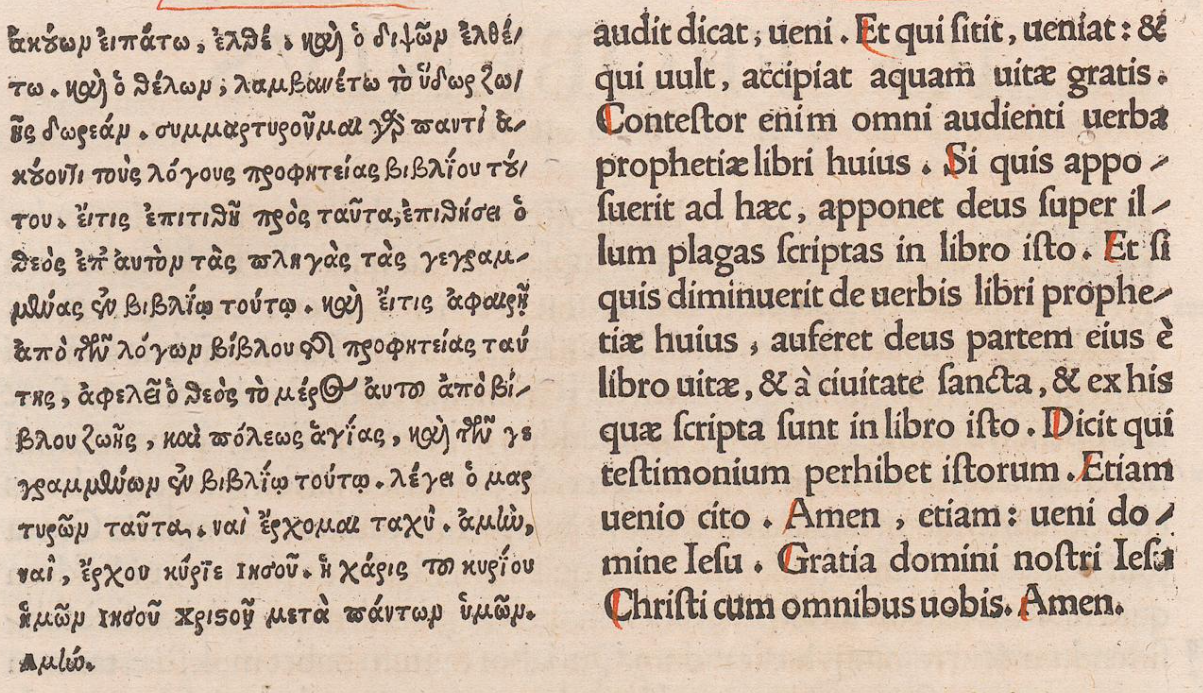
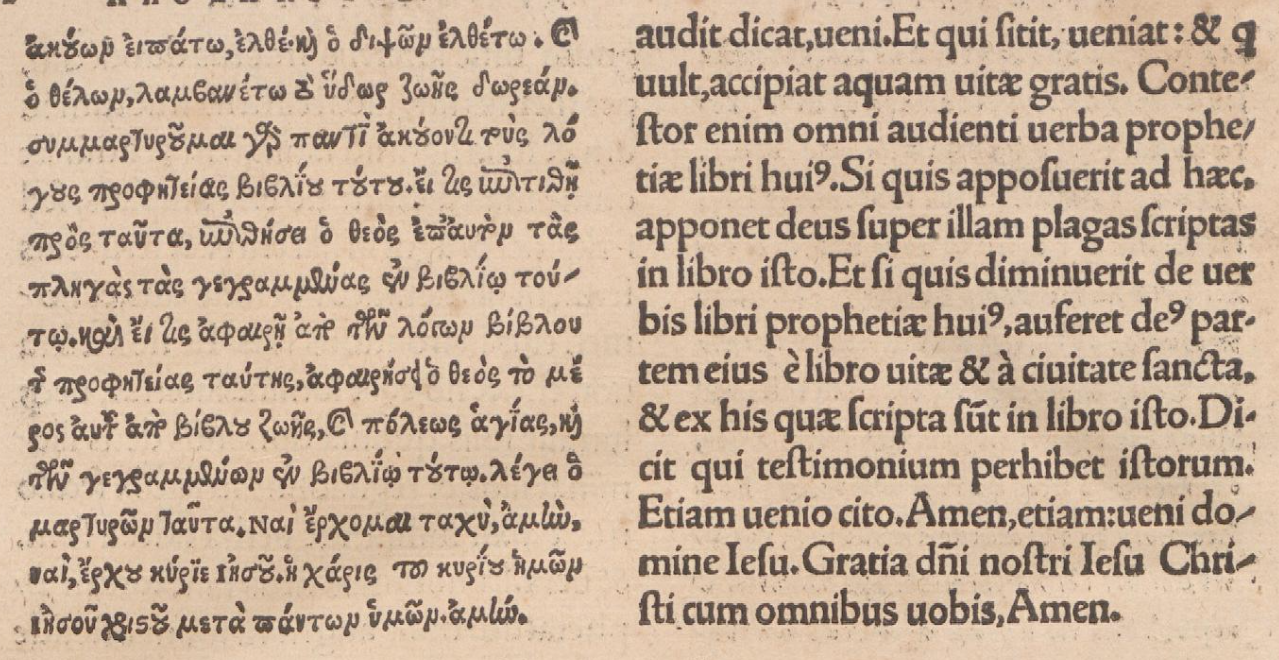
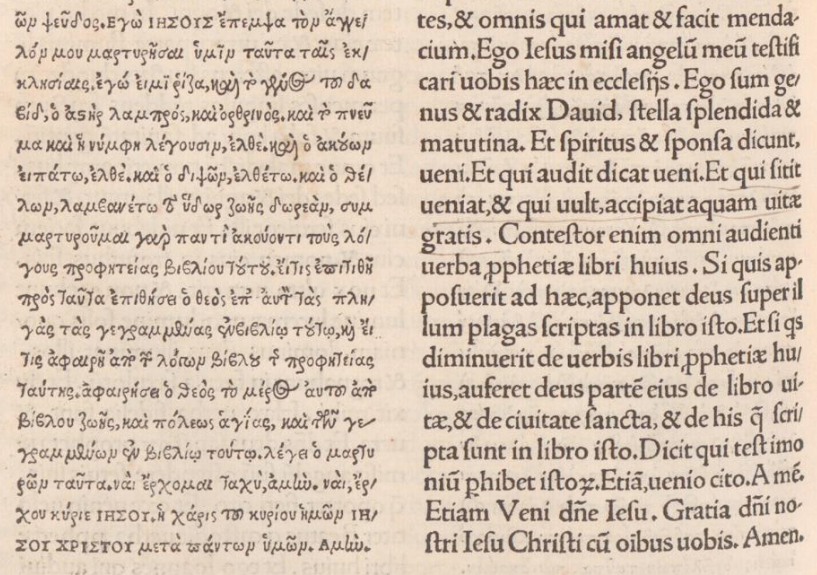
I plan to update this page as time permits.  However, for now I want to provide the five editions of Erasmus (including Greek and Latin) for the passage in question, as well as the four editions of Stephanus (only one of which includes Latin).
(1516, image 584)
(1519, image 690)
(1519, p. 565, image 691)
(1522, p. 561, image 633)
(1522, p. 562, image 634)
(1527, p. 545, image 597)
(1535, p. 429, image 477)
H.T. to Jan Krans for this helpful list of online editions of Erasmus (link).
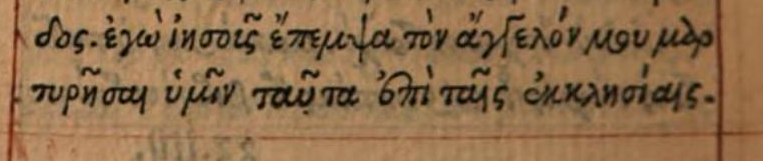


(1546, p. 360)
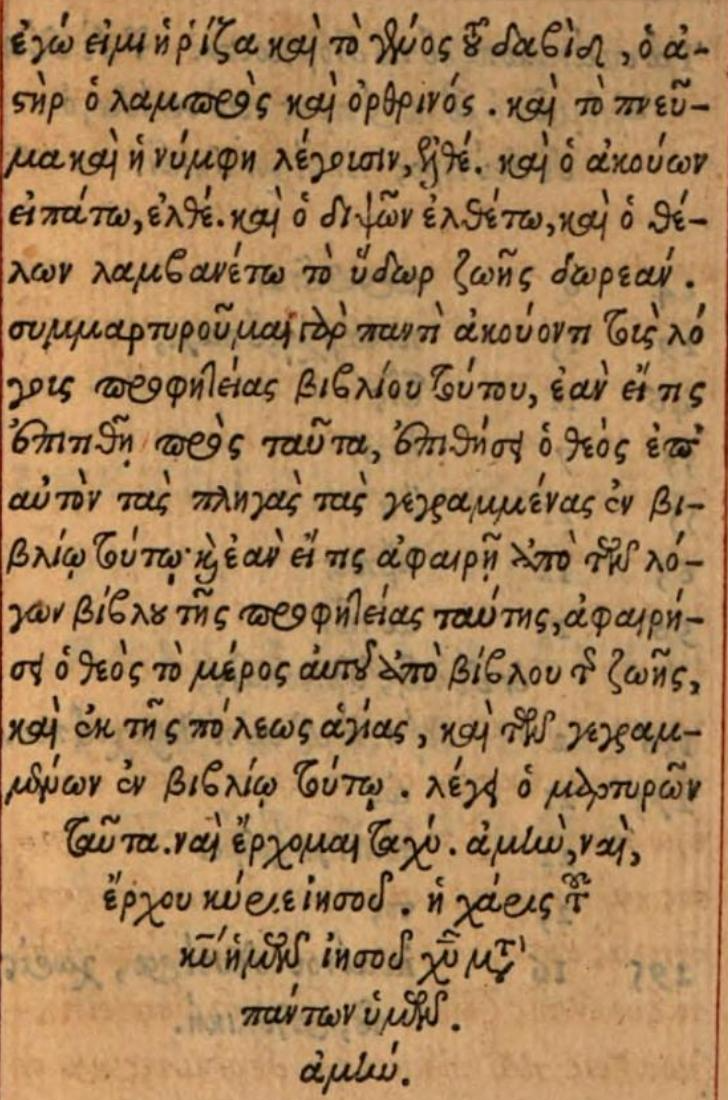
(1546, p. 361)
(1549, p. 360)
(1549, p. 361)
(1550, p. 202)
(1551, p. 312r)
(1551, p. 312v)

H.T. also to Jan Krans for this helpful list of online editions of Stephanus (link).

Friday, September 27, 2024

Beza's Ancient Codices at Luke 17:36

 In a recent video, Dwayne Green commented on Theodore Beza's Annotations on Luke 17:36.  His comments should be visible in the right column of this screenshot:

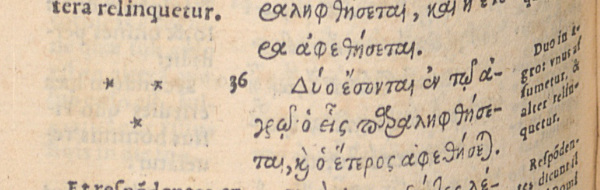
Beza says that the verse is found in the Complutensian edition and in four old/aged/ancient (vetustis) codices.  Dwayne asked folks if they could identify the codices in question. The answer is that they are the four manuscripts listed after the Computensian in Stephanus' 1550 edition:


For a higher quality scan of the same portion:


Here Beza seems rightly to have identified that alpha refers to the Complutensian.  Beta is Codex B, GA 05, also known as Codex Bezae, and dated to the fifth century.  The GA numbers for the remainder are: 4 (13th century), 7 (12th century), and 8 (11th century), each of which are in the National Library of France in Paris.  I'm indebted to J. K. Elliot for providing the mapping of manuscripts to Stephanus' notations.

Why did Beza include the verse in the text, when the Stephanus 1550 (apparently following Erasmus) had omitted it? It's hard to know for sure, but it may well have been of significance that Stephanus 1551 included it:


The three stars are because there is no corresponding Latin translation by Erasmus, if my understanding is correct (as Erasmus' editions did not include the verse).