Showing posts with label James White. Show all posts

Friday, December 19, 2025

Does Grace Sherman rescue David Allen? Or does Allen's Appeal Backfire? What does it mean that 1 John 5:1a is "condition" and 1 John 5:1b is "consequence"

Previously (link), we considered David Allen's putative attempt to respond to James White's challenge regarding providing a consistent exegesis of 1 John 2:29, 1 John 4:7, and 1 John 5:1.  We observed that Allen provided both a written response and a video.  In this post, we consider the most central part of that response that has not been addressed to date.

The following is a transcript from Allen's video (starting around 38 minutes, 47 seconds into the video):

Number four, semantic structural analysis. As linguists Grace Sherman and John Tuggy demonstrate with respect to 1 John 5:1, the semantic structure of the two propositions, proposition one, if anyone believes that Jesus is God's anointed, and proposition two, he is the one whom God has caused to live spiritually, i.e. be regenerated. Now notice this: semantically what is being communicated there -- the communication relationship there is one of condition consequence from a semantic standpoint. The condition is faith and precedes the consequence, which is regeneration. This is the natural way to interpret the verse. 

This closely follows p. 3 of Allen's written response, so closely that we can say he's just reading his written response:

There another place in the video where Allen makes reference to his position on this point. Starting around 21 minutes, 39 seconds into the video, Allen responds to Flowers by saying (transcription, as with the previous transcription, is Youtube's, lightly cleaned up by the present author):

Right. Well, I'm going to go ahead and raise some eyebrows by saying that I'm going to differ with you and Carson a little bit, because I actually think there are good reasons to think that 1 John 5:1 really can't be interpreted to argue for regeneration preceding faith.

But it's not on grammatical grounds. I'm going to get to all this in a minute. I'll just tease this right now. It's rather on semantic grounds. Semantic structure makes it pretty clear that what's happening there is faith preceding regeneration. So I'm a little bit stronger on that. I understand what Carson is saying. I don't disagree with what Carson is saying except to say that I think when you bring in the full orbed -- all of the exegetical material -- looking at it from a semantic perspective, contextually, you don't have a case for regeneration preceding faith, but you can have a case for faith preceding regeneration. So that would sort of be okay be how I might word that. 

I previously mentioned that I don't know what difference Allen intends between semantic and grammatical grounds, but at that time I did not have the benefit of having Sherman's work in front of me.  Incidentally, the book is published by "Summer Institute of Linguistics" in 1994 and lists as authors, "Grace E. Sherman and John C. Tuggy." The publisher has bios on a number of their authors (link to bios) but neither Sherman nor Tuggy are on the list.  I was able to locate archives of publications attributed to Tuggy (link), which shows an active interest in linguistics; the archives similarly listed a shorter two other linguistic-related publications associated with Sherman's name (link). Not that credentials are the be-all or end-all, but I was not able to locate any information regarding whether these authors have any specific training.  I only mention this because Allen calls them "linguists," in citing them. 

In order to respond to Allen, it's necessary to consider Sherman's book, of which page 91 is the single cited page.  On the other hand, in view of James White's challenge, it would be good also to consider whether Sherman anticipated the challenge (by more than two decades!) and provided the answer to the problem of applying Allen's (borrowed) analysis(?) at 1 John 5:1 to 1 John 2:29 and 1 John 4:7.

Sherman has a note that is of particular interest at 1 John 2:29 and then nothing at all of interest at 1 John 4:7, except that her silence as to the parallel structure suggests she simply has not considered the issue.  From Sherman's analysis and conclusions for 1 John 2:29 and 1 John 4:7 we can more clearly demonstrate the fundamental inconsistency at 1 John 5:1.

First, pp. 55-56 address 1 John 2:29a:


Notice that in the "Relational Structure" section, Sherman does not break down 2:29b.  However, when analyzing 2:29a, Sherman says that "The Greek grammatical structure indicates a condition-CONSEQUENCE relation. However, we know that the protasis of the condition is true, so that this functions as a reason-RESULT, here encoded as 'since'."  

When it comes to analyzing 2:29b, Sherman says that the Greek "has been begotten" is figurative, and that this signifies spiritual regeneration.  Thus, Sherman translates/interprets the text as "if anyone continues doing what is right, then God has caused him to live spiritually."

Second, pp. 79-81 address 1 John 4:7c:


As can be seen, Sherman does not further divide 1 John 4:7c, but treats the unit as a 'HEAD".  Sherman identifies the first appeal in this section (including 1 John 4:7) as "In a sense, this is the climax of the whole Epistle."  This is reasonable observation.  Note as well that once again Sherman explains "has been born from God" figuratively, in this case translating/interpreting it as "if anyone loves his Christian brothers, he has been caused by God to live spiritually and he knows God experientially" and to explain it thus:

The context shows that physical birth is not in view here; what is referred to is God's causing us to live eternally, that is, to associate properly with God, as a child with a father in a family.

Within the argument John is making, Sherman properly considers that 4:7c fits logically under "Love has its source in God," (i.e., 1 John 4:7b).  This, of course, is behind a right understanding of 1 John 2:29b as well: because God is the source of righteous acts, we know that the one who continues in doing what is righteous got that from God.

The challenge, of course, is to apply this same principle consistently when it comes to 1 John 5:1a-b (according to Sherman's division).  As noted above, p. 91 is the single page of Sherman's work that addresses 1 John 5:1a-b:

Note that on the page, Sherman has divided 1 John 5:1a as "condition" and 1 John 5:1b as "CNQ" (p. vi explains that this abbreviation means "consequent").  Allen asserted that "linguists Grace Sherman and John Tuggy demonstrate" but, as you can see, there is mere assertion, not demonstration.  Incidentally, I have referred to the author as "Sherman" instead of "Sherman and Tuggy" because of the preface of the book, which indicates that the initial work was Sherman's and that Tuggy (to paraphrase) beefed up the justifications of the positions set forth by Sherman.  In cases where there is bare assertion, it seems better to credit Sherman.

Note, however, that the "NOTES" skip right past 1 John 5:1b, and the notes on 1 John 5:1 are focused on the title "Christ."  

Nevertheless, Sherman twice provides the translation/interpretation: "If a person believes that Jesus is God's Anointed One, he is one whom God has caused to live spiritually."  

I should add that the discussion of 1 John 5:1 resurfaces on the next pair of pages, pp. 92-93:


Notice here that the translation/interpretation offered pushed into a chiastic structure.  Sherman argues that "there is no doubt that the whole verse is an aphorism" and again "Verse 1 is a generalized statement in which the actors are unspecified or unidentified ...." (p. 93)

Recall from James White's challenge:

The Provisionist position is that 1 John 5:1 must be understood with the substantive participle in the present, "Everyone who believes (as a result) is born from God."  I believe the natural reading is "everyone believing has been born from God," with the perfect passive action preceding and conditioning the action of the participle. 

Based on the interpretation/translations offered by Sherman, it seems that notwithstanding the "condition/consequence" labelling, Sherman supports White more than Allen.  Specifically note:

  • 1 John 2:29b "if anyone continues doing what is right, then God has caused him to live spiritually."
  • 1 John 4:7c "if anyone loves his Christian brothers, he has been caused by God to live spiritually and he knows God experientially" 
  • 1 John 5:1b "If a person believes that Jesus is God's Anointed One, he is one whom God has caused to live spiritually."

This (of course) agrees with White's analysis as to the relative time issue.

What then of the condition/consequence point?  Recall that Sherman had identified something as being condition/consequence based on Greek grammar, but based on knowledge that the protasis is true, Sherman recategorized as reason-result, at 1 John 2:29a.

So, what are some other examples of condition/consequence and reason/result offered by Sherman?  At p. 24 we see multiple examples:


What we can glean from these examples is that if we assume that Sherman has common sense, we see that she is not using "condition/consequence" to mean that the condition is the cause of the consequence.  Rather, Sherman is using "condition" and "consequence" to express the fact that the truth of the condition statement guarantees the truth of the consequence statement. 

I wish there were a better explanation, but it seems that Allen may have mistakenly assumed that Sherman's "condition/consequence" meant something like "cause/effect," when it plainly does not (see multiple instances on p. 24 that cannot reasonably be thought to be cause/effect).  As a result, it seems that Allen has quoted Sherman as supportive of his position, when Sherman does not address the specific conclusion of the relative timing of initial faith and being born of God and her proposed interpretation/translation most closely aligns with James White's.

Sherman does not say that the condition is faith or that this precedes the consequence, nor that the consequence is regeneration.  Instead, Sherman says that the condition is the statement (the portion following the if, of course) "If anyone believes that Jesus is God's Anointed One" and the consequence is the statement "he is one whom God has caused to live spiritually."  Notice that Sherman uses the the present tense for the condition statement and the perfect tense for the consequent statement.  The meaning of condition/consequence in this analysis is that if the condition is true, then the consequence is true.  In other words, if A is 5:1a is true, then 5:1b is true.  That's all that "condition" and "consequence" means here.  Moreover, given that Sherman has maintained the present/perfect distinction, the most natural read of the text is parallel to that of 1 John 2:29b and 1 John 4:7c.

Finally, for the same reason that 1 John 2:29a is grammatically a condition-consequence statement, so also is 1 John 2:29b and 1 John 4:7c.  And Sherman does not offer any reason or explanation (or even assertion) to handle these three parallel texts differently from one another.

Monday, December 01, 2025

James White's 1 John 5:1 Challenge - Some Key Points

Recently, James White issued a challenge (link to challenge) to Dr. David L. Allen regarding Dr. Allen's interpretation of 1 John 5:1.  Dr. Allen responded, putatively "accepting" the challenge (link to written response - link to video response).  However, I have provided a detailed response explaining why the response does not address the challenge that was offered (part 1 - part 2 - and short summary).

According to Allen, the "semantic structure" of 1 John 5:1 indicates that the text means that faith produces regeneration.  However, White's challenge was to apply the same methodology to parallel passages at 1 John 2:29 and 1 John 4:7.  If one were to apply the same methodology, those passages would teach that doing righteousness produces regeneration and loving God produces regeneration, respectively.  As those are absurd results, Allen's methodology must be wrong.  However, even despite allegedly "accepting" Dr. White's challenge, Dr. Allen has not addressed how his methodology can be consistently applied to 1 John 2:29 and 1 John 4:7 without producing absurdity.

There is more, but that's the core of the issue.

Monday, April 21, 2025

Libertarian Free Will and James White's Debate with AK Richardson

Did Dr. James R. White "concede" that Adam had Libertarian Free Will?  There was a moment in Dr. White's debate with AK Richardson, where AK asked whether Adam had free will.  Here is my transcript of the exchange: 

AK: Do you believe that if God purposes to design man with libertarian free will - as we call it - and then given the responsibility to believe can he do that if he wants. 

JRW: Yeah It didn't last long That was called Adam 

AK: Okay So so then if if so he did create Adam with libertarian free will So then you would concede--

JRW: But even then that libertarian free will existed under the decree of God because it was not God's purpose that Christ was not going to come The incarnation wasn't going to be ne necessary stuff like that. But Adam is completely different than we are Once the fall takes place we're in Romans 5.

AK: But you did affirm that he had libertarian free will?

JRW: Yes. As a creature. In other words he did not have a fallen nature. 

When Dr. White said "even then that libertarian free will existed under the decree of God," (link to clip) and again when Dr. White said, "in other words he did not have a fallen nature," (link to clip) it should have been apparent to the unbiased listener that Dr. White is speaking only of Adam having Freedom of Will in the sense of not being bound by a sin nature, and not of Adam having Freedom from God's Will.

So, no.  Dr. White was not saying that Adam had Libertarian Free Will in the sense that contemporary philosophers use that term (link), for example as in contrast with Compatible Free Will.  I would have preferred Dr. White to have clarified by saying "free will, not Libertarian Free Will."  However, I'm not the boss of him.  

For Dr. White, he felt it was sufficient to clarify that Adam had free will "as a creature" and more specifically as an "unfallen creature".  As he said a few seconds later:

AK: Let me ask you this way: You still you would believe then -- and you would agree -- that being libertarianly free does not in any way oppose God being sovereign? 

JRW: Libertarianly free as a creature. Adam's choices were limited. Adam could not libertarianly freely choose to fly. So he was a creature. He had that freedom within that realm as an unfallen creature.

(link to clip)

I realize that for a lot of folks, that segment of the debate was a "gotcha" moment, because of the more standard meaning of "Libertarian Free Will" in contemporary philosophical circles.  That said, it's worth observing that, to put it bluntly, that's not what Dr. White meant.

If AK had asked Dr. White the question: was the Fall foreordained by God? The answer would have been "yes," because Dr. White said that Adam's will "existed under the decree of God."

Hopefully this provides clarification for those who badly need clarification on this issue.

Thursday, October 20, 2022

Does Pro Pastor Answer Objections?

Jordan Steffaniak tweeted (link to thread) the following, which I've taken the liberty of reformatting for space here.  Go to the link for the original formatting: 

JS (October 18): PSA: If you’re curious about the value of medieval sources, the nature of sola scriptura, etc. Don’t waste your time reading this. They don’t interact with their opponents. They ask questions no one is asking. They refute views no one is espousing. YW. https://gbtseminary.org/gbts-journal/
JS (October 19): I've been informed that I'm a biased, bigoted, scholastic snob that lied in my statement that GBTS failed to w/ their opponents on medieval theology, sola scriptura etc. I'm more than willing to retract my claims if proven wrong. But I'm unable to see where my claim is false.
TF (October 19): Are you willing to be shown?
JS (October 19): Yep. But no one is willing to provide any evidence besides snarky replies, apparently. 🤷🏼‍♂️

Since Jordan says he is willing to be shown, here is the evidence that his claims are wrong.

First, how can it really be both ways?  Either they don't have opponents because they answer(?  -- I suppose "ask" was just a twitter-o) questions no one is asking and refute views no one is espousing, or they "don't interact with their opponents."   If they are really just off discussing questions no one cares about, so be it.  There are a vast array of journals I have never read, and will never read.  

Of course, no one has to warn me off.  No one has to tell me to actively ignore such uninteresting journals (to me).  Instead, I just naturally gravitate away from such topics.

On the other hand, Jordan seems to recognize that the issue presents itself as being related to the value of medieval sources.  Jeff Moore, the editor, characterizes the issue this way: "Our inaugural issue addresses a contemporary question that is raging, regrettably, among evangelicals: Is Thomas Aquinas a helpful guide for Protestants?"  We will come back in a moment to the question of whether this is a question people are asking.  Suffice to say that this question is provided right on the cover of the issue, surrounded by images of Calvin and other early Reformers.

It's unclear from Jordan's tweet whether he read beyond that title page.  Maybe he read the whole issue thoroughly, maybe not.  There is only so much one can discern from 140 characters or whatever the current limit is. 

Second, Jordan linked to a page that provides only the first volume, first issue of "Pro Pastor:  A Journal of Grace Bible Theological Seminary."  The print release date for this issue is October 31, 2022, which is still future as of the writing of this post.  To say, "they don't interact with their opponents," is a strange claim to put it mildly.  Shouldn't there minimally be an opportunity for opponents to the journal to arise?  How much opposition can a journal expect before its very first issue of its first volume?

Nevertheless, of course, the journal didn't spring up in a vacuum.  It's the publication of a seminary, and the publication of the individual authors.  I note that the fourth page of the digital edition has the caveat: "The views expressed in the following articles and reviews are not necessarily those of the faculty, the administration, or the trustees of Grace Bible Theological Seminary."  That said, though, perhaps Jordan means that the seminary, as such, doesn't interact with "their" opponents.  A better interpretation, though, is that Jordan meant to refer to the authors of the articles.

This issue has articles from: James R. White (two articles), Jeff Moore (an introduction and one article), Jeffrey D. Johnson (one article), and Owen Strachan (one article).  There is also an uncredited "Summary Chart," but presumably the chart's author is not on the hook.

Do the authors interact with their opponents?  James White has conducted numerous debates (over 150 at last count), many of which are online.  To suggest that White doesn't interact with his opponents must, at best, come with some heavy qualification.  I'm less familiar with Owen Strachan and Jeffrey Johnson.  I found what appears to be an interaction between Owen Strachan and Jermaine Marshall (link to video).  Jeffrey Johnson is an incredibly common name, but I believe I found an interaction between Jeffrey Johnson and Michael Horton (link to video).  I didn't find anything debate-related with Jeff Moore, so I don't know whether he does debates or not.  Perhaps he does not.

So, at least most of these authors may have some experience with actual debate, and James White, the biggest contributor to this issue, has an overwhelming abundance of experience with debate.  That said, none of James White's debates have been specifically on Thomas Aquinas.  James White has had an informal dialog with William Lane Craig on Calvinism vs. Molinism and a formal debate with Tim Stratton on "Is Molinism Biblical," which have some connection to Thomas, but no debates specifically on the topic of "Is Thomas Aquinas a helpful guide for Protestants?"

Nevertheless, White has responded to opponents on Thomas Aquinas on his program, The Dividing Line (here is an example), numerous times.   Again, I'm less familiar with the others, and I don't know whether they have similarly responded or not.

Giving Jordan the benefit of the doubt, though, perhaps Jordan just meant that this issue itself, in the issue, doesn't respond to opponents.

On page 1, Jeff Moore identifies John Gerstner's article, "Aquinas was a Protestant," and Matthew Barrett's article, "What is Eternal Generation? (and Interview)," and asks whether the claims of those articles are true.

White's first article, in fairness to Jordan, simply sets up a definition of Sola Scriptura.  White's second article then aims to answer the question of whether Thomas held to Sola Scriptura.  I suppose that for a lot of advocates of Thomism, this question is not one they are asking.  It is a question seemingly raised by Tabletalk Magazine, May 1994: Should Old Aquinas Be Forgot? (and similarly posed by Travis James Campbell in the Aquila Report).

However, again, the focus even of White's second article is on analyzing Thomas' writings, not responding to a particular competing interpretation of Thomas.

Like White's two articles, Moore's article is similarly mostly a positive presentation on whether pagan philosophy should be understood as being in collaboration or conflict with Christianity, with the underlying argument being that Thomas was wrong to try to supplement Aristotle, rather than discarding Aristotle in favor of Scripture.  While this is not a direct response to opponents, one can surely see the relevance to the question of the usefulness of Thomas to Protestants today.

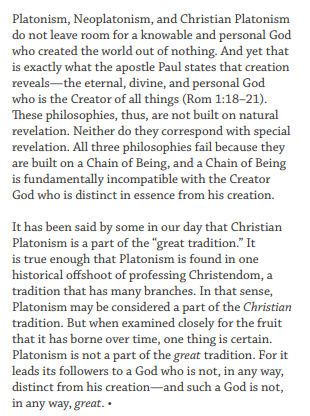
Jeffrey Johnson's article, "Is Platonism a Part of the Great Tradition," is clearly a shot across the bow of Craig Carter, and Craig Carter is identified in the first footnote of the article.  It's hard not to see the article as a challenge to Craig Carter's concept of Christian Platonism.  For example, Carter writes:


Now, if Jordan were simply saying that Johnson did not quote Carter and interact with those quotations, ok.  But it is hard to see Johnson's conclusion as not being in conflict with Carter's position:


Owen Strachan tackled the topic of whether Thomas taught monergism, and concluded that Thomas did not.  While Strachan's article does not directly interact with John Gerstner's article arguing that Thomas taught Sola Fide, it is once again hard to see this as anything other than a correction to it.

I suppose that what Jordan may have meant to say, instead of what he actually said, was that this issue does not address questions of the doctrine of divine simplicity, eternal functional subordination, or theology proper.  The first two topics are not mentioned at all in the issue.

The phrase, "theology proper," appears twice each at pp. 34 and 40, all of which are in Owen Strachan's article.  For those interested, I provide the relevant paragraphs:

Broadly speaking, the “great tradition” movement downplays soteriological differences and focuses attention on supposed ecumenical agreement over the doctrine of God (theology proper). It finds this common ground in the Nicene tradition, as it is often called, which took shape in the four ecumenical creeds, continued to be developed in the medieval period, and came to full flower under Thomas Aquinas.
...
In the present hour, Aquinas is supposedly the theological hero who can rescue us from theological drift. The neo-Reformed project, it is alleged, platformed soteriology, but divested itself of sound classical theology proper. Now, by a return to a certain version of Reformed scholasticism, we can right the ship. If we will embrace Doctor Angelicus (Aquinas, per the Catholics); if we will learn extensively from Catholic theologians and philosophers; if we will root out the biblicists with their supposedly “solo scriptura” method; if we will exchange the Reformational paradigm carved loosely by diverse voices and works like old Princeton, Spurgeon, early Westminster, Lloyd-Jones, and the neo-Reformed movement for a “great tradition” paradigm knit together by an ecumenical band of thinkers, we will save the church from its fundamentalist capsizing.
...
Some tell us in our time that we can chart a middle way here. We can love Thomas but avoid his errors. We can avoid his doctrine of salvation, even while we embrace his doctrine of God. We may share many commitments with some who make these claims. We desire no doctrinal war with them, and we pray for peace in the body. But we cannot constrain ourselves from warning the church today: Thomas was not a proto-Reformer. Considered in widescope view, with his body of teaching taken into account, Thomas is not a sound guide. 
...  
But perhaps, even after this treatment of Thomas, someone will say in response to me, “But Thomas has all this rich theology proper that you’re ignoring! He’s orthodox as I read him. How can you charge him with not knowing the true God, even if he does get some things wrong on soteriology?” My reply is simple. Just as Thomas might have seemingly orthodox theology proper, so too may a prosperity gospel preacher have a seemingly correct Trinitarianism. Let’s say that on paper, he holds to Nicene theology, and even honors the “great tradition.” But what if that preacher proclaims a false gospel, one in which sin has no place, and the gospel as he presents it is actually about God making all your biggest dreams come true? Clearly, even technical orthodoxy on the Trinity does not change the fact that such a preacher does not honor or know the true God.

So, perhaps Jordan's underlying disappointment was that Strachan and the rest don't debate Thomas' theology proper.  

If one wanted to debate the soundness of Thomas' theology proper, this issue would look like a gigantic ad hominem argument.  Such an analysis misses the point of the issue.  The point of the issue, aptly summarized by the title of the issue, was this: "Is Thomas Aquinas a helpful guide for Protestants?" The answer provided is that Thomas is not, because of positions the authors say he held, including on important issues like Sola Scriptura, the relevance of Aristotle, the relevance of Denys and other Platonists, and Monergism.  

I hate having to put a caveat on an article like this, but I don't trust *some* of the readers' ability to understand negative implications.  I'm not saying I fully agree with any of the authors about anything they wrote.  I don't agree with Craig Carter's label of the historical Francis Turretin as a Christian Platonist.

Thursday, August 26, 2021

Further Defense of James White on Providential Preservation

My previous post (link), defending Dr. James White against the false accusation that he rejects the Reformed doctrine of providential preservation, received a response in a facebook group.  The following provides detailed rebuttals/responses/replies to the comments provided.  I will label Dr. White's critic/accuser as "N" for "Negative," as he expressed a negative opinion about Dr. White.

N: "I would also like to point out that your blog is a prime example of a blog written by someone who doesn't actually understand the position he is attacking."

Mostly, I am just defending Dr. White's position on the high level issue of holding to the Reformed doctrine of providential preservation of the text of Scripture (specifically the New Testament).  I am not defending Dr. White on every detail of his textual critical conclusions, as he and I disagree on some things, and because it goes beyond the scope of the criticism.  Similarly, I am not addressing his views on the Old Testament, which he has not made fully clear to me.  Likewise, it is well known that I disagree with Dr. White on things like church polity and the proper recipients of baptism.  This is not a general defense of Dr. White, just a rebuttal to one specific false accusation.

I do understand the position of many of his critics.  Let's see if my responses below demonstrate my understanding of this particular critic's position and criticism.

N: "I'm not saying that to be rude, but rather to point out that it is unhelpful to try to combat a position without knowing exactly what the position is first."

In principle, I agree.  I have noticed many critics of Dr. White run into this very problem.

N: "This isn't simply a "particular" interpretation, but rather it is the result of going back and actually looking at the whole of what the framers said instead of reading modern evangelical text criticism back into the confession. The modern text critical positions differ from what the framers believed. The underlying beliefs and methodologies are not the same."

Keep in mind that the original (and false) allegation was this: "He's Reformed in many areas...but providential preservation is not one of them."

"Framers" is the kind of terminology we typically hear in the context of Constitutional interpretation, typically from a Conservative perspective.  The Reformed movement didn't exactly have "framers," though it certainly had a number of leading and influential figures, and it also had a number of confessions (which had framers).

It's extremely implausible that our accuser has literally looked at "the whole" of what even the contributors to the Westminster Confession had to say, much less all the major and minor Reformation figures.  Nevertheless, sometimes people do extensive research, in which case we should see evidence of it.

A false dilemma is proposed between this alleged need for extensive research and "reading modern evangelical text criticism back into the confession."  It's one thing to say that authors of the Westminster Confession embraced various forms of textual criticism and another thing to say that the authors of the Westminster Confession anachronistically embraced a specific position on textual criticism that emerged centuries later, or specific tools (such as Coherence-Based Genealogical Method (CGBM)) that were only recently invented.

We need to let historical theologians sit in their place in history.  What we can say is that many of them, including leading first generation figures like Calvin and Beza, as well as second generation figures like (the real) Francis Turretin, embraced textual criticism.

Is Dr. White's view exactly the same as Calvin?  Maybe not.  For example, it seems as though Calvin is sometimes willing to accept a conjectural emendation in the New Testament, whereas Dr. White is not willing to accept the same.  In this sense, Dr. White holds to a higher view of providential preservation than Calvin. Nevertheless, Dr. White's view is still within Confessional bounds on this point, as the Westminster Confession does not address that particular nuance.

Are the "underlying beliefs" the same?  In general, yes. Are the "methodologies" the same?  At a high level, yes.  While CBGM did not exist at the time, CBGM is an example of how to do collation.  Collation was done at the time and it, and its product, was embraced by many of the Reformers.

N: "There was a change from the time of the framers to Warfield."

Benjamin Breckenridge Warfield is often the boogieman for folks who oppose "modern" textual criticism.  He's notable as the last conservative to be chair of theology at Princeton.  Warfield did not focus on textual criticism, though he certainly did discuss it.

N: "Garnet Howard Milne's book "Has the Bible been kept pure? The Westminster Confession of Faith and the providential preservation of Scripture" deals with this in detail. I highly recommend the read. It helps show the original meaning/intent of those who wrote the confession."

Milne's 2017 "independently published" work may be a good read, but let's see what arguments can be presented here.

N: "It is a documented, historical fact that Warfield was the champion of the modern view of the confession, the view that you hold to."

I really don't love when people try to tell me what view I hold to.  Maybe let me be the one to tell you that.  Just a thought.  

N: "It doesn't seem that you've engaged with the sources that show this since you believe the confessional view is some new understanding being read into the text."

The question is really what the Reformers taught and what the Confession says, not what role Warfield had in the debate.  

N: "Milne shows Warfield's struggle with this in the previously mentioned book, as does Theodore P. Letis in his "Ecclesiastical Text." They both give quote after quote. If I have time, I will look through my books and give you more examples later."

It's not particularly germane.  This isn't about whether Warfield was Reformed on this subject, but about whether Dr. White is Reformed on this subject.

N: "He, and those who follow in his footsteps, are in direct opposition to the clear, plain reading of WCF 1.8."

Again, whether BB Warfield is Reformed is a tangent.

N: "Here's one example of what Warfield believed found in his An Introduction to Textual Criticism of the NT: "And while we cannot despair of restoring to ourselves and to the Church Of God, his book, word-for-word, as he gave it by inspiration to men, there is reason to believe that we may never have all the text of The Bible in the original languages."

Dr. White, by contrast, explicitly affirms that we have all the text of the New Testament in Greek.  So, this criticism does not attach to his position.  

N: "And this is the position that all honest text critics must take, and it is why no text critic believes text criticism will ever lead to a copy of the autographa."

Here we start to see the problem.  N has tried to decide what position other people "must" take and if they deny it, they are not "honest."  N is wrong, though.

N: "You can already see his position is at odds with the confession on this point. Believing the church is in possession of a corrupt text that is in need of restoration is in direct opposition to any natural understanding of the words used in 1.8 of the WCF. There is no reconciliation between these two positions. Something cannot be both pure, in the possession of the Church, and known to the church while simultaneously being corrupt and in need of restoration."

One challenge with this interpretation is that the text of the Westminster Confession does not say, "just now in these last days," but "in all ages." They did not mean that there was always some particular copy that was word-for-word correct.  Moreover, the Reformers soundly insisted that texts of the Scriptures that had been in use in the church for centuries needed work.  They insisted that both the Septuagint and Vulgate needed conformity to the Greek and Hebrew.  They did not claim that one particular printed Greek text was perfect and not in need of any revision.

N: "You are missing something major by overemphasizing the point you say the confession is making while minimizing the very important bit about preservation (which is vital for refuting the papist position)."

I don't agree, and since no argument is provided in support, I'm not sure what else to say.

N: "Then you make some odd claim regarding an "English Ecclesiastical text." This is irrelevant to the issue at hand, having nothing to do with this conversation or the position the Confessional Text advocates hold to. The Ecclesiastical Text(s) we are holding to are the Masoretic Old Testament and the Textus Receptus New Testament. These are not English. They are Hebrew and Greek. Do we prefer the KJV? Yeah. But that's because we believe it to be the best translation of the Ecclesiastical OT and NT."

One of the challenges of saying "the Textus Receptus," is this: which Textus Receptus?  The 1550 Stephanus?  The 1894 Scrivener text?

The bigger challenge is that the Westminster Confession didn't mean "the Textus Receptus" it meant the Greek.

N: "None of us believe the WCF is speaking of the KJV. To suggest such shows you have not actually engaged any scholarly works from the Confessional side. At this point, your blog is beginning to read like someone who doesn't know his opponent's position. I mean that as respectfully as possible. It is frustrating to put time into a response when you haven't even taken the time to understand what you're fighting against."

1) I mean this in in the nicest possible way, but works like those by Milne and Letis do not deserve the label, "scholarly." 

2) While the so-called Confessional Text position will often assert that it is not simply adopting the KJV, the reason that those of us who have had to deal with their arguments often highlight the KJV is that there is often a preference for the Scrivener 1894, which is a backtranslation of the KJV in to Koine.  Moreover, we find that some (though perhaps not all) so-called Confessional Text advocates won't acknowledge errors in the KJV where the KJV departs from, for example, the 1550 Stephanus or its main base text, the 1598 Beza. 

N: "You thinking this quote proves your point shows yet again that you don't understand the Confessional position and have not engaged with any material from Confessional Text scholars."

It seems more probable that the opposite is true, given that my post is a defense of Dr. White, not an engagement with one of the many so-called Confessional Text authors.

N (quoting from a "Purely Presbyterian article"): "We do not deny the necessity of textual criticism. We readily acknowledge it. We deny, however, that the the true text of Scripture has been lost with the non-extant autographs written by the hands of the Apostles and Prophets. On the contrary, we affirm, with Turretin, that the infallible, inerrant word of God exists today in the apographs which have been in the possession of the Church in every age."

That, however, is a statement that Dr. White would affirm.

N (I think again quoting from the same source): "This point by Owen is essential to grasp. We believe that the entirety of the Holy Scripture is and was contained in the copies which have been in the possession of the Church throughout the ages. Hence, those copies are sufficient for whatever textual criticism needs to be done. No new discovery of manuscripts needed. We therefore reject the notion that the manuscripts which have been in the possession of the Church in every age are to be corrected by manuscripts that have been hidden under a rock (so to speak) for 1500 years. This would be to deny that God has preserved His word as pure in all ages, and that the Church was left with a corrupted text for many centuries."

Now we are getting at a possible difference, namely whether to use newly discovered manuscripts in the collation.  However, good luck finding any Reformer who rejected, on principle, the use of the most ancient manuscripts, or insisted only that continuously used manuscripts be referenced.  One will struggle in vain to find such.  

N: "From the testimony of Scripture itself it can be shown that God would providentially preserve His word in all ages. It cannot, however, be shown from Scripture that God would leave His Church with text so corrupted that it could not be remedied with the extant manuscripts in the possession of the Church. We reject the idea that God would leave His Church with manuscripts with variants, errors, omissions, or additions that could not be remedied with the copies in her possession in each age, as a borderline atheistic notion."

Again, Dr. White does not say that the variants (etc.) could not be remedied in earlier ages, and can only be remedied now that we have the papyri, despite the fact that the papyri are very helpful and make the task easier.

N: "What you have proven is that you think you understand the Confessional Text position but do not."

There is not just one so-called "Confessional Text" position, and it was not my assertion that I understand that position as well as any of its/their adherents.  My position was that Dr. White is Reformed on the doctrine of providential preservation.

Tuesday, August 24, 2021

James White and Providential Preservation

Dr. James White has managed to become something of a lightning rod for advocates of the King James Version and its corresponding back-translation into Koine Greek, the Textus Receptus (as provided by F.H.A. Scrivener in 1894).  There are a wide array of KJV advocates, but one narrow band of the spectrum alleges that it is presenting "the Confessional position."

An example comment I recently encountered: "He's Reformed in many areas...but providential preservation is not one of them."

The person is referring to a particular interpretation (or band of interpretations) of the Westminster Confession of Faith, which states, in part (Chapter 1, Section 8):
8. The Old Testament in Hebrew (which was the native language of the people of God of old), and the New Testament in Greek (which at the time of the writing of it was most generally known to the nations), being immediately inspired by God, and by his singular care and providence kept pure in all ages, are therefore authentical; so as in all controversies of religion the Church is finally to appeal unto them. But because these original tongues are not known to all the people of God who have right unto, and interest in the Scriptures, and are commanded, in the fear of God, to read and search them, therefore they are to be translated into the vulgar language of every nation unto which they come, that the Word of God dwelling plentifully in all, they may worship him in an acceptable manner, and, through patience and comfort of the Scriptures, may have hope.
The main points of this section are that the final appeal is to the Greek and Hebrew, as distinct from the Latin (or any other translation), but that it is appropriate and necessary to translate the Scriptures into the languages of every nation.  This was a rejection of the Council of Trent, which declared "Moreover, the same sacred and holy Synod,--considering that no small utility may accrue to the Church of God, if it be made known which out of all the Latin editions, now in circulation, of the sacred books, is to be held as authentic,--ordains and declares, that the said old and vulgate edition, which, by the lengthened usage of so many years, has been approved of in the Church, be, in public lectures, disputations, sermons and expositions, held as authentic; and that no one is to dare, or presume to reject it under any pretext whatever."  (Fourth Session, April 1546)

In short, the main point of this section was a rejection of the "ecclesiastical text" of the Vulgate in favor of the Hebrew and Greek.  In a most ironic twist, modern advocates of an English ecclesiastical text have latched onto a portion of the paragraph.  

In particular, they have latched onto the phrase, "by his singular care and providence kept pure in all ages," as though it referred specifically to the KJV (which had only first been printed less than forty years before) or, in an odd anachronism, to Scrivner's TR that was about two centuries yet to come.

What the Confession means is that the Hebrew and Greek copies have not suffered from corruption, such that they can no longer be trusted, and that we consequently must look to the Latin Vulgate or some other source.  The Confession does not get into the specific issue of the Greek manuscripts and their texts.

We know, however, from contemporary Reformed discussions on the subject, that it was known that there were multiple manuscript copies of the New Testament books in Greek and multiple manuscript copies of the Old Testament books in Hebrew, and that these did not always agree with one another perfectly.

For example, under the question, "QUESTION 11: Are the Hebrew version of the Old Testament and the Greek of the New the only authentic ones? Affirmative, against the Roman Catholics." Francis Turretin (the real and original one) addressed the issue raised about textual variants:  "VIII. The variant readings that occur in Scripture do not detract from its authenticity, because they are easily recognized and understood, partly by the context, and partly by collation of the better manuscripts; many are of such nature that, although they differ, yet they agree in meaning."

In short, Turretin acknowledged that there were textual variants, but he suggested using textual criticism (i.e. "partly by context, and partly collation") to resolve these issues.  Turretin wasn't a Westminster Divine, but his position on this is consistent with the understanding the Westminster divines had.

Thus, my friend is mistaken when he claims that "providential preservation" is not one of the areas where Dr. White is Reformed.  On the contrary, there are a number of men who are Reformed in many areas but who, in their effort to bolster an English ecclesiastical text, have accidentally departed from the Confession.

Friday, November 15, 2019

Jeff Riddle and Ephesians 3:9

Jeff Riddle recently posted a lengthy "text note" regarding Ephesians 3:9.  My reactions follow.

The post is riddled with an even worse radical skepticism than that of Bart Ehrman.  Both Ehrman and Riddle oppose the Reformed orthodox position that we can reconstruct the original text from the extant copies. Ehrman, however, at least acknowledges that for the New Testament we have "much earlier attestation than for any other book from antiquity."

Erhman's radical skepticism is linked to his rejection of supernaturalism.  What about JR's?  JR's seems to be theologically motivated. He writes: "In the end, we can only be sure that in the providence of God the reading “the fellowship of the mystery” was that preserved in the TR."  That's the only thing that JR thinks we can know for sure.  Yet JR knows more than that conclusion lets on.  JR knows, for example, "Among current extant Greek manuscripts, of all eras, the Majority reading is indeed η οικονομια. In fact, the external evidence is so overwhelming that the NA28 does not even list any variants at this point in its critical apparatus."  Therefore, JR also know for sure that this state of affairs is also in the providence of God.  Why does JR pick God's providential ordering of the TR rather than God's providential preservation of Greek copies? Let the reader decide.

JR seems to acknowledge that there is no real argument to be made in defense of the TR position from the textual evidence.  Instead, after pointing out the obvious fact that one reading is likely a scribal error for the other reading (rather than a deliberate change) he offers a variety of mostly skeptical arguments:

1) Reasoned Eclecticism vs. Majority Text
JR states: "It seems particularly odd for [Dr. James R. White] to reject the TR reading at Ephesians 3:9 based on the fact that it is not the Majority reading since, supposedly, he is not himself an advocate for the Majority text but, instead, embraces an eclectic method (reasoned eclecticism)."
It's hard to figure out if JR just doesn't understand reasoned eclecticism or what.  Does he seriously not understand why reasoned eclecticism would favor a text that is supported by "p46, all known uncials, almost all minuscules, all known versions, and patristic quotations"? That's not simply picking the text because it is the majority text.  I think JR knows this.  Moreover, in any other case where "p46, all known uncials, almost all minuscules, all known versions, and patristic quotations" support a given reading, it would be shocking of editors following reasoned eclecticism concluded that a very late poorly attested minority reading were the original.  JR points to the variant of "through Jesus Christ" in the sane verse and asks why the majority is not followed here.  JR should know the answer: the situation is quite different.  "through Jesus Christ" is not found in "p46, all known uncials, almost all minuscules, all known versions, and patristic quotations."  There may be a majority in favor of inclusion of the phrase, but the witnesses for omission are not just a few scattered late manuscripts.  JR surely knows this, but chooses to ask the question as though he does not.

2) CBGM supports conjectural emendation?

JR states: "Furthermore, [Dr. James R. White] expresses great confidence in the new CBGM, despite the fact that in the NA28 it favors a reading in 2 Peter 3:10 based on NO extant Greek mss.! There seems to be a problem with consistency."

It's unclear whether JR is aware that Dr. White rejects the conjectural emendation proposed at 2 Peter 3:10.  It also seems that JR thinks that the CBGM some how spit out this conjectural emendation.  That's not the case.  The fault here lies with the ECM editors, not with the CBGM.

3) "Major Problem" of Insufficient Analysis

JR is aware that an analysis of the textual evidence has been done.  He quotes from Bruce Metzger, who provides a summary of the analysis. Nevertheless, JR asserts that Dr. White's analysis of the Greek manuscript evidence falls short.  JR implies that "proper analytical study" requires identifying the list of late manuscripts that apparently contain the TR reading. One wonders from where JR gets this standard.  It looks like he just made it up, presumably because he himself is having trouble finding any late manuscripts that support the TR reading.

Does JR offer any analysis that contradicts Metzger?  No. He just throws out a made-up standard and says it wasn't met.

4) Sometimes late manuscripts have early readings
This is one of those "true but irrelevant" statements, also known as red herrings.  There are a few late manuscripts that seem to be copied from very old manuscripts, and which consequently have early readings.  This is one thing that the CBGM should be good at helping us identify.

5) "Extremely thin" early Greek manuscript evidence?
What JR characterizes as "extremely thin" is actually pretty remarkable.  We have one papyrus that, despite bad damage to the edges of the page, does have this portion of the verse, dating back to about A.D. 200.  It contradicts the TR.  Then from the fourth to the seventh centuries we have five more uncial manuscripts.  As JR concedes, "Yes, η οικονομια is the reading found in the five early uncials and became the Majority reading ... ." 

6) Versional and Patristic Evidence
Once again, JR complains that Dr. White doesn't provide him with the information that JR himself can get from Metzger.  He says that Dr. White "never provides any specific examples from the versions for our comparison and analysis."  Here's an easy one: Codex Amiatinus (A.D. 700) is a Latin Vulgate manuscript produced in England.  It has "dispensatio", which is a Latin translation of the Greek. But, of course, where does this standard of having to provide specific examples come from? It's just something JR made up.

7) Why does the TR have the reading it has?
JR doesn't know why. Erasmus' first edition has the reading, and Stephanus and Beza maintained it.  The only 17th century (or earlier) exegete that I could find that mentioned the discrepancy was a Jesuit, Cornelius à Lapide.

JR says: "On what basis did the Reformed men affirm 'fellowship' here as the true reading, over against the Majority Greek ms. tradition? We do not know."
I reply: To the extent we don't know, it's because it seems they got the reading from the Roman Catholic, Erasmus, and didn't double check his work.  JR's comments seems to suppose some group of "Reformed men" huddling around the text and coming to a decision about whether to accept or reject each reading.  That's not how it worked.  There were some readings that were disputed, to be sure.  This does not appear to have been one of them.

Stephanus noted the variant issue in his 1550 edition (link to image - it's note 3) but we know he used the same manuscript Erasmus had (mentioned below).  If anyone digs up additional information, it would be interesting and useful.  As far as I know, Stephanus does not explain the decision to continue with Erasmus' choice.

8) They might have had other manuscripts!
JR makes the assertion: "It is certainly possible that they had access to Greek mss. which are no longer available to us."
I reply: "Certainly possible" sounds so much better than "this is just wild speculation, but ...." It means the same thing here.

We have figured out which manuscripts Erasmus borrowed for his work.  One of those was Minuscule 2817, which has the reading (both in the main text and apparently in the accompanying commentary)(link to whole manuscript)(editorial note: it's cool to be reading from the same page Erasmus read from). So, it would be most natural to blame this reading on that manuscript, rather than blaming it on Erasmus or his printer.  I have not checked the other three manuscripts that Erasmus had.

9) Some manuscripts have been lost since the 16th-17th centuries
Yes, some have. On the other hand, the ones that Erasmus used have survived.  It sad when Biblical manuscripts perish, but in God's providence, we still have most of the manuscripts identified in the 16th century, and others they did not know about.

10) The printed editions may testify to lost manuscripts
In the case of Erasmus' base text, we have reasons for thinking we know what manuscripts he worked from.  Accordingly, there is no particular need for its testimony.  Similarly, my recollection is that we have identified the manuscripts that Stephanus mentions.  If any of those are now lost, his marginal notes can provide a form of testimony to them.  But JR has not given us a reason to think that any relevant manuscripts have been lost, that any relevant manuscripts were used in the preparation of Erasmus' text, or that

Conclusion
JR argues: "It is only in the modern era that “Reformed” men have abandoned the traditional text for the modern reconstructed text."  Actually, the Reformers (especially Beza) worked on reconstructing the text and the high orthodox (e.g. Turretin) affirmed the continued use of collation to reconstruct the text.  This is nothing new or modern.

JR argues: "In so doing they have embraced a religious epistemology that abandons stability, continuity, and consistency." Actually, the Reformers fought against Rome's similar assertions for the Vulgate text.  They argued that the Greek apographa - the copies - provide the original text.

-TurretinFan


PS Upon reviewing this post before publishing, I note that there is an unintentional pun in the opening paragraph. No disrespect was intended to Pastor Riddle.

Thursday, November 14, 2019

John Owen versus the MARTs

The Modern Advocates of the Received Texts (MARTs) are a group of folks who argue that the textus receptus is not just the best text out there, it's jot and tittle the same as the original. Their position is thoroughly modern. Despite the fact that they like to characterize their position as being "Reformed Bibliology" or "Confessional Bibliology" or "The Confessional Text" position, their position is not one of the positions held by the early Reformers (obviously Luther was against their view, but also Calvin and Beza held a position contradictory to their view). It is also not the position expressed by the leading Reformed of the 17th century. One of the folks that I would associate with the MART viewpoint, Jeff Riddle, recently stated that John Owen is a "gold mine." I suspect that some of Owen's statements definitely will sound helpful. On the other hand, here are five examples of why it would be inaccurate to categorize the great John Owen as a proto-MART.

Example 1
Nature and Causes of Apostasy from the Gospel, Chapter 1

2. Ἀνασταυροῦντας ἑαυτοῖς τὸν Υἱὸν τοῦ Θεοῦ. Beza affirms that ἑαυτοῖς, “to themselves,” is absent from some copies, and then the words may admit of a sense diverse from that which is commonly received; for ἀνασταυροῦντας, “crucifying again;” may refer unto τινάς included and supposed in ἀνακινίζειν, that some or any should renew them. It is impossible that any should renew them to repentance; for this cannot be done without crucifying the Son of God again, since these apostates have utterly rejected all interest in and benefit by his death, as once undergone for sinners.

The variant being addressed her is the omission or inclusion of ἑαυτοῖς at Hebrews 6:6. Beza's 1598 printing includes the word in the text. What is significant here is that Owen does not simply rely on Beza's main reading of Hebrews 6:4-6, but Owen also consults the alleged variant reading that he says Beza mentions, and he does so in interpreting the text. Owen ultimately adopts the main reading, but look at the justification (on the next page of the same chapter):

But the word is constant enough in ancient copies to maintain its own station, and the context requires its continuance; and this makes the work of "crucifying again" to be the act of the apostates themselves, and to be asserted as that which belongs unto their sin, and not denied as belonging to a relief from their sin: "They crucify him again to themselves."

Notice that Beza relies on both external and internal evidence (i.e. evidence from the copies and evidence from the flow of the text). Most critically, notice that Owen places weight on the copies being ancient. Owen does not presume that ancient copies are worse because they are ancient. Instead, Owen takes for granted that the ancient copies should be a standard for evaluating the printed text reading.

Example 2
The Death of Death, Book 1, Chapter 5:

That which some contend, that by the eternal Spirit is here meant our Saviour’s own Deity, I see no great ground for. Some Greek and Latin copies read, not, as we commonly, Πνεύματος αἰωνίου, but Πνεύματος ἁγίου, and so the doubt is quite removed: and I see no reason why he may not as well be said to offer himself through the Holy Spirit, as to be “declared to be the Son of God, according to the Spirit of holiness, by the resurrection from the dead,” as Rom. i. 4; as also to be “quickened by the Spirit,” 1 Pet. iii. 18. The working of the Spirit was required as well in his oblation as resurrection, in his dying, as quickening.

The variant being addressed here is the substitution of αἰωνίου (eternal) for ἁγίου (holy) or vice versa. The main reading in Beza's 1598 is eternal, but notice that Owen goes to the variant reading both in the Greek and also in the Latin to interpret the text.


Example 3
The Death of Death, Book 1, Chapter 3:

Hence the Father himself is sometimes called our Saviour: 1 Tim. i. 1, “According to the commandment Θεοῦ σωτῆρος ἡμῶν,” — “of God our Saviour.” Some copies, indeed, read it, Θεοῦ καὶ σωτῆρος ἡμῶν, — “of God and our Saviour;” but the interposition of that particle καὶ arose, doubtless, from a misprision that Christ alone is called Saviour. But directly this is the same with that parallel place of Tit. i. 3, Κατ’ ἐπιταγὴν τοῦ σωτῆρος ἡμῶν Θεοῦ, — “According to the commandment of God our Saviour,” where no interposition of that conjunctive particle can have place; the same title being also in other places ascribed to him, as Luke i. 47, “My spirit hath rejoiced in God my Saviour.”

The variant being addressed her is the inclusion or omission of καὶ (and). Notice that Owen considers the variant, identifies the variant as a probable orthodox corruption, and then instead confirms the point from a place where there is no such variant issue.

Example 4
Vinidiciae Evangelicae, Chapter 22

1st. From the event: Heb. x. 2, 3, “For then would they not have ceased to be offered? because that the worshippers once purged should have had no more conscience of sins. But in those sacrifices there was a remembrance again made of sins every year.” The words of the second verse are to be read with an interrogation, conclusive in the negative: “Would they not have ceased to have been offered?” that is, certainly they would. And because they did not do so, it is evident from the event that they could not take away sin. In most copies the words are, Ἐπεὶ ἂ ἐπαύσαντο προσφερόμεναι. Those that add the negative particle οὐκ put it for οὐχί,. as it is frequently used.

The variant of interest here is the inclusion or omission of οὐκ. Interestingly enough, Beza's 1598 has the οὐκ. Owen seems to be willing to depart from Beza because the wording Owen adopts is allegedly found in "most copies."

Example 5
Vinidiciae Evangelicae, Chapter 13

Owen presents the following Q/A from his theological opponent:
Q. What dost thou answer to 1 Tim. iii. 16?
A. 1. That in many ancient copies, and in the Vulgar Latin itself, the word “God” is not read; wherefore from that place nothing certain can be concluded.

Owen replies:

1. Though the word “God,” be not in the Vulgar Latin, yet the unanimous, constant consent of all the original copies, confessed to be so both by Beza and Erasmus, is sufficient to evince that the loss of that translation is not of any import to weaken the sense of the place. Of other ancient copies, whereof they boast, they cannot instance one.

The variant here is the substitution of ὅς (he) for Θεὸς (God) or vice versa. Owen argues that the unanimous consent of the Greek trumps the Latin. Note as well that Owen is plainly relying only on the printed texts himself: particularly Erasmus and Beza. Owen does not pretend to be an expert in textual criticism himself, nor is he claiming personal knowledge about all the manuscripts.

Shortly thereafter, Owen responds to Grotius:

Θεὸς ἐφανερώθη ἐν σαρκί. “Suspectam nobis hanc lectionem faciunt interpretes veteres, Latinus, Syrus, Arabs, et Ambrosius, qui omnes legunt, ο` ἐφανερώθη.” Addit Hincmarus Opusculo 55. illud Θεός, “hic positum a Nestorianis.” 1. But this suspicion might well have been removed from this learned man by the universal consent of all original copies, wherein, as it seems, his own manuscript, that sometimes helps him at a need, doth not differ. 2. One corruption in one translation makes many. 3. The Syriac reads the word “God,” and so Tremellius hath rendered it; Ambrose and Hincmarus followed the Latin translation; and there is a thousand times more probability that the word Θεός was filched out by the Arians than that it was foisted in by the Nestorians. But if the agreement of all original copies may be thus contemned, we shall have nothing certain left us.

Note especially Owen's assertion: "if the agreement of all original copies may be thus contemned, we shall have nothing certain left us." That is something we have heard Dr. James White say numerous times in other contexts. Owen does not appeal to some kind of TR canonization. Instead he appeals to the extant Greek copies. Owen also argues from the probabilities as to what possible heretical source of corruption may have affected the text. Furthermore, Owen downplays the significance of the translations.

Continuing in Chapter 14, Owen states:

The learned Grotius is pitifully entangled about the last two places urged by our catechists. Of his sleight in dealing with that of John xx. 28, I have spoken before, and discovered the vanity of his insinuations. Here he tells you, that after Christ’s resurrection, it grew common with the Christians to call him God, and urges Rom. ix. 5; but coming to expound that place, he finds that shift will not serve the turn, it being not any Christians calling him God that there is mentioned, but the blessed apostle plainly affirming that he is “God over all, blessed for ever;” and therefore, forgetting what he had said before, he falls upon a worse and more desperate evasion, affirming that the word Θεός ought not to be in the text, because Erasmus had observed that Cyprian and Hilary, citing this text, did not name the word! And this he rests upon, although he knew that all original copies whatever, constantly, without any exception, do read it, and that Beza had manifested, against Erasmus, that Cyprian adver. Judæos, lib. ii. cap. vi., and Hilary ad Ps. xii., do both cite this place to prove that Christ is called God, though they do not express the text to the full; and it is known how Athanasius used it against the Arians, without any hesitation as to the corruption of the text. This way of shifting indeed is very wretched, and not to be pardoned. I am well contented with all who, from what he writes on John i. 1 (the first place mentioned), do apprehend that when he wrote his annotations on that place he was no opposer of the deity of Christ; but I must take leave to say, that, for mine own part, I am not able to collect from all there spoken in his own words that he doth at all assert the assuming of the human nature into personal subsistence with the Son of God. I speak as to the thing itself, and not to the expressions which he disallows.

Once again, Owen appeals to "all original copies whatever, constantly, without any exception, do read it" to settle the question.

Interestingly enough, there are indeed ancient copies that have the pronoun rather than the word "God." So, it turns out that Owen was mistaken about the issue of unanimity.

Conclusion
John Owen ardently defended many TR readings, including readings close to the heart of MARTs. John Owen did so, however, from a point of view that is not a MART point of view.  Indeed, Owen did not feel compelled to follow Beza's 1598 printing, but departed when he believed the Greek copy evidence warranted.  Moreover, it's fair to say we know more now about the Greek copies than Owen did.  A lot of textual critical work, especially finding and collating manuscripts, has been done since the days of Erasmus and Beza - and even since the days of Owen himself.

Friday, May 12, 2017

Responding to Jeff Riddle - Regarding James White and (the real) Turretin

Our brother in Christ, Jeff Riddle (JR), has posted some comments regarding James White (JW) and the real Francis Turretin (FT), which because I'm a friend of the former and a fan of the latter, I would like to address:

JR wrote:
1. JW typically confuses the TR and Majority text position with KJV-Onlyism. Furthermore, he criticizes KJV-Onlyism for all the wrong reason.

I note that the problem with KJV-Onlyism is not, as JW argues, that the KJV was translated from 1604-11 and is, therefore, outdated, but that KJV-Onlyism is inconsistent with confessional Christianity’s assertion that the Bible was immediately inspired in the original languages (Hebrew and Greek) and not in an English translation.
a) JW distinguishes amongst a variety of related positions in his book, the King James Only Controversy. So, I don't think "typically confuses" is very accurate. He does sometimes lump them together, but that's because they often use similar (flawed) arguments.
b) JW agrees with JR that one reason KJVO is wrong is that the text was inspired in the original languages as distinct from the translations. However, there are also other reasons for opposing the KJVO position. Moreover, not all KJVO folks necessarily say that the KJV/KJB was immediately inspired.

JR wrote:
2. JW wrongly describes Scrivener’s edition of the Greek NT as “not a real Greek NT” since it represents an edition of the TR which underlies the KJV.
Scrivener's edition is an attempt to (in essence) create a Greek text from the English text, by matching up the corresponding Greek reading that would go with the English reading. In that sense, it's like a back translation into Greek from another language, and consequently although it is in Greek, it's not a Greek text in the usual sense.

JR:
3. JW rejects the TR and Majority text positions on the basis of the fact that this is not, at present, the position taught “in every major” Reformed seminary” or by “leading scholars.”
JW may mention that point, but it's not the main reason for rejecting the TR position or any of the Majority text positions.

JR:
4. JW asserts that Protestant scholastics, like Francis Turretin, were just “wrong” when they defended the traditional text of the Bible, including texts like the traditional rendering of 1 Corinthians 15:47, the ending of Mark, the pericope adulterae, and the comma Johanneum.

I point out that Turretin likely was not denying the existence of textual variants but affirming that the traditional text was indeed found in all “faithful,” “received,” or “orthodox” copies of the Bible. See my upcoming article in PRJ “John Calvin and Text Criticism.”
He does assert that they were wrong (in specific cases), but he also explains why they were wrong (in those cases where JW thinks they are wrong). Moreover, methodologically, Turretin agrees with JW. For example, Turretin endorses the approach of using the collation of various copies to restore the original readings.

JR:
5. JW argues that p75 and Vaticanus (B) were “the text of the early church” and were more reliable than the text which was affirmed in the Reformation era.
There was not one single text that was affirmed in the Reformation era. There were multiple printed editions, and folks like Calvin and Turretin endorsed the use of textual criticism to restore the original text. Hopefully it is also clear that there was not one single text of the early church, either, for the ancient uncials and papyri have differences amongst them. Nevertheless, those ancients texts certainly have the advantage of being older, whatever else one might say about their reliability.

JR:
I point out that although the TR was not printed until the Reformation era, it was based on mss. with antiquity equal to that of p75 and B. In addition, the line represented by p75 and B came to an end in the 500s and ceased to be copied, not appearing again till revived in the 1800s.
a) It's simply not true that the TR was based on manuscripts with antiquity equal to P75 and B.
b) The Alexandrian text type definitely was copied less after Muslims decimated the Christian populations in North Africa and the middle east.
c) But there is at least one Alexandrian text type manuscript from as late as 1044 (minuscule 81). There is also ninth century minuscules (minuscules 33 and 892), which are from the Alexandrian text type. So, the "ceased to be copied" claim is not really true.

JR:
JW and other Reformed evangelicals who embrace the modern critical text have a rather difficult problem on their hands. They express admiration for the Protestant fathers (like Turretin—or Calvin, Owen, the framers of the 1689 confession, etc.) then are rather embarrassed to discover that these men defended the traditional text out of conviction and not, as they too often assume, out of ignorance.
Conviction and ignorance aren't opposites. Knowledge and ignorance are opposites. As mentioned above, Turretin (and other Reformers) methodologically agreed with the use of collation to obtain the original readings. We have more knowledge of the text than they did. Thus, the difference between JW's position and FT's position is not so much much because of different convictions, but because of different information.

JR:
Lastly, I make reference to my sermon last Sunday on the Trinity based on chapter two, paragraph three of the 1689 confession, noting not only the use of 1 John 5:7 there as a leading prooftext for the Trinity but also how the 1689 Baptist Confession refers to the second person of the Godhead as “the Word or the Son,” making specific and explicit use of the comma Johanneum in the articulation of the Trinity (cf. chapter two, paragraph three in the 1689 with the WCF and the Savoy here). This represents a significant problem for those who affirm the 1689 confession but reject the comma.
John 1:1 teaches that Jesus is the Word, and John 1:34 teaches that Jesus is the Son of God. So, there is no problem. The comma does not use the phrase "Word or the Son," so that is not an explicit or specific use of the comma. Moreover, while the prooftexts of the confessions include I John 5:7, that's obviously not the only prooftext provided, and the doctrine of the Trinity does not depend on the authenticity of that text.

-TurretinFan

Thursday, September 08, 2016

Responding to Steve Tassi on Romans 9

In his recent live interaction with Dr. James White, Steve Tassi argued that while Romans 9 is referring to election, it is not discussing salvation when it refers to mercy.

Audience
First, he argues that we must consider the audiences spoken to.  He does not clearly elaborate on this point, but his implication seems to be that the audience spoken to is Jewish readers.

The audience, however, are gentile Roman believers.  We see this in the first chapter:
Romans 1:7 To all that be in Rome, beloved of God, called to be saints: Grace to you and peace from God our Father, and the Lord Jesus Christ.
Romans 1:13 Now I would not have you ignorant, brethren, that oftentimes I purposed to come unto you, (but was let hitherto,) that I might have some fruit among you also, even as among other Gentiles.
So, the audience is not the nation of Israel, but rather is believing Gentiles.

Glorious Salvation Terms
Second, he argues that we must consider the references made are to Pharaoh, Moses, Isaac, and Rebekah, rather than to the typical terms that Paul uses when referencing salvation, such as "the blood of Jesus," "the cross," and other references to blood sacrifice and grace.

Dr. White countered this point by observing that the chapter and verse divisions are somewhat artificial, and that he demonstrated a continual flow from Romans 8.

To elaborate on that point more fully, Christ's death is explicitly mentioned in Romans 8:34.  Moreover, Romans 9:32-33 specifically mention faith in Christ.  Tassi surely cannot deny that both Romans 8 and Romans 10 are about salvation, so his assertion that Romans 9 is not about salvation because of the usage of terms, seems weak.

Context of Cited Texts
Third, he argues the Old Testament material cited or referred to by Paul never refers to salvation in its original context.

Dr. White countered this by pointing out that it's more important to note how Paul uses them, then how they were originally used.

To provide an example, in Galatians 4, Paul points to Hagar and Ishmael in contrast to Sarah and Isaac. Moreover, Paul explicitly interprets those figures as an allegory, rather than relying on their original context.

Furthermore, it is Pauline to shift between Old Testament images and analogous New Testament ideas.  For example, 1 Corinthians 10 is full of this kind of transition.

Conclusion
Tassi essentially concludes that the references in Romans 9 are references to election and mercy with respect to national Israel vis-a-vis the destruction of the nation, rather than to the church and salvation from hell.

This conclusion is unjustified.  To the extent it is premised on the arguments presented in its support, those arguments have been shown above to be incorrect.  Moreover, it is a conclusion that runs directly contrary to the text of Romans 9.  For example:
Romans 9:23-24 And that he might make known the riches of his glory on the vessels of mercy, which he had afore prepared unto glory, even us, whom he hath called, not of the Jews only, but also of the Gentiles?
How can that be mercy on the nation of Israel if it includes not only Jews but also Gentiles?  It cannot.  Which is one of numerous reasons that Tassi's presentation on Romans 9 should be rejected.

-TurretinFan

Tuesday, November 03, 2015

James White: The Same Sex Marriage Debate vs Codrington

Dr. White debated Graeme Codrington on the topic of same sex marriage (link to debate on SermonAudio). I agreed with Codrington that Dr. White did an excellent job defending the "traditional" view. I wanted to mention a few points that occurred to me in listening to the debate, while encouraging you, my reader, to go listen to the debate for yourself. Also check out the related debate that I mention in my comments below.

1) Heteronomative Scripture
Dr. White made a good point in the debate that it's more than just the "six verses" that specifically call out homosexual practices as sin. Instead, the remainder of Scripture provides a positive presentation regarding sexuality. That positive presentation makes heterosexual relations the norm. That's an important point, because it frames the issue. Within the context of Scripture, the pattern is "husband and wife" not simply life partners.

2) Patriarchal Scripture
Codrington raised the point that Scriptures present a patriarchal model in which there is male headship and even male ownership of wives and children. I noticed a similar issue arise in the debate between Jason Wallace and Scott Dalgarno (link to youtube video of that debate). One thing we need to be prepared to do is to confound Codrington and Dalgarno by affirming that the Biblical norm of patriarchy. Basic consistency does demand this from us - if we are going to affirm the creation ordinance of heterosexual marriage, we should also affirm the creation ordinance of how that heterosexual marriage is to be ordered. There is a sort of perverse consistency to Codrington and Dalgarno rejecting the Biblical norm of heterosexuality, given that they have already rejected the Biblical norm of patriarchy. If Biblical norms for the ordering of society matter, we should hold the. If they don't matter, we shouldn't insist on them.

3) Ownership of Humans in Scripture
Codrington and Dalgarno raised the ubiquitous objection that Scripture doesn't condemn slavery. Again, we need to be prepared to confound these men by affirming the Scripture's position. We are "bought with a price" (1 Cor 6:20 and 7:23). We are slaves of Jesus, our master. He owns us. We are his property. We are not absolutely opposed to slavery on Enlightenment grounds, even though we are opposed to any form of slavery that is based on denying the full humanity of people based on their skin color or the like. We recognize that the Bible affirmed that slaves were the property of their masters (e.g. Exodus 21:20-21 And if a man smite his servant, or his maid, with a rod, and he die under his hand; he shall be surely punished. Notwithstanding, if he continue a day or two, he shall not be punished: for he is his money.). Thus, we don't agree with the idea that it is somehow intrinsically immoral for a man to own another man, even though we recognize limitations on that ownership (see the same verses above).

Both Codrington and Dalgarno seem to take for granted that the Bible was wrong on the relationship of masters and slaves, husbands and wives, and parents and children. The "liberal church" has certainly begun to take those debates for granted. We need to be ready to shock them by affirming that the Bible was right on those things.

Thursday, August 20, 2015

Molinism - Responses to a Some Attempted Defenses

Someone posting under the name Richard Bushey has a post attempting to defend Molinism against some of the criticisms offered by my friend, Dr. James White (link). I'd like to rebut a few points.

Is Molinism too heavily reliant on philosophy? Mr. Bushey argues that philosophy is inherent to every kind of theology. However, that misses the point. The problem is not simply that Molinism employs philosophy but that it is (at best) totally speculative, based solely on philosophy, rather than being based on Scripture with philosophy being employed to draw out what is implied by Scripture.

Does Molinism begin with libertarian free will aka the "autonomous will of man"? It certainly does. Mr. Bushey says that Molinist just "recognize that freedom of the will exists." The problem is that Molinists cannot establish this starting principle from Scripture. The Scriptures teach that man has a will and that he makes decisions, but not that man's will is autonomous. On the contrary, the Scriptures have plenty of contrary examples.

Does Molinism compromise God's sovereignty? Yes, though not as much Mr. Bushey seems to be willing to let it. Mr. Bushey thinks that on Molinism, God "does not have to dictate every single movement to have sovereignty." Actually, on Molinism God does decide every single movement in his decree to instantiate a single feasible world. Even so, God's sovereignty is compromised because there is a difference between the set of "possible worlds" that God could create, and the set of "feasible worlds" that humans would cooperate in bringing about. Thus, God's choices are limited by human autonomy. Oddly, they are limited by a human autonomy not even yet in existence and consequently having no actual basis.

Mr. Bushey admits, "the Molinist is saying that with the additive of human freedom, then God’s choices become limited because he wants to persist in allowing humans the luxury and virtue of freedom of the will." Since this imagined freedom supposedly results in the eternal damnation of many, it hardly seems appropriate to call it a luxury, and it quite obviously isn't a virtue when exercised in that way.

Furthermore, the idea that freedom to fall into damnation is somehow a good thing contradicts the idea that heaven is going to be a good place, since we won't have the possibility of falling into damnation. Similarly, God himself necessarily lacks the freedom to sin, which suggests that the freedom to sin is certainly not a virtue and is not truly a luxury.

Finally, the Scriptures do not teach or suggest that God has a desire that humans be autonomous. That's that unbiblical philosophical presupposition creeping back in.

Is predestination still personal on Molinism? In some strains of Molinism, where it is suggested that God tries to save the maximum number of people, it does seem impersonal to that extent. Naturally, there are a variety of Molinistic views, so William Lane Craig's views on that point are not representative of the entire spectrum of Molinists. When God chooses to instantiate a particular world, that inevitably leads to a particular group of individuals certainly being saved and all the others being certainly lost, on Molinism. So, from that perspective, it is personal and individual.

Who dealt God the cards? One of the central problems of Molinism is the grounding objection. I've dealt with at length in a previous post (here), so I won't repeat it all. In short, while human autonomy is supposed to limit God's choices prior to the final decree of creation, the problem is that there is no existing created thing at that logical instant to provide the limitation, and the limitation is not internal to God. It's an insoluable problem that can get glossed over, but which ought to trouble every Molinist. On Molinism, God is not literally dealt cards by a card dealer, but what other than a co-eternal being could limit God before God's decree to create?

Does Molinism retain freedom of the will? On Molinism, a person in a particular situation would always make the same decision. That does not look, walk, or quack like autonomy - it sounds like determinism. IF a die is a fair die, it has an equal probability of coming up 1, 2, 3, 4, 5, or 6. But the Molinist will would, in a particular situation, always come up the same. That looks more like loaded dice.

Is David's experience in Keliah evidence for Molinism? Some Molinists think that God's answer to David's hypothetical question supports the idea of middle knowledge, because it suggests God knows what a person would do, even in circumstances that don't come to pass. Unfortunately, these Molinists have overlooked that God's answer is exactly the same as it would be if the men of Keliah were purely deterministic. If you don't see why, just substitute a non-human in David's question - "If I stay, will the walls collapse on me?" Obviously, in that case, the answer has nothing to do with middle knowledge. The same is the case with David's actual question. The only reason for thinking it has to do with middle knowledge is the insertion of the idea of an autonomous human will - an insertion that lacks basis in Scripture.

-TurretinFan

I've skipped over the stuff about Dr. White supposedly not knowing various things. Those accusations can hopefully be seen to be false in view of the explanations above.