In the last decade, the Ethiopic has sometimes been brought out as an alleged versional witness to Beza's amended reading of Revelation 16:5.
Interestingly, we have a hand-marked copy of a 1565 New Testament in which Beza has hand-marked this revision:
(b3052; p. 647, as cited by INTF)
Background: the Ethiopic Text
Horne's "Introduction to the Critical Study and Knowledge of the Holy Scriptures," vol. 4 (1856)(pp. 315-23), provides an excellent introduction to the Ethiopic version (also referred to as the Aethiopic, and sometimes as the Abyssinian).
In a nutshell, it is believed that the Ethiopic version was produced around the middle of the fourth century, as a result of the evangelistic efforts of Frumentius and Aedesius. Although Horne does not mention it, it appears that it was around the same time that the Ethiopic script began to be written consistently left to right after some centuries of being right to left (following a period of apparently being written Boustrophedon (i.e. from right to left and left to right in alternating lines, like an ox ploughing a field). It was also around this time that the Ge'ez characters began to be modified with vowel indications (similar to the later development in Hebrew).
Some people have attributed the Ethiopic version to the work of Frumentius, but Horne doubts this. The Ethiopic account of the translation places it at a later date, and suggests it is a translation from the Arabic (an idea that Horne rejects). Horne does not mention, but some have suggested a date as late as the 14th century, for the date of translation into Ge'ez. Several scholars today suggest a fifth or sixth century origin of the translation and connect it with missionary activity of the Nine Saints. If this is correct, the Garima Gospels manuscripts may be essentially the original translation work.
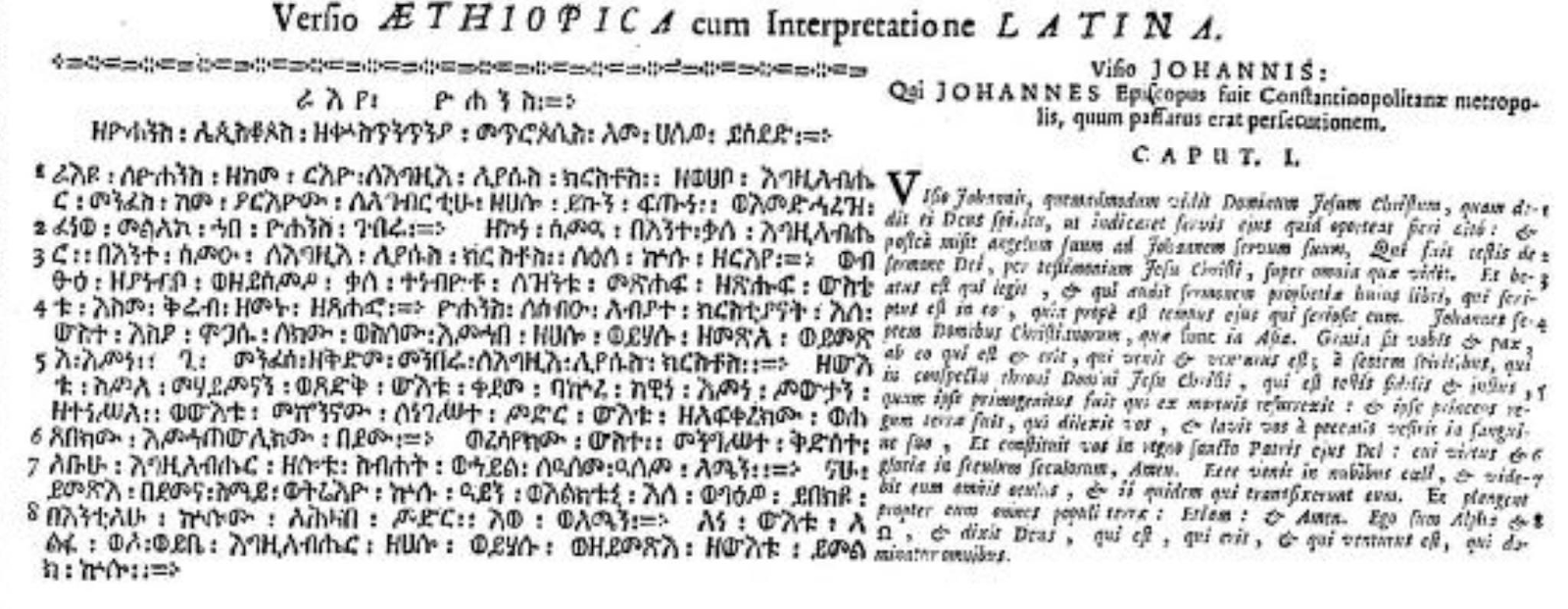
The first printed edition of any part of the Ethiopic text was a Psalter printed in 1513 (Google Books suggests 1518) and mislabeled as "Chaldee." In 1548, the New Testament except for Paul's Epistles and Hebrews were printed in Rome, with the remainder of the New Testament following in 1549 (also at Rome). Peter and company relied on three manuscripts, two from the 15th century and one from the 16th century, and they are apparently still available.
Horne says that others have described the Roman edition as "far from accurate," but criticized the report that "a large part of the book of Acts" was "filled up" "by a translation from the Latin and Greek" (pp. 316-17).
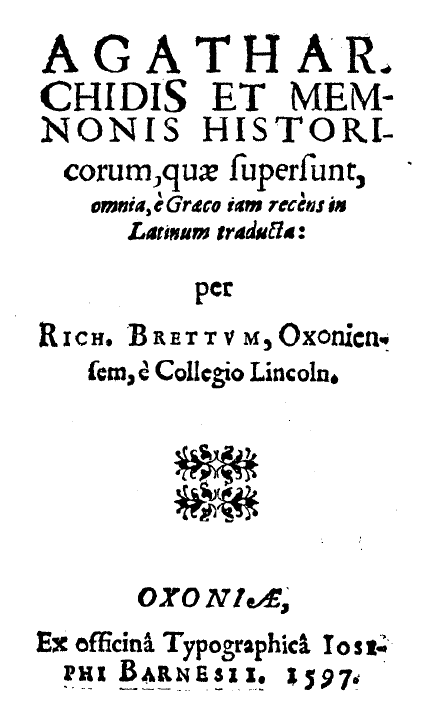
Walton's Polyglott (1652) provided an Ethiopic text corresponding to the Roman edition but with "all the former errors retained and new ones ... introduced." (p. 317) It also included a Latin translation, which Horne criticizes as being "far from accurate." Christoph August Bode (around 1750) produced an allegedly improved Latin translation of the same Ethiopic text.
About 70 years later, in 1826, Platt printed the Gospels from a collation of manuscripts, followed by the remainder of the New Testament in 1830. Platt's edition, however, was not intended as a critical edition, but merely to give the Ethiopians the best printed text "as could be conveniently done" (p. 317). Apparently some of his notes were provided, but only as far as the Gospels are concerned.
Horne believes that the Ethiopic is a direct translation of the Greek, but that the translator "could not have been a Greek himself" (p. 318), because of a series of translation errors he notes, which suggest a less than perfect understanding of Greek (see p. 319).
Horne states: "It can be no cause for surprise that this version, made by such an incompetent translator, should often be very poor and incorrect." (p. 319) Horne indicates that the Gospels represent the best work of the translation. Horne quotes Platt as saying: "What gives it the appearance of a loose and paraphrastic translation is, that it contains so many repetitions, continually representing the same phrase by two different expressions immediately succeeding one another; and when these are not connected together by the requisite intermediate particles, of course a great confusion is introduced." (p. 320) There is even some suggestion of different versions coming together, although Horne dismisses this notion.
Horne suggests that the translation may be the work of different translators, arguing: "the latter part is so much more paraphrastic than the Gospels, and shows such a general incompetence, that it looks as if it had originated with a more recent hand, perhaps the reviser of the Gospels." (p. 320)
Horne characterizes the text as "mixed" (i.e. both Byzantine and Alexandrian readings). Moreover, the version seems to be of interest on the question of the long ending of Mark.
Horne notes that the use of the Ethiopic version for textual criticism began "(or nearly so)" with Walton's Polyglott, as the Latin translation made the text accessible. Based on my own notes, it seems that Owen and Gill make use of the Ethiopic in their commentaries (presumably via the Polyglott), but that there does not seem to have been much scholarly use of it before then (frankly, I have yet to see evidence of any scholarly use of it before the Polyglott).
Horne, writing in 1856, has only brought us up to the time of Platt. Here's my more encompassing history of the relevant progress of Ethiopic scholarship, certainly not exhaustive, but hitting some high points:
Hayyim ben David Schwartz (1490-1549)
- Psalterium in Quatvor Linguis Hebraea Graeca Chaldaea Latina. Edited by Johann Potken, with the assistance of Johann Soter (1518?)
Tasfa-Seyon (aka "Brother Peter the Ethiopian"), Tanse'a-Wald (aka Paulus), and Za-Sellase (aka Bernardus) (fl. 1548)
- Testamentum Nouum cum epistola Pauli ad Hebreos tantum, cum concordantijs euangelistarum Eusebij & numeratione omnium verborum eorundem. Missale cum benedictione incensi ceræ ... Chaldea, quæ omnia frater Petrus Ethyops ... imprimi curauit (link)
Brian Walton (1600-1661)
- Biblia Polyglotta (1654 to 1657)(link - see vol. 10, 1657)(Dudley Loftus of Dublin translated into Latin, and Edmund Castell revised)
C.A. Bode (1722-96)
- Gospel secundum Matthaeum ex versione Aethiopici interpretis in Bibliis polyglottis Anglicanis editum, cum graeco ipsius fonte-studiose contulitatque plurimis tam exegeticis quam philologicis observationibus textum partim, partim versionem illustravit . Hall 1749. (link)
- Novum NJ Ch. Testamentunn, ex versione aethiopioi interpretis in bibliis polyglottis anglicanis editum, ex aethiopica lingua in latinam translatum. T.ll. Brunsv. 1752–55. (vol. 1)(vol. 2)
Thomas Pell Platt (1798-1852)
- Novum Testamentum Domini Nostri et Servatoris Jesu Christi Aethiopice. Ad codicum manuscriptorum fidem (1830) (link)
August Dillmann (1823-1894) German orientalist. He is well known as a commentator, but for our purposes, his great contributions relate to the Ethiopic language:
Marcel Cohen (1884-1974) French, but expert in Semitic languages, especially Ethiopic (link to Wikipedia), whose works include:
- 1921: "La prononciation traditionelle du Guèze (éthiopien classique)", in: Journal asiatique Sér. 11 / T. 18. (link)
- 1924: Le système verbal sémitique et l'expression du temps. Paris: Leroux. (link)
Wolf Leslau (1906-2006) originally Polish, but expert in Ethiopian languages (Wikipedia) author of (among many others):
- 1987: Comparative dictionary of Ge‛ez (Classical Ethiopic) : Gǝ‛ǝz-English/English-Gǝ‛ǝz with an index of the Semitic roots. Wiesbaden: Harrassowitz, xlix + 813 p. (link)
- 1989: Concise dictionary of Gǝ‛ǝz (Classical Ethiopic). Wiesbaden: Harrassowitz, 247 p.
Leslau brings us up to near the end of the twentieth century (he was naturally less active in his 90s). I'm not sure who to name as the current leading light in Ethiopic studies. However, I am appreciative of the following contemporaries:
- Monica Devens
- TraCES-Lexicon project (link to project)
- Concordance of the Ethiopian Bible (as of Apr 25, 2021)
- Concordance of the Acts, Catholic Epistles and Apocalypse (link)
- Concordance of the four Gospels (link)
- Concordance of the Pauline Epistles (link)
- Concordance of Genesis, Exodus, and Leviticus (link)
- Concordance of Numbers and Deuteronomy (link)
- Daniel de Caussin
- The Bible in ግዕዝ - Ge'ez (Ethiopic)(link)
- Ge'ez Bible, (Genesis through Ruth plus the Psalms) (link)
- Curt Niccum
- Apokalypse Now: The Ethiopic Version of Revelation Fifty Years after Hofman (2017)
- Honorable Mention (not contemporary):
- Ethiopic Grammar, With Chrestomathy and Glossary, By Samuel Alfred Browne Mercer · 1920 (link)
Additional details may be found in Bruce Metzger's "The Early Versions of the New Testsament: Their Origen, Transmission, and Limitions" (1977), beginning at p. 215.
From my standpoint, the Ethiopic text poses a number of challenges. First, the Ge'ez character set itself provides a hurdle. There are some similarities of shape with a Paleo-Canaanite script (it is apparently derivative of Ancient South Arabian), and similar names and sounds of many of the characters, and the use of vowel markings on the consonants is mostly regular enough to allow for a reasonable learning curve, particularly with someone already familiar with Greek and Hebrew.
To complicate matters, some Ge'ez reference materials for Western/European readers attempt to overcome the character hurdle by transliterating to Latin letters. Some of these transliterations are straightforward, others less so. While a technique of looking for matching characters can allow comparison of reference materials without learning the character set, the use of transliteration in some reference materials can defeat this. On the bright side, the shapes of the Ge'ez characters in print is largely stable since the 16th century. Moreover, the inclusion of Ge'ez characters in the Unicode set (probably because of their use in modern Amharic) promotes the use of digital tools without the requirement of transliterating or using elaborate font techniques.
To this, add the complexity of the language itself, which uses both prefixes and suffixes to perform declension (if one can call it that) and conjugation, but also to add conjunctions and prepositions. Thus, parsing the language can be difficult.
In some ways, one might observe that these difficulties are not necessarily more than a language like Greek or Hebrew, for a native English speaker. That said, there are vastly more resources available to English speakers for those two languages, because of their significance as the original languages of Scripture.
By way of example, consider how the second person singular masculine is indicated by a suffix ከ (sometimes transliterated as kä or ka) as opposed to the second person singular feminine, ኬ (ki or kee). As you may notice, the difference between ka and kee is the difference between the kaf character with no vowel modification and the kaf character with a vowel modification in the lower right corner (fifth form out of seven forms that a kaf can take).

Interestingly, Ge'ez numbers seem to be borrowed Greek numbers, perhaps via Coptic.
However, the point of this article is not to be a primer on Ge'ez, but merely to provide some background.
Hofmann's "Die äthiopische Übersetzung der Johannes-Apokalypse – Textus" (CSCO 281; Scriptores Aethiopici 55), Leuven 1967, seems to be the most recent critical text of Apocalypse, based on about 26 manuscripts. Since that time, the number of known manuscripts has risen to over a 100, and a few of the manuscripts are potentially even older than those used by Hofmann. Nevertheless, as of 2019, it appears that the scholarly consensus is this: "Hofmann’s Ethiopic version of the Apocalypse remains insufficient for determining the Greek Vorlage behind the Ethiopian version." (source)
Nevertheless, Metzger (1977) (p. 232) notes that John Mill in 1707 identified some Ethiopic readings in which the Latin translation of the Ethiopic found in Walton's Polyglot agree with codex Alexandrinus, and in a few places sided with the Ethiopic either alone or with very few other witnesses. At Revelation 16:5, Mill has:
I've included his notes at Revelation 16:4 as well as 16:5, just to show that Mill did consult the Ethiopic in Revelation 16, but did not cite it for a textual variant here. (
Link to Mill - 1710, which is an expansion of the 1707 edition with the further work of Ludolph Kuster)
Metzger (1977)(p. 232) also states that Hoskier found more than fifty readings in the Pauline epistles (excluding Hebrews) where the Ethiopic is nearly alone in agreeing with P46.
Metzger has a specific section, beginning at p. 236, on the Book of Revelation. He concludes on the basis of Hofmann's work that all the manuscripts correspond to a single Greek Vorlage. Hofmann, per Metzger, indicates that the Apocalypse was translated between 550 and 650 by a different translator from the Gospels. However, Metzger (p. 237) states: "It is to be regretted, therefore, that we no longer have his rendering in its original form, for what the manuscripts offer is a text that has been greatly contaminated by various influences over the centuries, including Schlimmverbesserungen, revisions, and alterations made on the basis of other versions." Schlimmverbesserungen literally means "bad improvements." Those "other versions" changes seem to have come from the Coptic and Arabic versions.
Within Metzger's book, Hofmann himself offers a chapter section on "Limitations of the Ethiopic in Representing Greek," beginning at p. 240. The limitations he identifies are phonetics (which should not affect our study of this verse, as no transliteration questions are present), morphology (a bigger issue), and syntax (which Hofmann sees as relatively slight). Under the topic of morphology, Hofmann identifies numerous issues, such as Ethiopic having only masculine and feminine but not neuter, and Ethiopic lacking both definite and indefinite articles. Of particular interest to us are verb forms, but Hofmann tells us (p. 244): "Ethiopic is capable of expressing only a very limited measure of the information that is contained in a Greek verb-form." More specifically, when it comes to the question of Time of the verb: "The Ethiopic verb has no reference to time. It indicates only whether an action is regarded as complete (Perfect) or incomplete (Imperfect)." (p. 245)
(p. 245)
Perhaps even more significant for us, "εἶναι" (to be) has its own issues. Hofmann explains: "Ethiopic lacks a precise equivalent for εἶναι used as a copula" (p. 246). Hofmann explains (pp. 246-7):
Likewise, Hofmann explains that there are limitations on rendering participles from Greek to Ethiopic, except for the perfect passive participle (pp. 247-8).
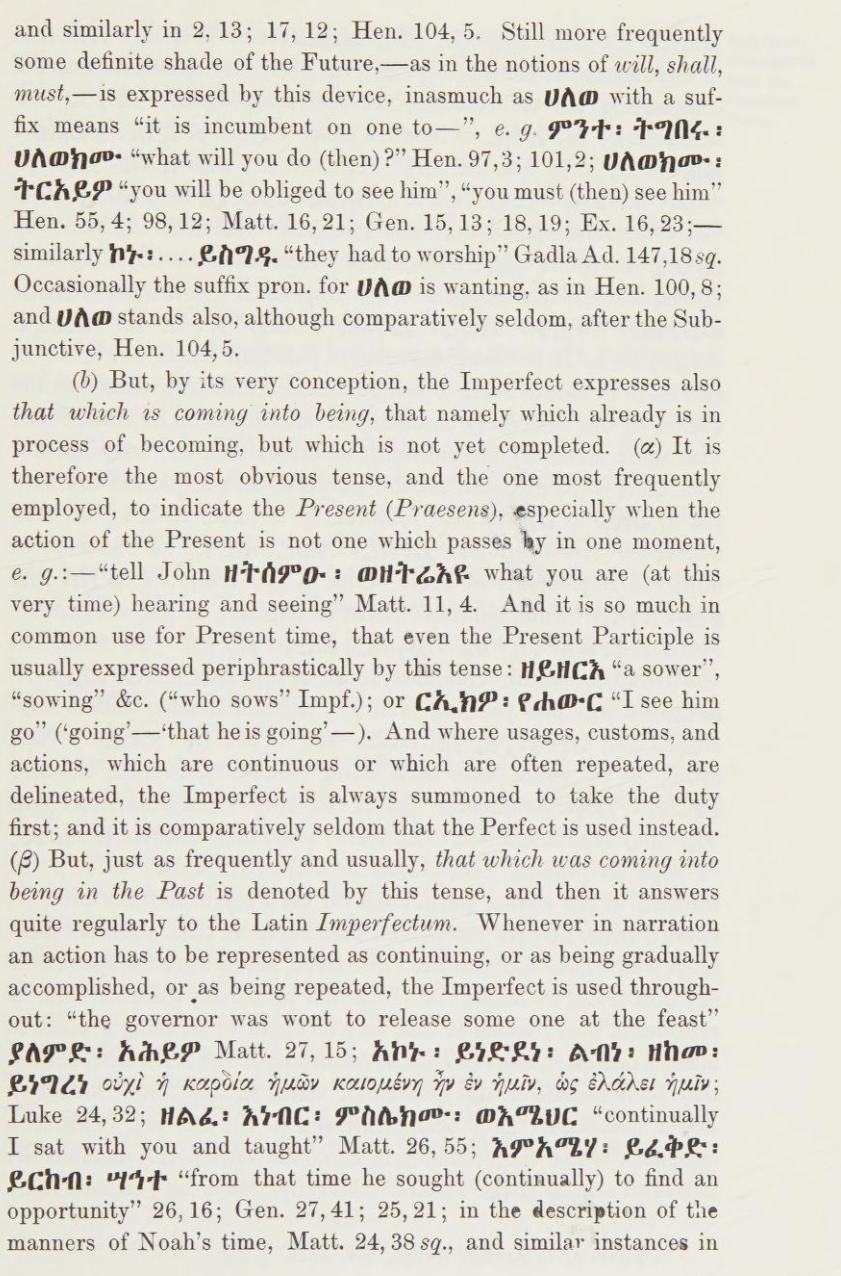
Dillmann himself (in Chricton's translation) explains the issues with time of verbs at
pp. 166-72 of his Grammar:
Likewise, issues associated with HLW and KN are mentioned at pp. 499-500:


Niccum (2017) describes the substantial work that has been done since Hofmann, including redating of manuscripts, but also finding numerous additional manuscripts. Niccum states (p. 217): "Hofmann’s verdict that none of the extant witnesses examined preserves unadulterated the text of the initial translation, the so-called Axumite Bible, still holds true." Niccum says that Arabic influence is present in "every manuscript" (p. 217).
The Ethiopic Text of Revelation 1:4, 1:8, 4:8, 11:17, and 16:5
There is a similarity in the original Greek among five passages in Revelation: Revelation 1:4&8, 4:8, 11:17, and 16:5, in that each describes God with reference to multiple participles of εἶναι with different times. Accordingly, particularly given the difficulty of translating between Greek and Ethiopic when it comes to participles, times, and specifically εἶναι, it makes sense to consider these passages together.
Except in the case of Revelation 16:5, I am copying only the portion translating the Greek being verb participles together with a translation of "is to come" (or the like) if included.
1548 "Peter the Ethiopian" Bible
Rev 1:4 (left page, left column, mid way down) (f. 101/p. 252)

Rev 1:8 (left page, right column, near top)(f. 101/p. 252)

Rev 4:8 (left page, right column, slightly above middle)(f. 103/p. 256)

Rev 11:17 (right page, left column, middle)(f. 106/p. 262)

Rev 16:5 (right page, right column, lower middle)(f. 106/p. 262)

Walton's Polyglot (1657)
Revelation 4:8 (p. 943)

Revelation 11:17 (p. 957)

Revelation 16:5 (p. 965)

Platt (1830)
Rev. 1:4(p. 696)(right)

Rev. 1:8 (p. 698)(left)

Rev. 4:8 (p. 704)(right)

Rev. 11:17 (p. 718) (left)

Rev. 16:5 (p. 726) (right)

Hofmann (1967)
Rev. 1:4 (link)

Rev. 1:8 (link)

Rev. 4:8 (link)

Rev. 11:17 (link)

Rev. 16:5 (link)

Summary Comparison of the Ethiopic Printed Editions
In the following, I provide a comparison amongst the Ethiopic texts of "The Bible in Ge'ez" (BG), "The Concordance of the Ethiopian Bible" (CEB), Walton's Polyglot (EP), Peter the Ethiopian's Bible (1548), Platt's 19th century printing (Platt), and the main text of Hofmann's critical text (Hofmann).
Revelation 1:4
- Rev. 1:4 (BG)
- Rev. 1:4 (CEB)
- Rev. 1:4 (WP)
- Rev. 1:4 (1548/9)
- Rev. 1:4 (Platt)
- Rev. 1:4 (Hofmann)
The differences amongst these versions are:
- Platt and Hofmann omit one word (more discussion of this below);
- Walton's contains a typo (transcription error - or perhaps my transcription error in reading Walton - the text base of the letter is a bit fuzzy) in the form of an unvocalized letter in one word; and
- Walton's, following the 1548, omits a prefix in one word.
Revelation 1:8
- Rev. 1:8 (BG)
- Rev. 1:8 (CEB)
- Rev. 1:8 (WP)
- Rev. 1:8 (1548)
- Rev. 1:8 (Platt)
- Rev. 1:8 Hofmann
The differences amongst these versions are:
The Bible in Ge'ez and the Concordance add one word (apparently to harmonize with 1:4). More discussion on this below.
Revelation 4:8
- Rev. 4:8 (BG)
- Rev. 4:8 (CEB)
- Rev. 4:8 (WP)
- Rev. 4:8 (1548)
- Rev. 4:8 (Platt)
- Rev. 4:8 (Hofmann)
For once, there seems to be perfect agreement amongst these print versions. Notice, however, that the overall phrase has shrunk to just two words.
Revelation 11:17
- Rev. 11:17 (BG)
- Rev. 11:17 (CEB)
- Rev. 11:17(1548)
- Rev. 11:17(WP)
- Rev. 11:17 (Platt)
- Rev. 11:17(Hofmann)
The differences amongst these versions are:
- The transcription error in Walton's (or perhaps my error of sight) returns for one letter;
- Walton's, following the 1548, and Platt omit a suffix in one word; and
- Platt, the BG, and CEB have a substituted prefix in one word.
Revelation 16:5
- Rev. 16:5 (BG)
- … ጻድቅ አንተ እግዚኦ ወራትዕ ዘሀለውከ ወትሄሉ ወከመዝ ኰነንከ
- Rev. 16:5 (CEB)
- … ጻድቅ አንተ እግዚኦ ወራትዕ ዘሀሎከ ወትሄሉ ወከመዝ ኰነንከ
- Rev. 16:5 (WP)
- … ጻድቅ አንተ እግዚኦ ወራትዕ ዘሀሎከ ወትሄሉ ከመዝ ኰነንከው
- Rev. 16:5 (1548/9)
- … ጻድቅ አንተ እግዚኦ ወራትዕ ዘሀሎከ ወትሄሉ ከመዝ ኰነንከው
- Rev. 16:5 (Platt)
- … ጻድቅ አንተ እግዚኦ ወራትዕ ዘሀለውከ ወትሄሉ ወከመዝ ኰነንከ
- Rev. 16:5 (Hofmann)
- … ጻድቅ አንተ እግዚኦ ወራትዕ ዘሀሎከ ወትሄሉ ከመዝ ኰነንከ
For once, there is a non-alignment between the GB and CEB. It was only this difference that led me to list them separately. The differences amongst these versions are:
- Platt and BG provide a different vocalization and suffix in one word;
- Platt and BG, joined by CEB, and Platt add a prefix to one word; and
- Walton, following the 1548, adds a suffix to one word.
Latin Translational Differences
There are three professional Latin translations of the text, to my knowledge:
- Loftus (provided in Walton's Polyglot 1657)
- Bode (1755) using Walton's base text with (more woodenly literal?) alternative translation in parentheses
- Hoffman (1967) corresponding to Hoffman's main text with alternative renderings in parenthesis.
That means that there is no "professional" Latin translation corresponding to Platt's text or to the BG/CEB text. While there is value to machine translation, I am not confident in the ability of machine translation to handle Ge'ez, because of the relatively small number of English-Ge'ez (and vice versa) texts upon which to train.
Loftus (1657)
Rev. 1:4 (Loftus)
... qui est & erit, qui venit & venturus est ...
Rev. 1:8 (Loftus)
... qui est, qui erit, & qui venturus est ...
Rev. 4:8 (Loftus)
... qui est, & erit.
Rev. 11:17 (Loftus)
... qui est & erit ...
Rev. 16:5 (Loftus)
Justus es Domine, et rectus, qui fuisti et eris, sic judicasti eos ...
Bode (1755)
Rev. 1:4 (Bode)

... qui fuit, et erit, qui venit, et veniet ...
Rev. 1:8 (Bode)

... qui est (fuit), et erat (erit), et qui veniet ...
Rev. 4:8 (Bode)

... qui est, et qui erat.
Rev. 11:17 (Bode)

... qui est (fuit) et erit ...
Rev. 16:5 (Bode)


iustus tu es Domine, ac rectus (incorruptus), qui es (fuisti) et eris, dum sic judicasti eos ...
Hofmann (1967)
Rev. 1:4 (Hofmann)

... qui est et erit (... qui-existit et-existet), et-qui-veniet ...
Rev. 1:8 (Hofmann)

... qui est et qui erit (qui-existit et-existet) et-qui-veniet ...
Rev. 4:8 (Hofmann)

... qui est et erit (qui-existit et-existet).
Rev. 11:17 (Hofmann)

... qui est et erit (qui-existit et-existet) ...
Rev. 16:5 (Hofmann)

iustus es (tu) domine et-rectus qui es et eris (qui-existis et-existes) sic iudicasti ...
In summary:
Rev. 1:4
- (Loftus) ... qui est & erit, qui venit & venturus est ...
- (Bode) ... qui fuit, et erit, qui venit, et veniet ...
- (Hofmann) ... qui est et erit (... qui-existit et-existet), et-qui-veniet ...
Rev. 1:8
- (Loftus) ... qui est, qui erit, & qui venturus est ...
- (Bode) ... qui est (fuit), et erat (erit), et qui veniet ...
- (Hofmann) ... qui est et qui erit (qui-existit et-existet) et-qui-veniet ...
Rev. 4:8
- (Loftus) ... qui est, & erit.
- (Bode) ... qui est, et qui erat.
- (Hofmann) ... qui est et erit (qui-existit et-existet).
Rev. 11:17
- (Loftus) ... qui est & erit ...
- (Bode) ... qui est (fuit) et erit ...
- (Hofmann) ... qui est et erit (qui-existit et-existet) ...
Rev. 16:5
- (Loftus) Justus es Domine, et rectus, qui fuisti et eris, sic judicasti eos ...
- (Bode) iustus tu es Domine, ac rectus (incorruptus), qui es (fuisti) et eris, dum sic judicasti eos ...
- (Hofmann) iustus es (tu) domine et-rectus qui es et eris (qui-existis et-existes) sic iudicasti ...
Observations:
- Latin "qui" can mean "which" or "who" (among other things) depending on the context. When I convert these Latin translations to English, I favor "which" to indicate the third person, and "who" to indicate the second person.
- Further to 1, based on the Greek manuscripts we have, we know that the original Greek uses participles with articles. By contrast, the translations use indicative verbs and pronouns (neither Latin nor Ge'ez has articles). This is not a big surprise as it pertains to the articles; even though English has articles, we use articles a bit differently from Greek. Additionally, rendering Greek participles into Ethiopic can be challenging because, as noted above, Ethiopic generally does not have equivalent participles to Greek.
- The key Latin phrases in the above translate to English as follows:
- "qui est" - "which is"
- "& erit" or "et erit" - "and will be"
- "qui erit" - "which will be"
- "qui fuit" - "which has been"
- "qui venit" - "which comes"
- "& venturus est" - "and is going to come"
- "et veniet" - "and will come"
- "qui existit" - "which exists"
- "et existet" - "and will exist"
- "et qui veniet" - "and which will come
- "et erat" - "and was"
- "et qui erat" - "and which was"
- "qui fuisti" - "who have been"
- "qui es" - "who are"
- "et rectus" / "ac rectus" - "and right"
- "eos" - "them"
- In the first four passages, third person singular (i.e. he/she/it) verbs are used, whereas in Revelation 16:5, second person singular verbs (i.e. thou/you) are used. This change in the Latin seems to accurately reflect the underlying difference in the Ge'ez.
- The reason for the longer reading of Rev. 1:4 in the Loftus and Bode translations is an extra word of Ge'ez.
- Bode has an odd inconsistency between the translation at 1:4 and at 1:8, given that the first two words (corresponding to "qui est" and "et erat" respectively) are the same in both places.
- Hofmann's "existit..." parenthetical readings provide an arguably better translation of the connotation.
- The absence of the "eos" (them) in Hofmann is due to the absence of the corresponding suffix in the Ge'ez text.
- The difference between iudicasti and judicasti is simply a question of whether to use the letter "j" in Latin, the meaning is the same either way.
In translation:
The following is an English translation corresponding to the 1548 and Hofmann (Crit.) Ge'ez texts, respectively.
Rev. 1:4 (1548) which is and will be, which comes and will come | ዘሀሎ ወይሄሉ ዘመጽአ ወይመጽእ
Rev. 1:4 (Crit.) which is and will be, and which will come | ዘሀሎ ወይሄሉ ወዘይመጽእ
I note that I selected "which is ..." rather than "which was ..." in view of the seeming preference in the variety of places and translators, although there is a sound argument for "which was" instead of "which is" as well. Likewise, while "is going to come" is also possible instead of "will come," I favor Bode's translation, which happens to align with Hofmann on this, and I attribute the difference in Loftus to a preference for the more classical Latin formation, although it might also represent the connotation of the Ge'ez better.
***
Rev. 1:8 (both) which is and will be, and which will come | ዘሀሎ ወይሄሉ ወዘይመጽእ
The Ge'ez text at Rev. 1:8 is the same (and same as the crit. Ge'ez at 1:4) and consequently the translation should be the same with the same rationale.
***
Rev. 4:8 (both) which is and will be | ዘሀሎ ወይሄሉ
Again, the translation should be the same as the words are the same. The Ethiopic omits a form of "to come" here.
***
Rev. 11:17 (both) which is and will be | ዘሀሎ ወይሄሉ
Again, the Ethiopic omits a form of "to come" here, and again the translation should be the same as the words are the same.
***
Rev. 16:5 (1548) Just you are, O Lord, and right, who are and will be, thus you have judged them | ጻድቅ አንተ እግዚኦ ወራትዕ ዘሀሎከ ወትሄሉ ከመዝ ኰነንከው
Rev. 16:5 (Crit.) Just you are, O Lord, and right, who are and will be, thus you have judged | ጻድቅ አንተ እግዚኦ ወራትዕ ዘሀሎከ ወትሄሉ ከመዝ ኰነንከ
The only difference is the final suffix, which provides the "them" in the 1548.
Comparison between Revelation 16:5 and the Ge'ez
When we try to make a comparison between the Greek at Revelation 16:5 and the Ge'ez at Revelation 16:5, let's see what happens. For the sake of completeness, I'm providing the two most likely readings based on the Greek manuscripts (reading 1 and reading 2) and the reading proposed by Beza (reading 3).
1) ὁ ὢν | καὶ ὁ ἦν | καὶ ὁ ὅσιος
2) ὁ ὢν | καὶ ὁ ἦν | ὁ ὅσιος
3) ὁ ὢν | καὶ ὁ ἦν | καὶ ὁ ἐσόμενος
In the other places that "ὁ ὢν καὶ ὁ ἦν" appear (Rev. 1:4, Rev. 1:8, and Rev. 11:17) and in the place where "ὁ ἦν καὶ ὁ ὢν" appears (Rev. 4:8), the Ge'ez uniformly translates this as "ዘሀሎ ወይሄሉ" ("which is and will be"). The only difference with the Ge'ez in Rev. 16:5 (from the previous instances) is that the Ge'ez adds the pronoun suffix kaf (ከ) to the first word, which seems to reflect the "εἶ" (you [masculine] are) immediately before this text.
It's not an exact translation of the underlying Greek any of the three places, but this can be explained because of difficulty in handling forms of "to be," participles, and times in Ge'ez when translating from other languages.
Based on this analysis, the phrase "ዘሀሎከ ወትሄሉ" here does not distinguish amongst the three candidate Greek readings.
The Ge'ez word that helps us distinguish amongst these options is "ወራትዕ," which is composed of the conjunction prefix "ወ" (and) and ራትዕ ("right").
The Comparative Dictionary of Ge'ez offers the following entry for this word (pp. 475-76):


Note that this word can have a range of meanings. In this case, I believe that the translator from Greek to Ge'ez thought that the Greek was to be understood in terms of a phrase, "καὶ ὁ ὅσιος ὅτι ταῦτα ἔκρινας" (and the Holy because you have judged thus), and therefore translated ὅσιος as "right"/"true" or even "righteous" in view of correctly judging.
It's not an exact translation, under any analysis. However, if this analysis is correct, and I believe it is, the Ge'ez here is a witness to reading (1) above, namely "ὁ ὢν καὶ ὁ ἦν καὶ ὁ ὅσιος." While this is not the NA28 reading (the NA28 omits the second καὶ), it is supportive of a variant that exists in a substantial minority of the Greek manuscripts.
Conclusions
I recognize that TR defenders will not welcome this analysis. While it is true that the literal Ge'ez includes a future form of the verb "to be" (i.e. ወትሄሉ), it is inappropriate to rely on this as allegedly serving to witness to Beza's text. The best understanding of the text to which it witnesses is "ὁ ὢν καὶ ὁ ἦν καὶ ὁ ὅσιος." It is not a literal translation of that underlying text, but there are excellent reasons why it is not a literal translation of that underlying text, reasons grounded in the differences between Ge'ez and Greek, and a general willingness of the Ge'ez translator to try to convey the sense without being concerned with being overly literal.
TR advocates will not be impressed by the fact that the Ethiopic at Rev. 11:17 witnesses the shorter majority/critical text. Likewise, TR advocates will not adopt the shorter reading at Rev. 4:8 found in the Ethiopic text.
Ultimately, while interesting, the Ethiopic text is not dispositive for New Testament textual studies. There remains work to be done in advancing Hofmann's work from the 1960s using the new manuscripts that have come to light since then. Nevertheless, I do not anticipate seeing a significantly different result as to this specific reading.
Additionally, I add that the "literal translation" sword has two edges. While ወትሄሉ is a future form of the verb "to be," it is not literally "ὁ ἐσόμενος," even though that also includes a future form of the verb "to be."
Finally, I should add that it is unreasonable to suppose that Beza had access to and considered the 1548 Ge'ez text. Peter the Ethiopian (aka Tesfa-Sion) acknowledged the challenges of printing the text (“those who composed it could not read Ethiopic, and we who read Ethiopic knew not how to compose.”) but did a remarkably good job considering. While it is apparently true that both Gelawdewos, King of Ethiopia, and the pope of Rome consented in this project, there is nothing to suggest to us that scholars such as Beza had access to the readings of this text or consulted it for their edition. Indeed, I would challenge anyone who thinks otherwise to point to a single instance where Beza cites to the Ethiopic at any verse.
Appendix I
The above conclusions are further supported by Dillman's Lexicon Linguae Aethiopicae (available here).
(
col. 4)
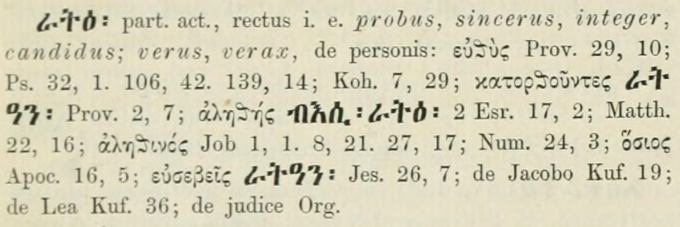
(col. 291)
(
col. 811)
Appendix II
As of October 31, 2023, Munster's site provides the following note regarding Beza's conjecture:
In Beza’s hand copy (b3052; p. 647), ὁ ὅσιος is underlined, and ὁ ἐσόμενος entered in the margin.
Though Beza’s annotation states the reading is introduced “ex vetusto bonae fidei manuscripto codice” (“from an old and reliable manuscript”), there is no such Greek manuscript here. Beza probably made an error, mistaking his own conjectured reading for an attested one.
The conjecture is adopted in the Greek text and the Latin translation.
There is no versional evidence for the conjecture. The Ethiopic simply omits ὁ ὅσιος (at least in most manuscripts), and has only two elements (ዘሀሎከ ወትሄሉ ). The Ethiopic omits the equivalent of ὁ ἐρχόμενος in Rev 4:8 and 11:17, but it does not do so in Rev 1:4 en 1:8.
Wettstein (NTG 2) mentions a “Codex Stephani,” but this merely reflects his (incorrect) inference from Beza’s annotation. This inference is followed by other such as Huyshe (s30566).
For references to Erasmus see cj16082; s28499.
While various aspects of this note are outside the scope of my research above, I would simply note that I must respectfully disagree with the statement: "The Ethiopic simply omits ὁ ὅσιος (at least in most manuscripts), and has only two elements (ዘሀሎከ ወትሄሉ )." A better characterization is that the Ethiopic is a witness to "ὁ ὢν καὶ ὁ ἦν καὶ ὁ ὅσιος" as it uses the same words used to translate "ὁ ὢν καὶ ὁ ἦν" (in Rev. 1:4, 1:8, and 11:17, and the reversal of the phrase at Rev. 4:8) and because it appears to translate "καὶ ὁ ὅσιος" by "ወራትዕ" as testified by Dillman and as argued above.
The presence of an additional word for holy in some manuscripts, as noted by Hofmann, is best explained by the tendency to reduplicate words (compare the expansion of "coming" statement in Rev. 1:4) and/or by a secondary corruption from the Arabic by a translator familiar with Ge'ez and Arabic, but without access to the Greek original. Multiple redactions based on the Arabic text are noted by Metzger, although it remains for further study (from this standpoint of this post) whether the specific manuscripts with the added word are the later and further revised manuscripts.
On the latter premise (Arabic-Ge'ez corruption), the editing translator recognized that the Ge'ez word equivalent to "righteous" was an inadequate equivalent to the Arabic word for "holy". On the former premise (Greek-Ge'ez false correction), the editing translator recognized that the Ge'ez word equivalent to "righteous" was an inadequate equivalent to the Greek word for "holy" and consequently added a further word to expand the text and capture the full meaning.
A further explanation (also Greek-Ge'ez false correction) is that the editing translator mistook the "just and righteous" as an Ethiopic expansion and viewed "holy" as omitted in his exemplar, and therefore intended to restore what he thought had been omitted.