Showing posts with label Kenneth Wilson. Show all posts

Friday, December 02, 2022

Index Page for Responses to Ken Wilson's "Augustine's Conversion from Traditional Free Choice to 'Non-Free Free Will'"

Dr. Kenneth M. Wilson wrote a book (2018), which is apparently an edition of a doctoral thesis he defended at Oxford (2012).  The book, published by the respected publisher Mohr Siebeck as part of the reputable series, Studien und Texte zu Antike und Christentum (vol. 111), has a number of issues.  Among the issues are the title: Augustine's Conversion from Traditional Free Choice to "Non-Free Free Will," which has been abbreviated to "Augustine's Conversion" for the spine of the book.

Others have been responding for longer than I have.  My own responses so far have focused on Section A of Chapter 3 of the book, in a section on Origen.  The format of the following index is to link the Youtube version of the review episode, together with a brief description of the discussed matter.  After that I have identified the Origen source material discussed in the episode, for those interested in Origen studies.

Episode 1 - First Three Paragraphs (p. 65)

Princ., Pref. 5; cf. 1.6.2

Episode 2 - Next Few Paragraphs (pp. 65-66)

P. Arch. 3.1.6

P. Arch. 3.1.7; cf. 3.1.10

Philoc. 27.10-12

Episode 3 - Philocalia Discussion (p. 66)

Somewhat tangential to the discussion, this is an episode just discussing the work, Philocalia, which was composed by others repurposing Origen's work.

Episode 4 - "Saturates His Writings"? (p. 66)

Hom. Jer.20.2

Philoc. 27.2

De Princ.2.9.6-7

Episode 5 - "Grace as Merit"? (p. 66)

Comm. Rom. 3.9

P. Arch. 3.1.12; Cels. 6.68

Episode 6 - "Grace vs. Rewards" (p. 66)

Comm. Rom. 4.4-5

Episode 7 - "Higher Honor and Rewards" (p. 66)

Comm. Rom. 8.7.4; 8.7.7

Exhort. 14

Episode 8 - "Unilateral Divine Infusion" (p. 66)

P. Arch. 3.1.5 

Episode 9 - "Scheck concludes without warrant ... Quite to the Contrary" (pp. 66-67)

Scheck (2001), 31 (we considered 30-32)

Comm. Rom. 4.5.3

Comm. Rom. 4.5.1

von Harnack (1886; repr., 1990), 551, fnt. 2

Harnack Material, Lehrbuch der Dogmengeschichte, Bd.1, Die Zeit der Alten Kirche (English version) (1886 German version)

Episode 10 - "Contra heretics claiming God directly influences minds or 'wills,' Origen ..."

First Principles, Book Three, Chapter 1 (From Latin) (From Greek)

P. Arch. 3.1.16; cf. 3.1.21 on 2 Tim 2.20

P. Arch 3.1.17

P. Arch 3.1.21 

Episode 11 - "In context, Origen refutes the idea that foreknowledge is a causative ..." (pp. 67-68)

Cels. 6.45

Cels. 2.20

Philoc. 23.7  (Commentary III on Genesis, II, 3; but Philoc. 23.12 and following are from Cels. 2) (Sources of the Philocalia) (via Archive.org)

Episode 12 - "Origen also corrects an error in the prevailing pagan and heretical beliefs ..." (p. 68)

Princ. 3.2.3

P. Arch. 3.1.14 (From Latin) (From Greek)

Philoc. 25.2

Episode 13 - "Concurring with prior Christian authors ..." (p. 68)

O'Leary (2004), 115 (Alternative Online edition); cf. Cels. 6.55. (Internal Citations: ComMt 10.11; PArch 3.3.5; Philoc. 23; CCel 3.66-69 (Ch. 66, Ch. 67, Ch. 68, Ch. 69)


McIntire (2005), vol.5, 3206-3209  (Online edition)


Episode 14 - "Heretics had proof texted Phil 2.13 ..." (p. 69)

P. Arch.3.1.20 (Latin here)

P. Arch.3.1.21 (Latin here) (Previously Discussed in Episode 10)

P. Arch.3.1.18 (Latin here)

Planned Material

Episode 15 - "Foreknowledge of human choice results in predestination. ..." (p. 69)

Comm. Rom.7.8.6
Comm. Rom.7.8.2-3
Comm. Rom.7.8.7
Comm. Ev. Jo.6.59
Comm. Rom.3.8.13
Comm. Rom.4.11.1
Cels.5.16
Comm. Rom.8.11.5
Comm. Rom.7.16.8
Alviar (1993), 39 -- Alviar, J. Jose Klesis: The Theology of the Christian Vocation according to Origen. Dublin: Four Courts Press, 1993.


Episode X - Tangent Episode for Discussion of Material Relied upon by Harnack (discussed in Episode 9) in the section relied on by Wilson

In Ezech. hom. I., c. II

Orig. in Matth. series 69, Lomm. IV

in Rom. IV. 5, Lomm. VI 

in Rom. IX. 3, Lomm. VII


Friday, August 12, 2022

Irenaeus and the Manichaeans?

Dr. Kenneth Wilson is a contributor to the critique of Calvinism that I'm currently reviewing.  I'm not up to Wilson's chapter yet in my review, but Thuyen Tran called my attention to a rather glaring error in his chapter/article of the book, and an indication that this was not the first time this error had been seen from Wilson.  The error identified was related to a claim by Wilson regarding Irenaeus and the Manichaeans.

In an interview video that Dr. Leighton Flowers posted on February 26, 2019 (link to a few seconds before relevant point of video), Wilson made an interesting claim:

LF: Now did you, in your preparations, did you read through many of these other early church fathers as well?

KW: I did.  I have many chapters in my dissertation discussing their views, all talking about original sin, about freedom of will, and the earliest Christians - those guys you just mentioned - Irenaeus, Tertullian and Clement - they're all arguing against Stoics, and against Manichaeans and Gnostics. 

Manichaeans were followers of Mani, a 3rd century Persian, who was born around 216 and died around 276.  Tertullian died around 220.  Irenaeus died around 202. Clement of Rome is believed to have died around 100, while Clement of Alexandria died around 215.  None of them had any interaction with Mani or Mani's followers or Manichaeism.

By itself, this off-hand response during a video interview is not particularly troubling.  People make slips of the tongue all the time, and while the listed early Christians didn't interact with Mani, they did interact with other heretical, quasi-Christian, and non-Christian groups.

More troubling, though, was the following assertion Wilson makes in the critique to Calvinism edited by Allen and Lemke, and published by B&H academic:

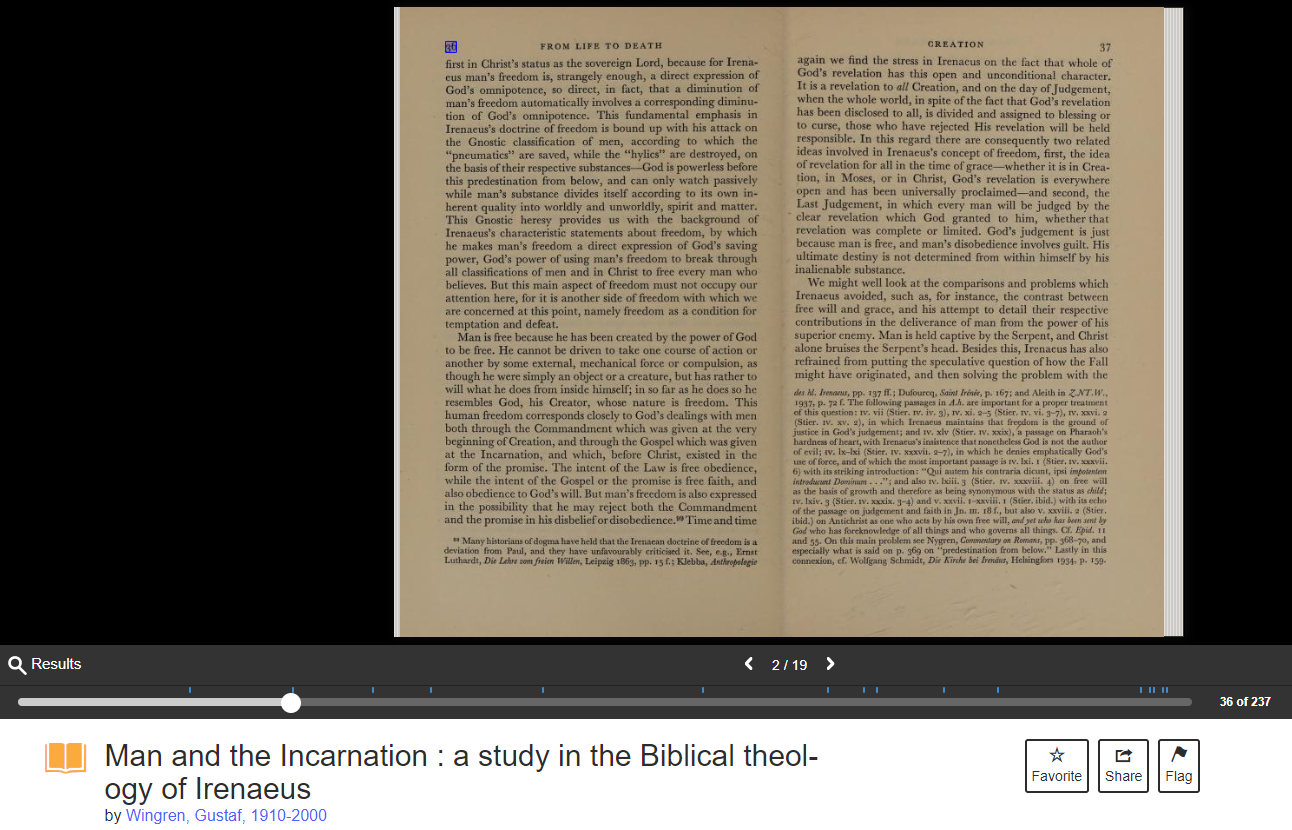
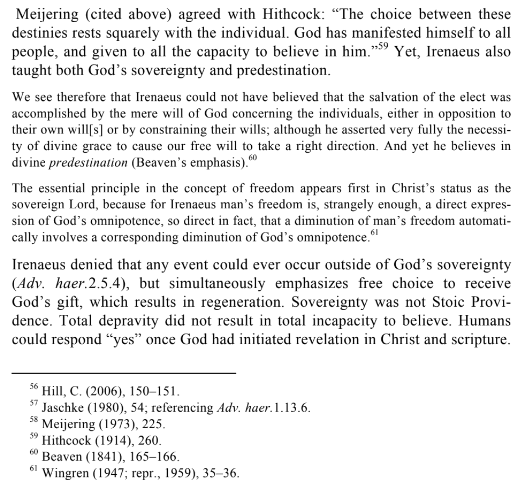
For example, Irenaeus (ca. AD 180) had argued that the Manichaean god was puny because he could only achieve his goals by micromanaging all events and persons. In contrast, the Christian God allowed humanity freedom, yet was so powerful he could still accomplish his plans.  It requires a more omnipotent and sovereign God to allow human freedom. "The essential principle in the concept of freedom appears first in Christ's status as the sovereign Lord, because for Irenaeus man's freedom is, strangely enough, a direct expression of God's omnipotence, so direct in fact, that a diminution of man's freedom automatically involves a corresponding diminution of God's omnipotence." (FN17 Gustaf Wingren ... Man and the Incarnation ... pp. 36-37)

One reason this is troubling because obviously Irenaeus was not responding to Mani or the Manichaean god.  He correctly notes the approximate date of Irenaeus's Against Heresies.  On the other hand, he did not seem to recognize that this was almost a century before the rise of Mani's religion.

Another reason this is troubling is that it is not a correct analysis of Irenaeus.  Obviously, interpretations of Irenaeus differ, but even Wilson's source, Wingren, acknowledges that the position that Irenaeus was responding to was not one of divine micromanagement, but exactly the opposite.

Wingren states, in the sentence immediately following that quoted by Wilson: 

This fundamental emphasis in Irenaeus's doctrine of freedom is bound up with his attack on the Gnostic classification of men, according to which the "pneumatics" are saved, while the "hylics" are destroyed, on the basis of their respective substances--God is powerless before this predestination from below, and can only watch passively while man's substance divides itself according to his own inherent quality into wordly and unworldly, spirit and matter. 

Thus, Irenaeus was not opposing an Augustinian or Calvinistic conception of God's providence, but a position in which God is unable to control.  Here's a copy of the relevant pages:

Finally, this is troubling because it appears to be the result of simply recycling source material.  This same quotation from Wingren is found in Wilson's book, which itself is apparently essentially his dissertation:


K. Wilson, Augustine's Conversion from Traditional Free Choice to "non-free Free Will" A Comprehensive Methodology, p. 54 (2018).

While I appreciate Wilson's attempt to contribute to patristic scholarship, I would encourage him not only to correct this error in any subsequent edition of "Calvinism: a Biblical and Theological Critique," but also to correct his underlying error of thought regarding the relationship of Irenaeus to Augustinian thought.

Friday, April 24, 2020

Kenneth M. Wilson's "Augustine's Conversion from Traditional Free Choice to 'Non-Free Free Will'" - Calvinism Discussion

Since one vocal contra-Calvinist has been relying on Dr. Wilson's materials to bash Calvinism, it makes sense to discuss every single place that Dr. Wilson mentions John Calvin in his book.

Based on a text search for "Calvin" within the book, there is exactly one hit:
Kolakowski argues that the Church's repeated anathemas on the teachings by Luther, Calvin, and the Jansenists also condemned Augustine's novel teachings on 'double predestination,' total incapacity of 'the will' for good, irresistible grace, "non-free free will," and limited atonement.[12]
[fn 12: Kolakowski (1995), 3-33.]
Leszek Kołakowski (1927-2009) was a Polish anti-Marxist philosopher. Kolakowski's "God Owes Us Nothing: A Brief Remark on Pascal's Religion and on the Spirit of Jansenism," is evidently the work Wilson was citing. He apparently refers to Kolakowski's work a couple more times.

Kolakowski's book begins with part one, "Why did the Catholic Church Condemn the Teaching of Saint Augustine?" (pp. 3-112) The sub-section boldly titled, "What Was Wrong with Augustine?" begins at page 30.

I couldn't figure out from looking at Kolakowski's material what Wilson's quotation mark convention meant. It feels like the single marks are non-adoptive quotations of individual words or phrases (aka scare quotes) and double quotations are Wilson's own paraphrase. In any event, the usage is - at best - distracting.

At page 5, Kolakowski fires this salvo:

This is an odd paradox for the "provisionalist" crowd, who don't want to be considered Pelagian, but nevertheless don't want to accept Augustine.

From what I can tell, Kolakowski does not opine on whether Augustine was the originator of the doctrines he taught. Kolakowski, at page 4, explains:

All of these, per Kolakowski, "defined their doctrinal stance first by giving their own interpretation of the canonical texts, in particular Paul's letter to the Romans...."

In any event, I'll end this meandering post here.