1) Marriage is for both believers and unbelievers.
2) Marriage is not a sacrament, although marriage does provide a spiritual illustration.
3) In Scripture, particularly in the Old Testament, the civil magistrate is given jurisdiction for policing marriage including criminal prosecution of adultery.
4) The general equity of the OT civil law on marriage is at least that the civil magistrate has authority and duty to regulate marriage.
5) Jesus himself makes a distinction between moral principles around marriage and civil law rules. For example, Jesus explains that the moral principles around divorce are more strict than the OT civil law.
6) We Christians have to obey both the moral rules and the civil law rules (unless doing the latter comes into conflict with the former). So, even if we live in an "easy divorce" location, we should not treat marriage lightly.
7) If you're a copy-and-paste theonomist who thinks the only legitimate civil laws are those of the Torah, keep in mind that you are going to have a very different set of laws. There was, for example, no prohibition on bigamy by men.
8) Assuming you're not a copy-and-paste theonomist, then we are not stuck with the OT civil law found in the Torah.
9) In that case, the civil law (whether American or Texan or Mexican or whatever place one finds oneself) matters. Since the general equity of the OT civil law on marriage is that the civil magistrate has a duty to police it, then it follows that the civil law of one's current residence matters.
Wednesday, July 29, 2020

Tuesday, July 28, 2020
Thoughts on Blogging at Alpha and Omega Ministries
Apparently as far back as 2004, I was blogging at Alpha and Omega Ministries' team blog. I really don't recall it being before 2006 or 2007, but that's what the time stamps seem to say. For around a decade (give or take), I was a fairly active contributor to the blog. In 2016, after the first quarter, I basically didn't blog. Then in 2017, 2018, and 2019, I think I had about one post per year. I hadn't posted anything new this year either. I'm not a contributor to that blog any longer. Nevertheless, I wish them all the best. I have no idea whether they plan to keep my articles up or take them down (link to articles here). I think I have a mirror copy of most of the articles here, although perhaps not all.
Friday, April 24, 2020
Kenneth M. Wilson's "Augustine's Conversion from Traditional Free Choice to 'Non-Free Free Will'" - Calvinism Discussion
Since one vocal contra-Calvinist has been relying on Dr. Wilson's materials to bash Calvinism, it makes sense to discuss every single place that Dr. Wilson mentions John Calvin in his book.
Based on a text search for "Calvin" within the book, there is exactly one hit:
Kolakowski's book begins with part one, "Why did the Catholic Church Condemn the Teaching of Saint Augustine?" (pp. 3-112) The sub-section boldly titled, "What Was Wrong with Augustine?" begins at page 30.
I couldn't figure out from looking at Kolakowski's material what Wilson's quotation mark convention meant. It feels like the single marks are non-adoptive quotations of individual words or phrases (aka scare quotes) and double quotations are Wilson's own paraphrase. In any event, the usage is - at best - distracting.
At page 5, Kolakowski fires this salvo:

This is an odd paradox for the "provisionalist" crowd, who don't want to be considered Pelagian, but nevertheless don't want to accept Augustine.
From what I can tell, Kolakowski does not opine on whether Augustine was the originator of the doctrines he taught. Kolakowski, at page 4, explains:

All of these, per Kolakowski, "defined their doctrinal stance first by giving their own interpretation of the canonical texts, in particular Paul's letter to the Romans...."
In any event, I'll end this meandering post here.
Based on a text search for "Calvin" within the book, there is exactly one hit:
Kolakowski argues that the Church's repeated anathemas on the teachings by Luther, Calvin, and the Jansenists also condemned Augustine's novel teachings on 'double predestination,' total incapacity of 'the will' for good, irresistible grace, "non-free free will," and limited atonement.[12]Leszek Kołakowski (1927-2009) was a Polish anti-Marxist philosopher. Kolakowski's "God Owes Us Nothing: A Brief Remark on Pascal's Religion and on the Spirit of Jansenism," is evidently the work Wilson was citing. He apparently refers to Kolakowski's work a couple more times.
[fn 12: Kolakowski (1995), 3-33.]
Kolakowski's book begins with part one, "Why did the Catholic Church Condemn the Teaching of Saint Augustine?" (pp. 3-112) The sub-section boldly titled, "What Was Wrong with Augustine?" begins at page 30.
I couldn't figure out from looking at Kolakowski's material what Wilson's quotation mark convention meant. It feels like the single marks are non-adoptive quotations of individual words or phrases (aka scare quotes) and double quotations are Wilson's own paraphrase. In any event, the usage is - at best - distracting.
At page 5, Kolakowski fires this salvo:

This is an odd paradox for the "provisionalist" crowd, who don't want to be considered Pelagian, but nevertheless don't want to accept Augustine.
From what I can tell, Kolakowski does not opine on whether Augustine was the originator of the doctrines he taught. Kolakowski, at page 4, explains:

All of these, per Kolakowski, "defined their doctrinal stance first by giving their own interpretation of the canonical texts, in particular Paul's letter to the Romans...."
In any event, I'll end this meandering post here.
Saturday, January 18, 2020
Benedetto Plazza's Help(?) in the Immaculate Conception Debate
In Mr. Albrecht's debate with Tony Costa on the immaculate conception, Mr. Albrecht raised a question as to the popes who denied the immaculate conception during one of the cross-examinations. Tony pointed to Schaff, who in turn pointed to Launoy. Mr. Albrecht followed up by asking if Tony had a citation to where John XXII said what he is identified as saying. He went on to insinuate that Launoy was just making things up, calling him a Socinian and so on (we addressed some of that ad hominem in a previous post).
I respond:
1) Note that Launoy himself identified this as John XXII or Benedict XII. He was not certain which pope wrote this. This is actually a mark of honesty, integrity, and caution on the part of Launoy.
2) Benedetto Plazza is about the only author I could find (possibly this reflects more on my searching than on extant disputations) who tried to discuss Launoy's assertions. In itself, this is a massive argument from silence, but it also explains why Schaff was willing to pass on the list without presenting counterpoints.
3) BP (in his Cause of the Immaculate Conception of the Blessed Virgin Mary, p. 226) points us to Codex 4163 in the Royal Gallic Library, which contains manuscript sermons of Pope John XXII. Launoy pointed us to a manuscript sermon in the library of Cardinal Mazarin. The sermon evidently was a sermon on the feast of the assumption of Mary - the first sermon on that subject in the collection. Thanks to the French National Library, and BP's help, I was able to locate the very manuscript that corresponds to these indicators:
Here's the entry:
The page with the quotation can be found here (link to page)(related link)(another related link), which also provides context for the quotation (highlighting of the original Latin is mine):

Evidently Launoy as uncertain as to whether the title page indication of authorship was correct, which attributes the sermons to John XXII (though note that the original hand of this manuscript identifies it as a papal sermon). The scholar Noël Valois, in "Jacques Duese, pape sous le nom de Jean XXII," concludes that the sermons in this manuscript are John XXII's, and I see no other more recent scholarship to the contrary. To be fair, John XXII isn't the most notable pope of all time, though part of the Avignon papacy.
There is also a manuscript collection of John XXII sermons in the Vatican library if you are interested (link 1)(link 2). I don't think that this particular sermon is in that collection, but I have not fully read the Vatican manuscript.
I respond:
1) Note that Launoy himself identified this as John XXII or Benedict XII. He was not certain which pope wrote this. This is actually a mark of honesty, integrity, and caution on the part of Launoy.
2) Benedetto Plazza is about the only author I could find (possibly this reflects more on my searching than on extant disputations) who tried to discuss Launoy's assertions. In itself, this is a massive argument from silence, but it also explains why Schaff was willing to pass on the list without presenting counterpoints.
3) BP (in his Cause of the Immaculate Conception of the Blessed Virgin Mary, p. 226) points us to Codex 4163 in the Royal Gallic Library, which contains manuscript sermons of Pope John XXII. Launoy pointed us to a manuscript sermon in the library of Cardinal Mazarin. The sermon evidently was a sermon on the feast of the assumption of Mary - the first sermon on that subject in the collection. Thanks to the French National Library, and BP's help, I was able to locate the very manuscript that corresponds to these indicators:
Here's the entry:
Cote : Latin 3290
Ancienne cote : Mazarin 1031
Ancienne cote : Regius 4163
Johannes XXII papa , Sermones.
The page with the quotation can be found here (link to page)(related link)(another related link), which also provides context for the quotation (highlighting of the original Latin is mine):

Evidently Launoy as uncertain as to whether the title page indication of authorship was correct, which attributes the sermons to John XXII (though note that the original hand of this manuscript identifies it as a papal sermon). The scholar Noël Valois, in "Jacques Duese, pape sous le nom de Jean XXII," concludes that the sermons in this manuscript are John XXII's, and I see no other more recent scholarship to the contrary. To be fair, John XXII isn't the most notable pope of all time, though part of the Avignon papacy.
There is also a manuscript collection of John XXII sermons in the Vatican library if you are interested (link 1)(link 2). I don't think that this particular sermon is in that collection, but I have not fully read the Vatican manuscript.
Friday, January 17, 2020
Schaff and Launoy Pre-Response
Another area that Mr. William Albrecht may choose to attack in our debate scheduled for tomorrow is the veracity of the historians from whom the list of popes came, Philip Schaff. Schaff is neither omniscient not infallible, and his conclusions and findings (like those of any historian), are open to challenge. That said, he is a leading Protestant historian, and has been accused by some of being too "Pro-Catholic." That said, he was quite definitely Protestant, and for some Roman Catholics that might be too much to handle.
Someone might say that, in any event, a historian is only as good as his sources. In this case, the source Schaff cites is another notable historian, Jean de Launoy. Launoy was the myth-buster of his time and an ordained priest in the Roman Catholic Church. His work was not well received by those who love their traditions, and the traditions he attacked included the claim that Mary Magdelene spent time in Provence, France. He got the reputation of being excessively skeptical of the miraculous, a charge that led to him being described having a sort of Socinian rationalism. But wait, there's more.
Launoyle - le dénicheur de saints ('the Sainthunter') - managed to vex the Carmelites and Pope Benedict XIV, the latter of which ended up attacking Launoy's character in a papal bull (De Festis). How did Launoy do this? As "A Catholic Dictionary," (Addis and Arnold eds.) reports on the entry for "Scapular," Launoy proved that the Sabbatine bull of Pope John XXII was, in fact, a clumsy forgery, and that one attributed to Pope Alexander V was another forgery designed to cover the first. As the Sabbatine Bull provided an indulgence in association with the use of the scapular, as well as because it recounted an alleged Marian apparition, it was much beloved by folks like Pope Benedict XIV.
Benedict XIV has negative comments for Launoy ("impudentissime, turpissimeque mentitum"), but the dictionary mentioned above refers to his debunking of the forgery, "a dissertation of wonderful learning."
As Sherry L. Reams described it: "Launoy--a priest and doctor of theology whose major offense was to demonstrate the absurdity of such famous medieval legends as those casting Dionysius the Areopagite as the first bishop of Paris and crediting the foundation of the church in Provence to Lazarus, Martha, and Mary Magdalene--aroused such passionate opposition among his countrymen that he gained a lasting reputation as an impious enemy of the saints." (The Leganda Aurea, University of Wisconsin Press, 1985, p. 32)
As icing on the cake, Launoy was Gallican as opposed to being an ultramontanist. Gallicans took the position that papal power was limited by the authority of the bishops and temporal governments. Whether this was the cause or effect of Benedict XIV execrations, who knows.
Suffice to suggest that the extant criticism of him is more about a disagreement with his conclusion than an attack on his historical methods. Like Schaff, he is neither omniscient nor infallible. Neither of those, however, should prevent us from benefiting from his historical insights.
I should point out that Benedict XIV would not have liked Launoy's list of popes that denied the immaculate conception. Reportedly his "golden bull," Gloriosae Dominae, was one of the stepping stones toward the definition of the dogma of the Immaculate Conception (and toward a future definition of Mary Co-Redemptrix), and referred to Mary as "Queen of Heaven" (compare Jeremiah 7:18, 44:17-19&25).
Someone might say that, in any event, a historian is only as good as his sources. In this case, the source Schaff cites is another notable historian, Jean de Launoy. Launoy was the myth-buster of his time and an ordained priest in the Roman Catholic Church. His work was not well received by those who love their traditions, and the traditions he attacked included the claim that Mary Magdelene spent time in Provence, France. He got the reputation of being excessively skeptical of the miraculous, a charge that led to him being described having a sort of Socinian rationalism. But wait, there's more.
Launoyle - le dénicheur de saints ('the Sainthunter') - managed to vex the Carmelites and Pope Benedict XIV, the latter of which ended up attacking Launoy's character in a papal bull (De Festis). How did Launoy do this? As "A Catholic Dictionary," (Addis and Arnold eds.) reports on the entry for "Scapular," Launoy proved that the Sabbatine bull of Pope John XXII was, in fact, a clumsy forgery, and that one attributed to Pope Alexander V was another forgery designed to cover the first. As the Sabbatine Bull provided an indulgence in association with the use of the scapular, as well as because it recounted an alleged Marian apparition, it was much beloved by folks like Pope Benedict XIV.
Benedict XIV has negative comments for Launoy ("impudentissime, turpissimeque mentitum"), but the dictionary mentioned above refers to his debunking of the forgery, "a dissertation of wonderful learning."
As Sherry L. Reams described it: "Launoy--a priest and doctor of theology whose major offense was to demonstrate the absurdity of such famous medieval legends as those casting Dionysius the Areopagite as the first bishop of Paris and crediting the foundation of the church in Provence to Lazarus, Martha, and Mary Magdalene--aroused such passionate opposition among his countrymen that he gained a lasting reputation as an impious enemy of the saints." (The Leganda Aurea, University of Wisconsin Press, 1985, p. 32)
As icing on the cake, Launoy was Gallican as opposed to being an ultramontanist. Gallicans took the position that papal power was limited by the authority of the bishops and temporal governments. Whether this was the cause or effect of Benedict XIV execrations, who knows.
Suffice to suggest that the extant criticism of him is more about a disagreement with his conclusion than an attack on his historical methods. Like Schaff, he is neither omniscient nor infallible. Neither of those, however, should prevent us from benefiting from his historical insights.
I should point out that Benedict XIV would not have liked Launoy's list of popes that denied the immaculate conception. Reportedly his "golden bull," Gloriosae Dominae, was one of the stepping stones toward the definition of the dogma of the Immaculate Conception (and toward a future definition of Mary Co-Redemptrix), and referred to Mary as "Queen of Heaven" (compare Jeremiah 7:18, 44:17-19&25).
Thursday, January 16, 2020
"Fundamentals of Catholic Dogma" by Ludwig Ott regarding the Immaculate Conception
In "Fundamentals of Catholic Dogma," Ludwig Ott describes the historical development of the dogma (link to starting page of discussion). Ott traces the dogma back to Eadmer, a twelfth century British monk. Shortly thereafter, Ott tells us that Bernard of Clairvaux "warned the faithful that this was an unfounded innovation, and taught that Mary was sanctified after conception only, that is, when she was already in the womb." Likewise, Ott acknowledges that "Neither the Greek nor the Latin Fathers explicitly teach the Immaculate Conception of Mary." Nevertheless, Ott argues that they taught the immaculate conception implicitly by teaching Mary's most perfect purity and holiness and the similarity and contrast between Mary and Eve. Nevertheless, though Ephraim the Syrian may be brought forth as an example of these high views of Mary, they still fall short of teaching the immaculate conception. That is why it is not until the 12th century that we see -as Ott puts it - the first monograph the subject. Moreover, that view was met with immediate resistance. As Ott explains: "Under the influence of St. Bernard, the leading theologians of the twelfth and thirteenth centuries (Petrus Lombardus, St. Alexander of Hales, St. Bonaventure, St. Albert the Great, St. Thomas Aquinas cf. S. th. III 27, 2), rejected the doctrine of the Immaculate Conception."
As Ott points out, John Duns Scotus (died 1304) finally proposed a version of the doctrine that received wider acceptance and ultimately seems to have been embraced in the papal definition of the dogma.
I mention this partly because I have heard Mr. Albrecht cite or quote from Ott a number of times, though he does not seem to quote these statements of his. It seems to be inconvenient to his view of history to acknowledge that this dogma is a doctrinal innovation. Unlike some errors about Mary, this is one whose relative modernity we can trace back from its conception in the twelfth century, to its birth in the late 13th, to its childhood struggles through the late medieval and modern period, until its final dogmatization in the middle of the 19th century.
We could fault Ott for failing to note the popes against the dogma in the developmental period:
Nevertheless, we understand that there may be various reasons for such a non-acknowledgment.
As Ott points out, John Duns Scotus (died 1304) finally proposed a version of the doctrine that received wider acceptance and ultimately seems to have been embraced in the papal definition of the dogma.
I mention this partly because I have heard Mr. Albrecht cite or quote from Ott a number of times, though he does not seem to quote these statements of his. It seems to be inconvenient to his view of history to acknowledge that this dogma is a doctrinal innovation. Unlike some errors about Mary, this is one whose relative modernity we can trace back from its conception in the twelfth century, to its birth in the late 13th, to its childhood struggles through the late medieval and modern period, until its final dogmatization in the middle of the 19th century.
We could fault Ott for failing to note the popes against the dogma in the developmental period:
- Innocent III (c. 1216)
- Innocent V (d. 1276)
- John XXII / Benedict XII (c. 1342)
- Clement VI (d. 1352)
Nevertheless, we understand that there may be various reasons for such a non-acknowledgment.
Pre-Responding to the "Immaculate" => "Immaculate Conception" Argument
It's hard to know exactly how Mr. Albrecht intends to defend against the fact that so many popes taught contrary to the dogma of the immaculate conception before its definition in the 19th century. In a previous post, I discussed the specific arguments I expect to hear from Albrecht about certain contra-IC quotations, but Albrecht claimed that he was sitting on a pile of quotations on the other side. What could those be?
My best guess (based on Mr. Albrecht's arguments in other debates on the subject) is that they include quotations like these:
Leo I, Sermon 31 (link)
"After celebrating but lately the day on which immaculate virginity brought forth the Saviour of mankind, ..."
7th Ecumenical Council, Decree (link)
"With the Fathers of this synod we confess that he who was incarnate of the immaculate Mother of God and Ever-Virgin Mary has two natures, recognizing him as perfect God and perfect man, as also the Council of Chalcedon has promulgated, ..."
6th Ecumenical Council (link)
- Letter of Agatho
"Moreover we confess that one of the same holy consubstantial Trinity, God the Word, who was begotten of the Father before the worlds, in the last days of the world for us and for our salvation came down from heaven, and was incarnate of the Holy Ghost, and of our Lady, the holy, immaculate, ever-virgin and glorious Mary, truly and properly the Mother of God, that is to say according to the flesh which was born of her; ..."
- Prosphoneticus to the Emperor
"For as the Word, he is consubstantial and eternal with God his father; but as taking flesh of the immaculate Virgin Mary, the Mother of God, he is perfect man, consubstantial with us and made in time."
These and many other writings describe Mary and/or her virginity as "immaculate." A modern reader will be tempted to automatically associate the term "immaculate" with the dogma of the "immaculate conception." This is particularly tempting for Protestants, who reject the idea that Mary was sinless, and consequently would affirm that her virginity was immaculate at the incarnation, and that she had been justified by faith, but not that she was otherwise sinless. Tempting though it may be, it's an equivocation fallacy.
State vs. Event
To avoid this equivocation fallacy, note well the difference between a state and an event. The state of being sinless is one thing, and how a person became sinless is another thing. For example, there is a view of baptismal regeneration that suggests that when a person is baptized, they are made pure from original sin and all preceding actual sins. Likewise, the doctrine of justification by faith alone also teaches that in justification we are rendered guiltless. Without getting into the important distinctions between baptismal regeneration (defined that way) and justification by faith alone, the point is that a person is in some sense sinless in both cases. Likewise, both Roman Catholics and Protestants agree that those in heaven are sinless.
So, even if Scripture had said that Mary was sinless (a state) at Jesus' conception, that would not necessarily tell us how she became that way (an event). Scripture does not speak of Mary in that way, while some in the Patristic era and many in the medieval era definitely did speak of Mary as sinless. How could she be sinless if she was not immaculately conceived? She could have been purified from sin rather than being preserved from sin.
What about other possible arguments? It's hard to say. I recall Mr. Albrecht taking the position that Leo the Great exegeted Genesis 3:15 in a way that represents Mary as the New Eve, or something to that effect. Those kind of arguments should readily be seen to be a rabbit trail.
-TurretinFan
My best guess (based on Mr. Albrecht's arguments in other debates on the subject) is that they include quotations like these:
Leo I, Sermon 31 (link)
"After celebrating but lately the day on which immaculate virginity brought forth the Saviour of mankind, ..."
7th Ecumenical Council, Decree (link)
"With the Fathers of this synod we confess that he who was incarnate of the immaculate Mother of God and Ever-Virgin Mary has two natures, recognizing him as perfect God and perfect man, as also the Council of Chalcedon has promulgated, ..."
6th Ecumenical Council (link)
- Letter of Agatho
"Moreover we confess that one of the same holy consubstantial Trinity, God the Word, who was begotten of the Father before the worlds, in the last days of the world for us and for our salvation came down from heaven, and was incarnate of the Holy Ghost, and of our Lady, the holy, immaculate, ever-virgin and glorious Mary, truly and properly the Mother of God, that is to say according to the flesh which was born of her; ..."
- Prosphoneticus to the Emperor
"For as the Word, he is consubstantial and eternal with God his father; but as taking flesh of the immaculate Virgin Mary, the Mother of God, he is perfect man, consubstantial with us and made in time."
These and many other writings describe Mary and/or her virginity as "immaculate." A modern reader will be tempted to automatically associate the term "immaculate" with the dogma of the "immaculate conception." This is particularly tempting for Protestants, who reject the idea that Mary was sinless, and consequently would affirm that her virginity was immaculate at the incarnation, and that she had been justified by faith, but not that she was otherwise sinless. Tempting though it may be, it's an equivocation fallacy.
State vs. Event
To avoid this equivocation fallacy, note well the difference between a state and an event. The state of being sinless is one thing, and how a person became sinless is another thing. For example, there is a view of baptismal regeneration that suggests that when a person is baptized, they are made pure from original sin and all preceding actual sins. Likewise, the doctrine of justification by faith alone also teaches that in justification we are rendered guiltless. Without getting into the important distinctions between baptismal regeneration (defined that way) and justification by faith alone, the point is that a person is in some sense sinless in both cases. Likewise, both Roman Catholics and Protestants agree that those in heaven are sinless.
So, even if Scripture had said that Mary was sinless (a state) at Jesus' conception, that would not necessarily tell us how she became that way (an event). Scripture does not speak of Mary in that way, while some in the Patristic era and many in the medieval era definitely did speak of Mary as sinless. How could she be sinless if she was not immaculately conceived? She could have been purified from sin rather than being preserved from sin.
What about other possible arguments? It's hard to say. I recall Mr. Albrecht taking the position that Leo the Great exegeted Genesis 3:15 in a way that represents Mary as the New Eve, or something to that effect. Those kind of arguments should readily be seen to be a rabbit trail.
-TurretinFan
Tuesday, January 14, 2020
Pre-Responding to William Albrecht's Position on Popes Leo and Innocent
It's sometimes hard to pin down one's debate opponent before the debate, as not everyone has published extensively on a given topic. Thankfully, in a recent debate with an Orthodox opponent, William Albrecht was questioned about the writings of a couple of popes in the list of popes that we hope to discuss in our debate on January 18. The Orthodox advocate started with Leo.
Leo the Great, Fifth sermon on the Nativity (Sermon 25), Chapter 5.
My rebuttal is this:
1) I certainly grant that Leo is not particularly discussing Mary's conception. Indeed, technically since Leo says "sons," and Mary is a daughter, there's that.
2) Nevertheless, Leo's logic (as explained by Albrecht) undermines Albrecht's point. For Leo, as Albrecht was starting to concede, the issue is whether someone was conceived by sexual intercourse. Mary was so conceived. Therefore, Leo's position logically entails that she contracted the pollution of carnal concupiscence. Again, if someone will point out that Leo does not mention this logic here, I will concede that point as well.
3) And, of course, while the context may not explicitly address conception, the context does say this: "He took an origin in the womb of the Virgin, was placed in the baptismal font; he gave to the water, what he gave to his mother; for the power of the Most High and the overshadowing of the Holy Spirit, which worked that Mary gave birth to the Savior, also worked that water regenerate the believer." The parallel here does seem to suggest a purification of Mary (as Albrecht stated), but purification is opposed to preservation. If she was preserved as the immaculate conception dogma teaches, she did not need to be purified.
4) And while Leo may say great things about Mary elsewhere, there are also many similar quotations to this as outlined in my post (link to "How Many Popes Does it Take to Deny the Immaculate Conception?).
Innocent III, Sermon on the Assumption, Sermon 2 (aka Second Discourse on the Assumption)(see the alternate translation here)
Albrecht's opponent then reiterated the question, emphasizing the phrase "produced in sin." Albrecht responded: "No, he never uses the word 'produced in sin' here. I disagree with that interpretation - that translation - I disagree with that. And he doesn't say 'produced.' It says 'Eve was produced without sin, but she brought forth in sin.' And then he uses a different word for produced with Mary. It doesn't use that word." (approx. 45:00-45:45 debate time)
1) I suspect that Albrecht may not have listened carefully, and began by discussing the quotation from Innocent III in his Sermon on the Purification of the Virgin.
2) Nevertheless, when he switched over to the quotation from the Sermon on the Assumption, his denial of the use of the term "produced," is baffling. The Latin as provided by Patrologiae Latina (vol. 217 - here) states:
So, no. It's the identical word, letter for letter the same. And the translation "produced" is the right translation from the Latin. I would like to given Albrecht the benefit of the doubt that his eyes may have skipped back up to the other quotation, though it is mystifying how he could be so wrong.
-TurretinFan
Leo the Great, Fifth sermon on the Nativity (Sermon 25), Chapter 5.
... when by the condition of birth, there is one cause of perishing for all. And so among the sons of men, the Lord Jesus alone was born innocent, since he alone was conceived without the pollution of carnal concupiscence.Albrecht responded that he agreed with this because "he is simply talking about the fact that the purification of Mary comes from the Holy Spirit. If you read farther there, it actually says nothing about-- [timer beeped] speaking of Mary's conception, it says nothing about Mary's conception. He viewed sexual intercourse as sinful, and he says the shattering (sic for shadowing?) of the Holy Spirit is a purifying one, not one for sin. There's much more to be said about Leo, but I've got all these quotes in front of me. [time was then called] (approx. 37:30-38:00 debate time)
My rebuttal is this:
1) I certainly grant that Leo is not particularly discussing Mary's conception. Indeed, technically since Leo says "sons," and Mary is a daughter, there's that.
2) Nevertheless, Leo's logic (as explained by Albrecht) undermines Albrecht's point. For Leo, as Albrecht was starting to concede, the issue is whether someone was conceived by sexual intercourse. Mary was so conceived. Therefore, Leo's position logically entails that she contracted the pollution of carnal concupiscence. Again, if someone will point out that Leo does not mention this logic here, I will concede that point as well.
3) And, of course, while the context may not explicitly address conception, the context does say this: "He took an origin in the womb of the Virgin, was placed in the baptismal font; he gave to the water, what he gave to his mother; for the power of the Most High and the overshadowing of the Holy Spirit, which worked that Mary gave birth to the Savior, also worked that water regenerate the believer." The parallel here does seem to suggest a purification of Mary (as Albrecht stated), but purification is opposed to preservation. If she was preserved as the immaculate conception dogma teaches, she did not need to be purified.
4) And while Leo may say great things about Mary elsewhere, there are also many similar quotations to this as outlined in my post (link to "How Many Popes Does it Take to Deny the Immaculate Conception?).
Innocent III, Sermon on the Assumption, Sermon 2 (aka Second Discourse on the Assumption)(see the alternate translation here)
Eve was produced without sin, but she brought forth in sin; Mary was produced in sin, but she brought forth without sin.Albrecht was asked if he agreed with Innocent III and Albrecht responded: "Pope Innocent III here says that the Holy Ghost had, before the annunciation, cleansed Mary's soul from original sin. He then says that he, in turn, appeared to cleanse her flesh from the appearance of sin. She was innately cleansed from Original Sin by God well before the Annunciation, so I do agree. There is no hint of Mary sinning here, or even having a sinful nature."
Albrecht's opponent then reiterated the question, emphasizing the phrase "produced in sin." Albrecht responded: "No, he never uses the word 'produced in sin' here. I disagree with that interpretation - that translation - I disagree with that. And he doesn't say 'produced.' It says 'Eve was produced without sin, but she brought forth in sin.' And then he uses a different word for produced with Mary. It doesn't use that word." (approx. 45:00-45:45 debate time)
1) I suspect that Albrecht may not have listened carefully, and began by discussing the quotation from Innocent III in his Sermon on the Purification of the Virgin.
2) Nevertheless, when he switched over to the quotation from the Sermon on the Assumption, his denial of the use of the term "produced," is baffling. The Latin as provided by Patrologiae Latina (vol. 217 - here) states:
Illa fuit sine culpa producta, sed produxit in culpam; haec autem fuit in culpa producta, sed sine culpa produxit.Indeed, the PL editors (publishing in 1890) felt it necessary to point out in a footnote that this was said before the definition that now exists. (See footnote 21 at the bottom of the same page.)(see identical Latin here)
So, no. It's the identical word, letter for letter the same. And the translation "produced" is the right translation from the Latin. I would like to given Albrecht the benefit of the doubt that his eyes may have skipped back up to the other quotation, though it is mystifying how he could be so wrong.
-TurretinFan
How does "Read Your Bible" Translate into "Formal Sufficiency"?
How does Origen teach the formal sufficiency of Scripture? Pastor David King received a hot response to his position that the following quotation supports formal sufficiency:
The translation appears in Oden's "Romans" volume in the "Ancient Christian Commentary on Scripture" (p. 308, cited as CER 5:32, referring to Heither's 5 volume edition) It comes from book 9 of Origen's commentary.
Thomas Scheck's translation, found in Origen: Commentary on the Epistle to the Romans Books 6-10 (Volume 2, Book 9, chapter 1, section 12, p. 196) published by The Catholic University of America Press (2002) is this:
There have been various criticisms of Rufinus' work, but as long as we are not discussing the doctrine of the Trinity, we have good reason to believe that the thoughts are Origen's, even if the expression is Rufinus'.
The Latin, as provided in Migne at PG14:1206C-07A is this:
Meanwhile, another passage of Origen has been raised namely On First Principles, Book IV, Section 9:
English translation based on Rufinus' Latin translation:
English translation based on extant Greek of Origen:
English translation provided by Peter Martens, an Origen scholar (in Origen and Scripture: The Contours of the Exegetical Life, p. 130 - this is shorter because only this portion was translated):
As Martens acknowledges, there is considerable debate over what Origen mean by the "standard" (first two translation) or "rule" (Martens' translation):

As you can see from the quotation above, the ideas range from "the principle of allegorical exegesis" to "the canon of Scripture." Whichever sense you land on, Origen does not simply mean "go ask the church what the text means: the closest to that would be "the ecclesiastical preaching as enumerated in the preface ...." Martens seems to believe that Origen was referring to the church's rule of faith, without a lot of explanation as to what it means. For example, in a footnote on page 131, Martens writes:
 As Martens argues: "adherence to the church's rule of faith and a discerning engagement with the Greco-Roman disciplines yielded viable interpretations of Scripture -- or at the very least, safeguarded interpreters from the sorts of doctrinal errors committed in the Gnostic exegetical circles." (p. 131)
Interestingly, it's quite possible to adopt both the "rule of faith" position and the canon of Scripture position simultaneously, if the Scripture is self-interpreting and the rule of faith for the church, and if the Scriptures were handed down by the apostles and those that followed them.
In any event, Origen himself clarifies his meaning two sections later, after discussing the challenges of reading prophesy and the apostles' letters and the need for the mind of Christ and the keys of interpretation:
From the Latin:
And that's, of course, one of the key principles of formal sufficiency: Scripture interprets Scripture. This contrasts with the view expressed at CCC119 "It is the task of exegetes to work, according to these rules, towards a better understanding and explanation of the meaning of Sacred Scripture in order that their research may help the Church to form a firmer judgement. For, of course, all that has been said about the manner of interpreting Scripture is ultimately subject to the judgement of the Church which exercises the divinely conferred commission and ministry of watching over and interpreting the Word of God." (DV 12 § 3.)
If reading Scripture is the way we renew our mind, this implies that Scripture does not merely contain revelation, but that it does so in a form that permits our proper understanding of it. In other words, the Scriptures are formally sufficient. Obviously, a person can inconsistently advise us to read our Bibles, even while teaching that the church has the final say (which is not what Origen said, even under Martens' view), but on its face every statement that affirms that reading the Scriptures is the way to make progress in the Christian life is an affirmation of the formal sufficiency of Scripture.
The more one reads the scriptures daily the greater one's understanding is, the more renewed always and every day. I doubt whether a mind which is lazy towards the holy scriptures and the exercise of spiritual knowledge can be renewed at all.Origen's Commentary on the Epistle to the Romans, on the words "transformed by the renewal of your mind" (Romans 12:2).
The translation appears in Oden's "Romans" volume in the "Ancient Christian Commentary on Scripture" (p. 308, cited as CER 5:32, referring to Heither's 5 volume edition) It comes from book 9 of Origen's commentary.
Thomas Scheck's translation, found in Origen: Commentary on the Epistle to the Romans Books 6-10 (Volume 2, Book 9, chapter 1, section 12, p. 196) published by The Catholic University of America Press (2002) is this:
(12) Our mind is renewed through training in wisdom and meditation upon the Word of God, and the spiritual interpretation of his law. And to the extent it makes daily progress by reading the Scriptures, to the extent that its understanding goes deeper, to that extent it becomes continuously new and daily new. I do not know if anyone can be renewed who is lazy in respect to the Holy Scriptures and training in spiritual understanding, by which it becomes possible not only to understand what has been written, but also to explain more clearly and to reveal more carefully. [fn39]These are two different translations of Rufinus' Latin translation of Origen's Greek original. Only fragments of the Greek original have survived. Origen's commentary on Romans is the earliest surviving Greek commentary on Romans by 150 years, and it has survived primarily because of Rufinus' Latin translation. Tyrannius Rufinus of Aquileia (345-411) was a prodigious translator into Latin from Greek. In 1941, a papyrus was discovered that contained the longest known fragment, a section covering Romans 3:5-5:5. As far as I know, we don't have the original Greek for the paragraph quoted above (just in case Nick, or anyone like him wants to accuse us of "hiding the Greek").
FN39: Heither in Origenes, Commentarii, 5:32 n. 17, observes, "The reading of scripture is for Origen the preferred way to make progress in one's Christian life."
There have been various criticisms of Rufinus' work, but as long as we are not discussing the doctrine of the Trinity, we have good reason to believe that the thoughts are Origen's, even if the expression is Rufinus'.
The Latin, as provided in Migne at PG14:1206C-07A is this:
Renovatione sensus vestri. Renovatur autem sensus noster per exercitia sapientiae, et mediationem verbi Dei, et legis ejus intelligentiam spiritalem: et quanto quis quotidie ex Scripturarum proficit lectione, quanto altius intellectus ejus accedit, tanto semper novus et quotidie novus ellicitur. Nescio autem si potest renovari sensus qui piger est erga Scripturas divinas et intelligentiae spiritalis exercitia, quibus possit non solum intelligere quae scripta sunt, verum et explicare apertius, et manifestare dilgentius.So, what does it all mean?
Meanwhile, another passage of Origen has been raised namely On First Principles, Book IV, Section 9:
English translation based on Rufinus' Latin translation:
Now the reason of the erroneous apprehension of all these points on the part of those whom we have mentioned above, is no other than this, that holy Scripture is not understood by them according to its spiritual, but according to its literal meaning. And therefore we shall endeavour, so far as our moderate capacity will permit, to point out to those who believe the holy Scriptures to be no human compositions, but to be written by inspiration of the Holy Spirit, and to be transmitted and entrusted to us by the will of God the Father, through His only-begotten Son Jesus Christ, what appears to us, who observe things by a right way of understanding, to be the standard and discipline delivered to the apostles by Jesus Christ, and which they handed down in succession to their posterity, the teachers of the holy Church.
English translation based on extant Greek of Origen:
Now the cause, in all the points previously enumerated, of the false opinions, and of the impious statements or ignorant assertions about God, appears to be nothing else than the not understanding the Scripture according to its spiritual meaning, but the interpretation of it agreeably to the mere letter. And therefore, to those who believe that the sacred books are not the compositions of men, but that they were composed by inspiration of the Holy Spirit, agreeably to the will of the Father of all things through Jesus Christ, and that they have come down to us, we must point out the ways (of interpreting them) which appear (correct) to us, who cling to the standard of the heavenly Church of Jesus Christ according to the succession of the apostles.
English translation provided by Peter Martens, an Origen scholar (in Origen and Scripture: The Contours of the Exegetical Life, p. 130 - this is shorter because only this portion was translated):
Therefore we must show to those who believe that the sacred books are writings not from men, but that they were composed and have come down to us from the inspiration of the Holy Spirit by the will of the Father of the universe through Jesus Christ, what are the apparent ways [of interpretation] for those who hold to the rule of the heavenly church of Jesus Christ through the succession of the apostles.
As Martens acknowledges, there is considerable debate over what Origen mean by the "standard" (first two translation) or "rule" (Martens' translation):

As you can see from the quotation above, the ideas range from "the principle of allegorical exegesis" to "the canon of Scripture." Whichever sense you land on, Origen does not simply mean "go ask the church what the text means: the closest to that would be "the ecclesiastical preaching as enumerated in the preface ...." Martens seems to believe that Origen was referring to the church's rule of faith, without a lot of explanation as to what it means. For example, in a footnote on page 131, Martens writes:

Interestingly, it's quite possible to adopt both the "rule of faith" position and the canon of Scripture position simultaneously, if the Scripture is self-interpreting and the rule of faith for the church, and if the Scriptures were handed down by the apostles and those that followed them.
In any event, Origen himself clarifies his meaning two sections later, after discussing the challenges of reading prophesy and the apostles' letters and the need for the mind of Christ and the keys of interpretation:
From the Latin:
11. But, as we had begun to observe, the way which seems to us the correct one for the understanding of the Scriptures, and for the investigation of their meaning, we consider to be of the following kind: for we are instructed by Scripture itself in regard to the ideas which we ought to form of it.From the Greek:
11. The way, then, as it appears to us, in which we ought to deal with the Scriptures, and extract from them their meaning, is the following, which has been ascertained from the Scriptures themselves.So, it is not that there is a deficiency in the form of Scripture that must be made up by the church, but rather the Scriptures themselves provide the key to their understanding.
And that's, of course, one of the key principles of formal sufficiency: Scripture interprets Scripture. This contrasts with the view expressed at CCC119 "It is the task of exegetes to work, according to these rules, towards a better understanding and explanation of the meaning of Sacred Scripture in order that their research may help the Church to form a firmer judgement. For, of course, all that has been said about the manner of interpreting Scripture is ultimately subject to the judgement of the Church which exercises the divinely conferred commission and ministry of watching over and interpreting the Word of God." (DV 12 § 3.)
If reading Scripture is the way we renew our mind, this implies that Scripture does not merely contain revelation, but that it does so in a form that permits our proper understanding of it. In other words, the Scriptures are formally sufficient. Obviously, a person can inconsistently advise us to read our Bibles, even while teaching that the church has the final say (which is not what Origen said, even under Martens' view), but on its face every statement that affirms that reading the Scriptures is the way to make progress in the Christian life is an affirmation of the formal sufficiency of Scripture.
Friday, January 03, 2020
Duns Scotus and the Immaculate Conception
In our recent debate (link), Roman Catholic apologist William Albrecht took the position that the dogma of the immaculate conception was ancient and biblical. The careful listener will note that Mr. Albrecht was unable to provide any patristic quotations that actually affirmed the idea of the immaculate conception, and his rather bizarre exegesis of Galatians 3 was an interpretation totally foreign the patristic era. Mr. Albrecht attributed his exegesis to Duns Scotus, a medieval theologian, who overlaps with Thomas Aquinas. I have seen a philosophical defense of this error from Duns Scotus (which you can read here and in a second instance here), but I have not yet seen an exegetical defense.
This should be unsurprising, as the Encyclopedia Britannica suggests that the first clear articulation of the immaculate conception came in the 12th century and then found its explanation in the writings of Duns Scotus (link). Pope Benedict XVI similarly acknowledged Duns Scotus as having, as one of his three main contributions, the following: "Secondly, Scotus argued that our Lady’s preservation from original sin was a privilege granted in view of her Son’s redemptive passion and death; this theory was to prove decisive for the eventual definition of the dogma of the Immaculate Conception." (link)
Similarly, writing about the doctrine of the immaculate conception, Eugene Lobo, S.J. indicated: "It took a long time for this doctrine to develop. While many Fathers and Doctors of the Church considered Mary the greatest and holiest of the saints, they often had difficulty in seeing Mary as sinless either at her conception or throughout her life. This is one of the Church teachings that arose more from the piety of the faithful than from the insights of brilliant theologians. Even such champions of Mary as Bernard and Thomas Aquinas could not see theological justification for this teaching. Two Franciscans, William of Ware and Blessed John Duns Scotus, helped develop the theology. They point out that Mary’s Immaculate Conception enhances Jesus’ redemptive work. Other members of the human race are cleansed from original sin after birth. In Mary, Jesus’ work was so powerful as to prevent original sin at the outset." (link)
In short, the dogma of the immaculate conception was one of the later errors to develop in Roman Catholicism, which is why it is not surprising that over a half dozen bishops of Rome taught contrary to it (link).
On a tangential note, I would point out without endorsement the interesting discussion that Duns Scotus provides on the Sufficiency of Scripture (link).
This should be unsurprising, as the Encyclopedia Britannica suggests that the first clear articulation of the immaculate conception came in the 12th century and then found its explanation in the writings of Duns Scotus (link). Pope Benedict XVI similarly acknowledged Duns Scotus as having, as one of his three main contributions, the following: "Secondly, Scotus argued that our Lady’s preservation from original sin was a privilege granted in view of her Son’s redemptive passion and death; this theory was to prove decisive for the eventual definition of the dogma of the Immaculate Conception." (link)
Similarly, writing about the doctrine of the immaculate conception, Eugene Lobo, S.J. indicated: "It took a long time for this doctrine to develop. While many Fathers and Doctors of the Church considered Mary the greatest and holiest of the saints, they often had difficulty in seeing Mary as sinless either at her conception or throughout her life. This is one of the Church teachings that arose more from the piety of the faithful than from the insights of brilliant theologians. Even such champions of Mary as Bernard and Thomas Aquinas could not see theological justification for this teaching. Two Franciscans, William of Ware and Blessed John Duns Scotus, helped develop the theology. They point out that Mary’s Immaculate Conception enhances Jesus’ redemptive work. Other members of the human race are cleansed from original sin after birth. In Mary, Jesus’ work was so powerful as to prevent original sin at the outset." (link)
In short, the dogma of the immaculate conception was one of the later errors to develop in Roman Catholicism, which is why it is not surprising that over a half dozen bishops of Rome taught contrary to it (link).
On a tangential note, I would point out without endorsement the interesting discussion that Duns Scotus provides on the Sufficiency of Scripture (link).
Thursday, January 02, 2020
Leo I and Gregory I vs. the Immaculate Conception
In an earlier post (link), I provided evidence that the teachings of Leo I aka Leo the Great and Gregory I aka Gregory the Great at least implicitly contradict the modern dogma of the immaculate conception. Luigi Gambero's "Mary and the Fathers of the Church" has a section on Leo I (pp. 302-09) and a section on Gregory I (pp. 366-72). While Mr. Gambero can point to teachings by Leo I and Gregory I that we would not accept (such as Leo's and Gregory's apparent idea that Mary miraculously maintained the physical evidence of virginity despite giving birth), Mr. Gambero does not present any evidence from Leo I in favor of the dogma of the immaculate conception.
Mr. Gambero's subject matter index for the immaculate conception does not point us to any Roman bishop in the patristic period (i.e. up to the time of John of Damascus) as teaching the dogma. Jurgens' "The Faith of the Early Fathers" similarly fails to provide any allegation of teaching on this subject from any Roman bishop (also within that same time period).
In addition to the materials in my previous post, I also located these further examples from Leo's letters:
Letter 31:2 – “For if the New Man had not been made in the likeness of sinful flesh, and taken on Him our old nature, and being consubstantial with the Father, had deigned to be consubstantial with His mother also, and being alone free from sin, had united our nature to Him the whole human race would be held in bondage beneath the Devil's yoke , and we should not be able to make use of the Conqueror's victory, if it had been won outside our nature.”
Letter 35:3 – “For although the Lord’s nativity according to the flesh has certain characteristics wherein it transcends the ordinary beginnings of man’s being, both because He alone was conceived and born without concupiscence of a pure Virgin, and because He was so brought forth of His mother’s womb that her fecundity bare Him without loss of virginity: yet His flesh was not of another nature to ours: nor was the soul breathed into Him from another source to that of all other men, and it excelled others not in difference of kind but in superiority of power. For He had no opposition in His flesh [nor did the strife of desires give rise to a conflict of wishes]. His bodily senses were active without the law of sin, and the reality of His emotions being under the control of His Godhead and His mind, was neither assaulted by temptations nor yielded to injurious influences.”
Ultimately, while a few RC apologists may try to excuse Leo's or Gregory's remarks, a straightforward reading of their words is that they held Jesus to be the lone exception to original sin. Indeed, to the extent they tried to explain it, they did so by reference to the virgin birth. Mary, however, was not virgin born: she was conceived in the ordinary way. Thus, in the mindset of these writers, she would not have been an exception. She could be purified from that sin, but she would have automatically contracted it by the way she was conceived.
-TurretinFan
Mr. Gambero's subject matter index for the immaculate conception does not point us to any Roman bishop in the patristic period (i.e. up to the time of John of Damascus) as teaching the dogma. Jurgens' "The Faith of the Early Fathers" similarly fails to provide any allegation of teaching on this subject from any Roman bishop (also within that same time period).
In addition to the materials in my previous post, I also located these further examples from Leo's letters:
Letter 31:2 – “For if the New Man had not been made in the likeness of sinful flesh, and taken on Him our old nature, and being consubstantial with the Father, had deigned to be consubstantial with His mother also, and being alone free from sin, had united our nature to Him the whole human race would be held in bondage beneath the Devil's yoke , and we should not be able to make use of the Conqueror's victory, if it had been won outside our nature.”
Letter 35:3 – “For although the Lord’s nativity according to the flesh has certain characteristics wherein it transcends the ordinary beginnings of man’s being, both because He alone was conceived and born without concupiscence of a pure Virgin, and because He was so brought forth of His mother’s womb that her fecundity bare Him without loss of virginity: yet His flesh was not of another nature to ours: nor was the soul breathed into Him from another source to that of all other men, and it excelled others not in difference of kind but in superiority of power. For He had no opposition in His flesh [nor did the strife of desires give rise to a conflict of wishes]. His bodily senses were active without the law of sin, and the reality of His emotions being under the control of His Godhead and His mind, was neither assaulted by temptations nor yielded to injurious influences.”
Ultimately, while a few RC apologists may try to excuse Leo's or Gregory's remarks, a straightforward reading of their words is that they held Jesus to be the lone exception to original sin. Indeed, to the extent they tried to explain it, they did so by reference to the virgin birth. Mary, however, was not virgin born: she was conceived in the ordinary way. Thus, in the mindset of these writers, she would not have been an exception. She could be purified from that sin, but she would have automatically contracted it by the way she was conceived.
-TurretinFan
Monday, November 18, 2019
Miscellaneous notes about the 1549 Ethiopic
Orientalism, Aramaic and Kabbalah in the Catholic Reformation: The First Printing of the Syriac New Testament is a 2007 Brill book by Robert Wilkinson. Pages 68-70 provide some insight into the background of the printing of the 1548-9 Ethiopic (Ge'ez) Bible. Evidently, the printing was based on a single manuscript that had recently arrived in Rome from Ethiopia. In a footnote, Wilkinson points the reader to Metzger's "Early Versions of the New Testament" regarding the deficiencies of the manuscript.
Metzger, at p. 299, points out that the Latin translation in Walton's Polyglot was repeatedly criticized: "its Latin rendering has more than once been excoriated as being far from accurate." (p. 230). "Novum Domini nostri Iesu Christi Testamentum ex versione Aethiopici interpretis in Bibliis polyglottis Anglicanis editum ex Aethiopica lingva in Latinam" by Christoph August Bode (aka Bodius) (1753), may provide some improvements to Walton's translation, but only appears to address the four gospels (link).
Evidently then-Cardinal of Sana Croce, Marcello Cervini (later Pope Marcellus II), was a patron of the printing. The colophon "seems remarkably to claim that Cervini could read Ethiopic. If this were so, it would suggest an involvement in Oriental Studies beyond that which has been previously imagined." (Wilkinson, p. 69, fn. 23)
Metzger, at p. 299, points out that the Latin translation in Walton's Polyglot was repeatedly criticized: "its Latin rendering has more than once been excoriated as being far from accurate." (p. 230). "Novum Domini nostri Iesu Christi Testamentum ex versione Aethiopici interpretis in Bibliis polyglottis Anglicanis editum ex Aethiopica lingva in Latinam" by Christoph August Bode (aka Bodius) (1753), may provide some improvements to Walton's translation, but only appears to address the four gospels (link).
Evidently then-Cardinal of Sana Croce, Marcello Cervini (later Pope Marcellus II), was a patron of the printing. The colophon "seems remarkably to claim that Cervini could read Ethiopic. If this were so, it would suggest an involvement in Oriental Studies beyond that which has been previously imagined." (Wilkinson, p. 69, fn. 23)
Sunday, November 17, 2019
Critical Text, Textus Recptus, and Majority - an Example Collation
| NA28 | Beza 1598 | Hodges-Farstad (Majority) |
|---|---|---|
| 31Ἦν δὲ ἄνθρωπος ἐκ τῶν Φαρισαίων, Νικόδημος ὄνομα αὐτῷ, ἄρχων τῶν Ἰουδαίων· 2οὗτος ἦλθεν πρὸς αὐτὸν νυκτὸς καὶ εἶπεν αὐτῷ· ῥαββί, οἴδαμεν ὅτι ἀπὸ θεοῦ ἐλήλυθας διδάσκαλος· οὐδεὶς γὰρ δύναται ταῦτα τὰ σημεῖα ποιεῖν ἃ σὺ ποιεῖς, ἐὰν μὴ ᾖ ὁ θεὸς μετ’ αὐτοῦ. 3ἀπεκρίθη [] Ἰησοῦς καὶ εἶπεν αὐτῷ· ἀμὴν ἀμὴν λέγω σοι, ἐὰν μή τις γεννηθῇ ἄνωθεν, οὐ δύναται ἰδεῖν τὴν βασιλείαν τοῦ θεοῦ. | 31ην δε ανθρωπος εκ των φαρισαιων νικοδημος ονομα αυτω αρχων των ιουδαιων 2ουτος ηλθεν προς τον ιησουν νυκτος και ειπεν αυτω ραββι οιδαμεν οτι απο θεου εληλυθας διδασκαλος ουδεις γαρ [] ταυτα τα σημεια δυναται ποιειν α συ ποιεις εαν μη η ο θεος μετ αυτου 3 απεκριθη ο ιησους και ειπεν αυτω αμην αμην λεγω σοι εαν μη τις γεννηθη ανωθεν ου δυναται ιδειν την βασιλειαν του θεου | 31ην δε ανθρωπος εκ των φαρισαιων νικοδημος ονομα αυτω αρχων των ιουδαιων 2ουτος ηλθε προς αὐτὸν νυκτὸς και ειπεν αυτω ραββι οιδαμεν οτι απο θεου εληλυθας διδασκαλος ουδεις γαρ [] ταυτα τα σημεια δυναται ποιειν α συ ποιεις εαν μη η ο θεος μετ αυτου 3 απεκριθη ο ιησους και ειπεν αυτω αμην αμην λεγω σοι εαν μη τις γεννηθη ανωθεν ου δυναται ιδειν την βασιλειαν του θεου |
| Auton Dunatai [] | ton Jesoun [] o |
Auton [] o |
I selected the above example at random, John 3:1-3 in "the critical text" (NA28), "the textus receptus" (Beza's 1598 printing), and "the majority text" (the Hodges-Farstad, which I couldn't simply paste in - so it's possible I made a transcription error).
There are about 65 words, and about 62 of those words are the same in all three, for an agreement of about 95%. You could express it this way: the NA28 agrees with the majority text 95% of the time (at least for this sample, which may or may not be representative).
There are three variant readings that I found amongst these printed texts. The first is whether it should be "ton jesoun" (Jesus) or "auton" (Him). On this variant, the NA28 and majority text agree. On the other two variants, the majority and TR agree against the NA28.
In this sample, I didn't come across a case where the three texts had entirely different readings, at least in part because it's a small sample.
When I say that no matter which text you pick, it's basically the same, this is what I mean. In my opinion, the "Him" clearly is Jesus, the "can" is implied in the majority text and TR, and whether Jesus has an article in verse 3 is not translatable into English. So, while these are differences, and while we should care about every jot and tittle, the differences are not really that great.
I know that the differences would be greater if we went to John 5:4 or John 8:1, but if we look at the New Testament as a whole, the differences are slight. We should care about those differences, but we shouldn't let that get out of proportion.
Friday, November 15, 2019
Jeff Riddle and Ephesians 3:9
Jeff Riddle recently posted a lengthy "text note" regarding Ephesians 3:9. My reactions follow.
The post is riddled with an even worse radical skepticism than that of Bart Ehrman. Both Ehrman and Riddle oppose the Reformed orthodox position that we can reconstruct the original text from the extant copies. Ehrman, however, at least acknowledges that for the New Testament we have "much earlier attestation than for any other book from antiquity."
Erhman's radical skepticism is linked to his rejection of supernaturalism. What about JR's? JR's seems to be theologically motivated. He writes: "In the end, we can only be sure that in the providence of God the reading “the fellowship of the mystery” was that preserved in the TR." That's the only thing that JR thinks we can know for sure. Yet JR knows more than that conclusion lets on. JR knows, for example, "Among current extant Greek manuscripts, of all eras, the Majority reading is indeed η οικονομια. In fact, the external evidence is so overwhelming that the NA28 does not even list any variants at this point in its critical apparatus." Therefore, JR also know for sure that this state of affairs is also in the providence of God. Why does JR pick God's providential ordering of the TR rather than God's providential preservation of Greek copies? Let the reader decide.
JR seems to acknowledge that there is no real argument to be made in defense of the TR position from the textual evidence. Instead, after pointing out the obvious fact that one reading is likely a scribal error for the other reading (rather than a deliberate change) he offers a variety of mostly skeptical arguments:
1) Reasoned Eclecticism vs. Majority Text
JR states: "It seems particularly odd for [Dr. James R. White] to reject the TR reading at Ephesians 3:9 based on the fact that it is not the Majority reading since, supposedly, he is not himself an advocate for the Majority text but, instead, embraces an eclectic method (reasoned eclecticism)."
It's hard to figure out if JR just doesn't understand reasoned eclecticism or what. Does he seriously not understand why reasoned eclecticism would favor a text that is supported by "p46, all known uncials, almost all minuscules, all known versions, and patristic quotations"? That's not simply picking the text because it is the majority text. I think JR knows this. Moreover, in any other case where "p46, all known uncials, almost all minuscules, all known versions, and patristic quotations" support a given reading, it would be shocking of editors following reasoned eclecticism concluded that a very late poorly attested minority reading were the original. JR points to the variant of "through Jesus Christ" in the sane verse and asks why the majority is not followed here. JR should know the answer: the situation is quite different. "through Jesus Christ" is not found in "p46, all known uncials, almost all minuscules, all known versions, and patristic quotations." There may be a majority in favor of inclusion of the phrase, but the witnesses for omission are not just a few scattered late manuscripts. JR surely knows this, but chooses to ask the question as though he does not.
2) CBGM supports conjectural emendation?
JR states: "Furthermore, [Dr. James R. White] expresses great confidence in the new CBGM, despite the fact that in the NA28 it favors a reading in 2 Peter 3:10 based on NO extant Greek mss.! There seems to be a problem with consistency."
It's unclear whether JR is aware that Dr. White rejects the conjectural emendation proposed at 2 Peter 3:10. It also seems that JR thinks that the CBGM some how spit out this conjectural emendation. That's not the case. The fault here lies with the ECM editors, not with the CBGM.
3) "Major Problem" of Insufficient Analysis
JR is aware that an analysis of the textual evidence has been done. He quotes from Bruce Metzger, who provides a summary of the analysis. Nevertheless, JR asserts that Dr. White's analysis of the Greek manuscript evidence falls short. JR implies that "proper analytical study" requires identifying the list of late manuscripts that apparently contain the TR reading. One wonders from where JR gets this standard. It looks like he just made it up, presumably because he himself is having trouble finding any late manuscripts that support the TR reading.
Does JR offer any analysis that contradicts Metzger? No. He just throws out a made-up standard and says it wasn't met.
4) Sometimes late manuscripts have early readings
This is one of those "true but irrelevant" statements, also known as red herrings. There are a few late manuscripts that seem to be copied from very old manuscripts, and which consequently have early readings. This is one thing that the CBGM should be good at helping us identify.
5) "Extremely thin" early Greek manuscript evidence?
What JR characterizes as "extremely thin" is actually pretty remarkable. We have one papyrus that, despite bad damage to the edges of the page, does have this portion of the verse, dating back to about A.D. 200. It contradicts the TR. Then from the fourth to the seventh centuries we have five more uncial manuscripts. As JR concedes, "Yes, η οικονομια is the reading found in the five early uncials and became the Majority reading ... ."
6) Versional and Patristic Evidence
Once again, JR complains that Dr. White doesn't provide him with the information that JR himself can get from Metzger. He says that Dr. White "never provides any specific examples from the versions for our comparison and analysis." Here's an easy one: Codex Amiatinus (A.D. 700) is a Latin Vulgate manuscript produced in England. It has "dispensatio", which is a Latin translation of the Greek. But, of course, where does this standard of having to provide specific examples come from? It's just something JR made up.
7) Why does the TR have the reading it has?
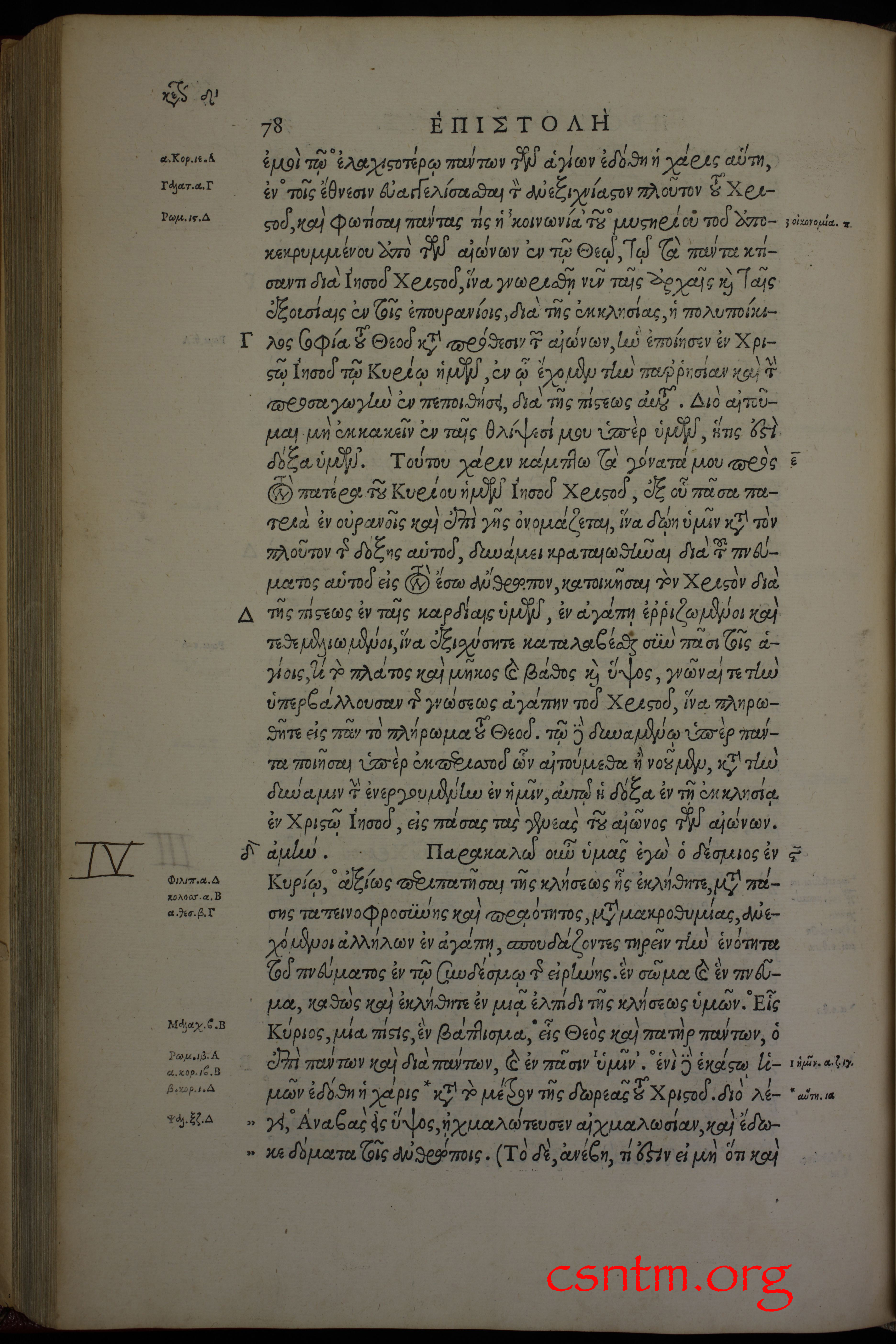
JR doesn't know why. Erasmus' first edition has the reading, and Stephanus and Beza maintained it. The only 17th century (or earlier) exegete that I could find that mentioned the discrepancy was a Jesuit, Cornelius à Lapide.
JR says: "On what basis did the Reformed men affirm 'fellowship' here as the true reading, over against the Majority Greek ms. tradition? We do not know."
I reply: To the extent we don't know, it's because it seems they got the reading from the Roman Catholic, Erasmus, and didn't double check his work. JR's comments seems to suppose some group of "Reformed men" huddling around the text and coming to a decision about whether to accept or reject each reading. That's not how it worked. There were some readings that were disputed, to be sure. This does not appear to have been one of them.
Stephanus noted the variant issue in his 1550 edition (link to image - it's note 3) but we know he used the same manuscript Erasmus had (mentioned below). If anyone digs up additional information, it would be interesting and useful. As far as I know, Stephanus does not explain the decision to continue with Erasmus' choice.
8) They might have had other manuscripts!
JR makes the assertion: "It is certainly possible that they had access to Greek mss. which are no longer available to us."
I reply: "Certainly possible" sounds so much better than "this is just wild speculation, but ...." It means the same thing here.
We have figured out which manuscripts Erasmus borrowed for his work. One of those was Minuscule 2817, which has the reading (both in the main text and apparently in the accompanying commentary)(link to whole manuscript)(editorial note: it's cool to be reading from the same page Erasmus read from). So, it would be most natural to blame this reading on that manuscript, rather than blaming it on Erasmus or his printer. I have not checked the other three manuscripts that Erasmus had.
9) Some manuscripts have been lost since the 16th-17th centuries
Yes, some have. On the other hand, the ones that Erasmus used have survived. It sad when Biblical manuscripts perish, but in God's providence, we still have most of the manuscripts identified in the 16th century, and others they did not know about.
10) The printed editions may testify to lost manuscripts
In the case of Erasmus' base text, we have reasons for thinking we know what manuscripts he worked from. Accordingly, there is no particular need for its testimony. Similarly, my recollection is that we have identified the manuscripts that Stephanus mentions. If any of those are now lost, his marginal notes can provide a form of testimony to them. But JR has not given us a reason to think that any relevant manuscripts have been lost, that any relevant manuscripts were used in the preparation of Erasmus' text, or that
Conclusion
JR argues: "It is only in the modern era that “Reformed” men have abandoned the traditional text for the modern reconstructed text." Actually, the Reformers (especially Beza) worked on reconstructing the text and the high orthodox (e.g. Turretin) affirmed the continued use of collation to reconstruct the text. This is nothing new or modern.
JR argues: "In so doing they have embraced a religious epistemology that abandons stability, continuity, and consistency." Actually, the Reformers fought against Rome's similar assertions for the Vulgate text. They argued that the Greek apographa - the copies - provide the original text.
-TurretinFan
PS Upon reviewing this post before publishing, I note that there is an unintentional pun in the opening paragraph. No disrespect was intended to Pastor Riddle.
The post is riddled with an even worse radical skepticism than that of Bart Ehrman. Both Ehrman and Riddle oppose the Reformed orthodox position that we can reconstruct the original text from the extant copies. Ehrman, however, at least acknowledges that for the New Testament we have "much earlier attestation than for any other book from antiquity."
Erhman's radical skepticism is linked to his rejection of supernaturalism. What about JR's? JR's seems to be theologically motivated. He writes: "In the end, we can only be sure that in the providence of God the reading “the fellowship of the mystery” was that preserved in the TR." That's the only thing that JR thinks we can know for sure. Yet JR knows more than that conclusion lets on. JR knows, for example, "Among current extant Greek manuscripts, of all eras, the Majority reading is indeed η οικονομια. In fact, the external evidence is so overwhelming that the NA28 does not even list any variants at this point in its critical apparatus." Therefore, JR also know for sure that this state of affairs is also in the providence of God. Why does JR pick God's providential ordering of the TR rather than God's providential preservation of Greek copies? Let the reader decide.
JR seems to acknowledge that there is no real argument to be made in defense of the TR position from the textual evidence. Instead, after pointing out the obvious fact that one reading is likely a scribal error for the other reading (rather than a deliberate change) he offers a variety of mostly skeptical arguments:
1) Reasoned Eclecticism vs. Majority Text
JR states: "It seems particularly odd for [Dr. James R. White] to reject the TR reading at Ephesians 3:9 based on the fact that it is not the Majority reading since, supposedly, he is not himself an advocate for the Majority text but, instead, embraces an eclectic method (reasoned eclecticism)."
It's hard to figure out if JR just doesn't understand reasoned eclecticism or what. Does he seriously not understand why reasoned eclecticism would favor a text that is supported by "p46, all known uncials, almost all minuscules, all known versions, and patristic quotations"? That's not simply picking the text because it is the majority text. I think JR knows this. Moreover, in any other case where "p46, all known uncials, almost all minuscules, all known versions, and patristic quotations" support a given reading, it would be shocking of editors following reasoned eclecticism concluded that a very late poorly attested minority reading were the original. JR points to the variant of "through Jesus Christ" in the sane verse and asks why the majority is not followed here. JR should know the answer: the situation is quite different. "through Jesus Christ" is not found in "p46, all known uncials, almost all minuscules, all known versions, and patristic quotations." There may be a majority in favor of inclusion of the phrase, but the witnesses for omission are not just a few scattered late manuscripts. JR surely knows this, but chooses to ask the question as though he does not.
2) CBGM supports conjectural emendation?
JR states: "Furthermore, [Dr. James R. White] expresses great confidence in the new CBGM, despite the fact that in the NA28 it favors a reading in 2 Peter 3:10 based on NO extant Greek mss.! There seems to be a problem with consistency."
It's unclear whether JR is aware that Dr. White rejects the conjectural emendation proposed at 2 Peter 3:10. It also seems that JR thinks that the CBGM some how spit out this conjectural emendation. That's not the case. The fault here lies with the ECM editors, not with the CBGM.
3) "Major Problem" of Insufficient Analysis
JR is aware that an analysis of the textual evidence has been done. He quotes from Bruce Metzger, who provides a summary of the analysis. Nevertheless, JR asserts that Dr. White's analysis of the Greek manuscript evidence falls short. JR implies that "proper analytical study" requires identifying the list of late manuscripts that apparently contain the TR reading. One wonders from where JR gets this standard. It looks like he just made it up, presumably because he himself is having trouble finding any late manuscripts that support the TR reading.
Does JR offer any analysis that contradicts Metzger? No. He just throws out a made-up standard and says it wasn't met.
4) Sometimes late manuscripts have early readings
This is one of those "true but irrelevant" statements, also known as red herrings. There are a few late manuscripts that seem to be copied from very old manuscripts, and which consequently have early readings. This is one thing that the CBGM should be good at helping us identify.
5) "Extremely thin" early Greek manuscript evidence?
What JR characterizes as "extremely thin" is actually pretty remarkable. We have one papyrus that, despite bad damage to the edges of the page, does have this portion of the verse, dating back to about A.D. 200. It contradicts the TR. Then from the fourth to the seventh centuries we have five more uncial manuscripts. As JR concedes, "Yes, η οικονομια is the reading found in the five early uncials and became the Majority reading ... ."
6) Versional and Patristic Evidence
Once again, JR complains that Dr. White doesn't provide him with the information that JR himself can get from Metzger. He says that Dr. White "never provides any specific examples from the versions for our comparison and analysis." Here's an easy one: Codex Amiatinus (A.D. 700) is a Latin Vulgate manuscript produced in England. It has "dispensatio", which is a Latin translation of the Greek. But, of course, where does this standard of having to provide specific examples come from? It's just something JR made up.
7) Why does the TR have the reading it has?
JR doesn't know why. Erasmus' first edition has the reading, and Stephanus and Beza maintained it. The only 17th century (or earlier) exegete that I could find that mentioned the discrepancy was a Jesuit, Cornelius à Lapide.
JR says: "On what basis did the Reformed men affirm 'fellowship' here as the true reading, over against the Majority Greek ms. tradition? We do not know."
I reply: To the extent we don't know, it's because it seems they got the reading from the Roman Catholic, Erasmus, and didn't double check his work. JR's comments seems to suppose some group of "Reformed men" huddling around the text and coming to a decision about whether to accept or reject each reading. That's not how it worked. There were some readings that were disputed, to be sure. This does not appear to have been one of them.
Stephanus noted the variant issue in his 1550 edition (link to image - it's note 3) but we know he used the same manuscript Erasmus had (mentioned below). If anyone digs up additional information, it would be interesting and useful. As far as I know, Stephanus does not explain the decision to continue with Erasmus' choice.
8) They might have had other manuscripts!
JR makes the assertion: "It is certainly possible that they had access to Greek mss. which are no longer available to us."
I reply: "Certainly possible" sounds so much better than "this is just wild speculation, but ...." It means the same thing here.
We have figured out which manuscripts Erasmus borrowed for his work. One of those was Minuscule 2817, which has the reading (both in the main text and apparently in the accompanying commentary)(link to whole manuscript)(editorial note: it's cool to be reading from the same page Erasmus read from). So, it would be most natural to blame this reading on that manuscript, rather than blaming it on Erasmus or his printer. I have not checked the other three manuscripts that Erasmus had.
9) Some manuscripts have been lost since the 16th-17th centuries
Yes, some have. On the other hand, the ones that Erasmus used have survived. It sad when Biblical manuscripts perish, but in God's providence, we still have most of the manuscripts identified in the 16th century, and others they did not know about.
10) The printed editions may testify to lost manuscripts
In the case of Erasmus' base text, we have reasons for thinking we know what manuscripts he worked from. Accordingly, there is no particular need for its testimony. Similarly, my recollection is that we have identified the manuscripts that Stephanus mentions. If any of those are now lost, his marginal notes can provide a form of testimony to them. But JR has not given us a reason to think that any relevant manuscripts have been lost, that any relevant manuscripts were used in the preparation of Erasmus' text, or that
Conclusion
JR argues: "It is only in the modern era that “Reformed” men have abandoned the traditional text for the modern reconstructed text." Actually, the Reformers (especially Beza) worked on reconstructing the text and the high orthodox (e.g. Turretin) affirmed the continued use of collation to reconstruct the text. This is nothing new or modern.
JR argues: "In so doing they have embraced a religious epistemology that abandons stability, continuity, and consistency." Actually, the Reformers fought against Rome's similar assertions for the Vulgate text. They argued that the Greek apographa - the copies - provide the original text.
-TurretinFan
PS Upon reviewing this post before publishing, I note that there is an unintentional pun in the opening paragraph. No disrespect was intended to Pastor Riddle.
Thursday, November 14, 2019
John Owen versus the MARTs
The Modern Advocates of the Received Texts (MARTs) are a group of folks who argue that the textus receptus is not just the best text out there, it's jot and tittle the same as the original. Their position is thoroughly modern. Despite the fact that they like to characterize their position as being "Reformed Bibliology" or "Confessional Bibliology" or "The Confessional Text" position, their position is not one of the positions held by the early Reformers (obviously Luther was against their view, but also Calvin and Beza held a position contradictory to their view). It is also not the position expressed by the leading Reformed of the 17th century. One of the folks that I would associate with the MART viewpoint, Jeff Riddle, recently stated that John Owen is a "gold mine." I suspect that some of Owen's statements definitely will sound helpful. On the other hand, here are five examples of why it would be inaccurate to categorize the great John Owen as a proto-MART.
Example 1
Nature and Causes of Apostasy from the Gospel, Chapter 1
The variant being addressed her is the omission or inclusion of ἑαυτοῖς at Hebrews 6:6. Beza's 1598 printing includes the word in the text. What is significant here is that Owen does not simply rely on Beza's main reading of Hebrews 6:4-6, but Owen also consults the alleged variant reading that he says Beza mentions, and he does so in interpreting the text. Owen ultimately adopts the main reading, but look at the justification (on the next page of the same chapter):
Notice that Beza relies on both external and internal evidence (i.e. evidence from the copies and evidence from the flow of the text). Most critically, notice that Owen places weight on the copies being ancient. Owen does not presume that ancient copies are worse because they are ancient. Instead, Owen takes for granted that the ancient copies should be a standard for evaluating the printed text reading.
Example 2
The Death of Death, Book 1, Chapter 5:
The variant being addressed here is the substitution of αἰωνίου (eternal) for ἁγίου (holy) or vice versa. The main reading in Beza's 1598 is eternal, but notice that Owen goes to the variant reading both in the Greek and also in the Latin to interpret the text.
Example 3
The Death of Death, Book 1, Chapter 3:
The variant being addressed her is the inclusion or omission of καὶ (and). Notice that Owen considers the variant, identifies the variant as a probable orthodox corruption, and then instead confirms the point from a place where there is no such variant issue.
Example 4
Vinidiciae Evangelicae, Chapter 22
The variant of interest here is the inclusion or omission of οὐκ. Interestingly enough, Beza's 1598 has the οὐκ. Owen seems to be willing to depart from Beza because the wording Owen adopts is allegedly found in "most copies."
Example 5
Vinidiciae Evangelicae, Chapter 13
Owen presents the following Q/A from his theological opponent:
Owen replies:
The variant here is the substitution of ὅς (he) for Θεὸς (God) or vice versa. Owen argues that the unanimous consent of the Greek trumps the Latin. Note as well that Owen is plainly relying only on the printed texts himself: particularly Erasmus and Beza. Owen does not pretend to be an expert in textual criticism himself, nor is he claiming personal knowledge about all the manuscripts.
Shortly thereafter, Owen responds to Grotius:
Note especially Owen's assertion: "if the agreement of all original copies may be thus contemned, we shall have nothing certain left us." That is something we have heard Dr. James White say numerous times in other contexts. Owen does not appeal to some kind of TR canonization. Instead he appeals to the extant Greek copies. Owen also argues from the probabilities as to what possible heretical source of corruption may have affected the text. Furthermore, Owen downplays the significance of the translations.
Continuing in Chapter 14, Owen states:
Once again, Owen appeals to "all original copies whatever, constantly, without any exception, do read it" to settle the question.
Interestingly enough, there are indeed ancient copies that have the pronoun rather than the word "God." So, it turns out that Owen was mistaken about the issue of unanimity.
Conclusion
John Owen ardently defended many TR readings, including readings close to the heart of MARTs. John Owen did so, however, from a point of view that is not a MART point of view. Indeed, Owen did not feel compelled to follow Beza's 1598 printing, but departed when he believed the Greek copy evidence warranted. Moreover, it's fair to say we know more now about the Greek copies than Owen did. A lot of textual critical work, especially finding and collating manuscripts, has been done since the days of Erasmus and Beza - and even since the days of Owen himself.
Example 1
Nature and Causes of Apostasy from the Gospel, Chapter 1
2. Ἀνασταυροῦντας ἑαυτοῖς τὸν Υἱὸν τοῦ Θεοῦ. Beza affirms that ἑαυτοῖς, “to themselves,” is absent from some copies, and then the words may admit of a sense diverse from that which is commonly received; for ἀνασταυροῦντας, “crucifying again;” may refer unto τινάς included and supposed in ἀνακινίζειν, that some or any should renew them. It is impossible that any should renew them to repentance; for this cannot be done without crucifying the Son of God again, since these apostates have utterly rejected all interest in and benefit by his death, as once undergone for sinners.
The variant being addressed her is the omission or inclusion of ἑαυτοῖς at Hebrews 6:6. Beza's 1598 printing includes the word in the text. What is significant here is that Owen does not simply rely on Beza's main reading of Hebrews 6:4-6, but Owen also consults the alleged variant reading that he says Beza mentions, and he does so in interpreting the text. Owen ultimately adopts the main reading, but look at the justification (on the next page of the same chapter):
But the word is constant enough in ancient copies to maintain its own station, and the context requires its continuance; and this makes the work of "crucifying again" to be the act of the apostates themselves, and to be asserted as that which belongs unto their sin, and not denied as belonging to a relief from their sin: "They crucify him again to themselves."
Notice that Beza relies on both external and internal evidence (i.e. evidence from the copies and evidence from the flow of the text). Most critically, notice that Owen places weight on the copies being ancient. Owen does not presume that ancient copies are worse because they are ancient. Instead, Owen takes for granted that the ancient copies should be a standard for evaluating the printed text reading.
Example 2
The Death of Death, Book 1, Chapter 5:
That which some contend, that by the eternal Spirit is here meant our Saviour’s own Deity, I see no great ground for. Some Greek and Latin copies read, not, as we commonly, Πνεύματος αἰωνίου, but Πνεύματος ἁγίου, and so the doubt is quite removed: and I see no reason why he may not as well be said to offer himself through the Holy Spirit, as to be “declared to be the Son of God, according to the Spirit of holiness, by the resurrection from the dead,” as Rom. i. 4; as also to be “quickened by the Spirit,” 1 Pet. iii. 18. The working of the Spirit was required as well in his oblation as resurrection, in his dying, as quickening.
The variant being addressed here is the substitution of αἰωνίου (eternal) for ἁγίου (holy) or vice versa. The main reading in Beza's 1598 is eternal, but notice that Owen goes to the variant reading both in the Greek and also in the Latin to interpret the text.
Example 3
The Death of Death, Book 1, Chapter 3:
Hence the Father himself is sometimes called our Saviour: 1 Tim. i. 1, “According to the commandment Θεοῦ σωτῆρος ἡμῶν,” — “of God our Saviour.” Some copies, indeed, read it, Θεοῦ καὶ σωτῆρος ἡμῶν, — “of God and our Saviour;” but the interposition of that particle καὶ arose, doubtless, from a misprision that Christ alone is called Saviour. But directly this is the same with that parallel place of Tit. i. 3, Κατ’ ἐπιταγὴν τοῦ σωτῆρος ἡμῶν Θεοῦ, — “According to the commandment of God our Saviour,” where no interposition of that conjunctive particle can have place; the same title being also in other places ascribed to him, as Luke i. 47, “My spirit hath rejoiced in God my Saviour.”
The variant being addressed her is the inclusion or omission of καὶ (and). Notice that Owen considers the variant, identifies the variant as a probable orthodox corruption, and then instead confirms the point from a place where there is no such variant issue.
Example 4
Vinidiciae Evangelicae, Chapter 22
1st. From the event: Heb. x. 2, 3, “For then would they not have ceased to be offered? because that the worshippers once purged should have had no more conscience of sins. But in those sacrifices there was a remembrance again made of sins every year.” The words of the second verse are to be read with an interrogation, conclusive in the negative: “Would they not have ceased to have been offered?” that is, certainly they would. And because they did not do so, it is evident from the event that they could not take away sin. In most copies the words are, Ἐπεὶ ἂ ἐπαύσαντο προσφερόμεναι. Those that add the negative particle οὐκ put it for οὐχί,. as it is frequently used.
The variant of interest here is the inclusion or omission of οὐκ. Interestingly enough, Beza's 1598 has the οὐκ. Owen seems to be willing to depart from Beza because the wording Owen adopts is allegedly found in "most copies."
Example 5
Vinidiciae Evangelicae, Chapter 13
Owen presents the following Q/A from his theological opponent:
Q. What dost thou answer to 1 Tim. iii. 16?
A. 1. That in many ancient copies, and in the Vulgar Latin itself, the word “God” is not read; wherefore from that place nothing certain can be concluded.
Owen replies:
1. Though the word “God,” be not in the Vulgar Latin, yet the unanimous, constant consent of all the original copies, confessed to be so both by Beza and Erasmus, is sufficient to evince that the loss of that translation is not of any import to weaken the sense of the place. Of other ancient copies, whereof they boast, they cannot instance one.
The variant here is the substitution of ὅς (he) for Θεὸς (God) or vice versa. Owen argues that the unanimous consent of the Greek trumps the Latin. Note as well that Owen is plainly relying only on the printed texts himself: particularly Erasmus and Beza. Owen does not pretend to be an expert in textual criticism himself, nor is he claiming personal knowledge about all the manuscripts.
Shortly thereafter, Owen responds to Grotius:
Θεὸς ἐφανερώθη ἐν σαρκί. “Suspectam nobis hanc lectionem faciunt interpretes veteres, Latinus, Syrus, Arabs, et Ambrosius, qui omnes legunt, ο` ἐφανερώθη.” Addit Hincmarus Opusculo 55. illud Θεός, “hic positum a Nestorianis.” 1. But this suspicion might well have been removed from this learned man by the universal consent of all original copies, wherein, as it seems, his own manuscript, that sometimes helps him at a need, doth not differ. 2. One corruption in one translation makes many. 3. The Syriac reads the word “God,” and so Tremellius hath rendered it; Ambrose and Hincmarus followed the Latin translation; and there is a thousand times more probability that the word Θεός was filched out by the Arians than that it was foisted in by the Nestorians. But if the agreement of all original copies may be thus contemned, we shall have nothing certain left us.
Note especially Owen's assertion: "if the agreement of all original copies may be thus contemned, we shall have nothing certain left us." That is something we have heard Dr. James White say numerous times in other contexts. Owen does not appeal to some kind of TR canonization. Instead he appeals to the extant Greek copies. Owen also argues from the probabilities as to what possible heretical source of corruption may have affected the text. Furthermore, Owen downplays the significance of the translations.
Continuing in Chapter 14, Owen states:
The learned Grotius is pitifully entangled about the last two places urged by our catechists. Of his sleight in dealing with that of John xx. 28, I have spoken before, and discovered the vanity of his insinuations. Here he tells you, that after Christ’s resurrection, it grew common with the Christians to call him God, and urges Rom. ix. 5; but coming to expound that place, he finds that shift will not serve the turn, it being not any Christians calling him God that there is mentioned, but the blessed apostle plainly affirming that he is “God over all, blessed for ever;” and therefore, forgetting what he had said before, he falls upon a worse and more desperate evasion, affirming that the word Θεός ought not to be in the text, because Erasmus had observed that Cyprian and Hilary, citing this text, did not name the word! And this he rests upon, although he knew that all original copies whatever, constantly, without any exception, do read it, and that Beza had manifested, against Erasmus, that Cyprian adver. Judæos, lib. ii. cap. vi., and Hilary ad Ps. xii., do both cite this place to prove that Christ is called God, though they do not express the text to the full; and it is known how Athanasius used it against the Arians, without any hesitation as to the corruption of the text. This way of shifting indeed is very wretched, and not to be pardoned. I am well contented with all who, from what he writes on John i. 1 (the first place mentioned), do apprehend that when he wrote his annotations on that place he was no opposer of the deity of Christ; but I must take leave to say, that, for mine own part, I am not able to collect from all there spoken in his own words that he doth at all assert the assuming of the human nature into personal subsistence with the Son of God. I speak as to the thing itself, and not to the expressions which he disallows.
Once again, Owen appeals to "all original copies whatever, constantly, without any exception, do read it" to settle the question.
Interestingly enough, there are indeed ancient copies that have the pronoun rather than the word "God." So, it turns out that Owen was mistaken about the issue of unanimity.
Conclusion
John Owen ardently defended many TR readings, including readings close to the heart of MARTs. John Owen did so, however, from a point of view that is not a MART point of view. Indeed, Owen did not feel compelled to follow Beza's 1598 printing, but departed when he believed the Greek copy evidence warranted. Moreover, it's fair to say we know more now about the Greek copies than Owen did. A lot of textual critical work, especially finding and collating manuscripts, has been done since the days of Erasmus and Beza - and even since the days of Owen himself.
Saturday, September 28, 2019
Francis Turretin - the "Received Text" - "Confessional Text" and related Textual Critical Issues
Background - Name and the significance of Methodology
I've been using the nom de plume, TurretinFan, for over a decade. Why? It's certainly not because I slavishly follow everything that theologian taught. On the contrary, I have a number of disagreements with him, though typically about things that don't or shouldn't matter. The big examples that come to mind are geocentrism and the perpetual virginity of Mary. From time to time this leads to taunts of "You should stop calling yourself 'Francis Turretin'" or the like. I can live with that.
My reason for using that pen-name is because I enjoy the clarity of thinking that the real Francis Turretin had, as expressed in his elenctic methodology. His methodology has led to him sometimes being referred to as a Reformed scholastic. I don't think he would want to be lumped in with the medieval scholastics, but at least some of them (for example, Thomas Aquinas) can be admired for their systematic consideration of issues.
Methodology and Textual Positions
Methodology is key in distinguishing different textual positions, not just in distinguishing presentations of theology. I myself enjoy the King James Version and appreciate the beauty of the language used, as well as the useful clarity provided by distinguishing between "thou" and "you." Enjoying, however, is not really a methodology. I don't just enjoy the KJV, I preferentially use it as an English translation. Yet again, however, mere use is not a methodology.
When it comes to the text of the New Testament, there are many schools of thought. Depending on who you listen to, you may hear terms like "Critical Text," "Received Text," "Ecclesiastical Text," "King James Only," "Majority Text," "Byzantine Text," "Westcott and Hort Text" and so on.
At the risk of over-simplification, we can broadly group the positions into four schools of thought.
A. Non-Preservationist
This school of thought sees nothing particularly special about the Scriptures and treats them as being the same as any other ancient text. This group could be further sub-divided into naturalists (like atheists) and super-naturalists (like Muslims and Mormons). The latter groups may think that the New Testament was a special book, but they nevertheless insist that it was hopelessly corrupted due to (among other things) a lack of divine preservation.
Interestingly enough, when we read Reformation-era Reformers, we see them contending against Roman Catholics who had this same non-preservationist mindset as it applies to the Greek text. They would insist that the Latin was preserved, but would not extend this to the original Greek. Interestingly enough, we also see a similar mixture of views in certain KJV only groups who are open to the idea the New Testament has been preserved (in this time) only in English and not in the original language. Modern Roman Catholics (post Vatican II) seem to accept the preservation of the original text of the New Testament, and the Nova Vulgata reflects a reliance on the Greek text to correct the Latin text.
B. Preservationist
This school of thought views the Scriptures as the Word of God and understands (hopefully from the Scriptures themselves) that because of the Scriptures' purpose and nature, God will preserve them forever, or at least until we see God face to face.
1. Hard Traditionalist
This sub-group of preservationists take the position that the preserved text is a matter of hard tradition. This may take the form of a particular text being widely used by "the church" or the form of a particular text being supposedly authoritatively accepted by the church.
2. Soft Traditionalist
This sub-group of preservationists take the position that the preserved text is a matter of what we might call "lower case t tradition." They believe that because God has preserved his word through every generation, therefore we can examine tradition to see what text has been handed down.
3. Rationalist
This sub-group of preservationists take the position that the preserved text can be obtained without any particular reference to tradition, as such. In this view, the New Testament text can be established more or less the same way that we would establish the text of Homer's works, but with much higher certainty because of the much better evidence.
This is, of course, an over-simplification. Among the preservationists, there is probably something more resembling a spectrum, rather than the neat boxes I've provided.
The Confessional Position
The Westminster Confession of Faith and the London Baptist Confession have identical text at I:6:
The quoted phrase means at least that only the views in group B are confessional, while the views in group A should not be taught in the church. The confession does not specify to what degree we should be relying on tradition or reason to identify the providentially preserved Scriptures. As a result, the big tent of the confession is broad enough for a variety of views on this. There is not just one "ye olde Confessional Position" on that level of detail. I leave it to someone with more time on their hands to review the minutes of the Assembly to see if the wording was debated, but ultimately it matters what made it into the Confession, and such further detail did not.
The Confession's Proof Texts
Some folks like to point out that the Confession uses as proof texts, the following:
To further complicate things, when the American Presbyterians revised the confession to (among other things) update the proof texts, those references were removed, such that the version of the WCF on the OPC website today does not use those proof texts (link to pdf version).
So, saying that the inclusion of the long ending of Mark and the Comma Johanneum is "confessional," is strained. It is probably most accurate to say that the original authors of the Confession probably accepted those passages without seriously investigating the matter.
The Real Francis Turretin's Position
The real Francis Turretin, however, did not simply hastily add a proof text to his work. In 1674, Turretin published a treatise, "De Tribus Testibus Coelestibus ex 1 Joann. V, 7" and in 1676 he published "De Spiritu, Aqua et Sanguine in terra testantibus, ex 1 Joann. V, 8." Moreover, near the start of the former treatise, Turretin attempts a defense of the passage against the Socinian accusation of insertion. His first argument? an appeal to the historical evidence as he understood it, with reference to Jerome and to the work of Erasmus, Complutensis, and Stephanus, among others who provided printed Greek New Testaments, based on his understanding that they drew the reading from the most ancient codices.
Turretin's second argument was an appeal to the wording of the remainder of the text. He reasons that verse 9's comparison between human and divine testimony only makes sense if the three earthly testimonies are in parallel with three heavenly testimonies.
Turretin's third argument is to appeal to the writings of Cyprian, Athanasius, and Fulgentius, who (he thought) used the verse approvingly.
Turretin's fourth argument is to question whether it is more probable that the Arians removed the verse or the orthodox added the verse.
In other words, while Turretin obviously reaches the opposite conclusion of the current editors of the ECM, he does so using a very similar methodology. In fact, the question of orthodox corruption of the text is one that remains of interest today (hundreds of years later).
This may not persuade the harder-tradition folk. So, an easier example is Turretin's rejection of the word "Cainan" in Luke 3:36. According to Turretin, the best explanation here is that the word was spuriously added by corruption via the Septuagint (see vol. 1, pp. 73-74 of Turretin's Institutes, 1.2.5.12). In that case, Turretin is clearly departing from the "Textus Receptus" reading. His reason for doing so is mostly on internal grounds of needing to harmonize with the Old Testament.
And, of course, this gets us to Turretin's own clear statement about his methodology (emphasis supplied):
Turretin was not unique in these views. He was not alone in mistakenly accepting the Comma Johanneum, nor was he alone in doing so on faulty textual critical grounds. He was not alone in being unfamiliar with the manuscripts in existence, and he was not alone in relying heavily on the printed editions (and perhaps even only on reports about those printed editions).
I've been using the nom de plume, TurretinFan, for over a decade. Why? It's certainly not because I slavishly follow everything that theologian taught. On the contrary, I have a number of disagreements with him, though typically about things that don't or shouldn't matter. The big examples that come to mind are geocentrism and the perpetual virginity of Mary. From time to time this leads to taunts of "You should stop calling yourself 'Francis Turretin'" or the like. I can live with that.
My reason for using that pen-name is because I enjoy the clarity of thinking that the real Francis Turretin had, as expressed in his elenctic methodology. His methodology has led to him sometimes being referred to as a Reformed scholastic. I don't think he would want to be lumped in with the medieval scholastics, but at least some of them (for example, Thomas Aquinas) can be admired for their systematic consideration of issues.
Methodology and Textual Positions
Methodology is key in distinguishing different textual positions, not just in distinguishing presentations of theology. I myself enjoy the King James Version and appreciate the beauty of the language used, as well as the useful clarity provided by distinguishing between "thou" and "you." Enjoying, however, is not really a methodology. I don't just enjoy the KJV, I preferentially use it as an English translation. Yet again, however, mere use is not a methodology.
When it comes to the text of the New Testament, there are many schools of thought. Depending on who you listen to, you may hear terms like "Critical Text," "Received Text," "Ecclesiastical Text," "King James Only," "Majority Text," "Byzantine Text," "Westcott and Hort Text" and so on.
At the risk of over-simplification, we can broadly group the positions into four schools of thought.
A. Non-Preservationist
This school of thought sees nothing particularly special about the Scriptures and treats them as being the same as any other ancient text. This group could be further sub-divided into naturalists (like atheists) and super-naturalists (like Muslims and Mormons). The latter groups may think that the New Testament was a special book, but they nevertheless insist that it was hopelessly corrupted due to (among other things) a lack of divine preservation.
Interestingly enough, when we read Reformation-era Reformers, we see them contending against Roman Catholics who had this same non-preservationist mindset as it applies to the Greek text. They would insist that the Latin was preserved, but would not extend this to the original Greek. Interestingly enough, we also see a similar mixture of views in certain KJV only groups who are open to the idea the New Testament has been preserved (in this time) only in English and not in the original language. Modern Roman Catholics (post Vatican II) seem to accept the preservation of the original text of the New Testament, and the Nova Vulgata reflects a reliance on the Greek text to correct the Latin text.
B. Preservationist
This school of thought views the Scriptures as the Word of God and understands (hopefully from the Scriptures themselves) that because of the Scriptures' purpose and nature, God will preserve them forever, or at least until we see God face to face.
1. Hard Traditionalist
This sub-group of preservationists take the position that the preserved text is a matter of hard tradition. This may take the form of a particular text being widely used by "the church" or the form of a particular text being supposedly authoritatively accepted by the church.
2. Soft Traditionalist
This sub-group of preservationists take the position that the preserved text is a matter of what we might call "lower case t tradition." They believe that because God has preserved his word through every generation, therefore we can examine tradition to see what text has been handed down.
3. Rationalist
This sub-group of preservationists take the position that the preserved text can be obtained without any particular reference to tradition, as such. In this view, the New Testament text can be established more or less the same way that we would establish the text of Homer's works, but with much higher certainty because of the much better evidence.
This is, of course, an over-simplification. Among the preservationists, there is probably something more resembling a spectrum, rather than the neat boxes I've provided.
The Confessional Position
The Westminster Confession of Faith and the London Baptist Confession have identical text at I:6:
8. The Old Testament in Hebrew (which was the native language of the people of God of old), and the New Testament in Greek (which at the time of the writing of it was most generally known to the nations), being immediately inspired by God, and by his singular care and providence kept pure in all ages, are therefore authentical; so as in all controversies of religion the Church is finally to appeal unto them. But because these original tongues are not known to all the people of God who have right unto, and interest in, the Scriptures, and are commanded, in the fear of God, to read and search them, therefore they are to be translated into the language of every people unto which they come, that the Word of God dwelling plentifully in all, they may worship him in an acceptable manner, and, through patience and comfort of the Scriptures, may have hope.The key phrase for our discussion is, of course, "by his singular care and providence kept pure in all ages."
The quoted phrase means at least that only the views in group B are confessional, while the views in group A should not be taught in the church. The confession does not specify to what degree we should be relying on tradition or reason to identify the providentially preserved Scriptures. As a result, the big tent of the confession is broad enough for a variety of views on this. There is not just one "ye olde Confessional Position" on that level of detail. I leave it to someone with more time on their hands to review the minutes of the Assembly to see if the wording was debated, but ultimately it matters what made it into the Confession, and such further detail did not.
The Confession's Proof Texts
Some folks like to point out that the Confession uses as proof texts, the following:
- The long ending of Mark: 7:3(f), 8:4(g), and 17:3(m)
- The Comma Johanneum: 2:3(o)
To further complicate things, when the American Presbyterians revised the confession to (among other things) update the proof texts, those references were removed, such that the version of the WCF on the OPC website today does not use those proof texts (link to pdf version).
So, saying that the inclusion of the long ending of Mark and the Comma Johanneum is "confessional," is strained. It is probably most accurate to say that the original authors of the Confession probably accepted those passages without seriously investigating the matter.
The Real Francis Turretin's Position
The real Francis Turretin, however, did not simply hastily add a proof text to his work. In 1674, Turretin published a treatise, "De Tribus Testibus Coelestibus ex 1 Joann. V, 7" and in 1676 he published "De Spiritu, Aqua et Sanguine in terra testantibus, ex 1 Joann. V, 8." Moreover, near the start of the former treatise, Turretin attempts a defense of the passage against the Socinian accusation of insertion. His first argument? an appeal to the historical evidence as he understood it, with reference to Jerome and to the work of Erasmus, Complutensis, and Stephanus, among others who provided printed Greek New Testaments, based on his understanding that they drew the reading from the most ancient codices.
Turretin's second argument was an appeal to the wording of the remainder of the text. He reasons that verse 9's comparison between human and divine testimony only makes sense if the three earthly testimonies are in parallel with three heavenly testimonies.
Turretin's third argument is to appeal to the writings of Cyprian, Athanasius, and Fulgentius, who (he thought) used the verse approvingly.
Turretin's fourth argument is to question whether it is more probable that the Arians removed the verse or the orthodox added the verse.
In other words, while Turretin obviously reaches the opposite conclusion of the current editors of the ECM, he does so using a very similar methodology. In fact, the question of orthodox corruption of the text is one that remains of interest today (hundreds of years later).
This may not persuade the harder-tradition folk. So, an easier example is Turretin's rejection of the word "Cainan" in Luke 3:36. According to Turretin, the best explanation here is that the word was spuriously added by corruption via the Septuagint (see vol. 1, pp. 73-74 of Turretin's Institutes, 1.2.5.12). In that case, Turretin is clearly departing from the "Textus Receptus" reading. His reason for doing so is mostly on internal grounds of needing to harmonize with the Old Testament.
And, of course, this gets us to Turretin's own clear statement about his methodology (emphasis supplied):
The question is not as to the particular corruption of some manuscripts or as to the errors which have crept into the books of particular editions through the negligence of copyists or printers. All acknowledge the existence of many such small corruptions. The question is whether there are universal corruptions and errors so diffused through all the copies (both manuscript and edited) as that they cannot be restored and corrected by any collation of various copies, or of Scripture itself and of parallel passages.Notice that Turretin explicitly acknowledges small corruptions and argues that these can be restored and corrected. The tools for such correction are collation (which is exactly what CBGM and other "modern" textual critical techniques primarily rely on) and comparison with Scripture itself (the internal evidences that CBGM is (to my knowledge) less well equipped to perform, but which human editors nevertheless have to employ, and which we see in the most recent texts of the New Testament.
Turretin was not unique in these views. He was not alone in mistakenly accepting the Comma Johanneum, nor was he alone in doing so on faulty textual critical grounds. He was not alone in being unfamiliar with the manuscripts in existence, and he was not alone in relying heavily on the printed editions (and perhaps even only on reports about those printed editions).
Wednesday, June 19, 2019
Responding to Leighton Flowers' "Choice Beef" Argument
Leighton Flowers (transcription of oral comments):
We see that use of the term "choice" in its superlative form ("choicest") in a couple of King James verses:
Isaiah 5:2 And he fenced it, and gathered out the stones thereof, and planted it with the choicest vine, and built a tower in the midst of it, and also made a winepress therein: and he looked that it should bring forth grapes, and it brought forth wild grapes.
Isaiah 22:7 And it shall come to pass, that thy choicest valleys shall be full of chariots, and the horsemen shall set themselves in array at the gate.
We also see it in its simple form in other verses:
Genesis 49:11 Binding his foal unto the vine, and his ass's colt unto the choice vine; he washed his garments in wine, and his clothes in the blood of grapes:
We actually see it in connection with choosing in at least one verse:
2 Samuel 10:9 When Joab saw that the front of the battle was against him before and behind, he chose of all the choice men of Israel, and put them in array against the Syrians:
The thing is, God does not choose the way men choose, but sometimes just the opposite:
1 Corinthians 1:22-29
For the Jews require a sign, and the Greeks seek after wisdom: but we preach Christ crucified, unto the Jews a stumblingblock, and unto the Greeks foolishness; but unto them which are called, both Jews and Greeks, Christ the power of God, and the wisdom of God. Because the foolishness of God is wiser than men; and the weakness of God is stronger than men. For ye see your calling, brethren, how that not many wise men after the flesh, not many mighty, not many noble, are called: but God hath chosen the foolish things of the world to confound the wise; and God hath chosen the weak things of the world to confound the things which are mighty; and base things of the world, and things which are despised, hath God chosen, yea, and things which are not, to bring to nought things that are: that no flesh should glory in his presence.
Second, God choosing for "no apparent reason" is not the same as God choosing "for no reason." The reason for God's choices may not be apparent to us, but that does not mean that there is no reason.
T-Fan
When we ask about election, we're talking about mainly God having favor - Him choosing somebody over someone else. Matter of fact, when we use the word "choice," a lot of times we're thinking of kind of the verb form of it, like, "I made a choice between these options." But if you go into the grocery store, later today, and you go to the "choice meat" section. The word "choice" there is used more as an adjective. It's describing the type of meat. It's the type of meat that is favorable over the other lesser favorable meat. And so when you talk about something that is choice, you are not always talking about necessarily God choosing something for no apparent reason, but you're choosing that meat because it's a favorable meat. There's a reason to have the choice of that meat.First, "choice" is usually the noun form of the verb "to choose." It is sometimes used as an adjective, where it typically connotes "the best." As Webster's dictionary explains (source):
choice adjective
choicer; choicest
Definition of choice (Entry 2 of 2)
1 : worthy of being chosen
accepting the choicest candidates
2 : selected with care
prepared his report with choice words
3a : of high quality
served choice wine with the dinner
b : of a grade between prime and good
choice meat
We see that use of the term "choice" in its superlative form ("choicest") in a couple of King James verses:
Isaiah 5:2 And he fenced it, and gathered out the stones thereof, and planted it with the choicest vine, and built a tower in the midst of it, and also made a winepress therein: and he looked that it should bring forth grapes, and it brought forth wild grapes.
Isaiah 22:7 And it shall come to pass, that thy choicest valleys shall be full of chariots, and the horsemen shall set themselves in array at the gate.
We also see it in its simple form in other verses:
Genesis 49:11 Binding his foal unto the vine, and his ass's colt unto the choice vine; he washed his garments in wine, and his clothes in the blood of grapes:
We actually see it in connection with choosing in at least one verse:
2 Samuel 10:9 When Joab saw that the front of the battle was against him before and behind, he chose of all the choice men of Israel, and put them in array against the Syrians:
The thing is, God does not choose the way men choose, but sometimes just the opposite:
1 Corinthians 1:22-29
For the Jews require a sign, and the Greeks seek after wisdom: but we preach Christ crucified, unto the Jews a stumblingblock, and unto the Greeks foolishness; but unto them which are called, both Jews and Greeks, Christ the power of God, and the wisdom of God. Because the foolishness of God is wiser than men; and the weakness of God is stronger than men. For ye see your calling, brethren, how that not many wise men after the flesh, not many mighty, not many noble, are called: but God hath chosen the foolish things of the world to confound the wise; and God hath chosen the weak things of the world to confound the things which are mighty; and base things of the world, and things which are despised, hath God chosen, yea, and things which are not, to bring to nought things that are: that no flesh should glory in his presence.
Second, God choosing for "no apparent reason" is not the same as God choosing "for no reason." The reason for God's choices may not be apparent to us, but that does not mean that there is no reason.
T-Fan
Thursday, May 30, 2019
"Behold Your Mother" by Tim Staples - a Review by TurretinFan
"Behold Your Mother," by Tim Staples, "respectfully but clearly answers every conceivable Protestant objection to Mary, the Mother of God," according to Mitch Pacwa. Of course, Protestants don't object to Mary, but we understand he means the Marian dogmas of Roman Catholicism. Al Kresta, with unintentional irony, states that Tim "addresses objections I haven't seen addressed elsewhere." Robert Spitzer puts it this way: "Tim Staples presents a remarkable defense of the six major Marian doctrines, including a veritable compendium of source material from the Bible, Fathers, and Church documents." These quotations come from the endorsements on the back cover of Tim's book. Absent from the book are any official nihil obstat or imprimatur. Tim may have "street cred" with Mitch Pacwa, but he lacks the official approval of the magisterium.
Tim's book is dedicated, "For Valerie," presumably referring to his wife.
The book is not written to an academic audience. "Behold Your Mother" has about 473 footnotes and 352 pages. The list of works cited is the last five pages of the book. After Pacwa's claims for thoroughness, you may be surprised to discover that notable Protestant responses to the Marian dogmas are not listed. For example, Svendsen's "Who is My Mother," is not listed (though his much less relevant "Evangelical Answers: a Critique of Roman Catholic Apologists," is listed). Tim does include a few Protestant works, notably James White's "Mary--Another Redeemer" and Lorraine Boettner's "Roman Catholicism." Nevertheless, Tim does not provide much evidence of a deep familiarity with Protestant or other historical scholarship on the issues involved.
The book is structured around the five Marian Dogmas. After a brief introduction, the book is divided into the following parts:
The book then includes a section on "Queen of Queens: Mary's Regal Role in the Kingdom of God" (pp. 273-289) and a section on "Mary's Ongoing Place in our Lives" (pp. 291-92). A set of appendices follow, addressed to a variety of topics including things, namely: "Patristic Evidence for Theotokos," "Patristic Evidence for Mary's Perpetual Virginity," "Mary's Virginity in Partu," "Mary's Freedom from the Pains of Labor," "Answering Four False Charges about Patristic Mariology," and "Queenship has its Privileges."
Introduction
The introduction is subtitled "Why Mary Matters." In some ways, the introduction serves to mis-frame the issues. It is true that among the Protestant objections are objections that Roman Catholic emphasis on Mary detracts from Jesus. That would be an objection that might be raised, even if the Marian dogmas were all true. What is even more significant, however, is the fact that Rome has dogmatized false doctrines. Some of the errors Rome teaches on these topics are allegedly essential to the Christian life.
Tim tries to address the first objection by suggesting that Mary should be an instrument of faith to lead us to Jesus. That doesn't fully answer the objection. You cannot fully answer a pragmatic objection with a merely theoretical response. The answer to "the emphasis on Mary detracts from Jesus" is not really answered by "well, it's not supposed to be that way." Even if we grant that Roman Catholicism teaches that Mary should point people to Jesus, we still often see that in practice the emphasis on Mary does not lead to Jesus, but rather leads to Mary.
Moreover, the emphasis on Mary is not a Biblical emphasis. The last clear reference to Mary is in Acts 1, where she and her other sons (described as Jesus' brothers) finally join the disciples. The Biblical emphasis is on Jesus, not Mary. Scripture is Christocentric.
Tim argues that "In seeing the truth about Mary's Immaculate Conception and Assumption, we will not only see the glory of Mary, but we will see the immeasurable dignity and calling of all Christians in her" (emphasis original). That has a vaguely Scriptural sound to it, but recall that Tim has (perhaps unwittingly) stolen from Abraham to give to Mary: "And the scripture, foreseeing that God would justify the heathen through faith, preached before the gospel unto Abraham, saying, In thee shall all nations be blessed" (Galatians 3:8) or perhaps from Jesus himself: I marvel that ye are so soon removed from him that called you into the grace of Christ unto another gospel:" (Galatians 1:6) or "But ye are a chosen generation, a royal priesthood, an holy nation, a peculiar people; that ye should shew forth the praises of him who hath called you out of darkness into his marvellous light;" (1 Peter 2:9).
In point of fact, Christians are not called in Mary. They are called in Jesus. "Behold my servant, whom I uphold; mine elect, in whom my soul delighteth; I have put my spirit upon him: he shall bring forth judgment to the Gentiles." (Isaiah 42:1) "Who hath saved us, and called us with an holy calling, not according to our works, but according to his own purpose and grace, which was given us in Christ Jesus before the world began," (2 Timothy 1:9).
Similarly, Tim argues that "we will see God's glory and faithfulness to his promises concretized--his grace perfected--in the life of a real human person." Once again, Tim is stealing from Jesus to give to Mary: "But the God of all grace, who hath called us unto his eternal glory by Christ Jesus, after that ye have suffered a while, make you perfect, stablish, strengthen, settle you" (1 Peter 5:10) and "And he said unto me, My grace is sufficient for thee: for my strength is made perfect in weakness. Most gladly therefore will I rather glory in my infirmities, that the power of Christ may rest upon me" (2 Corinthians 12:9). Tim's comment about "real human person" leaves one wondering whether Tim is refusing to acknowledge that Jesus is one person who is fully and really human while also fully and really divine.
Tim tells us that "Our Lady will teach us of the holiness of marriage ... ." This is truly a most curious assertion. According to Rome's view of Mary's virginity, she never knew her husband, Joseph. What a curious model for marriage!
Tim argues that "Behold your mother" (John 19:27) were Jesus' words not only to John but "to each of us." No argument is presented (at least, in the introduction) for this assertion. The text states: "When Jesus therefore saw his mother, and the disciple standing by, whom he loved, he saith unto his mother, Woman, behold thy son! Then saith he to the disciple, Behold thy mother! And from that hour that disciple took her unto his own home." (John 19:26-27) I've maintained the KJV wording here partly to make clear that the text says "thee" singular and not "you" plural. There is nothing in the text or the context that imply that Jesus had in mind something other than John caring for his mother after Jesus' death. There is nothing here to suggest the universal motherhood of Mary any more than there is anything to suggest the universal sonship of John. Is John the son of every woman? Surely not. Likewise, Mary is not the mother of every Christian. The text itself shows how John interpreted this command. He did not start praying the not-yet-invented rosary, he took her to his house.
In the next post in this series, we will take a look at "Part I" of Tim's book.
Tim's book is dedicated, "For Valerie," presumably referring to his wife.
The book is not written to an academic audience. "Behold Your Mother" has about 473 footnotes and 352 pages. The list of works cited is the last five pages of the book. After Pacwa's claims for thoroughness, you may be surprised to discover that notable Protestant responses to the Marian dogmas are not listed. For example, Svendsen's "Who is My Mother," is not listed (though his much less relevant "Evangelical Answers: a Critique of Roman Catholic Apologists," is listed). Tim does include a few Protestant works, notably James White's "Mary--Another Redeemer" and Lorraine Boettner's "Roman Catholicism." Nevertheless, Tim does not provide much evidence of a deep familiarity with Protestant or other historical scholarship on the issues involved.
The book is structured around the five Marian Dogmas. After a brief introduction, the book is divided into the following parts:
- Part I "Mother of God" (pp. 17-50);
- Part II "Full of Grace" (pp. 55-127);
- Part III "Ever-Virgin" (pp. 131-192);
- Part IV "Assumed into Heaven" (pp. 197-230); and
- Part V "Mediatrix and Co-Redemptrix" (pp. 235-272).
The book then includes a section on "Queen of Queens: Mary's Regal Role in the Kingdom of God" (pp. 273-289) and a section on "Mary's Ongoing Place in our Lives" (pp. 291-92). A set of appendices follow, addressed to a variety of topics including things, namely: "Patristic Evidence for Theotokos," "Patristic Evidence for Mary's Perpetual Virginity," "Mary's Virginity in Partu," "Mary's Freedom from the Pains of Labor," "Answering Four False Charges about Patristic Mariology," and "Queenship has its Privileges."
Introduction
The introduction is subtitled "Why Mary Matters." In some ways, the introduction serves to mis-frame the issues. It is true that among the Protestant objections are objections that Roman Catholic emphasis on Mary detracts from Jesus. That would be an objection that might be raised, even if the Marian dogmas were all true. What is even more significant, however, is the fact that Rome has dogmatized false doctrines. Some of the errors Rome teaches on these topics are allegedly essential to the Christian life.
Tim tries to address the first objection by suggesting that Mary should be an instrument of faith to lead us to Jesus. That doesn't fully answer the objection. You cannot fully answer a pragmatic objection with a merely theoretical response. The answer to "the emphasis on Mary detracts from Jesus" is not really answered by "well, it's not supposed to be that way." Even if we grant that Roman Catholicism teaches that Mary should point people to Jesus, we still often see that in practice the emphasis on Mary does not lead to Jesus, but rather leads to Mary.
Moreover, the emphasis on Mary is not a Biblical emphasis. The last clear reference to Mary is in Acts 1, where she and her other sons (described as Jesus' brothers) finally join the disciples. The Biblical emphasis is on Jesus, not Mary. Scripture is Christocentric.
Tim argues that "In seeing the truth about Mary's Immaculate Conception and Assumption, we will not only see the glory of Mary, but we will see the immeasurable dignity and calling of all Christians in her" (emphasis original). That has a vaguely Scriptural sound to it, but recall that Tim has (perhaps unwittingly) stolen from Abraham to give to Mary: "And the scripture, foreseeing that God would justify the heathen through faith, preached before the gospel unto Abraham, saying, In thee shall all nations be blessed" (Galatians 3:8) or perhaps from Jesus himself: I marvel that ye are so soon removed from him that called you into the grace of Christ unto another gospel:" (Galatians 1:6) or "But ye are a chosen generation, a royal priesthood, an holy nation, a peculiar people; that ye should shew forth the praises of him who hath called you out of darkness into his marvellous light;" (1 Peter 2:9).
In point of fact, Christians are not called in Mary. They are called in Jesus. "Behold my servant, whom I uphold; mine elect, in whom my soul delighteth; I have put my spirit upon him: he shall bring forth judgment to the Gentiles." (Isaiah 42:1) "Who hath saved us, and called us with an holy calling, not according to our works, but according to his own purpose and grace, which was given us in Christ Jesus before the world began," (2 Timothy 1:9).
Similarly, Tim argues that "we will see God's glory and faithfulness to his promises concretized--his grace perfected--in the life of a real human person." Once again, Tim is stealing from Jesus to give to Mary: "But the God of all grace, who hath called us unto his eternal glory by Christ Jesus, after that ye have suffered a while, make you perfect, stablish, strengthen, settle you" (1 Peter 5:10) and "And he said unto me, My grace is sufficient for thee: for my strength is made perfect in weakness. Most gladly therefore will I rather glory in my infirmities, that the power of Christ may rest upon me" (2 Corinthians 12:9). Tim's comment about "real human person" leaves one wondering whether Tim is refusing to acknowledge that Jesus is one person who is fully and really human while also fully and really divine.
Tim tells us that "Our Lady will teach us of the holiness of marriage ... ." This is truly a most curious assertion. According to Rome's view of Mary's virginity, she never knew her husband, Joseph. What a curious model for marriage!
Tim argues that "Behold your mother" (John 19:27) were Jesus' words not only to John but "to each of us." No argument is presented (at least, in the introduction) for this assertion. The text states: "When Jesus therefore saw his mother, and the disciple standing by, whom he loved, he saith unto his mother, Woman, behold thy son! Then saith he to the disciple, Behold thy mother! And from that hour that disciple took her unto his own home." (John 19:26-27) I've maintained the KJV wording here partly to make clear that the text says "thee" singular and not "you" plural. There is nothing in the text or the context that imply that Jesus had in mind something other than John caring for his mother after Jesus' death. There is nothing here to suggest the universal motherhood of Mary any more than there is anything to suggest the universal sonship of John. Is John the son of every woman? Surely not. Likewise, Mary is not the mother of every Christian. The text itself shows how John interpreted this command. He did not start praying the not-yet-invented rosary, he took her to his house.
In the next post in this series, we will take a look at "Part I" of Tim's book.
Wednesday, December 19, 2018
Later Alexandrian Manuscripts
Some of my Reformed brothers who (like me) prefer the KJV, seem to have a very low information understanding of textual criticism. For example, there seems to be a myth that manuscripts in the "Alexandrian text-type" family stopped being produced around the turn of the millenium. In fact, there are manuscripts dated from the 12th to 15th centuries (all are minuscules):
12th Century:
157 (A.D. 1122)
323 (12th)
850 (12th)
1241 (except Acts) (12th)
2298 (12th)
12th or 13th Century:
94 (12th or 13th)
442 (12th or 13th)
13th Century:
383 (13th)
579 (13th)
614 (13th)
1292 (Catholic Epistles) (13th)
1852 (13th)
2053 (13th)
2062 (13th)
13th or 14th Century:
1342 (Mark) (13th or 14th)
14th Century:
1506 (Romans and the first part of First Corinthians) (A.D. 1320)
718 (14th)
15th Century:
322 (15th)
12th Century:
157 (A.D. 1122)
323 (12th)
850 (12th)
1241 (except Acts) (12th)
2298 (12th)
12th or 13th Century:
94 (12th or 13th)
442 (12th or 13th)
13th Century:
383 (13th)
579 (13th)
614 (13th)
1292 (Catholic Epistles) (13th)
1852 (13th)
2053 (13th)
2062 (13th)
13th or 14th Century:
1342 (Mark) (13th or 14th)
14th Century:
1506 (Romans and the first part of First Corinthians) (A.D. 1320)
718 (14th)
15th Century:
322 (15th)
Friday, December 07, 2018
Flat Earth Problems
I hear the "NASA lies" claim a few times from Flat Earth people, and it makes me wonder: does anyone actually believe Flat Earth views? For months I've been hearing about such positions, but I assumed that these were just atheist trolls having fun on the Internet. Apparently, that's not the case. So, here are a few problems for "flat earth" views:
1) Circumnavigation
There is not a "west edge" or an "east edge" of the world, except as defined by an arbitrary meridian, like the international date line. The modern "flat earth" folks seem to propose that instead the world is disk shaped, such that "north" is the center of the disk and "south" is the edge of the disk. I suspect the reason for this (instead of the opposite polarity) is that there are more commercial flights over the Artic circle than over the Antarctic circle.
2) South Pole
There is, however, a south pole. It's expensive to vacation there, but you can in fact go to the south pole. Just like the North Pole (when it's ice covered), you can go through all 24 hours of the day in thirty seconds or so. Some flat earth folks suggest that there is an enormous ice wall at the southern edge of the world, but instead you'll find a south pole. In theory, you should be able to charter a flight from Argentina to Australia, which could be directed to fly over the South Pole on the shortest great circle path (for example, there is a 12500 km / 7800 mile path over Antarctica from Buenos Aires, Argentina to Perth, Australia, which would be very close to going directly over the South Pole).
3) Southern Hemisphere Driving
Similarly, the disk projections of the world end up creating very distorted wide images of Australia, compared to the standard globe-based images of Australia. One could go to Australia and using a car's odometer to compare north, south, east, and west mileages between cities and see whether the projections align with the reality.
4) GPS
How on earth is GPS supposed to work if the world is not a globe. GPS works based on satellites circling the globe. You can actually get a map of their current positions (link). What's the theory here? They don't really exist? They are just flying around like airplanes? How do they stay up so long if they are not actually in orbit? Once again, if you want you can get a GPS receiver that outputs the raw data and actually see the messages from the satellites in the sky over you right now. You can then use math to get your current position from their messages. That's what a GPS device does to get your position, and it works with some amount of accuracy. Maybe NASA lies, but how could they possibly be making up GPS? Everyone uses it these days. You can even use it at the South Pole (granted that it's not the most ideal spot because the satellites are lower on the horizon there, but you can still use it).
5) Satellite Maps
How do satellite maps work? Why is it that you can go to some remote location, arrange fallen trees in an "X" and see it show up on Google maps in a short time?
-TurretinFan
1) Circumnavigation
There is not a "west edge" or an "east edge" of the world, except as defined by an arbitrary meridian, like the international date line. The modern "flat earth" folks seem to propose that instead the world is disk shaped, such that "north" is the center of the disk and "south" is the edge of the disk. I suspect the reason for this (instead of the opposite polarity) is that there are more commercial flights over the Artic circle than over the Antarctic circle.
2) South Pole
There is, however, a south pole. It's expensive to vacation there, but you can in fact go to the south pole. Just like the North Pole (when it's ice covered), you can go through all 24 hours of the day in thirty seconds or so. Some flat earth folks suggest that there is an enormous ice wall at the southern edge of the world, but instead you'll find a south pole. In theory, you should be able to charter a flight from Argentina to Australia, which could be directed to fly over the South Pole on the shortest great circle path (for example, there is a 12500 km / 7800 mile path over Antarctica from Buenos Aires, Argentina to Perth, Australia, which would be very close to going directly over the South Pole).
3) Southern Hemisphere Driving
Similarly, the disk projections of the world end up creating very distorted wide images of Australia, compared to the standard globe-based images of Australia. One could go to Australia and using a car's odometer to compare north, south, east, and west mileages between cities and see whether the projections align with the reality.
4) GPS
How on earth is GPS supposed to work if the world is not a globe. GPS works based on satellites circling the globe. You can actually get a map of their current positions (link). What's the theory here? They don't really exist? They are just flying around like airplanes? How do they stay up so long if they are not actually in orbit? Once again, if you want you can get a GPS receiver that outputs the raw data and actually see the messages from the satellites in the sky over you right now. You can then use math to get your current position from their messages. That's what a GPS device does to get your position, and it works with some amount of accuracy. Maybe NASA lies, but how could they possibly be making up GPS? Everyone uses it these days. You can even use it at the South Pole (granted that it's not the most ideal spot because the satellites are lower on the horizon there, but you can still use it).
5) Satellite Maps
How do satellite maps work? Why is it that you can go to some remote location, arrange fallen trees in an "X" and see it show up on Google maps in a short time?
-TurretinFan
Thursday, December 06, 2018
Podcast Questions?
Does anyone have any questions that they would like me to address on my upcoming podcast?
Wednesday, October 31, 2018
Reason for Corruption?
One possible reason for corruption of the patristic church was the influence of outside religions, particularly the idol-heavy pagan religions:
C. Guignebert, in an illuminating article, [FN 59] points out that for the first five centuries many converts from paganism to Christianity lived a sort of double religious life, which made them what he calls demi-Christians. Among the reasons he gives for this situation are syncretism, poor instruction in the faith, and the scandal of Christian converts who lapsed back into either partial or total paganism.From Fathers of the Church series (vol. 68), St. John Chrysostom, Discourses Against Judaizing Christians, translated by Paul W. Harkins, p. xxxiv.
[FN 59: "Les Demi-chrétiens" 65-102.]
Subscribe to:
Comments (Atom)