Tuesday, August 16, 2022

Doxology or Devil - The debate over the ending of the Lord's Prayer

In an article in the Puritan Reformed Journal (2021), "Doxology or Devil: A Case for the Longer Ending of the Lord's Prayer," OPC Pastors Brett Mahlen and Christian McShaffrey provided an attempt to defend the reading of Matthew 6:13 found in the King James Version, though not as the main text reading most recent major English translations.  Subsequently, they were interviewed by pastor Jeff Riddle (not OPC) for what I believe is his vlog on this particular topic (link to article)(link to video).  As I've recently had a video episode on the same topic without the benefit of having heard the presentation of Mssrs. Mahlen, McShaffrey, and Riddle (MMR), I thought it prudent to provide a few comments on the material they provide.  I refer to MMR throughout, whether referring to the article that didn't include Riddle, or the video, which did.

The article begins with an important concession, namely that the question of whether "for thine is the kingdom, and the power, and the glory, for ever. Amen" is original is a question that obtains its answer through textual criticism.  They specifically admit: "That is a question that can only be answered through textual criticism." (p. 21)

Unfortunately, the rest of the article does not pass textual critical muster.  The arguments may be summarized as follows: (1) a rejection of the "shorter is better" principle of textual criticism; (2) an analysis of the internal evidence; (3) thematic considerations (a second category of internal evidence); (4) Greek manuscripts; (5) Other Ancient Witnesses (a first category of external evidence); (6) Liturgical Use (a second category of external evidence); (7) Roman Catholic Usage (a third category of external evidence); (8) Reformation era usage (a fourth category of external evidence); (9) textual reconstruction (an argument about/against Westcott and Hort); (10) tomorrow's text (some discussions about the future of the text in light of the coherence-based genealogical method).

It's not clear whether MMR understand the "shorter is better" principle. As explained by Jeff Miller ("Breaking the Rules: Lectio Brevior Potior and New Testament Textual Criticism"), this principle of textual criticism originated with Johann J.  Griesbach (who died in 1812, before Brooke Foss Westcott's birth in 1825).  Miller goes on to explain that this principle is more of a description than a prescription.  Today, we might call it a rule of thumb.

Worse for MMR, Miller points out that this principle has been essentially abandoned by contemporary textual criticism, despite its presence in relatively recent descriptions of textual criticism.  While shorter readings are often still preferred over longer readings, it is not simply on the grounds that they are shorter.  

MMR argue that the principle is "based on the assumption that ancient copyists were more prone to add material to Scripture than accidentally omit." (p. 22)  MMR challenge this on the basis that they believe ancient scribes would have been worried about the warnings of Revelation 22:18 against additions.

Let's consider the Revelation 22:18 point first.  If MMR are right that essentially the TR reading of Revelation 22 is original, while Revelation 22:18 provides a warning against additions, Revelation 22:19 provides an even stronger warning against subtractions.  Adding (per vs. 18) will result in plagues, but removing (per vs. 19) will result in a loss of heaven itself.  Assuming scribes were concerned by Revelation 22's warnings, it would have been rational for them to err on the side of addition rather than subtraction.

Moreover, we may rightly question whether scribes interpreted Revelation 22 to be referring to all of Scripture or only the book of Revelation itself.  However, even assuming they interpreted it as applying to all of Scripture, the warnings favor a strategy of erring on the side of addition rather than on the side of subtraction: better to receive a plague than to lose one's place in heaven.

There is, however, a still more fundamental error in MMR's response.  The question is not whether scribes are more likely to deliberately expand the text or accidentally reduce the text.  The question is what scenario best explains the omission or insertion of text at this point.

In many cases, accidental omission is the most obvious explanation of a textual variant, particularly when the omission starts after a series of letters that are the same as the last few letters of the omitted material, and when the amount of omitted material is relatively short (less than a few lines).  Other cases where accidental omission are fairly certain are when the omitted word or letter renders the sentence or word meaningless or contextually nonsensical.  

This particular variant does not fall neatly into either of those categories.  

There is another option.  Another case where accidental omission might be expected to occur would be when there is some parallel verse (for example, in the synoptic gospels) that the scribe may have in mind and consequently may accidentally reproduce from memory of the parallel, rather than from the scribe's exemplar.    

In this case, the parallel account is in Luke's gospel, and there indisputably the Lord's prayer ends without the traditional doxology (see Luke 11:4).  So, one could imagine a scribe more familiar with the reading in Luke who might therefore truncate Matthew's version to conform to his memory.

There are a few problems with this, primarily that there is no reason at all to suppose the Luke's account would have a priority of memory for a scribe copying Matthew.  Secondarily, there is an observed tendency of scribes to be conservative of the text, meaning that they are more reluctant to remove something that they think is extraneous than they are to include something that think might be extraneous.  These suspected insertions were sometimes labelled with markings (see this discussion).  The same or similar markings were apparently sometimes used to separate the main text from marginal notes.  It is not hard to understand how a copyist failing to transcribe these markings could create a copy that shows material as main text material, where his exemplar had the material marked off.  It is thought that this could explain the suspected insertion at John 5:4 regarding the angel troubling the waters.

The accidental inclusion of the doxology into the text would be expected to occur because of a scribe inserting a doxology in liturgical use into the text, either from memory, as part of a lectionary, or initially as a marginal note.

MMR state: "The authors refuse to believe that the vast majority of copyists did their work with either a well-meant or subversive intent to alter the text of Scripture."  (p. 23)  We agree with this statement, because it is much more likely that the doxology was added from a well-meant intent to preserve the text of Scripture.  For the scribes in the Byzantine tradition from A.D. 1100 onward (the scribes who produced the vast majority of the extant copies), it is not necessary to speculate anything about their sincerity.  It seems likely that they had at least some exemplars that included the doxology, and it was also embedded in their liturgical tradition.  So, it would be unsurprising if they produced their copies blissfully unaware of the textual variant issue.

When it comes to analyzing the "internal evidence," MMR skip over the grammatical considerations of the text itself, which should be the usual starting place.  It's worth pointing out that kingdom, power, and glory fit Matthew's vocabulary.  The word, "Amen," is found in Matthew, though usually with a different significance.  The expression, "glory for ever, amen," seems more closely aligned the usage of the apostles and other New Testament authors in their epistles.  For example:

Jude 25 To the only wise God our Saviour, be glory and majesty, dominion and power, both now and ever. Amen.

1 Peter 5:11 To him be glory and dominion for ever and ever. Amen

Revelation 1:6 And hath made us kings and priests unto God and his Father; to him be glory and dominion for ever and ever. Amen.

Hebrews 13:21 Make you perfect in every good work to do his will, working in you that which is wellpleasing in his sight, through Jesus Christ; to whom be glory for ever and ever. Amen.

Phillippians 4:20 Now unto God and our Father be glory for ever and ever. Amen.

Perhaps because the immediate grammatical context does not provide a strong indication one way or another (though the use of "glory for ever, amen," is not typical of the gospels), MMR turns to three other texts of Scripture: Luke 11:2-4, 1 Chronicles 29:11, and 2 Timothy 4:18.

Regarding Luke 11:2-4, MMR acknowledge that the text in Luke is different from that in Matthew, but argue that this "proves nothing other than the fact that Jesus taught His disciples how top pray on more than one occasion."  Once again, MMR seem to be overlooking a few things.

First, even if the event were the same, it is not necessary for the gospel authors to provide the same account in both places.

Second, MMR seem to be unaware of the multiple places where the TR reading at Luke appears to reflect interpolation from Matthew.  Papyrus 75 and B have shorter readings, for example, omitting material that would harmonize Luke and Matthew. 

Third, MMR casts the question in an odd way: "Thus, this is not a compelling reason why the text of Luke 11:2-4 should be used to modify the text of Matthew 6:13." No one, I hope, is suggesting that Luke should be used to modify Matthew.  Rather, the absence of the doxology from Luke is simply evidence suggestive of the non-originality of the doxology in Matthew's possibly parallel account.

Regarding, 1 Chronicles 29:11, MMR state: "Some critics have suggested that this prayer of David is the source of the alleged 'added' doxology, but this assumes that at least one ancient copyist thought it appropriate to modify the exemplar before him by adding material."  I'm not sure of which critic MMR are referring to, and they don't bother to cite a source.  

There are multiple possibilities for where the first scribe to include this material may have got it, and multiple possibilities for how it was included in the text.  Other places where there is a similar doxology are the apostolic concluding greetings I mentioned above.  Daniel 2:37 provides an example of a similar blessing, though not directed to God in that instance. 

As I mentioned above, the most natural guess is that it was introduced as a marginal note or a scribe writing the Lord's prayer from memory, remembering the familiar liturgical doxology.

I should point out that whatever the source, the familiarity of a liturgical form of the Lord's prayer to most scribes is something that could be expected to provided a repeated influence on the text.  For example, various ancient translations provide a different ending than that found in the TR. 

Regarding 2 Timothy 4:18, MMR speculate that this is an allusion to the Lord's prayer as it is found in Matthew, because of the use of "evil," "kingdom," "glory," "for ever," and "amen."  While this text could hint at a familiarity with the Lord's prayer in the form found in Matthew in the TR, we don't have any reason to suppose that Paul knew Matthew's gospel.   The gospel alluded to by Paul in 1 Timothy 5:18, for example is Luke, specifically Luke 10:7.  Moreover, Luke was one of Paul's companions.  So, if there is a form of the Lord's prayer that would be most familiar to Paul, one might expect Luke's form, rather than Matthew's form.

Furthermore, the doxologies of Paul and other New Testament writers informed the usage of doxologies by the churches in the patristic period preceding Chrysostom.  Thus, it is reasonable to suppose that the doxology is formed from Paul, rather than vice versa.

Turning to "thematic considerations," which is another category of the intrinsic evidence, MMR provide the argument that inclusion of "glory" in the Lord's prayer would provide a bookend to the warning against seeking the glory of men in Matthew 6:2.  This argument is probably one of the strongest arguments they offer, particularly if we expand it to also include "Father in heaven".

6 Take heed that ye do not your alms before men, to be seen of them: otherwise ye have no reward of your Father which is in heaven. Therefore when thou doest thine alms, do not sound a trumpet before thee, as the hypocrites do in the synagogues and in the streets, that they may have glory of men. Verily I say unto you, They have their reward.  But when thou doest alms, let not thy left hand know what thy right hand doeth: That thine alms may be in secret: and thy Father which seeth in secret himself shall reward thee openly. And when thou prayest, thou shalt not be as the hypocrites are: for they love to pray standing in the synagogues and in the corners of the streets, that they may be seen of men. Verily I say unto you, They have their reward. But thou, when thou prayest, enter into thy closet, and when thou hast shut thy door, pray to thy Father which is in secret; and thy Father which seeth in secret shall reward thee openly. But when ye pray, use not vain repetitions, as the heathen do: for they think that they shall be heard for their much speaking. Be not ye therefore like unto them: for your Father knoweth what things ye have need of, before ye ask him. 

After this manner therefore pray ye: Our Father which art in heaven, Hallowed be thy name. Thy kingdom come, Thy will be done in earth, as it is in heaven. Give us this day our daily bread. And forgive us our debts, as we forgive our debtors. And lead us not into temptation, but deliver us from evil: For thine is the kingdom, and the power, and the glory, for ever. Amen.

For if ye forgive men their trespasses, your heavenly Father will also forgive you: But if ye forgive not men their trespasses, neither will your Father forgive your trespasses. Moreover when ye fast, be not, as the hypocrites, of a sad countenance: for they disfigure their faces, that they may appear unto men to fast. Verily I say unto you, They have their reward. But thou, when thou fastest, anoint thine head, and wash thy face; That thou appear not unto men to fast, but unto thy Father which is in secret: and thy Father, which seeth in secret, shall reward thee openly. Lay not up for yourselves treasures upon earth, where moth and rust doth corrupt, and where thieves break through and steal: But lay up for yourselves treasures in heaven, where neither moth nor rust doth corrupt, and where thieves do not break through nor steal: For where your treasure is, there will your heart be also.

The problem with this argument, though, is that the immediately preceding them is "asking for things," and the immediately following argument is regarding forgiveness of sins.  The doxology tends to break that thematic flow, and the single reference to glory, while it would serve as a bookend, would break the comments about forgiveness of sins into a separate discussion, despite its excellent fit with "forgive us our debts, as we forgive our debtors."  

MMR also emphasize that if the Lord's Prayer does not include the doxology, it would begin with the Father and end with the Devil ("deliver us from [the] evil [one]").  It's interesting that they adopt that translation for the purpose of this rhetoric.  As they acknowledge, they grabbed this piece of rhetoric from Dean Burgon.  This rhetorical flourish has little real impact: what better place would there be in the prayer for a reference to the devil (if that is what it is), than at the exact opposite end of the prayer.  Moreover, how could they possibly object to this bookending, since they allege that the original of the Lord's Prayer in Luke starts and ends like that!  If that's unfitting, and if Luke is really that way, then they have an argument with Jesus and with the Holy Spirit, not with us.

So, thematic considerations don't favor inclusion.

Regarding Greek manuscripts, MMR don't seem to have a very accurate understanding of the current state of textual criticism.  Instead, they seem to be following criticisms provided by TR supporters before the discovery of the papyri.

MMR state: "The witnesses deemed most valuable in modern text criticism are two Greek uncials ... called Sinaiticus and Vaticanus." MMR acknowledge that these two witnesses omit the doxology, but argue that "Such a joint witness is dubious," because these manuscripts differ with one another over 5,000 times.  

The high level of differences is normally thought of as evidence that these are independent witnesses.  So, suggesting that the differences somehow undermine the value of these witnesses is rather bizarre.

Furthermore, of course, the papyri have become a highly valuable asset in modern textual criticism.  For example, in Luke, Papyrus 75 provides a third apparently independent witness to the early state of Luke's text of the Lord's prayer, and demonstrates that the TR version of Luke's Lord's Prayer has been harmonized to Mathew's, rather than the reverse.

There are papyri witnesses of Matthew, but my understanding is that they are all rather incomplete, and that none includes Matthew 6.  Papyrus 1 includes part of Matthew 1, Papyrus 19 includes part of Matthew 10-11, and so on.  The closest fragment I could find where there is a textual difference between the TR and the main text of the NA27 is P64 at Matthew 5:22, where the papyrus supports the reading of Sinaiticus and Vaticanus against the later witnesses, including Washingtonianus.

Washingtonianus (W) is an early manuscript, probably from the fourth or fifth centuries.

While the papyrus witnesses do not address this text, there are other Greek manuscripts, such as the family of minuscules usually designated "family 1," that support the testimony of Sinaiticus and Vaticanus.

MMR say that because of the presence in W, the doxology's authenticity cannot be immediately dismissed.  W is useful evidence.  For example, W helps to demonstrate that some of the interpolations in the TR in Luke's Lord's Prayer are later than W, and confirms the pattern of interpolation over time that I've mentioned above.  That said, it's not conclusive and it is generally thought to be a little newer (maybe by a century) than Sinaiticus and Vaticanus and consequently subject to some interpolations that they lack.

Turning to "other ancient witnesses," MMR appeal to the Didache.  They mention that the Didache was written well before Sinaiticus and Vaticanus.  While that is true, the form of the Didache we have is largely derived from the twelfth century manuscript, Codex Hieroslymitanus (we know the age because the scribe dated the completion to June 11, 1056).  

While that version of the Didache has a doxology in the Lord's Prayer, it does not have the TR's doxology: it lacks the word "kingdom."  Furthermore, it is not clear that the version of the Didache found in that codex represents the original form of the work.  The earliest manuscripts of the Didache don't include section 8, which contains the Lord's Prayer.  What remains of the earliest translations (Coptic and Ethiopian) do not include this section and one further early translation has apparently been lost.  Shawn White has a helpful discussion (link).  Moreover, in the book referenced at that post, Shawn White provides an interesting insight into the doxology (pp. 42-43 of his book on the Didache):


The insight is that a number of doxologies are present as liturgical punctuation.  If this insight is correct, it can explain the Didache's doxology (different from TR Matthew) not as being intended to represent the text of Matthew, but rather as a liturgical addition thereto.  

MMR next refer to the writings of John Chrysostom, whose text of Matthew included the doxology.  It's quite true that Chrysostom's text had the doxology.  His writings provide evidence of that.  On the other hand, it is equally clear that the texts of Jerome and Augustine did not.  In fact, aside from the author of the incomplete commentary on Matthew (a commentary long erroneously ascribed to Chrysostom), Chrysostom seems to stand largely alone in the patristic period as a church father accepting this text as Scripture.  

MMR refer to the Apostolic Constitutions and the Peshitta. The Peshitta has an even longer doxology than the TR, stating "for ever and ever" as opposed to just "for ever."  Presumably, MMR are willing to acknowledge this as a scribe (or translator) adding to the text, which should give them pause about their theory that devout people would never do so.  There also seems to be some reversal of the wording regarding God's will being done "as in heaven so on earth," rather than "on earth as it is in heaven," which we might chalk up to translational style. It also appears that the "amen," which is typically found in Peshitta editions today may not be the most original reading (link to critical Peshitta).

MMR are notably silent of the fact that the doxology is absent from the Vulgate.  Thus,  when they say "the doxology was known to and used by Christians from the earliest of times," (p. 26) they are excluding most of the Western church.  Thus, Wycliffe's Matthew states: "and lead us not into temptation, but deliver us from evil. Amen." (Wycliffe translated from the Vulgate of his day, and died 1384)  Likewise, Aelfric's Homily on the Lord's Supper (in Anglo Saxon) does not include the doxology (link).  Aelfric was an English abbot who died around 1010.  So, it's not quite as though the English-speaking Christians have been using this from the earliest days.    

Next, MMR comment on liturgical use.  MMR note that the doxology was not part of the responsive reading in the liturgy known as Chrysostom's; it was recited by the priest alone.  MMR fail to recognize that this may be because it is not actually part of the prayer, and instead suggest that this liturgical division "seems eventually to have evolved into a formal textual separation, as can be clearly observed in the Bible versions and liturgies of the Roman Catholic Church today."  It's hard to understand this explanation.  They claim this would have been the effect on "congregants" who were "never asked or allowed to recite the doxology."  It's absolutely baffling how the a Greek liturgy used in Greek churches would have any influence at all in the West on Western "congregants," much less on Western scribes and translators.  Moreover, in fact, the places that used the liturgy of Chrysostom are exactly the places that have the doxology in the text.

MMR claim that omission of the doxology from the Lord's Prayer was "a decidedly Roman Catholic distinctive." (p. 27)  On the contrary, though, the non-insertion of the doxology goes back far before a distinctively Roman Catholic church, back at least to the days of Augustine and Jerome.  Moreover, there is no meaningful association between the ancient Greek manuscripts that do not insert the Lord's Prayer and the Roman Catholic church.  The fact that one is named for the Vatican is because it was held in a library there for a long time.

MMR acknowledge that both the Vulgate and a number of very old Latin manuscripts omit the Lord's Prayer.  They mention Calvin, who observes with surprise that the clause is omitted by "the Latins."

MMR claim that "Including the doxology of the Lord's Prayer was a Protestant distinctive," (p. 28) but fail to acknowledge that this is only because the Protestants of that era believed that the Lord's prayer was in the original Greek, a question answered for them and us by textual criticism, not adherence to human tradition.  Moreover, of course, Roman Catholic priest Erasmus was the one who included it in the first published Greek text.

I skip over the section on "Reformation Era" church history, in which they comment on the Complutensian Polyglot, Tyndale's first English translation, and his subsequent revision, except to comment on one point.  They say, "We find no Protestant challenging it until the nineteenth century." (p. 29)

On the other hand, the Protestant Johann Jakob Griesbach challenged it in the 1770's (link):


I suppose the reason that MMR were unfamiliar with this work is that they have had a rather brief exposure to the topic of textual criticism, since Griesbach is one of the big names in textual criticism. 

MMR, in the section titled "Textual Reconstruction," go on to suggest that it was Westcott and Hort to which we owe the idea of considering the readings of Sinaiticus and Vaticanus of high value.  Of course, they were valued before then, and it is not Westcott and Hort that brought them to prominence.  They quote something from Hort that describes the Textus Receptus as "vile" because it leans "entirely on late MSS."  

Westscott and Hort's first Green New Testament was published over 100 years after Griesbach's first. MMR call their work a project of "overthrowing the Protestant New Testament," which puts the least charitable spin on the efforts to restore the original text.

Finally, in the section about "Tomorrow's Text," MMR suggest that the coherence-based genealogical method (CBGM) may pose a challenge to the "text critical canons developed by Dr. Hort ...." (p. 30 - oddly, at p. 29 Hort is "Mr. Hort," and on p. 30 he is "Dr. Hort")  Of course, Hort didn't "develop" modern textual criticism, and the CBGM likewise doesn't challenge the principles of textual criticism: it just provides a more powerful tool.

MMR state: "the CBGM does seem to offer some hope concerning its potential re-inclusion." (pp. 30-31) I guess anyone can hope, but it would be very surprising indeed, given the weight of the evidence against originality, if the ECM were to adopt the doxology as original.  The absence from family 1 and the earliest uncials is hard to overcome.

MMR's conclusion accordingly fails, when they state: "As for the church, we have a much better confidence, knowing the doxology was known to-- and used by--- Christians from the earliest era of ecclesiastical history. Let all Christians therefore receive it as God's Word without qualification or mental reservation, and safeguard its place in our churches' standards." (p. 31) All this from the mere hope that textual criticism in the future may justify the text that has become traditional!

The video is not simply a regurgitation of the article.  MMR begin with introductions (about the first five minutes), and I will be quick to acknowledge that the OPC ministers have outstanding credentials as pastors, not to slight Pastor Riddle (the one Baptist) by any means.

One interesting point that the video emphasizes early on, but which has less emphasis (I think) in the article, is that the Westminster Standards adopt the doxology as part of the Lord's Prayer.  They do not explicitly say in the catechisms that this doxology is found in one place in the Bible, but they do teach the Lord's prayer as including this doxology.

Of course, the doxology is itself perfectly orthodox, so it should not cause any consternation.  Riddle states (about 10 minutes in) that if the doxology is not original to the Lord's Prayer then the catechism would be teaching adherence to "something unbiblical."  One wonders what Riddle thinks of the Heidelberg Catechism going through the Apostles' Creed! Does he find that to be "something unbiblical" as well?

In the video, regarding the Didache, there is this exchange (around 21 minutes):

Riddle: You guys point out in your article that there is some early evidence- quite early evidence in fact - for the doxology of the Lord's Prayer that shows its antiquity. It certainly wasn't something invented in, you know, the fifth century or something like that, so Christian, what are some of the other ancient witnesses to the authenticity of the doxology?

McShaffrey: Well, the earliest witness is a document called the Didache, which I think most conservative evangelicals would date to the first century.  And it contains the doxology at the end of the Lord's Prayer, and it even commands the reader to pray this three times a day and of course it was a document for discipleship of the early Christians. So, if oldest is best is really our law in text critical matters we have a witness predating the Sinai and Vatican manuscripts by a few hundred years, and I think it's an early, valid and probably catholic witness everybody has heard of the Didache and naybe even made use of it.

Riddle: Right

McShaffrey: But I know the modern critics - you know - say that's not a Greek manuscript of the New Testament text so it doesn't count.

Riddle: Yeah

Some necessary corrections:

1) I don't think enough "conservative evangelicals" know about the Didache to have any kind of educated guess as to its date of composition.  The "two ways" material from the beginning of the Didache is probably the oldest material in the work.  Moreover, there is a lot of speculation regarding how and when the Didache (in the form its usually found today) was composed.  

2) The Didache has a doxology after the Lord's prayer, but the doxology differs from the TR's doxology.  Moreover, as noted above, the Didache has doxology material elsewhere, which provides an indication that there may not be any intent to suggest that either Matthew's or Luke's Lord's Prayer had a doxology.  

3) In terms of manuscripts witnesses, the only essentially complete manuscript of the Didache is an 11th century manuscript.  Moreover, that is literally the only manuscript of the Didache that has the Lord's prayer.  So, to suggest that the Didache is an earlier witness to the Lord's prayer is misleading at best.

4) In terms of catholicity, note that although the work probably had some influence at one time, only one substantially complete manuscript survives.  So, the idea that it received some kind of widespread and universal reception does not seem sound.

5) As to the orthodoxy of the writers, there is an odd command to fast on Wednesday and Friday, rather than on Tuesday and Thursday.  Likewise, the discussion of the Lord's Supper does not appear to have any reference to Christ's death, which is certainly odd. Similarly the group that prepared this work seems to have had a regular office of prophet, with regulations on the office.  Finally, while faith is mentioned a few times, its salvific role seems to be only as an aid to good works (see Didache 16). To describe this as the catholic faith is a stretch.

6) Modern textual critics do not necessarily ignore witnesses other than the Greek manuscripts.  While those of us, like myself, who hold to the preservation of the text will not accept a reading that is not found in the Greek manuscripts, there is still value in ancient quotations from Scripture in establishing which reading is original.

I appreciate that Riddle brings up (around 23:30) the issue that the Didache's doxology does not match that of the TR.  His insistence that it is a reference to the doxology is misplaced, however.  For example, this same doxology is found in the Prayer after Communion (Didache 10), and a similar one is found in the Eucharist prayer (Didache 9).  Moreover, the Didache is not only difference because of the word "kingdom," but also because it lacks the "Amen."  

As an aside, I think it should fascinate my Roman Catholic readers to note that the author(s) of the Didache focus on the bread metaphorically in a way similar to what Augustine eventually did: "Even as this broken bread was scattered over the hills, and was gathered together and became one, so let Your Church be gathered together from the ends of the earth into Your kingdom; for Yours is the glory and the power through Jesus Christ forever."  After all, bread comes from grain and represents the Body of Christ, which is the Church.

Around 25 minutes in, Riddle comes to the same inference that I did, in reading the article, namely that it seems McShaffrey and Mahlen are suggesting that the manuscripts that lack the doxology arose due to liturgical influence.

Mahlen seems to acknowledge the point I raised above, namely that the non-recitation seems to support the idea that it was not actually part of Matthew's (or Luke's) Lord's Prayer. However, Riddle seems to urge the point set forth in the article, namely that a couple of hundred years of liturgical practice of not having the people say the doxology could lead to a scribal omission.

The challenge with the article's and Riddle's point is that there is not compelling evidence that liturgical practice of what is commonly called "The Divine Liturgy of Chrysostom," is much more ancient than Chrysostom himself, such that it would explain multiple seemingly independent scribal omissions in Sinaiticus and Vaticanus.

The video next turns to the doxology as a "distinctly Protestant reading," though obviously it is more accurately described as a distinctively Eastern Orthodox reading that was brought into Protestant Bibles by its prevalence especially in the later Greek manuscripts.

It's amusing to hear Pastor McShaffrey (I think it was him) speak of the "papish Polyglot," which omitted the doxology, in contrast to the work of Erasmus (with no acknowledgment that his first printing was literally dedicated to the pope).  Thankfully, Riddle points out a few minutes later that Erasmus was a Roman Catholic. 

I appreciate Riddle's acknowledgment that Tyndale's first edition did not include it.  I also agree with and appreciate Riddle's acknowledgment that the doxology is very unlikely to be found to be original by the ECM.  

Thankfully, Matthew is the very next book to which CBGM is to be applied, so we should not have to wait long to see.

I also appreciate the admission by Pastors Mahlen and McShaffrey that their article was intended to influence debate within the OPC on the subject.  I also appreciate their acknowledgment that their presbytery did not accept their motion to overture the General Assembly on the subject.

I would exhort Pastors Mahlen and McShaffrey to read more on the subject, as I think they could benefit from a more detailed understanding of the subject they have chosen to discuss/debate publicly. 

Post Script:

On the topic of "scribes would never," I think Pastors Mahlen and McShaffrey should familiarize themselves with the manuscripts a bit more.  Taking Matthew 6:13 as an example, manuscript 38 adds "των αιωνων" to make it "forever and ever," manuscript 157 adds "του π̅ρ̅ς̅ και του υιου και του αγιου π̅ν̅ς̅ " before "forever," while manuscript 740 adds "ου π̅ρ̅ς̅ και του υιου και του αγιου π̅ν̅ς̅ νυν και αει και" at that same point.  These longer examples of the doxological form are even more Trinitarian than the TR.  Yet is the longest doxology original?  No.    

Update of August 23, 2022:

Dan Chapa asked "Regarding the Didache, 1) do you have any textual variants of the Didache that exclude the doxology and 2) if you hypothesize that it's a later insertion, why doesn't it match most Greek manuscripts?"

As to (1), textual variants can only occur when you have at least two copies of something.  As the article above explains, there is only one manuscript of the Didache (in any language) that has this section.  It would be interesting to check, and perhaps I will be able to do so later, whether the same and similar doxologies found in other places in the Didache have any textual variants.  A Coptic manuscript, for example, includes at least a portion of Didache 10:3 and following, which could at least confirm whether the doxology used at 10:6 is as ancient as the Coptic version.  Evidently, the Coptic/Sahidic doxology to the Lord's Prayer likewise lacks the reference to "kingdom," though it includes an "amen."  I think (based on reading Niederwimmer's commentary on that point, see p. 161, which does not mention a textual variant) that the form "the power and the glory" is present in the Coptic ms. of 10:6.  Unfortunately for us, the Coptic does not include 8.  The Georgian version, which seems to have been lost (since the 1930s), apparently had 8 (and apparently had "sixth day" instead of the literal Greek "preparation day" both of which mean Friday).  There does seem to be a difference at 10:6 (Herr ist gekommen und sein Reich für immer zu uns - which, if I've correctly understood the collator means that the Georgian text does not mention power and glory there).  I think Shawn White mentioned that he didn't address the now-lost Georgian version or its collation by Dr. Gregor Peradse because it is unclear whether or not the Georgian version is just a modern translation. Dr. Peradse provides some consideration of the date based on the Georgian spellings used, which suggests that the manuscript he saw was not particularly ancient, but that it (or its exemplar) may have been medieval.  In any event, that's the closest we can come to finding a textual variant here.

As to (2), I assume you are talking about the speculation I made elsewhere that a Greek scribe could have harmonized the text of the prayer to align with his memory of the Lord's Prayer.  This speculative path does seem less likely, given that the doxology provided in the Greek manuscript is not the doxology used in the Greek liturgy nor that found in late Greek manuscripts.  Instead, the doxology seems at first blush to come from a tradition like the Coptic tradition, which omits "kingdom."  That could be original to the composition of this section of the Didache (whenever that was) or it could be a later insertion to this section.  The fact that the identical doxology used in 10:6 and a very similar one is used in 9 (neither of which is a quotation from Scripture) suggests that this is simply the author's liturgical addition, like the instruction that the prayer be prayed thrice daily.  

Friday, August 12, 2022

Irenaeus and the Manichaeans?

Dr. Kenneth Wilson is a contributor to the critique of Calvinism that I'm currently reviewing.  I'm not up to Wilson's chapter yet in my review, but Thuyen Tran called my attention to a rather glaring error in his chapter/article of the book, and an indication that this was not the first time this error had been seen from Wilson.  The error identified was related to a claim by Wilson regarding Irenaeus and the Manichaeans.

In an interview video that Dr. Leighton Flowers posted on February 26, 2019 (link to a few seconds before relevant point of video), Wilson made an interesting claim:

LF: Now did you, in your preparations, did you read through many of these other early church fathers as well?

KW: I did.  I have many chapters in my dissertation discussing their views, all talking about original sin, about freedom of will, and the earliest Christians - those guys you just mentioned - Irenaeus, Tertullian and Clement - they're all arguing against Stoics, and against Manichaeans and Gnostics. 

Manichaeans were followers of Mani, a 3rd century Persian, who was born around 216 and died around 276.  Tertullian died around 220.  Irenaeus died around 202. Clement of Rome is believed to have died around 100, while Clement of Alexandria died around 215.  None of them had any interaction with Mani or Mani's followers or Manichaeism.

By itself, this off-hand response during a video interview is not particularly troubling.  People make slips of the tongue all the time, and while the listed early Christians didn't interact with Mani, they did interact with other heretical, quasi-Christian, and non-Christian groups.

More troubling, though, was the following assertion Wilson makes in the critique to Calvinism edited by Allen and Lemke, and published by B&H academic:

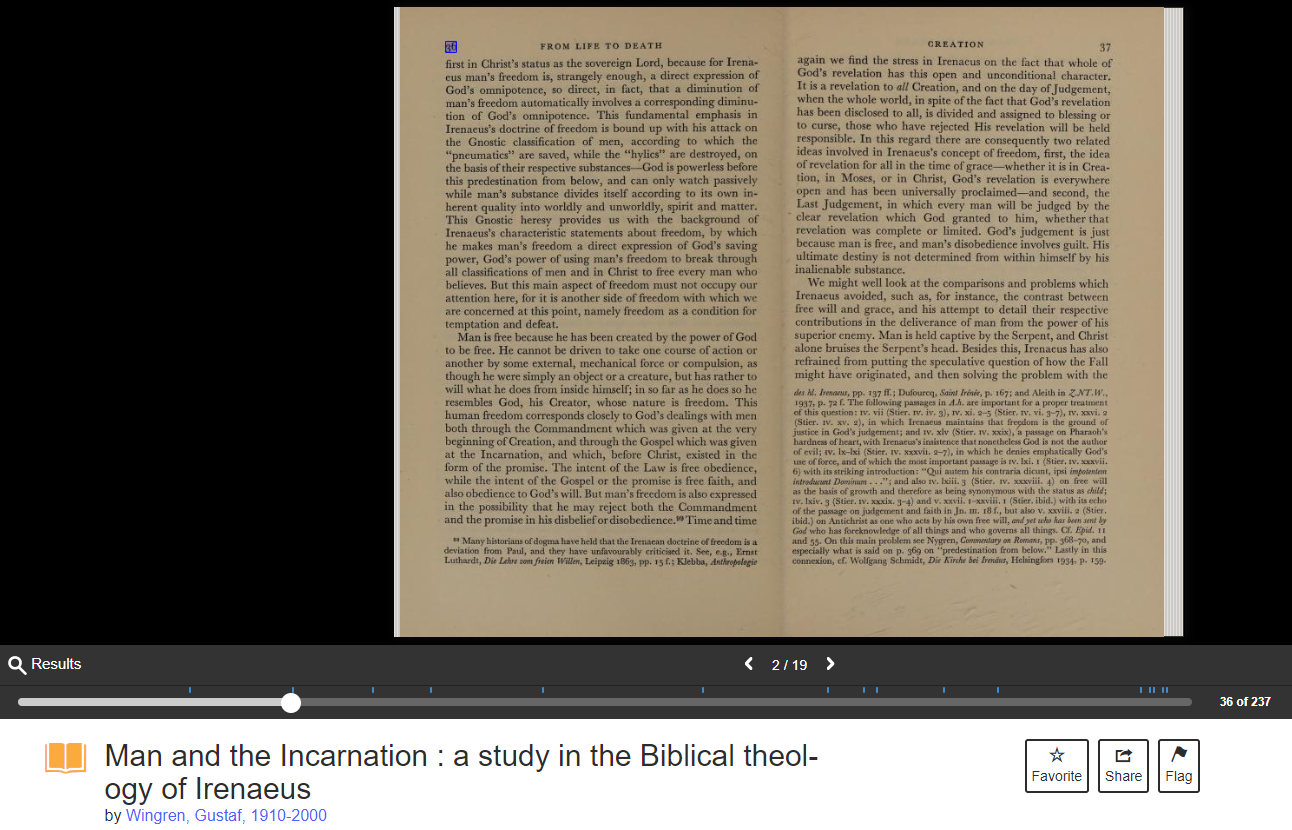
For example, Irenaeus (ca. AD 180) had argued that the Manichaean god was puny because he could only achieve his goals by micromanaging all events and persons. In contrast, the Christian God allowed humanity freedom, yet was so powerful he could still accomplish his plans.  It requires a more omnipotent and sovereign God to allow human freedom. "The essential principle in the concept of freedom appears first in Christ's status as the sovereign Lord, because for Irenaeus man's freedom is, strangely enough, a direct expression of God's omnipotence, so direct in fact, that a diminution of man's freedom automatically involves a corresponding diminution of God's omnipotence." (FN17 Gustaf Wingren ... Man and the Incarnation ... pp. 36-37)

One reason this is troubling because obviously Irenaeus was not responding to Mani or the Manichaean god.  He correctly notes the approximate date of Irenaeus's Against Heresies.  On the other hand, he did not seem to recognize that this was almost a century before the rise of Mani's religion.

Another reason this is troubling is that it is not a correct analysis of Irenaeus.  Obviously, interpretations of Irenaeus differ, but even Wilson's source, Wingren, acknowledges that the position that Irenaeus was responding to was not one of divine micromanagement, but exactly the opposite.

Wingren states, in the sentence immediately following that quoted by Wilson: 

This fundamental emphasis in Irenaeus's doctrine of freedom is bound up with his attack on the Gnostic classification of men, according to which the "pneumatics" are saved, while the "hylics" are destroyed, on the basis of their respective substances--God is powerless before this predestination from below, and can only watch passively while man's substance divides itself according to his own inherent quality into wordly and unworldly, spirit and matter. 

Thus, Irenaeus was not opposing an Augustinian or Calvinistic conception of God's providence, but a position in which God is unable to control.  Here's a copy of the relevant pages:

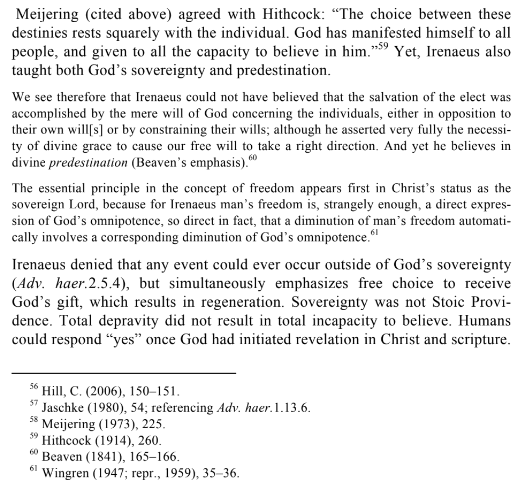
Finally, this is troubling because it appears to be the result of simply recycling source material.  This same quotation from Wingren is found in Wilson's book, which itself is apparently essentially his dissertation:


K. Wilson, Augustine's Conversion from Traditional Free Choice to "non-free Free Will" A Comprehensive Methodology, p. 54 (2018).

While I appreciate Wilson's attempt to contribute to patristic scholarship, I would encourage him not only to correct this error in any subsequent edition of "Calvinism: a Biblical and Theological Critique," but also to correct his underlying error of thought regarding the relationship of Irenaeus to Augustinian thought.

Wednesday, August 10, 2022

Part 2 of a Critique of "Calvinism: a Biblical and Theological Critique"

"Calvinism: a Biblical and Theological Critique" (CABTC) has an introduction by the editors, Drs. Allen and Lemke (A&L).  The eleven page introduction is broken into the following sections: 

  • The Debate over Calvinism (pp. 1-3)
  • Are all Non-Calvinists Accurately Described as Pelagians or Semi-Pelagians? (pp. 3-4)
  • Which Calvinism? (pp. 4-7)
  • Presuppositions and Presumptions (p. 7)
  • Why this Volume? (pp. 8-10)
  • Differing Views, Unified Spirit (pp. 10-11)

I'm reviewing this book as I go, so I'm not yet prepared to say whether the introduction adequately captures the spirit and thrust of the book.  If appropriate, I may revisit this post at a later time to update.

I'll address each section of the introduction in turn.  

The Debate over Calvinism

The bulk of this section is recounting the Synod of Dort, which provided a Calvinist response to the Remonstrants.  Oddly, A&L repeatedly characterize the Remonstrants as "Calvinists," apparently based on the Remonstrants' affirmation of human depravity.     

On the positive side, A&L state that "Calvinism appears to be on the rise at this time" (p. 1). I find it hard to measure such things, but I certainly hope that is true.  In that small portion of the section, A&L seem to have a clearer concept of Calvinism, identifying Together for the Gospel, 9Marks, and Sovereign Grace Ministries as Calvinist, but not the John 3:16 Conference.  Curious in their omission are the G3 conference and the Founders conference, not to mention any of the NAPARC churches or mainstream "Reformed" churches (the focus of A&L is plainly on Baptists and other baptistic evangelicals).

Considering that the first section of the introduction is characterized in terms of "debate," you might expect that the book will offer debate with Calvinists such as the unidentified "seasoned scholars" that they say "fervently believe in and teach Calvinism." 

The conclusion of the "debate" section is worded to smoothly flow into the next section...

Are All Non-Calvinists Accurately Described as Pelagians or Semi-Pelagians

A&L point the reader to their appendix on the same subject.  The gist of the argument is that there are non-Calvinistic positions that are not Pelagian, and that calling such positions "Semi-Pelagian" amounts to a slur or caricature.  A&L attempt to link the use of this term to the Dortian suppression of the Remonstrants, which they allege included persecutions up to and including a beheading.

Which Calvinism?

A&L state: "The articles address Calvinism broadly, as opposed to any particular Calvinist thinker ...." This is further justification of my overall point from part 1 of this review, that the book provides little scholarly interaction with Calvinist arguments (link to part 1).

The section includes a lengthy portion asserting that according to Richard Muller, a Baptist who holds to the five points is not a Calvinist.  Oddly enough, Baptist preacher John Piper seems to be the most often quoted "Calvinist." The one time Norman Geisler is cited (in a footnote at p. 50), it is to attack John Piper's alleged errors, although Geisler's claim to be a "moderate Calvinist" is not acknowledged.

At one side, S&L seem to act as though Calvinism is so amorphous that it can't be easily defined (so that it can be said that various Calvinists disagree about various points and any representation of "Calvinism" is valid if they can find someone broadly within the Calvinist camp that holds the position), at another side S&L would like to define Calvinism to make it unpalatable to their baptistic readership (for example, suggesting that Calvinism is associated with infant baptism), and at yet another side S&L seem to be able to identify "Calvinists" not only so that they can assert that both Remonstrants and Amyraldians are Calvinists but also that various preachers and other theologians are Calvinists.  In supporting Richard Muller's Calvinistic credentials they say he is someone "who has indisputable Calvinist credentials."   

Presuppositions and Presumptions

A&L begin this section by claiming, "Calvinists presume that concepts like total inability, irresistible grace, and regeneration preceding faith are matters of fact" (p. 7).  Actually, of course, Calvinists argue that Scripture teaches total depravity, irresistible grace, and effectual calling, they don't just "presume" them.  Similarly, A&L assert "Presuppositions like 'original sin entails original guilt' are taken as fact" (p. 7).  Once again, this seems to be a fundamental category error between an exegetical conclusion and a presupposition.

The remainder of this brief section reminds the reader that there are Confessional Lutherans who are neither Calvinist nor Arminian.  For the second edition (if one is made), the editors may want to correct the grammar of one sentence here, which ends: "informs us that Lutheranism is . . . Lutherans." (p. 7)

Why This Volume?

A&L point out that their previous book, "Whosoever Will: A Biblical-Theological Critique of Five-Point Calvinism" sold over 15,000 copies including a Spanish translation.  A&L also acknowledged the existence of the responsive book, "Whomever He Will: A Surprising Display of Sovereign Mercy." The authors of that work, Barrett and Nettles, are mentioned multiple times in CABTC.

A&L acknowledge that four of the "articles" in this work are updates of corresponding "articles" from the previous work, while the remaining eleven are new.  As I didn't address the previous work, this should not have a significant impact on this review.

A&L note that they have broadened their field of authors from Baptists to Baptists, Methodists, and Arminians: "This new work includes authors from the Baptist, Methodist, and Arminian traditions." (p. 9)

A&L state that what unifies the authors of this tome is a desire to articulate concerns about the doctrines of Calvinism as they pertain to soteriology.

Differing Views, Unified Spirit

A&L assert that the authors entered this discussion with "reluctance" because of their desire for unity among evangelical Christians.  It is a bit odd to list reluctance in a book that has the earmarks of a sequel, and one of the contributors has a podcast that seems to focus nearly exclusively on this subject.

According to A&L, the contributors are not "anti-Calvinist," and that they are "interested in dialogue, not diatribe."  We have observed that there is limited interaction with Calvinist scholars in this particular work, but we will see the extent to which they engage in the dialog they indicate they desire.

Wednesday, August 03, 2022

Part 1 of a Critique of "Calvinism: a Biblical and Theological Critique"

"Calvinism: a Biblical and Theological Critique" (CABTC) was published by B&H Academic.  The book has a relatively low level of engagement with Calvinist scholars and other proponents of Calvinism.  

It's not absolutely zero interaction.  For example, they mention my friend, James White, twice: once in Kenneth Wilson's section in a footnote, where an episode of Dr. White's podcast is mentioned together with a ten minute segment of Dr. Wilson appearing on Leighton Flowers' podcast, in which Dr. White is allegedly "rebutted," for the idea that "Some Calvinists claim to have found Calvinistic theology in the early church fathers" and once in David Allen's section as a footnote to the sentence, "One of [Robert Some's] texts was Rom 8:33-34." The footnote in David Allen's section points to a website where David Allen's "full treatment of Rom 8:32" allegedly can be found, in a page that has Dr. White's name in the title.

On the other hand, considering that the editors of and credited contributors to the work have at least one doctorate and are professors, one might have expected that their targets would be the work of Calvinist professors.  Instead, their go-to target is retired pastor and celebrated author, John Piper.  Piper, we should acknowledge, received a doctorate and taught in a university for a few years before becoming pastor of Bethlehem Baptist and writing his now famous book, "Desiring God." 

CABTC lacks a bibliography, which seems odd for an "academic" publication, but is apparently normal for the publisher, B&H Academic (based on a perusal of several other of their recent books).  Admittedly, I'm less familiar with the standards of Baptist academia, so perhaps this is totally normal in those circles.

The fifteen contributors are mostly professors at Baptist seminaries or men who received their doctorates from Baptist seminaries (9/15).  The exceptions are Brian Abasciano (Gordon-Conwell Theological Seminary), William Klein (Denver Seminary), Roger Olson (Baylor University), J. Matthew Pinson (Welch College), Ken Wilson (Grace School of Theology), and Ben Witherington III (Asbury Theological Seminary).  

The list includes respectable names in academia, but if what you are looking for is scholarly interaction with Calvinism and Calvinist arguments, this book is probably not for you.

Thankfully, we are able to provide a reasoned response to the arguments provided in this critique, and we plan to do so, Lord willing, in future posts.

UPDATE:
A few people commented on the odd title "Biblical and Theological Critique" as though any Protestant Critique that was theological could fail to be Biblical or vice versa.  

Compounding that problem, "A Biblical and Theological Critique" is also the section title of Section one of the book (occupying about the first third of the pages).  Section two is "Historical Issues with Calvinism" and section three is "Crucial Theological, Biblical, and Ecclesiological Issues with Calvinism."  There's an "Epilogue" that has the title: "Calvinists and Non-Calvinists Together for the Gospel," as well as an appendix titled, "Semi-Pelagianism: the Theological Catchall."  

Friday, July 22, 2022

Bonus Response to C. Jaye Cox's Annihilationism Arguments

I posted a rebuttal of what I see as CJ's top seven arguments for annihilationism (link).  There's another argument that didn't make it to the top seven.  

The extra argument goes that if the punishment for sin is an eternity in hell, then Hitler is getting the same punishment as the kindest, most outwardly righteous unbeliever (for example, Mother Theresa).

I don't know who was the first writer to address this topic, but I'm confident in saying that the most memorable treatment of this issue was tackled by Dante Alighieri in "Inferno."  

Dante provided one way in which Hell could provide varying degrees of eternal torment to sinners.  Dante is not inspired, but Dante's imagination provides a fairly simple way in which God can punishment sinners eternally without punishing sinners identically. 


Friday, July 15, 2022

Rebuttals to C. Jay Cox's Seven Arguments for Annihilationism

C. Jay Cox has seven arguments for annihilationism.  In the following discussion, I respond to and rebut each of them, in advance of a debate he and I have planned.  His points are listed as "CJ" and mine as "TF."  This is not an attempt to replace the debate, but rather, hopefully, to improve the quality of the debate.  

CJ1. The Doctrine of Eternal Conscious Torment Implies "Sadism" which is Contrary to God's Nature

CJ typically argues this point from verses that talk about God desiring all to come to salvation or not taking any pleasure in the death of the wicked.

TF1A:

One flaw with this argument is the assumption that inflicting pain on others is sadism. Other motives can include a motive to help the person (as in the case of surgeons and dentists) or even apathy (as in the case of narcissists). It's simply assuming the worse of God to assume that God's motive for Hell is sadism.  God's self-motivation is, at least, his own glory.

TF1B:

Another flaw is that CJ has to admit that Scripture itself portrays God as tormenting the devil (and the beast and the false prophet) forever:

Revelation 20:10

And the devil that deceived them was cast into the lake of fire and brimstone, where the beast and the false prophet are, and shall be tormented day and night for ever and ever.

In the past, CJ has expressed some uncertainty about the interpretation of this verse.  Nevertheless, even if CJ were to deny the most straightforward meaning of the text and claim that this was just a metaphor, still this is a description of God's actions that God applies to Himself.

Furthermore, recall that the damned are sent to receive the same punishment as the devil:

Matthew 25:41

Then shall he say also unto them on the left hand, Depart from me, ye cursed, into everlasting fire, prepared for the devil and his angels:

That is a punishment of everlasting fire.  The only obvious reason that the fire is described as "everlasting" is that it will continue doing what it does forever.

TF1C:

Furthermore, while God is not sadistic, CJ must have misunderstood the passages he quoted, because God describes himself not as apathetic about punishing the wicked, nor as saddened by his task, but this way:

Psalm 2:4

He that sitteth in the heavens shall laugh: the Lord shall have them in derision.

Psalm 37:13

The Lord shall laugh at him: for he seeth that his day is coming.

Psalm 59:8

But thou, O LORD, shalt laugh at them; thou shalt have all the heathen in derision.

Proverbs 1:26

I also will laugh at your calamity; I will mock when your fear cometh;

Likewise:

Rom 9:22

What if God, willing to shew his wrath, and to make his power known, endured with much longsuffering the vessels of wrath fitted to destruction:

Hebrews 10:30-31

For we know him that hath said, Vengeance belongeth unto me, I will recompense, saith the Lord. And again, The Lord shall judge his people. It is a fearful thing to fall into the hands of the living God.

CJ2: Eternal Punishment for Temporal Sins is Unfair but God is Fair

CJ typically appeals to the Lex Taliones or the like

TF2A: See TF1A above, as Scripture says God will punish the devil eternally.

TF2B:  The Lex Taliones is a civil law for crimes by humans against humans.  There are other punishments in the civil law of Moses including the death penalty for proselytizing false religions, engaging in witchcraft, or violating the sabbath.  So, while the punishments are just, they are not always of the same kind as the crime, as in the Lex Taliones.  Also, the punishments for crimes against God are much more severe than against humans.  You aren't punished under the law of Moses for crimes against humans unless you cause an injury.  You cannot injure God, but you are still punished for crimes against God.

TF2C: Sins against humans are serious, but sins against God are much more severe, because they are an offense to the dignity of the eternal God.  No temporal punishment is sufficient to pay one's debt.

TF2D: Even if one could pay the debt of punishment by a period of time in hell, Scripture does not suggest that the lost ever become holy.  Thus, we have every expectation that the wicked will continue to sin in Hell.

Ecclesiastes 11:3

If the clouds be full of rain, they empty themselves upon the earth: and if the tree fall toward the south, or toward the north, in the place where the tree falleth, there it shall be.

Jeremiah 13:23

Can the Ethiopian change his skin, or the leopard his spots? then may ye also do good, that are accustomed to do evil.

Matthew 25:30

And cast ye the unprofitable servant into outer darkness: there shall be weeping and gnashing of teeth.

Revelation 16:8-11

And the fourth angel poured out his vial upon the sun; and power was given unto him to scorch men with fire. And men were scorched with great heat, and blasphemed the name of God, which hath power over these plagues: and they repented not to give him glory.  And the fifth angel poured out his vial upon the seat of the beast; and his kingdom was full of darkness; and they gnawed their tongues for pain, and blasphemed the God of heaven because of their pains and their sores, and repented not of their deeds.

CJ3: Eternal Life is the Opposite of Death

TF3A: The Scriptures contrast "eternal life" with a variety of expressions including those that suggest some kind of death ("perish" in John 3:15; "lose it" (namely life) in John 12:25; and "death" in Romans 6:23) but Scripture also contrasts eternal life with "everlasting fire" Matthew 18:8, with "everlasting punishment" in Matthew 25:46, with "corruption" in Galatians 6:8, and with "shame and everlasting contempt" in Daniel 12:1, as well as abiding under God's wrath in John 3:36 and thirsting in John 4:14.  Furthermore, Revelation makes it clear that the lake of fire is the second death (Revelation 21:8).

TF3B: Additionally, the Scriptures explain that Eternal Life is something we have now, not only in the future, and that it is union with Christ.  

1 John 5:11
And this is the record, that God hath given to us eternal life, and this life is in his Son.

John 17:3
And this is life eternal, that they might know thee the only true God, and Jesus Christ, whom thou hast sent.

TF3C: Further to TF3B, this is why the second death is described in terms of separation from God:

2 Thessalonians 1:9
Who shall be punished with everlasting destruction from the presence of the Lord, and from the glory of his power;

And contrast:
Jude 24
Now unto him that is able to keep you from falling, and to present you faultless before the presence of his glory with exceeding joy,

TF3D: Further to TF3D this was pictured for us in the Old Testament in multiple cases where sin is not permitted in the presence of God:

Genesis 3:8
And they heard the voice of the LORD God walking in the garden in the cool of the day: and Adam and his wife hid themselves from the presence of the LORD God amongst the trees of the garden.

Genesis 4:16
And Cain went out from the presence of the LORD, and dwelt in the land of Nod, on the east of Eden.

Jonah 1:10
Then were the men exceedingly afraid, and said unto him, Why hast thou done this? For the men knew that he fled from the presence of the LORD, because he had told them.

Leviticus 22:3
Say unto them, Whosoever he be of all your seed among your generations, that goeth unto the holy things, which the children of Israel hallow unto the LORD, having his uncleanness upon him, that soul shall be cut off from my presence: I am the LORD.

Jeremiah 52:3
For through the anger of the LORD it came to pass in Jerusalem and Judah, till he had cast them out from his presence, that Zedekiah rebelled against the king of Babylon.

TF3E: Also, the death and life contrast applies to the present state:
John 5:24
Verily, verily, I say unto you, He that heareth my word, and believeth on him that sent me, hath everlasting life, and shall not come into condemnation; but is passed from death unto life.

CJ4: 4. Hell is Constantly Described as a Fire as Burning Up of Chaff, Trash, and Human Sacrifices (Gahenna is reference to this)

TF4A: There are multiple illustrations of hell and of God's wrath.  Fire is one of the illustrations.

TF4B: Even when fire is mentioned, burning up is not the constant point.  Compare Revelation 20:10, quoted above.

TF4C: There are other, fundamentally different, illustrations, such as everlasting chains or chains of darkness (Jude 6, 2 Peter 2:4) and darkness (Job 10:22; Proverbs 20:20) mist of darkness (2 Peter 2:17) blackness of darkness (Jude 13) or outer darkness (Matthew 8:12; Matthew 22:13; Matthew 25:13).

Ecclesiastes 11:8
But if a man live many years, and rejoice in them all; yet let him remember the days of darkness; for they shall be many. All that cometh is vanity.

CJ5: This Fire is the Second Death, a Literal Death (as opposed to Eternal Life)

TF5: The lake of fire is something capable of torturing the devil and his angels, which are spirits.  Moreover, it's not just that the wicked are thrown in, they have a place there.  The lake of fire is the second death.  Yet the punishment is also darkness.  That's because both darkness and fire are both symbols of suffering due to pain and fear, see Revelation 16:8-11 above.

CJ6: Wicked are constantly described as Perishing, Dying, Being Destroyed, Being given to Destruction

TF6: There are definitely those descriptions, but since there are other descriptions (see above), they must be harmonized.  Notice, for example, that the beast and false prophet are cast alive into the lake of fire.

Revelation 19:20
And the beast was taken, and with him the false prophet that wrought miracles before him, with which he deceived them that had received the mark of the beast, and them that worshipped his image. These both were cast alive into a lake of fire burning with brimstone.

Likewise, Korah is described as going down to the abyss alive:

Numbers 16:33
They, and all that appertained to them, went down alive into the pit, and the earth closed upon them: and they perished from among the congregation.

Likewise, the grave is described as a prison:

Job 17:16
They shall go down to the bars of the pit, when our rest together is in the dust.

It's a prison that will not hold believers:

Matthew 16:18
And I say also unto thee, That thou art Peter, and upon this rock I will build my church; and the gates of hell shall not prevail against it.

CJ7: Hades is a place of torment but is Destroyed
TF7A: The verse in mind is this:
Revelation 20:14
And death and hell were cast into the lake of fire. This is the second death.

TF7B: In context, death and hell are symbols of the places of the lost, since the lost were "in them":
Revelation 20:13
And the sea gave up the dead which were in it; and death and hell delivered up the dead which were in them: and they were judged every man according to their works.

Indeed, these are places to which there are keys:
Revelation 1:18
I am he that liveth, and was dead; and, behold, I am alive for evermore, Amen; and have the keys of hell and of death.

It is true that they are also personified in chapter 6, but there is no reason to treat Revelation 20:14 as referring to those personifications rather than the places of Revelation 20:13.
Revelation 6:8
And I looked, and behold a pale horse: and his name that sat on him was Death, and Hell followed with him. And power was given unto them over the fourth part of the earth, to kill with sword, and with hunger, and with death, and with the beasts of the earth.

TF7C: Keep in mind that death and hell (as places) are essentially synonymous in Hebrew thought, see 2 Samuel 22:6, Psalm 18:5, Psalm 55:15, Psalm 116:3, Proverbs 5:5, Proverbs 7:27, and Habakkuk 2:5. Similarly, there is fascinating passage in which they are both places and seemingly personified in Isaiah 28:15 and 18.


-TurretinFan

Tuesday, June 28, 2022

Epiphanius of Salamis - Evidence of the Bodily Assumption in the Panarion

 Panarion, Anacephalaeosis VII, Chapter 78, Against Antidicomarians (p. 635):

23,8 And there have been many such things to mislead the deluded, though the saints are not responsible for anyone’s stumbling; the human mind finds no rest, but is perverted to evils. (9) The holy virgin may have died and been buried—her falling asleep was with honor, her death in purity, her crown in virginity. Or she may have been put to death—as the scripture says, “And a sword shall pierce through her soul” 96—her fame is among the martyrs and her holy body, by which light rose on the world, [rests] amid blessings. Or she may have remained alive, for God is not incapable of doing whatever he wills. No one knows her end.

The greatest relevance of the passage above is that there was not a reliable tradition as to how Mary left the Earth during the time of Epiphanius of Salamis, known to him.

Moreover, when discussing the translation of Enoch and Elijah in Anacephalaeosis IV, at 64,1 and 64,2 (p. 197), in responding to the followers of Origen, Epiphanius does not mention Mary.  Likewise, when mentioning the resurrection to glory, Epiphanius only mentions Christ at 65,1.  

However, defenders of the Bodily Assumption sometimes reference to the chapter following Epiphanius' famous "No one knows her end":

Panarion, Anacephalaeosis VII, Chapter 79, Against Collyridians (p. 641):
5,1 For what this sect has to say is complete nonsense and, as it were, an old wives’ tale. Which scripture has spoken of it? Which prophet per-mitted the worship of a man, let alone a woman? (2) The vessel is choice but a woman, and by nature no different [from others]. Like the bodies of the saints, however, she has been held in honor for her character and understanding. And if I should say anything more in her praise, [she is] like Elijah, who was virgin from his mother’s womb, always remained so, and was taken up and has not seen death. She is like John who leaned on the Lord’s breast, “the disciple whom Jesus loved.”(FN12) She is like St. Thecla; and Mary is still more honored than she, because of the providence vouchsafed her. (3) But Elijah is not to be worshiped, even though he is alive. And John is not to be worshiped, even though by his own prayer—or rather, by receiving the grace from God—he made an awesome thing of his falling asleep.(FN13) But neither is Thecla worshiped, nor any of the saints.
For the age-old error of forgetting the living God and worshiping his creatures will not get the better of me. (4) They served and worshiped the creature more than the creator,” and “were made fools.”(FN14) If it is not his will that angels be worshiped, how much more the woman born of Ann,(FN15) who was given to Ann by Joachim(FN16) and granted to her father and mother by promise, after prayer and all diligence? She was surely not born other than normally, but of a man’s seed and a woman’s womb like everyone else. (5) For even though the story and traditions of Mary say that her father Joachim was told in the wilderness, “Your wife has conceived,”(FN17) it was not because this had come about without conjugal intercourse or a man’s seed. The angel who was sent to him predicted the coming event, so that there would be no doubt. The thing had truly happened, had already been decreed by God, and had been promised to the righteous. 
FN12 John 13:23.
FN13 Cf. Act. John 108-115. 
FN14 Rom 1:24; 22. 
FN15 Cf. Protoevangelium of James 4:1-3. 
FN16 Cf. Protoevangelium of James 4:1-3. 
FN17 Cf. Protoevangelium of James 4:2.

Naturally, there is an urgent rush to assume that the comparison to Elijah is a comparison to his translation.  Moreover, continuing to John the Assumptionists think they have hope.  That hope, however, should be crushed by Thecla, who is one of the most famous female martyrs.

As noted by the editor of the English translation, the account of John praying at the end of his life comes from the apocryphal Acts of John.  Some advocates of the Bodily Assumption like to point out that some versions of the Acts of John actually have John not simply dying, but getting translated (see the discussion at this link).  There is no evidence that Epiphanius had such an ending in mind.

Instead, as I pointed out during the debate, Epiphanius was arguing that Mary was virgin like Epiphanius thought Elijah was, and as was John according to the prayer in Acts of John 113 (113 "O thou who hast kept me until this hour for thyself and untouched by union with a woman:"), and as Thecla was reputed to have been.  We see this confirmed from the fact that the next section after what I quoted above begins: "6,1 And everywhere we see the scriptures saying < the same >. Isaiah predicted the things that would be realized in the Son of God and said, “Behold, the virgin shall be with child and shall bear a son and shall call his name Immanuel.”[FN18 Isa 7:14]"

Our Roman Catholic friends would do well to hear Epiphanius words of caution in the immediately preceding section (Panarion, Anacephalaeosis VII, Chapter 79, Against Collyridians, pp. 640-41):
4,6 Yes, of course Mary’s body was holy, but she was not God. Yes, the Virgin was indeed a virgin and honored as such, but she was not given us to worship; she worships Him who, though born of her flesh, has come from heaven, from the bosom of his Father. (7) And the Gospel therefore protects us by telling us so on the occasion when the Lord himself said, “Woman, what is between me and thee? Mine hour is not yet come.”[FN11 John 2:4.] < For > to make sure that no one would suppose, because of the words, “What is between me and thee?” that the holy Virgin is anything more [than a woman], he called her “Woman” as if by prophecy, because of the schisms and sects that were to appear on earth. Otherwise some might stumble into the nonsense of the sect from excessive awe of the saint.
If Epiphanius were alive today, surely he would view the "hyper-dulia" offered to Mary to be excessive awe.  Mary was just a woman, she should not be the object of religious veneration.

Nevertheless, both the context prior and the context post are about Mary's virginity, not her supposed assumption.  The end of Mary, no one knows, as Epiphanius explicitly affirmed. 
 

Sunday, June 12, 2022

TurretinFan vs. Joshua Gibbs - Perseverance of the Saints Debate (predicted affirmative constructive)

I look forward to this debate with Mr. Gibbs.  

What is the position I’m defending?

Westminster Confession of Faith - Chapter 17

1. They whom God hath accepted in his Beloved, effectually called and sanctified by his Spirit, can neither totally nor finally fall away from the state of grace; but shall certainly persevere therein to the end, and be eternally saved.a

a. John 10:28-29; Phil 1:6; 1 Pet 1:5, 9; 2 Pet 1:10; 1 John 3:9.

2. This perseverance of the saints depends, not upon their own free will, but upon the immutability of the decree of election, flowing from the free and unchangeable love of God the Father;a upon the efficacy of the merit and intercession of Jesus Christ;b the abiding of the Spirit and of the seed of God within them;c and the nature of the covenant of grace:d from all which ariseth also the certainty and infallibility thereof.e

a. Jer 31:3; 2 Tim 2:18-19. • b. Luke 22:32; John 17:11, 24; Heb 7:25; 9:12-15; 10:10, 14; 13:20-21; Rom 8:33-39. • c. John 14:16-17; 1 John 2:27; 3:9. • d. Jer 32:40. • e. John 10:28; 2 Thes 3:3; 1 John 2:19.

3. Nevertheless they may, through the temptations of Satan and of the world, the prevalency of corruption remaining in them, and the neglect of the means of their preservation, fall into grievous sins;a and for a time continue therein:b whereby they incur God’s displeasure,c and grieve his Holy Spirit;d come to be deprived of some measure of their graces and comforts;e have their hearts hardened,f and their consciences wounded;g hurt and scandalize others,h and bring temporal judgments upon themselves.i

a. Mat 26:70, 72, 74. • b. Psa 51 title with v. 14. • c. 2 Sam 11:27; Isa 64:5, 7, 9. • d. Eph 4:30. • e. Psa 51:8, 10, 12; Song 5:2-4, 6; Rev 2:4. • f. Isa 63:17; Mark 6:52; 16:14. • g. Psa 32:3-4; 51:8. • h. 2 Sam 12:14. • i. Psa 89:31-32; 1 Cor 11:32.

One thing I will briefly suggest is that we do not lapse into a side debate as to what constitutes Calvinism and what other folks outside this debate may have said.  The position I’ve read above is a widely agreed upon definition of the Calvinistic understanding of the text, though I think it would also be held by others, and possibly some folks who call themselves “Calvinists” would not agree with it.

We are saved by grace, through faith, and that is a gift of God:

Ephesians 2:8 For by grace are ye saved through faith; and that not of yourselves: it is the gift of God:

We also shall be saved:

Acts 15:11 But we believe that through the grace of the Lord Jesus Christ we shall be saved, even as they.

Faith means Trust in God:

1 Timothy 4:10 For therefore we both labour and suffer reproach, because we trust in the living God, who is the Saviour of all men, specially of those that believe.

Faith is not merely Believing that God Exists

James 2:19 Thou believest that there is one God; thou doest well: the devils also believe, and tremble.

Justification is not the Only Aspect of Salvation - Salvation also includes Adoption

Galatians 4:5 To redeem them that were under the law, that we might receive the adoption of sons.

Ephesians 1:5 Having predestinated us unto the adoption of children by Jesus Christ to himself, according to the good pleasure of his will,

Adoption comes by the Spirit

Romans 8:9-17

But ye are not in the flesh, but in the Spirit, if so be that the Spirit of God dwell in you. Now if any man have not the Spirit of Christ, he is none of his. And if Christ be in you, the body is dead because of sin; but the Spirit is life because of righteousness. But if the Spirit of him that raised up Jesus from the dead dwell in you, he that raised up Christ from the dead shall also quicken your mortal bodies by his Spirit that dwelleth in you. Therefore, brethren, we are debtors, not to the flesh, to live after the flesh. For if ye live after the flesh, ye shall die: but if ye through the Spirit do mortify the deeds of the body, ye shall live. For as many as are led by the Spirit of God, they are the sons of God. For ye have not received the spirit of bondage again to fear; but ye have received the Spirit of adoption, whereby we cry, Abba, Father. The Spirit itself beareth witness with our spirit, that we are the children of God: and if children, then heirs; heirs of God, and joint-heirs with Christ; if so be that we suffer with him, that we may be also glorified together. 

Moreover, the Spirit Aids Us

Romans 8:26-39

Likewise the Spirit also helpeth our infirmities: for we know not what we should pray for as we ought: but the Spirit itself maketh intercession for us with groanings which cannot be uttered. And he that searcheth the hearts knoweth what is the mind of the Spirit, because he maketh intercession for the saints according to the will of God. 

And we know that all things work together for good to them that love God, to them who are the called according to his purpose. 

For whom he did foreknow, he also did predestinate to be conformed to the image of his Son, that he might be the firstborn among many brethren.

Moreover whom he did predestinate, them he also called: and whom he called, them he also justified: and whom he justified, them he also glorified.

What shall we then say to these things? If God be for us, who can be against us? He that spared not his own Son, but delivered him up for us all, how shall he not with him also freely give us all things? Who shall lay any thing to the charge of God's elect? It is God that justifieth. Who is he that condemneth? It is Christ that died, yea rather, that is risen again, who is even at the right hand of God, who also maketh intercession for us. 

Who shall separate us from the love of Christ? shall tribulation, or distress, or persecution, or famine, or nakedness, or peril, or sword? As it is written, For thy sake we are killed all the day long; we are accounted as sheep for the slaughter. 

Nay, in all these things we are more than conquerors through him that loved us. For I am persuaded, that neither death, nor life, nor angels, nor principalities, nor powers, nor things present, nor things to come, nor height, nor depth, nor any other creature, shall be able to separate us from the love of God, which is in Christ Jesus our Lord.

What is Faith?

Hebrews 11:1-2

Now faith is the substance of things hoped for, the evidence of things not seen. For by it the elders obtained a good report.

Notice the connection between faith and a good report.  The good report is not the cause of the faith, it’s the other way ‘round.  Moreover, remember that our faith does not depend on us.

Jesus is the author and the finisher of our faith

Hebrew 12:1-2

Wherefore seeing we also are compassed about with so great a cloud of witnesses, let us lay aside every weight, and the sin which doth so easily beset us, and let us run with patience the race that is set before us, looking unto Jesus the author and finisher of our faith; who for the joy that was set before him endured the cross, despising the shame, and is set down at the right hand of the throne of God.

Jesus will Finish What He Started

Philippians 1:3-8

I thank my God upon every remembrance of you, always in every prayer of mine for you all making request with joy, for your fellowship in the gospel from the first day until now; being confident of this very thing, that he which hath begun a good work in you will perform it until the day of Jesus Christ: even as it is meet for me to think this of you all, because I have you in my heart; inasmuch as both in my bonds, and in the defence and confirmation of the gospel, ye all are partakers of my grace. For God is my record, how greatly I long after you all in the bowels of Jesus Christ.

False Faith is “Dead” Faith - it’s not the real thing

James 2:14-26

What doth it profit, my brethren, though a man say he hath faith, and have not works? can faith save him? If a brother or sister be naked, and destitute of daily food, and one of you say unto them, Depart in peace, be ye warmed and filled; notwithstanding ye give them not those things which are needful to the body; what doth it profit? Even so faith, if it hath not works, is dead, being alone. Yea, a man may say, Thou hast faith, and I have works: shew me thy faith without thy works, and I will shew thee my faith by my works. Thou believest that there is one God; thou doest well: the devils also believe, and tremble. But wilt thou know, O vain man, that faith without works is dead? Was not Abraham our father justified by works, when he had offered Isaac his son upon the altar? Seest thou how faith wrought with his works, and by works was faith made perfect? And the scripture was fulfilled which saith, Abraham believed God, and it was imputed unto him for righteousness: and he was called the Friend of God. Ye see then how that by works a man is justified, and not by faith only. Likewise also was not Rahab the harlot justified by works, when she had received the messengers, and had sent them out another way? For as the body without the spirit is dead, so faith without works is dead also.

How is it reasonable to link faith with works?  The answer is the Spirit.

Galatians 5:16-25

This I say then, Walk in the Spirit, and ye shall not fulfil the lust of the flesh. For the flesh lusteth against the Spirit, and the Spirit against the flesh: and these are contrary the one to the other: so that ye cannot do the things that ye would. But if ye be led of the Spirit, ye are not under the law. 

Now the works of the flesh are manifest, which are these; Adultery, fornication, uncleanness, lasciviousness, idolatry, witchcraft, hatred, variance, emulations, wrath, strife, seditions, heresies, envyings, murders, drunkenness, revellings, and such like: of the which I tell you before, as I have also told you in time past, that they which do such things shall not inherit the kingdom of God.

But the fruit of the Spirit is love, joy, peace, longsuffering, gentleness, goodness, faith, meekness, temperance: against such there is no law. 

And they that are Christ's have crucified the flesh with the affections and lusts. If we live in the Spirit, let us also walk in the Spirit. 

Warning to False Believers

Jude 5-13

I will therefore put you in remembrance, though ye once knew this, how that the Lord, having saved the people out of the land of Egypt, afterward destroyed them that believed not. And the angels which kept not their first estate, but left their own habitation, he hath reserved in everlasting chains under darkness unto the judgment of the great day. Even as Sodom and Gomorrha, and the cities about them in like manner, giving themselves over to fornication, and going after strange flesh, are set forth for an example, suffering the vengeance of eternal fire. Likewise also these filthy dreamers defile the flesh, despise dominion, and speak evil of dignities. Yet Michael the archangel, when contending with the devil he disputed about the body of Moses, durst not bring against him a railing accusation, but said, The Lord rebuke thee. But these speak evil of those things which they know not: but what they know naturally, as brute beasts, in those things they corrupt themselves. Woe unto them! for they have gone in the way of Cain, and ran greedily after the error of Balaam for reward, and perished in the gainsaying of Core. These are spots in your feasts of charity, when they feast with you, feeding themselves without fear: clouds they are without water, carried about of winds; trees whose fruit withereth, without fruit, twice dead, plucked up by the roots; raging waves of the sea, foaming out their own shame; wandering stars, to whom is reserved the blackness of darkness for ever.

If you have believed, bring forth the appropriate Fruit

Romans 6:15-23

What then? shall we sin, because we are not under the law, but under grace? God forbid. Know ye not, that to whom ye yield yourselves servants to obey, his servants ye are to whom ye obey; whether of sin unto death, or of obedience unto righteousness? But God be thanked, that ye were the servants of sin, but ye have obeyed from the heart that form of doctrine which was delivered you. Being then made free from sin, ye became the servants of righteousness. I speak after the manner of men because of the infirmity of your flesh: for as ye have yielded your members servants to uncleanness and to iniquity unto iniquity; even so now yield your members servants to righteousness unto holiness. For when ye were the servants of sin, ye were free from righteousness. What fruit had ye then in those things whereof ye are now ashamed? for the end of those things is death. But now being made free from sin, and become servants to God, ye have your fruit unto holiness, and the end everlasting life. For the wages of sin is death; but the gift of God is eternal life through Jesus Christ our Lord.

Fruit is not how we are Justified before God, nor is it the cause of our Salvation but it is Evidence

Matthew 7:15-20

Beware of false prophets, which come to you in sheep's clothing, but inwardly they are ravening wolves. Ye shall know them by their fruits. Do men gather grapes of thorns, or figs of thistles? Even so every good tree bringeth forth good fruit; but a corrupt tree bringeth forth evil fruit. A good tree cannot bring forth evil fruit, neither can a corrupt tree bring forth good fruit. Every tree that bringeth not forth good fruit is hewn down, and cast into the fire. Wherefore by their fruits ye shall know them.


Monday, May 23, 2022

Where are all the ashes?

 If Annihilationists were right, one might expect to see the end of the wicked more often equated with non-existence.  Of course, not all Annhilationists say that man ceases to exist, sometimes they will say he is reduced to ashes.

One nice thing about the ashes argument is that there is a Biblical "ashes" motif that it can be drawn from.  For example, at Genesis 18:27, Abraham calls himself "dust and ashes" (עָפָר וָאֵֽפֶר).  The Hebrew word for ashes, transliterated 'epher, is used about two dozen times in the Old Testament.

The first is Abraham's usage.

The second/third is in the ordinance of the red heifer, which is burned up, reduced to ash, the ashes are gathered up, and then placed in a clean place outside the camp.  Even the person who touches the ashes is considered ceremonially unclean.  The purpose of the sacrifice is the purification of sin. (Leviticus 19:1-10)

Many are ashes that are applied to the body as a sign of mourning (2 Samuel 13:19, Esther 4:1, 3, Isaiah 58:5, 61:3, Jeremiah 61:3, Ezekiel 27:30, Daniel 9:3, Jonah 3:6)

Several are in the book of Job.  In Job 2:8, Job sits down amongst the ashes with a potsherd.  In Job 13:12, Job compares his friends to ashes and bodies of clay.  In John 30:19, Job complains that he has become like dust and ashes.  In Job 42:6, Job repents in dust and ashes.

The afflicted person in Psalm 102 complains that he has eaten ashes like bread (Psalm 102:9).

Psalm 147:16 compares the hoarfrost to scattered ashes.

Lamentations 3:16 describes a person having their teeth broken with gravel and covered with ashes.

The main two places of interest to annihilationists are two places where they are described in ashen terms.  

The first is Ezekiel 28, regarding the destruction of the King of Tyre.  In this passage, a picture is painted of the King of Tyre that describes him in lofty terms, but then calls for his destruction in terms of a fire coming from inside of him, devouring him, turning him to ash, and him becoming nothing more than a terrifying experience for those who saw it, concluding with "never shalt thou be any more."  (Ezekiel 28:19)  This end is similar to those described by Ezekiel 26:21 (where it is about the city of Tyre) and Ezekiel 27:36 (also about the city of Tyre).  The most natural understanding, therefore, of this pericope is that it is about the destruction of the city of Tyre as such.  Interestingly, one of the defensive strategies that the men of Tyre used was to set their own ships on fire and kamikaze attack Alexander the Great's causeway.  It was initially effective, apparently, but ultimately they suffered a humiliating defeat.

The final reference is Malachi 4:3, where the wicked are describes as being "ashes under the soles of your feet" in the day that comes that burns the proud like stubble in an oven.  If this were the only, or the dominant description of the afterlife, then annihilationism would be a lot more tempting. 

I would be remiss if I did not point out that another word for ashes was used in Exodus 9:8&10 to describe the ashes that Moses sprinkled toward heaven, resulting in the plague of boils. Likewise, there is a further word for that can mean fat or the ashes thereof (deshen), which is used of sacrificial ashes in Leviticus 1:16, 4:12, 6:10-11, 7:10, and 1 Kings 13:3&5.  The only place where deshen might be of particular interest to annihilationists is in Jeremiah 31:40, describing a valley of dead bodies and ashes.  This may be awkward, though, as that valley is described as being holy to the Lord.

The New Testament refers to the same sackloth and ashes practice (interestingly in reference to a hypothetical preaching of the gospel to Tyre) at Matthew 11:21 and Luke 10:13.  Likewise, the New Testament mentions ceremonially cleansing ashes (apparently of the red heifer) Hebrews 9:13.    

Finally, the English word "ashes" is typically used as part of the translation of the verb in 2 Peter 2:6, which refers to the incineration of Sodom and Gomorrha.

While the Old Testament speaks of some kind of annihilation of the city of Tyre, there is not any closely similar statement made regarding unbelievers.  The closest would be 2 Peter 2:6, which we may consider under a separate post.

In short, if annhilationism were correct, one would expect the Scriptures to be more full of ashes than they are.  They are not ash-free, but certainly the few mentions of ashes are not really enough to justify annihilitionist reliance on them over against explicit didactic teachings on the subject.

Wednesday, May 18, 2022

Ignatius an Annhiliationist?

 In a recent video, Chris Date (CD) claims that Ignatius of Antioch was an annihilationist (link).  CD generally uses the term "conditional immortality" to describe his position.  

Before getting into a discussion of Ignatius himself, CD includes the bizarre claim that Tatian of Adiabene (c. 120-180) is the "oldest Christian advocate of eternal torment" (30:45 in video) Not only do we see such teachings in 1 Clement (which CD disputes as we analyze here), Polycarp (which CD also disputes as we analyze here), and Ignatius of Antioch (as discussed below) but even more clearly in others, such as Justin Martyr.

Justin Martyr (c. 100-165), First Apology, Chapter 52: "For the prophets have proclaimed two advents of His: the one, that which is already past, when He came as a dishonoured and suffering Man; but the second, when, according to prophecy, He shall come from heaven with glory, accompanied by His angelic host, when also He shall raise the bodies of all men who have lived, and shall clothe those of the worthy with immortality, and shall send those of the wicked, endued with eternal sensibility, into everlasting fire with the wicked devils." (link)  CDlater weakly concedes (around 43:10 in the video) that Justin Martyr seems in some places to be ECT and in some places annihilationist.  Nevertheless, the quotation above is an extremely clear statement of eternal conscious torment.  I suspect, and perhaps we'll be able to investigate this more another time, that the problem is CD's optimistically annihilationist hermeneutic of the early Christian writers.  

CD finally begins to discuss Ignatius' teaching around 47 minutes into the video (link to point). CD states that he's going to be working from what he refers to as the "middle recension" of Ignatius.  There is actually remaining debate over what exactly the original text of Ignatius is, and where there are differences amongst the recensions, relying on a variant reading is a tricky matter.

The first piece of evidence that CD points to is actually evidence in support of eternal conscious torment.  Ignatius' Epistle to the Ephesians, Chapter 16, states, "If, then, those who do this as respects the flesh have suffered death, how much more shall this be the case with any one who corrupts by wicked doctrine the faith of God, for which Jesus Christ was crucified! Such an one becoming defiled [in this way], shall go away into everlasting fire, and so shall every one that hearkens unto him."  The longer recension is somewhat different on this point, reading: "And if those that corrupt mere human families are condemned to death, how much more shall those suffer everlasting punishment who endeavour to corrupt the Church of Christ, for which the Lord Jesus, the only-begotten Son of God, endured the cross, and submitted to death!"  The difference in meaning is not significant if Ignatius held to ECT, and indeed the reference to "everlasting fire" is a reference to ECT. The only reason to read it otherwise is based on hoping that Ignatius is just using Biblical language and that the annihilationist interpretation of everlasting fire is correct.   There is, quite frankly, no sound reason to think this.  We can and will discuss the annihilationist interpretation of everlasting fire, but for now suffice to say that this is an example of Ignatius affirming the eternal torment view.

The second piece of evidence that CD points to is Ignatius' Epistle to the Magnesians, Chapter 5.  There, Ignatius writes, "Seeing, then, all things have an end, these two things are simultaneously set before us—death and life; and every one shall go unto his own place." (shorter recension)  The longer recension is more expansive but has the same core: "Seeing, then, all things have an end, and there is set before us life upon our observance [of God’s precepts], but death as the result of disobedience, and every one, according to the choice he makes, shall go to his own place, let us flee from death, and make choice of life." (longer recension).

I should be quick to point out that "go to his own place" points to death not simply as a biological state, but rather to a place.  This view is, naturally, more compatible with the ECT view than its annihilationist alternative.

CD argues that Ignatius "consistently" uses death to mean simply biological death.  CD is wrong about that.  For example, Ignatius uses "death" to refer to spiritual death in his Epistle to the Trallians, Chapter 11: "Flee, therefore, those evil offshoots [of Satan], which produce death-bearing fruit, whereof if any one tastes, he instantly dies." (shorter) "Avoid also the children of the evil one, Theodotus and Cleobulus, who produce death-bearing fruit, whereof if any one tastes, he instantly dies, and that not a mere temporary death, but one that shall endure for ever." (longer)

Notice, by the way, that the editor who produced the longer recension affirmed everlasting punishment (as pointed out above), so the editor that says "death ... that shall endure forever" is referring to ECT.  This should be basically an aside, since the longer recension is presumably not the original.

It is a bit vexing to deal with this issue of CD claiming something is used consistently one way, presenting evidence to allegedly support that claim, and then it turning out that CD has not included the counter-evidence. 

CD even points to Ignatius' Epistle to the Smyrnaeans Chapter 2, which states: "And He suffered truly, even as also He truly raised up Himself, not, as certain unbelievers maintain, that He only seemed to suffer, as they themselves only seem to be [Christians]. And as they believe, so shall it happen unto them, when they shall be divested of their bodies, and be mere evil spirits." (shorter) The longer recension doesn't discuss this divestment of bodies.

I really cannot approve of CD's excerpting of "and be mere evil spirits" in his effort to make Ignatius look more like an annihilationist than Ignatius was.

Moreover, CD refers the reader to Igantius' Epistle to the Smyrnaeans Chapter 5, which states: "But he who does not acknowledge this, has in fact altogether denied Him, being enveloped in death." (shorter - longer is essentially the same on this point)  Note that being enveloped with death once again cannot refer to biological death, because it is that they area already experiencing.

CD then points to Smyrnaeans 7, which states: "Those, therefore, who speak against this gift of God, incur death in the midst of their disputes. But it were better for them to treat it with respect, that they also might rise again." (shorter) "They are ashamed of the cross; they mock at the passion; they make a jest of the resurrection." (longer) The textual variation seems markedly significant here.  Nevertheless, even assuming the shorter recension is accurate, the sense of "rise again" is probably best understood as "rise again with Christ" as opposed to being a claim that there is only a resurrection of the just.

CD next turns to Ignatius' Epistle to the Trallians, Chapter 2, where Ignatius states: "ye appear to me to live not after the manner of men, but according to Jesus Christ, who died for us, in order, by believing in His death, ye may escape from death." (shorter) "ye appear to me to live not after the manner of men, but according to Jesus Christ, who died for us, in order that, by believing in His death, ye may by baptism be made partakers of His resurrection." (longer)  I note that the longer seems to convey the sense meant by the shorter.  More pointedly, though, believers do not escape from just ordinary death in the sense of not experiencing ordinary death.  Instead, they escape from death by resurrection from the dead to eternal life.  I can appreciate why this statement, by itself, could be taken in an annihilationist sense, but it doesn't directly address the issue.

CD talks briefly about the sense of the word, life, namely that it is not necessarily a special technical term.  I suppose probably some people argue this, but since I don't, I'll pass this by, except in one particular.

On the second or third slide of his presentation about Ignatius' use of "life," CD comes to the place in Ignatius' Epistle to the Trallians, Chapter 9, where Ignatius states: "He was also truly raised from the dead, His Father quickening Him, even as after the same manner His Father will so raise up us who believe in Him by Christ Jesus, apart from whom we do not possess the true life." (shorter) (the longer has no equivalent statement)  Even setting aside the troubling textual variant issue, the statement "apart from whom we do not possess the true life" is a statement of the ECT position on what eternal life is, as distinct from the annihilationist/reductionist view that reduces life to biological life.

Likewise, in the keystone evidence that Chris presents, the off-quoted passage of Ignatius in Epistle to the Ephesians, Chapter 20: "breaking one and the same bread, which is the medicine of immortality, and the antidote to prevent us from dying, but [which causes] that we should live for ever in Jesus Christ."  (Schaff only provides a single recension here, and I haven't taken the time to investigate which it is.) there is a similar expression of life that matters being life "in Jesus Christ."  CD seems to overlook this important qualifier.  CD claims that "life" and "dying" here have no special theological significance, but it should be obvious that Ignatius who longed for martyrdom did not think that the bread of the Eucharist would stop him from suffering martyrdom.  The idea that there is no special theological significance is totally unthinkable.

CD goes so far as to change Ignatius' words in the spoken part of the presentation, to go from "prevent us from dying" to "cures death and makes it possible for us to rise immortal."  That change in wording is significant to CD's claim that Ignatius' terms don't have special theological significance, but they are not the words that Ignatius used.  In point of fact, "prevent dying" means you don't die, whereas "cures death" means raises to life after you die.  Of course, Ignatius does affirm the resurrection of the believers, but one to a new life in union with Christ, which is what the ECT position teaches.

Sunday, May 15, 2022

Is the Spirit Immortal?

Unlike animals, humans have an immortal soul.

Ecclesiastes 3:21

Who knoweth the spirit of man that goeth upward, and the spirit of the beast that goeth downward to the earth?

Early Christians understood and believed in the existence of disembodied spirits.

Acts 12:15

And they said unto her, Thou art mad. But she constantly affirmed that it was even so. Then said they, It is his angel.

This contrasted with Sadducee teachings.

Acts 23:8

For the Sadducees say that there is no resurrection, neither angel, nor spirit: but the Pharisees confess both.

It was not just superstitious Christians that believed that the spirit lives on after the body dies.  Jesus endorsed and argued for an anti-annihilationist view specifically against the Sadducees. 

Matthew 22:32

I am the God of Abraham, and the God of Isaac, and the God of Jacob? God is not the God of the dead, but of the living.

Likewise, Jesus taught us that the souls of believers immediately pass into glory.

Luke 23:43

And Jesus said unto him, Verily I say unto thee, To day shalt thou be with me in paradise.

Nevertheless, death is something.  That is why we treat death as separation.  Indeed, James provides a clear statement to that effect:

James 2:26

For as the body without the spirit is dead, so faith without works is dead also.


Friday, May 13, 2022

Clement and Eternal Conscious Torment

Chris Date (CD) has a video in which he claims that Clement of Rome held to "conditional immortality" (link - if you're interested to hear what he has to say about Clement of Rome, you can jump forward to timestamp 26:00 and listen to 44:09).  

First, note that we refer to the book we refer to as 1 Clement, a letter from the church at Rome to the church at Corinth, is traditionally identified as having been written by Clement of Rome, even though Clement may not have written the letter or may not have done so in an individual capacity.   The author of the book avoids using the first person to refer to himself, does not identify himself as Clement in the text of the work, and the letter begins, "The Church of God which sojourneth in Rome to the Church of God which sojourneth in Corinth...."  Likewise, the postscript of the letter asks that the messengers (who presumably carried the letter) be speedily returned to "us."  Although the author of 1 Clement is traditionally identified as Clement of Rome, I will refer to the author as "the author of 1 Clement." 

At least one other letter has been attributed to Clement of Rome (it's referred to as 2 Clement), but it is by another author.  The mid-second century author of that work does refer to "eternal punishment" (2 Clement 6:7), affirms that the dead will be judged (2 Clement 1:1), uses "death" to refer to something like spiritual death ("our whole life was nothing else but death" 2 Clement 1:6), suggests that the fire of the afterlife will have a hardening effect like fire has on clay with the effect of repentance being impossible there (2 Clement 8:1-3), and identifies the punishment of the damned with "grievous torments in unquenchable fire" (2 Clement 17:7) after quoting from Isaiah 66:24 (2 Clement 17:5).  Naturally, CD does not provide his detailed comments on this work, and he does not need to, since it is not the work of Clement of Rome.  I merely mention it as a minor aside against the false and ridiculous notion that the doctrine of eternal conscious torment should be associated with Augustine, centuries later despite being the understanding of Christians before then.

Returning to 1 Clement, the full text of the epistle in the original Greek and parallel English can be found at the following link (link to full text of 1 Clement).  

While Hell is not the central focus of the letter, the author of 1 Clement, does touch on the subject a little.

XI. Διὰ φιλοξενίαν καὶ εὐσέβειαν Λὼτ ἐσώθη ἐκ Σοδόμων, τῆς περιχώρου πάσης κριθείσης διὰ πυρὸς καὶ θείου, πρόδηλον ποιήσας ὁ δεσπότης ὅτι τοὺς ἐλπίζοντας ἐπ’ αὐτὸν οὐκ ἐγκαταλείπει, τοὺς δὲ ἑτεροκλινεῖς ὑπάρχοντας εἰς κόλασιν καὶ αἰκισμὸν τίθησιν. 2. Συνεξελθούσης γὰρ αὐτῷ τῆς γυναικὸς ἑτερογνώμονος ὑπαρχούσης καὶ οὐκ ἐν ὁμονοίᾳ, εἰς τοῦτο σημεῖον ἐτέθη, ὥστε γενέσθαι αὐτὴν στήλην ἁλὸς ἕως τῆς ἡμέρας ταύτης, εἰς τὸ γνωστὸν εἶναι πᾶσιν ὅτι οἱ δίψυχοι καὶ οἱ διστάζοντες περὶ τῆς τοῦ Θεοῦ δυνάμεως εἰς κρίμα καὶ εἰς σημείωσιν πάσαις ταῖς γενεαῖς γίνονται.

11. For his hospitality and godliness Lot was saved from Sodom, when all the country round about was judged by fire and brimstone; the Master having thus fore shown that He forsaketh not them which set their hope on Him, but appointeth unto punishment and torment them which swerve aside. [2.] For when his wife had gone forth with him, being otherwise minded and not in accord, she was appointed for a sign hereunto, so that she became a pillar of salt unto this day, that it might be known unto all men that they which are double-minded and they which doubt concerning the power of God are set for a judgment and for a token unto all the generations.

The author of 1 Clement argues that God has appointed unbelievers to "κόλασιν καὶ αἰκισμὸν" (punishment and torture).  Even if we were to accept annihilationist claims that kolasin can refer to a death penalty, as such (and that seems to be a stretch at best), aikismon is not similarly ambiguous: it means torture not death.  Moreover, the author of 1 Clement links these punishments and tortures with the fire and brimstone (πυρὸς καὶ θείου) that was put on Sodom.  

Furthermore, the author of 1 Clement suggests a perpetuity to the judgment by saying that the judgment will be "unto all generations" like Lot's wife who "unto this day" is a pillar of salt. 

Because CD has convinced himself to reduce the punishment of Sodom to annihilation, he fails to account for the "torment" aspect of the comment.  Indeed, eternal conscious torment fits much better both with "punishment" and "torment."  Likewise, while one can certainly appreciate that the memory of a death can serve as a reminder, the ongoing existence of Lot's wife as a pillar of salt suggests an emphasis on the damned continuing to exist in some form so that they serve a similar memorial function. 

What remains to be said?  The author of 1 Clement does not explicitly say that the torment will last forever.  So, if someone wants to claim that 1 Clement does not rule out the idea that the torment might end some day, I think it's fair to acknowledge that 1 Clement does not directly address this topic.

That said, because the author of 1 Clement focuses on the punishments and torture of the wicked, 1 Clement is not consistent with the annihilationist focus on cessation of being as the reward of the wicked.

CD argues from 1 Clement 9 that capital punishment (a term the author of 1 Clement never uses) awaits the wicked.  That section reads as follows:

IX. Διὸ ὑπακούσωμεν τῇ μεγαλοπρεπεῖ καὶ ἐνδόξῳ βουλήσει αὐτοῦ, καὶ ἱκέται γενόμενοι τοῦ ἐλέους καὶ τῆς χρηστότητος αὐτοῦ προσπέσωμεν καὶ ἐπιστρέψωμεν ἐπὶ τοὺς οἰκτιρμοὺς αὐτοῦ, ἀπολιπόντες τὴν ματαιοπονίαν τήν τε ἔριν καὶ τὸ εἰς θάνατον ἄγον ζῆλος. 2. Ἀτενίσωμεν εἰς τοὺς τελείως λειτουργήσαντας τῇ μεγαλοπρεπεῖ δόξῃ αὐτοῦ. 3. Λάβωμεν Ἐνώχ, ὃς ἐν ὑπακοῇ δίκαιος εὑρεθεὶς μετετέθη, καὶ οὐχ εὑρέθη αὐτοῦ θάνατος. 4. Νῶε πιστὸς εὑρεθεὶς διὰ τῆς λειτουργίας αὐτοῦ παλιγγενεσίαν κόσμῳ ἐκήρυξεν, καὶ διέσωσεν δι’ αὐτοῦ ὁ δεσπότης τὰ εἰσελθόντα ἐν ὁμονοίᾳ ζῷα εἰς τὴν κιβωτόν.

9. Wherefore let us be obedient unto His excellent and glorious will; and presenting ourselves as suppliants of His mercy and goodness, let us fall down before Him and betake ourselves unto His compassions, forsaking the vain toil and the strife and the jealousy which leadeth unto death. [2.] Let us fix our eyes on them that ministered perfectly unto His excellent glory. [3.] Let us set before us Enoch, who being found righteous in obedience was translated, and his death was not found. [4.] Noah, being found faithful, by his ministration preached regeneration unto the world, and through him the Master saved the living creatures that entered into the ark in concord.

CD is not wrong that the author of 1 Clement has in mind death as a consequence of sin.  However, the death that the author of 1 Clement uses as an illustration is the ordinary death that we all eventually face, and that even Noah himself eventually faced.  Thus, "capital punishment" as a description is a spin too far.

CD argues that the author of 1 Clement uses "death" in simply the ordinary way.  This is inaccurate.  First, the author of 1 Clement uses "death" in a way that also seems to refer to spiritual death in his quotation of "death into the world" (1 Clement 3).  Moreover, this usage is particularly relevant, because it links jealousy with death: "seeing that they have conceived an unrighteous and ungodly jealousy, through which also death entered into the world" (ζῆλον ἄδικον καὶ ἀσεβῆ ἀνειληφότας, δι’ οὗ καὶ «θάνατος εἰσῆλθεν εἰς τὸν κόσμον».  1 Clement 3)  This word for jealousy is, of course, the same Greek word used in 1 Clement 9.

Moreover, jealousy is what the author of 1 Clement identifies as a critical problem in Corinth.  Thus, jealousy is discussed in 1 Clement 3, and then repeatedly in 1 Clement 4, 5, and 6.  The author of 1 Clement comes back to jealousy in 1 Clement 9, 14, 43 and 45.  Finally, the author of 1 Clement brings up jealousy one last time in the conclusion at 1 Clement 63.

Perhaps even more significantly than the jealousy-death connection in general, the author of 1 Clement states at 1 Clement 4: "Jealousy caused Joseph to be persecuted even unto death, and to come even unto bondage." (Ζῆλος ἐποίησεν Ἰωσὴφ μέχρι θανάτου διωχθῆναι καὶ μέχρι δουλείας εἰσελθεῖν.)  

We know, and it seems fair to assume the author of 1 Clement knew, that Joseph was not literally persecuted to physical death, but instead to an imprisonment.  In case you are wondering, it's not because a different Greek word for death is used: it's the same Greek word for death.  

CD presents six other examples of this word use in the text, which falsely suggests that the author of 1 Clement only uses the word in one particular way. 

Moreover, the translation CD provided for 1 Clement 51 seems inaccurate and misleading in the context of our discussion.

LI. Ὅσα οὖν παρεπέσαμεν καὶ ἐποιήσαμεν διά τινας παρεμπτώσεις τοῦ ἀντικειμένου, ἀξιώσωμεν ἀφεθῆναι ἡμῖν· καὶ ἐκεῖνοι δέ, οἵτινες ἀρχηγοὶ στάσεως καὶ διχοστασίας ἐγενήθησαν, ὀφείλουσιν τὸ κοινὸν τῆς ἐλπίδος σκοπεῖν. 2. Οἱ γὰρ μετὰ φόβου καὶ ἀγάπης πολιτευόμενοι ἑαυτοὺς θέλουσιν μᾶλλον αἰκίαις περιπίπτειν ἢ τοὺς πλησίον· μᾶλλον δὲ ἑαυτῶν κατάγνωσιν φέρουσιν ἢ τῆς παραδεδομένης ἡμῖν καλῶς καὶ δικαίως ὁμοφωνίας. 3. Καλὸν γὰρ ἀνθρώπῳ ἐξομολογεῖσθαι περὶ τῶν παραπτωμάτων ἢ σκληρῦναι τὴν καρδίαν αὐτοῦ, καθὼς ἐσκληρύνθη ἡ καρδία τῶν στασιασάντων πρὸς τὸν θεράποντα τοῦ Θεοῦ Μωϋσῆν, ὧν τὸ κρίμα πρόδηλον ἐγενήθη. 4. «Κατέβησαν γὰρ εἰς ᾅδου ζῶντες», καὶ «θάνατος ποιμανεῖ αὐτούς». 5. Φαραὼ καὶ ἡ στρατιὰ αὐτοῦ καὶ πάντες οἱ ἡγούμενοι Αἰγύπτου, «τά τε ἅρματα καὶ οἱ ἀναβάται» αὐτῶν οὐ δι’ ἄλλην τινὰ αἰτίαν ἐβυθίσθησαν εἰς θάλασσαν ἐρυθρὰν καὶ ἀπώλοντο, ἀλλὰ διὰ τὸ σκληρυνθῆναι αὐτῶν τὰς ἀσυνέτους καρδίας μετὰ τὸ γενέσθαι τὰ σημεῖα καὶ τὰ τέρατα ἐν Αἰγύπτῳ διὰ τοῦ θεράποντος τοῦ Θεοῦ Μωϋσέως.

51. For all our transgressions which we have committed through any of the wiles of the adversary, let us entreat that we may obtain forgiveness. Yea and they also, who set themselves up as leaders of faction and division, ought to look to the common ground of hope. [2.] For such as walk in fear and love desire that they themselves should fall into suffering rather than their neighbors; and they pronounce condemnation against themselves rather than against the harmony which hath been handed down to us nobly and righteously. [3.] For it is good for a man to make confession of his trespasses rather than to harden his heart, as the heart of those was hardened who made sedition against Moses the servant of God; [4.] whose condemnation was clearly manifest, for they went down to hades alive, and Death shall be their shepherd. [5.] Pharaoh and his host and all the rulers of Egypt, their chariots and their horsemen, were overwhelmed in the depths of the Red Sea, and perished for none other reason but because their foolish hearts were hardened after that the signs and the wonders had been wrought in the land of Egypt by the hand of Moses the servant of God.

Rather than "death shall be their shepherd," CD provides "and death swallowed them up," and omits "alive" from "into hell."  When he mentions this same section a few minutes later, to claim that "alive" has a uniform meaning in 1 Clement, he asserts that they go there to die, which is not what the text says.  

The author of 1 Clement is referring the rebellion of Korah described in Numbers 16, and particularly quoting from Numbers 16:30, which says that "they go down quick (i.e. alive) into the pit (i.e. hell)" (LXX: καταβήσονται ζῶντες εἰς ᾅδου), and from Psalm 49:14 (LXX Psalm 48:15, θάνατος ποιμανεῖ αὐτούς - [NETS] death shall be their shepherd ), which is about the sons of Korah.

If anything, the judgment of Korah is suggestive of the eternal conscious torment view.  The shepherding of those in Hades by the personification of Death is one that treats the dead as, in some sense, alive.

I will point out that "Death shall feed upon them" is another interpretation of the underlying Psalm.  The difference is similar to the difference between feeding someone and feeding upon someone.  Nevertheless, I agree with Lightfoot's translation of 1 Clement, which agrees with the New English Translation of the Septuagint (NETS) translation of Psalm 48:15. 

Regarding 1 Clement 11, CD argues that "torture" is not a good translation of aikismos, because aikismos can also just refer to "bad treatment." Even if aikismos can more broadly include other kinds of bad treatment, the context is the reason it gets translated as "torture" or the like.  Moreover, if the meaning is even softer than "torture," this would only further undermine, not support, the denial that the author of 1 Clement held the eternal conscious torment view.  In any event, I disagree with CD's criticism of the translation.

I don't know of anyone who has translated it merely "bad treatment." Instead, here are some of the translations in addition to Lightfoot's translation (1869).
  • William Burton (1647) translated: "punishment and plagues" (link at XIV in Burton's sectioning of the text)
  • William Wake (1719) translated: "punishment and correction" (link
  • Temple Chevallier (1833) translated: "punishment and correction" (link)
  • John Keith (1897) included in Schaff's edition: "punishment and torture" (link)
  • Kevin Edgecomb (2006) translated: "punishment and torments" (link)
  • Adolf von Harnack (English ed. and trans. Jacob Cerone) (2021) translated: "punishment and torment" (p. 15)
Incidentally, I criticize the translation 1 Clement 51 that CD provided, but I don't know what translation CD is using.  I think the original language text of the epistle does not support his reading, though, regardless of his translation choice.

CD makes an argument that because the author of 1 Clement sees immortality and life as a gift from God for the righteous, that this implies that he does not think that the wicked will live forever in hell.  This is one of what I would refer to as the fundamental errors of CD's method of argumentation.  He provides a reductionist interpretation of life and death, and then imposes that interpretation onto certain texts.

CD argues that the author of 1 Clement takes the position that only believers will be resurrected.  On the other hand, this would not make a 1 Clement a holder of the conditional immortality position for which CD usually advocates, since that position affirms a general resurrection.  More bluntly, this reductionism misses the fact that for 1 Clement the resurrection that matters is the resurrection to life, not the resurrection to torment.

Moreover, 1 Clement's way of considering life, death, and resurrection does not follow CD's reductionism, as evidenced by 1 Clement 24, where the resurrection is compared to our daily sleeping and waking and to the growth cycle of plants.  Further evidence is provided in 1 Clement 25 where the author relates the myth of the Phoenix.  In the case of 1 Clement 24, the author of 1 Clement is following gospel metaphors for death, but - of course - these are metaphors.

I further criticism I have is that CD tends to spin 1 Clement and then treat the spin as though it was what 1 Clement says.  For example, around 39:00 to 39:15, CD repeatedly emphatically says that the author says "only ..." when, at most, CD would be justified in saying that the author of 1 Clement "only says" or "implies that only ...."  There are about 17 uses of "only" in the English of 1 Clement, the majority of those are "not only" and none of them is in the context of any of the above-discussed issues, except that the Phoenix is the "only one of its kind," despite its unusual 500 year cycle of life. 

According to CD, if Clement (and Ignatius) denied the general resurrection, they would still be "conditionalists" because of their denial of continued union of body and soul of the wicked.  This is because the "conditionalist" movement is being defined negatively, as a rejection of the eternal conscious torment position.

CD suggests to his listeners to claim that Clement and Ignatius are "indisputably conditionalists," which is a dramatic oversell of his conclusion.  We will address Ignatius in another post.  For now, suffice to say that there is no strong reason to deny that Clement held to the same view as the author of 2 Clement or other early Christian writers, who believed that what awaits the lost is an eternity of torment.

Thursday, May 12, 2022

Polycarp and Eternal Torment

Chris Date has a video arguing for the idea that Polycarp of Smyrna held to conditional immortality (link to video).

CD's arguments hang on several points:

1) Ignatius writes to Polycarp that Polycarp views immortality and eternal life as being the prize set before him (Ignatius' Epistle to Polycarp, Chapter 2).  However, this would only be relevant to CD's contentions if eternal torment is rightly said to be immortality and eternal life.  CD tends to argue that eternal torment is (or at least would be if it happened) immortality and eternal life.

As a minor aside of interest probably only to me, I point out that the Epistle to Polycarp exists in a long recension and a short recension.  The wording that CD relies on includes a variant.  I don't think the variant directly or meaningfully affects his argument.  One recension describes immortality and eternal life as a prize and the other describes it as the will of God. 

2) The Martyrdom of Polycarp reports Polycarp as having said that resurrection, incorruption, and immortality will be his reward (Martyrdom of Polycarp, 14, 17, and 19)

While this is the case, the author of the Martyrdom of Polycarp argues that the martyrs did not flinch before the torments they were faced with, because they were set in contrast to eternal torments.  CD tries to argue that duration was not the contrast that the author of MoP had in mind, but the contrast between "eternal" and "single hour" is fairly straightforward.  Moreover, the contrast is between two different torments.  See Martyrdom of Polycarp, 2.

Moreover, CD's own position has to affirm that the damned are resurrected and that Polycarp believes that they will be.  After all Polycarp avers that Christ will come to judge not just the living but the dead:

Polycarp, Epistle to the Philippians, Chapter 2, (translation in Schaff) "He comes as the Judge of the living and the dead. [Acts 17:31] His blood will God require of those who do not believe in Him."

Lightfoot translation (link to translation): "who cometh as judge of quick and dead; whose blood God will require of them that are disobedient unto Him."

Now, "his blood God will require" seems to be a usage of the Hebraism originating at least as early as Genesis 9:5 (see also, Genesis 42:22, 2 Samuel 4:11, Ezekiel 3:17, 18, and 20, 33:6&8, Luke 11:50-51).  Contrary to CD's gloss, to "require his blood" does not necessarily mean to die a violent, bloody death.  It means to be held accountable for the blood that was shed.  It is interesting that Polycarp's letter uses this wording, as it relates to the doctrine of the atonement, but that's not a subject for this particular post.

I would echo CD's comments about the potential unreliability of the work, the Martyrdom of Polycarp.  Candida Moss's "The Myth of Persecution," mentions some of the issues associated with the work. 

3) Polycarp in his Epistle to the Philippians implies that only the righteous will be raised and live:

Polycarp, Epistle to the Philippians, Chapter 2, (translation in Schaff) "But He who raised Him up from the dead will raise us up also, if we do His will, and walk in His commandments, and love what He loved," 

Lightfoot translation (link to translation): "Now He that raised Him from the dead will raise us also; if we do His will and walk in His commandments and love the things which He loved," 

Polycarp, Epistle to the Philippians, Chapter 8, (translation in Schaff) "Let us then continually persevere in our hope, and the earnest of our righteousness, which is Jesus Christ, who bore our sins in His own body on the tree, [1 Peter 2:24] who did no sin, neither was guile found in His mouth, [1 Peter 2:22] but endured all things for us, that we might live in Him."

Lightfoot translation (link to translation): "Let us therefore without ceasing hold fast by our hope and by the earnest of our righteousness, which is Jesus Christ who took up our sins in His own body upon the tree, who did no sin, neither was guile found in His mouth, but for our sakes He endured all things, that we might live in Him."

Polycarp, Epistle to the Philippians, Chapter 1, (translation in Schaff) "our Lord Jesus Christ, who for our sins suffered even unto death, [but] whom God raised from the dead, having loosed the bands of the grave."

Lightfoot translation (link to translation): "our Lord Jesus Christ, who endured to face even death for our sins, whom God raised, having loosed the pangs of Hades;"

While this is certainly the case, the solution is not to insist that Polycarp means "it will be as if they hadn't been resurrected," but instead that Polycarp considers eternal punishment to be something other than the promised eternal life.

Just as Polycarp doesn't count the resurrection of damnation as the resurrection, so also Polycarp doesn't count eternal punishment as eternal life. The only people who seem to count it that way are opponents of eternal conscious torment.