
Brent Nongbri in “The Lord’s Prayer and XMΓ: Two Christian Papyrus Amulets,” The Harvard Theological Review, vol. 104, no. 1, 2011, pp. 59–68 (JSTOR), presented a papyrus tentatively dated to the 6th or 7th century. The papyrus is thought to have been an amulet papyrus, something folded up and worn on the body of the person who owned it. The text of the Lord's Prayer on the papyrus ends (as in other early witnesses) without the doxology familiar to KJV readers. This is the opposite of what one's expectation would be if (1) this was intended as being worn for the purpose of having some kind of special power and (2) if the person who made it thought that the prayer included the doxology. The best explanation seems to be that this early witnesses (identified as P.CtTBR inv. 4600 in the article) was created by someone who did not think that the doxology was a part of the Lord's Prayer. Of course, it is not certain that this was an amulet (only "probably an amulet" according to the article). The papyrus itself is not the best possible witness to the text of the Lord's Prayer for lots of reasons (there is some wear and tear, and poor spelling). Nevertheless, if one holds that the doxology was originally part of the Lord's Prayer, this kind of document seems hard to explain.
Tuesday, May 20, 2025

Monday, May 19, 2025
Josephus' Canon - A Brief Response to Gary Michuta
In a recent livestream ("Josephus Does Not Give a Canon"), Gary Michuta argued that a famous quotation from Against Apion, usually cited in discussions of Josephus' canon, is misleading because it is based on an interpolated Greek text (via Eusebius) and because it includes a further unjustified gloss provided by the most popular translator of Josephus. Even assuming Michuta is right about the Greek text of Josephus' work and the gloss by an 18th century translator, Josephus still is referring to a closed canon of Scripture, and the citation stands.
Michuta even goes so far as to claim (source), "If you're a defender of the faith, guys, this is a silver bullet for you. You can refute probably 99% of non-Catholic apologists who are appealing to Josephus, just by this one move I'm going to show you."
It's certainly possible that many non-Roman-Catholic apologists will not be ready for Michuta's argument. In that very limited way, it could prevail. Likewise, it's certainly possible that if someone has not read anything except the two or three lines mentioned in the video, they might think that the citation has been "debunked" or the like. However, once we dig in, we see that the silver bullet ricochets harmlessly off the truth.
And it is the truth that is most important. Michuta has identified some potential problems. We should not ignore them, but instead we should address them head on.
The allegedly misleading translation, based on the allegedly interpolated Greek text, is as follows (source) Against Apion, Book I, sections 6-8 (Michuta gives credit to William Whiston for this translation and to Siwart Haverkamp for the Greek):
6. As to the care of writing down the records from the earliest antiquity among the Egyptians, and Babylonians; that the priests were entrusted therewith, and employed a philosophical concern about it; that they were the Chaldean priests that did so among the Babylonians; and that the Phoenicians, who were mingled among the Greeks, did especially make use of their letters, both for the common affairs of life, and for the delivering down the history of common transactions; I think I may omit any proof: because all men allow it so to be. But now as to our forefathers, that they took no less care about writing such records: (for I will not say they took greater care than the others I spoke of:) and that they committed that matter to their High-priests, and to their Prophets; and that these records have been written all along down to our own times, with the utmost accuracy; nay if it be not too bold for me to say it, our history will be so written hereafter; I shall endeavor briefly to inform you.
7. For our forefathers did not only appoint the best of these priests, and those that attended upon the divine worship, for that design, from the beginning; but made provision that the stock of the priests should continue unmixed, and pure. For he who is partaker of the priesthood, must propagate of a wife of the same nation; without having any regard to money, or any other dignities: but he is to make a scrutiny, and take his wife’s genealogy from the ancient tables; and procure many witnesses to it. And this is our practice, not only in Judea; but wheresoever any body of men of our nation do live: and even there an exact catalogue of our priests marriages is kept: I mean at Egypt and at Babylon; or in any other place of the rest of the habitable earth, whithersoever our priests are scattered. For they send to Jerusalem the ancient names of their parents in writing, as well as those of their remoter ancestors: and signify who are the witnesses also. But if any war falls out, such as have fallen out a great many of them already, when Antiochus Epiphanes made an invasion upon our country: as also when Pompey the great, and Quintilius Varus did so also: and principally in the wars that have happened in our own times: those priests that survive them compose new tables of genealogy, out of the old records, and examine the circumstances of the women that remain. For still they do not admit of those that have been captives; as suspecting that they have had conversation with some foreigners. But what is the strongest argument of our exact management in this matter is what I am now going to say; that we have the names of our High priests from father to son set down in our records, for the interval of two thousand years. And if any of these have been transgressors of these rules, they are prohibited to present themselves at the altar, or to be partakers of any other of our purifications. And this is justly, or rather necessarily done: because every one is not permitted of his own accord to be a writer; nor is there any disagreement in what is written. They being only prophets that have written the original and eldest accounts of things, as they learned them of God himself, by inspiration: and others have written what hath happened in their own times, and that in a very distinct manner also.
8. For we have not an innumerable multitude of books among us, disagreeing from, and contradicting one another: [as the Greeks have:] but only twenty two books: which contain the records of all the past times: which are justly believed to be divine. And of them five belong to Moses: which contain his laws, and the traditions of the origin of mankind, till his death. This interval of time was little short of three thousand years. But as to the time from the death of Moses, till the reign of Artaxerxes, King of Persia, who reigned after Xerxes, the Prophets, who were after Moses, wrote down what was done in their times, in thirteen books. The remaining four books contain hymns to God; and precepts for the conduct of human life. ’Tis true, our history hath been written since Artaxerxes very particularly; but hath not been esteemed of the like authority with the former by our forefathers; because there hath not been an exact succession of Prophets since that time. And how firmly we have given credit to these books of our own nation, is evident by what we do. For during so many ages as have already passed, no one has been so bold, as either to add any thing to them; to take any thing from them; or to make any change in them. But it is become natural to all Jews, immediately, and from their very birth, to esteem these books to contain divine doctrines; and to persist in them: and, if occasion be, willingly to die for them. For ’tis no new thing for our captives, many of them in number, and frequently in time, to be seen to endure wracks, and deaths of all kinds, upon the theatres; that they may not be obliged to say one word against our laws, and the records that contain them. Whereas there are none at all among the Greeks who would undergo the least harm on that account: no nor in case all the writings that are among them were to be destroyed. For they take them to be such discourses as are framed agreeably to the inclinations of those that write them. And they have justly the same opinion of the elder writers: since they see some of the present generation bold enough to write about such affairs, wherein they were not present; nor had concern enough to inform themselves about them from those that knew them. Examples of which may be had in this late war of ours: where some persons have written histories, and published them, without having been in the places concerned; or having been near them when the actions were done: but these men put a few things together, by hearsay; and insolently abuse the world; and call these writings by the name of Histories.
I have provided the full section with surrounding context, rather than the shorter portion Michuta offered in his video, for a couple of reasons. Most obviously, you (dear Reader) and I don't have the same time constraints in a blog post that Michuta has in a video. Also, in this case, the context matters. The portion that Michuta initially quoted was just this: "For we have not an innumerable multitude of books among us, disagreeing from, and contradicting one another: [as the Greeks have:] but only twenty two books: which contain the records of all the past times: which are justly believed to be divine."
According to Michuta, "which are just believed to be divine," is a valid translation of a Greek text but that the Greek text itself is not supported by any of the manuscripts of Josephus' Against Apion, but only by the quotation found in Eusebius. Michuta believes that either Eusebius, or someone who was copying Eusebius' manuscript, must have inserted the Greek word Theon. Michuta argues that although the most popular translation of the text has "divine" here, it is not original to Josephus.
Likewise, according to Michuta, the second highlighted portion, which says "by our forefathers" has inserted the reference to the forefathers without any corresponding Greek text, as a gloss on the sense of the text, but not actually something found in Josephus' Greek.
Admittedly, I am not addressing Michuta's textual critical claims about Josephus, because I don't think it's necessary to do so. Henry St. John Thackeray (1869–1930) provided an updated translation of Josephus in the early 1900s.
Thackery's translation (available here) of the section in question is this:
(6) Of the care bestowed by the Egyptians and Babylonians on their chronicles from the remotest ages, and how the charge and exposition of these was entrusted, in the former country to the priests, in the latter to the Chaldaeans ; and how, among the nations in touch with the Greeks, it was the Phoenicians who made the largest use of writing, both for the ordinary affairs of life and for the commemoration of public events ; of all this I think I need say nothing, as the facts are universally admitted. But that our forefathers took no less, not to say even greater, care than the nations I have mentioned in the keeping of their records—a task which they assigned to their chief priests and prophets—and that down to our own times these records have been, and if I may venture to say so, will continue to be, preserved with scrupulous accuracy, I will now endeavour briefly to demonstrate.
(7) Not only did our ancestors in the first instance set over this business men of the highest character, devoted to the service of God, but they took precautions to ensure that the priests' lineage should be kept unadulterated and pure. A member of the priestly order must, to beget a family, marry a woman of his own race, without regard to her wealth or other distinctions ; but he must investigate her pedigree, obtaining the genealogy from the archives and producing a number of witnesses. And this practice of ours is not confined to the home country of Judaea, but wherever there is a Jewish colony, there too a strict account is kept by the priests of their marriages ; I allude to the Jews in Egypt and Babylon and other parts of the world in which any of the priestly order are living in dispersion. A statement is drawn up by them and sent to Jerusalem, showing the names of the bride and her father and more remote ancestors, together with the names of the witnesses. In the not infrequent event of war, for instance when our country was invaded by Antiochus Epiphanes, by Pompey the Great, by Quintilius Varus, and above all in our own times, the surviving priests compile fresh records from the archives ; they also pass scrutiny upon the remaining women, and disallow marriage with any who have been taken captive, suspecting them of having had frequent intercourse with foreigners. But the most convincing proof of our accuracy in this matter is that our records contain the names of our high priests, with the succession from father to son for the last two thousand years. And whoever violates any of the above rules is forbidden to minister at the altars or to take any other part in divine worship.
It therefore naturally, or rather necessarily, follows (seeing that with us it is not open to everybody to write the records, and that there is no discrepancy in what is written ; seeing that, on the contrary, the prophets alone had this privilege, obtaining their knowledge of the most remote and ancient history through the inspiration which they owed to God, and committing to writing a clear account of the events of their own time just as they occurred)—it follows, I say, that (8) we do not possess myriads of inconsistent books, conflicting with each other. Our books, those which are justly accredited, are but two and twenty, and contain the record of all time.
Of these, five are the books of Moses, comprising the laws and the traditional history from the birth of man down to the death of the lawgiver. This period falls only a little short of three thousand years. From the death of Moses until Artaxerxes, who succeeded Xerxes as king of Persia, the prophets subsequent to Moses wrote the history of the events of their own times in thirteen books. The remaining four books contain hymns to God and precepts for the conduct of human life.
From Artaxerxes to our own time the complete history has been written, but has not been deemed worthy of equal credit with the earlier records, because of the failure of the exact succession of the prophets.We have given practical proof of our reverence for our own Scriptures. For, although such long ages have now passed, no one has ventured either to add, or to remove, or to alter a syllable ; and it is an instinct with every Jew, from the day of his birth, to regard them as the decrees of God, to abide by them, and, if need be, cheerfully to die for them. Time and again ere now the sight has been witnessed of prisoners enduring tortures and death in every form in the theatres, rather than utter a single word against the laws and the allied documents.What Greek would endure as much for the same cause ? Even to save the entire collection of his nation's writings from destruction he would not face the smallest personal injury. For to the Greeks they are mere stories improvised according to the fancy of their authors ; and in this estimate even of the older historians they are quite justified, when they see some of their own contemporaries venturing to describe events in which they bore no part, without taking the trouble to seek information from those who know the facts. We have actually had so-called histories even of our recent war published by persons who never visited the sites nor were anywhere near the actions described, but, having put together a few hearsay reports, have, with the gross impudence of drunken revellers, miscalled their productions by the name of history.
The relevant portion, you can see, does not include the word "divine" nor "forefathers": "Our books, those which are justly accredited, are but two and twenty, and contain the record of all time." ... "with the earlier records."
Michuta suggests that we should look at the work of the very recent Brill series (Michuta oddly refers to the editor, Steve Mason, rather than to the translator, John M.G. Barclay, although his slide is correct - perhaps Michuta was a just a bit tired when presenting, he mentioned it was around 3 or 4 am for him). John M.G. Barclay has provided what is asserted by Brill to be "a fresh English translation ... based on new textual research conducted by the Münster Josephus project." (source) Published in 2006, it benefits from an additional century of scholarship compared to Thackery. Barclay's translation offers this (pp. 28-30):
Naturally, then, or rather necessarily-- seeing that it is not open to anyone to write of their own accord, nor is there any disagreement present in what is written, but the prophets alone learned, by inspiration from God, what had happened in the distant and most ancient past and recorded plainly events in their own time just as they occurred--(1.8) among us there are not thousands of books in disagreement and conflict with each other, but only twenty-two books, containing the record of all time, which are rightly trusted. Five of these are the books of Moses, which contain both the laws and the tradition from the birth of humanity up to his death; this is a period of a little less than 3,000 years. From the death of Moses until Artaxerxes, king of the Persians after Xerxes, the prophets after Moses wrote the history of what took place in their own times in thirteen books; the remaining four books contain hymns to God and instructions for people on life. From Artaxerxes up to our own time every event has been recorded, but this is not judged worthy of the same trust, since exact line of succession of the prophets did not continue.
If you're wondering how such few lines could occupy three pages of the book, it's because about 80% of each page is commentary, with only about 6 lines of text per page.
Coming back to Michuta's claims, you will notice that both Thackery and Barclay omit "divine" and "forefathers." On the other hand, while Michuta claims that those words are responsible for misleading people into thinking this is a canon list, Barclay demonstrates otherwise.
Michuta says (source): "My assertion is, Josephus doesn't give a canon. In fact, I believe his twenty-two books that he gives in his work, Against Apion, actually isn't a canon at all. It is just a list of histories that are the most credible."
What Michuta overlooks, however, are several contextual clues. First, these are books with respect to which the Jews are not willing to add, remove, or change even a syllable. Second, there are "only" twenty-two books. Third, these are books written by prophets and maintained by prophets and priests. Fourth, these are books that Jews regard as "the decrees of God" and for which they are willing to die.
Picking Barclay's translation (for example), notice that the reason Josephus provides for the distinction between the twenty-two books (going from Creation to Artexerxes) and the remaining books is the absence of succession of prophets. Notice as well that Josephus includes four books of "hymns to God and instructions for people on life," which are not presented as being "historical" books.
Michuta argues that a canon list should identify the contents of the canon. Josephus does so in two ways: (1) by a general outline of the nature of the books; and (2) by a concluding date to the books. With respect to the first five, he also gives a specific author.
We don't need to latch on to the words "divine" and "fore-fathers" to conclude as we do.
Michuta should know this. After all, he not only screenshot Barclay's translation, but also footnote 158, which mentions that the word "divine" may be a Christian modification. Even if he had read only that footnote, he should have seen what it said, considering that he even highlighted it in his slide, namely: "anticipating the claim made in 1.42." This refers to the claim by Josephus that these books are regarded as "decrees of God."
Footnote 156, on the same page as footnote 158, has the following to say:

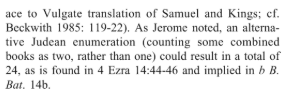
Notice that Barclay explains: "They are not characterized here as "sacred" (cf. 1.1, 54, 127), but they are clearly distinguished from other and subsequent literature (1.41), and to this extent Josephus' canon is clearly "closed" (even if the contents of these books and their textual form may have been subject to dispute); so rightly Beckwith 1985: 78-80; Mason 2002:110-27."
From my point of view, Michuta's characterization of the issue is misleading at best. While it is certainly possible that Eusebius' Greek and Whiston's English gloss may not be a woodenly literal representation of Josephus' original, even without those influences, it should be readily important that Josephus is referring to the canonical Scriptures.
Footnotes 166-67 on the next page, further underscore my point that Barclay himself sees the same thing in Josephus:


Note that Barclay is right to emphasize the fact that Josephus' motivation is to provide a low number of books. If he just meant to point to the reliable Old Testament histories, why bring in the number twenty-two in the first place? Particularly, why bring in that number when it includes the Psalms and Proverbs? The intuitively correct answer is that Josephus is appealing to an existing canon that is extrinsic to himself. This is not a list he just made up. The same explains why Josephus does not feel the need to provide the name for each book: just as people of his day knew what the names of the five books of Moses were, so also they knew which constituted the twenty-two books.
Ultimately, I fear that Michuta's video is likely to be misleading to Roman Catholic apologists who will boldly claim that Josephus didn't provide a canon or that such a view is based on a mistranslation of a faulty text. While such misleading claims may benefit my side in the sense that they can be debunked and we can demonstrate the veracity of our claims and the weakness of theirs, ultimately I think it is better for folks like Michuta to be more circumspect in their claims and analysis, to avoid misleading the next generation of apologists.
A brief postlude. There still remains the enigmatic question of which books Josephus did intend to be included in the twenty-two. Barclay provides his thoughts in footnote 165:

Saturday, May 10, 2025
God Doesn't Just Try to Save
There are differences of opinion, and there is dishonesty. When someone (@soteriology101) says he's a former Calvinist and says:
"Calvinist’s [sic] market that concept as God trying and failing to make it seem unbiblical."
"Calvinists have to paint God is [sic] failing simply because he gives us a choice because it makes their system look more plausible."
Calvinists realize that this does not represent their view, nor their thinking. Maybe at the time when Sot101 considers himself to have been a "Calvinist" that's really what he held. I doubt it.
I don't doubt that he considered himself a Calvinist, I take his word for that.
What I doubt is that he ever thought about marketing concepts to make things seem unbiblical or that he thought about painting God as failing to make his own system seem more plausible.
If he did think that way, that's messed up. We shouldn't be trying to make things "seem unbiblical." Nor should we be trying to make our system "look more plausible." If he was doing that then, he should repent of having done so.
On the other hand, if he knows very well that he never thought that way as a "Calvinist," then he should stop speaking falsehood.
But there is a third way. Maybe he was a Calvinist, but the years of trying to attack Calvinism have just led him to forget what he once believed and thought.
What I suspect is happening is that Sot101 is trying to simply reverse the charge that it his *misinterpretation* of the texts he mentioned (Matt 23:37; Luke 7:30; Ezk 18:31-32; Rom 10:21; & Matt 11:28-30), which seems to characterize God in an indefensible way.
More simply put, Calvinists affirm that "the Son of man is come to seek and to save that which was lost" and the Son of man *actually does* seek and and does save that which was lost. All the elect were lost, and all of the elect will be saved. "All that the Father giveth me shall come to me; and him that cometh to me I will in no wise cast out." (John 6:37)
Presumably to try to score some rhetorical point, Sot101 tweeted: "The Bible doesn’t say, 'The Son of Man has come to seek and to irresistibly save some of all sorts of that which is lost.'" To which I responded: "It doesn’t say the Son of Man has come to *try*."
This is what provoked the irrational outburst from Sot101. He apparently does not want us to characterize *his position* as being that God tries (and fails). One can understand that he finds such a characterization uncomfortable, because it is so obviously blasphemous. It's good that he has discomfort about that.
On the other hand, look at the analogy he offers to try to justify his position: "When I told my four-year-old daughter to eat her vegetables or she would not get dessert and she chose to refuse to eat her vegetables I did not try and fail. I very well could have forced fed her those vegetables if I were that kind of parent. I gave her a choice with consequences. "
This is one of those situations where it depends on how you look at it, I guess. From where I'm sitting, it looks like he tried and failed to get his daughter to eat her vegetables. But he says (or so one must infer) that he was not trying to get her to eat her vegetables, just giving her choice with consequences. Recall, however, that the verse that sparked this discussion was one about Jesus coming not to "give people a choice," but to "save." Calvinism says that Jesus did exactly what the angel of the Lord told Joseph in a dream "he shall save his people from their sins." (Matthew 1:21)
Moreover, let's alter Sot101's scenario. Suppose instead of going to bed hungry because she wouldn't eat her vegetables, suppose that the consequence of her choice was that she would die. Surely in that case, Sot101 would be on board with force feeding the girl in order to save her life. I hope - and more than that, I'm confident - that he's "that kind of parent." The consequences of not trusting on Christ for salvation is not just missing dinner: it's missing the wedding feast of the Lamb. The consequences are not less dire than physical death, they are more dire (Matthew 10:28).
Moreover, let's alter Sot101's scenario. Suppose instead of going to bed hungry because she wouldn't eat her vegetables, suppose that the consequence of her choice was that she would die. Surely in that case, Sot101 would be on board with force feeding the girl in order to save her life. I hope - and more than that, I'm confident - that he's "that kind of parent." The consequences of not trusting on Christ for salvation is not just missing dinner: it's missing the wedding feast of the Lamb. The consequences are not less dire than physical death, they are more dire (Matthew 10:28).
But the question remains. What does Calvinism say about these: "He marvels at their unbelief. (Mark 6:6) He expresses a willingness despite their unwillingness. (Matt 23:37) He rebukes them for rejecting the purpose God had for them. (Luke 7:30) He doesn’t wish that any perish but all to repent and live (Ezk 18:31-32) He holds out His hands to the weak and the unwilling (Rom 10:21; Matt 11:28-30)"?
While a detailed discussion is beyond the scope of this already-lengthy post, in summary Calvinism affirms a general outward call of the gospel and a willingness of God to receive anyone who responds in faith to the gospel. However, we distinguish between that and God miraculously working faith in those that previously lacked it. Does the general offer fail to save everyone who hears it? Absolutely. However, that's not the limit of what God can do to save his people from their sins. So, if someone wants to point that God gives good things like life, liberty, and property to people who are ultimately lost, and even gives them the Gospel, which saves everyone who believes, we just agree.
And surely Sot101 agreed when he was a "Calvinist" (quotations because that's what he considered himself). If Sot101 didn't agree with that when he was a "Calvinist," then I have to think he had a very wrong concept about Calvinism then.
Tuesday, May 06, 2025
Did Jesus Bookend the Canon in Matthew 23:35 and Luke 11:51?
In Matthew and Luke, Jesus refers to the pair of Abel and Zacharias.
Matthew 23:35 That upon you may come all the righteous blood shed upon the earth, from the blood of righteous Abel unto the blood of Zacharias son of Barachias, whom ye slew between the temple and the altar.
Luke 11:51 From the blood of Abel unto the blood of Zacharias, which perished between the altar and the temple: verily I say unto you, It shall be required of this generation.
To native English speakers, this may sound like “all from A to Z,” but this is just a coincidence of the English alphabet order - in Greek and Aramaic, Zacharias’ name would not be alphabetically near the end. However, “all … from X to Y,” naturally suggests that X and Y should somehow be book-ending characters.
This mode of speaking is found in a number of places, such as saying “all … from the least … unto the greatest” [FN1] or “all … from one end … to the other end” [FN2]. Sometimes they are more concrete, “all the firstborn … from the firstborn of Pharaoh … unto the firstborn of the maidservant ….” [FN3] or in the form of geographic designations, as in Joshua [FN4].
On other hand, single-ended ranges were also used, such as “all the firstborn … from a month old and upward ….,” “from the first day …,” or “from the beginning” – indeed, in Luke’s account of this very event, Jesus says “all the prophets … from the foundation of the world”.
Thus, while it is clear why Abel is selected as the example of the first “righteous blood,” it is less immediately obvious why there should be any end marker to the set. In other words, why doesn’t Jesus simply say “all the righteous blood that has been shed, from Abel unto now”? Moreover, why is Abel first and not second in the book-ends?
Considering Luke’s text more closely:
Luke 11:45-51
Then answered one of the lawyers, and said unto him, Master, thus saying thou reproachest us also. And he said, Woe unto you also, [ye] lawyers! for ye lade men with burdens grievous to be borne, and ye yourselves touch not the burdens with one of your fingers. Woe unto you! for ye build the sepulchres of the prophets, and your fathers killed them. Truly ye bear witness that ye allow the deeds of your fathers: for they indeed killed them, and ye build their sepulchres. Therefore also said the wisdom of God, I will send them prophets and apostles, and [some] of them they shall slay and persecute: that the blood of all the prophets, which was shed from the foundation of the world, may be required of this generation; from the blood of Abel unto the blood of Zacharias, which perished between the altar and the temple: verily I say unto you, It shall be required of this generation.
Notice that Jesus first gives a single-ended “all the prophets … from the foundation of the world,” but then gives a book-ended “Abel to Zacharias.” Setting aside alphabetical order, the most obvious and expected reason why Abel would be selected as the starting point of a range is if it is a “from beginning to end” range. We may then ask ourselves, Why Zacharias?
From the context, we would expect to find during this period of the “fathers” a prophet named Zacharias who was killed. However, Jesus provides greater specificity by saying that Zacharias perished between the altar and the temple. Moreover, considering that this character serves as a book-end, we would expect him to be in the period of “the fathers” and to be the last prophet to be martyred.
This expectation may disappoint us a little. We find a reference to Zacharias, who was killed in the place Jesus mentioned, but this occurred during the reign of King Joash of Judah (around 800 BC). On the other hand, there were prophets who lived afterward and who (at least according to Jewish legend) were killed. Indeed, it is thought that the reference to a person being “sawn asunder” in Hebrews 11 may be an allusion to the death of Isaiah, which occurred a century or more after the death of Zacharias.
Roman Catholics may be even more disappointed, because the deaths of the Maccabean martyrs is righteous blood that came even after Isaiah’s death, and their death is (to Roman Catholics) more than just a pious legend.
Nevertheless, the context of the death of Zacharias is fairly compelling. Recall the account:
2 Chronicles 24:20-22
And the Spirit of God came upon Zechariah the son of Jehoiada the priest, which stood above the people, and said unto them, Thus saith God, Why transgress ye the commandments of the LORD, that ye cannot prosper? because ye have forsaken the LORD, he hath also forsaken you. And they conspired against him, and stoned him with stones at the commandment of the king in the court of the house of the LORD. Thus Joash the king remembered not the kindness which Jehoiada his father had done to him, but slew his son. And when he died, he said, The LORD look upon [it], and require [it].
This idea of God “requiring” the death of Zechariah to be punished is quite similar to the concept referenced in Genesis of Abel:
Genesis 4:9-12
And the LORD said unto Cain, Where [is] Abel thy brother? And he said, I know not: [Am] I my brother's keeper? And he said, What hast thou done? the voice of thy brother's blood crieth unto me from the ground. And now [art] thou cursed from the earth, which hath opened her mouth to receive thy brother's blood from thy hand; When thou tillest the ground, it shall not henceforth yield unto thee her strength; a fugitive and a vagabond shalt thou be in the earth.
Thus, the author of Hebrews personifies Abel’s blood:
Hebrews 11:4 By faith Abel offered unto God a more excellent sacrifice than Cain, by which he obtained witness that he was righteous, God testifying of his gifts: and by it he being dead yet speaketh.
Hebrews 12:24 And to Jesus the mediator of the new covenant, and to the blood of sprinkling, that speaketh better things than [that of] Abel.
The same principle is taken up again in Revelation [FN6].
Still, while both Abel and Zacharias are martyrs, and while the blood of each calls out for God’s vengeance, why select Zacharias? To put it differently, in what way is Zacharias last to Abel being first?
The most straightforward answer to this is that Zacharias is last within the Hebrew canon. This is not obvious from the canonical order that we use in the English Bible, where 2 Chronicles is actually fairly early in the list. On the other hand, 2 Chronicles appears toward the end of the historical books of the Hebrew canon, and the remaining historical books (Ezra and Nehemiah) do not record any martyrdoms. Interestingly, for a variety of reasons, 2 Chronicles appears as the last book in some Jewish canon lists.[FN7]
It is not necessary, however, to think that 2 Chronicles was necessarily the last in any official list of Old Testament books at the time of Christ. It could have been that there were official lists with Chronicles last. The Canon List of Baba Bathra (folio 14b) from the Babylonian Talmud, for example, has such a list.[FN8]
However, even if 2 Chronicles was not “officially last,” the Martyrdom of Zechariah is the final martyrdom account within the historical books of the Hebrew canon, although 2 Maccabees (outside the Hebrew canon) contains at least one additional martyrdom account.[FN9]
This is an implicit testimony to the scope of the Old Testament canon. After all, Jesus is not explicitly saying, “2 Chronicles is the last book of the canon.” However, the most natural explanation for Jesus’ “from Abel to Zechariah” is that Jesus is identifying the first and last canonical martyrs of the Old Testament.
Origen is one of the earliest and most influential authors to leave a record of having considered the meaning of Jesus’ statement in a commentary.[FN10] Origen also discusses the question of the meaning of Jesus’ statement in a letter to Africanus [FN11], where he states:
In the blood of what prophets, can any one tell me? For where do we find anything like this written of Esaias, or Jeremias, or any of the twelve, or Daniel? Then about Zacharias the son of Barachias, who was slain between the temple and the altar, we learn from Jesus only, not knowing it otherwise from any Scripture.
From his commentary, we know that Origen was aware of the Zechariah mentioned in 2 Chronicles 24, because he mentions him as essentially the only Old Testament example of a prophet being killed by the people of Israel in Jerusalem.
Others also quote the section - some without comment on the identity of Zechariah, such as Irenaeus [FN12] or Petilianus the Donatist [FN13] - some with comment, such as Chrysostom [FN14]. The latter writes: “But who is this Zacharias? Some say, the father of John; some, the prophet; some, a priest with two different names, whom the Scripture also calls, the son of Jehoiada.”
Thomas Aquinas, in his Golden Chain [FN15], cites Theophylact as saying “some say was the Zacharias of old time, the son of Jehoiadah the Priest.” He also cites Bede as positively affirming that view and suggesting that the reason for Abel and Zacharias was to affirm people from both classes (laity and priests). He further cites Gregory of Nyssa as noting that “some say that Zacharias, the father of John” (seemingly alluding back to Origen or Origen’s source, the Protoevangelium of James). He also cites a Greek author (Photius?) who offers a different account of Zacharius (father of John the Baptist) death.
A check of Thomas regarding Theophylact confirms that among other theories, Theophylact mentions the 2 Chronicles 24 Zechariah [FN16].
Romanos the Melodist, Hymn 15, vs. 12, seemed at first glance to tacitly indicate that Zechariah is the 2 Chronicles 24 one (by linking him with Abel) [FN17], but on further reflection this may simply be the Protoevangelium account adopted.
Some will say that it cannot be Zechariah from 2 Chronicles 24 because of the Matthew parallel passage, citing at least two reasons that are only applicable to the Matthew parallel and not to the Luke passage itself. Thus, it is worth considering the Matthew account in greater detail:
Matthew 23:29-39
Woe unto you, scribes and Pharisees, hypocrites! because ye build the tombs of the prophets, and garnish the sepulchres of the righteous, And say, If we had been in the days of our fathers, we would not have been partakers with them in the blood of the prophets. Wherefore ye be witnesses unto yourselves, that ye are the children of them which killed the prophets. Fill ye up then the measure of your fathers. [Ye] serpents, [ye] generation of vipers, how can ye escape the damnation of hell? Wherefore, behold, I send unto you prophets, and wise men, and scribes: and [some] of them ye shall kill and crucify; and [some] of them shall ye scourge in your synagogues, and persecute [them] from city to city: That upon you may come all the righteous blood shed upon the earth, from the blood of righteous Abel unto the blood of Zacharias son of Barachias, whom ye slew between the temple and the altar. Verily I say unto you, All these things shall come upon this generation. O Jerusalem, Jerusalem, [thou] that killest the prophets, and stonest them which are sent unto thee, how often would I have gathered thy children together, even as a hen gathereth her chickens under [her] wings, and ye would not! Behold, your house is left unto you desolate. For I say unto you, Ye shall not see me henceforth, till ye shall say, Blessed [is] he that cometh in the name of the Lord.
The first main reason offered for doubting that Zacharias is the Zechariah of 2 Chronicles 24 is that the text says, “ye slew,” but Zechariah was slain 800 years earlier. This is solved by noting that Jesus has lumped in the Pharisees with those who killed Zacharias, not simply genetically but because they will also do the same deeds themselves by killing and persecuting the righteous.
Moreover, Jesus makes this point by saying that they “fill up” the “measure of your fathers” and that they “will” do so by subsequent persecutions. It is then on that basis that they will be held to account for Cain’s murder 4000 years earlier, and Zechariah’s murder 800 years earlier, even though they did not personally commit either one.
A second main reason offered for doubting that Zacharias is the Zechariah of 2 Chronicles 24 is that Jesus refers to him as being “the son of Barachias,” but 2 Chronicles 24 refers to Zechariah as the “son of Jehoiada”[FN17.5]. The minor prophet Zechariah refers to himself as “Zechariah, the son of Berechiah, the son of Iddo the prophet” (Zechariah 1:1&7). However, this Zechariah lived at the time of Darius during the captivity and return, whereas the 2 Chronicles 24 Zechariah died before the captivity.
There are multiple ways to resolve this apparent inconsistency.
First, it’s not perfectly clear that Zechariah the minor prophet was literally the son of a man named Berechiah. While he uses that term of himself, Ezra calls him simply the son of Iddo:
Ezra 5:1 Then the prophets, Haggai the prophet, and Zechariah the son of Iddo, prophesied unto the Jews that [were] in Judah and Jerusalem in the name of the God of Israel, [even] unto them.
Ezra 6:14 And the elders of the Jews builded, and they prospered through the prophesying of Haggai the prophet and Zechariah the son of Iddo. And they builded, and finished [it], according to the commandment of the God of Israel, and according to the commandment of Cyrus, and Darius, and Artaxerxes king of Persia.
If “son of Berechiah” is not a literal patronymic, what else could it be? It could be a title, like the negative “son of Belial” used in 1 Samuel 2:12, “Now the sons of Eli [were] sons of Belial; they knew not the LORD,” and numerous other places in the Old Testament [FN18]. If so, the meaning of the title would be presumably linked to the meaning of the name, “Blessed [by] Jah” [FN19].
Another view is that Jesus used the phrase “son of Barachias” to link the 2 Chronicles 24 Zechariah to the minor prophet Zechariah, through a deliberate name conflation. It has been argued that this was a thing that was done, and would not imply any error on Jesus’ part, because it was a known homiletic device of the time [FN20].
A further view is that just as Ezra leaves out Berechiah in calling Zechariah the “son of Iddo,” it is likewise possible that Berechiah was the name of one of the male ancestors of the 2 Chronicles 24 Zechariah. Similar New Testament use of patronymics for other than the direct father include “son of man” (particularly of Jesus), “son of Abraham,” and “son of David.”
More interesting, however, are the uses found in the following examples:
Luke 10:6 And if the son of peace be there, your peace shall rest upon it: if not, it shall turn to you again.
2 Thessalonians 2:3 Let no man deceive you by any means: for that day shall not come, except there come a falling away first, and that man of sin be revealed, the son of perdition;
Acts 4:36 And Joses, who by the apostles was surnamed Barnabas, (which is, being interpreted, The son of consolation,) a Levite, and of the country of Cyprus,
Mark 3:17 And James the son of Zebedee, and John the brother of James; and he surnamed them Boanerges, which is, The sons of thunder:
It would, therefore, be completely in character with Jesus and the apostles to refer to Zechariah the son of Jehoidah with an honorary patronymic, “son of Berechiah,” as way of affirming that Zechariah is “Blessed by Yah.”
Moreover, Jesus goes on to quote:
Psalm 118:26 Blessed [be] he that cometh in the name of the LORD: we have blessed you out of the house of the LORD.
Blessed (in this case) is the Hebrew word בָּרוּךְ (Barak) and LORD is the tetragrammaton YHWH, of which a shortened form is Yah, thereby connecting back with “son of Berechiah.”
Regarding the idea that Zechariah of 2 Chronicles 24 may have had an ancestor named Berechiah, it has been argued that “the only reason you would suggest that is to make the bookends argument work right”[FN21].
On the other hand, John Chrysostom in his Homily 74 on Matthew said, “But who is this Zacharias? Some say, the father of John; some, the prophet; some, a priest with two different names, whom the Scripture also calls, the son of Jehoiada.” We have no record of Chrysostom trying to make a bookends argument work, and in context he makes no such reference.
Likewise, Jerome’s Commentary on Matthew, Book 4, at 23:35-36, states [FN22]:
But we do need to ask who this Zechariah son of Barachiah is. For we read about many Zechariahs. He even removes the possibility of error for us by adding: “whom you killed between the sanctuary and the altar.” … I have read diverse things in diverse sources, and I ought to record the opinions of each of these. … Others want this Zechariah to be the one who was killed between the sanctuary and the altar by Joash king of Judea, as the history of Kings narrates. But one should observe that that Zechariah was not the son of Barachiah, but the son of Jehoiada the priest. This is why the Scripture relates: “Joash did not remember the good deeds of Jehoiada his father, which he had done for him.” Since, then, we should also retain Zechariah and the place of the killing is in agreement, we need to ask why he is called the son of Barachiah, and not of Jehoiada. Barachiah means “blessed of the Lord” in our language, and the justice of the priest Jehoiada is shown in the Hebrew language. In the gospel that the Nazarenes use, in place of “son of Barachiah” we have found it written: “son of Jehoiada.”
Even though Jerome might have been motivated to make a bookends argument, he does not make this connection in his Matthew commentary.
Both Chrysostom and Jerome, however, are motivated by the detail Jesus gives of the location of Zacharias’ homicide. Thus, they seek to explain the apparent inconsistency: Chrysostom by saying he has two names, and Jerome by suggesting that it is a character appellation (similar to those we saw above, such as Barnabas) or perhaps even a textual variant.
Likewise, as we saw above, even in the case of the minor prophet Zechariah, he is sometimes called “son of Berechiah,” and sometimes “son of Iddo.” Thus, it is hardly surprising for someone to have two such patronymics, with one being “son of Berechiah.”
Furthermore, the name “Berechiah” appears multiple times in Chronicles, prior to the birth of Zechariah [FN23] and even within the tribe of Judah. Moreover, we are not given a detailed genealogy as with some other Biblical men. Thus, it is not at all a stretch to suppose that Jehoiada and Zechariah may have been descendents of Berechiah, such as one of the Berechiahs recorded in Scripture.
Another point that has been raised is the evidence from the Targum
Aramaic Targum to Lamentations 2:20 (Christian M. M. Brady, trans.) [FN24]
See, O Lord, and observe from heaven against whom you have turned. Thus is it right for the daughters of Israel to eat the fruit of their wombs due to starvation, the lovely boys wrapped in fine linen? The Attribute of Justice replied, and said, “Is it right to kill priest and prophet in the Temple of the LORD, as when you killed Zechariah son of Iddo, the High Priest and faithful prophet in the Temple of the Lord on the Day of Atonement because he admonished you not to do evil before the Lord?”
However, both from the context that Lamentations 2:20 is before death of the minor prophet Zechariah, and from other Targum [FN25], it appears that this may simply be a name conflation in the opposite direction (i.e. calling Zechariah the son of Johoaida the son of Iddo, though he was not). This does, however, raise the possibility that it was potentially a Jewish custom to link the two (Zechariah of 2 Chronicles 24 and the minor prophet) and to treat them as though they were the same.
Another option that has been offered, as may be gleaned from the sources discussed above, is the idea that John the Baptist’s father, Zacharias, could be the Zacharias that Jesus had in mind.
Luke 11:47-48 Woe unto you! for ye build the sepulchres of the prophets, and your fathers killed them. 48 Truly ye bear witness that ye allow the deeds of your fathers: for they indeed killed them, and ye build their sepulchres.
FN1:
[Jer 31:34 KJV] 34 And they shall teach no more every man his neighbour, and every man his brother, saying, Know the LORD: for they shall all know me, from the least of them unto the greatest of them, saith the LORD: for I will forgive their iniquity, and I will remember their sin no more.
[Jer 42:1, 8 KJV] 1 Then all the captains of the forces, and Johanan the son of Kareah, and Jezaniah the son of Hoshaiah, and all the people from the least even unto the greatest, came near, ... 8 Then called he Johanan the son of Kareah, and all the captains of the forces which [were] with him, and all the people from the least even to the greatest,
[Jer 44:12 KJV] 12 And I will take the remnant of Judah, that have set their faces to go into the land of Egypt to sojourn there, and they shall all be consumed, [and] fall in the land of Egypt; they shall [even] be consumed by the sword [and] by the famine: they shall die, from the least even unto the greatest, by the sword and by the famine: and they shall be an execration, [and] an astonishment, and a curse, and a reproach.
[Act 8:10 KJV] 10 To whom they all gave heed, from the least to the greatest, saying, This man is the great power of God.
[Heb 8:11 KJV] 11 And they shall not teach every man his neighbour, and every man his brother, saying, Know the Lord: for all shall know me, from the least to the greatest.
FN2:
[Jer 12:12 KJV] 12 The spoilers are come upon all high places through the wilderness: for the sword of the LORD shall devour from the [one] end of the land even to the [other] end of the land: no flesh shall have peace.
[Deu 28:64 KJV] 64 And the LORD shall scatter thee among all people, from the one end of the earth even unto the other; and there thou shalt serve other gods, which neither thou nor thy fathers have known, [even] wood and stone.
FN3:
[Exo 11:5 KJV] 5 And all the firstborn in the land of Egypt shall die, from the firstborn of Pharaoh that sitteth upon his throne, even unto the firstborn of the maidservant that [is] behind the mill; and all the firstborn of beasts.
FN4:
[Jos 12:1 KJV] 1 Now these [are] the kings of the land, which the children of Israel smote, and possessed their land on the other side Jordan toward the rising of the sun, from the river Arnon unto mount Hermon, and all the plain on the east:
[Jos 13:4-5, 9 KJV] 4 From the south, all the land of the Canaanites, and Mearah that [is] beside the Sidonians, unto Aphek, to the borders of the Amorites: 5 And the land of the Giblites, and all Lebanon, toward the sunrising, from Baalgad under mount Hermon unto the entering into Hamath. ... 9 From Aroer, that [is] upon the bank of the river Arnon, and the city that [is] in the midst of the river, and all the plain of Medeba unto Dibon;
[Jos 15:46 KJV] 46 From Ekron even unto the sea, all that [lay] near Ashdod, with their villages:
FN5:
[Num 3:40 KJV] 40 And the LORD said unto Moses, Number all the firstborn of the males of the children of Israel from a month old and upward, and take the number of their names.
[Act 20:18 KJV] 18 And when they were come to him, he said unto them, Ye know, from the first day that I came into Asia, after what manner I have been with you at all seasons,
[Act 15:18 KJV] 18 Known unto God are all his works from the beginning of the world.
[Luk 11:50 KJV] 50 That the blood of all the prophets, which was shed from the foundation of the world, may be required of this generation;
FN6:
The martyrs in Revelation make a similar demand for justice:
Revelation 6:9-11
And when he had opened the fifth seal, I saw under the altar the souls of them that were slain for the word of God, and for the testimony which they held: And they cried with a loud voice, saying, How long, O Lord, holy and true, dost thou not judge and avenge our blood on them that dwell on the earth? And white robes were given unto every one of them; and it was said unto them, that they should rest yet for a little season, until their fellowservants also and their brethren, that should be killed as they [were], should be fulfilled.
This demand is met in Revelation 15-16:
Revelation 15:1-16:7 KJV] And I saw another sign in heaven, great and marvellous, seven angels having the seven last plagues; for in them is filled up the wrath of God. And I saw as it were a sea of glass mingled with fire: and them that had gotten the victory over the beast, and over his image, and over his mark, [and] over the number of his name, stand on the sea of glass, having the harps of God. And they sing the song of Moses the servant of God, and the song of the Lamb, saying, Great and marvellous [are] thy works, Lord God Almighty; just and true [are] thy ways, thou King of Nations. Who shall not fear thee, O Lord, and glorify thy name? for [thou] only [art] holy: for all nations shall come and worship before thee; for thy judgments are made manifest. And after that I looked, and, behold, the temple of the tabernacle of the testimony in heaven was opened: And the seven angels came out of the temple, having the seven plagues, clothed in pure and white linen, and having their breasts girded with golden girdles. And one of the four beasts gave unto the seven angels seven golden vials full of the wrath of God, who liveth for ever and ever. And the temple was filled with smoke from the glory of God, and from his power; and no man was able to enter into the temple, till the seven plagues of the seven angels were fulfilled. And I heard a great voice out of the temple saying to the seven angels, Go your ways, and pour out the vials of the wrath of God upon the earth. … And the second angel poured out his vial upon the sea; and it became as the blood of a dead [man]: and every living soul died in the sea. And the third angel poured out his vial upon the rivers and fountains of waters; and they became blood. And I heard the angel of the waters say, Thou art righteous, O Lord, which art, and wast, O Holy One! because thou hast judged thus. For they have shed the blood of saints and prophets, and thou hast given them blood to drink; for they are worthy. And I heard another out of the altar say, Even so, Lord God Almighty, true and righteous [are] thy judgments.
I’ve corrected “and shalt be” to “O Holy One!” in Revelation 16:5 and similarly “Saints” to “Nations” in Revelation 15:3.
FN7:
For example, the Jewish encyclopedia states: “The Jewish canon comprises twenty-four books, the five of the Pentateuch, eight books of the Prophets (Joshua, Judges, Samuel, Kings, Isaiah, Jeremiah, Ezekiel, the Minor Prophets), and eleven Hagiographa (Psalms, Proverbs, Job, Song of Solomon, Ruth, Lamentations, Ecclesiastes, Esther,Daniel, Ezra, and Chronicles).” https://www.jewishencyclopedia.com/articles/3259-bible-canon
FN8:
https://sanctushieronymus.blogspot.com/2012/02/canon-list-of-baba-bathra-14b.html
FN9:
2 Maccabees 7 https://bible.usccb.org/bible/2maccabees/7
Origen’s commentary on Luke 11 seems to have been lost, but his commentary on Matthew remains, at least in a Latin translation. Origen The Commentary Of Origen On The Gospel Of St Matthew, vol. 1, p. 29: “There is an ancient Latin translation of the latter portion of the Commentary on Matthew, done perhaps in the sixth century by an unknown translator.”
From The Series Commentariorum (On Matthew 22:34-27:66), volume 2 of Origen The Commentary Of Origen On The Gospel Of St Matthew.
(pp. 575-76)
Section 25:
But those who were reproached by Christ could not have killed “Zachariah son of Barachiah, one of the twelve prophets, whose writings we have in hand.[FN] But he means ‘Zachariah’ father of John, of whom we cannot show by the canonical Scriptures that he was either the son of ‘Barachiah’ or that the scribes and Pharisees killed him ‘between the temple and the altar. But a certain tradition has come to us that there is some place in the temple where virgins were permitted to stop and pray to God, but women who had experienced the bed of a man were not permitted to stop in that place. And after Mary had given birth to the Saviour, she entered and stopped to worship in that place of the virgins, and when those who knew that she had given birth to a son forbid her, Zachariah stopped and said to those forbidding her that she was worthy of the place of the virgins since she was still a virgin. Therefore, as ‘Zachariah’ was very clearly acting against the law and permitting a wife to stand in the place of the virgins, the men of that generation killed him “between the temple and the altar. Moreover, let us demand that those who do not accept a tradition of this kind provide an explanation of how Jesus reproached them because of Zachariah, not as the sons of those who killed “Zachariah immediately after the prophets, but as those who themselves killed Zachariah “between the temple and the altar’ If, therefore, the word Christ addressed to the Pharisees and scribes who were present at that time is true, ‘whom you killed between the temple and the altar} it is not possible to understand that ‘Zachariah’ who is one of the twelve prophets. Nor furthermore is it strange if it turns out that each ‘Zachariah and their fathers have the same name.
[FN The following is a parallel to this discussion in an anonymous Greek fragment in the Scholia Commentary of Peter of Laodicea: ‘For those now reproached by the Saviour could not have killed Zachariah the son of Barachiah who was numbered among the twelve prophets, but it is likely [as Joseppus says] that the Zachariah now mentioned was the father of John, of whom we are able to show from the Scriptures neither that he was the son of Barachiah nor that the scribes and Pharisees killed him “between the temple and the altar”. But some such tradition has reached us that at that time there was some place in the temple where virgins were permitted to enter and worship God, and those who had already experienced intercourse with a man were not permitted in that place. Mary, therefore, after giving birth to [our] Saviour went to worship and stood in the place of the virgins. And when those who knew she had given birth were forbidding her, Zachariah said to those forbidding her that she was worthy of the place of the virgins since she was still a virgin. Since, therefore, he was clearly contradicting the law and permitting a wife to be in the place of the virgins, those of that generation killed him “between the temple and the altar”. They are reproached by the Saviour, therefore, not as the sons of those who killed the prophets and Zachariah after the prophets, but as themselves having killed him. And it is not strange if it turns out that Zachariah, the father of John, has the same name as the one among the twelve prophets. So too the father of the father’.]
(p. 580)
Section 27
In this way, they also pour out the blood ‘of Zachariah, which means ‘Remembrance of God: For everyone who is eager to destroy the remembrance of God in those whom they cause to stumble is seen to pour out the blood ‘of Zachariah the son of Barachiah, whose name also means ‘the praising of God. For by the praising of God we are mindful of God. … The impious kill the remembrance of God ‘between the temple and the altar’ when the lewd corrupt the ‘temple’ of God, and its altar is polluted by the carelessness of disgraceful prayers, when the prayer of someone becomes his sin, as also it is said of the prayer of Judah, ‘Let his prayer be counted as his sin.
(pp. 580-81)
Section 28
It is worth investigating why, when the Saviour was speaking before hearers who included the scribes and Pharisees who boasted that they knew precisely what things belonged to the law and the prophets,'*" he said ‘Jerusalem’ had killed ‘the prophets’ and stoned ‘those sent’ to it when not much history of this kind is prophesied in the old Scriptures that are read in their synagogues. We read that Jeremiah was thrown into a cistern of mud;'*? he was not, however, killed in Jerusalem. But neither do we read that Isaiah, or Ezekiel, or any of the prophets suffered any such thing, so far as my memory recalls. But examining the second book of Chronicles, where many things are written about the illustrious prophets, I discovered that Asa, angered at the prophet Hanani who censured him, put him in jail, but he did nothing more against him.'** But also Ahab ordered Micaiah, who prophesied against him, to be imprisoned and to eat the bread of tribulation, but he did not kill him.'** But we read of one who was stoned, ‘Zechariah, son of the priest Jehoiada, when he censured the people.'** We do not, therefore, find more prophets killed in Jerusalem, or stoned (other than I mentioned) who had been sent to Jerusalem.
For this reason, we must see if perhaps we must explain the word of Christ from books that are more secret which are current among the Jews, and not only the word of Christ, but also that of his disciples, Stephen the first martyr, and Paul the apostle. For Stephen spoke as follows: ‘O stiff-necked and uncircumcised in heart and ears, you always resist the Holy Spirit, just as your fathers did, so also you. For which of the prophets did your fathers not persecute? And they killed those who announced the coming of the Just One, of whom you are now his betrayers and murderers’; and after this ‘they cast him out of the city and they stoned Stephen, calling out and saying.’** And Paul says the following about the killing of the prophets in the first letter to the Thessalonians: ‘For you have become imitators of the churches of God that are in Judaea in Christ Jesus, because you yourselves have suffered the same things from your countrymen as they too from the Jews, who killed the Lord Jesus and the prophets and have persecuted us, and are not pleasing to God?**” And to the Hebrews as follows: “They were stoned, they were sawn in pieces, they were tempted, killed by the sword, they wandered in sheepskins, in goatskins, being in need, restricted, afflicted with pains, of whom the world was not worthy, wandering in deserts, in mountains, in caves, and in pits of the earth.'** It is related, therefore, in unclear Scriptures that Isaiah was sawn in pieces and Zechariah and Ezekiel killed. And I think that Elijah, who wandered in the desert and in mountains, went around in sheepskins and goatskins. But assume that someone denies that the Epistle to the Hebrews is by Paul, and also denies the secret book of Isaiah; but what will he do with the words cited of Stephen, or Paul to the Thessalonians about prophets who were killed, or of our Lord himself? Or how will he deny that which Paul mentioned to Timothy, saying, ‘Just as Jannes and Jambres resisted Moses, so also those resist the truth’?**? And if he should also look at what is related in the first letter to the Corinthians, ‘What eye has not seen, or ear heard, how will anyone be able to deny all these things?**°
We have said all these things discussing the remark, not unaware that there are many fabrications of secrets by the impious who speak ‘iniquity against the height:?*! The followers of Hypythianus’*? use certain fabrications, and those who are followers of Basilides use others. We must, therefore, give careful consideration so that we not accept all secret books that are passed off in the name of saints, because of the Jews who, to confirm false doctrines, have perhaps fabricated certain works to destroy the truth of our Scriptures; we must also be careful not to deny all works that relate to the explanation of our Scriptures. It is the mark of a great person to hear and do what is said: ‘Prove all things; hold on to what is good?!5? Nevertheless, because of those who are not able, as money-changers,’** to discern whether words are true or false, and are not able themselves to guard carefully that they hold the true in themselves, ‘let them abstain from every evil appearance.’** No one ought to use books outside the canonical Scriptures to confirm doctrines.
Nevertheless, if someone accepts the “To the Hebrews’ as an epistle of Paul, he will say that we ought not use the plural at all in many references. For not many were sawn in pieces, but Isaiah alone; nor were many stoned but only Zechariah, son of Jehoiada; and only Zechariah son of Barachiah was killed by the sword; so also Elijah went about in sheepskins and goatskins; and other similar examples.’*° But further, let us investigate what is written in Luke when the Lord says, ‘Because it is not possible that a prophet perish outside of Jerusalem:’*” If, therefore, ‘it is not possible that a prophet perish outside of Jerusalem; that is, be killed, you will ask if no one was a prophet after the destruction of Jerusalem, lest perhaps a prophet killed ‘outside Jerusalem’ prove Christ’s word false. And if the Scriptures, on account of Agabus and the daughters of Philip the evangelist (not because of the false prophets of Phrygia'**) compel us, let us ask whether every just person is perhaps in Jerusalem and is not ‘outside Jerusalem, because ‘it is not possible’ for one who is outside Jerusalem to be afflicted with sufferings for the sake of the Word.
FN11:
https://www.newadvent.org/fathers/0414.htm
FN12:
https://www.newadvent.org/fathers/0103514.htm
In like manner, too, did the Lord say to those who should afterwards shed His blood, All righteous blood shall be required which is shed upon the earth, from the blood of righteous Abel to the blood of Zacharias the son of Barachias, whom you slew between the temple and the altar. Verily I say unto you, All these things shall come upon this generation. He thus points out the recapitulation that should take place in his own person of the effusion of blood from the beginning, of all the righteous men and of the prophets, and that by means of Himself there should be a requisition of their blood. Now this [blood] could not be required unless it also had the capability of being saved; nor would the Lord have summed up these things in Himself, unless He had Himself been made flesh and blood after the way of the original formation [of man], saving in his own person at the end that which had in the beginning perished in Adam.
FN13:
https://www.newadvent.org/fathers/14092.htm
Petilianus said: "In the third place, also, He calls the madness of persecutors in like manner by this name, ‘You generation of vipers, how can you escape the damnation of hell? Wherefore, behold, I send unto you prophets, and wise men, and scribes; and some of them you shall kill and crucify; and some of them shall you scourge in your synagogues, and persecute them from city to city: that upon you may come all the righteous blood shed upon the earth, from the blood of righteous Abel unto the blood of Zacharias, son of Barachias, whom you slew between the temple and the altar.' Matthew 23:33-35 Are they then really the sons of vipers according to the flesh, and not rather serpents in mind, and three-tongued malice, and deadliness of touch, and burning with the spirit of poison? They have truly become vipers, who by their bites have vomited forth death against the innocent people."
FN14:
https://www.newadvent.org/fathers/200174.htm
FN15:
Thomas Aquinas, Golden Chain, https://isidore.co/aquinas/english/CALuke.htm#11
THEOPHYL. But our Lord shows that the Jews have inherited the malice of Cain, since he adds, From the blood of Abel, to the blood of Zacharias, &c. Abel, inasmuch as he was slain by Cain; but Zacharias, whom they slew between the temple and the altar, some say was the Zacharias of old time, the son of Jehoiadah the Priest. BEDE; Why He begins from the blood of Abel, who was the first martyr, we need not wonder; but why, to the blood, of Zacharias, is a question, since many were slain after him even up to our Lord’s birth, and soon after His birth the Innocents, unless perhaps it was because Abel was a shepherd, Zacharias a Priest. And the one was killed in the field, the other in the court of the temple, martyrs of each class, that is, under their names are shadowed both laymen, and those engaged in the office of the altar.
GREG NYSS. But some say that Zacharias, the father of John, by the spirit of prophecy forecasting the mystery of the immaculate virginity of the mother of God, in no wise separated her from the part of the temple set apart for virgins, wishing to show that it was in the power of the Creator of all things to manifest a new birth, while he did not deprive the mother of the glory of her virginity. Now this part was between the altar and the temple, in which was placed the brazen altar, where for this reason they slew him. It is said also, that when they heard the King of the world was about to come, form fear of subjection they designedly attacked him who bore witness to His coming, and slew the priest in the temple.
GREEK EX. But others give another reason for the destruction of Zacharias. For at the murder of the children the blessed John was to be slain with the rest of the same age, but Elizabeth, snatching up her son from the midst of the slaughter, sought the desert. And so when Herod’s soldiers could not find Elisabeth and the child, they turn their wrath against Zacharias, killing him as he was ministering in the temple.
FN16:
On the Matthew passage, Theophylact writes:
But of which Zechariah is he here making mention? Some say of the one numbered among the twelve prophets; others, of the father of the Forerunner. For a tradition has been handed down to us that there was a certain place in the temple where the virgins stood. Now Zechariah, being a high priest, after the birth of Christ placed the Mother of God in the place of the virgins. The Jews, becoming angry at this, killed him, as having assigned a woman who had given birth to a place among virgins. And it is not surprising if even the father of the Forerunner had a father named Barachiah, just as the one among the twelve prophets is called the son of Barachiah; for it is likely that just as their names coincided, so also did those of their fathers.
Ποίου δὲ Ζαχαρίου ἐνταῦθα μέμνηται; Οἱ μὲν τοῦ ἐν τοῖς δώδεκα προφήταις φασὶ συναριθμουμένου· οἱ δέ, τοῦ πατρὸς τοῦ Προδρόμου· λόγος γὰρ ἔχει παραδοθεὶς ἡμῖν, ὅτι τόπος τις ἦν ἐν τῷ ναῷ, ἐν ᾧ ἵσταντο αἱ παρθένοι. Ὁ τοίνυν Ζαχαρίας ἀρχιερεὺς ὤν, καὶ μετὰ τὸ τεκεῖν τὸν Χριστὸν τὴν Θεοτόκον ἔστησεν ἐν τῷ τόπῳ τῶν παρθένων· ἀγανακτήσαντες δὲ ἐπὶ τούτῳ οἱ Ἰουδαῖοι, ἀπέκτειναν αὐτόν, ὡς μετὰ τῶν παρθένων τάξαντα γυναῖκα γεννήσασαν· οὐδὲν δὲ θαυμαστόν, εἰ καὶ ὁ πατὴρ τοῦ Προδρόμου εἶχε πατέρα Βαραχίαν ὀνόματι, ὥσπερ καὶ ὁ ἐν τοῖς δώδεκα προφήταις Βαραχίου λέγεται υἱός· εἰκὸς γὰρ ὥσπερ τὰ τούτων ὀνόματα συνέδραμον, οὕτω καὶ τὰ τῶν πατέρων αὐτῶν.
On the Luke passage, Theophylact writes:
Who, then, was this Zechariah whom they killed between the temple and the altar? Some say it was the ancient Zechariah, the son of Jehoiada, whom they stoned, as can be learned from the Book of Kings. But others say it was the father of the Forerunner (John the Baptist), because he placed the Theotokos among the virgins after she had given birth to Christ, positioning her in the place where they stood; this place was between the temple and the outer bronze altar. Therefore, they killed him. For since certain people expected Christ to be their king, yet did not wish to be ruled, they murdered this holy man, because he affirmed that a virgin had given birth, and that Christ, the one who would become their king—something they rejected—had been born; for they wished to remain kingless.
Τίς δὲ ἦν ἄρα Ζαχαρίας, ὃν ἐφόνευσαν μεταξὺ τοῦ ναοῦ καὶ τοῦ θυσιαστηρίου; Οἱ μὲν λέγουσι τὸν ἀρχαῖον Ζαχαρίαν τὸν τοῦ Ἰωάδε, καὶ ὃν ἐλιθοβόλησαν, ὡς ἔστι μαθεῖν ἐκ τῆς βίβλου τῶν Βασιλειῶν· οἱ δὲ τὸν πατέρα τοῦ Προδρόμου, τοῦτον γὰρ τάξαντα τὴν Θεοτόκον μετὰ τῶν παρθένων μετὰ τὸ τεκεῖν τὸν Χριστόν, καὶ στήσαντα ταύτην ἐν τῷ τόπῳ ἐν ᾧ ἐκεῖναι ἵσταντο· ὁ δὲ τόπος ἦν μεταξὺ τοῦ ναοῦ καὶ τοῦ θυσιαστηρίου τοῦ ἔξω τοῦ χαλκοῦ. Διὰ τοῦτο τοίνυν ἐφόνευσαν αὐτόν. Ἐπεὶ γὰρ προσεδόκων τινὲς τὸν Χριστὸν βασιλέα αὑτῶν ἐσόμενον, οὐκ ἤθελον δὲ βασιλευθῆναι, τούτου ἕνεκα ἐφόνευσαν τὸν ἅγιον, ὡς βεβαιοῦντα ὅτι παρθένος ἔτεκεν, καὶ ὁ Χριστὸς ἐγεννήθη ὁ μέλλων αὐτῶν βασιλεύειν, ὅπερ ἀπεστρέφοντο· ἀβασίλευτοι γὰρ ἤθελον εἶναι.
FN17:
Romanos the Melodist, Hymn 15, vs. 12:
As the lawless ones sprinkle innocent blood
of the harmless infants, it was necessary to remember
Abel, who offered a sacrifice to God pure and undefiled,
and to comfort him; for he too was slain.
And again, it was necessary to look upon Zechariah,
how he there will bring an accusation before God
against those who killed him. For always the Jews
and their rulers are insolent and lawless,
murderers and senseless and transgressors of the Law;
they rejected Moses, and once even sawed Isaiah in half;
and now they slaughter Rachel’s infants; therefore she also laments
<because their power is quickly destroyed.>
Ῥαινόντων τῶν ἀνόμων ἀθῷον αἷμα
τῶν ἀκάκων νηπίων, ἔδει μνησθῆναι
Ἄβελ τοῦ προσάξαντος τὴν θυσίαν τῷ Θεῷ καθαρὰν καὶ ἀμόλυντον,
καὶ παραμυθηθῆναι· κἀκεῖνος γὰρ ἐκτάνθη.
Καὶ πάλιν Ζαχαρίαν ἐχρῆν κατιδεῖν,
ὡς τῷ Θεῷ ἐκεῖ κατηγορίαν προσάξει
κατὰ τῶν τοῦτον ἀποκτεινάντων· ἀεὶ γάρ εἰσιν οἱ Ἰουδαῖοι
καὶ οἱ τούτων ἀνάσσοντες ὑβρισταὶ καὶ παράνομοι,
φονευταὶ καὶ ἀσυνετοὶ καὶ νόμον παραβαίνοντες·
τὸν Μωϋσῆν ἠθέτησαν, Ἠσαΐαν δὲ αὐτοὶ μέσον ἔπρισάν ποτε·
καὶ τὰ βρέφη τῆς Ῥαχὴλ κατασφάττουσι νῦν· διὰ τοῦτο καὶ θρηνοῦν
<ὅτι τὸ κράτος αὐτοῦ καθαιρεῖται ταχύ.>
Abel is the first martyr in the Hebrew canon and Zacharias is the final martyr in the Hebrew canon.
FN17.5:
Interestingly, it is possible that the “son of Jehoiada” should be taken in some honorary way. After all, the location of killing of Zechariah is reminiscent of an account from the life of Jehoiada:
2 Chronicles 23:12-15
Now when Athaliah heard the noise of the people running and praising the king, she came to the people into the house of the LORD: And she looked, and, behold, the king stood at his pillar at the entering in, and the princes and the trumpets by the king: and all the people of the land rejoiced, and sounded with trumpets, also the singers with instruments of musick, and such as taught to sing praise. Then Athaliah rent her clothes, and said, Treason, Treason. Then Jehoiada the priest brought out the captains of hundreds that were set over the host, and said unto them, Have her forth of the ranges: and whoso followeth her, let him be slain with the sword. For the priest said, Slay her not in the house of the LORD. So they laid hands on her; and when she was come to the entering of the horse gate by the king's house, they slew her there.
However, the wording of account of the death of Zechariah is most naturally taken as referring to his natural son, particularly because of the use of “Jehoiada his father”:
2 Chronicles 24:15-22
But Jehoiada waxed old, and was full of days when he died; an hundred and thirty years old [was he] when he died. And they buried him in the city of David among the kings, because he had done good in Israel, both toward God, and toward his house. Now after the death of Jehoiada came the princes of Judah, and made obeisance to the king. Then the king hearkened unto them. And they left the house of the LORD God of their fathers, and served groves and idols: and wrath came upon Judah and Jerusalem for this their trespass. Yet he sent prophets to them, to bring them again unto the LORD; and they testified against them: but they would not give ear. And the Spirit of God came upon Zechariah the son of Jehoiada the priest, which stood above the people, and said unto them, Thus saith God, Why transgress ye the commandments of the LORD, that ye cannot prosper? because ye have forsaken the LORD, he hath also forsaken you. And they conspired against him, and stoned him with stones at the commandment of the king in the court of the house of the LORD. Thus Joash the king remembered not the kindness which Jehoiada his father had done to him, but slew his son. And when he died, he said, The LORD look upon [it], and require [it].
FN18:
[Deu 13:13 KJV] 13 [Certain] men, the children of Belial, are gone out from among you, and have withdrawn the inhabitants of their city, saying, Let us go and serve other gods, which ye have not known;
[Jdg 19:22 KJV] 22 [Now] as they were making their hearts merry, behold, the men of the city, certain sons of Belial, beset the house round about, [and] beat at the door, and spake to the master of the house, the old man, saying, Bring forth the man that came into thine house, that we may know him.
[Jdg 20:13 KJV] 13 Now therefore deliver [us] the men, the children of Belial, which [are] in Gibeah, that we may put them to death, and put away evil from Israel. But the children of Benjamin would not hearken to the voice of their brethren the children of Israel:
[1Sa 1:16 KJV] 16 Count not thine handmaid for a daughter of Belial: for out of the abundance of my complaint and grief have I spoken hitherto.
[1Sa 2:12 KJV] 12 Now the sons of Eli [were] sons of Belial; they knew not the LORD.
[1Sa 10:27 KJV] 27 But the children of Belial said, How shall this man save us? And they despised him, and brought him no presents. But he held his peace.
[1Sa 25:17, 25 KJV] 17 Now therefore know and consider what thou wilt do; for evil is determined against our master, and against all his household: for he [is such] a son of Belial, that [a man] cannot speak to him. ... 25 Let not my lord, I pray thee, regard this man of Belial, [even] Nabal: for as his name [is], so [is] he; Nabal [is] his name, and folly [is] with him: but I thine handmaid saw not the young men of my lord, whom thou didst send.
[1Sa 30:22 KJV] 22 Then answered all the wicked men and [men] of Belial, of those that went with David, and said, Because they went not with us, we will not give them [ought] of the spoil that we have recovered, save to every man his wife and his children, that they may lead [them] away, and depart.
[2Sa 16:7 KJV] 7 And thus said Shimei when he cursed, Come out, come out, thou bloody man, and thou man of Belial:
[2Sa 20:1 KJV] 1 And there happened to be there a man of Belial, whose name [was] Sheba, the son of Bichri, a Benjamite: and he blew a trumpet, and said, We have no part in David, neither have we inheritance in the son of Jesse: every man to his tents, O Israel.
[2Sa 23:6 KJV] 6 But [the sons] of Belial [shall be] all of them as thorns thrust away, because they cannot be taken with hands:
[1Ki 21:10, 13 KJV] 10 And set two men, sons of Belial, before him, to bear witness against him, saying, Thou didst blaspheme God and the king. And [then] carry him out, and stone him, that he may die. ... 13 And there came in two men, children of Belial, and sat before him: and the men of Belial witnessed against him, [even] against Naboth, in the presence of the people, saying, Naboth did blaspheme God and the king. Then they carried him forth out of the city, and stoned him with stones, that he died.
[2Ch 13:7 KJV] 7 And there are gathered unto him vain men, the children of Belial, and have strengthened themselves against Rehoboam the son of Solomon, when Rehoboam was young and tenderhearted, and could not withstand them.
FN19:
Genesius’ Hebrew-Chaldee Lexicon:

https://www.blueletterbible.org/lexicon/h1296/kjv/wlc/0-1/
FN20:
[Incomplete] p. 219 of Roger T. Beckwith, “The Old Testament Canon of the New Testament Church and its background in Early Judaism.”
FN21:
“Is the Canonical Bookends Argument Solid? (Lk 11:49-51; Mt 23:34-36),” Apocrypha Apocalypse channel, Gary Michuta, 10:12 into the video: https://youtu.be/vM85w_SF2gk?t=612
FN22:
https://turretinfan.blogspot.com/2025/04/john-chrysostom-and-jerome-on-zechariah.html
FN23:
Among the list of Solomon’s sons:
[1Ch 3:20 KJV] 20 And Hashubah, and Ohel, and Berechiah, and Hasadiah, Jushabhesed, five.
As a Levite:
[1Ch 9:16 KJV] 16 And Obadiah the son of Shemaiah, the son of Galal, the son of Jeduthun, and Berechiah the son of Asa, the son of Elkanah, that dwelt in the villages of the Netophathites.
As Levites (specifically at the time of David):
[1Ch 15:17, 23 KJV] 17 So the Levites appointed Heman the son of Joel; and of his brethren, Asaph the son of Berechiah; and of the sons of Merari their brethren, Ethan the son of Kushaiah; ... 23 And Berechiah and Elkanah [were] doorkeepers for the ark.
FN24:
Aramaic Targum to Lamentations 2:20 (Christian M. M. Brady, trans.) [FN24] https://www.sefaria.org/Aramaic_Targum_to_Lamentations.2?lang=bi
FN25:
Multiple Targumim describe the martyrdom of Zechariah:
Gittin 57b:3; The William Davidson Talmud (Koren - Steinsaltz) https://www.sefaria.org/Gittin.57b.3?lang=bi
Nebuzaradan said to them: If you tell me whose blood this is, it will be well for you. But if not, I will comb your flesh with iron combs. They said to him: What shall we say to you? He was a prophet among us, who used to rebuke us about heavenly matters, and we rose up against him, and killed him (II Chronicles 24:20–22), and for many years now his blood has not settled.
Jerusalem Talmud Taanit 4:5:17; Heinrich W. Guggenheimer, 1999-2015 https://www.sefaria.org/Jerusalem_Talmud_Taanit.4.5.17?lang=bi
Rebbi Joḥanan said, 80’000 young priests were slaughtered for the blood of Zachariah. Rebbi Yudan asked Rebbi Aḥa, where did they kill Zachariah? In the women’s courtyard or in Israel’s courtyard? He said to him, neither in Israel’s courtyard nor in the women’s courtyard but in the priests’ courtyard. They treated his blood neither as ram’s blood nor as gazelle’s blood. There is written, he shall pour out its blood and cover it with dust. But here, for its blood was in its midst, on a bare rock he put it. Why all this? To arise rage, to avenge vengeance, I put its blood on a bare rock, without being covered. Seven sins did Israel commit on that day. They killed a priest, prophet, and judge, spilled innocent blood, defiled the Temple courtyard, and it was a Sabbath and Day of Atonement. When Nebuzaraddan came here and saw the blood bubbling, he asked them, what is the matter with this? They told him, it is the blood of bulls, sheep, and rams, which we were sacrificing on the altar. Immediately he brought bulls, rams, and sheep and slaughtered them on it, but the blood still was bubbling. Since they did not confess, he hung them on gallows. They said, since the Holy One, praise to Him, wants to ask for his blood from us, they told him, it is the blood of a priest, prophet, and judge who was prophesying for us [all that you are doing to us.] We conspired against him and killed him. Immediately he brought 80’000 young priests and slaughtered them on it, but the blood was still bubbling. At this moment he got angry with him, and said to him, do you want to destroy your entire people because of you? Immediately the Holy One, praise to Him, was filled with mercy and said, if this one who is flesh and blood, and cruel, is filled with mercy for My children, I, where it is written about Me, for a compassionate power is the Eternal, your God, He will not destroy you nor forget the covenant of your forefathers, not so much more? Immediately he indicated to the blood and it was absorbed on its place.
Sanhedrin 96b:5; The William Davidson Talmud (Koren - Steinsaltz) https://www.sefaria.org/Sanhedrin.96b.5?lang=bi
When he reached the Sanctuary, he saw the blood of Zechariah the priest boiling. It had not calmed since he was killed in the Temple (see II Chronicles 24:20–22). Nebuzaradan said to the priests there: What is this? They said to him: It is the blood of offerings that was spilled. Nebuzaradan said to them: Bring animals and I will test to determine if the blood of the animals is similar to the blood that is boiling. He slaughtered the animals and their blood was not similar to the boiling blood. Nebuzaradan said to the priests: Reveal the source of that blood to me, and if not I will comb your flesh with an iron comb.
