
In the linked article, there are two points (link). One point is the quite silly and worthless ad hominem argument that Benedict XVI was (in his youth) a part of Hitler's Nazi Youth organization. There is no doubt that he was, he admits it himself. However, it was also compulsory. Furthermore, while someone might argue he ought to have sought martyrdom rather than be a part of the Nazi movement, nevertheless that was a long time before he became pope (see this more balanced article).
In short, standing alone, Ratzinger's participation in that particular evil organization (I mean the Nazi Youth organization) is not an argument against Catholicism. It's really only something that can become relevant to a discussion on Catholicism under very special circumstances, such as when someone in Catholicism complains that a particular minister was previously a drug addict or a member of a violent gang, as though that mattered to the truth of the gospel he now proclaims.
Such a claim is absolutely silly, after all. Not only might one respond to such a claim by pointing out Benedict XVI's past life, one might point to true Christians who had serious sin. One cannot forget David and Solomon who both fell into serious and scandalous sin. Furthermore, we could add Moses and Paul: Moses was a murderer and Paul consented to Stephen's death.
But there is another point that the article raises. Sometimes those in Catholicism are so anxious to defend "the Church" that they do not bother to deal truthfully and honestly. An example is Father Federico Lombardi, the Vatican's chief spokesman, who (according to the article) "felt compelled to declare that the pope, growing up as Joseph Ratzinger in Bavaria, 'never, never, never' belonged to the Hitler Youth." (He later backtracked on that.)
That issue is one that is much more germane to the distinctions between Rome and Geneva. The Bible never lies to us, but "the Church" through her spokesmen certainly sometimes does. Now, you can say that Lombardi was simply unaware of the Pope's biography - or perhaps he is simply an incompetent spokesman. The point is, however, that he passionately conveyed a message that wasn't true in attempt to defend Rome and his master, the pope. The Bible does not suffer from that weakness: it is the inspired and consequently infallible Word of God.
-TurretinFan
N.B. Rome's teaching on infallibility does not state that Vatican spokesmen are infallible. In fact, it hardly teaches that anything Rome sets forth is infallible. But you can trust everything the Bible teaches.
Friday, April 19, 2013

Thursday, April 18, 2013
Pope John XX as the Test of Papal Infallibility and Apostolic Succession
In the late 1950's and early 1960's there was a pope who took the name "John XXIII." I get the sense that John XXIII is popular among the less traditionalist segment of Roman Catholicism. For example, Joseph Biden is quoted as saying (source):
I was raised as a Catholic, I’m a practicing Catholic, and I’m totally at home with the Catholicism that I was raised in and this whole culture of social responsibility, reaction to abuse of power, the whole notion that there is collective civic responsibility. It’s the Catholic consciousness that I’m totally comfortable with. … To sum it up, as a Catholic, I’m a John XXIII guy, I’m not a Pope John Paul guy.
Likewise, Garry Wills explains (Why Priests?, p. 57):
After Humani Generis, directives for punishment were issued from Rome -- silencing not only Lubac, but Jean Daniélou, Yves Congar, Marie-Dominique Chenu, Karl Rahner, Teilhard de Chardin, John Courtney Murray, and other leading liberal thinkers. Under Pope John XXIII these men emerged from the shadows to bask in the warmth of the Second Vatican Council, where they became leading lights.
My point about infallibility is not to contrast Pope Pius XII's repression of the "liberals" with John XXIII's elevation of the same liberals. If that were so, I'd call this post "Pope John XXIII as the test of papal infallibility." The point is not just one pope praising what another pope has condemned. Rather my point goes deeper - to the supposed chain of apostolic succession.
Start going back the chain of apostolic succession through all twenty-three pope Johns. If you try this, you'll notice a few odd things.
First, there was already a "Pope John XXIII" from 1410 to 1415, also known as Baldassare Cossa. The 20th century "Pope John XXIII" was Angelo Giuseppe Roncalli. By styling himself as John XXIII, Roncalli was identifying Cossa as an anti-pope.
This highlights a period of time in the late 1300's and the early 1400's when there were competing claims to the papal throne.
Thus, for example, one "list of popes" provides the following:
202. Urban VI (1378-89) Opposed by Robert of Geneva ("Clement VII"), antipope (1378-1394)
203. Boniface IX (1389-1404) Opposed by Robert of Geneva ("Clement VII") (1378-1394), Pedro de Luna ("Benedict XIII") (1394-1417) and Baldassare Cossa ("John XXIII") (1400-1415), antipopes
204. Innocent VII (1404-06) Opposed by Pedro de Luna ("Benedict XIII") (1394-1417) and Baldassare Cossa ("John XXIII") (1400-1415), antipopes
205. Gregory XII (1406-15) Opposed by Pedro de Luna ("Benedict XIII") (1394-1417), Baldassare Cossa ("John XXIII") (1400-1415), and Pietro Philarghi ("Alexander V") (1409-1410), antipopes
206. Martin V (1417-31)
207. Eugene IV (1431-47) Opposed by Amadeus of Savoy ("Felix V"), antipope (1439-1449)
Even though this sort of thing would seem to wreak havoc on people trying to figure out religion by following the right human being (instead of by following the Word of God) during that period, perhaps it is not so significant now. And, indeed, this is not even the point of bringing up John XXIII (namely to highlight that he's not the first John XXIII).
Stepping back one more step, we come to John XXII. In the same list quoted above, he's listed as:
196. John XXII (1316-34) Opposed by Nicholas V, antipope (1328-1330)
Noting this interesting problem of competing popes, let's step back to John XXI:
187. John XXI (1276-77)
Nothing so remarkable there. But what about John XX? If you keep scanning back through that same list, you'll find John XIX:
144. John XIX (1024-32)
But between John XIX and John XXI you won't find a John XX. Why not? Because John XXI made a mistake. He thought that several of his predecessors had been off by one in their count of the number of pope Johns. He thought that there was a pope John between John XIV and John XV, who had not been properly identified. So, he was trying to correct it. Yet he was mistaken.
In fact, not only is there no pope between John XIV and John XV, the only "John XVI" was an anti-pope. Using the same list:
136. John XIV (983-84)137. John XV (985-96)138. Gregory V (996-99) Opposed by John XVI, antipope (997-998)139. Sylvester II (999-1003)140. John XVII (1003)
Now, I'm certainly not claiming that traditionalist Roman Catholics hold to the idea that the ordinal number next to the pope's name has the charism of infallibility.
My point is broader. If the pope cannot figure out which pope John he is, do you really think he can define dogma infallibly? Likewise, if the popes John themselves cannot figure out the chain of succession, so as to know which ordinal number goes with their name, what makes you think that this chain of succession is historically reliable and has any real meaning?
When people tell me about supposed "apostolic succession" or "papal infallibility" good old non-existent Pope John XX is in the back of my mind, and perhaps should be in yours as well. Instead of following errant men, follow Scripture, the infallible Word of God.
-TurretinFan
Response to "Christmas Wars"
Steve Hays has a post called "Christmas Wars," about objections to Christmas (link to post). As a non-celebrant of the day, I thought it would be interesting to review his identified objections and his responses to the objections.
1. Constitutional Objection
As far as I know, Steve's right about this.
2. Genetic Objection
Steve has two responses here. The first isn't really argued, so I'll pass over it. The second is that the meaning of the holiday is properly defined other ways than by its origins. That's certainly true, at least to a degree.
Yet I think that the response misses the objection. The objection is, in essence, that Christmas is tainted by its pagan roots. Thus, partaking in the celebration is partaking in paganism. The reasoning would be from the issue of meat offered to idols. We are not to partake in the ceremonies of the heathen. If pagan origin of the holiday means that those participating in it are participating to some degree in a pagan religious celebration, they should not.
Incidentally, I think the weakness of the objection lies in the argument that the co-opting taints the holiday. Isn't that rather like saying that Reformation Day is tainted by Halloween? I don't really buy that.
3. Calendrical Objection
I don't buy Steve's first response here, which is that it is "dubious" that Jesus was not born on December 25. We really have no good reason for thinking that December 25 is the day of Jesus' birth. The best Steve can do here is to say that there is not iron-clad proof that December 25 was not the actual day. Based solely on the fact that the Bible does not tell us the date, there's about a 99.7% chance that it was not December 25. That's hardly "dubious."
Steve's second response is that the objection is irrelevant. In other words, who cares if it is really Jesus' birthday? This is a stronger objection, but of course the holiday is sold (by ditties like "God Bless Ye Merry Gentlemen") as being important because it is Jesus' birthday.
4. The So-Called Puritan Objection
I don't think Steve accurately represents the Puritans' views here. The objection he identifies is the objection that it is "wrong to observe any (religious) holiday that isn’t commanded in Scripture." I'm not sure he could find any Puritan actually saying that.
Steve's first response is to allege that this is a false dichotomy. Perhaps it is, at least as stated - but I don't think the Puritans would state it that way.
Steve's second response is to allege that the observation of the Lord's Day would also fall prey to this objection. A full response would require a lot of detail, but suffice that the Puritans did believe that the Lord's Day is a religious holy day commanded by Scripture.
5. The "Baptist" Objection
I agree with Steve's responses.
6. The Commercialization Objection
I agree with Steve's responses.
7. The Politically Correct Objection
I agree with Steve's responses.
8. The Ethical Objection
I agree with Steve's first response, to wit that Christians can adopt less than the full package of "Christmas" customs. As to his second and third responses, I disagree. You shouldn't lie to your kids - and while kids may be upset that they were not lied to, one should not lie in order to avoid alienating one's kids, since a good end cannot justify an evil means.
- TurretinFan
1. Constitutional Objection
As far as I know, Steve's right about this.
2. Genetic Objection
Steve has two responses here. The first isn't really argued, so I'll pass over it. The second is that the meaning of the holiday is properly defined other ways than by its origins. That's certainly true, at least to a degree.
Yet I think that the response misses the objection. The objection is, in essence, that Christmas is tainted by its pagan roots. Thus, partaking in the celebration is partaking in paganism. The reasoning would be from the issue of meat offered to idols. We are not to partake in the ceremonies of the heathen. If pagan origin of the holiday means that those participating in it are participating to some degree in a pagan religious celebration, they should not.
Incidentally, I think the weakness of the objection lies in the argument that the co-opting taints the holiday. Isn't that rather like saying that Reformation Day is tainted by Halloween? I don't really buy that.
3. Calendrical Objection
I don't buy Steve's first response here, which is that it is "dubious" that Jesus was not born on December 25. We really have no good reason for thinking that December 25 is the day of Jesus' birth. The best Steve can do here is to say that there is not iron-clad proof that December 25 was not the actual day. Based solely on the fact that the Bible does not tell us the date, there's about a 99.7% chance that it was not December 25. That's hardly "dubious."
Steve's second response is that the objection is irrelevant. In other words, who cares if it is really Jesus' birthday? This is a stronger objection, but of course the holiday is sold (by ditties like "God Bless Ye Merry Gentlemen") as being important because it is Jesus' birthday.
4. The So-Called Puritan Objection
I don't think Steve accurately represents the Puritans' views here. The objection he identifies is the objection that it is "wrong to observe any (religious) holiday that isn’t commanded in Scripture." I'm not sure he could find any Puritan actually saying that.
Steve's first response is to allege that this is a false dichotomy. Perhaps it is, at least as stated - but I don't think the Puritans would state it that way.
Steve's second response is to allege that the observation of the Lord's Day would also fall prey to this objection. A full response would require a lot of detail, but suffice that the Puritans did believe that the Lord's Day is a religious holy day commanded by Scripture.
5. The "Baptist" Objection
I agree with Steve's responses.
6. The Commercialization Objection
I agree with Steve's responses.
7. The Politically Correct Objection
I agree with Steve's responses.
8. The Ethical Objection
I agree with Steve's first response, to wit that Christians can adopt less than the full package of "Christmas" customs. As to his second and third responses, I disagree. You shouldn't lie to your kids - and while kids may be upset that they were not lied to, one should not lie in order to avoid alienating one's kids, since a good end cannot justify an evil means.
- TurretinFan
Churchless Evangelicals
R. Scott Clark has some serious and sobering words to "churchless evangelicals" (part 1) (part 2). I actually wouldn't agree with everything he says (or at least not as he says it) - I think some of his comments could be taken as suggesting that the ministers themselves are the means of grace, instead of the Word, Sacraments, and Prayer. They are not the means of grace, nor are they the mediators of grace. They are not priests and the congregants are not laity. Yet I suspect that this is just an infelicitous wording on Prof. Clark's part - I'm sure he'd agree with me that ministers are not priests and that there is no priest but Christ in Christianity.
-TurretinFan
-TurretinFan
All Forms of Slavery?
Thabiti Anyabwile and Doug Wilson have concluded their discussion, but in the conclusion section, Thabiti posted an item claiming it was a point of common agreement between the men:
The gospel does not demand the liberation of human slaves. The command to masters is not "free your slaves," but rather masters are commanded to treat their slaves equitably, with the very reason being that they themselves have a master in heaven.
This is very similar to the commands to husbands to love their wives:
In both cases, the metaphor between the master-slave relationship or the husband-wife relationship is not subversive of the relationship, it reinforces it. These superior-inferior relationships are not intrinsically evil - they are actually pictures of our relationship with God.
Moreover, Paul presumes that there will be believing slave owners. He writes:
In other words, even though the Gospel does make all Christians brethren, that does not mean that believing slaves should stop serving believing masters.
I realize that modern American culture (and more broadly Western European culture) is highly anti-slavery. We, as Christians, need to rise above the culture and stand on God's revelation, rather than the changing morals of human society. That means that we can be critical of systems in which there is abuse of slaves by masters, but we don't have to declare our Lord sinful for having us as his slaves. We don't need to conform the gospel to our culture, we need to acknowledge the places where the gospel opposes the culture.
We call Jesus, Lord, not just because he is our King but also because he is our Master, recall that Colossians 4:1 (quoted above) states: "Οἱ κύριοι (kurioi - masters), τὸ δίκαιον καὶ τὴν ἰσότητα τοῖς δούλοις (doulois - slaves) παρέχεσθε, εἰδότες ὅτι καὶ ὑμεῖς ἔχετε κύριον (kurion - Lord/Master) ἐν οὐρανῷ." If you really think that "all other forms of slavery" are wrong, then how can you claim to be a "δοῦλον δὲ κυρίου" (doulon de kuriou - Slave of the Master or Servant of the Lord, 2 Timothy 2:24).
-TurretinFan
3. The logic of the gospel is jubilee logic. This means that the messianic promises all looked forward to the day when the liberation of the world from every form of slavery would begin, and the arrival of Christ was the inauguration of God’s kingdom. This liberation from slavery begins with liberating men from their slavery to sin, but it necessarily and inexorably includes all other forms of slavery as well—whether the forms of slavery as they existed in the ancient world, or the more recent forms in our country.Sorry, guys, but minimally we're still slaves of our Lord. We're more than that, but we are that. That metaphor for our relationship to God remains. We are not slaves to sin, we're slaves to God.
The gospel does not demand the liberation of human slaves. The command to masters is not "free your slaves," but rather masters are commanded to treat their slaves equitably, with the very reason being that they themselves have a master in heaven.
Ephesians 6:9
And, ye masters, do the same things unto them, forbearing threatening: knowing that your Master also is in heaven; neither is there respect of persons with him.
Colossians 4:1
Masters, give unto your servants that which is just and equal; knowing that ye also have a Master in heaven.
This is very similar to the commands to husbands to love their wives:
Ephesians 5:24-25
Therefore as the church is subject unto Christ, so let the wives be to their own husbands in every thing. Husbands, love your wives, even as Christ also loved the church, and gave himself for it;
In both cases, the metaphor between the master-slave relationship or the husband-wife relationship is not subversive of the relationship, it reinforces it. These superior-inferior relationships are not intrinsically evil - they are actually pictures of our relationship with God.
Moreover, Paul presumes that there will be believing slave owners. He writes:
1 Timothy 6:2
And they that have believing masters, let them not despise them, because they are brethren; but rather do them service, because they are faithful and beloved, partakers of the benefit. These things teach and exhort.
In other words, even though the Gospel does make all Christians brethren, that does not mean that believing slaves should stop serving believing masters.
I realize that modern American culture (and more broadly Western European culture) is highly anti-slavery. We, as Christians, need to rise above the culture and stand on God's revelation, rather than the changing morals of human society. That means that we can be critical of systems in which there is abuse of slaves by masters, but we don't have to declare our Lord sinful for having us as his slaves. We don't need to conform the gospel to our culture, we need to acknowledge the places where the gospel opposes the culture.
We call Jesus, Lord, not just because he is our King but also because he is our Master, recall that Colossians 4:1 (quoted above) states: "Οἱ κύριοι (kurioi - masters), τὸ δίκαιον καὶ τὴν ἰσότητα τοῖς δούλοις (doulois - slaves) παρέχεσθε, εἰδότες ὅτι καὶ ὑμεῖς ἔχετε κύριον (kurion - Lord/Master) ἐν οὐρανῷ." If you really think that "all other forms of slavery" are wrong, then how can you claim to be a "δοῦλον δὲ κυρίου" (doulon de kuriou - Slave of the Master or Servant of the Lord, 2 Timothy 2:24).
-TurretinFan
Tuesday, April 16, 2013
The Real Francis Turretin: The Supernatural Existence of Everything
"All things are properly said to be … supernaturally through infinite power (as from the terminus a quo and by the way of creation)."
Cited generally as "Francis Turretin, Institutes of Elenctic Theology, P & R." (at The Lord God Exists).
Cited generally as "Francis Turretin, Institutes of Elenctic Theology, P & R." (at The Lord God Exists).
The Real Francis Turretin on Christ's Teaching Role
“Christ is our only teacher (Matt. 23:8) in such a sense as that the ministry of the word is not thereby excluded, but necessarily included because now in it only he addresses us and by it instructs us. Christ is not set in opposition to the Scriptures; rather he is set in opposition to the false teachers of the Pharisees who ambitiously assumed the authority due to Christ alone.”
Cited as Turretin, Institues, V. I, 59 (at Reformed Reasons)
Cited as Turretin, Institues, V. I, 59 (at Reformed Reasons)
Is There Any Evidence of Jesus' Resurrection?
Someone recently kindly suggested a debate on the topic of "whether there is any evidence for Jesus' resurrection." The most surprising thing to me is that anyone would think such a topic is debatable. Normally the question people have is over the weight or credibility of the evidence, not whether there is evidence or not.
There certainly is evidence. The most obvious evidence is the New Testament, which records a variety of testimony. That testimony includes purported eye-witness testimony of Jesus being crucified, dying, and rising again on the third day. Now, a skeptic may fail to accept the claims of this testimony, but that does not change the fact that the evidence is evidence.
The New Testament also records the miracles that accompanied the people who taught the resurrection, including those who were eyewitnesses of the resurrection but also those who were apparently not, particularly Paul. These miracles provided secondary evidence - evidence of the truthfulness of the witnesses, God using the sign gifts to show that they were divinely sanctioned.
The Old Testament also provides evidence of the resurrection. The form of this evidence is prophecy. In other words, the Old Testament prophesied that the Christ would rise again from the dead. For example:
Is there any other extra-biblical evidence of the resurrection? Other evidence is very attenuated. There is evidence of the willingness of Christians to die for their faith, which included (and was based on) belief that Jesus rose and that all men will one day rise. This is evidence that the belief was sincerely held. But, of course, such sincerity is primarily of value with respect to the martyrdom of the eyewitnesses (such as James the brother of Jesus) and not so much of 2nd or subsequent generations of believers.
Indeed, there is evidence of the resurrection in a very attenuated way in the lives of believers (i.e. true Christians) today. Our lives show the work of the Spirit in our lives and confirm the truth of Scripture in a general way.
So, yes - there is evidence. For someone to argue that writings aren't evidence would seem to be absurd. So, I'm not sure that the topic (as proposed) is really a debatable.
A related question might be whether someone should believe that Jesus rose again based on the weight of the evidence. And of course, that question depends on a number of prior considerations. Given that the Scriptures are the inspired and infallible Word of God, they are the best possible evidence for anything. If it says it in the Bible, you can rightly trust that it is true. That's a higher level of reliaiblity than something as otherwise reliable as radiometric dating, DNA testing, polygraph, or eyewitness testimony. God's word is even more reliable than your own senses.
Of course, a skeptic may refuse to accept that the Scriptures are the Word of God, but that does not change the objective reality that they are. It just means that the skeptic is shutting himself off from the most reliable evidence.
-TurretinFan
There certainly is evidence. The most obvious evidence is the New Testament, which records a variety of testimony. That testimony includes purported eye-witness testimony of Jesus being crucified, dying, and rising again on the third day. Now, a skeptic may fail to accept the claims of this testimony, but that does not change the fact that the evidence is evidence.
The New Testament also records the miracles that accompanied the people who taught the resurrection, including those who were eyewitnesses of the resurrection but also those who were apparently not, particularly Paul. These miracles provided secondary evidence - evidence of the truthfulness of the witnesses, God using the sign gifts to show that they were divinely sanctioned.
The Old Testament also provides evidence of the resurrection. The form of this evidence is prophecy. In other words, the Old Testament prophesied that the Christ would rise again from the dead. For example:
Psalm 16:10Is there any direct physical evidence of the resurrection? No. Things like the "Shroud of Turin" or the "Sudarium of Oviedo" are just pious frauds, like so many other supposed relics.
For thou wilt not leave my soul in hell; neither wilt thou suffer thine Holy One to see corruption.
Is there any other extra-biblical evidence of the resurrection? Other evidence is very attenuated. There is evidence of the willingness of Christians to die for their faith, which included (and was based on) belief that Jesus rose and that all men will one day rise. This is evidence that the belief was sincerely held. But, of course, such sincerity is primarily of value with respect to the martyrdom of the eyewitnesses (such as James the brother of Jesus) and not so much of 2nd or subsequent generations of believers.
Indeed, there is evidence of the resurrection in a very attenuated way in the lives of believers (i.e. true Christians) today. Our lives show the work of the Spirit in our lives and confirm the truth of Scripture in a general way.
So, yes - there is evidence. For someone to argue that writings aren't evidence would seem to be absurd. So, I'm not sure that the topic (as proposed) is really a debatable.
A related question might be whether someone should believe that Jesus rose again based on the weight of the evidence. And of course, that question depends on a number of prior considerations. Given that the Scriptures are the inspired and infallible Word of God, they are the best possible evidence for anything. If it says it in the Bible, you can rightly trust that it is true. That's a higher level of reliaiblity than something as otherwise reliable as radiometric dating, DNA testing, polygraph, or eyewitness testimony. God's word is even more reliable than your own senses.
Of course, a skeptic may refuse to accept that the Scriptures are the Word of God, but that does not change the objective reality that they are. It just means that the skeptic is shutting himself off from the most reliable evidence.
-TurretinFan
Echos of the Great Earthquake?
In Matthew's gospel, we are treated to the only direct account of a remarkable resurrection:
But I wonder whether we may have some indirect evidence - some echos, as it were, in this passage:
Still, I have to acknowledge that as fun as this explanation may be, it is just speculation. I don't know the basis for the false claim that the resurrection is already past - I just know that the claim is false. The resurrection, both of the just and the unjust is still to come.
-TurretinFan
Matthew 27:51-53We don't have any other direct accounts of this resurrection, leading some to doubt that it happened.
And, behold, the veil of the temple was rent in twain from the top to the bottom; and the earth did quake, and the rocks rent; and the graves were opened; and many bodies of the saints which slept arose, and came out of the graves after his resurrection, and went into the holy city, and appeared unto many. Now when the centurion, and they that were with him, watching Jesus, saw the earthquake, and those things that were done, they feared greatly, saying, Truly this was the Son of God.
But I wonder whether we may have some indirect evidence - some echos, as it were, in this passage:
2 Timothy 2:18Isn't the great earthquake resurrection the most obvious candidate for this belief? After all, if a significant number of people rose from the dead at the same time, that might appear to be a big enough miracle that people might forsake any expectation of a general resurrection. And what alternative basis could there be? A limitation of the resurrection to Jesus himself? A fulfillment of the resurrection in Tabitha and Eutychus or Lazaraus? It's hard to understand this "resurrection is past already" hyper-preterism (so to speak) aside from the great earthquake resurrection.
Who concerning the truth have erred, saying that the resurrection is past already; and overthrow the faith of some.
Still, I have to acknowledge that as fun as this explanation may be, it is just speculation. I don't know the basis for the false claim that the resurrection is already past - I just know that the claim is false. The resurrection, both of the just and the unjust is still to come.
-TurretinFan
Didymus on Hell
Didymus the Blind (c. 313 – 398) (aka Didymus of Alexandria) provided a number of commentaries, much of which seem to have been lost, largely because of his association with Origen. I happened to be reading his commentary on 1 Corinthians 15 (as translated by Alice Thompson Croft) and found the following:
Didymus is right. The reason that the dead are resurrected is so that they can be eternally punished. What I had not noticed before reading Didymus is that the resurrection of the dead is one that is to incorruption. In other words, if their bodies were corruptible, they would be able to return to their previous state, but because their bodies are raised incorruptible, they will endure the pains of hell forever.
What distinguishes the resurrection of the elect from the resurrection of the reprobate for Didymus is that the elect will be raised to glory:
-TurretinFan
Because some people in Corinth were saying that the soul was mortal and the resurrection of the body was superfluous, Paul had discussed their error, and he says: "The gospel, through which you were called from the error of polytheism to the knowledge of the true God, and through which you are sustained and have salvation, this gospel which is well-known to you, I brought and established." "I remind you of the gospel of God, in order that you might know that the recollection of the resurrection of the dead is not mine nor anyone else's."(at 1 Corinthians 15:1-2)
It is not the bodies of all who rise that are like the glory of the luminaries and stars, but only the bodies of those who have lived well and been sober. For even the bodies of worthless people rise incorruptible, but they are deprived of the glory of the heavenly bodies. And it is to be noted that the glory of the bodies that are raised is real as is also that of the luminaries.(at 1 Corinthians 15:41)
The dead will be raised, their body, which was formerly corruptible, becoming incorruptible. Now some say here "we shall be changed," in contrast to the statement some others make, whosoever they are, on the topic of the dead, namely "we are raised incorruptible in our bodies, whereas our souls are changed when they are altered to conform to a better and more divine quality." But another person says the dead who are sinners are raised incorruptible in order to endure eternal punishments but [those] who have lived virtuously [i.e., towards excellence] are changed from glory to glory. The mortal is therefore also corruptible, not indeed the reverse. Therefore the corruptible puts on incorruption, and the mortal puts on immortality in the crucial moment of the resurrection of the dead.(at 1 Corinthians 15:52-53)
Didymus is right. The reason that the dead are resurrected is so that they can be eternally punished. What I had not noticed before reading Didymus is that the resurrection of the dead is one that is to incorruption. In other words, if their bodies were corruptible, they would be able to return to their previous state, but because their bodies are raised incorruptible, they will endure the pains of hell forever.
What distinguishes the resurrection of the elect from the resurrection of the reprobate for Didymus is that the elect will be raised to glory:
1 Corinthians 15:42My primary concern about this particular point is that the grave is associated with corruption of the body. Moreover, in several places, this seems to be the reward for evil-doers:
So also is the resurrection of the dead. It is sown in corruption; it is raised in incorruption:
1 Corinthians 15:52
In a moment, in the twinkling of an eye, at the last trump: for the trumpet shall sound, and the dead shall be raised incorruptible, and we shall be changed.
Galatians 6:8However, those verses could refer generically to death and more generally to the fact that the good things of this life are corruptible:
For he that soweth to his flesh shall of the flesh reap corruption; but he that soweth to the Spirit shall of the Spirit reap life everlasting.
2 Peter 2:12
But these, as natural brute beasts, made to be taken and destroyed, speak evil of the things that they understand not; and shall utterly perish in their own corruption;
Matthew 6:19-20So, perhaps Didymus' point is stronger than I thought. Moreover, the only verses that talk about post-resurrection bodies don't specifically differentiate between the elect and the reprobate. So, I may have been too cautious to accept his proposal.
Lay not up for yourselves treasures upon earth, where moth and rust doth corrupt, and where thieves break through and steal: but lay up for yourselves treasures in heaven, where neither moth nor rust doth corrupt, and where thieves do not break through nor steal:
1 Corinthians 9:25
And every man that striveth for the mastery is temperate in all things. Now they do it to obtain a corruptible crown; but we an incorruptible.
-TurretinFan
Mary: Quasi-Incarnation of the Holy Spirit?
A typical accusation against Roman Catholics is that they make Mary out to be virtually a fourth member of the Trinity, converting the Trinity into a quadernity. Of course, all knowledgeable and conservative Roman Catholics disavow such a view. Nevertheless, there is a view within Roman Catholicism (meaning that it has been taught by some Roman Catholic theologians and it has not been condemned by the Roman Catholic Church), that goes a step further and tries to unite Mary with the third person of the Trinity.
This view is referred to as the "quasi-incarnation of the Spirit."
Apparently, Maximilian Kolbe (a Roman Catholic "saint" from the 20th century) is the person most closely associated with this view. Dwight Campbell explains:
And again:
Dr. Mark Miravalle (a professor of theology and mariology) video in which he tries to explain Kolbe's "unique contribution" to mariology. A big chunk of the video explanation is actually a rant against contraception, but that is what it is. The remainder confirms much of what we read above.
He points out that Kolbe calls the Holy Spirit the "uncreated Immaculate Conception." Why wouldn't that be Jesus? Miravalle does not tell us. According to Miravalle, Kolbe argues that the Holy Spirit and Mary are spouses (!). Moreover, the allegation is that Mary and the Holy Spirit work together to "bring forth the graces leading the redemption and the fruit of the redemption." Kolbe actually says that calling their relationship spousal is "too weak" to describe their relationship.
In a follow-up section, Miravalle explains that the better analogy is the hypostatic union. Kolbe claims that, as we saw above, the Holy Spirit "in a certain sense was incarnate in Mary." The distinctions he makes is that the Holy Spirit is not actually incarnate, and that the Holy Spirit is a different person from Mary. However, according to Miravalle, Kolbe takes the position that "if the Holy Spirit were to become incarnate, he would be Mary."
But it goes farther than that. Miravalle attributes to Kolbe the idea that "the Holy Spirit acts only through Mary his spouse." That, of course, leads to the idea that Mary is the "mediatrix of all graces." But notice that Miravalle's way of expressing Kolbe provides the flip-side to the coin we saw above. Above, all of Mary's acts are the Holy Spirit's acts, but now all of the Holy Spirit's acts are Mary's acts. The two become functionally indistinguishable, and again Jesus as mediator is pushed out of the picture.
It should not be surprising that Kolbe's devotional life expressed Mariolatry. For example, he apparently composed the Immaculata prayer, which states:
Notice that he says that the "entire order of mercy" is entrusted to Mary and that "all graces come to us" through Mary's hands. At least Jesus is mentioned, but he is mentioned on the other side of the transaction - not as a mediator, but as the one needing Mary's mediation with mankind.
Notice that he casts himself at Mary's feet and gives himself to her. Notice that he relies on an interpretation/mistranslation of Genesis 3:15 that substitutes Mary for Jesus as the one who crushes the serpent's head. Notice that he attributes to Mary the destruction of "all heresies."
The "daily renewal" prayer for the same adds to the errors:
The parallels made to the divine don't stop there. Deacon Antonio explains:
My friend David King provided an interesting patristic response to the idea that Spirit becoming incarnate:
Gregory of Nyssa (c. 335-95): [Apollinarius] claims that this man is from heaven because the heavenly spirit took on flesh. Where does scripture speak of such a thing? Which author of the sacred text says that spirit became incarnate? Neither the Gospel nor the great Apostle [Paul] has taught us such a thing. Instead, the Gospel proclaims "the Word became flesh" [Jn 1.14] and the Spirit descended in the form of a dove [Mt 3.16]. Nothing is said here of the Spirit becoming incarnate with regard to the mystery of our faith. "His glory has dwelt in our land" [Ps 84.10]. "Truth has sprung from the earth" [Ps 84.12]. "God has manifested himself in flesh" [1Tm 3.126]. "Righteousness has looked down from heaven" [Ps 84.12]. These and other examples show that the divinely inspired scripture does not mention the Spirit's incarnation. (Translation via here)
Greek text: Τοῦτον δέ φησιν ἐξ οὐρανοῦ διὰ τοῦτο καλεῖσθαι, διότι τὸ πνεῦμα τὸ οὐράνιον ἐσαρκώθη. Τίς Γραφὴ ταῦτα λέγει; εἰς τίνα τῶν ἁγίων ἀναφέρει τὸν λόγον, ὅτι πνεῦμα ἐσαρκώθη; Οὐχ οὕτως παρὰ τῶν Εὐαγγελίων ἠκούσαμεν, οὐχ οὕτως παρὰ τῆς μεγάλης τοῦ Ἀποστόλου φωνῆς ἐδι δάχθημεν, ἀλλʼ ὅτι μὲν ὁ Λόγος σὰρξ ἐγένετο, λέγει τὸ κήρυγμα καὶ ἐν εἴδει περιστερᾶς τὸ Πνεῦμα καταβῆναί φησιν ἡ εὐαγγελικὴ ἱστορία· σάρκωσιν δὲ πνεύματος οὐδεὶς εἶπε τῶν τῷ πνεύματι λαλούντων μυστήρια. Ἡ δόξα κατεσκήνωσεν ἐν τῇ γῇ ἡμῶν· καὶ Ἡ ἀλήθεια ἐκ τῆς γῆς ἀνέτειλε· καὶ Θεὸς ἐφανερώθη ἐν σαρκί· καὶ Δικαιοσύνη ἐκ τοῦ οὐρανοῦ διέκυψε· καὶ ἄλλα τοιαῦτα πολλά. Πνεῦμα δὲ σαρκούμενον ἡ θεόπνευστος οὐκ οἶδε γραφή. Adversus Apollinarem, §12, PG 45:1145.
Of course, Kolbe doesn't say the Holy Spirit was incarnate, only "quasi-incarnate." This claim, like the higher claim, fails the test of Scripture. Scripture does not teach that Mary was the spouse of the Holy Spirit (she was the spouse of Joseph) or that Mary is quasi-incarnate. It was not the Holy Spirit who forgot Jesus in Jerusalem. It was not the Holy Spirit whose request to see Jesus was met with him stretching forth his hands to his disciples and saying, "Behold my mother and my brethren!"
Kolbe's views aren't just wrong, they're blasphemous. By associating Mary with the Holy Spirit in this way, Kolbe's views unduly exalt a mere creature and unduly diminish the work of Jesus and the Holy Spirit.
-TurretinFan
This view is referred to as the "quasi-incarnation of the Spirit."
Apparently, Maximilian Kolbe (a Roman Catholic "saint" from the 20th century) is the person most closely associated with this view. Dwight Campbell explains:
In other writings the Polish friar attempts to describe Mary's deep, intimate union with the Third Person of the Trinity from her conception, by calling Mary the "quasi-incarnation" of the Holy Spirit. He is careful to stress that this union "is not of the same order as the hypostatic union linking the human and divine natures in Christ"; for he repeated often that the Holy Spirit does not dwell in Mary in the same way in which the Eternal Word is present in the sacred humanity of Jesus.The need for these caveats up front hints at what is coming. Campbell further explains:
With the term "quasi-incarnation" Kolbe means that Mary is so much like (quasi) the Holy Spirit, in that she reflects the Third Person of the Trinity especially in two qualities or attributes: receptivity and fruitfulness. The Holy Spirit is the Fruit of the Father and the Son. He was "eternally conceived," if you will, as the Fruit of the all-pure love which has forever flowed between the Father and the Son. He receives the mutual love of the Father and the Son and eternally fructifies it within the inner life of the Trinity. Mary's sinlessness from conception is the fruit of God's love. At Mary's conception the Holy Spirit conformed her to himself. The Blessed Virgin, by reason of the singular grace of her Immaculate Conception, is totally receptive to the love of God. At the Annunciation she receives God's love and in cooperation with the Holy Spirit makes that love fruitful — infinitely so — in conceiving the Incarnate Word.I'm sure my Orthodox friends will be quick to notice that Kolbe's view springs out of his double-procession view of the Holy Spirit, something traditionally rejected in Eastern Orthodoxy. Moreover, it is odd to make the Holy Spirit the "fruit," regardless. Wouldn't the the Son be a better example of uncreated fruit?
Campbell quotes Kolbe as saying:
[T]he Holy Spirit manifests his share in the word of Redemption through the Immaculate Virgin who, although she is a person entirely distinct from him, is so intimately associated with him that our minds cannot understand it. So, while their union is not of the same order as the hypostatic union linking the human and divine natures in Christ, it remains true to say that Mary's action is the very action of the Holy Spirit.Notice this claim - Mary's action is the action of the Holy Spirit. How much closer to making Mary a fourth person of the Trinity could one get?
And again:
When we reflect on these two truths: that all graces come from the Father by the Son and the Holy Spirit; and that our Holy Mother Mary is, so to speak, one with the Holy Spirit, we are driven to the conclusion that this Most Holy Mother is indeed the intermediary by whom all graces come to us.Notice how in this picture, Jesus is no longer the mediator of all graces, Mary is. This exaltation of Mary comes not only at the expense of the Spirit, but of the Son as well.
Dr. Mark Miravalle (a professor of theology and mariology) video in which he tries to explain Kolbe's "unique contribution" to mariology. A big chunk of the video explanation is actually a rant against contraception, but that is what it is. The remainder confirms much of what we read above.
He points out that Kolbe calls the Holy Spirit the "uncreated Immaculate Conception." Why wouldn't that be Jesus? Miravalle does not tell us. According to Miravalle, Kolbe argues that the Holy Spirit and Mary are spouses (!). Moreover, the allegation is that Mary and the Holy Spirit work together to "bring forth the graces leading the redemption and the fruit of the redemption." Kolbe actually says that calling their relationship spousal is "too weak" to describe their relationship.
In a follow-up section, Miravalle explains that the better analogy is the hypostatic union. Kolbe claims that, as we saw above, the Holy Spirit "in a certain sense was incarnate in Mary." The distinctions he makes is that the Holy Spirit is not actually incarnate, and that the Holy Spirit is a different person from Mary. However, according to Miravalle, Kolbe takes the position that "if the Holy Spirit were to become incarnate, he would be Mary."
But it goes farther than that. Miravalle attributes to Kolbe the idea that "the Holy Spirit acts only through Mary his spouse." That, of course, leads to the idea that Mary is the "mediatrix of all graces." But notice that Miravalle's way of expressing Kolbe provides the flip-side to the coin we saw above. Above, all of Mary's acts are the Holy Spirit's acts, but now all of the Holy Spirit's acts are Mary's acts. The two become functionally indistinguishable, and again Jesus as mediator is pushed out of the picture.
It should not be surprising that Kolbe's devotional life expressed Mariolatry. For example, he apparently composed the Immaculata prayer, which states:
O Immaculata, Queen of Heaven and earth, refuge of sinners and our most loving Mother, God has willed to entrust the entire order of mercy to you. I, (name), a repentant sinner, cast myself at your feet, humbly imploring you to take me with all that I am and have, wholly to yourself as your possession and property. Please make of me, of all my powers of soul and body, of my whole life, death and eternity, whatever most pleases you.(source)
If it pleases you, use all that I am and have without reserve, wholly to accomplish what was said of you: "She will crush your head," and "You alone have destroyed all heresies in the whole world." Let me be a fit instrument in your immaculate and merciful hands for introducing and increasing your glory to the maximum in all the many strayed and indifferent souls, and thus help extend as far as possible the blessed kingdom of the most Sacred Heart of Jesus. For wherever you enter you obtain the grace of conversion and growth in holiness, since it is through your hands that all graces come to us from the most Sacred Heart of Jesus.
V. Allow me to praise you, O Sacred Virgin
R. Give me strength against your enemies
Amen
Notice that he says that the "entire order of mercy" is entrusted to Mary and that "all graces come to us" through Mary's hands. At least Jesus is mentioned, but he is mentioned on the other side of the transaction - not as a mediator, but as the one needing Mary's mediation with mankind.
Notice that he casts himself at Mary's feet and gives himself to her. Notice that he relies on an interpretation/mistranslation of Genesis 3:15 that substitutes Mary for Jesus as the one who crushes the serpent's head. Notice that he attributes to Mary the destruction of "all heresies."
The "daily renewal" prayer for the same adds to the errors:
Immaculata, Queen and Mother of the Church,Notice that this is not just an acknowledgment of prayers to Mary, but also an offering of "all my ... sacrifices". The only way in which he does not treat Mary as divine is to explicitly say "you are divine."
I renew my consecration to you for this day and for always, so that you might use me for the coming of the Kingdom of Jesus in the whole world. To this end I offer you all my prayers, actions and sacrifices for this day.
The parallels made to the divine don't stop there. Deacon Antonio explains:
The infinite love that Jesus had for the Father made him a special image of the Father; it made him an “icon” of the Father. An icon is not simply an image; it is a window into a spiritual reality. Jesus essentially told Philip, “If you know me, you know the spiritual reality of who the Father is”.Notice the comparison - like Jesus is the Icon the Father, Mary is the Icon of the Holy Spirit. But the fact that Jesus is the Icon of the Father proves that Jesus is divine. So, what should we gather from Mary's Icon-status? Well, clearly she is being treated in nearly every way as if she were a fourth person of the Trinity, except to actually say that she is a fourth person of the Trinity.
Mary has been called the Icon of the Holy Spirit, no doubt, because of the profound love that united her to the Holy Spirit throughout her life. As an icon of the Holy Spirit, Mary reveals the Holy Spirit to us. And we should also see Mary in the Holy Spirit. Saint Maximilian Kolbe believed this, because he called the Holy Spirit the “Uncreated Immaculate Conception” and he called Mary the “created Immaculate Conception”.
My friend David King provided an interesting patristic response to the idea that Spirit becoming incarnate:
Gregory of Nyssa (c. 335-95): [Apollinarius] claims that this man is from heaven because the heavenly spirit took on flesh. Where does scripture speak of such a thing? Which author of the sacred text says that spirit became incarnate? Neither the Gospel nor the great Apostle [Paul] has taught us such a thing. Instead, the Gospel proclaims "the Word became flesh" [Jn 1.14] and the Spirit descended in the form of a dove [Mt 3.16]. Nothing is said here of the Spirit becoming incarnate with regard to the mystery of our faith. "His glory has dwelt in our land" [Ps 84.10]. "Truth has sprung from the earth" [Ps 84.12]. "God has manifested himself in flesh" [1Tm 3.126]. "Righteousness has looked down from heaven" [Ps 84.12]. These and other examples show that the divinely inspired scripture does not mention the Spirit's incarnation. (Translation via here)
Greek text: Τοῦτον δέ φησιν ἐξ οὐρανοῦ διὰ τοῦτο καλεῖσθαι, διότι τὸ πνεῦμα τὸ οὐράνιον ἐσαρκώθη. Τίς Γραφὴ ταῦτα λέγει; εἰς τίνα τῶν ἁγίων ἀναφέρει τὸν λόγον, ὅτι πνεῦμα ἐσαρκώθη; Οὐχ οὕτως παρὰ τῶν Εὐαγγελίων ἠκούσαμεν, οὐχ οὕτως παρὰ τῆς μεγάλης τοῦ Ἀποστόλου φωνῆς ἐδι δάχθημεν, ἀλλʼ ὅτι μὲν ὁ Λόγος σὰρξ ἐγένετο, λέγει τὸ κήρυγμα καὶ ἐν εἴδει περιστερᾶς τὸ Πνεῦμα καταβῆναί φησιν ἡ εὐαγγελικὴ ἱστορία· σάρκωσιν δὲ πνεύματος οὐδεὶς εἶπε τῶν τῷ πνεύματι λαλούντων μυστήρια. Ἡ δόξα κατεσκήνωσεν ἐν τῇ γῇ ἡμῶν· καὶ Ἡ ἀλήθεια ἐκ τῆς γῆς ἀνέτειλε· καὶ Θεὸς ἐφανερώθη ἐν σαρκί· καὶ Δικαιοσύνη ἐκ τοῦ οὐρανοῦ διέκυψε· καὶ ἄλλα τοιαῦτα πολλά. Πνεῦμα δὲ σαρκούμενον ἡ θεόπνευστος οὐκ οἶδε γραφή. Adversus Apollinarem, §12, PG 45:1145.
Of course, Kolbe doesn't say the Holy Spirit was incarnate, only "quasi-incarnate." This claim, like the higher claim, fails the test of Scripture. Scripture does not teach that Mary was the spouse of the Holy Spirit (she was the spouse of Joseph) or that Mary is quasi-incarnate. It was not the Holy Spirit who forgot Jesus in Jerusalem. It was not the Holy Spirit whose request to see Jesus was met with him stretching forth his hands to his disciples and saying, "Behold my mother and my brethren!"
Kolbe's views aren't just wrong, they're blasphemous. By associating Mary with the Holy Spirit in this way, Kolbe's views unduly exalt a mere creature and unduly diminish the work of Jesus and the Holy Spirit.
-TurretinFan
Friday, April 12, 2013
The Works of John Witherspoon
John Witherspoon is one signers of the Declaration of Independence, and was a minister and president of Princeton Seminary. I'm not a big fan of his writings, but they are useful in marking the initial steps of distinctively American Presbyterian, as well as reflecting the thoughts of one of the U.S.A.'s "founding fathers."
Archive.org has kindly provided his works for easy download.
Volume 1
Volume 2
Volume 3
Volume 4
Volume 5
Volume 6
Volume 7
Volume 8
Volume 9
Also, for those unsatisfied by the above, please feel free to explore the other copies of the works available at Archive.org (link to unorganized list).
I also found the following set (apparently incomplete?) on Google:
Volume 1
Volume 2
Volume 3
Volume 4
-TurretinFan
Archive.org has kindly provided his works for easy download.
Volume 1
Volume 2
Volume 3
Volume 4
Volume 5
Volume 6
Volume 7
Volume 8
Volume 9
Also, for those unsatisfied by the above, please feel free to explore the other copies of the works available at Archive.org (link to unorganized list).
I also found the following set (apparently incomplete?) on Google:
Volume 1
Volume 2
Volume 3
Volume 4
-TurretinFan
Miscellaneous Free Translations
Some of these works may be of greater interest to some of my audience than to others, but I'm thankful that each of the following currently available for free. Thanks to Roger Pearse for pointing me in the right direction:
Armistead, Mary Allyson - The Middle English Physiologus: A Critical Translation and Commentary (link) (127 pp.)
Bennett, Byard John - The Origin of Evil: Didymus the Blind's Contra Manichaeos and its Debt to Origen's Theology and Exegesis (link) (404 pp.)
Croft, Alice Thomspon - Didymus the Blind on 1 Corinthians 15 (link) (146 pp.)
Haase, Barbara S. - Ennodius' panegyric to Theoderic to Great: A translation and commentary. (link) (110 pp.)
Hegedus, Timothy Michael - Jerome's commentary on Jonah: Translation with introduction and critical notes (link) (pp. 163)
Heisler, Jeanne Marie - Gnat or Apostolic Bee: A Translation and Commentary on Theodoret's Commentary on Jonah (link) (242 pp.)
Pettipiece, Timothy James - Heracleon: Fragments of early Valentinian exegesis. Text, translation, and commentary (link) (189 pp.)
Pratelli, Simone Isacco Maria - Gregory Barhebraeus' Commentary on the Twelve Prophets in the "Storehouse of Mysteries". Introduction, Critical Text, and Translation. (link) (164 pp. + 44 pp.)
Shute, Dan - Peter Martyr and the Rabbinic Bible in the Interpretation of Lamentations (link) (908 pp.)
Smith, Yancy Warren - Hippolytus' Commentary on the Song of Songs in Social and Critical Context (link) (578 pp.)
-TurretinFan
Armistead, Mary Allyson - The Middle English Physiologus: A Critical Translation and Commentary (link) (127 pp.)
Bennett, Byard John - The Origin of Evil: Didymus the Blind's Contra Manichaeos and its Debt to Origen's Theology and Exegesis (link) (404 pp.)
Croft, Alice Thomspon - Didymus the Blind on 1 Corinthians 15 (link) (146 pp.)
Haase, Barbara S. - Ennodius' panegyric to Theoderic to Great: A translation and commentary. (link) (110 pp.)
Hegedus, Timothy Michael - Jerome's commentary on Jonah: Translation with introduction and critical notes (link) (pp. 163)
Heisler, Jeanne Marie - Gnat or Apostolic Bee: A Translation and Commentary on Theodoret's Commentary on Jonah (link) (242 pp.)
Pettipiece, Timothy James - Heracleon: Fragments of early Valentinian exegesis. Text, translation, and commentary (link) (189 pp.)
Pratelli, Simone Isacco Maria - Gregory Barhebraeus' Commentary on the Twelve Prophets in the "Storehouse of Mysteries". Introduction, Critical Text, and Translation. (link) (164 pp. + 44 pp.)
Shute, Dan - Peter Martyr and the Rabbinic Bible in the Interpretation of Lamentations (link) (908 pp.)
Smith, Yancy Warren - Hippolytus' Commentary on the Song of Songs in Social and Critical Context (link) (578 pp.)
-TurretinFan
Thursday, April 11, 2013
Limits on Patriarchy - Deborah and other Prophetesses
Apparently all but one of the judges that judged Israel were male. The one exception was Deborah. She provides us with an example of a limit on the patriarchy:
We aren't told much about how she judged Israel. From the context, it appears that she was a prophetess and thus people came to her to hear judgment from God.
Nevertheless, notice that her title is male-defined. She's not simply "Deborah," but "Deborah ... the wife of Lapidoth."
Moreover, while she gives orders to Barak (from God), when Barak insists on having her come with him to the battle, God punishes Barak by giving the glory of killing Sisera to a woman.
Deborah is not the only prophetess in Scripture. The prophet Joel prophesied:
1. Anna
As well as two false prophetesses:
1. Jezebel
To the list of prophetesses, we might also consider adding Elizabeth and Mary. After all, recall:
We also may consider adding the author of the Song of Solomon, if that work is written to him, rather than by him. Recall that the book begins:
That sounds like a woman speaking to Solomon, rather than Solomon himself speaking.
Finally, to the list above, we may add the "wise woman," mentioned here:
We may also add the young lady who had the spirit of divination, though she would seem to be a false prophetess who happened to speak the truth:
In short, Deborah and the other prophetesses help to emphasize the fact that prophecy is a gift from God given to humans (not simply to males). It provides a limitation on the patriarchy, in that it shows that God can dispense his gifts to whomever he pleases, not only to males but also to females.
-TurretinFan
Judges 4:4-9Notice that Deborah is described as having "judged" Israel. Moreover, she is also described as a "prophetess."
And Deborah, a prophetess, the wife of Lapidoth, she judged Israel at that time. And she dwelt under the palm tree of Deborah between Ramah and Bethel in mount Ephraim: and the children of Israel came up to her for judgment.
And she sent and called Barak the son of Abinoam out of Kedeshnaphtali, and said unto him, "Hath not the Lord God of Israel commanded, saying, 'Go and draw toward mount Tabor, and take with thee ten thousand men of the children of Naphtali and of the children of Zebulun? And I will draw unto thee to the river Kishon Sisera, the captain of Jabin's army, with his chariots and his multitude; and I will deliver him into thine hand.'"
And Barak said unto her, "If thou wilt go with me, then I will go: but if thou wilt not go with me, then I will not go."
And she said, "I will surely go with thee: notwithstanding the journey that thou takest shall not be for thine honour; for the Lord shall sell Sisera into the hand of a woman." And Deborah arose, and went with Barak to Kedesh.
We aren't told much about how she judged Israel. From the context, it appears that she was a prophetess and thus people came to her to hear judgment from God.
Nevertheless, notice that her title is male-defined. She's not simply "Deborah," but "Deborah ... the wife of Lapidoth."
Moreover, while she gives orders to Barak (from God), when Barak insists on having her come with him to the battle, God punishes Barak by giving the glory of killing Sisera to a woman.
Deborah is not the only prophetess in Scripture. The prophet Joel prophesied:
Joel 2:32The Apostle Peter applies these to the extraordinary gifts first given at Pentecost:
And it shall come to pass afterward, that I will pour out my spirit upon all flesh; and your sons and your daughters shall prophesy, your old men shall dream dreams, your young men shall see visions: and also upon the servants and upon the handmaids in those days will I pour out my spirit. And I will shew wonders in the heavens and in the earth, blood, and fire, and pillars of smoke. The sun shall be turned into darkness, and the moon into blood, before the great and terrible day of the Lord come. And it shall come to pass, that whosoever shall call on the name of the Lord shall be delivered: for in mount Zion and in Jerusalem shall be deliverance, as the Lord hath said, and in the remnant whom the Lord shall call.
Acts 2:14-21The only recorded instances of this fulfillment were the daughters of Philip:
But Peter, standing up with the eleven, lifted up his voice, and said unto them, Ye men of Judaea, and all ye that dwell at Jerusalem, be this known unto you, and hearken to my words: for these are not drunken, as ye suppose, seeing it is but the third hour of the day.
But this is that which was spoken by the prophet Joel; "and it shall come to pass in the last days, saith God, I will pour out of my Spirit upon all flesh: and your sons and your daughters shall prophesy, and your young men shall see visions, and your old men shall dream dreams: and on my servants and on my handmaidens I will pour out in those days of my Spirit; and they shall prophesy: and I will shew wonders in heaven above, and signs in the earth beneath; blood, and fire, and vapour of smoke: the sun shall be turned into darkness, and the moon into blood, before the great and notable day of the Lord come: and it shall come to pass, that whosoever shall call on the name of the Lord shall be saved."
Acts 21:8-9There were also a few other pre-Pentecost prophetesses:
And the next day we that were of Paul's company departed, and came unto Caesarea: and we entered into the house of Philip the evangelist, which was one of the seven; and abode with him. And the same man had four daughters, virgins, which did prophesy.
1. Anna
Luke 2:362. Isaiah's Wife
And there was one Anna, a prophetess, the daughter of Phanuel, of the tribe of Aser: she was of a great age, and had lived with an husband seven years from her virginity;
Isaiah 8:33. Huldah
And I went unto the prophetess; and she conceived, and bare a son. Then said the Lord to me, Call his name Mahershalalhashbaz.
2 Kings 22:144. Miriam
So Hilkiah the priest, and Ahikam, and Achbor, and Shaphan, and Asahiah, went unto Huldah the prophetess, the wife of Shallum the son of Tikvah, the son of Harhas, keeper of the wardrobe; (now she dwelt in Jerusalem in the college;) and they communed with her.
2 Chronicles 34:22
And Hilkiah, and they that the king had appointed, went to Huldah the prophetess, the wife of Shallum the son of Tikvath, the son of Hasrah, keeper of the wardrobe; (now she dwelt in Jerusalem in the college:) and they spake to her to that effect.
Exodus 15:20You will notice that Huldah is "the wife of Shallum," Isaiah's wife is his wife, and Miriam is the sister of Aaron and Moses. The only woman among them who is not defined in large measure by her male relations is Anna, who was a widow. Widowhood was one way for a woman in a patriarchy to have a measure of autonomy. It is a sad an unnatural thing, of course, but it did happen.
And Miriam the prophetess, the sister of Aaron, took a timbrel in her hand; and all the women went out after her with timbrels and with dances.
As well as two false prophetesses:
1. Jezebel
Revelation 2:202. Noadiah
Notwithstanding I have a few things against thee, because thou sufferest that woman Jezebel, which calleth herself a prophetess, to teach and to seduce my servants to commit fornication, and to eat things sacrificed unto idols.
Nehemiah 6:14It may simply be coincidence, but it is interesting that neither Revelation's Jezebel, nor Noahdiah is described in terms of her male relationships.
My God, think thou upon Tobiah and Sanballat according to these their works, and on the prophetess Noadiah, and the rest of the prophets, that would have put me in fear.
To the list of prophetesses, we might also consider adding Elizabeth and Mary. After all, recall:
Luke 1:41-55
And it came to pass, that, when Elisabeth heard the salutation of Mary, the babe leaped in her womb; and Elisabeth was filled with the Holy Ghost: and she spake out with a loud voice, and said, Blessed art thou among women, and blessed is the fruit of thy womb. And whence is this to me, that the mother of my Lord should come to me? For, lo, as soon as the voice of thy salutation sounded in mine ears, the babe leaped in my womb for joy. And blessed is she that believed: for there shall be a performance of those things which were told her from the Lord.
And Mary said, My soul doth magnify the Lord, and my spirit hath rejoiced in God my Saviour. For he hath regarded the low estate of his handmaiden: for, behold, from henceforth all generations shall call me blessed. For he that is mighty hath done to me great things; and holy is his name. And his mercy is on them that fear him from generation to generation. He hath shewed strength with his arm; he hath scattered the proud in the imagination of their hearts. He hath put down the mighty from their seats, and exalted them of low degree. He hath filled the hungry with good things; and the rich he hath sent empty away. He hath helped his servant Israel, in remembrance of his mercy; as he spake to our fathers, to Abraham, and to his seed for ever.
We also may consider adding the author of the Song of Solomon, if that work is written to him, rather than by him. Recall that the book begins:
Song of Solomon 1:1-2
The song of songs, which is Solomon's. Let him kiss me with the kisses of his mouth: for thy love is better than wine.
That sounds like a woman speaking to Solomon, rather than Solomon himself speaking.
Finally, to the list above, we may add the "wise woman," mentioned here:
2 Samuel 20:16
Then cried a wise woman out of the city, Hear, hear; say, I pray you, unto Joab, Come near hither, that I may speak with thee.
We may also add the young lady who had the spirit of divination, though she would seem to be a false prophetess who happened to speak the truth:
Acts 16:16-18In any event, these cases of prophetesses are an exception rather than a rule, and generally even they are under the headship of their husband, betrothed, or father in the patriarchy (the exception being a widow). Deborah seems to be the one with the most power, since she is identified as a judge, but even in that case it is clear that she was not supposed to be a military leader, like the male judges.
And it came to pass, as we went to prayer, a certain damsel possessed with a spirit of divination met us, which brought her masters much gain by soothsaying: The same followed Paul and us, and cried, saying, These men are the servants of the most high God, which shew unto us the way of salvation. And this did she many days. But Paul, being grieved, turned and said to the spirit, I command thee in the name of Jesus Christ to come out of her. And he came out the same hour.
In short, Deborah and the other prophetesses help to emphasize the fact that prophecy is a gift from God given to humans (not simply to males). It provides a limitation on the patriarchy, in that it shows that God can dispense his gifts to whomever he pleases, not only to males but also to females.
-TurretinFan
Free Debates Featuring James White
I was reluctant to post this list, because I'm concerned that people who might otherwise support Dr. White's ministry by buying copies of the debates will just watch them for free. However, I trust that people who would support Dr. White's ministry by buying his debates will consider doing so in some other way, since his ministry is reliant on support of Christians who support what he's doing.
Moreover, keep in mind that the debates below represent less than a quarter of the debates Dr. White has done. (see here for a list of debates you can get at store.aomin.org - that list may need to be updated at some point)
1. David Bernard vs. James White, "Are Tongues Necessary?" (informal radio debate on WMCA radio in New York, circa August 18, 2003) (mp3) (Audio-only on Youtube part 1/5)(part 2/5)(part 3/5)(part 4/5)(part 5/5)
2. Jack Moorman vs. James White, "Should we Exclusively Use the King James Bible?" (television debate on Revelation TV, February 2, 2011) (Youtube)
3. Jalal Abualrub vs. James White, "Is Jesus Christ God?" (March 2008) (Youtube - Part 1)(Youtube - Part 2)
4. Nadir Ahmed vs. James White, "Can We Trust What the New Testament Tells Us about Jesus and the Gospel?" (March 21, 2008) (Youtube)
5. Ehteshaam Gulam vs. James White, "Jesus: A Prophet of Allah or Divine Son of God?" (June 21, 2010) (Youtube)
6. Robert Fastiggi vs. James White, "The Doctrine of Mary Debate" (Youtube - part 1)(part 2)(part 3)(part 4)(part 5)(part 6)(part 7)(part 8)(part 9)
7. Robert Fastiggi vs. James White, "Indulgences Debate" (Youtube)
8. Abdullah al Andalusi vs. James White, "The Big Trinity Debate" (Youtube - part 1)(part 2)(part 3)
9. Abdullah al Andalusi vs. James White, "Does the Trinity Equal Polytheism?" (The "Unbelievable" radio show on Premier Christian Radio)(Youtube - video)
10. Robert Fastiggi vs. James White, "Papal Infallibility Debate" (Youtube)
11. James White vs. Adnan Rashid, "Did Jesus & Mohammed preach the same thing?" (Trinity College) (Youtube - Part 1)(Youtube - Part 2)
12. James White vs. Adnan Rashid "Bible or the Qur'an?" (UCD, Ireland) (Youtube - Part 1) (Youtube - Part 2)
13. NT Wright vs. James White "St. Paul and Justification" (Unbelievable Radio) (Youtube)
14. James White vs Shabir Ally - Did Jesus Claim Deity? (2012) (Youtube)
15. Shabir Ally vs James White - "Is the Bible the inspired Word Of God" (Youtube)
16. James White vs. Robert Sungenis "Predestination Debate 2010" (part 1)(part 2)(part 3)(part 4)(part 5)(part 6)(part 7)(part 8)(part 9)(part 10)(part 11)
17. James White vs. Robert Sungenis "Purgatory Debate 2010" (part 1)(part 2)
18. James White vs. Robert Sungenis "Papal Infallibility Debate" (Youtube)
19. James White vs. Robert Sungenis "Is the Roman Mass a Propitiatory Sacrifice" (Youtube)
20. James White vs. Robert Sungenis "Assumption Debate 2010" (part 1)(part 2)(part 3)(part 4)(part 5)(part 6)(part 7)(part 8)(part 9)(part 10)(part 11)
21. Dr. James White - Two Different Views on Hell Debated (Unbelievable Radio Program) (Youtube)
22. James White vs Zakir Hussain "Is Muhammed Prophesied in the Bible?" (Youtube)
23. James White vs. Sami Zaatari "Was Jesus Crucified?" (Youtube)
24. Dr. Anthony Buzzard vs Dr. James White "Is Jesus God?" (part 1) (part 2) (part 3)
25. Daniel Peterson/William Hamblin vs. James White (Mormonism topic) (Youtube Playlist)
Moreover, keep in mind that the debates below represent less than a quarter of the debates Dr. White has done. (see here for a list of debates you can get at store.aomin.org - that list may need to be updated at some point)
1. David Bernard vs. James White, "Are Tongues Necessary?" (informal radio debate on WMCA radio in New York, circa August 18, 2003) (mp3) (Audio-only on Youtube part 1/5)(part 2/5)(part 3/5)(part 4/5)(part 5/5)
2. Jack Moorman vs. James White, "Should we Exclusively Use the King James Bible?" (television debate on Revelation TV, February 2, 2011) (Youtube)
3. Jalal Abualrub vs. James White, "Is Jesus Christ God?" (March 2008) (Youtube - Part 1)(Youtube - Part 2)
4. Nadir Ahmed vs. James White, "Can We Trust What the New Testament Tells Us about Jesus and the Gospel?" (March 21, 2008) (Youtube)
5. Ehteshaam Gulam vs. James White, "Jesus: A Prophet of Allah or Divine Son of God?" (June 21, 2010) (Youtube)
6. Robert Fastiggi vs. James White, "The Doctrine of Mary Debate" (Youtube - part 1)(part 2)(part 3)(part 4)(part 5)(part 6)(part 7)(part 8)(part 9)
7. Robert Fastiggi vs. James White, "Indulgences Debate" (Youtube)
8. Abdullah al Andalusi vs. James White, "The Big Trinity Debate" (Youtube - part 1)(part 2)(part 3)
9. Abdullah al Andalusi vs. James White, "Does the Trinity Equal Polytheism?" (The "Unbelievable" radio show on Premier Christian Radio)(Youtube - video)
10. Robert Fastiggi vs. James White, "Papal Infallibility Debate" (Youtube)
11. James White vs. Adnan Rashid, "Did Jesus & Mohammed preach the same thing?" (Trinity College) (Youtube - Part 1)(Youtube - Part 2)
12. James White vs. Adnan Rashid "Bible or the Qur'an?" (UCD, Ireland) (Youtube - Part 1) (Youtube - Part 2)
13. NT Wright vs. James White "St. Paul and Justification" (Unbelievable Radio) (Youtube)
14. James White vs Shabir Ally - Did Jesus Claim Deity? (2012) (Youtube)
15. Shabir Ally vs James White - "Is the Bible the inspired Word Of God" (Youtube)
16. James White vs. Robert Sungenis "Predestination Debate 2010" (part 1)(part 2)(part 3)(part 4)(part 5)(part 6)(part 7)(part 8)(part 9)(part 10)(part 11)
17. James White vs. Robert Sungenis "Purgatory Debate 2010" (part 1)(part 2)
18. James White vs. Robert Sungenis "Papal Infallibility Debate" (Youtube)
19. James White vs. Robert Sungenis "Is the Roman Mass a Propitiatory Sacrifice" (Youtube)
20. James White vs. Robert Sungenis "Assumption Debate 2010" (part 1)(part 2)(part 3)(part 4)(part 5)(part 6)(part 7)(part 8)(part 9)(part 10)(part 11)
21. Dr. James White - Two Different Views on Hell Debated (Unbelievable Radio Program) (Youtube)
22. James White vs Zakir Hussain "Is Muhammed Prophesied in the Bible?" (Youtube)
23. James White vs. Sami Zaatari "Was Jesus Crucified?" (Youtube)
24. Dr. Anthony Buzzard vs Dr. James White "Is Jesus God?" (part 1) (part 2) (part 3)
25. Daniel Peterson/William Hamblin vs. James White (Mormonism topic) (Youtube Playlist)
Wednesday, April 10, 2013
Clarifying the Rebuttal to the Necessity Argument for the Papacy
Scott Alt has posted a response to my earlier post, which mentioned the fact that the papacy is not necessary. Mr. Alt's primary error is confusing a rebuttal argument and a positive argument. Mr. Alt misunderstood my post as something like the following argument:
3) Therefore, the papacy is not true.
But to extend Mr. Alt's own analogy, we know that having a succession of presidents is what the founders wanted, because they left behind documents describing what they wanted, most significantly the Constitution. By contrast, what Jesus and the apostles left behind as documentation of what they want is the New Testament, which makes no mention at all of any papacy (Roman or otherwise).
Mr. Alt has some comments on the "unbroken succession" claim, but as I've already pointed out, that claim is meaningless. Apparently, Mr. Alt finds it "sophomoric" to point out when Rome makes meaningless claims, but so be it.
Mr. Alt asks "does TF really mean for us to believe that when there’s a sede vacante the slate is wiped clean and the Church has to start over again as if it were 33 A.D.?" Obviously, that is not what I mean for him to believe. I mean for him to believe that the Roman system of ecclesiology is not the system of ecclesiology that Jesus and the apostles appointed. In fact, it hardly has any resemblance to it. I also mean for him to believe that Rome's claim to "unbroken succession" is not simply flawed, it's meaningless.
Mr. Alt tries to turn the tables by pointing out that the elders in Reformed churches are not necessary, in the sense that Christ could have established things differently. The difference, of course, is that Jesus through the apostles actually established churches in which there is oversight by elders. Jesus through the apostles did not establish a papacy.
Mr. Alt concludes:
-TurretinFan
1) If something is not necessary, it is not true;
2) The papacy is not necessary;
That argument is not correct, because (1) is false. That was not my argument.
Rather my argument was a rebuttal to the often-heard allegation that the papacy must be true because it is necessary. In other words, my actual argument was a response to this argument:
Rather my argument was a rebuttal to the often-heard allegation that the papacy must be true because it is necessary. In other words, my actual argument was a response to this argument:
1) If the papacy is necessary, it must be true;
2) The papacy is necessary;
3) Therefore, the papacy must be true.
My rebuttal is that (2) is false. The papacy is not necessary. Therefore, as I said, "Any argument for the papacy … needs to come from some other quarter than from necessity."
Mr. Alt makes a comparison to the U.S. presidency. But no one argues that we have a president because that's necessary. They argue that we have a president because that's what the U.S. constitution provides for. We could have a parliamentarian form of government or a monarchy or any number of other forms of government. A presidency is not necessary. And indeed, Mr. Alt himself states "the point, rather, is what the Founders intended to give us."
Then, Mr. Alt tries make an analogous argument for the papacy:
The papacy isn’t “necessary”; but the point isn’t what is “necessary,” but what Christ intended for His Church. ... The point is what God chooses, not what human beings feel they need.This, however, is an assertion in search of an argument. The argument it is looking for is not the kind rebutted in my post. So far, so good.
But to extend Mr. Alt's own analogy, we know that having a succession of presidents is what the founders wanted, because they left behind documents describing what they wanted, most significantly the Constitution. By contrast, what Jesus and the apostles left behind as documentation of what they want is the New Testament, which makes no mention at all of any papacy (Roman or otherwise).
Mr. Alt has some comments on the "unbroken succession" claim, but as I've already pointed out, that claim is meaningless. Apparently, Mr. Alt finds it "sophomoric" to point out when Rome makes meaningless claims, but so be it.
Mr. Alt asks "does TF really mean for us to believe that when there’s a sede vacante the slate is wiped clean and the Church has to start over again as if it were 33 A.D.?" Obviously, that is not what I mean for him to believe. I mean for him to believe that the Roman system of ecclesiology is not the system of ecclesiology that Jesus and the apostles appointed. In fact, it hardly has any resemblance to it. I also mean for him to believe that Rome's claim to "unbroken succession" is not simply flawed, it's meaningless.
Mr. Alt tries to turn the tables by pointing out that the elders in Reformed churches are not necessary, in the sense that Christ could have established things differently. The difference, of course, is that Jesus through the apostles actually established churches in which there is oversight by elders. Jesus through the apostles did not establish a papacy.
Mr. Alt concludes:
Really, those on the Reformed side need to come up with better arguments. Any argument against the papacy must be made on the basis of what Christ did or did not intend, not on any subjective, earth-bound idea about what’s “necessary.”Actually, it is the advocates for the papacy that need better arguments. Strictly speaking, those who want to advocate for a papacy need to make the argument for the papacy. We can limit ourselves to rebuttal arguments - arguments that demonstrate the flaws in the various and sundry arguments for the papacy. We do not need to provide a definitive disproof of the papacy (although that has been done as well). Most importantly, not every post needs to be such a definitive disproof - it can simply be a rebuttal to a specific pro-papal argument.
-TurretinFan
What's Wrong with This Image? (Blessed Virgin Mary Meets Grandma Eve)
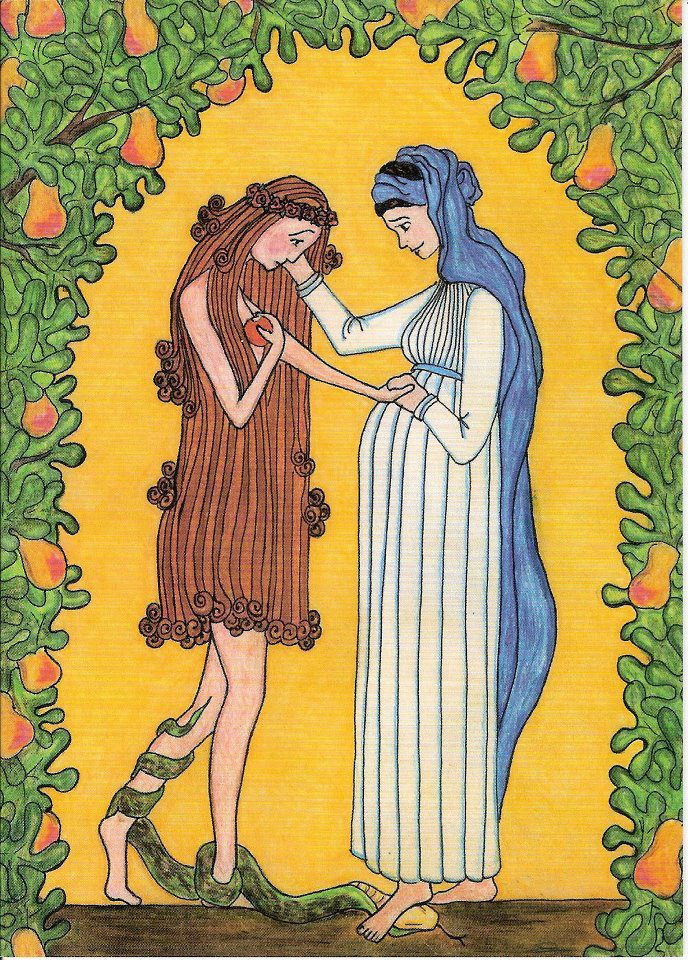 |
| Can You Spot the Errors? |
1) Grandma Eve's Legs and Looks
For some reason, Eve has a fruit in hand, but no fig leaves yet. Nevertheless she seems to have a 21st century conception of female modesty, feeling the need to wear her hair so as to cover only from the top of the legs up. Also, why make Eve and Mary look like Western Europeans? These are really the least of our problems with this picture, though.
2) Who is the New Eve?
Eve was the bride of Adam. Mary is not the bride of Christ, the church is.
Eve is our physical mother. Mary is not our spiritual mother, the church is.
Adam brought forth Eve. Jesus brought forth the church.
Mary is not the "new Eve" - if anything is, the church is. Mary, as greatly blessed as she was, is merely a member of that church.
3) Who crushed the head of the serpent?
The picture reflects the old Vulgate's erroneous translation "ipsa conteret caput tuum" (she will crush your head) rather than the new Vulgate's more accurate translation "ipsum conteret caput tuum" (it [i.e. the seed] will crush your head).
-TurretinFan
Sabas on The Twenty-Two Greek Letters and Their Significance
I had heard of a number of authors who testify to the fact that the Jewish canon is (and has for millenia been) twenty-two books. It was interesting to see confirmation of this fact in "Mysteries of the Greek Alphabet." The surprising thing about this is that the author chalks up the canon of the Jews as being twenty-two books, not based on the Hebrew Alphabet, but based on the Greek alphabet (claiming that two of the Greek letters are later additions). The author writes:
The manuscript itself is late 14th century (interesting to me given my recent review, its date is in relation to the "Age of the Martyrs," dating the beginning of the age to beginning of the reign of Diocletian, 284), but apparently is based on a much older original. If we accept the authorship identified with the manuscript it is apparently the work of St. Sabas (439-532). The main objection to this date is the fact that the third section of the work mentions the Arabic alphabet. Alcock seems to think that this reference makes Sabastian authorship impossible, although he notes the possibility that the references to the Arabic may be a later addition. This is possible, of course, since the Sahidic Coptic that we have is a translation from the Greek original, the Coptic people had interaction with the Arabic-speaking people.
I'm more optimistic that the references may possibly be original. The modern Arabic alphabet was just beginning to be developed in the 4th and 5th centuries, but there were Arab (broadly defined) peoples who used an alphabet (the Nabataean alphabet) before then. Moreover, the author refers to the fact that Alif is used for "1000," which was presumably true of Arabic before the positional number system was introduced to the Arabs (around 500 and increasingly used thereafter). Moreover, unlike Hebrew and the author's ancient Greek (according to the author), modern Arabic has 28 letters (based on 18 basic symbols, or rasm, plus various dottings). This argues for an earlier date for the work, from my point of view. I'm not aware of any scholarly study of the work aside from the notes provided with the text in Le Muséon.
I mention above that we have the Coptic translation of the text. Apparently Joseph Paramelle found a Greek copy of the text (per this entry). Unfortunately, I cannot tell what happened to that Greek copy since its discovery in 1989. Paramelle has come before his maker, so I cannot ask him. I wonder if it is one of the works in "Extraits hermétiques inédits dans un manuscrit d'Oxford" Mahé, Jean-Pierre • Para Melle, Joseph . (1991) in Revue des études grecques vol. 104 (1991) p. 109-139.
In any event, I simply add this reference to the already-existing pile of references from the patristic era that confirm a short Jewish canon.
-TurretinFan
Update: Apparently there is a German translation of the original Greek (here). The relevant portion of the text is substantially the same in Greek (regarding the twenty-two books) and the Greek also seems to make the reference to the Arabic, which seems to undermine my Coptic-Arabic suggestion.
Among them are twenty-two letters, apart from the xi and the psi, added by philosophers(Anthony Alcock, English translator, Roger Pearse, Publisher)
at the end. In this way, I am speaking of twenty-two letters: they correspond to the
number of the twenty-two works made by God in the creation, which are as follows.
The first: the first heaven.
The second: the earth below the abyss.
The third: the water on the face of the earth and below it.
The fourth: the other earth, which is the void.
The fifth: the spirit on the face of water, which is the air.
The sixth: the darkness upon the face of the abyss.
The seventh: the light that is called fire.
The eighth: the firmament called sky
The ninth: the separation of the two waters, above the firmament and below it.
The tenth: the emergence of the earth from the depths of the water.
The eleventh: the appearance of plants upon the face of the earth.
The twelfth: fruit-bearing trees with seeds on them.
The 13th: all beacons that bring light.
The fourteenth: the sun and the moon.
The fifteenth: their emplacement in the firmament of heaven.
The sixteenth: the fish in the waters.
The seventeenth: the birds of the air.
The eighteenth: all sea creatures that are large and those in the waters.
The nineteenth: all the animals.
The twentieth: all the poisonous reptiles
The twenty-first: all the beasts upon the earth.
The twenty-second: man of reason, the perfection of the entire world.
These are the works which God that came into being in the creation of the world, twenty-two of them.
For this reason there are twenty-two books counted in the Old Testament by the Jews.
For this reason, twenty-two thousand cattle were slaughtered by Solomon in dedicating the
Temple.
The manuscript itself is late 14th century (interesting to me given my recent review, its date is in relation to the "Age of the Martyrs," dating the beginning of the age to beginning of the reign of Diocletian, 284), but apparently is based on a much older original. If we accept the authorship identified with the manuscript it is apparently the work of St. Sabas (439-532). The main objection to this date is the fact that the third section of the work mentions the Arabic alphabet. Alcock seems to think that this reference makes Sabastian authorship impossible, although he notes the possibility that the references to the Arabic may be a later addition. This is possible, of course, since the Sahidic Coptic that we have is a translation from the Greek original, the Coptic people had interaction with the Arabic-speaking people.
I'm more optimistic that the references may possibly be original. The modern Arabic alphabet was just beginning to be developed in the 4th and 5th centuries, but there were Arab (broadly defined) peoples who used an alphabet (the Nabataean alphabet) before then. Moreover, the author refers to the fact that Alif is used for "1000," which was presumably true of Arabic before the positional number system was introduced to the Arabs (around 500 and increasingly used thereafter). Moreover, unlike Hebrew and the author's ancient Greek (according to the author), modern Arabic has 28 letters (based on 18 basic symbols, or rasm, plus various dottings). This argues for an earlier date for the work, from my point of view. I'm not aware of any scholarly study of the work aside from the notes provided with the text in Le Muséon.
I mention above that we have the Coptic translation of the text. Apparently Joseph Paramelle found a Greek copy of the text (per this entry). Unfortunately, I cannot tell what happened to that Greek copy since its discovery in 1989. Paramelle has come before his maker, so I cannot ask him. I wonder if it is one of the works in "Extraits hermétiques inédits dans un manuscrit d'Oxford" Mahé, Jean-Pierre • Para Melle, Joseph . (1991) in Revue des études grecques vol. 104 (1991) p. 109-139.
In any event, I simply add this reference to the already-existing pile of references from the patristic era that confirm a short Jewish canon.
-TurretinFan
Update: Apparently there is a German translation of the original Greek (here). The relevant portion of the text is substantially the same in Greek (regarding the twenty-two books) and the Greek also seems to make the reference to the Arabic, which seems to undermine my Coptic-Arabic suggestion.
Tuesday, April 09, 2013
Vatican Vacancy and Papal Necessity
For a brief time earlier this year, there was no pope - no bishop of Rome for the Roman Catholics. The "Camerlengo of the Holy Roman Church" (Cardinal Tarcisio Bertone held this office at that time) was in charge of Vatican City and Gandalf Castle and the few other "temporal powers" that still exist. Yet there was no "visible head" or "earthly head" or the like. There was a break, of sorts, in the supposedly "unbroken succession"! (see more on this point)
And more fundamentally, life went on. Life would have gone on had the cardinals not picked a successor. The bishop of Rome is really not necessary for anyone. People who had questions about the meaning of Scripture found answers. The Bible is no more or less clear today than it was during that time.
The Roman Catholic Church couldn't exist as such without a pope for the long run, because of various administrative tasks that fall to the pope (like appointing new bishops and elevating new cardinals). But those tasks are not tasks that are really necessary for the bishop of Rome to be doing.
What's the point? Simply that the papacy isn't necessary. It wasn't necessary in the time of the apostles and it is not necessary now. Any argument for the papacy, therefore, needs to come from some other quarter than from necessity.
-TurretinFan
And more fundamentally, life went on. Life would have gone on had the cardinals not picked a successor. The bishop of Rome is really not necessary for anyone. People who had questions about the meaning of Scripture found answers. The Bible is no more or less clear today than it was during that time.
The Roman Catholic Church couldn't exist as such without a pope for the long run, because of various administrative tasks that fall to the pope (like appointing new bishops and elevating new cardinals). But those tasks are not tasks that are really necessary for the bishop of Rome to be doing.
What's the point? Simply that the papacy isn't necessary. It wasn't necessary in the time of the apostles and it is not necessary now. Any argument for the papacy, therefore, needs to come from some other quarter than from necessity.
-TurretinFan
Pressing Chris Date's Retreat
Over at "Rethinking Hell," Mr. Chris Date has retreated a few steps in his discussion of the meaning of the term "punishment."
Recall that the argument that "punishment" in this case was a "result" noun was one of Mr. Date's first supposedly "positive" arguments for his position. Now, Mr. Date tries to argue for ambiguity. He states: "First, it should be noted that many deverbal nouns are polysemous, ambiguous between a process or result meaning."
Of course, this is true - it's something that Mr. Blauser and I already pointed out in our supplement. It's true, but it's not necessarily relevant.
Moreover, while it is true, it can be misleading. While - in some cases - a word standing alone can be ambiguous, even words with a range of meaning that includes both process and result can unambiguously express one or the other in context. In other words, the fact that something is a deverbal noun doesn't make it automatically ambiguous in a particular context.
Mr. Date even admits:
Similarly, it's not true that just because some (or many) deverbal nouns are polysemous, that therefore all deverbal nouns are polysemous. Moreover, there are kinds and degrees of polysemeity. For example, there are words like "punishment" that (in English) nearly always refer to a process, just like there are words like "injury" that almost always refer to a result.
After an irrelevant tangent over whether a fine is a process or result (it's a result), Mr. Date points out that "capital punishment" is a use of "punishment" that carries a "result" sense.
Of course, the only reason it carries a "result" sense in English is that it is being modified by a term that requires that sense. In other words, it is the modifier that goes with the word "punishment" that determines whether it carries its usual process sense, or this exceptional "result" sense.
In like way, "fine" can refer to the process of transferring the money. For example, "During the fine of Mr. Date, the bank discovered that there were insufficient funds in his account." In this case, a word that normally refers to a result carries a meaning that refers to a process.
"Capital punishment" is just an example in the opposite direction, where a term that is normally about the process is used to refer to a result. Just as we make result nouns function as though they were process nouns, we can make process nouns function as though they were result nouns. For example, slap "completed" on a process noun, and you now have a usage that refers to result.
Moreover, "capital punishment" is not a term used in Scripture, and this particular example of the semantic domain of "punishment", therefore, does not have a corresponding expression in Koine Greek (that I could locate - perhaps there's some use I'm unaware of). In short, this is an exception to the general rule in English - but not one that Mr. Date will find in the Biblical text.
Taking the usage of "punishment" in the King James Version, the only modifiers aside from "everlasting" in Matthew 25:46, are "my" (Genesis 4:13), "no" (1 Samuel 18:10), "strange" (Job 31:3), and "sorer" (Hebrews 10:29). The only other place where the corresponding Greek word is used, the KJV translates it as torment, not punishment.
Moreover, in this case - the word that modifies "punishment" is the word that means "everlasting." It's a word that relates to duration. As such, it's a word that unmistakably suggests that "process" or "manner" sense of "punishment" is intended, just as if it had said "long punishment," "lengthy punishment," or "short punishment."
So, Chris Date has two uphill battles to try to make his supposedly positive case. First, he has to deal with the fact that "everlasting" here suggests a process, and second he has to deal with the fact that "punishment" normally refers to a process.
Chris Date attempted to rely on Augustine. Regarding his misuse of Augustine, Mr. Date asks:
Mr. Date turns from there to a rebuttal argument extracted from Jonathan Edwards. Jonathan Edwards argues that if the Biblical descriptions of punishment in the afterlife all refer simply to a state of annihilation, and if being in that state eternally meets the description of "eternal punishment," then there is no reason for a lengthy period of suffering prior to such annihilation.
Mr. Date mistakenly takes comfort in this argument, supposing that Edwards is saying that continuing in the state of being annihilated is legitimately viewed as an "eternal punishment." On the contrary, while Mr. Date cited section 31 of the chapter, in section 1 Edwards explicitly states "Eternal punishment is not eternal annihilation." (get the book, here)
Finally, Mr. Date uses an argument worth laying to rest here, although perhaps it could be addressed anywhere. He writes:
Thus, in this example:
It's also referred to earlier in Matthew:
And, I should add, this concept of fire that burns forever is not a strictly New Testament concept:
Or to take another example:
The fire on the altar, like the fire that consumed Sodom, are pictures of the unquenchable fire that is coming:
If we are to read "eternal" as merely "from God" with respect to the fire and the punishment, then we should do so also with "eternal life." But surely Scripture makes it abundantly clear that eternal life is forever.
All this to say this verse:
-TurretinFan
Recall that the argument that "punishment" in this case was a "result" noun was one of Mr. Date's first supposedly "positive" arguments for his position. Now, Mr. Date tries to argue for ambiguity. He states: "First, it should be noted that many deverbal nouns are polysemous, ambiguous between a process or result meaning."
Of course, this is true - it's something that Mr. Blauser and I already pointed out in our supplement. It's true, but it's not necessarily relevant.
Moreover, while it is true, it can be misleading. While - in some cases - a word standing alone can be ambiguous, even words with a range of meaning that includes both process and result can unambiguously express one or the other in context. In other words, the fact that something is a deverbal noun doesn't make it automatically ambiguous in a particular context.
Mr. Date even admits:
I do not dispute that “punishment” does sometimes—even often—refer to the process of punishing. But since such deverbal nouns are often polysemous, it does not follow that therefore “punishment” carries a process meaning every time it’s used. “Punishment” may often describe “a manner of treatment, not the result of that treatment,” but this is not always the case.This is similar to the post-modern fallacy of assuming that just because people sometimes revise their opinions - or even often revise their opinions on many things - that therefore there is nothing that should be held absolutely.
Similarly, it's not true that just because some (or many) deverbal nouns are polysemous, that therefore all deverbal nouns are polysemous. Moreover, there are kinds and degrees of polysemeity. For example, there are words like "punishment" that (in English) nearly always refer to a process, just like there are words like "injury" that almost always refer to a result.
After an irrelevant tangent over whether a fine is a process or result (it's a result), Mr. Date points out that "capital punishment" is a use of "punishment" that carries a "result" sense.
Of course, the only reason it carries a "result" sense in English is that it is being modified by a term that requires that sense. In other words, it is the modifier that goes with the word "punishment" that determines whether it carries its usual process sense, or this exceptional "result" sense.
In like way, "fine" can refer to the process of transferring the money. For example, "During the fine of Mr. Date, the bank discovered that there were insufficient funds in his account." In this case, a word that normally refers to a result carries a meaning that refers to a process.
"Capital punishment" is just an example in the opposite direction, where a term that is normally about the process is used to refer to a result. Just as we make result nouns function as though they were process nouns, we can make process nouns function as though they were result nouns. For example, slap "completed" on a process noun, and you now have a usage that refers to result.
Moreover, "capital punishment" is not a term used in Scripture, and this particular example of the semantic domain of "punishment", therefore, does not have a corresponding expression in Koine Greek (that I could locate - perhaps there's some use I'm unaware of). In short, this is an exception to the general rule in English - but not one that Mr. Date will find in the Biblical text.
Taking the usage of "punishment" in the King James Version, the only modifiers aside from "everlasting" in Matthew 25:46, are "my" (Genesis 4:13), "no" (1 Samuel 18:10), "strange" (Job 31:3), and "sorer" (Hebrews 10:29). The only other place where the corresponding Greek word is used, the KJV translates it as torment, not punishment.
Moreover, in this case - the word that modifies "punishment" is the word that means "everlasting." It's a word that relates to duration. As such, it's a word that unmistakably suggests that "process" or "manner" sense of "punishment" is intended, just as if it had said "long punishment," "lengthy punishment," or "short punishment."
So, Chris Date has two uphill battles to try to make his supposedly positive case. First, he has to deal with the fact that "everlasting" here suggests a process, and second he has to deal with the fact that "punishment" normally refers to a process.
Chris Date attempted to rely on Augustine. Regarding his misuse of Augustine, Mr. Date asks:
Did we not see Augustine explicitly stating that the measure of capital punishment is not in the duration of the punishing, but rather in the duration of the consequent lifelessness?No, we did not. We saw him explicitly saying that it was not in the duration of the act of killing but in the duration of the exile ("As to the award of death for any great crime, do the laws reckon the punishment to consist in the brief moment in which death is inflicted, or in this, that the offender is eternally banished from the society of the living?").
Mr. Date turns from there to a rebuttal argument extracted from Jonathan Edwards. Jonathan Edwards argues that if the Biblical descriptions of punishment in the afterlife all refer simply to a state of annihilation, and if being in that state eternally meets the description of "eternal punishment," then there is no reason for a lengthy period of suffering prior to such annihilation.
Mr. Date mistakenly takes comfort in this argument, supposing that Edwards is saying that continuing in the state of being annihilated is legitimately viewed as an "eternal punishment." On the contrary, while Mr. Date cited section 31 of the chapter, in section 1 Edwards explicitly states "Eternal punishment is not eternal annihilation." (get the book, here)
Finally, Mr. Date uses an argument worth laying to rest here, although perhaps it could be addressed anywhere. He writes:
The phrase Jesus uses a mere verses earlier, “eternal fire,” carries a certain meaning elsewhere, which along with the rest of Scripture must be the lens through which we interpret “eternal punishment,” rather than the other way around.The argument Mr. Date is referring to here attempts to read the shadow into the substance, instead of recognizing that the shadow is just a shadow.
Thus, in this example:
Matthew 25:41There is that fire that lasts forever. It's the same fire that whose smoke will rise up forever (as we discussed here).
Then shall he say also unto them on the left hand, Depart from me, ye cursed, into everlasting fire, prepared for the devil and his angels:
It's also referred to earlier in Matthew:
Matthew 18:8
Wherefore if thy hand or thy foot offend thee, cut them off, and cast them from thee: it is better for thee to enter into life halt or maimed, rather than having two hands or two feet to be cast into everlasting fire.
Chris Date's argument is to rely on the fact that the fire sent against Sodom and Gomoorrha is also called "eternal fire."
Jude 7The argument is that the fire and brimstone against Sodom was not eternal in the duration of its burning. But Sodom is just an example - a shadow or type of future punishment. Similarly, Gehenna and Tophet/Topheth are types of the future burning, but the fires there were not literally unending.
Even as Sodom and Gomorrha, and the cities about them in like manner, giving themselves over to fornication, and going after strange flesh, are set forth for an example, suffering the vengeance of eternal fire.
And, I should add, this concept of fire that burns forever is not a strictly New Testament concept:
Isaiah 33:14I should note that a similar thing occurs when the "read the limitations of the shadow into the substance" hermeneutic encounters similar types:
The sinners in Zion are afraid; fearfulness hath surprised the hypocrites. Who among us shall dwell with the devouring fire? who among us shall dwell with everlasting burnings?
Jeremiah 17:4Yet the Babylonian captivity was only for a matter of years.
And thou, even thyself, shalt discontinue from thine heritage that I gave thee; and I will cause thee to serve thine enemies in the land which thou knowest not: for ye have kindled a fire in mine anger, which shall burn for ever.
Or to take another example:
Leviticus 6:13Nevertheless, the fire on the altar did go out. It was relit by God at the building of Solomon's temple, and then went out again, at the latest at the time of the captivity (but probably significantly before then).
The fire shall ever be burning upon the altar; it shall never go out.
The fire on the altar, like the fire that consumed Sodom, are pictures of the unquenchable fire that is coming:
Matthew 3:12Trying to reconcile the idea that the "fire" is "eternal" with the claim that it is not unending results in people like Mr. Date having to argue that the fire is only "eternal" in the sense of being from the eternal God.
Whose fan is in his hand, and he will throughly purge his floor, and gather his wheat into the garner; but he will burn up the chaff with unquenchable fire.
Luke 3:17
Whose fan is in his hand, and he will throughly purge his floor, and will gather the wheat into his garner; but the chaff he will burn with fire unquenchable.
If we are to read "eternal" as merely "from God" with respect to the fire and the punishment, then we should do so also with "eternal life." But surely Scripture makes it abundantly clear that eternal life is forever.
All this to say this verse:
Matthew 25:46makes it perfectly clear that both hell (i.e. the lake of fire) and heaven are eternal.
And these shall go away into everlasting punishment: but the righteous into life eternal.
-TurretinFan
Subscribe to:
Posts (Atom)
