Wednesday, November 16, 2022

Hebraism in Ephesians 1:11?

Earlier today, I was considering Ephesians 1:11 and my friend, Dan, pointed out that the word for "obtained an inheritance" is derived from a word that means to select by lot.  This came up because we had been discussing Ezekiel 24 and the non-choice there:

Ezekiel 24:6 Wherefore thus saith the Lord GOD; Woe to the bloody city, to the pot whose scum is therein, and whose scum is not gone out of it! bring it out piece by piece; let no lot fall upon it.

In the English Standard Version, the translation for "let no lot fall upon it" was something like "without making any choice."  

In the first chapter of Ephesians, Paul uses a Greek word that has a "lot" connotation to it:

Ephesians 1:11 In whom also we have obtained an inheritance (ἐκληρώθημεν), being predestinated according to the purpose of him who worketh all things after the counsel of his own will:

The verb ἐκληρώθημεν (eklerothemen) comes from the verb, κληρόω (klero'o), which is thought to come from κλῆρος (kleros) which in its most literal sense refers to lot.  

However, κλῆρος (kleros) is translated as heritage or inheritance in a few places:

Acts 26:18

To open their eyes, and to turn them from darkness to light, and from the power of Satan unto God, that they may receive forgiveness of sins, and inheritance among them which are sanctified by faith that is in me.

Colossians 1:12

Giving thanks unto the Father, which hath made us meet to be partakers of the inheritance of the saints in light:

1 Peter 5:3

Neither as being lords over God's heritage, but being ensamples to the flock.

The same Greek word has similar usage in the Septuagint:

Genesis 48:6

And thy issue, which thou begettest after them, shall be thine, and shall be called after the name of their brethren in their inheritance.

Exodus 6:8

And I will bring you in unto the land, concerning the which I did swear to give it to Abraham, to Isaac, and to Jacob; and I will give it you for an heritage: I am the LORD.

In reading the various translations of Ephesians 1:11, one caught my eye.  It was an "Orthodox Jewish Bible" translation, but what was interesting was that it cross-referenced Psalm 16.

Psalm 16:5-6 

The LORD is the portion of mine inheritance and of my cup: thou maintainest my lot. The lines are fallen unto me in pleasant places; yea, I have a goodly heritage.

I don't know how a word about casting lots became linked with the concept of inheritance.  The most obvious connection to me in light of Psalm 16 was the division of Canaan.

Numbers 26:55 Notwithstanding the land shall be divided by lot: according to the names of the tribes of their fathers they shall inherit.

However, when I checked the LSJ lexicon, I found that apparently Greek already had a similar usage, even outside Septuagint usage (link to entry).

So, in the end, while I thought this might be an example of a Hebraism, now I'm thinking it is interesting parallel in linguistic development, but not necessarily a Hebraism.

Interesting food for thought.

Tuesday, October 25, 2022

Are Conditional Abilities "Real"?

In a recent video, my friend Dan Chapa and I, discussed a Conditional Analysis argument from Guillaume Bignon's book Excusing Sinners and Blaming God (link to video).  During our discussion, one of the disconnects seemed to center on whether conditional abilities are something real or not.  

We speak of conditional abilities all the time.  When someone asks a teenager, "can you drive," they typically mean something like, "have you learned to drive," "do you have a license," or "do you have a car at your disposal."  An affirmative answer describes a real ability of the teenager, even if that ability isn't presently being actualized.

It's not an ability off in some hypothetical world, it's an ability in the real world.

Likewise, we can speak of conditional disabilities.  These are also real absences of ability.  For example, if the teen responds, "I can't drive, I'm grounded," we understand the implication that the teen knows how to drive, has a license, but is currently under a parental restriction that prevents the teen from driving.  The way that the teen has expressed this disability has also informed us about an underlying ability.

Such a response is different from, "I can't, I haven't learned yet," or "I can't, I failed the driver's license exam."  These statements of disability express the absence of different kinds of abilities.  "I haven't learned yet," may express something about the cognitive and motor skills aspects, whereas "I failed the driver's license exam" may express (at least) a legal obstacle.  

If that's too abstract, consider the adjective, "flammable" (or "inflammable," which means the same thing).  A pool of gasoline is "flammable" even if there is no match nearby.  We say the same about lots of abilities of physical things.  Copper is ductile, even if no one draws it out into wire.  Granola is crunchy, even before you place it into your mouth.

Let's bring this back to the subject of the discussion.

When we say, "He could if he wanted to," we are describing a conditional ability.  When we say, "He couldn't, even if he wanted to," we are describing a conditional disability. These are real abilities, even though they are conditional abilities.  

In our discussion, we mentioned the case of a daughter whose father orders her to carry an item upstairs and she fails to do so.  We care about the answer to the question, "Could she have done what he asked, if she wanted to?" or more broadly to the question of "What stopped her from doing what he asked?"  In other words, we want to know the answer to the question, "What's the condition that would have to be removed such that on a conditional analysis, she could have done what he asked?"

If the answer is, "well if she didn't hate her dad so much, she could have," or "well if she weren't so stubborn, she could have," we have one evaluation of the situation, but if the answer is, "if the item weighed less, she could have," or "if she had heard his request, she could have," or "if the item actually existed, she could have," we have different analysis.

In the discussion, there was also a misunderstanding of the conditional analysis as suggesting that the conditional analysis implies that the past is not fixed or implying that a person has the ability to change the past.  That's not the implication of a conditional analysis that evaluates a different past.  

In fact, God himself provided a conditional analysis that involved a different past:

Numbers 12:14  And the LORD said unto Moses, If her father had but spit in her face, should she not be ashamed seven days? let her be shut out from the camp seven days, and after that let her be received in again.

God's conditional analysis, "If X had occurred, then Y would have followed," is true, even though it would involve a different past.  This is not so much about an ability, per se, but it is nevertheless about a causal chain that proceeds from a different past than the actual past.

Likewise, in Scripture, humans likewise use a conditional analysis involving a different past, to describe human ability/inability:

Judges 14:18  And the men of the city said unto him on the seventh day before the sun went down, What is sweeter than honey? and what is stronger than a lion? And he said unto them, If ye had not plowed with my heifer, ye had not found out my riddle.

Here, Samson's conditional analysis is "If X had not occurred, then Y would not have occurred."  He's accusing them of cheating, saying that without cheating they did not have the ability to guess his riddle.

Jonathan has a similar conditional analysis of Saul's requirement for fasting during battle:

1 Samuel 14:30 How much more, if haply the people had eaten freely to day of the spoil of their enemies which they found? for had there not been now a much greater slaughter among the Philistines?

In Jonathan's analysis, "if the people had done X, then they could have done Y."  He's explaining that the decisive factor for the people failing to more thoroughly exterminate the Philistines was not the people's lack of resolve or strength, but a lack of food. 

This is not an exhaustive look at the Scriptural use of conditional analysis, but I thought I would add a few from the New Testament as well:

Matthew 24:43 But know this, that if the goodman of the house had known in what watch the thief would come, he would have watched, and would not have suffered his house to be broken up.

This conditional analysis example is interesting because Jesus is not speaking about a different actual past, but a different past in the world of parables.  That said, the same conditional analysis applies.  "If the man knew X, he would have done Y." 

This example is also interesting because Jesus is not saying that it was possible for the man to know X.  How could he know when the thief would come?!  Rather, Jesus is explaining what the result would have been had the man known.  He's saying (among other things) something about the character of the man, that he's not apathetic about burglary nor powerless to stop a burglary that he's aware of.

An example that should spring to mind is this one, as it was recently discussed in another episode:

Luke 10:13 Woe unto thee, Chorazin! woe unto thee, Bethsaida! for if the mighty works had been done in Tyre and Sidon, which have been done in you, they had a great while ago repented, sitting in sackcloth and ashes.

Once again, Jesus is providing a conditional analysis, even if it is hyperbole.  The conditional analysis is not suggesting that it is possible for the past to change, such that the same works could now have been done, but rather it is describing the relative character of the hearts of the men of Chorazin and Bethsaida, that it is even harder than the hearts of those of Tyre and Sidon.

Finally, we have a conditional analysis from Martha: 

John 11:21 Then said Martha unto Jesus, Lord, if thou hadst been here, my brother had not died.

Martha is not saying that Jesus has the ability to change the past.  She is saying that Jesus has the ability to heal.  Thus, she believes that the decisive factor in her brother's death was not a lack of healing power in Jesus but instead was Jesus' personal absence. 

Conditional abilities are real abilities.  They are real abilities when it comes to healing the sick, they are real abilities when it comes to being able to be wowed by miracles, they are real abilities when it comes to the ability to resist burglars, they are real abilities when it comes to warfare, they are real abilities when it comes to solving puzzles, or even to suffer shame.  Conditional analysis is valid, even when it implies a different past than the actual past. The necessity of the past is not violated by the use of conditional analysis, but it's simply set aside for the purpose of conditional analysis.


Thursday, October 20, 2022

Does Pro Pastor Answer Objections?

Jordan Steffaniak tweeted (link to thread) the following, which I've taken the liberty of reformatting for space here.  Go to the link for the original formatting: 

JS (October 18): PSA: If you’re curious about the value of medieval sources, the nature of sola scriptura, etc. Don’t waste your time reading this. They don’t interact with their opponents. They ask questions no one is asking. They refute views no one is espousing. YW. https://gbtseminary.org/gbts-journal/
JS (October 19): I've been informed that I'm a biased, bigoted, scholastic snob that lied in my statement that GBTS failed to w/ their opponents on medieval theology, sola scriptura etc. I'm more than willing to retract my claims if proven wrong. But I'm unable to see where my claim is false.
TF (October 19): Are you willing to be shown?
JS (October 19): Yep. But no one is willing to provide any evidence besides snarky replies, apparently. 🤷🏼‍♂️

Since Jordan says he is willing to be shown, here is the evidence that his claims are wrong.

First, how can it really be both ways?  Either they don't have opponents because they answer(?  -- I suppose "ask" was just a twitter-o) questions no one is asking and refute views no one is espousing, or they "don't interact with their opponents."   If they are really just off discussing questions no one cares about, so be it.  There are a vast array of journals I have never read, and will never read.  

Of course, no one has to warn me off.  No one has to tell me to actively ignore such uninteresting journals (to me).  Instead, I just naturally gravitate away from such topics.

On the other hand, Jordan seems to recognize that the issue presents itself as being related to the value of medieval sources.  Jeff Moore, the editor, characterizes the issue this way: "Our inaugural issue addresses a contemporary question that is raging, regrettably, among evangelicals: Is Thomas Aquinas a helpful guide for Protestants?"  We will come back in a moment to the question of whether this is a question people are asking.  Suffice to say that this question is provided right on the cover of the issue, surrounded by images of Calvin and other early Reformers.

It's unclear from Jordan's tweet whether he read beyond that title page.  Maybe he read the whole issue thoroughly, maybe not.  There is only so much one can discern from 140 characters or whatever the current limit is. 

Second, Jordan linked to a page that provides only the first volume, first issue of "Pro Pastor:  A Journal of Grace Bible Theological Seminary."  The print release date for this issue is October 31, 2022, which is still future as of the writing of this post.  To say, "they don't interact with their opponents," is a strange claim to put it mildly.  Shouldn't there minimally be an opportunity for opponents to the journal to arise?  How much opposition can a journal expect before its very first issue of its first volume?

Nevertheless, of course, the journal didn't spring up in a vacuum.  It's the publication of a seminary, and the publication of the individual authors.  I note that the fourth page of the digital edition has the caveat: "The views expressed in the following articles and reviews are not necessarily those of the faculty, the administration, or the trustees of Grace Bible Theological Seminary."  That said, though, perhaps Jordan means that the seminary, as such, doesn't interact with "their" opponents.  A better interpretation, though, is that Jordan meant to refer to the authors of the articles.

This issue has articles from: James R. White (two articles), Jeff Moore (an introduction and one article), Jeffrey D. Johnson (one article), and Owen Strachan (one article).  There is also an uncredited "Summary Chart," but presumably the chart's author is not on the hook.

Do the authors interact with their opponents?  James White has conducted numerous debates (over 150 at last count), many of which are online.  To suggest that White doesn't interact with his opponents must, at best, come with some heavy qualification.  I'm less familiar with Owen Strachan and Jeffrey Johnson.  I found what appears to be an interaction between Owen Strachan and Jermaine Marshall (link to video).  Jeffrey Johnson is an incredibly common name, but I believe I found an interaction between Jeffrey Johnson and Michael Horton (link to video).  I didn't find anything debate-related with Jeff Moore, so I don't know whether he does debates or not.  Perhaps he does not.

So, at least most of these authors may have some experience with actual debate, and James White, the biggest contributor to this issue, has an overwhelming abundance of experience with debate.  That said, none of James White's debates have been specifically on Thomas Aquinas.  James White has had an informal dialog with William Lane Craig on Calvinism vs. Molinism and a formal debate with Tim Stratton on "Is Molinism Biblical," which have some connection to Thomas, but no debates specifically on the topic of "Is Thomas Aquinas a helpful guide for Protestants?"

Nevertheless, White has responded to opponents on Thomas Aquinas on his program, The Dividing Line (here is an example), numerous times.   Again, I'm less familiar with the others, and I don't know whether they have similarly responded or not.

Giving Jordan the benefit of the doubt, though, perhaps Jordan just meant that this issue itself, in the issue, doesn't respond to opponents.

On page 1, Jeff Moore identifies John Gerstner's article, "Aquinas was a Protestant," and Matthew Barrett's article, "What is Eternal Generation? (and Interview)," and asks whether the claims of those articles are true.

White's first article, in fairness to Jordan, simply sets up a definition of Sola Scriptura.  White's second article then aims to answer the question of whether Thomas held to Sola Scriptura.  I suppose that for a lot of advocates of Thomism, this question is not one they are asking.  It is a question seemingly raised by Tabletalk Magazine, May 1994: Should Old Aquinas Be Forgot? (and similarly posed by Travis James Campbell in the Aquila Report).

However, again, the focus even of White's second article is on analyzing Thomas' writings, not responding to a particular competing interpretation of Thomas.

Like White's two articles, Moore's article is similarly mostly a positive presentation on whether pagan philosophy should be understood as being in collaboration or conflict with Christianity, with the underlying argument being that Thomas was wrong to try to supplement Aristotle, rather than discarding Aristotle in favor of Scripture.  While this is not a direct response to opponents, one can surely see the relevance to the question of the usefulness of Thomas to Protestants today.

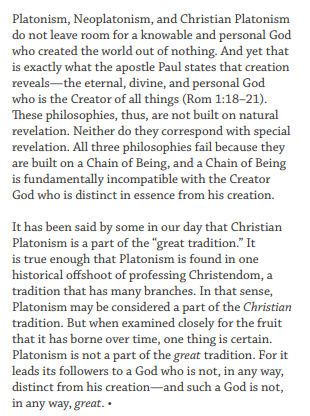
Jeffrey Johnson's article, "Is Platonism a Part of the Great Tradition," is clearly a shot across the bow of Craig Carter, and Craig Carter is identified in the first footnote of the article.  It's hard not to see the article as a challenge to Craig Carter's concept of Christian Platonism.  For example, Carter writes:


Now, if Jordan were simply saying that Johnson did not quote Carter and interact with those quotations, ok.  But it is hard to see Johnson's conclusion as not being in conflict with Carter's position:


Owen Strachan tackled the topic of whether Thomas taught monergism, and concluded that Thomas did not.  While Strachan's article does not directly interact with John Gerstner's article arguing that Thomas taught Sola Fide, it is once again hard to see this as anything other than a correction to it.

I suppose that what Jordan may have meant to say, instead of what he actually said, was that this issue does not address questions of the doctrine of divine simplicity, eternal functional subordination, or theology proper.  The first two topics are not mentioned at all in the issue.

The phrase, "theology proper," appears twice each at pp. 34 and 40, all of which are in Owen Strachan's article.  For those interested, I provide the relevant paragraphs:

Broadly speaking, the “great tradition” movement downplays soteriological differences and focuses attention on supposed ecumenical agreement over the doctrine of God (theology proper). It finds this common ground in the Nicene tradition, as it is often called, which took shape in the four ecumenical creeds, continued to be developed in the medieval period, and came to full flower under Thomas Aquinas.
...
In the present hour, Aquinas is supposedly the theological hero who can rescue us from theological drift. The neo-Reformed project, it is alleged, platformed soteriology, but divested itself of sound classical theology proper. Now, by a return to a certain version of Reformed scholasticism, we can right the ship. If we will embrace Doctor Angelicus (Aquinas, per the Catholics); if we will learn extensively from Catholic theologians and philosophers; if we will root out the biblicists with their supposedly “solo scriptura” method; if we will exchange the Reformational paradigm carved loosely by diverse voices and works like old Princeton, Spurgeon, early Westminster, Lloyd-Jones, and the neo-Reformed movement for a “great tradition” paradigm knit together by an ecumenical band of thinkers, we will save the church from its fundamentalist capsizing.
...
Some tell us in our time that we can chart a middle way here. We can love Thomas but avoid his errors. We can avoid his doctrine of salvation, even while we embrace his doctrine of God. We may share many commitments with some who make these claims. We desire no doctrinal war with them, and we pray for peace in the body. But we cannot constrain ourselves from warning the church today: Thomas was not a proto-Reformer. Considered in widescope view, with his body of teaching taken into account, Thomas is not a sound guide. 
...  
But perhaps, even after this treatment of Thomas, someone will say in response to me, “But Thomas has all this rich theology proper that you’re ignoring! He’s orthodox as I read him. How can you charge him with not knowing the true God, even if he does get some things wrong on soteriology?” My reply is simple. Just as Thomas might have seemingly orthodox theology proper, so too may a prosperity gospel preacher have a seemingly correct Trinitarianism. Let’s say that on paper, he holds to Nicene theology, and even honors the “great tradition.” But what if that preacher proclaims a false gospel, one in which sin has no place, and the gospel as he presents it is actually about God making all your biggest dreams come true? Clearly, even technical orthodoxy on the Trinity does not change the fact that such a preacher does not honor or know the true God.

So, perhaps Jordan's underlying disappointment was that Strachan and the rest don't debate Thomas' theology proper.  

If one wanted to debate the soundness of Thomas' theology proper, this issue would look like a gigantic ad hominem argument.  Such an analysis misses the point of the issue.  The point of the issue, aptly summarized by the title of the issue, was this: "Is Thomas Aquinas a helpful guide for Protestants?" The answer provided is that Thomas is not, because of positions the authors say he held, including on important issues like Sola Scriptura, the relevance of Aristotle, the relevance of Denys and other Platonists, and Monergism.  

I hate having to put a caveat on an article like this, but I don't trust *some* of the readers' ability to understand negative implications.  I'm not saying I fully agree with any of the authors about anything they wrote.  I don't agree with Craig Carter's label of the historical Francis Turretin as a Christian Platonist.

Friday, October 14, 2022

It's all about the Exegesis - Matthew 24:36 (Mark 13:32)

Too much digital ink has been spilled over the recent call by my friend, James White, to people to learn and apply the skills of exegesis to the text of Scripture, instead of rushing to glib answers without carefully studying the text.  James is right - adherence to Scripture is of the first importance.  Our answers to the outsiders claiming that Christ is not fully divine must be answered from the text, not simply from the creeds.

This is not to say that the creeds are wrong.  This is not to say that the creeds are unhelpful.  This is not to say that we must sit under a tree with our Bible and wear noise-cancelling headphones to ignore the work of our fellow believers.

Rather, this is to say that our answer must be rooted in God's Word.  Look at the exegetical work of several Reformed exegetes on the challenging text of Matthew 24:36.

1. Calvin (link to commentary)

Calvin argues that the day referred to is the final judgment.  Amongst the lessons Calvin draws from the text, here is one that seems very fitting today: "We ought therefore to be on our guard, lest our anxiety about the time be carried farther than the Lord allows; for the chief part of our wisdom lies in confining ourselves soberly within the limits of God’s word."  This is something that my friend, James, has been promoting for decades.

Calvin starts out rather provocatively: "Mark adds, nor the Son himself. And surely that man must be singularly mad, who would hesitate to submit to the ignorance which even the Son of God himself did not hesitate to endure on our account."  You can only imagine the flurry of tweets this line might cause today.

After addressing various objections, Calvin settles on this explanation with reference to the text of Matthew and Mark:

I have no doubt that he refers to the office appointed to him by the Father as in a former instance, when he said that it did not belong to him to place this or that person at his right or left hand, (Matthew 20:23; Mark 5:40.) For (as I explained under that passage (159)) he did not absolutely say that this was not in his power, but the meaning was, that he had not been sent by the Father with this commission, so long as he lived among mortals. So now I understand that, so far as he had come down to us to be Mediator, until he had fully discharged his office that information was not given to him which he received after his resurrection; for then he expressly declared that power over all things had been given to him, (Matthew 28:18.)

Calvin does make reference to Christ's human nature, and does so in a way that could probably be improved:

As to the first objection, that nothing is unknown to God, the answer is easy. For we know that in Christ the two natures were united into one person in such a manner that each retained its own properties; and more especially the Divine nature was in a state of repose, and did not at all exert itself, (158) whenever it was necessary that the human nature should act separately, according to what was peculiar to itself, in discharging the office of Mediator. 

(158:  “La Divinité s’est tenue comme cachee; c’est à dire, n’a point demonstré sa vertu;” — “the Divine nature was kept, as it were, concealed; that is, did not display its power.”)

2. John Gill (link to commentary)

Gill argues that the day referred to is the destruction of Jerusalem. Gill makes an interesting connection to Isaiah 63:4, where it is written: "For the day of vengeance is in mine heart ... " which Gill explains means that God had kept this day to himself, not even revealing it to the angels.

Gill wraps up his explanation of the text this way:

The Ethiopic version adds here, "nor the son", and so the Cambridge copy of Beza's; which seems to be transcribed from Mark 13:32 where that phrase stands; and must be understood of Christ as the son of man, and not as the Son of God; for as such, he lay in the bosom of the Father, and knew all his purposes and designs; for these were purposed in him: he knew from the beginning who would betray him, and who would believe in him; he knew what would befall the rejecters of him, and when that would come to pass; as he must know also the day of the last judgment, since it is appointed by God, and he is ordained to execute it: but the sense is, that as he, as man and mediator, came not to destroy, but to save; so it was not any part of his work, as such, to know, nor had he it in commission to make known the time of Jerusalem's ruin:

but my Father only; to the exclusion of all creatures, angels and men; but not to the exclusion of Christ as God, who, as such, is omniscient; nor of the Holy Spirit, who is acquainted with the deep things of God, the secrets of his heart, and this among others,

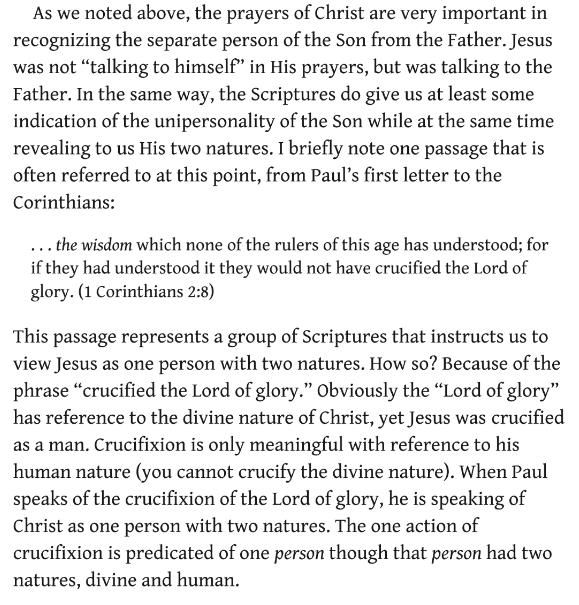
Notice that Gill does not have to explicitly discuss the text in terms of the "two natures one person" distinction, but Gill instead relies on the Matthean category of "Son of Man."  Nevertheless, Gill ultimately, and correctly affirms that Christ as God and the Holy Spirit also know.  The "two natures in one person" understanding fits with and flows from this kind of exegesis, but an explanation of the text is more than just a glib appeal to the two natures.

3. Matthew Henry (link to commentary)(link to Mark commentary)

Henry, who also takes this as a reference to the final judgment, does not address the objection about "nor the Son" in the Matthew commentary, following the TR text.  However, in his commentary on the synoptic account in Mark (which has the phrase), Henry offers multiple explanations, without clearly settling on one:

II. "As to the end of the world, do not enquire when it will come, for it is not a question fit to be asked, for of that day, and that hour, knoweth no man; it is a thing at a great distance; the exact time is fixed in the counsel of God, but is not revealed by any word of God, either to men on earth, or to angels in heaven; the angels shall have timely notice to prepare to attend in that day, and it shall be published, when it comes to the children of men, with sound of trumpet; but, at present, men and angels are kept in the dark concerning the precise time of it, that they may both attend to their proper services in the present day." But it follows, neither the Son; but is there any thing which the Son is ignorant of? We read indeed of a book which was sealed, till the Lamb opened the seals; but did not he know what was in it, before the seals were opened? Was not he privy to the writing of it? There were those in the primitive times, who taught from this text, that there were some things that Christ, as man, was ignorant of; and from these were called Agnoetae; they said, "It was no more absurd to say so, than to say that his human soul suffered grief and fear;" and many of the orthodox fathers approved of this. Some would evade it, by saying that Christ spoke this in a way of prudential economy, to divert the disciples from further enquiry: but to this one of the ancients answers, It is not fit to speak too nicely in this matter—ou dei pany akribologein, so Leontius in Dr. Hammond, "It is certain (says Archbishop Tillotson) that Christ, as God, could not be ignorant of any thing; but the divine wisdom which dwelt in our Saviour, did communicate itself to his human soul, according to the divine pleasure, so that his human nature might sometimes not know some things; therefore Christ is said to grow in wisdom (Lu. 2:52), which he could not be said to do, if the human nature of Christ did necessarily know all things by virtue of its union with the divinity." Dr. Lightfoot explains it thus; Christ calls himself the Son, as Messiah. Now the Messiah, as such, was the father's servant (Isa. 42:1), sent and deputed by him, and as such a one he refers himself often to his Father's will and command, and owns he did nothing of himself (Jn. 5:19); in like manner he might be said to know nothing of himself. The revelation of Jesus Christ was what God gave unto him, Rev. 1:1. He thinks, therefore, that we are to distinguish between those excellencies and perfections of his, which resulted from the personal union between the divine and human nature, and those which flowed from the anointing of the Spirit; from the former flowed the infinite dignity of his perfect freedom from all sin; but from the latter flowed his power of working miracles, and his foreknowledge of things to come. What therefore (saith he) was to be revealed by him to his church, he was pleased to take, not from the union of the human nature with the divine, but from the revelation of the Spirit, by which he yet knew not this, but the Father only knows it; that is, God only, the Deity; for (as Archbishop Tillotson explains it) it is not used here personally, in distinction from the Son and the Holy Ghost, but as the Father is, Fons et Principium Deitatis—The Fountain of Deity.

While this is not the most satisfying example of exegesis, it certainly does illustrate something more than just offering a glib response.  Moreover, Henry's list of explanations show the diversity of explanations that have been offered.  Finally, the reference to Luke 2:52 helps point us to a more general explanation.

4. Matthew Poole (link to commentary)

Poole, in his concise commentary, offers this:

Mark addeth, Mark 13:32, neither the Son, but the Father. Of that day and hour, that is, the particular time when the heavens and the earth shall pass away, as he had before said, or when the end of the world shall be, which was one of the questions propounded to him by his disciples, Matthew 24:3.

Knoweth no man, no mere man, nor have men any reason to be troubled at it; for it is a piece of knowledge which the Father hath reserved in his own power, and his own pleasure, from the angels, who continually behold his face. Nay, I myself, as man, know it not. Nor is it more absurd, or derogating from the perfection of Christ, than for to say, that Christ, as man, was not omnipotent, or omniscient, &c. By the way, this gives a great check to the curiosity of men’s inquiries after the particular time or year when the world shall have an end, or the day of judgment begin, or be.

Unfortunately, I don't currently have access to Poole's more detailed work on this, but you can see that Poole concludes that Jesus is speaking "as man." 

Ultimately, the lesson we can learn from this exercise of reviewing some older commentaries on the text is that there are exegetical answers to the questions that people raise.  In this case, if one simply goes to the creedal formulations and applies them to the text, one will get the right result (of course), but without understanding how it is that the text teaches it, one is left without an answer to the next question.

Note how the different expositors bring out different facets of understanding.  Henry (following Tilllotson) mentions that the "Father" can be referenced not as the person of the Trinity distinct from the Son, but as the fountain of deity.  Recall the use in the Old Testament of Father in this way both about God as Creator and even about the person of Jesus Christ: 

Malachi 2:10 Have we not all one father? hath not one God created us? why do we deal treacherously every man against his brother, by profaning the covenant of our fathers? 

Psalm 103:13 Like as a father pitieth his children, so the LORD pitieth them that fear him.

Isaiah 9:6 For unto us a child is born, unto us a son is given: and the government shall be upon his shoulder: and his name shall be called Wonderful, Counsellor, The mighty God, The everlasting Father, The Prince of Peace. 

Isaiah 63:16 Doubtless thou art our father, though Abraham be ignorant of us, and Israel acknowledge us not: thou, O LORD, art our father, our redeemer; thy name is from everlasting.

It is without doubt that Isaiah 9:6 refers to Jesus, not as the first person of the Trinity, but nevertheless as having that same title of deity.  Furthermore, it is right to speak of Christ as our redeemer.

So also we see the Jewish understanding God as father, presumably formed by Malachi 2 and Isaiah 63:

John 8:41 Ye do the deeds of your father. Then said they to him, We be not born of fornication; we have one Father, even God.

Obviously, the Jews did not mean that as a reference to the person of the Father as distinct from the Son, since they did not have a proper understanding of the Trinity.  

Likewise, it is right to speak of Jesus in his economic relationship to the Father in the economy of redemption, because Matthew had previously quoted Jesus thus: 

Matthew 11:25-27

At that time Jesus answered and said, I thank thee, O Father, Lord of heaven and earth, because thou hast hid these things from the wise and prudent, and hast revealed them unto babes. Even so, Father: for so it seemed good in thy sight. All things are delivered unto me of my Father: and no man knoweth the Son, but the Father; neither knoweth any man the Father, save the Son, and he to whomsoever the Son will reveal him.

I don't want to belabor the point, but the bottom line is that Jesus, in Matthew (and Mark) is speaking of the Father in contradistinction to the created order.  So, whether Jesus means the person of the Father or the Triune Godhead (through something akin to federal headship or synecdoche or simply by reference to the relation of all three persons to us), the bottom line is that this statement is not a denial that Jesus according to his divine nature knew it nor is it a denial that the Holy Spirit knew it.

As to the latter point, the text is not speaking of the Holy Spirit, as a distinct person from the Father and the Son.  As to the former point, Jesus is speaking of himself as the Son of Man.  Jesus uses that description of himself numerous times in Matthew and most relevant to our consideration in the immediate context of the text:

Matthew 24:27 For as the lightning cometh out of the east, and shineth even unto the west; so shall also the coming of the Son of man be.

Matthew 24:30 And then shall appear the sign of the Son of man in heaven: and then shall all the tribes of the earth mourn, and they shall see the Son of man coming in the clouds of heaven with power and great glory.

(our text)

Matthew 24:37 But as the days of Noe were, so shall also the coming of the Son of man be.

Matthew 24:39 And knew not until the flood came, and took them all away; so shall also the coming of the Son of man be.

Matthew 24:44 Therefore be ye also ready: for in such an hour as ye think not the Son of man cometh.

Matthew 25:13 Watch therefore, for ye know neither the day nor the hour wherein the Son of man cometh.

Matthew 25:31 When the Son of man shall come in his glory, and all the holy angels with him, then shall he sit upon the throne of his glory:

The same is true, though to a lesser extent, in the context in Mark 13:

Mark 13:26 And then shall they see the Son of man coming in the clouds with great power and glory.

So, Jesus is not speaking of the Son as the Son of God, but as the Son of Man.  He is speaking of the Son in the role given to him by the Father, not in absolute terms.

Ultimately, I find Gill's explanation the best, but I will admit that I'm drawn to it because it seems to me to be the one that is most exegetically grounded in the text of Scripture.

Likewise, while I agree with Calvin that Jesus' deity was "covered" ("veiled" to use the term my friend James has used a few times recently), such that Jesus did not always exercise the powers that he has as God (particularly during his humiliation), such an explanation should not stand alone, but should be connected to the Scripture from which it is derived.

Thus, Paul writes:

Philippians  2:7-8

But made himself of no reputation, and took upon him the form of a servant, and was made in the likeness of men: and being found in fashion as a man, he humbled himself, and became obedient unto death, even the death of the cross.

This was the condition of Jesus when he spoke the words of Matthew 24:36/Mark 13:32.  So, we should not come to any wrong conclusions regarding the Son, nor regarding the Holy Spirit from this text.  Furthermore, while the creeds and confessions are right, we do not have to appeal to their authority to establish the right understanding of this text.

Wednesday, October 12, 2022

James White and Matthew 24:36

My friend, James White, has been consistently defending the Trinity for decades.  I'm truly mystified by the fact that some folks are seriously worried about his view of the two natures of Christ and of his interpretation of Matthew 24:36.  Here's an example of White's discussion from the Forgotten Trinity.

People respond that this seems at odds with his comments on Matthew 24:36.

He explained Matthew 24:36 on the DL in 2006, starting around 47 minutes in.  1st, James explicitly affirms that the text doesn't apply to the Holy Spirit. 2nd, James briefly mentions to two natures (not in detail, though):

(link to DL)

Again in 2012, James 1st) explains textual variant issues.  2nd) addresses inconsistent Muslim use 3rd) sets aside economic Trinity explanations as possible but weak 4th) explains that these limitations apply to Christ as incarnate using the same "veil" metaphor James is using now (link to video):


About one hour, five minutes into a recent presentation (Link) James again holds to his "veil" metaphor, which apparently is now so objectionable.


Thursday, October 06, 2022

What about tests in Scripture?

My friend, Dan, has a post that has remained unrebutted for the past 12 years (link), as far as I know.  Before we come to the arguments he makes, let's look at the Scriptural discussion of trying, testing, and temptation (in the older sense of the word).

1. Nāsâ (נָסָה) (pronounced naw-saw') Strong's H5254

Variously translated as to test, try, attempt, assay, prove, or tempt (though not in the modern sense of tempt).

It's found in a few dozen verses in the Old Testament.  For example, in Genesis 22:1 God tests Abraham.  Likewise, in Psalm 106:14, the people of Israel tested God.  

The Psalms provide examples of Hebrew synonyms of the word.  For example, Psalm 26:2 states: "Examine me, O LORD, and prove me; try my reins and my heart."  The word nasa is translated "prove" here.  The parallel Hebrew words are Bahan (H974) translated here "examine" and Sarap (H6884) translated "try".  

2. Bāḥan (בָּחַן) (pronounced baw-khan') Strong's H974

Variously translated as examine, prove, tempt (again, not in the modern sense), or try.

It's found in nearly as many verses as nasa in the Old Testament.  Like nasa it can be used of God testing man.  Thus, David says that God tries the heart in 1 Chronicles 29:17.  Similarly, the people of Israel are said to have tried God in Psalm 95:9.

As with nasa, there are parallels of bahan in the Psalms.  For example, Psalm 139:23 "Search me, O God, and know my heart: try me, and know my thoughts."  In this case, "try" (bahan) is parallel to Haqar (H2713) translated "search" here.  The result of the searching and trying was knowing the hearts and thoughts of the person.

Bahan can also refer to testing in a different sense.  For example: Zechariah 13:9 And I will bring the third part through the fire, and will refine them as silver is refined, and will try them as gold is tried:  they shall call on my name, and I will hear them: I will say, It is my people: and they shall say, The LORD is my God.

In this case, the idea is one of purification through heat.  The parallel word translated "refined" here is Sarap.

3. Sārap̄ (צָרַף) (pronounced tsaw-raf') H6884

Used about as often as each of nasa and bahan, sarap is usually translated in connection with the smelting process, but less often in the sense of testing.  Nevertheless, God speaks about trying the people Gideon has recruited in Judges 7:4 to reduce the number of people.  This is not a word that is typically used of men about God.  Rather the Word of God is "tried" (Psalm 18:30) in the sense of being pure (see Proverbs 30:5).  

4. Hāqar (חָקַר) (pronounced khaw-kar') H2713

With a similar usage rate to the others, haqar is often used about inanimate or abstract objects, such as the facts (Deuteronomy 13:14) or the land (Judges 18:2).  It is used of God searching out man, for example in Psalm 44:21.  I did not find it used of man trying to search out God.

5. Peirazo (πειράζω) G3984

The Septuagint translates the temptation of Abraham with a form of the word πειράζω, which is typically translated as "tempt" in the KJV, with the sense of a test or trial.  The word is used about equal times in the LXX and the NT, and can refer to Jesus being tempted by the devil (Matthew 4:1), or Jesus testing the disciples (John 6:6)

6. Ekpeirazo (ἐκπειράζω) G1598

This term seems to be essentially a strengthened form of πειράζω, and is found a small handful of times in the LXX and NT.

7. Dokimazo (δοκιμάζω) G1384

This term is most often translated as prove, try, approve, or discern.  It's used by the author of Hebrews in quoting from Psalm 95:9-10 (LXX Psalm 94:9-10) at Hebrew 3:9 in parallel to πειράζω.  

There may be words to consider, but these seem to be the biggest ones to think about.  With these in mind, let's consider Dan's argument:

The bible often speaks of God trying or testing us. For example, (Exodus 16:4) Such passages are strong evidence that God has given us the ability to choose between alternatives since the "or not" seems to be up to us. But such passages seem to imply something more than the ability to choose otherwise, they imply that at least in some circumstances we are able to choose good or evil. 

No one with any sense denies that we choose between alternatives.  The question is usually how we choose between alternatives. The use of testing implies some kind of determinism.  If human decisions were like the roll of the dice or the drawing of lots, what would be the value of the test be? Doctors test patients to find the cause of their symptoms. Professors test students to determine their level of knowledge or wisdom.  In general, while it is true that tests assume a range of possible outcomes, the point of tests assumes a causal link between the test and the outcome.  

If you test an indeterminate process, you would expect an indeterminate response.  For example, if you roll a die, you don't think you have a numerically superior die if you get a six, nor a numerically inferior die if you get a one.  If you are going to test dice, you would only be testing them to make sure they appear to produce a truly random outcome.

Similarly, a test of human beings reveals their character, their nature, and the like.  The same is true of God.  When they Israelites tested God, they found out something about God.  It only makes sense that the learned something about God if there is a meaningful connection between God and God's acts.  God reveals Himself in his acts.  We reveal ourselves in ours.  When we have the opportunity to sin and we sin, we reveal the depravity of our heart.  When we have the opportunity to good and we don't do it, we reveal the same.

Dan continued:

God is only able to choose between good options; He cannot sin. Fallen man, without grace, can only choose between sinful options. Same for fallen angels. The blessed in heaven can no longer sin. But when God tests man, we are not limited to only good or only evil; we can choose good or evil.

In some sense, of course, that it is true.  However, that's not the point of a test.  A test can reveal that pure gold is pure, just as a test can reveal that a counterfeit bill is fake.  While both results are possible in some sense, that does not mean that both outcomes are possible in a given situation with a given bar of gold or three-dollar bill.

Dan continues:

The ability to choose otherwise seems sufficient for moral responsibly - you don't need to be able to choose good or evil to be responsible for your choices. On the other hand, more is at stake in divine testing than moral responsibility: the Father is seeking people to worship Him in spirit and in truth (John 4:23).

This is an interesting take.  Dan seems to be suggesting that the Father's "seeking" in John 4:23 is connected with God testing people.  I would be interested to hear his explanation, as there does not seem to be much contextual basis for it.

As best understood, though, Dan seems to be suggesting that God is looking for people that will worship God spiritually and truthfully.  Thus, God is testing people in order to find such people.  However, such an interpretation again seems to assume a deterministic connection between the people and the test outcome, such that the test says something about the person more generally, and not simply about the result of the test.  As such, it would seem to backfire on Dan's more generally commitment to indeterminism.

Dan continues:

And this helps answer the question of why God didn't create a world in which we only do good, or even the question of why God didn't create a world in which everyone gets saved. God wants a relationship with people who can choose to have a relationship with Him or not.

I don't find this theodicy very compelling for several reasons:

1) It seems clear that God has a perfect intra-Trinitarian relationship, despite the inability of God to do otherwise.

2) God likewise has a great relationship with the elect angels, apparently without such choice.

3) God plans to have a great relationship with the elect in heaven forever, without any further choice.

4) Even on compatibilism, men choose God.  However, that choice is because God first chose them.  To suggest that the "or not" is important to God does not seem supportable.

Dan then lists various "passages speaking of God testing or trying us."

Dan adds the following (Scripture texts abbreviated to the citations): 

One final closing thought - God does not tempt us; He tests us. The Devil tempts us but God is Holy and does not tempt us. (James 1:12-15). When we are tempted, God does not want us to fail; He provides us a way out. (1 Corinthians 10:13) Satan, however, walks about like a roaring lion, seeking whom he may devour. (1 Peter 5:8) So Christ warns us to watch and pray, lest you enter into temptation (Mark 14:38). Yet circumstantially, trials and temptations may have a lot in common. The key difference between trials and temptations is that the Devil wants you to fall, but God wants you to be able to say (Psalm 17:3-4)

There are a range of meanings to tempt or test, to be sure.  Likewise, there can be different purposes for the same tests.  Take Job, for example. God was revealing Job's heart. Arguably, the devil was trying to do the same thing, but with an opposite intent.  God wanted to reveal that Job loved God, but the devil wanted to reveal that Job only had a mercenary connection to God.  The test was the same, even at a high level, but the intent of the test was different.  The devil wanted to accuse Job, but God had a higher purpose in the testing.

Tuesday, September 20, 2022

Philippians - a Problem for “the Church has Always been Catholic” Roman Catholicism

There are two problems, one major and one minor, for a certain stream of Roman Catholicism, in the first verse of Philippians.  There are different streams of Roman Catholicism.  One popular stream of Roman Catholicism tries to assert that "the Church has always been Roman Catholic."  Typically, they would just use "Catholic" but their meaning is that they think their church represents an unchanged version of Christianity.  That's not the only stream of Roman Catholic thought.  There are other Roman Catholic views that would recognize the papacy as a development, as something that didn't exist in the earliest days, but eventually developed.

The two problems are for the first stream.  First, here is the verses.

Philippians 1:1 Paul and Timotheus, the servants of Jesus Christ, to all the saints in Christ Jesus which are at Philippi, with the bishops and deacons:

Notice that Paul is writing to the Christians at Philippi, an important Roman colony city.  This city has not just a single bishop in a monoepiscopate.  Instead, the city has plurality of bishops.  The monoepiscopacy was a very natural development (and we see it happening even in some Protestant churches), but it is a merely human tradition, not an apostolic tradition.

Likewise, notice that Timothy is the natural successor of Paul.  Timothy is not one of the apostles, but he appears in Philippians as Paul's co-author (Philippians 1:1) and messenger (Philippians 1:1), and Timothy also appears as Paul's co-worker in Romans (Romans 16:21) as Paul's messenger to Corinth (1 Corinthians 4:17 and 16:10), as a fellow preacher with Paul and Silvanus in Corinth (2 Corinthians 1:19), as Paul's messenger to Thessalonica (1 Thessalonians 3:2) and from Thessalonica (1 Thessalonians 3:6), as the recipient of two personal epistles of Paul (1 & 2 Timothy), and as the companion of the author of Hebrews (Hebrews 13:23), which is often ascribed to Paul.  Moreover, Timothy is co-author of 2 Corinthians (2 Corinthians 1:1), Colossians (Colossians 1:1), 1 Thessalonians (1 Thessalonians 1:1), 2 Thessalonians (2 Thessalonians 1:1), and Philemon (Philemon 1).  Who among the second generation of the church is more noted than Timothy? Certainly not the alleged successor of Peter at Rome, Linus or his alleged successor Anacletus/Cletus.

This is a less direct problem for Roman Catholicism, but it should give pause to folks who think that the Bible reflects an early "Roman Catholic" church. 

Monday, September 19, 2022

Molina's View of Middle Knowledge

Sometimes Calvinists are accused of "straw manning" Molinist positions regarding God's knowledge of conditional future contingents.  I recognize that there are many different Molinists, and that they may have many different views.  The following, however, are Molina's views, as summarized in the introduction to Part IV of Concordia, "On Divine Foreknowledge," by Prof. Alfred J. Freddoso, a go-to expert on this topic (and not someone likely to be accused of being a Calvinist) (pp. 23-24):

 On Molina's view, then, the source of God's foreknowledge of absolute future contingents is threefold: (i) His prevolitional natural knowledge of metaphysically necessary states of affairs, (ii) His prevolitional middle knowledge of conditional future contingents, and (iii) His free knowledge of the total causal contribution He himself wills to make to the created world. By (i) He knows which spatio-temporal arrangements of secondary causes are possible and which contingent effects might emanate from any such arrangement. By (ii) He knows which contingent effects would in fact emanate from any possible spatio-temporal arrangement of secondary causes. By (iii) He knows which secondary causes He wills to create and conserve and how He wills to cooperate with them via His intrinsically neutral general concurrence. So given His natural knowledge, His middle knowledge, and His free knowledge of His own causal contribution to the created world, He has free knowledge of all absolute future contingents. That is, He has within Himself the means required for knowing with certainty which contingent effects will in fact emanate from the actual arrangement of secondary causes.

In a paper on Molina (available here), Freddoso similarly summarizes Molina's views on God's knowledge this way:

According to Molina, then, the basis for God's providence and for his foreknowledge of absolute future contingents is threefold: (i) his pre-volitional natural knowledge of metaphysically necessary truths, (ii) his pre-volitional middle knowledge of futuribilia, and (iii) his post-volitional knowledge of the total causal contribution he himself wills to make to the created world. By (i) he knows which spatio-temporal arrangements of secondary causes are possible and which contingent effects might possibly emanate from any such arrangement. By (ii) he knows which contingent effects would in fact emanate from any such arrangement. By (iii) he knows which secondary causes he wills to create and precisely how he wills to cooperate with them via his intrinsically neutral cooperating grace and general concurrence. So given God's pre-volitional natural knowledge and middle knowledge, he is able to choose a comprehensive providential plan; and given further his post-volitional knowledge of what his own causal contribution to the created world will be, he has free knowledge of all absolute future contingents.

The "Internet Encyclopedia of Philosophy" provides these insights (link) that claim to relate more broadly to Molinism and not specifically to Molina:

In the contemporary discussion of possible worlds, two concepts have proven particularly instructive: actualization and similarity. In popular piety, it is not unusual to refer to God creating the world. However, in possible worlds semantics, this is seen as semantically improper. Instead, God’s creative activity should be referred to as creating the heavens and the Earth, but actualizing a particular possible world (since possible states of affairs do not have a beginning, which the language of creation implies). According to the doctrine of Molinism, God can actualize a world where His will is brought about by the free decisions of creatures, but in order to make this claim, contemporary Molinists have had to distinguish between strong and weak actualization. Strong actualization refers to the efforts of a being when it causally determines the occurrence of an event (e.g., God causes something to happen), while weak actualization refers to the contribution of a being to the occurrence of an event by placement of a free creature in circumstances in which he will freely cause the event. Weak actualization has proven to be a powerful tool for understanding the relationship between God’s providence and human freedom. However, it must be noted that it implies that there may be some states of affairs that God cannot weakly actualize, which leads to the further conclusion that there may be some possible worlds that God cannot actualize.


Saturday, September 17, 2022

Affirmative Constructive Speech for Hell Debate with Eddie Crume

The orthodox doctrine of Hell is not fully captured by the Apostles' Creed, which speaks of the the judgment of the living and the dead, but nevertheless makes the short list of important doctrines in Hebrews 6. 

Hebrew 6:1-3

Therefore leaving the principles of the doctrine of Christ, let us go on unto perfection; not laying again the foundation of repentance from dead works, and of faith toward God, of the doctrine of baptisms, and of laying on of hands, and of resurrection of the dead, and of eternal judgment. And this will we do, if God permit.

Hebrews delivers on this by mentioning the judgment at least twice:

Hebrews 9:27

And as it is appointed unto men once to die, but after this the judgment:

Hebrew 10:26-31

For if we sin wilfully after that we have received the knowledge of the truth, there remaineth no more sacrifice for sins, but a certain fearful looking for of judgment and fiery indignation, which shall devour the adversaries. He that despised Moses' law died without mercy under two or three witnesses: of how much sorer punishment, suppose ye, shall he be thought worthy, who hath trodden under foot the Son of God, and hath counted the blood of the covenant, wherewith he was sanctified, an unholy thing, and hath done despite unto the Spirit of grace? For we know him that hath said, Vengeance belongeth unto me, I will recompense, saith the Lord. And again, The Lord shall judge his people. It is a fearful thing to fall into the hands of the living God.

While the New Testament provides some of the clearest teachings on Hell, the judgment of Hell is not new to the New Testament:

Daniel 12:2

And many of them that sleep in the dust of the earth shall awake, some to everlasting life, and some to shame and everlasting contempt.

In the New Testament, we hear of Hell from Jesus' lips:

Matthew 25:46

And these shall go away into everlasting punishment: but the righteous into life eternal.

We also hear of it from the lips of demons:

Matthew 8:29

And, behold, they cried out, saying, What have we to do with thee, Jesus, thou Son of God? art thou come hither to torment us before the time?

We also hear it in parables:

Matthew 18:34

And his lord was wroth, and delivered him to the tormentors, till he should pay all that was due unto him.

Luke 16:23

And in hell he lift up his eyes, being in torments, and seeth Abraham afar off, and Lazarus in his bosom.

We see the torments of Hell depicted in the Apocalypse:

Revelation 14:11

And the smoke of their torment ascendeth up for ever and ever: and they have no rest day nor night, who worship the beast and his image, and whosoever receiveth the mark of his name.

Revelation 20:10

And the devil that deceived them was cast into the lake of fire and brimstone, where the beast and the false prophet are, and shall be tormented day and night for ever and ever.

And we are told that the wicked will go to be punished with the devil:

Matthew 25:41

Then shall he say also unto them on the left hand, Depart from me, ye cursed, into everlasting fire, prepared for the devil and his angels:

Even though the lake of fire is referred to as the "Second Death" the lake is the place where the wicked will have their place:

Revelation 21:8

But the fearful, and unbelieving, and the abominable, and murderers, and whoremongers, and sorcerers, and idolaters, and all liars, shall have their part in the lake which burneth with fire and brimstone: which is the second death.

In explaining the parable of the unjust steward, Jesus explicitly describes as eternal the habitations of those who serve unrighteous mammon. 

Luke 16:9

And I say unto you, Make to yourselves friends of the mammon of unrighteousness; that, when ye fail, they may receive you into everlasting habitations.

This is a grievous doctrine to many folks.  They think it's somehow inappropriate for God to punish sin so harshly.  Thus, some latch on to passages that metaphorically describe the lost in inanimate terms:

Isaiah 66:24

And they shall go forth, and look upon the carcases of the men that have transgressed against me: for their worm shall not die, neither shall their fire be quenched; and they shall be an abhorring unto all flesh.

Jesus alludes to this passage to describe Hell:

Mark 9:42-48

And whosoever shall offend one of these little ones that believe in me, it is better for him that a millstone were hanged about his neck, and he were cast into the sea. And if thy hand offend thee, cut it off: it is better for thee to enter into life maimed, than having two hands to go into hell, into the fire that never shall be quenched: Where their worm dieth not, and the fire is not quenched.  And if thy foot offend thee, cut it off: it is better for thee to enter halt into life, than having two feet to be cast into hell, into the fire that never shall be quenched: Where their worm dieth not, and the fire is not quenched. And if thine eye offend thee, pluck it out: it is better for thee to enter into the kingdom of God with one eye, than having two eyes to be cast into hell fire: Where their worm dieth not, and the fire is not quenched.

As can be gleaned from this usage, the picture of fire and worms is one of suffering that people will endure, not a literal description of the situation.  Moreover, while destruction metaphors are one set of the descriptions of the afterlife, they are not the only one.

Hell is also described in terms of darkness:

Matthew 8:12

But the children of the kingdom shall be cast out into outer darkness: there shall be weeping and gnashing of teeth.

Matthew 22:13

Then said the king to the servants, Bind him hand and foot, and take him away, and cast him into outer darkness; there shall be weeping and gnashing of teeth.

Matthew 25:30

And cast ye the unprofitable servant into outer darkness: there shall be weeping and gnashing of teeth.

The darkness is associated with both crying and with anger.   

Jude 12-13 describes some wicked people this way:

These are spots in your feasts of charity, when they feast with you, feeding themselves without fear: clouds they are without water, carried about of winds; trees whose fruit withereth, without fruit, twice dead, plucked up by the roots; raging waves of the sea, foaming out their own shame; wandering stars, to whom is reserved the blackness of darkness for ever.

The apostle Peter describes them similarly:

2 Peter 2:17

These are wells without water, clouds that are carried with a tempest; to whom the mist of darkness is reserved for ever.

Finally, there are some who try to go the other way, and have everyone saved.

Hebrews explains that the time of salvation is limited:

Hebrews 4:6-7

Seeing therefore it remaineth that some must enter therein, and they to whom it was first preached entered not in because of unbelief: again, he limiteth a certain day, saying in David, To day, after so long a time; as it is said, To day if ye will hear his voice, harden not your hearts.

Moreover, the two-fold division of humanity is not only seen from the left-hand and right-hand or righteous and wicked distinctions but also from the Apostle's teaching:

Romans 9:22-24

What if God, willing to shew his wrath, and to make his power known, endured with much longsuffering the vessels of wrath fitted to destruction: and that he might make known the riches of his glory on the vessels of mercy, which he had afore prepared unto glory, even us, whom he hath called, not of the Jews only, but also of the Gentiles?

Thus, while there is a general resurrection coming, it has two categories:

John 5:29

And shall come forth; they that have done good, unto the resurrection of life; and they that have done evil, unto the resurrection of damnation.

**** 

Endnotes:

Anathema 9 of the Emperor Justinian Against Origen at the Second Council of Constantinople (AD 553 - also known as the Fifth Ecumenical Council): If anyone says or thinks that the punishment of demons and of impious men is only temporary, and will one day have an end, and that a restoration (ἀποκατάστασις) will take place of demons and of impious men, let him be anathema.


Thursday, September 15, 2022

What are the Eternal Habitations of the Wicked?

Usually, I think of Matthew as the Gospel with the clearest presentation of Hell.  On the other hand, Luke contains at least one surprisingly explicit reference in addition to (and shortly before) the parable of the rich man and Lazarus:

Luke 16:9  And I say unto you, Make to yourselves friends of the mammon of unrighteousness; that, when ye fail, they may receive you into everlasting habitations.

The phrase translated "that, when ye fail" is literally "that, when you've ceased" (ἵνα ὅταν ἐκλίπητε - hina otan eklipete).  The concept here is the death of the person. Hebrews 1:12 uses the word (negated, of course) to explain that God will never die.  

Standing alone, this phrase of the verse might seem to support annihilation.  If we are gone like the sun is gone from the sky during an eclipse, that sounds a bit like annihilation.   

What comes next, however, undermines annihilation.  These wicked people, when dead, have an everlasting habitation (τὰς αἰωνίους σκηνάς - tas aionious skinas).  These "tents" (σκηνάς) are eternal (αἰωνίους).

The unjust steward, accused of wasting his master's money, made his involuntary retirement plans by favoring the master's creditors with a debt reduction at his master's expense.  He wasn't going to be able to work as a steward ever again, but at least there would be people who were in his debt, who would take him into their homes and treat him as a friend.

In this he was at least consistent: he served money and he squandered money.  By contrast, we should serve God and take appropriate care of the good things He gives us.

Where will you be?  I would rather be a porter in God's house than dwelling in the tents of wickedness (Psalm 84:10). 

Tuesday, September 13, 2022

My Objections to Dan's and Tim's Joint Defense of Mere Molinism

Dan Chapa and Tim Stratton (D&T) provided a video defense of Mere Molinism (link) in responding to material from Colton Carlson (CC).  This is just to highlight a few places where I took issue with their defense.  All time stamps are approximate.  I appreciate the generally cordial tone of their video, although I have a few bones to pick with them, as I elaborate below.

Luck Objection (9:00 to 22:00)

D&T acknowledged that CC raised the objection that on libertarian free will, the absence of sufficient causal conditions for an action implies that an agent lacks the control necessary for responsibility because there is no explanation for the actual choice over the alternative choice.  In short, the moral agent is, in essence, just lucky to take the action, and therefore deserves no obvious moral praise or blame for taking it.    

D&T oddly began their discussion by referring to a baby's first choice that allegedly involves reason.  I say, "allegedly," because on libertarian free will, reason is not a sufficient causal condition for any libertarian free choice.   I say, "oddly," because it is usually acknowledged that babies are not responsible for choices and that they lack a fully formed power of reason. 

D&T first argued that "contrastive explanations" can't have an infinite regress.  They then seemed to argue that even if God is is the first cause, and further that if God's nature determined God's action, they asserted that there is no "contrastive explanation" for why God's nature determined one action over another.  A first mistake here is that a "contrastive explanation" does not itself require a preceding contrastive explanation, unless that "contrastive explanation" comes to be, but God's nature does not come to be.  Furthermore, God's decree is eternal: it has no reference to any preceding causal state.

D&T then argued that you need a "buck-stopping, first cause principle to explain these things," and argued that you don't need a contrastive explanation, you just need a "first event" to ground responsibility.    This response isn't particularly persuasive for at least two reasons: (1) it's directly contradictory to the "first cause" argument for the existence of God; and (2) just asserting that you don't need a contrastive explanation doesn't seem to answer the luck objection in a meaningful way.  For example, if indeed moral agents just luckily do the things they do, the fact that they are allegedly luckily the "first cause" of this chain does not seem to address the luck objection.

D&T then further argued that God has libertarian free will, that many Calvinists will acknowledge this, and that consequently libertarian free will is not an incoherent concept.  The problem with this argument, of course, is the definition of "libertarian free will."  God's actions in time are already decided by God from eternity past.  There was never a time when they were not decided.  Yet they flow freely from God, in the sense that no one other than God himself places any limitation on them.  That's the kind of freedom that we hold dear.

D&T ask whether God is "just lucky" to have selected to do what God selected to do.  The answer to that is no, because the reasons for God's decree arise entirely from within God.  God's eternal decrees are not reasonless, they are grounded in God himself.

D&T present the example of Exodus 9:15 where God says he has the ability to strike the people with pestilence.  The weakness in D&T's appeal to this text is that God is not speaking about God's ability vis-à-vis God's eternal decree, but rather God's ability to impose punishments vis-à-vis man's ability to resist.  The point is not whether such an action would contradict some aspect of God's character, nature, wisdom, or the like, but rather the point is the helplessness of the people with respect to God.  In fact, Exodus 9:15-16 shows this, because at the same time God says He could do something other than what He did, and God explains that the alternative action contradicts his purpose.  This provides the contrastive explanation: a rare case where God explains why he chose one action over another.

Stratton makes a claim about what he thinks "the vast majority" of Calvinists believe.  This is one of those fake statistical claims that is problematic.  It's even more problematic when Stratton defines God's freedom that he thinks "the vast majority" of Calvinists hold to without any reference to libertarian freedom ("he could have done otherwise" or "he could have created differently" or the like).

It's dangerous to try to evaluate the underlying cause of such an obviously flawed appeal to Exodus 9:15 passage and the obviously flawed claim that because Calvinists say God is Free that this means libertarian freedom.  Both are straightforward examples of begging the question by assuming something that hasn't been established.

Dan and I had a debate titled, "The Bible Teaches Libertarian Free Will Debate," about 10 years ago (link to mp3), in which one of Dan's central arguments was to appeal to dictionary definitions of "choose" (see this transcript of his opening argument).  As I concluded then (link to transcript of my closing argument), Dan's argument similarly begged the question by assuming that choose (in Scripture and in the dictionaries) refers to a libertarian free choice, rather than by establishing his argument from Scripture.  

As you will notice from the transcript of Dan's opening, for example, he stated:

6 of the 20 dictionaries defined choose as - to select from a number of possibilities. That’s it.  That's libertarian free will right there.    The bible says we choose, choose means select from a number of possibilities, selecting from an number of possibilities is the essence of  libertarian free will, so the bible teaches  libertarian free will.

Notice, however, that there is nothing distinctively libertarian about "select from a number of possibilities."  What does libertarian free will actually entail as distinct from compatibilist free will?  Here's where the problem gets worse for folks like D&T: philosophical supporters of libertarian free will cannot themselves agree (see the numerous points raised here).  This isn't a problem for libertarian free will as a philosophical position, it's a problem for claims like "Calvinists believe God is free, therefore they say God has libertarian freedom," or the like.

I think it may be time for a follow-up debate to my and Dan's debate, in case Dan believes he now he stronger arguments or at least believes that his arguments presented then continue to hold up. 

D&T seem to argue that God's decree must be the result of deliberation.  On the contrary, however, Calvinists should insist that any discussion of God deliberating is language of accommodation, and that God does not and has never thought sequentially.

D&T argue, toward the end of their response, that LFW advocates have "the same foundation for control" as Calvinists.  This is just not true, and is kind of the main point of the luck objection.  So, it's not entirely clear whether the force of the luck objection was rightly understood.  

Conditional Ability to Do Otherwise (vs. Categorical Ability to do Otherwise) (22:00 to 42:00)

D&T seem to argue both that compatibilists are somehow borrowing libertarian ground by appealing to conditional abilities, and simultaneously they seem to try to make a regression argument about wants being voluntary.  My main objections here are that (1) it's self-evident that wants are not always voluntary (for example, hunger) and (2) on libertarian free will, wants are necessarily irrelevant as a causal explanation for the choice.  While libertarians may be able to affirm the statement, "I could choose [X] if I wanted to," that's only because wanting to is irrelevant to the ability to choose [X].  

D&T suggest that in certain cases "wanting to" may be a necessary condition (in both compatibility and libertarian accounts).  However, the chart provided by D&T (an excerpt is shown below) messes up this point:


Notice that under the "reversibility" row, for "Libertarian," D&T have "You can even if you don't want to."  That correctly treats wanting to as irrelevant to the choice.  However, if wanting to were a necessary condition, then "you cannot if you don't want to" is correct on both compatibilism (labelled by D&T as "Determinist") and libertarianism.

The chart's second row is simply an example of an attempted regression.  The whole point of a conditional analysis is to consider a given stage of decision making.  On libertarianism, as on compatibilism, the "wanting to" may or may not be voluntary or otherwise under the control of the person.  As mentioned above, the "wanting" may be hunger.  Assuming that wanting to is voluntary, saying "I can want to" is simply the same question about a different choice, and simply regresses the analysis a step.

Finally, the first row of the chart is potentially misleading.  Compatibilism doesn't require that any one cause be a sufficient condition.  Of course, if "wanting to" is treated as the proximate cause of the choice, then that would be different.  If that is so, though, then the chart equivocates, in that wanting to is not the proximate cause of a choice in libertarianism.

If it is acknowledged that wanting to is just one causal factor, then it may be more accurate to say, "You can and will if you want to" than to say "You can and must if you want to" in that column.  The more grammatically accepted way of saying it is this: "You can and would if you wanted to." 

D&T point out that you don't have the ability to do otherwise in the actual world, but instead in the counter-factual world.  Of course, you only do otherwise in the counter-factual world, so there does not seem to be any meaningful downside to this point.

Furthermore, the whole point of "conditional" ability is to posit and analyze counter-factual worlds.  You don't say, "If I wanted to, I could," unless you want to analyze a different world than the actual world, namely a world in which you wanted to.

Incidentally, even libertarian categorical freedom falls prey to this problem of objecting to reference to hypotheticals.  Under libertarian freedom, in the real world the agent only can bring about one of the multiple competitive outcomes.  In the case of simple binary decision, the agent cannot both choose [X] and not choose [X], he can only choose [X] or not choose [X].  The other path is not in the real world, it's in a hypothetical world where the agent chooses the opposite.

D&T have some back and forth banter regarding Jesus' and Peter's interactions in Mark 14:34-38.  They claim that if Peter was a determinist, he would have answered that he couldn't do otherwise.  The banter, however, overlooked Jesus' own statement: "The spirit indeed is willing, but the flesh is weak," which provides the causal explanation for the sleep of Peter and the others.  Of course, in fact, Jesus and Peter weren't discussing the relationship of Peter's actions to God's decrees and so the conversation was literally exactly what one would expect from two divine determinists.  On the other hand, if we were to interpret this as a discussion about the relationship of Peter's actions to God's decrees, the causal explanation ("the flesh is weak") is one that fits better with a compatibilist understanding.  That said, I wish that falling asleep were an example of a voluntary act of the will, but I think we know that for most people it is not.

The same thing relates to other comments during this portion, such as calling the condition an "impossible condition."  It's not "impossible," it's just not "actual," but of course that's the nature of hypothetical.   

Epistemic Possibilities vs. Freethinking Argument (42:00 to 54:00)

Dan seemed to argue that epistemic possibility is not an adequate explanation of deliberation, because we don't have the same kinds of epistemic uncertainties about the past as we do about the future.  This strikes me as odd, because we don't normally deliberate about the past.

This portion of the discussion also suffers from the same problem as the previous portion, in terms of characterizing "the theistic determinist" view in terms that would likely not be acceptable to Calvinists and others that are being lumped into this group, at least not without qualification.  For example, "and it could not have been otherwise," may be true vis-à-vis the decree, but would not necessarily be true under a hypothetical analysis.  

D&T seemed to argue that people don't have "epistemic access" to an outcome if there is a causal explanation for their choice of the alternative outcome.  This doesn't make much sense, because there doesn't seem to be any reason that epistemic access to an object would require any freedom at all with respect to causing that object.  It makes even less sense, because Tim distinguishes between awareness and epistemic access, but it's unclear how (if at all) these differ.   

Also, again, they say that Peter should have said, "No," to the question, "Could you have stayed awake one hour," but in context the question does have an implied negative answer, as we can conclude from Jesus' own explanation that the spirit is willing, but the flesh is weak.  Jesus was pointing out Peter's failure, which demonstrated Peter's inability.

Can Calvinists be Molinists (54:00 to 1:11:00)

D&T argue that Calvinists can be Molinists and that some Calvinists are Molinists.  This, naturally, depends on how one defines Calvinism.  With folks like Norman Geisler claiming to be a "moderate Calvinist," I suppose one can find a very wide variety within self-labelled Calvinism.  There is no one official pope of Calvinism to say who is in and who is out.  One fairly big-tent way of describing Calvinism is in terms of the five points of Calvinism, which have been memorized using the acrostic TULIP for a while now.  Amyraldians would consider themselves Calvinists without adopting the L point.  As to both Calvinists and Amyraldians, the practical sticking point is combination of the "U" and "I" points.  Both Calvinists and Amyraldians (as per the four or five points) confess that God's election is not conditional on the sinner and that God's calling of sinners to repentance and faith in Christ is effectual.  

On Molinism, God is unable to decree what a person would do in any particular circumstance because humans have libertarian free will.  Thus, fitting Molinism with Calvinism would require either assuming that either God luckily elected people that God was able to place in situations where they libertarian-freely repent and believe, or that any person God could create would libertarian-freely believe and repent under the right set of circumstances.  The former of these options seems to be essentially blasphemous.  The latter of these options then would seem to be the only way to hold these points together.

The bigger problem for Molinism is that its affirmation of Libertarian Free Will runs smack into divine sovereignty, which is also a core Calvinistic doctrine. It's not one of the five points of Calvinism, but it is a point of doctrine that some Calvinists (for example, James White here) have suggested could be called the first of six points of Calvinism.  

Colton provided another option, which is some form of Molinism that applies to lots of things, but not to salvation as such. In other words, another way to try to reconcile Molinism and Calvinism is just to say that repentance and faith are involuntary (at least involuntary in a libertarian-free sense of voluntary).  D&T at first seem to agree with Colton that this option is not a reasonable way to reconcile Molinism with Calvinism, but then seem to say that think it might be a viable way to harmonize them.  

One problem with argument is that Calvinism not only teaches that God effectual calls, but also that men respond with their will: "but because he who works in man both to will and to do, and indeed all things in all, produces both the will to believe, and the act of believing also." (Canons of Dordt, 3rd and 4th head, article 14)  the Westminster Confession is even more explicit: "yet so, as they come most freely, being made willing by His grace." (WCF, Ch. 10, Section 1)

Are Arminians Semi-Pelagians (1:11:00 to 1:25:00)

D&T assert that it's a disparaging term and tantamount to accusing Arminians of being heretics.  D&T argue that Colton's definition of Semi-Pelagianism is wrong.  D&T refer to Canon 7 of the Council of Orange.  D&T don't make application of their definition to Leighton Flowers, and I will leave that observation there.

D&T seem to argue that the Council of Orange doesn't fully embrace Augustine's views.  I may have to leave this question for another time.  For now, suffice to say that D&T's argument, as they explained it, defines Semi-Pelagianism so narrowly that even Roman Catholicism is not semi-Pelagian.

Folk Intuitions / Do People Think their Beliefs are Causally Determined (1:25:00 to 1:42:00)

D&T argue that no one thinks that their thought processes are determined.  I think the modifier "all" was used: "all their thoughts and beliefs," at some point.  It seems like that would be a necessary qualification.  Many people struggle with obsessive or intrusive thoughts, especially worries and anxieties that they seem to believe are outside of our beyond their control.  They feel as though their thoughts happen to them.  In some ways of considering thought, for example, people are encouraged to think of thoughts as distinct from awareness, such that thoughts may be involuntary, but awareness or attention is voluntary (at least with some training). 

The argument here is that "folk intuitions" are "libertarian" rather than "compatibilistic."  This section of the talk suffers from the same defects as some of the previous sections, in terms of assuming specific meanings and inaccurately characterizing the opposing viewpoint.  

D&T interact a bit with a study that evidently Colton had cited.  While I disagree with their analysis I found it interesting that Dan said that if God himself revealed that determinism is true, Dan would agree with compatibilism, whereas Tim indicated that he would deny responsibility.

D&T oddly seem to overlook that the first example, which they criticize, demonstrates a widespread refusal to accept the idea of advance knowledge of the future.  If that is indeed a folk intuition, it seems to undercut the reliability of folk intuitions.

The one interesting point that Dan raises in this section (around 1:39:00) is that if Scripture intends something other than folk intuitions, it should say so clearly.  While I agree with this, Scripture does clearly teach that God knows all things including the future.  That advance knowledge of the future undermines folk intuitions, and pushes us to look more deeply into Scripture.  

Likewise, the explicit Scriptural statements that God "predestines," need to be weighed in this same "folk intuition" scale.  As D&T seem to recognize, folk intuition regards predestination as incompatible with free will.  As with folk intuitions about the knowability of the future, folk intuitions about divine foreordination are wrong.  Moreover, since Scripture teaches both human freedom and divine foreordination, the result of a proper exegesis of Scripture is compatibilism, even if compatibilism is contrary to folk intuition.

Frankfurt cases (1:42:00 to end)

D&T argue that there is a "flicker of libertarian freedom" in each of the Frankfurt examples in which people would be willing to assign responsibility to the protagonist.  

D&T's analysis of what they labelled as "Stump's example" was not entirely clear to me.  They seemed to be conflating the Frankfurt example with a positive example of "exhaustive divine determinism."

Furthermore, the "flicker" or "flame" of libertarian freedom seems to be something that D&T grasp at.  D&T, however, do not seem to address the elephant in the room in terms of the fact that their flicker/flame is not at the time of choosing but merely at some previous time.


Wednesday, September 07, 2022

Gone Astray like a Sheep

The longest psalm of all, Psalm 119, concludes with these words:

Psalm 119:176 I have gone astray like a lost sheep; seek thy servant; for I do not forget thy commandments.

The prophet wrote:

Isaiah 53:6 All we like sheep have gone astray; we have turned every one to his own way; and the LORD hath laid on him the iniquity of us all.

Peter the apostle likewise wrote:

1 Peter 2:25
For ye were as sheep going astray; but are now returned unto the Shepherd and Bishop of your souls.

Jesus said:

Matthew 18:10-14
Take heed that ye despise not one of these little ones; for I say unto you, That in heaven their angels do always behold the face of my Father which is in heaven. For the Son of man is come to save that which was lost. How think ye? if a man have an hundred sheep, and one of them be gone astray, doth he not leave the ninety and nine, and goeth into the mountains, and seeketh that which is gone astray? And if so be that he find it, verily I say unto you, he rejoiceth more of that sheep, than of the ninety and nine which went not astray. Even so it is not the will of your Father which is in heaven, that one of these little ones should perish.

And again, Jesus said:

Luke 15:1-6
Then drew near unto him all the publicans and sinners for to hear him. And the Pharisees and scribes murmured, saying, This man receiveth sinners, and eateth with them. And he spake this parable unto them, saying, What man of you, having an hundred sheep, if he lose one of them, doth not leave the ninety and nine in the wilderness, and go after that which is lost, until he find it? And when he hath found it, he layeth it on his shoulders, rejoicing. And when he cometh home, he calleth together his friends and neighbours, saying unto them, Rejoice with me; for I have found my sheep which was lost. I say unto you, that likewise joy shall be in heaven over one sinner that repenteth, more than over ninety and nine just persons, which need no repentance.

Let's not think overly highly of ourselves.  Sheep are many things, but they are not wise.  Left to their own devices, they get themselves into trouble and need to be rescued.