Martin Downes at Against Heresies has an interesting post providing the real Francis Turretin's Thoughts on the Trinity in the Old Testament. (link)
Enjoy!
-TurretinFan
Sunday, July 05, 2009

Saturday, July 04, 2009
The real Francis Turretin on: Uses of the Law
The relation of the law and Christ is the subject of an interesting quotation from the real Francis Turretin helpfully provided by Proki (link). Check it out!
-TurretinFan
-TurretinFan
Friday, July 03, 2009
Problems with Paradoxes
Over at the Triablogue, in the comments box, Mr. Anderson wrote:
Mr. Anderson is no lightweight when it comes to critical thinking, so I've taken a good bit of time to mull over his comments. Nevertheless, I see a few problems with his critique, or at least a few weaknesses. Let's see if I can explain.
Restatement of the Main Argument
The main argument against irresolvable paradoxes is this:
Suppose for the sake of the argument, a first premise
(P1) The situation that both proposition P is true and P is false (at the same time and in the same way) is a possible situation for any given P.
P1 actually combines two ideas: (1) irresolvable paradox is possible, where irresolvable paradox is defined by a given statement being both true and false in the same way and at the same time; and (2) paradoxes are not limited to only certain categories of propositions.
If P1 is accepted, and if we further add a second premise
(P2) P1 is a proposition, i.e. a member of the set of "any given P"
then we may conclude
(C1) It is possible that (P1) is also false.
Or in other words, if we accept the existence of unlimitable paradoxes, we must also be prepared to accept at least the possibility of the nonexistence of unlimitable paradoxes.
Enhancement to the Main Argument
The main argument may be enhanced, however, through simplification. One enhancement is as follows:
(P3) Reasoned thought is present IFF (i.e. if and only if) the law of non-contradictions is not violated;
(P4) Paradoxes violate the law of non-contradiction; and
(C2) Therefore, reasoned thought is not present when paradoxes are present.
Responses to Objections
Mr. Anderson's main objection seems to be to the boundless aspect of P1. Mr. Anderson, if I have understood him correctly, believes in the existence of irresolvable paradoxes, but only within certain bounds. I'm not sure what objection Mr. Anderson would be able to give to the enhancement argument.
Mr. Anderson's main objection does not appear to be sustainable. It is, of course, handy to say that paradox only exists within special, contained boundaries. And if that were strictly true that would seem to address the problem. Unfortunately, we cannot be assured (within a system that accomodates paradox) that the boundaries themselves are strictly true as opposed to merely paradoxically true.
Conclusion
I don't see any good reason to accept the existence of irreconcilable paradoxes. Such things, were they to exist, would seem to be outside the realm of rational discussion. Accordingly, it would be odd to call any basis for accepting them a "reason." Furthermore, I have seen no reason to reject the strongly intuitive position of the universality of the laws of logic and particularly the law of non-contradiction. I also would see no valid reason for setting boundaries on irreconcilable paradoxes if I were to accept them at all. I'm willing to hear arguments for why I should deny the universality of the laws of logic, but so far I haven't seen any that are logical ... and I'm willing to hear reasons to set boundaries on irreconcilable paradoxes but so far, again, I haven't seen anything beyond simple fiat to support the idea that irreconcilable paradoxes only exist within specific boundaries.
-TurretinFan
Unless I've badly misunderstood it, which is entirely possible, your argument is designed to show that the claim that there can be irresolvable paradoxes is itself a paradox.(source)
Your premise (i) states your opponents' position, for the second of argument. Your (ii) then apparently tries to deduce some further proposition from (i) (since you say "Given (i)..."). What you deduce from (i) is that the negation of (i) (i.e., that there cannot be an irresolvable paradox) would be "either a paradox or a real contradiction".
But as I've pointed out, this is just a non sequitur. You've given no good reason to think this follows from (i).
Perhaps the idea is that, if irresolvable paradoxes are possible, then for just any proposition p we affirm, we must also be prepared to affirm non-p. But again, this is simply a non sequitur. It doesn't follow from (i) at all. Why think that it does?
One might as well argue that, if irresolvable paradoxes are possible, and we believe that the Earth orbits the Sun, then we should also be prepared to believe that the Earth doesn't orbit the Sun. The problem, of course, is that we have plenty of good reason to affirm the former and no good reason to affirm the latter. So your suggestion (if I read you correctly) that if the irresolvable-paradox view is true then it must (by its own lights) be on a par with the no-irresolvable-paradox view, begs the question entirely.
Mr. Anderson is no lightweight when it comes to critical thinking, so I've taken a good bit of time to mull over his comments. Nevertheless, I see a few problems with his critique, or at least a few weaknesses. Let's see if I can explain.
Restatement of the Main Argument
The main argument against irresolvable paradoxes is this:
Suppose for the sake of the argument, a first premise
(P1) The situation that both proposition P is true and P is false (at the same time and in the same way) is a possible situation for any given P.
P1 actually combines two ideas: (1) irresolvable paradox is possible, where irresolvable paradox is defined by a given statement being both true and false in the same way and at the same time; and (2) paradoxes are not limited to only certain categories of propositions.
If P1 is accepted, and if we further add a second premise
(P2) P1 is a proposition, i.e. a member of the set of "any given P"
then we may conclude
(C1) It is possible that (P1) is also false.
Or in other words, if we accept the existence of unlimitable paradoxes, we must also be prepared to accept at least the possibility of the nonexistence of unlimitable paradoxes.
Enhancement to the Main Argument
The main argument may be enhanced, however, through simplification. One enhancement is as follows:
(P3) Reasoned thought is present IFF (i.e. if and only if) the law of non-contradictions is not violated;
(P4) Paradoxes violate the law of non-contradiction; and
(C2) Therefore, reasoned thought is not present when paradoxes are present.
Responses to Objections
Mr. Anderson's main objection seems to be to the boundless aspect of P1. Mr. Anderson, if I have understood him correctly, believes in the existence of irresolvable paradoxes, but only within certain bounds. I'm not sure what objection Mr. Anderson would be able to give to the enhancement argument.
Mr. Anderson's main objection does not appear to be sustainable. It is, of course, handy to say that paradox only exists within special, contained boundaries. And if that were strictly true that would seem to address the problem. Unfortunately, we cannot be assured (within a system that accomodates paradox) that the boundaries themselves are strictly true as opposed to merely paradoxically true.
Conclusion
I don't see any good reason to accept the existence of irreconcilable paradoxes. Such things, were they to exist, would seem to be outside the realm of rational discussion. Accordingly, it would be odd to call any basis for accepting them a "reason." Furthermore, I have seen no reason to reject the strongly intuitive position of the universality of the laws of logic and particularly the law of non-contradiction. I also would see no valid reason for setting boundaries on irreconcilable paradoxes if I were to accept them at all. I'm willing to hear arguments for why I should deny the universality of the laws of logic, but so far I haven't seen any that are logical ... and I'm willing to hear reasons to set boundaries on irreconcilable paradoxes but so far, again, I haven't seen anything beyond simple fiat to support the idea that irreconcilable paradoxes only exist within specific boundaries.
-TurretinFan
The real Francis Turretin on: The Tri-Partite Division of the Law
At Virginia is for Hugenots, Andrew Meyers has an excellent post on the tri-partite division of the law with explanatory quotations from a variety of authors from Thomas Aquinas (popular with one of my pseudonymous readers) to Francis Turretin. (link)
To the glory of Him who gave good laws to Israel,
-TurretinFan
To the glory of Him who gave good laws to Israel,
-TurretinFan
Thursday, July 02, 2009
Atonement Category Error
I am sure he means well, but Panta Dokimazete gives a less than ideal title to this post (link). The less than ideal title is "Unlimited/Limited Atonement." The post correctly states the death of Christ has a general benefit for all mankind, in that it incidentally prevents their immediate destruction. However, the term "Unlimited/Limited Atonement" is less than ideal to describe this concept for two reasons:
1) Potential Confusion
The neo-Amyraldians have been using this term to describe their position, which is not simply that there incidental benefits (such as delayed judgment) to the non-elect. I realize that we do not have to cede things to groups that err, but perhaps it would be better to give them this term so that they may distinguish themselves from Calvinists.
2) Technical Accuracy - Both "Unlimited" and "Atonement" are Being Used Imprecisely
Technically, the atonement is the reconciliation - the rendering of God as propitious (favorable) toward the beneficiary. God is not rendered propitious toward the reprobate by Christ's sacrifice. Indeed, the temporal benefits that they enjoy incidental to the salvation of the elect are only temporal benefits. Moreover, these temporal benefits - because they do not lead to repentance - actually increase the heinousness of the sin of the unbelievers, making them even more culpable (blameworthy).
Furthermore, "universal" and "unlimited" are not identical terms. The merit of Christ's death is unlimited (though it is only impetrated for the elect - see this previous post). The incidental effects of Christ's death, on the other hand, are merely universal.
Conclusion
Yes, I realize that this sounds like my nitpicking an otherwise good post (although, as I plan to mention in another post - I think Chrysostom is referring to the unlimited sufficiency of Christ's death, not to the incidental benefits of that death). I don't mean to detract from Panta Dokimazete's work, and - in fact - I hope this encourages him to continue. Along the way, I'd like to help him develop the categories more clearly so as not to fall prey to the "unlimited/limited atonement" error promoted by the neo-Amyraldians out there who may seize upon the verbal match to suggest unity of position.
-TurretinFan
UPDATE: J.D. Longmire has what appears to be an identical post (link). Same comment on that one. I'm not sure who originally wrote this post, but I read PD's before I read JDL's.
1) Potential Confusion
The neo-Amyraldians have been using this term to describe their position, which is not simply that there incidental benefits (such as delayed judgment) to the non-elect. I realize that we do not have to cede things to groups that err, but perhaps it would be better to give them this term so that they may distinguish themselves from Calvinists.
2) Technical Accuracy - Both "Unlimited" and "Atonement" are Being Used Imprecisely
Technically, the atonement is the reconciliation - the rendering of God as propitious (favorable) toward the beneficiary. God is not rendered propitious toward the reprobate by Christ's sacrifice. Indeed, the temporal benefits that they enjoy incidental to the salvation of the elect are only temporal benefits. Moreover, these temporal benefits - because they do not lead to repentance - actually increase the heinousness of the sin of the unbelievers, making them even more culpable (blameworthy).
Furthermore, "universal" and "unlimited" are not identical terms. The merit of Christ's death is unlimited (though it is only impetrated for the elect - see this previous post). The incidental effects of Christ's death, on the other hand, are merely universal.
Conclusion
Yes, I realize that this sounds like my nitpicking an otherwise good post (although, as I plan to mention in another post - I think Chrysostom is referring to the unlimited sufficiency of Christ's death, not to the incidental benefits of that death). I don't mean to detract from Panta Dokimazete's work, and - in fact - I hope this encourages him to continue. Along the way, I'd like to help him develop the categories more clearly so as not to fall prey to the "unlimited/limited atonement" error promoted by the neo-Amyraldians out there who may seize upon the verbal match to suggest unity of position.
-TurretinFan
UPDATE: J.D. Longmire has what appears to be an identical post (link). Same comment on that one. I'm not sure who originally wrote this post, but I read PD's before I read JDL's.
Back to Guadalupe - Miraculous Preservation?
Mr. Bellisario has started a new podcast, the "Catholic Champion Podcast" (link to episode 1). In this podcast he complains about a lot of things. He complains about me calling his idol "an idol." He complains about me calling the worship of the idol "worship." He complains about me "mocking" his idol and idolatry. His biggest complaint, though, seems to be that I pointed out how minor and honest the mistake was. He doesn't like my suggestion that he deal with the main issues. So be it.
Let's get back to a more significant issue: the superstition surrounding this idol. This superstition demonstrates the fact that the image allegedly of Mary is an idol. One example of the gross superstition surrounding this idol is seen in the following paragraph from an apparently popular website devoted to "Our Lady of Guadalupe":
If you look at the image provided on that web site, you might be impressed by the apparent high quality of the preservation (link to image). It looks great. The problem is, that's not the actual image. The actual image has undergone deterioration over the years.
Here (at this link) is an attested faithful reproduction of the image (although one should note that the horizontal mid-line of the reproduction does not appear to have any correspondence in the original). As you can see from the reproduction, there is some real loss of quality in the image. First, there is the most noticeable deterioration along the center of the image. This is due to the fact that the image was painted on a medium made up of two parts, joined along that center line. That's a very natural place for the image to undergo deterioration and damage, just as the edges would be if the image were painted to the edges.
Next, two significant horizontal lines are visible passing just under Mary's hands, and then a second symmetrical pair of lines running approximately through where her knees would be. Given the symmetrical nature of the damage, one is inclined to attribute this to damage from folding the image at some point in the past.
Further, in the upper right corner there is a large stain that appears to be some kind of water damage. A more severe stain appears in the extreme bottom right of the image.
Moving from the blank space of the image inward, consider the outer edge of the corona that surrounds Mary, just beyond the rays that extend from her. The quality of this corona seems to be seriously degraded, particularly at the points where the horizontal fold lines pass through it, but also at other points along the edge of this ring.
Moving inward again, and considering the rays, we see that there is serious loss of paint in many of the rays. This is more pronounced on the right side of the image, although the the sixth ray above the mid-line of the image on the left side appears to have lost paint along about 60% of its length.
We similar asymmetrical loss of paint in the crescent moon under Mary's feet. The right hand side of the moon is slightly more deteriorated.
Moving still further inward, consider Mary's cloak. This cloak originally was covered with stars. These stars appear to have either oxidized or faded in an uneven way such that some of them are quite dark whereas others appear to have a brighter appearance.
Hopefully the above serve to illustrate the general point. Now, of course, some of those problems identified above may only be germane to the reproduction, so it is worthwhile pointing out another reproduction (link). This reproduction shows less deterioration, but some of the same major elements, including the stain in the upper right (less pronounced), the vertical line through the painting center, the horizontal lines (less pronounced), and the loss of paint in the rays and moon. The corona looks much better in this reproduction, but there is still deterioration visible.
High quality photos of the original at the present time seem to be hard to find. Many are from a bad angle (example) or seem to have some focus issues (example) or exposure issues (example). Still, these photographs confirm that the main areas of deterioration identified above are in the painting that is being displayed as the image of "Our Lady of Guadalupe."
So, what is left of the claim of miraculous preservation? Well, someone might claim that this is pretty good preservation for a nearly 500 year old painting, especially considering what it has seen over the years (allegedly, a bomb was exploded nearby the image on November 14, 1921. However, since 1993, the image joined the pope in being protected by bullet-proof glass, presumably out of a concern for the idol's safety just as the pope's safety became a concern). Nevertheless, the plain fact is that while there is still a visible image, it has deteriorated over the years. The claims to the contrary are just superstition - superstition that is contradicted by the photographic evidence.
-TurretinFan
UPDATE: Let me anticipate a quibble. The quibble is that the paint may have decayed, but the medium on which it is painted has not. It should be obvious that the superstition is about the image as a whole, but in case the quotation above wasn't clear enough:
"The colors have not faded and the cloth has not deteriorated." (source)
"The tilma remains just as vibrant as ever, having never faded." (source)
"The image of Mary emblazoned on Juan Diego's tilma has not faded in nearly five hundred years, nor has the fragile ayate fabric deteriorated ... ." (source)
"There were no signs of cracking or fading on the original image." (claiming as well that "The face, robe, and mantle of the Virgin are declared inexplicable by science. The sunburst, tassels, cuff, moon, gold border of the mantle, stars, and brooch were touched up with paint by Fray Miguel Sanchez trying to enhance the image. Those overlays are showing significant cracking while the original is in perfect condition.") (source)
"It is remarkable that after more than four centuries there is no fading or cracking of the original figure on any portion of the agave tilma, which—being unsized—should have deteriorated centuries ago." (makes similar, though more nuanced, claim regarding human additions to the image) (source)
Let's get back to a more significant issue: the superstition surrounding this idol. This superstition demonstrates the fact that the image allegedly of Mary is an idol. One example of the gross superstition surrounding this idol is seen in the following paragraph from an apparently popular website devoted to "Our Lady of Guadalupe":
After complying to the Bishop's request for a sign, She also left for us an image of herself imprinted miraculously on the native's tilma, a poor quality cactus-cloth, which should have deteriorated in 20 years but shows no sign of decay 477 years later and still defies all scientific explanations of its origin.(source)
If you look at the image provided on that web site, you might be impressed by the apparent high quality of the preservation (link to image). It looks great. The problem is, that's not the actual image. The actual image has undergone deterioration over the years.
Here (at this link) is an attested faithful reproduction of the image (although one should note that the horizontal mid-line of the reproduction does not appear to have any correspondence in the original). As you can see from the reproduction, there is some real loss of quality in the image. First, there is the most noticeable deterioration along the center of the image. This is due to the fact that the image was painted on a medium made up of two parts, joined along that center line. That's a very natural place for the image to undergo deterioration and damage, just as the edges would be if the image were painted to the edges.
Next, two significant horizontal lines are visible passing just under Mary's hands, and then a second symmetrical pair of lines running approximately through where her knees would be. Given the symmetrical nature of the damage, one is inclined to attribute this to damage from folding the image at some point in the past.
Further, in the upper right corner there is a large stain that appears to be some kind of water damage. A more severe stain appears in the extreme bottom right of the image.
Moving from the blank space of the image inward, consider the outer edge of the corona that surrounds Mary, just beyond the rays that extend from her. The quality of this corona seems to be seriously degraded, particularly at the points where the horizontal fold lines pass through it, but also at other points along the edge of this ring.
Moving inward again, and considering the rays, we see that there is serious loss of paint in many of the rays. This is more pronounced on the right side of the image, although the the sixth ray above the mid-line of the image on the left side appears to have lost paint along about 60% of its length.
We similar asymmetrical loss of paint in the crescent moon under Mary's feet. The right hand side of the moon is slightly more deteriorated.
Moving still further inward, consider Mary's cloak. This cloak originally was covered with stars. These stars appear to have either oxidized or faded in an uneven way such that some of them are quite dark whereas others appear to have a brighter appearance.
Hopefully the above serve to illustrate the general point. Now, of course, some of those problems identified above may only be germane to the reproduction, so it is worthwhile pointing out another reproduction (link). This reproduction shows less deterioration, but some of the same major elements, including the stain in the upper right (less pronounced), the vertical line through the painting center, the horizontal lines (less pronounced), and the loss of paint in the rays and moon. The corona looks much better in this reproduction, but there is still deterioration visible.
High quality photos of the original at the present time seem to be hard to find. Many are from a bad angle (example) or seem to have some focus issues (example) or exposure issues (example). Still, these photographs confirm that the main areas of deterioration identified above are in the painting that is being displayed as the image of "Our Lady of Guadalupe."
So, what is left of the claim of miraculous preservation? Well, someone might claim that this is pretty good preservation for a nearly 500 year old painting, especially considering what it has seen over the years (allegedly, a bomb was exploded nearby the image on November 14, 1921. However, since 1993, the image joined the pope in being protected by bullet-proof glass, presumably out of a concern for the idol's safety just as the pope's safety became a concern). Nevertheless, the plain fact is that while there is still a visible image, it has deteriorated over the years. The claims to the contrary are just superstition - superstition that is contradicted by the photographic evidence.
-TurretinFan
UPDATE: Let me anticipate a quibble. The quibble is that the paint may have decayed, but the medium on which it is painted has not. It should be obvious that the superstition is about the image as a whole, but in case the quotation above wasn't clear enough:
"The colors have not faded and the cloth has not deteriorated." (source)
"The tilma remains just as vibrant as ever, having never faded." (source)
"The image of Mary emblazoned on Juan Diego's tilma has not faded in nearly five hundred years, nor has the fragile ayate fabric deteriorated ... ." (source)
"There were no signs of cracking or fading on the original image." (claiming as well that "The face, robe, and mantle of the Virgin are declared inexplicable by science. The sunburst, tassels, cuff, moon, gold border of the mantle, stars, and brooch were touched up with paint by Fray Miguel Sanchez trying to enhance the image. Those overlays are showing significant cracking while the original is in perfect condition.") (source)
"It is remarkable that after more than four centuries there is no fading or cracking of the original figure on any portion of the agave tilma, which—being unsized—should have deteriorated centuries ago." (makes similar, though more nuanced, claim regarding human additions to the image) (source)
The Importance of Church Going
I recently came across the Youtube video of a user who calls himself BroJustin. Justin (I presume that's his name) is not a big fan of churches. In fact, at the end of his video he states: "I believe church-going is demonic" (link to video - obviously not recommended).
Considering his video I was struck by a few things. Justin raises a few good points about abuses of church going and then primarily appeals to the segment of discontented folks before unleashing the "church-going is demonic" bomb.
What are Justin's good points? There are folks out there who are more interested in whether a person goes to church than in what that person actually believes. These folks seem to think that the only folks who are unsaved are atheists and the small (I think) number of anti-church folks like Justin. Such a priority is out of whack. Going to a bad church could leave someone spiritually worse off than staying at home. The externality of going to church is a good thing, but it is merely an external thing.
What's another good point? Justin raises the problem of unsaved people who feel comfortable in church. There are many churches where this is a real problem. While we do want the unsaved to hear the gospel, the doctrines of God are unpleasant to the unregenerate man.
But these problems with some (perhaps even many or most) churches and church-goers do not negate the fact that church-going is a good thing that is expected of Christians.
What is the Biblical proof?
1) We see it taken for granted in the epistle of James:
James 2:2 For if there come unto your assembly a man with a gold ring, in goodly apparel, and there come in also a poor man in vile raiment;
2) We see it exhorted as a duty not to be forsaken in the epistle to the Hebrews:
Hebrews 10:25 Not forsaking the assembling of ourselves together, as the manner of some is; but exhorting one another: and so much the more, as ye see the day approaching.
3) We see it practiced (on the Lord's Day) from the very beginning of the church:
John 20:19 Then the same day at evening, being the first day of the week, when the doors were shut where the disciples were assembled for fear of the Jews, came Jesus and stood in the midst, and saith unto them, Peace be unto you.
4) We see that it was a Jewish practice that Paul continued and that we continue:
Acts 18:4 And he reasoned in the synagogue every sabbath, and persuaded the Jews and the Greeks.
These four proofs should be enough. Christians are to continue the Jewish practice of weekly meeting (assembly) for worship, although we meet on the first day of the week in commemoration of the resurrection of Christ, that great act of redemption that gives us rest from the bondage of sin and the completion of the new creation.
-TurretinFan
Considering his video I was struck by a few things. Justin raises a few good points about abuses of church going and then primarily appeals to the segment of discontented folks before unleashing the "church-going is demonic" bomb.
What are Justin's good points? There are folks out there who are more interested in whether a person goes to church than in what that person actually believes. These folks seem to think that the only folks who are unsaved are atheists and the small (I think) number of anti-church folks like Justin. Such a priority is out of whack. Going to a bad church could leave someone spiritually worse off than staying at home. The externality of going to church is a good thing, but it is merely an external thing.
What's another good point? Justin raises the problem of unsaved people who feel comfortable in church. There are many churches where this is a real problem. While we do want the unsaved to hear the gospel, the doctrines of God are unpleasant to the unregenerate man.
But these problems with some (perhaps even many or most) churches and church-goers do not negate the fact that church-going is a good thing that is expected of Christians.
What is the Biblical proof?
1) We see it taken for granted in the epistle of James:
James 2:2 For if there come unto your assembly a man with a gold ring, in goodly apparel, and there come in also a poor man in vile raiment;
2) We see it exhorted as a duty not to be forsaken in the epistle to the Hebrews:
Hebrews 10:25 Not forsaking the assembling of ourselves together, as the manner of some is; but exhorting one another: and so much the more, as ye see the day approaching.
3) We see it practiced (on the Lord's Day) from the very beginning of the church:
John 20:19 Then the same day at evening, being the first day of the week, when the doors were shut where the disciples were assembled for fear of the Jews, came Jesus and stood in the midst, and saith unto them, Peace be unto you.
4) We see that it was a Jewish practice that Paul continued and that we continue:
Acts 18:4 And he reasoned in the synagogue every sabbath, and persuaded the Jews and the Greeks.
These four proofs should be enough. Christians are to continue the Jewish practice of weekly meeting (assembly) for worship, although we meet on the first day of the week in commemoration of the resurrection of Christ, that great act of redemption that gives us rest from the bondage of sin and the completion of the new creation.
-TurretinFan
Wednesday, July 01, 2009
Thanks to Bellisario and a Suggestion or Two
Yesterday, Mr. Bellisario attempted to correct what he perceived to be a factual error in my previous post (link to Bellisario)(link to previous post). I appreciate the correction, and have updated my post.
There were a few main points to my post, but Mr. Bellisario happened to notice an issue with respect to a minor parenthetical remark regarding the idol whose worship played a prominent role in the article. Now, I appreciate that Mr. Bellisario carefully reads the articles presented here, just as I'm glad he listens carefully to Dr. White's Sunday School lessons, but I'd like to encourage him to focus a little more on the main points. If, for example, Mr. Bellisario spent less time worrying about what images are supposed to represent (just as I should spend a bit more on that) and how many Roman Catholics served in the German army, and more time worrying about correctly interpreting Scripture and keeping himself from idols, he'd probably benefit spiritually.
This is not to take away from the importance of my getting the details and nuances correct too. Surely, it is wrong of me to distract attentive readers such as Mr. Bellisario from the main point by providing some minor, even trivial, error with respect to a very tangential point. I need to honor him by presenting him only with the most accurate information that I can.
Nevertheless, on this minor point, I'd like to encourage Mr. Bellisario to think a bit more deeply. I don't say this to suggest that he change his mind, but simply so that he can perhaps get more out of this than he has already. So, a few thoughts:
1) How Does One Correctly Interpret This Idol?
a) Idol-Fashioner's Intent
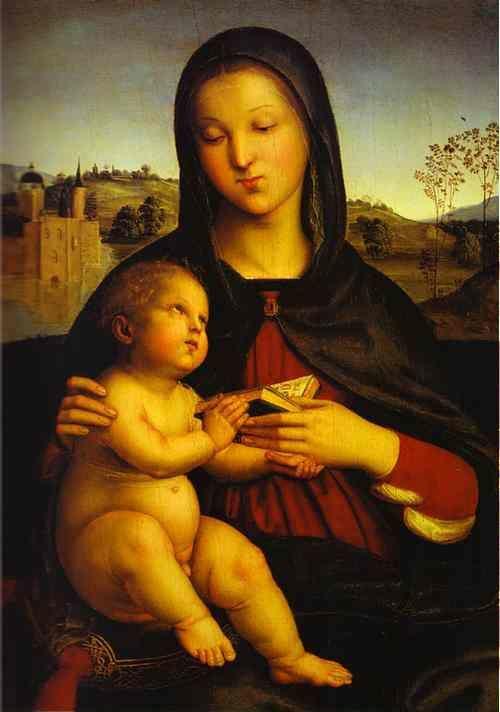
Usually, the best way to interpret a particular idol is to look to the intent of the maker. In the case of the more magnificent Renaissance-era idols, the artisan (whether painter or sculptor) left some clear indication of what was intended. Thus, in Raphael's "Madonna and Child" we are informed by the painter (at least, that's my recollection, I haven't documented this) that the subject of the painting is supposed to Mary and Jesus as a child (link - warning, child appears to be naked). In this particular instance, if it were not for Raphael's indication that this is supposed to be Mary and Jesus, we might think it could be any woman and her naked baby. The artist has informed us who he was painting and that helps us recognize his subject.
This is, by far, the most usual way to understand idols. But sometimes the one who fashioned the idols is unavailable. This is allegedly the case with respect to the "Our Lady of Guadalupe" idol, since the image is alleged to have miraculously appeared, much - one imagines - like the way that the golden calf came out of the fire - Exodus 32:24 And I said unto them, Whosoever hath any gold, let them break it off. So they gave it me: then I cast it into the fire, and there came out this calf.). How do we understand the image then?
b) Contextual
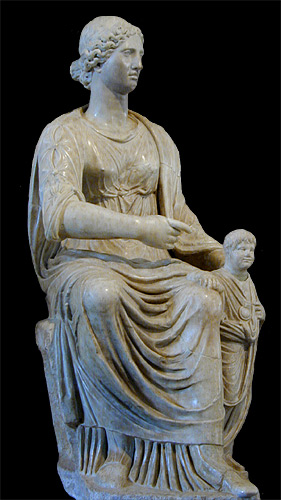
Sometimes the context can provide clues. For example, the following "woman and child" sculpture is of Roman origin (link to image). Could this be intended to be Mary and Jesus? That was probably not the sculptor's intent, and we would want to look to contextual clues to ensure us that this is the case. Of course, if we're very lucky, the sculptor places a legend on his work, or we find some other clues that lead us to his intent.
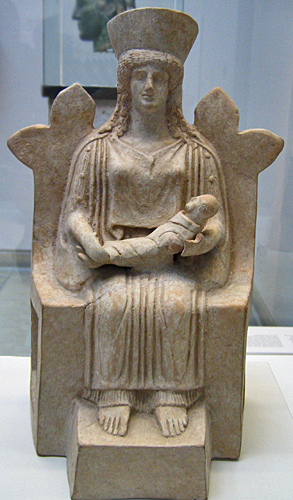
Here's a more interesting example (link). This looks rather a lot like this image (link). If we had found the former statue in an appropriate context (late medieval Spain, for example) we might have thought it was supposed to be a statue of "Mary, Queen of Heaven" but instead, since this statue is dated to about 450 B.C., the statue is more likely to be that of a pagan goddess or queen.
Likewise, this idol of Isis breast-feeding Horus (link - Raphael-esque infant and breastfeeding) is similar in many ways to the collection of Renaissance-era paintings here (link - same warnings). However, the former is plainly too old to be intended as a sort of Egyptianized Madonna with child, while the latter collection can be contextually identified as idols of Mary and Jesus - and if we saw any other Renaissance-era paintings of a woman breast-feeding her child, given the cultural context, our first thought would probably be that the painting is intended to depict Mary and Jesus.
2) Application to the Guadalupean Idol
This idol allegedly appeared miraculously. Thus, there is no artist who could have told people what the painting was supposed to represent. Personally, I don't believe this story, though. That doesn't actually directly impact things, because whoever the artist was, he's keeping silence about his work.
In theory, the woman in the picture could be any woman. But to view the woman as someone other than Mary requires us to ignore the context of to whom this idol allegedly came. It came to a Roman Catholic - someone in a religion filled with idols of Mary, including icons in which Mary looks something a bit like the woman in this idol.
If an idol of a woman were going to come to a Roman Catholic, it would almost certainly be an idol of Mary, not of some other woman. Additionally, this woman has a crown on (Thanks to Alex's attention it's worth pointing out that Mary's crown is in many reproductions of the idol, but is not clearly visible in the idol as it presently stands. In fact, it looks like if there ever was a crown, it has been painted over. This nuance subtracts from our associating this with Mary, but still it seems likely to be intended to be her.), which is something most usually found of Mary (as opposed to other women) in Roman Catholic idolatry. Additionally, having a woman standing on a crescent moon seems to be a popular way to depict Mary either as Queen of Heaven (link) or during her Assumption (link - link). In fact, the assumption images have a lot of similarities to the Guadalupean one (some of them, of course, were painted later and so could have been influenced by that of Guadalupe).
So, despite the absence of any authorial clues, we can be pretty sure about the main subject of the idol. The main subject is supposed to be Mary. Quite possibly, the image was intended to be an image of the assumption and the little fellow at the bottom of the image is supposed to be an angel that is carrying Mary up into heaven. That's sort of a best guess based on assuming (no pun intended) that the artist of the cloak modeled it after the European idolatry that is comparable.
When I first saw the Guadalupean image, I got the sense that the artist was trying to follow something along the lines of the following (link to image of Mary with crown and Jesus playing at her feet). If that were the case, the little fellow at Mary's feet would more likely be some sort of representation of Jesus. If, however, the image is intended to fall in the Assumption or Queen of Heaven genre, then it would seem more likely that the little fellow is supposed to be an angel.
Another indication that this is supposed to be an angel are the wings. Although winged images of Jesus are not unheard-of (link to example), they seem to be fairly rare.
Another reason to suppose an angel is the location of the little guy. The guy is at the bottom of the image, directly under Mary's feet. Although angels are in reality higher in dignity than any mere human (including Mary), in Roman Catholic idolatry they are very often depicted below her, both in several of the examples above as well as in this famous work (link). Here's another example of a little cherub holding up the hem of Mary's garment (link).
One of the facts that weigh against the person being an angel is that his back is towards Mary, whereas usually in Roman Catholic idolatry one expects to see angels looking adoringly at Mary. However, in some Roman Catholic idols, the representation of Jesus can back towards Mary (example of both aspects). Nevertheless, although angels tend to gaze adoringly at Mary, perhaps it would be an inappropriately-angled gaze from that particular position. Furthermore, such an illustration is not unprecedented (see this example of the "Mary Queen of All Saints" idol).
If this were an image of divine and not merely human origin, we would see no need to presume that the painter was building on pre-existing themes, and we would not assume that homologous design elements were intended to convey the same meanings or symbolism. Nevertheless, since this work is (fairly obviously, despite numerous pious papist protests to the contrary) a human composition and the composition of a Roman Catholic in particular (and not of a 5th century BC Egyptian or 2nd Century pagan Roman), we tend to use that context and presume that its visually similar themes are, in fact, derived from earlier European idols.
As such, my best guess at this point as to the derivation of the work is that it is a painting based on Albrecht Duhrer's "Madonna in Heaven" (link) together with one or more similar portrayals (for example, the angel could be related to this one). If the "angel" at the bottom is not Jesus, then Jesus has been removed from the image. So, while I'm not claiming to have the final word on this, my best guess is that the little winged guy at the bottom of the image is really supposed to be some variety of angel and not, as I had originally suggested, Jesus. Instead, he's entirely missing from the picture unless, of course, one sees Mary as pregnant in the picture, a hypothesis that seems popular on the Internet.
Conclusion
It would be handy to be more familiar with Rome's idolatry in order to avoid distracting folks like Mr. Bellisario from the rather clear problem that this is, in fact, idolatry through making mistakes over a rather minor graphical element of the idol. One would hope that Mr. Bellisario would then not miss the parallels between Diana of the Ephesians and the Virgin of the Mexicans. I need to try to be careful as well that this post avoid similar minor errors lest it distract Mr. Bellisario (or folks like him) from the parallel between Aaron's calf and this painting.
-TurretinFan
There were a few main points to my post, but Mr. Bellisario happened to notice an issue with respect to a minor parenthetical remark regarding the idol whose worship played a prominent role in the article. Now, I appreciate that Mr. Bellisario carefully reads the articles presented here, just as I'm glad he listens carefully to Dr. White's Sunday School lessons, but I'd like to encourage him to focus a little more on the main points. If, for example, Mr. Bellisario spent less time worrying about what images are supposed to represent (just as I should spend a bit more on that) and how many Roman Catholics served in the German army, and more time worrying about correctly interpreting Scripture and keeping himself from idols, he'd probably benefit spiritually.
This is not to take away from the importance of my getting the details and nuances correct too. Surely, it is wrong of me to distract attentive readers such as Mr. Bellisario from the main point by providing some minor, even trivial, error with respect to a very tangential point. I need to honor him by presenting him only with the most accurate information that I can.
Nevertheless, on this minor point, I'd like to encourage Mr. Bellisario to think a bit more deeply. I don't say this to suggest that he change his mind, but simply so that he can perhaps get more out of this than he has already. So, a few thoughts:
1) How Does One Correctly Interpret This Idol?
a) Idol-Fashioner's Intent
Usually, the best way to interpret a particular idol is to look to the intent of the maker. In the case of the more magnificent Renaissance-era idols, the artisan (whether painter or sculptor) left some clear indication of what was intended. Thus, in Raphael's "Madonna and Child" we are informed by the painter (at least, that's my recollection, I haven't documented this) that the subject of the painting is supposed to Mary and Jesus as a child (link - warning, child appears to be naked). In this particular instance, if it were not for Raphael's indication that this is supposed to be Mary and Jesus, we might think it could be any woman and her naked baby. The artist has informed us who he was painting and that helps us recognize his subject.
This is, by far, the most usual way to understand idols. But sometimes the one who fashioned the idols is unavailable. This is allegedly the case with respect to the "Our Lady of Guadalupe" idol, since the image is alleged to have miraculously appeared, much - one imagines - like the way that the golden calf came out of the fire - Exodus 32:24 And I said unto them, Whosoever hath any gold, let them break it off. So they gave it me: then I cast it into the fire, and there came out this calf.). How do we understand the image then?
b) Contextual
Sometimes the context can provide clues. For example, the following "woman and child" sculpture is of Roman origin (link to image). Could this be intended to be Mary and Jesus? That was probably not the sculptor's intent, and we would want to look to contextual clues to ensure us that this is the case. Of course, if we're very lucky, the sculptor places a legend on his work, or we find some other clues that lead us to his intent.
Here's a more interesting example (link). This looks rather a lot like this image (link). If we had found the former statue in an appropriate context (late medieval Spain, for example) we might have thought it was supposed to be a statue of "Mary, Queen of Heaven" but instead, since this statue is dated to about 450 B.C., the statue is more likely to be that of a pagan goddess or queen.
Likewise, this idol of Isis breast-feeding Horus (link - Raphael-esque infant and breastfeeding) is similar in many ways to the collection of Renaissance-era paintings here (link - same warnings). However, the former is plainly too old to be intended as a sort of Egyptianized Madonna with child, while the latter collection can be contextually identified as idols of Mary and Jesus - and if we saw any other Renaissance-era paintings of a woman breast-feeding her child, given the cultural context, our first thought would probably be that the painting is intended to depict Mary and Jesus.
2) Application to the Guadalupean Idol
This idol allegedly appeared miraculously. Thus, there is no artist who could have told people what the painting was supposed to represent. Personally, I don't believe this story, though. That doesn't actually directly impact things, because whoever the artist was, he's keeping silence about his work.
In theory, the woman in the picture could be any woman. But to view the woman as someone other than Mary requires us to ignore the context of to whom this idol allegedly came. It came to a Roman Catholic - someone in a religion filled with idols of Mary, including icons in which Mary looks something a bit like the woman in this idol.
If an idol of a woman were going to come to a Roman Catholic, it would almost certainly be an idol of Mary, not of some other woman. Additionally, this woman has a crown on (Thanks to Alex's attention it's worth pointing out that Mary's crown is in many reproductions of the idol, but is not clearly visible in the idol as it presently stands. In fact, it looks like if there ever was a crown, it has been painted over. This nuance subtracts from our associating this with Mary, but still it seems likely to be intended to be her.), which is something most usually found of Mary (as opposed to other women) in Roman Catholic idolatry. Additionally, having a woman standing on a crescent moon seems to be a popular way to depict Mary either as Queen of Heaven (link) or during her Assumption (link - link). In fact, the assumption images have a lot of similarities to the Guadalupean one (some of them, of course, were painted later and so could have been influenced by that of Guadalupe).
So, despite the absence of any authorial clues, we can be pretty sure about the main subject of the idol. The main subject is supposed to be Mary. Quite possibly, the image was intended to be an image of the assumption and the little fellow at the bottom of the image is supposed to be an angel that is carrying Mary up into heaven. That's sort of a best guess based on assuming (no pun intended) that the artist of the cloak modeled it after the European idolatry that is comparable.
When I first saw the Guadalupean image, I got the sense that the artist was trying to follow something along the lines of the following (link to image of Mary with crown and Jesus playing at her feet). If that were the case, the little fellow at Mary's feet would more likely be some sort of representation of Jesus. If, however, the image is intended to fall in the Assumption or Queen of Heaven genre, then it would seem more likely that the little fellow is supposed to be an angel.
Another indication that this is supposed to be an angel are the wings. Although winged images of Jesus are not unheard-of (link to example), they seem to be fairly rare.
Another reason to suppose an angel is the location of the little guy. The guy is at the bottom of the image, directly under Mary's feet. Although angels are in reality higher in dignity than any mere human (including Mary), in Roman Catholic idolatry they are very often depicted below her, both in several of the examples above as well as in this famous work (link). Here's another example of a little cherub holding up the hem of Mary's garment (link).
One of the facts that weigh against the person being an angel is that his back is towards Mary, whereas usually in Roman Catholic idolatry one expects to see angels looking adoringly at Mary. However, in some Roman Catholic idols, the representation of Jesus can back towards Mary (example of both aspects). Nevertheless, although angels tend to gaze adoringly at Mary, perhaps it would be an inappropriately-angled gaze from that particular position. Furthermore, such an illustration is not unprecedented (see this example of the "Mary Queen of All Saints" idol).
If this were an image of divine and not merely human origin, we would see no need to presume that the painter was building on pre-existing themes, and we would not assume that homologous design elements were intended to convey the same meanings or symbolism. Nevertheless, since this work is (fairly obviously, despite numerous pious papist protests to the contrary) a human composition and the composition of a Roman Catholic in particular (and not of a 5th century BC Egyptian or 2nd Century pagan Roman), we tend to use that context and presume that its visually similar themes are, in fact, derived from earlier European idols.
As such, my best guess at this point as to the derivation of the work is that it is a painting based on Albrecht Duhrer's "Madonna in Heaven" (link) together with one or more similar portrayals (for example, the angel could be related to this one). If the "angel" at the bottom is not Jesus, then Jesus has been removed from the image. So, while I'm not claiming to have the final word on this, my best guess is that the little winged guy at the bottom of the image is really supposed to be some variety of angel and not, as I had originally suggested, Jesus. Instead, he's entirely missing from the picture unless, of course, one sees Mary as pregnant in the picture, a hypothesis that seems popular on the Internet.
Conclusion
It would be handy to be more familiar with Rome's idolatry in order to avoid distracting folks like Mr. Bellisario from the rather clear problem that this is, in fact, idolatry through making mistakes over a rather minor graphical element of the idol. One would hope that Mr. Bellisario would then not miss the parallels between Diana of the Ephesians and the Virgin of the Mexicans. I need to try to be careful as well that this post avoid similar minor errors lest it distract Mr. Bellisario (or folks like him) from the parallel between Aaron's calf and this painting.
-TurretinFan
Tuesday, June 30, 2009
June - Sexual Depravity "Pride Month" - Part 26
Isaiah 5:20 Woe unto them that call evil good, and good evil; that put darkness for light, and light for darkness; that put bitter for sweet, and sweet for bitter!
James 2:11 For he that said, Do not commit adultery, said also, Do not kill. Now if thou commit no adultery, yet if thou kill, thou art become a transgressor of the law.
1 John 3:15 Whosoever hateth his brother is a murderer: and ye know that no murderer hath eternal life abiding in him.
Luke 13:3 (and 5) I tell you, Nay: but, except ye repent, ye shall all likewise perish.
2 Peter 3:9 The Lord is not slack concerning his promise, as some men count slackness; but is longsuffering to us-ward, not willing that any should perish, but that all should come to repentance.
Matthew 21:32 For John came unto you in the way of righteousness, and ye believed him not: but the publicans and the harlots believed him: and ye, when ye had seen it, repented not afterward, that ye might believe him.
Acts 19:4 Then said Paul, John verily baptized with the baptism of repentance, saying unto the people, that they should believe on him which should come after him, that is, on Christ Jesus.
Mark 1:15 And saying, The time is fulfilled, and the kingdom of God is at hand: repent ye, and believe the gospel.
James 2:11 For he that said, Do not commit adultery, said also, Do not kill. Now if thou commit no adultery, yet if thou kill, thou art become a transgressor of the law.
1 John 3:15 Whosoever hateth his brother is a murderer: and ye know that no murderer hath eternal life abiding in him.
Luke 13:3 (and 5) I tell you, Nay: but, except ye repent, ye shall all likewise perish.
2 Peter 3:9 The Lord is not slack concerning his promise, as some men count slackness; but is longsuffering to us-ward, not willing that any should perish, but that all should come to repentance.
Matthew 21:32 For John came unto you in the way of righteousness, and ye believed him not: but the publicans and the harlots believed him: and ye, when ye had seen it, repented not afterward, that ye might believe him.
Acts 19:4 Then said Paul, John verily baptized with the baptism of repentance, saying unto the people, that they should believe on him which should come after him, that is, on Christ Jesus.
Mark 1:15 And saying, The time is fulfilled, and the kingdom of God is at hand: repent ye, and believe the gospel.
Monday, June 29, 2009
Important Clarification
No: I am not Frank Turk. This is Frank Turk.
He's a famous blogger. I'm just a blogger.
No: I am not Frank Turek. This is Frank Turek.
He's a reputable person; published author. I'm just a blogger.
No: I am not Francis Turretin (read about his life here).
He's a famous theologian. I'm just a blogger and a fan of his.
-TurretinFan
He's a famous blogger. I'm just a blogger.
No: I am not Frank Turek. This is Frank Turek.
He's a reputable person; published author. I'm just a blogger.
No: I am not Francis Turretin (read about his life here).
He's a famous theologian. I'm just a blogger and a fan of his.
-TurretinFan
June - Sexual Depravity "Pride Month" - Part 25
Isaiah 5:20 Woe unto them that call evil good, and good evil; that put darkness for light, and light for darkness; that put bitter for sweet, and sweet for bitter!
Proverbs 29:3 Whoso loveth wisdom rejoiceth his father: but he that keepeth company with harlots spendeth his substance.
Proverbs 6:26 For by means of a whorish woman a man is brought to a piece of bread: and the adulteress will hunt for the precious life.
Proverbs 23:27 For a whore is a deep ditch; and a strange woman is a narrow pit.
Proverbs 29:3 Whoso loveth wisdom rejoiceth his father: but he that keepeth company with harlots spendeth his substance.
Proverbs 6:26 For by means of a whorish woman a man is brought to a piece of bread: and the adulteress will hunt for the precious life.
Proverbs 23:27 For a whore is a deep ditch; and a strange woman is a narrow pit.
Sunday, June 28, 2009
Catholicism in Mexico Survives Only as a Cult?
I should point out a caveat about articles on religion in the popular media. I've noticed, from time to time, that not every article on religion is highly accurate. The following article, to which I was somewhat recently directed, provides an example with the headline: "Catholicism in Mexico Survives Only as a Cult, Priest Claims." This headline was, as far as I can tell, due to the failure of the editor to understand that the "cult of Mary" is the worship of Mary (hyper-dulia, to be specific in Roman Catholic terms) and not "a cult" in the sense that we use that term in English.
I understand how the editor might be confused. The worship of Mary in Catholicism in most English-speaking countries is downplayed significantly - seemingly to lure Protestants. The result is that some lay apologists seem unaware of the difference between worship (cultus or as we would tend to describe it, "religious veneration") and the sort of everyday respect we have for one another ("secular veneration" might be a way to distinguish it from the religious veneration discussed above).
And I know - I know - Roman Catholics in English-speaking countries are quick to say, "We don't worship Mary," by which they mean that they don't worship Mary as God. That's all very nice, but check out the photo of the church that accompanied this horribly badly headlined article (link to article - direct link to photo - another view of idol - a third view - a fourth view).
The choice of idols for this particular church shows a distinct emphasis - and that emphasis is on Mary. Of course, one's idols may be an inaccurate guide as to one's interest, but the idols in this particular church suggest that the reverence for Mary is primary, despite her never being called "God." One also sees the same thing in the shocked looks that were given when the American Secretary of State asked the absurd question, "Who painted this?" (link to photo of event)
Of course, this just showed Mrs. Clinton's ignorance of the local superstitions:
If this reminds you of Scripture - it should:
Acts 19:23-41
So, yes - Catholicism survives in Mexico as (to a large extent) the cult of Mary - as the veneration of an image that (like the image of Diana) is alleged to be of miraculous origin. It would be unfair to suggest that there is nothing more to it than that, but it is a significant aspect - despite the journalistic confusion such comments can create.
-TurretinFan
FURTHER UPDATE: Mr. Bellisario, seemingly unaware of the first update above (or perhaps he posted it before the update? Who knows!) has also complained that according to the divinely inspired legend that he obtained (from a Geocities web page that was so scholarly that it wasn't sure of the correct spelling of Mayan) the dude at the bottom of the idols is an angel (though no mention is made that this is supposed to be an angelic representation Juan Diego).
I understand how the editor might be confused. The worship of Mary in Catholicism in most English-speaking countries is downplayed significantly - seemingly to lure Protestants. The result is that some lay apologists seem unaware of the difference between worship (cultus or as we would tend to describe it, "religious veneration") and the sort of everyday respect we have for one another ("secular veneration" might be a way to distinguish it from the religious veneration discussed above).
And I know - I know - Roman Catholics in English-speaking countries are quick to say, "We don't worship Mary," by which they mean that they don't worship Mary as God. That's all very nice, but check out the photo of the church that accompanied this horribly badly headlined article (link to article - direct link to photo - another view of idol - a third view - a fourth view).
The choice of idols for this particular church shows a distinct emphasis - and that emphasis is on Mary. Of course, one's idols may be an inaccurate guide as to one's interest, but the idols in this particular church suggest that the reverence for Mary is primary, despite her never being called "God." One also sees the same thing in the shocked looks that were given when the American Secretary of State asked the absurd question, "Who painted this?" (link to photo of event)
Of course, this just showed Mrs. Clinton's ignorance of the local superstitions:
In 1531 a "Lady from Heaven" appeared to a humble Native American at Tepeyac, a hill northwest of what is now Mexico City.(source - as you'll see in the clearer image there, Jesus isn't completely missing, he's just hiding down at the bottom of the picture - direct link to picture - UPDATE: Someone complained to me that the guy at the bottom of the picture is not supposed to be Jesus but Juan Diego (technically he just complained that it wasn't supposed to be Jesus). Although there is no heaven-fallen-down guidebook for the idol, that seems to be reasonable - and my comment was in error - Jesus is entirely left out of the picture - although some have argued that Mary is supposed to be pregnant in the picture, in which case Jesus is sort of present as a baby bulge. FURTHER UPDATE - see below)
She identified herself as the ever virgin Holy Mary, Mother of the True God for whom we live, of the Creator of all things, Lord of heaven and the earth.
She made a request for a church to be built on the site, and submitted her wish to the local Bishop. When the Bishop hesitated, and requested her for a sign, the Mother of God obeyed without delay or question to the Church's local Bishop, and sent her native messenger to the top of the hill in mid-December to gather an assorment [sic - assortment, I think, is meant] of roses for the Bishop.
After complying to the Bishop's request for a sign, She also left for us an image of herself imprinted miraculously on the native's tilma, a poor quality cactus-cloth, which should have deteriorated in 20 years but shows no sign of decay 477 years later and still defies all scientific explanations of its origin.
If this reminds you of Scripture - it should:
Acts 19:23-41
And the same time there arose no small stir about that way. For a certain man named Demetrius, a silversmith, which made silver shrines for Diana, brought no small gain unto the craftsmen; whom he called together with the workmen of like occupation, and said, Sirs, ye know that by this craft we have our wealth. Moreover ye see and hear, that not alone at Ephesus, but almost throughout all Asia, this Paul hath persuaded and turned away much people, saying that they be no gods, which are made with hands: so that not only this our craft is in danger to be set at nought; but also that the temple of the great goddess Diana should be despised, and her magnificence should be destroyed, whom all Asia and the world worshippeth. [Note that Paul was not preaching that instead of Diana, statues of Mary should be made - a natural response if the Apostolic church were idolatrous.]
And when they heard these sayings, they were full of wrath, and cried out, saying, Great is Diana of the Ephesians. And the whole city was filled with confusion: and having caught Gaius and Aristarchus, men of Macedonia, Paul's companions in travel, they rushed with one accord into the theatre.
And when Paul would have entered in unto the people, the disciples suffered him not. And certain of the chief of Asia, which were his friends, sent unto him, desiring him that he would not adventure himself into the theatre.
Some therefore cried one thing, and some another: for the assembly was confused; and the more part knew not wherefore they were come together. And they drew Alexander out of the multitude, the Jews putting him forward. And Alexander beckoned with the hand, and would have made his defence unto the people.
But when they knew that he was a Jew [this was significant, because people knew that Jews did not have idols], all with one voice about the space of two hours cried out, Great is Diana of the Ephesians.
And when the townclerk had appeased the people, he said, Ye men of Ephesus, what man is there that knoweth not how that the city of the Ephesians is a worshipper of the great goddess Diana, and of the image which fell down from Jupiter? [Note that the Ephesians distinguished between Diana and Jupiter.] Seeing then that these things cannot be spoken against, ye ought to be quiet, and to do nothing rashly. For ye have brought hither these men, which are neither robbers of churches, nor yet blasphemers of your goddess. Wherefore if Demetrius, and the craftsmen which are with him, have a matter against any man, the law is open, and there are deputies: let them implead one another. But if ye enquire any thing concerning other matters, it shall be determined in a lawful assembly. For we are in danger to be called in question for this day's uproar, there being no cause whereby we may give an account of this concourse. And when he had thus spoken, he dismissed the assembly.
So, yes - Catholicism survives in Mexico as (to a large extent) the cult of Mary - as the veneration of an image that (like the image of Diana) is alleged to be of miraculous origin. It would be unfair to suggest that there is nothing more to it than that, but it is a significant aspect - despite the journalistic confusion such comments can create.
-TurretinFan
FURTHER UPDATE: Mr. Bellisario, seemingly unaware of the first update above (or perhaps he posted it before the update? Who knows!) has also complained that according to the divinely inspired legend that he obtained (from a Geocities web page that was so scholarly that it wasn't sure of the correct spelling of Mayan) the dude at the bottom of the idols is an angel (though no mention is made that this is supposed to be an angelic representation Juan Diego).
Messiah's Name is Jesus
I recently read an interesting article in which a leading kabbalist took the position that the name of the Messiah is Yehoshua (Jesus). Apparently this old rabbi, who died at 108 had left behind a note to be revealed one year after his death. The note provide an acrostic sentence with the name of the Messiah, and the initial letters of the sentence spell out a form of the Jewish name for Jesus.
Some folks have denounced the note as a forgery. However, no reason for the forgery has been adduced. None of the associates of this rabbi are Christians, and there does not appear to be any way for Christians somehow to infiltrate the group of "ultra-Orthodox" (per the article) Jews and plant this note. I suppose an enemy of his could by trying to suggest that he had secretly converted to or compromised with Christianity, but there would seem to be much easier ways of trying do this.
What does this confirm? Not that much. One is tempted to conclude that even an unbeliever like this rabbi can come to see much truth about the Messiah from careful study of the Old Testament, and the article highlights a number of points where we would say that this rabbi got it right (as well as a few where he was way off the mark). One may even say that this name of the Messiah is found in the Old Testament forshadowed in at least two ways. Justin Martyr explains one way:
And he also explains another way:
Now, don't get me wrong - Justin's arguments (especially the first one) are not very compelling without the further revelation provided by Jesus himself. Nevertheless, these and other passages may make clear to even an unbelieving rabbi who studies enough, that the name of the Messiah was to be Jesus. Furthermore, one might also observe that names are picked for their significance, not simply for their ephony. Thus, the name "Jesus" which means "Savior" is not a surprising name for the Messiah, given the Messiah's salvific role.
In fact, we are told that this is the reason for the name:
Matthew 1:21 And she shall bring forth a son, and thou shalt call his name JESUS: for he shall save his people from their sins.
Which is indirectly a proof of the divinity of Jesus:
Zechariah 9:16 And the LORD their God shall save them in that day as the flock of his people: for they shall be as the stones of a crown, lifted up as an ensign upon his land.
Jesus is the Saviour because Jesus is God. We are His people and the sheep of his pasture:
Psalm 79:13 So we thy people and sheep of thy pasture will give thee thanks for ever: we will shew forth thy praise to all generations.
Psalm 95:7 For he is our God; and we are the people of his pasture, and the sheep of his hand. To day if ye will hear his voice,
Psalm 100:3 Know ye that the LORD he is God: it is he that hath made us, and not we ourselves; we are his people, and the sheep of his pasture.
For this shepherd is Jesus, who was prophesied by the prophets:
Zechariah 13:7 Awake, O sword, against my shepherd, and against the man that is my fellow, saith the LORD of hosts: smite the shepherd, and the sheep shall be scattered: and I will turn mine hand upon the little ones.
The shepherd will be smitten and the sheep will be scattered, but there will also be a salvation and ingathering of the sheep:
Ezekiel 34:12 As a shepherd seeketh out his flock in the day that he is among his sheep that are scattered; so will I seek out my sheep, and will deliver them out of all places where they have been scattered in the cloudy and dark day.
We know that Jesus fulfilled these prophecies:
Matthew 26:31 Then saith Jesus unto them, All ye shall be offended because of me this night: for it is written, I will smite the shepherd, and the sheep of the flock shall be scattered abroad.
Mark 14:27 And Jesus saith unto them, All ye shall be offended because of me this night: for it is written, I will smite the shepherd, and the sheep shall be scattered.
John 10:11 I am the good shepherd: the good shepherd giveth his life for the sheep.
And while there are others who can be viewed as "shepherds" in a lesser sense, Jesus is the one unique Great Shepherd:
Hebrew 13:20 Now the God of peace, that brought again from the dead our Lord Jesus, that great shepherd of the sheep, through the blood of the everlasting covenant,
1 Peter 2:25 For ye were as sheep going astray; but are now returned unto the Shepherd and Bishop of your souls.
And do not forget - our Shepherd is Jehovah, the LORD:
Psalm 23:1 (A Psalm of David.) The LORD is my shepherd; I shall not want.
Jeremiah 31:10 Hear the word of the LORD, O ye nations, and declare it in the isles afar off, and say, He that scattered Israel will gather him, and keep him, as a shepherd doth his flock.
There are so many such proofs that I will not now burden you with all of them. Suffice that those who truly follow the Old Testament will follow Jesus:
John 5:46 For had ye believed Moses, ye would have believed me: for he wrote of me.
And those who study them are studying Christ:
Luke 24:44 And he said unto them, These are the words which I spake unto you, while I was yet with you, that all things must be fulfilled, which were written in the law of Moses, and in the prophets, and in the psalms, concerning me.
And consequently, we (and especially Jews) are exhorted to search the Scriptures and to find Jesus there:
John 5:39 Search the scriptures; for in them ye think ye have eternal life: and they are they which testify of me.
We have no strong evidence that this particular rabbi trusted in the already-come Messiah Jesus, but may God give others who read his works grace to see that Jesus is the Messiah, the very Son of God who is the Shepherd of Israel and the Judge of All the Earth, who also will come again to judge the Earth on the last day. (link to article - but see this previous article about the dangers of religious journal)
-TurretinFan
Some folks have denounced the note as a forgery. However, no reason for the forgery has been adduced. None of the associates of this rabbi are Christians, and there does not appear to be any way for Christians somehow to infiltrate the group of "ultra-Orthodox" (per the article) Jews and plant this note. I suppose an enemy of his could by trying to suggest that he had secretly converted to or compromised with Christianity, but there would seem to be much easier ways of trying do this.
What does this confirm? Not that much. One is tempted to conclude that even an unbeliever like this rabbi can come to see much truth about the Messiah from careful study of the Old Testament, and the article highlights a number of points where we would say that this rabbi got it right (as well as a few where he was way off the mark). One may even say that this name of the Messiah is found in the Old Testament forshadowed in at least two ways. Justin Martyr explains one way:
Justin: Moreover, in the book of Exodus we have also perceived that the name of God Himself which, He says, was not revealed to Abraham or to Jacob, was Jesus, and was declared mysteriously through Moses. Thus it is written: 'And the Lord spoke to Moses, Say to this people, Behold, I send My angel before your face, to keep you in the way, to bring you into the land which I have prepared for you. Give heed to Him, and obey Him; do not disobey Him. For He will not draw back from you; for My name is in Him.' [Exodus 23:20-21] Now understand that He who led your fathers into the land is called by this name Jesus, and first called Auses [Numbers 13:16]. (Oshea). For if you shall understand this, you shall likewise perceive that the name of Him who said to Moses, 'for My name is in Him,' was Jesus. For, indeed, He was also called Israel, and Jacob's name was changed to this also. Now Isaiah shows that those prophets who are sent to publish tidings from God are called His angels and apostles. For Isaiah says in a certain place, 'Send me.' Isaiah 6:8 And that the prophet whose name was changed, Jesus [Joshua], was strong and great, is manifest to all. If, then, we know that God revealed Himself in so many forms to Abraham, and to Jacob, and to Moses, how are we at a loss, and do not believe that, according to the will of the Father of all things, it was possible for Him to be born man of the Virgin, especially after we have such Scriptures, from which it can be plainly perceived that He became so according to the will of the Father?- Justin Martyr, Dialog with Trypho, Chapter 75 (source)
And he also explains another way:
Justin: But you ought to believe Zechariah when he shows in parable the mystery of Christ, and announces it obscurely. The following are his words: 'Rejoice, and be glad, O daughter of Zion: for, lo, I come, and I shall dwell in the midst of you, says the Lord. And many nations shall be added to the Lord in that day. And they shall be my people, and I will dwell in the midst of you; and they shall know that the Lord of hosts has sent me unto you. And the Lord shall inherit Judah his portion in the holy land, and He shall choose Jerusalem again. Let all flesh fear before the Lord, for He is raised up out of His holy clouds. And He showed me Jesus (Joshua) the high priest standing before the angel [of the Lord ]; and the devil stood at his right hand to resist him. And the Lord said to the devil, The Lord who has chosen Jerusalem rebuke you. Behold, is not this a brand plucked out of the fire?' [Zechariah 2:10-13, Zechariah 3:1-2]- Justin Martyr, Dialog with Trypho, Chapter 115 (source)
As Trypho was about to reply and contradict me, I said:
Wait and hear what I say first: for I am not to give the explanation which you suppose, as if there had been no priest of the name of Joshua (Jesus) in the land of Babylon, where your nation were prisoners. But even if I did, I have shown that if there was a priest named Joshua (Jesus) in your nation, yet the prophet had not seen him in his revelation, just as he had not seen either the devil or the angel of the Lord by eyesight, and in his waking condition, but in a trance, at the time when the revelation was made to him. But I now say, that as [Scripture] said that the Son of Nave (Nun) by the name Jesus (Joshua) wrought powerful works and exploits which proclaimed beforehand what would be performed by our Lord; so I proceed now to show that the revelation made among your people in Babylon in the days of Jesus (Joshua) the priest, was an announcement of the things to be accomplished by our Priest, who is God, and Christ the Son of God the Father of all.
Now, don't get me wrong - Justin's arguments (especially the first one) are not very compelling without the further revelation provided by Jesus himself. Nevertheless, these and other passages may make clear to even an unbelieving rabbi who studies enough, that the name of the Messiah was to be Jesus. Furthermore, one might also observe that names are picked for their significance, not simply for their ephony. Thus, the name "Jesus" which means "Savior" is not a surprising name for the Messiah, given the Messiah's salvific role.
In fact, we are told that this is the reason for the name:
Matthew 1:21 And she shall bring forth a son, and thou shalt call his name JESUS: for he shall save his people from their sins.
Which is indirectly a proof of the divinity of Jesus:
Zechariah 9:16 And the LORD their God shall save them in that day as the flock of his people: for they shall be as the stones of a crown, lifted up as an ensign upon his land.
Jesus is the Saviour because Jesus is God. We are His people and the sheep of his pasture:
Psalm 79:13 So we thy people and sheep of thy pasture will give thee thanks for ever: we will shew forth thy praise to all generations.
Psalm 95:7 For he is our God; and we are the people of his pasture, and the sheep of his hand. To day if ye will hear his voice,
Psalm 100:3 Know ye that the LORD he is God: it is he that hath made us, and not we ourselves; we are his people, and the sheep of his pasture.
For this shepherd is Jesus, who was prophesied by the prophets:
Zechariah 13:7 Awake, O sword, against my shepherd, and against the man that is my fellow, saith the LORD of hosts: smite the shepherd, and the sheep shall be scattered: and I will turn mine hand upon the little ones.
The shepherd will be smitten and the sheep will be scattered, but there will also be a salvation and ingathering of the sheep:
Ezekiel 34:12 As a shepherd seeketh out his flock in the day that he is among his sheep that are scattered; so will I seek out my sheep, and will deliver them out of all places where they have been scattered in the cloudy and dark day.
We know that Jesus fulfilled these prophecies:
Matthew 26:31 Then saith Jesus unto them, All ye shall be offended because of me this night: for it is written, I will smite the shepherd, and the sheep of the flock shall be scattered abroad.
Mark 14:27 And Jesus saith unto them, All ye shall be offended because of me this night: for it is written, I will smite the shepherd, and the sheep shall be scattered.
John 10:11 I am the good shepherd: the good shepherd giveth his life for the sheep.
And while there are others who can be viewed as "shepherds" in a lesser sense, Jesus is the one unique Great Shepherd:
Hebrew 13:20 Now the God of peace, that brought again from the dead our Lord Jesus, that great shepherd of the sheep, through the blood of the everlasting covenant,
1 Peter 2:25 For ye were as sheep going astray; but are now returned unto the Shepherd and Bishop of your souls.
And do not forget - our Shepherd is Jehovah, the LORD:
Psalm 23:1 (A Psalm of David.) The LORD is my shepherd; I shall not want.
Jeremiah 31:10 Hear the word of the LORD, O ye nations, and declare it in the isles afar off, and say, He that scattered Israel will gather him, and keep him, as a shepherd doth his flock.
There are so many such proofs that I will not now burden you with all of them. Suffice that those who truly follow the Old Testament will follow Jesus:
John 5:46 For had ye believed Moses, ye would have believed me: for he wrote of me.
And those who study them are studying Christ:
Luke 24:44 And he said unto them, These are the words which I spake unto you, while I was yet with you, that all things must be fulfilled, which were written in the law of Moses, and in the prophets, and in the psalms, concerning me.
And consequently, we (and especially Jews) are exhorted to search the Scriptures and to find Jesus there:
John 5:39 Search the scriptures; for in them ye think ye have eternal life: and they are they which testify of me.
We have no strong evidence that this particular rabbi trusted in the already-come Messiah Jesus, but may God give others who read his works grace to see that Jesus is the Messiah, the very Son of God who is the Shepherd of Israel and the Judge of All the Earth, who also will come again to judge the Earth on the last day. (link to article - but see this previous article about the dangers of religious journal)
-TurretinFan
June - Sexual Depravity "Pride Month" - Part 24
Isaiah 5:20 Woe unto them that call evil good, and good evil; that put darkness for light, and light for darkness; that put bitter for sweet, and sweet for bitter!
Deuteronomy 23:17 There shall be no whore of the daughters of Israel, nor a sodomite of the sons of Israel.
Deuteronomy 23:18 Thou shalt not bring the hire of a whore, or the price of a dog, into the house of the LORD thy God for any vow: for even both these are abomination unto the LORD thy God.
Deuteronomy 23:17 There shall be no whore of the daughters of Israel, nor a sodomite of the sons of Israel.
Deuteronomy 23:18 Thou shalt not bring the hire of a whore, or the price of a dog, into the house of the LORD thy God for any vow: for even both these are abomination unto the LORD thy God.
Saturday, June 27, 2009
Transubstantiation, Metaphor, and Common Sense
Over at Beggars All Reformation, one of the commenters had provided a quotation derived from the Westminster Confession of Faith, as follow:
Even leaving aside the bizarre statistical claim, there are numerous problems with this kind of argument from Bellisario.
(1) Jesus never used the word "metaphor" in the pages of Holy Scripture - not just about this metaphor, but about any of them. (2) Normally what distinguishes metaphor from simile is the absence of a signal - if it said "this represents my body" we would have simile, not metaphor. (3) Jesus didn't say that the cup was a figure of speech for the contents of the cup, but folks use their common sense to recognize this. (4) Finally, some of the early church fathers confirm that Jesus used metaphors, including the metaphor identification of his body with bread and of wine with his blood.
"What mean, then, the words, "I am the true vine"? Was it to the literal vine, from which that metaphor was drawn, that He intended to point them by the addition of "true"? For it is by similitude, and not by any personal propriety, that He is thus called a vine; just as He is also termed a sheep, a lamb, a lion, a rock, a corner-stone, and other names of a like kind, which are themselves rather the true ones, from which these are drawn as similitudes, not as realities."
- Augustine, Tractate 80 on John's Gospel, Section 1
Maybe Bellisario would claim that Augustine was deceived because he made these claims without Jesus ever saying that "I am the true vine" is a metaphor (nor the other examples that Augustine listed).
"And when He says, "The Lord looked down from Heaven:" [Psalm 14:2] it describes His perfect knowledge by a metaphor taken from men. So also here He says, "Now I know," to declare this to be greater than all which had preceded it."
- Chrysostom, Homily 3 on Second Corinthians, Section 6
Again, the text does not explicitly say that this is a metaphor. Did someone trick Chrysostom into thinking it was a metaphor?
But let's hit a little closer to home. We are frequently told by those who use Rome as the substitute for reason, that John 6 employs the same transubstantial language as in the words of institution. But Augustine says:
"Now the rule in regard to this variation has two forms. For things that signify now one thing and now another, signify either things that are contrary, or things that are only different. They signify contraries, for example, when they are used metaphorically at one time in a good sense, at another in a bad, as in the case of the leaven mentioned above. Another example of the same is that a lion stands for Christ in the place where it is said, "The lion of the tribe of Judah has prevailed;" (Revelation 5:5) and again, stands for the devil where it is written, "Your adversary the devil, as a roaring lion, walks about seeking whom he may devour." (1 Peter 5:8) In the same way the serpent is used in a good sense, "Be wise as serpents;" (Matthew 10:16) and again, in a bad sense, "The serpent beguiled Eve through his subtlety." (2 Corinthians 11:3) Bread is used in a good sense, "I am the living bread which came down from heaven;" (John 6:51) in a bad, "Bread eaten in secret is pleasant." (Proverbs 9:17) And so in a great many other cases. The examples I have adduced are indeed by no means doubtful in their signification, because only plain instances ought to be used as examples."
- Augustine, On Christian Doctrine, Book III, Chapter 25, Section 36
Augustine didn't just think that "I am the living bread which came down from heaven;" was a metaphor - he thought it was an obvious metaphor. But our Lord never said it was a metaphor.
And Augustine was not alone:
"And entertaining this view, we may regard the proclamation of the Gospel, which is universally diffused, as milk; and as meat, faith, which from instruction is compacted into a foundation, which, being more substantial than hearing, is likened to meat, and assimilates to the soul itself nourishment of this kind. Elsewhere the Lord, in the Gospel according to John, brought this out by symbols, when He said: "Eat my flesh, and drink my blood;" [John 6:34] describing distinctly by metaphor the drinkable properties of faith and the promise, by means of which the Church, like a human being consisting of many members, is refreshed and grows, is welded together and compacted of both—of faith, which is the body, and of hope, which is the soul; as also the Lord of flesh and blood."
- Clement of Alexandria, The Paedogogus, Chapter 6
"The Scripture, accordingly, has named wine the symbol of the sacred blood; but reproving the base tippling with the dregs of wine, it says: "Intemperate is wine, and insolent is drunkenness." [Proverbs 20:1] It is agreeable, therefore, to right reason, to drink on account of the cold of winter, till the numbness is dispelled from those who are subject to feel it; and on other occasions as a medicine for the intestines."
- Clement of Alexandria, The Paedogogus, Chapter 2
And of course, it's not just those two guys, but Theodoret declares:
"Moreover the Lord Himself promised to give on behalf of the life of the world, not His invisible nature, but His body. "For," He says, "the bread that I will give is my flesh which I will give for the life of the world," and when He took the symbol of divine mysteries, He said, "This is my body which is given for you.""
- Theodoret, Letter 130
And again Chrysostom:
"And He Himself drank of it. For lest on hearing this, they should say, What then? Do we drink blood, and eat flesh? And then be perplexed (for when He began to discourse concerning these things, even at the very sayings many were offended),therefore lest they should be troubled then likewise, He first did this Himself, leading them to the calm participation of the mysteries. Therefore He Himself drank His own blood. What then must we observe that other ancient rite also? Some one may say. By no means. For on this account He said, "Do this," that He might withdraw them from the other. For if this works remission of sins, as it surely does work it, the other is now superfluous.
As then in the case of the Jews, so here also He has bound up the memorial of the benefit with the mystery, by this again stopping the mouths of heretics. For when they say, Whence is it manifest that Christ was sacrificed? Together with the other arguments we stop their mouths from the mysteries also. For if Jesus did not die, of what are the rites the symbols?"
- Chrysostom, Homily 82 on Matthew, Section 1
"Those who have become acquainted with the secondary (i.e., under Christ) constitutions of the apostles, are aware that the Lord instituted a new oblation in the new covenant, according to [the declaration of] Malachi the prophet. For, "from the rising of the sun even to the setting my name has been glorified among the Gentiles, and in every place incense is offered to my name, and a pure sacrifice;" [Malachi 1:11] as John also declares in the Apocalypse: "The incense is the prayers of the saints." Then again, Paul exhorts us "to present our bodies a living sacrifice, holy, acceptable unto God, which is your reasonable service." [Romans 12:1] And again, "Let us offer the sacrifice of praise, that is, the fruit of the lips." [Hebrews 13:15] Now those oblations are not according to the law, the handwriting of which the Lord took away from the midst by cancelling it; [Colossians 2:14] but they are according to the Spirit, for we must worship God "in spirit and in truth." [John 4:24] And therefore the oblation of the Eucharist is not a carnal one, but a spiritual; and in this respect it is pure. For we make an oblation to God of the bread and the cup of blessing, giving Him thanks in that He has commanded the earth to bring forth these fruits for our nourishment. And then, when we have perfected theoblation, we invoke the Holy Spirit, that He may exhibit this sacrifice, both the bread the body of Christ, and the cup the blood of Christ, in order that the receivers of these antitypes may obtain remission of sins and life eternal. Those persons, then, who perform these oblations in remembrance of the Lord, do not fall in with Jewish views, but, performing the service after a spiritual manner, they shall be called sons of wisdom."
- Fragments from the Lost Writings of Irenæus, Section 37 (I should point out that I'm not sure about the legitimacy of the authorship of this quotation.)
So, in conclusion, yes - the Westminster Confession of Faith is right in saying that the error of transubstantiation is repugnant to common sense and reason. The reasons for folks to accept it have to do not with respecting the word of God, but in following the traditions of men - traditions which (in this case) were not followed by the early churches.
-TurretinFan
The doctrine which maintains the change...transubstantiation.. is repugnant, not to Scripture alone, but even to common sense and reason...overthroweth..cause manifold superstitions..gross idolatries.Mr. Bellisario responded (in two separate comments that I have joined:
What is repugnant is that you reject Our Lord's words which tell us otherwise. Not you or your false confession will ever change His words. Common sense does not give us the Gospel. Our lord did. You and your "confession" reject Our lord and His words. Common sense tells me to listen to his words.I answered Bellisario:
Our Lord isn't the one who invented this concept of transubstantiation. He used a metaphor, but that's too common sense for some folks.Bellisario responded (again, in two comments that I have joined):
Prove He used a metaphor. That is a lie from the devil. Our Lord never said it was a metaphor. I find it funny that there is only 1 interpretation of this passage of Scripture in the Catholic Church, while the great Saint Robert Bellarmine, writing in the sixteen hundreds, counted over two hundred interpretations of our Lord’s words at the Last Supper, “This is my Body…this is my Blood.” This is the result of everyone trying to interpret Our Lord's words for themselves outside the Church. Who says your interpretation is right?I now answer, at greater length:
Even leaving aside the bizarre statistical claim, there are numerous problems with this kind of argument from Bellisario.
(1) Jesus never used the word "metaphor" in the pages of Holy Scripture - not just about this metaphor, but about any of them. (2) Normally what distinguishes metaphor from simile is the absence of a signal - if it said "this represents my body" we would have simile, not metaphor. (3) Jesus didn't say that the cup was a figure of speech for the contents of the cup, but folks use their common sense to recognize this. (4) Finally, some of the early church fathers confirm that Jesus used metaphors, including the metaphor identification of his body with bread and of wine with his blood.
"What mean, then, the words, "I am the true vine"? Was it to the literal vine, from which that metaphor was drawn, that He intended to point them by the addition of "true"? For it is by similitude, and not by any personal propriety, that He is thus called a vine; just as He is also termed a sheep, a lamb, a lion, a rock, a corner-stone, and other names of a like kind, which are themselves rather the true ones, from which these are drawn as similitudes, not as realities."
- Augustine, Tractate 80 on John's Gospel, Section 1
Maybe Bellisario would claim that Augustine was deceived because he made these claims without Jesus ever saying that "I am the true vine" is a metaphor (nor the other examples that Augustine listed).
"And when He says, "The Lord looked down from Heaven:" [Psalm 14:2] it describes His perfect knowledge by a metaphor taken from men. So also here He says, "Now I know," to declare this to be greater than all which had preceded it."
- Chrysostom, Homily 3 on Second Corinthians, Section 6
Again, the text does not explicitly say that this is a metaphor. Did someone trick Chrysostom into thinking it was a metaphor?
But let's hit a little closer to home. We are frequently told by those who use Rome as the substitute for reason, that John 6 employs the same transubstantial language as in the words of institution. But Augustine says:
"Now the rule in regard to this variation has two forms. For things that signify now one thing and now another, signify either things that are contrary, or things that are only different. They signify contraries, for example, when they are used metaphorically at one time in a good sense, at another in a bad, as in the case of the leaven mentioned above. Another example of the same is that a lion stands for Christ in the place where it is said, "The lion of the tribe of Judah has prevailed;" (Revelation 5:5) and again, stands for the devil where it is written, "Your adversary the devil, as a roaring lion, walks about seeking whom he may devour." (1 Peter 5:8) In the same way the serpent is used in a good sense, "Be wise as serpents;" (Matthew 10:16) and again, in a bad sense, "The serpent beguiled Eve through his subtlety." (2 Corinthians 11:3) Bread is used in a good sense, "I am the living bread which came down from heaven;" (John 6:51) in a bad, "Bread eaten in secret is pleasant." (Proverbs 9:17) And so in a great many other cases. The examples I have adduced are indeed by no means doubtful in their signification, because only plain instances ought to be used as examples."
- Augustine, On Christian Doctrine, Book III, Chapter 25, Section 36
Augustine didn't just think that "I am the living bread which came down from heaven;" was a metaphor - he thought it was an obvious metaphor. But our Lord never said it was a metaphor.
And Augustine was not alone:
"And entertaining this view, we may regard the proclamation of the Gospel, which is universally diffused, as milk; and as meat, faith, which from instruction is compacted into a foundation, which, being more substantial than hearing, is likened to meat, and assimilates to the soul itself nourishment of this kind. Elsewhere the Lord, in the Gospel according to John, brought this out by symbols, when He said: "Eat my flesh, and drink my blood;" [John 6:34] describing distinctly by metaphor the drinkable properties of faith and the promise, by means of which the Church, like a human being consisting of many members, is refreshed and grows, is welded together and compacted of both—of faith, which is the body, and of hope, which is the soul; as also the Lord of flesh and blood."
- Clement of Alexandria, The Paedogogus, Chapter 6
"The Scripture, accordingly, has named wine the symbol of the sacred blood; but reproving the base tippling with the dregs of wine, it says: "Intemperate is wine, and insolent is drunkenness." [Proverbs 20:1] It is agreeable, therefore, to right reason, to drink on account of the cold of winter, till the numbness is dispelled from those who are subject to feel it; and on other occasions as a medicine for the intestines."
- Clement of Alexandria, The Paedogogus, Chapter 2
And of course, it's not just those two guys, but Theodoret declares:
"Moreover the Lord Himself promised to give on behalf of the life of the world, not His invisible nature, but His body. "For," He says, "the bread that I will give is my flesh which I will give for the life of the world," and when He took the symbol of divine mysteries, He said, "This is my body which is given for you.""
- Theodoret, Letter 130
And again Chrysostom:
"And He Himself drank of it. For lest on hearing this, they should say, What then? Do we drink blood, and eat flesh? And then be perplexed (for when He began to discourse concerning these things, even at the very sayings many were offended),therefore lest they should be troubled then likewise, He first did this Himself, leading them to the calm participation of the mysteries. Therefore He Himself drank His own blood. What then must we observe that other ancient rite also? Some one may say. By no means. For on this account He said, "Do this," that He might withdraw them from the other. For if this works remission of sins, as it surely does work it, the other is now superfluous.
As then in the case of the Jews, so here also He has bound up the memorial of the benefit with the mystery, by this again stopping the mouths of heretics. For when they say, Whence is it manifest that Christ was sacrificed? Together with the other arguments we stop their mouths from the mysteries also. For if Jesus did not die, of what are the rites the symbols?"
- Chrysostom, Homily 82 on Matthew, Section 1
"Those who have become acquainted with the secondary (i.e., under Christ) constitutions of the apostles, are aware that the Lord instituted a new oblation in the new covenant, according to [the declaration of] Malachi the prophet. For, "from the rising of the sun even to the setting my name has been glorified among the Gentiles, and in every place incense is offered to my name, and a pure sacrifice;" [Malachi 1:11] as John also declares in the Apocalypse: "The incense is the prayers of the saints." Then again, Paul exhorts us "to present our bodies a living sacrifice, holy, acceptable unto God, which is your reasonable service." [Romans 12:1] And again, "Let us offer the sacrifice of praise, that is, the fruit of the lips." [Hebrews 13:15] Now those oblations are not according to the law, the handwriting of which the Lord took away from the midst by cancelling it; [Colossians 2:14] but they are according to the Spirit, for we must worship God "in spirit and in truth." [John 4:24] And therefore the oblation of the Eucharist is not a carnal one, but a spiritual; and in this respect it is pure. For we make an oblation to God of the bread and the cup of blessing, giving Him thanks in that He has commanded the earth to bring forth these fruits for our nourishment. And then, when we have perfected theoblation, we invoke the Holy Spirit, that He may exhibit this sacrifice, both the bread the body of Christ, and the cup the blood of Christ, in order that the receivers of these antitypes may obtain remission of sins and life eternal. Those persons, then, who perform these oblations in remembrance of the Lord, do not fall in with Jewish views, but, performing the service after a spiritual manner, they shall be called sons of wisdom."
- Fragments from the Lost Writings of Irenæus, Section 37 (I should point out that I'm not sure about the legitimacy of the authorship of this quotation.)
So, in conclusion, yes - the Westminster Confession of Faith is right in saying that the error of transubstantiation is repugnant to common sense and reason. The reasons for folks to accept it have to do not with respecting the word of God, but in following the traditions of men - traditions which (in this case) were not followed by the early churches.
-TurretinFan
June - Sexual Depravity "Pride Month" - Part 23
Isaiah 5:20 Woe unto them that call evil good, and good evil; that put darkness for light, and light for darkness; that put bitter for sweet, and sweet for bitter!
Leviticus 19:29 Do not prostitute thy daughter, to cause her to be a whore; lest the land fall to whoredom, and the land become full of wickedness.
Leviticus 21:9 And the daughter of any priest, if she profane herself by playing the whore, she profaneth her father: she shall be burnt with fire.
Deuteronomy 22:21 Then they shall bring out the damsel to the door of her father's house, and the men of her city shall stone her with stones that she die: because she hath wrought folly in Israel, to play the whore in her father's house: so shalt thou put evil away from among you.
Leviticus 19:29 Do not prostitute thy daughter, to cause her to be a whore; lest the land fall to whoredom, and the land become full of wickedness.
Leviticus 21:9 And the daughter of any priest, if she profane herself by playing the whore, she profaneth her father: she shall be burnt with fire.
Deuteronomy 22:21 Then they shall bring out the damsel to the door of her father's house, and the men of her city shall stone her with stones that she die: because she hath wrought folly in Israel, to play the whore in her father's house: so shalt thou put evil away from among you.
Friday, June 26, 2009
Common Man Argument for Libertarian Free Will (rebutted)
Paul Manata has an interesting, if somewhat philosophical, post that seems to sum up most of the major arguments responsive to the "Common Man" Libertarian Free Will (LFW) argument (link). It's a good article, and I encourage folks who think that there is some merit to the "common man" argument for LFW to read it and be disabused of such an idea. I have a couple minor nitpicks.
1) Manata mentions, but I would more heavily emphasize, that the common man's definition of "choose" is better represented by essentially the Least Common Denominator of dictionary definitions than by simply the first entry of the most popular dictionary. As such, the common man's definition does not have as a core aspect the "possible" element that is so key to the Libertarian (in the philosophical sense) argument.
Thus, for example, if one goes to Princeton's Wordnet and punches in "choose" one gets:
Likewise, Webster's New World Collegiate Dictionary provides:
One certainly can find dictionaries that include "possible" in the definition of choose (The first - and only the first - definition in the American Heritage dictionary, for example, has this feature: "To select from a number of possible alternatives; decide on and pick out" - I've added the emphasis), but such a feature that is not found in most dictionary definitions of a word can hardly be viewed as the actual "common man" meaning of the term. A better way to assess the "common man" meaning is to look for the commonalities and overlap of the many dictionary definitions.
2) What's up with the gratuitous reference to Michael Sudduth? :)
-TurretinFan
1) Manata mentions, but I would more heavily emphasize, that the common man's definition of "choose" is better represented by essentially the Least Common Denominator of dictionary definitions than by simply the first entry of the most popular dictionary. As such, the common man's definition does not have as a core aspect the "possible" element that is so key to the Libertarian (in the philosophical sense) argument.
Thus, for example, if one goes to Princeton's Wordnet and punches in "choose" one gets:
# S: (v) choose, take, select, pick out (pick out, select, or choose from a number of alternatives) "Take any one of these cards"; "Choose a good husband for your daughter"; "She selected a pair of shoes from among the dozen the salesgirl had shown her"Notice that none of these definitions included the word "possible" or an equivalent concept.
# S: (v) choose, prefer, opt (select as an alternative over another) "I always choose the fish over the meat courses in this restaurant"; "She opted for the job on the East coast"
# S: (v) choose (see fit or proper to act in a certain way; decide to act in a certain way) "She chose not to attend classes and now she failed the exam"
Likewise, Webster's New World Collegiate Dictionary provides:
transitive verb chose, chosen cho′·sen, choosing choos′·ingSame thing. "possible" is not part of the definition, although in one case the word "available" is there, which might arguably be an equivalent concept.
1. to pick out by preference from what is available; take as a choice; select to choose a book at the library
2. to decide or prefer: with an infinitive object to choose to remain
Etymology: ME chesen, cheosen < OE ceosan < IE base *ĝeus-, to taste, relish > L gustare, Goth kausjan
intransitive verb
1. to make one's selection
2. to have the desire or wish; please do as you choose
One certainly can find dictionaries that include "possible" in the definition of choose (The first - and only the first - definition in the American Heritage dictionary, for example, has this feature: "To select from a number of possible alternatives; decide on and pick out" - I've added the emphasis), but such a feature that is not found in most dictionary definitions of a word can hardly be viewed as the actual "common man" meaning of the term. A better way to assess the "common man" meaning is to look for the commonalities and overlap of the many dictionary definitions.
2) What's up with the gratuitous reference to Michael Sudduth? :)
-TurretinFan
June - Sexual Depravity "Pride Month" - Part 22
Isaiah 5:20 Woe unto them that call evil good, and good evil; that put darkness for light, and light for darkness; that put bitter for sweet, and sweet for bitter!
Matthew 5:27-28
27 Ye have heard that it was said by them of old time, Thou shalt not commit adultery: 28 But I say unto you, That whosoever looketh on a woman to lust after her hath committed adultery with her already in his heart.
Matthew 5:27-28
27 Ye have heard that it was said by them of old time, Thou shalt not commit adultery: 28 But I say unto you, That whosoever looketh on a woman to lust after her hath committed adultery with her already in his heart.
Grammar Lesson for ChristianTruthHammer
This is a response to ChristianTruthHammer and his "simple grammar lesson for James White and his followers." In this response I respectfully suggest four grammatical-exegetical points that our critic should have thought of before he posted his video.
1) "Active" is a voice, not a tense;
2) The verb to know is not a "being" verb, although it is sometimes a "stative" verb;
3) Some verbs - like "know" - can be either dynamic or stative depending on the context; and
4) In this context, the verb "foreknow" is dynamic, just like the verbs "predestine," "call," "justify," and "glorify," each of which has the same subject and object as "foreknow."
-TurretinFan
1) "Active" is a voice, not a tense;
2) The verb to know is not a "being" verb, although it is sometimes a "stative" verb;
3) Some verbs - like "know" - can be either dynamic or stative depending on the context; and
4) In this context, the verb "foreknow" is dynamic, just like the verbs "predestine," "call," "justify," and "glorify," each of which has the same subject and object as "foreknow."
-TurretinFan
Thursday, June 25, 2009
Calvin and Limited Atonement - Impetration Argument
Calvin never heard of the acronym "TULIP" and never argued with an Arminian. The Arminian controversy and the "five points of Calvinism" that were presented by the Reformed folks against the Arminians came after Calvin's death. After (and perhaps because of) the Arminian controversy, there arose a smaller controversy between the Calvinists and the Amyraldians. The Amyraldians, classically speaking, assert that Christ died for each and every person on the hypothesis of faith, thereby denying limited atonement. A few folks both then and now have sought to obtain Calvin's mantle for their Amyraldianism, and the Calvinists have responded with a variety of proofs of Calvin's Calvinism.
One of the proofs of Calvin's Calvinism is the fact that the death of Christ is tied to the impetration of the death of Christ, and Calvin recognizes that the impetration of the death of Christ was only for the elect. Therefore, the proof concludes, Calvin also implicitly recognized that the death of Christ was only for the elect.
In order to understand the argument, one must understand the sacrificial system. After all, the atonement is principally a sacrifice to satisfy divine Justice and reconcile us to God. In the sacrificial system, the priest kills an animal and presents it to God. The priest presents it to God on behalf of an individual or group. We call the animal the victim and the person on whose behalf the sacrifice is offered the beneficiary. The killing of the animal is the death of the victim, its presentation to God is the impetration of the death of the victim.
In Christ's sacrifice, Christ is both the priest and victim. We, the elect, are the beneficiaries. Now, Christ is a sufficient sacrifice to be offered for as large a group of beneficiaries as Christ wishes from one person to more people than there are atoms in the universe. But when we say that Christ is "offered for us" we are saying that Christ impetrated his death on our behalf, rendering God propitious toward us. In that sense, Christ is the propitiation for our sins.
At least one of the neo-Amyraldians has acknowledged that if Calvin links (as inseparable) the death of Christ and the impetration of Christ's death, then this proof suffices to show that Calvin held limited atonement. However, this man (Steve Costley of "Controversial Calvinism") has argued that Calvin does not so link Christ's death and impetration (link to his argument).
Mr. Costley makes his argument from a passage of Calvin that is not actually germane to the issue of the relation of Christ's death and its impetration. When we examine the places where Calvin considers the issue, we do see that he links them in an inseparable way.
There are at least a few places where this can be seen in Calvin. One way that it can be seen is in Calvin's discussion of assurance:
As you can see from this example, Calvin places assurance in the linking of us being united with Christ and the Father being "in him propitious to us." The Amyraldian and Arminian views essentially allege that God is already propitious toward all mankind. If Calvin held such a view, then knowledge of God's propitiation would not be a ground of assurance of salvation, since God is also propitious (according to the Amyraldians and Arminians) to everyone, even those in hell.
Calvin goes on to make this link even stronger in his subsequent comments in the same section:
Notice how in this discussion Calvin explains that Christ's death and resurrection "stand in the place of eternal intercession." It is hard to imagine Calvin using stronger linking short of saying that the death and impetration are inseparable. Calvin actually equates here the death of Christ and the intercession of Christ, and Calvin is clear (elsewhere, as well as here) that the intercession is specific to the elect. Calvin is essentially saying that Christ intercedes for us by dying for us.
Calvin says the same thing in his Institutes:
This becomes even more clear when the remainder of that section, and particularly the quotations from Augustine are considered:
Again, we see the close linking (both in Augustine and Calvin) of Christ's death and intercession. Hopefully, these quotations suffice to illustrate the point, although perhaps others could be adduced if someone were inclined to be argumentative or to doubt the clarity of Calvin's comments above.
Now, while this may settle the question of historical theology as to what Calvin (and Augustine) believed about the scope and extent of the atonement, it is more important to note that Calvin is rightly dividing the word of truth here. It is more important that this doctrine of the limited atonement is Scriptural, than that it was held by Calvin or Augustine. We don't accept the doctrine because those men taught it: we hold that doctrine because Scriptures teach it. I hope that no one will make the mistake of reading this and concluding that we hold to the doctrine of limited atonement simply because Calvin (or Augustine) taught it. No, they are aids to our understanding, but Scripture alone is our rule of faith.
-TurretinFan
UPDATE: Some readers may want to compare Beveridge's translation of Calvin's Institutes at the relevant section:
Or Battles' translation:
One of the proofs of Calvin's Calvinism is the fact that the death of Christ is tied to the impetration of the death of Christ, and Calvin recognizes that the impetration of the death of Christ was only for the elect. Therefore, the proof concludes, Calvin also implicitly recognized that the death of Christ was only for the elect.
In order to understand the argument, one must understand the sacrificial system. After all, the atonement is principally a sacrifice to satisfy divine Justice and reconcile us to God. In the sacrificial system, the priest kills an animal and presents it to God. The priest presents it to God on behalf of an individual or group. We call the animal the victim and the person on whose behalf the sacrifice is offered the beneficiary. The killing of the animal is the death of the victim, its presentation to God is the impetration of the death of the victim.
In Christ's sacrifice, Christ is both the priest and victim. We, the elect, are the beneficiaries. Now, Christ is a sufficient sacrifice to be offered for as large a group of beneficiaries as Christ wishes from one person to more people than there are atoms in the universe. But when we say that Christ is "offered for us" we are saying that Christ impetrated his death on our behalf, rendering God propitious toward us. In that sense, Christ is the propitiation for our sins.
At least one of the neo-Amyraldians has acknowledged that if Calvin links (as inseparable) the death of Christ and the impetration of Christ's death, then this proof suffices to show that Calvin held limited atonement. However, this man (Steve Costley of "Controversial Calvinism") has argued that Calvin does not so link Christ's death and impetration (link to his argument).
Mr. Costley makes his argument from a passage of Calvin that is not actually germane to the issue of the relation of Christ's death and its impetration. When we examine the places where Calvin considers the issue, we do see that he links them in an inseparable way.
There are at least a few places where this can be seen in Calvin. One way that it can be seen is in Calvin's discussion of assurance:
This so great an assurance; which dares to triumph over the devil, death, sin, and the gates of hell, ought to lodge deep in the hearts of all the godly; for our faith is nothing, except we feel assured that Christ is ours, and that the Father is in him propitious to us.- Calvin, Commentary on Romans 8:34 (link)
As you can see from this example, Calvin places assurance in the linking of us being united with Christ and the Father being "in him propitious to us." The Amyraldian and Arminian views essentially allege that God is already propitious toward all mankind. If Calvin held such a view, then knowledge of God's propitiation would not be a ground of assurance of salvation, since God is also propitious (according to the Amyraldians and Arminians) to everyone, even those in hell.
Calvin goes on to make this link even stronger in his subsequent comments in the same section:
Who intercedes, etc. It was necessary expressly to add this, lest the Divine majesty of Christ should terrify us. Though, then, from his elevated throne he holds all things in subjection under his feet, yet Paul represents him as a Mediator; whose presence it would be strange for us to dread, since he not only kindly invites us to himself, but also appears an intercessor for us before the Father. But we must not measure this intercession by our carnal judgment; for we must not suppose that he humbly supplicates the Father with bended knees and expanded hands; but as he appears continually, as one who died and rose again, and as his death and resurrection stand in the place of eternal intercession, and have the efficacy of a powerful prayer for reconciling and rendering the Father propitious to us, he is justly said to intercede for us.- Calvin, Commentary on Romans 8:34 (link)
Notice how in this discussion Calvin explains that Christ's death and resurrection "stand in the place of eternal intercession." It is hard to imagine Calvin using stronger linking short of saying that the death and impetration are inseparable. Calvin actually equates here the death of Christ and the intercession of Christ, and Calvin is clear (elsewhere, as well as here) that the intercession is specific to the elect. Calvin is essentially saying that Christ intercedes for us by dying for us.
Calvin says the same thing in his Institutes:
Yet we do not dream that he intercedes for us in suppliant prostration at the Father's feet; but we apprehend, with the apostle, that he appears in the presence of God for us in such a manner, that the virtue of his death avails as a perpetual intercession for us; yet so as that, being entered into the heavenly sanctuary, he continually, till the consummation of all things, presents to God the prayers of his people, who remain, as it were, at a distance in the court.- Calvin, Institutes of the Christian Religion, Book III, Chapter XX, Section XX (John Allen, translator)
This becomes even more clear when the remainder of that section, and particularly the quotations from Augustine are considered:
Now, the cavil of the sophists is quite frivolous, that Christ is the Mediator of redemption, but believers of intercession; as if Christ, after performing a temporary mediation, had left to his servants that which is eternal and shall never die. They who detract so diminutive a portion of honour from him, treat him, doubtless, very favourably. But the Scripture, with the simplicity of which a pious man, forsaking these impostors, ought to be contented, speaks very differently; for when John says, "If any man sin, we have an Advocate with the Father, Jesus Christ," does he only mean that he has been heretofore an Advocate for us, or does he not rather ascribe to him a perpetual intercession? What is intended by the assertion of Paul, that he "is even at the right hand of God, and also maketh intercession for us?" And when he elsewhere calls him the "one Mediator between God and man," does he not refer to prayers, which he has mentioned just before? For having first asserted that intercessions should be made for all men, he immediately adds, in confirmation of that idea, that all have one God and one Mediator. Consistent with which is the explanation of Augustine, when he thus expresses himself: "Christian men in their prayers mutually recommend each other to the Divine regard. That person, for whom no one intercedes, while he intercedes for all, is the true and only Mediator. The apostle Paul, though a principal member under the Head, yet because he was a member of the body of Christ, and knew the great and true High Priest of the Church had entered, not typically, into the recesses within the veil, the holy of holies, but truly and really into the interior recesses of heaven, into a sanctuary not emblematical, but eternal, — Paul, I say, recommends himself to the prayers of believers. Neither does he make himself a mediator between God and the people, but exhorts all the members of the body of Christ mutually to pray for one another; since the members have a mutual solicitude for each other; and if one member suffers, the rest sympathize with it. And so should the mutual prayers of all the members, who are still engaged in the labours of the present state, ascend on each other's behalf to the Head, who is gone before them into heaven, and who is the propitiation for our sins. For if Paul were a mediator, the other apostles would likewise sustain the same character; and so there would be many mediators; and Paul's argument could not be supported, when he says, 'For there is one God, and one Mediator between God and men, the man Christ Jesus; in whom we also are one, if we keep the unity of the Spirit in the bond of peace.'" Again, in another place: "But if you seek a priest, he is above the heavens, where he now intercedes for you, who died for you on earth."- Calvin, Institutes of the Christian Religion, Book III, Chapter XX, Section XX (John Allen, translator)
Again, we see the close linking (both in Augustine and Calvin) of Christ's death and intercession. Hopefully, these quotations suffice to illustrate the point, although perhaps others could be adduced if someone were inclined to be argumentative or to doubt the clarity of Calvin's comments above.
Now, while this may settle the question of historical theology as to what Calvin (and Augustine) believed about the scope and extent of the atonement, it is more important to note that Calvin is rightly dividing the word of truth here. It is more important that this doctrine of the limited atonement is Scriptural, than that it was held by Calvin or Augustine. We don't accept the doctrine because those men taught it: we hold that doctrine because Scriptures teach it. I hope that no one will make the mistake of reading this and concluding that we hold to the doctrine of limited atonement simply because Calvin (or Augustine) taught it. No, they are aids to our understanding, but Scripture alone is our rule of faith.
-TurretinFan
UPDATE: Some readers may want to compare Beveridge's translation of Calvin's Institutes at the relevant section:
Moreover, the Sophists are guilty of the merest trifling when they allege that Christ is the Mediator of redemption, but that believers are mediators of intercession; as if Christ had only performed a temporary mediation, and left an eternal and imperishable mediation to his servants. Such, forsooth, is the treatment which he receives from those who pretend only to take from him a minute portion of honour. Very different is the language of Scripture, with whose simplicity every pious man will be satisfied, without paying any regard to those importers. For when John says, "If any man sin, we have an advocate with the Father, Jesus Christ the righteous," (1 John 2:1), does he mean merely that we once had an advocate; does he not rather ascribe to him a perpetual intercession? What does Paul mean when he declares that he "is even at the right hand of God, who also maketh intercession for us"? (Rom. 8:32). But when in another passage he declares that he is the only Mediator between God and man (1 Tim. 2:5), is he not referring to the supplications which he had mentioned a little before? Having previously said that prayers were to be offered up for all men, he immediately adds, in confirmation of that statement, that there is one God, and one Mediator between God and man. Nor does Augustine give a different interpretation when he says, "Christian men mutually recommend each other in their prayers. But he for whom none intercedes, while he himself intercedes for all, is the only true Mediator. Though the Apostle Paul was under the head a principal member, yet because he was a member of the body of Christ, and knew that the most true and High Priest of the Church had entered not by figure into the inner veil to the holy of holies, but by firm and express truth into the inner sanctuary of heaven to holiness, holiness not imaginary, but eternal, he also commends himself to the prayers of the faithful. He does not make himself a mediator between God and the people, but asks that all the members of the body of Christ should pray mutually for each other, since the members are mutually sympathetic: if one member suffers, the others suffer with it. And thus the mutual prayers of all the members still laboring on the earth ascend to the Head, who has gone before into heaven, and in whom there is propitiation for our sins. For if Paul were a mediator, so would also the other apostles, and thus there would be many mediators, and Paul's statement could not stand, ëThere is one God, and one Mediator between God and men, the man Christ Jesus;' in whom we also are one if we keep the unity of the faith in the bond of peace," (August. Contra Parmenian, Lib. 2 cap. 8). Likewise in another passage Augustine says, "If thou requirest a priest, he is above the heavens, where he intercedes for those who on earth died for thee," (August. in Ps. 94) imagine not that he throws himself before his Father's knees, and suppliantly intercedes for us; but we understand with the Apostle, that he appears in the presence of God, and that the power of his death has the effect of a perpetual intercession for us; that having entered into the upper sanctuary, he alone continues to the end of the world to present the prayers of his people, who are standing far off in the outer court.- Calvin, Institutes of the Christian Religion, Book III, Chapter XX, Section XX (Henry Beveridge, translator)
Or Battles' translation:
This babbling of the Sophists is mere nonsense: that Christ is the Mediator of redemption, but believers are mediators of intercession. As if Christ had performed a mediation in time only to lay upon his servants the eternal and undying mediation! They who cut off so slight a portion of honor from him are, of course, treating him gently! Yet Scripture speaks far differently, disregarding these deceivers, and with a simplicity that ought to satisfy a godly man. For when John says, "If anyone sins, we have an advocate with the Father, Christ Jesus"[1 John 2:1], does he mean that Christ was an advocate for us once for all, or does he not rather ascribe to him a constant intercession? Why does Paul affirm that he "sits at the right hand of the Father and also intercedes for us" [Romans 8:34]? But when, in another passage, Paul calls him "the sole mediator between God and man" [1 Timothy 2:5], is he not referring to prayers, which were mentioned shortly before [1 Timothy 2:1-2]? For, after previously saying that intercession is to be made for all men, Paul, to prove this statement, soon adds that "there is one God, and... one mediator" [1 Timothy 2:5].- Calvin, Institutes of the Christian Religion, Book III, Chapter XX, Section XX (Ford Lewis Battles, translator)
Augustine similarly explains it when he says: "Christian men mutually commend one another by their prayers. However, it is he for whom no one intercedes, while he intercedes for all, who is the one true Mediator." The apostle Paul, although an eminent member under the Head, yet because he was a member of Christ's body, and knew that the greatest and truest priest of the church had not figuratively entered the inner precincts of the veil to the Holy of Holies but through express and steadfast truth had entered the inner precincts of heaven to a holiness real and eternal, also commends himself to the prayers of believers [Romans 15:30; Ephesians 6:19; Colossians 4:3]. And he does not make himself mediator between the people and God, but he asks that all members of Christ's body mutually pray for one another, "since the members are concerned for one another, and if one member suffers, the rest suffer with it" [1 Corinthians 12:25-26, Cf. Vg.]. And thus the mutual prayers for one another of all members yet laboring on earth rise to the Head, who has gone before them into heaven, in whom "is propitiation for our sins" [1 John 2:2, Vg.]. For if Paul were mediator, so also would the rest of the apostles be; and if there were many mediators, Paul's own statement would not stand, in which he had said: "One God, one mediator between God and men, the man Christ" [I Tim. 2:5], "in whom we also are one" [Romans 12:5], "if we maintain unity of faith in the bond of peace" [Ephesians 4:3]. Likewise, in another passage Augustine says: "But if you seek a priest, he is above the heavens, where he is making intercession for you, who died for you on earth." [Cf.Hebrews 7:26 ff.]
But we do not imagine that he, kneeling before God, pleads as a suppliant for us; rather, with the apostle we understand he so appears before God's presence that the power of his death avails as an everlasting intercession in our behalf [cf. Romans 8:34], yet in such a way that, having entered the heavenly sanctuary, even to the consummation of the ages [cf. Hebrews 9:24 ff.], he alone bears to God the petitions of the people, who stay far off in the outer court.
Subscribe to:
Posts (Atom)