
Jean Diodati was born in Geneva to a family exiled from Italy for being Protestants. He became a professor of Hebrew at 21 years old (at Beza's recommendation), and in 1609 he succeeded Beza as professor of theology in Geneva. He attended the Synod of Dordt and was one of the six men who drew up the Canons of Dordt.
At Revelation 16:5, Diodati's 1607 Italian Bible has:

In his 1641 edition, Diodati's Italian Bible has this:

Diodati's Annotations were translated into English (much as were the annotations of the Dutch State Bible). His annotations (translated) are these:


Diodati's Italian Bible was apparently well-received in Geneva -- in fact it is still what he is best known for today. He wanted to do the same for the French Bible, but this was not well-received, presumably because of a much stronger emotional attachment to the existing French Bible. B. M. Armstrong provides a fascinating account of the struggles Diodati faced. (See "Geneva and the Theology and Politics of French Calvinism: the Embarrassment of the 1588 Edition of the Bible of the Pastors and Professors of Geneva," pp. 113-33, in Calvinus Ecclesiae Genevensis Custos (1982).
The 1588 Geneva Bible, edited by Theodore Beza himself, has a lovely Psalter (with metrical Psalms prepared in part by Beza) and at Revelation 16:5 has the following:

I think it's worth noting that even Beza himself (like the Dutch State Bible) has "Holy" in the margin.
Diodati's French Bible finally was published in 1644. At Revelation 16:5 he has:
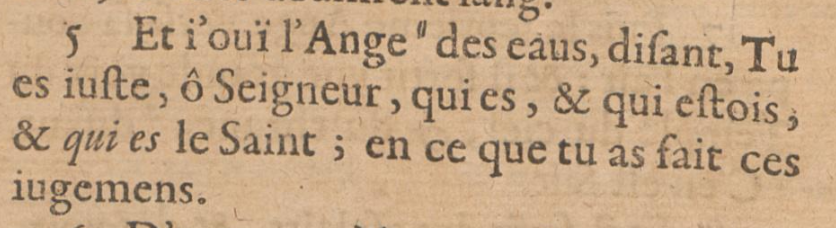

In short, Beza's successor in Geneva did not accept Beza's change to Revelation 16:5 and both in his Italian and French Bibles maintained respectively the Italian and French words for "Holy".
In 1645, Diodati resigned his professorship. He went to be with the Lord in 1649. As you may recall, Francis Turretin became the professor of theology at Geneva in 1653.


3 comments:
I just thought I would point out that Diodati stated that he followed the Vulgate where he safely could. In order to prove that Diodati denied Beza's reading because he thought this alone was incorrect, it would need to be demonstrated that he regularly followed the TR against other options.
Thanks, Mr. Yetzer. I don't go through the moderated comments often, but noticed this one stuck in the filter (probably because the post was more than a week old when the comment came in).
I think it's reasonable to say that he followed what he followed because he thought it was correct. It seems bizarre to say that he thought it was incorrect but used it anyway.
Nevertheless, I would love to see the citation of Diodati to which you are referring. If he says he follows the Vulgate, even where it is incorrect, I would love to see that.
Thanks for your comment, Mr. Yetzer. I think it's reasonable to assume that Diodati followed the reading he thought was the correct reading. That said, I would love to see the citation you have in mind for Diodati: surely he doesn't say he follows the Vulgate even in its errors!
Post a Comment