Monday, October 13, 2008

God's Decree = God's Endorsement?

Beowulf2k8 (b2k8) has provided a further comment illustrating his lack of understanding of Calvinism. Since I doubt he is the only person with this misunderstanding, I think it may be helpful to highlight the error he is making and explain why, biblically, he is wrong. b2k8 wrote:
In the sense that Calvinism teaches that God's Sovereinty [sic] means micromanagement and that God controls all of everything minutely, God is the author of Hinduism (according to Calvinism, of course, not me) and hence Hinduism is as as much "the faith" as Calvinism (according to Calvinism, since God decreed it equally with Calvinism, according to Calvinism), and therefore the Hindu woman is a martyr (to Calvinism, not to Christianity).
(source is an unpublished comment submitted on this earlier blog post)
It's a little difficult to construct a meaningful argument from b2k8's comment, but generally it seems to have the following structure:

1) Calvinism teaches that God micromanages all things minutely;
2) Minute micromanagement makes God the author of those things he minutely micromanages;
3) Therefore, God is the author of all things;
4) If God is the author of a religion, it is the faith;
5) Therefore, Hinduism is "the faith";
6) If someone dies for "the faith," then they are martyr; and
7) So, the Hindu woman in the article who was killed is a martyr under Calvinism.

As a preliminary matter, (7) does not follow from (6) because of a factual error, namely that the Hindu woman in the article was killed mistakenly, her tormentors and murders being under the misconception that she was a different religion than was actually her own.

The remainder of the errors are more interesting, as they are more fundamental leaps in reasoning and definition.

Error 1:

The first error is equivocation. It is the error by which b2k8 provides (4). We might agree that if God is the author of a religion, that is the faith. In agreeing with such a claim, though, we would need a definition of "author" that implies that the religion intended by God to be "the faith" and that it is the way that he has intended to be worshiped by his followers.

But these things cannot be said of Hinduism. Even assuming the remainder of b2k8's misconceptions of Calvinism (that God is the author of all things, since God minutely micromanages), God has not appointed Hinduism as the religion of His followers - instead it is a religion of the enemies of God. It is not intended by God to be "the faith," but is instead a counterfeit faith - a religion of devils.

Thus, at a minimum, we can see that b2k8 has equivocated (implicitly, of course, since he never provides a formal argument). Even if God is the author of Hinduism in some sense, that sense is not the sense required to make Hinduism "the faith."

Sometimes God sends lying spirits as a judgment. Recall, for example:

1 Kings 22:22 And the LORD said unto him, Wherewith? And he said, I will go forth, and I will be a lying spirit in the mouth of all his prophets. And he said, Thou shalt persuade him, and prevail also: go forth, and do so.

And sometimes as a judgment, God ordains that people will be deluded and believe a lie:

2 Thessalonians 2:11 And for this cause God shall send them strong delusion, that they should believe a lie:

Nevertheless, those lying spirits are not equivalent to the holy spirit, and the lies that ungodly believe are not equivalent to the truth.

Error 2:

A second error is definitional. B2k8 seemingly believes that minute micromanagement = authorship, but B2k8 provides no basis for this arbitrary definition. This is not the traditional definition of "author" that we use when, for example, we deny that God is the author of sin (yes, b2k8, it is the Calvinist position that God is not the author of sin). In the traditional sense, "author" comes from the Latin term auctor. In modern English the equivalent would be "actor." The person by who power the thing is carried out.

The person who carries out sin is never God. Sometimes it is sinful men, other times it is fallen angels. It is always a moral agent, but it is never God. God cannot break the moral law: that is the exclusive arena of men and demons.

But instead, b2k8 implicitly defines authorship as minute micromanagement. This is bizarre, to say the least. We consider ourselves the author of a document, for example, even when we do not minutely micromanage a computer - but simply type in the words and click the "print" button. Likewise, we do not need even to know what goes on inside a gun in order to be the morally responsible agent for a shooting.

This brings us to ...

Error 3:

Innovated standard of morality. For some reason, b2k8, along with many others, have invented a theory of morality in which, if God minutely micromanages things, he is morally responsible for what happens - and the actual person doing the sinful (or righteous - though that rarely comes up) act is not responsible under this theory.

But where did this theory come from? Who invented it? It seems to have been created out of thin air. There's nothing in the Bible to suggest such a rule of morality, and there's no particularly logical reason for arriving at such a rule.

And finally, we arrive at ...

Error 4:

Minute micromanagement is simply the logical conclusion of God being:

a) Interested in the smallest details of human life;
b) Omniscient; and
b) Omnipotent.

If all of (a), (b), and (c) are true, then minute micromanagement of some kind (whether Calvinistic, Molinistic, or otherwise) must follow. This, of course, offends the autonomous heart of rebellious man, but that really cannot be helped. God is the ruler over all the Earth, and because of (a), (b), and (c), everything that happens a particular way happens that way, because that is the way God wants it to happen in His providence.

There is a final error that b2k8 makes, that is only implicit in his criticism above ...

Error 5

Confusing the moral law of God and the Providence of God. God in his Providence ordains that certain bad acts will happen. God ordained that Jesus would be crucified, which was a sinful act on the part of those that did it to him. It was not sinless for Christ's murderers, just because God had ordained that it would happen, and just because God wanted it to happen. In fact, one can hardly imagine a more horrible crime than to slay the incarnate Son of God.

God wanted this great sin to happen, He ordained that it would happen, and He was glad that it happened, although he still counted it as sin against those who did it. The same is true of the many lesser sins that occur in God's providence. They happen for a reason that glorifies God ultimately, and yet they still sins for the people that do them. The fact that God has a good purpose in them does not excuse the people who commit the sins.

One hopes that this explanation will help b2k8, and others like him, to see that they have misunderstood and misrepresented Calvinism - perhaps simply because they have not fully understood its single source of authority: Scripture.

-TurretinFan

Deposit of the Funds Safe

Protestants may question whether the Vatican has safely maintained the Deposit of the Faith, but the Vatican Bank claims that those who have deposited funds are safe (link). I'm probably the last person to realize that the Vatican really was a player in the banking and finance industry in Europe, which is odd since I have watched the God-Father trilogy.

-TurretinFan

Norma Normans vs. Norma Normata

Scripture is, as they say, the Noma Normans non Normata (the "un-normed norm normer" or more loosely, "The norm of norms that is not normed"). When Scripture is described in this way, the concept is essentially equivalent to Sola Scriptura, as it declares that Scripture the standard according to which all other standards are measured, and which has no higher standard against which it is measured.

A number of Federal Visionists have been complaining that they are being judged, not according to the Scriptures, but according to the Confession of Faith. They seem to have the feeling that this stifles important doctrinal innovation. For example, one author (who I assume is a Federal Visionist, though I would be happy to be mistaken in this regard) responds to this comment:
It’s an inherently non-confessional stance that implicitly denies that our Standards contain the system of doctrine taught in Holy Scripture, and leads to an anything-goes biblicist approach. They plea for the freedom to do “cutting-edge” theology, which is really a euphemism for non-Reformed theology, while remaining in a confessional denomination.
with the following:
So, according to this Einstein, to be Confessional means to deny what the Confession says about Scripture being the ultimate authority, over and above confessions, creeds, councils, etc.?

No one is arguing for “anything goes” in any Reformed or Presbyterian circle I’m aware of — only, whatever God says, goes.

The rest of his characteristic analysis of the situation is seemingly mindless, and the fact that so-called “cutting edge” theology — in other words, always looking to reform ourselves and our theological praxis according to God’s Word, no matter what — is considered “non-Reformed” is laughable at best.

The PCA is filled with idolaters. Aaron yells to the crowd of sheep, while he points to the Westminster Confession of Faith, “This is your God, who brought you out of the land of Egypt.”

There’s a special place in Hell for this kind of lunacy.
(source)
The problem (or at least one problem) is that the author doesn't understand the role of the Confession. It is also a norm, but it is a Norma Normata - a norm that is normed. It is a helpful touchstone of what it means to be "Reformed," and it is a subordinate doctrinal standard of the PCA (and other Reformed churches in the Scottish tradition).

Schaff described things this way:
All creeds are more or less imperfect and fallible. The Bible alone is the rule of faith (regula credendi), the norma normans, and claims divine and therefore absolute authority; the creed is a rule of public teaching (regula docendi), the norma normata, and has only ecclesiastical and therefore relative authority, which depends on the measure of its agreement with the Bible. Confessions may be improved (as the Apostles' Creed is a gradual growth from the baptismal formula), or may be superseded by better ones with the increasing knowledge of the truth.
The Westminster Confession is an example as well of such change, as the version held by the PCA differs in certain regards from the version originally proposed by the Westminster divines.

Certainly we must be willing to norm our subordinate standards by the Word of God, but at the same time, when doing so, we need to be cognizant of the significance of such action. The Westminster Confession is not the ultimate standard for any Reformed Christian, but for many Reformed Christians it is a standard - a norma normata.

-TurretinFan

Who is to Blame for Svendsen's Book?

In response to this post (link) promoting a freely-downloadable mp3 related to Eric Svendsen's book, "Upon this Slippery Rock: Countering Roman Catholic Claims to Authority," Mr. Bellisario provided the following commentary, which I intersperse with my comments:

MB: "Wow. If Sola Scriptura is so simple and easy to get, then why do all of these simple-simons need Svendsen's book to explain it all?"

I answer: As you can see from the title of the book, the reason is the false claims of the advocates of Catholicism. Furthermore, of course, while Sola Scriptura is simple and easy to get ("the Bible is the only infallible rule of faith that we have") sometimes the devious and even Jesuitical objections to it are not simple and easy to get, and can be confusing for some people.

MB: "It's not Sola Scriptura, its Sola Svendsen."

I answer: This is just silly. Mr. Bellisario should know better than to make this kind of claim. Reformation Christianity does not deny the value of teachers, it just doesn't elevate them to the level of God's own Word: Scripture. Svendsen never makes himself out to be an infallible rule of faith - a fact that should be as simple and easy to get as Sola Scriptura itself.

MB: "Scripture isn't plain enough for all of you to understand. You need Svendsen to rescue your faith! Wow this is too good to be true."

I answer: This criticism seems to be founded on the same false premise as the one above, in which Sola Scriptura leaves no place for teachers. It's also based on a further straw man, which is the idea that the position of Sola Scriptura means that ALL doctrines of Scripture are alike plain. Of course, the truth is different from the straw men. There is a role for teachers in the church, and one of their roles is to help explain doctrines - including the less clear doctrines. Furthermore, of course, even though Sola Scriptura is a very simple concept, the issues become complicated by heretical objections from a variety of sources, principally those who bow the knee to the Roman Pontiff (one knee only, of course, as explained in Steve's post here)

MB: "I just love the advertisement for his book. All we need now is Billy Maze to sell it on lat night TV. Call now and you'll receive Svendsen's set of chopping knives for cutting out Rome's heresy!"

I answer: This scoffing does tend to serve as a thing that speaks for itself as to the attitude of the critic. No further comment, therefore, is needed.

-TurretinFan

Sunday, October 12, 2008

Death of a Non-Martyr

There is some very deplorable and evil violence taking place in India. Non-Christians are attacking and killing people and institutions that they believe are Christian. Some time ago I had mentioned that simply being a nun didn't make one a Christian, and that consequently I would not automatically consider a nun who was apparently killed simply because she was wearing a habit to be a martyr without further investigation. I think some people who read what I wrote had trouble wrapping their heads around the concept.

Perhaps this further sad story of the wicked actions of evil men will help those who had trouble with the nun non-martyrdom issue to see the bigger picture (link) (warning - somewhat graphic description of the persecution). In this case, the woman degraded and killed was actually a Hindu woman who simply happened to work at a Roman Catholic institution.

There is a sense in which she was killed for the faith (since she was killed by Hindus trying to oppose Christianity), but she certainly wasn't killed for her faith.

For reference, my earlier post in which the nun issue was raised in the comment box can be found here (link) and an earlier post I wrote providing evidence of the lack of faith of one of the most famous Roman Catholics in India is here (link).

-TurretinFan

Saturday, October 11, 2008

Response to Beowulf2k8 on Calvinism

I noticed that Beowulk2k8 had commented over at Triablogue on the topic of Calvinism (link to comment).

B2k8 writes:
You guys are so ridiculous. When Calvinism is ridiculed, it is funny because the Calvinist system is truly stupidity and Satan worship. When Arminianism is ridiculed it is just asinine lame Calvinists trying to look cool after being burned by the truth.

What the Calvinist dictionary says about what you believe is true.

Augustine: The first church father.

Free Will: Something that can't exist because it would make God helpless if true.

Infant damnation: Something that brings God glory.

Glory: Praise we give to God for anything wicked that has ever happened (except for the birth of Charles Finney).

God's secret will: To save a few and reprobate the rest (secret to Arminians but not to us)

Jesus Loves Me, This I Know: Misleading children's song.

Jesus Loves the Little Children: Another terrible song, obviously written by someone who didn't take the time to do a proper exegesis of scripture.

You love talking about exclusive Psalmody because you want to sing about killing your enemies rather than Christ's love. You love ignoring every ecclesiastical writer prior to Augustine because they all taught free will and election based on foreknowledge of faith (including Augustine before he became an Imperial bishop). You relish in the doctrine of infant damnation as if damning innocent infants for another man's sin was some great honor and glory to your manmade god.
Let's hit a few points: "When Calvinism is ridiculed, it is funny because the Calvinist system is truly stupidity and Satan worship." This is the sort of comment that cannot be backed up. One has to chuckle a bit, because one of the more frequent criticisms of Calvinism is that it is excessively intellectual. The "Satan worship" comment just demonstrates that B2k8 doesn't know what the Gospels is and who God is. A person who says that Calvinism is "Satan worship" is either (a) not a Christian, or (b) someone who doesn't know what Calvinism is.

B2k8 claims that "Augustine: The first church father" is actually a Calvinistic belief and B2k8 thinks that "You love ignoring every ecclesiastical writer prior to Augustine because they all taught free will and election based on foreknowledge of faith (including Augustine before he became an Imperial bishop)." This is absurd of course. While Augustine's writings are certainly notable, and undoubtedly contrary to B2k8's views, we find the same Calvinistic themes not only in the Old and New Testaments, but also in the Apostolic fathers - those ECFs that are the earliest to leave any writings behind. For one example, see this earlier post of mine (link). Incidentally I'd be highly interested in the supposed ECF that taught "election based on foreknowledge of faith" ... if anyone knows, please inform me.

B2k8 claims that "Free Will: Something that can't exist because it would make God helpless if true" is actually a Calvinistic belief. This is wrong as well. Calvinism teaches that men have a compatible free will, as opposed to the Arminian conception of an autonomous free will. The former kind of free will is compatible with predestination, that latter is not. The former kind can exist, and the latter - if true - would make God helpless to save those he wants to save. For more discussion, see my earlier post on deflating assumptions regarding man's free will (link).

B2k8 claims that "Infant damnation: Something that brings God glory" is actually a Calvinistic belief. This is a confused objection. First of all, if God chooses to damn any infants, it certainly will bring God glory. "All have sinned" applies not only to adults but to infants as well. Adam's sin is placed on the account of each of his natural descendants. Consequently, God would be just to condemn infants as well as adults. Nevertheless, God is also able to save infants, if he chooses. The standard Reformed position is that "elect infants, dying in infancy, will be saved." Some Calvinists believe that the category of "elect infants" includes all those infants who die in infancy, and others believe that the number is a subset of the group of those who die in infancy (there may even be some who believe that no infants who die in infancy are among the elect, but I've never much such a person). For more discussion, consider my earlier article on the "innocence" of children (link).

Bk28 claims that "Glory: Praise we give to God for anything wicked that has ever happened (except for the birth of Charles Finney)" is the Calvinist position. Leaving out the parenthetical, the statement is true but incomplete. We give glory to God in all things, or at least we try. It can be difficult to be like Job and say, "Naked came I out of my mother's womb, and naked shall I return thither: the LORD gave, and the LORD hath taken away; blessed be the name of the LORD." Job 1:21. Charles Finney's theology is error-riddled, but God had a purpose in his life as well. The comment is incomplete, because we give God praise as well for the good things that he does. In all things, God is to be praised. (1 Peter 4:11 If any man speak, let him speak as the oracles of God; if any man minister, let him do it as of the ability which God giveth: that God in all things may be glorified through Jesus Christ, to whom be praise and dominion for ever and ever. Amen.) Previously, I discussed the dangers associated with discerning God's providence, which is connected with this fact that everything that happens is for the best (link).

B2k8 thinks that "God's secret will: To save a few and reprobate the rest (secret to Arminians but not to us)" is an accurate picture of Calvinism. It seems clear that B2k8 doesn't understand Calvinism, at least on this point. God's secret will is his decree of Providence: his decision about what will happen. This is a "secret" will because God has given us very few details about what will happen. We know that there is a judgment day coming and that Christ will return, but we are not told whether the stock market will recover from last week's down-turn, or whether Georgia will remain an independent European nation. We know that in general all of the elect will be saved, and that all of the reprobate will not, but Calvinists do not claim to know who the elect are. I have discussed this issue of God's will many times, but one example would be in debating the issue with Seth McBee, as can be seen from this open question to him (link).

B2k8 thinks that "Jesus Loves Me, This I Know: Misleading children's song" and "Jesus Loves the Little Children: Another terrible song, obviously written by someone who didn't take the time to do a proper exegesis of scripture" are the Calvinist position. He's mostly right. The first song tends to suggest that all children are in God's present favor, the latter song explicitly says so. In point of fact, many (if not most) children are sinners in God's disfavor and in need of salvation by grace through faith in the finished work of Christ. It is interesting to note that at least some Calvinists seem to like the first song (Pastor Bill Shishko, for example, seems to fall in this category). Nevertheless, generally both songs are theologically weak. I've previously addressed "Jesus loves Me" (link).

B2k8 thinks that "You love talking about exclusive Psalmody because you want to sing about killing your enemies rather than Christ's love." This sort of dualism is practically Gnostic in its radical dispensational bent. And it is just wrong. We don't sing the Psalms because we want to sing about killing our enemies. I cannot think of any Psalms that are written with that focus (though there certainly some in which we ask for God's judgment on his and our enemies). Moreover, the Psalms are full of Christ's love. Psalm 1, for example, mentions that "the LORD knoweth (loves) the way of the righteous," and Psalm 2 speaks particularly of Christ saying, "I will declare the decree: the LORD hath said unto me, Thou art my Son; this day have I begotten thee." We could go on and on. My readers my recall my previous post contrasting certain modern worshipper-centered worship vs. God-centered worship (link).

Finally, B2k8 thinks that "You relish in the doctrine of infant damnation as if damning innocent infants for another man's sin was some great honor and glory to your manmade god." Mostly this is already addressed above. It is addressed at further link in this previous post (link).

-TurretinFan

I might be a ...

BookNerd, according to JT at Between Two World (link).

Practical Calvinism

MAV at the HoldFast blog, has provided an interesting post on practical Calvnism (link). I especially enjoyed the part where he quoted a definition of Calvinism as "that sight of the majesty of God that pervades all of life and all of experience." Amen!

-TurretinFan

Marveling at God's Creation

There has been discovery made of a bacteria that apparently obtains its energy without the use of oxygen (link). Of course, this will be used by scoffers to assert the evolutionary hypothesis, but it is an interesting specimen for legitimate scientific purposes as well.

If the bacteria can produce energy without oxygen, this could pave the way for new energy technologies that do not compete with us for oxygen, and that do not produce as a byproduct carbon-dioxide and -monoxide. It will be interesting to see if anything useful comes from the discovery of these marvels of God's design.

-TurretinFan

Thursday, October 09, 2008

Wes White on the Regulative Principle of Worship

I thoroughly enjoyed reading Pastor Wes White's blog post on the Regulative Principle of Worship (link). Obviously, Pastor White and I would disagree over some minor aspects presented in his article, but on the major points of the article, he hits the nail right on the head.

Pastor Wes White wrote:
Second, even if we only sang psalms, there would still be problems. You could still do a light, happy-clappy type worship just singing psalms. Indeed, many of the modern praise choruses are simply portions of psalms. Thus, I think that trying to use the RPW to solve everything is a dead end.
Indeed, that is so! RPW is the second commandment, but "happy-clappy type worship" that disrespects God is a violation not of the second commandment but of the third commandment. Just as it would be God-dishonoring to practice Exclusive Psalmody (EP) in a church that denied the Trinity (violation of the first commandment) or in a church that refused to meet weekly on the Lord's Day (violation of the fourth commandment), so also it would be God-dishonoring to practice EP in a way that loses sight of the fact that worship is to be directed Godward, and to be suitably respectful to our great God and King.

Following the Second Commandment doesn't get you off the hook with respect to the other three commandments of the first table!

-TurretinFan

Reformed Mafia Raided!

Well, perhaps the story is not nearly as exciting as that, but I was still sorry to see that the Reformed Mafia blog indicated that it was "Closed for Season" (link). I notice that my friend Theojunkie shares my disappointment (link).

Wednesday, October 08, 2008

Proverbs 2

Proverbs 2
1My son, if thou wilt receive my words, and hide my commandments with thee; 2So that thou incline thine ear unto wisdom, and apply thine heart to understanding; 3Yea, if thou criest after knowledge, and liftest up thy voice for understanding; 4If thou seekest her as silver, and searchest for her as for hid treasures; 5Then shalt thou understand the fear of the LORD, and find the knowledge of God. 6For the LORD giveth wisdom: out of his mouth cometh knowledge and understanding. 7He layeth up sound wisdom for the righteous: he is a buckler to them that walk uprightly. 8He keepeth the paths of judgment, and preserveth the way of his saints. 9Then shalt thou understand righteousness, and judgment, and equity; yea, every good path. 10When wisdom entereth into thine heart, and knowledge is pleasant unto thy soul; 11Discretion shall preserve thee, understanding shall keep thee: 12To deliver thee from the way of the evil man, from the man that speaketh froward things; 13Who leave the paths of uprightness, to walk in the ways of darkness; 14Who rejoice to do evil, and delight in the frowardness of the wicked; 15Whose ways are crooked, and they froward in their paths: 16To deliver thee from the strange woman, even from the stranger which flattereth with her words; 17Which forsaketh the guide of her youth, and forgetteth the covenant of her God. 18For her house inclineth unto death, and her paths unto the dead. 19None that go unto her return again, neither take they hold of the paths of life. 20That thou mayest walk in the way of good men, and keep the paths of the righteous. 21For the upright shall dwell in the land, and the perfect shall remain in it. 22But the wicked shall be cut off from the earth, and the transgressors shall be rooted out of it.

The entire chapter of Proverbs is a parental lecture explaining the value of listening to the parental advice.

Condition Precedent

The parent exhorts listening using an "if ... then ..." formulation. For the "If" portion, the parent provides four related parallel couplets:

1) If thou wilt receive my words || [if thou wilt] hide my commandments with thee
2) So that thou incline thine ear unto wisdom || [so that thou] apply thine heart to understanding
3) If thou criest after knowledge || [if thou] liftest up thy voice for understanding
4) If thou seekest her as silver || [if thou] searchest for her as for hid treasure

The first couplet emphasizes possession of the information. "Receive my words" is placed in parallel to "hide my commandments." Notice the much deeper and yet clear sense that "hide my commandments" has. If it stood alone, one might wonder whether it referred to ignoring the commandments, but in parallel with "receive my words," we see that it refers to planting the seed of Scripture in one's heart.

Psalm 119:11 Thy word have I hid in mine heart, that I might not sin against thee.

The second couplet emphasizes the acquisition of the information. "Incline thine ear" and "apply thine heart" are actions taken by the listener. It is not simply a passive reception of the Word of God, but an active pursuit. One is not only the flowerbed for the seed of God's word, but one tries to help plant it there in the first place.

The third couplet emphasizes the intensity of pursuit for the information. "Criest after" and "liftest up thy voice." The picture is of someone shouting to get attention. It's like the man calling "TAXI!" because he's running late for the airport. It's like a broker shouting out "BUY BUY" from the floor of the exchange. It's the voice of someone who wants to be heard, and who is seeking to make his request clear.

The fourth couplet emphasizes the valued placed on the information. "Seekest her as silver" and "searchest for her as for hid treasure." This is not a casual search that one might make, but a search into which one will put all of one's effort. Jesus provided the same kind of analogy to make a different point:

Luke 15:8-9
8Either what woman having ten pieces of silver, if she lose one piece, doth not light a candle, and sweep the house, and seek diligently till she find it? 9And when she hath found it, she calleth her friends and her neighbours together, saying, Rejoice with me; for I have found the piece which I had lost.

The reward for this search energetic search for the acquisition and possession of precious information is spelled out as the "then" part of the "if ... then ..." format of this lecture.

The short version of this bounty is expressed in a parallel couplet:

thou shalt understand the fear of the LORD || [thou shalt] find the knowledge of God

The reward for the search is that one gets one is looking for, an understanding of the fear of the LORD and a knowledge of God. This is theology: to understand the fear of the LORD and to know God. The fear of the LORD here stands for a proper reverence of God, and the associated worship of our Creator and Provider. Likewise, the "knowledge of God," is not simply intellectual knowledge, but it is an intimate knowledge, a true love of God.

As the Apostle John explains:

1 John 4:16 And we have known and believed the love that God hath to us. God is love; and he that dwelleth in love dwelleth in God, and God in him.

And the Apostle Paul states:

1 Corinthians 13:12 For now we see through a glass, darkly; but then face to face: now I know in part; but then shall I know even as also I am known.

And Jesus said:

John 10:14 I am the good shepherd, and know my sheep, and am known of mine.

Obviously, our knowledge and love of God is a reflection of God's love for and knowledge of us, and consequently is never as strong as his, especially since we are merely creatures created in his image.

1 John 4:19 We love him, because he first loved us.

And again:

1 John 3:16 Hereby perceive we the love of God, because he laid down his life for us: and we ought to lay down our lives for the brethren.

And further:

John 15:13 Greater love hath no man than this, that a man lay down his life for his friends.

But contrast:

Romans 5:8 But God commendeth his love toward us, in that, while we were yet sinners, Christ died for us.

The lecture itself provides a great deal of explanation of what is involved, using essentially the "because ... therefore ..." form presented as "for ... then ...".

In the "for" section, it is explained how/that the Lord brings us this this knowledge using three couplets:

1) the LORD giveth wisdom || out of his mouth cometh knowledge and understanding
2) He layeth up sound wisdom for the righteous || he is a buckler to them that walk uprightly.
3) He keepeth the paths of judgment, and preserveth the way of his saints.

The knowledge of God comes from God, he gives it. This is the first point to be seen. The second point is related. Not only does he give it, he puts it in firmly. He "layeth up" the wisdom and is a "buckler" or shield for the person who is following God's law. The shield or buckler is a defensive weapon - it guards from attacks. The third point is that God goes beyond protecting from external attacks, and also even essentially guides the feet of his people: keeping them on the path.

This last couplet is, of course, one of the classic proofs for the doctrine of perseverance of the saints. God is the author of our faith, he is the one who puts wisdom into us, like someone hiding something important.

The word translated "layeth up" here is the word צפן (tsaphan) which is the same word used, for example, to speak of how Moses' mother "hid" him three months after he was born. God takes his word and puts it in us in a secure place.

Proceeding to the result of this activity of God, we see the "then" clause:

Then shalt thou understand:
righteousness || judgment || equity || every good path

These four concepts are generally of overlapping scope. Judgment and equity are specific examples of righteousness, and "every good path" is a catch-all for righteous behavior. What is interesting that each of the examples is behavior: it is doing what is right. What will be understood by the person whom God blesses with Wisdom is the way in which he should live.

The lecture continues by providing more detail regarding this blessing:

When wisdom entereth into thine heart || [when] knowledge is pleasant unto thy soul

[then] Discretion shall preserve thee || [then] understanding shall keep thee

Notice emphasis on the preservative effect of wisdom. When you obtain wisdom - when it enters your heart, when it becomes pleasant to your soul, then you are preserved. It's a bit like salt that entering into meat preserves it. But the corruption preserved against is not only rotting - but also the corruption of falling, tripping, or stumbling.

This preservation is explained further negatively and positively. Negatively, a set of parallels is used:

To deliver thee from the way of the evil man || To deliver thee from the strange woman

The evil man is described with the following parallels:

from the way of the evil man || from the man that speaketh froward things || who leave the paths of uprightness, to walk in the ways of darkness || who rejoice to do evil, and delight in the frowardness of the wicked || whose ways are crooked, and they froward in their paths:

Notice how there are even further parallels within the parallels. This is a most beautiful and complex structure. We've noted above that the whole description of deliverance from the evil man is parallel to deliverance from the strange woman. Within that parallel are the descriptions of the evil man. Within those, in three instances there are further internal parallels:

a) leave the paths of uprightness || walk in the ways of darkness
b) rejoice to do evil || delight in the frowardness of the wicked
c) ways are crooked || froward in their paths

Notice that the first and last of these three are focused on staying on the figurative straight path of righteousness. Furthermore, for these wicked men, the second parallel emphasizes that they love to do evil - their departure from the straight path is something they love. Having God's word in one's heart preserves one from those sorts of desires.

The second negative image is that of deliverance from the strange woman. Again, multiple parallel images are used:

from the strange woman || from the stranger which flattereth with her words || which forsaketh the guide of her youth, and forgetteth the covenant of her God || For her house inclineth unto death, and her paths unto the dead || none that go unto her return again, neither take they hold of the paths of life.

Notice that the picture of the strange woman here, is essentially that of a prostitute or even simply an adulterous woman who lures in men through flattering words. If the evil man is simply someone who loves wickedness, the adulterous woman is a step further: she loves wickedness in a way that destroys not only herself but others. As with the pictures of the evil man, three of the depictions of the strange woman have internal parallels:

a) which forsaketh the guide of her youth || [which] forgetteth the covenant of her God
b) her house inclineth unto death || her paths unto the dead
c) none that go unto her return again || neither take they hold of the paths of life

Here, the latter two parallels focus on the ultimate demise of her and those who accompany her. The former parallel emphasizes the fact that her wickedness is a departure. Those raised in Christian homes should take this warning particularly to heart.

Having presented these negative warnings, a positive presentation is finally provided with a single parallel:

That thou mayest walk in the way of good men || [that thou mayest] keep the paths of the righteous

This is no surprise. One is being protected against going off the path and from following the prostitute to destruction. So, naturally, the positive characteristic of the word of God in one's heart is to keep on on the path of righteousness.

Finally, the lecture is concluded with a pair of contrasting parallels, positive, then negative using a "for ... but ..." layout:

Positive (For): the upright shall dwell in the land || the perfect shall remain in it
Negative (But): the wicked shall be cut off from the earth || the transgressors shall be rooted out of it

Notice the contrast, the righteous man lives, but the wicked dies - the perfect remains, but the transgressors are plucked out by the roots, completely removed. It is a very stern warning to be righteous.

Furthermore, it is essentially the same warning/promise we see in the fifth commandment:

Exodus 20:12 Honour thy father and thy mother: that thy days may be long upon the land which the LORD thy God giveth thee.

Deuteronomy 5:16 Honour thy father and thy mother, as the LORD thy God hath commanded thee; that thy days may be prolonged, and that it may go well with thee, in the land which the LORD thy God giveth thee.

Ephesians 6:2-3
2Honour thy father and mother; (which is the first commandment with promise;) 3That it may be well with thee, and thou mayest live long on the earth.

Thus, the parental lecture of this chapter can be seen as an elaborate, beautiful argument for and explanation of the 5th commandment.

Original (Hebrew)
Proverbs 2
1 בני אם־תקח אמרי ומצותי תצפן אתך׃
2 להקשׁיב לחכמה אזנך תטה לבך לתבונה׃
3 כי אם לבינה תקרא לתבונה תתן קולך׃
4 אם־תבקשׁנה ככסף וכמטמונים תחפשׂנה׃
5 אז תבין יראת יהוה ודעת אלהים תמצא׃
6 כי־יהוה יתן חכמה מפיו דעת ותבונה׃
7 וצפן לישׁרים תושׁיה מגן להלכי תם׃
8 לנצר ארחות משׁפט ודרך חסידו ישׁמר׃
9 אז תבין צדק ומשׁפט ומישׁרים כל־מעגל־טוב׃
10 כי־תבוא חכמה בלבך ודעת לנפשׁך ינעם׃
11 מזמה תשׁמר עליך תבונה תנצרכה׃
12 להצילך מדרך רע מאישׁ מדבר תהפכות׃
13 העזבים ארחות ישׁר ללכת בדרכי־חשׁך׃
14 השׂמחים לעשׂות רע יגילו בתהפכות רע׃
15 אשׁר ארחתיהם עקשׁים ונלוזים במעגלותם׃
16 להצילך מאשׁה זרה מנכריה אמריה החליקה׃
17 העזבת אלוף נעוריה ואת־ברית אלהיה שׁכחה׃
18 כי שׁחה אל־מות ביתה ואל־רפאים מעגלתיה׃
19 כל־באיה לא ישׁובון ולא־ישׂיגו ארחות חיים׃
20 למען תלך בדרך טובים וארחות צדיקים תשׁמר׃
21 כי־ישׁרים ישׁכנו־ארץ ותמימים יותרו בה׃
22 ורשׁעים מארץ יכרתו ובוגדים יסחו ממנה׃

LXX (Greek)
Proverbs 2
1Υἱέ, ἐὰν δεξάμενος ῥῆσιν ἐμῆς ἐντολῆς κρύψῃς παρὰ σεαυτῷ, 2ὑπακούσεται σοφίας τὸ οὖς σου, καὶ παραβαλεῖς καρδίαν σου εἰς σύνεσιν, παραβαλεῖς δὲ αὐτὴν ἐπὶ νουθέτησιν τῷ υἱῷ σου. 3ἐὰν γὰρ τὴν σοφίαν ἐπικαλέσῃ καὶ τῇ συνέσει δῷς φωνήν σου, τὴν δὲ αἴσθησιν ζητήσῃς μεγάλῃ τῇ φωνῇ, 4καὶ ἐὰν ζητήσῃς αὐτὴν ὡς ἀργύριον καὶ ὡς θησαυροὺς ἐξερευνήσῃς αὐτήν, 5τότε συνήσεις φόβον κυρίου καὶ ἐπίγνωσιν θεοῦ εὑρήσεις. 6ὅτι κύριος δίδωσιν σοφίαν, καὶ ἀπὸ προσώπου αὐτοῦ γνῶσις καὶ σύνεσις· 7καὶ θησαυρίζει τοῖς κατορθοῦσι σωτηρίαν, ὑπερασπιεῖ τὴν πορείαν αὐτῶν 8τοῦ φυλάξαι ὁδοὺς δικαιωμάτων καὶ ὁδὸν εὐλαβουμένων αὐτὸν διαφυλάξει. 9τότε συνήσεις δικαιοσύνην καὶ κρίμα καὶ κατορθώσεις πάντας ἄξονας ἀγαθούς. 10ἐὰν γὰρ ἔλθῃ ἡ σοφία εἰς σὴν διάνοιαν, ἡ δὲ αἴσθησις τῇ σῇ ψυχῇ καλὴ εἶναι δόξῃ, 11βουλὴ καλὴ φυλάξει σε, ἔννοια δὲ ὁσία τηρήσει σε, 12ἵνα ῥύσηταί σε ἀπὸ ὁδοῦ κακῆς καὶ ἀπὸ ἀνδρὸς λαλοῦντος μηδὲν πιστόν. 13ὦ οἱ ἐγκαταλείποντες ὁδοὺς εὐθείας τοῦ πορεύεσθαι ἐν ὁδοῖς σκότους, 14οἱ εὐφραινόμενοι ἐπὶ κακοῖς καὶ χαίροντες ἐπὶ διαστροφῇ κακῇ, 15ὧν αἱ τρίβοι σκολιαὶ καὶ καμπύλαι αἱ τροχιαὶ αὐτῶν 16τοῦ μακράν σε ποιῆσαι ἀπὸ ὁδοῦ εὐθείας καὶ ἀλλότριον τῆς δικαίας γνώμης. 17υἱέ, μή σε καταλάβῃ κακὴ βουλὴ ἡ ἀπολείπουσα διδασκαλίαν νεότητος καὶ διαθήκην θείαν ἐπιλελησμένη· 18ἔθετο γὰρ παρὰ τῷ θανάτῳ τὸν οἶκον αὐτῆς καὶ παρὰ τῷ ᾅδῃ μετὰ τῶν γηγενῶν τοὺς ἄξονας αὐτῆς· 19πάντες οἱ πορευόμενοι ἐν αὐτῇ οὐκ ἀναστρέψουσιν οὐδὲ μὴ καταλάβωσιν τρίβους εὐθείας· οὐ γὰρ καταλαμβάνονται ὑπὸ ἐνιαυτῶν ζωῆς. 20εἰ γὰρ ἐπορεύοντο τρίβους ἀγαθάς, εὕροσαν ἂν τρίβους δικαιοσύνης λείους. 21χρηστοὶ ἔσονται οἰκήτορες γῆς, ἄκακοι δὲ ὑπολειφθήσονται ἐν αὐτῇ, ὅτι εὐθεῖς κατασκηνώσουσι γῆν, καὶ ὅσιοι ὑπολειφθήσονται ἐν αὐτῇ· 22ὁδοὶ ἀσεβῶν ἐκ γῆς ὀλοῦνται, οἱ δὲ παράνομοι ἐξωσθήσονται ἀπ᾿ αὐτῆς.

Vulgate (Latin)
Proverbs 2
1fili mi si susceperis sermones meos et mandata mea absconderis penes te 2ut audiat sapientiam auris tua inclina cor tuum ad noscendam prudentiam 3si enim sapientiam invocaveris et inclinaveris cor tuum prudentiae 4si quaesieris eam quasi pecuniam et sicut thesauros effoderis illam 5tunc intelleges timorem Domini et scientiam Dei invenies 6quia Dominus dat sapientiam et ex ore eius scientia et prudentia 7custodiet rectorum salutem et proteget gradientes simpliciter 8servans semitas iustitiae et vias sanctorum custodiens 9tunc intelleges iustitiam et iudicium et aequitatem et omnem semitam bonam 10si intraverit sapientia cor tuum et scientia animae tuae placuerit 11consilium custodiet te prudentia servabit te 12ut eruaris de via mala ab homine qui perversa loquitur 13qui relinquunt iter rectum et ambulant per vias tenebrosas 14qui laetantur cum malefecerint et exultant in rebus pessimis 15quorum viae perversae et infames gressus eorum 16ut eruaris a muliere aliena et ab extranea quae mollit sermones suos 17et relinquit ducem pubertatis suae 18et pacti Dei sui oblita est inclinata est enim ad mortem domus eius et ad impios semitae ipsius 19omnes qui ingrediuntur ad eam non revertentur nec adprehendent semitas vitae 20ut ambules in via bona et calles iustorum custodias 21qui enim recti sunt habitabunt in terra et simplices permanebunt in ea 22impii vero de terra perdentur et qui inique agunt auferentur ex ea

Challenge to Pro-Choice Folks

Consider watching Rhology's video at Rhoblogy and leaving him a comment (link to video post). Warning, not for the weak of stomach. Abortion is murder, and from Rhology's description, photos of the victims of the murder are shown in the video. I myself am not willing to watch the video - but then again I am pro-life.

If you honestly believe that a fetus is simply part of a woman's body ...

Shame on you.

-TurretinFan

Nepalese Darkness

Here's an interesting, if somewhat depressing, story about the spiritual darkness that exists in Nepal. (link) The little girl in the story has been selected to be a living goddess until she becomes a woman, living practically in isolation during that time, and superstitiously feared as causing premature death in husbands once she is no longer a "goddess." It is a sad tale of superstition.

There is one God, and only one. That God does not live in temples made with hands, and is not worshiped with the works of men's hands, as though he needed anything. Let us continue to pray that the Gospel light will shine in these places of darkness, so that they may be set free from the bondage of this folly.

-TurretinFan

Tuesday, October 07, 2008

Proverbs 1:20-33

Proverbs 1:20-33

20Wisdom crieth without; she uttereth her voice in the streets: 21She crieth in the chief place of concourse, in the openings of the gates: in the city she uttereth her words, saying, 22How long, ye simple ones, will ye love simplicity? and the scorners delight in their scorning, and fools hate knowledge? 23Turn you at my reproof: behold, I will pour out my spirit unto you, I will make known my words unto you. 24Because I have called, and ye refused; I have stretched out my hand, and no man regarded; 25But ye have set at nought all my counsel, and would none of my reproof: 26I also will laugh at your calamity; I will mock when your fear cometh; 27When your fear cometh as desolation, and your destruction cometh as a whirlwind; when distress and anguish cometh upon you. 28Then shall they call upon me, but I will not answer; they shall seek me early, but they shall not find me: 29For that they hated knowledge, and did not choose the fear of the LORD: 30They would none of my counsel: they despised all my reproof. 31Therefore shall they eat of the fruit of their own way, and be filled with their own devices. 32For the turning away of the simple shall slay them, and the prosperity of fools shall destroy them. 33But whoso hearkeneth unto me shall dwell safely, and shall be quiet from fear of evil.

This is the first appearance of Wisdom - in anthropomorphic representation. Wisdom is pictured as a woman, calling out something like a preacher. This makes sense, because Wisdom's message is in essence the gospel. The Greek name is especially beautiful here Σοφία (Sophia) but perhaps some will say that the Hebrew name (חכמות - Chakmoth) is also beautiful. This Hebrew name for Wisdom is used only one place in the Bible, outside of the book of Proverbs, in a Psalm for the sons of Korah:

Psalm 49:3-4
3My mouth shall speak of wisdom (חכמות - Chakmoth); and the meditation of my heart shall be of understanding. 4I will incline mine ear to a parable: I will open my dark saying upon the harp.

Now, in our present book of proverbs, Solomon is speaking of Wisdom, and providing her sermon.

The first point to be seen is in respect to this sermon is that Wisdom's message is delivered publicly. The following parallels are presented:

Wisdom crieth || she uttereth her voice || She crieth || she uttereth her words

without (outside) || in the streets || in the chief place of concourse || in the openings of the gates in the city

Wisdom's message is vocal and public. She doesn't just send forth her message in some back alley or hidden away in a closet, but in the "chief place of concourse" and "in the openings of gates in the city" the busiest places in the city. Today men spend less of their time outdoors, but still Wisdom calls out publicly - where everyone can hear, whether that be in the marketplace, in the factory, or on the Internet. Wherever there are people, Wisdom proclaims her message.

The message is a simple, though not particularly complimentary one:

How long,

ye simple ones, will ye love simplicity? ||the scorners delight in their scorning? || fools hate knowledge?

How long will this go on? In other words, stop. Stop loving simplicity, stop delighting in scorning, stop hating knowledge. These things are all the same. The fool of Proverbs loves ignorance, "Ignorance is bliss," is perhaps his unofficial motto. He hates knowledge and wallows in his ignorance like a pig wallows in the mud. He is the same one who heaps scorn on what he doesn't understand. He loves mocking and he mocks what he should believe.

Wisdom offers knowledge. She declares that if the fool repents, he will receive the spirit of knowledge: that she will make known her words unto him. (Ephesians 1:17 That the God of our Lord Jesus Christ, the Father of glory, may give unto you the spirit of wisdom and revelation in the knowledge of him:) We are sometimes mocked by the enemies of the Gospel, as suggesting that we have only Wisdom's words. We have also that spirit of Wisdom by which the words of Wisdom are made known unto us.

Wisdom continues by explaining what the response to her preaching has been:

I have called, and ye refused || I have stretched out my hand, and no man regarded; || ye have set at nought all my counsel || [ye] would none of my reproof

The fool ignores the preached word of wisdom. She says, "come here and learn," and he declines. She beckons to him, but he rebuffs it. He ignores her advice as though it were worthless and blows off her criticism.

Wisdom then points out what she will do in view of this failure to heed the warnings given:

I also will laugh at your calamity || I will mock when your fear cometh

There is coming a time when the mockers will be mocked and when the scorners will be scorned. I listened today to a Muslim comedian mocking Christianity. He clearly thought himself enormously funny. If he continues to ignore wisdom, however, there is coming a day when he will face calamity and fear: in that day, when it truly matters, he will find himself the subject of ridicule.

Wisdom continues:

When your fear cometh as desolation || [when] your destruction cometh as a whirlwind || when distress and anguish cometh upon you

The time of fear, distress, anguish, and destruction will come. There is not a question about whether it will come - it certainly is coming.

At that time, Wisdom indicates:

Then shall they call upon me, || they shall seek me early,

but I will not answer || but they shall not find me:

The fool will not remain foolish forever. Eventually he will try to call upon God, but God will not answer him - he will try to seek God, but will be unable to find him. It will be too late to repent at that time, though if the fool now turned from his folly, God would answer and those that seek God now, will find him.

Wisdom continues by essentially reiterating the previous point:

For that (because)

they hated knowledge || [they] did not choose the fear of the LORD || They would none of my counsel || they despised all my reproof

Therefore

they shall eat of the fruit of their own way || [they shall] be filled with their own devices.

Knowledge, the fear of the LORD, his counsel, and his reproof are all roughly synonymous. They are all alike despised by the fool. The result: they get what they deserve - what is coming to them for doing what they did. Destruction is the fruit of the tree of folly. The concept "be filled with" is basically the idea of them be stuffed with this fruit that they cultivated (Latin is lovely here: "saturabuntur" - cognate for "saturated"). They'll be richly rewarded with what they have earned by their folly.

Finally, Wisdom summarizes here message:

Negatively the message is:

For the turning away of the simple shall slay them || the prosperity of fools shall destroy them

It is the rejection of wisdom that, in essence, is the reason the fools reject wisdom. Likewise, their current prosperity (whether gained by avarice - as in the previous parable - or otherwise) destroys them, by blocking them from turning from their foolishness.

But there is a positive side to Wisdom's message, as well:

But whoso hearkeneth unto me shall dwell safely || [he] shall be quiet from fear of evil

The person who hears Wisdom's cry and repents, will be saved from the coming destruction. It is really that simple. It is the gospel message: Repent and believe, for the kingdom of God is at hand.

Original (Hebrew)
Proverbs 1:20-33
20 חכמות בחוץ תרנה ברחבות תתן קולה׃
21 בראשׁ המיות תקרא בפתחי שׁערים בעיר אמריה תאמר׃
22 עד־מתי פתים תאהבו פתי ולצים לצון חמדו להם וכסילים ישׂנאו־דעת׃
23 תשׁובו לתוכחתי הנה אביעה לכם רוחי אודיעה דברי אתכם׃
24 יען קראתי ותמאנו נטיתי ידי ואין מקשׁיב׃
25 ותפרעו כל־עצתי ותוכחתי לא אביתם׃
26 גם־אני באידכם אשׂחק אלעג בבא פחדכם׃
27 בבא כשׁאוה פחדכם ואידכם כסופה יאתה בבא עליכם צרה וצוקה׃
28 אז יקראנני ולא אענה ישׁחרנני ולא ימצאנני׃
29 תחת כי־שׂנאו דעת ויראת יהוה לא בחרו׃
30 לא־אבו לעצתי נאצו כל־תוכחתי׃
31 ויאכלו מפרי דרכם וממעצתיהם ישׂבעו׃
32 כי משׁובת פתים תהרגם ושׁלות כסילים תאבדם׃
33 ושׁמע לי ישׁכן־בטח ושׁאנן מפחד רעה׃

LXX (Greek)
Proverbs 1:20-33
20Σοφία ἐν ἐξόδοις ὑμνεῖται, ἐν δὲ πλατείαις παρρησίαν ἄγει, 21ἐπ᾿ ἄκρων δὲ τειχέων κηρύσσεται, ἐπὶ δὲ πύλαις δυναστῶν παρεδρεύει, ἐπὶ δὲ πύλαις πόλεως θαρροῦσα λέγει 22Ὅσον ἂν χρόνον ἄκακοι ἔχωνται τῆς δικαιοσύνης, οὐκ αἰ σχυνθήσονται· οἱ δὲ ἄφρονες, τῆς ὕβρεως ὄντες ἐπιθυμηταί, ἀσεβεῖς γενόμενοι ἐμίσησαν αἴσθησιν 23καὶ ὑπεύθυνοι ἐγένοντο ἐλέγχοις. ἰδοὺ προήσομαι ὑμῖν ἐμῆς πνοῆς ῥῆσιν, διδάξω δὲ ὑμᾶς τὸν ἐμὸν λόγον. 24ἐπειδὴ ἐκάλουν καὶ οὐχ ὑπηκούσατε καὶ ἐξέτεινον λόγους καὶ οὐ προσείχετε, 25ἀλλὰ ἀκύρους ἐποιεῖτε ἐμὰς βουλάς, τοῖς δὲ ἐμοῖς ἐλέγχοις ἠπειθήσατε, 26τοιγαροῦν κἀγὼ τῇ ὑμετέρᾳ ἀπωλείᾳ ἐπιγελάσομαι, καταχαροῦμαι δέ, ἡνίκα ἂν ἔρχηται ὑμῖν ὄλεθρος, 27καὶ ὡς ἂν ἀφίκηται ὑμῖν ἄφνω θόρυβος, ἡ δὲ καταστροφὴ ὁμοίως καταιγίδι παρῇ, καὶ ὅταν ἔρχηται ὑμῖν θλῖψις καὶ πολιορκία, ἢ ὅταν ἔρχηται ὑμῖν ὄλεθρος. 28ἔσται γὰρ ὅταν ἐπικαλέσησθέ με, ἐγὼ δὲ οὐκ εἰσακούσομαι ὑμῶν· ζητήσουσίν με κακοὶ καὶ οὐχ εὑρήσουσιν. 29ἐμίσησαν γὰρ σοφίαν, τὸν δὲ φόβον τοῦ κυρίου οὐ προ είλαντο 30οὐδὲ ἤθελον ἐμαῖς προσέχειν βουλαῖς, ἐμυκτήριζον δὲ ἐμοὺς ἐλέγχους. 31τοιγαροῦν ἔδονται τῆς ἑαυτῶν ὁδοῦ τοὺς καρποὺς καὶ τῆς ἑαυτῶν ἀσεβείας πλησθήσονται· 32ἀνθ᾿ ὧν γὰρ ἠδίκουν νηπίους, φονευθήσονται, καὶ ἐξετασμὸς ἀσεβεῖς ὀλεῖ. 33ὁ δὲ ἐμοῦ ἀκούων κατασκηνώσει ἐπ᾿ ἐλπίδι καὶ ἡσυχάσει ἀφόβως ἀπὸ παντὸς κακοῦ.

Vulgate (Latin)
Proverbs 1:20-33
20sapientia foris praedicat in plateis dat vocem suam 21in capite turbarum clamitat in foribus portarum urbis profert verba sua dicens 22usquequo parvuli diligitis infantiam et stulti ea quae sibi sunt noxia cupiunt et inprudentes odibunt scientiam 23convertimini ad correptionem meam en proferam vobis spiritum meum et ostendam verba mea 24quia vocavi et rennuistis extendi manum meam et non fuit qui aspiceret 25despexistis omne consilium meum et increpationes meas neglexistis 26ego quoque in interitu vestro ridebo et subsannabo cum vobis quod timebatis advenerit 27cum inruerit repentina calamitas et interitus quasi tempestas ingruerit quando venerit super vos tribulatio et angustia 28tunc invocabunt me et non exaudiam mane consurgent et non invenient me 29eo quod exosam habuerint disciplinam et timorem Domini non susceperint 30nec adquieverint consilio meo et detraxerint universae correptioni meae 31comedent igitur fructus viae suae suisque consiliis saturabuntur 32aversio parvulorum interficiet eos et prosperitas stultorum perdet illos 33qui autem me audierit absque terrore requiescet et abundantia perfruetur malorum timore sublato

-TurretinFan

Psalm 25 - Dramatic Reading

Here's yet another dramatic reading of a Psalm. This time, the Psalm is Psalm 25. Again, the reader is Ryan Ferguson.


H.T. to Kenny Anderson at KennyBlog (link) for pointing this out to me.

-TurretinFan

Psalm 22 - Dramatic Reading

Here's another dramatic reading of a Psalm. This time, the Psalm is Psalm 22. The reader is Ryan Ferguson.


H.T. to Kenny Anderson at KennyBlog (link) for pointing this out to me.

-TurretinFan

BBC on Siniaticus - Three Reactions

As someone once pointed out to me, it seems journalists are able to get a handle on most topics. The topics that they really botch are the ones you personally happen to know something about.

Three blogs that know something about the textual transmission of the New Testament react to the BBC's discussion of Siniaticus:

Dr. James White at the Team Apologian blog (link).

MAV at the HoldFast blog (link).

Dirk Jongkind at the Evangelical Textual Criticism blog (link).

Enjoy!

-TurretinFan

Monday, October 06, 2008

Proverbs 1:17-19

Proverbs 1:17-19
Pro 1:17 Surely in vain the net is spread in the sight of any bird.
Pro 1:18 And they lay wait for their own blood; they lurk privily for their own lives.
Pro 1:19 So are the ways of every one that is greedy of gain; which taketh away the life of the owners thereof.

This parable may be seen as a continuation of the previous one, or perhaps as a separate parable. The "they" in verse 17 is still the wicked. The format of this parable, however, is to show the foolishness of the wicked.

The "net" mentioned is a snare net used to catch birds in the era before shotguns. The point of verse 17 is to simply point out that if you set a trap for a bird while the bird is watching, it is not going to do any good. It's pointless or vain to waste your time on such an activity.

This foolishness is then compared to the even greater foolishness of the wicked. They are described as ambushing themselves. Not only do they know of the net that they are about to be snared in, they themselves set in place! This is the sort of activity that makes the Dodo look brilliant.

Notice how poetic paralleling is again used to reinforce the point of what it is that the wicked are doing:

they lay wait for || they lurk privily for

their own blood || their own lives.

Both laying wait for, and lurking privily for are descriptions of an ambush, and both "their own blood" and "their own lives" indicates murderous intent. They are their own assassins.

The parable concludes by identifying the wicked people mentioned. These are people who are "greedy of gain." In general, these are people who have avarice: they desire material wealth that is not already theirs, and this is their driving force. It's a suicidal urge.

We know that it is a suicidal urge, because of the way that the parable concludes: "which taketh away the life of the owners thereof." Material wealth can be like a poison. One doesn't normally see headlines like, "Man killed by wealth," and yet that is the effect that wealth can have on man.

In reading this verse in English, it seems like the verse may be speaking of people who are so greedy for gain, they kill people in order to get wealthy. This would go well with the idea that the previous parable and this parable are all one parable. Nevertheless, it seems that this is not what is intended, but instead the connection is to gain itself (את - eth) taking away the life of its owner.

In any event, the warning is clear: it is foolishness to listen to the call of avarice and greedily seek after wealth. A bird has the sense to avoid a trap that it sees being set for it, so also a man should have the sense to see that his quest for wealth is a trap for his own soul.

Original (Hebrew)
Proverbs 1:17-19
17 כי־חנם מזרה הרשׁת בעיני כל־בעל כנף׃
18 והם לדמם יארבו יצפנו לנפשׁתם׃
19 כן ארחות כל־בצע בצע את־נפשׁ בעליו יקח׃

LXX (Greek)
Proverbs 1:17-19
17οὐ γὰρ ἀδίκως ἐκτείνεται δίκτυα πτερωτοῖς. 18αὐτοὶ γὰρ οἱ φόνου μετέχοντες θησαυρίζουσιν ἑαυτοῖς κακά, ἡ δὲ καταστροφὴ ἀνδρῶν παρανόμων κακή. 19αὗται αἱ ὁδοί εἰσιν πάντων τῶν συντελούντων τὰ ἄνομα· τῇ γὰρ ἀσεβείᾳ τὴν ἑαυτῶν ψυχὴν ἀφαιροῦνται.

Vulgate (Latin)
Proverbs 1:17-19
17frustra autem iacitur rete ante oculos pinnatorum 18ipsique contra sanguinem suum insidiantur et moliuntur fraudes contra animas suas 19sic semitae omnis avari animas possidentium rapiunt

-TurretinFan

Free Books in Florida

If you are in Florida and are a suitable candidate for receiving freebies (a seminary student or a poor elder, for example) you may want to check out this option, which really seems too good to be true (link).

-TurretinFan

Sunday, October 05, 2008

Jonathan Edwards - Birthday and Works

Jonathan Edwards was born 305 years ago today. Arguably, he is the greatest genius in American philosophy and theology to date. He was also a very instrumental preacher. Perhaps today he is most well known for his work on Freedom of the Will (in theology and philosophy) and his sermon, "Sinners in the Hands of an Angry God." His works, in 73 volumes, are now available on-line here (link).


Image by Matthew Lankford, (C) 2008, used by permission and with appreciation.

-TurretinFan

Psalm 145 - Dramatic Reading

Today, I came across an interesting dramatic reading of Psalm 145. There are few things I'd nitpick over (such as the cheering, the fact that Psalm is really designed to be sung, and some of the weird facial expressions and gestures of the presenter), but if you simply listen to the clip you'll get to hear a reading of the one hundred forty-fifth psalm in the ESV.


H.T. to Sarah at Sarah's Journal for pointing this out (link).

UPDATE: Evidently the man reading this psalm is Ryan Ferguson.

Proverbs 1:10-16

Proverbs 1:10-16
10My son, if sinners entice thee, consent thou not. 11If they say, Come with us, let us lay wait for blood, let us lurk privily for the innocent without cause: 12Let us swallow them up alive as the grave; and whole, as those that go down into the pit: 13We shall find all precious substance, we shall fill our houses with spoil: 14Cast in thy lot among us; let us all have one purse: 15My son, walk not thou in the way with them; refrain thy foot from their path: 16For their feet run to evil, and make haste to shed blood.

The main point of this proverb is to be careful who you befriend. As James wrote:

James 4:4 Ye adulterers and adulteresses, know ye not that the friendship of the world is enmity with God? whosoever therefore will be a friend of the world is the enemy of God.

We need to be careful who we become friends with, particularly when we are young. Innumerable old men can testify of foolishness and crime in which they were involved as young men, because they were hanging out with the wrong crowd.

Notice the way in which the warning is presented: when sinners entice you, don't consent. The English word "entice" may be a bit softer than the sense of the Hebrew word here, but it conveys the general sense that what is happening is soft coercion, not hard coercion. It's not when sinners "force" you or "compel" you, but when they "entice" (KJV) you or "lure" (MKJV) you. This same Hebrew word (פּתה - pathah) is used in Exodus 22:16 to describe a young unmarried woman who is seduced and in 2 Chronicles 18:19-21 to describe the lying spirit sent to deceive Ahab.

The parable includes a specific example. In the specific example, the allurement of the sinners is, in essence, "let's become bandits." What is involved? Kill some people, steal what they have, and become rich.

It's presented this way, one presumes, for shock value. This is not the way in which the young man is likely to get ensnared, for one's conscience informs one that killing innocent people is bad. Instead, the actual presentation tends to focus on the money: "you'll be rich," is the temptation posed.

And furthermore, there is some camaraderie thrown into the mix. Notice how they "cast in your lot with us." The sense is "try your luck with us" or simply "let's seek our fortune together." It's an alluring call, because the idea is not only one focusing on the temptations of "chance" and "luck," but also on the fact that like friends, they are going to be in it together.

This is reinforced by the partnership proposed: "let us all have one purse." The purse here is simply a bag of money. It's as though they are saying, "let's all share the same bank account." It's a way - in economic terms - for parties to bond their willingness to be partners together, to share money without division among the group.

It should be noted that this same practice (one bag for the group) was practiced not only among some of the early Christians (Acts 4:32 And the multitude of them that believed were of one heart and of one soul: neither said any of them that ought of the things which he possessed was his own; but they had all things common.) but even within the band of disciples that followed Jesus continually (John 12:6 This he said, not that he cared for the poor; but because he was a thief, and had the bag, and bare what was put therein.).

This sort of friendship can be good, and is alluring to those who want friends, but is dangerous and destructive when one becomes partners with thieves and murderers.

To remind us of that, the parable concludes with a restatement of the same point, using the poetic parallelisms form we saw earlier:

"walk not thou in the way with them;" || "refrain thy foot from their path:"

The point should not be thought of as literally not walking on roads owned by sinners, or on sidewalks where sinners are currently walking. Instead, the point is not to become part of their group of friends. Don't hang out with them. Right now the walk may simply seem like an innocent jaunt about town, but that is not where it will end up.

"For their feet run to evil," || "and [their feet] make haste to shed blood."

This simply the way that the wicked go. They tend to do that which is sinful in God's sight. Whether it is the general category of "evil" or the specific example of "shed[ding] blood" their path is taking them to that activity, and fast.

As the Apostle Paul writes:

1 Corinthians 15:33 Be not deceived: evil communications corrupt good manners.

Even so, let us not be deceived, but let us seek out friendship among the brethren. That does not mean cutting ourselves off from the world, and never interacting with those around us who are lost. It does, however, indicate that those people who are living in wickedness should not be the same people we consider our friends - those with whom we will cast in our lot, and with whom we will seek our fortune.

Original (Hebrew)
Proverbs 1:10-16
10 בני אם־יפתוך חטאים אל־תבא׃
11 אם־יאמרו לכה אתנו נארבה לדם נצפנה לנקי חנם׃
12 נבלעם כשׁאול חיים ותמימים כיורדי בור׃
13 כל־הון יקר נמצא נמלא בתינו שׁלל׃
14 גורלך תפיל בתוכנו כיס אחד יהיה לכלנו׃
15 בני אל־תלך בדרך אתם מנע רגלך מנתיבתם׃
16 כי רגליהם לרע ירוצו וימהרו לשׁפך־דם׃

LXX (Greek)
Proverbs 1:10-16
10υἱέ, μή σε πλανήσωσιν ἄνδρες ἀσεβεῖς, μηδὲ βουληθῇς, ἐὰν παρακαλέσωσί σε λέγοντες 11Ἐλθὲ μεθ᾿ ἡμῶν, κοινώνησον αἵματος, κρύψωμεν δὲ εἰς γῆν ἄνδρα δίκαιον ἀδίκως, 12καταπίωμεν δὲ αὐτὸν ὥσπερ ᾅδης ζῶντα καὶ ἄρωμεν αὐτοῦ τὴν μνήμην ἐκ γῆς· 13τὴν κτῆσιν αὐτοῦ τὴν πολυτελῆ καταλαβώμεθα, πλήσωμεν δὲ οἴκους ἡμετέρους σκύλων· 14τὸν δὲ σὸν κλῆρον βάλε ἐν ἡμῖν, κοινὸν δὲ βαλλάντιον κτησώμεθα πάντες, καὶ μαρσίππιον ἓν γενηθήτω ἡμῖν. 15μὴ πορευθῇς ἐν ὁδῷ μετ᾿ αὐτῶν, ἔκκλινον δὲ τὸν πόδα σου ἐκ τῶν τρίβων αὐτῶν· 16οἱ γὰρ πόδες αὐτῶν εἰς κακίαν τρέχουσιν καὶ ταχινοὶ τοῦ ἐκχέαι αἷμα·

Vulgate (Latin)
Proverbs 1:10-16
10fili mi si te lactaverint peccatores ne adquiescas 11si dixerint veni nobiscum insidiemur sanguini abscondamus tendiculas contra insontem frustra 12degluttiamus eum sicut infernus viventem et integrum quasi descendentem in lacum 13omnem pretiosam substantiam repperiemus implebimus domos nostras spoliis 14 sortem mitte nobiscum marsuppium unum sit omnium nostrum 15fili mi ne ambules cum eis prohibe pedem tuum a semitis eorum 16pedes enim illorum ad malum currunt et festinant ut effundant sanguinem

-TurretinFan

Saturday, October 04, 2008

Jeeves' Job

Steve Hays at Triablogue has a provocative post that lures in his readers (while ruffling their feathers) with this opening line: "Watching Catholic laymen defend Catholicism is like watching a dutiful butler put his drunken master to bed." (link) Since some of my most thoughtful readers (whose comments I much appreciate, even when I do not immediately post them) would probably fit into the general category Steve is trying to address, I figured they would like to know what is being said about them.

-TurretinFan

Proverbs 1:8-9

Proverbs 1:8-9
8My son, hear the instruction of thy father, and forsake not the law of thy mother: 9For they shall be an ornament of grace unto thy head, and chains about thy neck.

The first commandment of the second table of the law is "Honour thy father and thy mother: that thy days may be long upon the land which the LORD thy God giveth thee." (Exodus 20:12) (Deuteronomy 5:16 Honour thy father and thy mother, as the LORD thy God hath commanded thee; that thy days may be prolonged, and that it may go well with thee, in the land which the LORD thy God giveth thee.)

To God, this is of enormous importance. Recall Jesus' own summary of the law in this regard: "For God commanded, saying, Honour thy father and mother: and, He that curseth father or mother, let him die the death." (Matthew 15:4) Failure to honor father OR mother was a capital crime under the Old Testament civil law, and that was just because it is dishonoring to God when we dishonor our parents.

But notice the more specific instruction in this parable. The commands/instructions of one's parents are compared to ornaments on the head and chains around the neck. The picture is essentially one of the commands and instructions being jewelry. Something of incredible intrinsic value as well as beauty.

The word "grace" here is also significant. These are not just gaudy baubles or priceless treasures, they are good for you. The commandments of one's parents are for one's good. By following the instructions, one benefits. This is not only clear from the proverb, but also from the commandment itself, "that thy days may be prolonged, and that it may go well with thee ...." Of course, this should be understood as a general rule, not an absolute promise, and certainly not as an algorithm for longevity.

This couplet provides a few additional interesting points from a grammatical view. Notice that "hear" and "do not forsake" are paralleled, just as "instruction" and "law" are paralleled, and just as "ornament ... unto thy head" and "chains about thy neck" are paralleled. These parallel constructions help us understand what is meant.

On the one hand, if it simply said, "chains about thy neck," we might be unsure whether that was referring to golden chains (like a necklace) or to iron chains (like a slave collar). The use of two similar statements together can help to make the intended concept clearer.

It should be noted that not only the father, but the mother is mentioned. Partly this is for the sake of make an elegant parallel, but at the same time it indicates that a young man needs to honor not only the law of his father, but also the subordinate law of his mother. Husband and wife are not equals within the family, but both are over the children, and both must be obeyed (Ephesians 6:1 Children, obey your parents in the Lord: for this is right. Colosians 3:20 Children, obey your parents in all things: for this is well pleasing unto the Lord.).

Furthermore, such a parallel structure can give us insight into the meaning of the words involved. "Instruction" (מוּסר - musar) and "law" (תּרה - torah) have a similar sense to one another. In some cases, finding parallel structures like this can help to illustrate the overlapping semantic ranges of the words used.

The same principle applies to "hear" (שׁמע - shama) and "forsake not" (ואל־תטשׁ - al natash). The point is not just not to fall asleep when you parents are talking but to obey. Do what is commanded of you by your parents.

Ultimately, this proverb is not only generally commending the instructions of all parents to their children, but is commending the Word of God in Scripture to the child of God.

Recall the parallel that Jesus made:

Matthew 7:11 If ye then, being evil, know how to give good gifts unto your children, how much more shall your Father which is in heaven give good things to them that ask him?

So then how much better is it for us to follow the law of our Heavenly Father than to follow the law of our earthly fathers. They may mean us well, but they are fallible humans. Sometimes they make mistakes, and they may not always know what is best for us (even though they desire to give us the best).

Our Father in heaven, however, is able to give good commands and laws to us. Let us then seize for ourselves these divine ornaments of grace by hearing not forsaking the instructions and laws of God - for the communication of the law of God to us is favor, and it is to our benefit to obey.

Original (Hebrew)
Proverbs 1:8-9
8שׁמע בני מוסר אביך ואל־תטשׁ תורת אמך׃
9כי לוית חן הם לראשׁך וענקים לגרגרתיך׃

LXX (Greek)
Proverbs 1:8-9
8ἄκουε, υἱέ, παιδείαν πατρός σου καὶ μὴ ἀπώσῃ θεσμοὺς μητρός σου· 9στέφανον γὰρ χαρίτων δέξῃ σῇ κορυφῇ καὶ κλοιὸν χρύσεον περὶ σῷ τραχήλῳ.

Vulgate (Latin)
Proverbs 1:8-9
8audi fili mi disciplinam patris tui et ne dimittas legem matris tuae 9ut addatur gratia capiti tuo et torques collo tuo

-TurretinFan

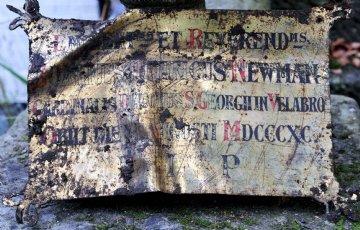
Newman Not Incorrupt (apparently)!

In what is undoubtedly a set-back of some sort for the movement to make former Cardinal Newman a saint, it is being reported that no significant physical remains of Newman were found in his coffin (link).

That will not, of course, stop the movement. I doubt they are looking for suggestions about how to justify classifying him as a "saint." If so, however, you could rely on the obviously supernatural oxidization pattern on the brass plate of his tomb.

Compare:


with


Although perhaps the hand in the second image should be point a bit more downward.

Democrats, however, will be glad to see that the upper left corner of the plate has taken on the silhouette of a donkey's head, thereby symbolizing Cardinal Newman's approval of Senator Biden's bizarre rationalization of his own status as anti-life Romanist.

But seriously, folks - Cardinal Newman (one of the most celebrated "converts" from the Church of England) is not deserving of special attention. Even assuming, for the sake of the argument, that he was a believer, he was a sinner in need of a savior, just like every other person. There is no need, no use, and no value in trying to seek his intercession through prayer. Religious veneration of his remains or of images of him are idolatry - failure to give all religious veneration only to God.

-TurretinFan

Friday, October 03, 2008

How Times Change!

A Bible reading marathon was "too Catholic" according to a rabbi quoted in this article (link), although several Muslims were taking part in the marathon that will be kicked off by the current pope, Benedict XVI.

Nehemiah 9:3 And they stood up in their place, and read in the book of the law of the LORD their God one fourth part of the day; and another fourth part they confessed, and worshipped the LORD their God.

-TurretinFan

Catholicism vs. The Bible

J&J Bible Ministries has a new post on the blog, Truth Matters, with the same title as this post (link). In the post, quotations from the Catechism of the Catholic Church are provided, followed by quotations from the Bible. The only commentary provided is via selection (of course) and through the use of emphasis in the quotations from the CCC.

Without endorsing all the comparisons made, I think the post highlights some areas that Romanists should be prepared to answer, specifically the issues of forgiveness of sins, justification by faith alone, and Mary's role (or absence thereof) in salvation.

-TurretinFan

Active Obedience Required

I recently came across the following proverb. The proverb is superficially witty:

"Drink wine, and you will sleep well. Sleep, and you will not sin. Avoid sin, and you will be saved. Ergo, drink wine and be saved."

This proverb is partly correct. While one is sleeping, for example, one is generally not out stealing, murdering, fornicating, and telling lies. Sins, however, are not limited to positive acts (sins of commission), but also to the absence of positive acts.

The greatest commandment is

Deuteronmy 6:5 And thou shalt love the LORD thy God with all thine heart, and with all thy soul, and with all thy might.

This commandment is a positive one. It is not simply prohibitory, it requires one to act positively toward God, not just refrain from certain sinful acts. Through sleep one can avoid becoming a murderer, but one is also failing to engage in the positive acts commanded in Scripture.

Furthermore, it is the positive acts that are commanded by God that prevent us from ever being able to merit from God. The sixth commandment ("Thou shalt not kill") not only forbids murder, but also implicitly commands us to take actions to preserve life. Thus, when we rally against laws permitting infanticide, we are not performing a meritorious act, we are simply obeying God's commandment.

For recall what Scripture commands:

Leviticus 19:18 Thou shalt not avenge, nor bear any grudge against the children of thy people, but thou shalt love thy neighbour as thyself: I am the LORD.

The proverbial "Good Samaritan" may feel warm and fuzzy after helping out his neighbour, but even the Good Samaritan is simply doing that which God commands. Thus, even the best mere man who most perfectly loves God and his neighbor can only hope to have a very small number of sins on his account: he can never hope to have anything more than debt to God.

Because of this principle, there is only one source of merit. To use a timely analogy, there is only one $700 Billion bailout plan. That one source of merit is Jesus Christ, the righteous. Jesus perfectly obeyed the law of God, thereby earning (under the covenant of works) life. Nevertheless, Jesus sacrificed that life to suffer punishment in place of sinners: punishment he did not personally deserve.

This bailout plan is not a redistribution of wealth from workers to bankers, but is instead redemption for slaves. Even the best mere man is a sinner in God's sight, deserving wrath and hell forever. Christ, by dying redeemed for himself a people out of all parts of the world.

If you are trusting in anything except that one acceptable sacrifice, you will appear before the judge of all the earth in debt, and will be justly sentenced to hell. So now, while there is time, turn from your sins, and embrace the Lamb of God, by whose blood you may be cleansed from your guilt.

You cannot measure up to the law of God on your own. You cannot do so through drinking, through sleeping, or through any amount of effort on your own part. You cannot do so through the assistance of other mere men, for they all (like yourself) are debtors to the law (as it is written "For all have sinned, and come short of the glory of God"). There is only one hope of salvation:

Acts 4:12 Neither is there salvation in any other: for there is none other name under heaven given among men, whereby we must be saved.

Jeremiah 23:6 In his days Judah shall be saved, and Israel shall dwell safely: and this is his name whereby he shall be called, THE LORD OUR RIGHTEOUSNESS.

1 Corinthians 1:30 But of him are ye in Christ Jesus, who of God is made unto us wisdom, and righteousness, and sanctification, and redemption:

Trying to live a good life by avoiding sin is not enough. The time is fulfilled, and the kingdom of God is at hand: repent and believe the gospel.

-TurretinFan

Proverbs 1:7

Proverbs 1:7 The fear of the LORD is the beginning of knowledge: but fools despise wisdom and instruction.

This proverb provides a central theme for the book of Proverbs. In order to have true wisdom, one must first submit to the Word of God. Fearing God involves hearing him - it involves listening attentively to what he says and obeying that word. For us, the primary way in which God's word comes is Scripture, including these proverbs.

Wisdom is defined through the great commandment:

Deuteronomy 6:5 And thou shalt love the LORD thy God with all thine heart, and with all thy soul, and with all thy might.

This may seem unexpected to the natural mind. We routinely see atheists mocking our quotation of Scripture. They tell us they need "scientific proof" and refuse to hear the Word of God. This is simply the way of the natural mind. It despises the Wisdom of God ... it does not recognize it for what it is.

There are few fools that knowingly reject wisdom, though they recognize it as such. More often fools despise wisdom because they do not recognize it for what it is. That is truly a pitiful sight. Let us take it to heart, fear the Lord, and increase our wisdom.

Notice also, though that fools despise instruction. There is nothing more provoking to human pride than correction. Thus, rather than being fools, we ought to be open to instruction. Throughout Proverbs this is key: do what the wise man does, and do not imitate the fool.

Original (Hebrew)
Proverbs 1:7
יראת יהוה ראשׁית דעת חכמה ומוסר אוילים בזו׃

LXX (Greek)
Proverbs 1:7
Ἀρχὴ σοφίας φόβος θεοῦ, σύνεσις δὲ ἀγαθὴ πᾶσι τοῖς ποιοῦσιν αὐτήν· εὐσέβεια δὲ εἰς θεὸν ἀρχὴ αἰσθήσεως, σοφίαν δὲ καὶ παιδείαν ἀσεβεῖς ἐξουθενήσουσιν.

Vulgate (Latin)
Proverbs 1:7
timor Domini principium scientiae sapientiam atque doctrinam stulti despiciunt

Thursday, October 02, 2008

Curse of the Billy Goat vs. Holy Water

In the "Holy Water Debate" (link to debate), I had made a comparison between the superstitions in baseball and the medieval superstitions surrounding "Holy Water." Unexpectedly, the two have merged for TBS has broadcast some footage of a papist priest sprinkling the Cubs' dugout with "Holy Water," evidently in an effort to reverse the "Curse of the Billy Goat" - the supposed explanation for the failure of the Cubs to win a World Series in a very long time.

Nota Bene: Sprinkling Holy Water to win baseball games is not something that has ever, to my knowledge, been infallibly taught by the Vatican magisterium. In fact, the CCC warns against superstition. That doesn't seem to stop it from happening in Catholicism.

If anyone can tell me the name of the priest (Matthew in the combox has noted that this is "Father" James Greaneus who, according to the article provided, is from the Midwest), his bishop, and whether his activity was sanctioned, I would be appreciative.

-TurretinFan

Wednesday, October 01, 2008

Textual Variant in 1611 KJV

The KJV, 1611 edition, was printed on more than one printing press. While the text printed was generally the same, there was at least one variant. At Ruth 3:15 the text correctly reads (in the current 2/3 majority of extant copies) "she went into the city" instead of "he went into the city", but the remaining about 1/3 have the variant with the misspelling.

Standard version of the KJV:

Ruth 3:15 Also he said, Bring the vail that thou hast upon thee, and hold it. And when she held it, he measured six measures of barley, and laid it on her: and she went into the city.

The KJV-1611 in the form provided with e-Sword reflects the variant:

Ruth 3:15 Also he said, Bring the vaile that thou hast vpon thee, and holde it. And when she helde it, he measured sixe measures of barley, and laide it on her: and he went into the citie.

The Schoenberg Center for Electronic Texts also has a copy of the KJV1611 with the "he" variant (link).

Copies of both variants can be purchased (though the price is quite steep: for an example, click to this site that I cannot vouch for).

For those people who believe that the KJV1611 was itself the subject of verbal plenary inspiration, I suppose the solution to the problem of this variant is to assert that one of the two variants (hopefully the "he" variant) was a later corruption. The problem, of course, is that there is no historical basis for this assertion, as it would appear that the two printings were performed at roughly the same time on at least two printing presses.

I should note that I still think that the KJV is the best English translation that is widely available, and it continues to be my preferred translation for study of the Scripture, for that reason.

-TurretinFan

Proverbs 1:1

Proverbs 1:1 The proverbs of Solomon the son of David, king of Israel;

This verse provides both the title of the book and the author of the first and main section of the book. The author is King Solomon, himself the son of David. Both were the king of Israel. It may be grammatically an open issue of whether "king of Israel" is meant to refer to Solomon or David. I believe that the latter sense is the probable, but the ambiguity is of no consequence.

Some people have attempted to deny that Solomon was the author of the book. Their rationale is that Solomon turned from God. For it is written,

1 Kings 11:6-10
6And Solomon did evil in the sight of the LORD, and went not fully after the LORD, as did David his father. 7Then did Solomon build an high place for Chemosh, the abomination of Moab, in the hill that is before Jerusalem, and for Molech, the abomination of the children of Ammon. 8And likewise did he for all his strange wives, which burnt incense and sacrificed unto their gods. 9And the LORD was angry with Solomon, because his heart was turned from the LORD God of Israel, which had appeared unto him twice, 10And had commanded him concerning this thing, that he should not go after other gods: but he kept not that which the LORD commanded.

The reasoning continues that if Solomon turned away from God, then he was not saved, and that an unsaved person could not be an author of the Holy Scripture. This reasoning is weak in two regards:

1) Scripture indicates the punishment laid upon Solomon for his disobedience. That punishment was (a) taking the ten tribes away from Solomon's son's rule and (b) stirring up adversaries against Solomon.

2) Scripture concludes the account of Solomon in the book of Kings by stating:

1 Kings 11:41-42
41And the rest of the acts of Solomon, and all that he did, and his wisdom, are they not written in the book of the acts of Solomon? 42And the time that Solomon reigned in Jerusalem over all Israel was forty years.

And Scripture concludes the account of Solomon in the Chronicles of the Kings of Israel by stating:

2 Chronicals 9:29-31
29Now the rest of the acts of Solomon, first and last, are they not written in the book of Nathan the prophet, and in the prophecy of Ahijah the Shilonite, and in the visions of Iddo the seer against Jeroboam the son of Nebat? 30And Solomon reigned in Jerusalem over all Israel forty years. 31And Solomon slept with his fathers, and he was buried in the city of David his father: and Rehoboam his son reigned in his stead.

Neither of these accounts suggest that Solomon died in ignominy, though of course that is not conclusive.

3) We are not told whether Solomon repented of his sin or not. The book of Proverbs itself speaks of repentance (see verse 23 of the first chapter, for example). This supports the idea that Solomon himself repented, though it is not conclusive.

4) There is no rule that Scripture must be written by saved men. The word of God has come by the mouth of a donkey and by mouth of King Saul, the suicide. Since we believe in verbal, plenary inspiration, it is irrelevant whether the prophet is himself a righteous or wicked man.

Original (Hebrew)
Proverbs 1:1
משׁלי שׁלמה בן־דוד מלך ישׂראל׃

LXX (Greek)
Proverbs 1:1
Παροιμίαι Σαλωμῶντος υἱοῦ Δαυιδ, ὃς ἐβασίλευσεν ἐν Ισραηλ,

Vulgate (Latin)
Proverbs 1:1
parabolae Salomonis filii David regis Israhel

Tuesday, September 30, 2008

Glossa Ordinaria Electronica

The Glossa Ordinaria is attributed to a 9th century German man named Strabo, who compiled commentary on the Bible, including quotations either from or attributed various church fathers. This gloss never seems to have been officially sanctioned by the pope, but was referenced as being of high authority by Thomas Aquinas. It was popular in the medieval period, and consequently is a valuable aid both for polemicists/apologists and historical theology buffs, as it has an influence to one degree or another on medieval theology.

Now, the scans of a 1603 printing of the Vulgate together with the Glossa Ordinaria have become available, thanks to Archive.org. Sorry, it is still only in Latin.

The following are the Archive.org pages for each of the six volumes as well as a link to the Black and White pdf available for that volume (other formats of the scan are also available).

Volume 1 (b/w pdf) (about 134 MB)
Volume 2 (b/w pdf) (about 116 MB)
Volume 3 (b/w pdf) (about 162 MB)
Volume 4 (b/w pdf) (about 180 MB)
Volume 5 (b/w pdf) (about 139 MB)
Volume 6 (b/w pdf) (about 128 MB)

Enjoy!

-TurretinFan

H.T. to Historical TheoBlogy (link) for bringing this to my attention.

Monday, September 29, 2008

Response to Victor Reppert on 1 Samuel 15

Victor Reppert wrote (not to me ... but it is also relevant to me):
How can you be so strongly pro-life on abortion and also defend killing "babes in arms" as enjoined by I Samuel 15?
I answer:
a) Killing is ordinarily a lawful and just part of warfare; and
b) More particularly, Israel's genocide of the Canaanites was specifically authorized by God as a punishment on the idolatry, necromancy, etc. of the nations of Canaan; but
c) Killing is not ordinarily a lawful and just part of life; and
d) More particularly, killing of unborn infants (at any stage of development) is not ordinarily authorized by God.

-TurretinFan

Cory Tucholski on Mary contra Bellisario

Cory Tucholski has provided a new post (link) on the subject of Mary's alleged Immaculate Conception, against a previous post by Mr. Bellisario. Cory sets out to demonstrate that the doctrine of the Immaculate Conception is an unnecessary tradition that actually denigrates the orthodox doctrine of the Incarnation.

-TurretinFan

Sunday, September 28, 2008

The Child Inside You

Those women who are pregnant, have been pregnant, or think they may one day be pregnant, would do well to check out one of the most advanced set of images I've seen to date showing what is inside the woman from the 6th week onward. (link) It's not just a lump of tissue - its a tiny person developing and growing in ways that are normally impossible to observe.

And though we know a lot more about when it happens than did our ancestors, even now the growth of children in the womb is quite a marvel to observe.

Ecclesiastes 11:5 As thou knowest not what is the way of the spirit, nor how the bones do grow in the womb of her that is with child: even so thou knowest not the works of God who maketh all.

-TurretinFan

H.T. Melinda at Stand to Reason for bringing this to my attention (link).

Proverbs 1:5-6

Proverbs 1:5-6
5A wise man will hear, and will increase learning; and a man of understanding shall attain unto wise counsels: 6To understand a proverb, and the interpretation; the words of the wise, and their dark sayings.

The Scriptures, and especially the proverbs, are not only for the foolish man to become wise, but also for the wise man to become wiser. In this regard, we may compare the Scriptures to the widow's cruse (I Kings 17) that was replenished daily, so that it never was depleted. So to, repairing frequently to the Holy Scriptures will not cause us to deplete the resources of wisdom, but instead will give us greater wisdom.

Notice that by hearing the wise man becomes wise, increasing his learning. Furthermore, notice that the understanding of the proverb is encompassed within this attainable knowledge together with the interpretation - the words of the wise and those things that harder to understand, the "dark sayings."

Original (Hebrew)
Proverbs 1:5-6
5ישׁמע חכם ויוסף לקח ונבון תחבלות יקנה׃ 6להבין משׁל ומליצה דברי חכמים וחידתם׃

LXX (Greek)
Proverbs 1:5-6
5τῶνδε γὰρ ἀκούσας σοφὸς σοφώτερος ἔσται, ὁ δὲ νοήμων κυβέρνησιν κτήσεται 6νοήσει τε παραβολὴν καὶ σκοτεινὸν λόγον ῥήσεις τε σοφῶν καὶ αἰνίγματα.

Vulgate (Latin)
Proverbs 1:5-6
5audiens sapiens sapientior erit et intellegens gubernacula possidebit 6animadvertet parabolam et interpretationem verba sapientium et enigmata eorum

-TurretinFan