
I have enjoyed reading the past series of articles from Qayaq Traveler, most of which have had something to do with the real Francis Turretin. (link) I think he's probably actually posted more about Turretin than I have! He also seems to have an interest in Clark. I'll have to remind myself that this isn't a competition.
Keep up the good work, fellow traveler!
-Turretinfan
Saturday, December 22, 2007

What Would the Apostle John Say?
This statue of Artemis
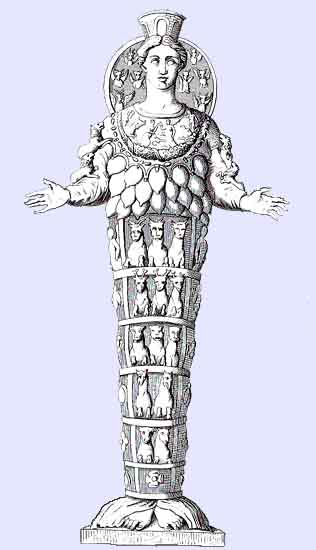
And This statue of Hera

are totally unlike
This statue:

So, while it is fair game to say that Greeks worshipped statues, do not suggest that the same is true of Catholics.
Got it?
Of course, I speak tongue in cheek.
The Apostle John had simple instructions: Little children, keep yourselves from idols.
Moses had simple instructions: Thou shalt not make unto thyself any graven image.
Has the point been made? Do you see where this use of idols came from? Do you see that it's wrong? Does my pointing this out, make you angry with me? I'm not that concerned about whether you will be angry with me or not, if you will turn from your idols to worship the living and true God in spirit and in truth.
We preach to you a gospel different from that which is preached by the man in third picture above. He labels his message "Christ Our Hope" - but he preaches a different Christ than the Christ that the Apostle Paul and we preach. The message of the man pictured above is dangerous for it encourages many souls to trust in religion and religiosity for salvation, rather than in Christ.
If there is a difference between the gospel of Rome and the gospel of the Reformation, to whom will you turn to resolve the matter? To your bishops? To our elders?
The only answer can be that we must turn to the Scriptures to see which group of men have the same gospel that Paul preached. Anyone can use the label "Christ our hope" (taken from 1 Timothy 1:1), but it is important to know the true Christ.
You may realize that simply reading the Scriptures will not be enough to ensure you get it right, for many before you have read the Scriptures and arrived at differing conclusions. What's missing, then, from my advice? Prayer. Pray to God to send His Holy Spirit upon you to give you wisdom to understand whether the religion of Rome or of the Reformation is true. Seek wisdom earnestly, for only a fool thinks he already knows all.
Many will say, "Lord, Lord," but will not enter into the kingdom. Do not be one of them. Take heed to your souls!
-Turretinfan
Friday, December 21, 2007
What the other Hodge and I believe about the Atonement
In a previous post (link), I identified what Charles Hodge and I believe about the atonement, as taken from Hodge's Systematic Theology. There's a great deal more that Hodge said that is relevant to the issue: the relevant chapters of his Systematic Theology stretch over 100 pages.
I thought I'd switch over, for a post, to his son, Archibald Alexander Hodge. Neither Hodge requires any introduction in Reformed circles, so I'll get right to the meat, with these quotations from his commentary on the Westminster Confession of Faith:
*******
Chapter 8, Section 6, Numbered Paragraph 2:
Christ thus has, in strict rigor, fully satisfied all the demands of divine justice upon those whom he represents. Jesus Christ has met the divine demand that the original covenant of works be fulfilled through the sorrow of His life and death, and he has met the divine demand for essential justice in the punishment of sin through the obedience unto death. Christ suffered as the representative of sinners. Our sins were laid upon him. He, "hath redeemed us from the curse of the law by being made a curse for us." He died, "the just for the unjust." "He is the propitiation (expiation) for our sins." He "gave his life a ransom for many." We are "bought with a price." (Gal. 3:13; 1 Pet. 3:18; 1 John 2:2; Matt. 20:28; 1 Cor. 6:20.) Christ suffered only in his single human soul and body, and only for a time. Nevertheless, his person was the infinite and transcendently glorious person of the eternal Son of God. Consequently his sufferings were precisely, both in kind and in degree, what the infinitely righteous wisdom of God saw to be in strict rigor a full equivalent, in respect to the demands of legal justice, for the eternal sufferings of all for whom he suffered. This is the doctrine of the whole Christian Church. The Thirty-nine Articles of the Church of England, say, Art. 31: "The offering of Christ, once made, is that perfect redemption, propitiation, and satisfaction, for all the sins of the whole world, both original and actual."
*******
Chapter 8, Section 6, Numbered Paragraph 3:
This proves, therefore-(1) That Christ did not die simply to make the salvation of those for whom he died possible-i.e., to remove legal obstructions to their salvation-but that he died with the design and effect of actually securing their salvation and of endowing them gratuitously with an inalienable title to heaven. (2) It proves, in the second place, that the vicarious sufferings of Christ must have been, in design and effect, personal and definite as to their object. Salvation must be applied to all those for whom it was purchased. Since not the possibility or opportunity for reconciliation, but actual reconciliation itself was purchased; since not only reconciliation, but a title to an eternal inheritance was purchased, it follows (a) That "to all those for whom Christ hath purchased redemption, he doth certainly and effectually apply and communicate the same." (Conf. Faith, ch. 8. s. 8.) And (b) That he who never receives the inheritance, and to whom the purchased grace is never applied, is not one of the persons for whom it was purchased.
*******
Chapter 8, Section 8, Numbered Paragraph 3:
Our Standards, it will be observed, very explicitly teach that Christ, as mediatorial Priest, made expiation and purchased salvation for certain definite persons. Thus, in chap. 3. s. 6, it is said: "As God has appointed the elect unto glory, so has he by the eternal and most free purpose of his will, foreordained all the means thereunto. Wherefore they who are elected being fallen in Adam, are redeemed by Christ. . . . Neither are any other redeemed by Christ, . . . but the elect only." Here it is expressly affirmed (1) That Christ died upon the cross on purpose to carry out the eternal purpose of God in the election of certain individuals to eternal life. (2) That Christ died for the purpose of saving no other than the elect.
*******
(source) (for all quotations above)
This is, of course, the same thing being said by Hodge's father, and by Shedd and many other Reformed authors as well. Compare, for example, the similar remarks by Robert Shaw (link).
May God be praised,
-Turretinfan
I thought I'd switch over, for a post, to his son, Archibald Alexander Hodge. Neither Hodge requires any introduction in Reformed circles, so I'll get right to the meat, with these quotations from his commentary on the Westminster Confession of Faith:
*******
Chapter 8, Section 6, Numbered Paragraph 2:
Christ thus has, in strict rigor, fully satisfied all the demands of divine justice upon those whom he represents. Jesus Christ has met the divine demand that the original covenant of works be fulfilled through the sorrow of His life and death, and he has met the divine demand for essential justice in the punishment of sin through the obedience unto death. Christ suffered as the representative of sinners. Our sins were laid upon him. He, "hath redeemed us from the curse of the law by being made a curse for us." He died, "the just for the unjust." "He is the propitiation (expiation) for our sins." He "gave his life a ransom for many." We are "bought with a price." (Gal. 3:13; 1 Pet. 3:18; 1 John 2:2; Matt. 20:28; 1 Cor. 6:20.) Christ suffered only in his single human soul and body, and only for a time. Nevertheless, his person was the infinite and transcendently glorious person of the eternal Son of God. Consequently his sufferings were precisely, both in kind and in degree, what the infinitely righteous wisdom of God saw to be in strict rigor a full equivalent, in respect to the demands of legal justice, for the eternal sufferings of all for whom he suffered. This is the doctrine of the whole Christian Church. The Thirty-nine Articles of the Church of England, say, Art. 31: "The offering of Christ, once made, is that perfect redemption, propitiation, and satisfaction, for all the sins of the whole world, both original and actual."
*******
Chapter 8, Section 6, Numbered Paragraph 3:
This proves, therefore-(1) That Christ did not die simply to make the salvation of those for whom he died possible-i.e., to remove legal obstructions to their salvation-but that he died with the design and effect of actually securing their salvation and of endowing them gratuitously with an inalienable title to heaven. (2) It proves, in the second place, that the vicarious sufferings of Christ must have been, in design and effect, personal and definite as to their object. Salvation must be applied to all those for whom it was purchased. Since not the possibility or opportunity for reconciliation, but actual reconciliation itself was purchased; since not only reconciliation, but a title to an eternal inheritance was purchased, it follows (a) That "to all those for whom Christ hath purchased redemption, he doth certainly and effectually apply and communicate the same." (Conf. Faith, ch. 8. s. 8.) And (b) That he who never receives the inheritance, and to whom the purchased grace is never applied, is not one of the persons for whom it was purchased.
*******
Chapter 8, Section 8, Numbered Paragraph 3:
Our Standards, it will be observed, very explicitly teach that Christ, as mediatorial Priest, made expiation and purchased salvation for certain definite persons. Thus, in chap. 3. s. 6, it is said: "As God has appointed the elect unto glory, so has he by the eternal and most free purpose of his will, foreordained all the means thereunto. Wherefore they who are elected being fallen in Adam, are redeemed by Christ. . . . Neither are any other redeemed by Christ, . . . but the elect only." Here it is expressly affirmed (1) That Christ died upon the cross on purpose to carry out the eternal purpose of God in the election of certain individuals to eternal life. (2) That Christ died for the purpose of saving no other than the elect.
*******
(source) (for all quotations above)
This is, of course, the same thing being said by Hodge's father, and by Shedd and many other Reformed authors as well. Compare, for example, the similar remarks by Robert Shaw (link).
May God be praised,
-Turretinfan
What Hodge and I Believe about the Atonement
From Hodge's Systematic Theology, Volume II, Chapter 7, Section "Argument from Related Doctrines," numbered paragraph 1 (pp. 520-21) (the following has been edited by being broken into smaller paragraphs):
********
No doctrine of the Bible, relating to the plan of salvation, is more plainly taught or more wide reaching than that which concerns the union between Christ and his people. That union in one aspect, was from eternity, we were in Him before the foundation of the world; given to Him of the Father, to redeem from the estate of sin and misery, into which it was foreseen our race would by transgression fall. It was for the accomplishment of this purpose of mercy that He assumed our nature, was born of a woman, and did and suffered all that He was called upon to do and to endure in working out our salvation.
He did not, therefore, come into the world for Himself. It was not to work out a righteousness of his own to entitle Him to the exaltation and power which in our nature He now enjoys. In virtue of the Godhead of his personality, He was of necessity infinitely exalted above all creatures. He came for us. He came as a representative. He came in the same relation to his people, which Adam, in the original covenant, bore to the whole race. He came to take their place; to be their substitute, to do for them, and in their name, what they could not do for themselves.
All He did, therefore, was vicarious; his obedience and his sufferings. The parallel between Adam and Christ, the two great representatives of man, the two federal heads, the one of all his natural descendants, the other of all given Him by the Father, is carried out into its details in Romans v. 12-21. It is assumed or implied, however, everywhere else in the sacred volume. What Adam did, in his federal capacity, was in law and justice regarded as done by all whom he represented. And so all that Christ did and suffered as a federal head, was in law and justice done or suffered by his people.
Therefore, as we were condemned for the disobedience of Adam, so we are justified for the obedience of Christ. As in Adam all died, so in Christ are all made alive. Hence Christ’s death is said to be our death, and we are said to rise with Him, to live with Him, and to be exalted, in our measure, in his exaltation. He is the head and we are the body. The acts of the head, are the acts of the whole mystical person.
The ideas, therefore, of legal substitution, of vicarious obedience and punishment, of the satisfaction of justice by one for all, underlie and pervade the whole scheme of redemption. They can no more be separated from that scheme than the warp can be separated from the woof without destroying the whole texture.
********
You can imagine how someone could read "the satisfaction by one for all" and think that Hodge held to a view that Christ died for the reprobate. Hopefully the remainder of the paragraph makes it clear that he and I do not think that, but instead hold that Christ came, died, and rose again for the purpose of saving his people (those for whom he is the federal head - those whom he represented on the cross) from their sins.
May God be Glorified!
-Turretinfan
P.S. Incidentally, this week has been a bit hectic. I hope to provide for the atonement debate a brief argument (my original draft got quite long and ungainly) as to why Hebrews 10 is talking about the same group Hodge is talking about in the paragraphs above.
********
No doctrine of the Bible, relating to the plan of salvation, is more plainly taught or more wide reaching than that which concerns the union between Christ and his people. That union in one aspect, was from eternity, we were in Him before the foundation of the world; given to Him of the Father, to redeem from the estate of sin and misery, into which it was foreseen our race would by transgression fall. It was for the accomplishment of this purpose of mercy that He assumed our nature, was born of a woman, and did and suffered all that He was called upon to do and to endure in working out our salvation.
He did not, therefore, come into the world for Himself. It was not to work out a righteousness of his own to entitle Him to the exaltation and power which in our nature He now enjoys. In virtue of the Godhead of his personality, He was of necessity infinitely exalted above all creatures. He came for us. He came as a representative. He came in the same relation to his people, which Adam, in the original covenant, bore to the whole race. He came to take their place; to be their substitute, to do for them, and in their name, what they could not do for themselves.
All He did, therefore, was vicarious; his obedience and his sufferings. The parallel between Adam and Christ, the two great representatives of man, the two federal heads, the one of all his natural descendants, the other of all given Him by the Father, is carried out into its details in Romans v. 12-21. It is assumed or implied, however, everywhere else in the sacred volume. What Adam did, in his federal capacity, was in law and justice regarded as done by all whom he represented. And so all that Christ did and suffered as a federal head, was in law and justice done or suffered by his people.
Therefore, as we were condemned for the disobedience of Adam, so we are justified for the obedience of Christ. As in Adam all died, so in Christ are all made alive. Hence Christ’s death is said to be our death, and we are said to rise with Him, to live with Him, and to be exalted, in our measure, in his exaltation. He is the head and we are the body. The acts of the head, are the acts of the whole mystical person.
The ideas, therefore, of legal substitution, of vicarious obedience and punishment, of the satisfaction of justice by one for all, underlie and pervade the whole scheme of redemption. They can no more be separated from that scheme than the warp can be separated from the woof without destroying the whole texture.
********
You can imagine how someone could read "the satisfaction by one for all" and think that Hodge held to a view that Christ died for the reprobate. Hopefully the remainder of the paragraph makes it clear that he and I do not think that, but instead hold that Christ came, died, and rose again for the purpose of saving his people (those for whom he is the federal head - those whom he represented on the cross) from their sins.
May God be Glorified!
-Turretinfan
P.S. Incidentally, this week has been a bit hectic. I hope to provide for the atonement debate a brief argument (my original draft got quite long and ungainly) as to why Hebrews 10 is talking about the same group Hodge is talking about in the paragraphs above.
Finally, a Free Ethiopic Grammar!
I doubt very much that many of my readers had been waiting eagerly for the announcement, but Google Books has an apparently mostly complete (perhaps totally complete, I haven't scanned thoroughly enough to be sure) copy of Dillman's "Ethiopic Grammar" (1907) (link). For those who like something bound, I think this was recently reprinted in 2003.
For those interested in textual criticism, who are really interested in tracking down the attestation of the Ethiopic/Aetheopic (or other spellings) translation of the Bible (which was apparently fairly early, and which apparently had little contact with Rome over the years), this is an essential resource. If there is a better work on the subject in any language (even in Amharic), I'm unaware of it.
For most everyone else, they will probably just chuckle at my excitement.
May God be glorified, and His people (whatever language they speak) be edified.
-Turretinfan
For those interested in textual criticism, who are really interested in tracking down the attestation of the Ethiopic/Aetheopic (or other spellings) translation of the Bible (which was apparently fairly early, and which apparently had little contact with Rome over the years), this is an essential resource. If there is a better work on the subject in any language (even in Amharic), I'm unaware of it.
For most everyone else, they will probably just chuckle at my excitement.
May God be glorified, and His people (whatever language they speak) be edified.
-Turretinfan
Wednesday, December 19, 2007
Fictional Dialog with Arthur Legalist
is Gnu Believer interviews Arthur Legalist in this recent dialog:
G. Believer: Welcome, Arthur. Why have you agreed to come on the show?
A. Legalist: Well, I want to talk to you about a real problem I've noticed.
GB: What's that?
AL: It's really the worst sin of our time. It has destroyed many lives.
GB: What's that? Non-Christianity, Murder, Idolatry, Adultery, Profanity/Blasphemy, Covetousness, Theft, Disobedience to Parents, Sabbath-breaking, or Lying?
AL: No, not exactly.
GB: Failure to Love God or our neighbor?
AL: No.
GB: What then?
AL: It's the scourge of [omitted].
GB: Interesting. The folks who led me to Christ taught me that our rule of faith and life is Scripture - but I don't know Scripture that well.
AL: (nodding)
GB: So, pardon my ignorance, but where does the Bible condemn [omitted].
AL: Well, it doesn't explicitly do so, at least not in so many words. The Bible doesn't say "Thou shalt not [omitted]." But the only biblical position that Christians today can have is one of total avoidance of [omitted].
GB: Didn't Paul sort of encourage [omitted]?
AL: Yes. That's true, but it's been abused.
GB: I'm not that sage, but does the Bible say that if something is abused it must be prohibited?
AL: Not in so many words.
GB: So, whose rule is this?
AL: Well, it's mine - but its the only sensible and proper thing. We Christians are called to be wise, and this is the wise thing to do.
GB: Again, I'm not such a seasoned Christian as you are, but perhaps a better solution would be to curb the abuse of [omitted].
AL: NO! WE MUST STOP [omitted] NOW! And if you don't agree, I'm going to see to it that trouble comes your way.
Now, consider for yourself what was omitted from that dialog.
Done?
It's a very dangerous thing to start accreting rules of life that are not Scriptural.
May God be thanked for all that He gives,
-Turretinfan
Keywords: Cosmetics, Jewelry, Meat, Caffeine, Alcohol, Tobacco, Firearms, Carbs, Fat, Sugar, Sugar-Substitutes, Motorcycling, Slavery, Tatoos, Rational Thought, Time at Work, Time with your Family
G. Believer: Welcome, Arthur. Why have you agreed to come on the show?
A. Legalist: Well, I want to talk to you about a real problem I've noticed.
GB: What's that?
AL: It's really the worst sin of our time. It has destroyed many lives.
GB: What's that? Non-Christianity, Murder, Idolatry, Adultery, Profanity/Blasphemy, Covetousness, Theft, Disobedience to Parents, Sabbath-breaking, or Lying?
AL: No, not exactly.
GB: Failure to Love God or our neighbor?
AL: No.
GB: What then?
AL: It's the scourge of [omitted].
GB: Interesting. The folks who led me to Christ taught me that our rule of faith and life is Scripture - but I don't know Scripture that well.
AL: (nodding)
GB: So, pardon my ignorance, but where does the Bible condemn [omitted].
AL: Well, it doesn't explicitly do so, at least not in so many words. The Bible doesn't say "Thou shalt not [omitted]." But the only biblical position that Christians today can have is one of total avoidance of [omitted].
GB: Didn't Paul sort of encourage [omitted]?
AL: Yes. That's true, but it's been abused.
GB: I'm not that sage, but does the Bible say that if something is abused it must be prohibited?
AL: Not in so many words.
GB: So, whose rule is this?
AL: Well, it's mine - but its the only sensible and proper thing. We Christians are called to be wise, and this is the wise thing to do.
GB: Again, I'm not such a seasoned Christian as you are, but perhaps a better solution would be to curb the abuse of [omitted].
AL: NO! WE MUST STOP [omitted] NOW! And if you don't agree, I'm going to see to it that trouble comes your way.
Now, consider for yourself what was omitted from that dialog.
Done?
It's a very dangerous thing to start accreting rules of life that are not Scriptural.
May God be thanked for all that He gives,
-Turretinfan
Keywords: Cosmetics, Jewelry, Meat, Caffeine, Alcohol, Tobacco, Firearms, Carbs, Fat, Sugar, Sugar-Substitutes, Motorcycling, Slavery, Tatoos, Rational Thought, Time at Work, Time with your Family
Tuesday, December 18, 2007
Cheerful Stroll Down the Broad Road
It was disappointing to read this recent blog post (link) by Alvin Kimel (a Roman Catholic priest) who had led us to believe that he had given up blogging (link and link). He presents the post as though he is not afraid of death and hell, as though he is whistling along the path, and yet the fact remains that he is on the broad road that leads to destruction - and unless he turns, destruction will find him, no matter how unafraid he may claim to be.
Here is a man who will openly state that "I do not believe God to be the absolute predestinarian of Augustine, Calvin, Beza, and Bañez." Amidst various blasphemies Kimel writes: "The God and Father of Jesus Christ intends the eternal salvation of every human being he has made and will make, without exception."
There are only two ways to go from there:
1) Universalism; and
2) Calling God a failure.
If Kimel's claim is true, God either will save all mankind or God is unable to achieve what he intends. The former is an utterly useless doctrine. If it is true, we do not need it, and if it is false, we do not want it. The latter denies God's essential attribute of omnipotence.
Kimel's condemnation, as things stand, is just. He even admits: "I know that I traduce the vast theological work of St Augustine."
He states: "I do not fear the God who is Holy Trinity. I fear my own freedom to turn from this God, to hide myself in an impenetrable egotism and despair which will forever close me to the roar of his love." Kimel's position is the consistent position of the semi-Pelagian who elevates himself to the determinative cause of his own salvation. He lacks fear of the Judge, he fears himself. He ought to fear God and God's judgment, and that ought to push him to renounce his own freedom as the source of his salvation. If you fear yourself, it would seem that you are trusting in yourself.
Kimel states that "to this Jesus I entrust my future; to his Father I commend my spirit" but he does so without knowing who Jesus is. He does not know the Logos, the Word made flesh, the omnipotent God the Son. The problem with Kimel's confession of faith is not that he got the names wrong. It is in the Holy Trinity that we must trust.
The problem with Kimel's confession of faith is the disclaimer, the fact that Kimel still fails to know the love of God. It is not his faith in Christ that assures him of God's love, but a sub-omnipotent view of divine omnicordiality. But for the Christian, this is not so.
Our love for God demonstrates to us that he loved us first. Our awareness of our transformation from God-haters and blasphemers to lovers of God makes us aware that God has begun a good work in us. Our knowledge that God is omnipotent to finish what he started gives us assurance that we will be saved from judgment.
There is still time for Kimel, that he will repent and turn to Christ. Many have done so before him, from Augustine to Luther, and so on. But he must turn to the Christ of the Gospel, not to the myth of Christ presented by the Vatican. He must turn to Christ and trust in Christ alone for salvation: not to the mediatorial work of the Mother of Christ or passed-on saints, not to a treasury of merit, not merely on a belief in the general mercy of God (though God is merciful).
Kimel has the law, he knows he is a sinner, and he confesses the same. He is aware of his sins, and he is afraid of judgment, no matter how stiff an upper lip he may put on. Kimel needs a savior: someone to take his place. There is only one available: Christ Jesus, God Almighty made man. He is the one mediator - the one advocate. If anyone believes on him for salvation, they will not be ashamed on judgment day. Let us pray that Kimel will be blessed with God's grace, to embrace the God who has mercy on whom He will have mercy and hardens whom He will.
May God be Magnified!
-Turretinfan
Here is a man who will openly state that "I do not believe God to be the absolute predestinarian of Augustine, Calvin, Beza, and Bañez." Amidst various blasphemies Kimel writes: "The God and Father of Jesus Christ intends the eternal salvation of every human being he has made and will make, without exception."
There are only two ways to go from there:
1) Universalism; and
2) Calling God a failure.
If Kimel's claim is true, God either will save all mankind or God is unable to achieve what he intends. The former is an utterly useless doctrine. If it is true, we do not need it, and if it is false, we do not want it. The latter denies God's essential attribute of omnipotence.
Kimel's condemnation, as things stand, is just. He even admits: "I know that I traduce the vast theological work of St Augustine."
He states: "I do not fear the God who is Holy Trinity. I fear my own freedom to turn from this God, to hide myself in an impenetrable egotism and despair which will forever close me to the roar of his love." Kimel's position is the consistent position of the semi-Pelagian who elevates himself to the determinative cause of his own salvation. He lacks fear of the Judge, he fears himself. He ought to fear God and God's judgment, and that ought to push him to renounce his own freedom as the source of his salvation. If you fear yourself, it would seem that you are trusting in yourself.
Kimel states that "to this Jesus I entrust my future; to his Father I commend my spirit" but he does so without knowing who Jesus is. He does not know the Logos, the Word made flesh, the omnipotent God the Son. The problem with Kimel's confession of faith is not that he got the names wrong. It is in the Holy Trinity that we must trust.
The problem with Kimel's confession of faith is the disclaimer, the fact that Kimel still fails to know the love of God. It is not his faith in Christ that assures him of God's love, but a sub-omnipotent view of divine omnicordiality. But for the Christian, this is not so.
Our love for God demonstrates to us that he loved us first. Our awareness of our transformation from God-haters and blasphemers to lovers of God makes us aware that God has begun a good work in us. Our knowledge that God is omnipotent to finish what he started gives us assurance that we will be saved from judgment.
There is still time for Kimel, that he will repent and turn to Christ. Many have done so before him, from Augustine to Luther, and so on. But he must turn to the Christ of the Gospel, not to the myth of Christ presented by the Vatican. He must turn to Christ and trust in Christ alone for salvation: not to the mediatorial work of the Mother of Christ or passed-on saints, not to a treasury of merit, not merely on a belief in the general mercy of God (though God is merciful).
Kimel has the law, he knows he is a sinner, and he confesses the same. He is aware of his sins, and he is afraid of judgment, no matter how stiff an upper lip he may put on. Kimel needs a savior: someone to take his place. There is only one available: Christ Jesus, God Almighty made man. He is the one mediator - the one advocate. If anyone believes on him for salvation, they will not be ashamed on judgment day. Let us pray that Kimel will be blessed with God's grace, to embrace the God who has mercy on whom He will have mercy and hardens whom He will.
May God be Magnified!
-Turretinfan
Saturday, December 15, 2007
Mormons are not Christians
One would think that the title of this post would be wholly unnecessary. It's more or less what 90% of the Mormon "missionaries" that have approached me over the years have acknowledged. It's clear that they deny they doctrine of the Trinity, whereas it is clear that the Trinity is accepted by all Christians.
Mormons have a new and different gospel, and a new and different prophet. They are no more Christians than Muslims are Christians.
Yet, for some reasons, perhaps for political reasons - they now wish to be called "Christians." Some misguided person has even started a blog (one post so far) called "Mormons are Christian" (link - not recommended).
Their distinctiveness from Christianity is even to be seen in the self-title that they prefer for themselves, the "Church of Jesus Christ of the the Latter-Day Saints" in contradistinction from the historical Church of our (Christians) Lord and Saviour Jesus Christ.
They refuse to accept the truth of this verse:
John 10:30 I and my Father are one.
Others, such as James White, have done much more thorough responses to Mormonism, and I'm not going to reduplicate their efforts here. Here's a link to the Alpha & Omega Ministries Articles on Mormonism, for more detailed reading. If all you've seen is "The Godmakers," your knowledge of Mormonism is probably out of date. There's a lot of material to be read. If you're interested, get started (link).
-Turretinfan
Mormons have a new and different gospel, and a new and different prophet. They are no more Christians than Muslims are Christians.
Yet, for some reasons, perhaps for political reasons - they now wish to be called "Christians." Some misguided person has even started a blog (one post so far) called "Mormons are Christian" (link - not recommended).
Their distinctiveness from Christianity is even to be seen in the self-title that they prefer for themselves, the "Church of Jesus Christ of the the Latter-Day Saints" in contradistinction from the historical Church of our (Christians) Lord and Saviour Jesus Christ.
They refuse to accept the truth of this verse:
John 10:30 I and my Father are one.
Others, such as James White, have done much more thorough responses to Mormonism, and I'm not going to reduplicate their efforts here. Here's a link to the Alpha & Omega Ministries Articles on Mormonism, for more detailed reading. If all you've seen is "The Godmakers," your knowledge of Mormonism is probably out of date. There's a lot of material to be read. If you're interested, get started (link).
-Turretinfan
Did Calvin Hold to the Doctrine of Limited Atonement?
Dr. Roger Nicole (link to theopedia entry) explains that Calvin did in this interesting article (link). He's a visiting professor Reformed Theological Seminary. He's identified as an expert (and his work recommend) on Amyraut by Prof. John Frame (link).
-Turretinfan
-Turretinfan
Animal Training - Choice in Lower Creatures Illustrated
Here's an amazing video of a man who has trained a turtle to obey his commands. The tricks would not be amazing if we were dealing with a dog, but they are rather impressive for a turtle.
I'm not sure that too many of my readers have ever tried obtaining turtilian(FN1) compliance with commands, but it is not easy. Turtles are not super-compliant animals.
But I think it is fair to point out that the result shown is not simply "turtle instinct," but instead is the result of man directing the exercise of a lower creature's will.
Enjoy!
(link)
-Turretinfan
Footnote 1: Do not confuse with Tertullian.
I'm not sure that too many of my readers have ever tried obtaining turtilian(FN1) compliance with commands, but it is not easy. Turtles are not super-compliant animals.
But I think it is fair to point out that the result shown is not simply "turtle instinct," but instead is the result of man directing the exercise of a lower creature's will.
Enjoy!
(link)
-Turretinfan
Footnote 1: Do not confuse with Tertullian.
Friday, December 14, 2007
Repost of Followup Questions
1) Is Christ's taking away "the legal claims of the law" of any ultimate benefit to the reprobate? If so, what?
2) Ransom is deliverance language, true, but it specifically is deliverance by payment (in English, anyhow - cf. Proverbs 6:35 or 13:8 or Psalm 49:7 or Job 36:18). Is your claim that this is a mistranslation (or just weak translation) or that it has become a weak translation (because English used to mean something else) or what?Is "delivered ... out of the Law of death" exactly equal to having the "legal claims of the law" removed, or are you trying to say something different here?
3) Was Christ the federal head of mankind (exhaustively) only with respect to the "legal claims of the law"? (or with respect to other aspects of salvation, assuming there are other aspects)
4) Does the Father also desire those to come whom the Son desires to come? If so, why does not the Father draw all men universally to himself? If not, why does the Son differ in his desire from the Father?
Those are the previous questions that I asked on your blog, and to which - as far as I can tell - you never responded.
To those, I add:
5) If the sin of the reprobate has been "wiped away" - on what legal basis are they judged?
-Turretinfan
2) Ransom is deliverance language, true, but it specifically is deliverance by payment (in English, anyhow - cf. Proverbs 6:35 or 13:8 or Psalm 49:7 or Job 36:18). Is your claim that this is a mistranslation (or just weak translation) or that it has become a weak translation (because English used to mean something else) or what?Is "delivered ... out of the Law of death" exactly equal to having the "legal claims of the law" removed, or are you trying to say something different here?
3) Was Christ the federal head of mankind (exhaustively) only with respect to the "legal claims of the law"? (or with respect to other aspects of salvation, assuming there are other aspects)
4) Does the Father also desire those to come whom the Son desires to come? If so, why does not the Father draw all men universally to himself? If not, why does the Son differ in his desire from the Father?
Those are the previous questions that I asked on your blog, and to which - as far as I can tell - you never responded.
To those, I add:
5) If the sin of the reprobate has been "wiped away" - on what legal basis are they judged?
-Turretinfan
Open Question to Seth on the Atonement Debate
After reflecting on our debate, it has occurred to me that perhaps our original resolution(s) was(were) not very well defined:
You posted this statement of the resolution:
*** QUOTE ***
Resolved: Christ's sacrifice has saved or will save each person upon whose behalf it was offered.
I will be denying that [assertion] and affirming that Christ died universally for the whole world, especially the elect.
*** END OF QUOTE ***
(source)
In the debate, I tried to ask you whether you were intending to take the position that Christ died with the intent that the benefits of his death would be applied to the reprobate.
Specifically I asked:
Did Christ die intending to save the reprobate?
You gave the following answer:
Christ died to pay for the sins of the world with the intention to save the elect. God's salvific will is purposed for only the elect, but his desire is for all to come to salvation. This is the famous "two-wills of God" theory, which I hold to. So this is where the multiple intentions comes in the discussion. Christ died for the whole of mankind, but his special love for the elect was the "joy set before him" and that is why he "endured the cross."
Try as I might, I cannot be sure whether that is supposed to be an affirmative or negative answer to the question.
If you are simply saying that Christ's death was of sufficient value to save the reprobate, we have no debate.
If you are simply saying that Christ's death would save the reprobate, if the reprobate man turned in faith to Christ, we have no debate.
I asked you follow-up questions in the comments section of your post, but I don't see any response, so I'm left wondering whether your intended disagreement with my position is anything more than a semantic disagreement.
After all, some of the folks on your side have suggested that they are merely holding to the teachings of Hodge and Shedd.
Yet Shedd clearly taught limited redemption (while semantically differentiating that from "unlimited" [that is to say, unlimited in intrinsic value] atonement):
 (Dogmatic Theology, p. 471)
So the question remains for you, what is it that you believe Christ intended on the cross as far as the salvation of the reprobate go? Was Christ offering his infinitely valuable sacrifice with the intent to save others than those whom he actually will save?
If you do not believe that Christ intended on the cross to save the reprobate, I'm not sure how you can reasonably say that you disagree with my assertion: "Christ's sacrifice has saved or will save each person upon whose behalf it was offered." - at least, as far as I intended it.
And if you are only disagreeing with it in a sense in which I did not intend it, perhaps we ought to call off the debate, as fundamentally (though not semantically) in agreement with each other.
-Turretinfan
You posted this statement of the resolution:
*** QUOTE ***
Resolved: Christ's sacrifice has saved or will save each person upon whose behalf it was offered.
I will be denying that [assertion] and affirming that Christ died universally for the whole world, especially the elect.
*** END OF QUOTE ***
(source)
In the debate, I tried to ask you whether you were intending to take the position that Christ died with the intent that the benefits of his death would be applied to the reprobate.
Specifically I asked:
Did Christ die intending to save the reprobate?
You gave the following answer:
Christ died to pay for the sins of the world with the intention to save the elect. God's salvific will is purposed for only the elect, but his desire is for all to come to salvation. This is the famous "two-wills of God" theory, which I hold to. So this is where the multiple intentions comes in the discussion. Christ died for the whole of mankind, but his special love for the elect was the "joy set before him" and that is why he "endured the cross."
Try as I might, I cannot be sure whether that is supposed to be an affirmative or negative answer to the question.
If you are simply saying that Christ's death was of sufficient value to save the reprobate, we have no debate.
If you are simply saying that Christ's death would save the reprobate, if the reprobate man turned in faith to Christ, we have no debate.
I asked you follow-up questions in the comments section of your post, but I don't see any response, so I'm left wondering whether your intended disagreement with my position is anything more than a semantic disagreement.
After all, some of the folks on your side have suggested that they are merely holding to the teachings of Hodge and Shedd.
Yet Shedd clearly taught limited redemption (while semantically differentiating that from "unlimited" [that is to say, unlimited in intrinsic value] atonement):
 (Dogmatic Theology, p. 471)
So the question remains for you, what is it that you believe Christ intended on the cross as far as the salvation of the reprobate go? Was Christ offering his infinitely valuable sacrifice with the intent to save others than those whom he actually will save?
If you do not believe that Christ intended on the cross to save the reprobate, I'm not sure how you can reasonably say that you disagree with my assertion: "Christ's sacrifice has saved or will save each person upon whose behalf it was offered." - at least, as far as I intended it.
And if you are only disagreeing with it in a sense in which I did not intend it, perhaps we ought to call off the debate, as fundamentally (though not semantically) in agreement with each other.
-Turretinfan
Thursday, December 13, 2007
Summary of Two Economies of the Covenant of Grace
The real Turretin's comments on the covenant of grace in its two-fold economy are summarized by Nathan Lewis, here(link).
-Turretinfan
-Turretinfan
Wednesday, December 12, 2007
Response to Federal Vision Error
The following is taken from the Joint Statement on the Federal Vision (this is the statement to which many [Doug Wilson says "all" I think] of the leaders of the FV have subscribed):
A) "Final Salvation"
Salvation is binary. There are different kinds of salvation to be sure, but salvation from hell is an either/or proposition. Christ saves "to the uttermost" not just for a time. To distinguish the salvation of one's soul into "final" and "something else" is to confuse salvation. Salvation is deliverance. There remains no condemnation to anyone who is justified, who has put on Christ's righteousness.
B) "The connection that an apostate has to Christ is not merely external."
1) Yes, it is merely external. The church is an external body. Union with the body of Christ via baptism provides external union: baptism of the Spirit (regeneration) is necessary for more than merely external union. They went out from us, because they were not of us. The apostate were only ever part of Christ outwardly and formally, not inwardly and really. Thus, apostacy is demonstration of a lack of real union with Christ.
2) Additionally, the verb tense is surely wrong. It should state "had."
In other words, surely the writers of the FV JS made a typographic error in stating that apostates presently have a connection to Christ. Even according only to the remainder of the paragraph, it should be clear that the connection that they had was cut off.
C) "Indeed falling from grace"
This terminology "fallen from grace" appears to be taken from:
Galatians 5:4 Christ is become of no effect unto you, whosoever of you are justified by the law; ye are fallen from grace.
There it is used to convey the effect that those who seek justification from works are out of God's favor (grace), and Christ is of no use to such a person:
Galatians 5:2-3
2Behold, I Paul say unto you, that if ye be circumcised, Christ shall profit you nothing. 3For I testify again to every man that is circumcised, that he is a debtor to do the whole law.
It seems, however, that the FVists have misunderstood Galatians 5:4 as suggesting some sort of fall from a state of saving (or perhaps prevenient?) grace.
D) "Apostasy is a terrifying reality for many baptized Christians"
The term "baptized Christians" is one loaded with potential for error. A Christian is one that is one inwardly, and the baptism that matters is of the heart. Apostasy may be a legitimate concern for a weak Christian struggling with sin, but it is not a "terrifying reality." Christians (true Christians) do not apostatize, and just because someone is baptized does not make him a Christian.
The present author has been enjoying Hoeksema's "Righteous by Faith Alone" (link). His commentary on Romans 2 applies marvellously to defeat the FV error with respect to the effect of baptism.
To paraphrase Romans 2:
Romans 2:26-29 (modified to substitute baptism for circumcision)
26Therefore if the [unbaptized man] keep the righteousness of the law, shall not his [lack of baptism] be counted for [baptism]? 27And shall not [lack of baptism] which is by nature, if it fulfil the law, judge thee, who by the letter and [baptism] dost transgress the law? 28For he is not a [Christian], which is one outwardly; neither is that [baptism], which is outward in the flesh: 29But he is a [Christian], which is one inwardly; and [baptism] is that of the heart, in the spirit, and not in the letter; whose praise is not of men, but of God.
Baptism is a sign and seal of the covenant. My Baptist brethren err by denying that sign to unregenerate children of believers, while my FV brethren err by asserting that the sign ipse actually provides grace to the children (though whether that is alleged to be the grace of regeneration, I cannot discern from the FV's joint statement).
Conclusion
It's good that the FVists affirm that "The decretally elect cannot apostatize." Wonderful. Nevertheless, it is only the elect who are properly and inwardly Christians, whether or not they are baptized. Baptism is a sign and imprimatur of the covenant, but it is not the covenant itself. A man will be saved by faith in Christ without baptism, and no one will be saved who is baptized and does not have faith.
Is there any benefit to baptism? Certainly! The baptized are outwardly part of the church, they receive the benefit of the preaching of the word, the instruction and discipline of the elders, and so forth.
As it was with the church in the Old Testament:
Romans 3:1-2
1What advantage then hath the Jew? or what profit is there of circumcision? 2Much every way: chiefly, because that unto them were committed the oracles of God.
These are advantages that accrued to the congregation (ekklesia) of the children of Israel in the Old Testament and to the church of the New Testament. Your baptized children receive this blessing that they have the word of God preached to them. They are under the ministry of the word, both - we hope - at home and among the congregation of the people of God.
This is a blessing of God, and it is - one might say - favor. It is, however, not the equivalent of saving grace. It is the outward and ordinary means, not the inward and effectual means, of salvation. It is valuable, and it is important - but it is as much overplayed by the FVists as it is underplayed by the Reformed Baptists.
I note that Andy Webb has posted some similar comments today on the Green Baggins(es) web site (link). I haven't read all that AW has posted yet, so there may be substantial overlap between our posts. I apologize for any unnecessary duplication.
-Turretinfan
ApostasyThis statement is erroneous and objectionable for several reasons:
We affirm that apostasy is a terrifying reality for many baptized Christians. All who are baptized into the triune Name are united with Christ in His covenantal life, and so those who fall from that position of grace are indeed falling from grace. The branches that are cut away from Christ are genuinely cut away from someone, cut out of a living covenant body. The connection that an apostate has to Christ is not merely external.
We deny that any person who is chosen by God for final salvation before the foundation of the world can fall away and be finally lost. The decretally elect cannot apostatize.
(emphases omitted)
A) "Final Salvation"
Salvation is binary. There are different kinds of salvation to be sure, but salvation from hell is an either/or proposition. Christ saves "to the uttermost" not just for a time. To distinguish the salvation of one's soul into "final" and "something else" is to confuse salvation. Salvation is deliverance. There remains no condemnation to anyone who is justified, who has put on Christ's righteousness.
B) "The connection that an apostate has to Christ is not merely external."
1) Yes, it is merely external. The church is an external body. Union with the body of Christ via baptism provides external union: baptism of the Spirit (regeneration) is necessary for more than merely external union. They went out from us, because they were not of us. The apostate were only ever part of Christ outwardly and formally, not inwardly and really. Thus, apostacy is demonstration of a lack of real union with Christ.
2) Additionally, the verb tense is surely wrong. It should state "had."
In other words, surely the writers of the FV JS made a typographic error in stating that apostates presently have a connection to Christ. Even according only to the remainder of the paragraph, it should be clear that the connection that they had was cut off.
C) "Indeed falling from grace"
This terminology "fallen from grace" appears to be taken from:
Galatians 5:4 Christ is become of no effect unto you, whosoever of you are justified by the law; ye are fallen from grace.
There it is used to convey the effect that those who seek justification from works are out of God's favor (grace), and Christ is of no use to such a person:
Galatians 5:2-3
2Behold, I Paul say unto you, that if ye be circumcised, Christ shall profit you nothing. 3For I testify again to every man that is circumcised, that he is a debtor to do the whole law.
It seems, however, that the FVists have misunderstood Galatians 5:4 as suggesting some sort of fall from a state of saving (or perhaps prevenient?) grace.
D) "Apostasy is a terrifying reality for many baptized Christians"
The term "baptized Christians" is one loaded with potential for error. A Christian is one that is one inwardly, and the baptism that matters is of the heart. Apostasy may be a legitimate concern for a weak Christian struggling with sin, but it is not a "terrifying reality." Christians (true Christians) do not apostatize, and just because someone is baptized does not make him a Christian.
The present author has been enjoying Hoeksema's "Righteous by Faith Alone" (link). His commentary on Romans 2 applies marvellously to defeat the FV error with respect to the effect of baptism.
To paraphrase Romans 2:
Romans 2:26-29 (modified to substitute baptism for circumcision)
26Therefore if the [unbaptized man] keep the righteousness of the law, shall not his [lack of baptism] be counted for [baptism]? 27And shall not [lack of baptism] which is by nature, if it fulfil the law, judge thee, who by the letter and [baptism] dost transgress the law? 28For he is not a [Christian], which is one outwardly; neither is that [baptism], which is outward in the flesh: 29But he is a [Christian], which is one inwardly; and [baptism] is that of the heart, in the spirit, and not in the letter; whose praise is not of men, but of God.
Baptism is a sign and seal of the covenant. My Baptist brethren err by denying that sign to unregenerate children of believers, while my FV brethren err by asserting that the sign ipse actually provides grace to the children (though whether that is alleged to be the grace of regeneration, I cannot discern from the FV's joint statement).
Conclusion
It's good that the FVists affirm that "The decretally elect cannot apostatize." Wonderful. Nevertheless, it is only the elect who are properly and inwardly Christians, whether or not they are baptized. Baptism is a sign and imprimatur of the covenant, but it is not the covenant itself. A man will be saved by faith in Christ without baptism, and no one will be saved who is baptized and does not have faith.
Is there any benefit to baptism? Certainly! The baptized are outwardly part of the church, they receive the benefit of the preaching of the word, the instruction and discipline of the elders, and so forth.
As it was with the church in the Old Testament:
Romans 3:1-2
1What advantage then hath the Jew? or what profit is there of circumcision? 2Much every way: chiefly, because that unto them were committed the oracles of God.
These are advantages that accrued to the congregation (ekklesia) of the children of Israel in the Old Testament and to the church of the New Testament. Your baptized children receive this blessing that they have the word of God preached to them. They are under the ministry of the word, both - we hope - at home and among the congregation of the people of God.
This is a blessing of God, and it is - one might say - favor. It is, however, not the equivalent of saving grace. It is the outward and ordinary means, not the inward and effectual means, of salvation. It is valuable, and it is important - but it is as much overplayed by the FVists as it is underplayed by the Reformed Baptists.
I note that Andy Webb has posted some similar comments today on the Green Baggins(es) web site (link). I haven't read all that AW has posted yet, so there may be substantial overlap between our posts. I apologize for any unnecessary duplication.
-Turretinfan
Important Catholic Doctrinal Resource
If you are interested in what the doctrines of Rome are, this new web site (link) by the so-called "Congregation for the Clergy" is a valuable resource. Obviously, as man have pointed out, it's usefulness is really quite limited in many circumstances, due to the lack of any infallible interpretation.
Still, the web site provides a handy piece of software (Biblia Clerus - warning, that's the executable install file I linked to - total installed size, without locked modules, is between 150 - 200 MB) the content of which is mostly free, with some content requiring a password (presumably those are portions that are either (a) under copyright or (b) we will not speculate openly the alternative reason).
-Turretinfan
Still, the web site provides a handy piece of software (Biblia Clerus - warning, that's the executable install file I linked to - total installed size, without locked modules, is between 150 - 200 MB) the content of which is mostly free, with some content requiring a password (presumably those are portions that are either (a) under copyright or (b) we will not speculate openly the alternative reason).
-Turretinfan
Turretin in the Top Ten?
I don't read much of the language of Indonesia, but this list (link) of theologians places Turretin in the top 10 (with Augustine taking the top spot). I doubt Turretin would approve of his own inclusion in the list, but would certainly approve of Augustine and Calvin taking positions higher than him in the list. If any of readers known Indonesian, I'd love to know whether the list is really a top theologians list, and if so - what is the criteria on which they're ordered.
-Turretinfan
-Turretinfan
Encouragement to Women
Pastor Wes White has provided an interesting exegesis of 1 Timothy 2:15, intended to encourage woman (link), while explaining the difficult phrase "she shall be saved in childbearing."
I'm not fully persuaded by Brother White's exegesis, mostly because it seems to create dicontinuity with "εαν μεινωσιν εν πιστει και αγαπη και αγιασμω μετα σωφροσυνης" at the end of the verse.
I'm inclined to think of the verse as providing something of a "reasons annexed to the commandments." That is to say, preservation in the dangerous (for most of human history) and painful time of childbirth is one of the temporal blessings that God may (at his discretion) provide to a woman of faith, love, and sober holiness.
Thus, I'm inclined to view "saved" in a temporal sense, rather than with respect to salvation from hell. Nevertheless, I'm unwilling to be dogmatic about my own exegesis.
For one thing, it is not clear to me whether the "they" in "if they continue ..." should refer to the women, to their children, to the husbands and wives together, or possibly to the men in verse 1 of chapter 3.
In other words, the exegetical challenges on 1 Timothy 2:15 are many.
The reason I currently favor the interpretation I note above is the seeming possible reference to:
Genesis 3:16 Unto the woman he said, I will greatly multiply thy sorrow and thy conception; in sorrow thou shalt bring forth children; and thy desire shall be to thy husband, and he shall rule over thee.
-Turretinfan
P.S. UPDATE 17 Dec. 2007: R. Scott Clark seems to have come out essentially agreeing with Brother White in this recent (as of my updating this) post (link).
I'm not fully persuaded by Brother White's exegesis, mostly because it seems to create dicontinuity with "εαν μεινωσιν εν πιστει και αγαπη και αγιασμω μετα σωφροσυνης" at the end of the verse.
I'm inclined to think of the verse as providing something of a "reasons annexed to the commandments." That is to say, preservation in the dangerous (for most of human history) and painful time of childbirth is one of the temporal blessings that God may (at his discretion) provide to a woman of faith, love, and sober holiness.
Thus, I'm inclined to view "saved" in a temporal sense, rather than with respect to salvation from hell. Nevertheless, I'm unwilling to be dogmatic about my own exegesis.
For one thing, it is not clear to me whether the "they" in "if they continue ..." should refer to the women, to their children, to the husbands and wives together, or possibly to the men in verse 1 of chapter 3.
In other words, the exegetical challenges on 1 Timothy 2:15 are many.
The reason I currently favor the interpretation I note above is the seeming possible reference to:
Genesis 3:16 Unto the woman he said, I will greatly multiply thy sorrow and thy conception; in sorrow thou shalt bring forth children; and thy desire shall be to thy husband, and he shall rule over thee.
-Turretinfan
P.S. UPDATE 17 Dec. 2007: R. Scott Clark seems to have come out essentially agreeing with Brother White in this recent (as of my updating this) post (link).
Edible Calvin
This chocolate is apparently sweet in the mouth but bitter in the belly (link).
Calvin would not approve, as the disclaimer on the web site indicates:
(source)
-Turretinfan
Calvin would not approve, as the disclaimer on the web site indicates:
These items were not produced, nor are they collected to venerate a man, but rather, to commemorate the life of one whom God used mightily to bring the light of the Gospel out of the darkness that entombed Europe at that time. We should be thankful to God that He saw fit to raise up faithful men to proclam the truth of His word. Even the briefest study of Calvin’s life reveals that we owe a great debt to the man who brought reform to the Church in the 16th century.
I must also add that the irony that Calvin would most assuredly despise the collecting of items bearing his image is not lost on us!
(source)
-Turretinfan
Monday, December 10, 2007
Murder Update: An Overlooked Detail
I'm sure most of my readers already know that at least two professing Christian groups in Colorado were targeted by a shooter (perhaps the same guy), resulting the deaths of several people.
I was surprised to learn the detail that did not show up in many of the news articles, but is provided by Vox Populi (link). I'm not familiar with that much of what VP writes, but the point he makes (that it is a good thing that the church had someone there with a gun) is a valid point (and seems to be repeated here).
God uses means to protect the innocent. Don't forget about that.
-Turretinfan
Update: Here's Carla's very different take on the subject (link).
Further Update: The guard turns out to be a heroine (link).
Yet more: TheoJunkie weighs in on the matter (link) (and in the combox of this post), as has Ben Witherington (link).
I was surprised to learn the detail that did not show up in many of the news articles, but is provided by Vox Populi (link). I'm not familiar with that much of what VP writes, but the point he makes (that it is a good thing that the church had someone there with a gun) is a valid point (and seems to be repeated here).
God uses means to protect the innocent. Don't forget about that.
-Turretinfan
Update: Here's Carla's very different take on the subject (link).
Further Update: The guard turns out to be a heroine (link).
Yet more: TheoJunkie weighs in on the matter (link) (and in the combox of this post), as has Ben Witherington (link).
Part of the New Calvinist Revolution
This interesting news article (link) states that it may soon be that a celbration of TULIP (or at least of a tulip) will soon grace (ha!) the North Sea.
-Turretinfan
-Turretinfan
Subscribe to:
Posts (Atom)
